A pink square with white letters
AI-generated content may be
incorrect.
5G Explained
A High-Level
Overview
A clear, concise introduction to 5G
from core concepts and architecture to
spectrum and key techniques.
January 2026
5G Explained – A High-Level Overview
Contents
2
03 Executive Summary
05 Introduction
06 5G Concepts and Drivers
08 RF Spectrum
mmWave
10 Key Techniques
Massive MIMO, Beamforming
Flexible Numerology, Frame Structure
TDD Configuration, Self-contained Slot, Bandwidth Part
14 Network Architecture Overview
Deployment Options
5G Core Network Overview
Network Slicing, Mobile Edge Computing
RAN Evolution
19 Key Takeaways
Content
Executive Summary
Executive
Summary
5G Concepts
And Drivers
5G Concepts
And Drivers
RF Spectrum
RF Spectrum
Key Techniques
Key Techniques
Network Architecture
Network
Architecture
Key Takeaways
Key Takeaways
Introduction
Introduction
20 References
5G Explained – A High-Level Overview
3
Executive
Summary
5G Explained – A High-Level Overview 3
5G Explained – A High-Level Overview provides a clear and structured
introduction to 5G, covering its core concepts, system architecture, spectrum
usage, and key enabling techniques. The document focuses on 5G Standalone
(SA) and the architectural foundations that distinguish 5G from previous
generations.
This overview highlights the fundamental elements introduced in 3GPP Release
15, which define the first phase of the 5G New Radio (NR) specifications and
laid the groundwork for commercial 5G deployments.
The content is aligned with 3GPP principles and explains how radio, core, and
cloud-native concepts come together to form the 5G system.
The objective of this document is to serve as a foundational entry point to 5G,
helping readers understand what 5G is built on, how the key building blocks fit
together, and why the architecture represents a significant evolution. It is
intended as a starting reference, enabling readers to confidently explore deeper
technical material through the cited specifications, standards, and industry
resources.
Content
Content Executive
Summary
5G Concepts
And Drivers
5G Concepts
And Drivers
RF Spectrum
RF Spectrum
Key Techniques
Key Techniques
Network Architecture
Network
Architecture
Key Takeaways
Key Takeaways
Introduction
Introduction
5G Explained – A High-Level Overview
4
4
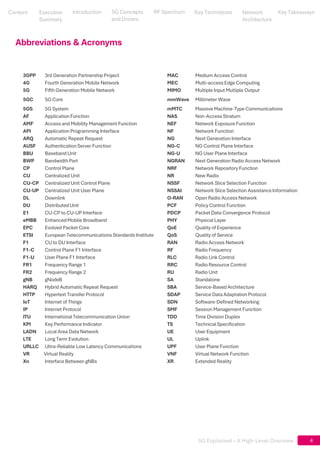
Abbreviations & Acronyms
3GPP 3rd Generation Partnership Project MAC Medium Access Control
4G Fourth Generation Mobile Network MEC Multi-access Edge Computing
5G Fifth Generation Mobile Network MIMO Multiple Input Multiple Output
5GC 5G Core mmWave Millimeter Wave
5GS 5G System mMTC Massive Machine-Type Communications
AF Application Function NAS Non-Access Stratum
AMF Access and Mobility Management Function NEF Network Exposure Function
API Application Programming Interface NF Network Function
ARQ Automatic Repeat Request NG Next Generation Interface
AUSF Authentication Server Function NG-C NG Control Plane Interface
BBU BasebandUnit NG-U NG User Plane Interface
BWP BandwidthPart NGRAN Next Generation Radio Access Network
CP Control Plane NRF Network Repository Function
CU Centralized Unit NR New Radio
CU-CP Centralized Unit Control Plane NSSF Network Slice Selection Function
CU-UP Centralized Unit User Plane NSSAI Network Slice Selection Assistance Information
DL Downlink O-RAN Open Radio Access Network
DU Distributed Unit PCF Policy Control Function
E1 CU-CP to CU-UP Interface PDCP Packet Data Convergence Protocol
eMBB EnhancedMobile Broadband PHY Physical Layer
EPC Evolved Packet Core QoE Quality of Experience
ETSI European Telecommunications Standards Institute QoS Quality of Service
F1 CU to DU Interface RAN Radio Access Network
F1-C Control Plane F1 Interface RF Radio Frequency
F1-U User Plane F1 Interface RLC Radio Link Control
FR1 Frequency Range 1 RRC Radio Resource Control
FR2 Frequency Range 2 RU Radio Unit
gNB gNodeB SA Standalone
HARQ Hybrid Automatic Repeat Request SBA Service-Based Architecture
HTTP Hypertext Transfer Protocol SDAP Service Data Adaptation Protocol
IoT Internet of Things SDN Software-Defined Networking
IP Internet Protocol SMF Session Management Function
ITU International Telecommunication Union TDD Time Division Duplex
KPI Key Performance Indicator TS Technical Specification
LADN Local Area Data Network UE User Equipment
LTE Long Term Evolution UL Uplink
URLLC Ultra-Reliable Low Latency Communications UPF User Plane Function
VR Virtual Reality VNF Virtual Network Function
Xn Interface Between gNBs XR Extended Reality
Content
Content
Executive Summary
Executive
Summary
5G Concepts
and Drivers
5G Concepts
and Drivers
RF Spectrum
RF Spectrum
Key Techniques
Key Techniques
Network Architecture
Network
Architecture
Key Takeaways
Key Takeaways
Introduction
Introduction
5G Explained – A High-Level Overview
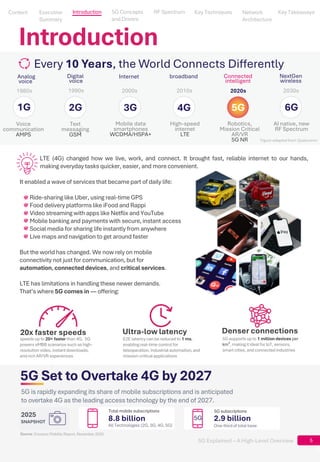
LTE (4G) changed how we live, work, and connect. It brought fast, reliable internet to our hands,
aaaaaa making everyday tasks quicker, easier, and more convenient.
It enabled a wave of services that became part of daily life:
Ride-sharing like Uber, using real-time GPS
Food delivery platforms like iFood and Rappi
Video streaming with apps like Netflix and YouTube
Mobile banking and payments with secure, instant access
Social media for sharing life instantly from anywhere
Live maps and navigation to get around faster
But the world has changed. We now rely on mobile
connectivity not just for communication, but for
automation, connected devices, and critical services.
LTE has limitations in handling these newer demands.
That’s where 5G comes in — offering:
Introduction
Analog
voice
Digital
voice
Internet broadband Connected
intelligent
NextGen
wireless
1980s 1990s 2000s 2010s 2020s 2030s
Voice
communication
AMPS
Text
messaging
GSM
Mobile data
smartphones
WCDMA/HSPA+
High-speed
internet
LTE
Robotics,
Mission Critical
AR/VR
5G NR
AI native, new
RF Spectrum
1G 2G 3G 4G 5G 6G
20x faster speeds Ultra-low latency Denser connections
speeds up to 20× faster than 4G, 5G
powers eMBB scenarios such as high-
resolution video, instantdownloads,
and rich AR/VR experiences
E2E latency can be reduced to 1 ms,
enabling real-time control for
teleoperation, industrialautomation,and
mission-criticalapplications
5G supports up to 1 million devices per
km², making it ideal for IoT, sensors,
smart cities, and connected industries
5G Set to Overtake 4G by 2027
5G is rapidly expanding its share of mobile subscriptions and is anticipated
to overtake 4G as the leading access technology by the end of 2027.
Source: Ericsson Mobility Report, November 2025
2025
SNAPSHOT
Total mobile subscriptions
8.8 billion
5G subscriptions
2.9 billion
One-third of total base
5G
All Technologies (2G, 3G, 4G, 5G)
Every 10 Years, the World Connects Differently
5
Content
Content
Executive
Summary
Executive
Summary
5G Concepts
and Drivers
5G Concepts
and Drivers
RF Spectrum
RF Spectrum
Key Techniques
Key Techniques
Network Architecture
Network
Architecture
Key Takeaways
Key Takeaways
Introduction
Figure adapted from Qualcomm
5
5G Explained – A High-Level Overview 5
5G Explained – A High-Level Overview
5G Concepts & Drivers
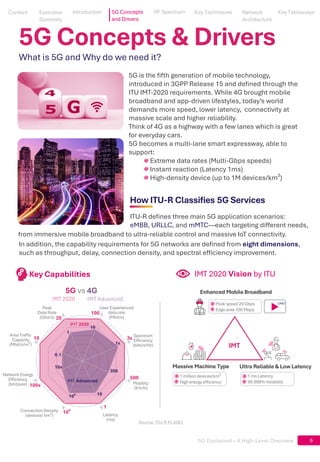
5G is the fifth generation of mobile technology,
introduced in 3GPP Release 15 and defined through the
ITU IMT-2020 requirements. While 4G brought mobile
broadband and app-driven lifestyles, today’s world
demands more speed, lower latency, connectivity at
massive scale and higher reliability.
Think of 4G as a highway with a few lanes which is great
for everyday cars.
5G becomes a multi-lane smart expressway, able to
support:
Extreme data rates (Multi-Gbps speeds)
Instant reaction (Latency 1ms)
High-density device (up to 1M devices/km²)
What is 5G and Why do we need it?
Spectrum
Efficiency
(bits/s/Hz)
Source: ITU-R M.2083
Enhanced Mobile Broadband
Massive Machine Type Ultra Reliable & Low Latency
UHD
000
000
IMT
Peak speed 20 Gbps
Edge area 100 Mbps
1 million devices/km²
High energy efficiency
1 ms Latency
99.999%reliability
IMT 2020 Vision by ITU
Key Capabilities
+
10
1x
350
10
10⁵
10x
0.1
1
10⁶
100x
10
20
100
3x
500
1
IMT 2020
IMT Advanced
User Experienced
data rate
(Mbit/s)
Mobility
(Km/h)
Latency
(ms)
Connection Density
(devices/ km²)
Network Energy
Efficiency
(bit/joule)
Area Traffic
Capacity
(Mbit/s/m²)
Peak
Data Rate
(Gbit/s)
5G vs 4G
In addition, the capability requirements for 5G networks are defined from eight dimensions,
such as throughput, delay, connection density, and spectral efficiency improvement.
ITU-R defines three main 5G application scenarios:
eMBB, URLLC, and mMTC—each targeting different needs,
How ITU-R Classifies 5G Services
from immersive mobile broadband to ultra-reliable control and massive IoT connectivity.
6
Content
Content
Executive
Summary
Executive
Summary
5G Concepts
and Drivers
RF Spectrum
RF Spectrum
Key Techniques
Key Techniques
Network Architecture
Network
Architecture
Key Takeaways
Key Takeaways
Introduction
Introduction
5G Explained – A High-Level Overview
Latency
1 ms
Reliability
99.999%
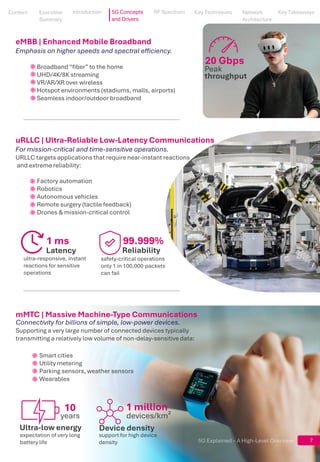
eMBB | Enhanced Mobile Broadband
Emphasis on higher speeds and spectral efficiency.
Broadband “fiber” to the home
UHD/4K/8K streaming
VR/AR/XR over wireless
Hotspot environments (stadiums, malls, airports)
Seamless indoor/outdoor broadband
Smart cities
Utility metering
Parking sensors, weather sensors
Wearables
mMTC | Massive Machine-Type Communications
Connectivity for billions of simple, low-power devices.
Supporting a very large number of connected devices typically
transmitting a relatively low volume of non-delay-sensitive data:
7
uRLLC | Ultra-Reliable Low-Latency Communications
For mission-critical and time-sensitive operations.
URLLC targets applications that require near-instant reactions
and extreme reliability:
Factory automation
Robotics
Autonomous vehicles
Remote surgery (tactile feedback)
Drones & mission-critical control
ultra-responsive, instant
reactions for sensitive
operations
safety-critical operations
only 1 in 100,000 packets
can fail
20 Gbps
Peak
throughput
10
Ultra-low energy
years
1 million
devices/km²
Device density
expectation of very long
battery life
support for high device
density
Content
Content
Executive
Summary
Executive
Summary
5G Concepts
and Drivers
RF Spectrum
RF Spectrum
Key Techniques
Key Techniques
Network Architecture
Network
Architecture
Key Takeaways
Key Takeaways
Introduction
Introduction
5G Explained – A High-Level Overview
The road space for wireless
RF Spectrum
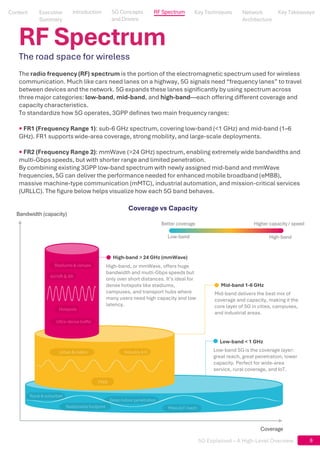
The radio frequency (RF) spectrum is the portion of the electromagnetic spectrum used for wireless
communication. Much like cars need lanes on a highway, 5G signals need “frequency lanes” to travel
between devices and the network. 5G expands these lanes significantly by using spectrum across
three major categories: low-band, mid-band, and high-band—each offering different coverage and
capacity characteristics.
To standardize how 5G operates, 3GPP defines two main frequency ranges:
• FR1 (Frequency Range 1): sub-6 GHz spectrum, covering low-band (<1 GHz) and mid-band (1–6
GHz). FR1 supports wide-area coverage, strong mobility, and large-scale deployments.
• FR2 (Frequency Range 2): mmWave (>24 GHz) spectrum, enabling extremely wide bandwidths and
multi-Gbps speeds, but with shorter range and limited penetration.
By combining existing 3GPP low-band spectrum with newly assigned mid-band and mmWave
frequencies, 5G can deliver the performance needed for enhanced mobile broadband (eMBB),
massive machine-type communication (mMTC), industrial automation, and mission-critical services
(URLLC). The figure below helps visualize how each 5G band behaves.
Bandwidth (capacity)
Coverage
Coverage vs Capacity
High-band > 24 GHz (mmWave)
Mid-band 1-6 GHz
Low-band < 1 GHz
Mid-band delivers the best mix of
coverage and capacity, making it the
core layer of 5G in cities, campuses,
and industrial areas.
Low-band < 1 GHz
Low-band 5G is the coverage layer:
great reach, great penetration, lower
capacity. Perfect for wide-area
service, rural coverage, and IoT.
High-band, or mmWave, offers huge
bandwidth and multi-Gbps speeds but
only over short distances. It’s ideal for
dense hotspots like stadiums,
campuses, and transport hubs where
many users need high capacity and low
latency.
Better coverage Higher capacity / speed
8
Low-band High-band
Nationwidefootprint
Rural & suburban
Deep indoor penetration
Mass IoT reach
Urban & metro Industry4.0
FWA
Stadiums& venues
AV/VR & XR
Hotspots
Ultra-dense traffic
Content
Content
Executive
Summary
Executive
Summary
5G Concepts
and Drivers
5G Concepts
and Drivers
RF Spectrum
Key Techniques
Key Techniques
Network Architecture
Network
Architecture
Key Takeaways
Key Takeaways
Introduction
Introduction
5G Explained – A High-Level Overview
sub-6 GHz
9
5G mmWave
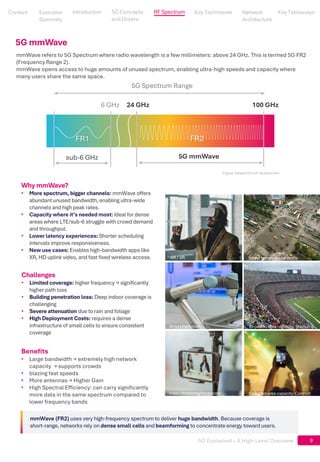
mmWave refers to 5G Spectrum where radio wavelength is a few millimeters: above 24 GHz. This is termed 5G FR2
(Frequency Range 2).
mmWave opens access to huge amounts of unused spectrum, enabling ultra-high speeds and capacity where
many users share the same space.
5G Spectrum Range
6 GHz 24 GHz 100 GHz
5G mmWave
Why mmWave?
• More spectrum, bigger channels: mmWave offers
abundant unused bandwidth, enabling ultra-wide
channels and high peak rates.
• Capacity where it’s needed most: Ideal for dense
areas where LTE/sub-6 struggle with crowd demand
and throughput.
• Lower latency experiences: Shorter scheduling
intervals improve responsiveness.
• New use cases: Enables high-bandwidth apps like
XR, HD uplink video, and fast fixed wireless access.
Challenges
• Limited coverage: higher frequency → significantly
higher path loss
• Building penetration loss: Deep indoor coverage is
challenging
• Severe attenuation due to rain and foliage
• High Deployment Costs: requires a dense
infrastructure of small cells to ensure consistent
coverage
Benefits
• Large bandwidth → extremely high network
capacity → supports crowds
• blazing fast speeds
• More antennas → Higher Gain
• High Spectral Efficiency: can carry significantly
more data in the same spectrum compared to
lower frequency bands
FR2
FR1
Crowded area capacity: Stadiums
Crowded area capacity: Concert
Video streaming/broadcast
SmartFactories
AR / VR Street macro applications
mmWave (FR2) uses very high-frequency spectrum to deliver huge bandwidth. Because coverage is
short-range, networks rely on dense small cells and beamforming to concentrate energy toward users.
Figure adapted from Qualcomm
Content
Content
Executive
Summary
Executive
Summary
5G Concepts
and Drivers
5G Concepts
and Drivers
RF Spectrum
Key Techniques
Key Techniques
Network Architecture
Network
Architecture
Key Takeaways
Key Takeaways
Introduction
Introduction
5G Explained – A High-Level Overview
Beamforming
Increase signal quality by focusing
power.
Massive MIMO
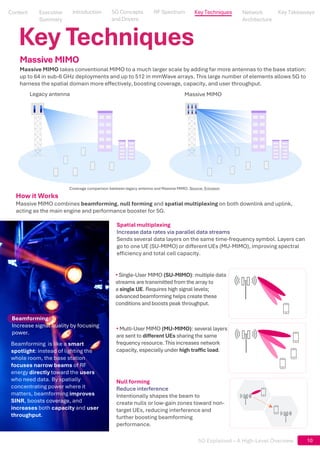
Massive MIMO takes conventional MIMO to a much larger scale by adding far more antennas to the base station:
up to 64 in sub-6 GHz deployments and up to 512 in mmWave arrays. This large number of elements allows 5G to
harness the spatial domain more effectively, boosting coverage, capacity, and user throughput.
Legacy antenna
How it Works
Massive MIMO combines beamforming, null forming and spatial multiplexing on both downlink and uplink,
acting as the main engine and performance booster for 5G.
Coverage comparison between legacy antenna and Massive MIMO. Source: Ericsson
Massive MIMO
smart
spotlight
focuses narrow beams
directly toward users
improves
SINR boosts coverage
increases capacity user
throughput
Spatial multiplexing
Increase data rates via parallel data streams
Sends several data layers on the same time-frequency symbol. Layers can
go to one UE (SU-MIMO) or different UEs (MU-MIMO), improving spectral
efficiency and total cell capacity.
• Single-User MIMO (SU-MIMO): multiple data
streams are transmitted from the array to
a single UE. Requires high signal levels;
advanced beamforming helps create these
conditions and boosts peak throughput.
• Multi-User MIMO (MU-MIMO): several layers
are sent to different UEs sharing the same
frequency resource. This increases network
capacity, especially under high traffic load.
Null forming
Reduce interference
Intentionally shapes the beam to
create nulls or low-gain zones toward non-
target UEs, reducing interference and
further boosting beamforming
performance.
10
Content
Content
Executive
Summary
Executive
Summary
5G Concepts
and Drivers
5G Concepts
and Drivers
RF Spectrum
RF Spectrum Key Techniques
Network Architecture
Network
Architecture
Key Takeaways
Key Takeaways
Introduction
Introduction
Key Techniques
5G Explained – A High-Level Overview
SCS
Frequency
Range
Slot
Duration
Typical Use Cases
15 kHz FR1
Low-band
1 ms Coverage layer, rural,
indoor, IoT, voice
30 kHz FR1
Mid-band
0.5 ms eMBB, urban networks,
enterprise, FWA
60 kHz FR1 /
Lower FR2
0.25 ms Dense urban areas,
capacity hotspots
120 kHz FR2
mmWave
0.125 ms AR/VR, cloud gaming,
industrial automation,
LLC, robotics, mission-
critical services
Flexible Numerology
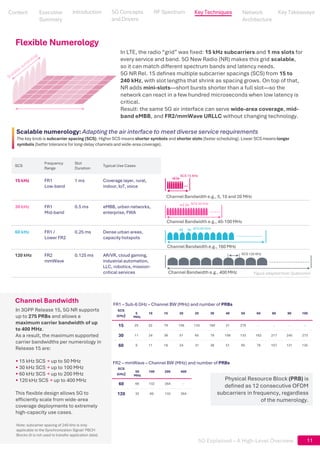
In LTE, the radio “grid” was fixed: 15 kHz subcarriers and 1 ms slots for
every service and band. 5G New Radio (NR) makes this grid scalable,
so it can match different spectrum bands and latency needs.
5G NR Rel. 15 defines multiple subcarrier spacings (SCS) from 15 to
240 kHz, with slot lengths that shrink as spacing grows. On top of that,
NR adds mini-slots—short bursts shorter than a full slot—so the
network can react in a few hundred microseconds when low latency is
critical.
Result: the same 5G air interface can serve wide-area coverage, mid-
band eMBB, and FR2/mmWave URLLC without changing technology.
SCS 15 KHz
Channel Bandwidth e.g., 5, 10 and 20 MHz
SCS 30 KHz
Channel Bandwidth e.g., 40-100 MHz
SCS 60 KHz
Channel Bandwidth e.g., 160 MHz
SCS 120 KHz
Channel Bandwidth e.g., 400 MHz
Scalable numerology: Adapting the air interface to meet diverse service requirements
SCS
(kHz)
5 10 15 20 25 30 40 50 60 80 90 100
15 25 52 79 106 133 160 21 270 - - - -
30 11 24 38 51 65 78 106 133 162 217 245 273
60 0 11 18 24 31 38 51 65 79 107 121 135
FR1 – Sub-6 GHz – Channel BW (MHz) and number of PRBs
MHz
SCS
(kHz)
50 100 200 400
60 66 132 264 -
120 32 66 132 264
MHz
FR2 – mmWave – Channel BW (MHz) and number of PRBs
Channel Bandwidth
In 3GPP Release 15, 5G NR supports
up to 275 PRBs and allows a
maximum carrier bandwidth of up
to 400 MHz.
As a result, the maximum supported
carrier bandwidths per numerology in
Release 15 are:
• 15 kHz SCS → up to 50 MHz
• 30 kHz SCS → up to 100 MHz
• 60 kHz SCS → up to 200 MHz
• 120 kHz SCS → up to 400 MHz
This flexible design allows 5G to
efficiently scale from wide-area
coverage deployments to extremely
high-capacity use cases.
Physical Resource Block (PRB) is
defined as 12 consecutive OFDM
subcarriers in frequency, regardless
of the numerology.
The key knob is subcarrier spacing (SCS). Higher SCS means shorter symbols and shorter slots (faster scheduling). Lower SCS means longer
symbols (better tolerance for long-delay channels and wide-area coverage).
11
Note: subcarrier spacing of 240 kHz is only
applicable to the Synchronization Signal/ PBCH
Blocks (it is not used to transfer application data)
Figure adapted from Qualcomm
Content
Content
Executive
Summary
Executive
Summary
5G Concepts
and Drivers
5G Concepts
and Drivers
RF Spectrum
RF Spectrum Key Techniques
Network Architecture
Network
Architecture
Key Takeaways
Key Takeaways
Introduction
Introduction
5G Explained – A High-Level Overview
Takeaway: 5G NR keeps the familiar 10 ms frame, and 1 ms subframe, but modernizes scheduling: slot timing scales
with numerology, mini-slots reduce latency, and TDD can dynamically shift DL/UL capacity as traffic changes.
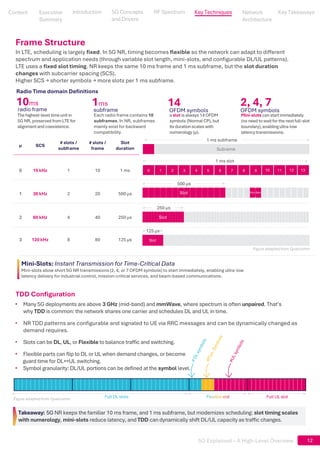
Flexible slot
Frame Structure
In LTE, scheduling is largely fixed. In 5G NR, timing becomes flexible so the network can adapt to different
spectrum and application needs (through variable slot length, mini-slots, and configurable DL/UL patterns).
LTE uses a fixed slot timing. NR keeps the same 10 ms frame and 1 ms subframe, but the slot duration
changes with subcarrier spacing (SCS).
Higher SCS → shorter symbols → more slots per 1 ms subframe.
12
1 ms slot
0 1 2 3 4 5 6 7 8 9
Subrame
1 ms subframe
Slot
500 µs
250 µs
125 µs
Slot
Mini Slot
OFDM
Slot
µ SCS
# slots /
subframe
# slots /
frame
Slot
duration
0 15 kHz 1 10 1 ms
1 30 kHz 2 20 500 µs
2 60 kHz 4 40 250 µs
3 120 kHz 8 80 125 µs
10 11 12 13
• Many 5G deployments are above 3 GHz (mid-band) and mmWave, where spectrum is often unpaired. That’s
why TDD is common: the network shares one carrier and schedules DL and UL in time.
• NR TDD patterns are configurable and signaled to UE via RRC messages and can be dynamically changed as
demand requires.
• Slots can be DL, UL, or Flexible to balance traffic and switching.
• Flexible parts can flip to DL or UL when demand changes, or become
guard time for DL UL switching.
• Symbol granularity: DL/UL portions can be defined at the symbol level.
10ms
radio frame
1ms
subframe
14
OFDM symbols
a slot is always 14 OFDM
symbols (Normal CP), but
its durationscales with
numerology (µ).
Each radio frame contains 10
subframes. In NR, subframes
mainly exist for backward
compatibility.
The highest-level time unit in
5G NR, preserved from LTE for
alignmentand coexistence.
2, 4, 7
OFDM symbols
Mini-slots can start immediately
(no need to wait for the next full-slot
boundary),enabling ultra-low
latency transmissions.
Radio Time domain Definitions
Mini-Slots: Instant Transmission for Time-Critical Data
Mini-slots allow short 5G NR transmissions (2, 4, or 7 OFDM symbols) to start immediately, enabling ultra-low
latency delivery for industrial control, mission-critical services, and beam-based communications.
TDD Configuration
Full DL slots Full UL slot
Figure adapted from Qualcomm
Content
Content
Executive
Summary
Executive
Summary
5G Concepts
and Drivers
5G Concepts
and Drivers
RF Spectrum
RF Spectrum Key Techniques
Network Architecture
Network
Architecture
Key Takeaways
Key Takeaways
Introduction
Introduction
5G Explained – A High-Level Overview
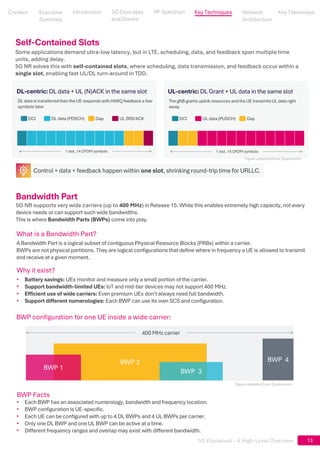
Control + data + feedback happen within one slot, shrinking round-trip time for URLLC.
Self-Contained Slots
Some applications demand ultra-low latency, but in LTE, scheduling, data, and feedback span multiple time
units, adding delay.
5G NR solves this with self-contained slots, where scheduling, data transmission, and feedback occur within a
single slot, enabling fast UL/DL turn-around in TDD.
13
DL-centric: DL data + UL (N)ACK in the same slot
DL data is transferred then the UE responds with HARQ feedback a few
symbols later
DCI DL data (PDSCH) Gap UL SRS/ACK
UL-centric: DL Grant + UL data in the same slot
The gNB grants uplink resources and the UE transmitsUL data right
away.
DCI UL data (PUSCH) Gap
1 slot, 14 OFDM symbols 1 slot, 14 OFDM symbols
5G NR supports very wide carriers (up to 400 MHz) in Release 15. While this enables extremely high capacity, not every
device needs or can support such wide bandwidths.
This is where Bandwidth Parts (BWPs) come into play.
Bandwidth Part
What is a Bandwidth Part?
A Bandwidth Part is a logical subset of contiguous Physical Resource Blocks (PRBs) within a carrier.
BWPs are not physical partitions. They are logical configurations that define where in frequency a UE is allowed to transmit
and receive at a given moment.
Why it exist?
• Battery savings: UEs monitor and measure only a small portion of the carrier.
• Support bandwidth-limited UEs: IoT and mid-tier devices may not support 400 MHz.
• Efficient use of wide carriers: Even premium UEs don’t always need full bandwidth.
• Support different numerologies: Each BWP can use its own SCS and configuration.
BWP configuration for one UE inside a wide carrier:
BWP 2
BWP 1
BWP 3
BWP 4
400 MHz carrier
BWP Facts
• Each BWP has an associated numerology, bandwidth and frequency location.
• BWP configuration is UE-specific.
• Each UE can be configured with up to 4 DL BWPs and 4 UL BWPs per carrier.
• Only one DL BWP and one UL BWP can be active at a time.
• Different frequency ranges and overlap may exist with different bandwidth.
Figure adapted from Qualcomm
Content
Content
Executive
Summary
Executive
Summary
5G Concepts
and Drivers
5G Concepts
and Drivers
RF Spectrum
RF Spectrum Key Techniques
Network Architecture
Network
Architecture
Key Takeaways
Key Takeaways
Introduction
Introduction
5G Explained – A High-Level Overview
Deployment Options
Network Architecture
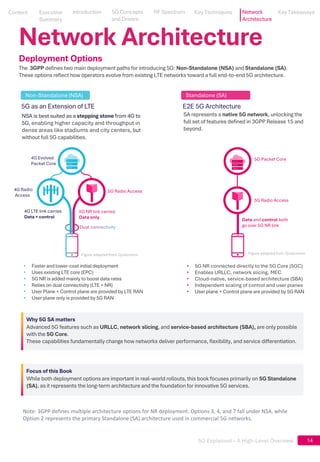
The 3GPP defines two main deployment paths for introducing 5G: Non-Standalone (NSA) and Standalone (SA).
These options reflect how operators evolve from existing LTE networks toward a full end-to-end 5G architecture.
14
Dual connectivity
5G NR link carries
Data only
4G LTE link carries
Data + control
5G Radio Access
4G Radio
Access
4G Evolved
Packet Core
5G Packet Core
5G Radio Access
Data and control both
go over 5G NR link
• Faster and lower-cost initial deployment
• Uses existing LTE core (EPC)
• 5G NR is added mainly to boost data rates
• Relies on dual connectivity (LTE + NR)
• User Plane + Control plane are provided by LTE RAN
• User plane only is provided by 5G RAN
• 5G NR connected directly to the 5G Core (5GC)
• Enables URLLC, network slicing, MEC
• Cloud-native, service-based architecture (SBA)
• Independent scaling of control and user planes
• User plane + Control plane are provided by 5G RAN
Non-Standalone (NSA) Standalone (SA)
5G as an Extension of LTE E2E 5G Architecture
Advanced 5G features such as URLLC, network slicing, and service-based architecture (SBA), are only possible
with the 5G Core.
These capabilities fundamentally change how networks deliver performance, flexibility, and service differentiation.
Why 5G SA matters
NSA is best suited as a stepping stone from 4G to
5G, enabling higher capacity and throughput in
dense areas like stadiums and city centers, but
without full 5G capabilities.
SA represents a native 5G network, unlocking the
full set of features defined in 3GPP Release 15 and
beyond.
While both deployment options are important in real-world rollouts, this book focuses primarily on 5G Standalone
(SA), as it represents the long-term architecture and the foundation for innovative 5G services.
Focus of this Book
Note: 3GPP defines multiple architecture options for NR deployment. Options 3, 4, and 7 fall under NSA, while
Option 2 represents the primary Standalone (SA) architecture used in commercial 5G networks.
Content
Content
Executive
Summary
Executive
Summary
5G Concepts
and Drivers
5G Concepts
and Drivers
RF Spectrum
RF Spectrum
Key Techniques
Key Techniques Network
Architecture
Key Takeaways
Key Takeaways
Introduction
Introduction
Figure adapted from Qualcomm
5G Explained – A High-Level Overview
5G Network Architecture Overview
15
5G Core Network
CP
UP
Data Network
gNB
UE
5G was designed to serve very different traffic types on one network: high-speed broadband (eMBB), massive IoT
(mMTC), and ultra-low latency / high reliability (URLLC). Compared to 4G, the architecture is more cloud-ready,
modular, and scalable.
Control Plane and User Plane Separation (CUPS)
Separates signaling (control) from data forwarding (user traffic),
allowing independent scalability, evolution and flexible
deployments e.g. centralized location or distributed (remote)
location.
Modular Design
Breaks the 5G core into modular network functions, enabling
flexible deployment, faster innovation, and network slicing
tailored to specific service requirements.
Reduced RAN-Core Inter-dependency
Minimizes tight coupling between RAN and Core, enabling
multi-vendor deployments and greater agility by allowing
operators to mix and match solutions from different suppliers.
Decoupling Compute and Storage Resources
Allows compute-intensive and storage-intensive services to be
scaled independently, optimizing resource usage for diverse
applications like real-time processing or data-heavy analytics.
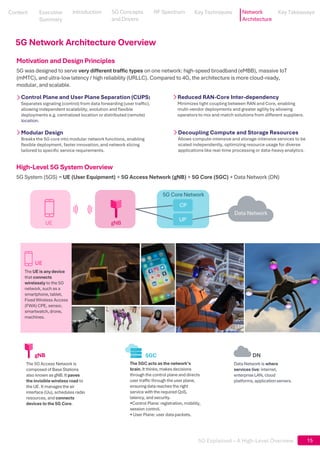
Motivation and Design Principles
High-Level 5G System Overview
5G System (5GS) = UE (User Equipment) + 5G Access Network (gNB) + 5G Core (5GC) + Data Network (DN)
gNB
The 5G Access Network is
composed of Base Stations
also known as gNB. It paves
the invisible wireless road to
the UE. It manages the air
interface (Uu), schedules radio
resources, and connects
devices to the 5G Core.
5GC
The 5GC acts as the network’s
brain. It thinks, makes decisions
through the control plane and directs
user traffic through the user plane,
ensuring data reaches the right
service with the required QoS,
latency, and security.
•Control Plane: registration, mobility,
session control.
• User Plane: user data packets.
DN
Data Network is where
services live: internet,
enterprise LAN, cloud
platforms, applicationservers.
UE
The UE is any device
that connects
wirelessly to the 5G
network, such as a
smartphone,tablet,
Fixed Wireless Access
(FWA) CPE, sensor,
smartwatch,drone,
machines.
Content
Content
Executive
Summary
Executive
Summary
5G Concepts
and Drivers
5G Concepts
and Drivers
RF Spectrum
RF Spectrum
Key Techniques
Key Techniques Network
Architecture
Key Takeaways
Key Takeaways
Introduction
Introduction
5G Explained – A High-Level Overview 16
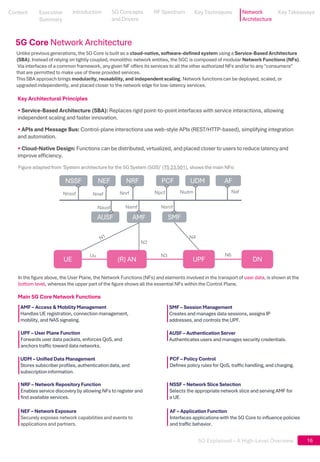
Unlike previous generations, the 5G Core is built as a cloud-native, software-defined system using a Service-Based Architecture
(SBA). Instead of relying on tightly coupled, monolithic network entities, the 5GC is composed of modular Network Functions (NFs).
Via interfaces of a common framework, any given NF offers its services to all the other authorized NFs and/or to any "consumers"
that are permitted to make use of these provided services.
This SBA approach brings modularity, reusability, and independent scaling. Network functions can be deployed, scaled, or
upgraded independently, and placed closer to the network edge for low-latency services.
UE (R) AN UPF DN
AUSF AMF SMF
NSSF NEF NRF PCF UDM AF
Nnssf Nnef Nnrf Npcf Nudm Naf
N2
N3
N4
N6
Figure adapted from ‘System architecture for the 5G System (5GS)’ (TS 23.501), shows the main NFs:
Key Architectural Principles
• Service-Based Architecture (SBA): Replaces rigid point-to-point interfaces with service interactions, allowing
independent scaling and faster innovation.
• APIs and Message Bus: Control-plane interactions use web-style APIs (REST/HTTP-based), simplifying integration
and automation.
• Cloud-Native Design: Functions can be distributed, virtualized, and placed closer to users to reduce latency and
improve efficiency.
Main 5G Core Network Functions
In the figure above, the User Plane, the Network Functions (NFs) and elements involved in the transport of user data, is shown at the
bottom level, whereas the upper part of the figure shows all the essential NFs within the Control Plane.
AMF – Access & Mobility Management
Handles UE registration, connection management,
mobility, and NAS signaling.
UPF – User Plane Function
Forwards user data packets, enforces QoS, and
anchors traffic toward data networks.
SMF – Session Management
Creates and manages data sessions, assigns IP
addresses, and controls the UPF.
AUSF – Authentication Server
Authenticates users and manages security credentials.
UDM – Unified Data Management
Stores subscriber profiles, authenticationdata, and
subscriptioninformation.
PCF – Policy Control
Defines policy rules for QoS, traffic handling, and charging.
NRF – Network Repository Function
Enables service discovery by allowing NFs to register and
find available services.
NSSF – Network Slice Selection
Selects the appropriate network slice and serving AMF for
a UE.
NEF – Network Exposure
Securely exposes network capabilities and events to
applicationsand partners.
AF – Application Function
Interfaces applicationswith the 5G Core to influence policies
and traffic behavior.
Nausf Namf Nsmf
5G Core Network Architecture
Uu
Content
Content
Executive
Summary
Executive
Summary
5G Concepts
and Drivers
5G Concepts
and Drivers
RF Spectrum
RF Spectrum
Key Techniques
Key Techniques Network
Architecture
Key Takeaways
Key Takeaways
Introduction
Introduction
5G Explained – A High-Level Overview
MEC platforms are typically deployed close to base stations. User traffic can be locally broken out at the edge,
often via a nearby UPF, allowing applications to run without traversing the entire core network.
17
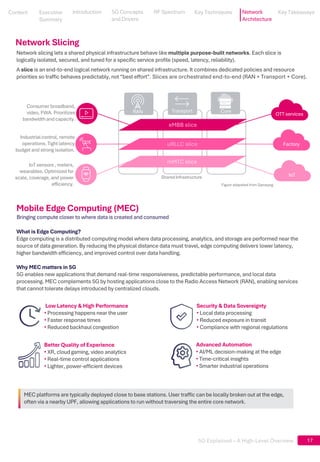
Network slicing lets a shared physical infrastructure behave like multiple purpose-built networks. Each slice is
logically isolated, secured, and tuned for a specific service profile (speed, latency, reliability).
OTT services
Factory
IoT
Shared Infrastructure
Transport
RAN Core
eMBB slice
uRLLC slice
mMTC slice
Consumer broadband,
video, FWA. Prioritizes
bandwidthand capacity.
Industrial control, remote
operations. Tight latency
budget and strong isolation.
IoT sensors , meters,
wearables. Optimized for
scale, coverage, and power
efficiency.
A slice is an end-to-end logical network running on shared infrastructure. It combines dedicated policies and resource
priorities so traffic behaves predictably, not “best effort”. Slices are orchestrated end-to-end (RAN + Transport + Core).
Bringing compute closer to where data is created and consumed
Mobile Edge Computing (MEC)
What is Edge Computing?
Edge computing is a distributed computing model where data processing, analytics, and storage are performed near the
source of data generation. By reducing the physical distance data must travel, edge computing delivers lower latency,
higher bandwidth efficiency, and improved control over data handling.
Why MEC matters in 5G
5G enables new applications that demand real-time responsiveness, predictable performance, and local data
processing. MEC complements 5G by hosting applications close to the Radio Access Network (RAN), enabling services
that cannot tolerate delays introduced by centralized clouds.
Low Latency & High Performance
• Processing happens near the user
• Faster response times
• Reduced backhaul congestion
Security & Data Sovereignty
• Local data processing
• Reduced exposure in transit
• Compliance with regional regulations
Better Quality of Experience
• XR, cloud gaming, video analytics
• Real-time control applications
• Lighter, power-efficient devices
Advanced Automation
• AI/ML decision-making at the edge
• Time-critical insights
• Smarter industrial operations
Network Slicing
Figure adapated from Samsung
Content
Content
Executive
Summary
Executive
Summary
5G Concepts
and Drivers
5G Concepts
and Drivers
RF Spectrum
RF Spectrum
Key Techniques
Key Techniques Network
Architecture
Key Takeaways
Key Takeaways
Introduction
Introduction
5G Explained – A High-Level Overview
DU
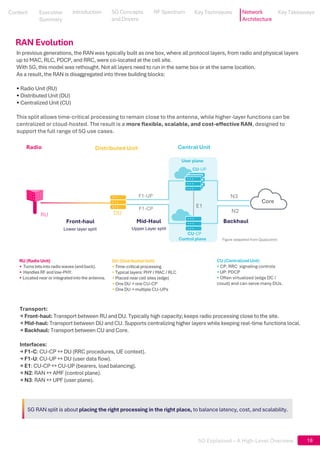
5G RAN split is about placing the right processing in the right place, to balance latency, cost, and scalability.
18
In previous generations, the RAN was typically built as one box, where all protocol layers, from radio and physical layers
up to MAC, RLC, PDCP, and RRC, were co-located at the cell site.
With 5G, this model was rethought. Not all layers need to run in the same box or at the same location.
As a result, the RAN is disaggregated into three building blocks:
• Radio Unit (RU)
• Distributed Unit (DU)
• Centralized Unit (CU)
This split allows time-critical processing to remain close to the antenna, while higher-layer functions can be
centralized or cloud-hosted. The result is a more flexible, scalable, and cost-effective RAN, designed to
support the full range of 5G use cases.
RU (Radio Unit)
• Turns bits into radio waves (and back).
• Handles RF and low-PHY.
• Located near or integrated into the antenna.
CU-UP
CU-CP
E1
F1-UP
F1-CP
Upper Layer split
Mid-Haul
Lower layer split
Front-haul Backhaul
RU
DU (Distributed Unit)
• Time-critical processing
• Typical layers: PHY / MAC / RLC
• Placed near cell sites (edge)
• One DU → one CU-CP
• One DU → multiple CU-UPs
CU (Centralized Unit)
• CP: RRC signaling controls
• UP: PDCP
• Often virtualized (edge DC /
cloud) and can serve many DUs.
User plane
Control plane
Radio Distributed Unit Central Unit
Core
Transport:
→ Front-haul: Transport between RU and DU. Typically high capacity; keeps radio processing close to the site.
→ Mid-haul: Transport between DU and CU. Supports centralizing higher layers while keeping real-time functions local.
→ Backhaul: Transport between CU and Core.
Interfaces:
→ F1-C: CU-CP DU (RRC procedures, UE context).
→ F1-U: CU-UP DU (user data flow).
→ E1: CU-CP CU-UP (bearers, load balancing).
→ N2: RAN AMF (control plane).
→ N3: RAN UPF (user plane).
N3
N2
RAN Evolution
Figure adapated from Qualcomm
Content
Content
Executive
Summary
Executive
Summary
5G Concepts
and Drivers
5G Concepts
and Drivers
RF Spectrum
RF Spectrum
Key Techniques
Key Techniques Network
Architecture
Key Takeaways
Key Takeaways
Introduction
Introduction
5G Explained – A High-Level Overview 19
Content
Content
Executive
Summary
Executive
Summary
5G Concepts
and Drivers
5G Concepts
and Drivers
RF Spectrum
RF Spectrum
Key Techniques
Key Techniques
Network Architecture
Network
Architecture
Key Takeaways
Introduction
Introduction
Key Takeaways
5G is not just faster connectivity. It is a flexible, service-driven platform
designed to adapt to very different applications and industries.
• 5G is about adaptability, not just speed.
It is designed to support everything from high-capacity consumer data to ultra-reliable, low-latency, mission-
critical services. All on the same network. Whether it’s streaming video, controlling machines, or connecting
thousands of devices, the radio and core adapts to deliver the right performance.
• Flexibility is built into the 5G air interface.
5G New Radio (NR) dynamically adapts how it transmits data using scalable numerology, flexible slot
structures, mini-slots, and self-contained slots, matching latency, reliability, and throughput to each
application.
• Capacity comes from smarter use of spectrum.
Technologies like Massive MIMO and beamforming focus radio energy toward users, improving coverage and
spectral efficiency, especially in mid-band and mmWave deployments.
• mmWave delivers extreme capacity where needed.
While coverage is limited, mmWave enables ultra-high throughput and massive user density in hotspots such
as stadiums, transport hubs, and dense urban areas.
• The 5G Core is cloud-native and service-based.
Control and user planes are separated, network functions are modular, and services communicate through
APIs — enabling scalability, agility, and new business models.
• Network slicing enables differentiated connectivity.
A single physical network can behave like many purpose-built networks — each slice optimized for
performance, latency, reliability, and security, based on service needs.
• Edge Computing brings intelligence closer to users.
By processing data near the RAN, 5G reduces latency, improves user experience, lowers backhaul load, and
enables real-time applications like automation, XR, and remote control.
• The RAN is no longer a single “box.”
The split into Radio Unit (RU), Distributed Unit
(DU), and Central Unit (CU) allows flexible
placement, independent scaling, and cloud-based
deployments, unlike legacy LTE architectures.
• 5G Standalone unlocks the full vision.
Advanced features like slicing, MEC, URLLC, and
service-based architecture depend on a full 5G
Core and cannot be fully realized in NSA
deployments.
• 5G is an evolution of architecture, not just radio
technology
Its true value comes from how radio, core, edge,
and cloud work together to create adaptable,
programmable, and future-proof networks.
5G Explained – A High-Level Overview 20
3GPP References
• 3GPP, 5G System Overview
• 3GPP TS 23.501 – System architecturefor the 5G System (5GS)
• 3GPP TS 23.502 – Procedures for the 5G System
• 3GPP TS 23.503 – Policy and charging control framework
• 3GPP TS 28.530 – Management and orchestrationof network slicing
• 3GPP TS 38.101 – NR; User Equipment radio transmission and reception
• 3GPP TS 38.104 – NR; Base Station (BS) radio transmission and reception
• 3GPP TS 38.201 – NR; Physical layer; General description
• 3GPP TS 38.211 – NR; Physical channels and modulation
• 3GPP TS 38.213 – NR; Physical layer procedures for control
• 3GPP TS 38.214 – NR; Physical layer procedures for data
• 3GPP TS 38.300 – NR; Overall description
• 3GPP TS 38.401 – NG-RAN architecture description
• 3GPP TS 38.410 – NG-RAN; General aspects and principles
Other References
• 5G New Radio in Bullets
• 5G Technology: 3GPP New Radio (Wiley)
• Cisco, 5G Radio Access Network (RAN)
• Ericsson, Leveraging the Potential of 5G Millimeter Wave
• Ericsson, Massive MIMO
• Ericsson, Ericsson Mobility Report, November 2025
• ETSI, MEC: A key technology towards 5G
• ITU-R Recommendation M.2083-0 – IMT Vision – Framework and objectives of the future development of IMT
• Keysight, 5G Flexible Numerology
• Qualcomm / GSMA, 5G mmWave: A resource for operators
• Qualcomm, Designing 5G NR
• MohamedElAdawi, High-level Overview of NR Release 15
• MohamedElAdawi, 5G NR Slot Format Deep Dive
• Moniem-tech-importance-of-massive-mimo-in-5g-nr
• Moniem-Tech, 5G 3GPP NR Frame Structure
• Moniem-Tech, 5G Network Architecture
• Moniem-Tech, What is Distributed Unit (DU) in Open RAN?
• Nokia, What is 5G core?
• Mpirical, What is 5G Core Network Architecture?
• Red Hat, 5G Core and RAN Overview
• Samsung, 5G Standalone Architecture
• Samsung, Network Slicing White Paper
• Samsung, Private Network Vol.2
• Sergio Rivera Cuevas, 5G Architecture: Standalone (SA)
• TelecomHall
References
About the Author
A pink square with white letters
AI-generated content may be
incorrect.
Luciano Motta is a telecommunications engineer with solid experience in public mobile networks
and enterprise wireless solutions.
He has worked on network performance and optimization projects for Tier-1 mobile operators,
both as an employee and as an RF consultant, supporting large-scale deployments and
improvements across nationwide networks.
His experience also includes mission-critical wireless communications in industrial and mining
environments, supporting applications where reliability, latency, and availability are essential.
Since 2023, Luciano has been working at Speedcast as a Wireless Solutions Engineer, supporting
enterprise 4G and 5G deployments globally.
Content
Content
Executive
Summary
Executive
Summary
5G Concepts
and Drivers
5G Concepts
and Drivers
RF Spectrum
RF Spectrum
Key Techniques
Key Techniques
Network Architecture
Network
Architecture
Key Takeaways
Key Takeaways
Introduction
Introduction

5G Explained! A High Level Overview [Introduction]

  • 1.
    A pink squarewith white letters AI-generated content may be incorrect. 5G Explained A High-Level Overview A clear, concise introduction to 5G from core concepts and architecture to spectrum and key techniques. January 2026
  • 2.
    5G Explained –A High-Level Overview Contents 2 03 Executive Summary 05 Introduction 06 5G Concepts and Drivers 08 RF Spectrum mmWave 10 Key Techniques Massive MIMO, Beamforming Flexible Numerology, Frame Structure TDD Configuration, Self-contained Slot, Bandwidth Part 14 Network Architecture Overview Deployment Options 5G Core Network Overview Network Slicing, Mobile Edge Computing RAN Evolution 19 Key Takeaways Content Executive Summary Executive Summary 5G Concepts And Drivers 5G Concepts And Drivers RF Spectrum RF Spectrum Key Techniques Key Techniques Network Architecture Network Architecture Key Takeaways Key Takeaways Introduction Introduction 20 References
  • 3.
    5G Explained –A High-Level Overview 3 Executive Summary 5G Explained – A High-Level Overview 3 5G Explained – A High-Level Overview provides a clear and structured introduction to 5G, covering its core concepts, system architecture, spectrum usage, and key enabling techniques. The document focuses on 5G Standalone (SA) and the architectural foundations that distinguish 5G from previous generations. This overview highlights the fundamental elements introduced in 3GPP Release 15, which define the first phase of the 5G New Radio (NR) specifications and laid the groundwork for commercial 5G deployments. The content is aligned with 3GPP principles and explains how radio, core, and cloud-native concepts come together to form the 5G system. The objective of this document is to serve as a foundational entry point to 5G, helping readers understand what 5G is built on, how the key building blocks fit together, and why the architecture represents a significant evolution. It is intended as a starting reference, enabling readers to confidently explore deeper technical material through the cited specifications, standards, and industry resources. Content Content Executive Summary 5G Concepts And Drivers 5G Concepts And Drivers RF Spectrum RF Spectrum Key Techniques Key Techniques Network Architecture Network Architecture Key Takeaways Key Takeaways Introduction Introduction
  • 4.
    5G Explained –A High-Level Overview 4 4 Abbreviations & Acronyms 3GPP 3rd Generation Partnership Project MAC Medium Access Control 4G Fourth Generation Mobile Network MEC Multi-access Edge Computing 5G Fifth Generation Mobile Network MIMO Multiple Input Multiple Output 5GC 5G Core mmWave Millimeter Wave 5GS 5G System mMTC Massive Machine-Type Communications AF Application Function NAS Non-Access Stratum AMF Access and Mobility Management Function NEF Network Exposure Function API Application Programming Interface NF Network Function ARQ Automatic Repeat Request NG Next Generation Interface AUSF Authentication Server Function NG-C NG Control Plane Interface BBU BasebandUnit NG-U NG User Plane Interface BWP BandwidthPart NGRAN Next Generation Radio Access Network CP Control Plane NRF Network Repository Function CU Centralized Unit NR New Radio CU-CP Centralized Unit Control Plane NSSF Network Slice Selection Function CU-UP Centralized Unit User Plane NSSAI Network Slice Selection Assistance Information DL Downlink O-RAN Open Radio Access Network DU Distributed Unit PCF Policy Control Function E1 CU-CP to CU-UP Interface PDCP Packet Data Convergence Protocol eMBB EnhancedMobile Broadband PHY Physical Layer EPC Evolved Packet Core QoE Quality of Experience ETSI European Telecommunications Standards Institute QoS Quality of Service F1 CU to DU Interface RAN Radio Access Network F1-C Control Plane F1 Interface RF Radio Frequency F1-U User Plane F1 Interface RLC Radio Link Control FR1 Frequency Range 1 RRC Radio Resource Control FR2 Frequency Range 2 RU Radio Unit gNB gNodeB SA Standalone HARQ Hybrid Automatic Repeat Request SBA Service-Based Architecture HTTP Hypertext Transfer Protocol SDAP Service Data Adaptation Protocol IoT Internet of Things SDN Software-Defined Networking IP Internet Protocol SMF Session Management Function ITU International Telecommunication Union TDD Time Division Duplex KPI Key Performance Indicator TS Technical Specification LADN Local Area Data Network UE User Equipment LTE Long Term Evolution UL Uplink URLLC Ultra-Reliable Low Latency Communications UPF User Plane Function VR Virtual Reality VNF Virtual Network Function Xn Interface Between gNBs XR Extended Reality Content Content Executive Summary Executive Summary 5G Concepts and Drivers 5G Concepts and Drivers RF Spectrum RF Spectrum Key Techniques Key Techniques Network Architecture Network Architecture Key Takeaways Key Takeaways Introduction Introduction
  • 5.
    5G Explained –A High-Level Overview LTE (4G) changed how we live, work, and connect. It brought fast, reliable internet to our hands, aaaaaa making everyday tasks quicker, easier, and more convenient. It enabled a wave of services that became part of daily life: Ride-sharing like Uber, using real-time GPS Food delivery platforms like iFood and Rappi Video streaming with apps like Netflix and YouTube Mobile banking and payments with secure, instant access Social media for sharing life instantly from anywhere Live maps and navigation to get around faster But the world has changed. We now rely on mobile connectivity not just for communication, but for automation, connected devices, and critical services. LTE has limitations in handling these newer demands. That’s where 5G comes in — offering: Introduction Analog voice Digital voice Internet broadband Connected intelligent NextGen wireless 1980s 1990s 2000s 2010s 2020s 2030s Voice communication AMPS Text messaging GSM Mobile data smartphones WCDMA/HSPA+ High-speed internet LTE Robotics, Mission Critical AR/VR 5G NR AI native, new RF Spectrum 1G 2G 3G 4G 5G 6G 20x faster speeds Ultra-low latency Denser connections speeds up to 20× faster than 4G, 5G powers eMBB scenarios such as high- resolution video, instantdownloads, and rich AR/VR experiences E2E latency can be reduced to 1 ms, enabling real-time control for teleoperation, industrialautomation,and mission-criticalapplications 5G supports up to 1 million devices per km², making it ideal for IoT, sensors, smart cities, and connected industries 5G Set to Overtake 4G by 2027 5G is rapidly expanding its share of mobile subscriptions and is anticipated to overtake 4G as the leading access technology by the end of 2027. Source: Ericsson Mobility Report, November 2025 2025 SNAPSHOT Total mobile subscriptions 8.8 billion 5G subscriptions 2.9 billion One-third of total base 5G All Technologies (2G, 3G, 4G, 5G) Every 10 Years, the World Connects Differently 5 Content Content Executive Summary Executive Summary 5G Concepts and Drivers 5G Concepts and Drivers RF Spectrum RF Spectrum Key Techniques Key Techniques Network Architecture Network Architecture Key Takeaways Key Takeaways Introduction Figure adapted from Qualcomm 5 5G Explained – A High-Level Overview 5
  • 6.
    5G Explained –A High-Level Overview 5G Concepts & Drivers 5G is the fifth generation of mobile technology, introduced in 3GPP Release 15 and defined through the ITU IMT-2020 requirements. While 4G brought mobile broadband and app-driven lifestyles, today’s world demands more speed, lower latency, connectivity at massive scale and higher reliability. Think of 4G as a highway with a few lanes which is great for everyday cars. 5G becomes a multi-lane smart expressway, able to support: Extreme data rates (Multi-Gbps speeds) Instant reaction (Latency 1ms) High-density device (up to 1M devices/km²) What is 5G and Why do we need it? Spectrum Efficiency (bits/s/Hz) Source: ITU-R M.2083 Enhanced Mobile Broadband Massive Machine Type Ultra Reliable & Low Latency UHD 000 000 IMT Peak speed 20 Gbps Edge area 100 Mbps 1 million devices/km² High energy efficiency 1 ms Latency 99.999%reliability IMT 2020 Vision by ITU Key Capabilities + 10 1x 350 10 10⁵ 10x 0.1 1 10⁶ 100x 10 20 100 3x 500 1 IMT 2020 IMT Advanced User Experienced data rate (Mbit/s) Mobility (Km/h) Latency (ms) Connection Density (devices/ km²) Network Energy Efficiency (bit/joule) Area Traffic Capacity (Mbit/s/m²) Peak Data Rate (Gbit/s) 5G vs 4G In addition, the capability requirements for 5G networks are defined from eight dimensions, such as throughput, delay, connection density, and spectral efficiency improvement. ITU-R defines three main 5G application scenarios: eMBB, URLLC, and mMTC—each targeting different needs, How ITU-R Classifies 5G Services from immersive mobile broadband to ultra-reliable control and massive IoT connectivity. 6 Content Content Executive Summary Executive Summary 5G Concepts and Drivers RF Spectrum RF Spectrum Key Techniques Key Techniques Network Architecture Network Architecture Key Takeaways Key Takeaways Introduction Introduction
  • 7.
    5G Explained –A High-Level Overview Latency 1 ms Reliability 99.999% eMBB | Enhanced Mobile Broadband Emphasis on higher speeds and spectral efficiency. Broadband “fiber” to the home UHD/4K/8K streaming VR/AR/XR over wireless Hotspot environments (stadiums, malls, airports) Seamless indoor/outdoor broadband Smart cities Utility metering Parking sensors, weather sensors Wearables mMTC | Massive Machine-Type Communications Connectivity for billions of simple, low-power devices. Supporting a very large number of connected devices typically transmitting a relatively low volume of non-delay-sensitive data: 7 uRLLC | Ultra-Reliable Low-Latency Communications For mission-critical and time-sensitive operations. URLLC targets applications that require near-instant reactions and extreme reliability: Factory automation Robotics Autonomous vehicles Remote surgery (tactile feedback) Drones & mission-critical control ultra-responsive, instant reactions for sensitive operations safety-critical operations only 1 in 100,000 packets can fail 20 Gbps Peak throughput 10 Ultra-low energy years 1 million devices/km² Device density expectation of very long battery life support for high device density Content Content Executive Summary Executive Summary 5G Concepts and Drivers RF Spectrum RF Spectrum Key Techniques Key Techniques Network Architecture Network Architecture Key Takeaways Key Takeaways Introduction Introduction
  • 8.
    5G Explained –A High-Level Overview The road space for wireless RF Spectrum The radio frequency (RF) spectrum is the portion of the electromagnetic spectrum used for wireless communication. Much like cars need lanes on a highway, 5G signals need “frequency lanes” to travel between devices and the network. 5G expands these lanes significantly by using spectrum across three major categories: low-band, mid-band, and high-band—each offering different coverage and capacity characteristics. To standardize how 5G operates, 3GPP defines two main frequency ranges: • FR1 (Frequency Range 1): sub-6 GHz spectrum, covering low-band (<1 GHz) and mid-band (1–6 GHz). FR1 supports wide-area coverage, strong mobility, and large-scale deployments. • FR2 (Frequency Range 2): mmWave (>24 GHz) spectrum, enabling extremely wide bandwidths and multi-Gbps speeds, but with shorter range and limited penetration. By combining existing 3GPP low-band spectrum with newly assigned mid-band and mmWave frequencies, 5G can deliver the performance needed for enhanced mobile broadband (eMBB), massive machine-type communication (mMTC), industrial automation, and mission-critical services (URLLC). The figure below helps visualize how each 5G band behaves. Bandwidth (capacity) Coverage Coverage vs Capacity High-band > 24 GHz (mmWave) Mid-band 1-6 GHz Low-band < 1 GHz Mid-band delivers the best mix of coverage and capacity, making it the core layer of 5G in cities, campuses, and industrial areas. Low-band < 1 GHz Low-band 5G is the coverage layer: great reach, great penetration, lower capacity. Perfect for wide-area service, rural coverage, and IoT. High-band, or mmWave, offers huge bandwidth and multi-Gbps speeds but only over short distances. It’s ideal for dense hotspots like stadiums, campuses, and transport hubs where many users need high capacity and low latency. Better coverage Higher capacity / speed 8 Low-band High-band Nationwidefootprint Rural & suburban Deep indoor penetration Mass IoT reach Urban & metro Industry4.0 FWA Stadiums& venues AV/VR & XR Hotspots Ultra-dense traffic Content Content Executive Summary Executive Summary 5G Concepts and Drivers 5G Concepts and Drivers RF Spectrum Key Techniques Key Techniques Network Architecture Network Architecture Key Takeaways Key Takeaways Introduction Introduction
  • 9.
    5G Explained –A High-Level Overview sub-6 GHz 9 5G mmWave mmWave refers to 5G Spectrum where radio wavelength is a few millimeters: above 24 GHz. This is termed 5G FR2 (Frequency Range 2). mmWave opens access to huge amounts of unused spectrum, enabling ultra-high speeds and capacity where many users share the same space. 5G Spectrum Range 6 GHz 24 GHz 100 GHz 5G mmWave Why mmWave? • More spectrum, bigger channels: mmWave offers abundant unused bandwidth, enabling ultra-wide channels and high peak rates. • Capacity where it’s needed most: Ideal for dense areas where LTE/sub-6 struggle with crowd demand and throughput. • Lower latency experiences: Shorter scheduling intervals improve responsiveness. • New use cases: Enables high-bandwidth apps like XR, HD uplink video, and fast fixed wireless access. Challenges • Limited coverage: higher frequency → significantly higher path loss • Building penetration loss: Deep indoor coverage is challenging • Severe attenuation due to rain and foliage • High Deployment Costs: requires a dense infrastructure of small cells to ensure consistent coverage Benefits • Large bandwidth → extremely high network capacity → supports crowds • blazing fast speeds • More antennas → Higher Gain • High Spectral Efficiency: can carry significantly more data in the same spectrum compared to lower frequency bands FR2 FR1 Crowded area capacity: Stadiums Crowded area capacity: Concert Video streaming/broadcast SmartFactories AR / VR Street macro applications mmWave (FR2) uses very high-frequency spectrum to deliver huge bandwidth. Because coverage is short-range, networks rely on dense small cells and beamforming to concentrate energy toward users. Figure adapted from Qualcomm Content Content Executive Summary Executive Summary 5G Concepts and Drivers 5G Concepts and Drivers RF Spectrum Key Techniques Key Techniques Network Architecture Network Architecture Key Takeaways Key Takeaways Introduction Introduction
  • 10.
    5G Explained –A High-Level Overview Beamforming Increase signal quality by focusing power. Massive MIMO Massive MIMO takes conventional MIMO to a much larger scale by adding far more antennas to the base station: up to 64 in sub-6 GHz deployments and up to 512 in mmWave arrays. This large number of elements allows 5G to harness the spatial domain more effectively, boosting coverage, capacity, and user throughput. Legacy antenna How it Works Massive MIMO combines beamforming, null forming and spatial multiplexing on both downlink and uplink, acting as the main engine and performance booster for 5G. Coverage comparison between legacy antenna and Massive MIMO. Source: Ericsson Massive MIMO smart spotlight focuses narrow beams directly toward users improves SINR boosts coverage increases capacity user throughput Spatial multiplexing Increase data rates via parallel data streams Sends several data layers on the same time-frequency symbol. Layers can go to one UE (SU-MIMO) or different UEs (MU-MIMO), improving spectral efficiency and total cell capacity. • Single-User MIMO (SU-MIMO): multiple data streams are transmitted from the array to a single UE. Requires high signal levels; advanced beamforming helps create these conditions and boosts peak throughput. • Multi-User MIMO (MU-MIMO): several layers are sent to different UEs sharing the same frequency resource. This increases network capacity, especially under high traffic load. Null forming Reduce interference Intentionally shapes the beam to create nulls or low-gain zones toward non- target UEs, reducing interference and further boosting beamforming performance. 10 Content Content Executive Summary Executive Summary 5G Concepts and Drivers 5G Concepts and Drivers RF Spectrum RF Spectrum Key Techniques Network Architecture Network Architecture Key Takeaways Key Takeaways Introduction Introduction Key Techniques
  • 11.
    5G Explained –A High-Level Overview SCS Frequency Range Slot Duration Typical Use Cases 15 kHz FR1 Low-band 1 ms Coverage layer, rural, indoor, IoT, voice 30 kHz FR1 Mid-band 0.5 ms eMBB, urban networks, enterprise, FWA 60 kHz FR1 / Lower FR2 0.25 ms Dense urban areas, capacity hotspots 120 kHz FR2 mmWave 0.125 ms AR/VR, cloud gaming, industrial automation, LLC, robotics, mission- critical services Flexible Numerology In LTE, the radio “grid” was fixed: 15 kHz subcarriers and 1 ms slots for every service and band. 5G New Radio (NR) makes this grid scalable, so it can match different spectrum bands and latency needs. 5G NR Rel. 15 defines multiple subcarrier spacings (SCS) from 15 to 240 kHz, with slot lengths that shrink as spacing grows. On top of that, NR adds mini-slots—short bursts shorter than a full slot—so the network can react in a few hundred microseconds when low latency is critical. Result: the same 5G air interface can serve wide-area coverage, mid- band eMBB, and FR2/mmWave URLLC without changing technology. SCS 15 KHz Channel Bandwidth e.g., 5, 10 and 20 MHz SCS 30 KHz Channel Bandwidth e.g., 40-100 MHz SCS 60 KHz Channel Bandwidth e.g., 160 MHz SCS 120 KHz Channel Bandwidth e.g., 400 MHz Scalable numerology: Adapting the air interface to meet diverse service requirements SCS (kHz) 5 10 15 20 25 30 40 50 60 80 90 100 15 25 52 79 106 133 160 21 270 - - - - 30 11 24 38 51 65 78 106 133 162 217 245 273 60 0 11 18 24 31 38 51 65 79 107 121 135 FR1 – Sub-6 GHz – Channel BW (MHz) and number of PRBs MHz SCS (kHz) 50 100 200 400 60 66 132 264 - 120 32 66 132 264 MHz FR2 – mmWave – Channel BW (MHz) and number of PRBs Channel Bandwidth In 3GPP Release 15, 5G NR supports up to 275 PRBs and allows a maximum carrier bandwidth of up to 400 MHz. As a result, the maximum supported carrier bandwidths per numerology in Release 15 are: • 15 kHz SCS → up to 50 MHz • 30 kHz SCS → up to 100 MHz • 60 kHz SCS → up to 200 MHz • 120 kHz SCS → up to 400 MHz This flexible design allows 5G to efficiently scale from wide-area coverage deployments to extremely high-capacity use cases. Physical Resource Block (PRB) is defined as 12 consecutive OFDM subcarriers in frequency, regardless of the numerology. The key knob is subcarrier spacing (SCS). Higher SCS means shorter symbols and shorter slots (faster scheduling). Lower SCS means longer symbols (better tolerance for long-delay channels and wide-area coverage). 11 Note: subcarrier spacing of 240 kHz is only applicable to the Synchronization Signal/ PBCH Blocks (it is not used to transfer application data) Figure adapted from Qualcomm Content Content Executive Summary Executive Summary 5G Concepts and Drivers 5G Concepts and Drivers RF Spectrum RF Spectrum Key Techniques Network Architecture Network Architecture Key Takeaways Key Takeaways Introduction Introduction
  • 12.
    5G Explained –A High-Level Overview Takeaway: 5G NR keeps the familiar 10 ms frame, and 1 ms subframe, but modernizes scheduling: slot timing scales with numerology, mini-slots reduce latency, and TDD can dynamically shift DL/UL capacity as traffic changes. Flexible slot Frame Structure In LTE, scheduling is largely fixed. In 5G NR, timing becomes flexible so the network can adapt to different spectrum and application needs (through variable slot length, mini-slots, and configurable DL/UL patterns). LTE uses a fixed slot timing. NR keeps the same 10 ms frame and 1 ms subframe, but the slot duration changes with subcarrier spacing (SCS). Higher SCS → shorter symbols → more slots per 1 ms subframe. 12 1 ms slot 0 1 2 3 4 5 6 7 8 9 Subrame 1 ms subframe Slot 500 µs 250 µs 125 µs Slot Mini Slot OFDM Slot µ SCS # slots / subframe # slots / frame Slot duration 0 15 kHz 1 10 1 ms 1 30 kHz 2 20 500 µs 2 60 kHz 4 40 250 µs 3 120 kHz 8 80 125 µs 10 11 12 13 • Many 5G deployments are above 3 GHz (mid-band) and mmWave, where spectrum is often unpaired. That’s why TDD is common: the network shares one carrier and schedules DL and UL in time. • NR TDD patterns are configurable and signaled to UE via RRC messages and can be dynamically changed as demand requires. • Slots can be DL, UL, or Flexible to balance traffic and switching. • Flexible parts can flip to DL or UL when demand changes, or become guard time for DL UL switching. • Symbol granularity: DL/UL portions can be defined at the symbol level. 10ms radio frame 1ms subframe 14 OFDM symbols a slot is always 14 OFDM symbols (Normal CP), but its durationscales with numerology (µ). Each radio frame contains 10 subframes. In NR, subframes mainly exist for backward compatibility. The highest-level time unit in 5G NR, preserved from LTE for alignmentand coexistence. 2, 4, 7 OFDM symbols Mini-slots can start immediately (no need to wait for the next full-slot boundary),enabling ultra-low latency transmissions. Radio Time domain Definitions Mini-Slots: Instant Transmission for Time-Critical Data Mini-slots allow short 5G NR transmissions (2, 4, or 7 OFDM symbols) to start immediately, enabling ultra-low latency delivery for industrial control, mission-critical services, and beam-based communications. TDD Configuration Full DL slots Full UL slot Figure adapted from Qualcomm Figure adapted from Qualcomm Content Content Executive Summary Executive Summary 5G Concepts and Drivers 5G Concepts and Drivers RF Spectrum RF Spectrum Key Techniques Network Architecture Network Architecture Key Takeaways Key Takeaways Introduction Introduction
  • 13.
    5G Explained –A High-Level Overview Control + data + feedback happen within one slot, shrinking round-trip time for URLLC. Self-Contained Slots Some applications demand ultra-low latency, but in LTE, scheduling, data, and feedback span multiple time units, adding delay. 5G NR solves this with self-contained slots, where scheduling, data transmission, and feedback occur within a single slot, enabling fast UL/DL turn-around in TDD. 13 DL-centric: DL data + UL (N)ACK in the same slot DL data is transferred then the UE responds with HARQ feedback a few symbols later DCI DL data (PDSCH) Gap UL SRS/ACK UL-centric: DL Grant + UL data in the same slot The gNB grants uplink resources and the UE transmitsUL data right away. DCI UL data (PUSCH) Gap 1 slot, 14 OFDM symbols 1 slot, 14 OFDM symbols 5G NR supports very wide carriers (up to 400 MHz) in Release 15. While this enables extremely high capacity, not every device needs or can support such wide bandwidths. This is where Bandwidth Parts (BWPs) come into play. Bandwidth Part What is a Bandwidth Part? A Bandwidth Part is a logical subset of contiguous Physical Resource Blocks (PRBs) within a carrier. BWPs are not physical partitions. They are logical configurations that define where in frequency a UE is allowed to transmit and receive at a given moment. Why it exist? • Battery savings: UEs monitor and measure only a small portion of the carrier. • Support bandwidth-limited UEs: IoT and mid-tier devices may not support 400 MHz. • Efficient use of wide carriers: Even premium UEs don’t always need full bandwidth. • Support different numerologies: Each BWP can use its own SCS and configuration. BWP configuration for one UE inside a wide carrier: BWP 2 BWP 1 BWP 3 BWP 4 400 MHz carrier BWP Facts • Each BWP has an associated numerology, bandwidth and frequency location. • BWP configuration is UE-specific. • Each UE can be configured with up to 4 DL BWPs and 4 UL BWPs per carrier. • Only one DL BWP and one UL BWP can be active at a time. • Different frequency ranges and overlap may exist with different bandwidth. Figure adapted from Qualcomm Figure adapted from Qualcomm Content Content Executive Summary Executive Summary 5G Concepts and Drivers 5G Concepts and Drivers RF Spectrum RF Spectrum Key Techniques Network Architecture Network Architecture Key Takeaways Key Takeaways Introduction Introduction
  • 14.
    5G Explained –A High-Level Overview Deployment Options Network Architecture The 3GPP defines two main deployment paths for introducing 5G: Non-Standalone (NSA) and Standalone (SA). These options reflect how operators evolve from existing LTE networks toward a full end-to-end 5G architecture. 14 Dual connectivity 5G NR link carries Data only 4G LTE link carries Data + control 5G Radio Access 4G Radio Access 4G Evolved Packet Core 5G Packet Core 5G Radio Access Data and control both go over 5G NR link • Faster and lower-cost initial deployment • Uses existing LTE core (EPC) • 5G NR is added mainly to boost data rates • Relies on dual connectivity (LTE + NR) • User Plane + Control plane are provided by LTE RAN • User plane only is provided by 5G RAN • 5G NR connected directly to the 5G Core (5GC) • Enables URLLC, network slicing, MEC • Cloud-native, service-based architecture (SBA) • Independent scaling of control and user planes • User plane + Control plane are provided by 5G RAN Non-Standalone (NSA) Standalone (SA) 5G as an Extension of LTE E2E 5G Architecture Advanced 5G features such as URLLC, network slicing, and service-based architecture (SBA), are only possible with the 5G Core. These capabilities fundamentally change how networks deliver performance, flexibility, and service differentiation. Why 5G SA matters NSA is best suited as a stepping stone from 4G to 5G, enabling higher capacity and throughput in dense areas like stadiums and city centers, but without full 5G capabilities. SA represents a native 5G network, unlocking the full set of features defined in 3GPP Release 15 and beyond. While both deployment options are important in real-world rollouts, this book focuses primarily on 5G Standalone (SA), as it represents the long-term architecture and the foundation for innovative 5G services. Focus of this Book Note: 3GPP defines multiple architecture options for NR deployment. Options 3, 4, and 7 fall under NSA, while Option 2 represents the primary Standalone (SA) architecture used in commercial 5G networks. Content Content Executive Summary Executive Summary 5G Concepts and Drivers 5G Concepts and Drivers RF Spectrum RF Spectrum Key Techniques Key Techniques Network Architecture Key Takeaways Key Takeaways Introduction Introduction Figure adapted from Qualcomm Figure adapted from Qualcomm
  • 15.
    5G Explained –A High-Level Overview 5G Network Architecture Overview 15 5G Core Network CP UP Data Network gNB UE 5G was designed to serve very different traffic types on one network: high-speed broadband (eMBB), massive IoT (mMTC), and ultra-low latency / high reliability (URLLC). Compared to 4G, the architecture is more cloud-ready, modular, and scalable. Control Plane and User Plane Separation (CUPS) Separates signaling (control) from data forwarding (user traffic), allowing independent scalability, evolution and flexible deployments e.g. centralized location or distributed (remote) location. Modular Design Breaks the 5G core into modular network functions, enabling flexible deployment, faster innovation, and network slicing tailored to specific service requirements. Reduced RAN-Core Inter-dependency Minimizes tight coupling between RAN and Core, enabling multi-vendor deployments and greater agility by allowing operators to mix and match solutions from different suppliers. Decoupling Compute and Storage Resources Allows compute-intensive and storage-intensive services to be scaled independently, optimizing resource usage for diverse applications like real-time processing or data-heavy analytics. Motivation and Design Principles High-Level 5G System Overview 5G System (5GS) = UE (User Equipment) + 5G Access Network (gNB) + 5G Core (5GC) + Data Network (DN) gNB The 5G Access Network is composed of Base Stations also known as gNB. It paves the invisible wireless road to the UE. It manages the air interface (Uu), schedules radio resources, and connects devices to the 5G Core. 5GC The 5GC acts as the network’s brain. It thinks, makes decisions through the control plane and directs user traffic through the user plane, ensuring data reaches the right service with the required QoS, latency, and security. •Control Plane: registration, mobility, session control. • User Plane: user data packets. DN Data Network is where services live: internet, enterprise LAN, cloud platforms, applicationservers. UE The UE is any device that connects wirelessly to the 5G network, such as a smartphone,tablet, Fixed Wireless Access (FWA) CPE, sensor, smartwatch,drone, machines. Content Content Executive Summary Executive Summary 5G Concepts and Drivers 5G Concepts and Drivers RF Spectrum RF Spectrum Key Techniques Key Techniques Network Architecture Key Takeaways Key Takeaways Introduction Introduction
  • 16.
    5G Explained –A High-Level Overview 16 Unlike previous generations, the 5G Core is built as a cloud-native, software-defined system using a Service-Based Architecture (SBA). Instead of relying on tightly coupled, monolithic network entities, the 5GC is composed of modular Network Functions (NFs). Via interfaces of a common framework, any given NF offers its services to all the other authorized NFs and/or to any "consumers" that are permitted to make use of these provided services. This SBA approach brings modularity, reusability, and independent scaling. Network functions can be deployed, scaled, or upgraded independently, and placed closer to the network edge for low-latency services. UE (R) AN UPF DN AUSF AMF SMF NSSF NEF NRF PCF UDM AF Nnssf Nnef Nnrf Npcf Nudm Naf N2 N3 N4 N6 Figure adapted from ‘System architecture for the 5G System (5GS)’ (TS 23.501), shows the main NFs: Key Architectural Principles • Service-Based Architecture (SBA): Replaces rigid point-to-point interfaces with service interactions, allowing independent scaling and faster innovation. • APIs and Message Bus: Control-plane interactions use web-style APIs (REST/HTTP-based), simplifying integration and automation. • Cloud-Native Design: Functions can be distributed, virtualized, and placed closer to users to reduce latency and improve efficiency. Main 5G Core Network Functions In the figure above, the User Plane, the Network Functions (NFs) and elements involved in the transport of user data, is shown at the bottom level, whereas the upper part of the figure shows all the essential NFs within the Control Plane. AMF – Access & Mobility Management Handles UE registration, connection management, mobility, and NAS signaling. UPF – User Plane Function Forwards user data packets, enforces QoS, and anchors traffic toward data networks. SMF – Session Management Creates and manages data sessions, assigns IP addresses, and controls the UPF. AUSF – Authentication Server Authenticates users and manages security credentials. UDM – Unified Data Management Stores subscriber profiles, authenticationdata, and subscriptioninformation. PCF – Policy Control Defines policy rules for QoS, traffic handling, and charging. NRF – Network Repository Function Enables service discovery by allowing NFs to register and find available services. NSSF – Network Slice Selection Selects the appropriate network slice and serving AMF for a UE. NEF – Network Exposure Securely exposes network capabilities and events to applicationsand partners. AF – Application Function Interfaces applicationswith the 5G Core to influence policies and traffic behavior. Nausf Namf Nsmf 5G Core Network Architecture Uu Content Content Executive Summary Executive Summary 5G Concepts and Drivers 5G Concepts and Drivers RF Spectrum RF Spectrum Key Techniques Key Techniques Network Architecture Key Takeaways Key Takeaways Introduction Introduction
  • 17.
    5G Explained –A High-Level Overview MEC platforms are typically deployed close to base stations. User traffic can be locally broken out at the edge, often via a nearby UPF, allowing applications to run without traversing the entire core network. 17 Network slicing lets a shared physical infrastructure behave like multiple purpose-built networks. Each slice is logically isolated, secured, and tuned for a specific service profile (speed, latency, reliability). OTT services Factory IoT Shared Infrastructure Transport RAN Core eMBB slice uRLLC slice mMTC slice Consumer broadband, video, FWA. Prioritizes bandwidthand capacity. Industrial control, remote operations. Tight latency budget and strong isolation. IoT sensors , meters, wearables. Optimized for scale, coverage, and power efficiency. A slice is an end-to-end logical network running on shared infrastructure. It combines dedicated policies and resource priorities so traffic behaves predictably, not “best effort”. Slices are orchestrated end-to-end (RAN + Transport + Core). Bringing compute closer to where data is created and consumed Mobile Edge Computing (MEC) What is Edge Computing? Edge computing is a distributed computing model where data processing, analytics, and storage are performed near the source of data generation. By reducing the physical distance data must travel, edge computing delivers lower latency, higher bandwidth efficiency, and improved control over data handling. Why MEC matters in 5G 5G enables new applications that demand real-time responsiveness, predictable performance, and local data processing. MEC complements 5G by hosting applications close to the Radio Access Network (RAN), enabling services that cannot tolerate delays introduced by centralized clouds. Low Latency & High Performance • Processing happens near the user • Faster response times • Reduced backhaul congestion Security & Data Sovereignty • Local data processing • Reduced exposure in transit • Compliance with regional regulations Better Quality of Experience • XR, cloud gaming, video analytics • Real-time control applications • Lighter, power-efficient devices Advanced Automation • AI/ML decision-making at the edge • Time-critical insights • Smarter industrial operations Network Slicing Figure adapated from Samsung Content Content Executive Summary Executive Summary 5G Concepts and Drivers 5G Concepts and Drivers RF Spectrum RF Spectrum Key Techniques Key Techniques Network Architecture Key Takeaways Key Takeaways Introduction Introduction
  • 18.
    5G Explained –A High-Level Overview DU 5G RAN split is about placing the right processing in the right place, to balance latency, cost, and scalability. 18 In previous generations, the RAN was typically built as one box, where all protocol layers, from radio and physical layers up to MAC, RLC, PDCP, and RRC, were co-located at the cell site. With 5G, this model was rethought. Not all layers need to run in the same box or at the same location. As a result, the RAN is disaggregated into three building blocks: • Radio Unit (RU) • Distributed Unit (DU) • Centralized Unit (CU) This split allows time-critical processing to remain close to the antenna, while higher-layer functions can be centralized or cloud-hosted. The result is a more flexible, scalable, and cost-effective RAN, designed to support the full range of 5G use cases. RU (Radio Unit) • Turns bits into radio waves (and back). • Handles RF and low-PHY. • Located near or integrated into the antenna. CU-UP CU-CP E1 F1-UP F1-CP Upper Layer split Mid-Haul Lower layer split Front-haul Backhaul RU DU (Distributed Unit) • Time-critical processing • Typical layers: PHY / MAC / RLC • Placed near cell sites (edge) • One DU → one CU-CP • One DU → multiple CU-UPs CU (Centralized Unit) • CP: RRC signaling controls • UP: PDCP • Often virtualized (edge DC / cloud) and can serve many DUs. User plane Control plane Radio Distributed Unit Central Unit Core Transport: → Front-haul: Transport between RU and DU. Typically high capacity; keeps radio processing close to the site. → Mid-haul: Transport between DU and CU. Supports centralizing higher layers while keeping real-time functions local. → Backhaul: Transport between CU and Core. Interfaces: → F1-C: CU-CP DU (RRC procedures, UE context). → F1-U: CU-UP DU (user data flow). → E1: CU-CP CU-UP (bearers, load balancing). → N2: RAN AMF (control plane). → N3: RAN UPF (user plane). N3 N2 RAN Evolution Figure adapated from Qualcomm Content Content Executive Summary Executive Summary 5G Concepts and Drivers 5G Concepts and Drivers RF Spectrum RF Spectrum Key Techniques Key Techniques Network Architecture Key Takeaways Key Takeaways Introduction Introduction
  • 19.
    5G Explained –A High-Level Overview 19 Content Content Executive Summary Executive Summary 5G Concepts and Drivers 5G Concepts and Drivers RF Spectrum RF Spectrum Key Techniques Key Techniques Network Architecture Network Architecture Key Takeaways Introduction Introduction Key Takeaways 5G is not just faster connectivity. It is a flexible, service-driven platform designed to adapt to very different applications and industries. • 5G is about adaptability, not just speed. It is designed to support everything from high-capacity consumer data to ultra-reliable, low-latency, mission- critical services. All on the same network. Whether it’s streaming video, controlling machines, or connecting thousands of devices, the radio and core adapts to deliver the right performance. • Flexibility is built into the 5G air interface. 5G New Radio (NR) dynamically adapts how it transmits data using scalable numerology, flexible slot structures, mini-slots, and self-contained slots, matching latency, reliability, and throughput to each application. • Capacity comes from smarter use of spectrum. Technologies like Massive MIMO and beamforming focus radio energy toward users, improving coverage and spectral efficiency, especially in mid-band and mmWave deployments. • mmWave delivers extreme capacity where needed. While coverage is limited, mmWave enables ultra-high throughput and massive user density in hotspots such as stadiums, transport hubs, and dense urban areas. • The 5G Core is cloud-native and service-based. Control and user planes are separated, network functions are modular, and services communicate through APIs — enabling scalability, agility, and new business models. • Network slicing enables differentiated connectivity. A single physical network can behave like many purpose-built networks — each slice optimized for performance, latency, reliability, and security, based on service needs. • Edge Computing brings intelligence closer to users. By processing data near the RAN, 5G reduces latency, improves user experience, lowers backhaul load, and enables real-time applications like automation, XR, and remote control. • The RAN is no longer a single “box.” The split into Radio Unit (RU), Distributed Unit (DU), and Central Unit (CU) allows flexible placement, independent scaling, and cloud-based deployments, unlike legacy LTE architectures. • 5G Standalone unlocks the full vision. Advanced features like slicing, MEC, URLLC, and service-based architecture depend on a full 5G Core and cannot be fully realized in NSA deployments. • 5G is an evolution of architecture, not just radio technology Its true value comes from how radio, core, edge, and cloud work together to create adaptable, programmable, and future-proof networks.
  • 20.
    5G Explained –A High-Level Overview 20 3GPP References • 3GPP, 5G System Overview • 3GPP TS 23.501 – System architecturefor the 5G System (5GS) • 3GPP TS 23.502 – Procedures for the 5G System • 3GPP TS 23.503 – Policy and charging control framework • 3GPP TS 28.530 – Management and orchestrationof network slicing • 3GPP TS 38.101 – NR; User Equipment radio transmission and reception • 3GPP TS 38.104 – NR; Base Station (BS) radio transmission and reception • 3GPP TS 38.201 – NR; Physical layer; General description • 3GPP TS 38.211 – NR; Physical channels and modulation • 3GPP TS 38.213 – NR; Physical layer procedures for control • 3GPP TS 38.214 – NR; Physical layer procedures for data • 3GPP TS 38.300 – NR; Overall description • 3GPP TS 38.401 – NG-RAN architecture description • 3GPP TS 38.410 – NG-RAN; General aspects and principles Other References • 5G New Radio in Bullets • 5G Technology: 3GPP New Radio (Wiley) • Cisco, 5G Radio Access Network (RAN) • Ericsson, Leveraging the Potential of 5G Millimeter Wave • Ericsson, Massive MIMO • Ericsson, Ericsson Mobility Report, November 2025 • ETSI, MEC: A key technology towards 5G • ITU-R Recommendation M.2083-0 – IMT Vision – Framework and objectives of the future development of IMT • Keysight, 5G Flexible Numerology • Qualcomm / GSMA, 5G mmWave: A resource for operators • Qualcomm, Designing 5G NR • MohamedElAdawi, High-level Overview of NR Release 15 • MohamedElAdawi, 5G NR Slot Format Deep Dive • Moniem-tech-importance-of-massive-mimo-in-5g-nr • Moniem-Tech, 5G 3GPP NR Frame Structure • Moniem-Tech, 5G Network Architecture • Moniem-Tech, What is Distributed Unit (DU) in Open RAN? • Nokia, What is 5G core? • Mpirical, What is 5G Core Network Architecture? • Red Hat, 5G Core and RAN Overview • Samsung, 5G Standalone Architecture • Samsung, Network Slicing White Paper • Samsung, Private Network Vol.2 • Sergio Rivera Cuevas, 5G Architecture: Standalone (SA) • TelecomHall References About the Author A pink square with white letters AI-generated content may be incorrect. Luciano Motta is a telecommunications engineer with solid experience in public mobile networks and enterprise wireless solutions. He has worked on network performance and optimization projects for Tier-1 mobile operators, both as an employee and as an RF consultant, supporting large-scale deployments and improvements across nationwide networks. His experience also includes mission-critical wireless communications in industrial and mining environments, supporting applications where reliability, latency, and availability are essential. Since 2023, Luciano has been working at Speedcast as a Wireless Solutions Engineer, supporting enterprise 4G and 5G deployments globally. Content Content Executive Summary Executive Summary 5G Concepts and Drivers 5G Concepts and Drivers RF Spectrum RF Spectrum Key Techniques Key Techniques Network Architecture Network Architecture Key Takeaways Key Takeaways Introduction Introduction