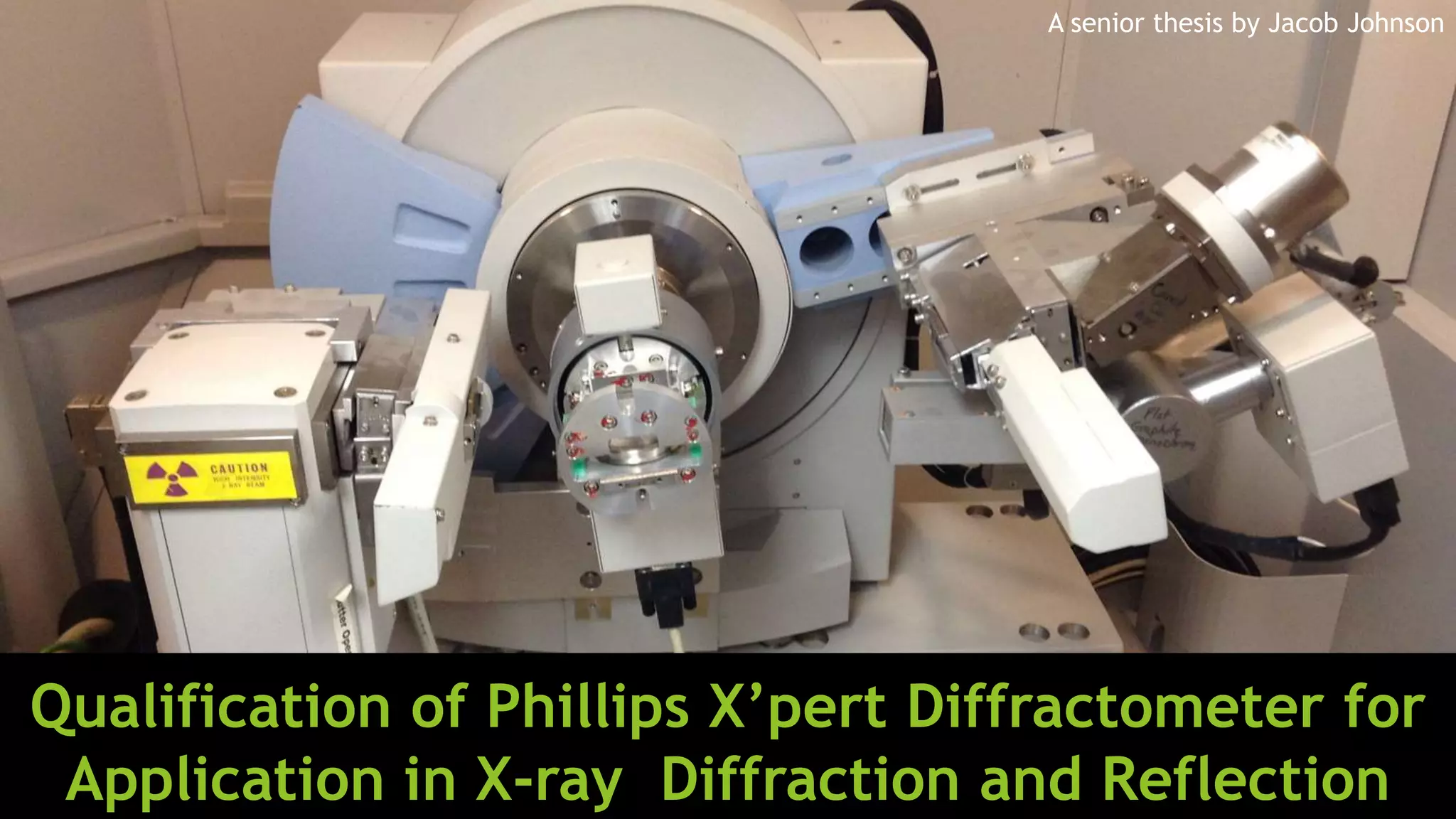
Qualification of Phillips X’pert Diffractometer for
Application in X-ray Diffraction and Reflection
A senior thesis by Jacob Johnson
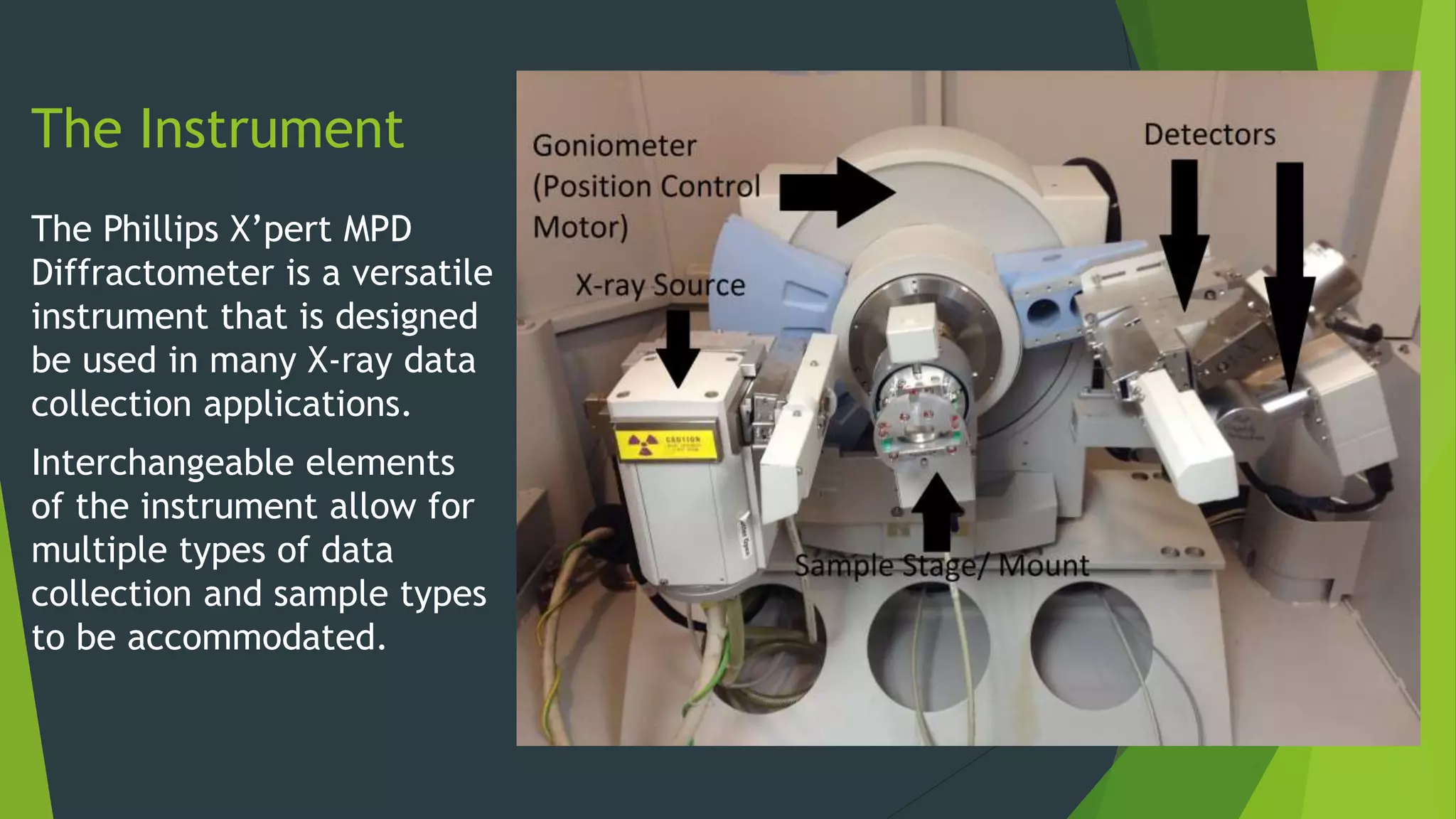
The Instrument
The Phillips X’pert MPD
Diffractometer is a versatile
instrument that is designed
be used in many X-ray data
collection applications.
Interchangeable elements
of the instrument allow for
multiple types of data
collection and sample types
to be accommodated.
Qualification of the Instrument for
Applications in X-ray Diffraction and X-ray
Reflection
X-ray Powder Diffraction
 The instrument can be configured to
make measurements in X-ray Powder
Diffraction (XRD)
 XRD is used to probe the crystalline
structure of solids, the diffraction
pattern can be analyzed to
determine the molecular structure of
a crystal lattice and aids in
crystallography
 Qualification of this instrument for
this use is one of the main reasons
that the instrument was acquired
Thin Film X-ray Reflectance
 The instrument can be configured to
make measurements in X-ray
Reflectivity (XRR) measurements at a
glancing angle
 XRR is used to probe the surface of
thin metallic films to determine their
characteristics
 Through another project here at the
university thin metallic films are
being manufactured
 Determining the characteristics of
these films is essential for their use
Generating X-rays
through characteristic
emission
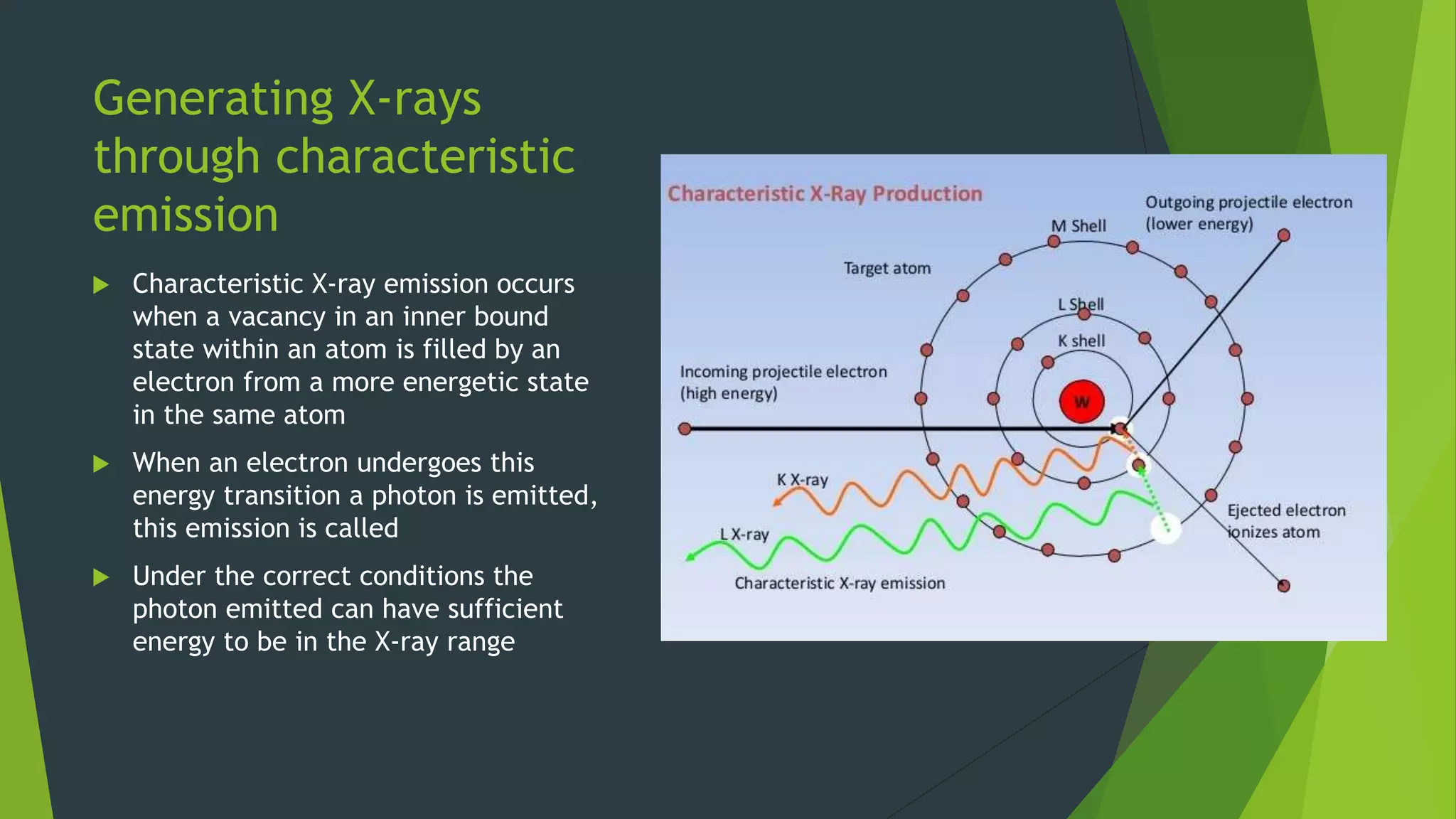
 Characteristic X-ray emission occurs
when a vacancy in an inner bound
state within an atom is filled by an
electron from a more energetic state
in the same atom
 When an electron undergoes this
energy transition a photon is emitted,
this emission is called
 Under the correct conditions the
photon emitted can have sufficient
energy to be in the X-ray range
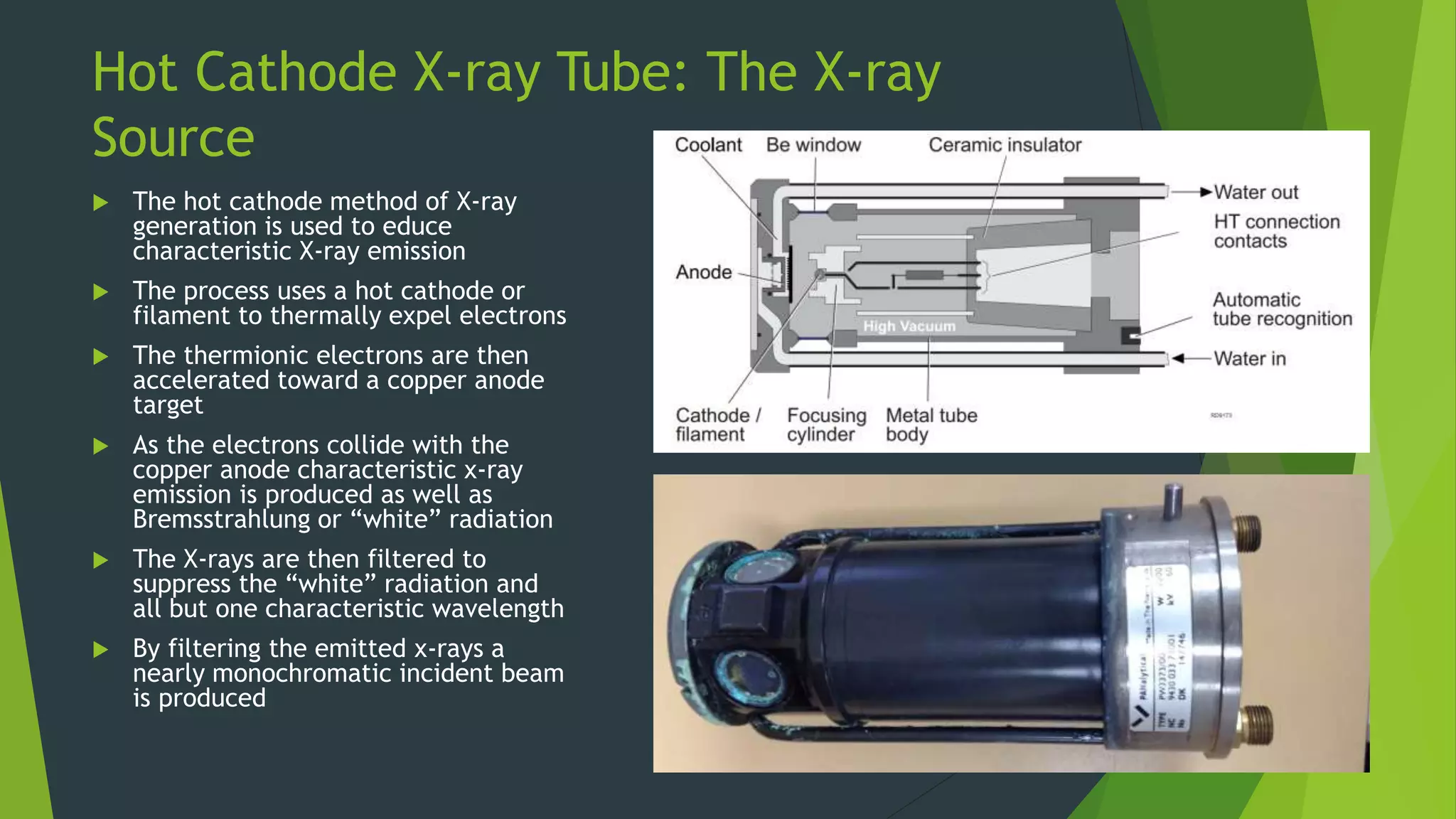
Hot Cathode X-ray Tube: The X-ray
Source
 The hot cathode method of X-ray
generation is used to educe
characteristic X-ray emission
 The process uses a hot cathode or
filament to thermally expel electrons
 The thermionic electrons are then
accelerated toward a copper anode
target
 As the electrons collide with the
copper anode characteristic x-ray
emission is produced as well as
Bremsstrahlung or “white” radiation
 The X-rays are then filtered to
suppress the “white” radiation and
all but one characteristic wavelength
 By filtering the emitted x-rays a
nearly monochromatic incident beam
is produced
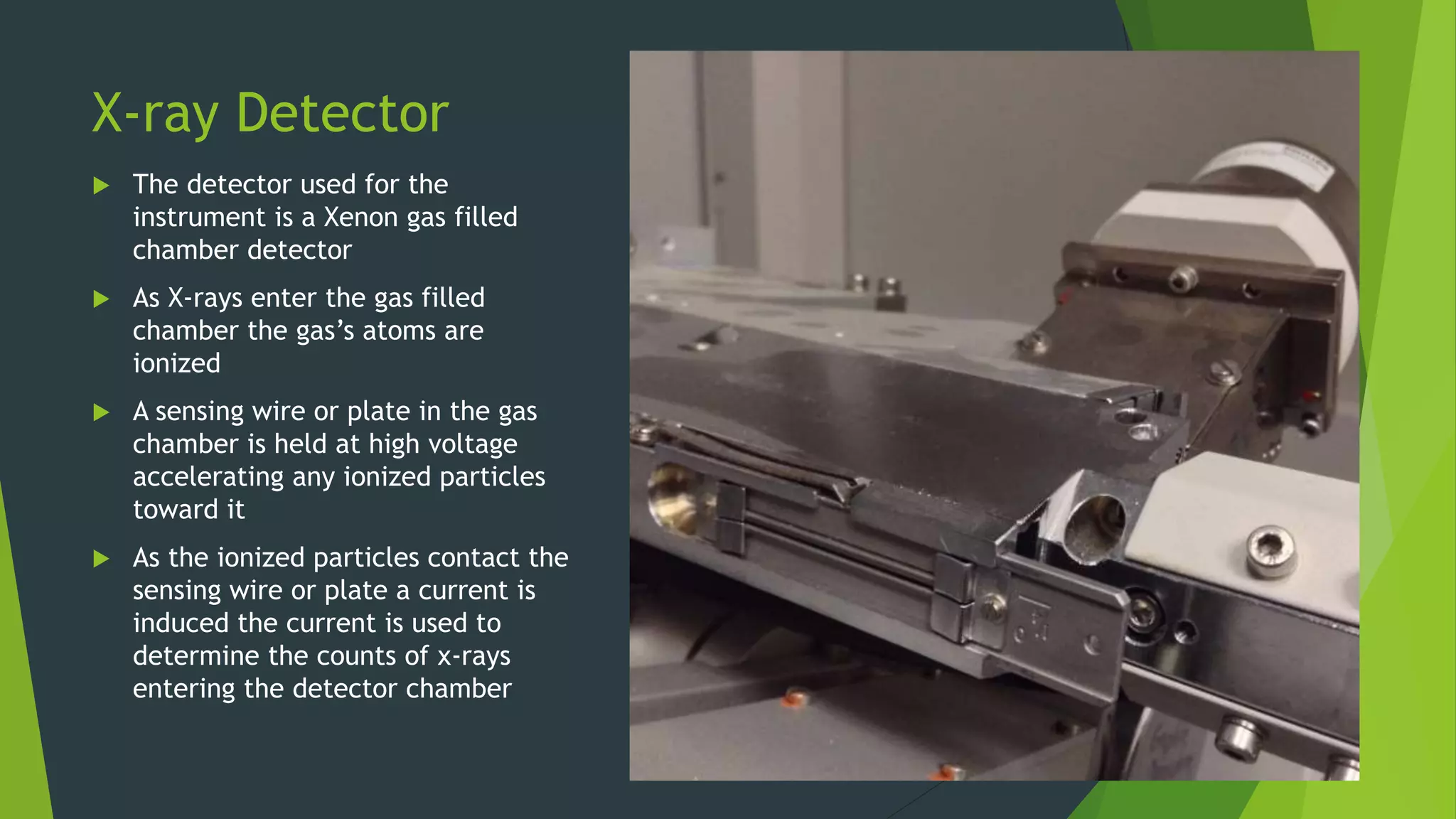
X-ray Detector
 The detector used for the
instrument is a Xenon gas filled
chamber detector
 As X-rays enter the gas filled
chamber the gas’s atoms are
ionized
 A sensing wire or plate in the gas
chamber is held at high voltage
accelerating any ionized particles
toward it
 As the ionized particles contact the
sensing wire or plate a current is
induced the current is used to
determine the counts of x-rays
entering the detector chamber
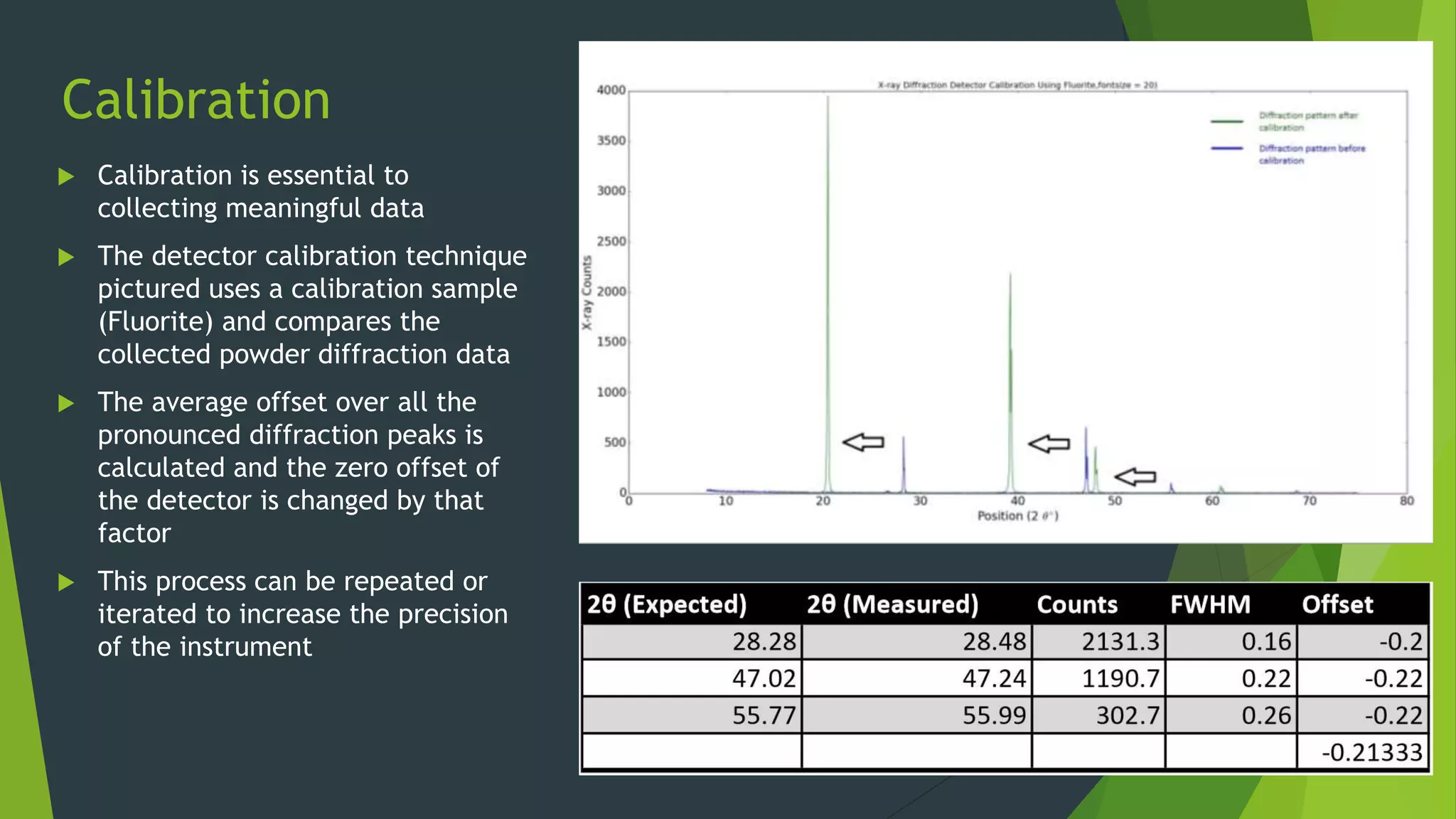
Calibration
 Calibration is essential to
collecting meaningful data
 The detector calibration technique
pictured uses a calibration sample
(Fluorite) and compares the
collected powder diffraction data
 The average offset over all the
pronounced diffraction peaks is
calculated and the zero offset of
the detector is changed by that
factor
 This process can be repeated or
iterated to increase the precision
of the instrument
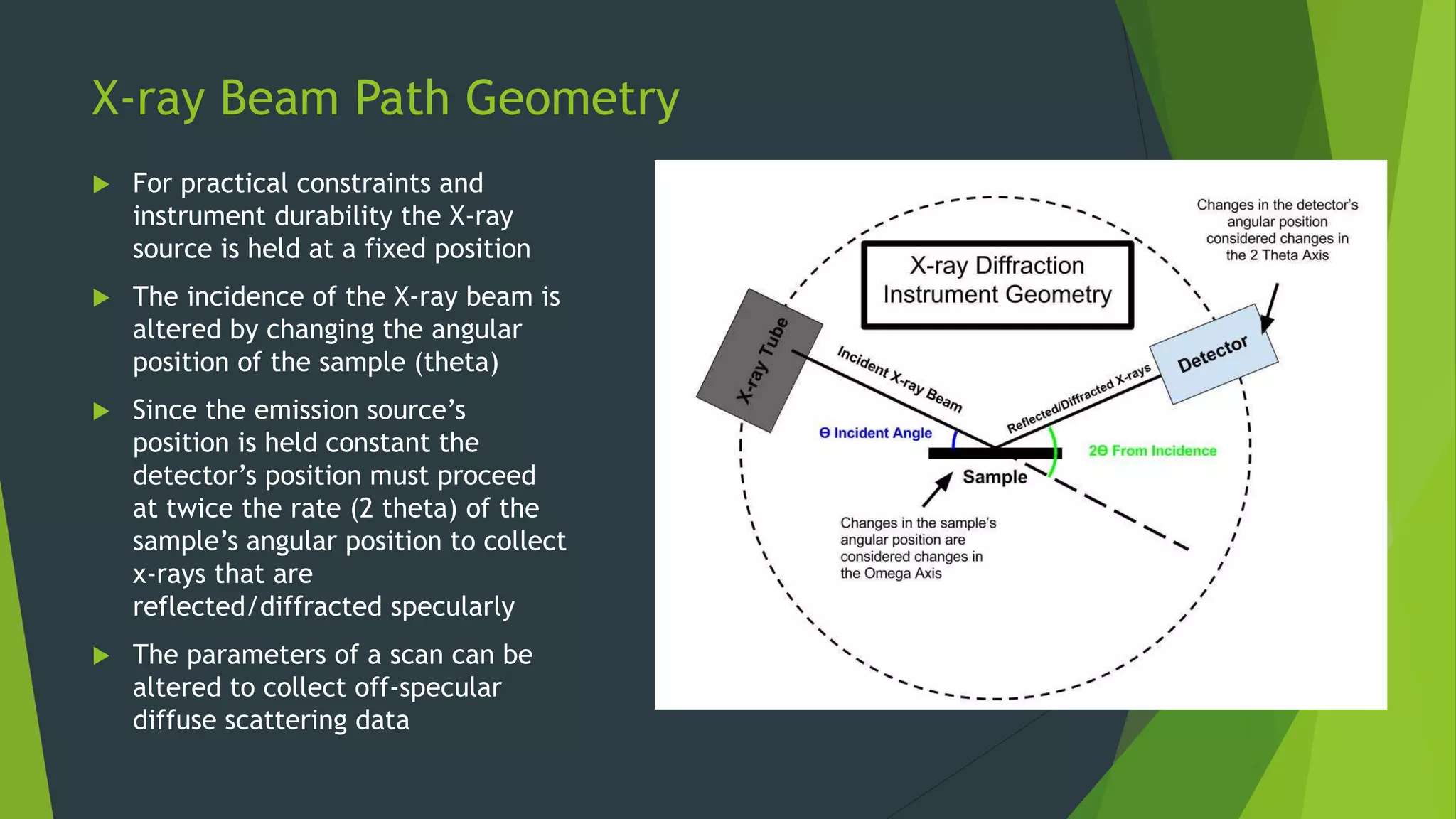
X-ray Beam Path Geometry
 For practical constraints and
instrument durability the X-ray
source is held at a fixed position
 The incidence of the X-ray beam is
altered by changing the angular
position of the sample (theta)
 Since the emission source’s
position is held constant the
detector’s position must proceed
at twice the rate (2 theta) of the
sample’s angular position to collect
x-rays that are
reflected/diffracted specularly
 The parameters of a scan can be
altered to collect off-specular
diffuse scattering data
Constructive interference and Path
Length Difference
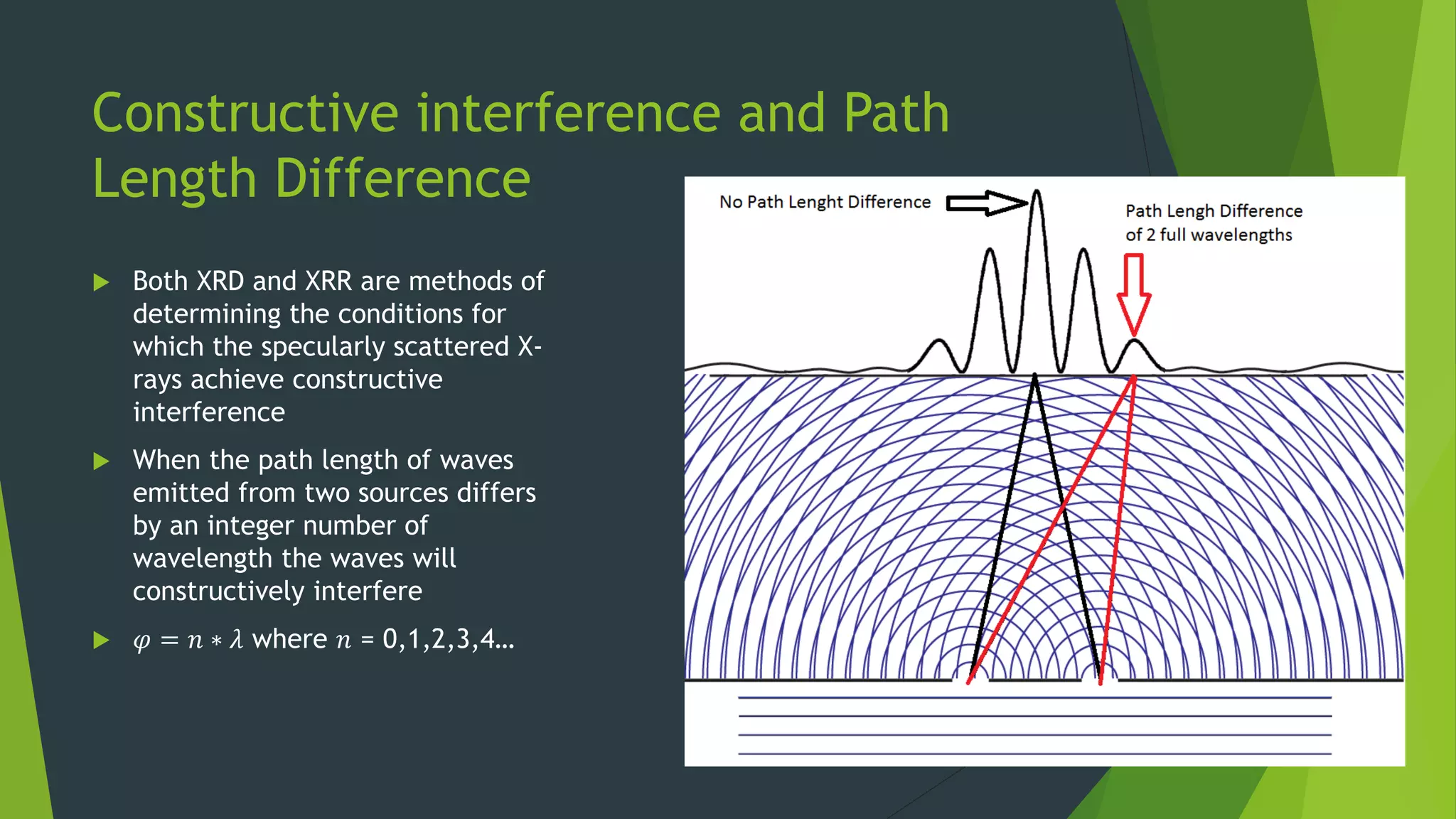
 Both XRD and XRR are methods of
determining the conditions for
which the specularly scattered X-
rays achieve constructive
interference
 When the path length of waves
emitted from two sources differs
by an integer number of
wavelength the waves will
constructively interfere
 𝜑 = 𝑛 ∗ 𝜆 where 𝑛 = 0,1,2,3,4…
X-ray Diffraction From a Crystal Lattice
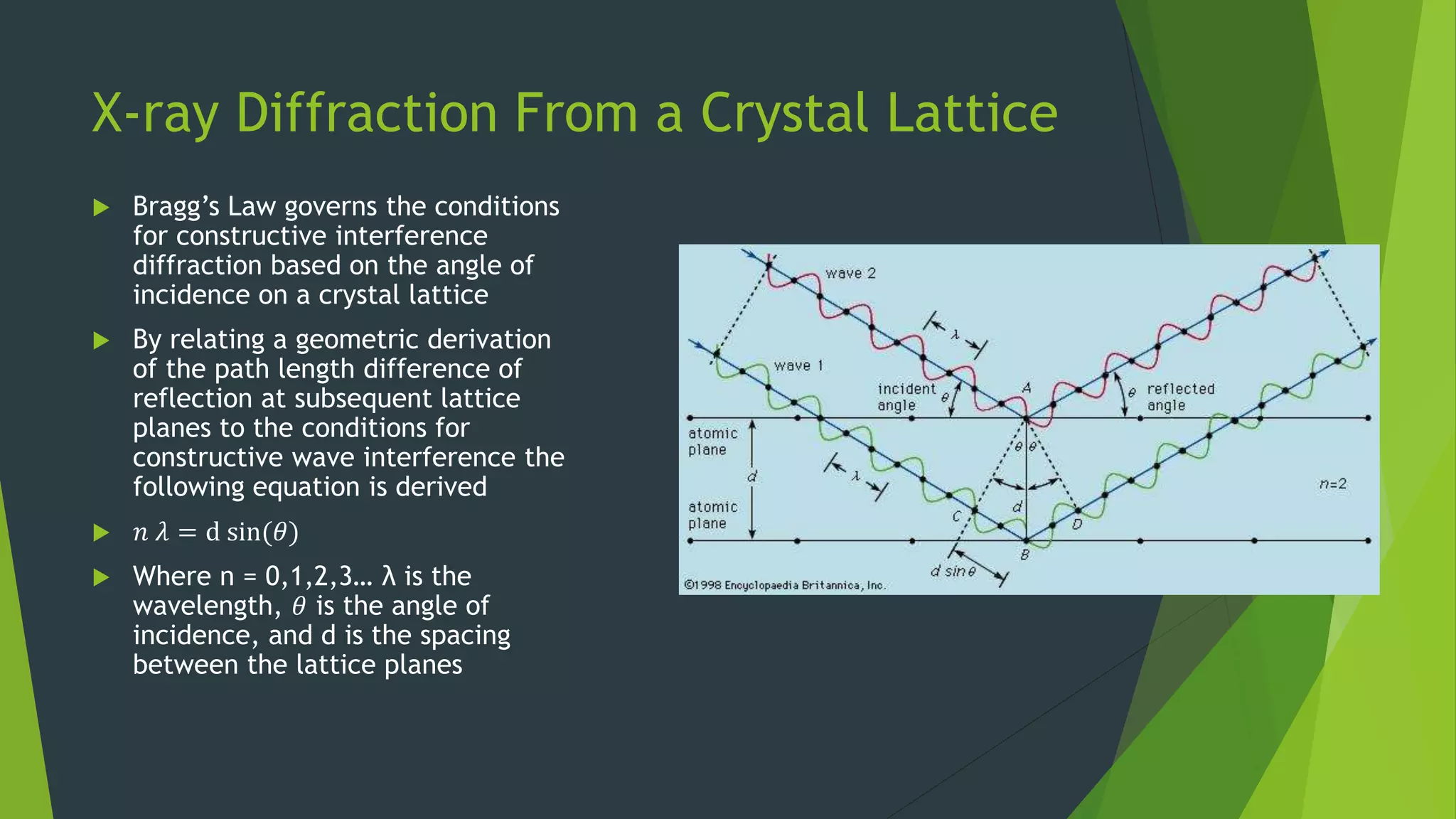
 Bragg’s Law governs the conditions
for constructive interference
diffraction based on the angle of
incidence on a crystal lattice
 By relating a geometric derivation
of the path length difference of
reflection at subsequent lattice
planes to the conditions for
constructive wave interference the
following equation is derived
 𝑛 𝜆 = d sin(𝜃)
 Where n = 0,1,2,3… λ is the
wavelength, 𝜃 is the angle of
incidence, and d is the spacing
between the lattice planes
Crystallography
Through XRD
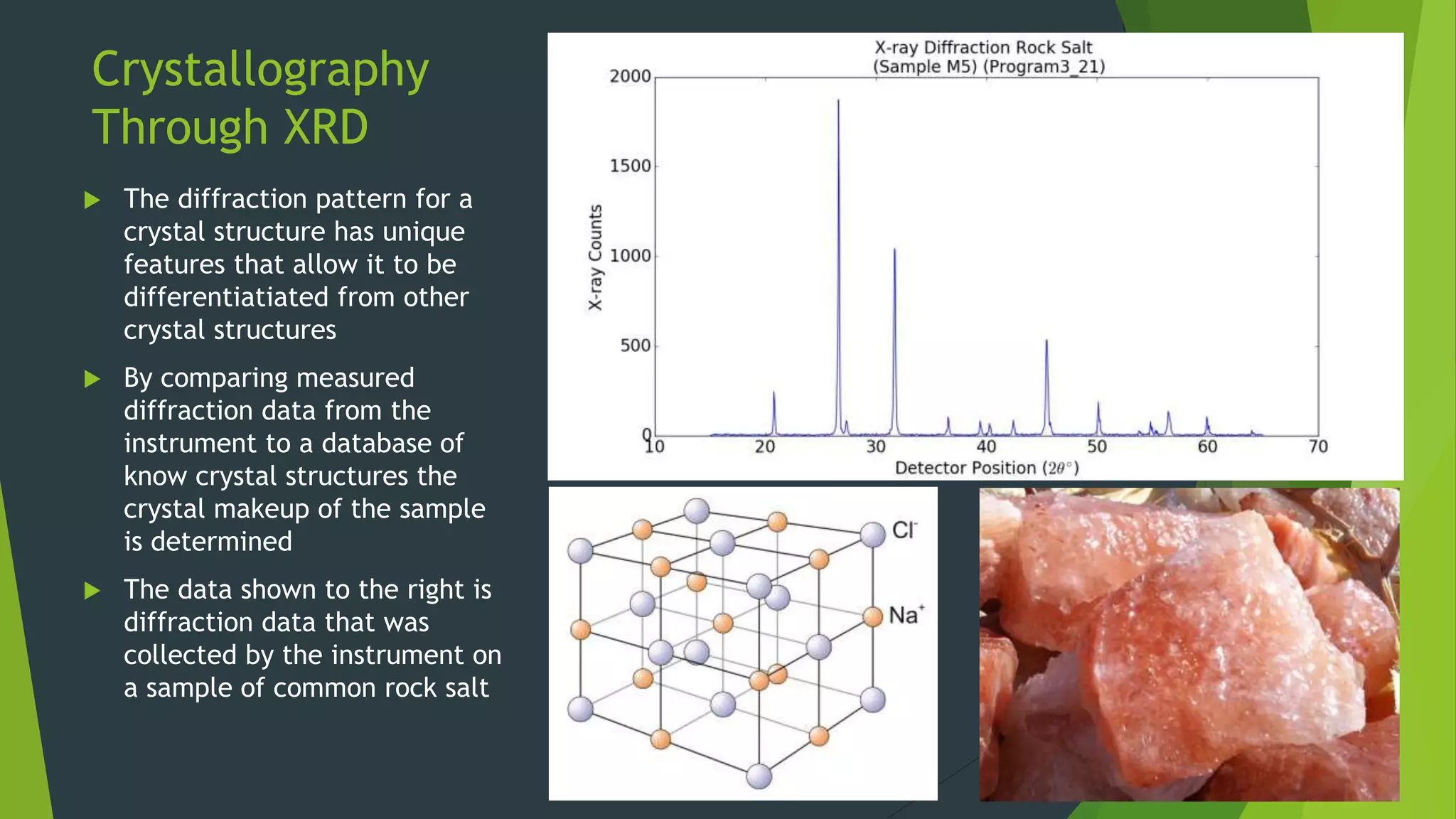
 The diffraction pattern for a
crystal structure has unique
features that allow it to be
differentiatiated from other
crystal structures
 By comparing measured
diffraction data from the
instrument to a database of
know crystal structures the
crystal makeup of the sample
is determined
 The data shown to the right is
diffraction data that was
collected by the instrument on
a sample of common rock salt
X-ray Reflectance
from Thin Films
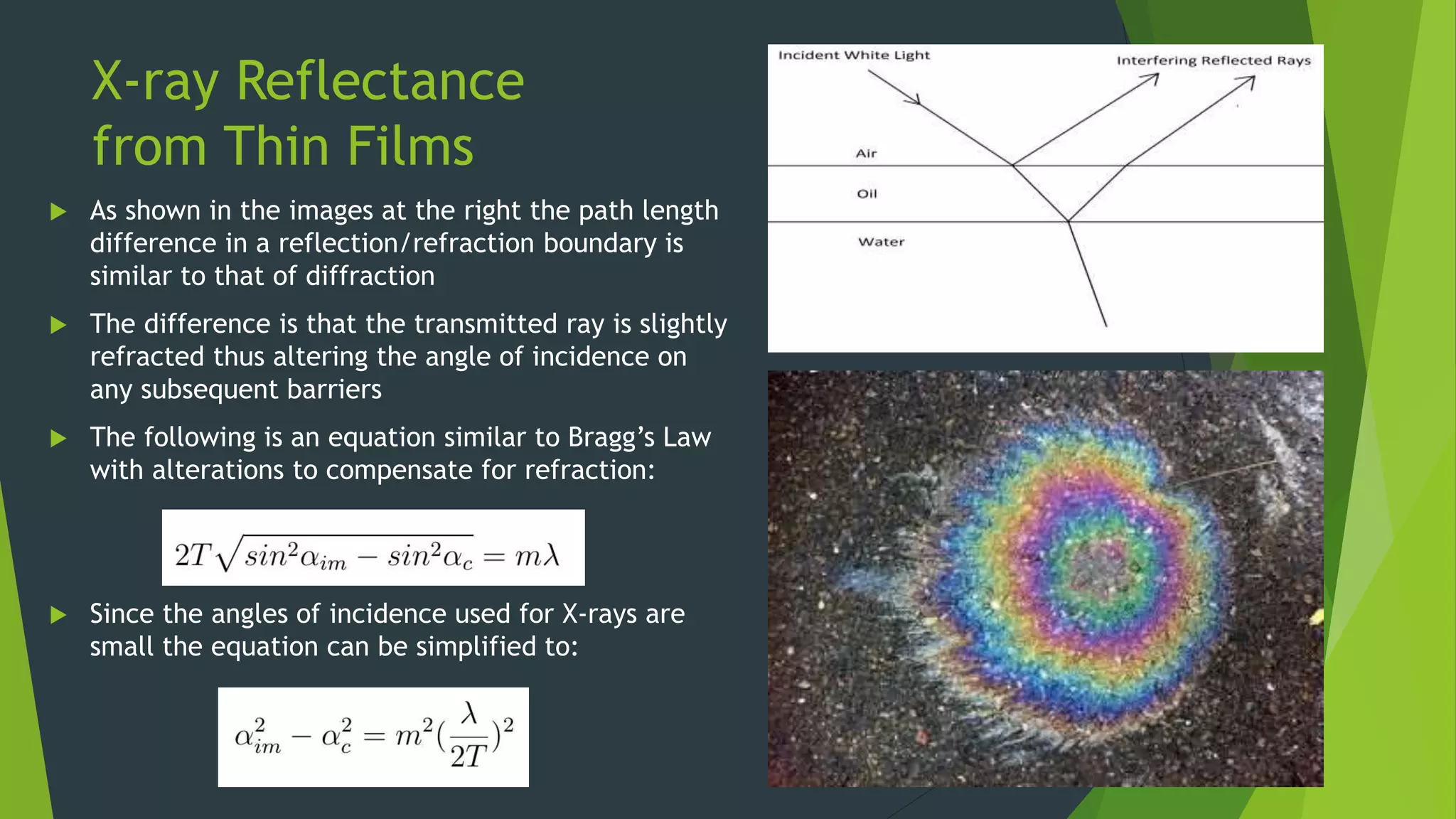
 As shown in the images at the right the path length
difference in a reflection/refraction boundary is
similar to that of diffraction
 The difference is that the transmitted ray is slightly
refracted thus altering the angle of incidence on
any subsequent barriers
 The following is an equation similar to Bragg’s Law
with alterations to compensate for refraction:
 Since the angles of incidence used for X-rays are
small the equation can be simplified to:
Thin Film Characterization
through XRR
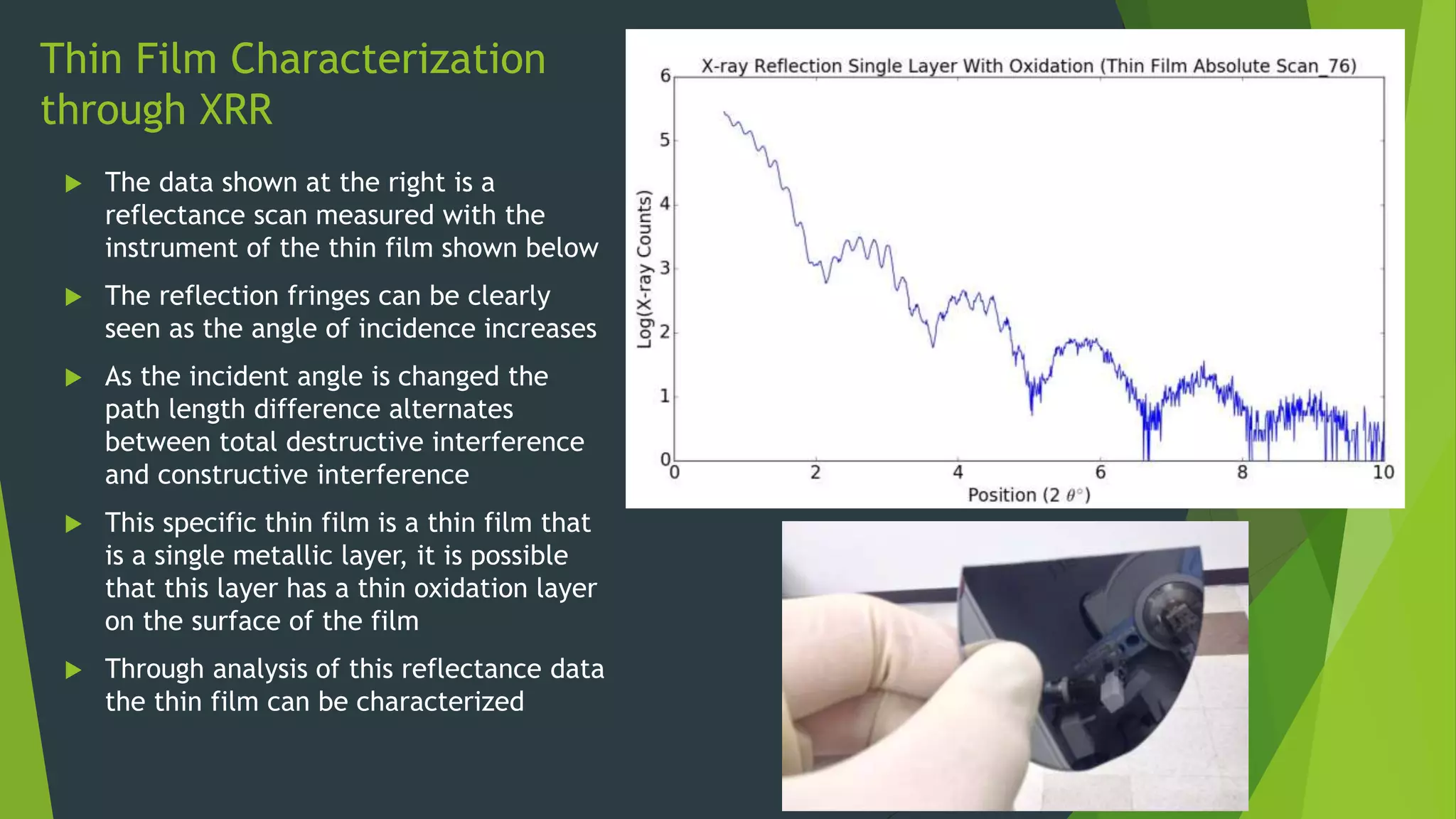
 The data shown at the right is a
reflectance scan measured with the
instrument of the thin film shown below
 The reflection fringes can be clearly
seen as the angle of incidence increases
 As the incident angle is changed the
path length difference alternates
between total destructive interference
and constructive interference
 This specific thin film is a thin film that
is a single metallic layer, it is possible
that this layer has a thin oxidation layer
on the surface of the film
 Through analysis of this reflectance data
the thin film can be characterized
Conclusion
 The objective of the project was achieved and the instrument
was qualified for the applications of X-ray diffraction and X-ray
reflection
 Further research was done to understand the methods of
crystallography from the diffraction data and characterization
of thin metallic thin films from the reflectance data
 Written step by step procedures were created for the
operation of the instrument
 Tutorial videos were filmed to show the operation techniques
of the instrument as well as sample preparation and sample
stage interchanging to alternate between XRR collection and
XRD
Future Work
Multi Layered Thin Film
Manufacturing and Analysis
 Single layered films have been
manufactured here through
another student led project
 A new electron beam
deposition system may be in
use soon, this system will have
the capability to create
multilayered thin films
 Multi Layered thin films can
also be studied through X-ray
Reflectivity
XRD Data Post Processing and
Crystallography of Impure Samples
 Many times in nature there are several
types of crystallized material contained
within a bulk sample
 The X’per High Score software package
that accompanies the data collection
software of the instrument has the
capability to extract data for
superimposed diffraction patterns from
several crystal types
 The data processing and analysis with this
software is something that requires
further attention to be used effectively

Qualification of Phillips X’pert MPD Diffractometer for XRD

  • 1.
    Qualification of PhillipsX’pert Diffractometer for Application in X-ray Diffraction and Reflection A senior thesis by Jacob Johnson
  • 2.
    The Instrument The PhillipsX’pert MPD Diffractometer is a versatile instrument that is designed be used in many X-ray data collection applications. Interchangeable elements of the instrument allow for multiple types of data collection and sample types to be accommodated.
  • 3.
    Qualification of theInstrument for Applications in X-ray Diffraction and X-ray Reflection X-ray Powder Diffraction  The instrument can be configured to make measurements in X-ray Powder Diffraction (XRD)  XRD is used to probe the crystalline structure of solids, the diffraction pattern can be analyzed to determine the molecular structure of a crystal lattice and aids in crystallography  Qualification of this instrument for this use is one of the main reasons that the instrument was acquired Thin Film X-ray Reflectance  The instrument can be configured to make measurements in X-ray Reflectivity (XRR) measurements at a glancing angle  XRR is used to probe the surface of thin metallic films to determine their characteristics  Through another project here at the university thin metallic films are being manufactured  Determining the characteristics of these films is essential for their use
  • 4.
    Generating X-rays through characteristic emission Characteristic X-ray emission occurs when a vacancy in an inner bound state within an atom is filled by an electron from a more energetic state in the same atom  When an electron undergoes this energy transition a photon is emitted, this emission is called  Under the correct conditions the photon emitted can have sufficient energy to be in the X-ray range
  • 5.
    Hot Cathode X-rayTube: The X-ray Source  The hot cathode method of X-ray generation is used to educe characteristic X-ray emission  The process uses a hot cathode or filament to thermally expel electrons  The thermionic electrons are then accelerated toward a copper anode target  As the electrons collide with the copper anode characteristic x-ray emission is produced as well as Bremsstrahlung or “white” radiation  The X-rays are then filtered to suppress the “white” radiation and all but one characteristic wavelength  By filtering the emitted x-rays a nearly monochromatic incident beam is produced
  • 6.
    X-ray Detector  Thedetector used for the instrument is a Xenon gas filled chamber detector  As X-rays enter the gas filled chamber the gas’s atoms are ionized  A sensing wire or plate in the gas chamber is held at high voltage accelerating any ionized particles toward it  As the ionized particles contact the sensing wire or plate a current is induced the current is used to determine the counts of x-rays entering the detector chamber
  • 7.
    Calibration  Calibration isessential to collecting meaningful data  The detector calibration technique pictured uses a calibration sample (Fluorite) and compares the collected powder diffraction data  The average offset over all the pronounced diffraction peaks is calculated and the zero offset of the detector is changed by that factor  This process can be repeated or iterated to increase the precision of the instrument
  • 8.
    X-ray Beam PathGeometry  For practical constraints and instrument durability the X-ray source is held at a fixed position  The incidence of the X-ray beam is altered by changing the angular position of the sample (theta)  Since the emission source’s position is held constant the detector’s position must proceed at twice the rate (2 theta) of the sample’s angular position to collect x-rays that are reflected/diffracted specularly  The parameters of a scan can be altered to collect off-specular diffuse scattering data
  • 9.
    Constructive interference andPath Length Difference  Both XRD and XRR are methods of determining the conditions for which the specularly scattered X- rays achieve constructive interference  When the path length of waves emitted from two sources differs by an integer number of wavelength the waves will constructively interfere  𝜑 = 𝑛 ∗ 𝜆 where 𝑛 = 0,1,2,3,4…
  • 10.
    X-ray Diffraction Froma Crystal Lattice  Bragg’s Law governs the conditions for constructive interference diffraction based on the angle of incidence on a crystal lattice  By relating a geometric derivation of the path length difference of reflection at subsequent lattice planes to the conditions for constructive wave interference the following equation is derived  𝑛 𝜆 = d sin(𝜃)  Where n = 0,1,2,3… λ is the wavelength, 𝜃 is the angle of incidence, and d is the spacing between the lattice planes
  • 11.
    Crystallography Through XRD  Thediffraction pattern for a crystal structure has unique features that allow it to be differentiatiated from other crystal structures  By comparing measured diffraction data from the instrument to a database of know crystal structures the crystal makeup of the sample is determined  The data shown to the right is diffraction data that was collected by the instrument on a sample of common rock salt
  • 12.
    X-ray Reflectance from ThinFilms  As shown in the images at the right the path length difference in a reflection/refraction boundary is similar to that of diffraction  The difference is that the transmitted ray is slightly refracted thus altering the angle of incidence on any subsequent barriers  The following is an equation similar to Bragg’s Law with alterations to compensate for refraction:  Since the angles of incidence used for X-rays are small the equation can be simplified to:
  • 13.
    Thin Film Characterization throughXRR  The data shown at the right is a reflectance scan measured with the instrument of the thin film shown below  The reflection fringes can be clearly seen as the angle of incidence increases  As the incident angle is changed the path length difference alternates between total destructive interference and constructive interference  This specific thin film is a thin film that is a single metallic layer, it is possible that this layer has a thin oxidation layer on the surface of the film  Through analysis of this reflectance data the thin film can be characterized
  • 14.
    Conclusion  The objectiveof the project was achieved and the instrument was qualified for the applications of X-ray diffraction and X-ray reflection  Further research was done to understand the methods of crystallography from the diffraction data and characterization of thin metallic thin films from the reflectance data  Written step by step procedures were created for the operation of the instrument  Tutorial videos were filmed to show the operation techniques of the instrument as well as sample preparation and sample stage interchanging to alternate between XRR collection and XRD
  • 15.
    Future Work Multi LayeredThin Film Manufacturing and Analysis  Single layered films have been manufactured here through another student led project  A new electron beam deposition system may be in use soon, this system will have the capability to create multilayered thin films  Multi Layered thin films can also be studied through X-ray Reflectivity XRD Data Post Processing and Crystallography of Impure Samples  Many times in nature there are several types of crystallized material contained within a bulk sample  The X’per High Score software package that accompanies the data collection software of the instrument has the capability to extract data for superimposed diffraction patterns from several crystal types  The data processing and analysis with this software is something that requires further attention to be used effectively