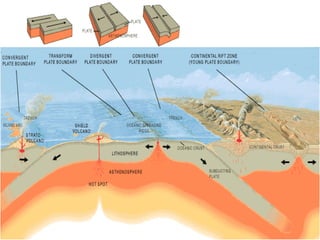
The Theory ofPlate Tectonics -
Boundaries,
Stresses,
and Faults
1. What is the theory of plate tectonics?
2. What are the three types of plate boundaries?
2.
What are Plates?
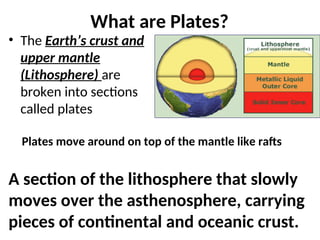
•The Earth’s crust and
upper mantle
(Lithosphere) are
broken into sections
called plates
A section of the lithosphere that slowly
moves over the asthenosphere, carrying
pieces of continental and oceanic crust.
Plates move around on top of the mantle like rafts
3.
What is theTheory of Plate Tectonics?
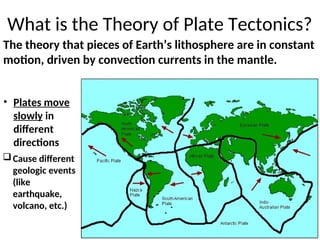
The theory that pieces of Earth’s lithosphere are in constant
motion, driven by convection currents in the mantle.
• Plates move
slowly in
different
directions
Cause different
geologic events
(like
earthquake,
volcano, etc.)
4.
What makes theplates move?
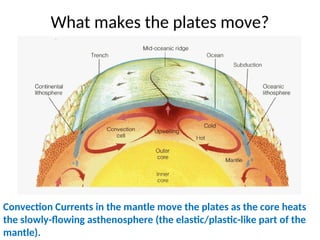
Convection Currents in the mantle move the plates as the core heats
the slowly-flowing asthenosphere (the elastic/plastic-like part of the
mantle).
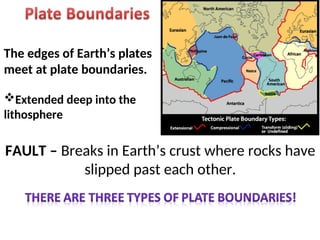
6.
FAULT – Breaksin Earth’s crust where rocks have
slipped past each other.
The edges of Earth’s plates
meet at plate boundaries.
Extended deep into the
lithosphere
7.
What are thethree types of
boundaries?
• Divergent Boundaries
• Convergent Boundaries
• Transform Boundaries
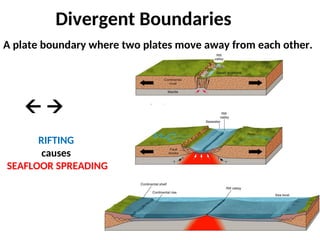
8.
Divergent Boundaries
A plateboundary where two plates move away from each other.
RIFTING
causes
SEAFLOOR SPREADING
9.
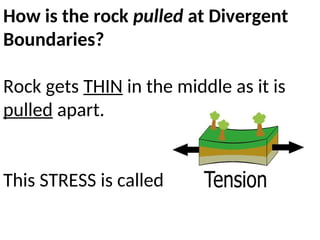
How is therock pulled at Divergent
Boundaries?
Rock gets THIN in the middle as it is
pulled apart.
This STRESS is called
10.
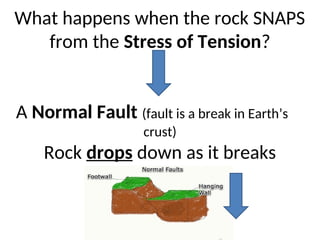
What happens whenthe rock SNAPS
from the Stress of Tension?
A Normal Fault (fault is a break in Earth’s
crust)
Rock drops down as it breaks
11.
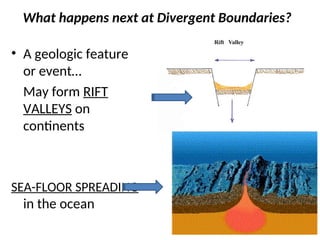
What happens nextat Divergent Boundaries?
• A geologic feature
or event…
May form RIFT
VALLEYS on
continents
SEA-FLOOR SPREADING
in the ocean
12.
Helpful Hints…
• Divergentis like “dissecting” or “dividing”
• If you pull warm bubble gum or silly putty, it will thin
in the middle until it is stressed so much that it
breaks.
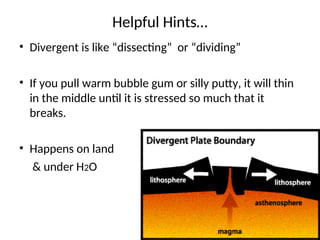
• Happens on land
& under H2O
13.
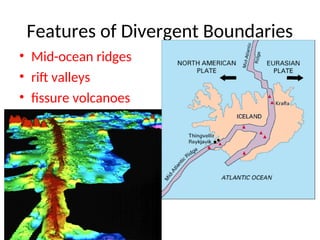
Features of DivergentBoundaries
• Mid-ocean ridges
• rift valleys
• fissure volcanoes
14.
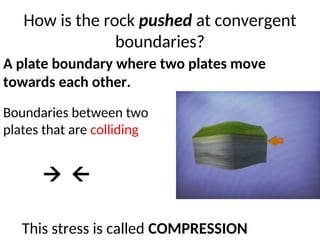
How is therock pushed at convergent
boundaries?
A plate boundary where two plates move
towards each other.
Boundaries between two
plates that are colliding
This stress is called COMPRESSION
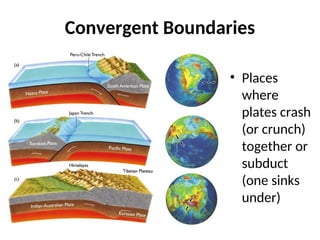
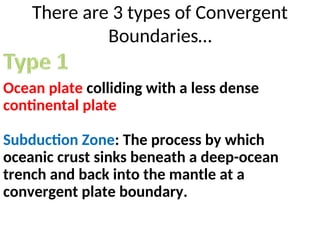
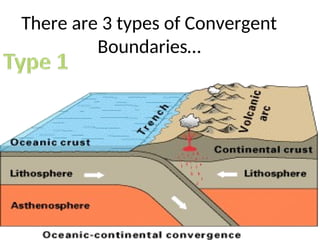
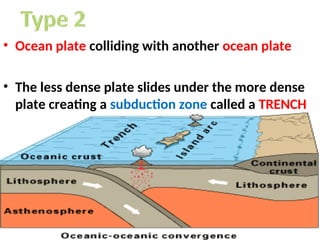
There are 3types of Convergent
Boundaries…
Ocean plate colliding with a less dense
continental plate
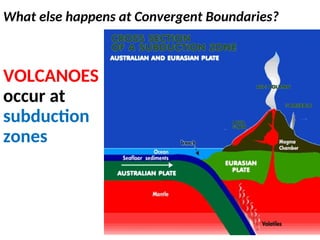
Subduction Zone: The process by which
oceanic crust sinks beneath a deep-ocean
trench and back into the mantle at a
convergent plate boundary.
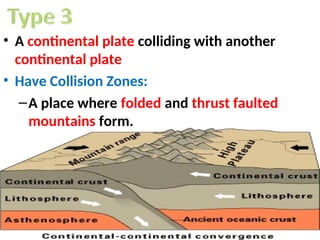
• A continentalplate colliding with another
continental plate
• Have Collision Zones:
–A place where folded and thrust faulted
mountains form.
23.
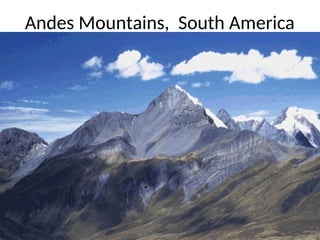
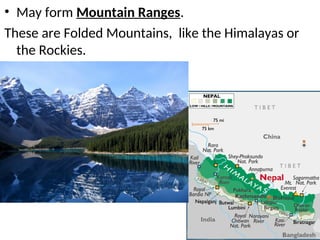
• May formMountain Ranges.
These are Folded Mountains, like the Himalayas or
the Rockies.
24.
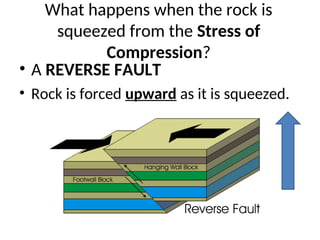
What happens whenthe rock is
squeezed from the Stress of
Compression?
• A REVERSE FAULT
• Rock is forced upward as it is squeezed.
25.
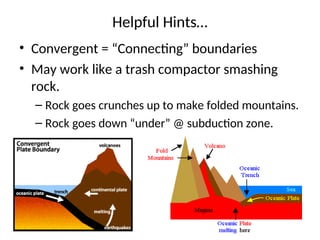
Helpful Hints…
• Convergent= “Connecting” boundaries
• May work like a trash compactor smashing
rock.
– Rock goes crunches up to make folded mountains.
– Rock goes down “under” @ subduction zone.
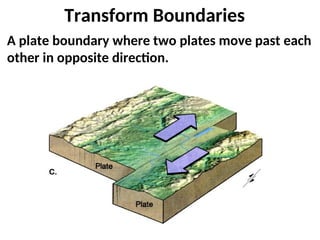
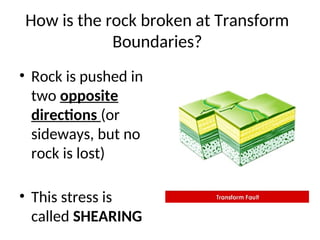
How is therock broken at Transform
Boundaries?
• Rock is pushed in
two opposite
directions (or
sideways, but no
rock is lost)
• This stress is
called SHEARING
28.
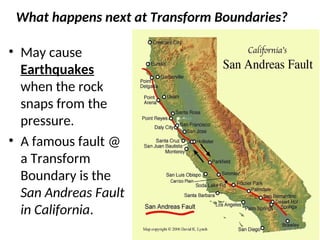
What happens nextat Transform Boundaries?
• May cause
Earthquakes
when the rock
snaps from the
pressure.
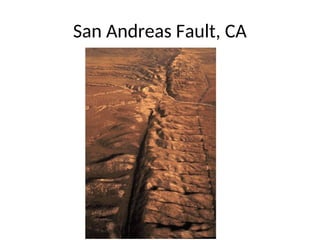
• A famous fault @
a Transform
Boundary is the
San Andreas Fault
in California.
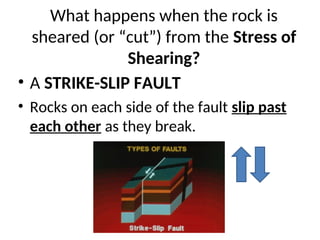
What happens whenthe rock is
sheared (or “cut”) from the Stress of
Shearing?
• A STRIKE-SLIP FAULT
• Rocks on each side of the fault slip past
each other as they break.
31.
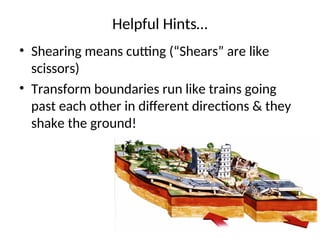
Helpful Hints…
• Shearingmeans cutting (“Shears” are like
scissors)
• Transform boundaries run like trains going
past each other in different directions & they
shake the ground!
32.
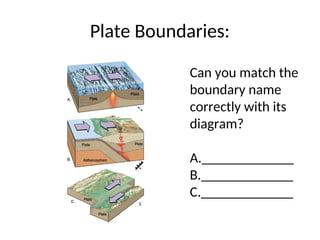
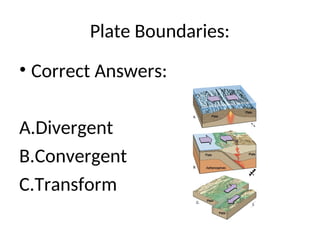
Can you matchthe
boundary name
correctly with its
diagram?
A._____________
B._____________
C._____________
Plate Boundaries: