Python
Interview Questions
1.What is an Interpreted language?
• An Interpreted language executes its statements line by line.
• Languages such as Python, Javascript, R, PHP, and Ruby are prime
examples of Interpreted languages.
• Programs written in an interpreted language runs directly from the
source code, with no intermediary compilation step.
2.What is PEP 8 and why is it important
• PEP stands for Python Enhancement Proposal.
• PEP 8 is especially important since it documents the style guidelines for
Python Code.
• Python open-source community requires you to follow these style
guidelines sincerely and strictly.
3.What does the ‘#’ symbol do in python?
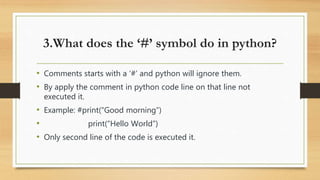
• Comments starts with a ‘#’ and python will ignore them.
• By apply the comment in python code line on that line not
executed it.
• Example: #print(“Good morning”)
• print(“Hello World”)
• Only second line of the code is executed it.
4.What is the difference between a Mutable
datatype and an Immutable datatype?
• Mutable datatype:
• You can change content without changing identity.
• Ex. List, set, dictionary.
• Immutable datatype:
• You can’t change immutable objects once created.
• Ex. String, tuple, int, float, complex.
5.Is Indentation Required in Python?
• Yes, indentation is required in Python.
• Indentations make the code easy to read for developers in all
programming languages.
• but in Python, it is very important to indent the code in a specific
order.
• Examples:
6.What are the key features of Python?
• Free and Open Source Python is a Portable language
• Easy to code Interpreted Language
• Easy to Read Large Standard Library
• Object-Oriented Language Frontend and backend
• GUI Programming Support
• High-Level Language
• Large Community Support
• Easy to Debug
7.What type of language is python?
Programming or Scripting?
• Python is capable of scripting, but in general sense, it is considered as a general-
purpose programming language.
• To know more about Scripting, you can refer to the Python Scripting Tutorial.

python_interview_questions (1) (1) (1).pptx

  • 1.
  • 2.
    1.What is anInterpreted language? • An Interpreted language executes its statements line by line. • Languages such as Python, Javascript, R, PHP, and Ruby are prime examples of Interpreted languages. • Programs written in an interpreted language runs directly from the source code, with no intermediary compilation step.
  • 3.
    2.What is PEP8 and why is it important • PEP stands for Python Enhancement Proposal. • PEP 8 is especially important since it documents the style guidelines for Python Code. • Python open-source community requires you to follow these style guidelines sincerely and strictly.
  • 4.
    3.What does the‘#’ symbol do in python? • Comments starts with a ‘#’ and python will ignore them. • By apply the comment in python code line on that line not executed it. • Example: #print(“Good morning”) • print(“Hello World”) • Only second line of the code is executed it.
  • 5.
    4.What is thedifference between a Mutable datatype and an Immutable datatype? • Mutable datatype: • You can change content without changing identity. • Ex. List, set, dictionary. • Immutable datatype: • You can’t change immutable objects once created. • Ex. String, tuple, int, float, complex.
  • 6.
    5.Is Indentation Requiredin Python? • Yes, indentation is required in Python. • Indentations make the code easy to read for developers in all programming languages. • but in Python, it is very important to indent the code in a specific order. • Examples:
  • 9.
    6.What are thekey features of Python? • Free and Open Source Python is a Portable language • Easy to code Interpreted Language • Easy to Read Large Standard Library • Object-Oriented Language Frontend and backend • GUI Programming Support • High-Level Language • Large Community Support • Easy to Debug
  • 10.
    7.What type oflanguage is python? Programming or Scripting? • Python is capable of scripting, but in general sense, it is considered as a general- purpose programming language. • To know more about Scripting, you can refer to the Python Scripting Tutorial.