Python Workshop


  Chaitanya Talnikar

  Saket Choudhary


 January 18, 2012


   WnCC     Python Workshop
Python


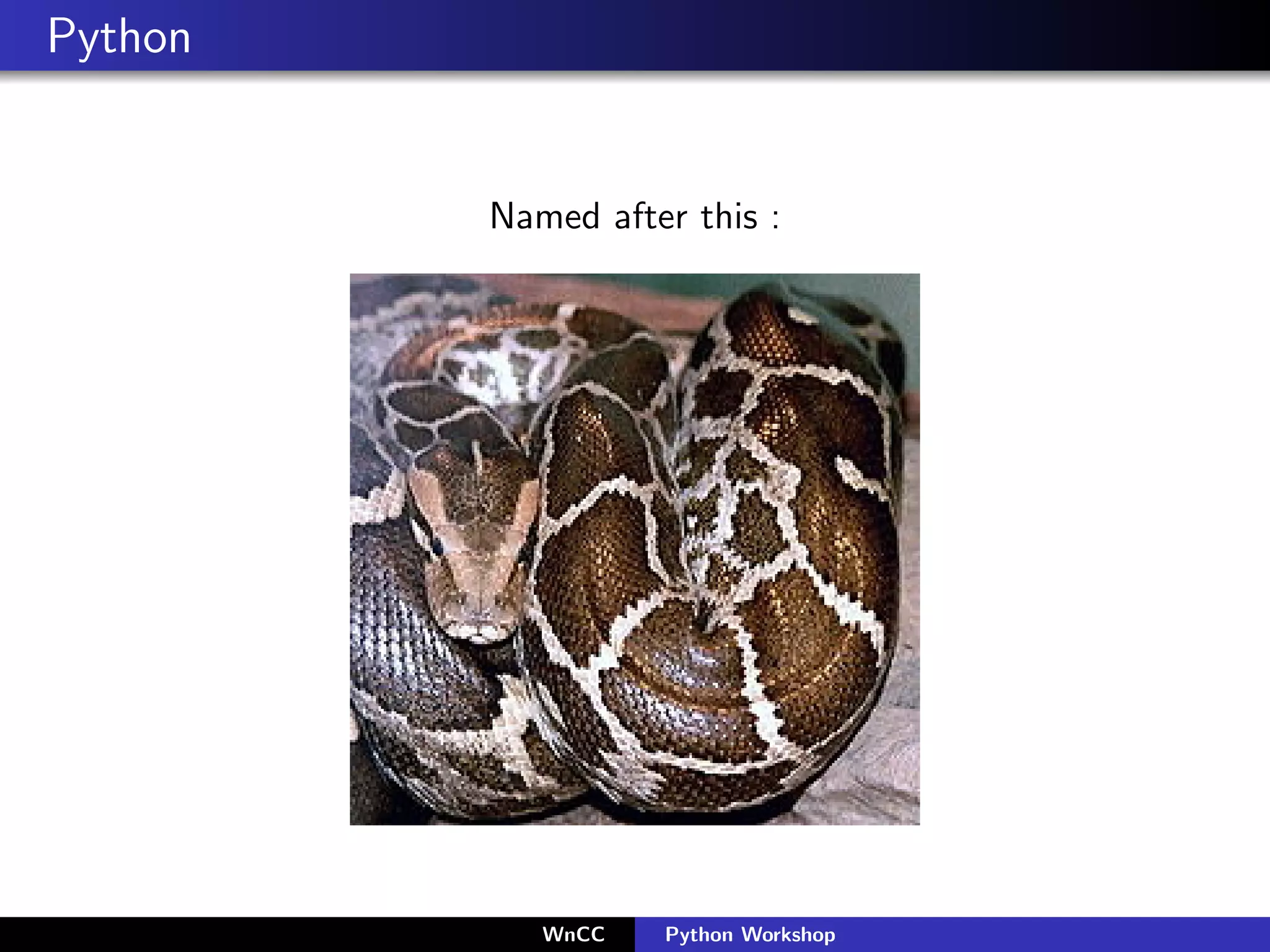
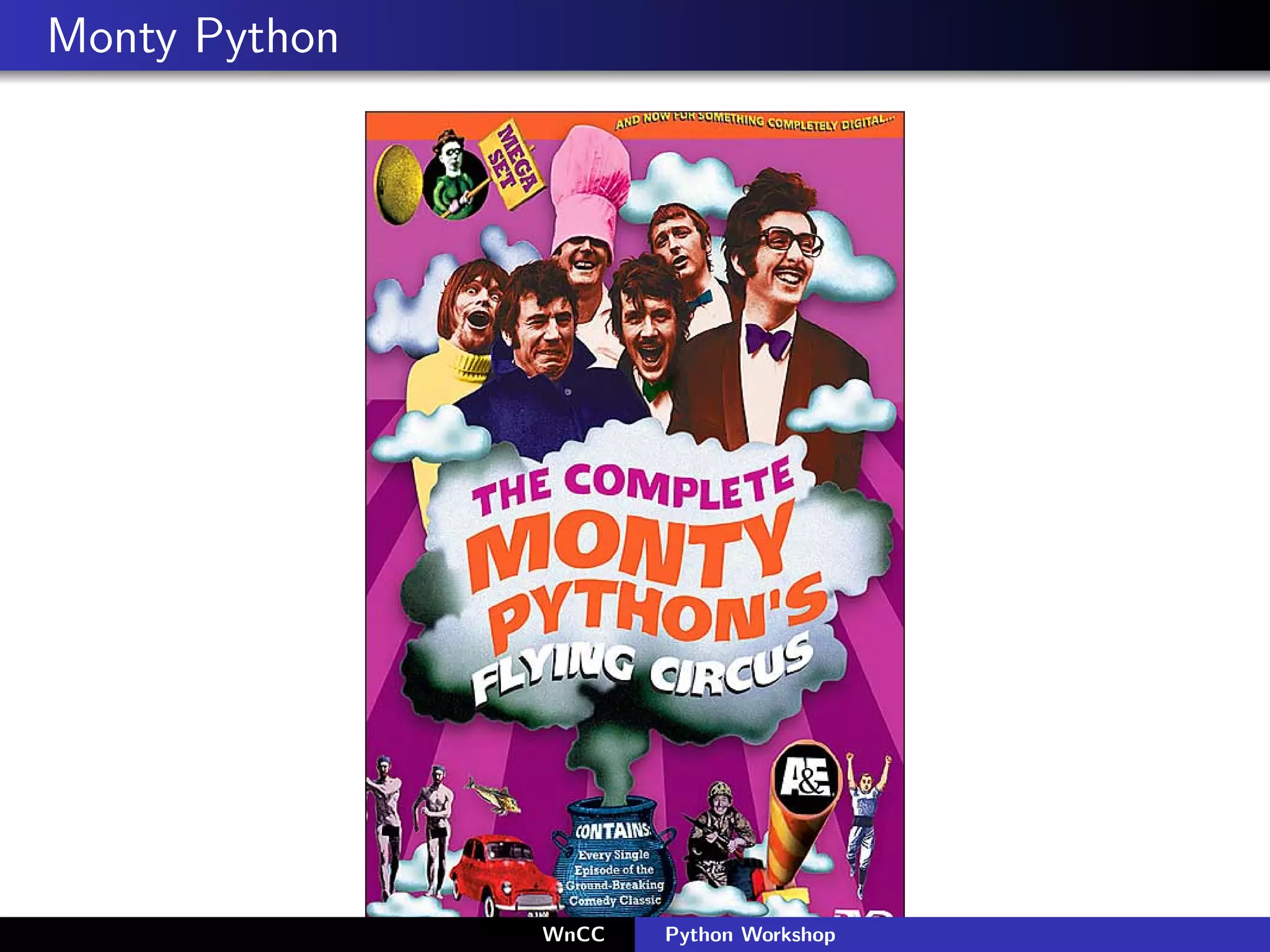
         Named after this :


            WnCC   Python Workshop
Python


     Slide 1 was a joke !


                            WnCC   Python Workshop
Python


     Slide 1 was a joke !
     Python : Conceived in late 1980s by Guido van Rossum as a
     successor to ABC programming language !


                            WnCC   Python Workshop
Python


     Slide 1 was a joke !
     Python : Conceived in late 1980s by Guido van Rossum as a
     successor to ABC programming language !
     Philosophy: Language for readable code ! Remarkable power
     coupled with clear beautiful syntax !


                            WnCC   Python Workshop
Python


     Slide 1 was a joke !
     Python : Conceived in late 1980s by Guido van Rossum as a
     successor to ABC programming language !
     Philosophy: Language for readable code ! Remarkable power
     coupled with clear beautiful syntax !
     Ideology behind Name : A Television Series Monty Python’s
     Flying Circus !


                            WnCC   Python Workshop
Monty Python


               WnCC   Python Workshop
Python: The Power Pack


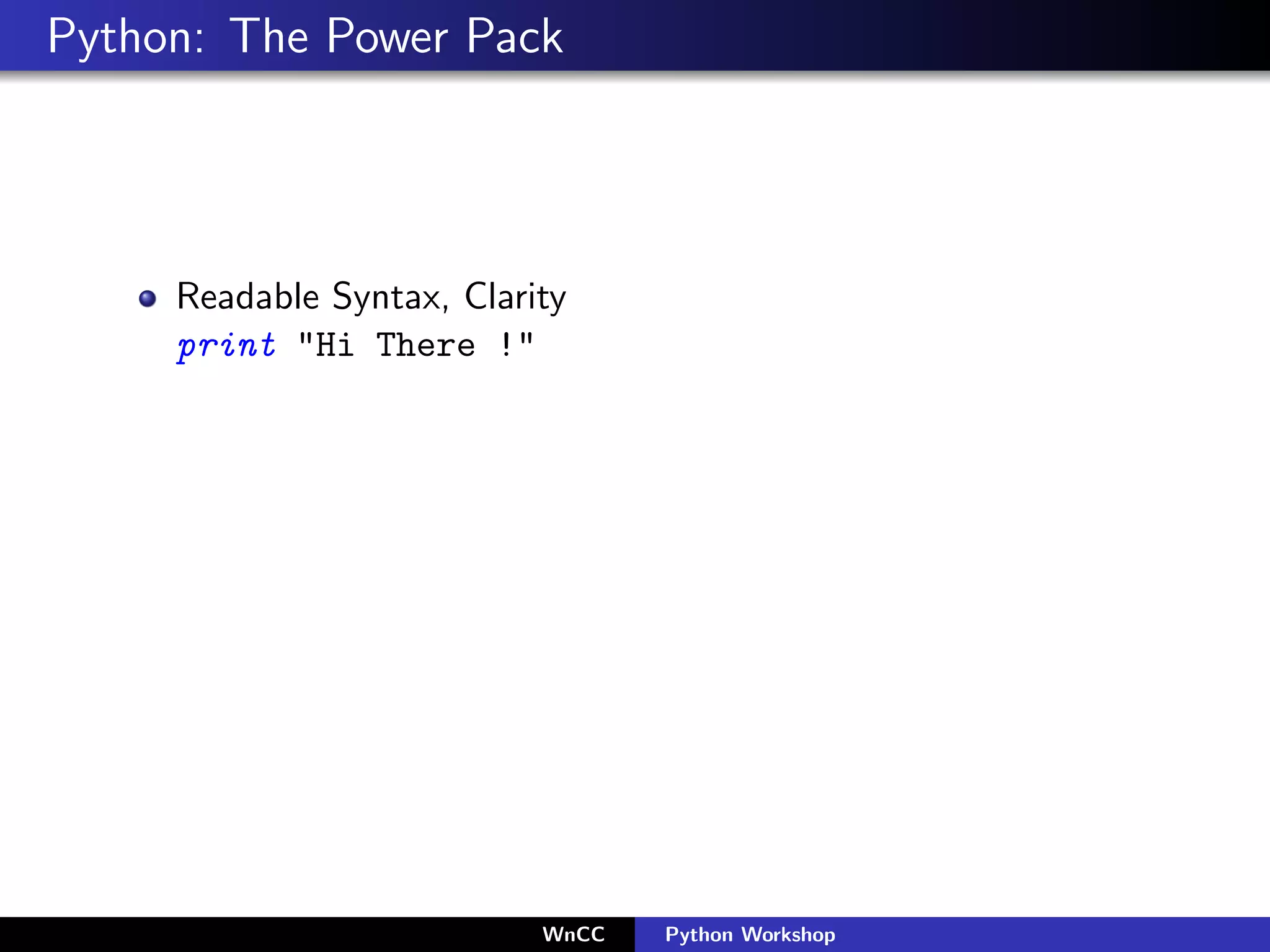
     Readable Syntax, Clarity
     print "Hi There !"


                           WnCC   Python Workshop
Python: The Power Pack


     Readable Syntax, Clarity
     print "Hi There !"
     Intuitive object Orientedness


                            WnCC     Python Workshop
Python: The Power Pack


     Readable Syntax, Clarity
     print "Hi There !"
     Intuitive object Orientedness
     Natural Expression of Procedural Code


                            WnCC     Python Workshop
Python: The Power Pack


     Readable Syntax, Clarity
     print "Hi There !"
     Intuitive object Orientedness
     Natural Expression of Procedural Code
     Full Modularity, support for heirarchical packages


                            WnCC     Python Workshop
Python: The Power Pack


     Readable Syntax, Clarity
     print "Hi There !"
     Intuitive object Orientedness
     Natural Expression of Procedural Code
     Full Modularity, support for heirarchical packages
     Exception-based Error Handling !


                            WnCC     Python Workshop
Python: The Power Pack


     Readable Syntax, Clarity
     print "Hi There !"
     Intuitive object Orientedness
     Natural Expression of Procedural Code
     Full Modularity, support for heirarchical packages
     Exception-based Error Handling !
     Is Open Source !


                            WnCC     Python Workshop
Python can run everywhere, Literally !


      Windows,Mac,Linux
      Most of Linux versions have Python pre-installed for other
      dependenices
      Python for Windows : http://python.org/getit/
      We will stick to Python2.7 for the session


                             WnCC   Python Workshop
Python v/s Other Languages


     On an average Python code is smaller than JAVA/C++ codes
     by 3.5 times owing to Pythons built in datatyeps and dynamci
     typing


                           WnCC   Python Workshop
Python v/s Other Languages


     On an average Python code is smaller than JAVA/C++ codes
     by 3.5 times owing to Pythons built in datatyeps and dynamci
     typing
     No Declarations of Arguments or variables !


                           WnCC    Python Workshop
Python v/s Other Languages


     On an average Python code is smaller than JAVA/C++ codes
     by 3.5 times owing to Pythons built in datatyeps and dynamci
     typing
     No Declarations of Arguments or variables !
     Dynamically declare and use variables !


                           WnCC    Python Workshop
Python v/s Other Languages


     On an average Python code is smaller than JAVA/C++ codes
     by 3.5 times owing to Pythons built in datatyeps and dynamci
     typing
     No Declarations of Arguments or variables !
     Dynamically declare and use variables !
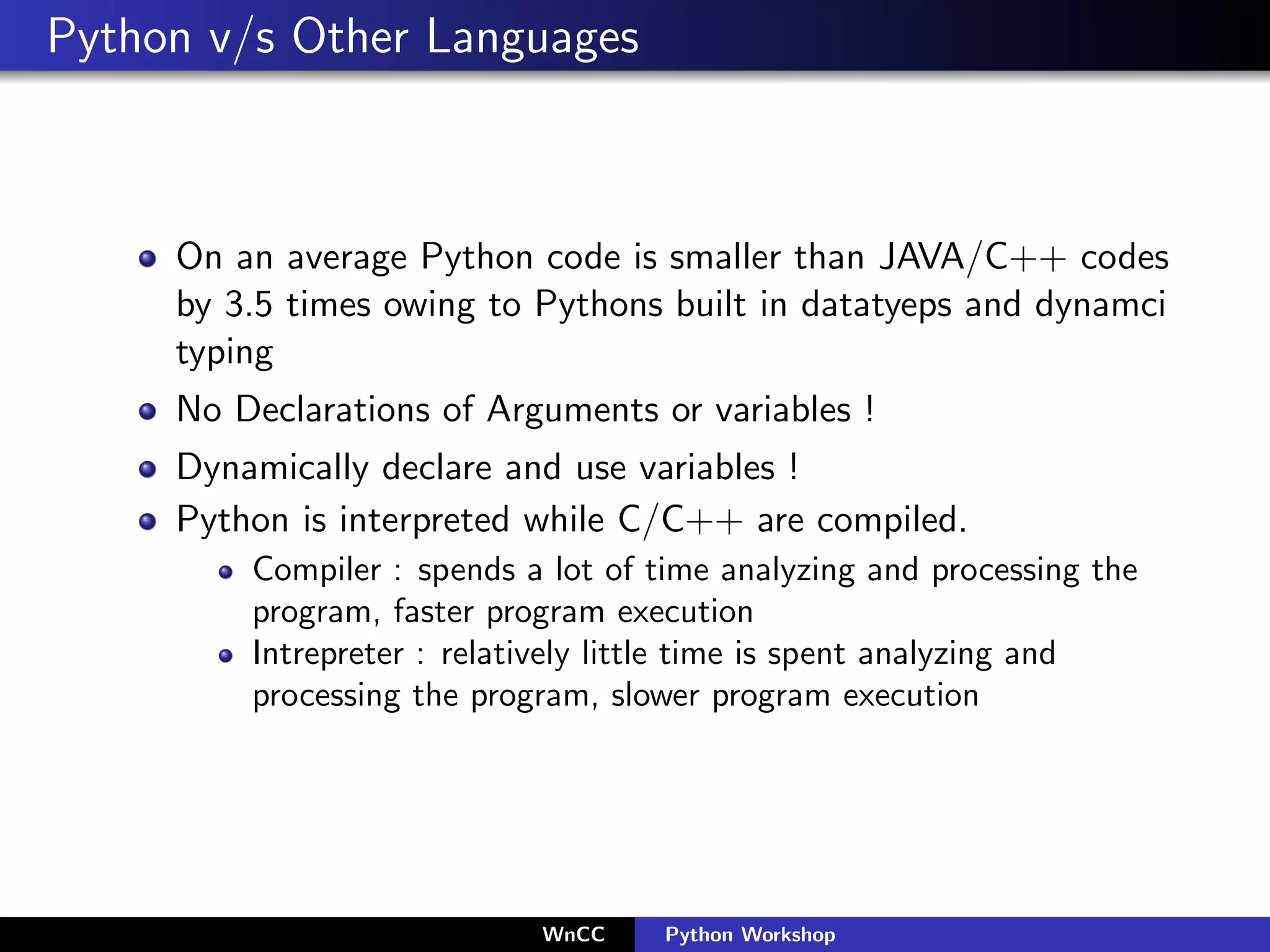
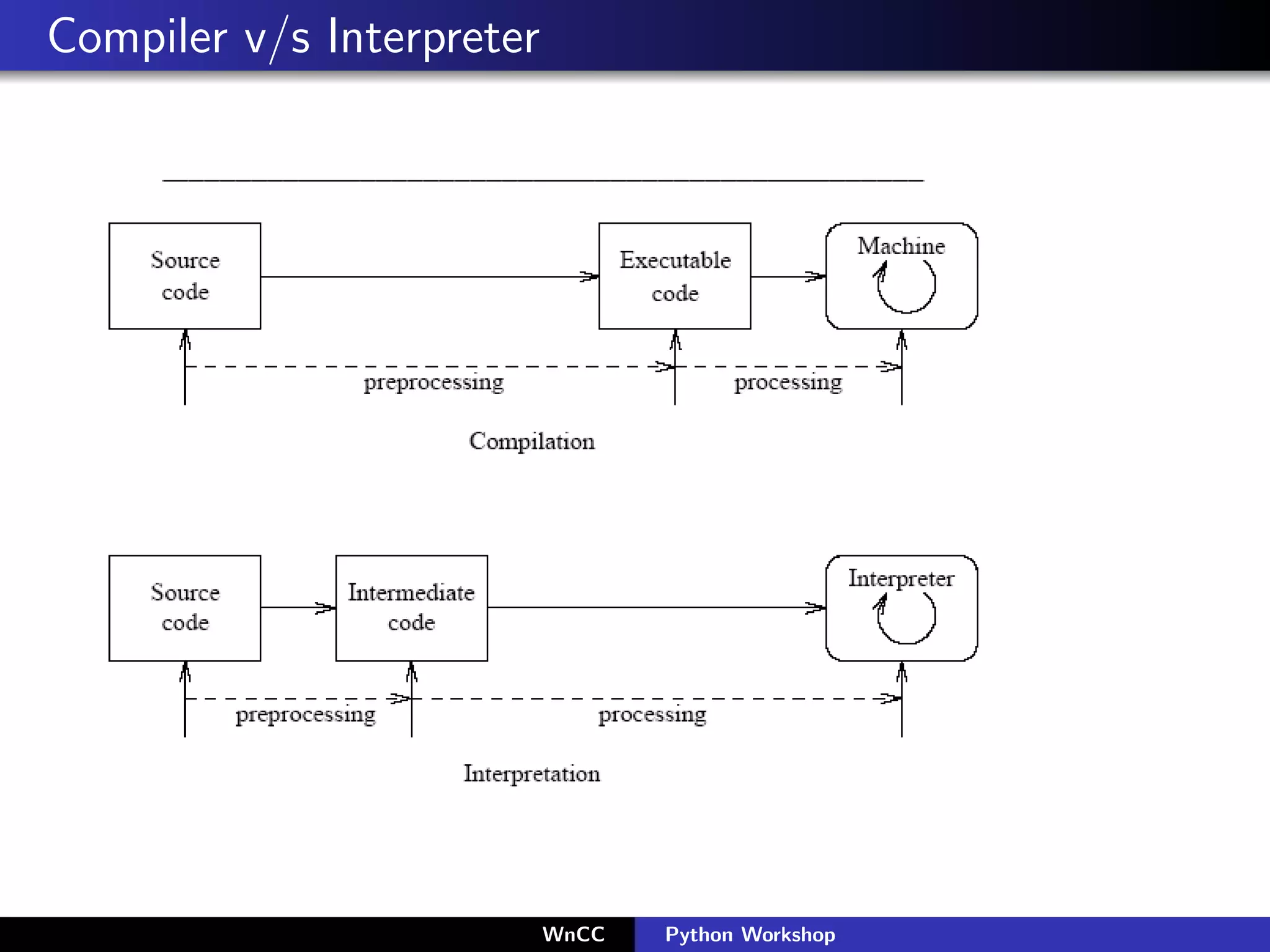
     Python is interpreted while C/C++ are compiled.
         Compiler : spends a lot of time analyzing and processing the
         program, faster program execution
         Intrepreter : relatively little time is spent analyzing and
         processing the program, slower program execution


                            WnCC    Python Workshop
Compiler v/s Interpreter


                           WnCC   Python Workshop
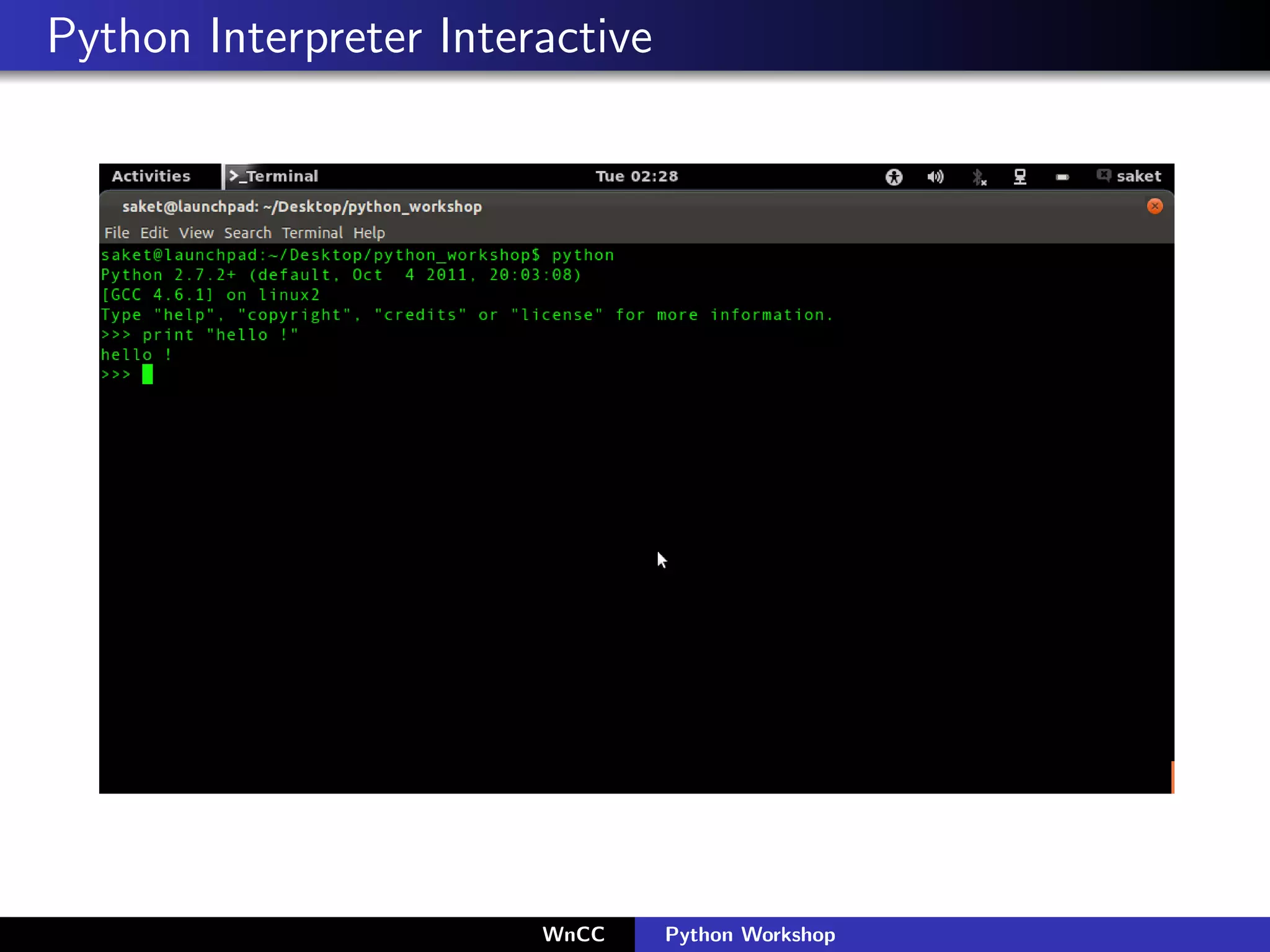
Python Interpreter Interactive


                        WnCC     Python Workshop
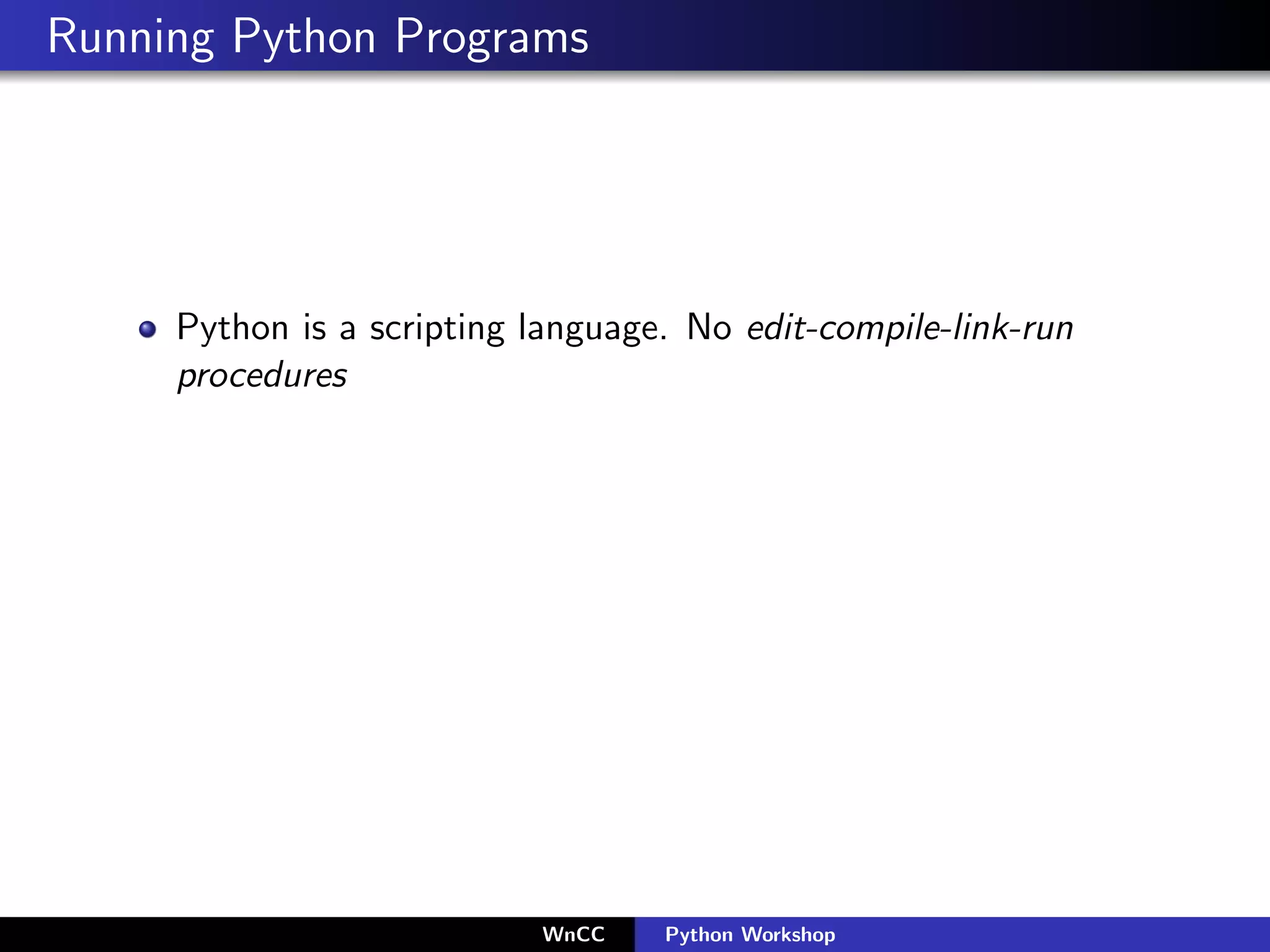
Running Python Programs


     Python is a scripting language. No edit-compile-link-run
     procedures


                           WnCC    Python Workshop
Running Python Programs


     Python is a scripting language. No edit-compile-link-run
     procedures
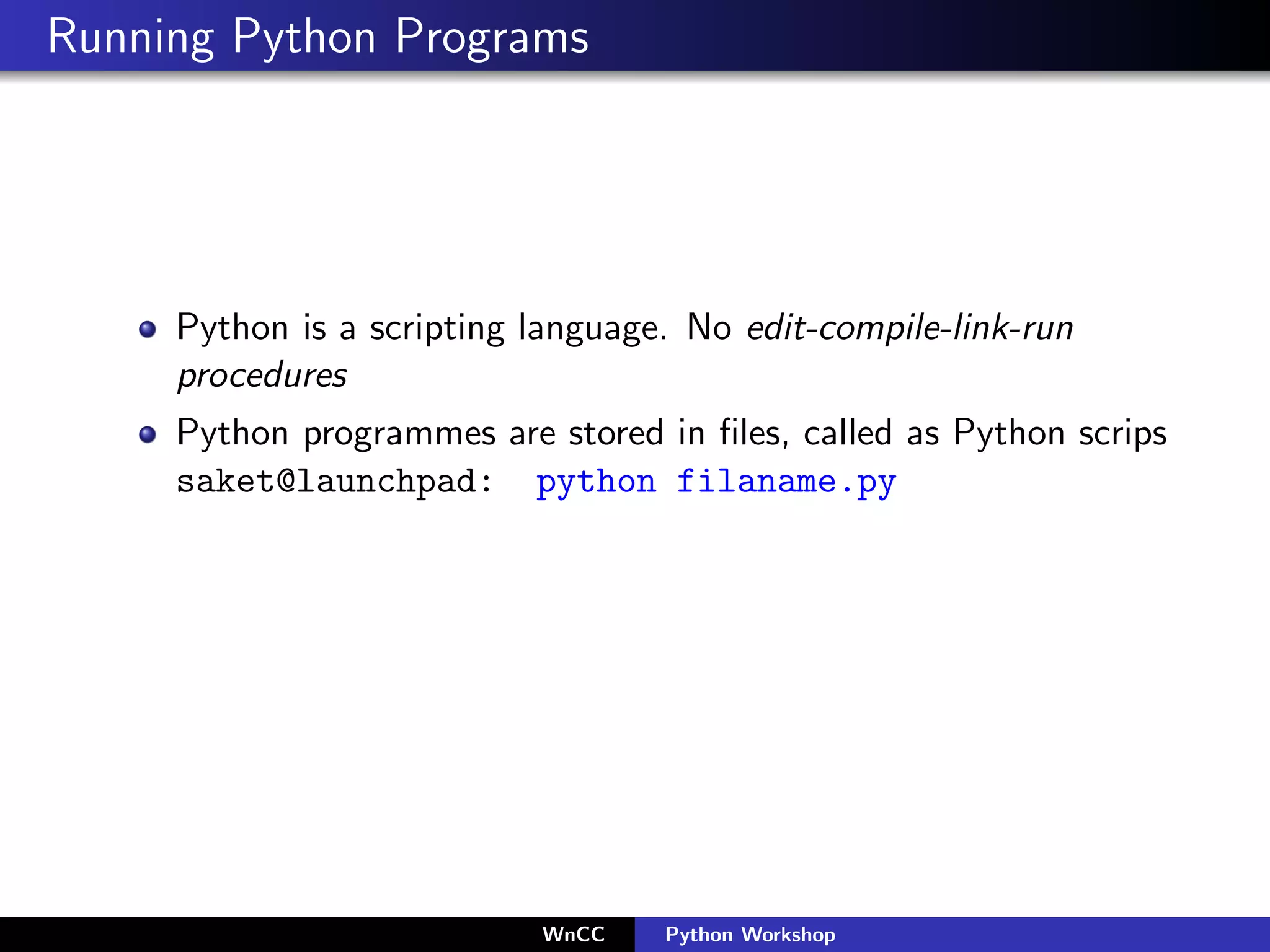
     Python programmes are stored in files, called as Python scrips
     saket@launchpad: python filaname.py


                           WnCC    Python Workshop
Running Python Programs


     Python is a scripting language. No edit-compile-link-run
     procedures
     Python programmes are stored in files, called as Python scrips
     saket@launchpad: python filaname.py
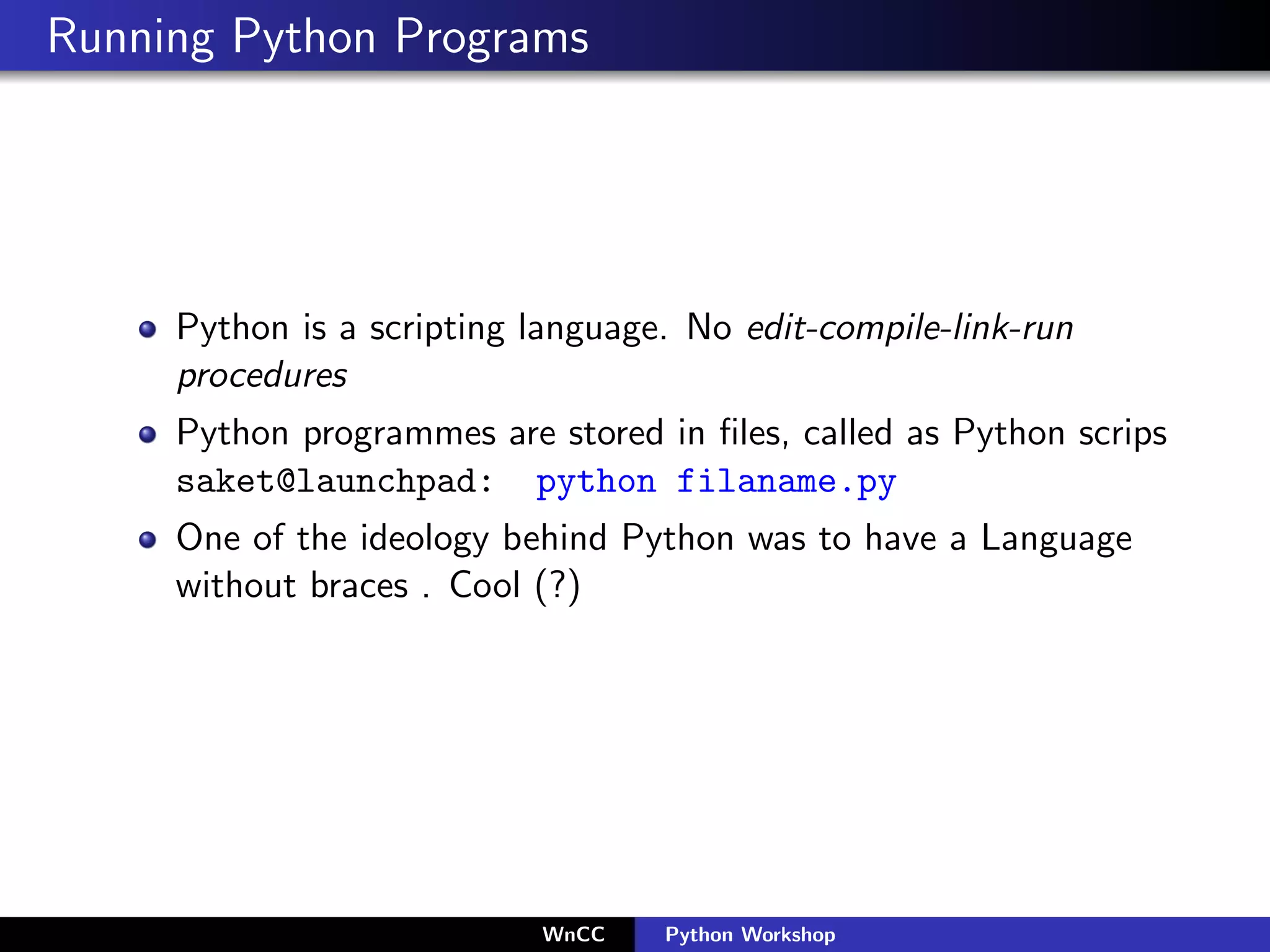
     One of the ideology behind Python was to have a Language
     without braces . Cool (?)


                           WnCC    Python Workshop
Sample I

     Variable declaration: The usual suspects:
           Strings
           int
           float
           bool
           complex
           files
     No declaration required
     x=3
     x ** 50
     Data Structures:
           Tuples - Immutable(Fixed length)
           ("this","cannot", "be" , "appended by anything")
           Lists
           ["this", "resembles", "traditional", "arrays"]


                           WnCC    Python Workshop
Sample II


            Dictonaries
            {"this":"corresponds to this", "and this": "to
            this"}
            set
            set(["this","has","unique","set of", "elements"])
            => union,intersection,difference


                           WnCC   Python Workshop
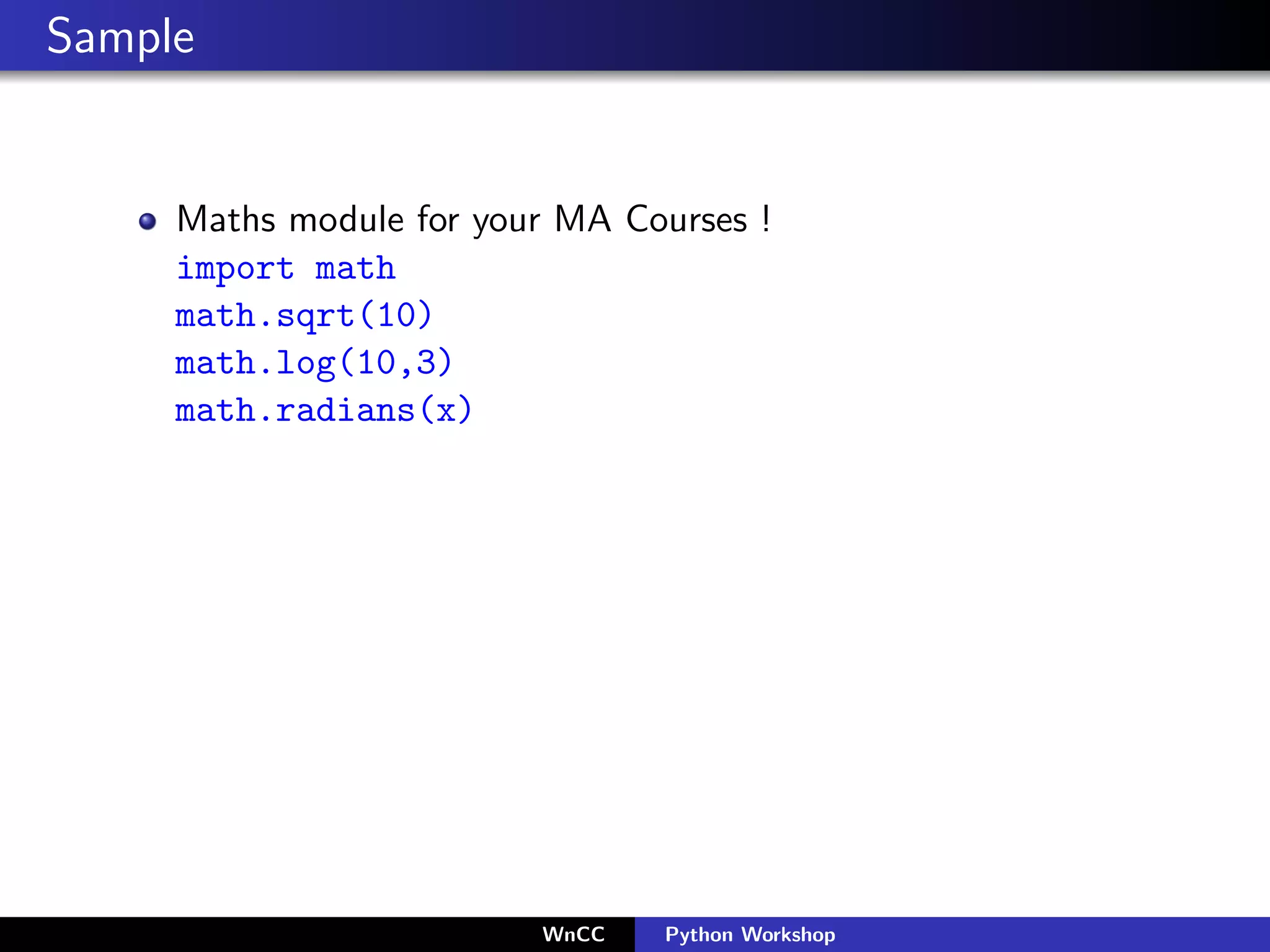
Sample


     Maths module for your MA Courses !
     import math
     math.sqrt(10)
     math.log(10,3)
     math.radians(x)


                         WnCC   Python Workshop
Sample


     Maths module for your MA Courses !
     import math
     math.sqrt(10)
     math.log(10,3)
     math.radians(x)
     Arrays of the scientific world from numpy import *
     a = array([1,2,3]) and not a = array(1,2,3)
     a
     array([1,2,3])
     zeros(3,4)
     array([[0., 0., 0., 0.], [0., 0., 0., 0.], [0.,
     0., 0., 0.]])


                         WnCC   Python Workshop
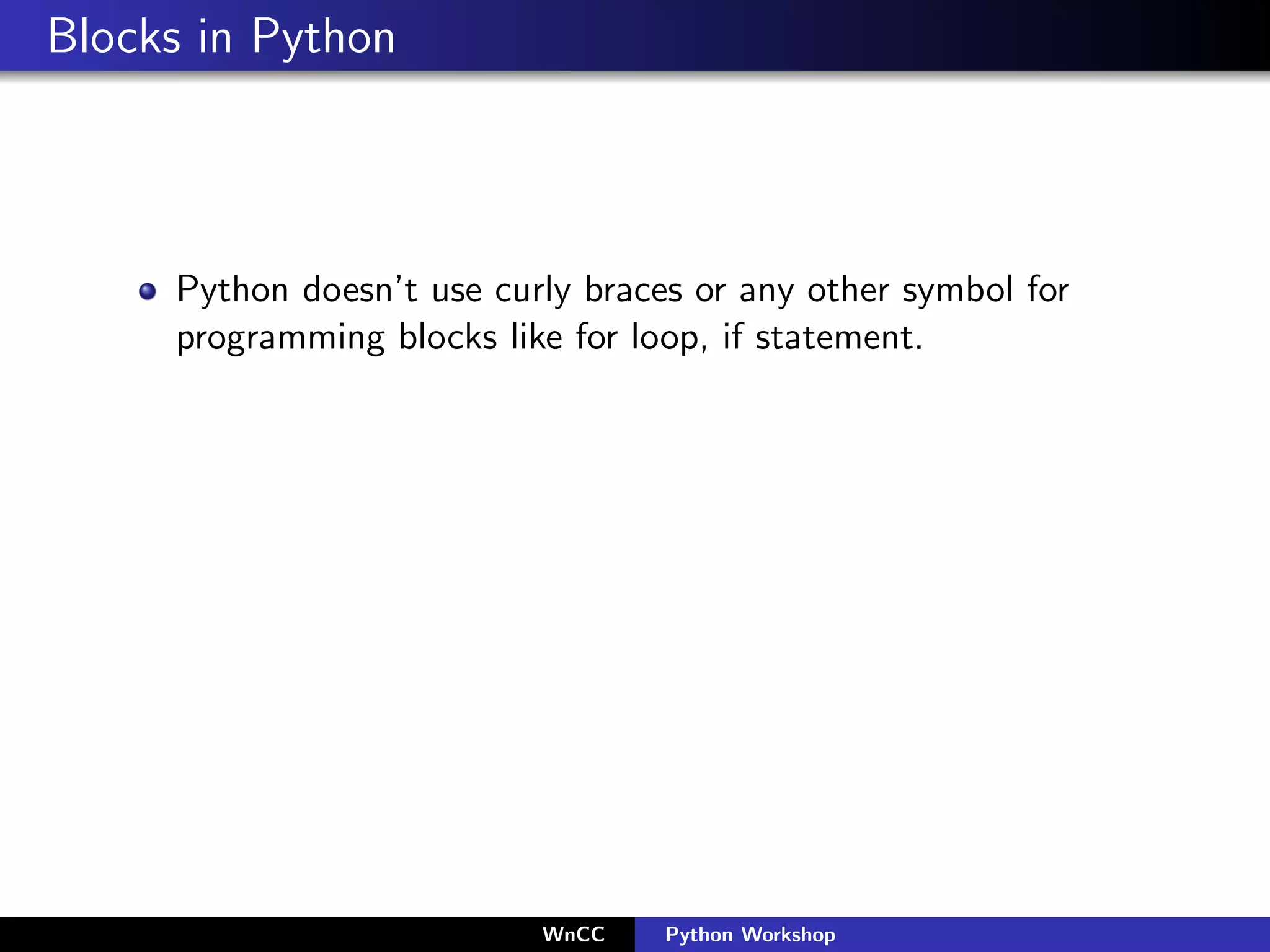
Blocks in Python


     Python doesn’t use curly braces or any other symbol for
     programming blocks like for loop, if statement.


                           WnCC    Python Workshop
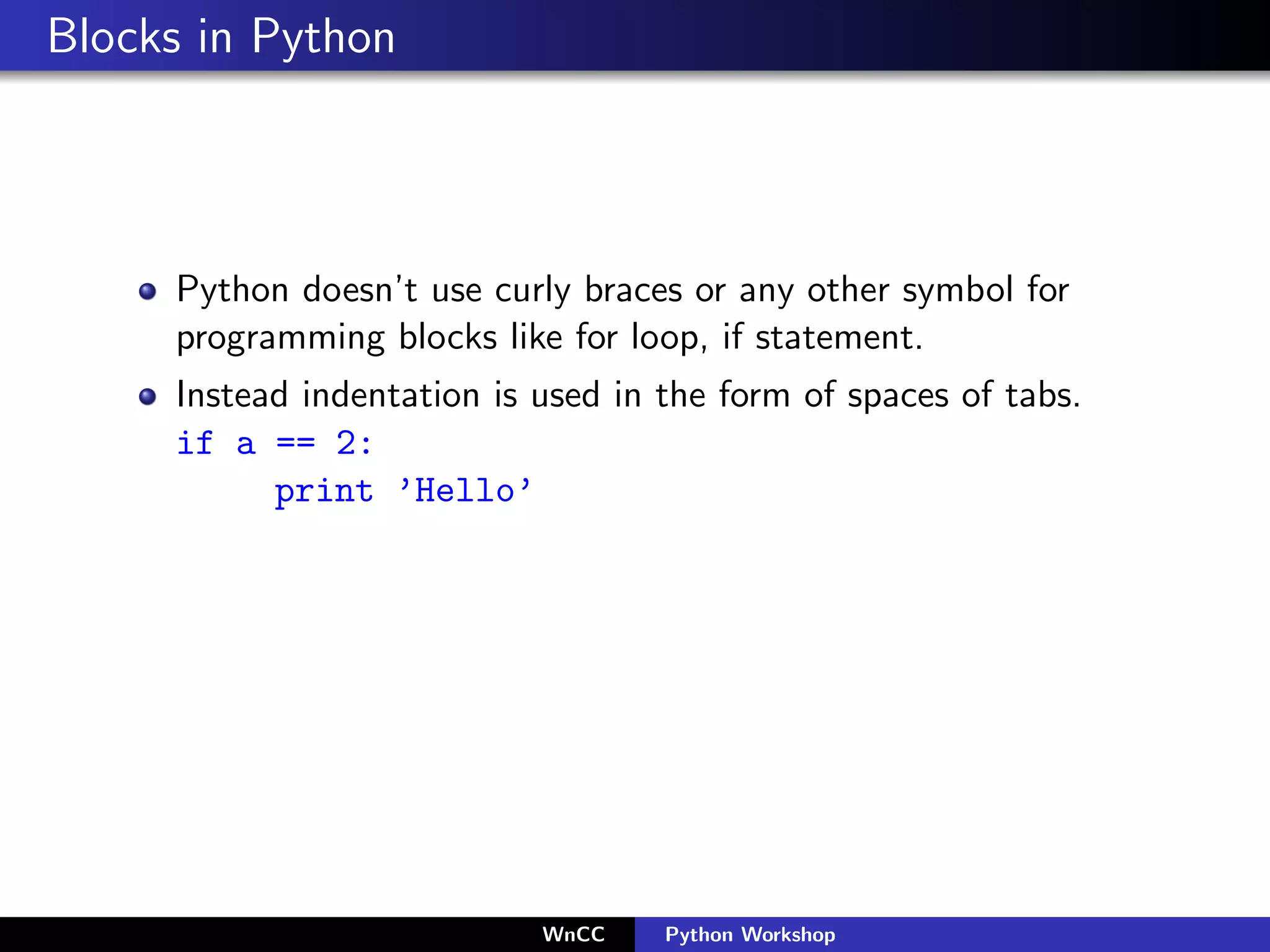
Blocks in Python


     Python doesn’t use curly braces or any other symbol for
     programming blocks like for loop, if statement.
     Instead indentation is used in the form of spaces of tabs.
     if a == 2:
           print ’Hello’


                            WnCC    Python Workshop
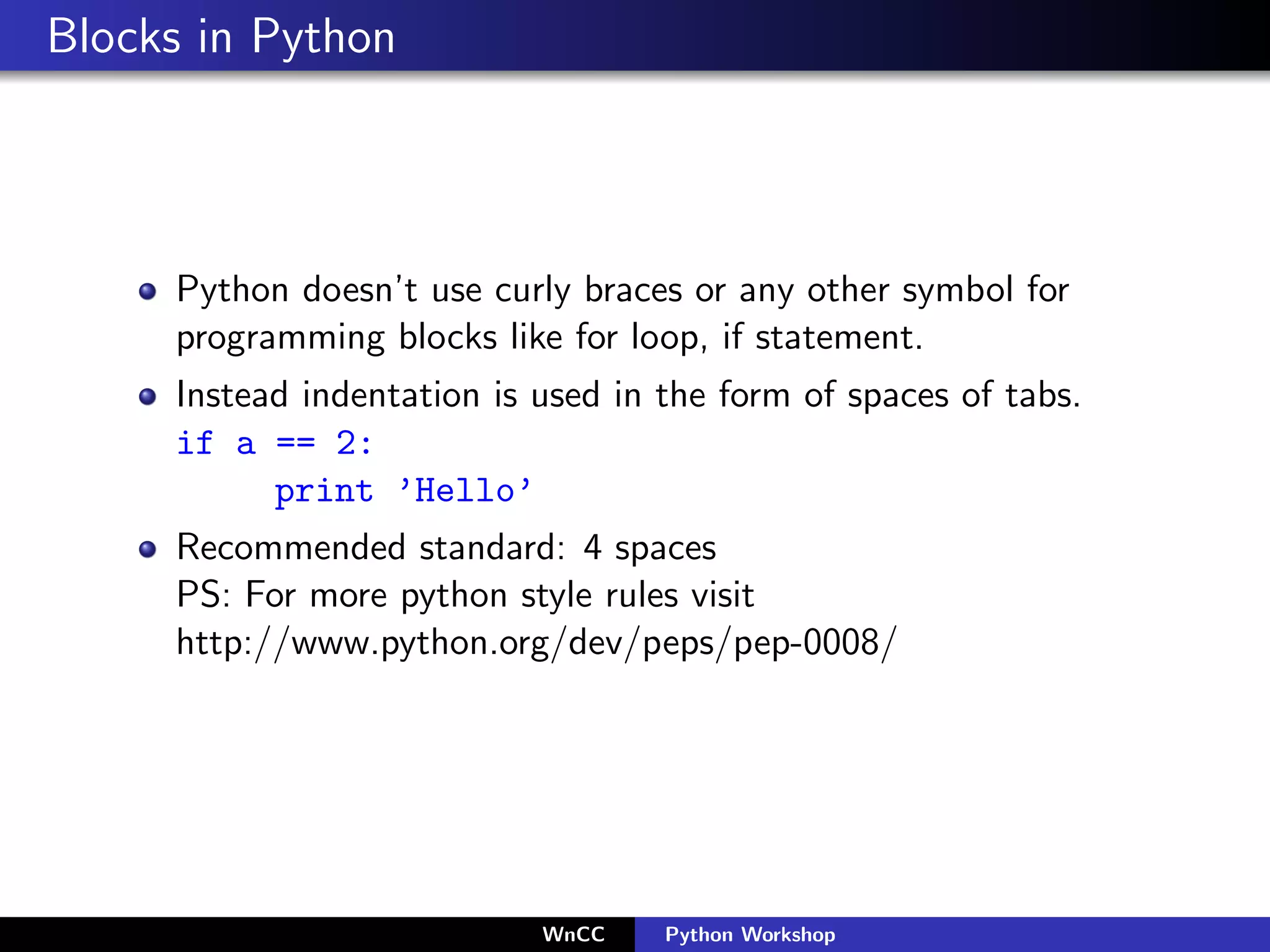
Blocks in Python


     Python doesn’t use curly braces or any other symbol for
     programming blocks like for loop, if statement.
     Instead indentation is used in the form of spaces of tabs.
     if a == 2:
           print ’Hello’
     Recommended standard: 4 spaces
     PS: For more python style rules visit
     http://www.python.org/dev/peps/pep-0008/


                            WnCC    Python Workshop
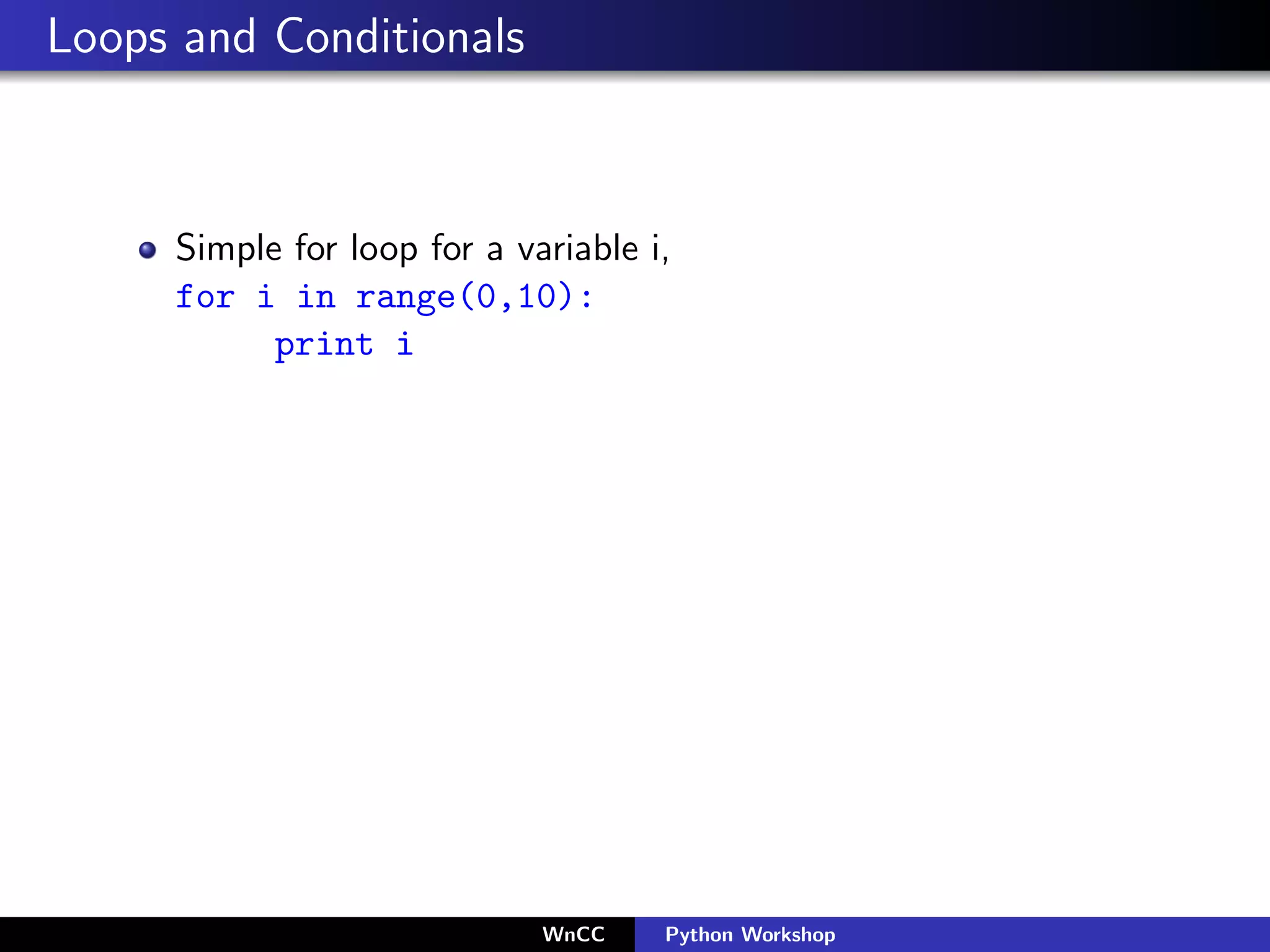
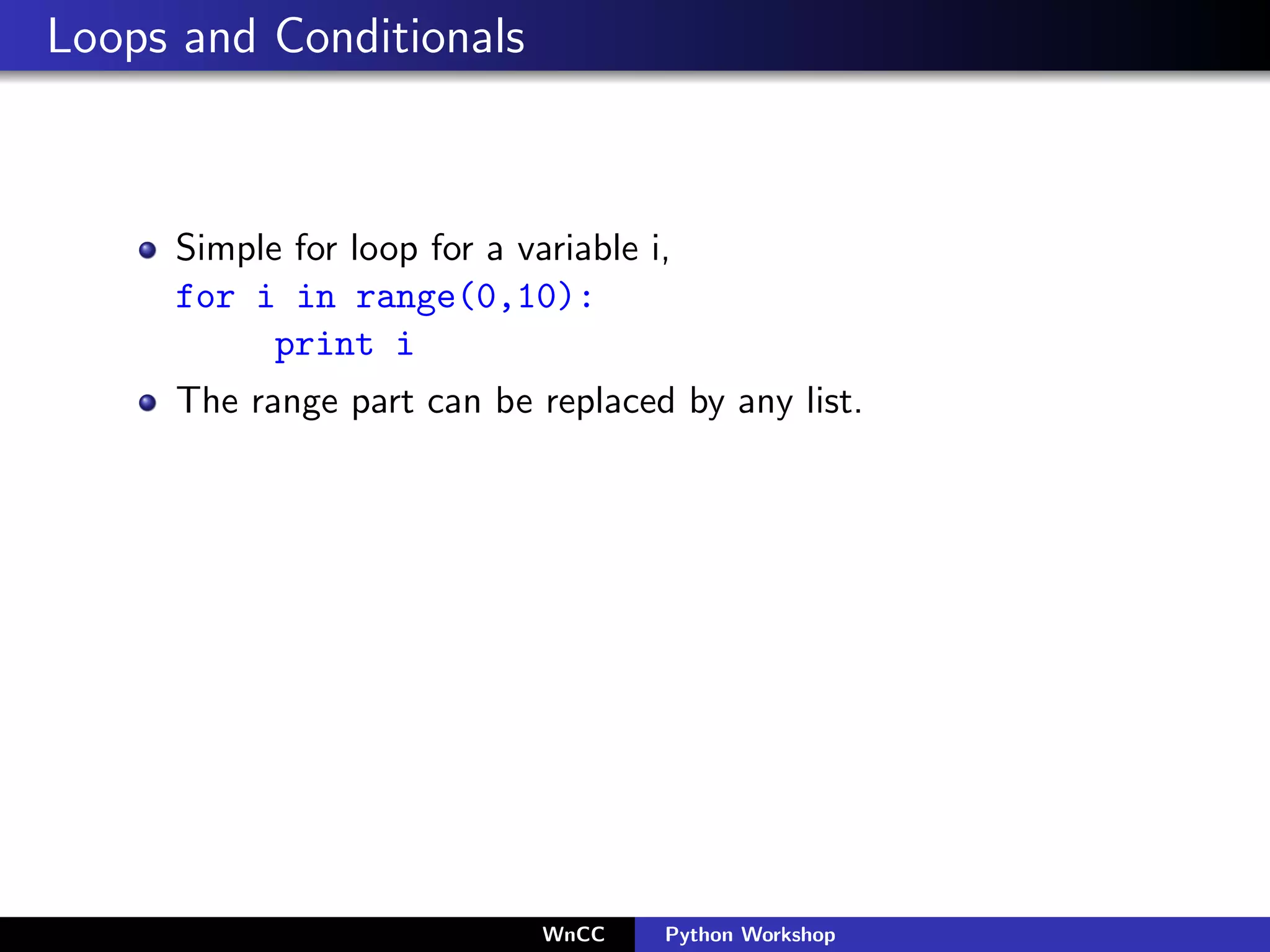
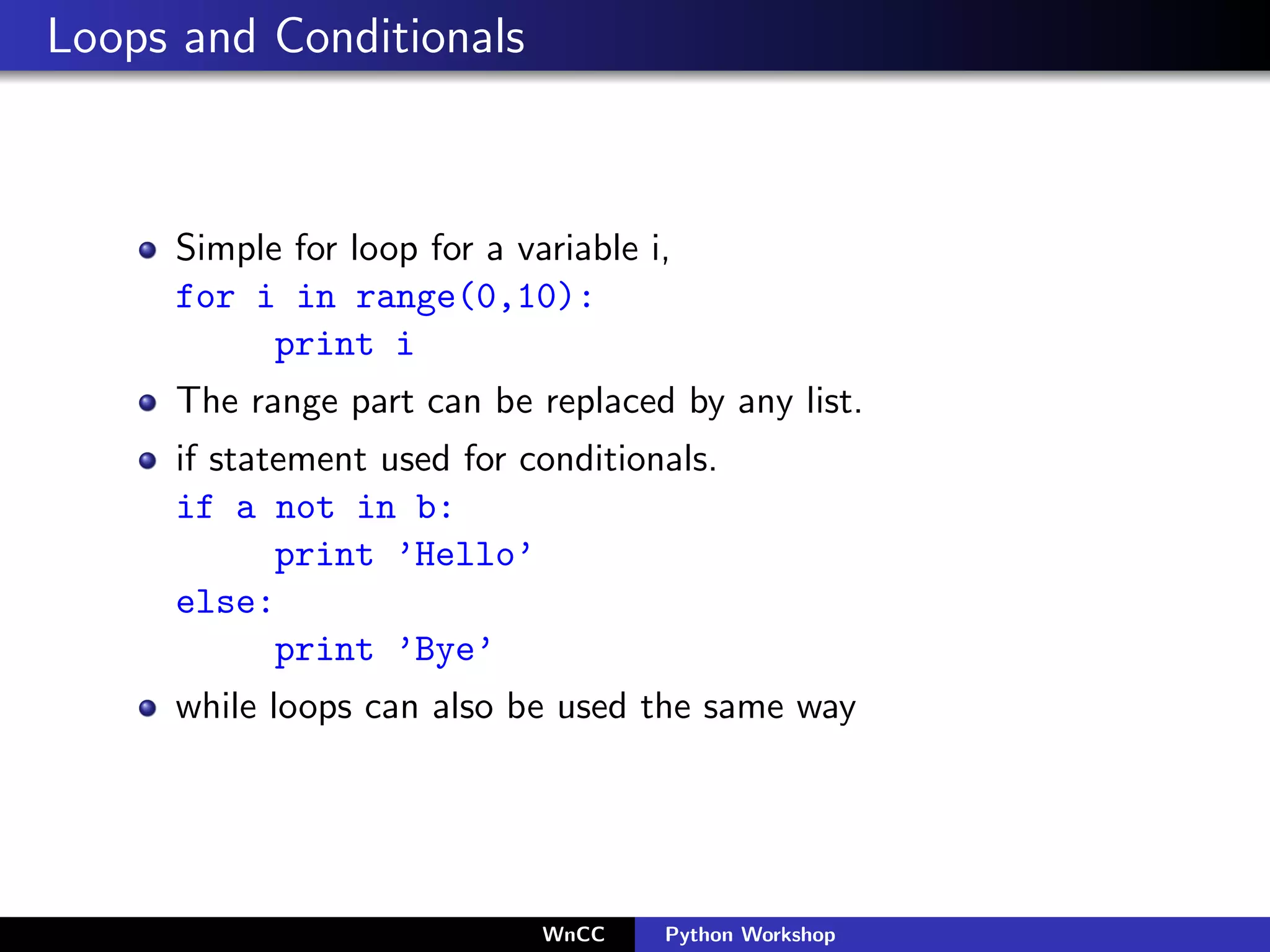
Loops and Conditionals


     Simple for loop for a variable i,
     for i in range(0,10):
           print i


                             WnCC    Python Workshop
Loops and Conditionals


     Simple for loop for a variable i,
     for i in range(0,10):
           print i
     The range part can be replaced by any list.


                             WnCC    Python Workshop
Loops and Conditionals


     Simple for loop for a variable i,
     for i in range(0,10):
           print i
     The range part can be replaced by any list.
     if statement used for conditionals.
     if a not in b:
            print ’Hello’
     else:
            print ’Bye’
     while loops can also be used the same way


                             WnCC    Python Workshop
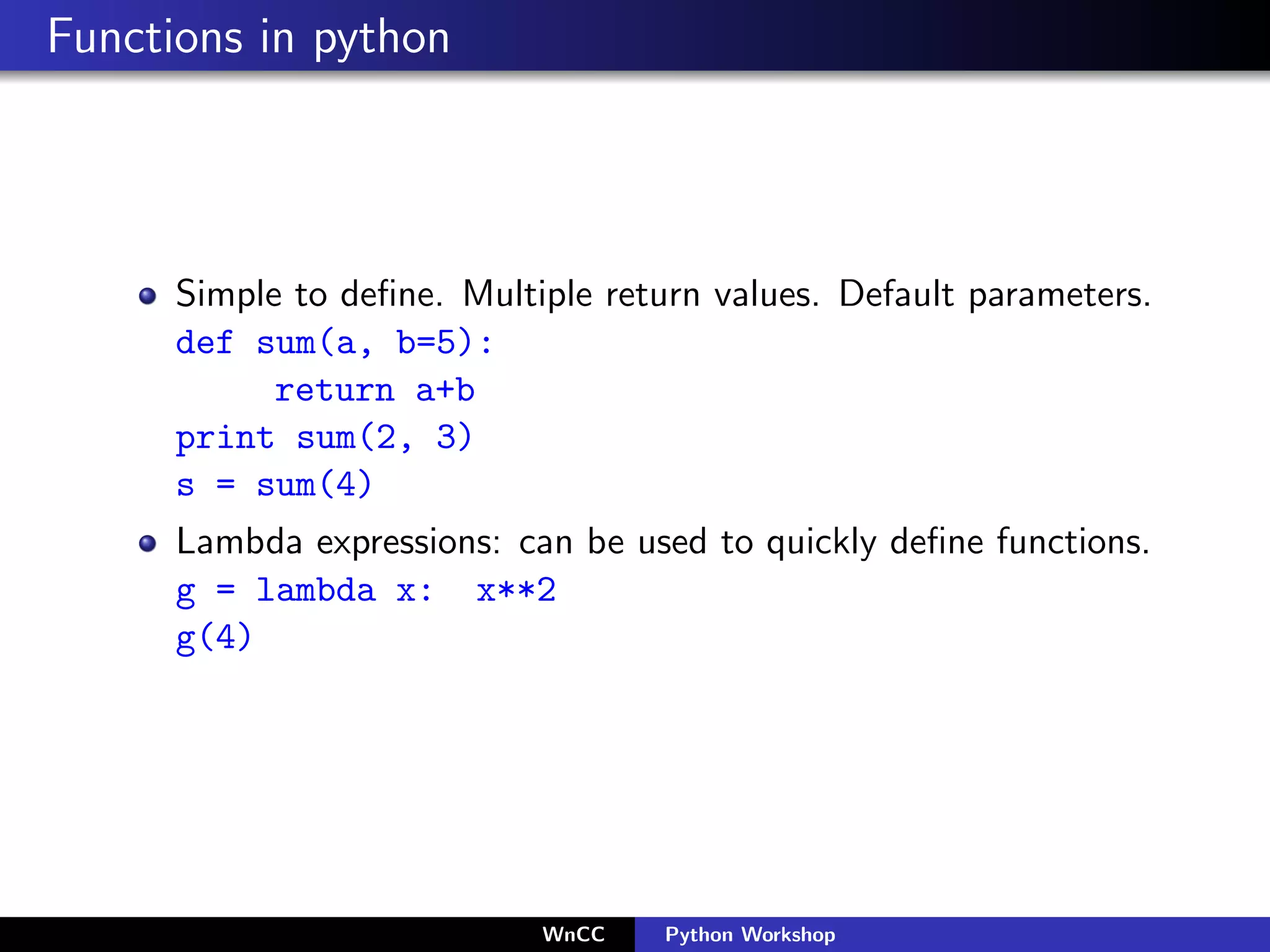
Functions in python


      Simple to define. Multiple return values. Default parameters.
      def sum(a, b=5):
            return a+b
      print sum(2, 3)
      s = sum(4)
      Lambda expressions: can be used to quickly define functions.
      g = lambda x: x**2
      g(4)


                            WnCC    Python Workshop
Lists and Tuples


      Tuples are just like lists, except their values cannot be
      changed.
      a = (2, 3)
      print a[0]
      Items can be added to a list using append and deleted using
      remove
      b = [2, 3]
      b.append(4)
      b.remove(2)


                              WnCC    Python Workshop
Lists and Tuples


      Tuples are just like lists, except their values cannot be
      changed.
      a = (2, 3)
      print a[0]
      Items can be added to a list using append and deleted using
      remove
      b = [2, 3]
      b.append(4)
      b.remove(2)
      The length of a list can be found out using len.
      Lists can store any type of object, you can even
      mix them len(b)
      l = [2, ’Hi’]


                              WnCC    Python Workshop
Dicts


        Dicts hold a value given a key, they can be used to store
        records.
        d = {’H2’: 23, ’H3’:17}
        print d[’H2’]
        d[’H5’] = 30


                               WnCC   Python Workshop
Dicts


        Dicts hold a value given a key, they can be used to store
        records.
        d = {’H2’: 23, ’H3’:17}
        print d[’H2’]
        d[’H5’] = 30
        To get a list of all keys or values
        print d.keys()
        v = d.values()


                                WnCC    Python Workshop
Dicts


        Dicts hold a value given a key, they can be used to store
        records.
        d = {’H2’: 23, ’H3’:17}
        print d[’H2’]
        d[’H5’] = 30
        To get a list of all keys or values
        print d.keys()
        v = d.values()
        The lists can also be sorted.
        v.sort()


                                WnCC    Python Workshop
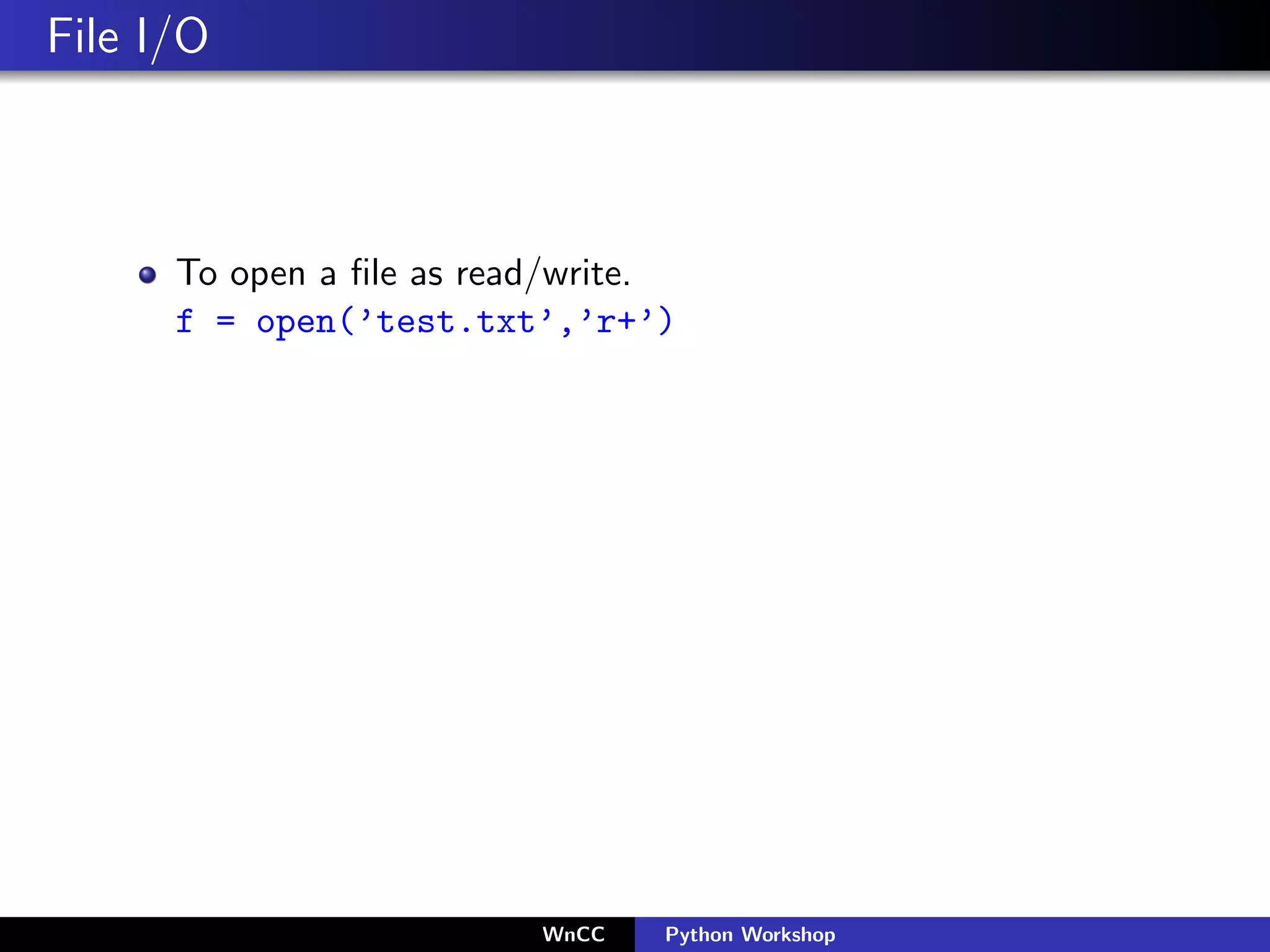
File I/O


      To open a file as read/write.
      f = open(’test.txt’,’r+’)


                          WnCC   Python Workshop
File I/O


      To open a file as read/write.
      f = open(’test.txt’,’r+’)
      To read the file entirely/line by line
      print f.read()
      print f.readline()


                              WnCC    Python Workshop
File I/O


      To open a file as read/write.
      f = open(’test.txt’,’r+’)
      To read the file entirely/line by line
      print f.read()
      print f.readline()
      Writing to a file, note the text is written at the current file
      location of f
      f.write("text")
      f.close()


                              WnCC    Python Workshop
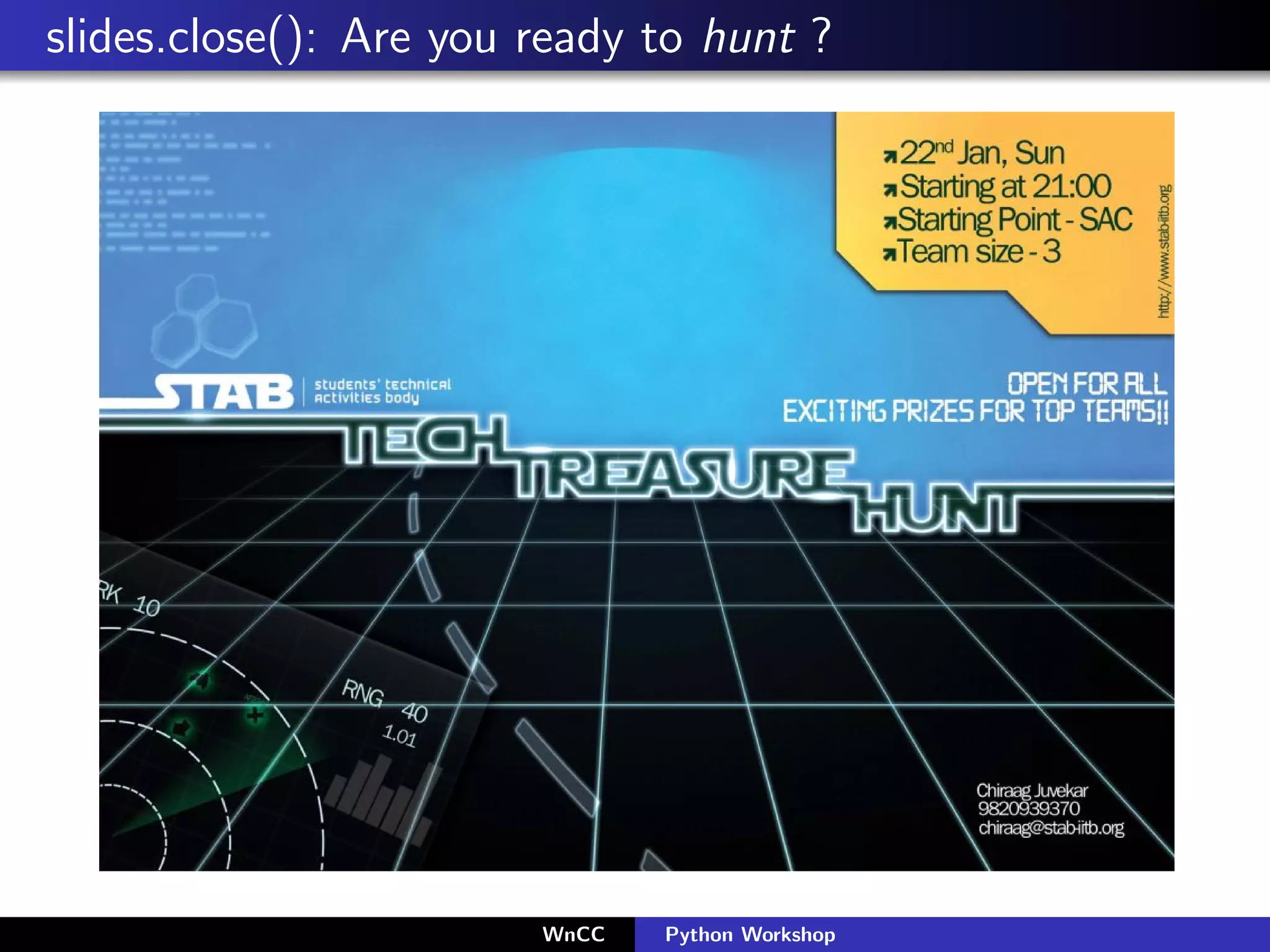
slides.close(): Are you ready to hunt ?


                        WnCC   Python Workshop

Python Workshop

  • 1.
    Python Workshop Chaitanya Talnikar Saket Choudhary January 18, 2012 WnCC Python Workshop
  • 2.
    Python Named after this : WnCC Python Workshop
  • 3.
    Python Slide 1 was a joke ! WnCC Python Workshop
  • 4.
    Python Slide 1 was a joke ! Python : Conceived in late 1980s by Guido van Rossum as a successor to ABC programming language ! WnCC Python Workshop
  • 5.
    Python Slide 1 was a joke ! Python : Conceived in late 1980s by Guido van Rossum as a successor to ABC programming language ! Philosophy: Language for readable code ! Remarkable power coupled with clear beautiful syntax ! WnCC Python Workshop
  • 6.
    Python Slide 1 was a joke ! Python : Conceived in late 1980s by Guido van Rossum as a successor to ABC programming language ! Philosophy: Language for readable code ! Remarkable power coupled with clear beautiful syntax ! Ideology behind Name : A Television Series Monty Python’s Flying Circus ! WnCC Python Workshop
  • 7.
    Monty Python WnCC Python Workshop
  • 8.
    Python: The PowerPack Readable Syntax, Clarity print "Hi There !" WnCC Python Workshop
  • 9.
    Python: The PowerPack Readable Syntax, Clarity print "Hi There !" Intuitive object Orientedness WnCC Python Workshop
  • 10.
    Python: The PowerPack Readable Syntax, Clarity print "Hi There !" Intuitive object Orientedness Natural Expression of Procedural Code WnCC Python Workshop
  • 11.
    Python: The PowerPack Readable Syntax, Clarity print "Hi There !" Intuitive object Orientedness Natural Expression of Procedural Code Full Modularity, support for heirarchical packages WnCC Python Workshop
  • 12.
    Python: The PowerPack Readable Syntax, Clarity print "Hi There !" Intuitive object Orientedness Natural Expression of Procedural Code Full Modularity, support for heirarchical packages Exception-based Error Handling ! WnCC Python Workshop
  • 13.
    Python: The PowerPack Readable Syntax, Clarity print "Hi There !" Intuitive object Orientedness Natural Expression of Procedural Code Full Modularity, support for heirarchical packages Exception-based Error Handling ! Is Open Source ! WnCC Python Workshop
  • 14.
    Python can runeverywhere, Literally ! Windows,Mac,Linux Most of Linux versions have Python pre-installed for other dependenices Python for Windows : http://python.org/getit/ We will stick to Python2.7 for the session WnCC Python Workshop
  • 15.
    Python v/s OtherLanguages On an average Python code is smaller than JAVA/C++ codes by 3.5 times owing to Pythons built in datatyeps and dynamci typing WnCC Python Workshop
  • 16.
    Python v/s OtherLanguages On an average Python code is smaller than JAVA/C++ codes by 3.5 times owing to Pythons built in datatyeps and dynamci typing No Declarations of Arguments or variables ! WnCC Python Workshop
  • 17.
    Python v/s OtherLanguages On an average Python code is smaller than JAVA/C++ codes by 3.5 times owing to Pythons built in datatyeps and dynamci typing No Declarations of Arguments or variables ! Dynamically declare and use variables ! WnCC Python Workshop
  • 18.
    Python v/s OtherLanguages On an average Python code is smaller than JAVA/C++ codes by 3.5 times owing to Pythons built in datatyeps and dynamci typing No Declarations of Arguments or variables ! Dynamically declare and use variables ! Python is interpreted while C/C++ are compiled. Compiler : spends a lot of time analyzing and processing the program, faster program execution Intrepreter : relatively little time is spent analyzing and processing the program, slower program execution WnCC Python Workshop
  • 19.
    Compiler v/s Interpreter WnCC Python Workshop
  • 20.
    Python Interpreter Interactive WnCC Python Workshop
  • 21.
    Running Python Programs Python is a scripting language. No edit-compile-link-run procedures WnCC Python Workshop
  • 22.
    Running Python Programs Python is a scripting language. No edit-compile-link-run procedures Python programmes are stored in files, called as Python scrips saket@launchpad: python filaname.py WnCC Python Workshop
  • 23.
    Running Python Programs Python is a scripting language. No edit-compile-link-run procedures Python programmes are stored in files, called as Python scrips saket@launchpad: python filaname.py One of the ideology behind Python was to have a Language without braces . Cool (?) WnCC Python Workshop
  • 24.
    Sample I Variable declaration: The usual suspects: Strings int float bool complex files No declaration required x=3 x ** 50 Data Structures: Tuples - Immutable(Fixed length) ("this","cannot", "be" , "appended by anything") Lists ["this", "resembles", "traditional", "arrays"] WnCC Python Workshop
  • 25.
    Sample II Dictonaries {"this":"corresponds to this", "and this": "to this"} set set(["this","has","unique","set of", "elements"]) => union,intersection,difference WnCC Python Workshop
  • 26.
    Sample Maths module for your MA Courses ! import math math.sqrt(10) math.log(10,3) math.radians(x) WnCC Python Workshop
  • 27.
    Sample Maths module for your MA Courses ! import math math.sqrt(10) math.log(10,3) math.radians(x) Arrays of the scientific world from numpy import * a = array([1,2,3]) and not a = array(1,2,3) a array([1,2,3]) zeros(3,4) array([[0., 0., 0., 0.], [0., 0., 0., 0.], [0., 0., 0., 0.]]) WnCC Python Workshop
  • 28.
    Blocks in Python Python doesn’t use curly braces or any other symbol for programming blocks like for loop, if statement. WnCC Python Workshop
  • 29.
    Blocks in Python Python doesn’t use curly braces or any other symbol for programming blocks like for loop, if statement. Instead indentation is used in the form of spaces of tabs. if a == 2: print ’Hello’ WnCC Python Workshop
  • 30.
    Blocks in Python Python doesn’t use curly braces or any other symbol for programming blocks like for loop, if statement. Instead indentation is used in the form of spaces of tabs. if a == 2: print ’Hello’ Recommended standard: 4 spaces PS: For more python style rules visit http://www.python.org/dev/peps/pep-0008/ WnCC Python Workshop
  • 31.
    Loops and Conditionals Simple for loop for a variable i, for i in range(0,10): print i WnCC Python Workshop
  • 32.
    Loops and Conditionals Simple for loop for a variable i, for i in range(0,10): print i The range part can be replaced by any list. WnCC Python Workshop
  • 33.
    Loops and Conditionals Simple for loop for a variable i, for i in range(0,10): print i The range part can be replaced by any list. if statement used for conditionals. if a not in b: print ’Hello’ else: print ’Bye’ while loops can also be used the same way WnCC Python Workshop
  • 34.
    Functions in python Simple to define. Multiple return values. Default parameters. def sum(a, b=5): return a+b print sum(2, 3) s = sum(4) Lambda expressions: can be used to quickly define functions. g = lambda x: x**2 g(4) WnCC Python Workshop
  • 35.
    Lists and Tuples Tuples are just like lists, except their values cannot be changed. a = (2, 3) print a[0] Items can be added to a list using append and deleted using remove b = [2, 3] b.append(4) b.remove(2) WnCC Python Workshop
  • 36.
    Lists and Tuples Tuples are just like lists, except their values cannot be changed. a = (2, 3) print a[0] Items can be added to a list using append and deleted using remove b = [2, 3] b.append(4) b.remove(2) The length of a list can be found out using len. Lists can store any type of object, you can even mix them len(b) l = [2, ’Hi’] WnCC Python Workshop
  • 37.
    Dicts Dicts hold a value given a key, they can be used to store records. d = {’H2’: 23, ’H3’:17} print d[’H2’] d[’H5’] = 30 WnCC Python Workshop
  • 38.
    Dicts Dicts hold a value given a key, they can be used to store records. d = {’H2’: 23, ’H3’:17} print d[’H2’] d[’H5’] = 30 To get a list of all keys or values print d.keys() v = d.values() WnCC Python Workshop
  • 39.
    Dicts Dicts hold a value given a key, they can be used to store records. d = {’H2’: 23, ’H3’:17} print d[’H2’] d[’H5’] = 30 To get a list of all keys or values print d.keys() v = d.values() The lists can also be sorted. v.sort() WnCC Python Workshop
  • 40.
    File I/O To open a file as read/write. f = open(’test.txt’,’r+’) WnCC Python Workshop
  • 41.
    File I/O To open a file as read/write. f = open(’test.txt’,’r+’) To read the file entirely/line by line print f.read() print f.readline() WnCC Python Workshop
  • 42.
    File I/O To open a file as read/write. f = open(’test.txt’,’r+’) To read the file entirely/line by line print f.read() print f.readline() Writing to a file, note the text is written at the current file location of f f.write("text") f.close() WnCC Python Workshop
  • 43.
    slides.close(): Are youready to hunt ? WnCC Python Workshop