Swipe
Python - Variable Types
Variables are nothing but reserved memory
locations to store values.
This means that when you create a variable you
reserve some space in memory.
Based on the data type of a variable, the interpreter
allocates memory and decides what can be stored
in the reserved memory.
Therefore, by assigning different data types to
variables, you can store integers, decimals or
characters in these variables.
Python - Variable Types
Python variables do not need explicit declaration to
reserve memory space.
The declaration happens automatically when you
assign a value to a variable.
The equal sign (=) is used to assign values to
variables.
Assigning Values to Variables
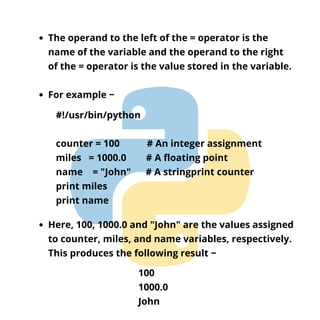
The operand to the left of the = operator is the
name of the variable and the operand to the right
of the = operator is the value stored in the variable.
For example −
#!/usr/bin/python
counter = 100 # An integer assignment
miles = 1000.0 # A floating point
name = "John" # A stringprint counter
print miles
print name
Here, 100, 1000.0 and "John" are the values assigned
to counter, miles, and name variables, respectively.
This produces the following result −
100
1000.0
John
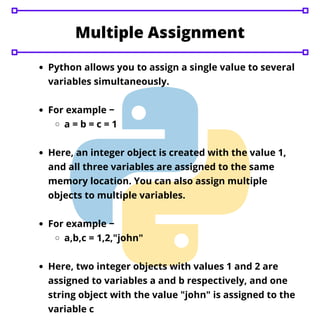
Python allows you to assign a single value to several
variables simultaneously.
For example −
a = b = c = 1
Here, an integer object is created with the value 1,
and all three variables are assigned to the same
memory location. You can also assign multiple
objects to multiple variables.
For example −
a,b,c = 1,2,"john"
Here, two integer objects with values 1 and 2 are
assigned to variables a and b respectively, and one
string object with the value "john" is assigned to the
variable c
Multiple Assignment
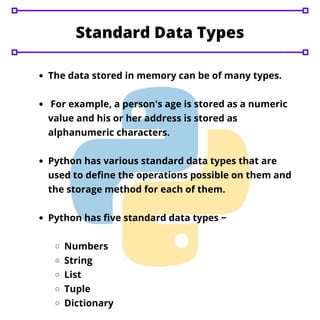
The data stored in memory can be of many types.
For example, a person's age is stored as a numeric
value and his or her address is stored as
alphanumeric characters.
Python has various standard data types that are
used to define the operations possible on them and
the storage method for each of them.
Python has five standard data types −
Numbers
String
List
Tuple
Dictionary
Standard Data Types
Sometimes, you may need to perform conversions
between the built-in types.
To convert between types, you simply use the type
name as a function.
There are several built-in functions to perform
conversion from one data type to another.
These functions return a new object representing
the converted value.
Data Type Conversion
int(x [,base])
Converts x to an integer. base specifies the base
if x is a string.
long(x [,base] )
Converts x to a long integer. base specifies the
base if x is a string.
float(x)
Converts x to a floating-point number.
complex(real [,imag])
Creates a complex number.
str(x)
Converts object x to a string representation.
repr(x)
Converts object x to an expression string.
eval(str)
Evaluates a string and returns an object.
oct(x)
Converts an integer to an octal string.
Function & Description
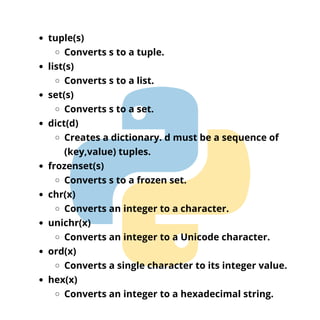
tuple(s)
Converts s to a tuple.
list(s)
Converts s to a list.
set(s)
Converts s to a set.
dict(d)
Creates a dictionary. d must be a sequence of
(key,value) tuples.
frozenset(s)
Converts s to a frozen set.
chr(x)
Converts an integer to a character.
unichr(x)
Converts an integer to a Unicode character.
ord(x)
Converts a single character to its integer value.
hex(x)
Converts an integer to a hexadecimal string.
Python Standard Data Types
Python Operations
Stay Tuned with
Topics for next Post

Python - variable types

  • 1.
  • 2.
    Variables are nothingbut reserved memory locations to store values. This means that when you create a variable you reserve some space in memory. Based on the data type of a variable, the interpreter allocates memory and decides what can be stored in the reserved memory. Therefore, by assigning different data types to variables, you can store integers, decimals or characters in these variables. Python - Variable Types
  • 3.
    Python variables donot need explicit declaration to reserve memory space. The declaration happens automatically when you assign a value to a variable. The equal sign (=) is used to assign values to variables. Assigning Values to Variables
  • 4.
    The operand tothe left of the = operator is the name of the variable and the operand to the right of the = operator is the value stored in the variable. For example − #!/usr/bin/python counter = 100 # An integer assignment miles = 1000.0 # A floating point name = "John" # A stringprint counter print miles print name Here, 100, 1000.0 and "John" are the values assigned to counter, miles, and name variables, respectively. This produces the following result − 100 1000.0 John
  • 5.
    Python allows youto assign a single value to several variables simultaneously. For example − a = b = c = 1 Here, an integer object is created with the value 1, and all three variables are assigned to the same memory location. You can also assign multiple objects to multiple variables. For example − a,b,c = 1,2,"john" Here, two integer objects with values 1 and 2 are assigned to variables a and b respectively, and one string object with the value "john" is assigned to the variable c Multiple Assignment
  • 6.
    The data storedin memory can be of many types. For example, a person's age is stored as a numeric value and his or her address is stored as alphanumeric characters. Python has various standard data types that are used to define the operations possible on them and the storage method for each of them. Python has five standard data types − Numbers String List Tuple Dictionary Standard Data Types
  • 7.
    Sometimes, you mayneed to perform conversions between the built-in types. To convert between types, you simply use the type name as a function. There are several built-in functions to perform conversion from one data type to another. These functions return a new object representing the converted value. Data Type Conversion
  • 8.
    int(x [,base]) Converts xto an integer. base specifies the base if x is a string. long(x [,base] ) Converts x to a long integer. base specifies the base if x is a string. float(x) Converts x to a floating-point number. complex(real [,imag]) Creates a complex number. str(x) Converts object x to a string representation. repr(x) Converts object x to an expression string. eval(str) Evaluates a string and returns an object. oct(x) Converts an integer to an octal string. Function & Description
  • 9.
    tuple(s) Converts s toa tuple. list(s) Converts s to a list. set(s) Converts s to a set. dict(d) Creates a dictionary. d must be a sequence of (key,value) tuples. frozenset(s) Converts s to a frozen set. chr(x) Converts an integer to a character. unichr(x) Converts an integer to a Unicode character. ord(x) Converts a single character to its integer value. hex(x) Converts an integer to a hexadecimal string.
  • 10.
    Python Standard DataTypes Python Operations Stay Tuned with Topics for next Post