 Tuples are very similar to lists, except that
they are immutable (they cannot be
changed).
 They are created using parentheses, rather
than square brackets.
 We generally use tuple for heterogeneous (different)
datatypes and list for homogeneous (similar) datatypes.
 Since tuple are immutable, iterating through tuple is
faster than with list. So there is a slight performance
boost.
 Tuples that contain immutable elements can be used as
key for a dictionary. With list, this is not possible.
 If you have data that doesn't change, implementing it as
tuple will guarantee that it remains write-protected.
mohammed.sikander@cranessoftware.com 3
 A tuple is created by placing all the
items (elements) inside a parentheses
(), separated by comma.
 The parentheses are optional but is a
good practice to write it.
 A tuple can have any number of items
and they may be of different types
(integer, float, list, string etc.).
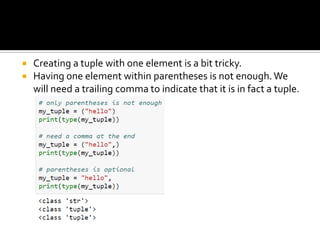
 Creating a tuple with one element is a bit tricky.
 Having one element within parentheses is not enough.We
will need a trailing comma to indicate that it is in fact a tuple.
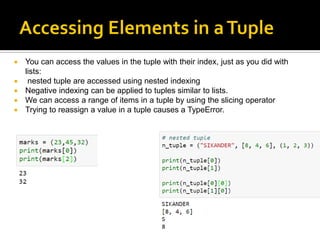
 You can access the values in the tuple with their index, just as you did with
lists:
 nested tuple are accessed using nested indexing
 Negative indexing can be applied to tuples similar to lists.
 We can access a range of items in a tuple by using the slicing operator
 Trying to reassign a value in a tuple causes a TypeError.
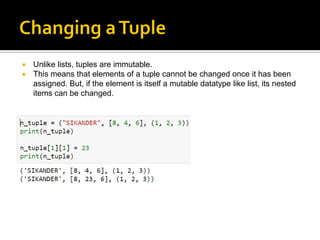
 Unlike lists, tuples are immutable.
 This means that elements of a tuple cannot be changed once it has been
assigned. But, if the element is itself a mutable datatype like list, its nested
items can be changed.
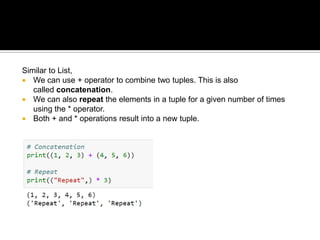
Similar to List,
 We can use + operator to combine two tuples. This is also
called concatenation.
 We can also repeat the elements in a tuple for a given number of times
using the * operator.
 Both + and * operations result into a new tuple.
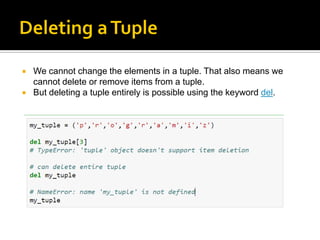
 We cannot change the elements in a tuple. That also means we
cannot delete or remove items from a tuple.
 But deleting a tuple entirely is possible using the keyword del.
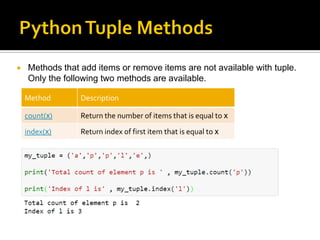
 Methods that add items or remove items are not available with tuple.
Only the following two methods are available.
Method Description
count(x) Return the number of items that is equal to x
index(x) Return index of first item that is equal to x
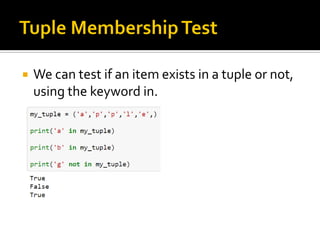
 We can test if an item exists in a tuple or not,
using the keyword in.
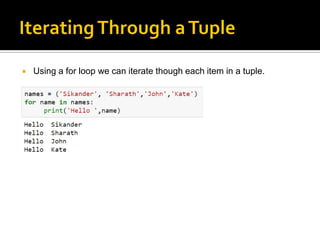
 Using a for loop we can iterate though each item in a tuple.
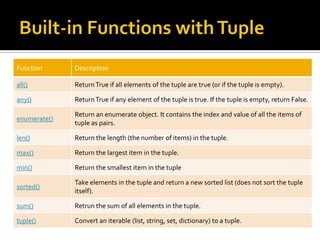
Function Description
all() ReturnTrue if all elements of the tuple are true (or if the tuple is empty).
any() ReturnTrue if any element of the tuple is true. If the tuple is empty, return False.
enumerate()
Return an enumerate object. It contains the index and value of all the items of
tuple as pairs.
len() Return the length (the number of items) in the tuple.
max() Return the largest item in the tuple.
min() Return the smallest item in the tuple
sorted()
Take elements in the tuple and return a new sorted list (does not sort the tuple
itself).
sum() Retrun the sum of all elements in the tuple.
tuple() Convert an iterable (list, string, set, dictionary) to a tuple.

Python tuple

  • 2.
     Tuples arevery similar to lists, except that they are immutable (they cannot be changed).  They are created using parentheses, rather than square brackets.
  • 3.
     We generallyuse tuple for heterogeneous (different) datatypes and list for homogeneous (similar) datatypes.  Since tuple are immutable, iterating through tuple is faster than with list. So there is a slight performance boost.  Tuples that contain immutable elements can be used as key for a dictionary. With list, this is not possible.  If you have data that doesn't change, implementing it as tuple will guarantee that it remains write-protected. mohammed.sikander@cranessoftware.com 3
  • 4.
     A tupleis created by placing all the items (elements) inside a parentheses (), separated by comma.  The parentheses are optional but is a good practice to write it.  A tuple can have any number of items and they may be of different types (integer, float, list, string etc.).
  • 5.
     Creating atuple with one element is a bit tricky.  Having one element within parentheses is not enough.We will need a trailing comma to indicate that it is in fact a tuple.
  • 6.
     You canaccess the values in the tuple with their index, just as you did with lists:  nested tuple are accessed using nested indexing  Negative indexing can be applied to tuples similar to lists.  We can access a range of items in a tuple by using the slicing operator  Trying to reassign a value in a tuple causes a TypeError.
  • 7.
     Unlike lists,tuples are immutable.  This means that elements of a tuple cannot be changed once it has been assigned. But, if the element is itself a mutable datatype like list, its nested items can be changed.
  • 8.
    Similar to List, We can use + operator to combine two tuples. This is also called concatenation.  We can also repeat the elements in a tuple for a given number of times using the * operator.  Both + and * operations result into a new tuple.
  • 9.
     We cannotchange the elements in a tuple. That also means we cannot delete or remove items from a tuple.  But deleting a tuple entirely is possible using the keyword del.
  • 10.
     Methods thatadd items or remove items are not available with tuple. Only the following two methods are available. Method Description count(x) Return the number of items that is equal to x index(x) Return index of first item that is equal to x
  • 11.
     We cantest if an item exists in a tuple or not, using the keyword in.
  • 12.
     Using afor loop we can iterate though each item in a tuple.
  • 13.
    Function Description all() ReturnTrueif all elements of the tuple are true (or if the tuple is empty). any() ReturnTrue if any element of the tuple is true. If the tuple is empty, return False. enumerate() Return an enumerate object. It contains the index and value of all the items of tuple as pairs. len() Return the length (the number of items) in the tuple. max() Return the largest item in the tuple. min() Return the smallest item in the tuple sorted() Take elements in the tuple and return a new sorted list (does not sort the tuple itself). sum() Retrun the sum of all elements in the tuple. tuple() Convert an iterable (list, string, set, dictionary) to a tuple.