By: Sachin Garg
CT University
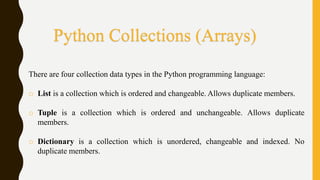
There are four collection data types in the Python programming language:
o List is a collection which is ordered and changeable. Allows duplicate members.
o Tuple is a collection which is ordered and unchangeable. Allows duplicate
members.
o Dictionary is a collection which is unordered, changeable and indexed. No
duplicate members.
Python Collections (Arrays)
A list is created by placing all the items (elements) inside a square
bracket [ ], separated by commas.
It can have any number of items and they may be of different types
(integer, float, string etc.).
Example:
list = [1, 2, 3] # list with same data-types list = [1, "Hello", 3.4] #
list with mixed data-types
List Creation
 It can be access in several ways
 Use the index operator [] to access an item in a list. Index starts from 0.
So, a list having 5 elements will have index from 0 to 4.
 Example:
list = ['p','r','o','b','e']
Output
O
bprint(list[2]) #Positive Indexing b
print(list[-2]) #Negative Indexing
Access Items From List
 Accessing a range of items in a list by using the slicing operator [ ] using
(colon :).
 Slicing can be best visualized by considering the index to be between the
elements.
 Example:
list = ['p','r','o','b','e']
print(list[0:4]) #Positive
print(list[-2:-1]) # Negative
Output
['p', 'r', 'o', 'b']
['b']
4
Slice List
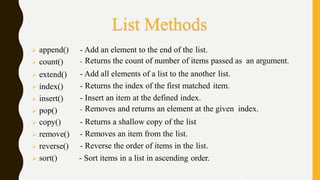
 append()
 count()
- Add an element to the end of the list.
- Returns the count of number of items passed as an argument.
- Add all elements of a list to the another list.
- Returns the index of the first matched item.
- Insert an item at the defined index.
- Removes and returns an element at the given index.
- Returns a shallow copy of the list
- Removes an item from the list.
- Reverse the order of items in the list.
 extend()
 index()
 insert()
 pop()
 copy()
 remove()
 reverse()
 sort() - Sort items in a list in ascending order.
5
List Methods
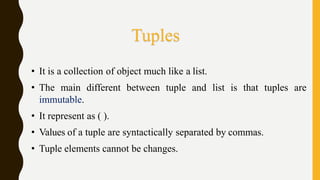
• It is a collection of object much like a list.
• The main different between tuple and list is that tuples are
immutable.
• It represent as ( ).
• Values of a tuple are syntactically separated by commas.
• Tuple elements cannot be changes.
Tuples
Tuple1 = ( ) //empty tuple
Tuple2 = ('zooming', 'For ’) //tuple with
strings l i s t 1 = [1, 2, 4, 5, 6]
Tuple
3
= tuple ( l i s t 1 ) //tuple with the use of l i s t
Tuple
4
= (‘zooming’,) * 3 //tuple with repetition
Tuple
5
= (5, 'Welcome', 7, ‘zooming’) //tuple with
mixed datatypes
Creation of Tuples
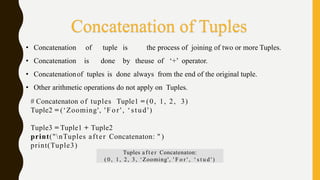
• Concatenation of tuple is the process of joining of two or more Tuples.
• Concatenation is done by theuse of ‘+’ operator.
• Concatenationof tuples is done always from the end of the original tuple.
• Other arithmetic operations do not apply on Tuples.
# Concatenaton of tuples Tuple1 = (0, 1, 2, 3)
Tuple2 = (‘Zooming', 'For', ‘stud')
Tuple3 = Tuple1 + Tuple2
print("nTuples after Concatenaton: " )
print(Tuple3)
Tuples aft er Concatenaton:
( 0 , 1, 2, 3, ‘Zooming', ' F o r ' , ‘ s t u d ' )
Concatenation of Tuples
# with Numbers
Tuple1 = tuple(‘ZOOMING')
# From First element
print(Tuple1[1:])
# Reversing the Tuple
print(Tuple1[::-1])
# Printing elements of a
Range
print(Tuple1[2:5])
( ‘ O ’ , ’ O ’ , ’ M ’ , ’ I ’ , ’ N ’ , ’
G ’ )
( ‘ G’ , ’ N’ , ’ I ’ , ’ M’ , ’ O’ , ’
O’ , ’ Z’ ) ( ‘ O ’ , ’ M ’ , ’ I ’ )
Slicing of Tuples
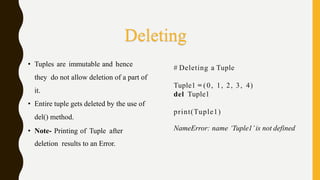
• Tuples are immutable and hence
they do not allow deletion of a part of
it.
• Entire tuple gets deleted by the use of
del() method.
• Note- Printing of Tuple after
deletion results to an Error.
# Deleting a Tuple
Tuple1 = (0, 1, 2, 3, 4)
del Tuple1
print(Tuple1)
NameError: name ‘Tuple1’is not defined
Deleting
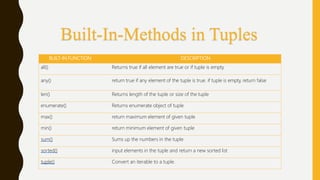
BUILT-IN FUNCTION DESCRIPTION
all() Returns true if all element are true or if tuple is empty
any() return true if any element of the tuple is true. if tuple is empty, return false
len() Returns length of the tuple or size of the tuple
enumerate() Returns enumerate object of tuple
max() return maximum element of given tuple
min() return minimum element of given tuple
sum() Sums up the numbers in the tuple
sorted() input elements in the tuple and return a new sorted list
tuple() Convert an iterable to a tuple.
Built-In-Methods in Tuples
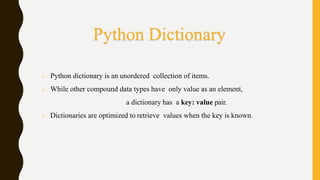
o Python dictionary is an unordered collection of items.
o While other compound data types have only value as an element,
a dictionary has a key: value pair.
o Dictionaries are optimized to retrieve values when the key is known.
Python Dictionary
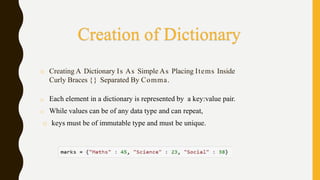
o Creating A Dictionary Is As Simple As Placing Items Inside
Curly Braces {} Separated By Comma.
o Each element in a dictionary is represented by a key:value pair.
o While values can be of any data type and can repeat,
o keys must be of immutable type and must be unique.
Creation of Dictionary
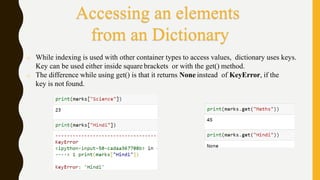
o While indexing is used with other container types to access values, dictionary uses keys.
Key can be used either inside square brackets or with the get() method.
o The difference while using get() is that it returns None instead of KeyError, if the
key is not found.
Accessing an elements
from an Dictionary
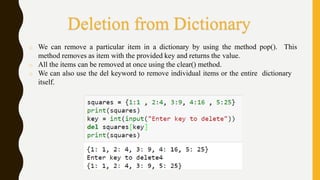
o We can remove a particular item in a dictionary by using the method pop(). This
method removes as item with the provided key and returns the value.
o All the items can be removed at once using the clear() method.
o We can also use the del keyword to remove individual items or the entire dictionary
itself.
Deletion from Dictionary
THANK YOU!!

Python Collections

  • 1.
  • 2.
    There are fourcollection data types in the Python programming language: o List is a collection which is ordered and changeable. Allows duplicate members. o Tuple is a collection which is ordered and unchangeable. Allows duplicate members. o Dictionary is a collection which is unordered, changeable and indexed. No duplicate members. Python Collections (Arrays)
  • 3.
    A list iscreated by placing all the items (elements) inside a square bracket [ ], separated by commas. It can have any number of items and they may be of different types (integer, float, string etc.). Example: list = [1, 2, 3] # list with same data-types list = [1, "Hello", 3.4] # list with mixed data-types List Creation
  • 4.
     It canbe access in several ways  Use the index operator [] to access an item in a list. Index starts from 0. So, a list having 5 elements will have index from 0 to 4.  Example: list = ['p','r','o','b','e'] Output O bprint(list[2]) #Positive Indexing b print(list[-2]) #Negative Indexing Access Items From List
  • 5.
     Accessing arange of items in a list by using the slicing operator [ ] using (colon :).  Slicing can be best visualized by considering the index to be between the elements.  Example: list = ['p','r','o','b','e'] print(list[0:4]) #Positive print(list[-2:-1]) # Negative Output ['p', 'r', 'o', 'b'] ['b'] 4 Slice List
  • 6.
     append()  count() -Add an element to the end of the list. - Returns the count of number of items passed as an argument. - Add all elements of a list to the another list. - Returns the index of the first matched item. - Insert an item at the defined index. - Removes and returns an element at the given index. - Returns a shallow copy of the list - Removes an item from the list. - Reverse the order of items in the list.  extend()  index()  insert()  pop()  copy()  remove()  reverse()  sort() - Sort items in a list in ascending order. 5 List Methods
  • 7.
    • It isa collection of object much like a list. • The main different between tuple and list is that tuples are immutable. • It represent as ( ). • Values of a tuple are syntactically separated by commas. • Tuple elements cannot be changes. Tuples
  • 8.
    Tuple1 = () //empty tuple Tuple2 = ('zooming', 'For ’) //tuple with strings l i s t 1 = [1, 2, 4, 5, 6] Tuple 3 = tuple ( l i s t 1 ) //tuple with the use of l i s t Tuple 4 = (‘zooming’,) * 3 //tuple with repetition Tuple 5 = (5, 'Welcome', 7, ‘zooming’) //tuple with mixed datatypes Creation of Tuples
  • 9.
    • Concatenation oftuple is the process of joining of two or more Tuples. • Concatenation is done by theuse of ‘+’ operator. • Concatenationof tuples is done always from the end of the original tuple. • Other arithmetic operations do not apply on Tuples. # Concatenaton of tuples Tuple1 = (0, 1, 2, 3) Tuple2 = (‘Zooming', 'For', ‘stud') Tuple3 = Tuple1 + Tuple2 print("nTuples after Concatenaton: " ) print(Tuple3) Tuples aft er Concatenaton: ( 0 , 1, 2, 3, ‘Zooming', ' F o r ' , ‘ s t u d ' ) Concatenation of Tuples
  • 10.
    # with Numbers Tuple1= tuple(‘ZOOMING') # From First element print(Tuple1[1:]) # Reversing the Tuple print(Tuple1[::-1]) # Printing elements of a Range print(Tuple1[2:5]) ( ‘ O ’ , ’ O ’ , ’ M ’ , ’ I ’ , ’ N ’ , ’ G ’ ) ( ‘ G’ , ’ N’ , ’ I ’ , ’ M’ , ’ O’ , ’ O’ , ’ Z’ ) ( ‘ O ’ , ’ M ’ , ’ I ’ ) Slicing of Tuples
  • 11.
    • Tuples areimmutable and hence they do not allow deletion of a part of it. • Entire tuple gets deleted by the use of del() method. • Note- Printing of Tuple after deletion results to an Error. # Deleting a Tuple Tuple1 = (0, 1, 2, 3, 4) del Tuple1 print(Tuple1) NameError: name ‘Tuple1’is not defined Deleting
  • 12.
    BUILT-IN FUNCTION DESCRIPTION all()Returns true if all element are true or if tuple is empty any() return true if any element of the tuple is true. if tuple is empty, return false len() Returns length of the tuple or size of the tuple enumerate() Returns enumerate object of tuple max() return maximum element of given tuple min() return minimum element of given tuple sum() Sums up the numbers in the tuple sorted() input elements in the tuple and return a new sorted list tuple() Convert an iterable to a tuple. Built-In-Methods in Tuples
  • 13.
    o Python dictionaryis an unordered collection of items. o While other compound data types have only value as an element, a dictionary has a key: value pair. o Dictionaries are optimized to retrieve values when the key is known. Python Dictionary
  • 14.
    o Creating ADictionary Is As Simple As Placing Items Inside Curly Braces {} Separated By Comma. o Each element in a dictionary is represented by a key:value pair. o While values can be of any data type and can repeat, o keys must be of immutable type and must be unique. Creation of Dictionary
  • 15.
    o While indexingis used with other container types to access values, dictionary uses keys. Key can be used either inside square brackets or with the get() method. o The difference while using get() is that it returns None instead of KeyError, if the key is not found. Accessing an elements from an Dictionary
  • 16.
    o We canremove a particular item in a dictionary by using the method pop(). This method removes as item with the provided key and returns the value. o All the items can be removed at once using the clear() method. o We can also use the del keyword to remove individual items or the entire dictionary itself. Deletion from Dictionary
  • 17.