Swipe
Python Syntax
The syntax of the Python programming language is
the set of rules that defines how a Python program
will be written and interpreted (by both the
runtime system and by human readers).
The Python language has many similarities to Perl,
C, and Java. However, there are some definite
differences between the languages.
Python syntax
A Python identifier is a name used to identify a
variable, function, class, module or other object. An
identifier starts with a letter A to Z or a to z or an
underscore (_) followed by zero or more letters,
underscores and digits (0 to 9).
Python does not allow punctuation characters such
as @, $, and % within identifiers. Python is a case
sensitive programming language. Thus, Manpower
and manpower are two different identifiers in
Python.
Python Identifiers
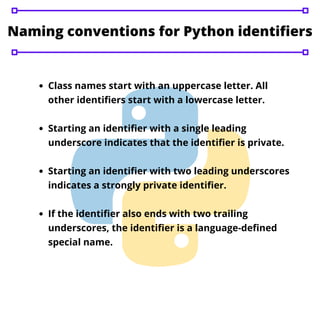
Class names start with an uppercase letter. All
other identifiers start with a lowercase letter.
Starting an identifier with a single leading
underscore indicates that the identifier is private.
Starting an identifier with two leading underscores
indicates a strongly private identifier.
If the identifier also ends with two trailing
underscores, the identifier is a language-defined
special name.
Naming conventions for Python identifiers
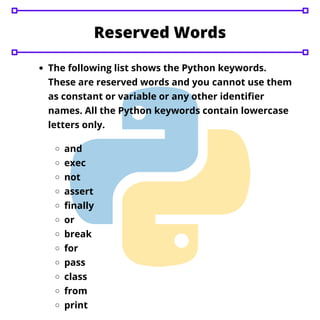
The following list shows the Python keywords.
These are reserved words and you cannot use them
as constant or variable or any other identifier
names. All the Python keywords contain lowercase
letters only.
Reserved Words
and
exec
not
assert
finally
or
break
for
pass
class
from
print
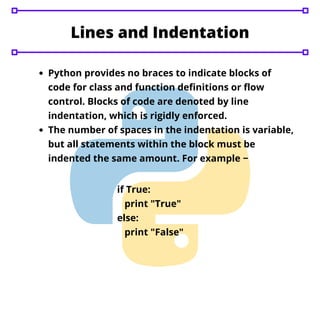
Python provides no braces to indicate blocks of
code for class and function definitions or flow
control. Blocks of code are denoted by line
indentation, which is rigidly enforced.
The number of spaces in the indentation is variable,
but all statements within the block must be
indented the same amount. For example −
Lines and Indentation
if True:
print "True"
else:
print "False"
Statements in Python typically end with a new line.
Python does, however, allow the use of the line
continuation character () to denote that the line
should continue. For example −
Multi-Line Statements
total = item_one + 
item_two + 
item_three
Statements contained within the [], {}, or () brackets
do not need to use the line continuation character.
For example −
days = ['Monday', 'Tuesday', 'Wednesday',
'Thursday', 'Friday']
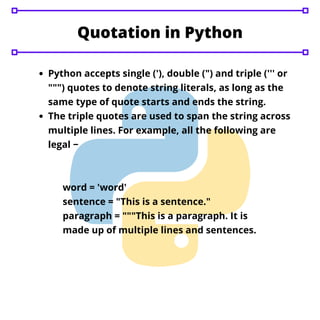
Python accepts single ('), double (") and triple (''' or
""") quotes to denote string literals, as long as the
same type of quote starts and ends the string.
The triple quotes are used to span the string across
multiple lines. For example, all the following are
legal −
Quotation in Python
word = 'word'
sentence = "This is a sentence."
paragraph = """This is a paragraph. It is
made up of multiple lines and sentences.
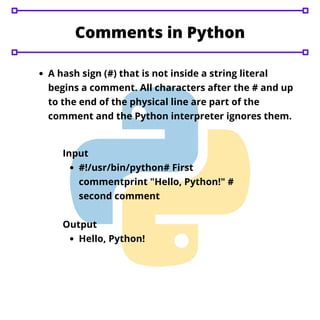
A hash sign (#) that is not inside a string literal
begins a comment. All characters after the # and up
to the end of the physical line are part of the
comment and the Python interpreter ignores them.
Comments in Python
#!/usr/bin/python# First
commentprint "Hello, Python!" #
second comment
Hello, Python!
Input
Output
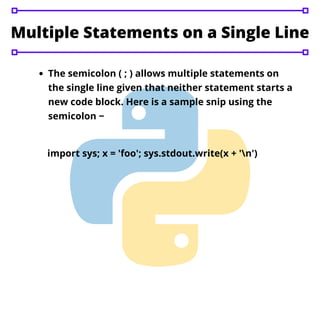
The semicolon ( ; ) allows multiple statements on
the single line given that neither statement starts a
new code block. Here is a sample snip using the
semicolon −
Multiple Statements on a Single Line
import sys; x = 'foo'; sys.stdout.write(x + 'n')
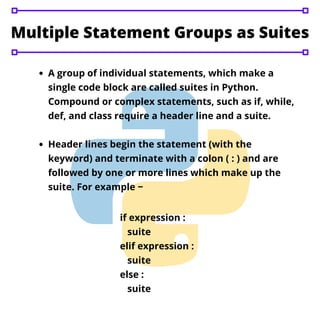
A group of individual statements, which make a
single code block are called suites in Python.
Compound or complex statements, such as if, while,
def, and class require a header line and a suite.
Header lines begin the statement (with the
keyword) and terminate with a colon ( : ) and are
followed by one or more lines which make up the
suite. For example −
Multiple Statement Groups as Suites
if expression :
suite
elif expression :
suite
else :
suite
Python Variable Types
Python Operations
Stay Tuned with
Topics for next Post

Python syntax

  • 1.
  • 2.
    The syntax ofthe Python programming language is the set of rules that defines how a Python program will be written and interpreted (by both the runtime system and by human readers). The Python language has many similarities to Perl, C, and Java. However, there are some definite differences between the languages. Python syntax
  • 3.
    A Python identifieris a name used to identify a variable, function, class, module or other object. An identifier starts with a letter A to Z or a to z or an underscore (_) followed by zero or more letters, underscores and digits (0 to 9). Python does not allow punctuation characters such as @, $, and % within identifiers. Python is a case sensitive programming language. Thus, Manpower and manpower are two different identifiers in Python. Python Identifiers
  • 4.
    Class names startwith an uppercase letter. All other identifiers start with a lowercase letter. Starting an identifier with a single leading underscore indicates that the identifier is private. Starting an identifier with two leading underscores indicates a strongly private identifier. If the identifier also ends with two trailing underscores, the identifier is a language-defined special name. Naming conventions for Python identifiers
  • 5.
    The following listshows the Python keywords. These are reserved words and you cannot use them as constant or variable or any other identifier names. All the Python keywords contain lowercase letters only. Reserved Words and exec not assert finally or break for pass class from print
  • 6.
    Python provides nobraces to indicate blocks of code for class and function definitions or flow control. Blocks of code are denoted by line indentation, which is rigidly enforced. The number of spaces in the indentation is variable, but all statements within the block must be indented the same amount. For example − Lines and Indentation if True: print "True" else: print "False"
  • 7.
    Statements in Pythontypically end with a new line. Python does, however, allow the use of the line continuation character () to denote that the line should continue. For example − Multi-Line Statements total = item_one + item_two + item_three Statements contained within the [], {}, or () brackets do not need to use the line continuation character. For example − days = ['Monday', 'Tuesday', 'Wednesday', 'Thursday', 'Friday']
  • 8.
    Python accepts single('), double (") and triple (''' or """) quotes to denote string literals, as long as the same type of quote starts and ends the string. The triple quotes are used to span the string across multiple lines. For example, all the following are legal − Quotation in Python word = 'word' sentence = "This is a sentence." paragraph = """This is a paragraph. It is made up of multiple lines and sentences.
  • 9.
    A hash sign(#) that is not inside a string literal begins a comment. All characters after the # and up to the end of the physical line are part of the comment and the Python interpreter ignores them. Comments in Python #!/usr/bin/python# First commentprint "Hello, Python!" # second comment Hello, Python! Input Output
  • 10.
    The semicolon (; ) allows multiple statements on the single line given that neither statement starts a new code block. Here is a sample snip using the semicolon − Multiple Statements on a Single Line import sys; x = 'foo'; sys.stdout.write(x + 'n')
  • 11.
    A group ofindividual statements, which make a single code block are called suites in Python. Compound or complex statements, such as if, while, def, and class require a header line and a suite. Header lines begin the statement (with the keyword) and terminate with a colon ( : ) and are followed by one or more lines which make up the suite. For example − Multiple Statement Groups as Suites if expression : suite elif expression : suite else : suite
  • 12.
    Python Variable Types PythonOperations Stay Tuned with Topics for next Post