Title - Sub
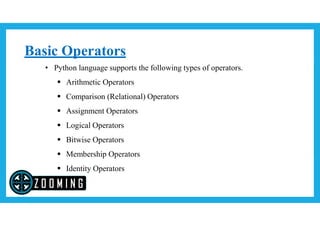
Basic Operators
• Python language supports the following types of operators.
 Arithmetic Operators
 Comparison (Relational) Operators
 Assignment Operators
 Logical Operators
 Bitwise Operators
 Membership Operators
 Identity Operators
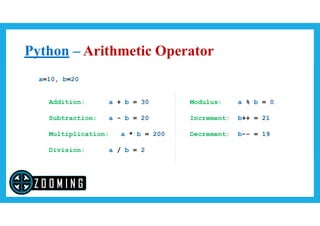
Python – Arithmetic Operator
a=10, b=20
Addition: a + b = 30
Subtraction: a - b = 20
Multiplication: a * b = 200
Division: a / b = 2
Modulus: a % b = 0
Increment: b++ = 21
Decrement: b-- = 19
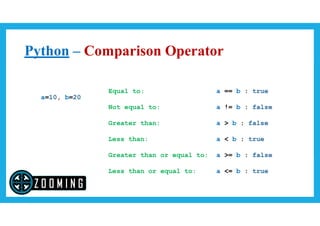
Python – Comparison Operator
a=10, b=20
Equal to: a == b : true
Not equal to: a != b : false
Greater than: a > b : false
Less than: a < b : true
Greater than or equal to: a >= b : false
Less than or equal to: a <= b : true
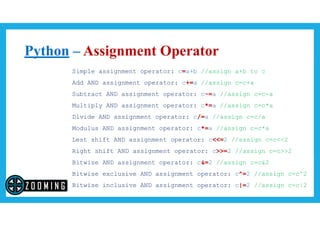
Python – Assignment Operator
Simple assignment operator: c=a+b //assign a+b to c
Add AND assignment operator: c+=a //assign c=c+a
Subtract AND assignment operator: c-=a //assign c=c-a
Multiply AND assignment operator: c*=a //assign c=c*a
Divide AND assignment operator: c/=a //assign c=c/a
Modulus AND assignment operator: c*=a //assign c=c*a
Lest shift AND assignment operator: c<<=2 //assign c=c<<2
Right shift AND assignment operator: c>>=2 //assign c=c>>2
Bitwise AND assignment operator: c&=2 //assign c=c&2
Bitwise exclusive AND assignment operator: c^=2 //assign c=c^2
Bitwise inclusive AND assignment operator: c|=2 //assign c=c|2
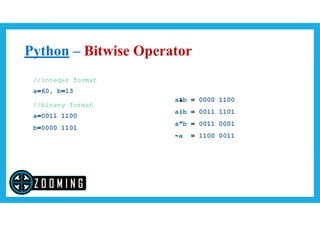
Python – Bitwise Operator
//integer format
a=60, b=13
//binary format
a=0011 1100
b=0000 1101
a&b = 0000 1100
a|b = 0011 1101
a^b = 0011 0001
~a = 1100 0011
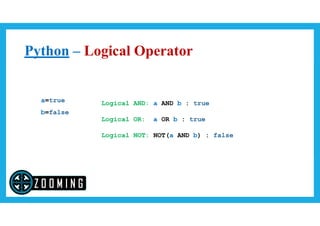
Python – Logical Operator
a=true
b=false
Logical AND: a AND b : true
Logical OR: a OR b : true
Logical NOT: NOT(a AND b) : false
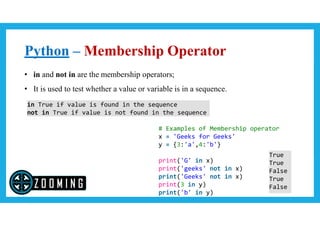
Python – Membership Operator
• in and not in are the membership operators;
• It is used to test whether a value or variable is in a sequence.
in True if value is found in the sequence
not in True if value is not found in the sequence
# Examples of Membership operator
x = 'Geeks for Geeks'
y = {3:'a',4:'b'}
print('G' in x)
print('geeks' not in x)
print('Geeks' not in x)
print(3 in y)
print('b' in y)
True
True
False
True
False

Python Basic Operators

  • 1.
  • 2.
    Basic Operators • Pythonlanguage supports the following types of operators.  Arithmetic Operators  Comparison (Relational) Operators  Assignment Operators  Logical Operators  Bitwise Operators  Membership Operators  Identity Operators
  • 3.
    Python – ArithmeticOperator a=10, b=20 Addition: a + b = 30 Subtraction: a - b = 20 Multiplication: a * b = 200 Division: a / b = 2 Modulus: a % b = 0 Increment: b++ = 21 Decrement: b-- = 19
  • 4.
    Python – ComparisonOperator a=10, b=20 Equal to: a == b : true Not equal to: a != b : false Greater than: a > b : false Less than: a < b : true Greater than or equal to: a >= b : false Less than or equal to: a <= b : true
  • 5.
    Python – AssignmentOperator Simple assignment operator: c=a+b //assign a+b to c Add AND assignment operator: c+=a //assign c=c+a Subtract AND assignment operator: c-=a //assign c=c-a Multiply AND assignment operator: c*=a //assign c=c*a Divide AND assignment operator: c/=a //assign c=c/a Modulus AND assignment operator: c*=a //assign c=c*a Lest shift AND assignment operator: c<<=2 //assign c=c<<2 Right shift AND assignment operator: c>>=2 //assign c=c>>2 Bitwise AND assignment operator: c&=2 //assign c=c&2 Bitwise exclusive AND assignment operator: c^=2 //assign c=c^2 Bitwise inclusive AND assignment operator: c|=2 //assign c=c|2
  • 6.
    Python – BitwiseOperator //integer format a=60, b=13 //binary format a=0011 1100 b=0000 1101 a&b = 0000 1100 a|b = 0011 1101 a^b = 0011 0001 ~a = 1100 0011
  • 7.
    Python – LogicalOperator a=true b=false Logical AND: a AND b : true Logical OR: a OR b : true Logical NOT: NOT(a AND b) : false
  • 8.
    Python – MembershipOperator • in and not in are the membership operators; • It is used to test whether a value or variable is in a sequence. in True if value is found in the sequence not in True if value is not found in the sequence # Examples of Membership operator x = 'Geeks for Geeks' y = {3:'a',4:'b'} print('G' in x) print('geeks' not in x) print('Geeks' not in x) print(3 in y) print('b' in y) True True False True False