Edible Freshwater andMarinewater Fishes
Categorization of Fish by their habitat:
• Freshwater Fish:
Fish that spend most or all of their life in freshwaters, such as rivers
and lakes, having a salinity of less than 1.0 ppt.
They may be divided into;
-Coldwater Fish (5 – 20 °C); examples: Mahseer, Trout, etc.,
-Warmwater Fish (21 – 35 °C); example: Carps, Catfish,
Snakeheads, Featherbacks, etc.
3.
Edible Freshwater andMarinewater Fishes
• Brackishwater Fish:
Fish that can tolerate a wide range of salinity (1.0 – 30.0 ppt) and live in
backwaters, estuaries and coastal waters.
Example: Mullet, Milkfish, Seabass, Pearlspot, Mudskipper, etc.
• Marine Fish:
Fish that spend most or all of their life in seawater, such as Seas and
Oceans, having salinity above 30 ppt.
Example: Sardines, Mackerel, Ribbonfish, Anchovies, Grouper, Cobia,
Tuna, etc.
4.
Edible Freshwater andMarinewater Fishes
Freshwater Fishes
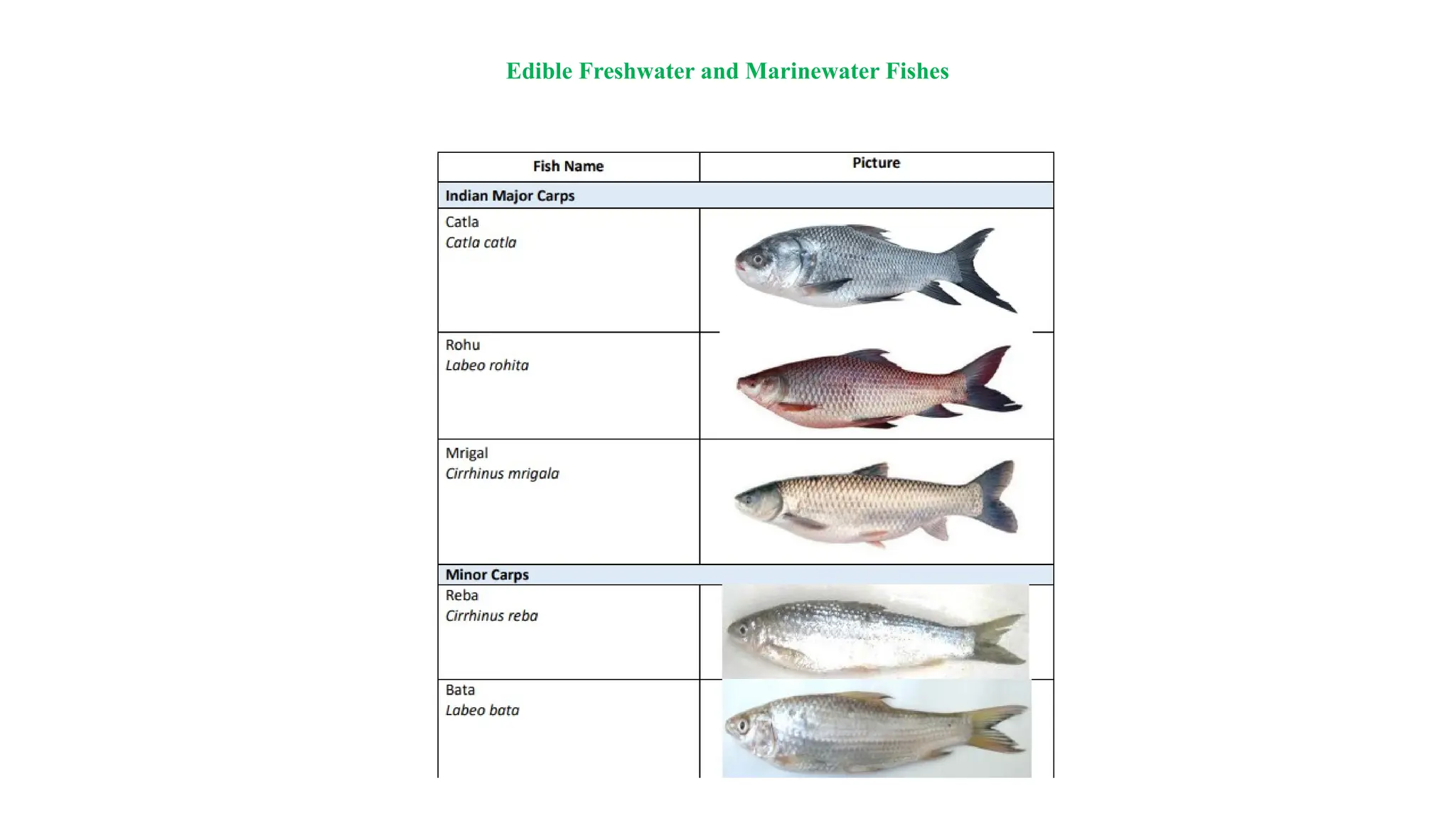
Carps
The carps which are native to the Indo-Pak River Systems are referred to as the
Gangetic Carps / Indian Major Carps (IMC), comprising of Catla, Rohu and Mrigal
that contribute 60% of total Carps production.
The carps that were introduced from other countries are referred to as Exotic Carps
such as Silver Carp, Grass Carp and Common Carp.
Besides the Major Carps, there are also smaller carps often referred to as Minor
Carps such as Reba (Cirrhinus reba), Bata (Labeo bata), Fringe-lipped carp (Labeo
fimbriatus), Calbasu (Labeo calbasu), white carp (Cirrhinus cirrhosus) and Cauvery
carp (Labeo kontius).
Edible Freshwater andMarinewater Fishes
Freshwater Fishes
Catfishes
Catfishes are a diverse group of ray-finned fish named for their
prominent barbels, which resemble a cat's whiskers.
Generally be found in faster-flowing rivers and streams, some catfish
species have adapted to living in shallow salt-water environments while
other catfish species live their lives in caves underground. Most catfish
are bottom feeders as they are negatively buoyant.
The air-breathing catfishes such as Magur and Singhi inhabit shallow
waters, withstand low oxygen conditions and are referred to as "live
fishes”.
Edible Freshwater andMarinewater Fishes
Freshwater Fishes
Featherbacks
o Featherbacks are adapted to flowing
conditions and widely distributed in deep and
clear waters.
o The Bronze Featherback is reported to enter
brackishwater.
o They are carnivorous and predatory fish and
feed on aquatic insects, mollusks, shrimps and
small fishes and take insects and tender roots
of aquatic plants during early stages of life.
o They are rich in nutritive value and commands
higher market price despite the presence of a
large number of intramuscular spines.
10.
Edible Freshwater andMarinewater Fishes
Freshwater Fishes
Snakehead
The snakeheads are members of the freshwater Perciformes fish family Channidae,
native to parts of Africa and Asia.
They can survive out of water for up to four days, provided they are wet.
They have a pair of air-chambers (suprabranchial cavity), developing from the
pharynx, lined by vascular epithelium, take in air and function like lungs.
Snakeheads consume plankton, aquatic insects, and mollusks during early life stages
and become predatory and cannibalistic as they grow.
The snakehead meat has good taste, high nutrient and also has high pharmaceutical
values. Snakehead also has all the essential amino acids for wound healing,
especially glycine, which is important for the formation of human skin collagen.
Edible Freshwater andMarinewater Fishes
Freshwater Fishes
Tilapia
• International fish
• Aquatic chicken
• Hardy species
• Although most of the natural
resources of Tilapias are found
mainly in Africa, nearly 80% of the
global Aquaculture production of
Tilapias of about 5.0 million metric
tonnes comes from Asia.
13.
Edible Freshwater andMarinewater Fishes
Freshwater Fishes
Coldwater fishes
The coldwater fisheries deal with
fisheries activity in water where
temperature of water ranges from 5 to
20 degrees centigrade.
The gills of cold water fish are greatly
reduced and the gill opening are smaller
in size for adaptation to cold
temperatures.
National Fish of Pakistan???
Edible Freshwater andMarinewater Fishes
Brackish water Fishes
(i) Fluctuating water level synchronizing with the tides.
(ii) Wide salinity range of 1-30 ppt.
(iii) Higher nutrient content and productivity.
(iv) Serve as nursery grounds for numerous marine organisms,
(v) Harbour a rich diversity of flora and fauna.
(vi) Support artisanal capture fisheries and provide livelihood to the
coastal fishers.
16.
Edible Freshwater andMarinewater Fishes
Brackish water Fishes
Mullets
They are euryhaline species that
tolerate salinity from 1-30 ppt.
They are omnivorous and are
known for the high protein and
vitamins contained in the muscle
tissue.
The Roe (ripe ovaries) from mature
females are a delicacy, high-valued
and sought after in many countries.
17.
Edible Freshwater andMarinewater Fishes
Brackish water Fishes
Milkfish
The Milkfish, Chanos chanos, is the
sole living representative of the
family Chanidae.
The distribution coincides with
coral reef areas where the water is
warm, clear and shallow.
It is one of the most important
species cultured in South-East Asia
18.
Edible Freshwater andMarinewater Fishes
Brackish water Fishes
Pearlspot
• The Green Chromide Pearlspot,
Etroplus suratensis, is the state
fish of Kerala and locally named
“Karimeen”.
• It breeds naturally in confined
conditions, sexes are separate and
fertilization is external
19.
Edible Freshwater andMarinewater Fishes
Brackish water Fishes
Groupers
• Though groupers are sea fish,
juveniles of some groupers are
found in coastal waters, mangroves,
estuaries and sandy bottoms.
• Groupers are ideal candidate
species for intensive aquaculture
due to high consumer demand,
desirable taste, hardiness in a
crowded environment, efficient
feed conversion, and rapid growth.
20.
Edible Freshwater andMarinewater Fishes
Brackish water Fishes
Catfish
• Nuna Tengara or the Long Whiskers
Catfish, Mystus gulio, is a common
and popular fish because of its
nutritional value and taste. It forms
schools of 10 to 25 individuals.
• Mystus vittatus, the Striped Dwarf
Catfish is found in brackishwater
systems with marginal vegetation in
lakes and swamps with a mud
substratum.
21.
Edible Freshwater andMarinewater Fishes
Brackish water Fishes
Scat
• Spotted Scat, Scatophagus argus,
occurs in two basic colour morphs
which are called Green Scat and Ruby
or Red Scat and lives in coastal muddy
areas, including estuaries, mangroves,
and the lower courses of rivers.
• It is an important aquaculture food fish
with high economic value and is also a
popular aquarium species due to its
colourful appearance, hardiness, slow
growth, and calm behaviour
22.
Edible Freshwater andMarinewater Fishes
Brackish water Fishes
Pompano
• The Silver Pompano, Trachinotus
blochii belongs to the family
Carangidae; it resembles the much
sought after Silver Pomfret
(Pampus argenteus).
• It is one of the most promising
species for coastal aquaculture as
its growth rate is high, meat
quality is good and fetches high
price in the market.
23.
Edible Freshwater andMarinewater Fishes
Marine Water Fishes
The important Marine Fisheries can be grouped into the following
categories:
Pelagic: Sardines, Anchovies, Ribbonfish, Mackerel, Seerfish, Tuna,
etc.
Column water: Bombay Duck, Cobia, Silver Bellies, Horse
Mackerel, etc.
Demersal: Perches, Catfish, Pomfrets, Flatfish, Eels, etc.
24.
Edible Freshwater andMarinewater Fishes
Marine Water Fishes
Sardines
Sardines are one of the two most
important commercial pelagic
schooling fishes.
Oil Sardine Sardinella longiceps
alone contributes to the largest
single species fishery. The other
13 species are termed as “Lesser
Sardines”, comprise all the
species of Sardines (Sardinella
spp.) other than the Indian Oil
Sardine.
25.
Edible Freshwater andMarinewater Fishes
Marine Water Fishes
Mackerel
Mackerel is a common name
applied to a number of different
species of schooling pelagic fish
of the family Scombridae.
Mackerels typically have: rows
of longitudinal bands or spots
along upper half of body, dorsal
and anal finlets, keels on caudal
peduncle and a deeply forked
caudal fin.
26.
Edible Freshwater andMarinewater Fishes
Marine Water Fishes
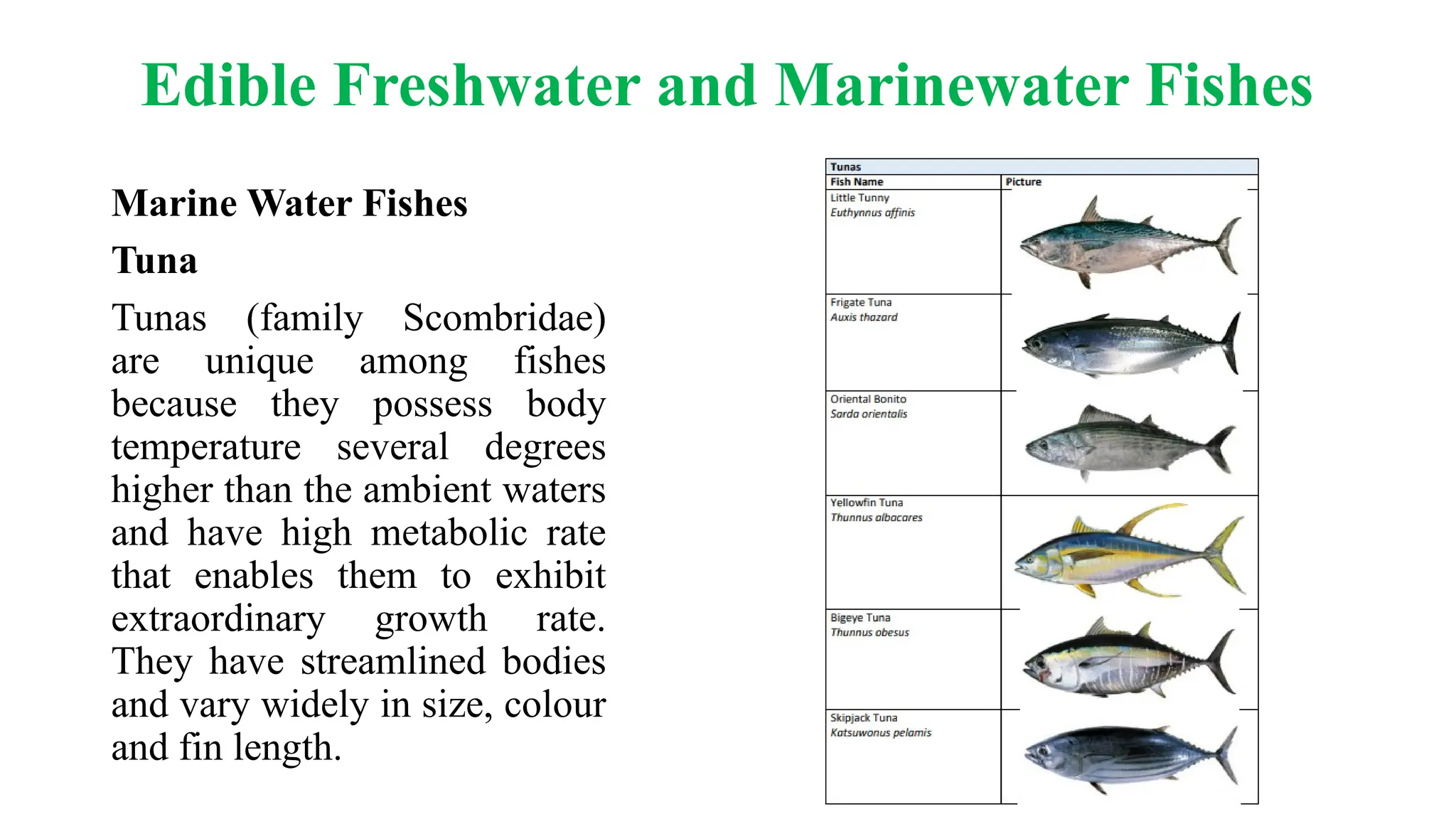
Tuna
Tunas (family Scombridae)
are unique among fishes
because they possess body
temperature several degrees
higher than the ambient waters
and have high metabolic rate
that enables them to exhibit
extraordinary growth rate.
They have streamlined bodies
and vary widely in size, colour
and fin length.
27.
Edible Freshwater andMarinewater Fishes
Marine Water Fishes
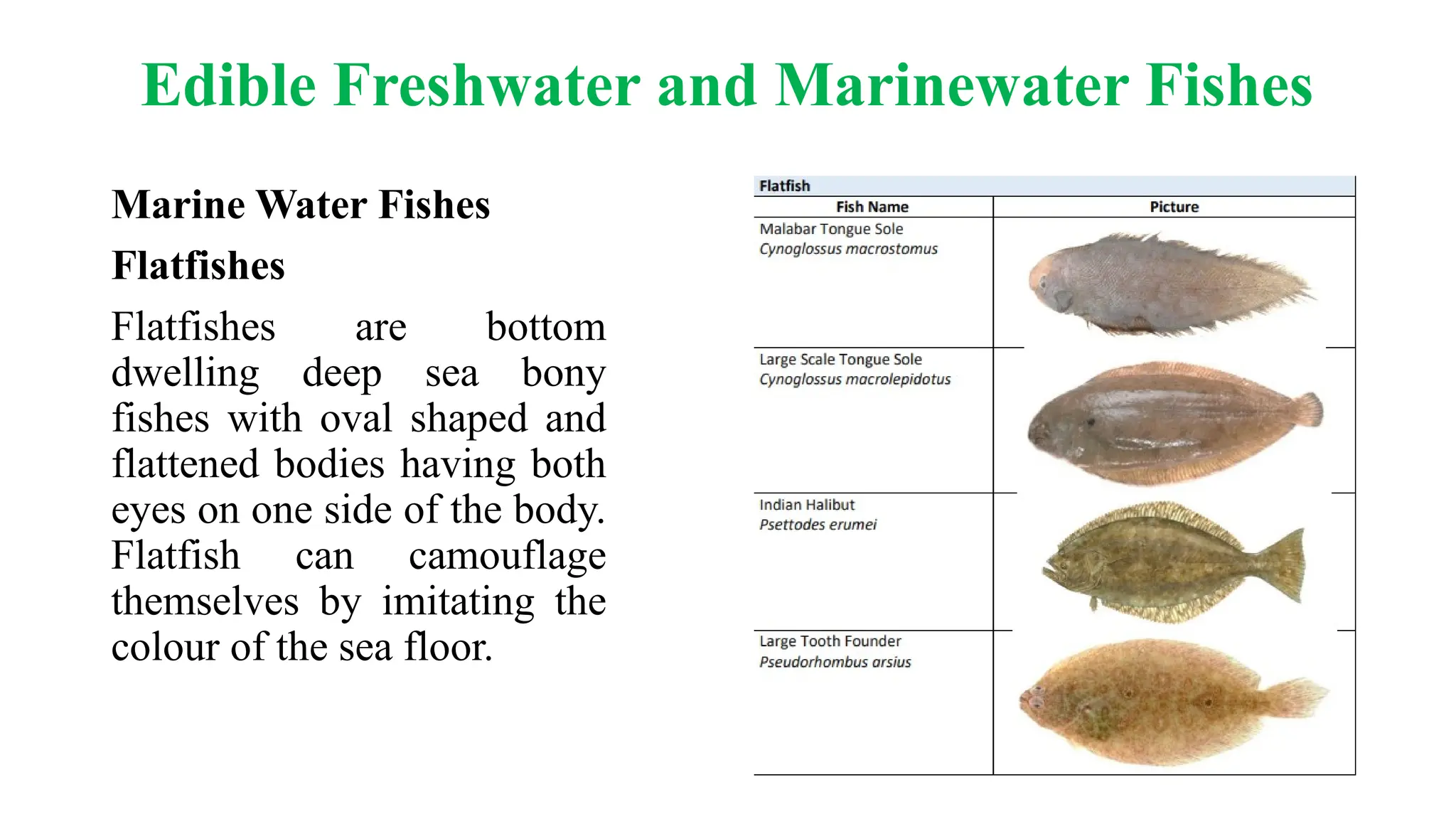
Flatfishes
Flatfishes are bottom
dwelling deep sea bony
fishes with oval shaped and
flattened bodies having both
eyes on one side of the body.
Flatfish can camouflage
themselves by imitating the
colour of the sea floor.