Wireless Bluetooth Controller For DC Motor

Presented By
Raghavendra K T
524ee10039
Electrial & electronic engineering
Rajeev Polytechnic
Hassan
Contents
Introduction
Objective
Block Diagram
User Interface
Microcontroller
Results
Applications
Bibliography
Introduction
     Speed control of a motor is essential while we are
using any type of motors.Here we are using wireless
bluetooth technology for the speed control of motor
instead of wired control.It is the newly invented method
for the speed control of motor.
     Bluetooth is an wireless network used to
communicate in b/w two devices with short centre
distance approximately 10 meters.In this system we are
using bluetooth as a main role for speed control of motor.
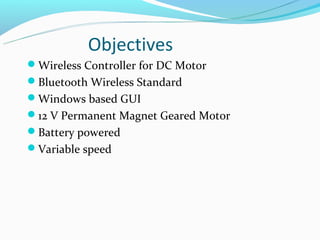
Objectives
Wireless Controller for DC Motor
Bluetooth Wireless Standard
Windows based GUI
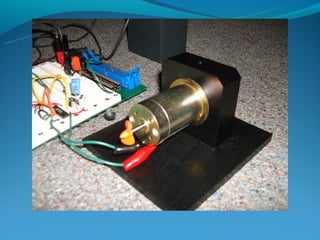
12 V Permanent Magnet Geared Motor
Battery powered
Variable speed
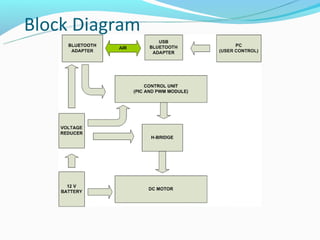
Block Diagram
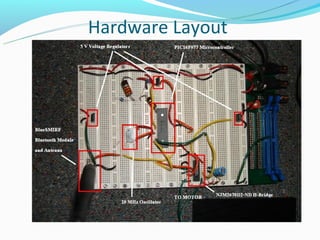
Hardware Layout
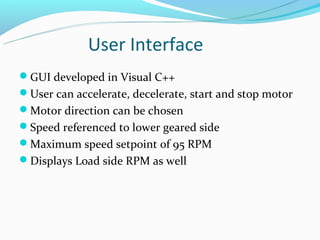
User Interface
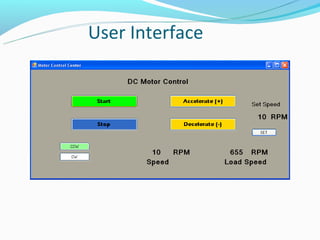
GUI developed in Visual C++
User can accelerate, decelerate, start and stop motor
Motor direction can be chosen
Speed referenced to lower geared side
Maximum speed setpoint of 95 RPM
Displays Load side RPM as well
User Interface
Microcontroller
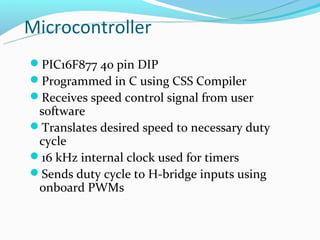
PIC16F877 40 pin DIP
Programmed in C using CSS Compiler
Receives speed control signal from user
 software
Translates desired speed to necessary duty
 cycle
16 kHz internal clock used for timers
Sends duty cycle to H-bridge inputs using
 onboard PWMs
Operation Tests
For a given duty cycle, the resulting speed was
 measured
Using a collection of these points, a linear
 translation from duty cycle to speed was
 calculated
Motor Operations
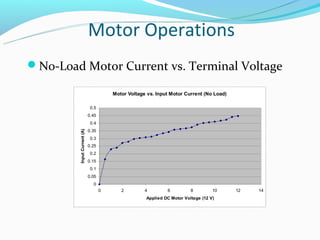
No-Load Motor Current vs. Terminal Voltage

                                           Motor Voltage vs. Input Motor Current (No Load)

                                 0.5
                                0.45
                                 0.4
        Input Current (A) (A)


                                0.35
                                 0.3
                                0.25
                                 0.2
                                0.15
                                 0.1
                                0.05
                                  0
                                       0      2         4        6          8         10     12   14
                                                        Applied DC Motor Voltage (12 V)
Motor Operations
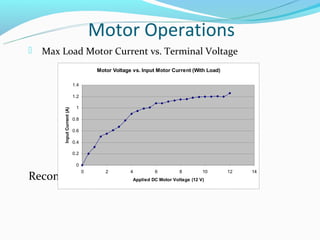
   Max Load Motor Current vs. Terminal Voltage
                                          Motor Voltage vs. Input Motor Current (With Load)

                                1.4

                                1.2
        Input Current (A) (A)


                                 1

                                0.8

                                0.6

                                0.4

                                0.2

                                 0

Recommended Max H-Bridge Current = 1.2 A
                                      0      2         4         6          8         10      12   14
                                                        Applied DC Motor Voltage (12 V)
Results
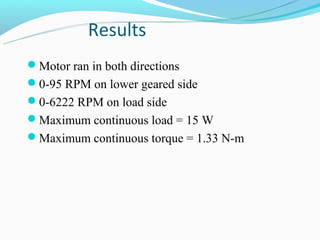
Motor ran in both directions
0-95 RPM on lower geared side
0-6222 RPM on load side
Maximum continuous load = 15 W
Maximum continuous torque = 1.33 N-m
Advantages
This system is easy to operate
It require only one operator
Speed control will be accurate
Power losses will be less
Disadvantages
It require more space
Initial cost is more
It require skilled person to operate
It works only in small centre distance
Applications
Robotics
Remote control car
Industrial Uses
Household Uses
Conclution
     Wireless becoming more and more available and
widely used bluetooth is one of the major player
interested in power and motor control
puni

puni

  • 1.
    Wireless Bluetooth ControllerFor DC Motor Presented By Raghavendra K T 524ee10039 Electrial & electronic engineering Rajeev Polytechnic Hassan
  • 2.
  • 3.
    Introduction Speed control of a motor is essential while we are using any type of motors.Here we are using wireless bluetooth technology for the speed control of motor instead of wired control.It is the newly invented method for the speed control of motor. Bluetooth is an wireless network used to communicate in b/w two devices with short centre distance approximately 10 meters.In this system we are using bluetooth as a main role for speed control of motor.
  • 4.
    Objectives Wireless Controller forDC Motor Bluetooth Wireless Standard Windows based GUI 12 V Permanent Magnet Geared Motor Battery powered Variable speed
  • 5.
  • 6.
  • 7.
    User Interface GUI developedin Visual C++ User can accelerate, decelerate, start and stop motor Motor direction can be chosen Speed referenced to lower geared side Maximum speed setpoint of 95 RPM Displays Load side RPM as well
  • 8.
  • 9.
    Microcontroller PIC16F877 40 pinDIP Programmed in C using CSS Compiler Receives speed control signal from user software Translates desired speed to necessary duty cycle 16 kHz internal clock used for timers Sends duty cycle to H-bridge inputs using onboard PWMs
  • 11.
    Operation Tests For agiven duty cycle, the resulting speed was measured Using a collection of these points, a linear translation from duty cycle to speed was calculated
  • 12.
    Motor Operations No-Load MotorCurrent vs. Terminal Voltage Motor Voltage vs. Input Motor Current (No Load) 0.5 0.45 0.4 Input Current (A) (A) 0.35 0.3 0.25 0.2 0.15 0.1 0.05 0 0 2 4 6 8 10 12 14 Applied DC Motor Voltage (12 V)
  • 13.
    Motor Operations  Max Load Motor Current vs. Terminal Voltage Motor Voltage vs. Input Motor Current (With Load) 1.4 1.2 Input Current (A) (A) 1 0.8 0.6 0.4 0.2 0 Recommended Max H-Bridge Current = 1.2 A 0 2 4 6 8 10 12 14 Applied DC Motor Voltage (12 V)
  • 14.
    Results Motor ran inboth directions 0-95 RPM on lower geared side 0-6222 RPM on load side Maximum continuous load = 15 W Maximum continuous torque = 1.33 N-m
  • 16.
    Advantages This system iseasy to operate It require only one operator Speed control will be accurate Power losses will be less
  • 17.
    Disadvantages It require morespace Initial cost is more It require skilled person to operate It works only in small centre distance
  • 18.
  • 19.
    Conclution Wireless becoming more and more available and widely used bluetooth is one of the major player interested in power and motor control