PUMPING WINDMILLS IN MALLORCA


➢The windmills were already part of the landscape of Mallorca during
 the Muslim period, before the Catalan conquest (1229).
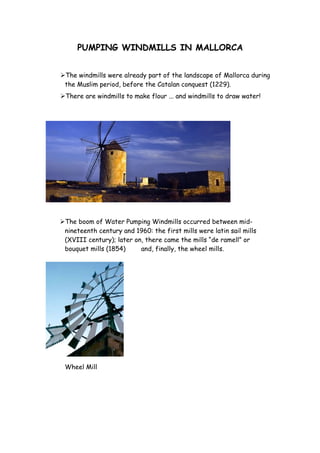
➢There are windmills to make flour ... and windmills to draw water!


➢The boom of Water Pumping Windmills occurred between mid-
 nineteenth century and 1960: the first mills were latin sail mills
 (XVIII century); later on, there came the mills “de ramell” or
 bouquet mills (1854)     and, finally, the wheel mills.


 Wheel Mill
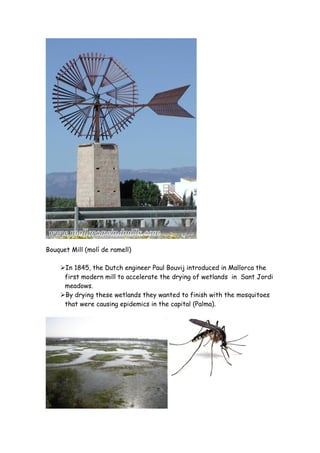
Bouquet Mill (molí de ramell)

    ➢In 1845, the Dutch engineer Paul Bouvij introduced in Mallorca the
     first modern mill to accelerate the drying of wetlands in Sant Jordi
     meadows.
    ➢By drying these wetlands they wanted to finish with the mosquitoes
     that were causing epidemics in the capital (Palma).
➢At the end of the 19th century and during the first half of the
       20th century, the mills invaded the landscape of the three low areas
       and wetlands in Mallorca: Prat de Sant Jordi, to the South-West.
       Campos and Ses Salines, to the South-East. And Sa Pobla-Muro, to
       the North.
   ➢In the three areas, a rich irrigated agriculture, made possible by
     water mills, replaced the traditional unirrigated agriculture.
   ➢From 1934, the wheel mill, more efficient, gradually replaced the
     other mills and became the most widely seen mills in the Mallorcan
     countryside.
   ➢                                      Irrigated Agriculture


Unirrigated Agriculture
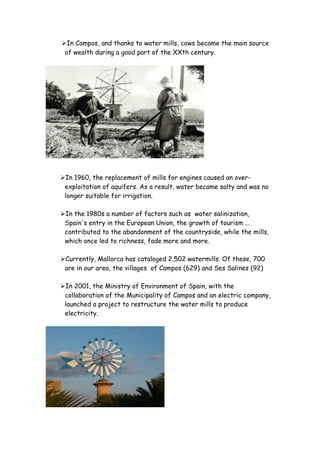
➢In Campos, and thanks to water mills, cows became the main source
 of wealth during a good part of the XXth century.


➢In 1960, the replacement of mills for engines caused an over-
 exploitation of aquifers. As a result, water became salty and was no
 longer suitable for irrigation.

➢In the 1980s a number of factors such as water salinization,
 Spain's entry in the European Union, the growth of tourism ...
 contributed to the abandonment of the countryside, while the mills,
 which once led to richness, fade more and more.

➢Currently, Mallorca has cataloged 2,502 watermills. Of these, 700
 are in our area, the villages of Campos (629) and Ses Salines (92)

➢In 2001, the Ministry of Environment of Spain, with the
 collaboration of the Municipality of Campos and an electric company,
 launched a project to restructure the water mills to produce
 electricity.
Pumping windmills in Mallorca

Pumping windmills in Mallorca

  • 1.
    PUMPING WINDMILLS INMALLORCA ➢The windmills were already part of the landscape of Mallorca during the Muslim period, before the Catalan conquest (1229). ➢There are windmills to make flour ... and windmills to draw water! ➢The boom of Water Pumping Windmills occurred between mid- nineteenth century and 1960: the first mills were latin sail mills (XVIII century); later on, there came the mills “de ramell” or bouquet mills (1854) and, finally, the wheel mills. Wheel Mill
  • 2.
    Bouquet Mill (molíde ramell) ➢In 1845, the Dutch engineer Paul Bouvij introduced in Mallorca the first modern mill to accelerate the drying of wetlands in Sant Jordi meadows. ➢By drying these wetlands they wanted to finish with the mosquitoes that were causing epidemics in the capital (Palma).
  • 3.
    ➢At the endof the 19th century and during the first half of the 20th century, the mills invaded the landscape of the three low areas and wetlands in Mallorca: Prat de Sant Jordi, to the South-West. Campos and Ses Salines, to the South-East. And Sa Pobla-Muro, to the North. ➢In the three areas, a rich irrigated agriculture, made possible by water mills, replaced the traditional unirrigated agriculture. ➢From 1934, the wheel mill, more efficient, gradually replaced the other mills and became the most widely seen mills in the Mallorcan countryside. ➢ Irrigated Agriculture Unirrigated Agriculture
  • 4.
    ➢In Campos, andthanks to water mills, cows became the main source of wealth during a good part of the XXth century. ➢In 1960, the replacement of mills for engines caused an over- exploitation of aquifers. As a result, water became salty and was no longer suitable for irrigation. ➢In the 1980s a number of factors such as water salinization, Spain's entry in the European Union, the growth of tourism ... contributed to the abandonment of the countryside, while the mills, which once led to richness, fade more and more. ➢Currently, Mallorca has cataloged 2,502 watermills. Of these, 700 are in our area, the villages of Campos (629) and Ses Salines (92) ➢In 2001, the Ministry of Environment of Spain, with the collaboration of the Municipality of Campos and an electric company, launched a project to restructure the water mills to produce electricity.