Private, Public, Hybrid Unique
Challenges with OpenStack
Gathering Info  CMDB
Ryszard Chojnacki, an OPS CMDB blueprint worker
27 October, 2015
Covering what?
• Define a scenario for collecting data
• Show actual payload headers used in one application
• Set the stage for a CMDB blueprints direction:
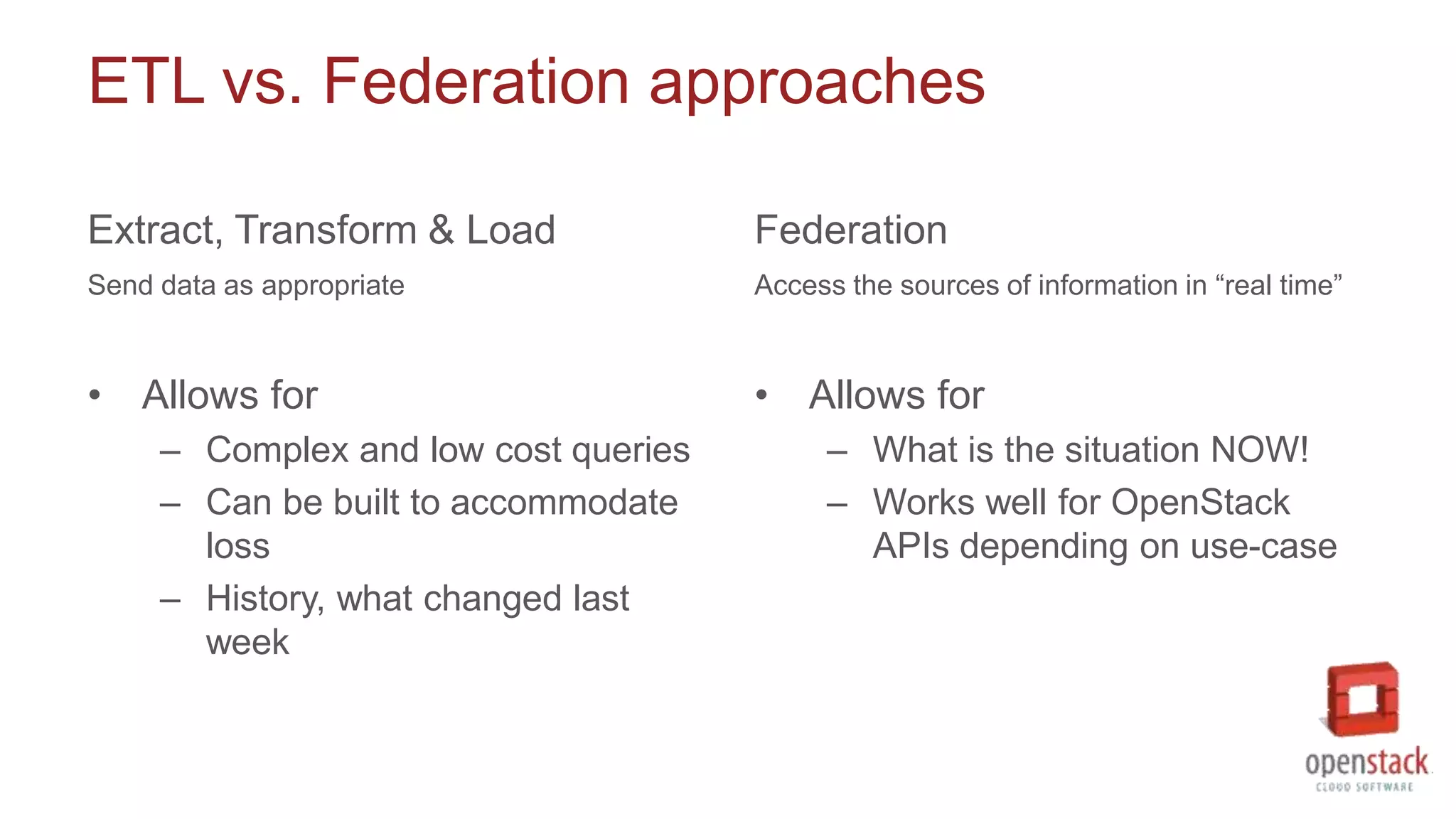
ETL vs. Federation approaches
Extract, Transform & Load
Send data as appropriate
• Allows for
– Complex and low cost queries
– Can be built to accommodate
loss
– History, what changed last
week
Federation
Access the sources of information in “real time”
• Allows for
– What is the situation NOW!
– Works well for OpenStack
APIs depending on use-case
Set the scene
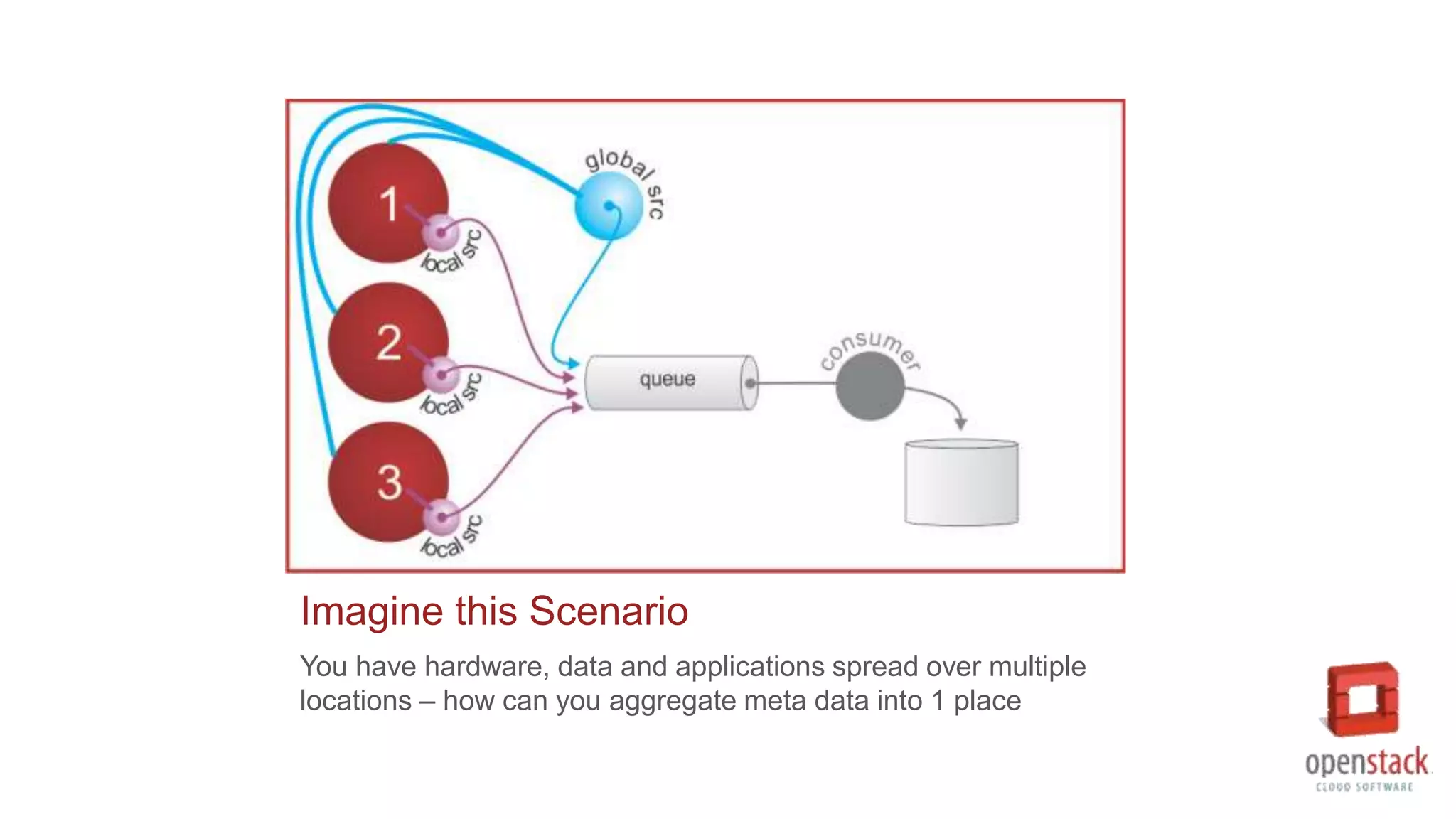
Imagine this Scenario
You have hardware, data and applications spread over multiple
locations – how can you aggregate meta data into 1 place
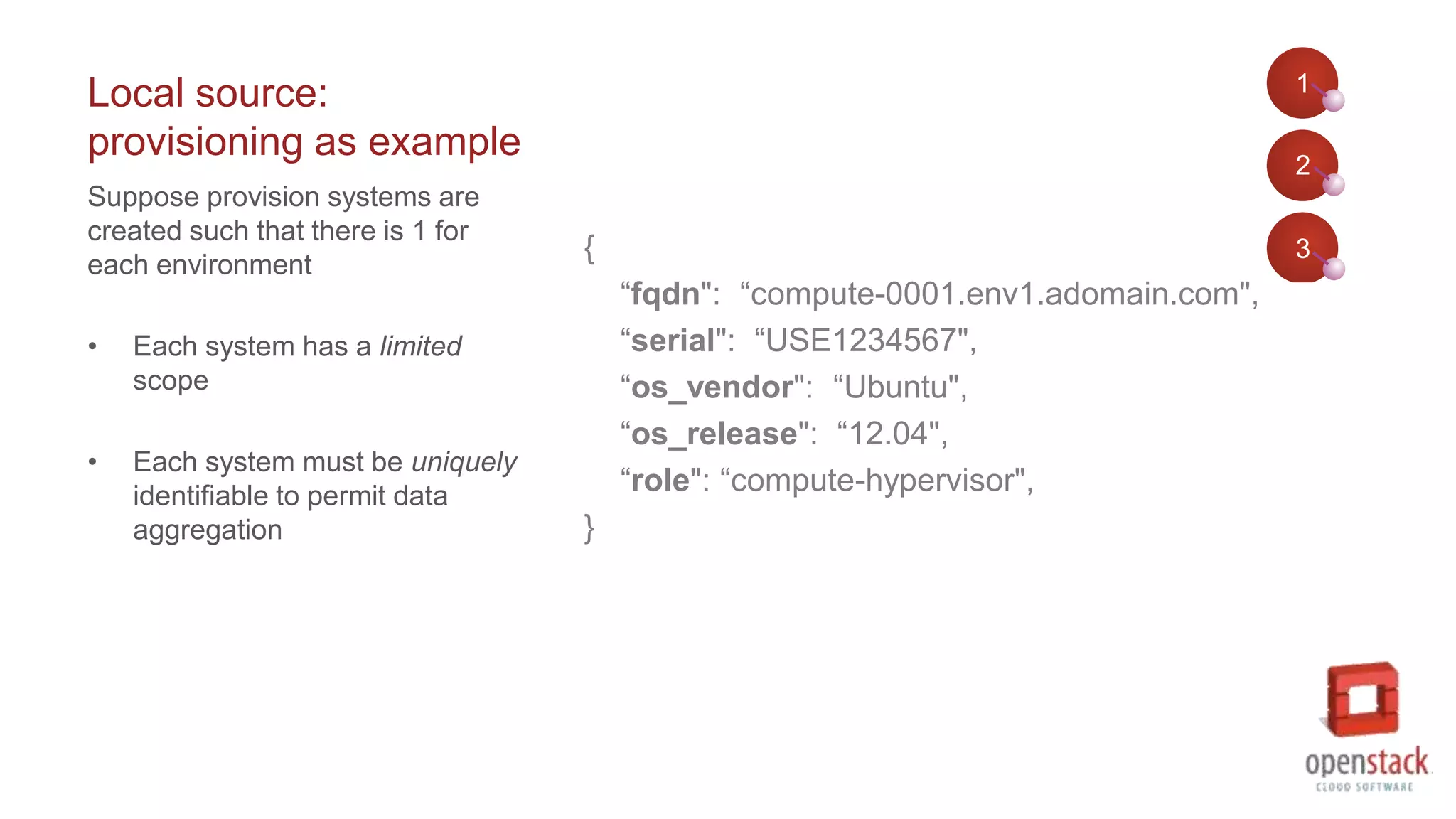
Local source:
provisioning as example
{
“fqdn": “compute-0001.env1.adomain.com",
“serial": “USE1234567",
“os_vendor": “Ubuntu",
“os_release": “12.04",
“role": “compute-hypervisor",
}
Suppose provision systems are
created such that there is 1 for
each environment
• Each system has a limited
scope
• Each system must be uniquely
identifiable to permit data
aggregation
1
2
3
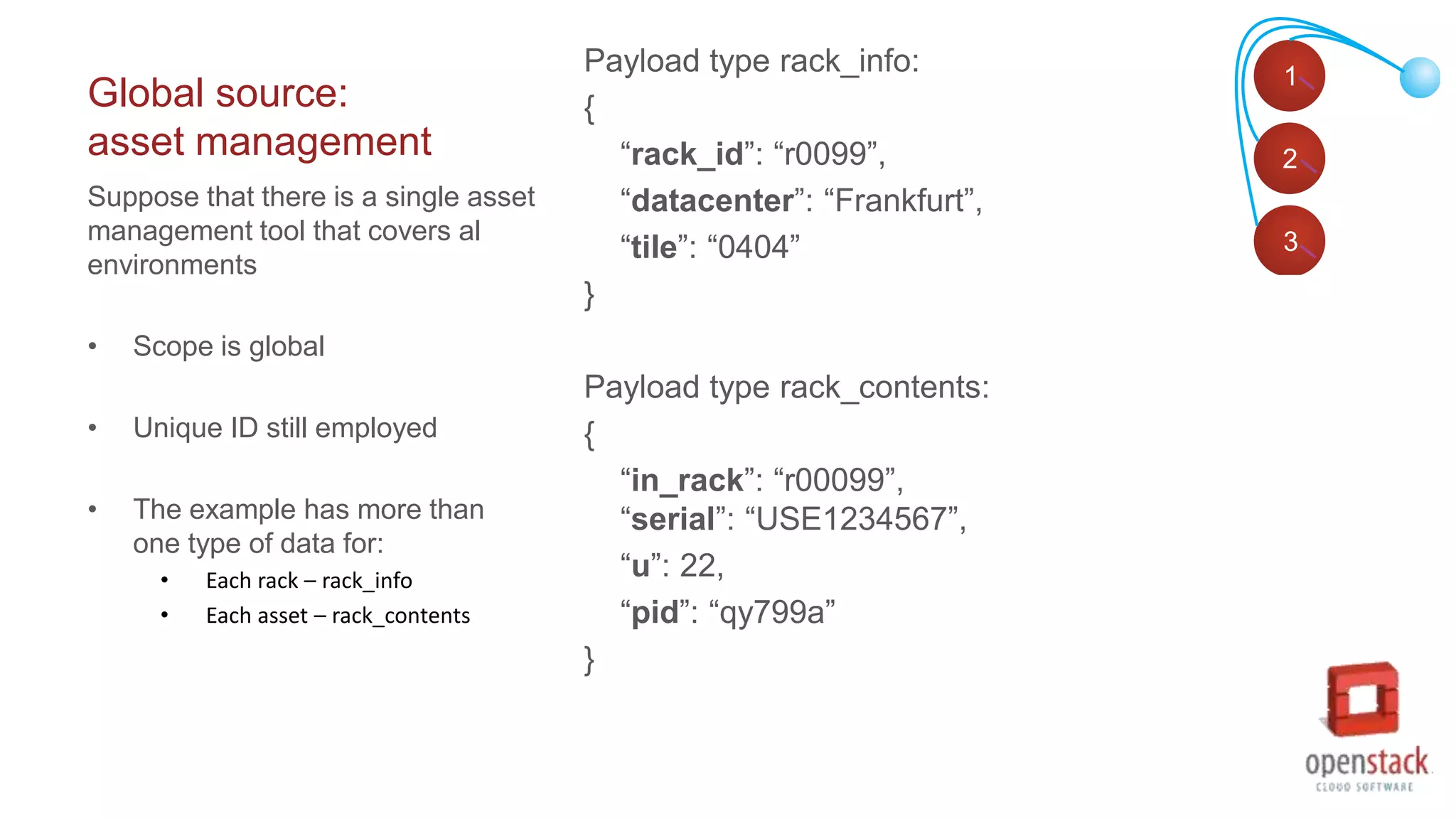
Global source:
asset management
Payload type rack_info:
{
“rack_id”: “r0099”,
“datacenter”: “Frankfurt”,
“tile”: “0404”
}
Payload type rack_contents:
{
“in_rack”: “r00099”,
“serial”: “USE1234567”,
“u”: 22,
“pid”: “qy799a”
}
Suppose that there is a single asset
management tool that covers al
environments
• Scope is global
• Unique ID still employed
• The example has more than
one type of data for:
• Each rack – rack_info
• Each asset – rack_contents
1
2
3
Snapshot Header
Message formats
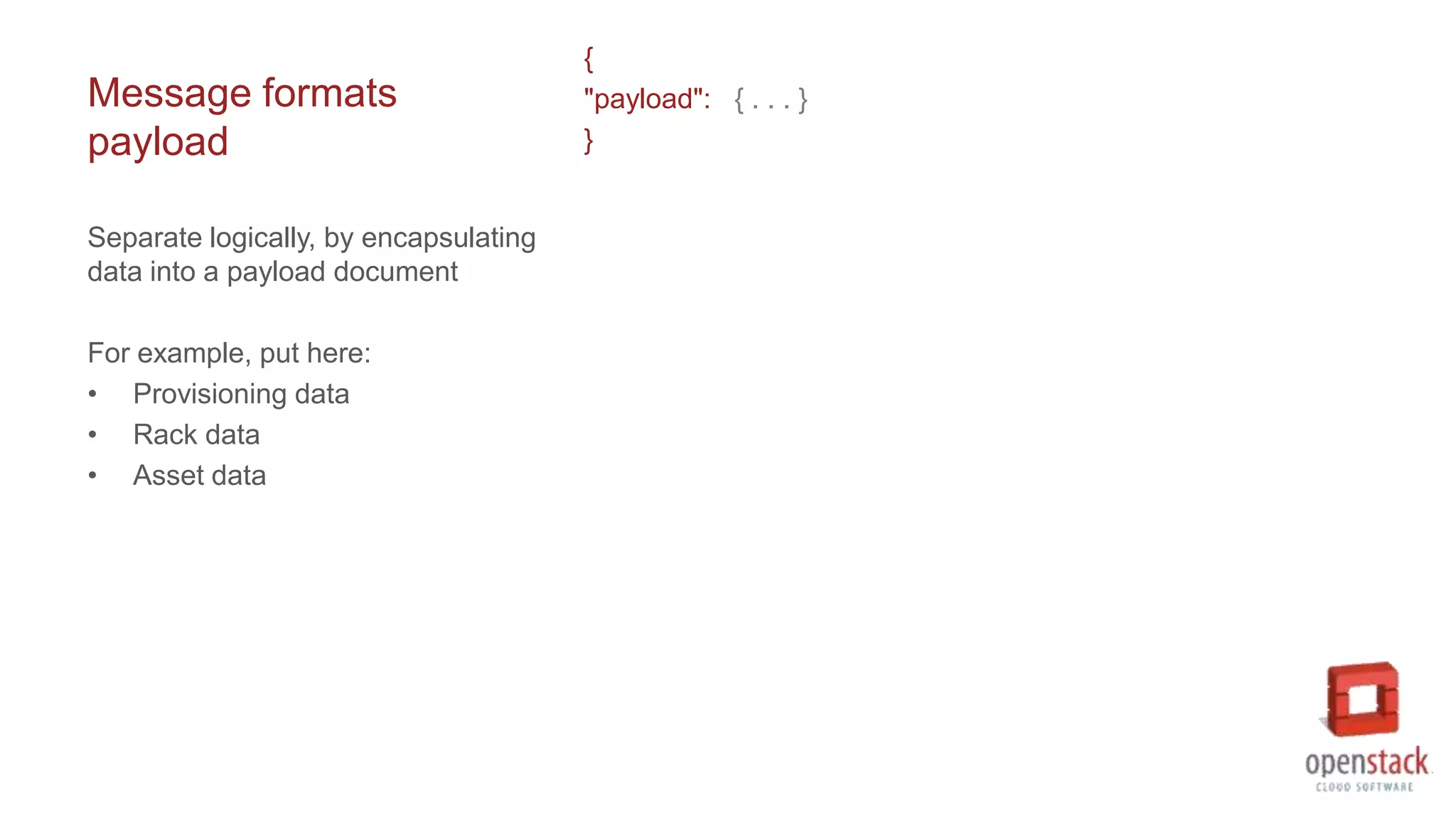
payload
{
"payload": { . . . }
}
Separate logically, by encapsulating
data into a payload document
For example, put here:
• Provisioning data
• Rack data
• Asset data
Message formats
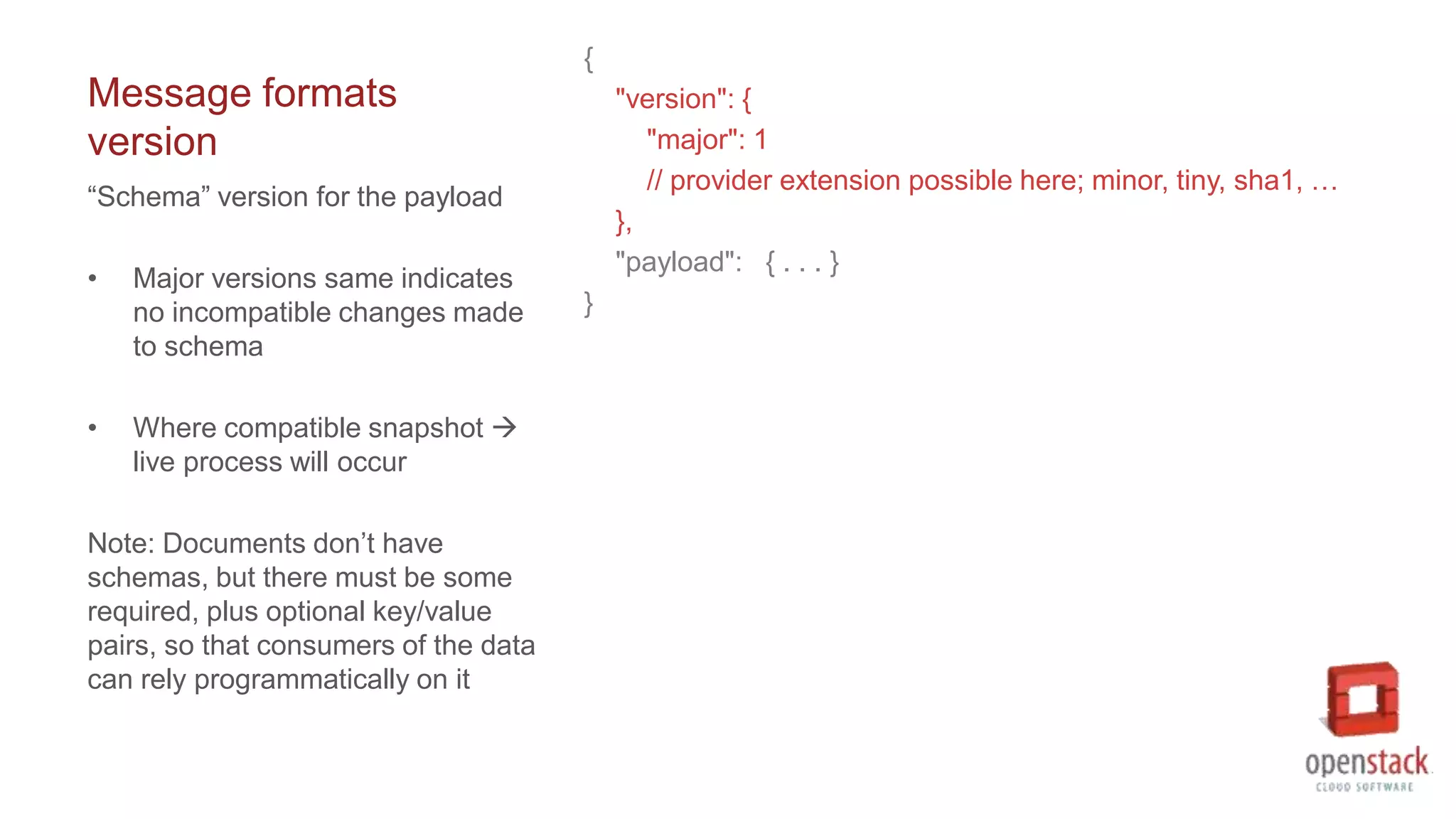
version
{
"version": {
"major": 1
// provider extension possible here; minor, tiny, sha1, …
},
"payload": { . . . }
}
“Schema” version for the payload
• Major versions same indicates
no incompatible changes made
to schema
• Where compatible snapshot 
live process will occur
Note: Documents don’t have
schemas, but there must be some
required, plus optional key/value
pairs, so that consumers of the data
can rely programmatically on it
Message formats
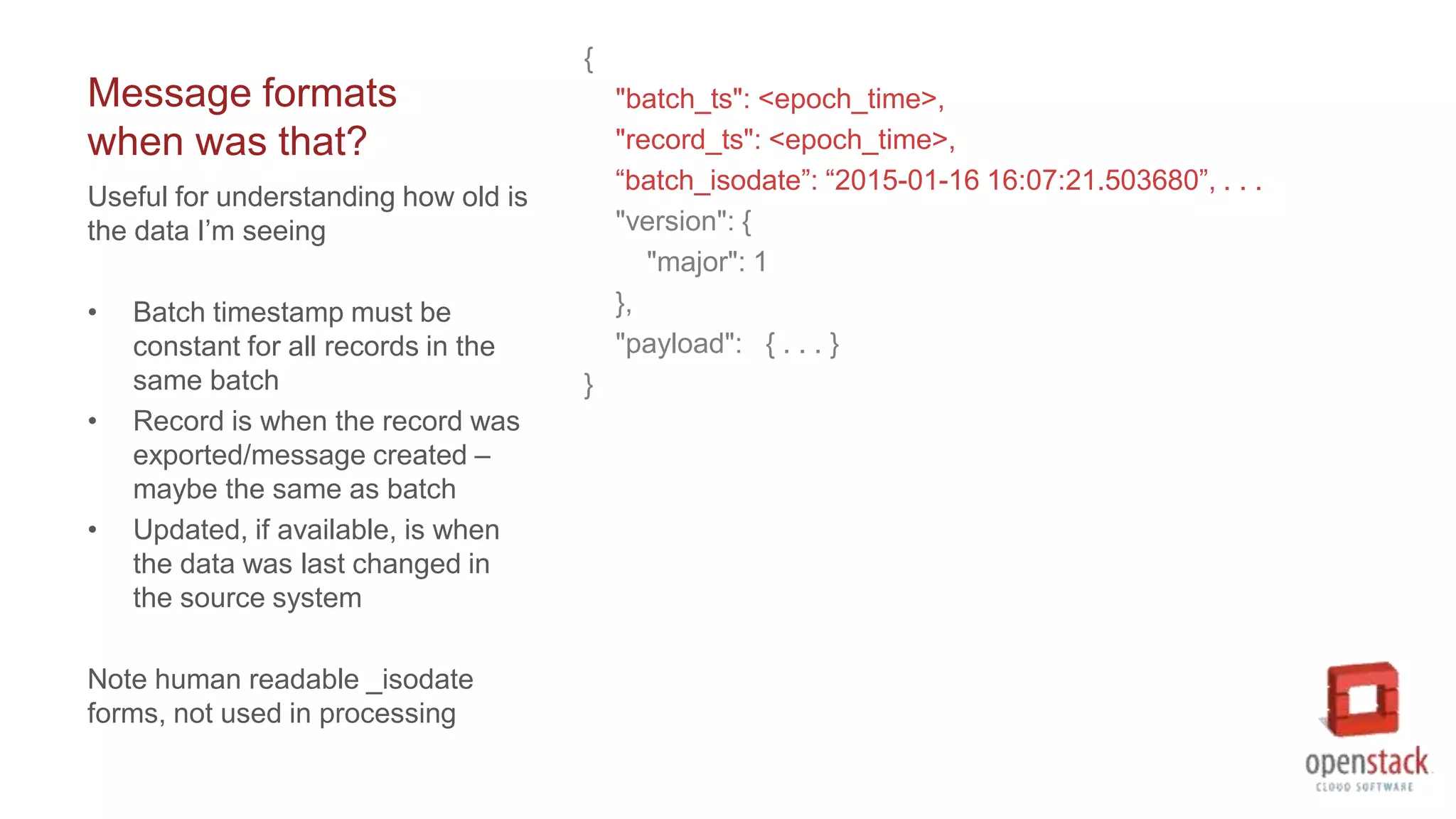
when was that?
{
"batch_ts": <epoch_time>,
"record_ts": <epoch_time>,
“batch_isodate”: “2015-01-16 16:07:21.503680”, . . .
"version": {
"major": 1
},
"payload": { . . . }
}
Useful for understanding how old is
the data I’m seeing
• Batch timestamp must be
constant for all records in the
same batch
• Record is when the record was
exported/message created –
maybe the same as batch
• Updated, if available, is when
the data was last changed in
the source system
Note human readable _isodate
forms, not used in processing
Message formats
{
"source": {
"system": "rackreader.adomain.net"
"type": "rack_info",
"location": "env"
},
"batch_ts": <epoch_time>,
"record_ts": <epoch_time>,
"import_ts": <epoch_time>,
"version": {
"major": 1
},
"payload": { . . . }
}
Provides where the data came from
and the type of data
• System: usually fqdn of source
system
• Location: the scope of the
system
• Type: describes the payload
content, and is tied to the
schema
Message formats
{
"record_id": “r00099-rackreader.adomain.net",
"msg_type": "snapshot",
"source": {
"system": "rackreader.adomain.net"
"type": "rack_info",
"location": "env"
},
"batch_ts": <epoch_time>,
"record_ts": <epoch_time>,
"import_ts": <epoch_time>,
"version": {
"major": 1
},
"payload": { . . . }
}
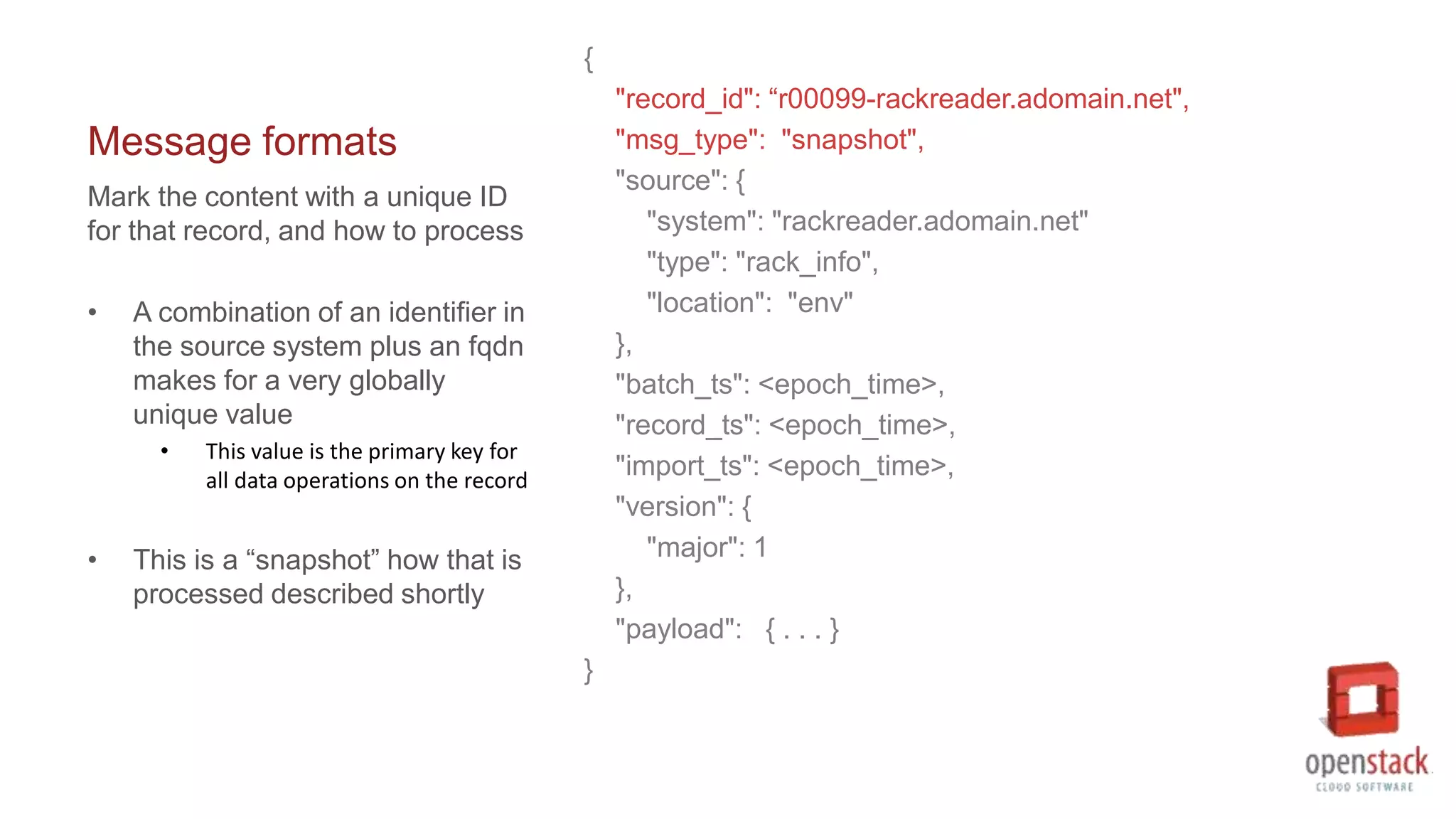
Mark the content with a unique ID
for that record, and how to process
• A combination of an identifier in
the source system plus an fqdn
makes for a very globally
unique value
• This value is the primary key for
all data operations on the record
• This is a “snapshot” how that is
processed described shortly
Implementation
Philosophy employed
• Operating at large scale  expect to have issues
– Small % error X a big number = some degree of loss
• Tolerant of loss
• Considerate of resources
• Wanted history
– Need easy access to the very latest
• Need a flexible [document] schema – this is JSON
– Provider/Agent is the owner of the schema for its data
– Need a way to converge; communities of practice
Snapshot versus event
based updates
Example
• Snapshot updates every 8h
– Larger data set but not very frequent
• Live updates as they occur
– Tiny data as they occur
• Result
– Minimal network utilization
– Small overhead on source
• Use the combination that best
suits the need
We run 2 collections
• Snapshot
• Has history
• Live
• Has only the latest
Snapshots update Live
Message type overview
Snapshot
• Snapshot
– Defines a Snapshot record
• Batch record count
– Defines how many items in a
batch
– Only If sizes match update
Live
• Required to know what to
delete
Live
• Overwrite
– Live overwrite a complete doc
for a single record
• Delete
– Delete from live a single
record
– Never affects Snapshot
Message formats
snapshot_size
{
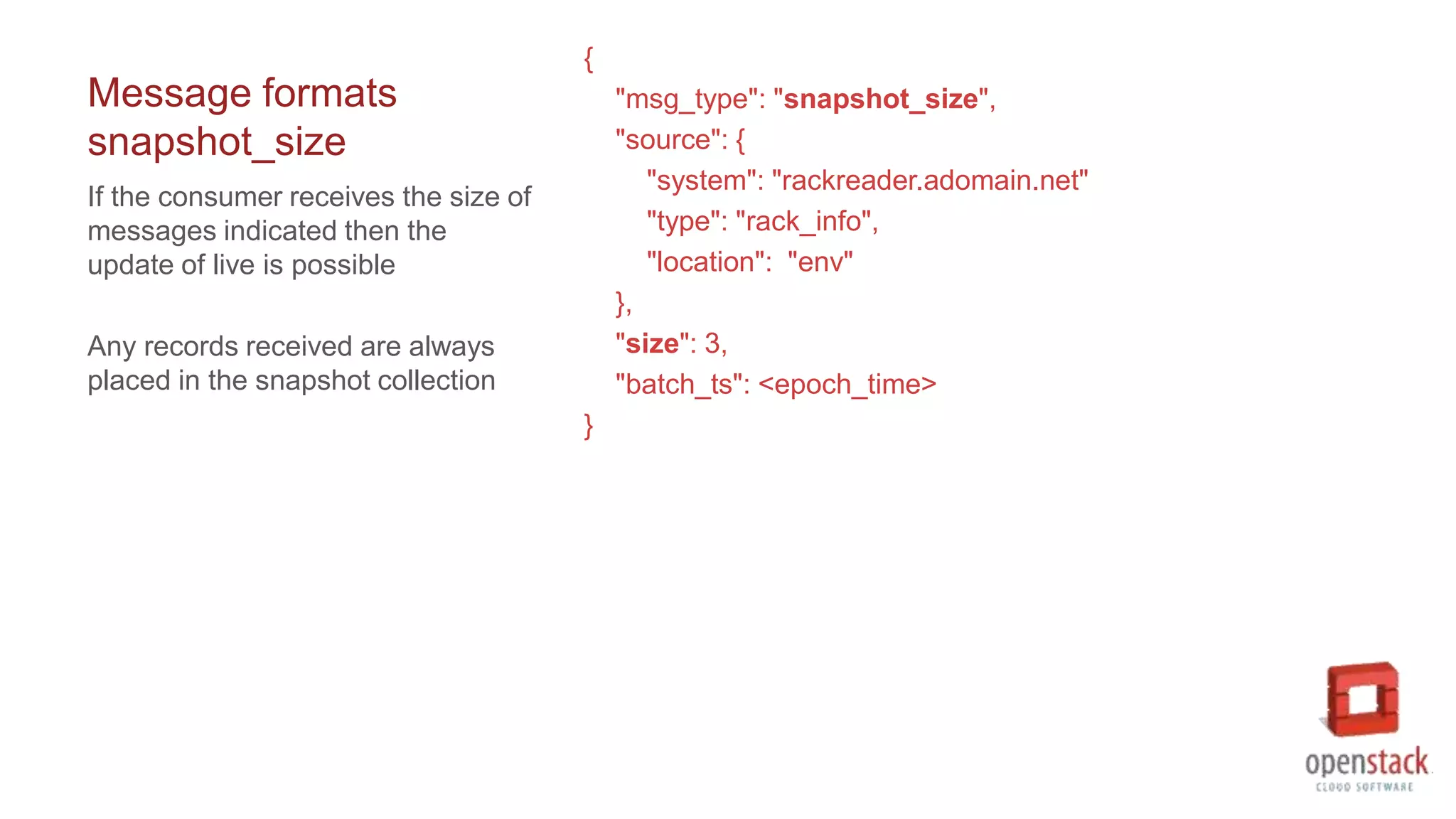
"msg_type": "snapshot_size",
"source": {
"system": "rackreader.adomain.net"
"type": "rack_info",
"location": "env"
},
"size": 3,
"batch_ts": <epoch_time>
}
If the consumer receives the size of
messages indicated then the
update of live is possible
Any records received are always
placed in the snapshot collection
Message formats
overwrite
{
"msg_type": "overwrite",
"record_id": “r00099-rackreader.adomain.net",
"source": {
"system": "rackreader.adomain.net"
"type": "rack_contents",
"location": "env"
},
"version": {
"major": 1
},
"record_ts": <epoch_time>,
"payload": { . . . }
}
• Separate the header info from
the payload data
Message formats
delete
{
"msg_type": “delete",
"record_id": “r00099-rackreader.adomain.net",
"source": {
"system": "rackreader.adomain.net"
"type": "rack_contents",
"location": "env"
},
"version": {
"major": 1
},
"record_ts": <epoch_time>,
}
• Separate the header info from
the payload data
Direction
Noteworthy
• If we lose an event we catch up in the batch update
• If we lose a batch, data is just 1 batch cycle stale
• Several companies have arrived at this position
• Records are fairly small
– rabbitMQ friendly
– Easy to search in your data store
CMDB blueprint
• Set the stage for a CMDB blueprints direction:
– Collect
– Store
– Query
• Focus on the Collection framework
• Community of Practice
– Share common stuff; hopefully every expanding domain
– Permit ad-hoc sources, for what you have now
Thank-you!
Message processing
A live update to
“B” goes straight in
here
And is later
updated again by
the snapshot
B
There are 2 collections
of data; snapshot and
live
Snapshot always keeps
growing
Live only has 1 entry
per record
Public private hybrid - cmdb challenge

Public private hybrid - cmdb challenge

  • 1.
    Private, Public, HybridUnique Challenges with OpenStack Gathering Info  CMDB Ryszard Chojnacki, an OPS CMDB blueprint worker 27 October, 2015
  • 2.
    Covering what? • Definea scenario for collecting data • Show actual payload headers used in one application • Set the stage for a CMDB blueprints direction:
  • 3.
    ETL vs. Federationapproaches Extract, Transform & Load Send data as appropriate • Allows for – Complex and low cost queries – Can be built to accommodate loss – History, what changed last week Federation Access the sources of information in “real time” • Allows for – What is the situation NOW! – Works well for OpenStack APIs depending on use-case
  • 4.
  • 5.
    Imagine this Scenario Youhave hardware, data and applications spread over multiple locations – how can you aggregate meta data into 1 place
  • 6.
    Local source: provisioning asexample { “fqdn": “compute-0001.env1.adomain.com", “serial": “USE1234567", “os_vendor": “Ubuntu", “os_release": “12.04", “role": “compute-hypervisor", } Suppose provision systems are created such that there is 1 for each environment • Each system has a limited scope • Each system must be uniquely identifiable to permit data aggregation 1 2 3
  • 7.
    Global source: asset management Payloadtype rack_info: { “rack_id”: “r0099”, “datacenter”: “Frankfurt”, “tile”: “0404” } Payload type rack_contents: { “in_rack”: “r00099”, “serial”: “USE1234567”, “u”: 22, “pid”: “qy799a” } Suppose that there is a single asset management tool that covers al environments • Scope is global • Unique ID still employed • The example has more than one type of data for: • Each rack – rack_info • Each asset – rack_contents 1 2 3
  • 8.
  • 9.
    Message formats payload { "payload": {. . . } } Separate logically, by encapsulating data into a payload document For example, put here: • Provisioning data • Rack data • Asset data
  • 10.
    Message formats version { "version": { "major":1 // provider extension possible here; minor, tiny, sha1, … }, "payload": { . . . } } “Schema” version for the payload • Major versions same indicates no incompatible changes made to schema • Where compatible snapshot  live process will occur Note: Documents don’t have schemas, but there must be some required, plus optional key/value pairs, so that consumers of the data can rely programmatically on it
  • 11.
    Message formats when wasthat? { "batch_ts": <epoch_time>, "record_ts": <epoch_time>, “batch_isodate”: “2015-01-16 16:07:21.503680”, . . . "version": { "major": 1 }, "payload": { . . . } } Useful for understanding how old is the data I’m seeing • Batch timestamp must be constant for all records in the same batch • Record is when the record was exported/message created – maybe the same as batch • Updated, if available, is when the data was last changed in the source system Note human readable _isodate forms, not used in processing
  • 12.
    Message formats { "source": { "system":"rackreader.adomain.net" "type": "rack_info", "location": "env" }, "batch_ts": <epoch_time>, "record_ts": <epoch_time>, "import_ts": <epoch_time>, "version": { "major": 1 }, "payload": { . . . } } Provides where the data came from and the type of data • System: usually fqdn of source system • Location: the scope of the system • Type: describes the payload content, and is tied to the schema
  • 13.
    Message formats { "record_id": “r00099-rackreader.adomain.net", "msg_type":"snapshot", "source": { "system": "rackreader.adomain.net" "type": "rack_info", "location": "env" }, "batch_ts": <epoch_time>, "record_ts": <epoch_time>, "import_ts": <epoch_time>, "version": { "major": 1 }, "payload": { . . . } } Mark the content with a unique ID for that record, and how to process • A combination of an identifier in the source system plus an fqdn makes for a very globally unique value • This value is the primary key for all data operations on the record • This is a “snapshot” how that is processed described shortly
  • 14.
  • 15.
    Philosophy employed • Operatingat large scale  expect to have issues – Small % error X a big number = some degree of loss • Tolerant of loss • Considerate of resources • Wanted history – Need easy access to the very latest • Need a flexible [document] schema – this is JSON – Provider/Agent is the owner of the schema for its data – Need a way to converge; communities of practice
  • 16.
    Snapshot versus event basedupdates Example • Snapshot updates every 8h – Larger data set but not very frequent • Live updates as they occur – Tiny data as they occur • Result – Minimal network utilization – Small overhead on source • Use the combination that best suits the need We run 2 collections • Snapshot • Has history • Live • Has only the latest Snapshots update Live
  • 17.
    Message type overview Snapshot •Snapshot – Defines a Snapshot record • Batch record count – Defines how many items in a batch – Only If sizes match update Live • Required to know what to delete Live • Overwrite – Live overwrite a complete doc for a single record • Delete – Delete from live a single record – Never affects Snapshot
  • 18.
    Message formats snapshot_size { "msg_type": "snapshot_size", "source":{ "system": "rackreader.adomain.net" "type": "rack_info", "location": "env" }, "size": 3, "batch_ts": <epoch_time> } If the consumer receives the size of messages indicated then the update of live is possible Any records received are always placed in the snapshot collection
  • 19.
    Message formats overwrite { "msg_type": "overwrite", "record_id":“r00099-rackreader.adomain.net", "source": { "system": "rackreader.adomain.net" "type": "rack_contents", "location": "env" }, "version": { "major": 1 }, "record_ts": <epoch_time>, "payload": { . . . } } • Separate the header info from the payload data
  • 20.
    Message formats delete { "msg_type": “delete", "record_id":“r00099-rackreader.adomain.net", "source": { "system": "rackreader.adomain.net" "type": "rack_contents", "location": "env" }, "version": { "major": 1 }, "record_ts": <epoch_time>, } • Separate the header info from the payload data
  • 21.
  • 22.
    Noteworthy • If welose an event we catch up in the batch update • If we lose a batch, data is just 1 batch cycle stale • Several companies have arrived at this position • Records are fairly small – rabbitMQ friendly – Easy to search in your data store
  • 23.
    CMDB blueprint • Setthe stage for a CMDB blueprints direction: – Collect – Store – Query • Focus on the Collection framework • Community of Practice – Share common stuff; hopefully every expanding domain – Permit ad-hoc sources, for what you have now
  • 24.
  • 25.
    Message processing A liveupdate to “B” goes straight in here And is later updated again by the snapshot B There are 2 collections of data; snapshot and live Snapshot always keeps growing Live only has 1 entry per record