Diode Comparison: Schottky, SPA, Zener, TVS


    Summary

    1.   Diode Description

    2.   Diode Characteristics

    3.   Diode Classification & Typical Applications

    4.   Details & Comparison of Diode Technologies

    5.   Device Parameter Comparison

    6.   Device Structure Comparison

    7.   I-V Curve and Capacitance Comparison

    8.   Application Comparison


                                          Confidential and Proprietary to Littelfuse, Inc. © 2005 Littelfuse, Inc. All rights reserved.   1
Diode Description


  All diodes share common characteristics. They are two-terminal electrical
   components that allow current to flow in one direction. This behavior is
   called “rectification”.
  Today, they are mostly built from semiconductor materials (Silicon). Before
   semiconductors, they were implemented with vacuum tube technology.
  To create a diode, you must form an electrical “junction”, usually by joining
   two dissimilar materials. The junction in a Shottky diode is created by
   joining a metal with semiconductor material.
  Current Littelfuse diodes are formed by joining two different types of
   Silicon semiconductor materials (creating a P-N junction).
  Littefuse diodes have two primary applications: power control and over-
   voltage (OV) protection.


                                           Confidential and Proprietary to Littelfuse, Inc. © 2005 Littelfuse, Inc. All rights reserved.   2
Diode Characteristics


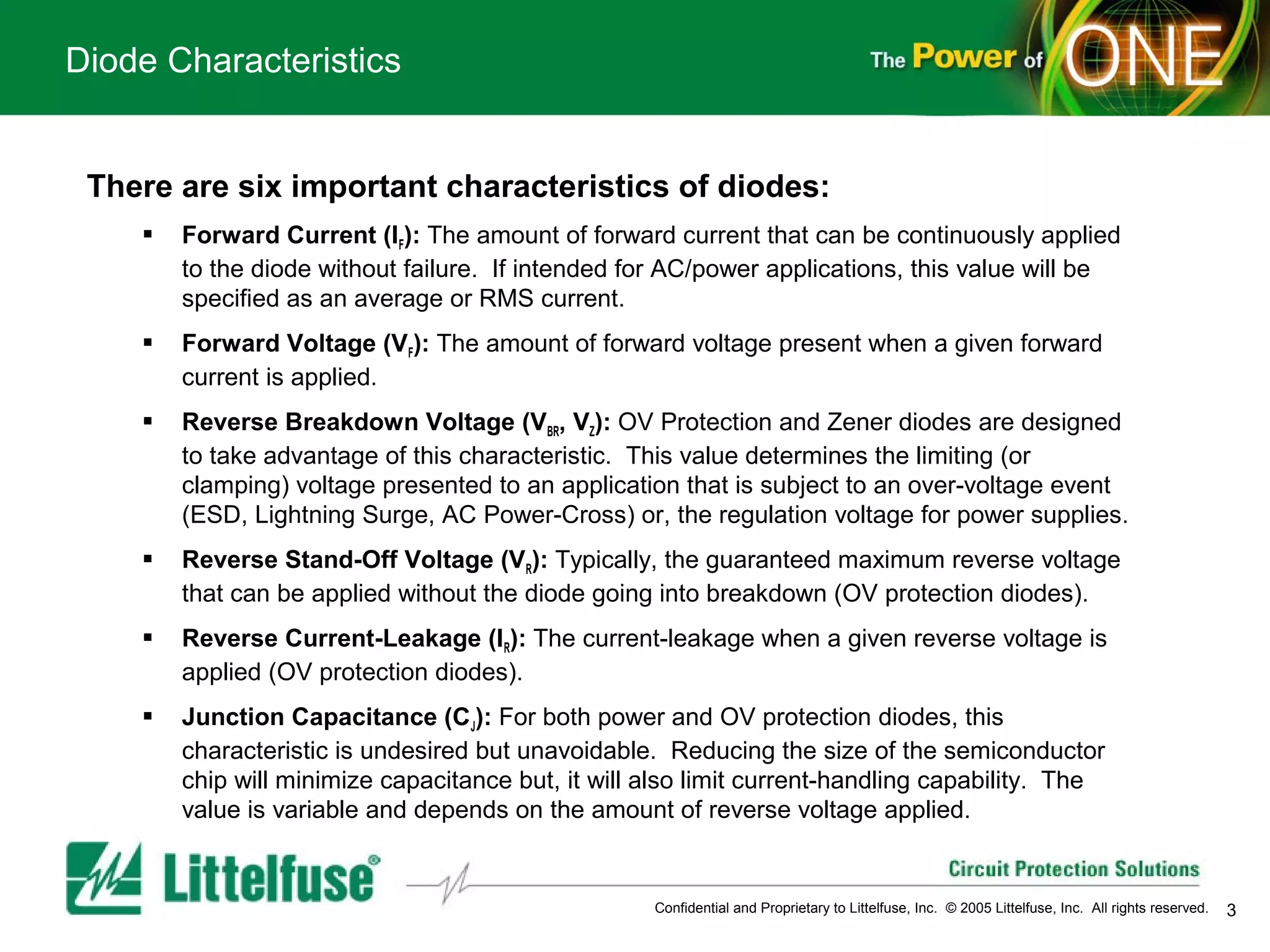
 There are six important characteristics of diodes:
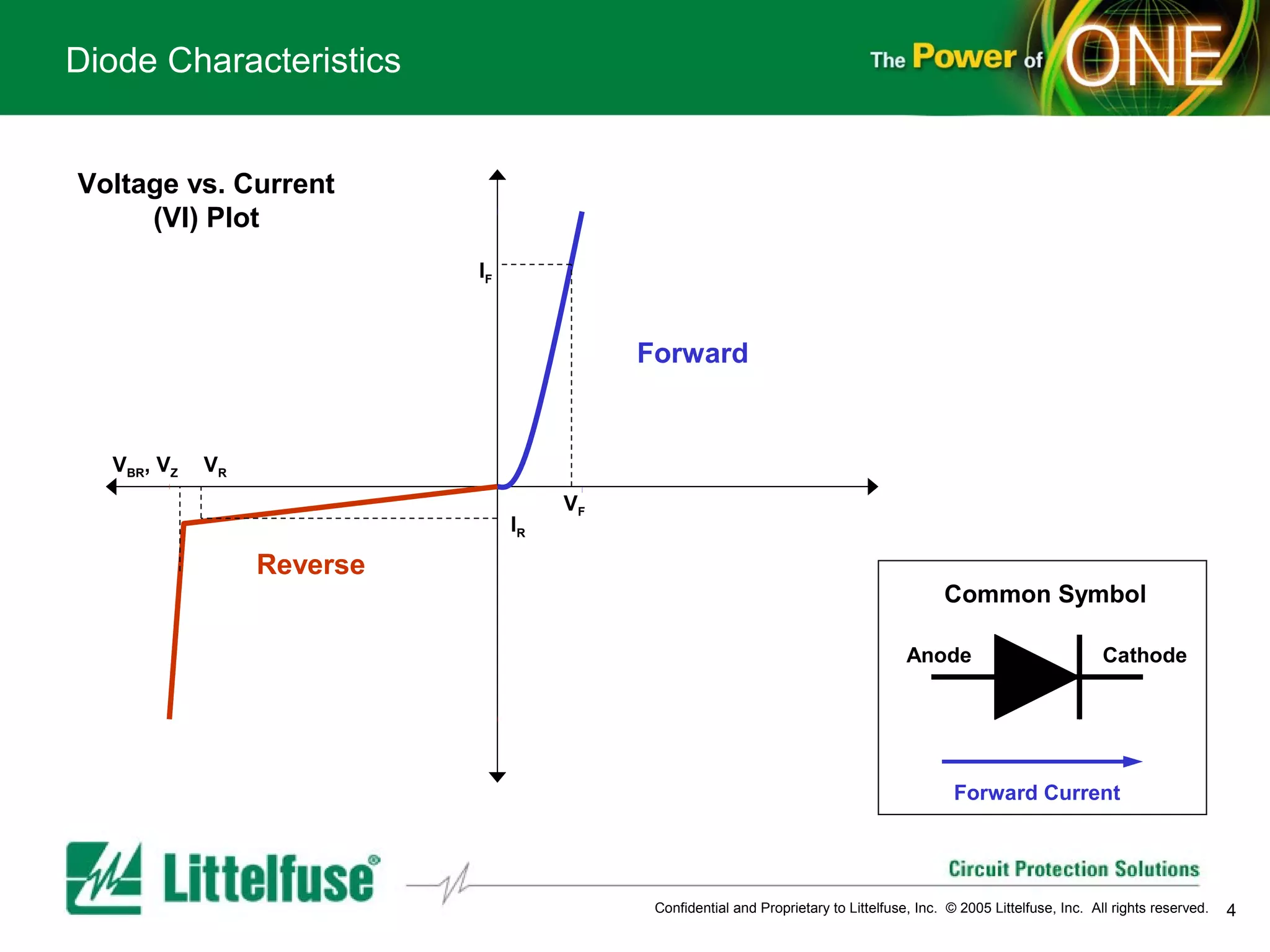
       Forward Current (IF): The amount of forward current that can be continuously applied
        to the diode without failure. If intended for AC/power applications, this value will be
        specified as an average or RMS current.
       Forward Voltage (VF): The amount of forward voltage present when a given forward
        current is applied.
       Reverse Breakdown Voltage (VBR, VZ): OV Protection and Zener diodes are designed
        to take advantage of this characteristic. This value determines the limiting (or
        clamping) voltage presented to an application that is subject to an over-voltage event
        (ESD, Lightning Surge, AC Power-Cross) or, the regulation voltage for power supplies.
       Reverse Stand-Off Voltage (VR): Typically, the guaranteed maximum reverse voltage
        that can be applied without the diode going into breakdown (OV protection diodes).
       Reverse Current-Leakage (IR): The current-leakage when a given reverse voltage is
        applied (OV protection diodes).
       Junction Capacitance (CJ): For both power and OV protection diodes, this
        characteristic is undesired but unavoidable. Reducing the size of the semiconductor
        chip will minimize capacitance but, it will also limit current-handling capability. The
        value is variable and depends on the amount of reverse voltage applied.


                                                    Confidential and Proprietary to Littelfuse, Inc. © 2005 Littelfuse, Inc. All rights reserved.   3
Diode Characteristics


Voltage vs. Current
     (VI) Plot
                           IF


                                          Forward


  VBR, VZ   VR
                                     VF
                                IR

                 Reverse
                                                                                           Common Symbol

                                                                                     Anode                            Cathode


                                                                                             Forward Current


                                           Confidential and Proprietary to Littelfuse, Inc. © 2005 Littelfuse, Inc. All rights reserved.   4
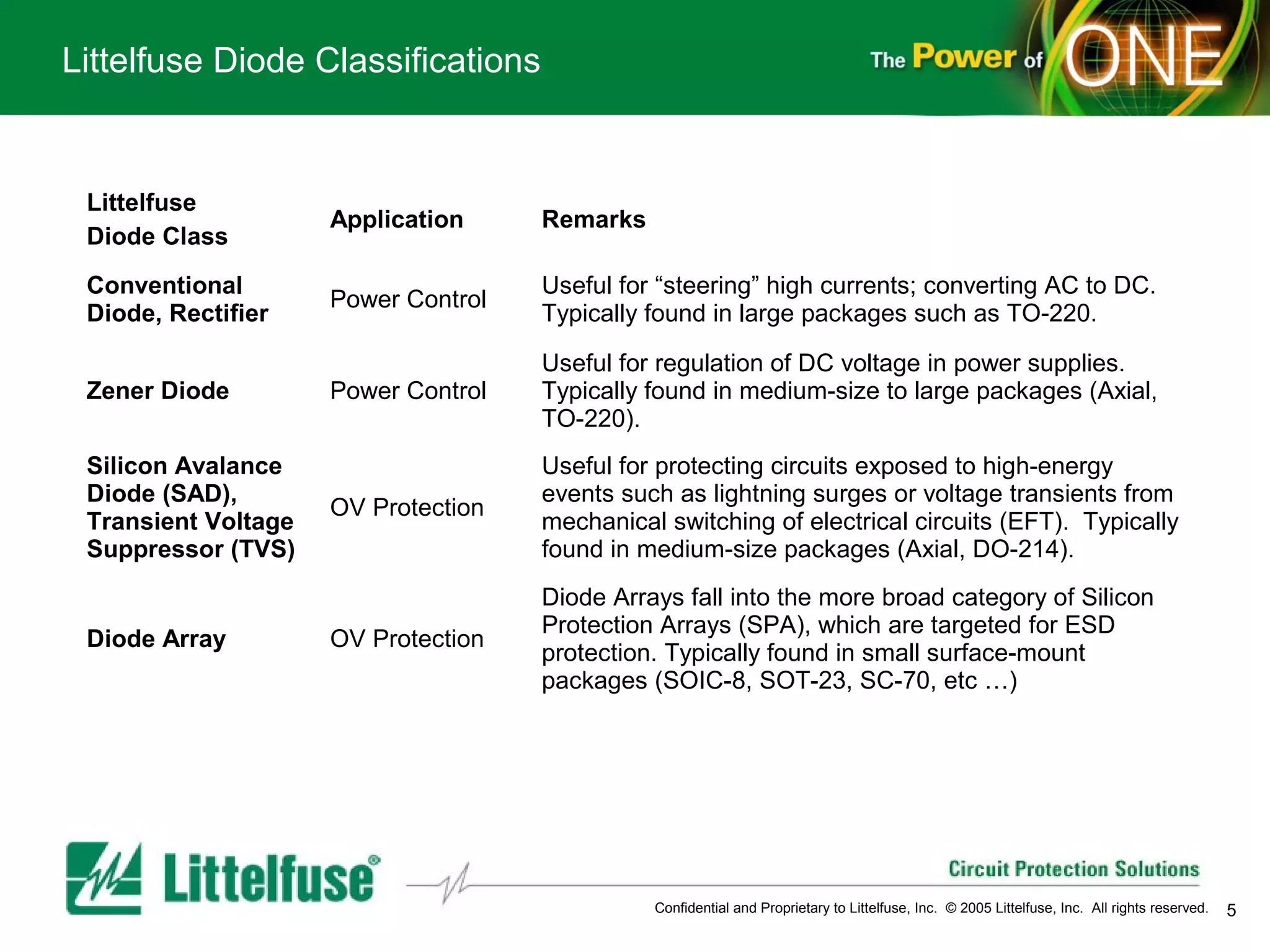
Littelfuse Diode Classifications


 Littelfuse
                     Application     Remarks
 Diode Class
 Conventional                        Useful for “steering” high currents; converting AC to DC.
                     Power Control
 Diode, Rectifier                    Typically found in large packages such as TO-220.

                                     Useful for regulation of DC voltage in power supplies.
 Zener Diode         Power Control   Typically found in medium-size to large packages (Axial,
                                     TO-220).
 Silicon Avalance                    Useful for protecting circuits exposed to high-energy
 Diode (SAD),                        events such as lightning surges or voltage transients from
                     OV Protection
 Transient Voltage                   mechanical switching of electrical circuits (EFT). Typically
 Suppressor (TVS)                    found in medium-size packages (Axial, DO-214).
                                     Diode Arrays fall into the more broad category of Silicon
                                     Protection Arrays (SPA), which are targeted for ESD
 Diode Array         OV Protection
                                     protection. Typically found in small surface-mount
                                     packages (SOIC-8, SOT-23, SC-70, etc …)


                                               Confidential and Proprietary to Littelfuse, Inc. © 2005 Littelfuse, Inc. All rights reserved.   5
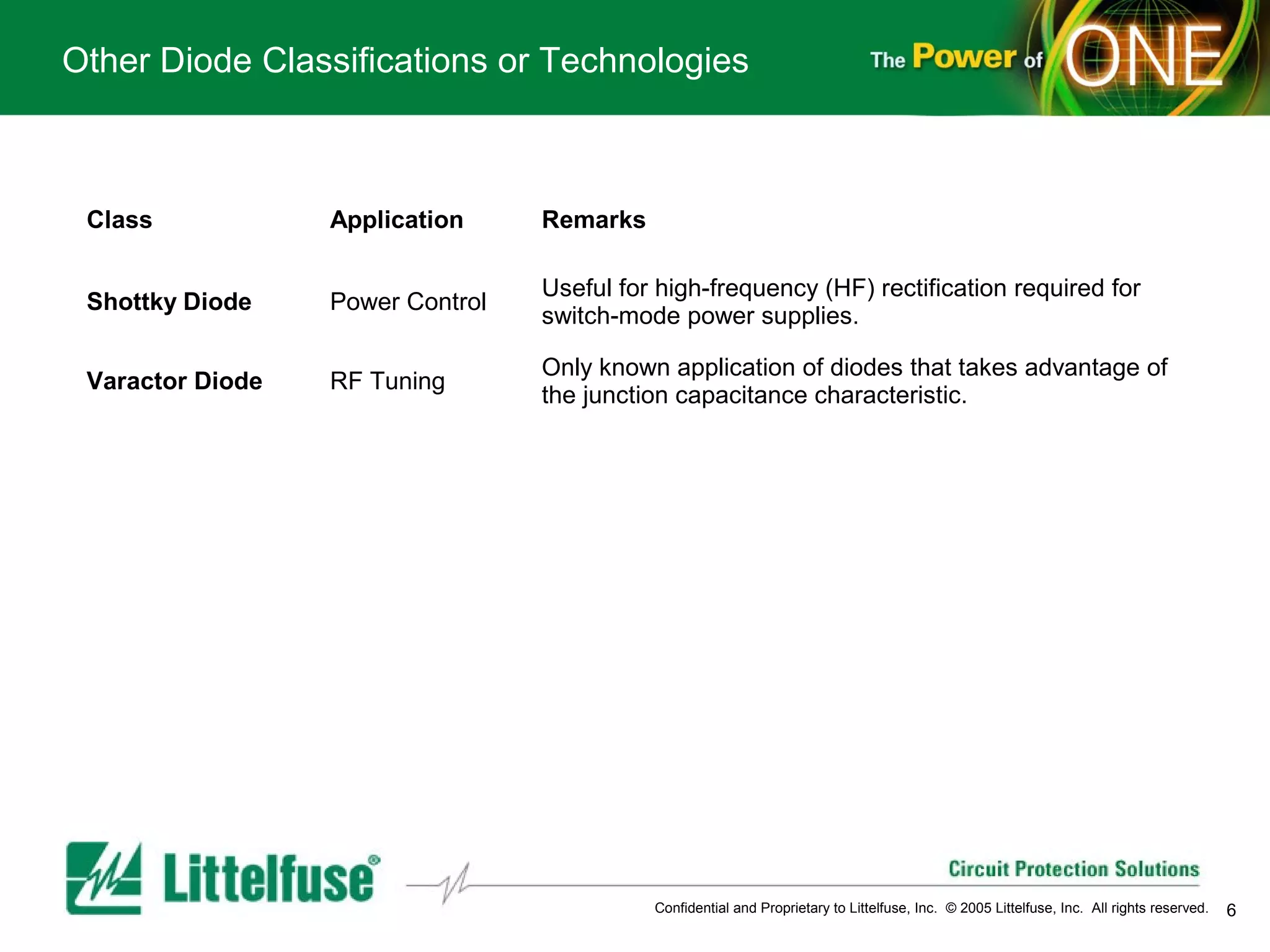
Other Diode Classifications or Technologies


 Class            Application     Remarks

                                  Useful for high-frequency (HF) rectification required for
 Shottky Diode    Power Control
                                  switch-mode power supplies.

                                  Only known application of diodes that takes advantage of
 Varactor Diode   RF Tuning
                                  the junction capacitance characteristic.


                                            Confidential and Proprietary to Littelfuse, Inc. © 2005 Littelfuse, Inc. All rights reserved.   6
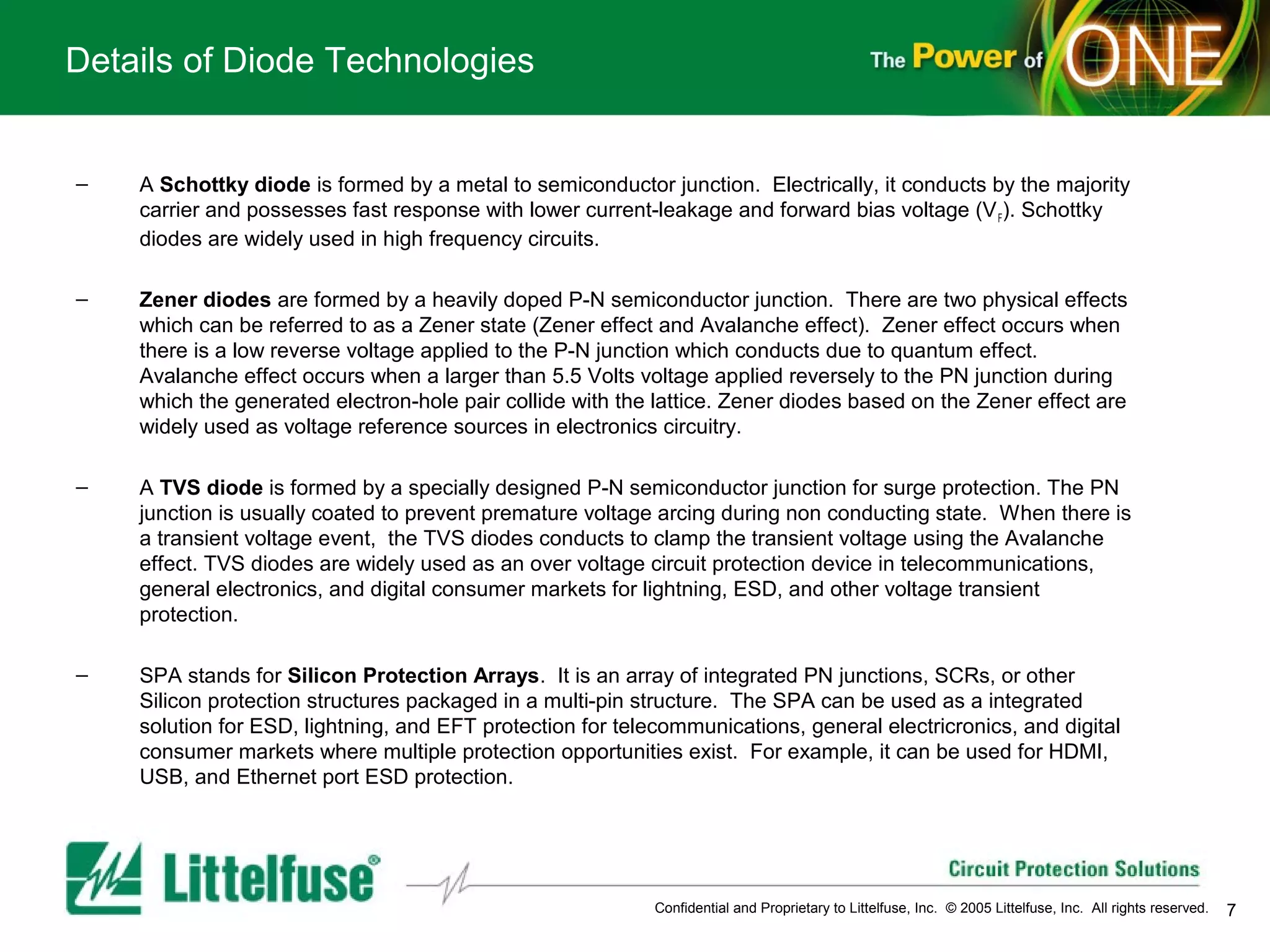
Details of Diode Technologies


–   A Schottky diode is formed by a metal to semiconductor junction. Electrically, it conducts by the majority
    carrier and possesses fast response with lower current-leakage and forward bias voltage (V F). Schottky
    diodes are widely used in high frequency circuits.

–   Zener diodes are formed by a heavily doped P-N semiconductor junction. There are two physical effects
    which can be referred to as a Zener state (Zener effect and Avalanche effect). Zener effect occurs when
    there is a low reverse voltage applied to the P-N junction which conducts due to quantum effect.
    Avalanche effect occurs when a larger than 5.5 Volts voltage applied reversely to the PN junction during
    which the generated electron-hole pair collide with the lattice. Zener diodes based on the Zener effect are
    widely used as voltage reference sources in electronics circuitry.

–   A TVS diode is formed by a specially designed P-N semiconductor junction for surge protection. The PN
    junction is usually coated to prevent premature voltage arcing during non conducting state. When there is
    a transient voltage event, the TVS diodes conducts to clamp the transient voltage using the Avalanche
    effect. TVS diodes are widely used as an over voltage circuit protection device in telecommunications,
    general electronics, and digital consumer markets for lightning, ESD, and other voltage transient
    protection.

–   SPA stands for Silicon Protection Arrays. It is an array of integrated PN junctions, SCRs, or other
    Silicon protection structures packaged in a multi-pin structure. The SPA can be used as a integrated
    solution for ESD, lightning, and EFT protection for telecommunications, general electricronics, and digital
    consumer markets where multiple protection opportunities exist. For example, it can be used for HDMI,
    USB, and Ethernet port ESD protection.


                                                            Confidential and Proprietary to Littelfuse, Inc. © 2005 Littelfuse, Inc. All rights reserved.   7
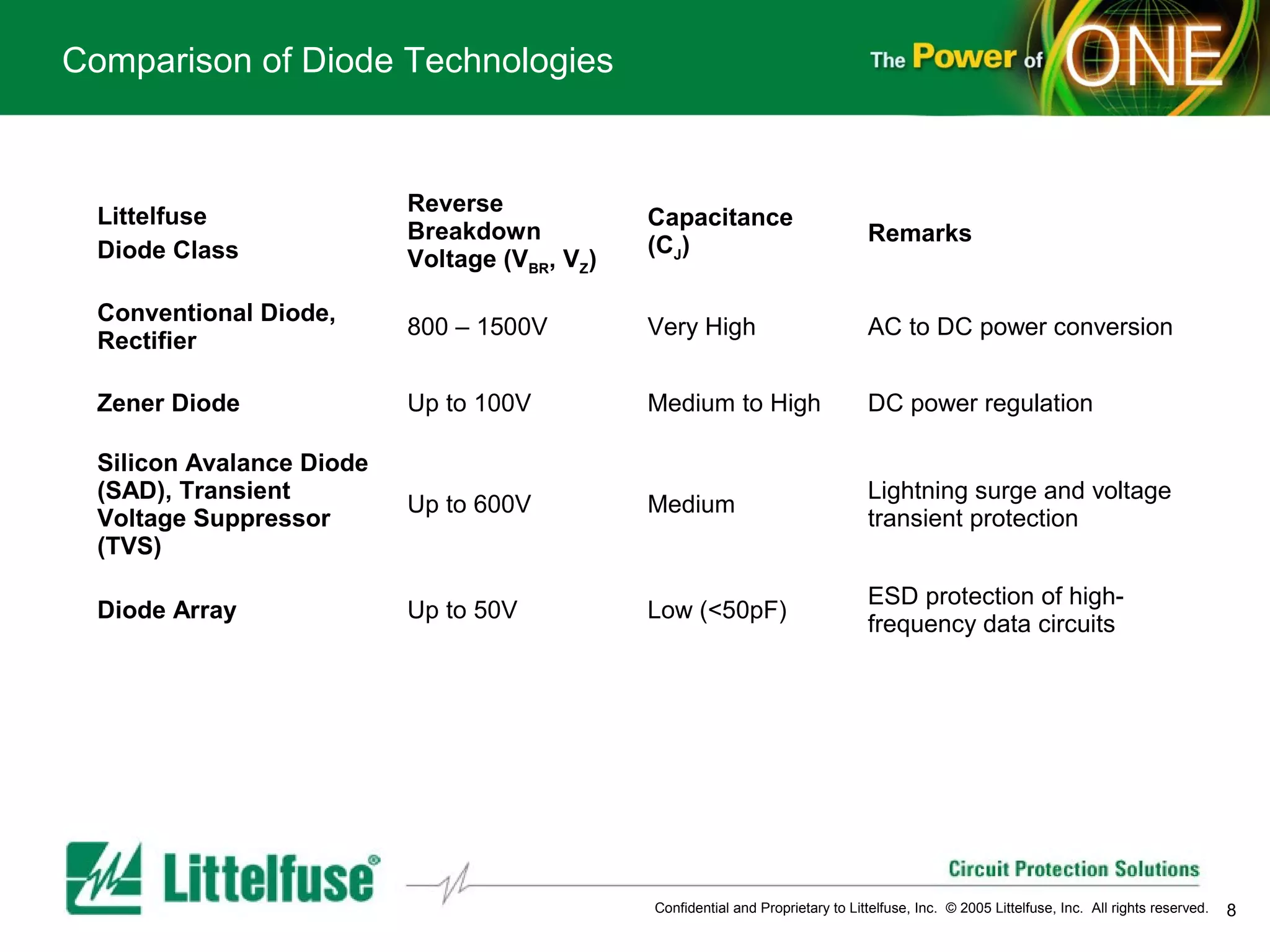
Comparison of Diode Technologies


                           Reverse
  Littelfuse                                   Capacitance
                           Breakdown                                              Remarks
  Diode Class                                  (CJ)
                           Voltage (VBR, VZ)

  Conventional Diode,
                           800 – 1500V         Very High                          AC to DC power conversion
  Rectifier

  Zener Diode              Up to 100V          Medium to High                     DC power regulation

  Silicon Avalance Diode
  (SAD), Transient                                                                Lightning surge and voltage
                           Up to 600V          Medium
  Voltage Suppressor                                                              transient protection
  (TVS)

                                                                                  ESD protection of high-
  Diode Array              Up to 50V           Low (<50pF)
                                                                                  frequency data circuits


                                               Confidential and Proprietary to Littelfuse, Inc. © 2005 Littelfuse, Inc. All rights reserved.   8
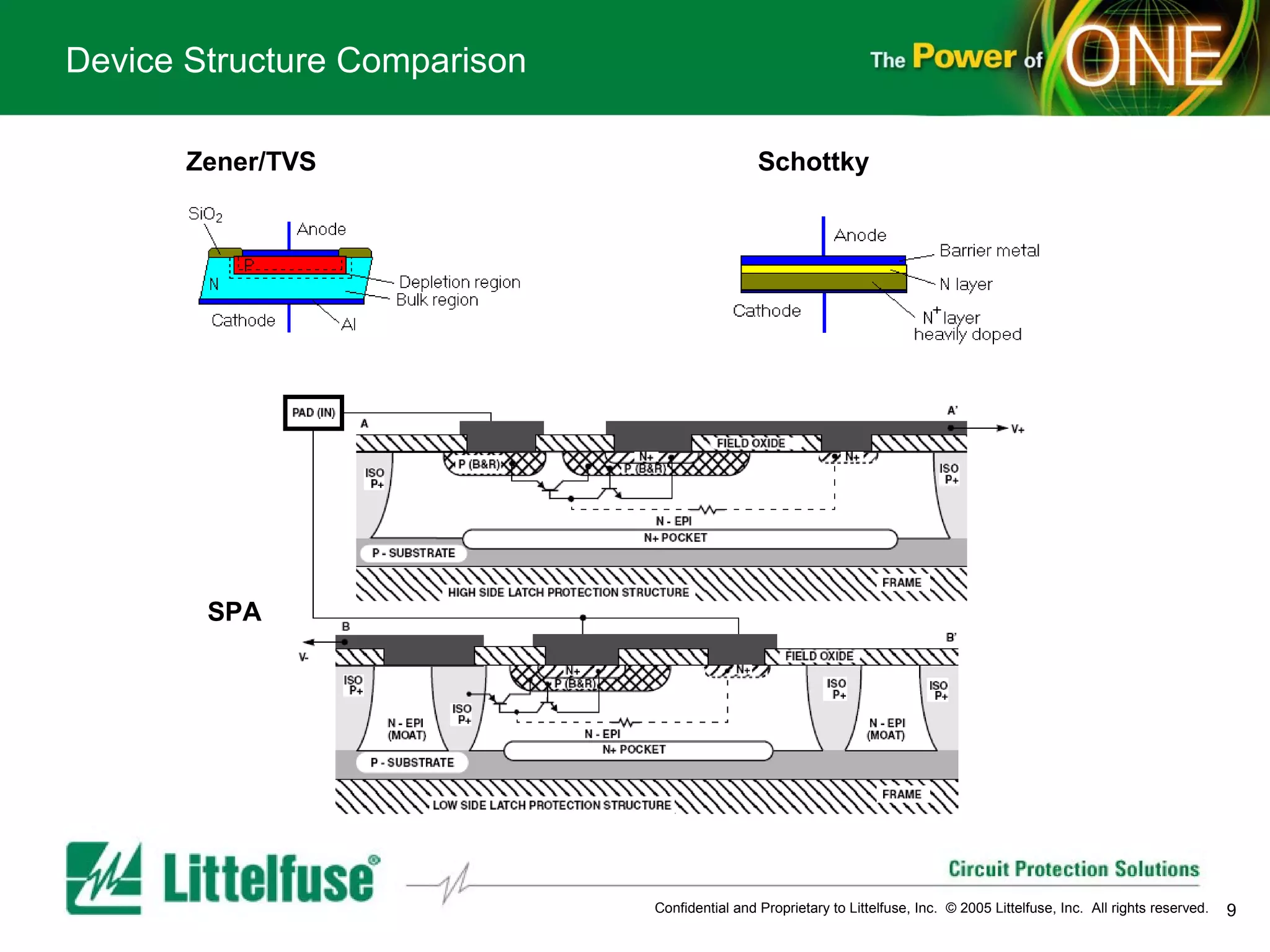
Device Structure Comparison

       Zener/TVS                               Schottky


        SPA


                              Confidential and Proprietary to Littelfuse, Inc. © 2005 Littelfuse, Inc. All rights reserved.   9
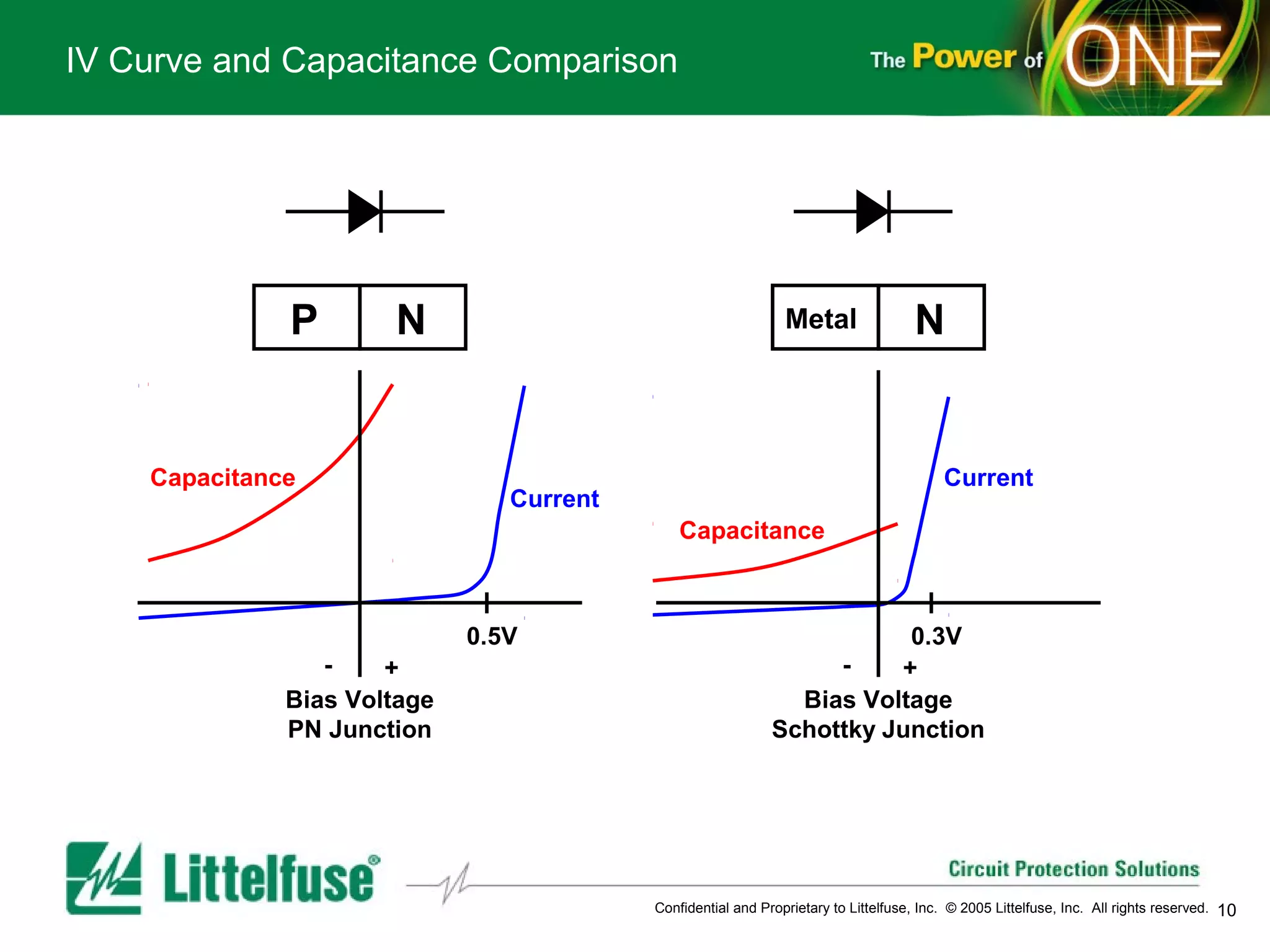
IV Curve and Capacitance Comparison


              P       N                                        Metal                 N


    Capacitance                                                                           Current
                                Current
                                              Capacitance


                             0.5V                                       0.3V
                 -    +                                           -    +
              Bias Voltage                                     Bias Voltage
              PN Junction                                    Schottky Junction


                                          Confidential and Proprietary to Littelfuse, Inc. © 2005 Littelfuse, Inc. All rights reserved.   10
Device Application Example


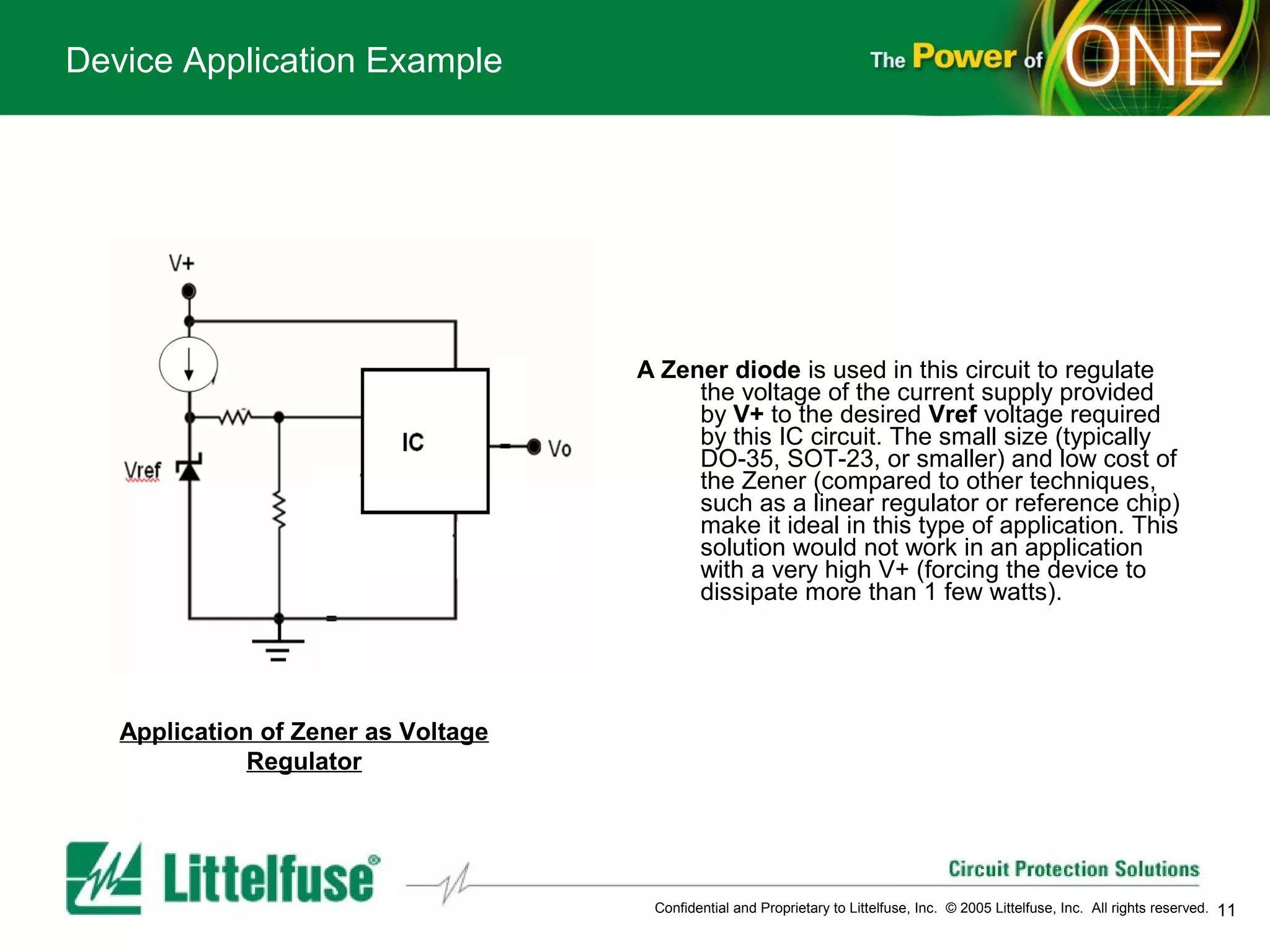
                                     A Zener diode is used in this circuit to regulate
                                          the voltage of the current supply provided
                                          by V+ to the desired Vref voltage required
                                          by this IC circuit. The small size (typically
                                          DO-35, SOT-23, or smaller) and low cost of
                                          the Zener (compared to other techniques,
                                          such as a linear regulator or reference chip)
                                          make it ideal in this type of application. This
                                          solution would not work in an application
                                          with a very high V+ (forcing the device to
                                          dissipate more than 1 few watts).


   Application of Zener as Voltage
              Regulator


                                      Confidential and Proprietary to Littelfuse, Inc. © 2005 Littelfuse, Inc. All rights reserved.   11
Device Application Example


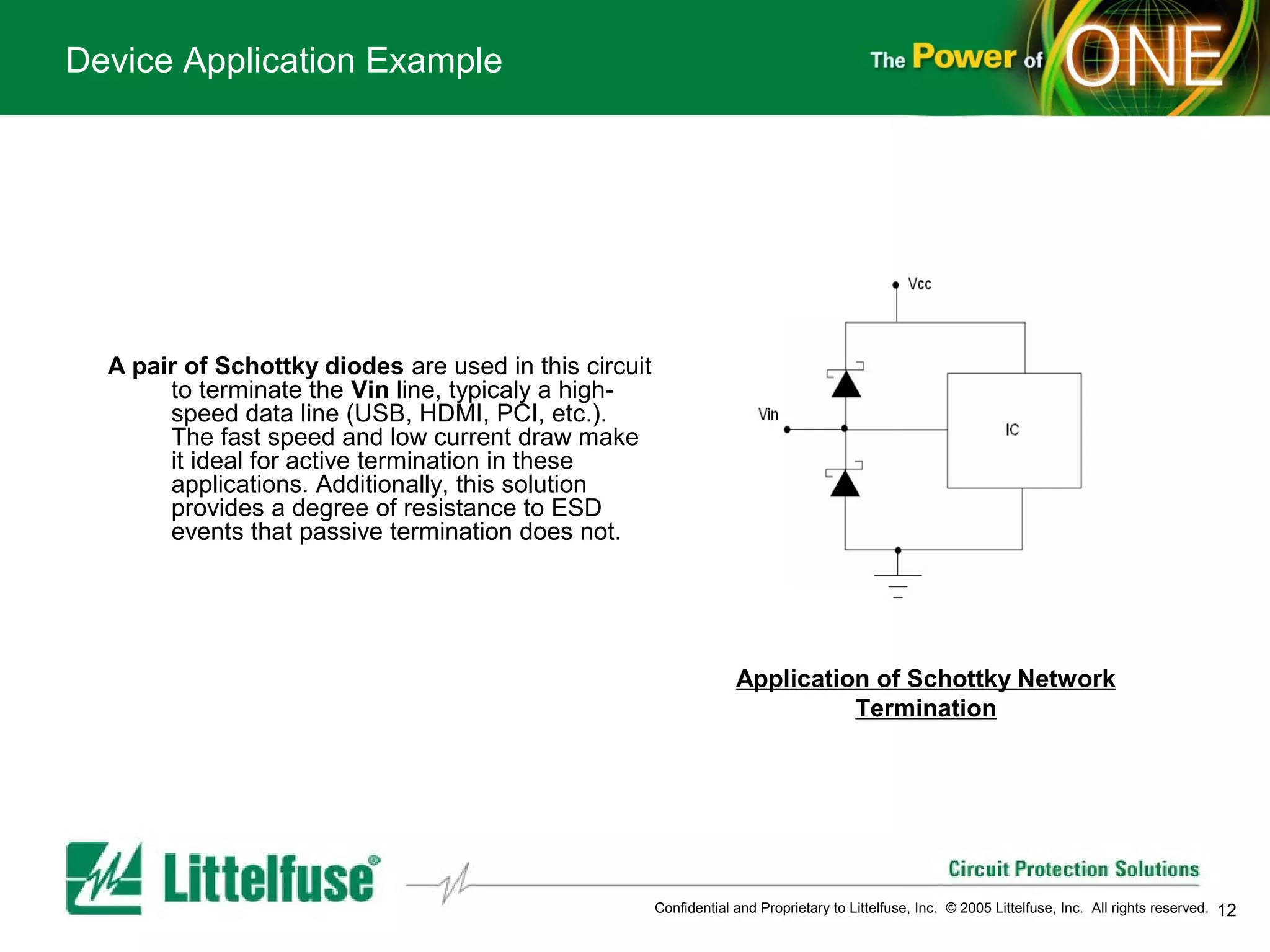
  A pair of Schottky diodes are used in this circuit
       to terminate the Vin line, typicaly a high-
       speed data line (USB, HDMI, PCI, etc.).
       The fast speed and low current draw make
       it ideal for active termination in these
       applications. Additionally, this solution
       provides a degree of resistance to ESD
       events that passive termination does not.


                                                                    Application of Schottky Network
                                                                              Termination


                                                       Confidential and Proprietary to Littelfuse, Inc. © 2005 Littelfuse, Inc. All rights reserved.   12
Device Application Example


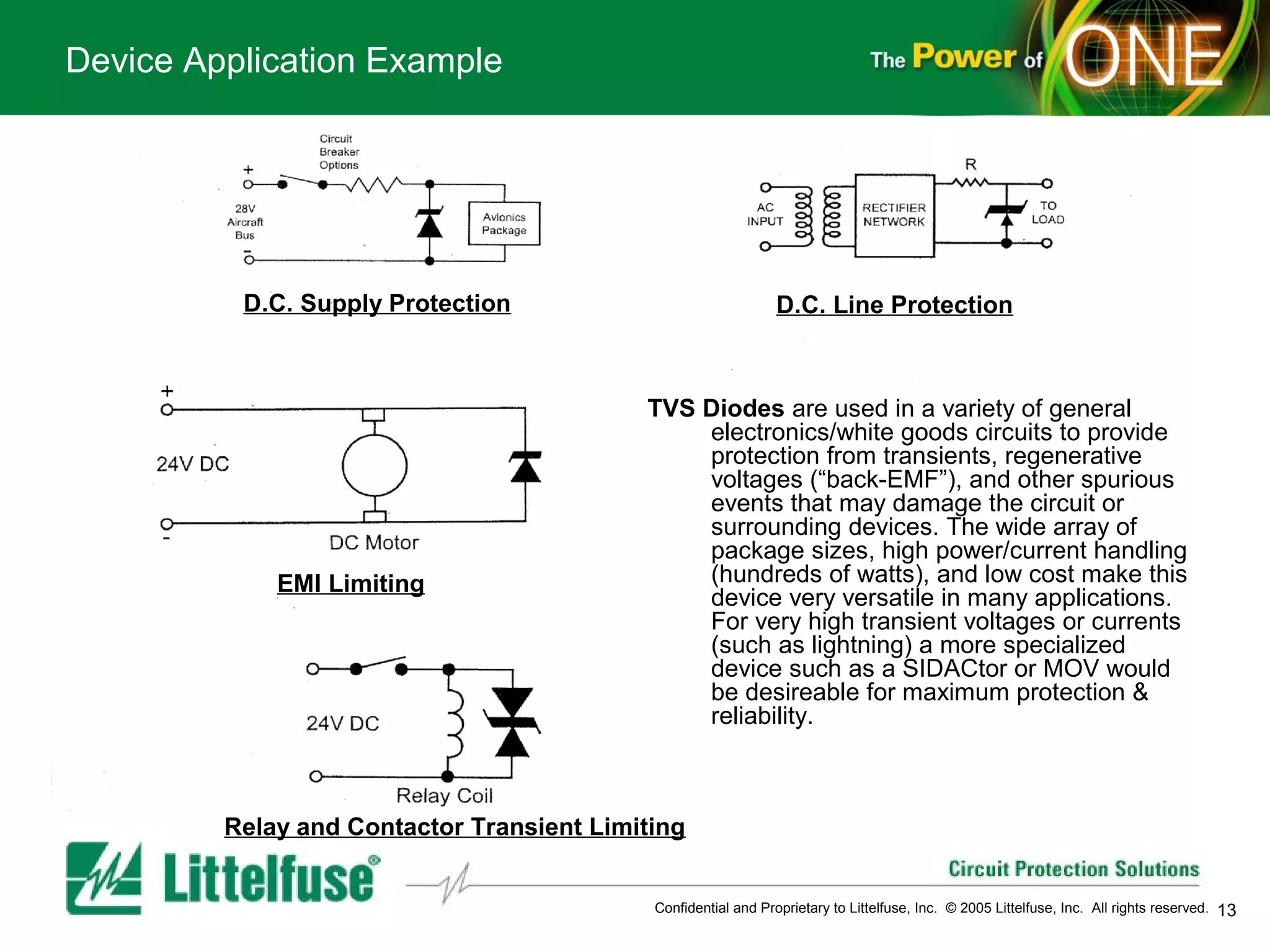
          D.C. Supply Protection                                D.C. Line Protection


                                           TVS Diodes are used in a variety of general
                                               electronics/white goods circuits to provide
                                               protection from transients, regenerative
                                               voltages (“back-EMF”), and other spurious
                                               events that may damage the circuit or
                                               surrounding devices. The wide array of
                                               package sizes, highProtection handling
                                                    A.C. Supply power/current
             EMI Limiting                      (hundreds of watts), and low cost make this
                                               device very versatile in many applications.
                                               For very high transient voltages or currents
                                               (such as lightning) a more specialized
                                               device such as a SIDACtor or MOV would
                                               be desireable for maximum protection &
                                               reliability.

                                                                                 Single
                                                                                 Line
         Relay and Contactor Transient Limiting


                                            Confidential and Proprietary to Littelfuse, Inc. © 2005 Littelfuse, Inc. All rights reserved.   13
Device Application Example

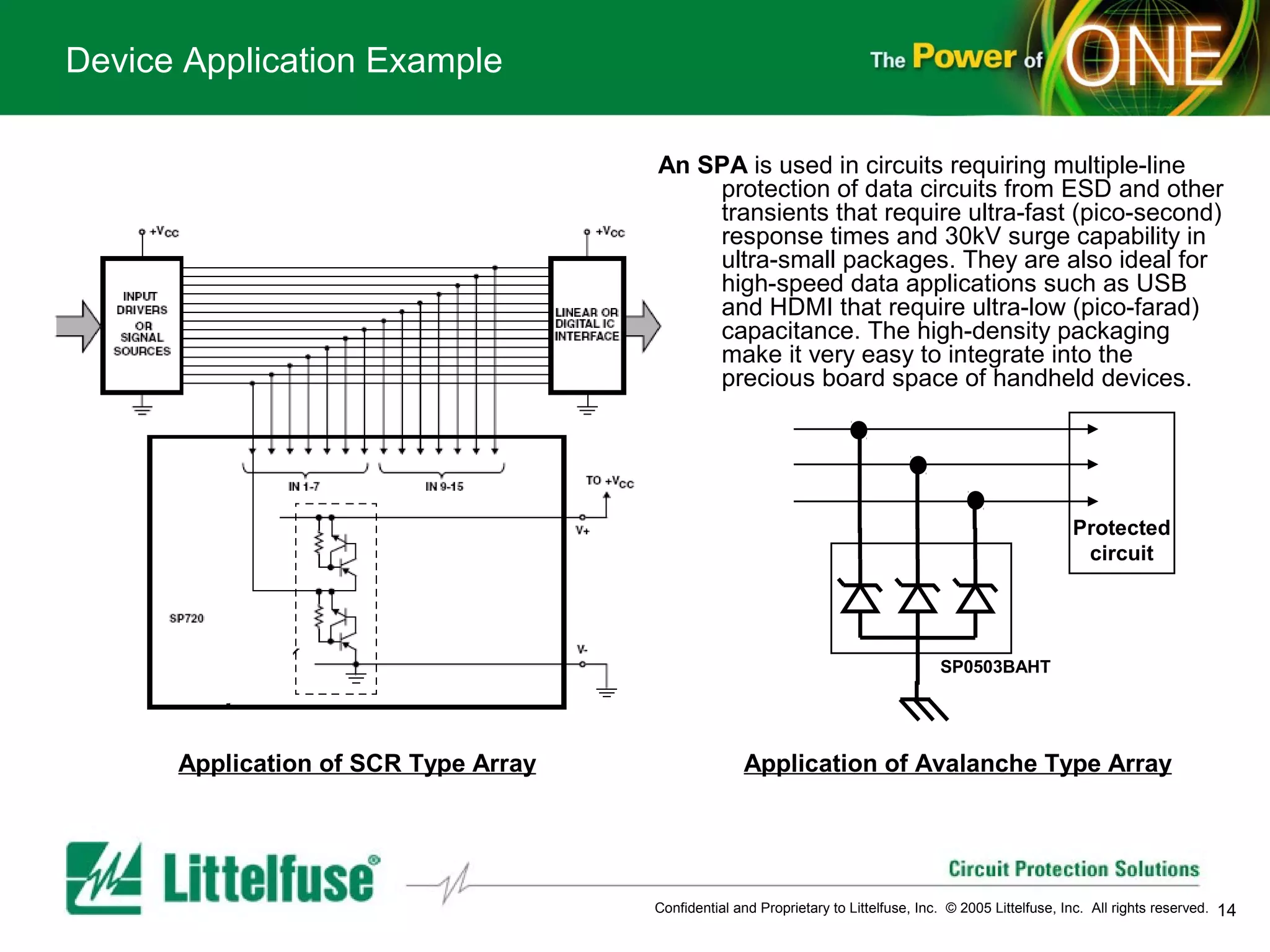
                                        An SPA is used in circuits requiring multiple-line
                                            protection of data circuits from ESD and other
                                            transients that require ultra-fast (pico-second)
                                            response times and 30kV surge capability in
                                            ultra-small packages. They are also ideal for
                                            high-speed data applications such as USB
                                            and HDMI that require ultra-low (pico-farad)
                                            capacitance. The high-density packaging
                                            make it very easy to integrate into the
                                            precious board space of handheld devices.


                                                                                                              Protected
                                                                                                               circuit


                                                                                       SP0503BAHT


        Application of SCR Type Array                 Application of Avalanche Type Array


                                        Confidential and Proprietary to Littelfuse, Inc. © 2005 Littelfuse, Inc. All rights reserved.   14

diode technology

  • 1.
    Diode Comparison: Schottky,SPA, Zener, TVS Summary 1. Diode Description 2. Diode Characteristics 3. Diode Classification & Typical Applications 4. Details & Comparison of Diode Technologies 5. Device Parameter Comparison 6. Device Structure Comparison 7. I-V Curve and Capacitance Comparison 8. Application Comparison Confidential and Proprietary to Littelfuse, Inc. © 2005 Littelfuse, Inc. All rights reserved. 1
  • 2.
    Diode Description All diodes share common characteristics. They are two-terminal electrical components that allow current to flow in one direction. This behavior is called “rectification”.  Today, they are mostly built from semiconductor materials (Silicon). Before semiconductors, they were implemented with vacuum tube technology.  To create a diode, you must form an electrical “junction”, usually by joining two dissimilar materials. The junction in a Shottky diode is created by joining a metal with semiconductor material.  Current Littelfuse diodes are formed by joining two different types of Silicon semiconductor materials (creating a P-N junction).  Littefuse diodes have two primary applications: power control and over- voltage (OV) protection. Confidential and Proprietary to Littelfuse, Inc. © 2005 Littelfuse, Inc. All rights reserved. 2
  • 3.
    Diode Characteristics Thereare six important characteristics of diodes:  Forward Current (IF): The amount of forward current that can be continuously applied to the diode without failure. If intended for AC/power applications, this value will be specified as an average or RMS current.  Forward Voltage (VF): The amount of forward voltage present when a given forward current is applied.  Reverse Breakdown Voltage (VBR, VZ): OV Protection and Zener diodes are designed to take advantage of this characteristic. This value determines the limiting (or clamping) voltage presented to an application that is subject to an over-voltage event (ESD, Lightning Surge, AC Power-Cross) or, the regulation voltage for power supplies.  Reverse Stand-Off Voltage (VR): Typically, the guaranteed maximum reverse voltage that can be applied without the diode going into breakdown (OV protection diodes).  Reverse Current-Leakage (IR): The current-leakage when a given reverse voltage is applied (OV protection diodes).  Junction Capacitance (CJ): For both power and OV protection diodes, this characteristic is undesired but unavoidable. Reducing the size of the semiconductor chip will minimize capacitance but, it will also limit current-handling capability. The value is variable and depends on the amount of reverse voltage applied. Confidential and Proprietary to Littelfuse, Inc. © 2005 Littelfuse, Inc. All rights reserved. 3
  • 4.
    Diode Characteristics Voltage vs.Current (VI) Plot IF Forward VBR, VZ VR VF IR Reverse Common Symbol Anode Cathode Forward Current Confidential and Proprietary to Littelfuse, Inc. © 2005 Littelfuse, Inc. All rights reserved. 4
  • 5.
    Littelfuse Diode Classifications Littelfuse Application Remarks Diode Class Conventional Useful for “steering” high currents; converting AC to DC. Power Control Diode, Rectifier Typically found in large packages such as TO-220. Useful for regulation of DC voltage in power supplies. Zener Diode Power Control Typically found in medium-size to large packages (Axial, TO-220). Silicon Avalance Useful for protecting circuits exposed to high-energy Diode (SAD), events such as lightning surges or voltage transients from OV Protection Transient Voltage mechanical switching of electrical circuits (EFT). Typically Suppressor (TVS) found in medium-size packages (Axial, DO-214). Diode Arrays fall into the more broad category of Silicon Protection Arrays (SPA), which are targeted for ESD Diode Array OV Protection protection. Typically found in small surface-mount packages (SOIC-8, SOT-23, SC-70, etc …) Confidential and Proprietary to Littelfuse, Inc. © 2005 Littelfuse, Inc. All rights reserved. 5
  • 6.
    Other Diode Classificationsor Technologies Class Application Remarks Useful for high-frequency (HF) rectification required for Shottky Diode Power Control switch-mode power supplies. Only known application of diodes that takes advantage of Varactor Diode RF Tuning the junction capacitance characteristic. Confidential and Proprietary to Littelfuse, Inc. © 2005 Littelfuse, Inc. All rights reserved. 6
  • 7.
    Details of DiodeTechnologies – A Schottky diode is formed by a metal to semiconductor junction. Electrically, it conducts by the majority carrier and possesses fast response with lower current-leakage and forward bias voltage (V F). Schottky diodes are widely used in high frequency circuits. – Zener diodes are formed by a heavily doped P-N semiconductor junction. There are two physical effects which can be referred to as a Zener state (Zener effect and Avalanche effect). Zener effect occurs when there is a low reverse voltage applied to the P-N junction which conducts due to quantum effect. Avalanche effect occurs when a larger than 5.5 Volts voltage applied reversely to the PN junction during which the generated electron-hole pair collide with the lattice. Zener diodes based on the Zener effect are widely used as voltage reference sources in electronics circuitry. – A TVS diode is formed by a specially designed P-N semiconductor junction for surge protection. The PN junction is usually coated to prevent premature voltage arcing during non conducting state. When there is a transient voltage event, the TVS diodes conducts to clamp the transient voltage using the Avalanche effect. TVS diodes are widely used as an over voltage circuit protection device in telecommunications, general electronics, and digital consumer markets for lightning, ESD, and other voltage transient protection. – SPA stands for Silicon Protection Arrays. It is an array of integrated PN junctions, SCRs, or other Silicon protection structures packaged in a multi-pin structure. The SPA can be used as a integrated solution for ESD, lightning, and EFT protection for telecommunications, general electricronics, and digital consumer markets where multiple protection opportunities exist. For example, it can be used for HDMI, USB, and Ethernet port ESD protection. Confidential and Proprietary to Littelfuse, Inc. © 2005 Littelfuse, Inc. All rights reserved. 7
  • 8.
    Comparison of DiodeTechnologies Reverse Littelfuse Capacitance Breakdown Remarks Diode Class (CJ) Voltage (VBR, VZ) Conventional Diode, 800 – 1500V Very High AC to DC power conversion Rectifier Zener Diode Up to 100V Medium to High DC power regulation Silicon Avalance Diode (SAD), Transient Lightning surge and voltage Up to 600V Medium Voltage Suppressor transient protection (TVS) ESD protection of high- Diode Array Up to 50V Low (<50pF) frequency data circuits Confidential and Proprietary to Littelfuse, Inc. © 2005 Littelfuse, Inc. All rights reserved. 8
  • 9.
    Device Structure Comparison Zener/TVS Schottky SPA Confidential and Proprietary to Littelfuse, Inc. © 2005 Littelfuse, Inc. All rights reserved. 9
  • 10.
    IV Curve andCapacitance Comparison P N Metal N Capacitance Current Current Capacitance 0.5V 0.3V - + - + Bias Voltage Bias Voltage PN Junction Schottky Junction Confidential and Proprietary to Littelfuse, Inc. © 2005 Littelfuse, Inc. All rights reserved. 10
  • 11.
    Device Application Example A Zener diode is used in this circuit to regulate the voltage of the current supply provided by V+ to the desired Vref voltage required by this IC circuit. The small size (typically DO-35, SOT-23, or smaller) and low cost of the Zener (compared to other techniques, such as a linear regulator or reference chip) make it ideal in this type of application. This solution would not work in an application with a very high V+ (forcing the device to dissipate more than 1 few watts). Application of Zener as Voltage Regulator Confidential and Proprietary to Littelfuse, Inc. © 2005 Littelfuse, Inc. All rights reserved. 11
  • 12.
    Device Application Example A pair of Schottky diodes are used in this circuit to terminate the Vin line, typicaly a high- speed data line (USB, HDMI, PCI, etc.). The fast speed and low current draw make it ideal for active termination in these applications. Additionally, this solution provides a degree of resistance to ESD events that passive termination does not. Application of Schottky Network Termination   Confidential and Proprietary to Littelfuse, Inc. © 2005 Littelfuse, Inc. All rights reserved. 12
  • 13.
    Device Application Example D.C. Supply Protection D.C. Line Protection TVS Diodes are used in a variety of general electronics/white goods circuits to provide protection from transients, regenerative voltages (“back-EMF”), and other spurious events that may damage the circuit or surrounding devices. The wide array of package sizes, highProtection handling A.C. Supply power/current EMI Limiting (hundreds of watts), and low cost make this device very versatile in many applications. For very high transient voltages or currents (such as lightning) a more specialized device such as a SIDACtor or MOV would be desireable for maximum protection & reliability.   Single Line Relay and Contactor Transient Limiting Confidential and Proprietary to Littelfuse, Inc. © 2005 Littelfuse, Inc. All rights reserved. 13
  • 14.
    Device Application Example An SPA is used in circuits requiring multiple-line protection of data circuits from ESD and other transients that require ultra-fast (pico-second) response times and 30kV surge capability in ultra-small packages. They are also ideal for high-speed data applications such as USB and HDMI that require ultra-low (pico-farad) capacitance. The high-density packaging make it very easy to integrate into the precious board space of handheld devices. Protected circuit SP0503BAHT   Application of SCR Type Array Application of Avalanche Type Array Confidential and Proprietary to Littelfuse, Inc. © 2005 Littelfuse, Inc. All rights reserved. 14