VARIATIONS IN
PSYCH0LOGICAL
ATTRIBUTES
U N I T - 1
D AT E - 1 2 / 0 3 - 2 0 2 3
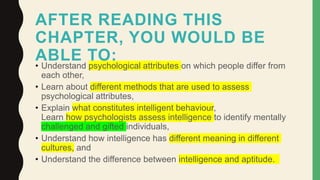
AFTER READING THIS
CHAPTER, YOU WOULD BE
ABLE TO:
• Understand psychological attributes on which people differ from
each other,
• Learn about different methods that are used to assess
psychological attributes,
• Explain what constitutes intelligent behaviour,
Learn how psychologists assess intelligence to identify mentally
challenged and gifted individuals,
• Understand how intelligence has different meaning in different
cultures, and
• Understand the difference between intelligence and aptitude.
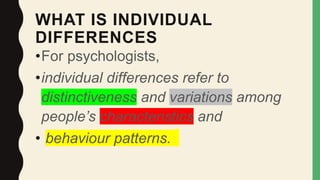
WHAT IS INDIVIDUAL
DIFFERENCES
•For psychologists,
•individual differences refer to
distinctiveness and variations among
people’s characteristics and
• behaviour patterns.
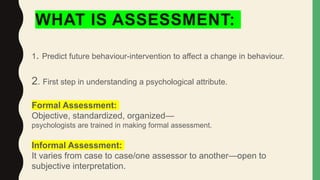
WHAT IS ASSESSMENT:
1. Predict future behaviour-intervention to affect a change in behaviour.
2. First step in understanding a psychological attribute.
Formal Assessment:
Objective, standardized, organized—
psychologists are trained in making formal assessment.
Informal Assessment:
It varies from case to case/one assessor to another—open to
subjective interpretation.
APPROACHES EXPLAINING
INDIVIDUAL DIFFERENCES
• Approaches explaining individual differences in psychological
functioning.
1. Trait Approach: Personal traits cause change in
behaviours. [INTERNAL FACTORS]
2. Situationism is a view which states that situations and
circumstances in which one is placed to influence one’s
behaviour.
[EXTERNAL FACTORS]
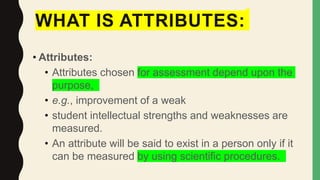
WHAT IS ATTRIBUTES:
• Attributes:
• Attributes chosen for assessment depend upon the
purpose,
• e.g., improvement of a weak
• student intellectual strengths and weaknesses are
measured.
• An attribute will be said to exist in a person only if it
can be measured by using scientific procedures.
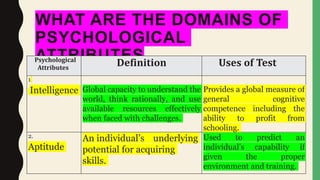
WHAT ARE THE DOMAINS OF
PSYCHOLOGICAL
ATTRIBUTES
Psychological
Attributes
Definition Uses of Test
1
Intelligence Global capacity to understand the
world, think rationally, and use
available resources effectively
when faced with challenges.
Provides a global measure of
general cognitive
competence including the
ability to profit from
schooling.
2.
Aptitude
An individual’s underlying
potential for acquiring
skills.
Used to predict an
individual’s capability if
given the proper
environment and training.
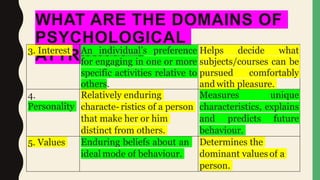
WHAT ARE THE DOMAINS OF
PSYCHOLOGICAL
ATTRIBUTES
3. Interest An individual’s preference
for engaging in one or more
specific activities relative to
others.
Helps decide what
subjects/courses can be
pursued comfortably
and with pleasure.
4.
Personality
Relatively enduring
characte- ristics of a person
that make her or him
distinct from others.
Measures unique
characteristics, explains
and predicts future
behaviour.
5. Values Enduring beliefs about an
ideal mode of behaviour.
Determines the
dominant values of a
person.
WHAT ARE THE
MAJOR ASSESSMENT METHODS
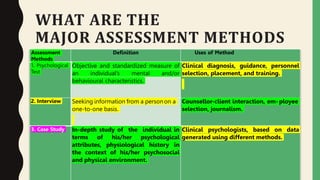
Assessment
Methods
Definition Uses of Method
1. Psychological
Test
Objective and standardized measure of
an individual’s mental and/or
behavioural characteristics.
Clinical diagnosis, guidance, personnel
selection, placement, and training.
2. Interview Seeking information from a personon a
one-to-one basis.
Counsellor-client interaction, em-ployee
selection, journalism.
3. Case Study In-depth study of the individual in
terms of his/her psychological
attributes, physiological history in
the context of his/her psychosocial
and physical environment.
Clinical psychologists, based on data
generated using different methods.
WHAT ARE THE
MAJOR ASSESSMENT METHODS
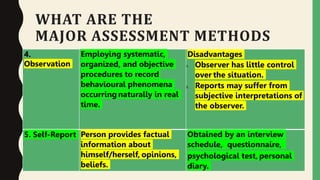
4.
Observation
Employing systematic,
organized, and objective
procedures to record
behavioural phenomena
occurring naturally in real
time.
Disadvantages
1. Observer has little control
over the situation.
2. Reports may suffer from
subjective interpretations of
the observer.
5. Self-Report Person provides factual
information about
himself/herself, opinions,
beliefs.
Obtained by an interview
schedule, questionnaire,
psychological test, personal
diary.
INTELLIGENCE
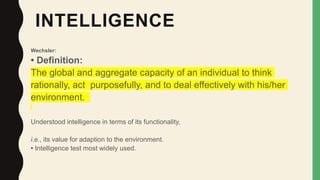
Wechsler:
• Definition:
The global and aggregate capacity of an individual to think
rationally, act purposefully, and to deal effectively with his/her
environment.
Understood intelligence in terms of its functionality,
i.e., its value for adaption to the environment.
• Intelligence test most widely used.

PSYCHOLOGICAL ATTIRIBUTES .pptx

  • 1.
    VARIATIONS IN PSYCH0LOGICAL ATTRIBUTES U NI T - 1 D AT E - 1 2 / 0 3 - 2 0 2 3
  • 2.
    AFTER READING THIS CHAPTER,YOU WOULD BE ABLE TO: • Understand psychological attributes on which people differ from each other, • Learn about different methods that are used to assess psychological attributes, • Explain what constitutes intelligent behaviour, Learn how psychologists assess intelligence to identify mentally challenged and gifted individuals, • Understand how intelligence has different meaning in different cultures, and • Understand the difference between intelligence and aptitude.
  • 3.
    WHAT IS INDIVIDUAL DIFFERENCES •Forpsychologists, •individual differences refer to distinctiveness and variations among people’s characteristics and • behaviour patterns.
  • 4.
    WHAT IS ASSESSMENT: 1.Predict future behaviour-intervention to affect a change in behaviour. 2. First step in understanding a psychological attribute. Formal Assessment: Objective, standardized, organized— psychologists are trained in making formal assessment. Informal Assessment: It varies from case to case/one assessor to another—open to subjective interpretation.
  • 5.
    APPROACHES EXPLAINING INDIVIDUAL DIFFERENCES •Approaches explaining individual differences in psychological functioning. 1. Trait Approach: Personal traits cause change in behaviours. [INTERNAL FACTORS] 2. Situationism is a view which states that situations and circumstances in which one is placed to influence one’s behaviour. [EXTERNAL FACTORS]
  • 6.
    WHAT IS ATTRIBUTES: •Attributes: • Attributes chosen for assessment depend upon the purpose, • e.g., improvement of a weak • student intellectual strengths and weaknesses are measured. • An attribute will be said to exist in a person only if it can be measured by using scientific procedures.
  • 7.
    WHAT ARE THEDOMAINS OF PSYCHOLOGICAL ATTRIBUTES Psychological Attributes Definition Uses of Test 1 Intelligence Global capacity to understand the world, think rationally, and use available resources effectively when faced with challenges. Provides a global measure of general cognitive competence including the ability to profit from schooling. 2. Aptitude An individual’s underlying potential for acquiring skills. Used to predict an individual’s capability if given the proper environment and training.
  • 8.
    WHAT ARE THEDOMAINS OF PSYCHOLOGICAL ATTRIBUTES 3. Interest An individual’s preference for engaging in one or more specific activities relative to others. Helps decide what subjects/courses can be pursued comfortably and with pleasure. 4. Personality Relatively enduring characte- ristics of a person that make her or him distinct from others. Measures unique characteristics, explains and predicts future behaviour. 5. Values Enduring beliefs about an ideal mode of behaviour. Determines the dominant values of a person.
  • 9.
    WHAT ARE THE MAJORASSESSMENT METHODS Assessment Methods Definition Uses of Method 1. Psychological Test Objective and standardized measure of an individual’s mental and/or behavioural characteristics. Clinical diagnosis, guidance, personnel selection, placement, and training. 2. Interview Seeking information from a personon a one-to-one basis. Counsellor-client interaction, em-ployee selection, journalism. 3. Case Study In-depth study of the individual in terms of his/her psychological attributes, physiological history in the context of his/her psychosocial and physical environment. Clinical psychologists, based on data generated using different methods.
  • 10.
    WHAT ARE THE MAJORASSESSMENT METHODS 4. Observation Employing systematic, organized, and objective procedures to record behavioural phenomena occurring naturally in real time. Disadvantages 1. Observer has little control over the situation. 2. Reports may suffer from subjective interpretations of the observer. 5. Self-Report Person provides factual information about himself/herself, opinions, beliefs. Obtained by an interview schedule, questionnaire, psychological test, personal diary.
  • 11.
    INTELLIGENCE Wechsler: • Definition: The globaland aggregate capacity of an individual to think rationally, act purposefully, and to deal effectively with his/her environment. Understood intelligence in terms of its functionality, i.e., its value for adaption to the environment. • Intelligence test most widely used.