Title
LSD OVERDOSES:
THREE CASE REPORTS
Authors
 MARK HADEN- Executive Director, MAPS Canada
-Adjunct Professor, University of British Columbia
School of Population and Public Health, Vancouver, British Columbia, Canada.
 BIRGITTA WOODS
Adult Psychiatrist, Vancouver Coastal Health, Vancouver,
British Columbia, Canada
Publication detail
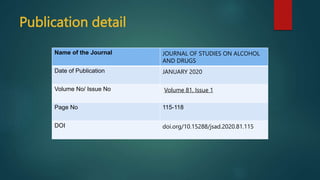
Name of the Journal JOURNAL OF STUDIES ON ALCOHOL
AND DRUGS
Date of Publication JANUARY 2020
Volume No/ Issue No Volume 81, Issue 1
Page No 115-118
DOI doi.org/10.15288/jsad.2020.81.115
Introduction
 In academic settings around the world, there is a resurgence of interest in using
psychedelic substances for the treatment of addictions,posttraumatic stress disorder
(PTSD), depression, anxiety, and other diagnoses.
 Lysergic acid diethylamide (LSD) specifically showed promise in historical research and
this interest continues today .
Introduction-Cont…
 Current research protocols specify dosages that are well within the range
of clinical safety .
 Research with larger dosages would present greater risk of adverse events
and thus be less likely to receive approval from research ethics review.
 To understand the effects of extremely high dosages of psychedelics such
as LSD, an examination of overdoses in naturalistic settings is required.
Objective
 describes the medical consequences of accidental overdoses in three
individuals.
Methods
CASE SERIES
Source of Information
 interviews,
 health records,
 case notes, and
 collateral reports.
Case Report 1:
LSD Overdose and the
Consequences for Bipolar
Disorder
Trajectory of Mental Health Concerns
 AV,15 years old female, first contact with the mental health system was in
March 1997 (at age 12),
 for “hallucinations” and behavioral problems at school and a depressed
mood in the context of a number of psychosocial stressors.
 Electroencephalogram (EEG): was normal,
 Initial diagnosis: unspecified psychotic disorder
 possible diagnoses: psychotic depression,
bipolar disorder, and
schizophreniform disorder
Trajectory of Mental Health Concerns –Conti..
 in May 1998, reported worsening of depressive symptoms without
evidence of psychosis.
 started on an antidepressant medication (sertraline)
 symptoms improved and stabilized until the fall of 1999.
 her depression worsened
 a seasonal (winter) depression,
 A light box was introduced in November 1999
Trajectory of Mental Health Concerns –Conti..
 shortly thereafter she started to show signs of hypomania (decreased need
for sleep, elevated mood, increased chattiness, increased productivity, and
“obsessive,cleaning”)
 treatment was discontinued and the sertraline was reduced
 Over the Christmas holidays, she admitted to using Ecstasy(MDMA)
 Her hypomanic symptoms continued and
 assessed by her psychiatrist on January 19, 2000
Trajectory of Mental Health Concerns –Conti.
 urine drug screen: positive only for cannabis.
 diagnosed with bipolar II disorder
 discontinue the sertraline and refused a mood stabilizer at that time.
 on February 17, 2000 hospitalized voluntarily
 Lithium 150 mg two times a day was started on an outpatient basis on
March,2000
 stopped taking it by the end of March
Trajectory of Mental Health Concerns –Conti..
 on April 19, 2000, hospitalized after an incident where she bit her mother.
 with intensified symptoms of hypomania
 was not sleeping and had grandiose delusions,that she could purchase a
town in Mexico and become the mayor and she could speak all languages.
 Hospital notes documented that she was grandiose,paranoid,irritable, and
disorganized.
 Her diagnosis was changed to bipolar I disorder as she had had a full-
blown manic episode with psychotic features.
Drug History
 first cannabis use was at age 11 with no effect. used again at age 12 and
began using regularly, escalating through ages 13–14, when she was using
it daily (1998–1999).
 She reported infrequent use of psilocybin mushrooms (in 1998) and LSD
on one prior occasion (Remembrance Day, November 11, 1999).
 She used Ecstasy (likely MDMA)twice with her initial use in December 1999.
 she never used cocaine,methamphetamine, or opiates.
Family History:
 bipolar diagnoses in two paternal relatives
 and alcoholism and trauma in her maternal lineage
Psychosocial Issue:
 home life was turbulent with parental separation, an incarcerated father
(1996, when she was age 12), subsequent ostracization by peers, the death
of her grandmother (1998, when she was age 14), and school changes.
 because of disruptive and defiant behavior and was moved to an
alternative school at age 13 (in 1997).
LSD Overdose incident
 Occurred during a summer solstice party (June 20, 2000, at age 15), where
the supplier of the liquid LSD made a decimal place error when preparing
individual dosages diluted in glasses of water.
 Specifically,what were intended to be 100 mcg dosages (a normal
recreational dosage) were actually 1,000 mcg per glass.
 AV drank one glass and the “leftover drops”from two other glasses.
Her total dosage was of 1,100–1,200 mcg, which was ingested at 10:00 p.m.
on a relatively empty stomach
LSD Overdose incident-continued
 Observers reported erratic behavior for the next 6.5 hours, followed by
lying in a fetal position with her arms/fists clenched tightly. she was alert
and oriented.
 transported to a local hospital where she was diagnosed with a seizure, as
this is what the witnesses reported.
 subsequent interviews with AV and observers revealed no loss of bladder
or bowel control, no biting of her tongue, no clonic movements in any
limbs, and only a brief period of confusion after the clenching episode. It
was unclear whether she had a loss of consciousness or whether she was
intensely preoccupied with her experience at the time
LSD Overdose incident-continued
 AV’s father reported that when he entered the hospital room the next
morning, AV stated, “It’s over.” He believed she was referring to the LSD
overdose incident,
 but she clarified that she meant her bipolar illness was cured.
LSD Overdose incident-continued
 Mental health team case notes
 June 28, 2000: A second EEG was ordered, which was normal.
 July 11, 2000: AV “came in today with a lovely fine balance and a glint in
her eye and she is maintaining a happy and credible mood balance ever
since the unfortunate incident that provoked her seizure three weeks ago”
and AV “has not presented with as easy and healthy a presentation in
many, many months.”
 July 19, 2000: AV “is entirely stable at present” and “she has an excellent
perspective on her illness and some things she can do to keep herself
well.”
Mental health team case notes-continued
 September 6, 2000: “ remained remarkably stable this summer with no evidence of recurrent
depression or mania” and “is doing remarkably well “
 February 14, 2001: AV discussed tapering off her lithium with her psychiatrist, who observed at
the end of the case note that, “her insight and self-awareness are quite remarkable.”
 May 30, 2001: AV “has gone off her lithium without evidence of clinical hypomania or
depression” and “she has had a fairly successful school year other than the one term out of
four.”
Post overdose reports
 AV’s father observed that his daughter appeared to be completely
recovered from her mental health concerns after the overdose incident.
 AV reports that she was free from all mental illness symptoms (bipolar or
other) for the subsequent 13 years until she gave birth and experienced
postpartum depression associated with a turbulent emotional period
 AV reports that after the LSD overdose incident she experienced life with a
“normal” brain, whereas her brain felt chemically unbalanced before the
incident.
Current Status of AV
 AV’s cannabis use was unchanged by the overdose event and she
continues to use cannabis regularly.
 Currently, AV has stable employment, stable positive friendships, and good
work relationships
Case 1: Conclusion
This case report documents a significant improvement in mood symptoms,
including reductions in mania with psychotic features, following an accidental
LSD overdose, that have been sustained for almost 20 years.
Case Report 2:
LSD Overdose While Pregnant
Clinical Presentation
 26-year-old woman (NM), who attended the above-described summer solstice party
(June 20, 2000) ingested half a glass of water infused with LSD (at a miscalculated
dosage of 500 mcg) at 9:00 p.m.
 within minutes felt an intense reaction but did not vomit, lose of consciousness, or have
a seizure.
 At the next morning was able to engage with others and debrief the events of the
previous night.
Clinical Presentation-cont…
 was an experienced user of psychedelics, as she had used LSD twice,
mushrooms “many times,” and 2C-B (4-Bromo
2,5dimethoxyphenethylamine) twice.
 She used cannabis occasionally and drank alcohol infrequently.
 She never used opiates or methamphetamine
Clinical Presentation-cont..
 NM did not know that she was pregnant at the time of the overdose, but
retrospective calculations indicate that she was 2 weeks into her
pregnancy.
 She subsequently gave birth to a son who is now 18 years old. He has
been easy to parent, is intelligent, does well academically (mostly A’s in
high school), is well adjusted socially (many healthy friends), and is fit (runs
and goes to the gym).
Case 2: Conclusion
 This case documents how an accidental overdose of LSD early in the first
trimester of pregnancy did not negatively affect the course of NM’s
pregnancy
or
 have any obvious teratogenic or other negative developmental effects on
her son.
Case Report 3:
Massive LSD Overdose Associated
With Reduction of Physical Pain
and Morphine Use
Background
 CB contracted Lyme disease in her early 20s and experienced subsequent
damage to her feet and ankles, causing significant pain.
 was prescribed morphine for analgesia and was on continuously for about
a decade (2008–2018).
 average use of morphine before the LSD overdose event was four to six
10-mg pills a day with a maximum of eight pills depending on her foot
pain levels (therefore 40–80 mg/day).
LSD overdose event
 In September 2015, CB (age 46) took 55 mg intranasally of what she believed was
cocaine but was actually pure LSD in powder form. (equivalent of 550 times the normal
recreational dosage of 100 mcg)
 She started vomiting within an hour and vomited frequently for the next 12 hours.
roommate revealed that she sat mostly still in a chair with her eyes either open, closed,
or rolled back, frothing at the mouth, occasionally vocalizing random words and
vomiting frequently.
LSD overdose event-Cont...
 Her recollection was that she sat up for this experience and mostly
“blacked out” for the first 12 hours, after which she was able to
communicate. She felt “pleasantly high” for the next 12hours (with
infrequent vomiting).
 CB reported that her foot pain was gone the next day.
 she discontinued her morphine, did not use it for 5 days, and did not
experience any withdrawal symptoms
LSD overdose event-cont..
 Subsequently her pain returned, restarted her morphine but at a lower dose (one to
two pills a day), and started microdosing LSD (25 mcg approximately every 3 days).
 She continued microdosing LSD with daily morphine until January 2018, she stopped the
morphine and all other pain medications, as she believed that her pain was significantly
reduced enough that pain medications were unnecessary.
 After discontinuing the morphine, CB reported no typical withdrawal symptoms.
However, she did experience an increase in anxiety, depression, and social withdrawal.
Case 3: Conclusion
 intranasal ingestion of 550 times the normal recreational dosage of LSD
was not fatal and had positive effects on pain levels and morphine
withdrawal.
 Although the effect was not sustained, she was able to reduce her
morphine dose significantly with microdosing LSD and was able to come
off of morphine eventually without typical withdrawal symptoms.
Discussion
 These case studies detail the medical consequences of three accidental
LSD overdoses.
 This information is novel, as no clinical trial research could be done with
this high dosage and there are no publications exploring the positive
outcomes of very large dosages of LSD.
Discussion-Cont…
 Although this experience was distressing for all participants, there appear
to be unpredictable, positive sequelae that ranged from improvements in
mental illness symptoms to a reduction in physical pain and morphine
withdrawal symptoms.
 Also,while in early pregnancy did not appear to cause harm to the fetus.
 This report builds on the historical safety data, which observes LSD to
have a low toxicity potential and adds to the rapidly expanding literature
exploring the potential therapeutic applications of psychedelic medicines
Limitations
 data are anecdotal,
 no blood or urine samples were available,
 and the LSD dosages were approximated.
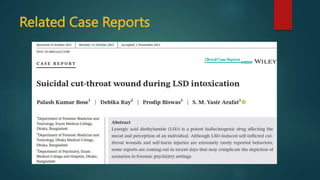
Related Case Reports
Articles :Therapeutic Use of
Psychedelics
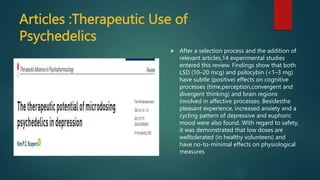
 After a selection process and the addition of
relevant articles,14 experimental studies
entered this review. Findings show that both
LSD (10–20 mcg) and psilocybin (<1–3 mg)
have subtle (positive) effects on cognitive
processes (time,perception,convergent and
divergent thinking) and brain regions
involved in affective processes. Besidesthe
pleasant experience, increased anxiety and a
cycling pattern of depressive and euphoric
mood were also found. With regard to safety,
it was demonstrated that low doses are
welltolerated (in healthy volunteers) and
have no-to-minimal effects on physiological
measures
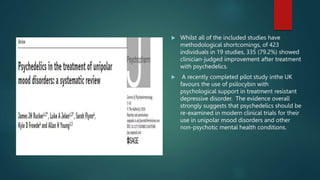
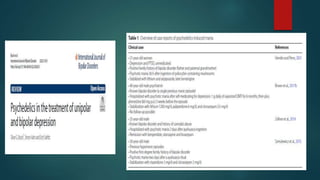
 Whilst all of the included studies have
methodological shortcomings, of 423
individuals in 19 studies, 335 (79.2%) showed
clinician-judged improvement after treatment
with psychedelics.
 A recently completed pilot study inthe UK
favours the use of psilocybin with
psychological support in treatment resistant
depressive disorder. The evidence overall
strongly suggests that psychedelics should be
re-examined in modern clinical trials for their
use in unipolar mood disorders and other
non-psychotic mental health conditions.
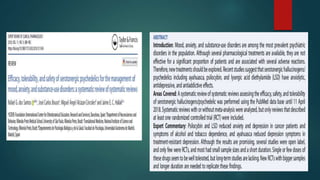
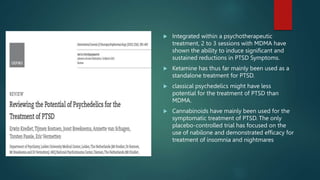
 Integrated within a psychotherapeutic
treatment, 2 to 3 sessions with MDMA have
shown the ability to induce significant and
sustained reductions in PTSD Symptoms.
 Ketamine has thus far mainly been used as a
standalone treatment for PTSD.
 classical psychedelics might have less
potential for the treatment of PTSD than
MDMA.
 Cannabinoids have mainly been used for the
symptomatic treatment of PTSD. The only
placebo-controlled trial has focused on the
use of nabilone and demonstrated efficacy for
treatment of insomnia and nightmares
psychedelic case series.pptx

psychedelic case series.pptx

  • 1.
  • 2.
    Authors  MARK HADEN-Executive Director, MAPS Canada -Adjunct Professor, University of British Columbia School of Population and Public Health, Vancouver, British Columbia, Canada.  BIRGITTA WOODS Adult Psychiatrist, Vancouver Coastal Health, Vancouver, British Columbia, Canada
  • 3.
    Publication detail Name ofthe Journal JOURNAL OF STUDIES ON ALCOHOL AND DRUGS Date of Publication JANUARY 2020 Volume No/ Issue No Volume 81, Issue 1 Page No 115-118 DOI doi.org/10.15288/jsad.2020.81.115
  • 4.
    Introduction  In academicsettings around the world, there is a resurgence of interest in using psychedelic substances for the treatment of addictions,posttraumatic stress disorder (PTSD), depression, anxiety, and other diagnoses.  Lysergic acid diethylamide (LSD) specifically showed promise in historical research and this interest continues today .
  • 5.
    Introduction-Cont…  Current researchprotocols specify dosages that are well within the range of clinical safety .  Research with larger dosages would present greater risk of adverse events and thus be less likely to receive approval from research ethics review.  To understand the effects of extremely high dosages of psychedelics such as LSD, an examination of overdoses in naturalistic settings is required.
  • 6.
    Objective  describes themedical consequences of accidental overdoses in three individuals.
  • 7.
  • 8.
    Source of Information interviews,  health records,  case notes, and  collateral reports.
  • 9.
    Case Report 1: LSDOverdose and the Consequences for Bipolar Disorder
  • 10.
    Trajectory of MentalHealth Concerns  AV,15 years old female, first contact with the mental health system was in March 1997 (at age 12),  for “hallucinations” and behavioral problems at school and a depressed mood in the context of a number of psychosocial stressors.  Electroencephalogram (EEG): was normal,  Initial diagnosis: unspecified psychotic disorder  possible diagnoses: psychotic depression, bipolar disorder, and schizophreniform disorder
  • 11.
    Trajectory of MentalHealth Concerns –Conti..  in May 1998, reported worsening of depressive symptoms without evidence of psychosis.  started on an antidepressant medication (sertraline)  symptoms improved and stabilized until the fall of 1999.  her depression worsened  a seasonal (winter) depression,  A light box was introduced in November 1999
  • 12.
    Trajectory of MentalHealth Concerns –Conti..  shortly thereafter she started to show signs of hypomania (decreased need for sleep, elevated mood, increased chattiness, increased productivity, and “obsessive,cleaning”)  treatment was discontinued and the sertraline was reduced  Over the Christmas holidays, she admitted to using Ecstasy(MDMA)  Her hypomanic symptoms continued and  assessed by her psychiatrist on January 19, 2000
  • 13.
    Trajectory of MentalHealth Concerns –Conti.  urine drug screen: positive only for cannabis.  diagnosed with bipolar II disorder  discontinue the sertraline and refused a mood stabilizer at that time.  on February 17, 2000 hospitalized voluntarily  Lithium 150 mg two times a day was started on an outpatient basis on March,2000  stopped taking it by the end of March
  • 14.
    Trajectory of MentalHealth Concerns –Conti..  on April 19, 2000, hospitalized after an incident where she bit her mother.  with intensified symptoms of hypomania  was not sleeping and had grandiose delusions,that she could purchase a town in Mexico and become the mayor and she could speak all languages.  Hospital notes documented that she was grandiose,paranoid,irritable, and disorganized.  Her diagnosis was changed to bipolar I disorder as she had had a full- blown manic episode with psychotic features.
  • 15.
    Drug History  firstcannabis use was at age 11 with no effect. used again at age 12 and began using regularly, escalating through ages 13–14, when she was using it daily (1998–1999).  She reported infrequent use of psilocybin mushrooms (in 1998) and LSD on one prior occasion (Remembrance Day, November 11, 1999).  She used Ecstasy (likely MDMA)twice with her initial use in December 1999.  she never used cocaine,methamphetamine, or opiates.
  • 16.
    Family History:  bipolardiagnoses in two paternal relatives  and alcoholism and trauma in her maternal lineage
  • 17.
    Psychosocial Issue:  homelife was turbulent with parental separation, an incarcerated father (1996, when she was age 12), subsequent ostracization by peers, the death of her grandmother (1998, when she was age 14), and school changes.  because of disruptive and defiant behavior and was moved to an alternative school at age 13 (in 1997).
  • 18.
    LSD Overdose incident Occurred during a summer solstice party (June 20, 2000, at age 15), where the supplier of the liquid LSD made a decimal place error when preparing individual dosages diluted in glasses of water.  Specifically,what were intended to be 100 mcg dosages (a normal recreational dosage) were actually 1,000 mcg per glass.  AV drank one glass and the “leftover drops”from two other glasses. Her total dosage was of 1,100–1,200 mcg, which was ingested at 10:00 p.m. on a relatively empty stomach
  • 19.
    LSD Overdose incident-continued Observers reported erratic behavior for the next 6.5 hours, followed by lying in a fetal position with her arms/fists clenched tightly. she was alert and oriented.  transported to a local hospital where she was diagnosed with a seizure, as this is what the witnesses reported.  subsequent interviews with AV and observers revealed no loss of bladder or bowel control, no biting of her tongue, no clonic movements in any limbs, and only a brief period of confusion after the clenching episode. It was unclear whether she had a loss of consciousness or whether she was intensely preoccupied with her experience at the time
  • 20.
    LSD Overdose incident-continued AV’s father reported that when he entered the hospital room the next morning, AV stated, “It’s over.” He believed she was referring to the LSD overdose incident,  but she clarified that she meant her bipolar illness was cured.
  • 21.
    LSD Overdose incident-continued Mental health team case notes  June 28, 2000: A second EEG was ordered, which was normal.  July 11, 2000: AV “came in today with a lovely fine balance and a glint in her eye and she is maintaining a happy and credible mood balance ever since the unfortunate incident that provoked her seizure three weeks ago” and AV “has not presented with as easy and healthy a presentation in many, many months.”  July 19, 2000: AV “is entirely stable at present” and “she has an excellent perspective on her illness and some things she can do to keep herself well.”
  • 22.
    Mental health teamcase notes-continued  September 6, 2000: “ remained remarkably stable this summer with no evidence of recurrent depression or mania” and “is doing remarkably well “  February 14, 2001: AV discussed tapering off her lithium with her psychiatrist, who observed at the end of the case note that, “her insight and self-awareness are quite remarkable.”  May 30, 2001: AV “has gone off her lithium without evidence of clinical hypomania or depression” and “she has had a fairly successful school year other than the one term out of four.”
  • 23.
    Post overdose reports AV’s father observed that his daughter appeared to be completely recovered from her mental health concerns after the overdose incident.  AV reports that she was free from all mental illness symptoms (bipolar or other) for the subsequent 13 years until she gave birth and experienced postpartum depression associated with a turbulent emotional period  AV reports that after the LSD overdose incident she experienced life with a “normal” brain, whereas her brain felt chemically unbalanced before the incident.
  • 24.
    Current Status ofAV  AV’s cannabis use was unchanged by the overdose event and she continues to use cannabis regularly.  Currently, AV has stable employment, stable positive friendships, and good work relationships
  • 25.
    Case 1: Conclusion Thiscase report documents a significant improvement in mood symptoms, including reductions in mania with psychotic features, following an accidental LSD overdose, that have been sustained for almost 20 years.
  • 26.
    Case Report 2: LSDOverdose While Pregnant
  • 27.
    Clinical Presentation  26-year-oldwoman (NM), who attended the above-described summer solstice party (June 20, 2000) ingested half a glass of water infused with LSD (at a miscalculated dosage of 500 mcg) at 9:00 p.m.  within minutes felt an intense reaction but did not vomit, lose of consciousness, or have a seizure.  At the next morning was able to engage with others and debrief the events of the previous night.
  • 28.
    Clinical Presentation-cont…  wasan experienced user of psychedelics, as she had used LSD twice, mushrooms “many times,” and 2C-B (4-Bromo 2,5dimethoxyphenethylamine) twice.  She used cannabis occasionally and drank alcohol infrequently.  She never used opiates or methamphetamine
  • 29.
    Clinical Presentation-cont..  NMdid not know that she was pregnant at the time of the overdose, but retrospective calculations indicate that she was 2 weeks into her pregnancy.  She subsequently gave birth to a son who is now 18 years old. He has been easy to parent, is intelligent, does well academically (mostly A’s in high school), is well adjusted socially (many healthy friends), and is fit (runs and goes to the gym).
  • 30.
    Case 2: Conclusion This case documents how an accidental overdose of LSD early in the first trimester of pregnancy did not negatively affect the course of NM’s pregnancy or  have any obvious teratogenic or other negative developmental effects on her son.
  • 31.
    Case Report 3: MassiveLSD Overdose Associated With Reduction of Physical Pain and Morphine Use
  • 32.
    Background  CB contractedLyme disease in her early 20s and experienced subsequent damage to her feet and ankles, causing significant pain.  was prescribed morphine for analgesia and was on continuously for about a decade (2008–2018).  average use of morphine before the LSD overdose event was four to six 10-mg pills a day with a maximum of eight pills depending on her foot pain levels (therefore 40–80 mg/day).
  • 33.
    LSD overdose event In September 2015, CB (age 46) took 55 mg intranasally of what she believed was cocaine but was actually pure LSD in powder form. (equivalent of 550 times the normal recreational dosage of 100 mcg)  She started vomiting within an hour and vomited frequently for the next 12 hours. roommate revealed that she sat mostly still in a chair with her eyes either open, closed, or rolled back, frothing at the mouth, occasionally vocalizing random words and vomiting frequently.
  • 34.
    LSD overdose event-Cont... Her recollection was that she sat up for this experience and mostly “blacked out” for the first 12 hours, after which she was able to communicate. She felt “pleasantly high” for the next 12hours (with infrequent vomiting).  CB reported that her foot pain was gone the next day.  she discontinued her morphine, did not use it for 5 days, and did not experience any withdrawal symptoms
  • 35.
    LSD overdose event-cont.. Subsequently her pain returned, restarted her morphine but at a lower dose (one to two pills a day), and started microdosing LSD (25 mcg approximately every 3 days).  She continued microdosing LSD with daily morphine until January 2018, she stopped the morphine and all other pain medications, as she believed that her pain was significantly reduced enough that pain medications were unnecessary.  After discontinuing the morphine, CB reported no typical withdrawal symptoms. However, she did experience an increase in anxiety, depression, and social withdrawal.
  • 36.
    Case 3: Conclusion intranasal ingestion of 550 times the normal recreational dosage of LSD was not fatal and had positive effects on pain levels and morphine withdrawal.  Although the effect was not sustained, she was able to reduce her morphine dose significantly with microdosing LSD and was able to come off of morphine eventually without typical withdrawal symptoms.
  • 37.
    Discussion  These casestudies detail the medical consequences of three accidental LSD overdoses.  This information is novel, as no clinical trial research could be done with this high dosage and there are no publications exploring the positive outcomes of very large dosages of LSD.
  • 38.
    Discussion-Cont…  Although thisexperience was distressing for all participants, there appear to be unpredictable, positive sequelae that ranged from improvements in mental illness symptoms to a reduction in physical pain and morphine withdrawal symptoms.  Also,while in early pregnancy did not appear to cause harm to the fetus.  This report builds on the historical safety data, which observes LSD to have a low toxicity potential and adds to the rapidly expanding literature exploring the potential therapeutic applications of psychedelic medicines
  • 39.
    Limitations  data areanecdotal,  no blood or urine samples were available,  and the LSD dosages were approximated.
  • 40.
  • 41.
    Articles :Therapeutic Useof Psychedelics  After a selection process and the addition of relevant articles,14 experimental studies entered this review. Findings show that both LSD (10–20 mcg) and psilocybin (<1–3 mg) have subtle (positive) effects on cognitive processes (time,perception,convergent and divergent thinking) and brain regions involved in affective processes. Besidesthe pleasant experience, increased anxiety and a cycling pattern of depressive and euphoric mood were also found. With regard to safety, it was demonstrated that low doses are welltolerated (in healthy volunteers) and have no-to-minimal effects on physiological measures
  • 42.
     Whilst allof the included studies have methodological shortcomings, of 423 individuals in 19 studies, 335 (79.2%) showed clinician-judged improvement after treatment with psychedelics.  A recently completed pilot study inthe UK favours the use of psilocybin with psychological support in treatment resistant depressive disorder. The evidence overall strongly suggests that psychedelics should be re-examined in modern clinical trials for their use in unipolar mood disorders and other non-psychotic mental health conditions.
  • 47.
     Integrated withina psychotherapeutic treatment, 2 to 3 sessions with MDMA have shown the ability to induce significant and sustained reductions in PTSD Symptoms.  Ketamine has thus far mainly been used as a standalone treatment for PTSD.  classical psychedelics might have less potential for the treatment of PTSD than MDMA.  Cannabinoids have mainly been used for the symptomatic treatment of PTSD. The only placebo-controlled trial has focused on the use of nabilone and demonstrated efficacy for treatment of insomnia and nightmares