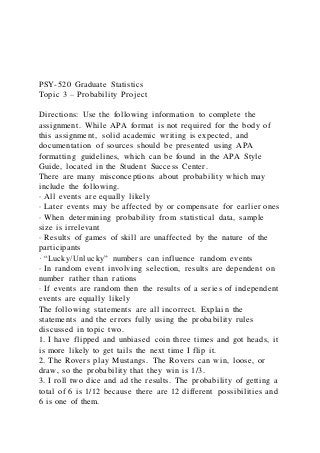
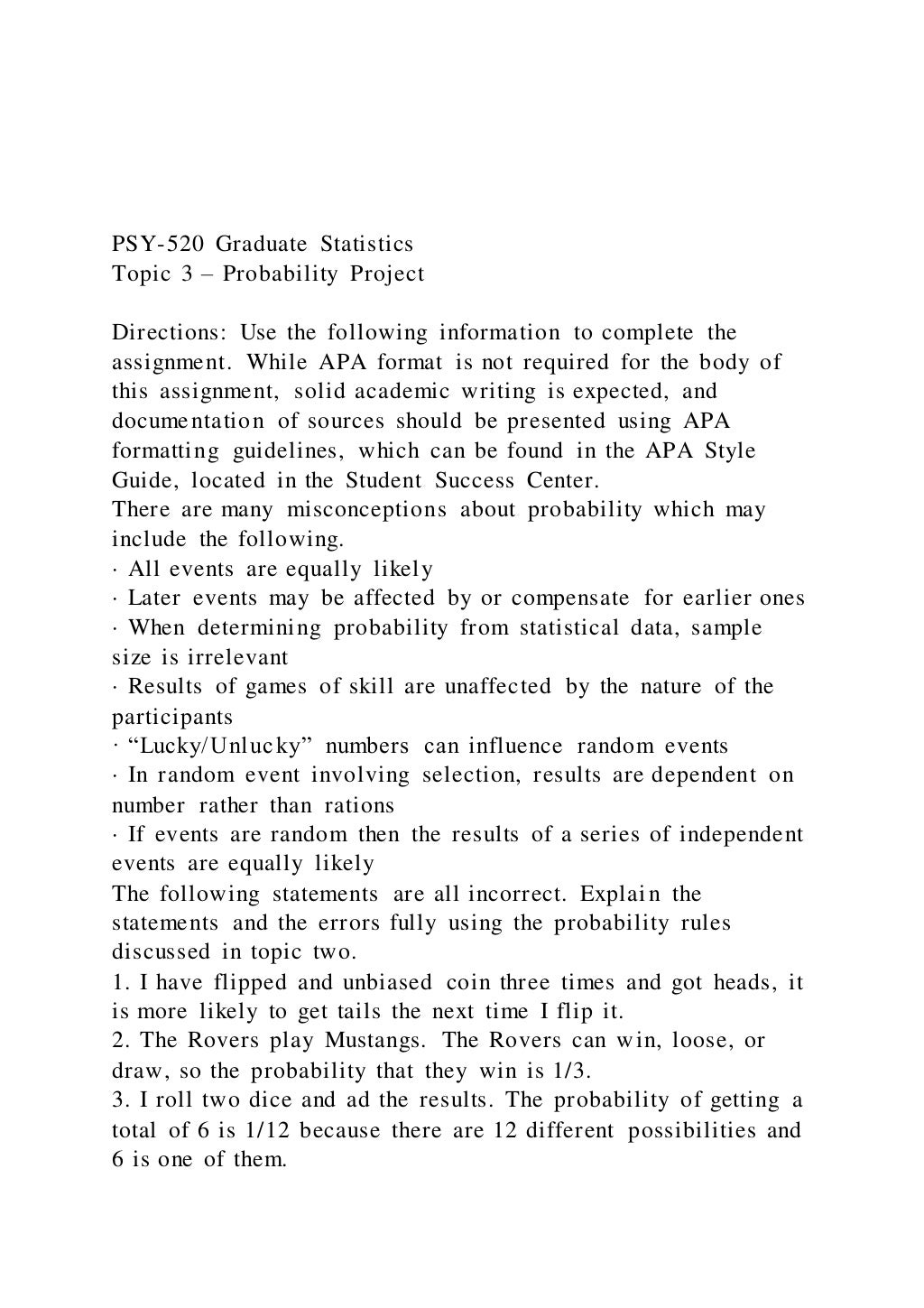
PSY-520 Graduate Statistics
Topic 3 – Probability Project
Directions: Use the following information to complete the
assignment. While APA format is not required for the body of
this assignment, solid academic writing is expected, and
documentation of sources should be presented using APA
formatting guidelines, which can be found in the APA Style
Guide, located in the Student Success Center.
There are many misconceptions about probability which may
include the following.
· All events are equally likely
· Later events may be affected by or compensate for earlier ones
· When determining probability from statistical data, sample
size is irrelevant
· Results of games of skill are unaffected by the nature of the
participants
· “Lucky/Unlucky” numbers can influence random events
· In random event involving selection, results are dependent on
number rather than rations
· If events are random then the results of a series of independent
events are equally likely
The following statements are all incorrect. Explain the
statements and the errors fully using the probability rules
discussed in topic two.
1. I have flipped and unbiased coin three times and got heads, it
is more likely to get tails the next time I flip it.
2. The Rovers play Mustangs. The Rovers can win, loose, or
draw, so the probability that they win is 1/3.
3. I roll two dice and ad the results. The probability of getting a
total of 6 is 1/12 because there are 12 different possibilities and
6 is one of them.
4. Mr. Purple has to have a major operation. 90% of the people
who have this operation make a complete recovery. There is a
90% chance that Mr. Purple will make a complete recovery if he
has this operation.
5. I flip two coins. The probability of getting heads and tails is
1/3 because I can get Heads and Heads, Heads and Tails, or
Tails and Tails.
6. 13 is an unlucky number so you are less likely to win raffles
with ticket number 13 than with a different dumber.
Uno, Koji, CHILDREN FOR HIRE , Japan Quarterly, 10:2
(1963:Apr./June) p.200
Uno, Koji, CHILDREN FOR HIRE , Japan Quarterly, 10:2
(1963:Apr./June) p.200
Uno, Koji, CHILDREN FOR HIRE , Japan Quarterly, 10:2
(1963:Apr./June) p.200
Uno, Koji, CHILDREN FOR HIRE , Japan Quarterly, 10:2
(1963:Apr./June) p.200
Uno, Koji, CHILDREN FOR HIRE , Japan Quarterly, 10:2
(1963:Apr./June) p.200
Uno, Koji, CHILDREN FOR HIRE , Japan Quarterly, 10:2
(1963:Apr./June) p.200
Uno, Koji, CHILDREN FOR HIRE , Japan Quarterly, 10:2
(1963:Apr./June) p.200
Uno, Koji, CHILDREN FOR HIRE , Japan Quarterly, 10:2
(1963:Apr./June) p.200
Uno, Koji, CHILDREN FOR HIRE , Japan Quarterly, 10:2
(1963:Apr./June) p.200
Uno, Koji, CHILDREN FOR HIRE , Japan Quarterly, 10:2
(1963:Apr./June) p.200
Uno, Koji, CHILDREN FOR HIRE , Japan Quarterly, 10:2
(1963:Apr./June) p.200
Uno, Koji, CHILDREN FOR HIRE , Japan Quarterly, 10:2
(1963:Apr./June) p.200
Uno, Koji, CHILDREN FOR HIRE , Japan Quarterly, 10:2
(1963:Apr./June) p.200
Uno, Koji, CHILDREN FOR HIRE , Japan Quarterly, 10:2
(1963:Apr./June) p.200
Uno, Koji, CHILDREN FOR HIRE , Japan Quarterly, 10:2
(1963:Apr./June) p.200
Uno, Koji, CHILDREN FOR HIRE , Japan Quarterly, 10:2
(1963:Apr./June) p.200
Uno, Koji, CHILDREN FOR HIRE , Japan Quarterly, 10:2
(1963:Apr./June) p.200
Uno, Koji, CHILDREN FOR HIRE , Japan Quarterly, 10:2
(1963:Apr./June) p.200
Uno, Koji, CHILDREN FOR HIRE , Japan Quarterly, 10:2
(1963:Apr./June) p.200
Uno, Koji, CHILDREN FOR HIRE , Japan Quarterly, 10:2
(1963:Apr./June) p.200
Uno, Koji, CHILDREN FOR HIRE , Japan Quarterly, 10:2
(1963:Apr./June) p.200
Uno, Koji, CHILDREN FOR HIRE , Japan Quarterly, 10:2
(1963:Apr./June) p.200
Uno, Koji, CHILDREN FOR HIRE , Japan Quarterly, 10:2
(1963:Apr./June) p.200
Uno, Koji, CHILDREN FOR HIRE , Japan Quarterly, 10:2
(1963:Apr./June) p.200
Uno, Koji, CHILDREN FOR HIRE , Japan Quarterly, 10:2
(1963:Apr./June) p.200
Uno, Koji, CHILDREN FOR HIRE , Japan Quarterly, 10:2
(1963:Apr./June) p.200
Uno, Koji, CHILDREN FOR HIRE , Japan Quarterly, 10:2
(1963:Apr./June) p.200
Uno, Koji, CHILDREN FOR HIRE , Japan Quarterly, 10:2
(1963:Apr./June) p.200
Uno, Koji, CHILDREN FOR HIRE , Japan Quarterly, 10:2
(1963:Apr./June) p.200
Uno, Koji, CHILDREN FOR HIRE , Japan Quarterly, 10:2
(1963:Apr./June) p.200
Uno, Koji, CHILDREN FOR HIRE , Japan Quarterly, 10:2
(1963:Apr./June) p.200
Uno, Koji, CHILDREN FOR HIRE , Japan Quarterly, 10:2
(1963:Apr./June) p.200
Need two response to two posts. These responses should be 100-
150 words each and say more
than “I agree” or “Good point.” Rather, your responses should
extend or somehow further the
discussion and analysis that was begun by one of your
classmates. (These post are based on the
readings in the attached file.)
Post 1
In the reading passage “Letter Found in a Cement Barrel”By
Hayama Yoshiki,the author depicts
a short story of Yozo Matsudo as a proletarian literature. Yozo
Matsudo,who works as a cement
digger,discovers a small wooden box in a barrel containing
cement powder while he is mixing
the cement without stopping. At the end of his work,he
trampled the wooden box and broke
it,and a letter came out from a woman who sewed a cement bag
wrapped in cloth from inside.
The content of the letter is that a female worker's lover was
sucked into a crusher that crushes
and shatters stones,was crushed with stones,burned,and
bones,meat and soul were mixed and
turned into cement. did. She eagerly wants to know where and
what her cement lover is used
for,and asks for a reply to this letter. There were few
descriptive sentences in this reading,and
the story was spelled out mainly in descriptive sentences,and I
was afraid of the depiction of her
lover becoming cement. But I doubt that the human body can
be so easily crushed,and it can
never be used. What I read from this depiction does not mean
that human beings are used as
cement,but that the society is made up of the hard work of
workers like them. I think that I
wanted to convey the painful situation of the workers that made
me describe the working
environment and the woman who lost her lover in an accident.
Post 2
The Unheard Laborer
The story that really held my attention was "Children
for Hire" by Ono Koji. This piece
reads very straight-forward but it also has an impact when read
because there is a transmission of
the character's vulnerabilities into the heart of the reader for the
most part. One aspect that really
comes to mind when reading this story is, rather than all the
characters being represented in the
situation, there seems to be a lack of consideration for the
interiors of the children. Taichi and
Junzo are perfect examples of this circumstance in different
ways. It is very evident that Omino
and Oseki were vigorously competing for Tachi’s attention, but
he seldom looks in their
direction. Taichi would do as he was asked, earned money, and
gave it to Sazo who was later to
be revealed as his favorite person. The moment he shares this
information with Omino represents
not only one of the moments where he shares his interior self
but it is also a chance to see his
interior being neglected because Omino was more interested in
understanding her standing in his
eyes over his true experience. In contrast, Junzo was more
fixated on the toys and candy to the
point that his mother mentioned that he refuses to eat anything
other than candy due to the
business he is doing for the sake of his family. Junzo was not
thrilled to enter this situation but it
could be argued that the candy was means for him to cope with
his circumstance and in some
manner became addicted to the feeling of rewards. Tachi’s
motivations always seemed allusive,
but I think that was because it was a narration performed from
the perspective of the adults rather
than his own personal narrative. In the end, his motivation for
doing what he does so diligently is
indirectly laid bare when he leaves intending to never return.
Under the guise of friendly yet
aloof behavior, he wanted to protect his family, Sazo. Despite
being five years old, Tachi seldom
seemed to be that small of a child until the story literally said
so. So, in the final moments when
Sazo says, “If I were all alone, well I could always find myself
a hole to curl up in. But there’s
Taichi” (229) Tachi’s world is practically shattered without a
second thought as to why he might
have been doing that work in the first place. So as a final
attempt to lessen Sazo’s burden he is up
without a trace. The children of poverty stricken families much
like Tachi in this story do not
have the luxury to do as they please, but to simply write them
off as children that don’t
understand anything and to treat their efforts as though they
meant nothing will certainly break
them long before the labor begins to wear them down.

PSY-520 Graduate StatisticsTopic 3 – Probability Project

  • 1.
    PSY-520 Graduate Statistics Topic3 – Probability Project Directions: Use the following information to complete the assignment. While APA format is not required for the body of this assignment, solid academic writing is expected, and documentation of sources should be presented using APA formatting guidelines, which can be found in the APA Style Guide, located in the Student Success Center. There are many misconceptions about probability which may include the following. · All events are equally likely · Later events may be affected by or compensate for earlier ones · When determining probability from statistical data, sample size is irrelevant · Results of games of skill are unaffected by the nature of the participants · “Lucky/Unlucky” numbers can influence random events · In random event involving selection, results are dependent on number rather than rations · If events are random then the results of a series of independent events are equally likely The following statements are all incorrect. Explain the statements and the errors fully using the probability rules discussed in topic two. 1. I have flipped and unbiased coin three times and got heads, it is more likely to get tails the next time I flip it. 2. The Rovers play Mustangs. The Rovers can win, loose, or draw, so the probability that they win is 1/3. 3. I roll two dice and ad the results. The probability of getting a total of 6 is 1/12 because there are 12 different possibilities and 6 is one of them.
  • 2.
    4. Mr. Purplehas to have a major operation. 90% of the people who have this operation make a complete recovery. There is a 90% chance that Mr. Purple will make a complete recovery if he has this operation. 5. I flip two coins. The probability of getting heads and tails is 1/3 because I can get Heads and Heads, Heads and Tails, or Tails and Tails. 6. 13 is an unlucky number so you are less likely to win raffles with ticket number 13 than with a different dumber. Uno, Koji, CHILDREN FOR HIRE , Japan Quarterly, 10:2 (1963:Apr./June) p.200 Uno, Koji, CHILDREN FOR HIRE , Japan Quarterly, 10:2 (1963:Apr./June) p.200 Uno, Koji, CHILDREN FOR HIRE , Japan Quarterly, 10:2 (1963:Apr./June) p.200 Uno, Koji, CHILDREN FOR HIRE , Japan Quarterly, 10:2 (1963:Apr./June) p.200 Uno, Koji, CHILDREN FOR HIRE , Japan Quarterly, 10:2 (1963:Apr./June) p.200
  • 3.
    Uno, Koji, CHILDRENFOR HIRE , Japan Quarterly, 10:2 (1963:Apr./June) p.200 Uno, Koji, CHILDREN FOR HIRE , Japan Quarterly, 10:2 (1963:Apr./June) p.200 Uno, Koji, CHILDREN FOR HIRE , Japan Quarterly, 10:2 (1963:Apr./June) p.200 Uno, Koji, CHILDREN FOR HIRE , Japan Quarterly, 10:2 (1963:Apr./June) p.200 Uno, Koji, CHILDREN FOR HIRE , Japan Quarterly, 10:2 (1963:Apr./June) p.200 Uno, Koji, CHILDREN FOR HIRE , Japan Quarterly, 10:2 (1963:Apr./June) p.200 Uno, Koji, CHILDREN FOR HIRE , Japan Quarterly, 10:2 (1963:Apr./June) p.200
  • 4.
    Uno, Koji, CHILDRENFOR HIRE , Japan Quarterly, 10:2 (1963:Apr./June) p.200 Uno, Koji, CHILDREN FOR HIRE , Japan Quarterly, 10:2 (1963:Apr./June) p.200 Uno, Koji, CHILDREN FOR HIRE , Japan Quarterly, 10:2 (1963:Apr./June) p.200 Uno, Koji, CHILDREN FOR HIRE , Japan Quarterly, 10:2 (1963:Apr./June) p.200 Uno, Koji, CHILDREN FOR HIRE , Japan Quarterly, 10:2 (1963:Apr./June) p.200 Uno, Koji, CHILDREN FOR HIRE , Japan Quarterly, 10:2 (1963:Apr./June) p.200 Uno, Koji, CHILDREN FOR HIRE , Japan Quarterly, 10:2 (1963:Apr./June) p.200
  • 5.
    Uno, Koji, CHILDRENFOR HIRE , Japan Quarterly, 10:2 (1963:Apr./June) p.200 Uno, Koji, CHILDREN FOR HIRE , Japan Quarterly, 10:2 (1963:Apr./June) p.200 Uno, Koji, CHILDREN FOR HIRE , Japan Quarterly, 10:2 (1963:Apr./June) p.200 Uno, Koji, CHILDREN FOR HIRE , Japan Quarterly, 10:2 (1963:Apr./June) p.200 Uno, Koji, CHILDREN FOR HIRE , Japan Quarterly, 10:2 (1963:Apr./June) p.200 Uno, Koji, CHILDREN FOR HIRE , Japan Quarterly, 10:2 (1963:Apr./June) p.200 Uno, Koji, CHILDREN FOR HIRE , Japan Quarterly, 10:2 (1963:Apr./June) p.200 Uno, Koji, CHILDREN FOR HIRE , Japan Quarterly, 10:2
  • 6.
    (1963:Apr./June) p.200 Uno, Koji,CHILDREN FOR HIRE , Japan Quarterly, 10:2 (1963:Apr./June) p.200 Uno, Koji, CHILDREN FOR HIRE , Japan Quarterly, 10:2 (1963:Apr./June) p.200 Uno, Koji, CHILDREN FOR HIRE , Japan Quarterly, 10:2 (1963:Apr./June) p.200 Uno, Koji, CHILDREN FOR HIRE , Japan Quarterly, 10:2 (1963:Apr./June) p.200 Uno, Koji, CHILDREN FOR HIRE , Japan Quarterly, 10:2 (1963:Apr./June) p.200 Need two response to two posts. These responses should be 100- 150 words each and say more than “I agree” or “Good point.” Rather, your responses should extend or somehow further the discussion and analysis that was begun by one of your classmates. (These post are based on the
  • 7.
    readings in theattached file.) Post 1 In the reading passage “Letter Found in a Cement Barrel”By Hayama Yoshiki,the author depicts a short story of Yozo Matsudo as a proletarian literature. Yozo Matsudo,who works as a cement digger,discovers a small wooden box in a barrel containing cement powder while he is mixing the cement without stopping. At the end of his work,he trampled the wooden box and broke it,and a letter came out from a woman who sewed a cement bag wrapped in cloth from inside. The content of the letter is that a female worker's lover was sucked into a crusher that crushes and shatters stones,was crushed with stones,burned,and bones,meat and soul were mixed and turned into cement. did. She eagerly wants to know where and what her cement lover is used for,and asks for a reply to this letter. There were few descriptive sentences in this reading,and the story was spelled out mainly in descriptive sentences,and I was afraid of the depiction of her lover becoming cement. But I doubt that the human body can be so easily crushed,and it can never be used. What I read from this depiction does not mean that human beings are used as cement,but that the society is made up of the hard work of workers like them. I think that I wanted to convey the painful situation of the workers that made me describe the working environment and the woman who lost her lover in an accident. Post 2 The Unheard Laborer
  • 8.
    The story thatreally held my attention was "Children for Hire" by Ono Koji. This piece reads very straight-forward but it also has an impact when read because there is a transmission of the character's vulnerabilities into the heart of the reader for the most part. One aspect that really comes to mind when reading this story is, rather than all the characters being represented in the situation, there seems to be a lack of consideration for the interiors of the children. Taichi and Junzo are perfect examples of this circumstance in different ways. It is very evident that Omino and Oseki were vigorously competing for Tachi’s attention, but he seldom looks in their direction. Taichi would do as he was asked, earned money, and gave it to Sazo who was later to be revealed as his favorite person. The moment he shares this information with Omino represents not only one of the moments where he shares his interior self but it is also a chance to see his interior being neglected because Omino was more interested in understanding her standing in his eyes over his true experience. In contrast, Junzo was more fixated on the toys and candy to the point that his mother mentioned that he refuses to eat anything other than candy due to the business he is doing for the sake of his family. Junzo was not thrilled to enter this situation but it could be argued that the candy was means for him to cope with his circumstance and in some manner became addicted to the feeling of rewards. Tachi’s motivations always seemed allusive, but I think that was because it was a narration performed from
  • 9.
    the perspective ofthe adults rather than his own personal narrative. In the end, his motivation for doing what he does so diligently is indirectly laid bare when he leaves intending to never return. Under the guise of friendly yet aloof behavior, he wanted to protect his family, Sazo. Despite being five years old, Tachi seldom seemed to be that small of a child until the story literally said so. So, in the final moments when Sazo says, “If I were all alone, well I could always find myself a hole to curl up in. But there’s Taichi” (229) Tachi’s world is practically shattered without a second thought as to why he might have been doing that work in the first place. So as a final attempt to lessen Sazo’s burden he is up without a trace. The children of poverty stricken families much like Tachi in this story do not have the luxury to do as they please, but to simply write them off as children that don’t understand anything and to treat their efforts as though they meant nothing will certainly break them long before the labor begins to wear them down.