
Drunk Driving Prevention System
Under the Guidance of Prof. Jagdish Kumar & Dr. Mohd Alam
Presented by
Prachi Singla 17104028
Pratyush Kumar 17104049
Rayvin Thingnam 17104103
Juvraj 17104110
Manish Verma 17104113
Objective
• According to NCRB (National Crime Records Bureau), “Driving under
influence of alcohol contributed 1.7% of total accidents which
resulted in injuries to 6,675 persons and 2,972 deaths in the country
(India).”
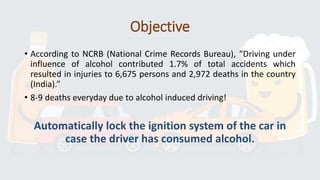
• 8-9 deaths everyday due to alcohol induced driving!
Automatically lock the ignition system of the car in
case the driver has consumed alcohol.
Phase 1
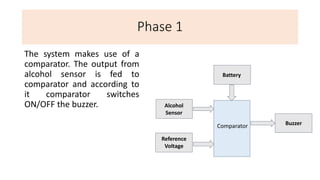
The system makes use of a
comparator. The output from
alcohol sensor is fed to
comparator and according to
it comparator switches
ON/OFF the buzzer.
Comparator
Alcohol
Sensor
Reference
Voltage
Battery
Buzzer
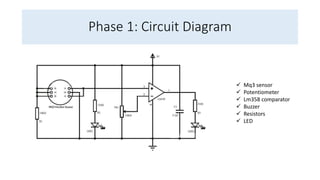
Phase 1: Circuit Diagram
 Mq3 sensor
 Potentiometer
 Lm358 comparator
 Buzzer
 Resistors
 LED
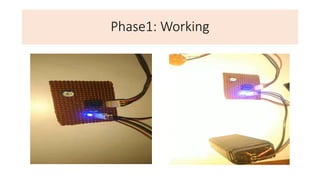
Phase1: Working
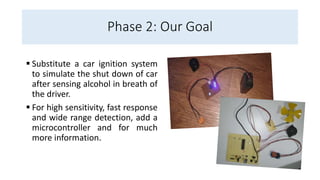
Phase 2: Our Goal
 Substitute a car ignition system
to simulate the shut down of car
after sensing alcohol in breath of
the driver.
 For high sensitivity, fast response
and wide range detection, add a
microcontroller and for much
more information.
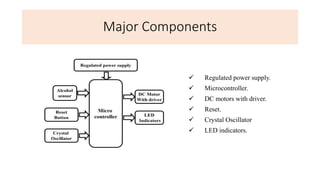
Major Components
 Regulated power supply.
 Microcontroller.
 DC motors with driver.
 Reset.
 Crystal Oscillator
 LED indicators.
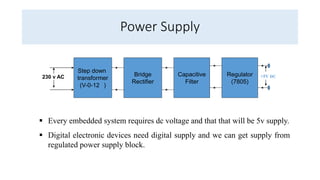
Power Supply
Step down
transformer
(V-0-12 )
Bridge
Rectifier
Capacitive
Filter
Regulator
(7805)
230 v AC +5V DC
 Every embedded system requires dc voltage and that that will be 5v supply.
 Digital electronic devices need digital supply and we can get supply from
regulated power supply block.
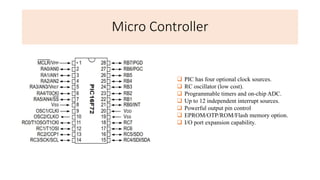
Micro Controller
 PIC has four optional clock sources.
 RC oscillator (low cost).
 Programmable timers and on-chip ADC.
 Up to 12 independent interrupt sources.
 Powerful output pin control
 EPROM/OTP/ROM/Flash memory option.
 I/O port expansion capability.
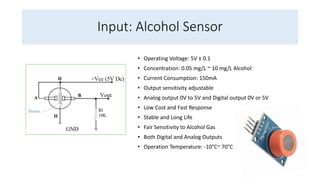
Input: Alcohol Sensor
• Operating Voltage: 5V ± 0.1
• Concentration: 0.05 mg/L ~ 10 mg/L Alcohol
• Current Consumption: 150mA
• Output sensitivity adjustable
• Analog output 0V to 5V and Digital output 0V or 5V
• Low Cost and Fast Response
• Stable and Long Life
• Fair Sensitivity to Alcohol Gas
• Both Digital and Analog Outputs
• Operation Temperature: -10°C~ 70°C
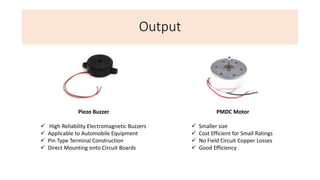
Output
PMDC Motor
 Smaller size
 Cost Efficient for Small Ratings
 No Field Circuit Copper Losses
 Good Efficiency
Piezo Buzzer
 High Reliability Electromagnetic Buzzers
 Applicable to Automobile Equipment
 Pin Type Terminal Construction
 Direct Mounting onto Circuit Boards
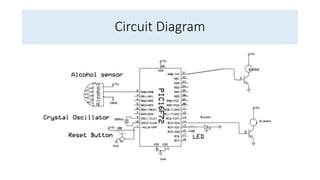
Circuit Diagram
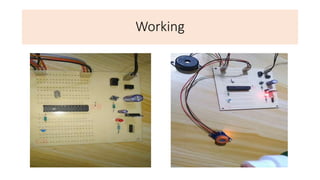
Working
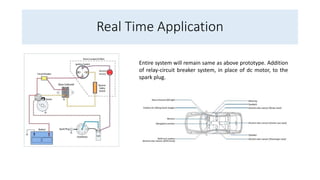
Real Time Application
Entire system will remain same as above prototype. Addition
of relay-circuit breaker system, in place of dc motor, to the
spark plug.
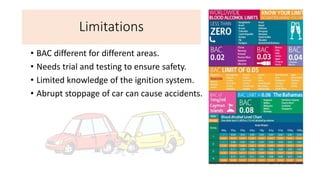
Limitations
• BAC different for different areas.
• Needs trial and testing to ensure safety.
• Limited knowledge of the ignition system.
• Abrupt stoppage of car can cause accidents.
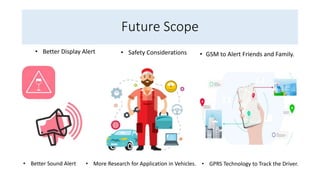
Future Scope
• GSM to Alert Friends and Family.
• GPRS Technology to Track the Driver.
• More Research for Application in Vehicles.
• Safety Considerations
• Better Display Alert
• Better Sound Alert
Prototype Alcohol Detection in Drivers

Prototype Alcohol Detection in Drivers

  • 1.
    Drunk Driving PreventionSystem Under the Guidance of Prof. Jagdish Kumar & Dr. Mohd Alam Presented by Prachi Singla 17104028 Pratyush Kumar 17104049 Rayvin Thingnam 17104103 Juvraj 17104110 Manish Verma 17104113
  • 2.
    Objective • According toNCRB (National Crime Records Bureau), “Driving under influence of alcohol contributed 1.7% of total accidents which resulted in injuries to 6,675 persons and 2,972 deaths in the country (India).” • 8-9 deaths everyday due to alcohol induced driving! Automatically lock the ignition system of the car in case the driver has consumed alcohol.
  • 3.
    Phase 1 The systemmakes use of a comparator. The output from alcohol sensor is fed to comparator and according to it comparator switches ON/OFF the buzzer. Comparator Alcohol Sensor Reference Voltage Battery Buzzer
  • 4.
    Phase 1: CircuitDiagram  Mq3 sensor  Potentiometer  Lm358 comparator  Buzzer  Resistors  LED
  • 5.
  • 6.
    Phase 2: OurGoal  Substitute a car ignition system to simulate the shut down of car after sensing alcohol in breath of the driver.  For high sensitivity, fast response and wide range detection, add a microcontroller and for much more information.
  • 7.
    Major Components  Regulatedpower supply.  Microcontroller.  DC motors with driver.  Reset.  Crystal Oscillator  LED indicators.
  • 8.
    Power Supply Step down transformer (V-0-12) Bridge Rectifier Capacitive Filter Regulator (7805) 230 v AC +5V DC  Every embedded system requires dc voltage and that that will be 5v supply.  Digital electronic devices need digital supply and we can get supply from regulated power supply block.
  • 9.
    Micro Controller  PIChas four optional clock sources.  RC oscillator (low cost).  Programmable timers and on-chip ADC.  Up to 12 independent interrupt sources.  Powerful output pin control  EPROM/OTP/ROM/Flash memory option.  I/O port expansion capability.
  • 10.
    Input: Alcohol Sensor •Operating Voltage: 5V ± 0.1 • Concentration: 0.05 mg/L ~ 10 mg/L Alcohol • Current Consumption: 150mA • Output sensitivity adjustable • Analog output 0V to 5V and Digital output 0V or 5V • Low Cost and Fast Response • Stable and Long Life • Fair Sensitivity to Alcohol Gas • Both Digital and Analog Outputs • Operation Temperature: -10°C~ 70°C
  • 11.
    Output PMDC Motor  Smallersize  Cost Efficient for Small Ratings  No Field Circuit Copper Losses  Good Efficiency Piezo Buzzer  High Reliability Electromagnetic Buzzers  Applicable to Automobile Equipment  Pin Type Terminal Construction  Direct Mounting onto Circuit Boards
  • 12.
  • 13.
  • 14.
    Real Time Application Entiresystem will remain same as above prototype. Addition of relay-circuit breaker system, in place of dc motor, to the spark plug.
  • 15.
    Limitations • BAC differentfor different areas. • Needs trial and testing to ensure safety. • Limited knowledge of the ignition system. • Abrupt stoppage of car can cause accidents.
  • 16.
    Future Scope • GSMto Alert Friends and Family. • GPRS Technology to Track the Driver. • More Research for Application in Vehicles. • Safety Considerations • Better Display Alert • Better Sound Alert