Protection against banking
and financial frauds
SUBMITTED BY : SOHIT KUMAR
HIMANSHU KUMAR
RAUSHAN KUMAR
RANJAN BARMAN
SUBMITTED TO : DR. PREETI DEVI
Introduction
 We are currently living in the era of digitalization. With the emergence of the internet,
the physical world has set foot into the digital world. India too is not behind in digitalizing
itself by promoting the "Digital India" campaign. Many industries like banking, insurance,
education, etc. are very keen on adopting digitalization. But nothing is perfect in this
world and the same is the case for digital payments as well i.e., with technology comes
vulnerability.
 While digital payments offer timeliness and comfort, it is prone to fraud as well.
Nowadays we see so many headlines about people losing their hard-earned money to
financial fraud. The reason being people lack knowledge on how to differentiate
between a genuine offer and a financial offer. They are also not aware of the remedies
which the government has to offer to the public in such circumstances.
Financial Frauds
 Financial fraud is any intentional act of deception involving financial
transactions for illegal gain. It can include misrepresenting information, identity
theft, or misusing funds to wrongfully obtain money or assets from a victim.
 Surveys and government data show a high incidence of financial fraud in India, with one
Local Circles survey indicating 47% of urban Indians faced financial fraud in the last three
years (as of mid-2024), and PwC reported 59% of organizations experienced financial
fraud in the past two years (as of late 2024). The total financial losses also show an
alarming trend, with the National Cyber Crime Reporting Portal (NCRP) recording over
₹22,000 crore in losses in 2024 alone, a significant increase from previous years.
Financial frauds in last few years:
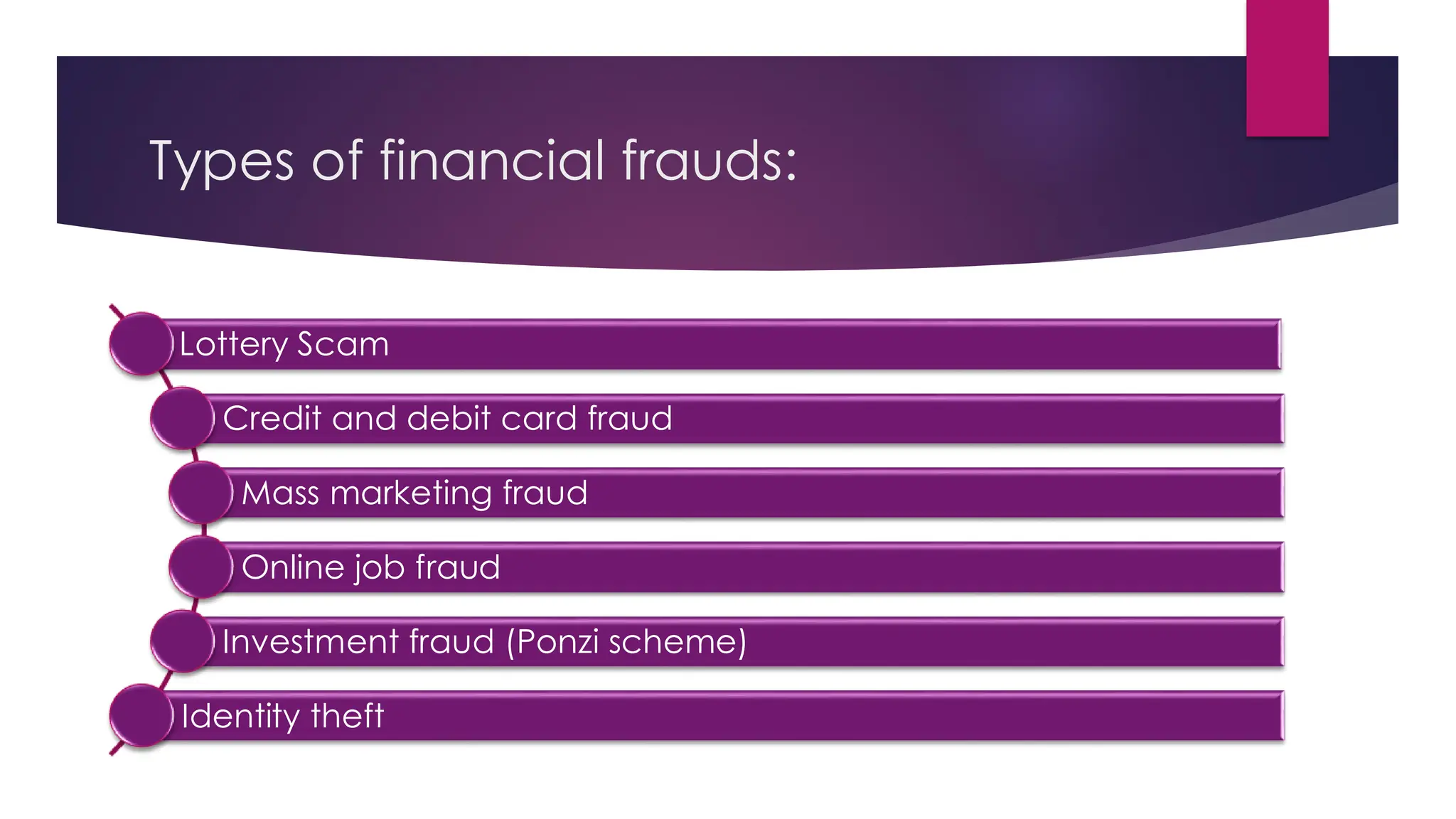
Types of financial frauds:
Lottery Scam
Credit and debit card fraud
Mass marketing fraud
Online job fraud
Investment fraud (Ponzi scheme)
Identity theft
Ponzi Schemes
 A Ponzi scheme is a type of investment fraud where returns are paid to earlier
investors using the capital of newer investors, rather than from profit earned. The
scheme relies on a continuous influx of new money to keep the illusion of
profitability alive. Eventually, it collapses when there aren’t enough new investors
to pay returns, or when the operator can no longer maintain the illusion.
 Named after Charles Ponzi, who became infamous for running this type of scam
in the early 20th century, these schemes are unsustainable and often lead to
significant financial losses for those involved.
Identifying Ponzi schemes:
❖ High returns with little or no risk
❖ Overly consistent returns.
❖ Unregistered investments
❖ Unlicensed sellers.
❖ Issues with paperwork
❖ Difficulty receiving payments
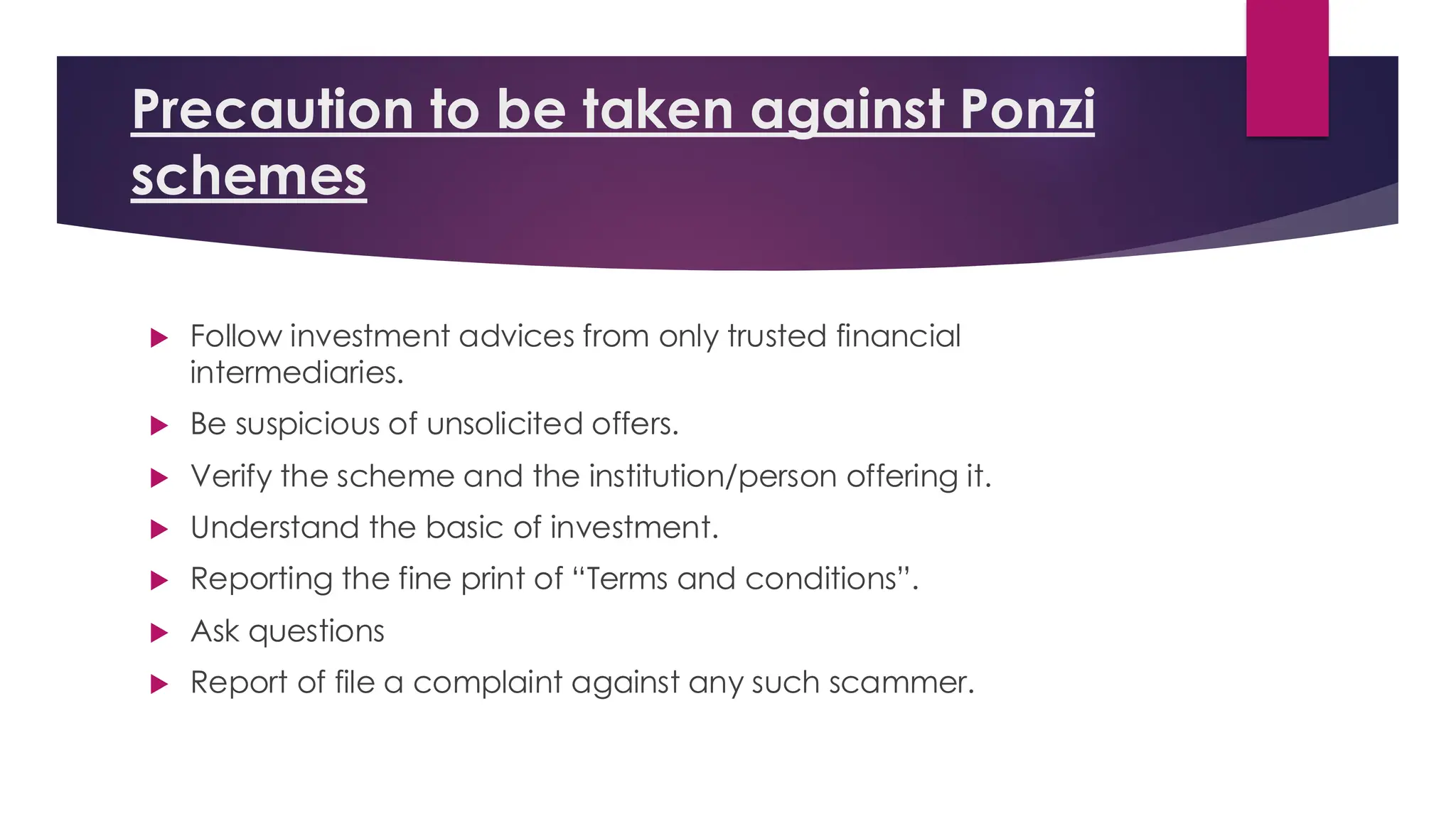
Precaution to be taken against Ponzi
schemes
 Follow investment advices from only trusted financial
intermediaries.
 Be suspicious of unsolicited offers.
 Verify the scheme and the institution/person offering it.
 Understand the basic of investment.
 Reporting the fine print of “Terms and conditions”.
 Ask questions
 Report of file a complaint against any such scammer.
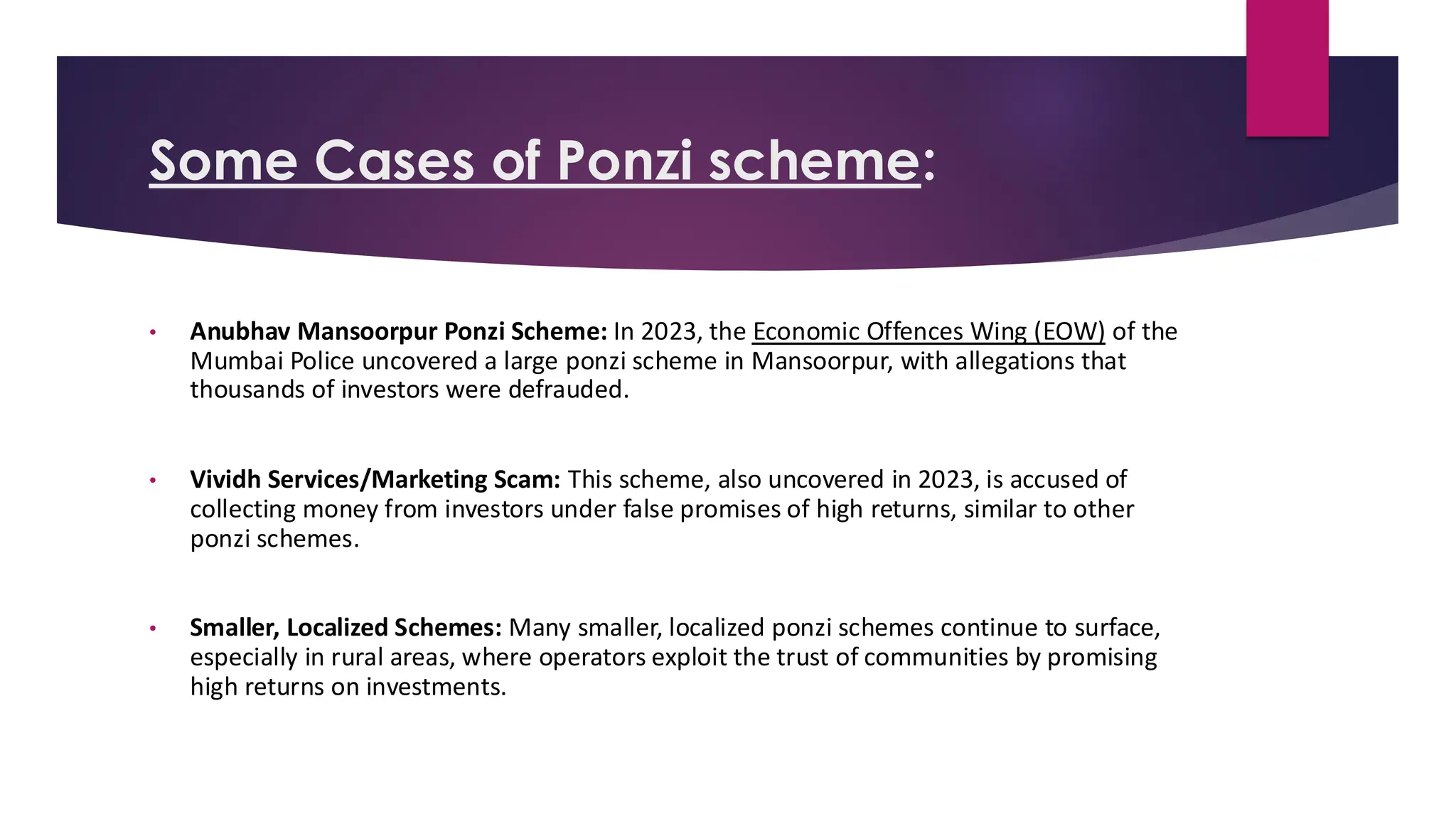
Some Cases of Ponzi scheme:
• Anubhav Mansoorpur Ponzi Scheme: In 2023, the Economic Offences Wing (EOW) of the
Mumbai Police uncovered a large ponzi scheme in Mansoorpur, with allegations that
thousands of investors were defrauded.
• Vividh Services/Marketing Scam: This scheme, also uncovered in 2023, is accused of
collecting money from investors under false promises of high returns, similar to other
ponzi schemes.
• Smaller, Localized Schemes: Many smaller, localized ponzi schemes continue to surface,
especially in rural areas, where operators exploit the trust of communities by promising
high returns on investments.
Online Frauds:
 Digitalization has made online frauds more prevalent due to the increasing
reliance on digital platforms for banking, shopping, and communication.
As more personal data is shared online, cybercriminals exploit
vulnerabilities in websites, apps, and even social media. Phishing attacks,
data breaches, and identity theft have become more sophisticated,
targeting individuals and businesses alike.
 While digitalization offers convenience, it also creates new opportunities
for fraudsters to exploit technological gaps. The shift to remote work, online
transactions, and digital currencies has expanded the attack surface,
making it crucial for users and companies to adopt enhanced
cybersecurity practices to prevent fraud.
Online fraud survey of last few years
 42% Indians surveyed say they or someone in their family has been a victim
of financial fraud in the last 3 years.
• The first question in the survey asked citizens, “Have
you or someone in your immediate family been a
victim of financial fraud in the last 3 years?”
• In response, the 54% of citizens said “Thankfully, no
one”. However, 4% said “Yes, multiple members”,
and while 38% revealed “Yes, one of us in the
family”.
• On an aggregate basis, 42% of Indians surveyed
say they or someone in their family have been
victims of financial fraud in the last 3 years.
Types of online banking frauds
 Phishing
 Vishing
 Frauds through unauthorized applications
 Skimming
 Sim Cloning
 QR code scanners
 Refund fraud
 Impersonation or fake identity on Social media platforms
Protection and security against online frauds
 To protect oneself from online fraud and incidents, “Awareness is the key”.
Some of the precautions and security actions that can be taken to avoid
online fraud are:
❖ Use only official and verified mobile phone applications.
❖ Use of a secure website
❖ Don’t share your passwords, bank details, or OTP(one-time password) with
strangers or financial intermediaries you don’t trust.
❖ Gather knowledge about different types of online fraud
❖ Avoid using public computers or wifi.
❖ Conduct research on the intermediary before sharing your details or
making an investment decision.
According to RBI(Reserve bank of India)
Steps to be taken in case you become one of the victims of online fraud:
 You are required to notify your bank immediately. Upon receipt of such
intimation, the bank will resolve the complaint within 90 days of receiving
the complaint.
 The bank is also required to reimburse the amount of loss, depending on
the negligence of the customer himself.
 The reimbursement policy further depends on RBI guidelines, the bank's
board policy, and the time taken by the customer to notify the bank
about the fraud.
Cybersecurity Measures by Banks
•Modern banks are increasingly investing in robust cybersecurity frameworks to protect customer data
and prevent fraud.
•Multi-Factor Authentication (MFA): Confirms user identity using passwords, OTPs, or biometrics.
•AI & Machine Learning: Detect suspicious activities and alert the bank in real time.
•Data Encryption: Secures sensitive information during online transactions.
•Regular Security Audits: Identify and fix potential vulnerabilities in banking systems.
•Dedicated Cyber Cells: Operate round the clock to monitor and address online financial crimes.
Role of Government and Regulatory
Bodies
•The government and financial regulators play a crucial role in preventing and managing financial
frauds.
•Reserve Bank of India (RBI): Sets guidelines for secure digital payments and customer
protection.
•National Cyber Crime Reporting Portal (NCRP): Allows easy reporting of online frauds by
citizens.
•CERT-In: Investigates cybersecurity threats and provides early warnings.
•Ministry of Finance: Conducts awareness campaigns on safe banking practices.
•Digital India Mission: Promotes secure, inclusive, and transparent online financial systems.
Public Awareness and Education
•Awareness and digital literacy are essential to protect individuals from fraud.
•Organize workshops and campaigns in schools, colleges, and rural areas.
•Encourage citizens to verify links, offers, and messages before taking any
action.
•Support initiatives like “Think Before You Click” and “Never Share Your OTP.”
•Spread verified information about scams through social media and official
platforms.
•A well-informed public is the strongest defense against financial frauds.
Future of Fraud Prevention
•The future of financial safety lies in combining technology, awareness, and regulation.
•Blockchain Technology: Brings transparency and traceability in digital payments.
•Biometric Authentication: Strengthens identity verification using fingerprints or facial
recognition.
•AI-Driven Fraud Detection: Predicts and prevents suspicious activities automatically.
•Cross-Sector Collaboration: Banks, telecom firms, and law enforcement agencies working
together.
•Data Protection Laws: Implementation of the Digital Personal Data Protection Act 2023
ensures better privacy and accountability
Conclusion
 Protection against financial frauds is essential to ensure the safety
of individuals, businesses, and the overall financial system. With
increasing digital transactions, awareness, vigilance, and the use of
secure technologies have become crucial. Strong regulations,
effective monitoring, and prompt reporting of suspicious activities
help reduce risks. By adopting safe practices, such as protecting
personal information, using secure banking channels, and staying
alert, individuals and institutions can safeguard themselves and
build trust in the financial system.
Thank you

Protection against banking and financial frauds-1.pdf

  • 1.
    Protection against banking andfinancial frauds SUBMITTED BY : SOHIT KUMAR HIMANSHU KUMAR RAUSHAN KUMAR RANJAN BARMAN SUBMITTED TO : DR. PREETI DEVI
  • 2.
    Introduction  We arecurrently living in the era of digitalization. With the emergence of the internet, the physical world has set foot into the digital world. India too is not behind in digitalizing itself by promoting the "Digital India" campaign. Many industries like banking, insurance, education, etc. are very keen on adopting digitalization. But nothing is perfect in this world and the same is the case for digital payments as well i.e., with technology comes vulnerability.  While digital payments offer timeliness and comfort, it is prone to fraud as well. Nowadays we see so many headlines about people losing their hard-earned money to financial fraud. The reason being people lack knowledge on how to differentiate between a genuine offer and a financial offer. They are also not aware of the remedies which the government has to offer to the public in such circumstances.
  • 3.
    Financial Frauds  Financialfraud is any intentional act of deception involving financial transactions for illegal gain. It can include misrepresenting information, identity theft, or misusing funds to wrongfully obtain money or assets from a victim.  Surveys and government data show a high incidence of financial fraud in India, with one Local Circles survey indicating 47% of urban Indians faced financial fraud in the last three years (as of mid-2024), and PwC reported 59% of organizations experienced financial fraud in the past two years (as of late 2024). The total financial losses also show an alarming trend, with the National Cyber Crime Reporting Portal (NCRP) recording over ₹22,000 crore in losses in 2024 alone, a significant increase from previous years.
  • 4.
    Financial frauds inlast few years:
  • 5.
    Types of financialfrauds: Lottery Scam Credit and debit card fraud Mass marketing fraud Online job fraud Investment fraud (Ponzi scheme) Identity theft
  • 6.
    Ponzi Schemes  APonzi scheme is a type of investment fraud where returns are paid to earlier investors using the capital of newer investors, rather than from profit earned. The scheme relies on a continuous influx of new money to keep the illusion of profitability alive. Eventually, it collapses when there aren’t enough new investors to pay returns, or when the operator can no longer maintain the illusion.  Named after Charles Ponzi, who became infamous for running this type of scam in the early 20th century, these schemes are unsustainable and often lead to significant financial losses for those involved.
  • 7.
    Identifying Ponzi schemes: ❖High returns with little or no risk ❖ Overly consistent returns. ❖ Unregistered investments ❖ Unlicensed sellers. ❖ Issues with paperwork ❖ Difficulty receiving payments
  • 8.
    Precaution to betaken against Ponzi schemes  Follow investment advices from only trusted financial intermediaries.  Be suspicious of unsolicited offers.  Verify the scheme and the institution/person offering it.  Understand the basic of investment.  Reporting the fine print of “Terms and conditions”.  Ask questions  Report of file a complaint against any such scammer.
  • 9.
    Some Cases ofPonzi scheme: • Anubhav Mansoorpur Ponzi Scheme: In 2023, the Economic Offences Wing (EOW) of the Mumbai Police uncovered a large ponzi scheme in Mansoorpur, with allegations that thousands of investors were defrauded. • Vividh Services/Marketing Scam: This scheme, also uncovered in 2023, is accused of collecting money from investors under false promises of high returns, similar to other ponzi schemes. • Smaller, Localized Schemes: Many smaller, localized ponzi schemes continue to surface, especially in rural areas, where operators exploit the trust of communities by promising high returns on investments.
  • 10.
    Online Frauds:  Digitalizationhas made online frauds more prevalent due to the increasing reliance on digital platforms for banking, shopping, and communication. As more personal data is shared online, cybercriminals exploit vulnerabilities in websites, apps, and even social media. Phishing attacks, data breaches, and identity theft have become more sophisticated, targeting individuals and businesses alike.  While digitalization offers convenience, it also creates new opportunities for fraudsters to exploit technological gaps. The shift to remote work, online transactions, and digital currencies has expanded the attack surface, making it crucial for users and companies to adopt enhanced cybersecurity practices to prevent fraud.
  • 11.
    Online fraud surveyof last few years  42% Indians surveyed say they or someone in their family has been a victim of financial fraud in the last 3 years. • The first question in the survey asked citizens, “Have you or someone in your immediate family been a victim of financial fraud in the last 3 years?” • In response, the 54% of citizens said “Thankfully, no one”. However, 4% said “Yes, multiple members”, and while 38% revealed “Yes, one of us in the family”. • On an aggregate basis, 42% of Indians surveyed say they or someone in their family have been victims of financial fraud in the last 3 years.
  • 12.
    Types of onlinebanking frauds  Phishing  Vishing  Frauds through unauthorized applications  Skimming  Sim Cloning  QR code scanners  Refund fraud  Impersonation or fake identity on Social media platforms
  • 13.
    Protection and securityagainst online frauds  To protect oneself from online fraud and incidents, “Awareness is the key”. Some of the precautions and security actions that can be taken to avoid online fraud are: ❖ Use only official and verified mobile phone applications. ❖ Use of a secure website ❖ Don’t share your passwords, bank details, or OTP(one-time password) with strangers or financial intermediaries you don’t trust. ❖ Gather knowledge about different types of online fraud ❖ Avoid using public computers or wifi. ❖ Conduct research on the intermediary before sharing your details or making an investment decision.
  • 14.
    According to RBI(Reservebank of India) Steps to be taken in case you become one of the victims of online fraud:  You are required to notify your bank immediately. Upon receipt of such intimation, the bank will resolve the complaint within 90 days of receiving the complaint.  The bank is also required to reimburse the amount of loss, depending on the negligence of the customer himself.  The reimbursement policy further depends on RBI guidelines, the bank's board policy, and the time taken by the customer to notify the bank about the fraud.
  • 15.
    Cybersecurity Measures byBanks •Modern banks are increasingly investing in robust cybersecurity frameworks to protect customer data and prevent fraud. •Multi-Factor Authentication (MFA): Confirms user identity using passwords, OTPs, or biometrics. •AI & Machine Learning: Detect suspicious activities and alert the bank in real time. •Data Encryption: Secures sensitive information during online transactions. •Regular Security Audits: Identify and fix potential vulnerabilities in banking systems. •Dedicated Cyber Cells: Operate round the clock to monitor and address online financial crimes.
  • 16.
    Role of Governmentand Regulatory Bodies •The government and financial regulators play a crucial role in preventing and managing financial frauds. •Reserve Bank of India (RBI): Sets guidelines for secure digital payments and customer protection. •National Cyber Crime Reporting Portal (NCRP): Allows easy reporting of online frauds by citizens. •CERT-In: Investigates cybersecurity threats and provides early warnings. •Ministry of Finance: Conducts awareness campaigns on safe banking practices. •Digital India Mission: Promotes secure, inclusive, and transparent online financial systems.
  • 17.
    Public Awareness andEducation •Awareness and digital literacy are essential to protect individuals from fraud. •Organize workshops and campaigns in schools, colleges, and rural areas. •Encourage citizens to verify links, offers, and messages before taking any action. •Support initiatives like “Think Before You Click” and “Never Share Your OTP.” •Spread verified information about scams through social media and official platforms. •A well-informed public is the strongest defense against financial frauds.
  • 18.
    Future of FraudPrevention •The future of financial safety lies in combining technology, awareness, and regulation. •Blockchain Technology: Brings transparency and traceability in digital payments. •Biometric Authentication: Strengthens identity verification using fingerprints or facial recognition. •AI-Driven Fraud Detection: Predicts and prevents suspicious activities automatically. •Cross-Sector Collaboration: Banks, telecom firms, and law enforcement agencies working together. •Data Protection Laws: Implementation of the Digital Personal Data Protection Act 2023 ensures better privacy and accountability
  • 19.
    Conclusion  Protection againstfinancial frauds is essential to ensure the safety of individuals, businesses, and the overall financial system. With increasing digital transactions, awareness, vigilance, and the use of secure technologies have become crucial. Strong regulations, effective monitoring, and prompt reporting of suspicious activities help reduce risks. By adopting safe practices, such as protecting personal information, using secure banking channels, and staying alert, individuals and institutions can safeguard themselves and build trust in the financial system.
  • 20.