1
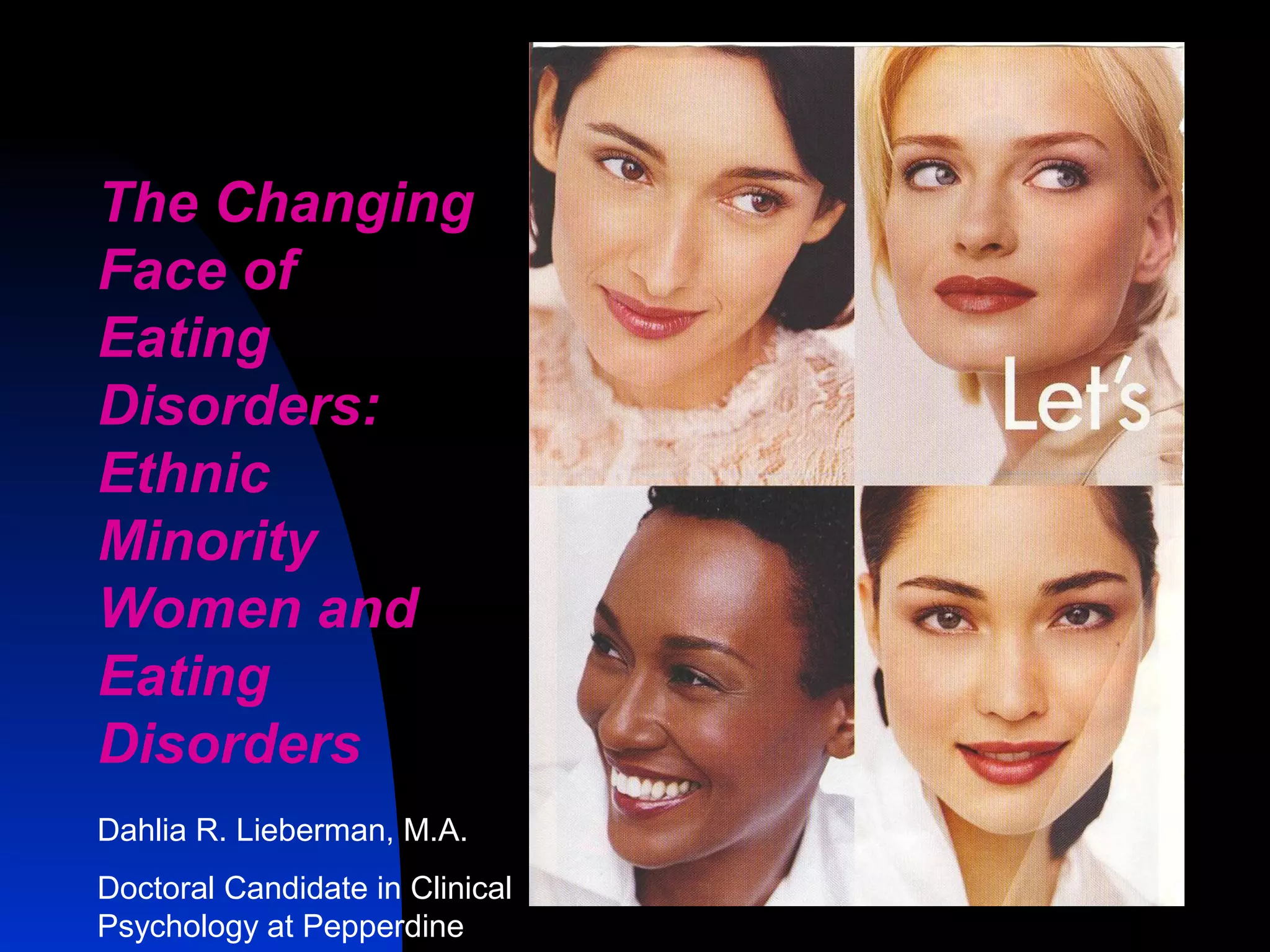
The Changing
Face of
Eating
Disorders:
Ethnic
Minority
Women and
Eating
Disorders
Dahlia R. Lieberman, M.A.
Doctoral Candidate in Clinical
Psychology at Pepperdine
2
Shining the Light On
Women of Color:
 Bruch (1985)- “Primary anorexia affects
primarily adolescent girls and women
from educated and prosperous homes”
 Bem (1981)- “People evaluate and
change their physical appearance to
conform to cultural standards”
 Harris & Kuba (1997)- “An eating
disorder can be understood as a
metaphor for a young woman’s self-
destructiveness related to a rejection of
her ethnoculture”
3
Shining the Light On
Women of Color:
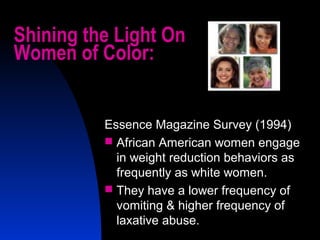
Essence Magazine Survey (1994)
 African American women engage
in weight reduction behaviors as
frequently as white women.
 They have a lower frequency of
vomiting & higher frequency of
laxative abuse.
4
Shining the Light On
Women of Color:
Striegel-Moore et al. Study (2000).
 Hispanic women are significantly
more likely than Caucasian and
African American women to use
diuretics.
 African American women have
higher frequency of laxative use to
lose weight.
5
Shining the Light On
Women of Color:
 Gross & Rosen (1988) – Rates for
bulimia nervosa similar in Hispanic
& Caucasian adolescent girls.
 Smith et.al., (1998) – Binge eating
disorder rates do not differ
significantly among African
American women compared with
Caucasian women.
6
 According to the United States
Census Bureau (2005), African
Americans and Latinos are two of
the fastest growing minority groups
in the United States.
 The US government now officially
recognizes that “women and girls
of all ethnic groups are susceptible
to eating disorders” (Office of
Women’s Health 2000).
7
Ethnic Differences in Eating
Disordered Behaviors (Crago and
Shisslak 2003)
 Dieting behaviors reported
significantly more often by White
females than by females in any
other ethnic group.
 Binge eating behaviors equally
common among minority women
and white females.
8
Ethnic Differences in Eating Disordered
Behaviors (Crago and Shisslak 2003)
 Vomiting rates in minority females either
comparable to or significantly higher than
those reported by White females.
 Rates of laxative use as a weight control
method among minority females either
comparable to or significantly higher than
rates reported by White females.
 Rates of diuretic use as a weight control
method among minority females was
comparable to or significantly higher than
rates reported by White females.
9
 Research results force us to think
“outside of the box”. We must challenge
the accuracy of the “young, white women
profile.”
 Women of color are not immune to
developing eating disorders.
 Failure to incorporate women of color
into our understanding of eating
disorders in the face of mounting
evidence is ultimately discriminatory.
10
Protective
Factors
11
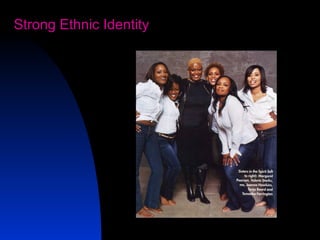
Strong Ethnic Identity
12
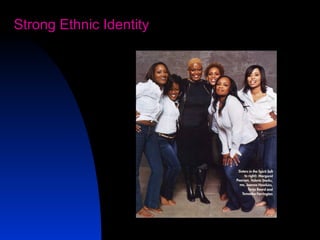
Strong Ethnic Identity
13
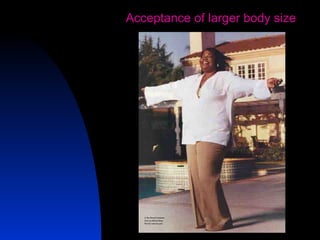
Acceptance of larger body size
14
History of African American Women
and Weight
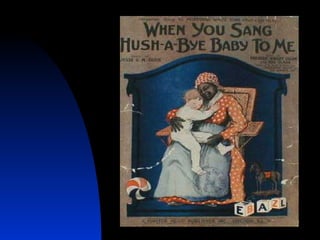
 Historically, African beauty was equated
with a fleshy, voluptuous body with hips.
 During slavery, women who were
voluptuous were likely to be sold for the
purposes of child bearing.
 Voluptuous slave women were often
initiated into the role of breeder by being
the sexual prize of the slave owner.
 The only legal means of escape from
being a concubine was to become a
Mammy.
15
16
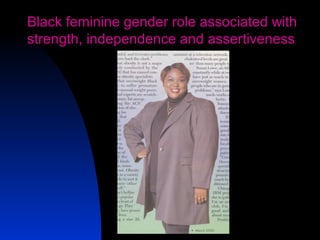
Black feminine gender role associated with
strength, independence and assertiveness
17
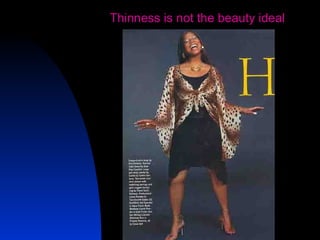
Thinness is not the beauty ideal
18
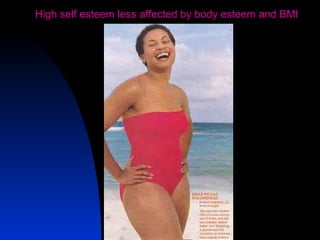
High self esteem less affected by body esteem and BMI
19
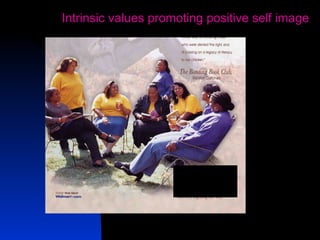
Intrinsic values promoting positive self image
20
Risk Factors
21
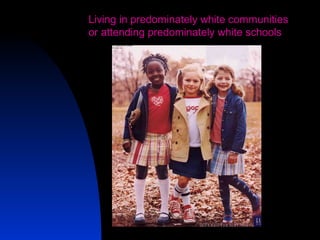
Living in predominately white communities
or attending predominately white schools
22
Goal of Development:
Connections Which Are Growth
Enhancing, Mutually Empathic and
Empowering
 During adolescence, perceived physical
attractiveness is the most important
criteria used for dating choices and
choosing friends
 Young girls of color experience a loss of
connectedness in adolescence--- a time
when beauty and looking a certain way is
pronounced
23
Goal of Development:
Connections Which Are Growth
Enhancing, Mutually Empathic and
Empowering
 Powerful impact of being different and
being treated differently leads to feelings
of isolation, shame, and disconnection
from self, culture and body.
 “Condemned isolation”---being locked
out of connection because you are
perceived as flawed (Jean Baker Miller).
24
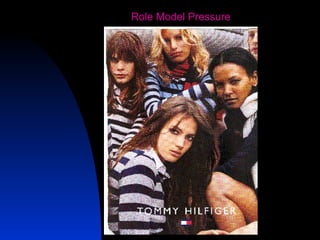
Role Model Pressure
25
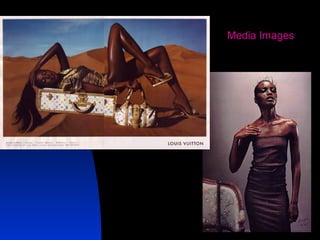
Media Images
26
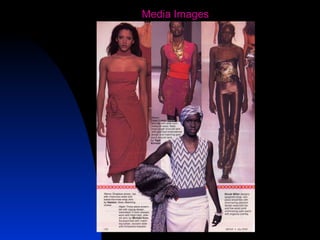
Media Images
27
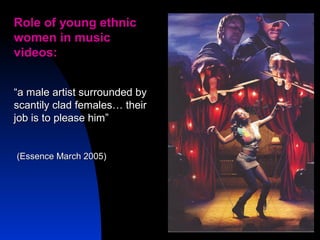
Role of young ethnicRole of young ethnic
women in musicwomen in music
videos:videos:
““a male artist surrounded bya male artist surrounded by
scantily clad females… theirscantily clad females… their
job is to please him”job is to please him”
(Essence March 2005)(Essence March 2005)
28
Risk Factors,
Cont.
 High rate of divorce or drug use
 Scarcity of available males
29
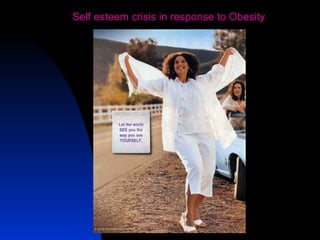
Self esteem crisis in response to Obesity
30
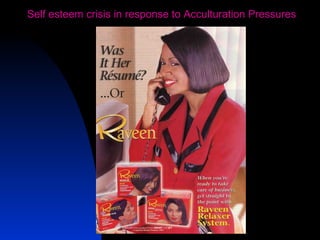
Self esteem crisis in response to Acculturation Pressures
31
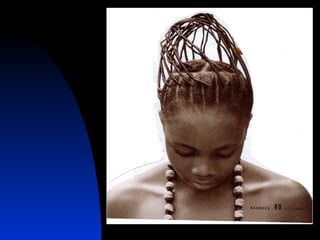
History of Black Hair
 African women adorned hair with
beautiful beads and elaborate locks,
plaits and twists. Hair designs were an
expression of pride and tribal heritage.
 When slaves were brought to this
country, the language, culture and
grooming traditions began to disappear.
 Without their combs and herbal
treatments, used in Africa, the more
elaborate hairstyles were lost.
32
33
History of Black Hair
 Black hair called “wool”. Lighter skinned,
straight-haired slaves commanded
higher prices at auction than darker,
more kinky haired slaves.
 Following the end of slavery whites
looked upon African American women
who styled their hair like white women as
‘well adjusted.’
 Having ‘good’ hair became a prerequisite
for entering certain schools, churches,
social groups and the business world.
34
History of Black Hair
 Madame CJ Walker, the 1st
American woman to become a self
made millionaire
35
36
37
38
Significance of Color
 The privilege afforded light skinned
Blacks has fueled the
internalization of color
consciousness
39
40
41
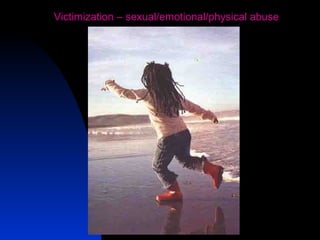
Victimization – sexual/emotional/physical abuse
42
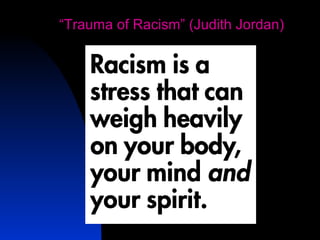
“Trauma of Racism” (Judith Jordan)
43
Minority Stress
Similarities/Common Themes:
 Rejection of Self
 Identity Crisis
 Yearning for Connection
 Feeling of being ‘other’ & desire to
belong
44
Ethnic Differences in Clinical
Presentation
 White Women:
 Dieting Behavior
 Obsessive Drive for Thinness
 Body Image Distortion
 Separation/Individuation Conflicts
 Women of Color:
 Laxative Abuse
 Obesity
 Psychological Effects of Acculturation
 Trauma of Racism
45
Barriers to Treatment for
Women of Color:
 Healthcare workers’ biases lead to
under-reporting and under-diagnosing.
 Tomes Silber (1986). Longer for non-
white women to be correctly diagnosed
with anorexia.
 Access to adequate treatment is largely
unattainable for poor women.
46
Barriers to Treatment
Women of Color:
 Eating disorders education
initiatives have not been directed
toward ethnic communities.
 Focused almost solely on obesity
treatment ignoring the complex
interplay between eating disorders
and obesity.
47

Proposal_Presentation--Changing_Face_of_Eating_Disorders

  • 1.
    1 The Changing Face of Eating Disorders: Ethnic Minority Womenand Eating Disorders Dahlia R. Lieberman, M.A. Doctoral Candidate in Clinical Psychology at Pepperdine
  • 2.
    2 Shining the LightOn Women of Color:  Bruch (1985)- “Primary anorexia affects primarily adolescent girls and women from educated and prosperous homes”  Bem (1981)- “People evaluate and change their physical appearance to conform to cultural standards”  Harris & Kuba (1997)- “An eating disorder can be understood as a metaphor for a young woman’s self- destructiveness related to a rejection of her ethnoculture”
  • 3.
    3 Shining the LightOn Women of Color: Essence Magazine Survey (1994)  African American women engage in weight reduction behaviors as frequently as white women.  They have a lower frequency of vomiting & higher frequency of laxative abuse.
  • 4.
    4 Shining the LightOn Women of Color: Striegel-Moore et al. Study (2000).  Hispanic women are significantly more likely than Caucasian and African American women to use diuretics.  African American women have higher frequency of laxative use to lose weight.
  • 5.
    5 Shining the LightOn Women of Color:  Gross & Rosen (1988) – Rates for bulimia nervosa similar in Hispanic & Caucasian adolescent girls.  Smith et.al., (1998) – Binge eating disorder rates do not differ significantly among African American women compared with Caucasian women.
  • 6.
    6  According tothe United States Census Bureau (2005), African Americans and Latinos are two of the fastest growing minority groups in the United States.  The US government now officially recognizes that “women and girls of all ethnic groups are susceptible to eating disorders” (Office of Women’s Health 2000).
  • 7.
    7 Ethnic Differences inEating Disordered Behaviors (Crago and Shisslak 2003)  Dieting behaviors reported significantly more often by White females than by females in any other ethnic group.  Binge eating behaviors equally common among minority women and white females.
  • 8.
    8 Ethnic Differences inEating Disordered Behaviors (Crago and Shisslak 2003)  Vomiting rates in minority females either comparable to or significantly higher than those reported by White females.  Rates of laxative use as a weight control method among minority females either comparable to or significantly higher than rates reported by White females.  Rates of diuretic use as a weight control method among minority females was comparable to or significantly higher than rates reported by White females.
  • 9.
    9  Research resultsforce us to think “outside of the box”. We must challenge the accuracy of the “young, white women profile.”  Women of color are not immune to developing eating disorders.  Failure to incorporate women of color into our understanding of eating disorders in the face of mounting evidence is ultimately discriminatory.
  • 10.
  • 11.
  • 12.
  • 13.
  • 14.
    14 History of AfricanAmerican Women and Weight  Historically, African beauty was equated with a fleshy, voluptuous body with hips.  During slavery, women who were voluptuous were likely to be sold for the purposes of child bearing.  Voluptuous slave women were often initiated into the role of breeder by being the sexual prize of the slave owner.  The only legal means of escape from being a concubine was to become a Mammy.
  • 15.
  • 16.
    16 Black feminine genderrole associated with strength, independence and assertiveness
  • 17.
    17 Thinness is notthe beauty ideal
  • 18.
    18 High self esteemless affected by body esteem and BMI
  • 19.
    19 Intrinsic values promotingpositive self image
  • 20.
  • 21.
    21 Living in predominatelywhite communities or attending predominately white schools
  • 22.
    22 Goal of Development: ConnectionsWhich Are Growth Enhancing, Mutually Empathic and Empowering  During adolescence, perceived physical attractiveness is the most important criteria used for dating choices and choosing friends  Young girls of color experience a loss of connectedness in adolescence--- a time when beauty and looking a certain way is pronounced
  • 23.
    23 Goal of Development: ConnectionsWhich Are Growth Enhancing, Mutually Empathic and Empowering  Powerful impact of being different and being treated differently leads to feelings of isolation, shame, and disconnection from self, culture and body.  “Condemned isolation”---being locked out of connection because you are perceived as flawed (Jean Baker Miller).
  • 24.
  • 25.
  • 26.
  • 27.
    27 Role of youngethnicRole of young ethnic women in musicwomen in music videos:videos: ““a male artist surrounded bya male artist surrounded by scantily clad females… theirscantily clad females… their job is to please him”job is to please him” (Essence March 2005)(Essence March 2005)
  • 28.
    28 Risk Factors, Cont.  Highrate of divorce or drug use  Scarcity of available males
  • 29.
    29 Self esteem crisisin response to Obesity
  • 30.
    30 Self esteem crisisin response to Acculturation Pressures
  • 31.
    31 History of BlackHair  African women adorned hair with beautiful beads and elaborate locks, plaits and twists. Hair designs were an expression of pride and tribal heritage.  When slaves were brought to this country, the language, culture and grooming traditions began to disappear.  Without their combs and herbal treatments, used in Africa, the more elaborate hairstyles were lost.
  • 32.
  • 33.
    33 History of BlackHair  Black hair called “wool”. Lighter skinned, straight-haired slaves commanded higher prices at auction than darker, more kinky haired slaves.  Following the end of slavery whites looked upon African American women who styled their hair like white women as ‘well adjusted.’  Having ‘good’ hair became a prerequisite for entering certain schools, churches, social groups and the business world.
  • 34.
    34 History of BlackHair  Madame CJ Walker, the 1st American woman to become a self made millionaire
  • 35.
  • 36.
  • 37.
  • 38.
    38 Significance of Color The privilege afforded light skinned Blacks has fueled the internalization of color consciousness
  • 39.
  • 40.
  • 41.
  • 42.
  • 43.
    43 Minority Stress Similarities/Common Themes: Rejection of Self  Identity Crisis  Yearning for Connection  Feeling of being ‘other’ & desire to belong
  • 44.
    44 Ethnic Differences inClinical Presentation  White Women:  Dieting Behavior  Obsessive Drive for Thinness  Body Image Distortion  Separation/Individuation Conflicts  Women of Color:  Laxative Abuse  Obesity  Psychological Effects of Acculturation  Trauma of Racism
  • 45.
    45 Barriers to Treatmentfor Women of Color:  Healthcare workers’ biases lead to under-reporting and under-diagnosing.  Tomes Silber (1986). Longer for non- white women to be correctly diagnosed with anorexia.  Access to adequate treatment is largely unattainable for poor women.
  • 46.
    46 Barriers to Treatment Womenof Color:  Eating disorders education initiatives have not been directed toward ethnic communities.  Focused almost solely on obesity treatment ignoring the complex interplay between eating disorders and obesity.
  • 47.

Editor's Notes

  • #2 Traditionally, eating disorders have been thought of as a “white women’s disease.” The most visible sufferers, as seen in the media, have been models, actresses and athletes who are young, white and female.
  • #3 Hilde Bruch was one of the early pioneers in the field of eating disorders in the late 1960’s. The results of her observational studies formed the theoretical basis for the belief that eating disorders are a disease of the affluent. This belief gained further support through the 1970’s due to biases in the research. Researchers mistakely believed that eating disorders were a “white’s only” disease because the patients being diagnosed, treated and researched were overwhelming white, middle/upper class and female. Until recently issues of body image disturbance and eating disorders among poor women and women of color tended to be overlooked.
  • #4 In the 1990’s, thanks in part to the influence of feminist therapy in the field of eating disorders, questions concerning cultural diversity began to be asked. Essence Magazine Survey was the first to ask African American Women about their weight reduction behaviors. They found that over half of them were at risk for developing eating disorders.
  • #8 Presently, there is not nationally representative data about the prevalence of eating disorders in different ethnic groups in the US because of sample size challenges. However, there have been a number of research studies aimed at determining ethnic differences in disordered eating behaviors. Dieting behaviors reported significantly more often by White females than by females in any other ethnic group. (60% of 50 studies reviewed) Binge eating behaviors equally common among minority women and white females. (54% of 28 studies reviewed)
  • #9 Vomiting rates in minority females either comparable to or significantly higher than those reported by White females. (58% of 19 studies reviewed) Rates of laxative use as a weight control method among minority females either comparable to or significantly higher than rates reported by White females. (69% of 16 studies reviewed)
  • #11 There do seem to be some mediating factors which are culturally based and appear to protect women of color from developing some types of eating problems – particularly anorexia nervosa.
  • #12 Women with close ties to their ethnic origins, who feel pride and a sense of connection are less vulnerable to eating disorders. They likely internalize different cultural messages, values, beliefs and traditions which are contrary to the Anglo European thinness ideal for women.
  • #13 Women with close ties to their ethnic origins, who feel pride and a sense of connection are less vulnerable to eating disorders. They likely internalize different cultural messages, values, beliefs and traditions which are contrary to Anglo European thinness ideal for women.
  • #14 African American & Hispanic cultures tend to value a full, rounded, curvy figure over the thin, angular beauty ideal. African American men are more willing to date a large size woman –preferring “a hambone to a chicken leg”. “our men like women with meat on our bones”. Studies have shown that African American men have a preference for women size 12-20. Additionally, there are ethnic differences in terms of at what weight African American women and white women perceive themselves as being fat. White women perceive themselves as overwt at lower BMI’s.
  • #15 To understand the cultural issues and pressures that impact African Americans, you have to go back and understand the impact of slavery on the collective psyche of African Americans. Historically, African beauty was equated with a fleshy, voluptuous body with hips. Fleshy African women were considered healthier, more fertile, and well endowed financially. Being a large woman was highly acceptable and even envied. Culturally, being large in Africa was not customary– the laborious tasks of the average African woman was not conducive to being big. African women who were fleshy were viewed as having more than the average woman. They were assumed to come from affluent families or had the potential to be good providers. These were the women to marry. During Slavery, being large brought women from the fields into the house. Mammy was safe from sexual advances of the slave owner and frequently lived better then the rest of the slaves. During slavery, women who were voluptuous were likely to be sold for the purposes of child bearing. It was their duty to give birth to as many children as possible in order to increase the slave owners wealth. Voluptuous slave women were often initiated into the role of breeder by being the sexual prize of the slave owner. The only legal means of escape from being a concubine was to become a Mammy. Mammy took care of the slave owners children. She was obese. Her weight combined with her status helped to keep her out of harm’s way.
  • #16 Because of the children’s attachment to her, she was protected from being sold. Mammy’s size most likely brought forth a deep sense of personal security. Obesity served a definite social purpose: It kept the slave owner away, it brought forth respect and status among slaves, it kept a woman from being sold and was often socially accepted by the majority.
  • #17 Socialization of African American women today is associated with strength, independence and assertiveness. Due to the system of discrimination in our country, African American women are seen as less threatening than African American men and as such were allowed more opportunity. Women have often been the primary or substantial bread winner in the family. African American women are perceived as a source of power and support. African American girls are typically raised to be strong, independent, self reliant and assertive so than they will have the survival skills needed to live in a racist society.
  • #18 African American cultural beauty is associated more with personal style, expression and essence rather than body size. An expression of attitude based on not only what one wears, but how one wears it.
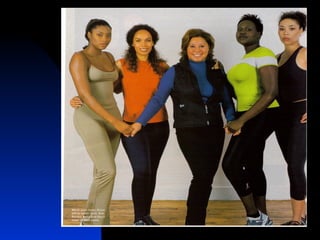
  • #19 Ophra’s staffers model bathing suits in her magazine. Not many women would feel comfortable enough to do this, but this woman is obviously comfortable in her own skin.
  • #20 Self esteem rooted in intrinsic values rather than external validation. Importance of spirituality as a source of strength Collectivism (brothers & sisters) vs competition and achievement of perfectionistic expectations.
  • #21 Presence of protective cultlural factors is not a guarantee that AA women will not develop eating disorders. AA women are exposed to and live in two cultural worlds. AA’s who possess certain risk factors are particularly vulnerable.
  • #22 Being biracial
  • #25 Being black and living in a predominantly white environment is like “Being a red dot on a white screen”. It is impossible to be inconspicuous. Feelings of anxiety,, discomfort, self consciousness are natural when one is different. Primitive survival mechanism. Being alike is normal --- being different is abnormal. Triggers unconscious attitudes and fears deeply ingrained in our culture. Chameleon Effect --- fine tune self to fit in due to acculturation pressures. Feeling pressured to act and look acceptable to counteract negative stereotypes. The rewards of our culture are available to those who fit in.
  • #26 AA women --- sexual images associated with primitive images. Female body used as packaging or a commodity.
  • #27 In the media, AA beauty is also tied to thinness.
  • #28 Sexualizing of young AA females in the media. Nowhere is this more apparent than in Hip-Hop music videos. Teenage girls are perfecting hypersexual stripper moves (booty clapping) and showing them off at middle school dances. 2003 study in Alabama – rural and poor AA girls. They found a correlation between hours of hip hop video consumption and increased STD’s, multiple sex partners and increased drug and alcohol use.
  • #29 More AA males in prison than in college. Educated AA women often need to be comfortable with a partner who has less education or accomplishments.
  • #30 Obese black women face prejudice in multiple ways--- sexual, racial, and fat prejudice. Higher incidence of obesity in AA. No difference in body size between AA and white girls during early childhood. By age 9 and into adolescence AA girls’ BMI’s surpass white girls. There appear to be ethnic differences in metabolic resting rates. AA girls and women have lower resting expenditures than whites. AA girls enter puberty at earlier age. And early maturation is associated with increased risk of Eating Disorder (teasing).
  • #31 Acculturation Pressure: Feeling compelled to silence aspects of one’s cultural self expression in order to fit in and function effectively within the white culture. Acculturation (blending in) reduces the effects of discrimination and allows one to move more smoothly and work with others. Black women face particular body image concerns because of racism and the beauty myth. Hair and skin color are central, crucial, emotional issues for AA women.
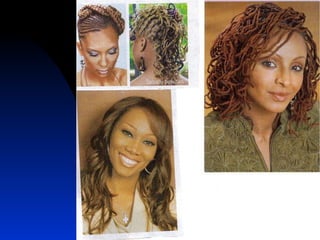
  • #36 If you bring up the subject of hair – the typical AA women will have hair stories to tell. Hair care is a ritual between mothers/grandmothers and daughters. At an early age we learn that our hair in its natural state needs to be tamed and controlled. Often through painful grooming procedures. Subconsciously the message is that it takes a lot of time, work and pain for me to be just acceptable.”
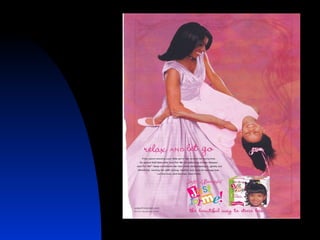
  • #37 Relax and let go--- Time spent relaxing your little girls hair should be worry free. So spend that time with just for me, deep conditions her hair while straightening it. Leaving her with strong, healthy, and easy to manage hair. “Let the love and the hair, flow freely.
  • #38 Today AA women take pride in natural hairstyles—Braids, short cropped hair. Wide range of self expression, AA women change their hair often.
  • #39 Light skinned black women with straight hair who most closely resemble the blond ideal have traditionally been deemed the most attractive by whites and by blacks. ( Halle Berry, Mariah Cary). The most destructive element of racism is Internalized racism.
  • #40 Cosmetic industry minimizes the ethnic differences. Beautiful black women in magazines look like white women with a heavy tan.
  • #41 Much more variety in skin color among AAs. Rainbow of shades.
  • #43 Stress of being a black female has damaging effects on the collective psyche of AA women and helps to place them at higher risk for some health crises…stroke, heart disease, high blood pressure, diabetes. It is not the fried chicken but the stress of racism, poverty and discrimination on body hormone levels—cortisol levels.
  • #45 Dieting behavior, obsessive drive for thinness, body image distortion and separation/individuation conflicts are significantly correlated with eating disorders in white women. Laxative abuse, obesity, the psychological effects of acculturation, struggles with ethno-cultural identity development and the trauma of racism and poverty may be more important for women of color. Since eating disorders may manifest themselves differently in non-white women, they may not always meet the specific criteria for anorexia or bulimia despite the fact they are suffering from serious eating disorders. Non-white women may more often meet criteria for EDNOS (or atypical eating disorder) which unfortunately carries very limited insurance coverage.
  • #46 In a study of access to care for potential eating disordered patients, Hispanic, African Americans were significantly less likely than White participants to receive referrals or recommendations for further evaluation or treatment. Access to adequate treatment, which is difficult for most women with eating disorders, is largely unattainable for poor women.
  • #47 Eating disorders education initiatives have not been directed toward ethnic communities. Medical education and prevention initiatives that have been directed toward women of color have focused almost solely on obesity treatment ignoring the complex interplay between eating disorders and obesity. Culturally Sensitive Eating Disorder Education: Education of medical and mental health professionals regarding minority cultural differences is paramount in developing an accurate assessment of patients. Eating disorder education needs to be directed toward ethnic minority young girls, women and their families. Outreach, Prevention and Education Since African American and Latino patients are more likely to consult within their families or communities, outreach efforts need to involve schools, churches, and community clinics. Eating disorder education needs to incorporate culturally appropriate materials and curriculum
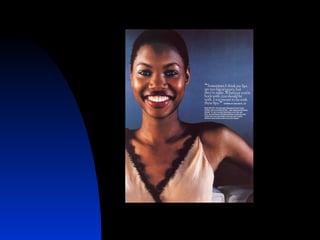
  • #48 Sometimes I think my lips are too big or pouty but they are mine. Whatever you are born with you should be with. I was meant to be with these lips.