Body Image and African
American Women
Rachel Kammen
AFAM 3433
November 19, 2013
Fall Semester
Issue of Significance
Body image affects all people of every race, age,
gender, sexuality etc. It is something that a lot of
people deal with and try to accept their body and
how they view themselves. Unfortunately, many
body image issue studies have been over white
women, from young girls to older women. Black
girls and women struggle with body image issues
as well. I plan to use this multimedia project to
showcase a few studies of Black women and body
image to show how they are affected by body
image.
Body Image Issues
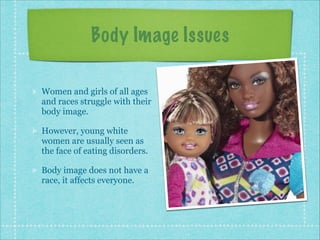
Women and girls of all ages
and races struggle with their
body image.
However, young white
women are usually seen as
the face of eating disorders.
Body image does not have a
race, it affects everyone.
Perceptions
This quote from one of the studies shows how black
women are stereotyped of having a positive body
image. Some people agree with this statement, but
other people have different opinions.
“African American (AA) women have traditionally been
thought to have a much greater satisfaction with their
bodies, less tendency to engage in disor- dered eating
or related practices, less likely to diet and an overall
more posi- tive body image (Fujioka, Ryan, Agle,
Legaspi, & Toohey, 2009; O’Neil, 2003; Parker et al.,
1995) (Reel 332).”
Inconclusive Findings
Some research has shown that when AA women
internalize the Western ideal of beauty and
thinness that they develop eating disorders and
patterns similar to white women (Watson 337).
Other research has shown that the
internalization does not cause AA women to
have these issues (Watson 337).
Background
There are many stereotypes regarding African American
women and body image. These problems and questioning
of their bodies can begin in childhood and continue into
adulthood. There are a lot of factors that can influence
whether a person has a negative or positive body image.
African American culture has recently gained a high
status and has been adapted by many different groups of
people. This issue is conflicted between the African
American community. Some people are flattered by the
acceptance of their ideas, but others are upset at what
people are doing with their culture.
Environment
Some have said that culture and environment can
influence a person’s perception of their body
image. Where a person lives can have a big impact
on how they view themselves.
“AA women who grew up and went to school in
predominately AA communities report having a
more positive body image than AA women who
grew up in predominately Caucasian communities
(Thompson, 1994) (Sanderson 498).”
Other Factors
“AA women’s oppression causes many factors to
go into their experiences regarding body image.
Race, gender, and class relate to psychological
distress in AA women (Watson 335).”
This is a very important concept to understand
when talking about body image and African
American women. Compared to other groups in
the United States, Black women face more
oppression which can lead to other things.
Racial Identity and Body Image
One positive idea about racial identity is that it can help
buffer racism and sexism. This happens when Black women
are surrounded by other Black women who support their
body ideals and do not look at what the media is saying
(Watson 338-9). African American women usually do not
look to the media for beauty ideals as they are mostly White
women anyway.
When compared with White women, Black women had
lower numbers of anoxeria, binge eating, and bulimia
(Watson 338-9). If an ethnic group is accepting of their
identity and have a community supporting them they are
less likely to have body image issues.
White Women vs Black Women
Some studies have shown that White women are more
likely to want to be thin than their African American
counterparts.
This is because White men like thin, White women
(Reel 325)
Black women see that Black men prefer larger Black
women.
Black women also tend to compare themselves to other
Black women instead of the majority of media images.
Panoptic Gaze
“The concept of panoptic gaze originated from Bentham’s designs for
the Panopticon, a prison structure that has a central guard tower,
allowing for each prisoner to be observed without observing the
guard. Feminist sociologist, Mary Duncan, related this to a woman’s
view of herself, as Weiss and Haber point out – ‘The point of
Bentham’s model prison, the Panopticon, is to train individuals to see
themselves as being seen’ (1999, p. 9). This type of surveillance is
symbolic of the experiences of our interview participants: a societal
gaze that enforces body ideals for women and may result in feelings of
guilt in those women subjected to it. (Reel 328-9)”
This gaze relates to how women see themselves as the ‘Other’. They
are always thinking of how other people view them and make sure to
live by society’s ideals. This gaze affects all women, but it impacts
African American women more.
Panoptic Gaze
“African-American women are in some cases operating
under the panoptic gaze with two conflicting body ideals.
While they are expected to maintain their femininity as a
societal member (thinness being equated to beauty), they
are expected by the opposite sex to meet another ideal of
femininity as a member of their ethnic group (larger is
better). (Reel 326)”
It is hard to choose what is right. In a society that praises
one thing and a culture that praises another many are
conflicted as to what to do. There is a definite separation
between larger Black women and smaller Black women, but
there shouldn’t be any stigma with any body types.
Body Ideals

Black women reported exercise as hurting their
body image, as one women reported losing her
butt (Reel 327).
Also another woman reported that big is
beautiful, if her family saw her as skinny she
looked sick or unwell (Reel 328).
Skin Color and Self-Esteem
When discussing
body image many
don’t even think of
mentioning skin
color, because it is
usually regarding
white women and
that is not something
that is thought about.

A study of 328 women of
color gave interesting
results regarding
satisfaction with their skin
color and self esteem.
4 types of women: African,
African American, African
Caribbean, and Biracial
were asked a series of
questions regarding their
skin tone.
Responses

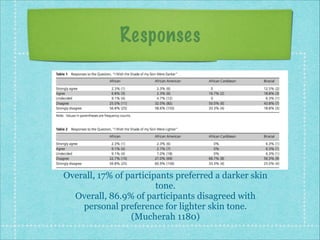
Overall, 17% of participants preferred a darker skin
tone.
Overall, 86.9% of participants disagreed with
personal preference for lighter skin tone.
(Mucherah 1180)
Podcast

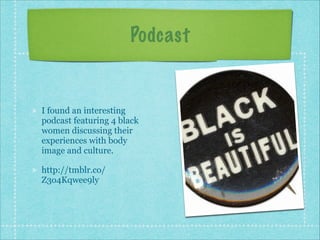
I found an interesting
podcast featuring 4 black
women discussing their
experiences with body
image and culture.
http://tmblr.co/
Z3o4Kqwee9ly
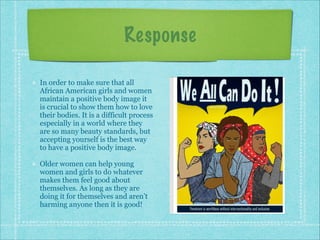
Response
In order to make sure that all
African American girls and women
maintain a positive body image it
is crucial to show them how to love
their bodies. It is a difficult process
especially in a world where they
are so many beauty standards, but
accepting yourself is the best way
to have a positive body image.
Older women can help young
women and girls to do whatever
makes them feel good about
themselves. As long as they are
doing it for themselves and aren’t
harming anyone then it is good!
References

Mucherah, Winnie, and Andrea Dawn Frazier. "How Deep Is Skin-Deep? The Relationship Between Skin Color Satisfaction,
Estimation Of Body Image, And Self-Esteem Among Women Of African Descent." Journal Of Applied Social Psychology 43.6 (2013):
1177-1184. Academic Search Premier. Web. 11 Nov. 2013.

!

Reel, Justine J., et al. "Age Before Beauty: An Exploration Of Body Image In African-American And Caucasian Adult Women."
Journal Of Gender Studies 17.4 (2008): 321-330. Academic Search Premier. Web. 11 Nov. 2013.

!

Sanderson, Sonya, Kirsten Lupinski, and Peggy Moch. "Is Big Really Beautiful? Understanding Body Image Perceptions Of
African American Females." Journal Of Black Studies 44.5 (2013): 496-507. Academic Search Premier. Web. 11 Nov. 2013.

!

Watson, Laurel B., et al. "Racial Identity Buffers African American Women From Body Image Problems And Disordered
Eating." Psychology Of Women Quarterly 37.3 (2013): 337-350. Academic Search Premier. Web. 11 Nov. 2013.

MMP 3

  • 1.
    Body Image andAfrican American Women Rachel Kammen AFAM 3433 November 19, 2013 Fall Semester
  • 2.
    Issue of Significance Bodyimage affects all people of every race, age, gender, sexuality etc. It is something that a lot of people deal with and try to accept their body and how they view themselves. Unfortunately, many body image issue studies have been over white women, from young girls to older women. Black girls and women struggle with body image issues as well. I plan to use this multimedia project to showcase a few studies of Black women and body image to show how they are affected by body image.
  • 3.
    Body Image Issues Womenand girls of all ages and races struggle with their body image. However, young white women are usually seen as the face of eating disorders. Body image does not have a race, it affects everyone.
  • 4.
    Perceptions This quote fromone of the studies shows how black women are stereotyped of having a positive body image. Some people agree with this statement, but other people have different opinions. “African American (AA) women have traditionally been thought to have a much greater satisfaction with their bodies, less tendency to engage in disor- dered eating or related practices, less likely to diet and an overall more posi- tive body image (Fujioka, Ryan, Agle, Legaspi, & Toohey, 2009; O’Neil, 2003; Parker et al., 1995) (Reel 332).”
  • 5.
    Inconclusive Findings Some researchhas shown that when AA women internalize the Western ideal of beauty and thinness that they develop eating disorders and patterns similar to white women (Watson 337). Other research has shown that the internalization does not cause AA women to have these issues (Watson 337).
  • 6.
    Background There are manystereotypes regarding African American women and body image. These problems and questioning of their bodies can begin in childhood and continue into adulthood. There are a lot of factors that can influence whether a person has a negative or positive body image. African American culture has recently gained a high status and has been adapted by many different groups of people. This issue is conflicted between the African American community. Some people are flattered by the acceptance of their ideas, but others are upset at what people are doing with their culture.
  • 7.
    Environment Some have saidthat culture and environment can influence a person’s perception of their body image. Where a person lives can have a big impact on how they view themselves. “AA women who grew up and went to school in predominately AA communities report having a more positive body image than AA women who grew up in predominately Caucasian communities (Thompson, 1994) (Sanderson 498).”
  • 8.
    Other Factors “AA women’soppression causes many factors to go into their experiences regarding body image. Race, gender, and class relate to psychological distress in AA women (Watson 335).” This is a very important concept to understand when talking about body image and African American women. Compared to other groups in the United States, Black women face more oppression which can lead to other things.
  • 9.
    Racial Identity andBody Image One positive idea about racial identity is that it can help buffer racism and sexism. This happens when Black women are surrounded by other Black women who support their body ideals and do not look at what the media is saying (Watson 338-9). African American women usually do not look to the media for beauty ideals as they are mostly White women anyway. When compared with White women, Black women had lower numbers of anoxeria, binge eating, and bulimia (Watson 338-9). If an ethnic group is accepting of their identity and have a community supporting them they are less likely to have body image issues.
  • 10.
    White Women vsBlack Women Some studies have shown that White women are more likely to want to be thin than their African American counterparts. This is because White men like thin, White women (Reel 325) Black women see that Black men prefer larger Black women. Black women also tend to compare themselves to other Black women instead of the majority of media images.
  • 11.
    Panoptic Gaze “The conceptof panoptic gaze originated from Bentham’s designs for the Panopticon, a prison structure that has a central guard tower, allowing for each prisoner to be observed without observing the guard. Feminist sociologist, Mary Duncan, related this to a woman’s view of herself, as Weiss and Haber point out – ‘The point of Bentham’s model prison, the Panopticon, is to train individuals to see themselves as being seen’ (1999, p. 9). This type of surveillance is symbolic of the experiences of our interview participants: a societal gaze that enforces body ideals for women and may result in feelings of guilt in those women subjected to it. (Reel 328-9)” This gaze relates to how women see themselves as the ‘Other’. They are always thinking of how other people view them and make sure to live by society’s ideals. This gaze affects all women, but it impacts African American women more.
  • 12.
    Panoptic Gaze “African-American womenare in some cases operating under the panoptic gaze with two conflicting body ideals. While they are expected to maintain their femininity as a societal member (thinness being equated to beauty), they are expected by the opposite sex to meet another ideal of femininity as a member of their ethnic group (larger is better). (Reel 326)” It is hard to choose what is right. In a society that praises one thing and a culture that praises another many are conflicted as to what to do. There is a definite separation between larger Black women and smaller Black women, but there shouldn’t be any stigma with any body types.
  • 13.
    Body Ideals Black womenreported exercise as hurting their body image, as one women reported losing her butt (Reel 327). Also another woman reported that big is beautiful, if her family saw her as skinny she looked sick or unwell (Reel 328).
  • 14.
    Skin Color andSelf-Esteem When discussing body image many don’t even think of mentioning skin color, because it is usually regarding white women and that is not something that is thought about. A study of 328 women of color gave interesting results regarding satisfaction with their skin color and self esteem. 4 types of women: African, African American, African Caribbean, and Biracial were asked a series of questions regarding their skin tone.
  • 15.
    Responses Overall, 17% ofparticipants preferred a darker skin tone. Overall, 86.9% of participants disagreed with personal preference for lighter skin tone. (Mucherah 1180)
  • 16.
    Podcast I found aninteresting podcast featuring 4 black women discussing their experiences with body image and culture. http://tmblr.co/ Z3o4Kqwee9ly
  • 17.
    Response In order tomake sure that all African American girls and women maintain a positive body image it is crucial to show them how to love their bodies. It is a difficult process especially in a world where they are so many beauty standards, but accepting yourself is the best way to have a positive body image. Older women can help young women and girls to do whatever makes them feel good about themselves. As long as they are doing it for themselves and aren’t harming anyone then it is good!
  • 18.
    References Mucherah, Winnie, andAndrea Dawn Frazier. "How Deep Is Skin-Deep? The Relationship Between Skin Color Satisfaction, Estimation Of Body Image, And Self-Esteem Among Women Of African Descent." Journal Of Applied Social Psychology 43.6 (2013): 1177-1184. Academic Search Premier. Web. 11 Nov. 2013. ! Reel, Justine J., et al. "Age Before Beauty: An Exploration Of Body Image In African-American And Caucasian Adult Women." Journal Of Gender Studies 17.4 (2008): 321-330. Academic Search Premier. Web. 11 Nov. 2013. ! Sanderson, Sonya, Kirsten Lupinski, and Peggy Moch. "Is Big Really Beautiful? Understanding Body Image Perceptions Of African American Females." Journal Of Black Studies 44.5 (2013): 496-507. Academic Search Premier. Web. 11 Nov. 2013. ! Watson, Laurel B., et al. "Racial Identity Buffers African American Women From Body Image Problems And Disordered Eating." Psychology Of Women Quarterly 37.3 (2013): 337-350. Academic Search Premier. Web. 11 Nov. 2013.