1 | P a g e M o d u l e I
S6 ME MBITS Project Management
Project Defined
PMI states that ”a project is a temporary endeavour undertaken to create a unique product or
service” . Temporary means that every project has a definite beginning and end, unique means
that the product or service is different in some distinguishing ways from all other products or
services.
Characteristics of a Project
i) Objectives
A project has a set of objectives or a mission. Once the objectives are achieved the project is
treated as completed.
ii) Life cycle
It consists of conception, detailed design of project areas, implementation based on the design
and commissioning the implemented project.
iii) Definite Time Limit
A project has a definite time limit in that it cannot continue forever
iv) Uniqueness
Every project is unique in the sense that no two projects are exactly the same
v) Team work
co-ordination among the diverse areas of project calls for team work
vi) Complexity
A project is a complex set of activities relating to diverse areas ( choosing technology, right kind
of people, procuring machinery etc)
vii) sub contracting
It reduces the complexity of the project and improves the quality as sub contractors are
specialized in particular fields of activity
viii) Risk and Uncertainty
There are foreseen or unforeseen risks in the project. Risk is the deviation from the expected
estimations.
ix) Customer specific nature
2 | P a g e M o d u l e I
S6 ME MBITS Project Management
It is the customer who decides the product to be produced and the services to be offered and
hence it is the responsibility of any organization to go for the products or services that are suited
to customer needs.
x) Change
There may be minor to major changes that may occur throughout the life span of a project, as a
natural outcome of many external factors. For example change in technology in the midst of the
project.
xi) Response to environments
Projects are often based on the need for the development of infrastructure and heavy industries.
xii) Forecasting
Only if the forecast gives positive indications, the project is taken up for further study. Thus it
must be accurate and based on sound fundamentals.
xiii) Rationale choice
Since the project is a scheme for investing resources, the choice of a project is done after making
a study of all the available avenues for investing resources and a rationale choice is made.
xiv) Optimality
Many project management concepts have evolved with the aim of achieving optimum utilization
of available resources (which may be scarce and costly)
xv) Control Mechanism
All projects will have pre-designed control mechanisms to ensure the completion of projects
within the time schedule , within the estimated cost and at the same time achieving the desired
quality and reliability.
Taxonomy of projects
Taxonomy is the classification of projects under different heads.
Based on the activity it can be industrial for production of goods or it can be non-industrial like
education or health care projects
Based on the location , national projects are set up within the boundaries of a country and
international projects are set up in other countries.
Based on ownership , an enterprise is considered public when the state or any national, regional
or local authority holds at least 51% of its capital and the enterprise is under the control of the
3 | P a g e M o d u l e I
S6 ME MBITS Project Management
state. A private sector project is one in which the ownership is completely in the hands of the
project promoters and investors . Profit maximization is the prime objective of private sector
projects. Joint sector projects are those in which the ownership is shared by the government and
private entrepreneurs.
Advantage to the government from the joint sector enterprise is that it can make use of the
managerial talents, entrepreneurial capabilities and marketing skills of the private entrepreneurs.
Advantage to the private firm is that the government shares the investment required for the
project and minimal red tapism.
Based on the size, projects are classified into small , medium and large. Investments on plant and
machinery upto 1 crore are small scale projects, above 100 crore are large scale projects and
between 1 crore and 100 crore are medium scale projects.
Based on the project completion time , crash projects are those which are to be expedited even
at the cost of ending up with a higher project cost when compared to normal projects.
Based on the purpose projects are classified into:
1. Expansion projects
2. Modernization projects
3. Diversification Projects
4. Backward integration projects
5. Forward integration projects
6. Replacement Projects
7. Balancing Projects
8. New Project
1. Expansion projects
They are the project s aimed at increasing the plant capacity for the current product range . It can
be done in two different ways
a) by establishing additional plant capacity
b) by acquiring another organization in the same line of activity
4 | P a g e M o d u l e I
S6 ME MBITS Project Management
2. Modernization projects
Mordernization refers to the change into a superior quality. As technological innovation is a
continuous process whenever either plant and machinery becomes obsolete or the production
process becomes obsolete, there is need for modernization. With out modernization , the product
quality may be inferior or the cost of production may be higher or both.
3. Diversification Projects
When manufacturer wants to offer more than one product, it is defined as diversification and the
associated project is called diversification project. There may be
a) Related diversification: Making closely related diversification to the existing product line . For
eg. clock manufacturer moving in to wrist watch manufacturing.
b) Unrelated diversification: Moving into totally different product ranges
4. Backward integration projects
Addition of manufacturing or processing facilities at the beginning stages of a product line to
avoid irregular raw material supply, additional inventory carrying costs, long lead times for raw
materials and to achieve higher profit margins.
5. Forward integration projects
By including additional manufacturing or processing facilities at the end of the production line,
the products that are currently produced may undergo further processing resulting in value
addition. For example an organization producing Polythene tubes may integrate its production
facilities forward by6 adding printing, cutting and bag making facilities so that the finished
product becomes printed Polythene bags as against continuous tubes.
6. Replacement Projects
Projects oriented on replacing the existing plant and machinery or a part of which is break down
7. Balancing Projects
Balancing projects are meant for the line balancing of various product ranges.
8. New Project
A new project is spearheaded in the development or offing of a new product or service which is
distinct from the existing ones.
5 | P a g e M o d u l e I
S6 ME MBITS Project Management
The 7S of Project Management
The 7S that defines Project Management are
Strategy: The high level requirements of the project and the means to achieve them.
Structure: The organizational arrangement that will be used to carry out the project
Systems: The methods for work to be designed , monitored and controlled
Staff: The selection, recruitment, management and leadership of those working on the project
Skills: The managerial and technical tools available to the project manager and staff
Style/culture: The underlying way of working and inter relating within the work team or
organization
Stakeholders: Individuals and groups who have an interest in the project process or outcome
In an instance the Digital certification operation in controlled environment (DCOCE) project is
aimed at the development of a website of Oxford University which provides authenticated access
to affiliated colleges and institutions, thereby able to provide digital certificates and other useful
information which together defines the goal and means to achieve the goal (strategy). The
methodology is to create several links, the click on which gives access to the required fields
defines systems. The tool available is a layout of the website to be designed and developed along
with the expertise in creating it attribute to the Skills. The hierarchy and the arrangement of the
team members defines the structure of the organization. The recruited team members along with
the project manager comprises the staff. The underlying way of work is by co-operating with
others as well as receiving useful information from outsiders( Style) .The fund raising is done
and the project is promoted by means of several partners (Stake holders) who have a lots of
interest in the project outcome.
Project Management defined
PMI defines project management as the application of knowledge, skills, tools and techniques to
project activities to meet project requirements.
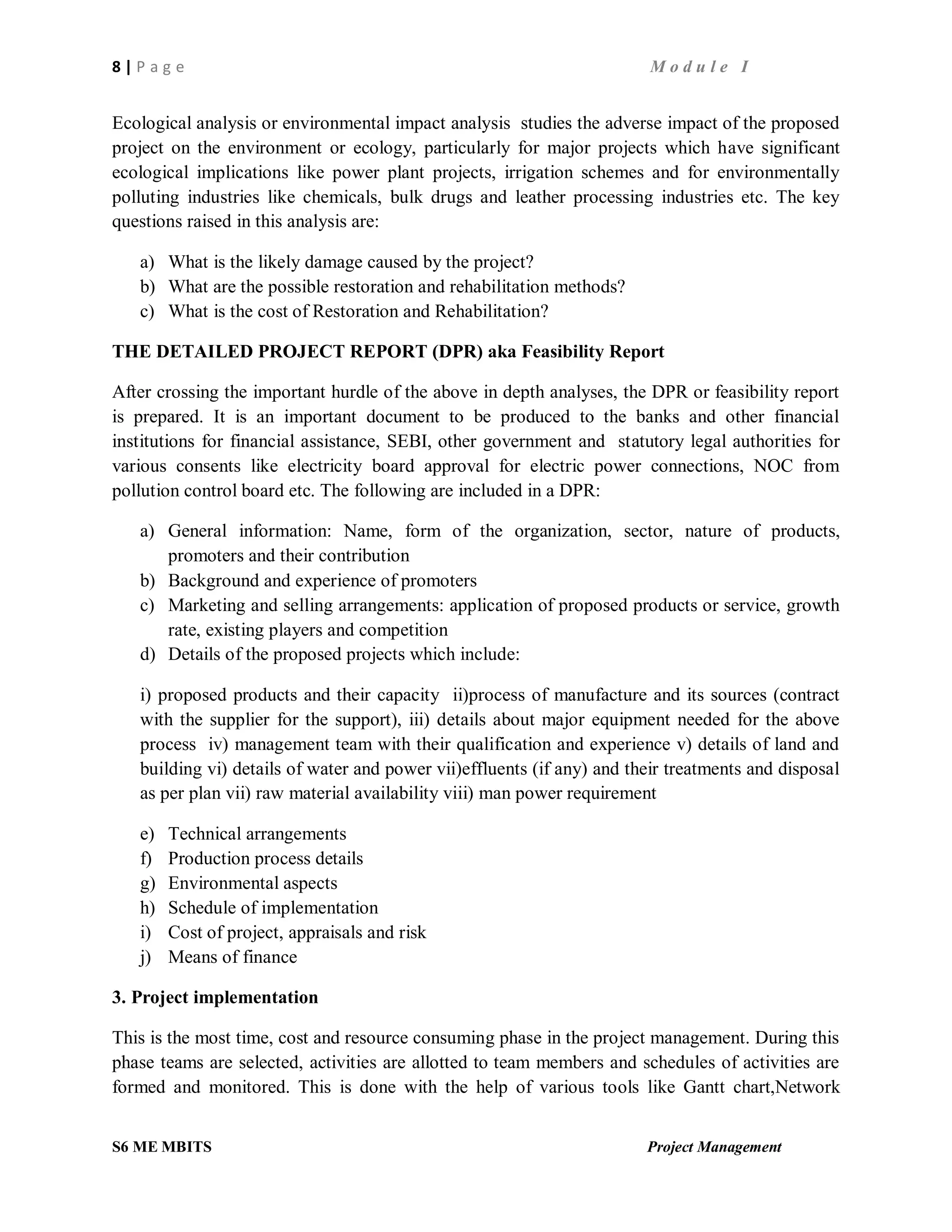
The Project Management process
The project management process consists of the following steps:
6 | P a g e M o d u l e I
S6 ME MBITS Project Management
1. Project identification and prima facie analysis
Identification is done mainly by closely examining the external situations (keeping eyes and ears
open) prevailing, listening to the customer voices, identifying gaps in fulfilling the customer
needs etc. The sources which serves the purpose will be journals , magazines, records, news
papers, market surveys, opinion polls, expert opinions, intuitions from veterans etc. Often the
prima facie analysis overlaps identification part (*pls write the below paragraph also even when
the question is about simply identification)
Prima facie analysis is done by means of comparing the performance of the existing industries,
price trends, price difference between international and domestic prices, government policies,
fiscal policies, monetary policies, location aspects , financial position etc. About 99% of the
ideas are rejected during prima facie analysis. Only those investment ideas which are screened
through the first phase will go for a detailed, in depth analysis called feasibility study
The two of the above may be some times stated as pre-feasibility study
2. Project preparation
The detailed, in depth analysis called feasibility study is performed to formulate the feasibility
report called the Detailed Project Report (DPR). The break up components of a feasibility study
will be:
1) Market and Demand Analysis
The following are studied during the market and demand feasibility:
7 | P a g e M o d u l e I
S6 ME MBITS Project Management
a) Demand- supply gap
b) Product life cycle and target market
c) Marketing channels
d) Competitors, their strengths and weakness
e) Present data, past data and the future data is forecasted
f) Modification of forecasts based on economic indicators
g) Demographic and geographic elements
h) Export potential
2) Technical Analysis
Technical feasibility is concerned with the assessment, selection and source (developed or
transferred) of technology , process, know-how, indigenization etc. Market and Technical
feasibility together determines the ideal location of the plant. Also the capacity planning, and
raw material selection are done during this phase.
3) Financial Feasibility
The procedural steps in financial analysis are:
a) Selection of the sources of funds
b) Estimation of the cost of the project as well as operating cost
c) Calculation of cost and benefits in terms of financial numbers
d) Assessment of tax implications
e) Financial workings like preparation of depreciation schedule, working capital schedule,
loan repayment schedule etc.
f) Preparation of cash flow statements, Profit and Loss (P&L) statements as well as balance
sheets.
g) Risk
h) Statistics of Financial viability (summary )
Most companies prefer interest cover ratio, Pay Back Period (PBP) and Net Present Value
(NPV), Internal rate of return (IRR) etc. for feasibility assessment. Riskiness of the project to be
presented in the project feasibility report by calculating break-even point and by carrying out
sensitivity analysis around critical success factors.
4) Social Cost Benefit Analysis (SCBA) aka Economic analysis (Socio Economic Analysis)
During this particular analysis, we try to determine the cost to the nation due to the proposed
project and compare with the benefits. This considers economic costs rather than accounting
costs. The benefits assessed will be the impact of the project on the income distribution, level of
savings and investments of the society, fulfillment of employment , self sufficiency etc.
5) Ecological Analysis
8 | P a g e M o d u l e I
S6 ME MBITS Project Management
Ecological analysis or environmental impact analysis studies the adverse impact of the proposed
project on the environment or ecology, particularly for major projects which have significant
ecological implications like power plant projects, irrigation schemes and for environmentally
polluting industries like chemicals, bulk drugs and leather processing industries etc. The key
questions raised in this analysis are:
a) What is the likely damage caused by the project?
b) What are the possible restoration and rehabilitation methods?
c) What is the cost of Restoration and Rehabilitation?
THE DETAILED PROJECT REPORT (DPR) aka Feasibility Report
After crossing the important hurdle of the above in depth analyses, the DPR or feasibility report
is prepared. It is an important document to be produced to the banks and other financial
institutions for financial assistance, SEBI, other government and statutory legal authorities for
various consents like electricity board approval for electric power connections, NOC from
pollution control board etc. The following are included in a DPR:
a) General information: Name, form of the organization, sector, nature of products,
promoters and their contribution
b) Background and experience of promoters
c) Marketing and selling arrangements: application of proposed products or service, growth
rate, existing players and competition
d) Details of the proposed projects which include:
i) proposed products and their capacity ii)process of manufacture and its sources (contract
with the supplier for the support), iii) details about major equipment needed for the above
process iv) management team with their qualification and experience v) details of land and
building vi) details of water and power vii)effluents (if any) and their treatments and disposal
as per plan vii) raw material availability viii) man power requirement
e) Technical arrangements
f) Production process details
g) Environmental aspects
h) Schedule of implementation
i) Cost of project, appraisals and risk
j) Means of finance
3. Project implementation
This is the most time, cost and resource consuming phase in the project management. During this
phase teams are selected, activities are allotted to team members and schedules of activities are
formed and monitored. This is done with the help of various tools like Gantt chart,Network
9 | P a g e M o d u l e I
S6 ME MBITS Project Management
diagrams and other monitoring tools. Infact many softwares have been developed for execution
and proper monitoring of the project. This phase is inclusive of making project and engineering
designs, Negotiations and contracting, construction, training and plant commissioning(
commissioning refers to the start up of the plant. Technically it is the most crucial stage).
4. Project Review
Refers to comparing the actual performance with projected performance. The review report is
helpful
i) for the operations management team for making corrective action ii) as a documented log for
future reference iii) in assessing the correctness of the assumptions made during various phases
iv) in uncovering the judgemental bias and induces a caution among project sponsors
Define the scope and objectives of Project management?
The scope lies in defining the boundaries of the project and the objectives are to yield superior
performance with respect to quality, cost and time making optimal use of the available resources
which are often scarce and costly
Define the importance of Project management?
The importance of project management arises out of the following key factors like rapidly
changing technologies, high entropy of the system, squeezed life cycle of products, globalization
impact as well as the increasing size of the organization. Project management is essential under
these scenarios to obtain the required objectives (as mentioned in the above question.pls write
objectives here also)
Capital Budgeting
Capital budgeting refers to the investment decision making procedures of business firms and
other enterprises. The capital budgeting consists of the following phases:
1. Planning (identification and assembly of investment proposals) – This phase is
concerned with the articulation of firms investment strategy, identification and
formulation of investment proposals, prima facie screening of the proposals and crucial
factors of the identified ideas which requires in-depth analysis.
2. Analysis- The detailed feasibility analysis asses the worthwhileness of different project
ideas with respect to Market and Demand Analysis, Technical Analysis, Financial and
Socio economic Analysis as well as Ecological Analysis
10 | P a g e M o d u l e I
S6 ME MBITS Project Management
3. Selection (Decision Making) - This phase follows and often overlaps the Analysis phase,
is useful in determining the financial viability (worthwhileness) of the various project
ideas. This financial appraisal phase includes discounting methods and non-discounting
methods. This includes currency gateway and executives blanket or non blanket
decisions.
4. Financing (Budgeting and appropriation) - This phase determines the Capital structure
(or the Debt-Equity ratio) for the selected project. Equity refers to the owner’s capital and
Debt refers to Debentures, long term loans, working capital advances etc. Flexibility,
Risk, Income, Control and Taxes (FRICT) are the factors which determine the capital
structure. This also checks the availability of funds and financial position of the
company.
5. Implementation- refers to making project and engineering designs, Negotiations and
contracting, construction, training and plant commissioning( Commissioning refers to the
start up of the plant. Technically it is the most crucial stage). For expeditious
implementation at reasonable cost the following are helpful:
i) Adequate formulation of projects ii) Use of the principle of responsibility Accounting
iii) Use of Network Techniques
6. Review- Refers to comparing the actual performance with projected performance. The
review report is helpful : i) for the operations management team for making corrective
action ii) as a documented log for future reference iii) in assessing the correctness of the
assumptions made during various phases iv) in uncovering the judgemental bias and
induces a caution among project sponsors
1 | P a g e M o d u l e II
S6 ME MBITS Project Management
COST OF THE PROJECT
Correct estimation of the cost of the project is essential since any underestimation may result in
shortage of funds which in turn brings the project into a halt. Any over estimate may be
detrimental to the interest of promoters and financing institutions.
The components of cost are:
1. Land: A key decision is whether to hire the land and building (especially for smaller
projects) . The extent of land required for a project can be estimated after deciding upon
the building plan.
2. Land development: It includes the cost of leveling the land, laying of internal roads, cost
of fencing, gates etc.
3. Building: It includes main factory buildings, auxiliary factory buildings, administrative
buildings, labs, godowns, overhead and underground water storage tanks , canteens,
restrooms, guest houses, staff quarters etc. The size of the main factory building depends
on the plant lay out.
4. Plant and Machinery: Local plant and machinery would be selected based on reputation,
past performance etc. and the cost involved will be basic price plus sales tax. Imported
machinery would have free on board (FOB) charges, shipping charges, import duty etc.
5. Electricals: The cost of electrical items include cost of cables, panel boards, voltage
stabilizers, transformers etc.
6. Transportation and erection charges: Transportation charges include cost of
transportation, loading and unloading charges, handling charges etc. Erection charges
include machinery foundation cost, machinery assembly and erection expenses.
7. Know- how or consultancy fees: a) Know-how fees to technical consultants b) expenses
of training employees in the production process.
8. Miscellaneous assets: These are the assets allied to the industrial activities but do not
form part of land and machinery. Examples are office equipments, fire fighting
equipments, water coolers, furniture, cash deposits with in the electricity board for
getting power connection, advances made to the lessor while leasing the building etc.
9. Provision for contingency: This is to include the deviations from the estimated cost. For
example the cost of the plant and machinery may rise during project implementation.
Usually 5%-15% of the cost of fixed assets (plant and machinery, electricals,
transportation and errection) is allowed as contingency cost.
10. Preliminary and pre-operative expenses: a) insurance premium on fixed assets(Usually a
given % of the cost of fixed assets like plant and machinery, electricals, transportation
and errection as wll as contingency cost is allowed as this cost.) b)interest or other
financial charges c) other start up expenses etc.
2 | P a g e M o d u l e II
S6 ME MBITS Project Management
11. Margin money for working capital: Margin money for working capital = (Total
working capital requirement) – (probable working capital loan that can be obtained from
the bank or other financing institutions)
The break up components are: cost of raw materials, rent, wages and salaries,administrative
and other overheads, power charges, sales cost, funds locked up in finished goods, repairs
and maintenance charge (RM cost is calculated as a given % of the plant and machinery
cost), debtors etc.
The working capital cycle is taken as 1 month unless otherwise specified and therefore all the
costs including RM costs should be calculated for 1 month under this head (11).
The fund required for setting up the project consists of investment on fixed assets while the
fund required for maintaining the operations of the plant consists of investment on working
capital. They are respectively called fixed assets and current assets.
Capital required for current assets( short term assets) is called working capital whereas the
capital required for fixed assets ( long term assets) is called fixed capital.
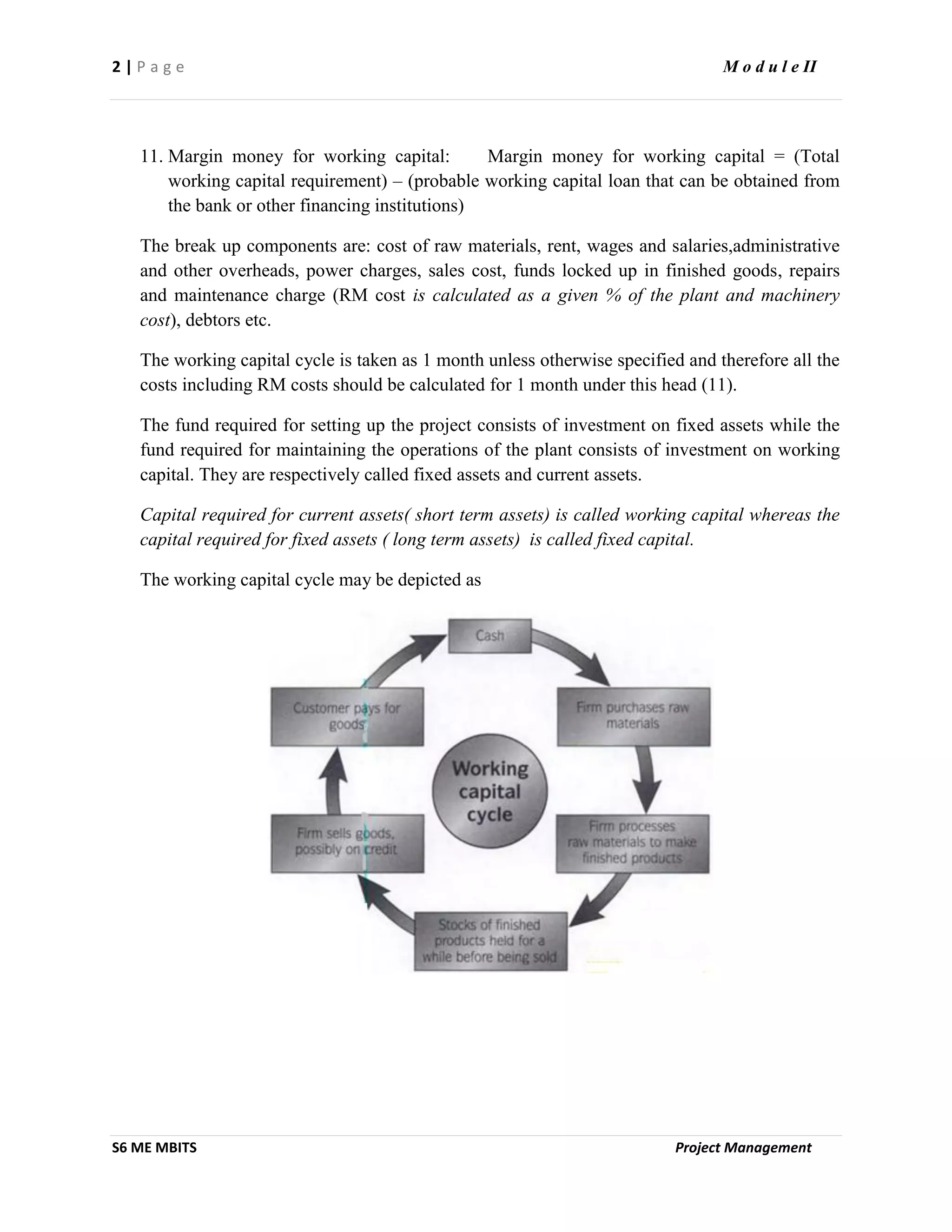
The working capital cycle may be depicted as
3 | P a g e M o d u l e II
S6 ME MBITS Project Management
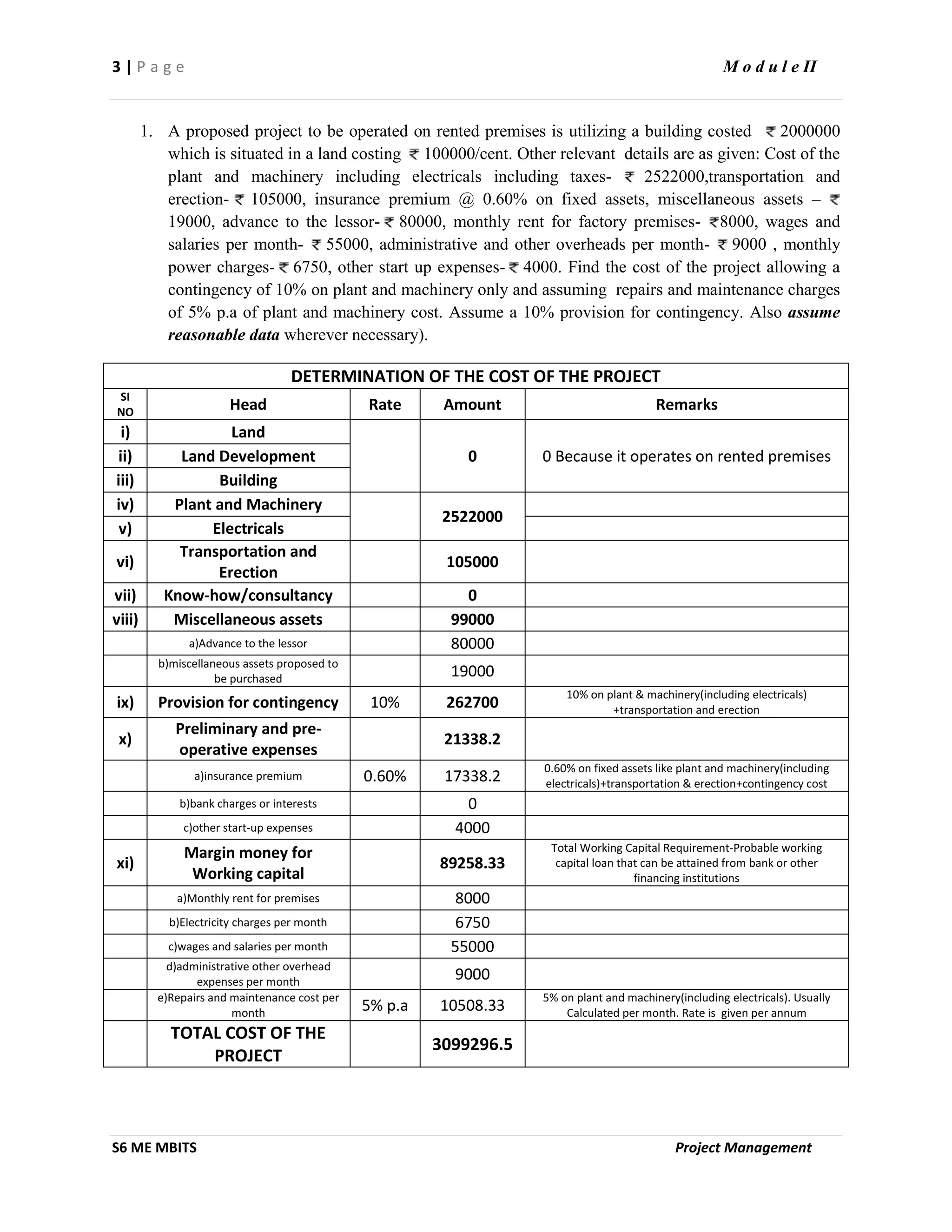
1. A proposed project to be operated on rented premises is utilizing a building costed 2000000
which is situated in a land costing 100000/cent. Other relevant details are as given: Cost of the
plant and machinery including electricals including taxes- 2522000,transportation and
erection- 105000, insurance premium @ 0.60% on fixed assets, miscellaneous assets –
19000, advance to the lessor- 80000, monthly rent for factory premises- 8000, wages and
salaries per month- 55000, administrative and other overheads per month- 9000 , monthly
power charges- 6750, other start up expenses- 4000. Find the cost of the project allowing a
contingency of 10% on plant and machinery only and assuming repairs and maintenance charges
of 5% p.a of plant and machinery cost. Assume a 10% provision for contingency. Also assume
reasonable data wherever necessary).
DETERMINATION OF THE COST OF THE PROJECT
SI
NO Head Rate Amount Remarks
i) Land
0 0 Because it operates on rented premisesii) Land Development
iii) Building
iv) Plant and Machinery
2522000
v) Electricals
vi)
Transportation and
Erection
105000
vii) Know-how/consultancy 0
viii) Miscellaneous assets 99000
a)Advance to the lessor 80000
b)miscellaneous assets proposed to
be purchased 19000
ix) Provision for contingency 10% 262700
10% on plant & machinery(including electricals)
+transportation and erection
x)
Preliminary and pre-
operative expenses
21338.2
a)insurance premium 0.60% 17338.2
0.60% on fixed assets like plant and machinery(including
electricals)+transportation & erection+contingency cost
b)bank charges or interests 0
c)other start-up expenses 4000
xi)
Margin money for
Working capital
89258.33
Total Working Capital Requirement-Probable working
capital loan that can be attained from bank or other
financing institutions
a)Monthly rent for premises 8000
b)Electricity charges per month 6750
c)wages and salaries per month 55000
d)administrative other overhead
expenses per month 9000
e)Repairs and maintenance cost per
month 5% p.a 10508.33
5% on plant and machinery(including electricals). Usually
Calculated per month. Rate is given per annum
TOTAL COST OF THE
PROJECT
3099296.5
4 | P a g e M o d u l e II
S6 ME MBITS Project Management
Time value of money
The ever changing value of money with respect to time is stated as time value of money. Money
has time value. A rupee today is more valuable than a rupee an year hence. There are several
reasons for time value of money like
i) Individuals in general prefer current consumption to future consumption
ii) Capital can be employed productively to generate positive returns.
iii) In an inflationary period, a rupee today represents a greater purchasing power than a rupee an
year hence.
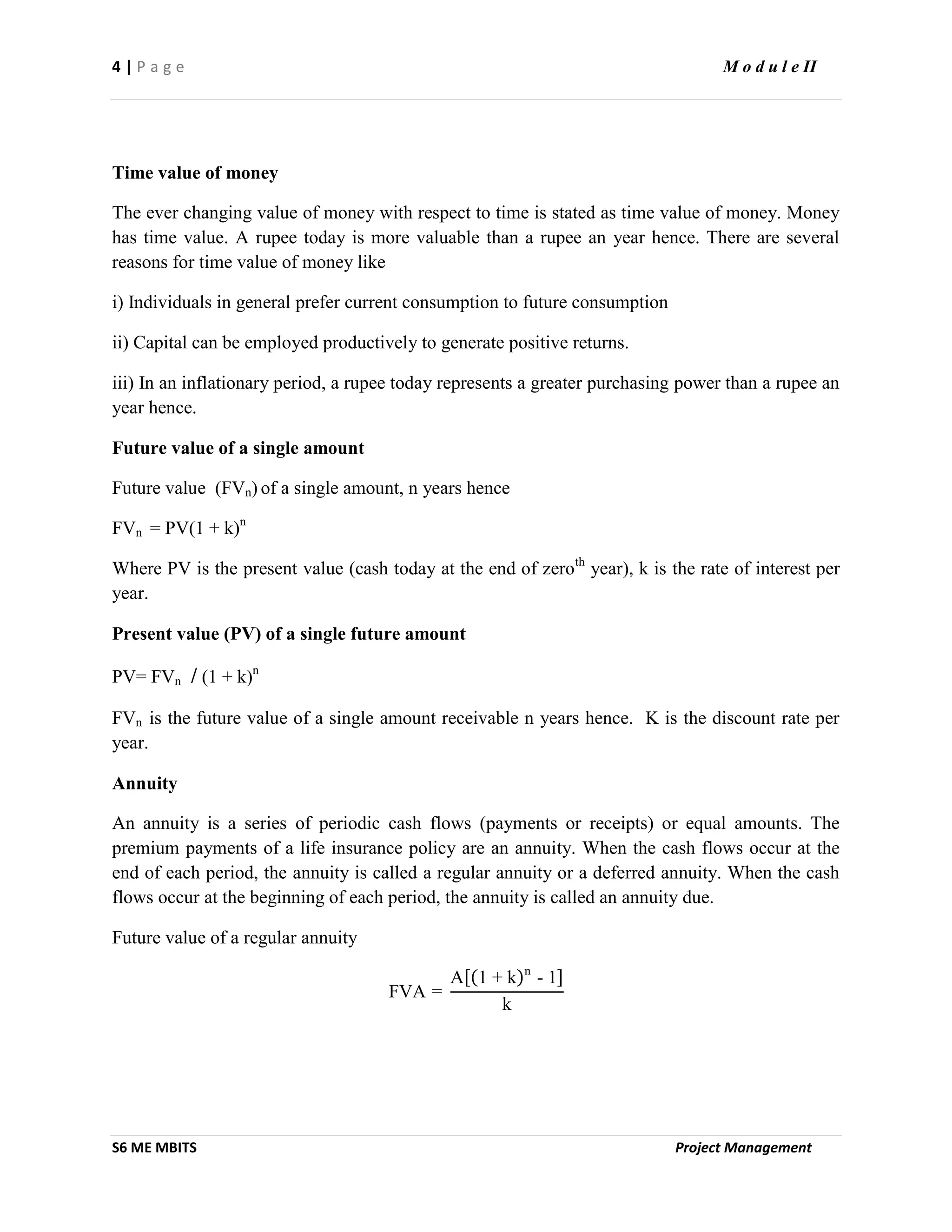
Future value of a single amount
Future value (FVn) of a single amount, n years hence
FVn = PV(1 + k)n
Where PV is the present value (cash today at the end of zeroth
year), k is the rate of interest per
year.
Present value (PV) of a single future amount
PV= FVn / (1 + k)n
FVn is the future value of a single amount receivable n years hence. K is the discount rate per
year.
Annuity
An annuity is a series of periodic cash flows (payments or receipts) or equal amounts. The
premium payments of a life insurance policy are an annuity. When the cash flows occur at the
end of each period, the annuity is called a regular annuity or a deferred annuity. When the cash
flows occur at the beginning of each period, the annuity is called an annuity due.
Future value of a regular annuity
FVA =
A 1 + k n
- 1
k
5 | P a g e M o d u l e II
S6 ME MBITS Project Management
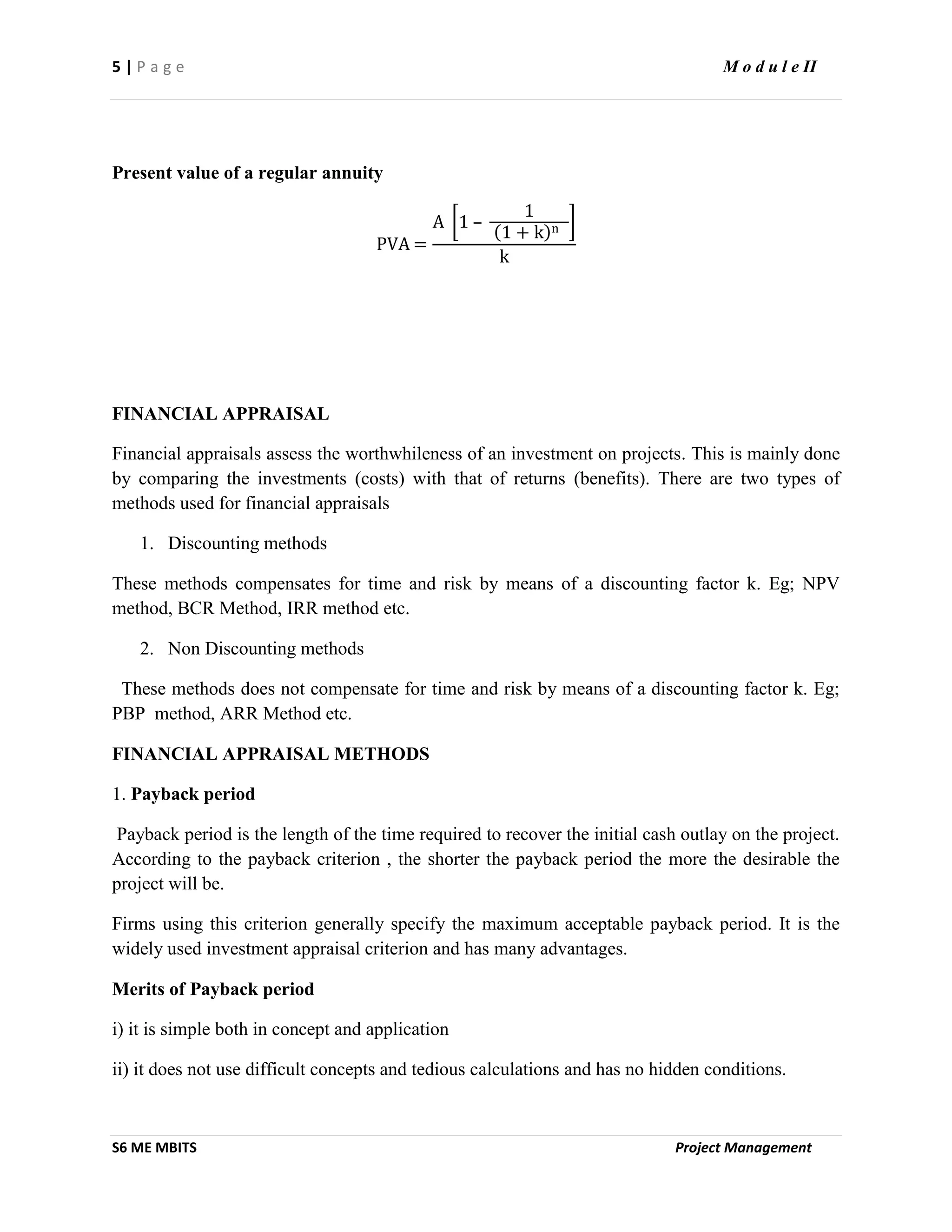
Present value of a regular annuity
PVA =
A 1 –
1
1 + k n
k
FINANCIAL APPRAISAL
Financial appraisals assess the worthwhileness of an investment on projects. This is mainly done
by comparing the investments (costs) with that of returns (benefits). There are two types of
methods used for financial appraisals
1. Discounting methods
These methods compensates for time and risk by means of a discounting factor k. Eg; NPV
method, BCR Method, IRR method etc.
2. Non Discounting methods
These methods does not compensate for time and risk by means of a discounting factor k. Eg;
PBP method, ARR Method etc.
FINANCIAL APPRAISAL METHODS
1. Payback period
Payback period is the length of the time required to recover the initial cash outlay on the project.
According to the payback criterion , the shorter the payback period the more the desirable the
project will be.
Firms using this criterion generally specify the maximum acceptable payback period. It is the
widely used investment appraisal criterion and has many advantages.
Merits of Payback period
i) it is simple both in concept and application
ii) it does not use difficult concepts and tedious calculations and has no hidden conditions.
6 | P a g e M o d u l e II
S6 ME MBITS Project Management
iii) since it emphasizes cash inflows, it may be a sensible criterion when the firm is pressed with
the problem of liquidity.
Demerits of Payback period
i) it fails to consider the time value of money
ii) cash inflows in the payback calculations are added with out discounting
iii) it ignores cash inflows after the payback period, which leads to discrimination against
projects which generate substantial cash inflows during later years.
iv) it is a measure of projects capital recovery, not profitability.
v) though it measures a projects liquidity, it fails to indicate the liquidity position of the firm as a
whole, which is more important.
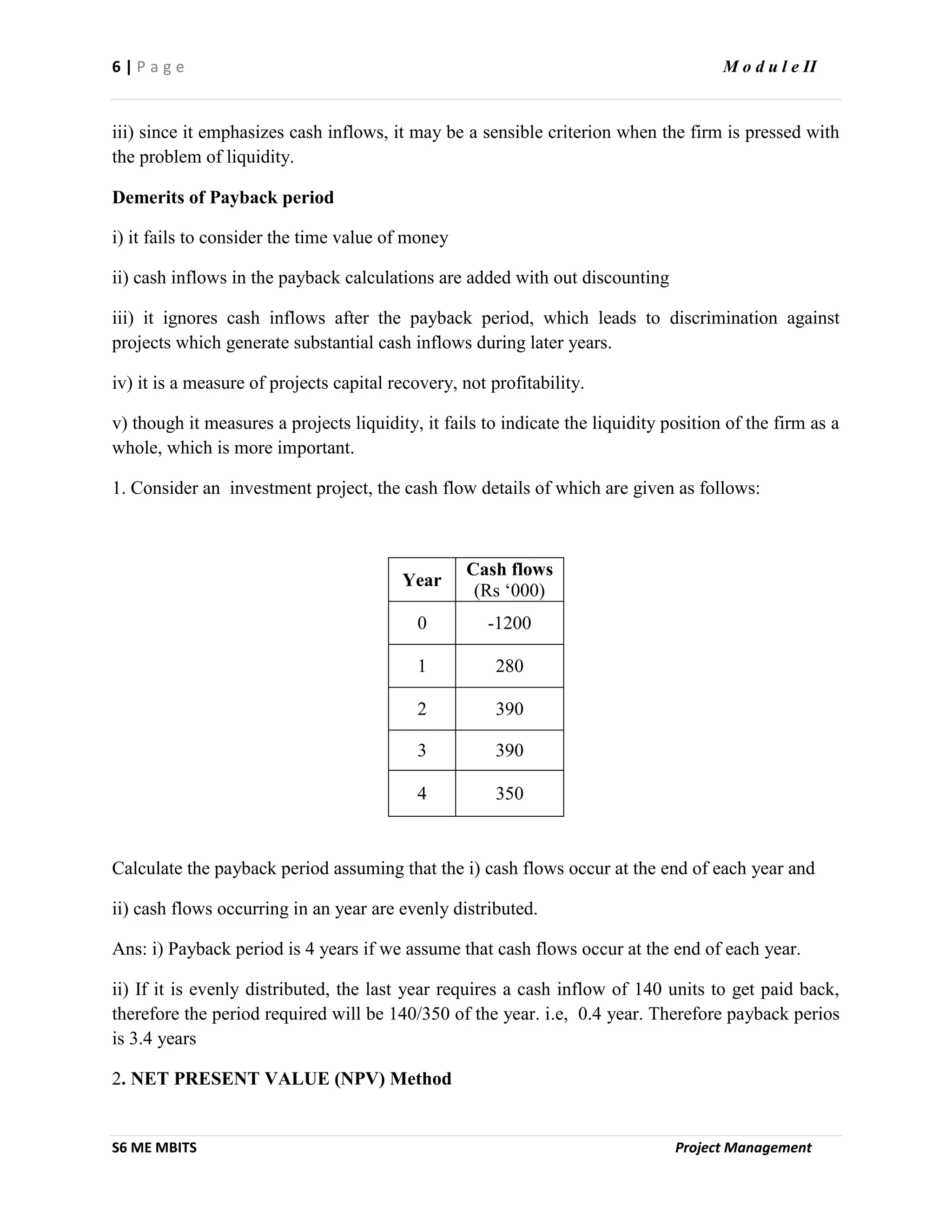
1. Consider an investment project, the cash flow details of which are given as follows:
Year
Cash flows
(Rs ‘000)
0 -1200
1 280
2 390
3 390
4 350
Calculate the payback period assuming that the i) cash flows occur at the end of each year and
ii) cash flows occurring in an year are evenly distributed.
Ans: i) Payback period is 4 years if we assume that cash flows occur at the end of each year.
ii) If it is evenly distributed, the last year requires a cash inflow of 140 units to get paid back,
therefore the period required will be 140/350 of the year. i.e, 0.4 year. Therefore payback perios
is 3.4 years
2. NET PRESENT VALUE (NPV) Method
7 | P a g e M o d u l e II
S6 ME MBITS Project Management
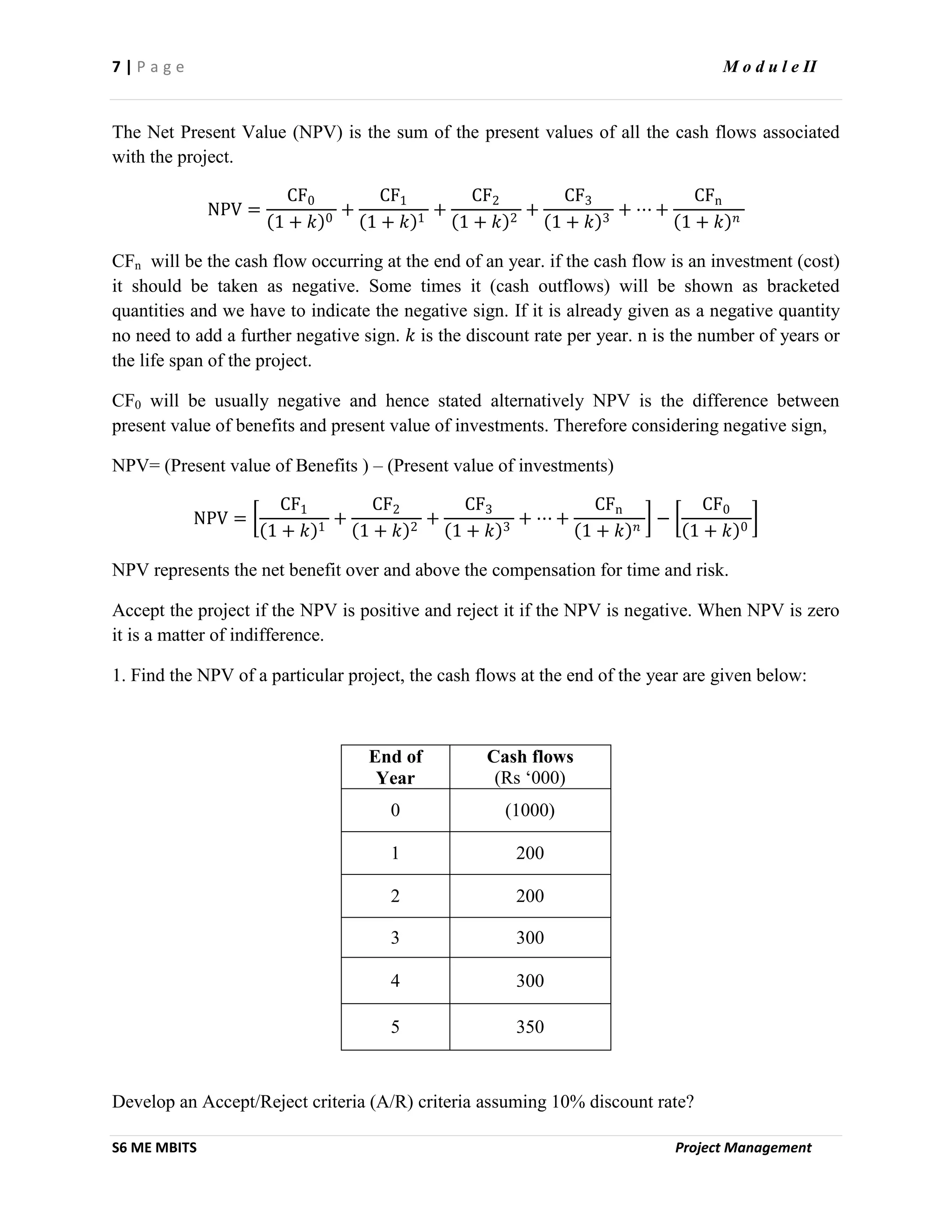
The Net Present Value (NPV) is the sum of the present values of all the cash flows associated
with the project.
NPV =
CF0
1 + 𝑘 0
+
CF1
1 + 𝑘 1
+
CF2
1 + 𝑘 2
+
CF3
1 + 𝑘 3
+ ⋯ +
CFn
1 + 𝑘 𝑛
CFn will be the cash flow occurring at the end of an year. if the cash flow is an investment (cost)
it should be taken as negative. Some times it (cash outflows) will be shown as bracketed
quantities and we have to indicate the negative sign. If it is already given as a negative quantity
no need to add a further negative sign. 𝑘 is the discount rate per year. n is the number of years or
the life span of the project.
CF0 will be usually negative and hence stated alternatively NPV is the difference between
present value of benefits and present value of investments. Therefore considering negative sign,
NPV= (Present value of Benefits ) – (Present value of investments)
NPV =
CF1
1 + 𝑘 1
+
CF2
1 + 𝑘 2
+
CF3
1 + 𝑘 3
+ ⋯ +
CFn
1 + 𝑘 𝑛
−
CF0
1 + 𝑘 0
NPV represents the net benefit over and above the compensation for time and risk.
Accept the project if the NPV is positive and reject it if the NPV is negative. When NPV is zero
it is a matter of indifference.
1. Find the NPV of a particular project, the cash flows at the end of the year are given below:
End of
Year
Cash flows
(Rs ‘000)
0 (1000)
1 200
2 200
3 300
4 300
5 350
Develop an Accept/Reject criteria (A/R) criteria assuming 10% discount rate?
8 | P a g e M o d u l e II
S6 ME MBITS Project Management
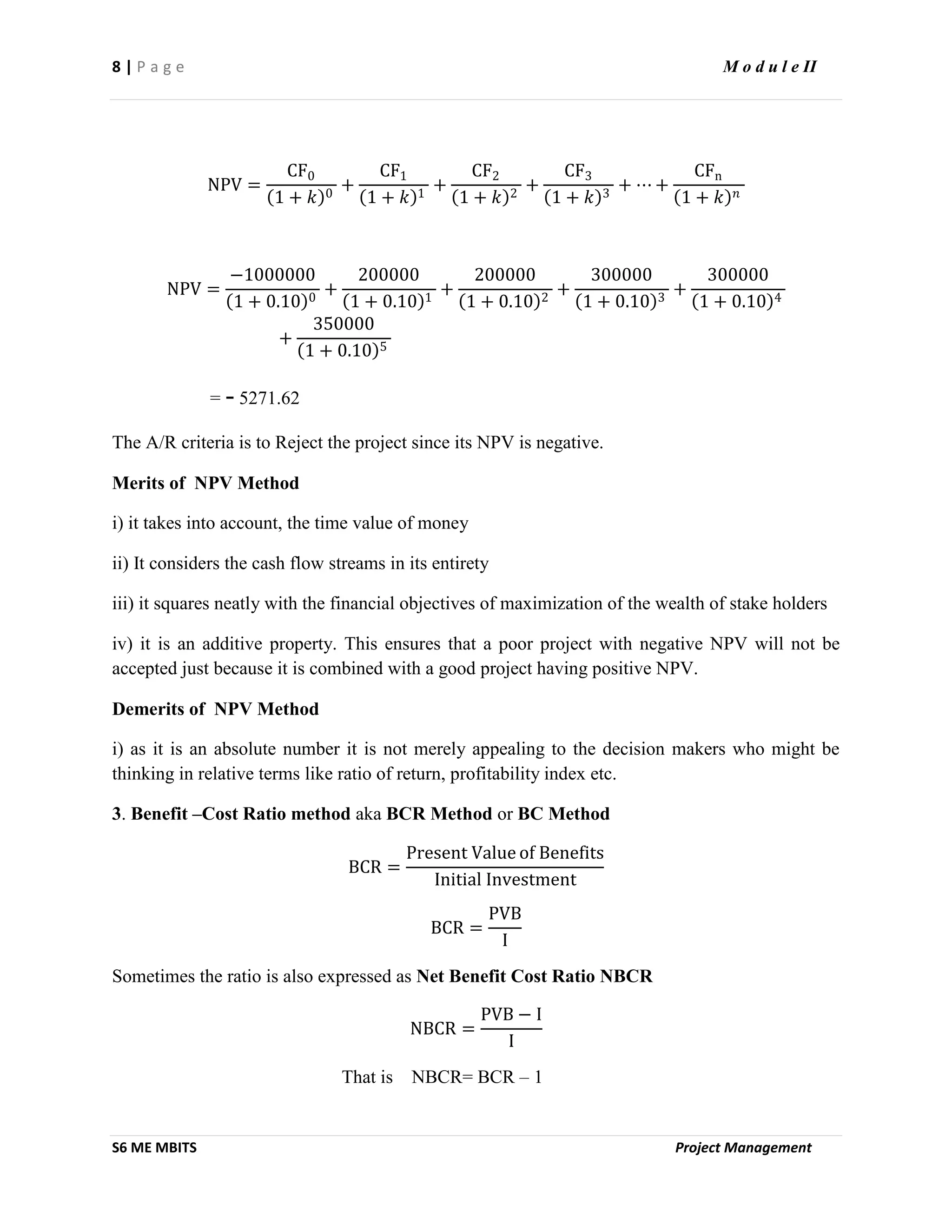
NPV =
CF0
1 + 𝑘 0
+
CF1
1 + 𝑘 1
+
CF2
1 + 𝑘 2
+
CF3
1 + 𝑘 3
+ ⋯ +
CFn
1 + 𝑘 𝑛
NPV =
−1000000
1 + 0.10 0
+
200000
1 + 0.10 1
+
200000
1 + 0.10 2
+
300000
1 + 0.10 3
+
300000
1 + 0.10 4
+
350000
1 + 0.10 5
= - 5271.62
The A/R criteria is to Reject the project since its NPV is negative.
Merits of NPV Method
i) it takes into account, the time value of money
ii) It considers the cash flow streams in its entirety
iii) it squares neatly with the financial objectives of maximization of the wealth of stake holders
iv) it is an additive property. This ensures that a poor project with negative NPV will not be
accepted just because it is combined with a good project having positive NPV.
Demerits of NPV Method
i) as it is an absolute number it is not merely appealing to the decision makers who might be
thinking in relative terms like ratio of return, profitability index etc.
3. Benefit –Cost Ratio method aka BCR Method or BC Method
BCR =
Present Value of Benefits
Initial Investment
BCR =
PVB
I
Sometimes the ratio is also expressed as Net Benefit Cost Ratio NBCR
NBCR =
PVB − I
I
That is NBCR= BCR – 1
9 | P a g e M o d u l e II
S6 ME MBITS Project Management
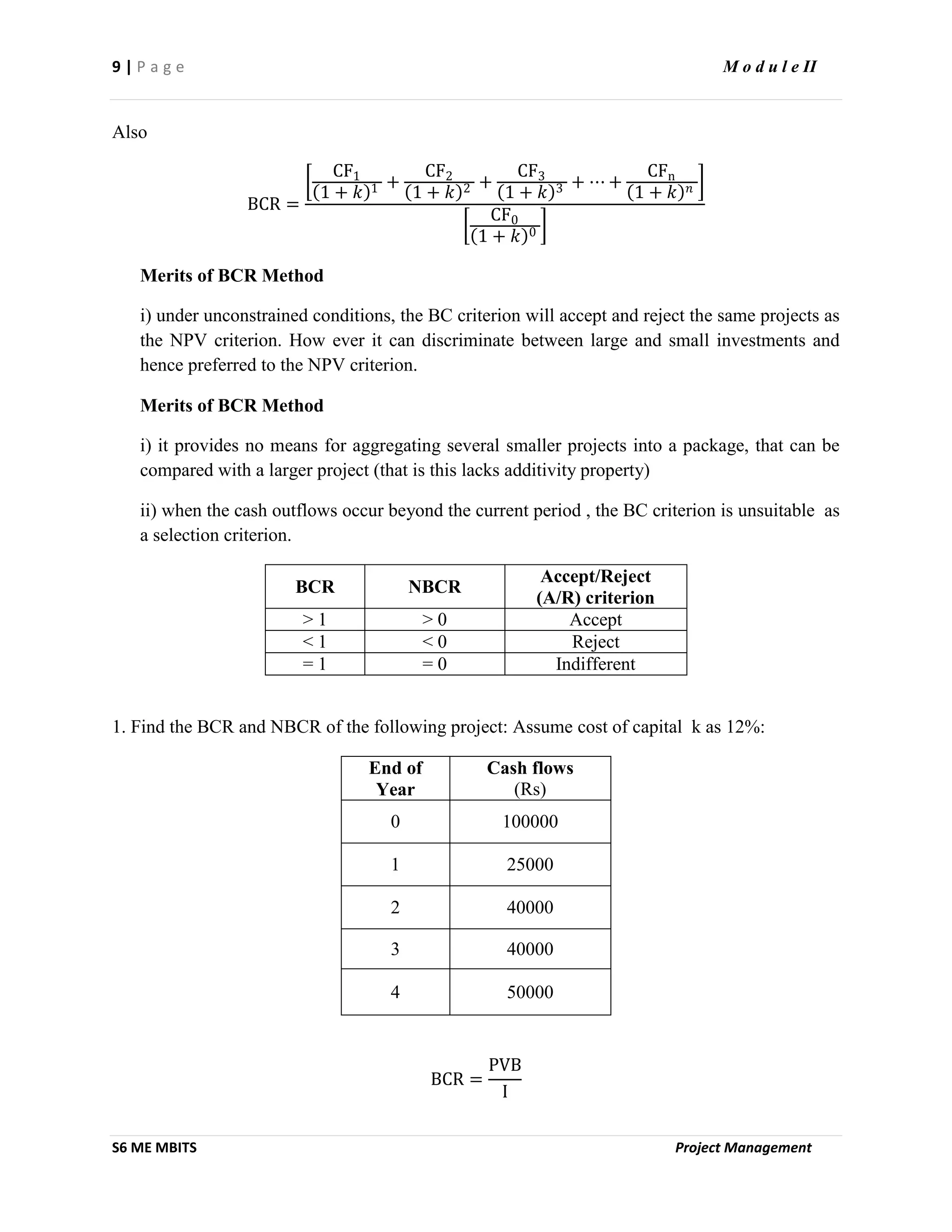
Also
BCR =
CF1
1 + 𝑘 1 +
CF2
1 + 𝑘 2 +
CF3
1 + 𝑘 3 + ⋯ +
CFn
1 + 𝑘 𝑛
CF0
1 + 𝑘 0
Merits of BCR Method
i) under unconstrained conditions, the BC criterion will accept and reject the same projects as
the NPV criterion. How ever it can discriminate between large and small investments and
hence preferred to the NPV criterion.
Merits of BCR Method
i) it provides no means for aggregating several smaller projects into a package, that can be
compared with a larger project (that is this lacks additivity property)
ii) when the cash outflows occur beyond the current period , the BC criterion is unsuitable as
a selection criterion.
BCR NBCR
Accept/Reject
(A/R) criterion
> 1 > 0 Accept
< 1 < 0 Reject
= 1 = 0 Indifferent
1. Find the BCR and NBCR of the following project: Assume cost of capital k as 12%:
End of
Year
Cash flows
(Rs)
0 100000
1 25000
2 40000
3 40000
4 50000
BCR =
PVB
I
10 | P a g e M o d u l e II
S6 ME MBITS Project Management
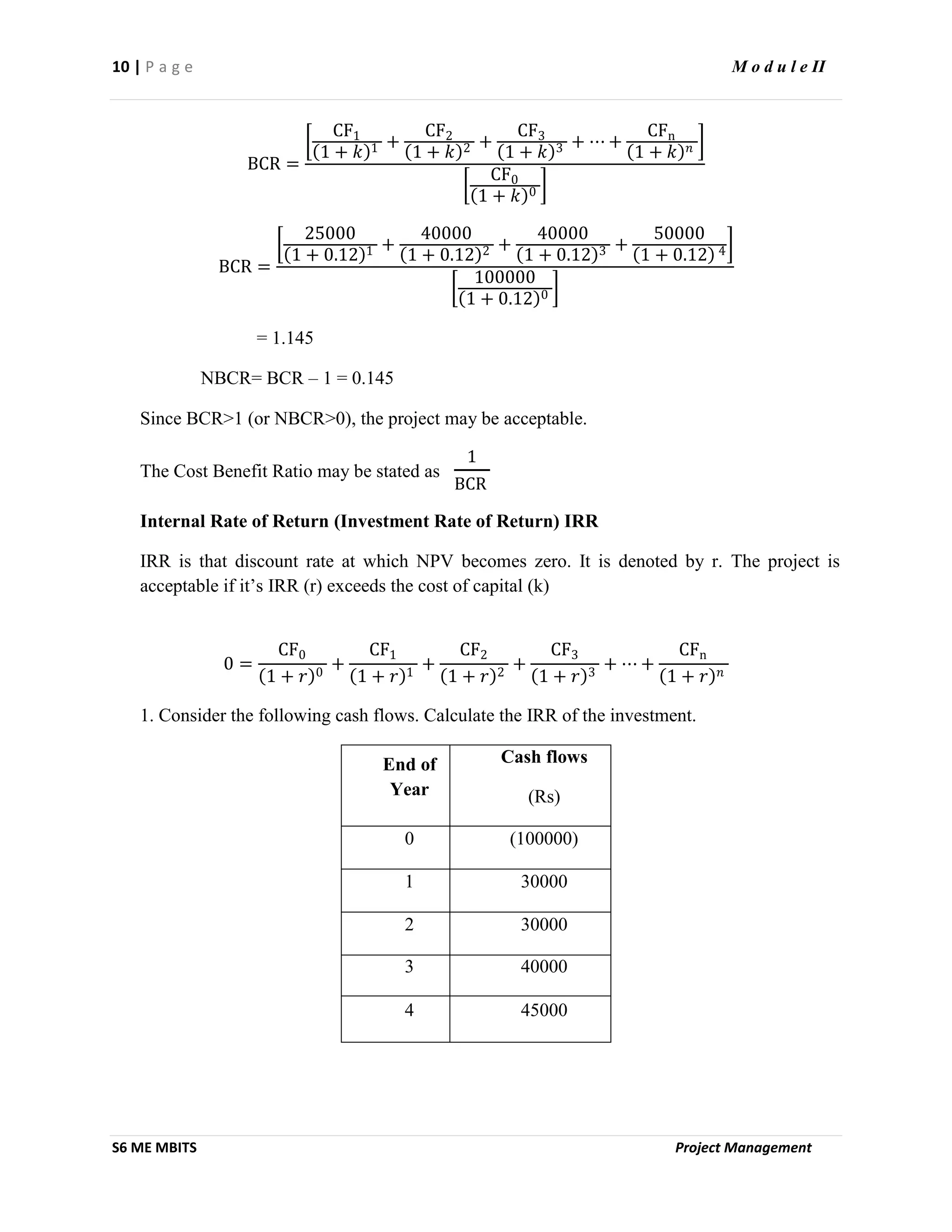
BCR =
CF1
1 + 𝑘 1 +
CF2
1 + 𝑘 2 +
CF3
1 + 𝑘 3 + ⋯ +
CFn
1 + 𝑘 𝑛
CF0
1 + 𝑘 0
BCR =
25000
1 + 0.12 1 +
40000
1 + 0.12 2 +
40000
1 + 0.12 3 +
50000
1 + 0.12 4
100000
1 + 0.12 0
= 1.145
NBCR= BCR – 1 = 0.145
Since BCR>1 (or NBCR>0), the project may be acceptable.
The Cost Benefit Ratio may be stated as
1
BCR
Internal Rate of Return (Investment Rate of Return) IRR
IRR is that discount rate at which NPV becomes zero. It is denoted by r. The project is
acceptable if it’s IRR (r) exceeds the cost of capital (k)
0 =
CF0
1 + 𝑟 0
+
CF1
1 + 𝑟 1
+
CF2
1 + 𝑟 2
+
CF3
1 + 𝑟 3
+ ⋯ +
CFn
1 + 𝑟 𝑛
1. Consider the following cash flows. Calculate the IRR of the investment.
End of
Year
Cash flows
(Rs)
0 (100000)
1 30000
2 30000
3 40000
4 45000
11 | P a g e M o d u l e II
S6 ME MBITS Project Management
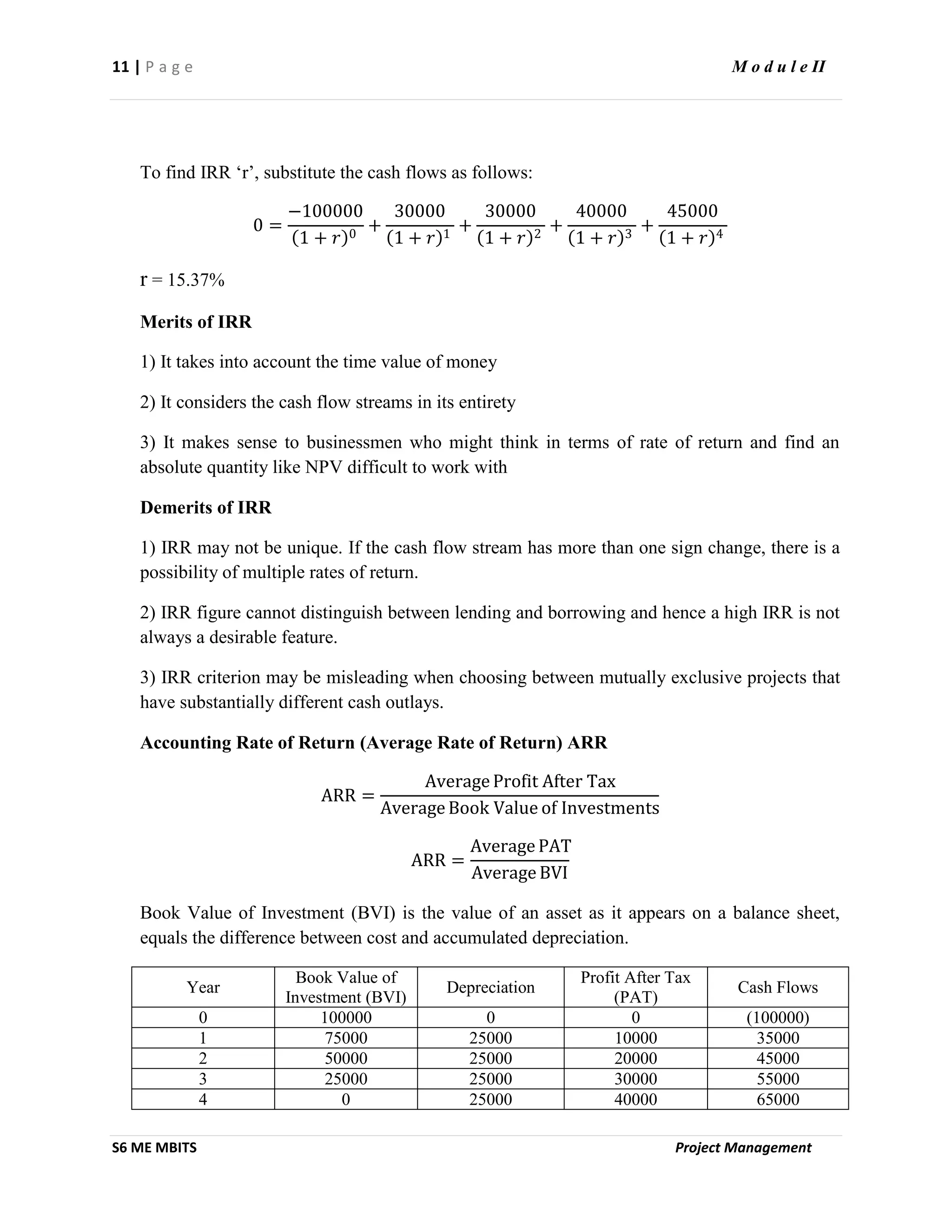
To find IRR ‘r’, substitute the cash flows as follows:
0 =
−100000
1 + 𝑟 0
+
30000
1 + 𝑟 1
+
30000
1 + 𝑟 2
+
40000
1 + 𝑟 3
+
45000
1 + 𝑟 4
r = 15.37%
Merits of IRR
1) It takes into account the time value of money
2) It considers the cash flow streams in its entirety
3) It makes sense to businessmen who might think in terms of rate of return and find an
absolute quantity like NPV difficult to work with
Demerits of IRR
1) IRR may not be unique. If the cash flow stream has more than one sign change, there is a
possibility of multiple rates of return.
2) IRR figure cannot distinguish between lending and borrowing and hence a high IRR is not
always a desirable feature.
3) IRR criterion may be misleading when choosing between mutually exclusive projects that
have substantially different cash outlays.
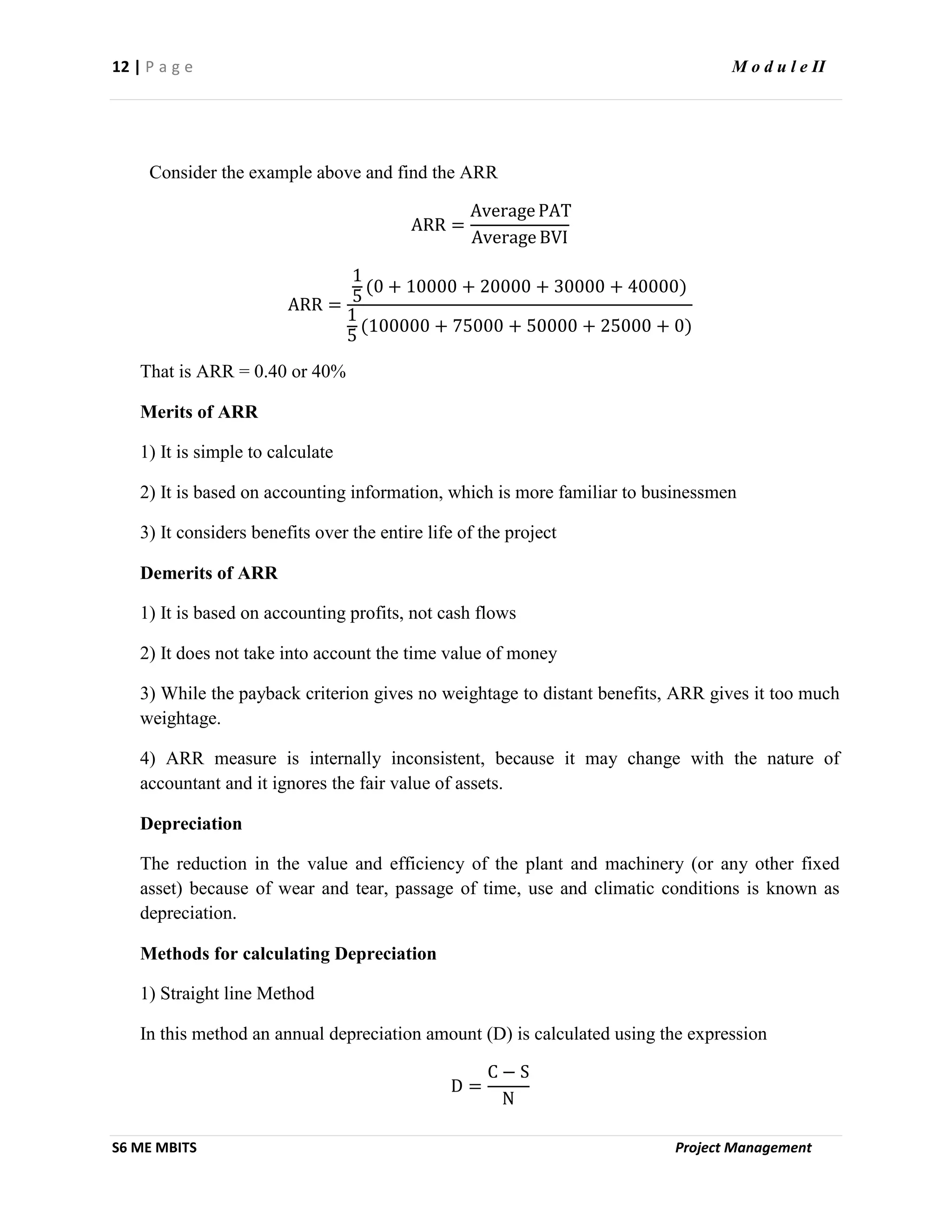
Accounting Rate of Return (Average Rate of Return) ARR
ARR =
Average Profit After Tax
Average Book Value of Investments
ARR =
Average PAT
Average BVI
Book Value of Investment (BVI) is the value of an asset as it appears on a balance sheet,
equals the difference between cost and accumulated depreciation.
Year
Book Value of
Investment (BVI)
Depreciation
Profit After Tax
(PAT)
Cash Flows
0 100000 0 0 (100000)
1 75000 25000 10000 35000
2 50000 25000 20000 45000
3 25000 25000 30000 55000
4 0 25000 40000 65000
12 | P a g e M o d u l e II
S6 ME MBITS Project Management
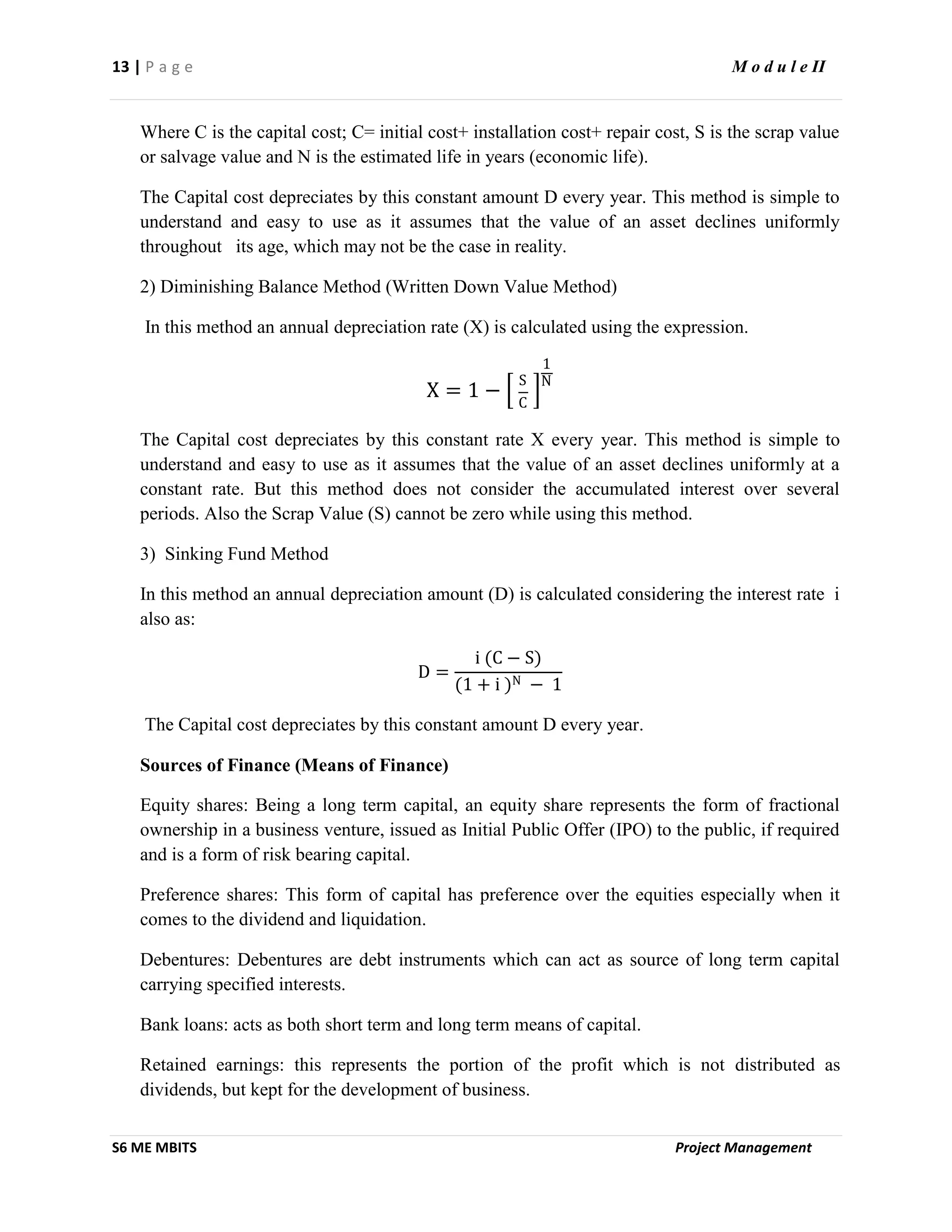
Consider the example above and find the ARR
ARR =
Average PAT
Average BVI
ARR =
1
5
(0 + 10000 + 20000 + 30000 + 40000)
1
5
(100000 + 75000 + 50000 + 25000 + 0)
That is ARR = 0.40 or 40%
Merits of ARR
1) It is simple to calculate
2) It is based on accounting information, which is more familiar to businessmen
3) It considers benefits over the entire life of the project
Demerits of ARR
1) It is based on accounting profits, not cash flows
2) It does not take into account the time value of money
3) While the payback criterion gives no weightage to distant benefits, ARR gives it too much
weightage.
4) ARR measure is internally inconsistent, because it may change with the nature of
accountant and it ignores the fair value of assets.
Depreciation
The reduction in the value and efficiency of the plant and machinery (or any other fixed
asset) because of wear and tear, passage of time, use and climatic conditions is known as
depreciation.
Methods for calculating Depreciation
1) Straight line Method
In this method an annual depreciation amount (D) is calculated using the expression
D =
C − S
N
13 | P a g e M o d u l e II
S6 ME MBITS Project Management
Where C is the capital cost; C= initial cost+ installation cost+ repair cost, S is the scrap value
or salvage value and N is the estimated life in years (economic life).
The Capital cost depreciates by this constant amount D every year. This method is simple to
understand and easy to use as it assumes that the value of an asset declines uniformly
throughout its age, which may not be the case in reality.
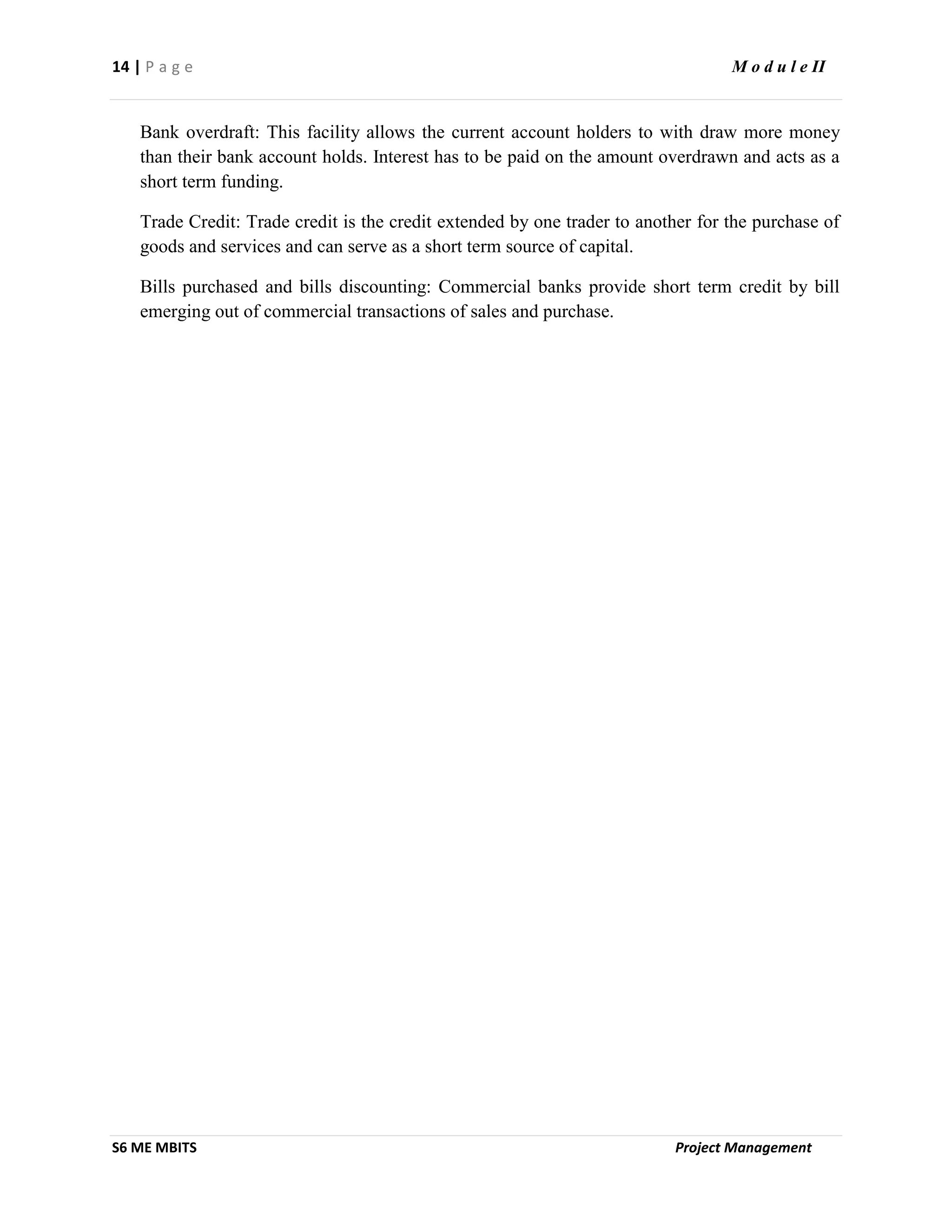
2) Diminishing Balance Method (Written Down Value Method)
In this method an annual depreciation rate (X) is calculated using the expression.
X = 1 −
S
C
1
N
The Capital cost depreciates by this constant rate X every year. This method is simple to
understand and easy to use as it assumes that the value of an asset declines uniformly at a
constant rate. But this method does not consider the accumulated interest over several
periods. Also the Scrap Value (S) cannot be zero while using this method.
3) Sinking Fund Method
In this method an annual depreciation amount (D) is calculated considering the interest rate i
also as:
D =
i (C − S)
(1 + i )N − 1
The Capital cost depreciates by this constant amount D every year.
Sources of Finance (Means of Finance)
Equity shares: Being a long term capital, an equity share represents the form of fractional
ownership in a business venture, issued as Initial Public Offer (IPO) to the public, if required
and is a form of risk bearing capital.
Preference shares: This form of capital has preference over the equities especially when it
comes to the dividend and liquidation.
Debentures: Debentures are debt instruments which can act as source of long term capital
carrying specified interests.
Bank loans: acts as both short term and long term means of capital.
Retained earnings: this represents the portion of the profit which is not distributed as
dividends, but kept for the development of business.
14 | P a g e M o d u l e II
S6 ME MBITS Project Management
Bank overdraft: This facility allows the current account holders to with draw more money
than their bank account holds. Interest has to be paid on the amount overdrawn and acts as a
short term funding.
Trade Credit: Trade credit is the credit extended by one trader to another for the purchase of
goods and services and can serve as a short term source of capital.
Bills purchased and bills discounting: Commercial banks provide short term credit by bill
emerging out of commercial transactions of sales and purchase.
1 | P a g e M o d u l e III
S6 ME MBITS Project Management
RISK
Risk is the variability in the actual returns in relation to the estimated returns
Sources of Risk
Project specific Risk: The earnings and cash flows of the project may be lower than expected because of
estimation error or some factors specific to the project like the quality of the management.
Competitive Risk: The earnings and cash flows of the project may be lower than expected due to the
unanticipated actions of the competitors.
Industry Specific Risk: The earnings and cash flows of the project may be lower than expected because of
the unexpected technological developments and regulatory changes that are specific to the industry the
project belongs to.
Market Risk: The earnings and cash flows of the project may be lower than expected due to the
unanticipated changes in macroeconomic factors like GDP growth rate, interest rate and inflation.
International Risk: In the case of a foreign project, the earnings and cash flows of the project may be
lower than expected due to exchange rate or political risk.
Perspectives on Risk
Perspectives means viewing the project from at least three angles
Standalone risk: This represents the risk of a project when it is viewed in isolation (Point of view of
Project manager).
Firm Risk: Also known as corporate risk, represents the contribution of a project to the risk of the firm
(Point of view of an undiversified investor).
Market Risk: Also known as Systematic Risk represents the risk of a project from the point of view of a
diversified investor.
Importance of Standalone Risk
Measuring a projects standalone Risk is easier than measuring its Corporate Risk and far easier than
measuring its Market Risk.
In most cases Standalone risk, Corporate Risk and Market Risk are highly correlated and therefore
measuring the first gives hints on the other two Risks.
The proponent of a capital investment is likely to be judged on that investment and hence this measure is
important.
In most firms, the capital budgeting committee considers investment proposals one at a time and so needs
this measure of standalone Risk.
2 | P a g e M o d u l e III
S6 ME MBITS Project Management
Importance of Corporate Risk
Undiversified investors (promoters) are more concerned about Corporate Risk than Market Risk.
Even Diversified investors (Retail investors) are interested in this Risk because it has a bearing on the
earnings and obviously the required returns.
The stability of the firms cash flows are valued by managers, suppliers, creditors, customers and the
community in which the firm operates and they take this measure as a criterion for joining hands with the
firm.
Importance of Market Risk
The ultimate aim of the project and the company is to maximize the shareholders wealth and therefore
this measure of Risk is very important.
Measurement of Risk
Sensitivity Analysis, Simulation, Standard deviation and Hillier Model are absolute measures of Risk,
whereas the coefficient of variation is a relative measure.
i) Sensitivity Analysis
Sensitivity analysis provides information as to how sensitive the various estimated project parameters
namely Cash Flows, Cost of capital and projects economic life are to estimation errors. In most cases the
variation in NPV are found out for the three different situations like best, most likely and worst.
Period (EOY)
Cash Flows (INR Lakhs)
[Project X]
Cash Flows (INR Lakhs)
[Project Y]
Worst
Most
Likely
Best Worst Most Likely Best
0 40000 40000 40000 40000 40000 40000
1 6000 8000 10000 0 8000 16000
2 6000 8000 10000 0 8000 16000
3 6000 8000 10000 0 8000 16000
Rate 0.10 0.10
Economic life
(Years)
3 3
Sensitivity Analysis performed on the above yields an outcome which is summarized in the following
table:
Period (EOY)
Cash Flows (INR Lakhs)
[Project X]
Cash Flows (INR Lakhs)
[Project Y]
Worst
Most
Likely
Best Worst Most Likely Best
0 40000 40000 40000 40000 40000 40000
1 6000 8000 10000 0 8000 16000
2 6000 8000 10000 0 8000 16000
3 6000 8000 10000 0 8000 16000
NPV
(INR Lakhs)
5636 20848 30060 (40000) 20848 81696
3 | P a g e M o d u l e III
S6 ME MBITS Project Management
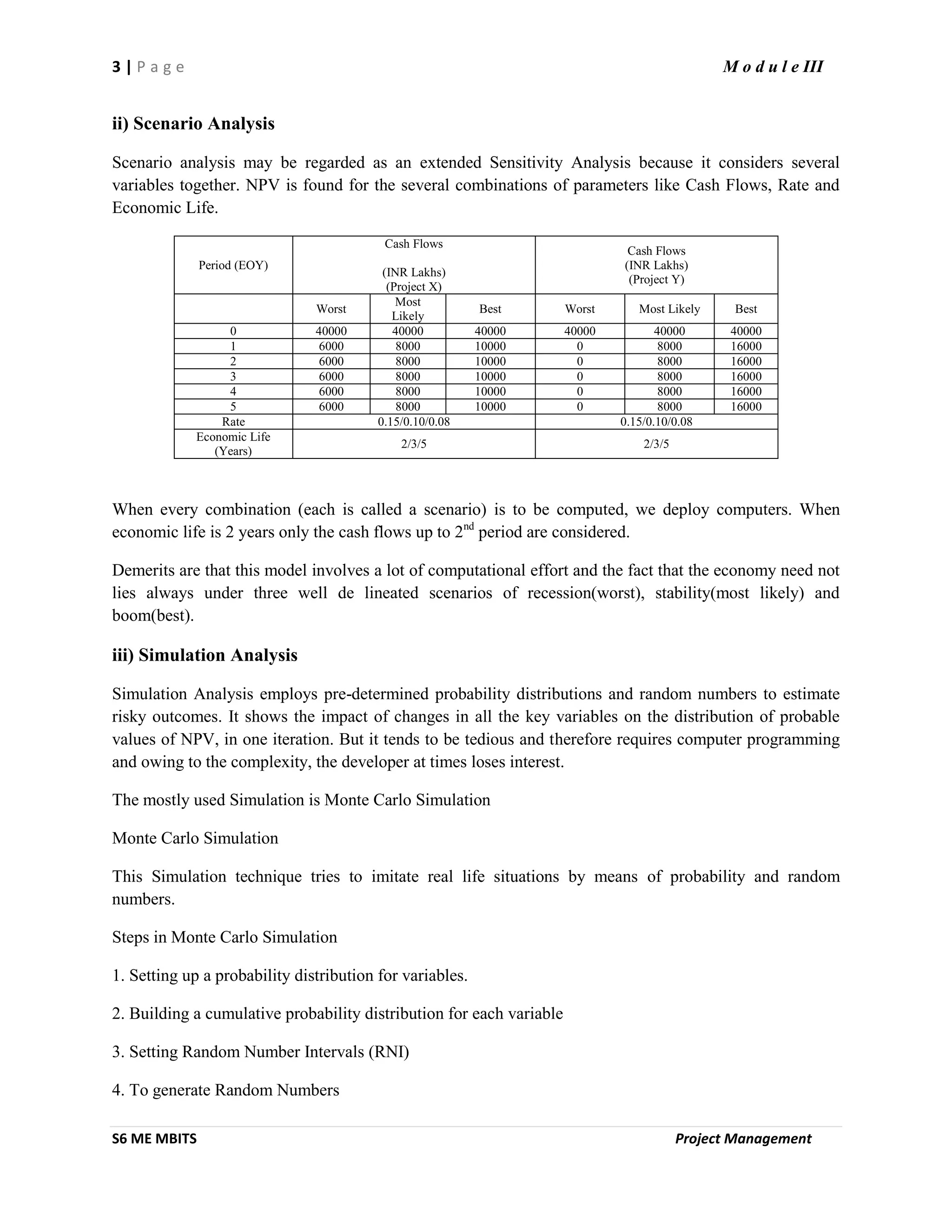
ii) Scenario Analysis
Scenario analysis may be regarded as an extended Sensitivity Analysis because it considers several
variables together. NPV is found for the several combinations of parameters like Cash Flows, Rate and
Economic Life.
Period (EOY)
Cash Flows
(INR Lakhs)
(Project X)
Cash Flows
(INR Lakhs)
(Project Y)
Worst
Most
Likely
Best Worst Most Likely Best
0 40000 40000 40000 40000 40000 40000
1 6000 8000 10000 0 8000 16000
2 6000 8000 10000 0 8000 16000
3 6000 8000 10000 0 8000 16000
4 6000 8000 10000 0 8000 16000
5 6000 8000 10000 0 8000 16000
Rate 0.15/0.10/0.08 0.15/0.10/0.08
Economic Life
(Years)
2/3/5 2/3/5
When every combination (each is called a scenario) is to be computed, we deploy computers. When
economic life is 2 years only the cash flows up to 2nd
period are considered.
Demerits are that this model involves a lot of computational effort and the fact that the economy need not
lies always under three well de lineated scenarios of recession(worst), stability(most likely) and
boom(best).
iii) Simulation Analysis
Simulation Analysis employs pre-determined probability distributions and random numbers to estimate
risky outcomes. It shows the impact of changes in all the key variables on the distribution of probable
values of NPV, in one iteration. But it tends to be tedious and therefore requires computer programming
and owing to the complexity, the developer at times loses interest.
The mostly used Simulation is Monte Carlo Simulation
Monte Carlo Simulation
This Simulation technique tries to imitate real life situations by means of probability and random
numbers.
Steps in Monte Carlo Simulation
1. Setting up a probability distribution for variables.
2. Building a cumulative probability distribution for each variable
3. Setting Random Number Intervals (RNI)
4. To generate Random Numbers
4 | P a g e M o d u l e III
S6 ME MBITS Project Management
5. Simulate the experiment by means of Random Sampling
Example 1: A Retailer deals in perishable items, the daily demand and supply of which are random
numbers, the past 500 days data shows the following:
Supply Demand
Available(kg) Number of days Available(kg) Number of days
10 40 10 50
20 50 20 110
30 190 30 200
40 150 40 100
50 70 50 40
The retailer buys the item at Rs. 20 per kg and sells the item at Rs. 30 per kg. If any of the commodity
remains at the end of the day, it has no sell value and is a dead loss. More over the loss on any unsatisfied
item is Rs. 8 per kg. Given the following random numbers: 31, 18, 63, 84, 15, 79, 07, 32, 43, 75, 81 and
27. Use the random numbers alternately to simulate supply and demand for six days sales.
Answer: Create RNI and Probability Distribution
Supply side Demand side
Supply
(kg)
Probability
Random
Number
Interval
(RNI)
Demand
(kg)
Probability
Random Number
Interval
(RNI)
10 0.08 00-07 10 0.10 00-09
20 0.10 08-17 20 0.22 10-31
30 0.38 18-55 30 0.40 32-71
40 0.30 56-85 40 0.20 72-91
50 0.14 86-99 50 0.08 92-99
Using Random numbers , simulate for six days: The Net profit is found to be +400 (see the table)
Day RN
Supply
(kg)
RN
Demand
(kg)
Cost
(Rs.)
Revenue
(Rs.)
Loss of
Unmet
Demand
(Rs.)
Profit
(Rs.)
1 31 30 18 20 600 600 - -
2 63 40 84 40 800 1200 - 400
3 15 20 79 40 400 600 160 40
4 07 10 32 30 200 300 160 -60
5 43 30 75 40 600 900 80 220
6 81 40 27 20 800 600 - -200
iv) The Hillier Model
The Hillier Model gives the NPV and the standard deviation of the NPV [𝜎(𝑁𝑃𝑉)] based on expected
cash flows under two different situations viz; perfectly correlated cash flows and uncorrelated cash flows.
5 | P a g e M o d u l e III
S6 ME MBITS Project Management
Response Uncorrelated cash flows Perfectly correlated cash flows
NPV
𝐶𝐹𝑡
1 + 𝑘 𝑡
𝑛
𝑡=1
− 𝐼
𝐶𝐹𝑡
1 + 𝑘 𝑡
𝑛
𝑡=1
− 𝐼
𝜎(𝑁𝑃𝑉)
𝜎𝑡
2
1 + 𝑘 2𝑡
𝑛
𝑡=1
𝜎𝑡
1 + 𝑘 𝑡
𝑛
𝑡=1
v) Standard Deviation
Standard Deviation𝜎 is the square root of the mean of the squared deviations; the deviation being the
difference between an outcome and the expected mean value of all outcomes. Note that only cash inflows
are considered for the calculations.
𝜎 = 𝑃1 (𝐶𝐹1 − 𝐶𝐹) 2 + 𝑃2(𝐶𝐹2 − 𝐶𝐹) 2 + ⋯ + 𝑃𝑛 (𝐶𝐹𝑛 − 𝐶𝐹) 2
Consider the following example:
Period
(EOY)
Cash Flows (INR Lakhs)
[Project X]
Probability
Cash Flows (INR Lakhs)
[Project Y]
Probability
0 (40000) (40000)
1 5636 0.25 40000 0.25
2 20848 0.50 20848 0.50
3 36060 0.25 1696 0.25
Rate 0.10 0.10
Economic
life (Years)
3 3
For the project X, the standard deviation is given by
𝜎 = 0.25(5636 − 20848) 2 + 0.50(20848 − 20848) 2 + 0.25(36060 − 20848) 2
= 12229.10
For the project Y, the standard deviation is given by
𝜎 = 0.25(40000 − 20848) 2 + 0.50(20848 − 20848) 2 + 0.25(1696 − 20848) 2
= 13542.51
Project Y is more risky as its standard deviation is higher when compared to Project X.
vi) Co-efficient of variation
6 | P a g e M o d u l e III
S6 ME MBITS Project Management
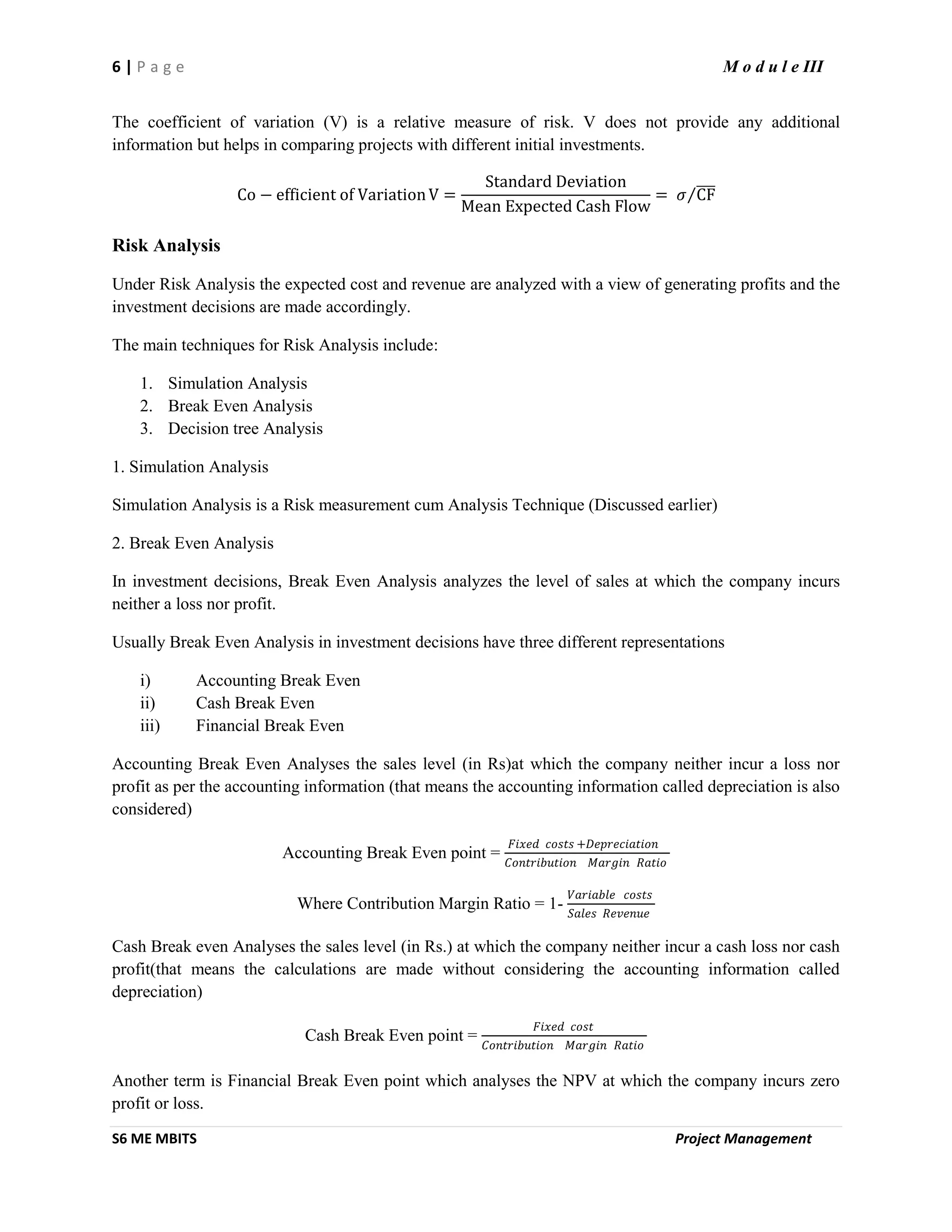
The coefficient of variation (V) is a relative measure of risk. V does not provide any additional
information but helps in comparing projects with different initial investments.
Co − efficient of VariationV =
Standard Deviation
Mean Expected Cash Flow
= 𝜎 CF
Risk Analysis
Under Risk Analysis the expected cost and revenue are analyzed with a view of generating profits and the
investment decisions are made accordingly.
The main techniques for Risk Analysis include:
1. Simulation Analysis
2. Break Even Analysis
3. Decision tree Analysis
1. Simulation Analysis
Simulation Analysis is a Risk measurement cum Analysis Technique (Discussed earlier)
2. Break Even Analysis
In investment decisions, Break Even Analysis analyzes the level of sales at which the company incurs
neither a loss nor profit.
Usually Break Even Analysis in investment decisions have three different representations
i) Accounting Break Even
ii) Cash Break Even
iii) Financial Break Even
Accounting Break Even Analyses the sales level (in Rs)at which the company neither incur a loss nor
profit as per the accounting information (that means the accounting information called depreciation is also
considered)
Accounting Break Even point =
𝐹𝑖𝑥𝑒𝑑 𝑐𝑜𝑠𝑡𝑠 +𝐷𝑒𝑝𝑟𝑒𝑐𝑖𝑎𝑡𝑖𝑜𝑛
𝐶𝑜𝑛𝑡𝑟𝑖𝑏𝑢𝑡𝑖𝑜𝑛 𝑀𝑎𝑟𝑔𝑖𝑛 𝑅𝑎𝑡𝑖𝑜
Where Contribution Margin Ratio = 1-
𝑉𝑎𝑟𝑖𝑎𝑏𝑙𝑒 𝑐𝑜𝑠𝑡𝑠
𝑆𝑎𝑙𝑒𝑠 𝑅𝑒𝑣𝑒𝑛𝑢𝑒
Cash Break even Analyses the sales level (in Rs.) at which the company neither incur a cash loss nor cash
profit(that means the calculations are made without considering the accounting information called
depreciation)
Cash Break Even point =
𝐹𝑖𝑥𝑒𝑑 𝑐𝑜𝑠𝑡
𝐶𝑜𝑛𝑡𝑟𝑖𝑏𝑢𝑡𝑖𝑜𝑛 𝑀𝑎𝑟𝑔𝑖𝑛 𝑅𝑎𝑡𝑖𝑜
Another term is Financial Break Even point which analyses the NPV at which the company incurs zero
profit or loss.
7 | P a g e M o d u l e III
S6 ME MBITS Project Management
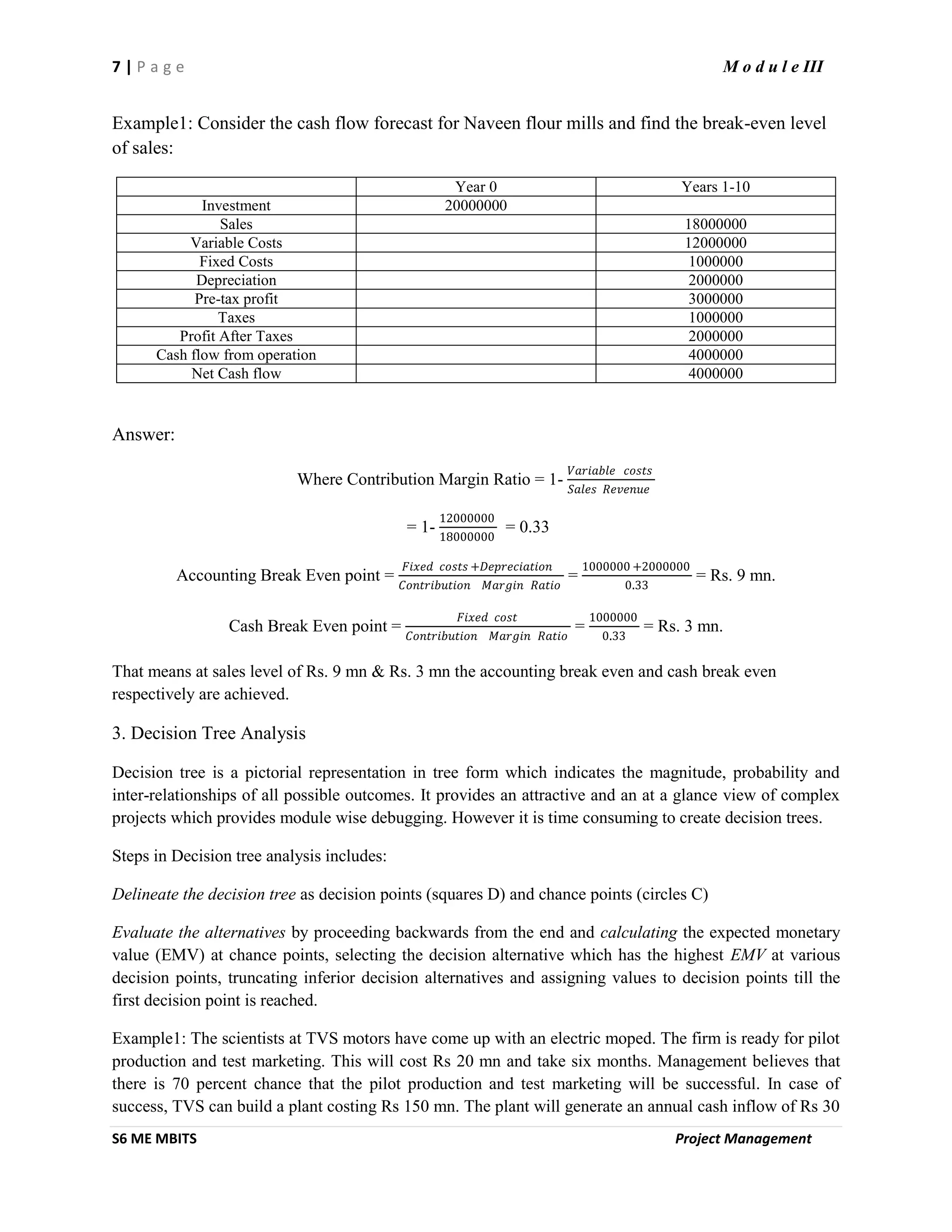
Example1: Consider the cash flow forecast for Naveen flour mills and find the break-even level
of sales:
Year 0 Years 1-10
Investment 20000000
Sales 18000000
Variable Costs 12000000
Fixed Costs 1000000
Depreciation 2000000
Pre-tax profit 3000000
Taxes 1000000
Profit After Taxes 2000000
Cash flow from operation 4000000
Net Cash flow 4000000
Answer:
Where Contribution Margin Ratio = 1-
𝑉𝑎𝑟𝑖𝑎𝑏𝑙𝑒 𝑐𝑜𝑠𝑡𝑠
𝑆𝑎𝑙𝑒𝑠 𝑅𝑒𝑣𝑒𝑛𝑢𝑒
= 1-
12000000
18000000
= 0.33
Accounting Break Even point =
𝐹𝑖𝑥𝑒𝑑 𝑐𝑜𝑠𝑡𝑠 +𝐷𝑒𝑝𝑟𝑒𝑐𝑖𝑎𝑡𝑖𝑜𝑛
𝐶𝑜𝑛𝑡𝑟𝑖𝑏𝑢𝑡𝑖𝑜𝑛 𝑀𝑎𝑟𝑔𝑖𝑛 𝑅𝑎𝑡𝑖𝑜
=
1000000 +2000000
0.33
= Rs. 9 mn.
Cash Break Even point =
𝐹𝑖𝑥𝑒𝑑 𝑐𝑜𝑠𝑡
𝐶𝑜𝑛𝑡𝑟𝑖𝑏𝑢𝑡𝑖𝑜𝑛 𝑀𝑎𝑟𝑔𝑖𝑛 𝑅𝑎𝑡𝑖𝑜
=
1000000
0.33
= Rs. 3 mn.
That means at sales level of Rs. 9 mn & Rs. 3 mn the accounting break even and cash break even
respectively are achieved.
3. Decision Tree Analysis
Decision tree is a pictorial representation in tree form which indicates the magnitude, probability and
inter-relationships of all possible outcomes. It provides an attractive and an at a glance view of complex
projects which provides module wise debugging. However it is time consuming to create decision trees.
Steps in Decision tree analysis includes:
Delineate the decision tree as decision points (squares D) and chance points (circles C)
Evaluate the alternatives by proceeding backwards from the end and calculating the expected monetary
value (EMV) at chance points, selecting the decision alternative which has the highest EMV at various
decision points, truncating inferior decision alternatives and assigning values to decision points till the
first decision point is reached.
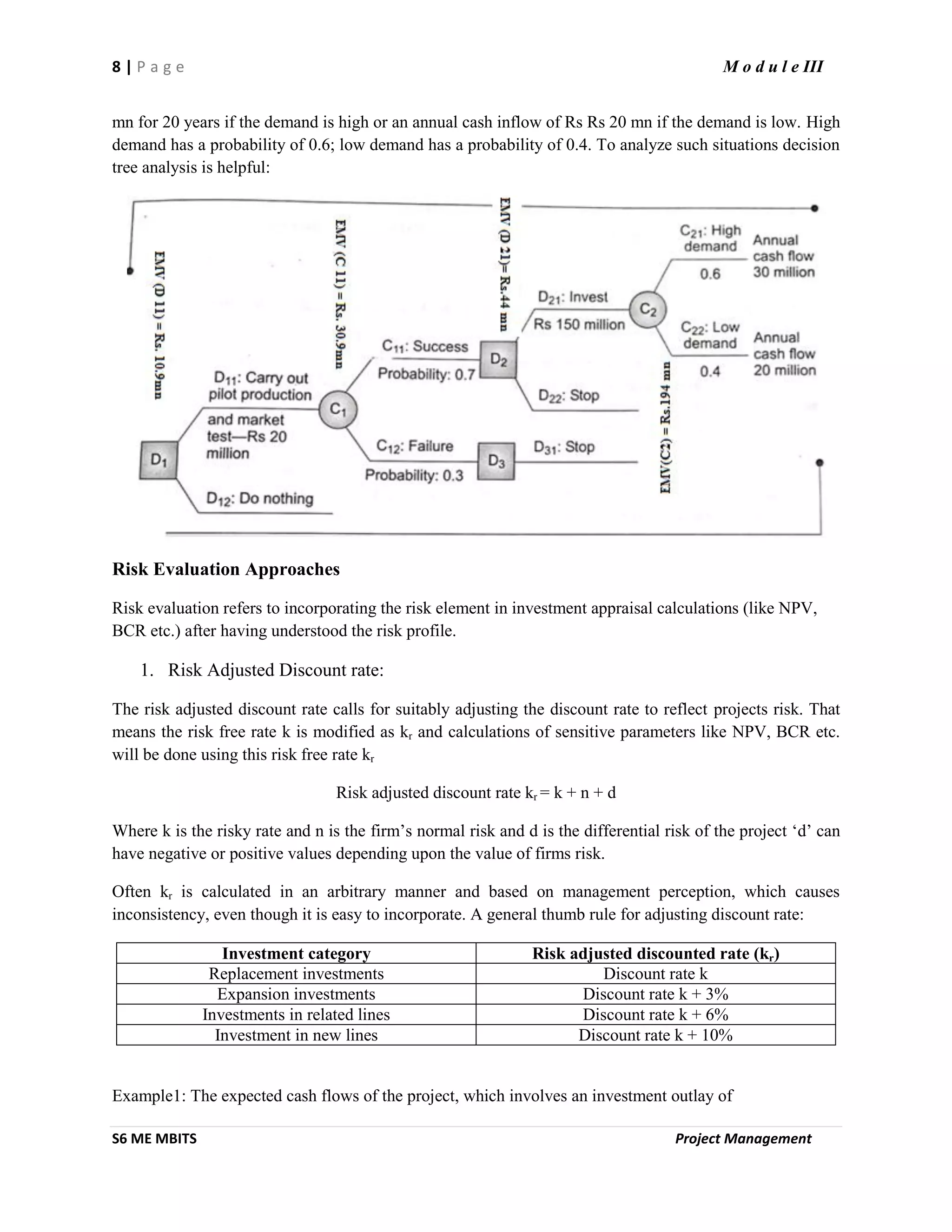
Example1: The scientists at TVS motors have come up with an electric moped. The firm is ready for pilot
production and test marketing. This will cost Rs 20 mn and take six months. Management believes that
there is 70 percent chance that the pilot production and test marketing will be successful. In case of
success, TVS can build a plant costing Rs 150 mn. The plant will generate an annual cash inflow of Rs 30
8 | P a g e M o d u l e III
S6 ME MBITS Project Management
mn for 20 years if the demand is high or an annual cash inflow of Rs Rs 20 mn if the demand is low. High
demand has a probability of 0.6; low demand has a probability of 0.4. To analyze such situations decision
tree analysis is helpful:
Risk Evaluation Approaches
Risk evaluation refers to incorporating the risk element in investment appraisal calculations (like NPV,
BCR etc.) after having understood the risk profile.
1. Risk Adjusted Discount rate:
The risk adjusted discount rate calls for suitably adjusting the discount rate to reflect projects risk. That
means the risk free rate k is modified as kr and calculations of sensitive parameters like NPV, BCR etc.
will be done using this risk free rate kr
Risk adjusted discount rate kr = k + n + d
Where k is the risky rate and n is the firm’s normal risk and d is the differential risk of the project ‘d’ can
have negative or positive values depending upon the value of firms risk.
Often kr is calculated in an arbitrary manner and based on management perception, which causes
inconsistency, even though it is easy to incorporate. A general thumb rule for adjusting discount rate:
Investment category Risk adjusted discounted rate (kr)
Replacement investments Discount rate k
Expansion investments Discount rate k + 3%
Investments in related lines Discount rate k + 6%
Investment in new lines Discount rate k + 10%
Example1: The expected cash flows of the project, which involves an investment outlay of
9 | P a g e M o d u l e III
S6 ME MBITS Project Management
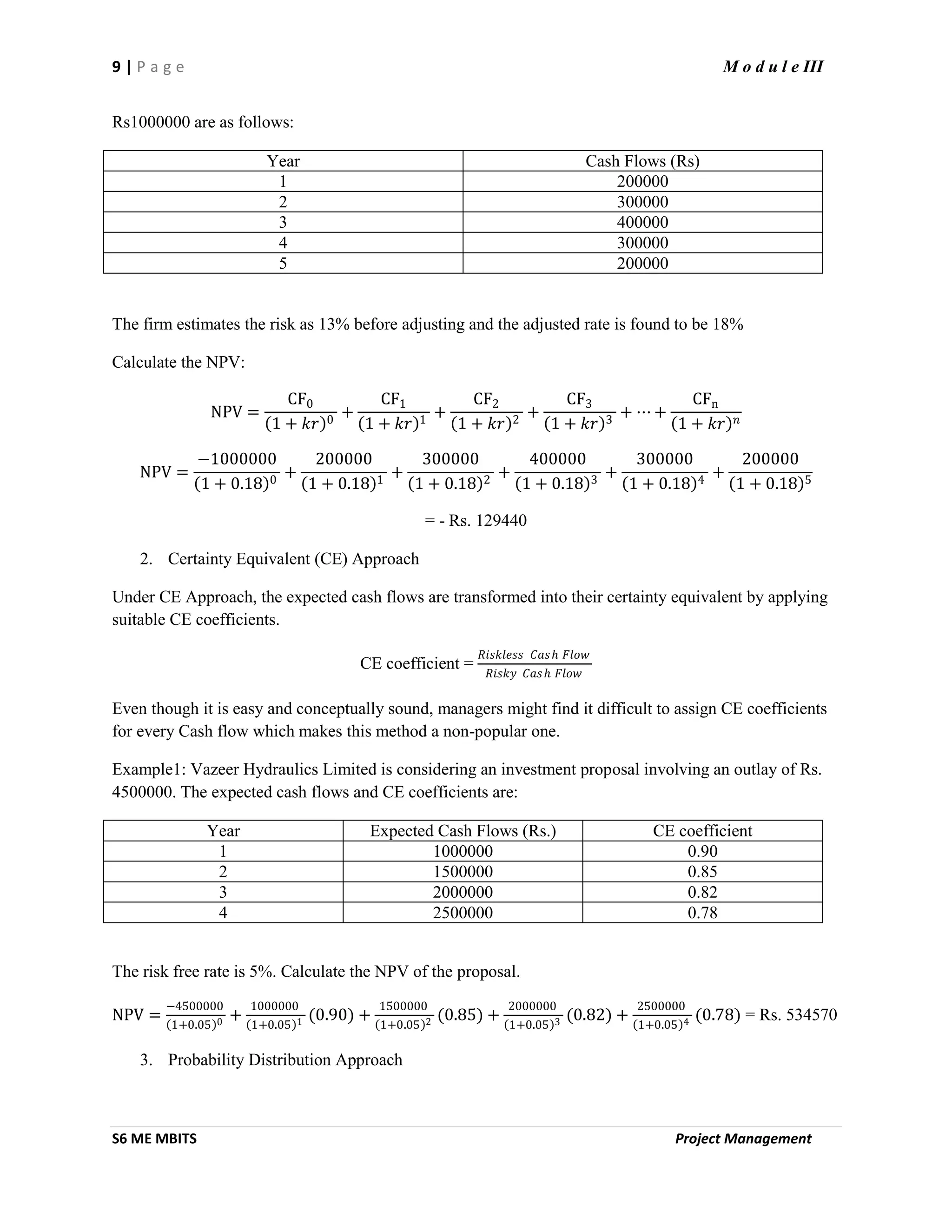
Rs1000000 are as follows:
Year Cash Flows (Rs)
1 200000
2 300000
3 400000
4 300000
5 200000
The firm estimates the risk as 13% before adjusting and the adjusted rate is found to be 18%
Calculate the NPV:
NPV =
CF0
1 + 𝑘𝑟 0
+
CF1
1 + 𝑘𝑟 1
+
CF2
1 + 𝑘𝑟 2
+
CF3
1 + 𝑘𝑟 3
+ ⋯ +
CFn
1 + 𝑘𝑟 𝑛
NPV =
−1000000
1 + 0.18 0
+
200000
1 + 0.18 1
+
300000
1 + 0.18 2
+
400000
1 + 0.18 3
+
300000
1 + 0.18 4
+
200000
1 + 0.18 5
= - Rs. 129440
2. Certainty Equivalent (CE) Approach
Under CE Approach, the expected cash flows are transformed into their certainty equivalent by applying
suitable CE coefficients.
CE coefficient =
𝑅𝑖𝑠𝑘𝑙𝑒𝑠𝑠 𝐶𝑎𝑠 𝑕 𝐹𝑙𝑜𝑤
𝑅𝑖𝑠𝑘𝑦 𝐶𝑎𝑠 𝑕 𝐹𝑙𝑜𝑤
Even though it is easy and conceptually sound, managers might find it difficult to assign CE coefficients
for every Cash flow which makes this method a non-popular one.
Example1: Vazeer Hydraulics Limited is considering an investment proposal involving an outlay of Rs.
4500000. The expected cash flows and CE coefficients are:
Year Expected Cash Flows (Rs.) CE coefficient
1 1000000 0.90
2 1500000 0.85
3 2000000 0.82
4 2500000 0.78
The risk free rate is 5%. Calculate the NPV of the proposal.
NPV =
−4500000
1+0.05 0 +
1000000
1+0.05 1 (0.90) +
1500000
1+0.05 2 (0.85) +
2000000
1+0.05 3 (0.82) +
2500000
1+0.05 4 (0.78) = Rs. 534570
3. Probability Distribution Approach
10 | P a g e M o d u l e III
S6 ME MBITS Project Management
The probability Distribution Approach evaluates risk through the application of probability distribution,
assuming independence of cash flows over time. The steps involved are determination of expected NPV,
computation of standard deviation of expected cash flows and calculation of probability of different value
of NPV based on z value. (Example below)
Example1: The cautious Limited is considering a proposal for the purchase of a new machine requiring an
outlay of Rs. 1500 Lakhs. Its estimate of the cash flow distribution for the three year life of the machine is
given below (amount in Rs. Lakhs). The probability distribution is assumed to be independent. Risk free
rate of interest is 5%. From the above information determine the following 1) expected NPV of the
project 2) the standard deviation of the NPV 3) the probability that the NPV will be zero or less 4) NPV
will be greater than 0 5) at least equal to the mean 6) profitability index of the expected value 7) the
probability that the profitability index will be less than 1:
Probable
Cash
Flows
(Rs)
(Period 1)
Probability
(Period 1)
Probable
Cash
Flows
(Rs)
(Period 2)
Probability
(Period 2)
Probable
Cash Flows
(Rs)
(Period 3)
Probability
(Period 3)
800 0.10 800 0.10 1200 0.20
600 0.20 700 0.30 900 0.50
400 0.40 600 0.40 600 0.20
200 0.30 500 0.20 300 0.10
Period 1 (All cash flow in Rs.) Period 2 All cash flow in Rs.) Period 3 (All cash flow in Rs.)
Probable
Cash
Flows
Probability
Expected
Cash
Flows
Probable
Cash
Flows
Probability
Expected
Cash
Flows
Probable
Cash
Flows
Probability
Expected
Cash
Flows
800 0.10 80 800 0.10 80 1200 0.20 240
600 0.20 120 700 0.30 210 900 0.50 450
400 0.40 160 600 0.40 240 600 0.20 120
200 0.30 60 500 0.20 100 300 0.10 30
𝐶𝐹1
= 420
𝐶𝐹2
= 630
𝐶𝐹3
= 840
Standard Deviation of Expected Cash flow for period 1is computed as:
(𝐶𝐹𝑡1 − 𝐶𝐹1)2
X 𝑝𝑖1
(800-420)2
X 0.10 = Rs. 14400
(600-420)2
X 0.20 = Rs. 6480
(400-420)2
X 0.40 = Rs. 160
(200-420)2
X 0.30 = Rs. 14520
(𝐶𝐹𝑡1 − 𝐶𝐹1)2
X 𝑝𝑖1
𝑛
𝑡=1 = Rs. 35600
11 | P a g e M o d u l e III
S6 ME MBITS Project Management
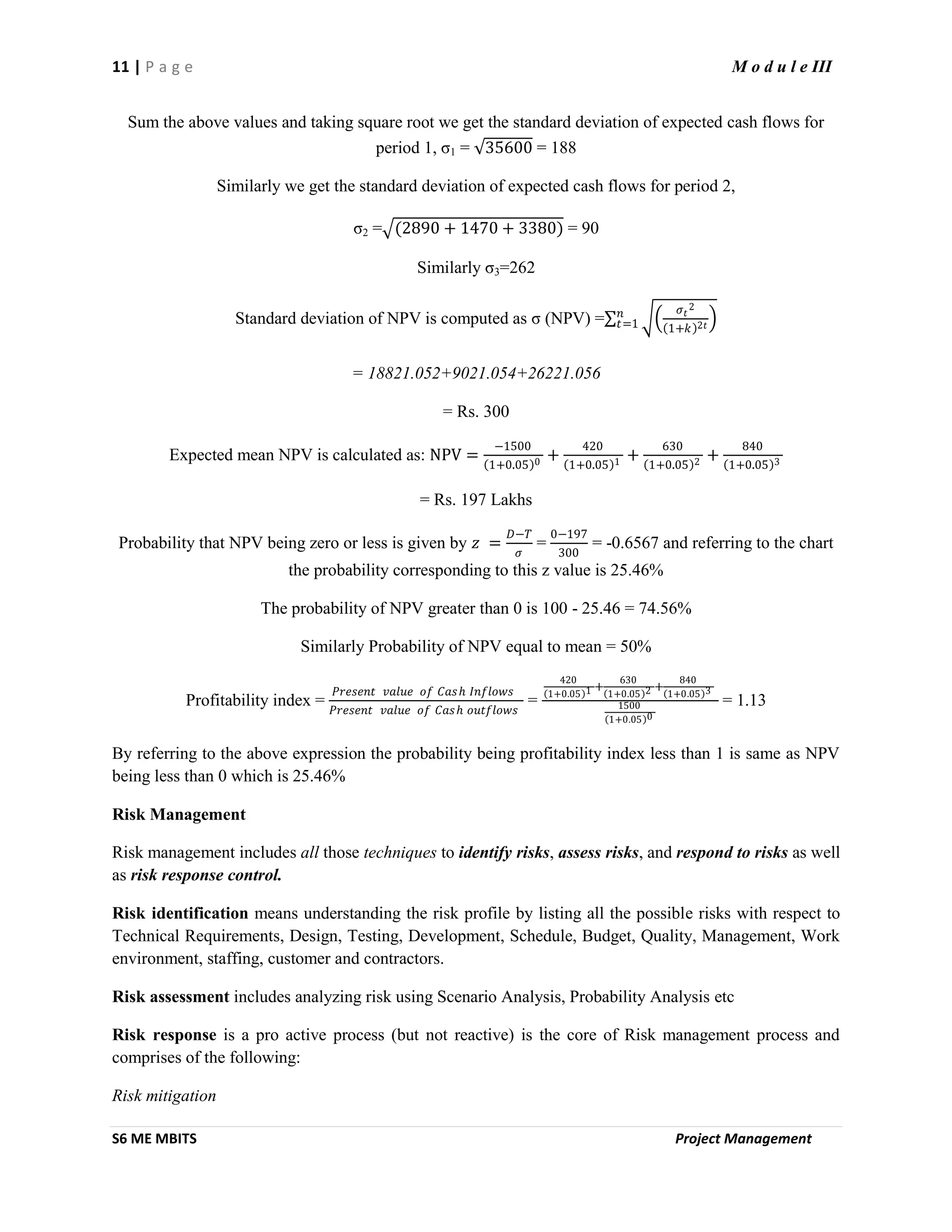
Sum the above values and taking square root we get the standard deviation of expected cash flows for
period 1, σ1 = 35600 = 188
Similarly we get the standard deviation of expected cash flows for period 2,
σ2 = (2890 + 1470 + 3380) = 90
Similarly σ3=262
Standard deviation of NPV is computed as σ (NPV) =
𝜎 𝑡
2
1+𝑘 2𝑡
𝑛
𝑡=1
= 18821.052+9021.054+26221.056
= Rs. 300
Expected mean NPV is calculated as: NPV =
−1500
1+0.05 0 +
420
1+0.05 1 +
630
1+0.05 2 +
840
1+0.05 3
= Rs. 197 Lakhs
Probability that NPV being zero or less is given by 𝑧 =
𝐷−𝑇
𝜎
=
0−197
300
= -0.6567 and referring to the chart
the probability corresponding to this z value is 25.46%
The probability of NPV greater than 0 is 100 - 25.46 = 74.56%
Similarly Probability of NPV equal to mean = 50%
Profitability index =
𝑃𝑟𝑒𝑠𝑒𝑛𝑡 𝑣𝑎𝑙𝑢𝑒 𝑜𝑓 𝐶𝑎𝑠 𝑕 𝐼𝑛𝑓𝑙𝑜𝑤𝑠
𝑃𝑟𝑒𝑠𝑒𝑛𝑡 𝑣𝑎𝑙𝑢𝑒 𝑜𝑓 𝐶𝑎𝑠 𝑕 𝑜𝑢𝑡𝑓𝑙𝑜𝑤𝑠
=
420
1+0.05 1 +
630
1+0.05 2 +
840
1+0.05 3
1500
1+0.05 0
= 1.13
By referring to the above expression the probability being profitability index less than 1 is same as NPV
being less than 0 which is 25.46%
Risk Management
Risk management includes all those techniques to identify risks, assess risks, and respond to risks as well
as risk response control.
Risk identification means understanding the risk profile by listing all the possible risks with respect to
Technical Requirements, Design, Testing, Development, Schedule, Budget, Quality, Management, Work
environment, staffing, customer and contractors.
Risk assessment includes analyzing risk using Scenario Analysis, Probability Analysis etc
Risk response is a pro active process (but not reactive) is the core of Risk management process and
comprises of the following:
Risk mitigation
12 | P a g e M o d u l e III
S6 ME MBITS Project Management
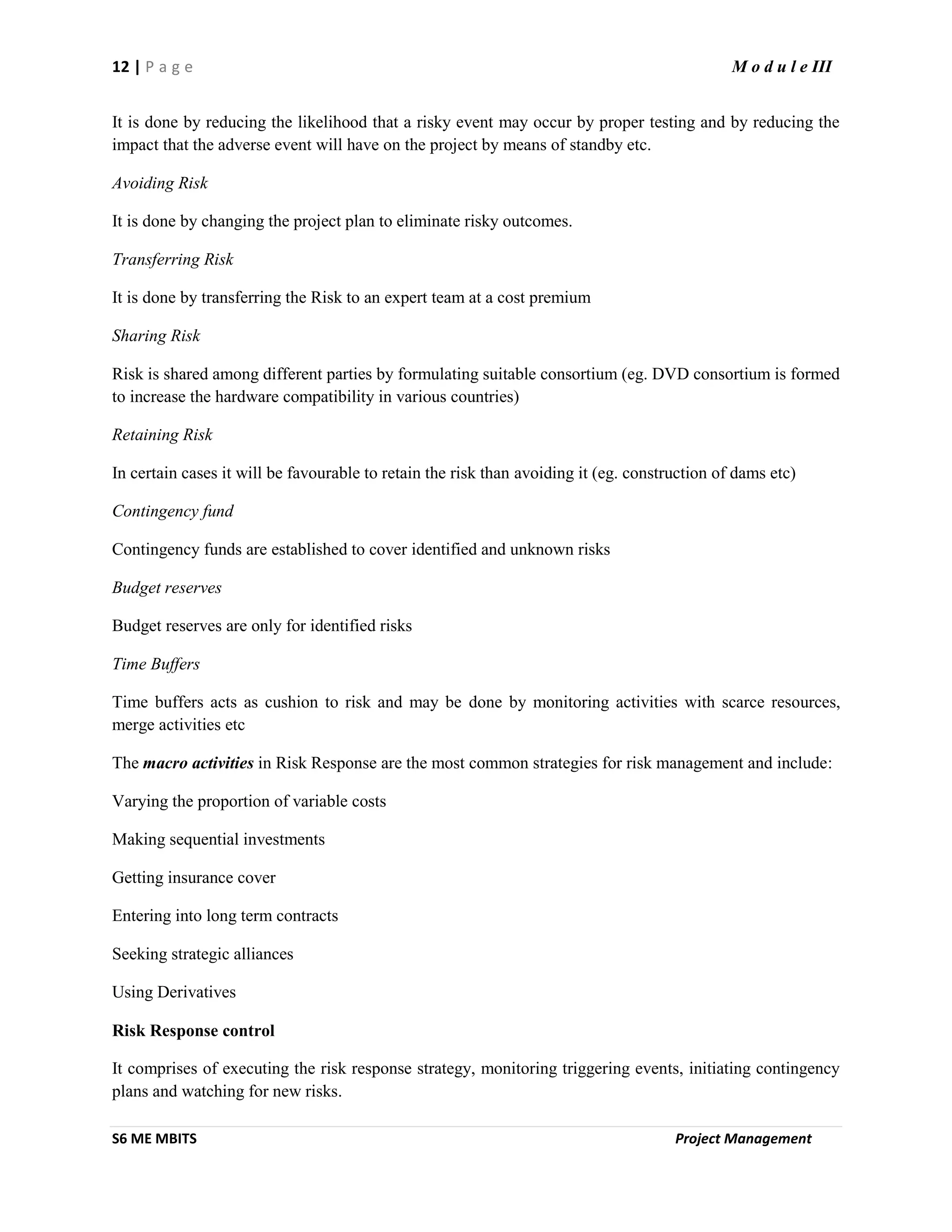
It is done by reducing the likelihood that a risky event may occur by proper testing and by reducing the
impact that the adverse event will have on the project by means of standby etc.
Avoiding Risk
It is done by changing the project plan to eliminate risky outcomes.
Transferring Risk
It is done by transferring the Risk to an expert team at a cost premium
Sharing Risk
Risk is shared among different parties by formulating suitable consortium (eg. DVD consortium is formed
to increase the hardware compatibility in various countries)
Retaining Risk
In certain cases it will be favourable to retain the risk than avoiding it (eg. construction of dams etc)
Contingency fund
Contingency funds are established to cover identified and unknown risks
Budget reserves
Budget reserves are only for identified risks
Time Buffers
Time buffers acts as cushion to risk and may be done by monitoring activities with scarce resources,
merge activities etc
The macro activities in Risk Response are the most common strategies for risk management and include:
Varying the proportion of variable costs
Making sequential investments
Getting insurance cover
Entering into long term contracts
Seeking strategic alliances
Using Derivatives
Risk Response control
It comprises of executing the risk response strategy, monitoring triggering events, initiating contingency
plans and watching for new risks.
1 | P a g e M o d u l e V
S6 ME MBITS Project Management
COMPUTER AIDED PROJECT MANAGEMENT
Need for a CPMS (Computerized Project Management System)
The need for a CPMS arises when the project size tends to become large and therefore complex
Advantages of a CPMS
1. High speed computations
2. It can store and process large volumes of data
3. Better Accuracy
4. Reduces human resources
5. Relieves project manager off many tasks
Essential Requirements of a Project Management Software
1. It should handle multiple projects together
2. It should support a variety of graphs and reports
3. Filtering capacity
4. It should support a wide range of file formats
5. It should be compatible with the existing OS and networking available in the company
6. It should be able to generate the reports required in the desired formats
7. Extensive one line help
Software packages for CPMS
Some of the software packages are PRISM, INSTAPLAN and MS Project2010
PRISM and INSTAPLAN are software packages developed in the early 21st
century by TCS and WIPRO
respectively.
For a given budget PRISM can generate the minimum time with in which the project must be completed.
INSTAPLAN is remarkable in that it can generate four types of reports and three types of presentations.
MS project2010 helps in an effective plan by building schedules, assigning resources and creating a
budget. Also better communication is effected by sharing project status, publishing milestones and by
communicating tasks. It has the track and analyze attribute using which tasks status are tracked, issues
and risks can be managed and reports are analyzed for improvement.
2 | P a g e M o d u l e V
S6 ME MBITS Project Management
Features of MS Project 2010
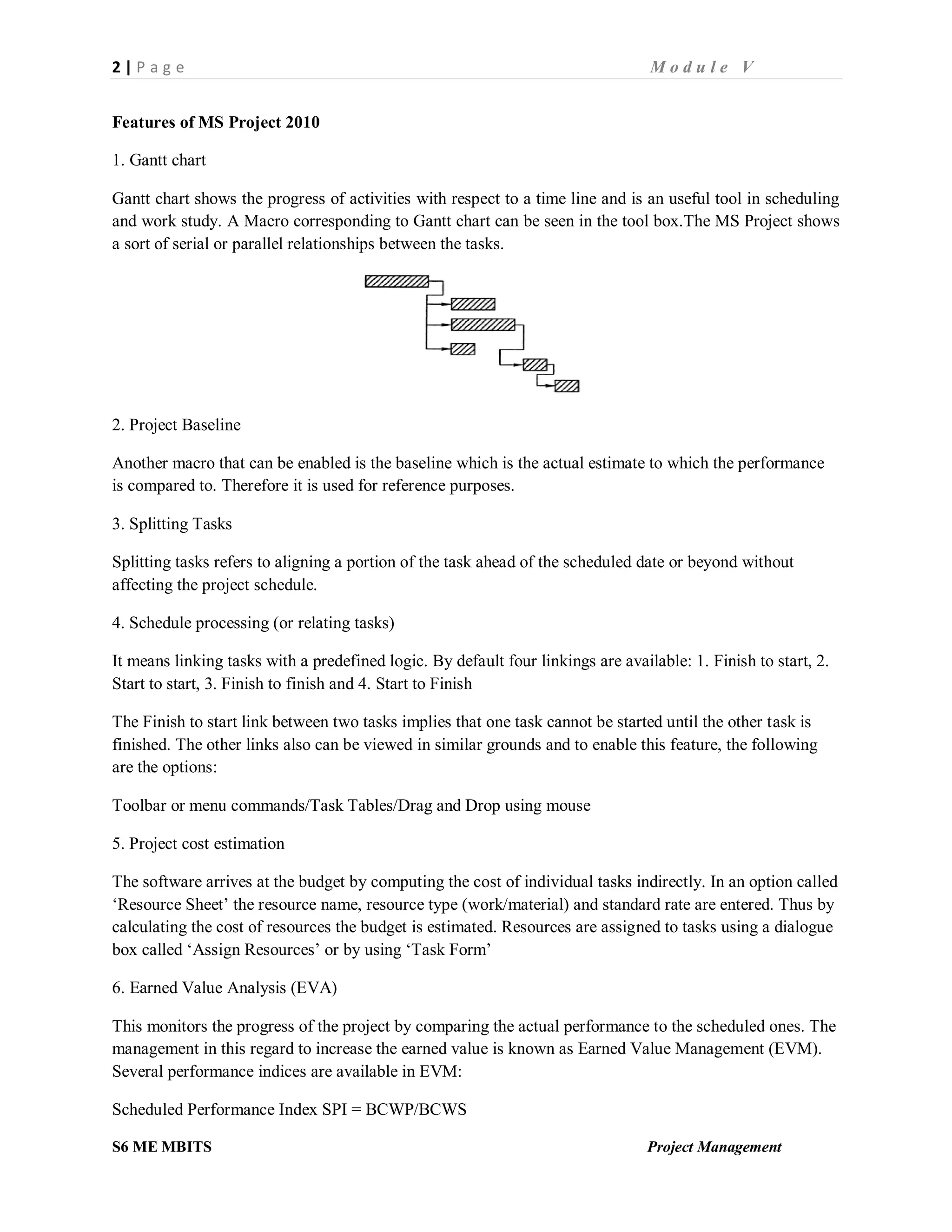
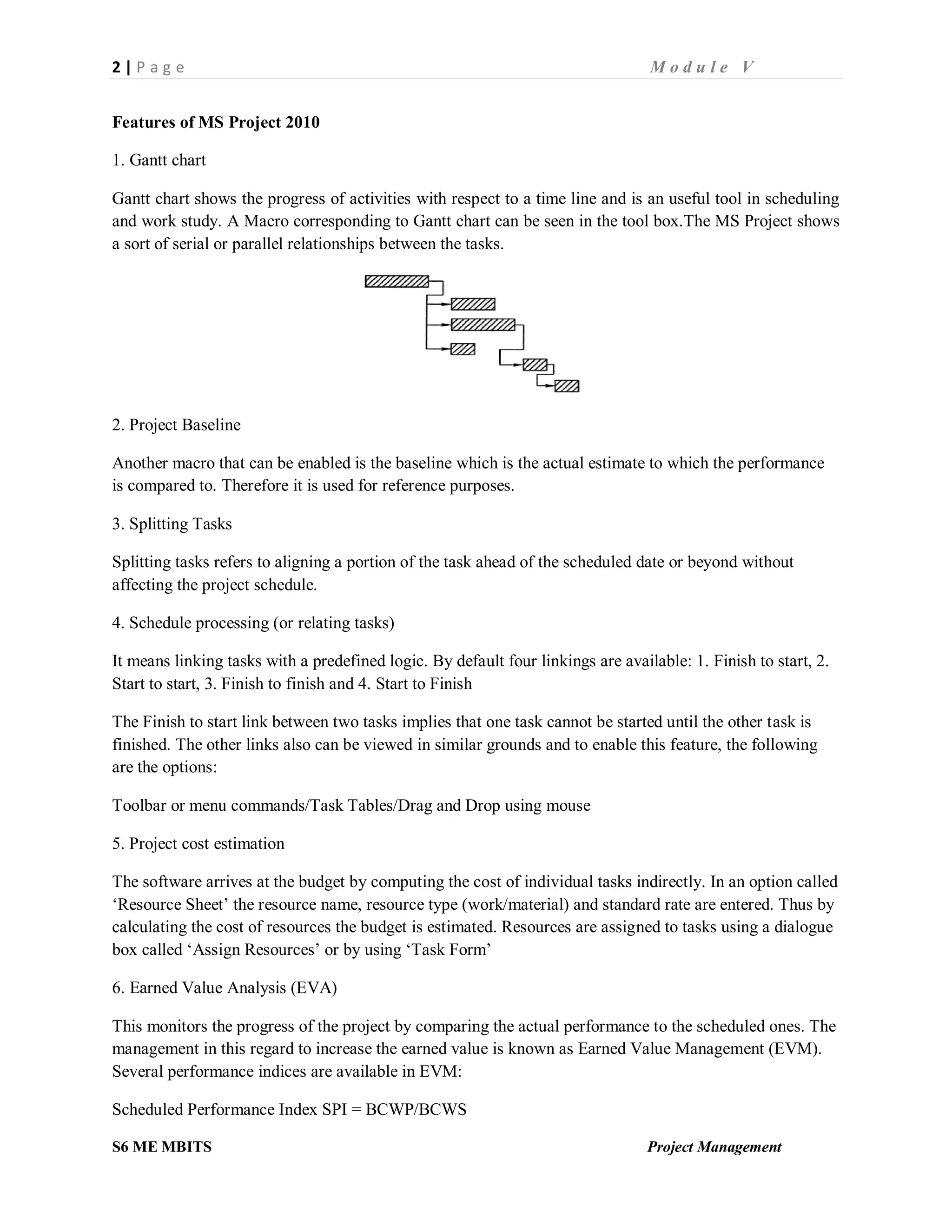
1. Gantt chart
Gantt chart shows the progress of activities with respect to a time line and is an useful tool in scheduling
and work study. A Macro corresponding to Gantt chart can be seen in the tool box.The MS Project shows
a sort of serial or parallel relationships between the tasks.
2. Project Baseline
Another macro that can be enabled is the baseline which is the actual estimate to which the performance
is compared to. Therefore it is used for reference purposes.
3. Splitting Tasks
Splitting tasks refers to aligning a portion of the task ahead of the scheduled date or beyond without
affecting the project schedule.
4. Schedule processing (or relating tasks)
It means linking tasks with a predefined logic. By default four linkings are available: 1. Finish to start, 2.
Start to start, 3. Finish to finish and 4. Start to Finish
The Finish to start link between two tasks implies that one task cannot be started until the other task is
finished. The other links also can be viewed in similar grounds and to enable this feature, the following
are the options:
Toolbar or menu commands/Task Tables/Drag and Drop using mouse
5. Project cost estimation
The software arrives at the budget by computing the cost of individual tasks indirectly. In an option called
‘Resource Sheet’ the resource name, resource type (work/material) and standard rate are entered. Thus by
calculating the cost of resources the budget is estimated. Resources are assigned to tasks using a dialogue
box called ‘Assign Resources’ or by using ‘Task Form’
6. Earned Value Analysis (EVA)
This monitors the progress of the project by comparing the actual performance to the scheduled ones. The
management in this regard to increase the earned value is known as Earned Value Management (EVM).
Several performance indices are available in EVM:
Scheduled Performance Index SPI = BCWP/BCWS
3 | P a g e M o d u l e V
S6 ME MBITS Project Management
BCWP is the Budgeted cost of Work Performed; BCWS is the Budgeted cost of Work scheduled
Cost Performance Index CPI= BCWP/ACWP
ACWP is the actual cost of work performed.
If SPI is greater than 1 the actual cost incurred is more than the budgeted cost and it is vice-versa in the
case of CPI.
There are almost 32 such indices in EVM. Another index is Variance at completion VAC = BAC-EAC
BAC is Base line cost at completion and EAC is Estimate at completion.
7. Resource Levelling
Resource leveling means evenly distributing the over allocated resources as far as possible and without
affecting the project completion time. If the allocation is optimum the resource allocation is called
resource smoothing.
The software offers Auto leveling and Manual Levelling options. Manual leveling can be done by taking
Resource Levelling dialog box >Level now
The software will not delay the tasks under the following constraints:
Must start on
Must finish on
As late as possible
As soon as possible
Also a priority value ranging from 0(lowest priority) to 1000(highest priority) can be set for critical tasks
8. Resource Pool
Resource pool is a file containing resource information of an organization. All the resources are entered
into the pool and are efficiently shared between multiple projects. Tasks with highest priority number will
receive importance while allocating resources.
9. PERT
PERT with three different options corresponding to weights are available in the software:
Optimistic Time (0.50/1.50/0.40)
Expected Time (4.00/4.00/3.60)
Pessimistic time (1.50/0.50/2.00)
10. MS Office fluent interface (ribbon)
4 | P a g e M o d u l e V
S6 ME MBITS Project Management
The most commonly used tools are provided in this interface
11. The backstage view
All the important tools to work with the particular project file.
12. Manually scheduled Tasks
These tasks are unaffected by changes in schedule, dependencies etc.
13. Time line view
This is the ‘project at a glance view’ which shows summary tasks and milestones
14. Auto filter improvements with sorting included
15. Custom fields provide to search and identify the right project by means of a letter/string/character etc.
16. Better pasting options and customizable ribbons
17. Team planner view to better assign/share resources
18. Multiple and versatile file formats and Share point integration
19. Inactive tasks: this option can disable the required tasks that are inactive
20. Visual Reports: provides highly structured graphical formats in excel or visio formats.
21. Change Highlighting: highlights the changes seen after making an alteration to the existing project
plan.
22. Cost resources: accrues categories of cost we wish to track.
23. Task inspector pane: shows the details that affect the scheduling of a selected task.
24. Multi level undo: back out of a series of actions when we needed.
25. Calendar working time exceptions: provides date and explanation of a project working time exception.
Reports available in MS Project 2010
MS Project provides basically two types of reports:
1. Visual Reports- Highly structured, highly illustrated reports to be exported to excel or Visio and are
usually consisting of Pivot charts and Pivot tables and therefore requiring relatively more memory size.
The default Visual Reports which are customizable can be accessed as:
Projects>Reports>Visual Reports> create Report
For editing/customization:
5 | P a g e M o d u l e V
S6 ME MBITS Project Management
Projects>Reports>Visual Reports> Edit Template>Field Picker
The built in visual reports are: baseline cost report, baseline work report, budget cost report, budget work
report, cash flow report, earned value over time report, resource cost summary report, resource remaining
work report, resource work availability report and resource work summary report.
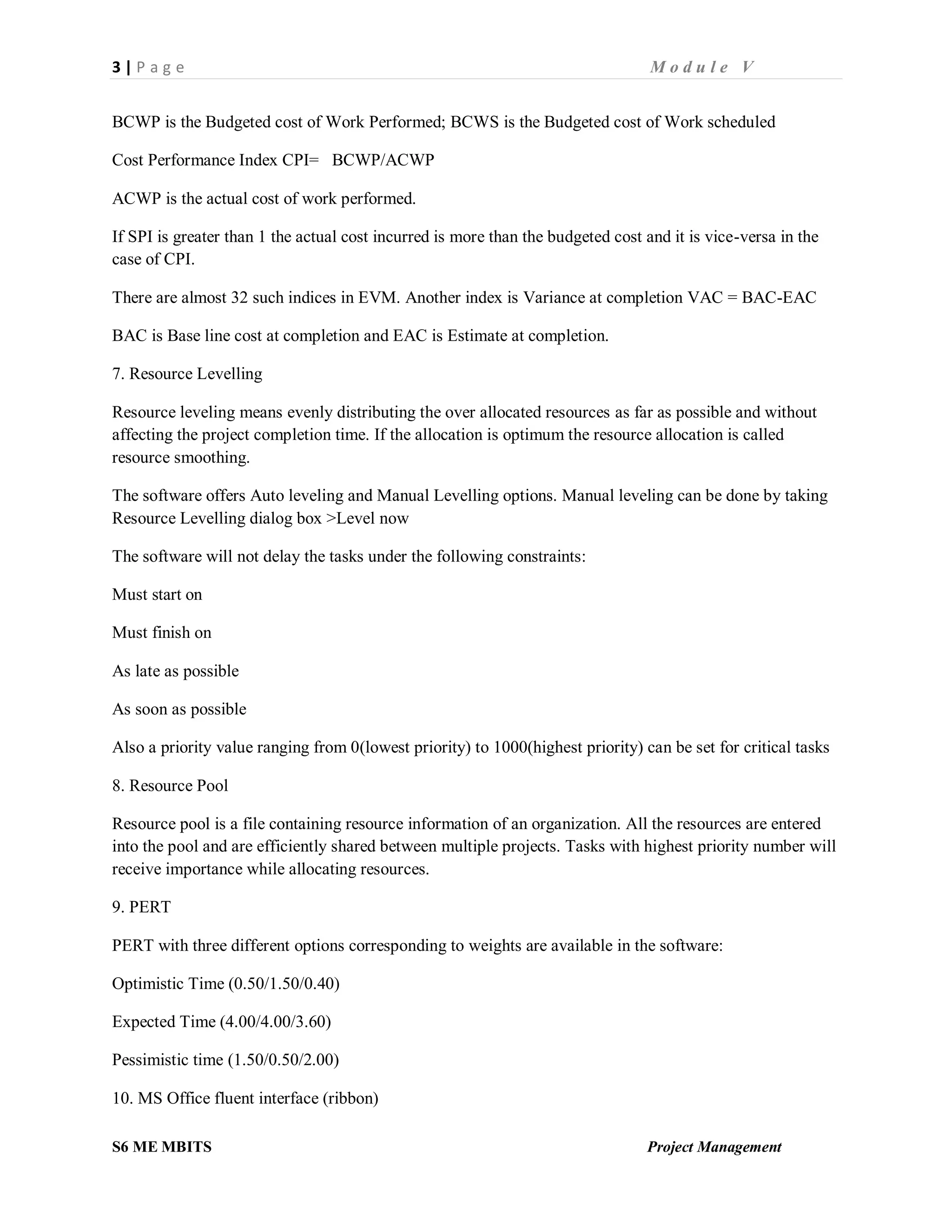
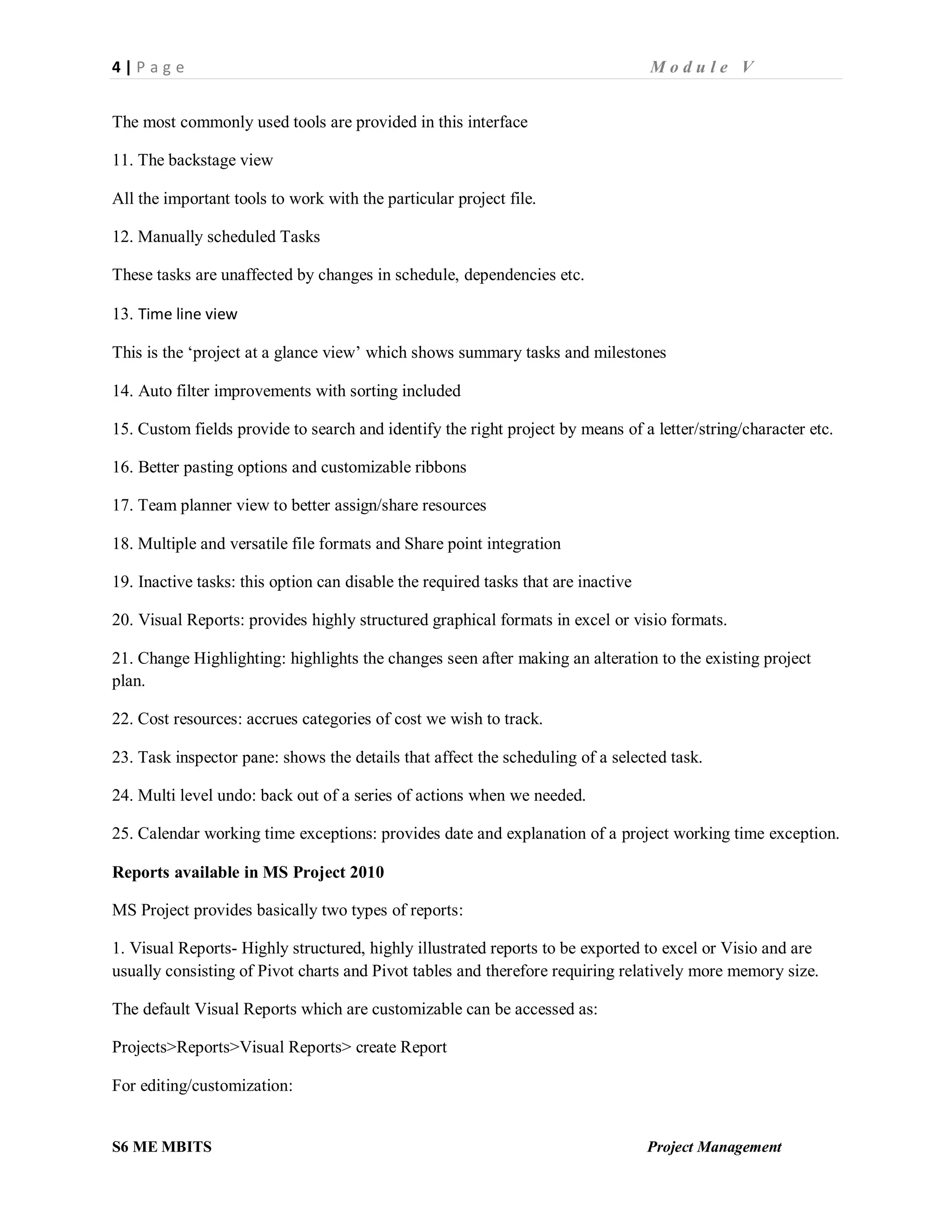
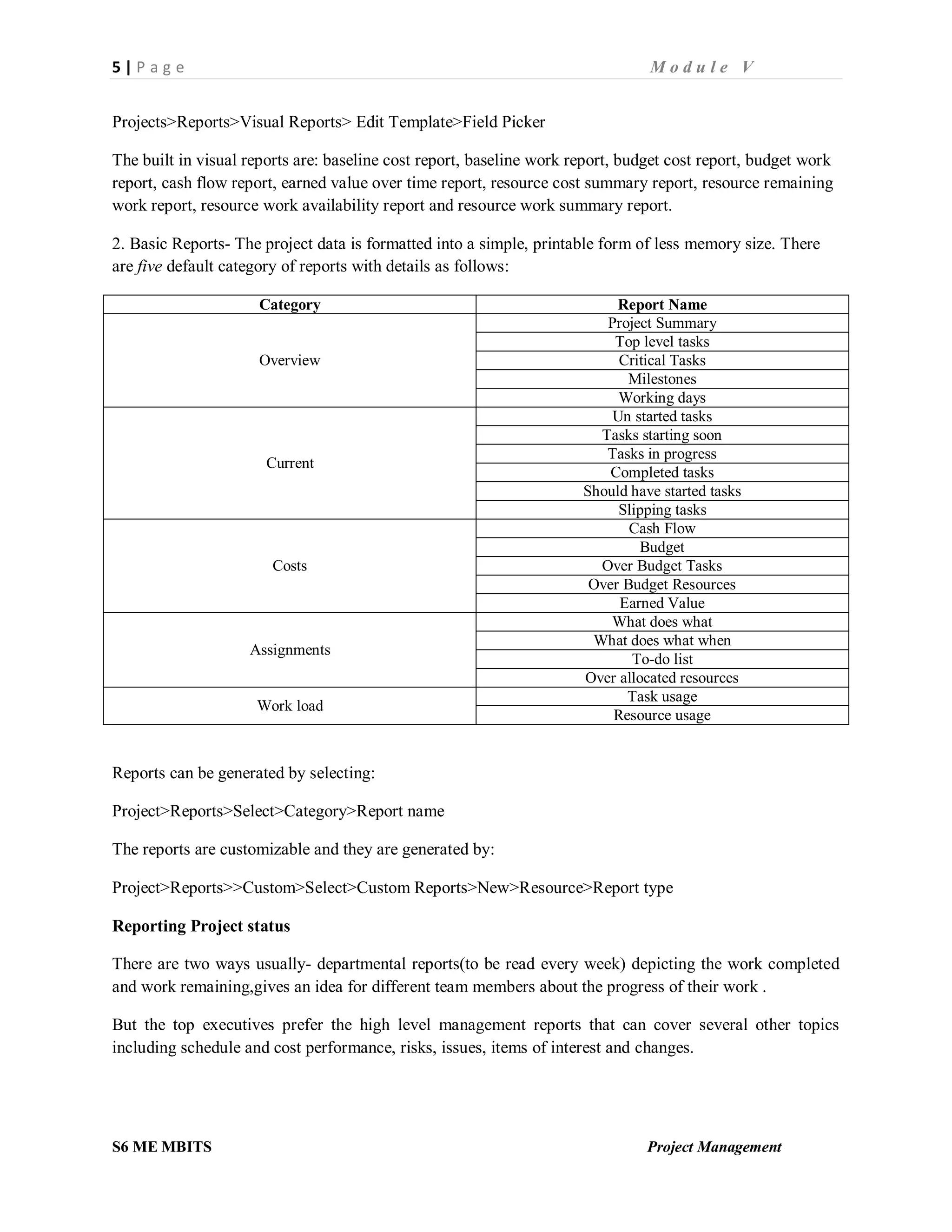
2. Basic Reports- The project data is formatted into a simple, printable form of less memory size. There
are five default category of reports with details as follows:
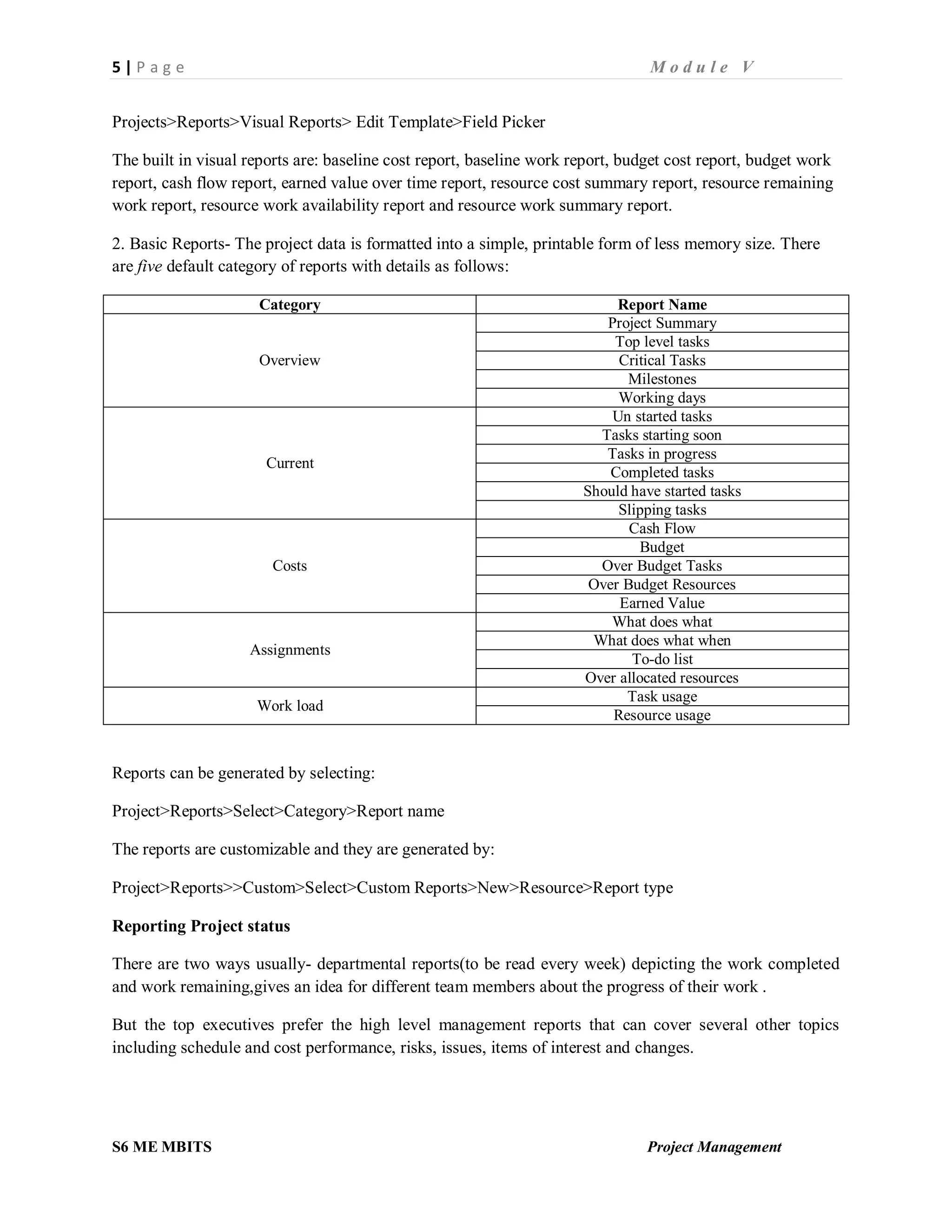
Category Report Name
Overview
Project Summary
Top level tasks
Critical Tasks
Milestones
Working days
Current
Un started tasks
Tasks starting soon
Tasks in progress
Completed tasks
Should have started tasks
Slipping tasks
Costs
Cash Flow
Budget
Over Budget Tasks
Over Budget Resources
Earned Value
Assignments
What does what
What does what when
To-do list
Over allocated resources
Work load
Task usage
Resource usage
Reports can be generated by selecting:
Project>Reports>Select>Category>Report name
The reports are customizable and they are generated by:
Project>Reports>>Custom>Select>Custom Reports>New>Resource>Report type
Reporting Project status
There are two ways usually- departmental reports(to be read every week) depicting the work completed
and work remaining,gives an idea for different team members about the progress of their work .
But the top executives prefer the high level management reports that can cover several other topics
including schedule and cost performance, risks, issues, items of interest and changes.
6 | P a g e M o d u l e V
S6 ME MBITS Project Management
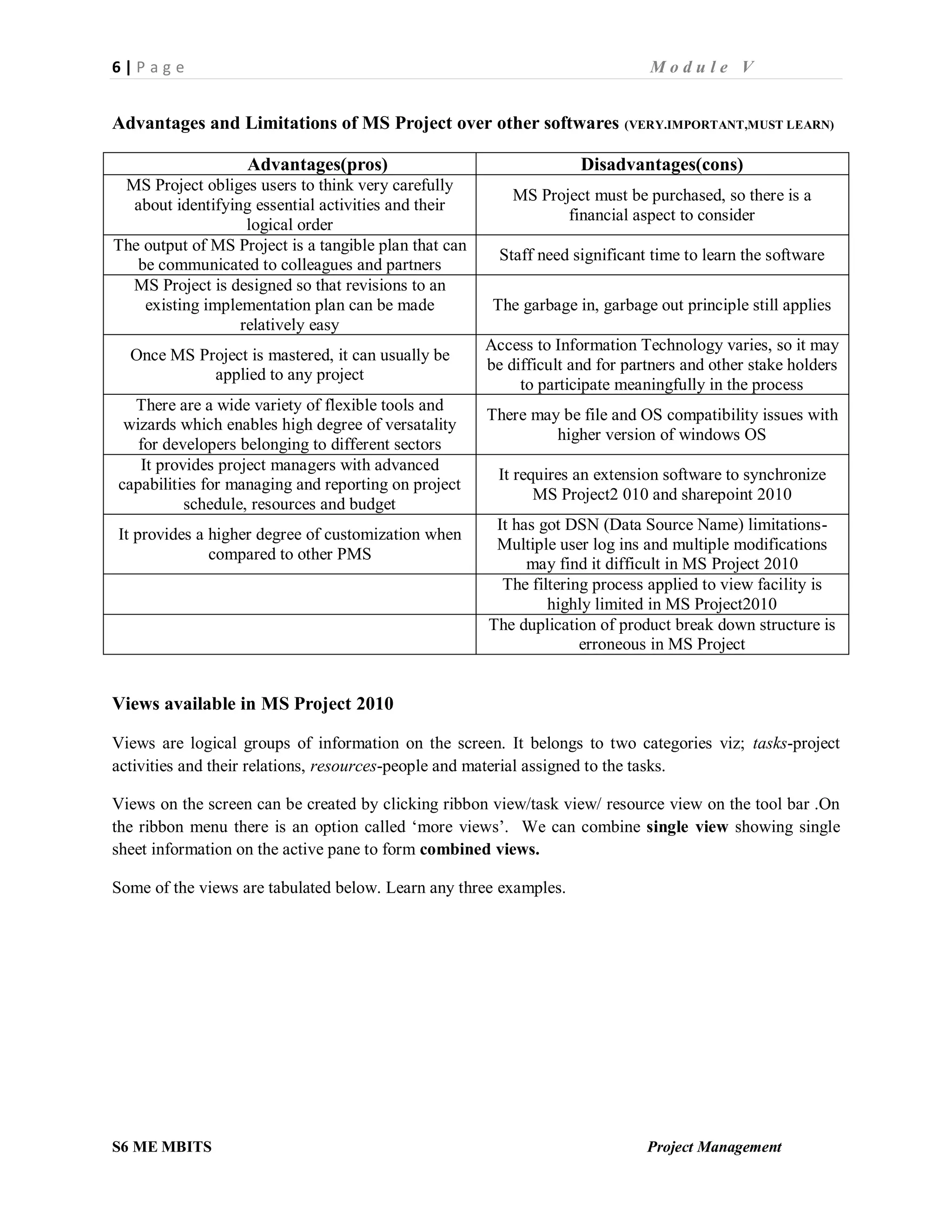
Advantages and Limitations of MS Project over other softwares (VERY.IMPORTANT,MUST LEARN)
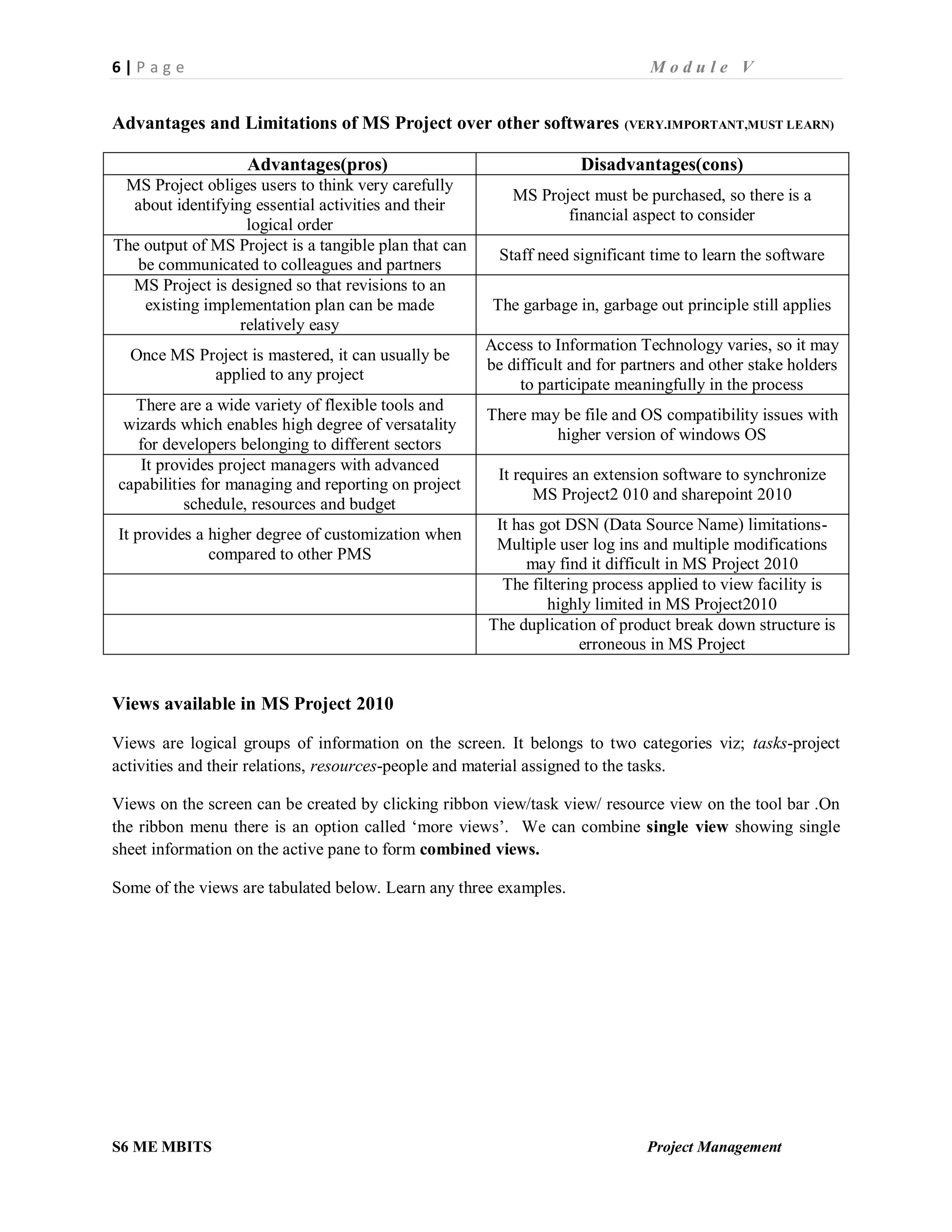
Advantages(pros) Disadvantages(cons)
MS Project obliges users to think very carefully
about identifying essential activities and their
logical order
MS Project must be purchased, so there is a
financial aspect to consider
The output of MS Project is a tangible plan that can
be communicated to colleagues and partners
Staff need significant time to learn the software
MS Project is designed so that revisions to an
existing implementation plan can be made
relatively easy
The garbage in, garbage out principle still applies
Once MS Project is mastered, it can usually be
applied to any project
Access to Information Technology varies, so it may
be difficult and for partners and other stake holders
to participate meaningfully in the process
There are a wide variety of flexible tools and
wizards which enables high degree of versatality
for developers belonging to different sectors
There may be file and OS compatibility issues with
higher version of windows OS
It provides project managers with advanced
capabilities for managing and reporting on project
schedule, resources and budget
It requires an extension software to synchronize
MS Project2 010 and sharepoint 2010
It provides a higher degree of customization when
compared to other PMS
It has got DSN (Data Source Name) limitations-
Multiple user log ins and multiple modifications
may find it difficult in MS Project 2010
The filtering process applied to view facility is
highly limited in MS Project2010
The duplication of product break down structure is
erroneous in MS Project
Views available in MS Project 2010
Views are logical groups of information on the screen. It belongs to two categories viz; tasks-project
activities and their relations, resources-people and material assigned to the tasks.
Views on the screen can be created by clicking ribbon view/task view/ resource view on the tool bar .On
the ribbon menu there is an option called ‘more views’. We can combine single view showing single
sheet information on the active pane to form combined views.
Some of the views are tabulated below. Learn any three examples.
7 | P a g e M o d u l e V
S6 ME MBITS Project Management
Project Management Information System (PMIS)
As defined by the Project Management Institute a PMIS is a standard set of automated project
management tools available within an organization and integrated into a system. A PMIS is typically a
computer driven system (though it can be paper based) to aid a project manager in the development of a
project. A project manager has to manage efficiently between these resources:
A PMIS helps him in achieving this. A PMIS is a tool, for not, a replacement of the project manager. A
PMIS can calculate schedules, costs, expectations and likely results. The PMIS however cannot replace
the expert judgment of the project manager and the project team. The goal of the PMIS is to automate,
organize and provide control of the project management process. A typical PMIS has the following
elements broadly divided as input module, processing module and output module:
1. WBS creation tools
8 | P a g e M o d u l e V
S6 ME MBITS Project Management
2. Calendaring features
3. Scheduling abilities
4. Work authorization tools
5. EVM Controls
6. Quality control charts, PERT charts, Gantt charts and other charting features
7. Calculations for the critical path, EVM, target dates based on the project schedule and more
8. Resource tracking and leveling
9. Report functionality
The schematic of a PMIS is given below:
Structure of a typical integrated PMIS is given below. As we can see above most of the PMIS is Software,
database and server centric which comprises the important elements and therefore serves almost all the
functionalities. While considering the cost of such a system, these elements contributes to 90% of its cost
and an average typical PMIS can be designed with a total cost of Rs. 200000 . The break up cost details
are as given in the adjacent table:
9 | P a g e M o d u l e V
S6 ME MBITS Project Management
Element/Component Cost (INR)
MS Project2010 Software 40000
Server computer with MySQL database 85000
2 PC’s 50000
LAN/Ethernet/Network cables 5000
Internet 1500
Telephones 3000
Printers 12500
Miscellaneous costs 3000
Total Cost of the PMIS 200000
Web enabled Project Management Software
These are software that are enabled to run on web using internet and mainly uses cloud based
functionalities. The main offering of these types of applications are collaborations. By web enabling the
software it can be used anywhere where a connection can be made and it can be accessed by whoever has
the right permissions. A projects complete database can be shared among the project team. Time,
efficiency and collaboration are the main reasons to use this type of project management system. Another
important aspect is that it can be used with hand held devices.
Both ‘Primavera’ and ‘Meridian’ have developed and enabled their software products to run on the web.
‘Talygen’ is another widely used Web enabled Project Management software that includes time tracking,
invoicing, expense tracker, HR, CRM and other tools to automate the business process.
Another web enabled software ‘Project Drive’ offers reliable and fully customizable project management
platform to manage, communicate and collaborate using the features like Time sheet module, resource
allocation, user management, user customization, implementation options etc. The basic architecture of a
web based Project Management system is given below:
10 | P a g e M o d u l e V
S6 ME MBITS Project Management
1 | P a g e M o d u l e V
S6 ME MBITS Project Management
COMPUTER AIDED PROJECT MANAGEMENT
Need for a CPMS (Computerized Project Management System)
The need for a CPMS arises when the project size tends to become large and therefore complex
Advantages of a CPMS
1. High speed computations
2. It can store and process large volumes of data
3. Better Accuracy
4. Reduces human resources
5. Relieves project manager off many tasks
Essential Requirements of a Project Management Software
1. It should handle multiple projects together
2. It should support a variety of graphs and reports
3. Filtering capacity
4. It should support a wide range of file formats
5. It should be compatible with the existing OS and networking available in the company
6. It should be able to generate the reports required in the desired formats
7. Extensive one line help
Software packages for CPMS
Some of the software packages are PRISM, INSTAPLAN and MS Project2010
PRISM and INSTAPLAN are software packages developed in the early 21st
century by TCS and WIPRO
respectively.
For a given budget PRISM can generate the minimum time with in which the project must be completed.
INSTAPLAN is remarkable in that it can generate four types of reports and three types of presentations.
MS project2010 helps in an effective plan by building schedules, assigning resources and creating a
budget. Also better communication is effected by sharing project status, publishing milestones and by
communicating tasks. It has the track and analyze attribute using which tasks status are tracked, issues
and risks can be managed and reports are analyzed for improvement.
2 | P a g e M o d u l e V
S6 ME MBITS Project Management
Features of MS Project 2010
1. Gantt chart
Gantt chart shows the progress of activities with respect to a time line and is an useful tool in scheduling
and work study. A Macro corresponding to Gantt chart can be seen in the tool box.The MS Project shows
a sort of serial or parallel relationships between the tasks.
2. Project Baseline
Another macro that can be enabled is the baseline which is the actual estimate to which the performance
is compared to. Therefore it is used for reference purposes.
3. Splitting Tasks
Splitting tasks refers to aligning a portion of the task ahead of the scheduled date or beyond without
affecting the project schedule.
4. Schedule processing (or relating tasks)
It means linking tasks with a predefined logic. By default four linkings are available: 1. Finish to start, 2.
Start to start, 3. Finish to finish and 4. Start to Finish
The Finish to start link between two tasks implies that one task cannot be started until the other task is
finished. The other links also can be viewed in similar grounds and to enable this feature, the following
are the options:
Toolbar or menu commands/Task Tables/Drag and Drop using mouse
5. Project cost estimation
The software arrives at the budget by computing the cost of individual tasks indirectly. In an option called
‘Resource Sheet’ the resource name, resource type (work/material) and standard rate are entered. Thus by
calculating the cost of resources the budget is estimated. Resources are assigned to tasks using a dialogue
box called ‘Assign Resources’ or by using ‘Task Form’
6. Earned Value Analysis (EVA)
This monitors the progress of the project by comparing the actual performance to the scheduled ones. The
management in this regard to increase the earned value is known as Earned Value Management (EVM).
Several performance indices are available in EVM:
Scheduled Performance Index SPI = BCWP/BCWS
3 | P a g e M o d u l e V
S6 ME MBITS Project Management
BCWP is the Budgeted cost of Work Performed; BCWS is the Budgeted cost of Work scheduled
Cost Performance Index CPI= BCWP/ACWP
ACWP is the actual cost of work performed.
If SPI is greater than 1 the actual cost incurred is more than the budgeted cost and it is vice-versa in the
case of CPI.
There are almost 32 such indices in EVM. Another index is Variance at completion VAC = BAC-EAC
BAC is Base line cost at completion and EAC is Estimate at completion.
7. Resource Levelling
Resource leveling means evenly distributing the over allocated resources as far as possible and without
affecting the project completion time. If the allocation is optimum the resource allocation is called
resource smoothing.
The software offers Auto leveling and Manual Levelling options. Manual leveling can be done by taking
Resource Levelling dialog box >Level now
The software will not delay the tasks under the following constraints:
Must start on
Must finish on
As late as possible
As soon as possible
Also a priority value ranging from 0(lowest priority) to 1000(highest priority) can be set for critical tasks
8. Resource Pool
Resource pool is a file containing resource information of an organization. All the resources are entered
into the pool and are efficiently shared between multiple projects. Tasks with highest priority number will
receive importance while allocating resources.
9. PERT
PERT with three different options corresponding to weights are available in the software:
Optimistic Time (0.50/1.50/0.40)
Expected Time (4.00/4.00/3.60)
Pessimistic time (1.50/0.50/2.00)
10. MS Office fluent interface (ribbon)
4 | P a g e M o d u l e V
S6 ME MBITS Project Management
The most commonly used tools are provided in this interface
11. The backstage view
All the important tools to work with the particular project file.
12. Manually scheduled Tasks
These tasks are unaffected by changes in schedule, dependencies etc.
13. Time line view
This is the ‘project at a glance view’ which shows summary tasks and milestones
14. Auto filter improvements with sorting included
15. Custom fields provide to search and identify the right project by means of a letter/string/character etc.
16. Better pasting options and customizable ribbons
17. Team planner view to better assign/share resources
18. Multiple and versatile file formats and Share point integration
19. Inactive tasks: this option can disable the required tasks that are inactive
20. Visual Reports: provides highly structured graphical formats in excel or visio formats.
21. Change Highlighting: highlights the changes seen after making an alteration to the existing project
plan.
22. Cost resources: accrues categories of cost we wish to track.
23. Task inspector pane: shows the details that affect the scheduling of a selected task.
24. Multi level undo: back out of a series of actions when we needed.
25. Calendar working time exceptions: provides date and explanation of a project working time exception.
Reports available in MS Project 2010
MS Project provides basically two types of reports:
1. Visual Reports- Highly structured, highly illustrated reports to be exported to excel or Visio and are
usually consisting of Pivot charts and Pivot tables and therefore requiring relatively more memory size.
The default Visual Reports which are customizable can be accessed as:
Projects>Reports>Visual Reports> create Report
For editing/customization:
5 | P a g e M o d u l e V
S6 ME MBITS Project Management
Projects>Reports>Visual Reports> Edit Template>Field Picker
The built in visual reports are: baseline cost report, baseline work report, budget cost report, budget work
report, cash flow report, earned value over time report, resource cost summary report, resource remaining
work report, resource work availability report and resource work summary report.
2. Basic Reports- The project data is formatted into a simple, printable form of less memory size. There
are five default category of reports with details as follows:
Category Report Name
Overview
Project Summary
Top level tasks
Critical Tasks
Milestones
Working days
Current
Un started tasks
Tasks starting soon
Tasks in progress
Completed tasks
Should have started tasks
Slipping tasks
Costs
Cash Flow
Budget
Over Budget Tasks
Over Budget Resources
Earned Value
Assignments
What does what
What does what when
To-do list
Over allocated resources
Work load
Task usage
Resource usage
Reports can be generated by selecting:
Project>Reports>Select>Category>Report name
The reports are customizable and they are generated by:
Project>Reports>>Custom>Select>Custom Reports>New>Resource>Report type
Reporting Project status
There are two ways usually- departmental reports(to be read every week) depicting the work completed
and work remaining,gives an idea for different team members about the progress of their work .
But the top executives prefer the high level management reports that can cover several other topics
including schedule and cost performance, risks, issues, items of interest and changes.
6 | P a g e M o d u l e V
S6 ME MBITS Project Management
Advantages and Limitations of MS Project over other softwares (VERY.IMPORTANT,MUST LEARN)
Advantages(pros) Disadvantages(cons)
MS Project obliges users to think very carefully
about identifying essential activities and their
logical order
MS Project must be purchased, so there is a
financial aspect to consider
The output of MS Project is a tangible plan that can
be communicated to colleagues and partners
Staff need significant time to learn the software
MS Project is designed so that revisions to an
existing implementation plan can be made
relatively easy
The garbage in, garbage out principle still applies
Once MS Project is mastered, it can usually be
applied to any project
Access to Information Technology varies, so it may
be difficult and for partners and other stake holders
to participate meaningfully in the process
There are a wide variety of flexible tools and
wizards which enables high degree of versatality
for developers belonging to different sectors
There may be file and OS compatibility issues with
higher version of windows OS
It provides project managers with advanced
capabilities for managing and reporting on project
schedule, resources and budget
It requires an extension software to synchronize
MS Project2 010 and sharepoint 2010
It provides a higher degree of customization when
compared to other PMS
It has got DSN (Data Source Name) limitations-
Multiple user log ins and multiple modifications
may find it difficult in MS Project 2010
The filtering process applied to view facility is
highly limited in MS Project2010
The duplication of product break down structure is
erroneous in MS Project
Views available in MS Project 2010
Views are logical groups of information on the screen. It belongs to two categories viz; tasks-project
activities and their relations, resources-people and material assigned to the tasks.
Views on the screen can be created by clicking ribbon view/task view/ resource view on the tool bar .On
the ribbon menu there is an option called ‘more views’. We can combine single view showing single
sheet information on the active pane to form combined views.
Some of the views are tabulated below. Learn any three examples.
7 | P a g e M o d u l e V
S6 ME MBITS Project Management
Project Management Information System (PMIS)
As defined by the Project Management Institute a PMIS is a standard set of automated project
management tools available within an organization and integrated into a system. A PMIS is typically a
computer driven system (though it can be paper based) to aid a project manager in the development of a
project. A project manager has to manage efficiently between these resources:
A PMIS helps him in achieving this. A PMIS is a tool, for not, a replacement of the project manager. A
PMIS can calculate schedules, costs, expectations and likely results. The PMIS however cannot replace
the expert judgment of the project manager and the project team. The goal of the PMIS is to automate,
organize and provide control of the project management process. A typical PMIS has the following
elements broadly divided as input module, processing module and output module:
1. WBS creation tools
8 | P a g e M o d u l e V
S6 ME MBITS Project Management
2. Calendaring features
3. Scheduling abilities
4. Work authorization tools
5. EVM Controls
6. Quality control charts, PERT charts, Gantt charts and other charting features
7. Calculations for the critical path, EVM, target dates based on the project schedule and more
8. Resource tracking and leveling
9. Report functionality
The schematic of a PMIS is given below:
Structure of a typical integrated PMIS is given below. As we can see above most of the PMIS is Software,
database and server centric which comprises the important elements and therefore serves almost all the
functionalities. While considering the cost of such a system, these elements contributes to 90% of its cost
and an average typical PMIS can be designed with a total cost of Rs. 200000 . The break up cost details
are as given in the adjacent table:
9 | P a g e M o d u l e V
S6 ME MBITS Project Management
Element/Component Cost (INR)
MS Project2010 Software 40000
Server computer with MySQL database 85000
2 PC’s 50000
LAN/Ethernet/Network cables 5000
Internet 1500
Telephones 3000
Printers 12500
Miscellaneous costs 3000
Total Cost of the PMIS 200000
Web enabled Project Management Software
These are software that are enabled to run on web using internet and mainly uses cloud based
functionalities. The main offering of these types of applications are collaborations. By web enabling the
software it can be used anywhere where a connection can be made and it can be accessed by whoever has
the right permissions. A projects complete database can be shared among the project team. Time,
efficiency and collaboration are the main reasons to use this type of project management system. Another
important aspect is that it can be used with hand held devices.
Both ‘Primavera’ and ‘Meridian’ have developed and enabled their software products to run on the web.
‘Talygen’ is another widely used Web enabled Project Management software that includes time tracking,
invoicing, expense tracker, HR, CRM and other tools to automate the business process.
Another web enabled software ‘Project Drive’ offers reliable and fully customizable project management
platform to manage, communicate and collaborate using the features like Time sheet module, resource
allocation, user management, user customization, implementation options etc. The basic architecture of a
web based Project Management system is given below:
10 | P a g e M o d u l e V
S6 ME MBITS Project Management

project management (pm) note,in mg university,S6 sem

  • 1.
    1 | Pa g e M o d u l e I S6 ME MBITS Project Management Project Defined PMI states that ”a project is a temporary endeavour undertaken to create a unique product or service” . Temporary means that every project has a definite beginning and end, unique means that the product or service is different in some distinguishing ways from all other products or services. Characteristics of a Project i) Objectives A project has a set of objectives or a mission. Once the objectives are achieved the project is treated as completed. ii) Life cycle It consists of conception, detailed design of project areas, implementation based on the design and commissioning the implemented project. iii) Definite Time Limit A project has a definite time limit in that it cannot continue forever iv) Uniqueness Every project is unique in the sense that no two projects are exactly the same v) Team work co-ordination among the diverse areas of project calls for team work vi) Complexity A project is a complex set of activities relating to diverse areas ( choosing technology, right kind of people, procuring machinery etc) vii) sub contracting It reduces the complexity of the project and improves the quality as sub contractors are specialized in particular fields of activity viii) Risk and Uncertainty There are foreseen or unforeseen risks in the project. Risk is the deviation from the expected estimations. ix) Customer specific nature
  • 2.
    2 | Pa g e M o d u l e I S6 ME MBITS Project Management It is the customer who decides the product to be produced and the services to be offered and hence it is the responsibility of any organization to go for the products or services that are suited to customer needs. x) Change There may be minor to major changes that may occur throughout the life span of a project, as a natural outcome of many external factors. For example change in technology in the midst of the project. xi) Response to environments Projects are often based on the need for the development of infrastructure and heavy industries. xii) Forecasting Only if the forecast gives positive indications, the project is taken up for further study. Thus it must be accurate and based on sound fundamentals. xiii) Rationale choice Since the project is a scheme for investing resources, the choice of a project is done after making a study of all the available avenues for investing resources and a rationale choice is made. xiv) Optimality Many project management concepts have evolved with the aim of achieving optimum utilization of available resources (which may be scarce and costly) xv) Control Mechanism All projects will have pre-designed control mechanisms to ensure the completion of projects within the time schedule , within the estimated cost and at the same time achieving the desired quality and reliability. Taxonomy of projects Taxonomy is the classification of projects under different heads. Based on the activity it can be industrial for production of goods or it can be non-industrial like education or health care projects Based on the location , national projects are set up within the boundaries of a country and international projects are set up in other countries. Based on ownership , an enterprise is considered public when the state or any national, regional or local authority holds at least 51% of its capital and the enterprise is under the control of the
  • 3.
    3 | Pa g e M o d u l e I S6 ME MBITS Project Management state. A private sector project is one in which the ownership is completely in the hands of the project promoters and investors . Profit maximization is the prime objective of private sector projects. Joint sector projects are those in which the ownership is shared by the government and private entrepreneurs. Advantage to the government from the joint sector enterprise is that it can make use of the managerial talents, entrepreneurial capabilities and marketing skills of the private entrepreneurs. Advantage to the private firm is that the government shares the investment required for the project and minimal red tapism. Based on the size, projects are classified into small , medium and large. Investments on plant and machinery upto 1 crore are small scale projects, above 100 crore are large scale projects and between 1 crore and 100 crore are medium scale projects. Based on the project completion time , crash projects are those which are to be expedited even at the cost of ending up with a higher project cost when compared to normal projects. Based on the purpose projects are classified into: 1. Expansion projects 2. Modernization projects 3. Diversification Projects 4. Backward integration projects 5. Forward integration projects 6. Replacement Projects 7. Balancing Projects 8. New Project 1. Expansion projects They are the project s aimed at increasing the plant capacity for the current product range . It can be done in two different ways a) by establishing additional plant capacity b) by acquiring another organization in the same line of activity
  • 4.
    4 | Pa g e M o d u l e I S6 ME MBITS Project Management 2. Modernization projects Mordernization refers to the change into a superior quality. As technological innovation is a continuous process whenever either plant and machinery becomes obsolete or the production process becomes obsolete, there is need for modernization. With out modernization , the product quality may be inferior or the cost of production may be higher or both. 3. Diversification Projects When manufacturer wants to offer more than one product, it is defined as diversification and the associated project is called diversification project. There may be a) Related diversification: Making closely related diversification to the existing product line . For eg. clock manufacturer moving in to wrist watch manufacturing. b) Unrelated diversification: Moving into totally different product ranges 4. Backward integration projects Addition of manufacturing or processing facilities at the beginning stages of a product line to avoid irregular raw material supply, additional inventory carrying costs, long lead times for raw materials and to achieve higher profit margins. 5. Forward integration projects By including additional manufacturing or processing facilities at the end of the production line, the products that are currently produced may undergo further processing resulting in value addition. For example an organization producing Polythene tubes may integrate its production facilities forward by6 adding printing, cutting and bag making facilities so that the finished product becomes printed Polythene bags as against continuous tubes. 6. Replacement Projects Projects oriented on replacing the existing plant and machinery or a part of which is break down 7. Balancing Projects Balancing projects are meant for the line balancing of various product ranges. 8. New Project A new project is spearheaded in the development or offing of a new product or service which is distinct from the existing ones.
  • 5.
    5 | Pa g e M o d u l e I S6 ME MBITS Project Management The 7S of Project Management The 7S that defines Project Management are Strategy: The high level requirements of the project and the means to achieve them. Structure: The organizational arrangement that will be used to carry out the project Systems: The methods for work to be designed , monitored and controlled Staff: The selection, recruitment, management and leadership of those working on the project Skills: The managerial and technical tools available to the project manager and staff Style/culture: The underlying way of working and inter relating within the work team or organization Stakeholders: Individuals and groups who have an interest in the project process or outcome In an instance the Digital certification operation in controlled environment (DCOCE) project is aimed at the development of a website of Oxford University which provides authenticated access to affiliated colleges and institutions, thereby able to provide digital certificates and other useful information which together defines the goal and means to achieve the goal (strategy). The methodology is to create several links, the click on which gives access to the required fields defines systems. The tool available is a layout of the website to be designed and developed along with the expertise in creating it attribute to the Skills. The hierarchy and the arrangement of the team members defines the structure of the organization. The recruited team members along with the project manager comprises the staff. The underlying way of work is by co-operating with others as well as receiving useful information from outsiders( Style) .The fund raising is done and the project is promoted by means of several partners (Stake holders) who have a lots of interest in the project outcome. Project Management defined PMI defines project management as the application of knowledge, skills, tools and techniques to project activities to meet project requirements. The Project Management process The project management process consists of the following steps:
  • 6.
    6 | Pa g e M o d u l e I S6 ME MBITS Project Management 1. Project identification and prima facie analysis Identification is done mainly by closely examining the external situations (keeping eyes and ears open) prevailing, listening to the customer voices, identifying gaps in fulfilling the customer needs etc. The sources which serves the purpose will be journals , magazines, records, news papers, market surveys, opinion polls, expert opinions, intuitions from veterans etc. Often the prima facie analysis overlaps identification part (*pls write the below paragraph also even when the question is about simply identification) Prima facie analysis is done by means of comparing the performance of the existing industries, price trends, price difference between international and domestic prices, government policies, fiscal policies, monetary policies, location aspects , financial position etc. About 99% of the ideas are rejected during prima facie analysis. Only those investment ideas which are screened through the first phase will go for a detailed, in depth analysis called feasibility study The two of the above may be some times stated as pre-feasibility study 2. Project preparation The detailed, in depth analysis called feasibility study is performed to formulate the feasibility report called the Detailed Project Report (DPR). The break up components of a feasibility study will be: 1) Market and Demand Analysis The following are studied during the market and demand feasibility:
  • 7.
    7 | Pa g e M o d u l e I S6 ME MBITS Project Management a) Demand- supply gap b) Product life cycle and target market c) Marketing channels d) Competitors, their strengths and weakness e) Present data, past data and the future data is forecasted f) Modification of forecasts based on economic indicators g) Demographic and geographic elements h) Export potential 2) Technical Analysis Technical feasibility is concerned with the assessment, selection and source (developed or transferred) of technology , process, know-how, indigenization etc. Market and Technical feasibility together determines the ideal location of the plant. Also the capacity planning, and raw material selection are done during this phase. 3) Financial Feasibility The procedural steps in financial analysis are: a) Selection of the sources of funds b) Estimation of the cost of the project as well as operating cost c) Calculation of cost and benefits in terms of financial numbers d) Assessment of tax implications e) Financial workings like preparation of depreciation schedule, working capital schedule, loan repayment schedule etc. f) Preparation of cash flow statements, Profit and Loss (P&L) statements as well as balance sheets. g) Risk h) Statistics of Financial viability (summary ) Most companies prefer interest cover ratio, Pay Back Period (PBP) and Net Present Value (NPV), Internal rate of return (IRR) etc. for feasibility assessment. Riskiness of the project to be presented in the project feasibility report by calculating break-even point and by carrying out sensitivity analysis around critical success factors. 4) Social Cost Benefit Analysis (SCBA) aka Economic analysis (Socio Economic Analysis) During this particular analysis, we try to determine the cost to the nation due to the proposed project and compare with the benefits. This considers economic costs rather than accounting costs. The benefits assessed will be the impact of the project on the income distribution, level of savings and investments of the society, fulfillment of employment , self sufficiency etc. 5) Ecological Analysis
  • 8.
    8 | Pa g e M o d u l e I S6 ME MBITS Project Management Ecological analysis or environmental impact analysis studies the adverse impact of the proposed project on the environment or ecology, particularly for major projects which have significant ecological implications like power plant projects, irrigation schemes and for environmentally polluting industries like chemicals, bulk drugs and leather processing industries etc. The key questions raised in this analysis are: a) What is the likely damage caused by the project? b) What are the possible restoration and rehabilitation methods? c) What is the cost of Restoration and Rehabilitation? THE DETAILED PROJECT REPORT (DPR) aka Feasibility Report After crossing the important hurdle of the above in depth analyses, the DPR or feasibility report is prepared. It is an important document to be produced to the banks and other financial institutions for financial assistance, SEBI, other government and statutory legal authorities for various consents like electricity board approval for electric power connections, NOC from pollution control board etc. The following are included in a DPR: a) General information: Name, form of the organization, sector, nature of products, promoters and their contribution b) Background and experience of promoters c) Marketing and selling arrangements: application of proposed products or service, growth rate, existing players and competition d) Details of the proposed projects which include: i) proposed products and their capacity ii)process of manufacture and its sources (contract with the supplier for the support), iii) details about major equipment needed for the above process iv) management team with their qualification and experience v) details of land and building vi) details of water and power vii)effluents (if any) and their treatments and disposal as per plan vii) raw material availability viii) man power requirement e) Technical arrangements f) Production process details g) Environmental aspects h) Schedule of implementation i) Cost of project, appraisals and risk j) Means of finance 3. Project implementation This is the most time, cost and resource consuming phase in the project management. During this phase teams are selected, activities are allotted to team members and schedules of activities are formed and monitored. This is done with the help of various tools like Gantt chart,Network
  • 9.
    9 | Pa g e M o d u l e I S6 ME MBITS Project Management diagrams and other monitoring tools. Infact many softwares have been developed for execution and proper monitoring of the project. This phase is inclusive of making project and engineering designs, Negotiations and contracting, construction, training and plant commissioning( commissioning refers to the start up of the plant. Technically it is the most crucial stage). 4. Project Review Refers to comparing the actual performance with projected performance. The review report is helpful i) for the operations management team for making corrective action ii) as a documented log for future reference iii) in assessing the correctness of the assumptions made during various phases iv) in uncovering the judgemental bias and induces a caution among project sponsors Define the scope and objectives of Project management? The scope lies in defining the boundaries of the project and the objectives are to yield superior performance with respect to quality, cost and time making optimal use of the available resources which are often scarce and costly Define the importance of Project management? The importance of project management arises out of the following key factors like rapidly changing technologies, high entropy of the system, squeezed life cycle of products, globalization impact as well as the increasing size of the organization. Project management is essential under these scenarios to obtain the required objectives (as mentioned in the above question.pls write objectives here also) Capital Budgeting Capital budgeting refers to the investment decision making procedures of business firms and other enterprises. The capital budgeting consists of the following phases: 1. Planning (identification and assembly of investment proposals) – This phase is concerned with the articulation of firms investment strategy, identification and formulation of investment proposals, prima facie screening of the proposals and crucial factors of the identified ideas which requires in-depth analysis. 2. Analysis- The detailed feasibility analysis asses the worthwhileness of different project ideas with respect to Market and Demand Analysis, Technical Analysis, Financial and Socio economic Analysis as well as Ecological Analysis
  • 10.
    10 | Pa g e M o d u l e I S6 ME MBITS Project Management 3. Selection (Decision Making) - This phase follows and often overlaps the Analysis phase, is useful in determining the financial viability (worthwhileness) of the various project ideas. This financial appraisal phase includes discounting methods and non-discounting methods. This includes currency gateway and executives blanket or non blanket decisions. 4. Financing (Budgeting and appropriation) - This phase determines the Capital structure (or the Debt-Equity ratio) for the selected project. Equity refers to the owner’s capital and Debt refers to Debentures, long term loans, working capital advances etc. Flexibility, Risk, Income, Control and Taxes (FRICT) are the factors which determine the capital structure. This also checks the availability of funds and financial position of the company. 5. Implementation- refers to making project and engineering designs, Negotiations and contracting, construction, training and plant commissioning( Commissioning refers to the start up of the plant. Technically it is the most crucial stage). For expeditious implementation at reasonable cost the following are helpful: i) Adequate formulation of projects ii) Use of the principle of responsibility Accounting iii) Use of Network Techniques 6. Review- Refers to comparing the actual performance with projected performance. The review report is helpful : i) for the operations management team for making corrective action ii) as a documented log for future reference iii) in assessing the correctness of the assumptions made during various phases iv) in uncovering the judgemental bias and induces a caution among project sponsors
  • 11.
    1 | Pa g e M o d u l e II S6 ME MBITS Project Management COST OF THE PROJECT Correct estimation of the cost of the project is essential since any underestimation may result in shortage of funds which in turn brings the project into a halt. Any over estimate may be detrimental to the interest of promoters and financing institutions. The components of cost are: 1. Land: A key decision is whether to hire the land and building (especially for smaller projects) . The extent of land required for a project can be estimated after deciding upon the building plan. 2. Land development: It includes the cost of leveling the land, laying of internal roads, cost of fencing, gates etc. 3. Building: It includes main factory buildings, auxiliary factory buildings, administrative buildings, labs, godowns, overhead and underground water storage tanks , canteens, restrooms, guest houses, staff quarters etc. The size of the main factory building depends on the plant lay out. 4. Plant and Machinery: Local plant and machinery would be selected based on reputation, past performance etc. and the cost involved will be basic price plus sales tax. Imported machinery would have free on board (FOB) charges, shipping charges, import duty etc. 5. Electricals: The cost of electrical items include cost of cables, panel boards, voltage stabilizers, transformers etc. 6. Transportation and erection charges: Transportation charges include cost of transportation, loading and unloading charges, handling charges etc. Erection charges include machinery foundation cost, machinery assembly and erection expenses. 7. Know- how or consultancy fees: a) Know-how fees to technical consultants b) expenses of training employees in the production process. 8. Miscellaneous assets: These are the assets allied to the industrial activities but do not form part of land and machinery. Examples are office equipments, fire fighting equipments, water coolers, furniture, cash deposits with in the electricity board for getting power connection, advances made to the lessor while leasing the building etc. 9. Provision for contingency: This is to include the deviations from the estimated cost. For example the cost of the plant and machinery may rise during project implementation. Usually 5%-15% of the cost of fixed assets (plant and machinery, electricals, transportation and errection) is allowed as contingency cost. 10. Preliminary and pre-operative expenses: a) insurance premium on fixed assets(Usually a given % of the cost of fixed assets like plant and machinery, electricals, transportation and errection as wll as contingency cost is allowed as this cost.) b)interest or other financial charges c) other start up expenses etc.
  • 12.
    2 | Pa g e M o d u l e II S6 ME MBITS Project Management 11. Margin money for working capital: Margin money for working capital = (Total working capital requirement) – (probable working capital loan that can be obtained from the bank or other financing institutions) The break up components are: cost of raw materials, rent, wages and salaries,administrative and other overheads, power charges, sales cost, funds locked up in finished goods, repairs and maintenance charge (RM cost is calculated as a given % of the plant and machinery cost), debtors etc. The working capital cycle is taken as 1 month unless otherwise specified and therefore all the costs including RM costs should be calculated for 1 month under this head (11). The fund required for setting up the project consists of investment on fixed assets while the fund required for maintaining the operations of the plant consists of investment on working capital. They are respectively called fixed assets and current assets. Capital required for current assets( short term assets) is called working capital whereas the capital required for fixed assets ( long term assets) is called fixed capital. The working capital cycle may be depicted as
  • 13.
    3 | Pa g e M o d u l e II S6 ME MBITS Project Management 1. A proposed project to be operated on rented premises is utilizing a building costed 2000000 which is situated in a land costing 100000/cent. Other relevant details are as given: Cost of the plant and machinery including electricals including taxes- 2522000,transportation and erection- 105000, insurance premium @ 0.60% on fixed assets, miscellaneous assets – 19000, advance to the lessor- 80000, monthly rent for factory premises- 8000, wages and salaries per month- 55000, administrative and other overheads per month- 9000 , monthly power charges- 6750, other start up expenses- 4000. Find the cost of the project allowing a contingency of 10% on plant and machinery only and assuming repairs and maintenance charges of 5% p.a of plant and machinery cost. Assume a 10% provision for contingency. Also assume reasonable data wherever necessary). DETERMINATION OF THE COST OF THE PROJECT SI NO Head Rate Amount Remarks i) Land 0 0 Because it operates on rented premisesii) Land Development iii) Building iv) Plant and Machinery 2522000 v) Electricals vi) Transportation and Erection 105000 vii) Know-how/consultancy 0 viii) Miscellaneous assets 99000 a)Advance to the lessor 80000 b)miscellaneous assets proposed to be purchased 19000 ix) Provision for contingency 10% 262700 10% on plant & machinery(including electricals) +transportation and erection x) Preliminary and pre- operative expenses 21338.2 a)insurance premium 0.60% 17338.2 0.60% on fixed assets like plant and machinery(including electricals)+transportation & erection+contingency cost b)bank charges or interests 0 c)other start-up expenses 4000 xi) Margin money for Working capital 89258.33 Total Working Capital Requirement-Probable working capital loan that can be attained from bank or other financing institutions a)Monthly rent for premises 8000 b)Electricity charges per month 6750 c)wages and salaries per month 55000 d)administrative other overhead expenses per month 9000 e)Repairs and maintenance cost per month 5% p.a 10508.33 5% on plant and machinery(including electricals). Usually Calculated per month. Rate is given per annum TOTAL COST OF THE PROJECT 3099296.5
  • 14.
    4 | Pa g e M o d u l e II S6 ME MBITS Project Management Time value of money The ever changing value of money with respect to time is stated as time value of money. Money has time value. A rupee today is more valuable than a rupee an year hence. There are several reasons for time value of money like i) Individuals in general prefer current consumption to future consumption ii) Capital can be employed productively to generate positive returns. iii) In an inflationary period, a rupee today represents a greater purchasing power than a rupee an year hence. Future value of a single amount Future value (FVn) of a single amount, n years hence FVn = PV(1 + k)n Where PV is the present value (cash today at the end of zeroth year), k is the rate of interest per year. Present value (PV) of a single future amount PV= FVn / (1 + k)n FVn is the future value of a single amount receivable n years hence. K is the discount rate per year. Annuity An annuity is a series of periodic cash flows (payments or receipts) or equal amounts. The premium payments of a life insurance policy are an annuity. When the cash flows occur at the end of each period, the annuity is called a regular annuity or a deferred annuity. When the cash flows occur at the beginning of each period, the annuity is called an annuity due. Future value of a regular annuity FVA = A 1 + k n - 1 k
  • 15.
    5 | Pa g e M o d u l e II S6 ME MBITS Project Management Present value of a regular annuity PVA = A 1 – 1 1 + k n k FINANCIAL APPRAISAL Financial appraisals assess the worthwhileness of an investment on projects. This is mainly done by comparing the investments (costs) with that of returns (benefits). There are two types of methods used for financial appraisals 1. Discounting methods These methods compensates for time and risk by means of a discounting factor k. Eg; NPV method, BCR Method, IRR method etc. 2. Non Discounting methods These methods does not compensate for time and risk by means of a discounting factor k. Eg; PBP method, ARR Method etc. FINANCIAL APPRAISAL METHODS 1. Payback period Payback period is the length of the time required to recover the initial cash outlay on the project. According to the payback criterion , the shorter the payback period the more the desirable the project will be. Firms using this criterion generally specify the maximum acceptable payback period. It is the widely used investment appraisal criterion and has many advantages. Merits of Payback period i) it is simple both in concept and application ii) it does not use difficult concepts and tedious calculations and has no hidden conditions.
  • 16.
    6 | Pa g e M o d u l e II S6 ME MBITS Project Management iii) since it emphasizes cash inflows, it may be a sensible criterion when the firm is pressed with the problem of liquidity. Demerits of Payback period i) it fails to consider the time value of money ii) cash inflows in the payback calculations are added with out discounting iii) it ignores cash inflows after the payback period, which leads to discrimination against projects which generate substantial cash inflows during later years. iv) it is a measure of projects capital recovery, not profitability. v) though it measures a projects liquidity, it fails to indicate the liquidity position of the firm as a whole, which is more important. 1. Consider an investment project, the cash flow details of which are given as follows: Year Cash flows (Rs ‘000) 0 -1200 1 280 2 390 3 390 4 350 Calculate the payback period assuming that the i) cash flows occur at the end of each year and ii) cash flows occurring in an year are evenly distributed. Ans: i) Payback period is 4 years if we assume that cash flows occur at the end of each year. ii) If it is evenly distributed, the last year requires a cash inflow of 140 units to get paid back, therefore the period required will be 140/350 of the year. i.e, 0.4 year. Therefore payback perios is 3.4 years 2. NET PRESENT VALUE (NPV) Method
  • 17.
    7 | Pa g e M o d u l e II S6 ME MBITS Project Management The Net Present Value (NPV) is the sum of the present values of all the cash flows associated with the project. NPV = CF0 1 + 𝑘 0 + CF1 1 + 𝑘 1 + CF2 1 + 𝑘 2 + CF3 1 + 𝑘 3 + ⋯ + CFn 1 + 𝑘 𝑛 CFn will be the cash flow occurring at the end of an year. if the cash flow is an investment (cost) it should be taken as negative. Some times it (cash outflows) will be shown as bracketed quantities and we have to indicate the negative sign. If it is already given as a negative quantity no need to add a further negative sign. 𝑘 is the discount rate per year. n is the number of years or the life span of the project. CF0 will be usually negative and hence stated alternatively NPV is the difference between present value of benefits and present value of investments. Therefore considering negative sign, NPV= (Present value of Benefits ) – (Present value of investments) NPV = CF1 1 + 𝑘 1 + CF2 1 + 𝑘 2 + CF3 1 + 𝑘 3 + ⋯ + CFn 1 + 𝑘 𝑛 − CF0 1 + 𝑘 0 NPV represents the net benefit over and above the compensation for time and risk. Accept the project if the NPV is positive and reject it if the NPV is negative. When NPV is zero it is a matter of indifference. 1. Find the NPV of a particular project, the cash flows at the end of the year are given below: End of Year Cash flows (Rs ‘000) 0 (1000) 1 200 2 200 3 300 4 300 5 350 Develop an Accept/Reject criteria (A/R) criteria assuming 10% discount rate?
  • 18.
    8 | Pa g e M o d u l e II S6 ME MBITS Project Management NPV = CF0 1 + 𝑘 0 + CF1 1 + 𝑘 1 + CF2 1 + 𝑘 2 + CF3 1 + 𝑘 3 + ⋯ + CFn 1 + 𝑘 𝑛 NPV = −1000000 1 + 0.10 0 + 200000 1 + 0.10 1 + 200000 1 + 0.10 2 + 300000 1 + 0.10 3 + 300000 1 + 0.10 4 + 350000 1 + 0.10 5 = - 5271.62 The A/R criteria is to Reject the project since its NPV is negative. Merits of NPV Method i) it takes into account, the time value of money ii) It considers the cash flow streams in its entirety iii) it squares neatly with the financial objectives of maximization of the wealth of stake holders iv) it is an additive property. This ensures that a poor project with negative NPV will not be accepted just because it is combined with a good project having positive NPV. Demerits of NPV Method i) as it is an absolute number it is not merely appealing to the decision makers who might be thinking in relative terms like ratio of return, profitability index etc. 3. Benefit –Cost Ratio method aka BCR Method or BC Method BCR = Present Value of Benefits Initial Investment BCR = PVB I Sometimes the ratio is also expressed as Net Benefit Cost Ratio NBCR NBCR = PVB − I I That is NBCR= BCR – 1
  • 19.
    9 | Pa g e M o d u l e II S6 ME MBITS Project Management Also BCR = CF1 1 + 𝑘 1 + CF2 1 + 𝑘 2 + CF3 1 + 𝑘 3 + ⋯ + CFn 1 + 𝑘 𝑛 CF0 1 + 𝑘 0 Merits of BCR Method i) under unconstrained conditions, the BC criterion will accept and reject the same projects as the NPV criterion. How ever it can discriminate between large and small investments and hence preferred to the NPV criterion. Merits of BCR Method i) it provides no means for aggregating several smaller projects into a package, that can be compared with a larger project (that is this lacks additivity property) ii) when the cash outflows occur beyond the current period , the BC criterion is unsuitable as a selection criterion. BCR NBCR Accept/Reject (A/R) criterion > 1 > 0 Accept < 1 < 0 Reject = 1 = 0 Indifferent 1. Find the BCR and NBCR of the following project: Assume cost of capital k as 12%: End of Year Cash flows (Rs) 0 100000 1 25000 2 40000 3 40000 4 50000 BCR = PVB I
  • 20.
    10 | Pa g e M o d u l e II S6 ME MBITS Project Management BCR = CF1 1 + 𝑘 1 + CF2 1 + 𝑘 2 + CF3 1 + 𝑘 3 + ⋯ + CFn 1 + 𝑘 𝑛 CF0 1 + 𝑘 0 BCR = 25000 1 + 0.12 1 + 40000 1 + 0.12 2 + 40000 1 + 0.12 3 + 50000 1 + 0.12 4 100000 1 + 0.12 0 = 1.145 NBCR= BCR – 1 = 0.145 Since BCR>1 (or NBCR>0), the project may be acceptable. The Cost Benefit Ratio may be stated as 1 BCR Internal Rate of Return (Investment Rate of Return) IRR IRR is that discount rate at which NPV becomes zero. It is denoted by r. The project is acceptable if it’s IRR (r) exceeds the cost of capital (k) 0 = CF0 1 + 𝑟 0 + CF1 1 + 𝑟 1 + CF2 1 + 𝑟 2 + CF3 1 + 𝑟 3 + ⋯ + CFn 1 + 𝑟 𝑛 1. Consider the following cash flows. Calculate the IRR of the investment. End of Year Cash flows (Rs) 0 (100000) 1 30000 2 30000 3 40000 4 45000
  • 21.
    11 | Pa g e M o d u l e II S6 ME MBITS Project Management To find IRR ‘r’, substitute the cash flows as follows: 0 = −100000 1 + 𝑟 0 + 30000 1 + 𝑟 1 + 30000 1 + 𝑟 2 + 40000 1 + 𝑟 3 + 45000 1 + 𝑟 4 r = 15.37% Merits of IRR 1) It takes into account the time value of money 2) It considers the cash flow streams in its entirety 3) It makes sense to businessmen who might think in terms of rate of return and find an absolute quantity like NPV difficult to work with Demerits of IRR 1) IRR may not be unique. If the cash flow stream has more than one sign change, there is a possibility of multiple rates of return. 2) IRR figure cannot distinguish between lending and borrowing and hence a high IRR is not always a desirable feature. 3) IRR criterion may be misleading when choosing between mutually exclusive projects that have substantially different cash outlays. Accounting Rate of Return (Average Rate of Return) ARR ARR = Average Profit After Tax Average Book Value of Investments ARR = Average PAT Average BVI Book Value of Investment (BVI) is the value of an asset as it appears on a balance sheet, equals the difference between cost and accumulated depreciation. Year Book Value of Investment (BVI) Depreciation Profit After Tax (PAT) Cash Flows 0 100000 0 0 (100000) 1 75000 25000 10000 35000 2 50000 25000 20000 45000 3 25000 25000 30000 55000 4 0 25000 40000 65000
  • 22.
    12 | Pa g e M o d u l e II S6 ME MBITS Project Management Consider the example above and find the ARR ARR = Average PAT Average BVI ARR = 1 5 (0 + 10000 + 20000 + 30000 + 40000) 1 5 (100000 + 75000 + 50000 + 25000 + 0) That is ARR = 0.40 or 40% Merits of ARR 1) It is simple to calculate 2) It is based on accounting information, which is more familiar to businessmen 3) It considers benefits over the entire life of the project Demerits of ARR 1) It is based on accounting profits, not cash flows 2) It does not take into account the time value of money 3) While the payback criterion gives no weightage to distant benefits, ARR gives it too much weightage. 4) ARR measure is internally inconsistent, because it may change with the nature of accountant and it ignores the fair value of assets. Depreciation The reduction in the value and efficiency of the plant and machinery (or any other fixed asset) because of wear and tear, passage of time, use and climatic conditions is known as depreciation. Methods for calculating Depreciation 1) Straight line Method In this method an annual depreciation amount (D) is calculated using the expression D = C − S N
  • 23.
    13 | Pa g e M o d u l e II S6 ME MBITS Project Management Where C is the capital cost; C= initial cost+ installation cost+ repair cost, S is the scrap value or salvage value and N is the estimated life in years (economic life). The Capital cost depreciates by this constant amount D every year. This method is simple to understand and easy to use as it assumes that the value of an asset declines uniformly throughout its age, which may not be the case in reality. 2) Diminishing Balance Method (Written Down Value Method) In this method an annual depreciation rate (X) is calculated using the expression. X = 1 − S C 1 N The Capital cost depreciates by this constant rate X every year. This method is simple to understand and easy to use as it assumes that the value of an asset declines uniformly at a constant rate. But this method does not consider the accumulated interest over several periods. Also the Scrap Value (S) cannot be zero while using this method. 3) Sinking Fund Method In this method an annual depreciation amount (D) is calculated considering the interest rate i also as: D = i (C − S) (1 + i )N − 1 The Capital cost depreciates by this constant amount D every year. Sources of Finance (Means of Finance) Equity shares: Being a long term capital, an equity share represents the form of fractional ownership in a business venture, issued as Initial Public Offer (IPO) to the public, if required and is a form of risk bearing capital. Preference shares: This form of capital has preference over the equities especially when it comes to the dividend and liquidation. Debentures: Debentures are debt instruments which can act as source of long term capital carrying specified interests. Bank loans: acts as both short term and long term means of capital. Retained earnings: this represents the portion of the profit which is not distributed as dividends, but kept for the development of business.
  • 24.
    14 | Pa g e M o d u l e II S6 ME MBITS Project Management Bank overdraft: This facility allows the current account holders to with draw more money than their bank account holds. Interest has to be paid on the amount overdrawn and acts as a short term funding. Trade Credit: Trade credit is the credit extended by one trader to another for the purchase of goods and services and can serve as a short term source of capital. Bills purchased and bills discounting: Commercial banks provide short term credit by bill emerging out of commercial transactions of sales and purchase.
  • 25.
    1 | Pa g e M o d u l e III S6 ME MBITS Project Management RISK Risk is the variability in the actual returns in relation to the estimated returns Sources of Risk Project specific Risk: The earnings and cash flows of the project may be lower than expected because of estimation error or some factors specific to the project like the quality of the management. Competitive Risk: The earnings and cash flows of the project may be lower than expected due to the unanticipated actions of the competitors. Industry Specific Risk: The earnings and cash flows of the project may be lower than expected because of the unexpected technological developments and regulatory changes that are specific to the industry the project belongs to. Market Risk: The earnings and cash flows of the project may be lower than expected due to the unanticipated changes in macroeconomic factors like GDP growth rate, interest rate and inflation. International Risk: In the case of a foreign project, the earnings and cash flows of the project may be lower than expected due to exchange rate or political risk. Perspectives on Risk Perspectives means viewing the project from at least three angles Standalone risk: This represents the risk of a project when it is viewed in isolation (Point of view of Project manager). Firm Risk: Also known as corporate risk, represents the contribution of a project to the risk of the firm (Point of view of an undiversified investor). Market Risk: Also known as Systematic Risk represents the risk of a project from the point of view of a diversified investor. Importance of Standalone Risk Measuring a projects standalone Risk is easier than measuring its Corporate Risk and far easier than measuring its Market Risk. In most cases Standalone risk, Corporate Risk and Market Risk are highly correlated and therefore measuring the first gives hints on the other two Risks. The proponent of a capital investment is likely to be judged on that investment and hence this measure is important. In most firms, the capital budgeting committee considers investment proposals one at a time and so needs this measure of standalone Risk.
  • 26.
    2 | Pa g e M o d u l e III S6 ME MBITS Project Management Importance of Corporate Risk Undiversified investors (promoters) are more concerned about Corporate Risk than Market Risk. Even Diversified investors (Retail investors) are interested in this Risk because it has a bearing on the earnings and obviously the required returns. The stability of the firms cash flows are valued by managers, suppliers, creditors, customers and the community in which the firm operates and they take this measure as a criterion for joining hands with the firm. Importance of Market Risk The ultimate aim of the project and the company is to maximize the shareholders wealth and therefore this measure of Risk is very important. Measurement of Risk Sensitivity Analysis, Simulation, Standard deviation and Hillier Model are absolute measures of Risk, whereas the coefficient of variation is a relative measure. i) Sensitivity Analysis Sensitivity analysis provides information as to how sensitive the various estimated project parameters namely Cash Flows, Cost of capital and projects economic life are to estimation errors. In most cases the variation in NPV are found out for the three different situations like best, most likely and worst. Period (EOY) Cash Flows (INR Lakhs) [Project X] Cash Flows (INR Lakhs) [Project Y] Worst Most Likely Best Worst Most Likely Best 0 40000 40000 40000 40000 40000 40000 1 6000 8000 10000 0 8000 16000 2 6000 8000 10000 0 8000 16000 3 6000 8000 10000 0 8000 16000 Rate 0.10 0.10 Economic life (Years) 3 3 Sensitivity Analysis performed on the above yields an outcome which is summarized in the following table: Period (EOY) Cash Flows (INR Lakhs) [Project X] Cash Flows (INR Lakhs) [Project Y] Worst Most Likely Best Worst Most Likely Best 0 40000 40000 40000 40000 40000 40000 1 6000 8000 10000 0 8000 16000 2 6000 8000 10000 0 8000 16000 3 6000 8000 10000 0 8000 16000 NPV (INR Lakhs) 5636 20848 30060 (40000) 20848 81696
  • 27.
    3 | Pa g e M o d u l e III S6 ME MBITS Project Management ii) Scenario Analysis Scenario analysis may be regarded as an extended Sensitivity Analysis because it considers several variables together. NPV is found for the several combinations of parameters like Cash Flows, Rate and Economic Life. Period (EOY) Cash Flows (INR Lakhs) (Project X) Cash Flows (INR Lakhs) (Project Y) Worst Most Likely Best Worst Most Likely Best 0 40000 40000 40000 40000 40000 40000 1 6000 8000 10000 0 8000 16000 2 6000 8000 10000 0 8000 16000 3 6000 8000 10000 0 8000 16000 4 6000 8000 10000 0 8000 16000 5 6000 8000 10000 0 8000 16000 Rate 0.15/0.10/0.08 0.15/0.10/0.08 Economic Life (Years) 2/3/5 2/3/5 When every combination (each is called a scenario) is to be computed, we deploy computers. When economic life is 2 years only the cash flows up to 2nd period are considered. Demerits are that this model involves a lot of computational effort and the fact that the economy need not lies always under three well de lineated scenarios of recession(worst), stability(most likely) and boom(best). iii) Simulation Analysis Simulation Analysis employs pre-determined probability distributions and random numbers to estimate risky outcomes. It shows the impact of changes in all the key variables on the distribution of probable values of NPV, in one iteration. But it tends to be tedious and therefore requires computer programming and owing to the complexity, the developer at times loses interest. The mostly used Simulation is Monte Carlo Simulation Monte Carlo Simulation This Simulation technique tries to imitate real life situations by means of probability and random numbers. Steps in Monte Carlo Simulation 1. Setting up a probability distribution for variables. 2. Building a cumulative probability distribution for each variable 3. Setting Random Number Intervals (RNI) 4. To generate Random Numbers
  • 28.
    4 | Pa g e M o d u l e III S6 ME MBITS Project Management 5. Simulate the experiment by means of Random Sampling Example 1: A Retailer deals in perishable items, the daily demand and supply of which are random numbers, the past 500 days data shows the following: Supply Demand Available(kg) Number of days Available(kg) Number of days 10 40 10 50 20 50 20 110 30 190 30 200 40 150 40 100 50 70 50 40 The retailer buys the item at Rs. 20 per kg and sells the item at Rs. 30 per kg. If any of the commodity remains at the end of the day, it has no sell value and is a dead loss. More over the loss on any unsatisfied item is Rs. 8 per kg. Given the following random numbers: 31, 18, 63, 84, 15, 79, 07, 32, 43, 75, 81 and 27. Use the random numbers alternately to simulate supply and demand for six days sales. Answer: Create RNI and Probability Distribution Supply side Demand side Supply (kg) Probability Random Number Interval (RNI) Demand (kg) Probability Random Number Interval (RNI) 10 0.08 00-07 10 0.10 00-09 20 0.10 08-17 20 0.22 10-31 30 0.38 18-55 30 0.40 32-71 40 0.30 56-85 40 0.20 72-91 50 0.14 86-99 50 0.08 92-99 Using Random numbers , simulate for six days: The Net profit is found to be +400 (see the table) Day RN Supply (kg) RN Demand (kg) Cost (Rs.) Revenue (Rs.) Loss of Unmet Demand (Rs.) Profit (Rs.) 1 31 30 18 20 600 600 - - 2 63 40 84 40 800 1200 - 400 3 15 20 79 40 400 600 160 40 4 07 10 32 30 200 300 160 -60 5 43 30 75 40 600 900 80 220 6 81 40 27 20 800 600 - -200 iv) The Hillier Model The Hillier Model gives the NPV and the standard deviation of the NPV [𝜎(𝑁𝑃𝑉)] based on expected cash flows under two different situations viz; perfectly correlated cash flows and uncorrelated cash flows.
  • 29.
    5 | Pa g e M o d u l e III S6 ME MBITS Project Management Response Uncorrelated cash flows Perfectly correlated cash flows NPV 𝐶𝐹𝑡 1 + 𝑘 𝑡 𝑛 𝑡=1 − 𝐼 𝐶𝐹𝑡 1 + 𝑘 𝑡 𝑛 𝑡=1 − 𝐼 𝜎(𝑁𝑃𝑉) 𝜎𝑡 2 1 + 𝑘 2𝑡 𝑛 𝑡=1 𝜎𝑡 1 + 𝑘 𝑡 𝑛 𝑡=1 v) Standard Deviation Standard Deviation𝜎 is the square root of the mean of the squared deviations; the deviation being the difference between an outcome and the expected mean value of all outcomes. Note that only cash inflows are considered for the calculations. 𝜎 = 𝑃1 (𝐶𝐹1 − 𝐶𝐹) 2 + 𝑃2(𝐶𝐹2 − 𝐶𝐹) 2 + ⋯ + 𝑃𝑛 (𝐶𝐹𝑛 − 𝐶𝐹) 2 Consider the following example: Period (EOY) Cash Flows (INR Lakhs) [Project X] Probability Cash Flows (INR Lakhs) [Project Y] Probability 0 (40000) (40000) 1 5636 0.25 40000 0.25 2 20848 0.50 20848 0.50 3 36060 0.25 1696 0.25 Rate 0.10 0.10 Economic life (Years) 3 3 For the project X, the standard deviation is given by 𝜎 = 0.25(5636 − 20848) 2 + 0.50(20848 − 20848) 2 + 0.25(36060 − 20848) 2 = 12229.10 For the project Y, the standard deviation is given by 𝜎 = 0.25(40000 − 20848) 2 + 0.50(20848 − 20848) 2 + 0.25(1696 − 20848) 2 = 13542.51 Project Y is more risky as its standard deviation is higher when compared to Project X. vi) Co-efficient of variation
  • 30.
    6 | Pa g e M o d u l e III S6 ME MBITS Project Management The coefficient of variation (V) is a relative measure of risk. V does not provide any additional information but helps in comparing projects with different initial investments. Co − efficient of VariationV = Standard Deviation Mean Expected Cash Flow = 𝜎 CF Risk Analysis Under Risk Analysis the expected cost and revenue are analyzed with a view of generating profits and the investment decisions are made accordingly. The main techniques for Risk Analysis include: 1. Simulation Analysis 2. Break Even Analysis 3. Decision tree Analysis 1. Simulation Analysis Simulation Analysis is a Risk measurement cum Analysis Technique (Discussed earlier) 2. Break Even Analysis In investment decisions, Break Even Analysis analyzes the level of sales at which the company incurs neither a loss nor profit. Usually Break Even Analysis in investment decisions have three different representations i) Accounting Break Even ii) Cash Break Even iii) Financial Break Even Accounting Break Even Analyses the sales level (in Rs)at which the company neither incur a loss nor profit as per the accounting information (that means the accounting information called depreciation is also considered) Accounting Break Even point = 𝐹𝑖𝑥𝑒𝑑 𝑐𝑜𝑠𝑡𝑠 +𝐷𝑒𝑝𝑟𝑒𝑐𝑖𝑎𝑡𝑖𝑜𝑛 𝐶𝑜𝑛𝑡𝑟𝑖𝑏𝑢𝑡𝑖𝑜𝑛 𝑀𝑎𝑟𝑔𝑖𝑛 𝑅𝑎𝑡𝑖𝑜 Where Contribution Margin Ratio = 1- 𝑉𝑎𝑟𝑖𝑎𝑏𝑙𝑒 𝑐𝑜𝑠𝑡𝑠 𝑆𝑎𝑙𝑒𝑠 𝑅𝑒𝑣𝑒𝑛𝑢𝑒 Cash Break even Analyses the sales level (in Rs.) at which the company neither incur a cash loss nor cash profit(that means the calculations are made without considering the accounting information called depreciation) Cash Break Even point = 𝐹𝑖𝑥𝑒𝑑 𝑐𝑜𝑠𝑡 𝐶𝑜𝑛𝑡𝑟𝑖𝑏𝑢𝑡𝑖𝑜𝑛 𝑀𝑎𝑟𝑔𝑖𝑛 𝑅𝑎𝑡𝑖𝑜 Another term is Financial Break Even point which analyses the NPV at which the company incurs zero profit or loss.
  • 31.
    7 | Pa g e M o d u l e III S6 ME MBITS Project Management Example1: Consider the cash flow forecast for Naveen flour mills and find the break-even level of sales: Year 0 Years 1-10 Investment 20000000 Sales 18000000 Variable Costs 12000000 Fixed Costs 1000000 Depreciation 2000000 Pre-tax profit 3000000 Taxes 1000000 Profit After Taxes 2000000 Cash flow from operation 4000000 Net Cash flow 4000000 Answer: Where Contribution Margin Ratio = 1- 𝑉𝑎𝑟𝑖𝑎𝑏𝑙𝑒 𝑐𝑜𝑠𝑡𝑠 𝑆𝑎𝑙𝑒𝑠 𝑅𝑒𝑣𝑒𝑛𝑢𝑒 = 1- 12000000 18000000 = 0.33 Accounting Break Even point = 𝐹𝑖𝑥𝑒𝑑 𝑐𝑜𝑠𝑡𝑠 +𝐷𝑒𝑝𝑟𝑒𝑐𝑖𝑎𝑡𝑖𝑜𝑛 𝐶𝑜𝑛𝑡𝑟𝑖𝑏𝑢𝑡𝑖𝑜𝑛 𝑀𝑎𝑟𝑔𝑖𝑛 𝑅𝑎𝑡𝑖𝑜 = 1000000 +2000000 0.33 = Rs. 9 mn. Cash Break Even point = 𝐹𝑖𝑥𝑒𝑑 𝑐𝑜𝑠𝑡 𝐶𝑜𝑛𝑡𝑟𝑖𝑏𝑢𝑡𝑖𝑜𝑛 𝑀𝑎𝑟𝑔𝑖𝑛 𝑅𝑎𝑡𝑖𝑜 = 1000000 0.33 = Rs. 3 mn. That means at sales level of Rs. 9 mn & Rs. 3 mn the accounting break even and cash break even respectively are achieved. 3. Decision Tree Analysis Decision tree is a pictorial representation in tree form which indicates the magnitude, probability and inter-relationships of all possible outcomes. It provides an attractive and an at a glance view of complex projects which provides module wise debugging. However it is time consuming to create decision trees. Steps in Decision tree analysis includes: Delineate the decision tree as decision points (squares D) and chance points (circles C) Evaluate the alternatives by proceeding backwards from the end and calculating the expected monetary value (EMV) at chance points, selecting the decision alternative which has the highest EMV at various decision points, truncating inferior decision alternatives and assigning values to decision points till the first decision point is reached. Example1: The scientists at TVS motors have come up with an electric moped. The firm is ready for pilot production and test marketing. This will cost Rs 20 mn and take six months. Management believes that there is 70 percent chance that the pilot production and test marketing will be successful. In case of success, TVS can build a plant costing Rs 150 mn. The plant will generate an annual cash inflow of Rs 30
  • 32.
    8 | Pa g e M o d u l e III S6 ME MBITS Project Management mn for 20 years if the demand is high or an annual cash inflow of Rs Rs 20 mn if the demand is low. High demand has a probability of 0.6; low demand has a probability of 0.4. To analyze such situations decision tree analysis is helpful: Risk Evaluation Approaches Risk evaluation refers to incorporating the risk element in investment appraisal calculations (like NPV, BCR etc.) after having understood the risk profile. 1. Risk Adjusted Discount rate: The risk adjusted discount rate calls for suitably adjusting the discount rate to reflect projects risk. That means the risk free rate k is modified as kr and calculations of sensitive parameters like NPV, BCR etc. will be done using this risk free rate kr Risk adjusted discount rate kr = k + n + d Where k is the risky rate and n is the firm’s normal risk and d is the differential risk of the project ‘d’ can have negative or positive values depending upon the value of firms risk. Often kr is calculated in an arbitrary manner and based on management perception, which causes inconsistency, even though it is easy to incorporate. A general thumb rule for adjusting discount rate: Investment category Risk adjusted discounted rate (kr) Replacement investments Discount rate k Expansion investments Discount rate k + 3% Investments in related lines Discount rate k + 6% Investment in new lines Discount rate k + 10% Example1: The expected cash flows of the project, which involves an investment outlay of
  • 33.
    9 | Pa g e M o d u l e III S6 ME MBITS Project Management Rs1000000 are as follows: Year Cash Flows (Rs) 1 200000 2 300000 3 400000 4 300000 5 200000 The firm estimates the risk as 13% before adjusting and the adjusted rate is found to be 18% Calculate the NPV: NPV = CF0 1 + 𝑘𝑟 0 + CF1 1 + 𝑘𝑟 1 + CF2 1 + 𝑘𝑟 2 + CF3 1 + 𝑘𝑟 3 + ⋯ + CFn 1 + 𝑘𝑟 𝑛 NPV = −1000000 1 + 0.18 0 + 200000 1 + 0.18 1 + 300000 1 + 0.18 2 + 400000 1 + 0.18 3 + 300000 1 + 0.18 4 + 200000 1 + 0.18 5 = - Rs. 129440 2. Certainty Equivalent (CE) Approach Under CE Approach, the expected cash flows are transformed into their certainty equivalent by applying suitable CE coefficients. CE coefficient = 𝑅𝑖𝑠𝑘𝑙𝑒𝑠𝑠 𝐶𝑎𝑠 𝑕 𝐹𝑙𝑜𝑤 𝑅𝑖𝑠𝑘𝑦 𝐶𝑎𝑠 𝑕 𝐹𝑙𝑜𝑤 Even though it is easy and conceptually sound, managers might find it difficult to assign CE coefficients for every Cash flow which makes this method a non-popular one. Example1: Vazeer Hydraulics Limited is considering an investment proposal involving an outlay of Rs. 4500000. The expected cash flows and CE coefficients are: Year Expected Cash Flows (Rs.) CE coefficient 1 1000000 0.90 2 1500000 0.85 3 2000000 0.82 4 2500000 0.78 The risk free rate is 5%. Calculate the NPV of the proposal. NPV = −4500000 1+0.05 0 + 1000000 1+0.05 1 (0.90) + 1500000 1+0.05 2 (0.85) + 2000000 1+0.05 3 (0.82) + 2500000 1+0.05 4 (0.78) = Rs. 534570 3. Probability Distribution Approach
  • 34.
    10 | Pa g e M o d u l e III S6 ME MBITS Project Management The probability Distribution Approach evaluates risk through the application of probability distribution, assuming independence of cash flows over time. The steps involved are determination of expected NPV, computation of standard deviation of expected cash flows and calculation of probability of different value of NPV based on z value. (Example below) Example1: The cautious Limited is considering a proposal for the purchase of a new machine requiring an outlay of Rs. 1500 Lakhs. Its estimate of the cash flow distribution for the three year life of the machine is given below (amount in Rs. Lakhs). The probability distribution is assumed to be independent. Risk free rate of interest is 5%. From the above information determine the following 1) expected NPV of the project 2) the standard deviation of the NPV 3) the probability that the NPV will be zero or less 4) NPV will be greater than 0 5) at least equal to the mean 6) profitability index of the expected value 7) the probability that the profitability index will be less than 1: Probable Cash Flows (Rs) (Period 1) Probability (Period 1) Probable Cash Flows (Rs) (Period 2) Probability (Period 2) Probable Cash Flows (Rs) (Period 3) Probability (Period 3) 800 0.10 800 0.10 1200 0.20 600 0.20 700 0.30 900 0.50 400 0.40 600 0.40 600 0.20 200 0.30 500 0.20 300 0.10 Period 1 (All cash flow in Rs.) Period 2 All cash flow in Rs.) Period 3 (All cash flow in Rs.) Probable Cash Flows Probability Expected Cash Flows Probable Cash Flows Probability Expected Cash Flows Probable Cash Flows Probability Expected Cash Flows 800 0.10 80 800 0.10 80 1200 0.20 240 600 0.20 120 700 0.30 210 900 0.50 450 400 0.40 160 600 0.40 240 600 0.20 120 200 0.30 60 500 0.20 100 300 0.10 30 𝐶𝐹1 = 420 𝐶𝐹2 = 630 𝐶𝐹3 = 840 Standard Deviation of Expected Cash flow for period 1is computed as: (𝐶𝐹𝑡1 − 𝐶𝐹1)2 X 𝑝𝑖1 (800-420)2 X 0.10 = Rs. 14400 (600-420)2 X 0.20 = Rs. 6480 (400-420)2 X 0.40 = Rs. 160 (200-420)2 X 0.30 = Rs. 14520 (𝐶𝐹𝑡1 − 𝐶𝐹1)2 X 𝑝𝑖1 𝑛 𝑡=1 = Rs. 35600
  • 35.
    11 | Pa g e M o d u l e III S6 ME MBITS Project Management Sum the above values and taking square root we get the standard deviation of expected cash flows for period 1, σ1 = 35600 = 188 Similarly we get the standard deviation of expected cash flows for period 2, σ2 = (2890 + 1470 + 3380) = 90 Similarly σ3=262 Standard deviation of NPV is computed as σ (NPV) = 𝜎 𝑡 2 1+𝑘 2𝑡 𝑛 𝑡=1 = 18821.052+9021.054+26221.056 = Rs. 300 Expected mean NPV is calculated as: NPV = −1500 1+0.05 0 + 420 1+0.05 1 + 630 1+0.05 2 + 840 1+0.05 3 = Rs. 197 Lakhs Probability that NPV being zero or less is given by 𝑧 = 𝐷−𝑇 𝜎 = 0−197 300 = -0.6567 and referring to the chart the probability corresponding to this z value is 25.46% The probability of NPV greater than 0 is 100 - 25.46 = 74.56% Similarly Probability of NPV equal to mean = 50% Profitability index = 𝑃𝑟𝑒𝑠𝑒𝑛𝑡 𝑣𝑎𝑙𝑢𝑒 𝑜𝑓 𝐶𝑎𝑠 𝑕 𝐼𝑛𝑓𝑙𝑜𝑤𝑠 𝑃𝑟𝑒𝑠𝑒𝑛𝑡 𝑣𝑎𝑙𝑢𝑒 𝑜𝑓 𝐶𝑎𝑠 𝑕 𝑜𝑢𝑡𝑓𝑙𝑜𝑤𝑠 = 420 1+0.05 1 + 630 1+0.05 2 + 840 1+0.05 3 1500 1+0.05 0 = 1.13 By referring to the above expression the probability being profitability index less than 1 is same as NPV being less than 0 which is 25.46% Risk Management Risk management includes all those techniques to identify risks, assess risks, and respond to risks as well as risk response control. Risk identification means understanding the risk profile by listing all the possible risks with respect to Technical Requirements, Design, Testing, Development, Schedule, Budget, Quality, Management, Work environment, staffing, customer and contractors. Risk assessment includes analyzing risk using Scenario Analysis, Probability Analysis etc Risk response is a pro active process (but not reactive) is the core of Risk management process and comprises of the following: Risk mitigation
  • 36.
    12 | Pa g e M o d u l e III S6 ME MBITS Project Management It is done by reducing the likelihood that a risky event may occur by proper testing and by reducing the impact that the adverse event will have on the project by means of standby etc. Avoiding Risk It is done by changing the project plan to eliminate risky outcomes. Transferring Risk It is done by transferring the Risk to an expert team at a cost premium Sharing Risk Risk is shared among different parties by formulating suitable consortium (eg. DVD consortium is formed to increase the hardware compatibility in various countries) Retaining Risk In certain cases it will be favourable to retain the risk than avoiding it (eg. construction of dams etc) Contingency fund Contingency funds are established to cover identified and unknown risks Budget reserves Budget reserves are only for identified risks Time Buffers Time buffers acts as cushion to risk and may be done by monitoring activities with scarce resources, merge activities etc The macro activities in Risk Response are the most common strategies for risk management and include: Varying the proportion of variable costs Making sequential investments Getting insurance cover Entering into long term contracts Seeking strategic alliances Using Derivatives Risk Response control It comprises of executing the risk response strategy, monitoring triggering events, initiating contingency plans and watching for new risks.
  • 37.
    1 | Pa g e M o d u l e V S6 ME MBITS Project Management COMPUTER AIDED PROJECT MANAGEMENT Need for a CPMS (Computerized Project Management System) The need for a CPMS arises when the project size tends to become large and therefore complex Advantages of a CPMS 1. High speed computations 2. It can store and process large volumes of data 3. Better Accuracy 4. Reduces human resources 5. Relieves project manager off many tasks Essential Requirements of a Project Management Software 1. It should handle multiple projects together 2. It should support a variety of graphs and reports 3. Filtering capacity 4. It should support a wide range of file formats 5. It should be compatible with the existing OS and networking available in the company 6. It should be able to generate the reports required in the desired formats 7. Extensive one line help Software packages for CPMS Some of the software packages are PRISM, INSTAPLAN and MS Project2010 PRISM and INSTAPLAN are software packages developed in the early 21st century by TCS and WIPRO respectively. For a given budget PRISM can generate the minimum time with in which the project must be completed. INSTAPLAN is remarkable in that it can generate four types of reports and three types of presentations. MS project2010 helps in an effective plan by building schedules, assigning resources and creating a budget. Also better communication is effected by sharing project status, publishing milestones and by communicating tasks. It has the track and analyze attribute using which tasks status are tracked, issues and risks can be managed and reports are analyzed for improvement.
  • 38.
    2 | Pa g e M o d u l e V S6 ME MBITS Project Management Features of MS Project 2010 1. Gantt chart Gantt chart shows the progress of activities with respect to a time line and is an useful tool in scheduling and work study. A Macro corresponding to Gantt chart can be seen in the tool box.The MS Project shows a sort of serial or parallel relationships between the tasks. 2. Project Baseline Another macro that can be enabled is the baseline which is the actual estimate to which the performance is compared to. Therefore it is used for reference purposes. 3. Splitting Tasks Splitting tasks refers to aligning a portion of the task ahead of the scheduled date or beyond without affecting the project schedule. 4. Schedule processing (or relating tasks) It means linking tasks with a predefined logic. By default four linkings are available: 1. Finish to start, 2. Start to start, 3. Finish to finish and 4. Start to Finish The Finish to start link between two tasks implies that one task cannot be started until the other task is finished. The other links also can be viewed in similar grounds and to enable this feature, the following are the options: Toolbar or menu commands/Task Tables/Drag and Drop using mouse 5. Project cost estimation The software arrives at the budget by computing the cost of individual tasks indirectly. In an option called ‘Resource Sheet’ the resource name, resource type (work/material) and standard rate are entered. Thus by calculating the cost of resources the budget is estimated. Resources are assigned to tasks using a dialogue box called ‘Assign Resources’ or by using ‘Task Form’ 6. Earned Value Analysis (EVA) This monitors the progress of the project by comparing the actual performance to the scheduled ones. The management in this regard to increase the earned value is known as Earned Value Management (EVM). Several performance indices are available in EVM: Scheduled Performance Index SPI = BCWP/BCWS
  • 39.
    3 | Pa g e M o d u l e V S6 ME MBITS Project Management BCWP is the Budgeted cost of Work Performed; BCWS is the Budgeted cost of Work scheduled Cost Performance Index CPI= BCWP/ACWP ACWP is the actual cost of work performed. If SPI is greater than 1 the actual cost incurred is more than the budgeted cost and it is vice-versa in the case of CPI. There are almost 32 such indices in EVM. Another index is Variance at completion VAC = BAC-EAC BAC is Base line cost at completion and EAC is Estimate at completion. 7. Resource Levelling Resource leveling means evenly distributing the over allocated resources as far as possible and without affecting the project completion time. If the allocation is optimum the resource allocation is called resource smoothing. The software offers Auto leveling and Manual Levelling options. Manual leveling can be done by taking Resource Levelling dialog box >Level now The software will not delay the tasks under the following constraints: Must start on Must finish on As late as possible As soon as possible Also a priority value ranging from 0(lowest priority) to 1000(highest priority) can be set for critical tasks 8. Resource Pool Resource pool is a file containing resource information of an organization. All the resources are entered into the pool and are efficiently shared between multiple projects. Tasks with highest priority number will receive importance while allocating resources. 9. PERT PERT with three different options corresponding to weights are available in the software: Optimistic Time (0.50/1.50/0.40) Expected Time (4.00/4.00/3.60) Pessimistic time (1.50/0.50/2.00) 10. MS Office fluent interface (ribbon)
  • 40.
    4 | Pa g e M o d u l e V S6 ME MBITS Project Management The most commonly used tools are provided in this interface 11. The backstage view All the important tools to work with the particular project file. 12. Manually scheduled Tasks These tasks are unaffected by changes in schedule, dependencies etc. 13. Time line view This is the ‘project at a glance view’ which shows summary tasks and milestones 14. Auto filter improvements with sorting included 15. Custom fields provide to search and identify the right project by means of a letter/string/character etc. 16. Better pasting options and customizable ribbons 17. Team planner view to better assign/share resources 18. Multiple and versatile file formats and Share point integration 19. Inactive tasks: this option can disable the required tasks that are inactive 20. Visual Reports: provides highly structured graphical formats in excel or visio formats. 21. Change Highlighting: highlights the changes seen after making an alteration to the existing project plan. 22. Cost resources: accrues categories of cost we wish to track. 23. Task inspector pane: shows the details that affect the scheduling of a selected task. 24. Multi level undo: back out of a series of actions when we needed. 25. Calendar working time exceptions: provides date and explanation of a project working time exception. Reports available in MS Project 2010 MS Project provides basically two types of reports: 1. Visual Reports- Highly structured, highly illustrated reports to be exported to excel or Visio and are usually consisting of Pivot charts and Pivot tables and therefore requiring relatively more memory size. The default Visual Reports which are customizable can be accessed as: Projects>Reports>Visual Reports> create Report For editing/customization:
  • 41.
    5 | Pa g e M o d u l e V S6 ME MBITS Project Management Projects>Reports>Visual Reports> Edit Template>Field Picker The built in visual reports are: baseline cost report, baseline work report, budget cost report, budget work report, cash flow report, earned value over time report, resource cost summary report, resource remaining work report, resource work availability report and resource work summary report. 2. Basic Reports- The project data is formatted into a simple, printable form of less memory size. There are five default category of reports with details as follows: Category Report Name Overview Project Summary Top level tasks Critical Tasks Milestones Working days Current Un started tasks Tasks starting soon Tasks in progress Completed tasks Should have started tasks Slipping tasks Costs Cash Flow Budget Over Budget Tasks Over Budget Resources Earned Value Assignments What does what What does what when To-do list Over allocated resources Work load Task usage Resource usage Reports can be generated by selecting: Project>Reports>Select>Category>Report name The reports are customizable and they are generated by: Project>Reports>>Custom>Select>Custom Reports>New>Resource>Report type Reporting Project status There are two ways usually- departmental reports(to be read every week) depicting the work completed and work remaining,gives an idea for different team members about the progress of their work . But the top executives prefer the high level management reports that can cover several other topics including schedule and cost performance, risks, issues, items of interest and changes.
  • 42.
    6 | Pa g e M o d u l e V S6 ME MBITS Project Management Advantages and Limitations of MS Project over other softwares (VERY.IMPORTANT,MUST LEARN) Advantages(pros) Disadvantages(cons) MS Project obliges users to think very carefully about identifying essential activities and their logical order MS Project must be purchased, so there is a financial aspect to consider The output of MS Project is a tangible plan that can be communicated to colleagues and partners Staff need significant time to learn the software MS Project is designed so that revisions to an existing implementation plan can be made relatively easy The garbage in, garbage out principle still applies Once MS Project is mastered, it can usually be applied to any project Access to Information Technology varies, so it may be difficult and for partners and other stake holders to participate meaningfully in the process There are a wide variety of flexible tools and wizards which enables high degree of versatality for developers belonging to different sectors There may be file and OS compatibility issues with higher version of windows OS It provides project managers with advanced capabilities for managing and reporting on project schedule, resources and budget It requires an extension software to synchronize MS Project2 010 and sharepoint 2010 It provides a higher degree of customization when compared to other PMS It has got DSN (Data Source Name) limitations- Multiple user log ins and multiple modifications may find it difficult in MS Project 2010 The filtering process applied to view facility is highly limited in MS Project2010 The duplication of product break down structure is erroneous in MS Project Views available in MS Project 2010 Views are logical groups of information on the screen. It belongs to two categories viz; tasks-project activities and their relations, resources-people and material assigned to the tasks. Views on the screen can be created by clicking ribbon view/task view/ resource view on the tool bar .On the ribbon menu there is an option called ‘more views’. We can combine single view showing single sheet information on the active pane to form combined views. Some of the views are tabulated below. Learn any three examples.
  • 43.
    7 | Pa g e M o d u l e V S6 ME MBITS Project Management Project Management Information System (PMIS) As defined by the Project Management Institute a PMIS is a standard set of automated project management tools available within an organization and integrated into a system. A PMIS is typically a computer driven system (though it can be paper based) to aid a project manager in the development of a project. A project manager has to manage efficiently between these resources: A PMIS helps him in achieving this. A PMIS is a tool, for not, a replacement of the project manager. A PMIS can calculate schedules, costs, expectations and likely results. The PMIS however cannot replace the expert judgment of the project manager and the project team. The goal of the PMIS is to automate, organize and provide control of the project management process. A typical PMIS has the following elements broadly divided as input module, processing module and output module: 1. WBS creation tools
  • 44.
    8 | Pa g e M o d u l e V S6 ME MBITS Project Management 2. Calendaring features 3. Scheduling abilities 4. Work authorization tools 5. EVM Controls 6. Quality control charts, PERT charts, Gantt charts and other charting features 7. Calculations for the critical path, EVM, target dates based on the project schedule and more 8. Resource tracking and leveling 9. Report functionality The schematic of a PMIS is given below: Structure of a typical integrated PMIS is given below. As we can see above most of the PMIS is Software, database and server centric which comprises the important elements and therefore serves almost all the functionalities. While considering the cost of such a system, these elements contributes to 90% of its cost and an average typical PMIS can be designed with a total cost of Rs. 200000 . The break up cost details are as given in the adjacent table:
  • 45.
    9 | Pa g e M o d u l e V S6 ME MBITS Project Management Element/Component Cost (INR) MS Project2010 Software 40000 Server computer with MySQL database 85000 2 PC’s 50000 LAN/Ethernet/Network cables 5000 Internet 1500 Telephones 3000 Printers 12500 Miscellaneous costs 3000 Total Cost of the PMIS 200000 Web enabled Project Management Software These are software that are enabled to run on web using internet and mainly uses cloud based functionalities. The main offering of these types of applications are collaborations. By web enabling the software it can be used anywhere where a connection can be made and it can be accessed by whoever has the right permissions. A projects complete database can be shared among the project team. Time, efficiency and collaboration are the main reasons to use this type of project management system. Another important aspect is that it can be used with hand held devices. Both ‘Primavera’ and ‘Meridian’ have developed and enabled their software products to run on the web. ‘Talygen’ is another widely used Web enabled Project Management software that includes time tracking, invoicing, expense tracker, HR, CRM and other tools to automate the business process. Another web enabled software ‘Project Drive’ offers reliable and fully customizable project management platform to manage, communicate and collaborate using the features like Time sheet module, resource allocation, user management, user customization, implementation options etc. The basic architecture of a web based Project Management system is given below:
  • 46.
    10 | Pa g e M o d u l e V S6 ME MBITS Project Management
  • 47.
    1 | Pa g e M o d u l e V S6 ME MBITS Project Management COMPUTER AIDED PROJECT MANAGEMENT Need for a CPMS (Computerized Project Management System) The need for a CPMS arises when the project size tends to become large and therefore complex Advantages of a CPMS 1. High speed computations 2. It can store and process large volumes of data 3. Better Accuracy 4. Reduces human resources 5. Relieves project manager off many tasks Essential Requirements of a Project Management Software 1. It should handle multiple projects together 2. It should support a variety of graphs and reports 3. Filtering capacity 4. It should support a wide range of file formats 5. It should be compatible with the existing OS and networking available in the company 6. It should be able to generate the reports required in the desired formats 7. Extensive one line help Software packages for CPMS Some of the software packages are PRISM, INSTAPLAN and MS Project2010 PRISM and INSTAPLAN are software packages developed in the early 21st century by TCS and WIPRO respectively. For a given budget PRISM can generate the minimum time with in which the project must be completed. INSTAPLAN is remarkable in that it can generate four types of reports and three types of presentations. MS project2010 helps in an effective plan by building schedules, assigning resources and creating a budget. Also better communication is effected by sharing project status, publishing milestones and by communicating tasks. It has the track and analyze attribute using which tasks status are tracked, issues and risks can be managed and reports are analyzed for improvement.
  • 48.
    2 | Pa g e M o d u l e V S6 ME MBITS Project Management Features of MS Project 2010 1. Gantt chart Gantt chart shows the progress of activities with respect to a time line and is an useful tool in scheduling and work study. A Macro corresponding to Gantt chart can be seen in the tool box.The MS Project shows a sort of serial or parallel relationships between the tasks. 2. Project Baseline Another macro that can be enabled is the baseline which is the actual estimate to which the performance is compared to. Therefore it is used for reference purposes. 3. Splitting Tasks Splitting tasks refers to aligning a portion of the task ahead of the scheduled date or beyond without affecting the project schedule. 4. Schedule processing (or relating tasks) It means linking tasks with a predefined logic. By default four linkings are available: 1. Finish to start, 2. Start to start, 3. Finish to finish and 4. Start to Finish The Finish to start link between two tasks implies that one task cannot be started until the other task is finished. The other links also can be viewed in similar grounds and to enable this feature, the following are the options: Toolbar or menu commands/Task Tables/Drag and Drop using mouse 5. Project cost estimation The software arrives at the budget by computing the cost of individual tasks indirectly. In an option called ‘Resource Sheet’ the resource name, resource type (work/material) and standard rate are entered. Thus by calculating the cost of resources the budget is estimated. Resources are assigned to tasks using a dialogue box called ‘Assign Resources’ or by using ‘Task Form’ 6. Earned Value Analysis (EVA) This monitors the progress of the project by comparing the actual performance to the scheduled ones. The management in this regard to increase the earned value is known as Earned Value Management (EVM). Several performance indices are available in EVM: Scheduled Performance Index SPI = BCWP/BCWS
  • 49.
    3 | Pa g e M o d u l e V S6 ME MBITS Project Management BCWP is the Budgeted cost of Work Performed; BCWS is the Budgeted cost of Work scheduled Cost Performance Index CPI= BCWP/ACWP ACWP is the actual cost of work performed. If SPI is greater than 1 the actual cost incurred is more than the budgeted cost and it is vice-versa in the case of CPI. There are almost 32 such indices in EVM. Another index is Variance at completion VAC = BAC-EAC BAC is Base line cost at completion and EAC is Estimate at completion. 7. Resource Levelling Resource leveling means evenly distributing the over allocated resources as far as possible and without affecting the project completion time. If the allocation is optimum the resource allocation is called resource smoothing. The software offers Auto leveling and Manual Levelling options. Manual leveling can be done by taking Resource Levelling dialog box >Level now The software will not delay the tasks under the following constraints: Must start on Must finish on As late as possible As soon as possible Also a priority value ranging from 0(lowest priority) to 1000(highest priority) can be set for critical tasks 8. Resource Pool Resource pool is a file containing resource information of an organization. All the resources are entered into the pool and are efficiently shared between multiple projects. Tasks with highest priority number will receive importance while allocating resources. 9. PERT PERT with three different options corresponding to weights are available in the software: Optimistic Time (0.50/1.50/0.40) Expected Time (4.00/4.00/3.60) Pessimistic time (1.50/0.50/2.00) 10. MS Office fluent interface (ribbon)
  • 50.
    4 | Pa g e M o d u l e V S6 ME MBITS Project Management The most commonly used tools are provided in this interface 11. The backstage view All the important tools to work with the particular project file. 12. Manually scheduled Tasks These tasks are unaffected by changes in schedule, dependencies etc. 13. Time line view This is the ‘project at a glance view’ which shows summary tasks and milestones 14. Auto filter improvements with sorting included 15. Custom fields provide to search and identify the right project by means of a letter/string/character etc. 16. Better pasting options and customizable ribbons 17. Team planner view to better assign/share resources 18. Multiple and versatile file formats and Share point integration 19. Inactive tasks: this option can disable the required tasks that are inactive 20. Visual Reports: provides highly structured graphical formats in excel or visio formats. 21. Change Highlighting: highlights the changes seen after making an alteration to the existing project plan. 22. Cost resources: accrues categories of cost we wish to track. 23. Task inspector pane: shows the details that affect the scheduling of a selected task. 24. Multi level undo: back out of a series of actions when we needed. 25. Calendar working time exceptions: provides date and explanation of a project working time exception. Reports available in MS Project 2010 MS Project provides basically two types of reports: 1. Visual Reports- Highly structured, highly illustrated reports to be exported to excel or Visio and are usually consisting of Pivot charts and Pivot tables and therefore requiring relatively more memory size. The default Visual Reports which are customizable can be accessed as: Projects>Reports>Visual Reports> create Report For editing/customization:
  • 51.
    5 | Pa g e M o d u l e V S6 ME MBITS Project Management Projects>Reports>Visual Reports> Edit Template>Field Picker The built in visual reports are: baseline cost report, baseline work report, budget cost report, budget work report, cash flow report, earned value over time report, resource cost summary report, resource remaining work report, resource work availability report and resource work summary report. 2. Basic Reports- The project data is formatted into a simple, printable form of less memory size. There are five default category of reports with details as follows: Category Report Name Overview Project Summary Top level tasks Critical Tasks Milestones Working days Current Un started tasks Tasks starting soon Tasks in progress Completed tasks Should have started tasks Slipping tasks Costs Cash Flow Budget Over Budget Tasks Over Budget Resources Earned Value Assignments What does what What does what when To-do list Over allocated resources Work load Task usage Resource usage Reports can be generated by selecting: Project>Reports>Select>Category>Report name The reports are customizable and they are generated by: Project>Reports>>Custom>Select>Custom Reports>New>Resource>Report type Reporting Project status There are two ways usually- departmental reports(to be read every week) depicting the work completed and work remaining,gives an idea for different team members about the progress of their work . But the top executives prefer the high level management reports that can cover several other topics including schedule and cost performance, risks, issues, items of interest and changes.
  • 52.
    6 | Pa g e M o d u l e V S6 ME MBITS Project Management Advantages and Limitations of MS Project over other softwares (VERY.IMPORTANT,MUST LEARN) Advantages(pros) Disadvantages(cons) MS Project obliges users to think very carefully about identifying essential activities and their logical order MS Project must be purchased, so there is a financial aspect to consider The output of MS Project is a tangible plan that can be communicated to colleagues and partners Staff need significant time to learn the software MS Project is designed so that revisions to an existing implementation plan can be made relatively easy The garbage in, garbage out principle still applies Once MS Project is mastered, it can usually be applied to any project Access to Information Technology varies, so it may be difficult and for partners and other stake holders to participate meaningfully in the process There are a wide variety of flexible tools and wizards which enables high degree of versatality for developers belonging to different sectors There may be file and OS compatibility issues with higher version of windows OS It provides project managers with advanced capabilities for managing and reporting on project schedule, resources and budget It requires an extension software to synchronize MS Project2 010 and sharepoint 2010 It provides a higher degree of customization when compared to other PMS It has got DSN (Data Source Name) limitations- Multiple user log ins and multiple modifications may find it difficult in MS Project 2010 The filtering process applied to view facility is highly limited in MS Project2010 The duplication of product break down structure is erroneous in MS Project Views available in MS Project 2010 Views are logical groups of information on the screen. It belongs to two categories viz; tasks-project activities and their relations, resources-people and material assigned to the tasks. Views on the screen can be created by clicking ribbon view/task view/ resource view on the tool bar .On the ribbon menu there is an option called ‘more views’. We can combine single view showing single sheet information on the active pane to form combined views. Some of the views are tabulated below. Learn any three examples.
  • 53.
    7 | Pa g e M o d u l e V S6 ME MBITS Project Management Project Management Information System (PMIS) As defined by the Project Management Institute a PMIS is a standard set of automated project management tools available within an organization and integrated into a system. A PMIS is typically a computer driven system (though it can be paper based) to aid a project manager in the development of a project. A project manager has to manage efficiently between these resources: A PMIS helps him in achieving this. A PMIS is a tool, for not, a replacement of the project manager. A PMIS can calculate schedules, costs, expectations and likely results. The PMIS however cannot replace the expert judgment of the project manager and the project team. The goal of the PMIS is to automate, organize and provide control of the project management process. A typical PMIS has the following elements broadly divided as input module, processing module and output module: 1. WBS creation tools
  • 54.
    8 | Pa g e M o d u l e V S6 ME MBITS Project Management 2. Calendaring features 3. Scheduling abilities 4. Work authorization tools 5. EVM Controls 6. Quality control charts, PERT charts, Gantt charts and other charting features 7. Calculations for the critical path, EVM, target dates based on the project schedule and more 8. Resource tracking and leveling 9. Report functionality The schematic of a PMIS is given below: Structure of a typical integrated PMIS is given below. As we can see above most of the PMIS is Software, database and server centric which comprises the important elements and therefore serves almost all the functionalities. While considering the cost of such a system, these elements contributes to 90% of its cost and an average typical PMIS can be designed with a total cost of Rs. 200000 . The break up cost details are as given in the adjacent table:
  • 55.
    9 | Pa g e M o d u l e V S6 ME MBITS Project Management Element/Component Cost (INR) MS Project2010 Software 40000 Server computer with MySQL database 85000 2 PC’s 50000 LAN/Ethernet/Network cables 5000 Internet 1500 Telephones 3000 Printers 12500 Miscellaneous costs 3000 Total Cost of the PMIS 200000 Web enabled Project Management Software These are software that are enabled to run on web using internet and mainly uses cloud based functionalities. The main offering of these types of applications are collaborations. By web enabling the software it can be used anywhere where a connection can be made and it can be accessed by whoever has the right permissions. A projects complete database can be shared among the project team. Time, efficiency and collaboration are the main reasons to use this type of project management system. Another important aspect is that it can be used with hand held devices. Both ‘Primavera’ and ‘Meridian’ have developed and enabled their software products to run on the web. ‘Talygen’ is another widely used Web enabled Project Management software that includes time tracking, invoicing, expense tracker, HR, CRM and other tools to automate the business process. Another web enabled software ‘Project Drive’ offers reliable and fully customizable project management platform to manage, communicate and collaborate using the features like Time sheet module, resource allocation, user management, user customization, implementation options etc. The basic architecture of a web based Project Management system is given below:
  • 56.
    10 | Pa g e M o d u l e V S6 ME MBITS Project Management