PROGRAMMING LANGUAGES
FOR ARTIFICIAL
INTELLIGENCE DEVELOPMENT
AN OVERVIEW
OF KEY
LANGUAGES
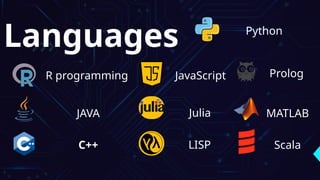
Languages Python
R programming
JAVA
C++
JavaScript
Julia
LISP
Prolog
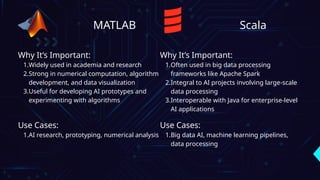
MATLAB
Scala
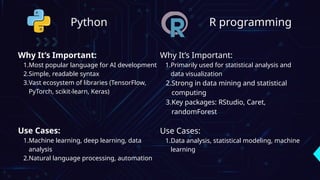
Python R programming
Why It’s Important:
1.Most popular language for AI development
2.Simple, readable syntax
3.Vast ecosystem of libraries (TensorFlow,
PyTorch, scikit-learn, Keras)
Use Cases:
1.Machine learning, deep learning, data
analysis
2.Natural language processing, automation
Why It’s Important:
1.Primarily used for statistical analysis and
data visualization
2.Strong in data mining and statistical
computing
3.Key packages: RStudio, Caret,
randomForest
Use Cases:
1.Data analysis, statistical modeling, machine
learning
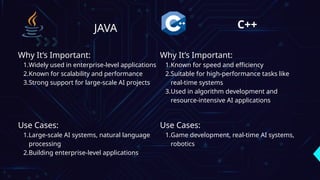
JAVA C++
Why It’s Important:
1.Widely used in enterprise-level applications
2.Known for scalability and performance
3.Strong support for large-scale AI projects
Use Cases:
1.Large-scale AI systems, natural language
processing
2.Building enterprise-level applications
Why It’s Important:
1.Known for speed and efficiency
2.Suitable for high-performance tasks like
real-time systems
3.Used in algorithm development and
resource-intensive AI applications
Use Cases:
1.Game development, real-time AI systems,
robotics
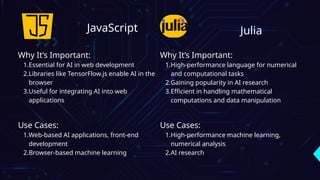
Why It’s Important:
1.Essential for AI in web development
2.Libraries like TensorFlow.js enable AI in the
browser
3.Useful for integrating AI into web
applications
Why It’s Important:
1.High-performance language for numerical
and computational tasks
2.Gaining popularity in AI research
3.Efficient in handling mathematical
computations and data manipulation
Use Cases:
1.High-performance machine learning,
numerical analysis
2.AI research
JavaScript Julia
Use Cases:
1.Web-based AI applications, front-end
development
2.Browser-based machine learning
Why It’s Important:
1.One of the oldest programming languages
with a history in AI
2.Traditionally used in symbolic reasoning and
natural language processing
Why It’s Important:
1.Used for logic programming in AI
2.Suited for symbolic reasoning and
knowledge-based systems
Use Cases:
1.Expert systems, rule-based AI, logical
reasoning
Use Cases:
1.AI research, symbolic AI, natural language
processing
LISP Prolog
Why It’s Important:
1.Widely used in academia and research
2.Strong in numerical computation, algorithm
development, and data visualization
3.Useful for developing AI prototypes and
experimenting with algorithms
Why It’s Important:
1.Often used in big data processing
frameworks like Apache Spark
2.Integral to AI projects involving large-scale
data processing
3.Interoperable with Java for enterprise-level
AI applications
Use Cases:
1.Big data AI, machine learning pipelines,
data processing
Use Cases:
1.AI research, prototyping, numerical analysis
MATLAB Scala
Thank
You
For
Watching
AI training
Toll Free:18002122121

Programming Languages for Artificial Intelligence Development.pptx

  • 1.
    PROGRAMMING LANGUAGES FOR ARTIFICIAL INTELLIGENCEDEVELOPMENT AN OVERVIEW OF KEY LANGUAGES
  • 2.
  • 3.
    Python R programming WhyIt’s Important: 1.Most popular language for AI development 2.Simple, readable syntax 3.Vast ecosystem of libraries (TensorFlow, PyTorch, scikit-learn, Keras) Use Cases: 1.Machine learning, deep learning, data analysis 2.Natural language processing, automation Why It’s Important: 1.Primarily used for statistical analysis and data visualization 2.Strong in data mining and statistical computing 3.Key packages: RStudio, Caret, randomForest Use Cases: 1.Data analysis, statistical modeling, machine learning
  • 4.
    JAVA C++ Why It’sImportant: 1.Widely used in enterprise-level applications 2.Known for scalability and performance 3.Strong support for large-scale AI projects Use Cases: 1.Large-scale AI systems, natural language processing 2.Building enterprise-level applications Why It’s Important: 1.Known for speed and efficiency 2.Suitable for high-performance tasks like real-time systems 3.Used in algorithm development and resource-intensive AI applications Use Cases: 1.Game development, real-time AI systems, robotics
  • 5.
    Why It’s Important: 1.Essentialfor AI in web development 2.Libraries like TensorFlow.js enable AI in the browser 3.Useful for integrating AI into web applications Why It’s Important: 1.High-performance language for numerical and computational tasks 2.Gaining popularity in AI research 3.Efficient in handling mathematical computations and data manipulation Use Cases: 1.High-performance machine learning, numerical analysis 2.AI research JavaScript Julia Use Cases: 1.Web-based AI applications, front-end development 2.Browser-based machine learning
  • 6.
    Why It’s Important: 1.Oneof the oldest programming languages with a history in AI 2.Traditionally used in symbolic reasoning and natural language processing Why It’s Important: 1.Used for logic programming in AI 2.Suited for symbolic reasoning and knowledge-based systems Use Cases: 1.Expert systems, rule-based AI, logical reasoning Use Cases: 1.AI research, symbolic AI, natural language processing LISP Prolog
  • 7.
    Why It’s Important: 1.Widelyused in academia and research 2.Strong in numerical computation, algorithm development, and data visualization 3.Useful for developing AI prototypes and experimenting with algorithms Why It’s Important: 1.Often used in big data processing frameworks like Apache Spark 2.Integral to AI projects involving large-scale data processing 3.Interoperable with Java for enterprise-level AI applications Use Cases: 1.Big data AI, machine learning pipelines, data processing Use Cases: 1.AI research, prototyping, numerical analysis MATLAB Scala
  • 8.