Processing Terabyte Scale
Genomics Datasets with ADAM
Frank Austin Nothaft
University of California, Berkeley
@fnothaft
Genome Resequencing
• When we sequence a human genome, we obtain
several hundred GB of raw sequence data
• With a reference genome, we can use this
sequence to compute diffs between individuals
• Two problems:
• How do we compute this diff?
• How do we make sense of the differences?
Building Scalable Genomics Tools on ADAM
• ADAM is an open source, high performance,
distributed library for genomic analysis
• ADAM defines a:
• Data schema and layout on disk
• Programming interface for distributed processing
of genomic data using Spark + Scala
• Goal is to enable both batch and exploratory analysis
of all types of genomic data
Genomics is built around flattened, single node
tools
• Legacy flat-file formats:
• Manually curated text/binary flat files
• E.g., SAM/BAM → alignment, VCF → variants, BED/GTF/etc → features
• These formats scale poorly beyond single computer storage/compute
capacity
• These legacy formats are functionally limiting and bug-prone:
• What accesses can be optimized (read a full row)
• What predicates can be evaluated (small number of genomic loci)
• How we write genomic algorithms (sorted iterator over genome)
• How we avoid technical lock-in (extend metadata)
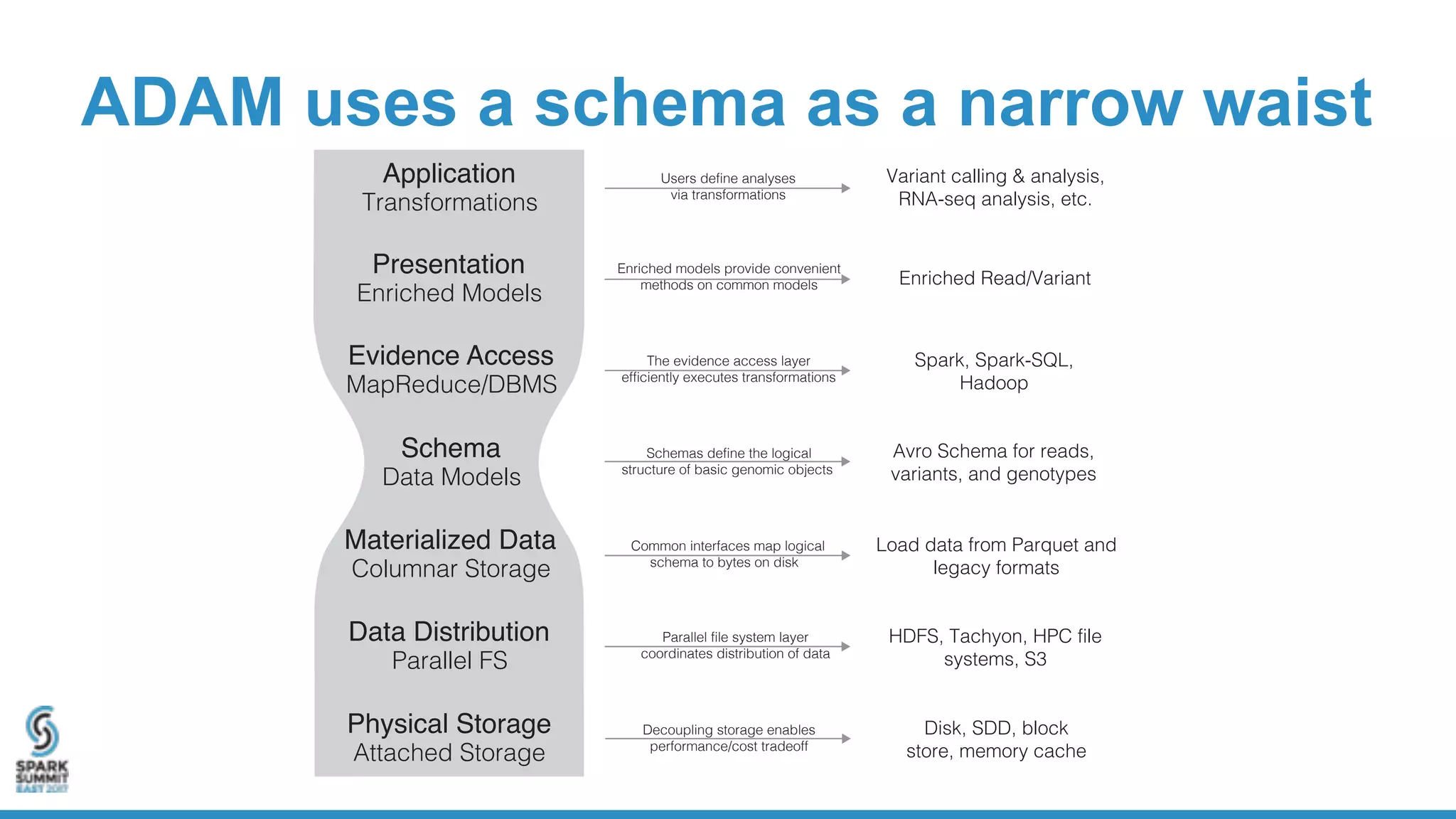
ADAM uses a schema as a narrow waist
Application
Transformations
Physical Storage
Attached Storage
Data Distribution
Parallel FS
Materialized Data
Columnar Storage
Evidence Access
MapReduce/DBMS
Presentation
Enriched Models
Schema
Data Models
Variant calling & analysis,
RNA-seq analysis, etc.
Disk, SDD, block
store, memory cache
HDFS, Tachyon, HPC file
systems, S3
Load data from Parquet and
legacy formats
Spark, Spark-SQL,
Hadoop
Enriched Read/Variant
Avro Schema for reads,
variants, and genotypes
Users define analyses
via transformations
Enriched models provide convenient
methods on common models
The evidence access layer
efficiently executes transformations
Schemas define the logical
structure of basic genomic objects
Common interfaces map logical
schema to bytes on disk
Parallel file system layer
coordinates distribution of data
Decoupling storage enables
performance/cost tradeoff
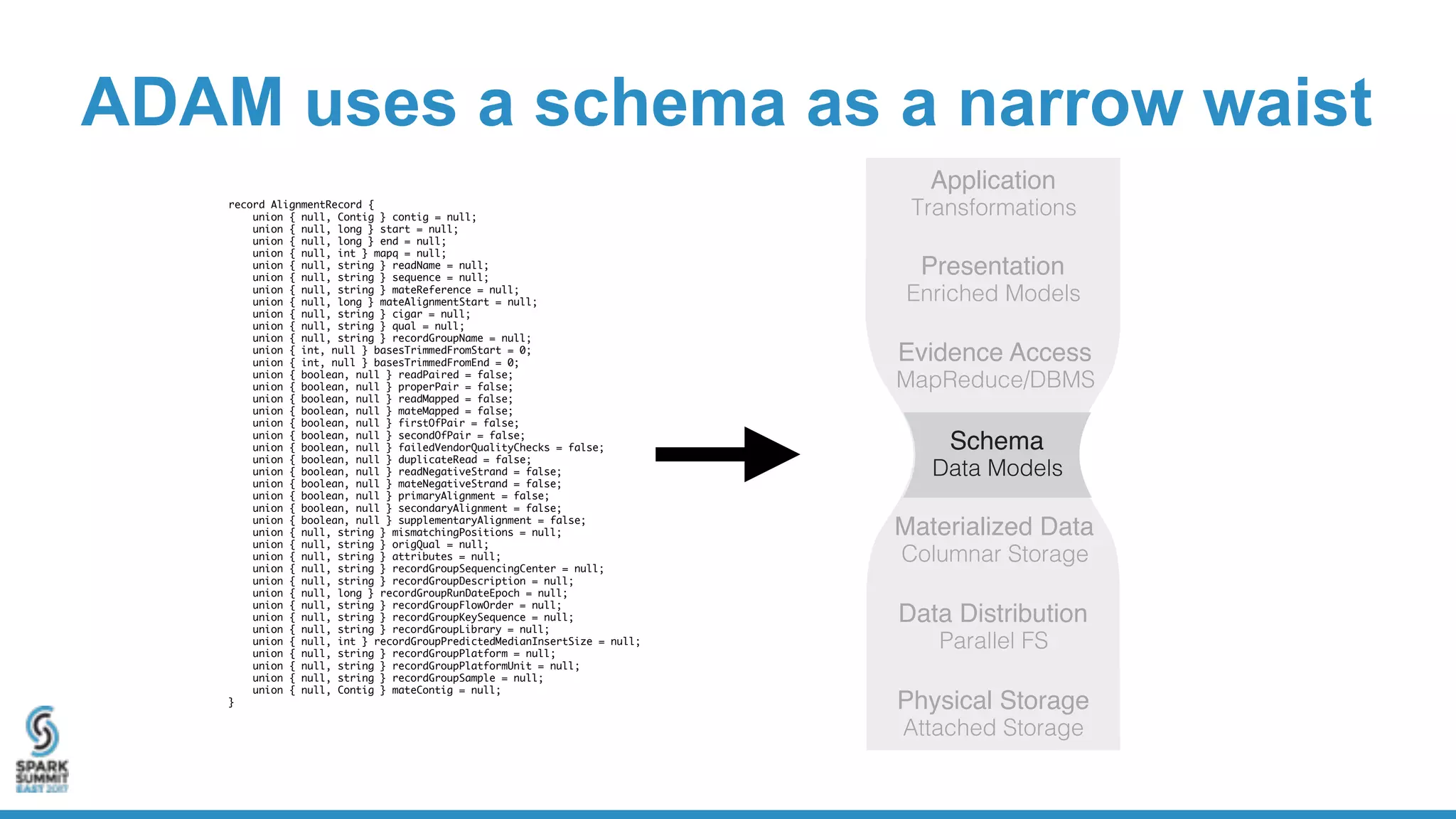
ADAM uses a schema as a narrow waist
Application
Transformations
Physical Storage
Attached Storage
Data Distribution
Parallel FS
Materialized Data
Columnar Storage
Evidence Access
MapReduce/DBMS
Presentation
Enriched Models
Schema
Data Models
record AlignmentRecord {
union { null, Contig } contig = null;
union { null, long } start = null;
union { null, long } end = null;
union { null, int } mapq = null;
union { null, string } readName = null;
union { null, string } sequence = null;
union { null, string } mateReference = null;
union { null, long } mateAlignmentStart = null;
union { null, string } cigar = null;
union { null, string } qual = null;
union { null, string } recordGroupName = null;
union { int, null } basesTrimmedFromStart = 0;
union { int, null } basesTrimmedFromEnd = 0;
union { boolean, null } readPaired = false;
union { boolean, null } properPair = false;
union { boolean, null } readMapped = false;
union { boolean, null } mateMapped = false;
union { boolean, null } firstOfPair = false;
union { boolean, null } secondOfPair = false;
union { boolean, null } failedVendorQualityChecks = false;
union { boolean, null } duplicateRead = false;
union { boolean, null } readNegativeStrand = false;
union { boolean, null } mateNegativeStrand = false;
union { boolean, null } primaryAlignment = false;
union { boolean, null } secondaryAlignment = false;
union { boolean, null } supplementaryAlignment = false;
union { null, string } mismatchingPositions = null;
union { null, string } origQual = null;
union { null, string } attributes = null;
union { null, string } recordGroupSequencingCenter = null;
union { null, string } recordGroupDescription = null;
union { null, long } recordGroupRunDateEpoch = null;
union { null, string } recordGroupFlowOrder = null;
union { null, string } recordGroupKeySequence = null;
union { null, string } recordGroupLibrary = null;
union { null, int } recordGroupPredictedMedianInsertSize = null;
union { null, string } recordGroupPlatform = null;
union { null, string } recordGroupPlatformUnit = null;
union { null, string } recordGroupSample = null;
union { null, Contig } mateContig = null;
}
Application
Transformations
Physical Storage
Attached Storage
Data Distribution
Parallel FS
Materialized Data
Columnar Storage
Evidence Access
MapReduce/DBMS
Presentation
Enriched Models
Schema
Data Models
ADAM uses a schema as a narrow waist
Application
Transformations
Physical Storage
Attached Storage
Data Distribution
Parallel FS
Materialized Data
Columnar Storage
Evidence Access
MapReduce/DBMS
Presentation
Enriched Models
Schema
Data Models
Application
Transformations
Physical Storage
Attached Storage
Data Distribution
Parallel FS
Materialized Data
Columnar Storage
Evidence Access
MapReduce/DBMS
Presentation
Enriched Models
Schema
Data Models
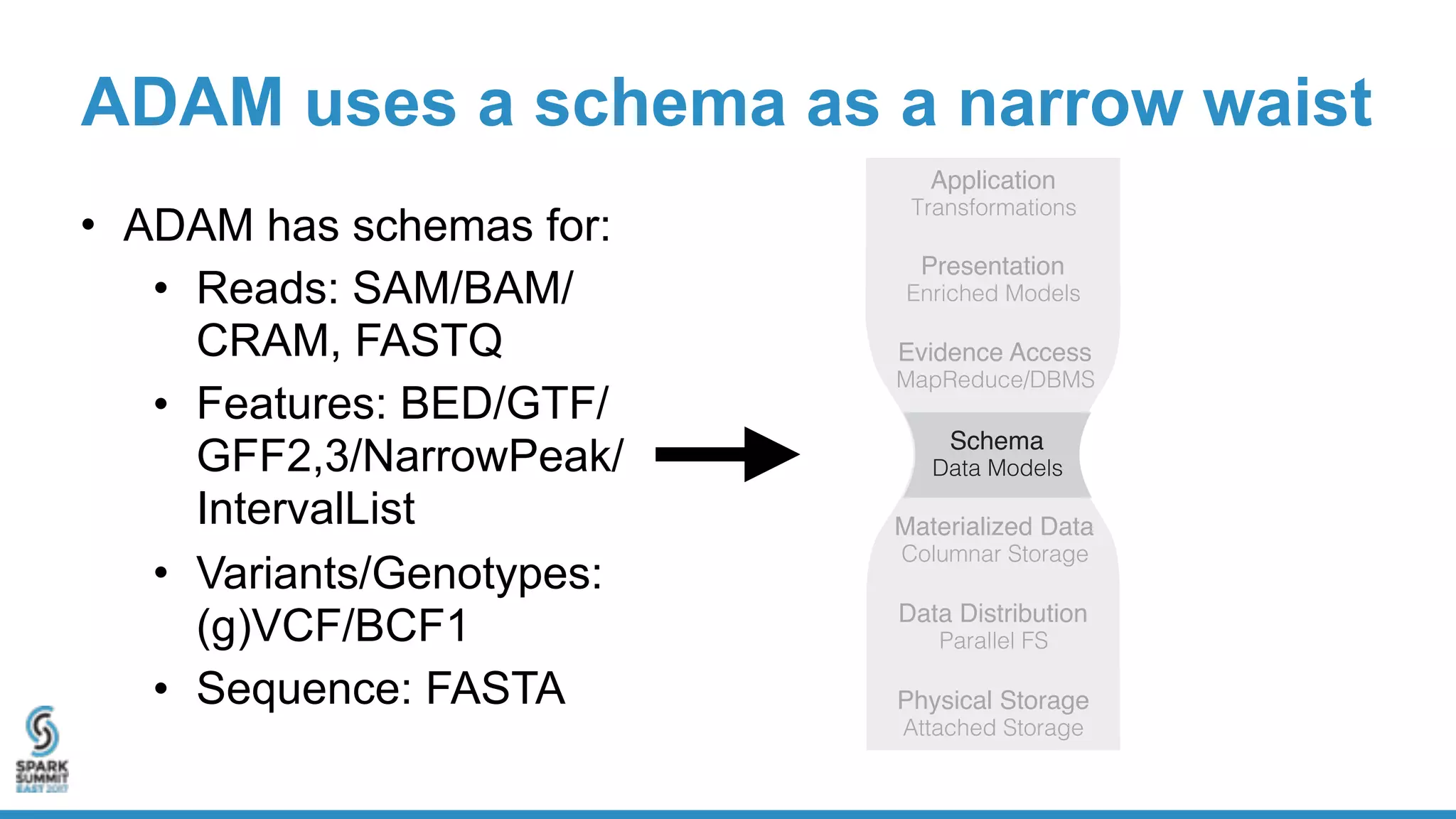
• ADAM has schemas for:
• Reads: SAM/BAM/
CRAM, FASTQ
• Features: BED/GTF/
GFF2,3/NarrowPeak/
IntervalList
• Variants/Genotypes:
(g)VCF/BCF1
• Sequence: FASTA
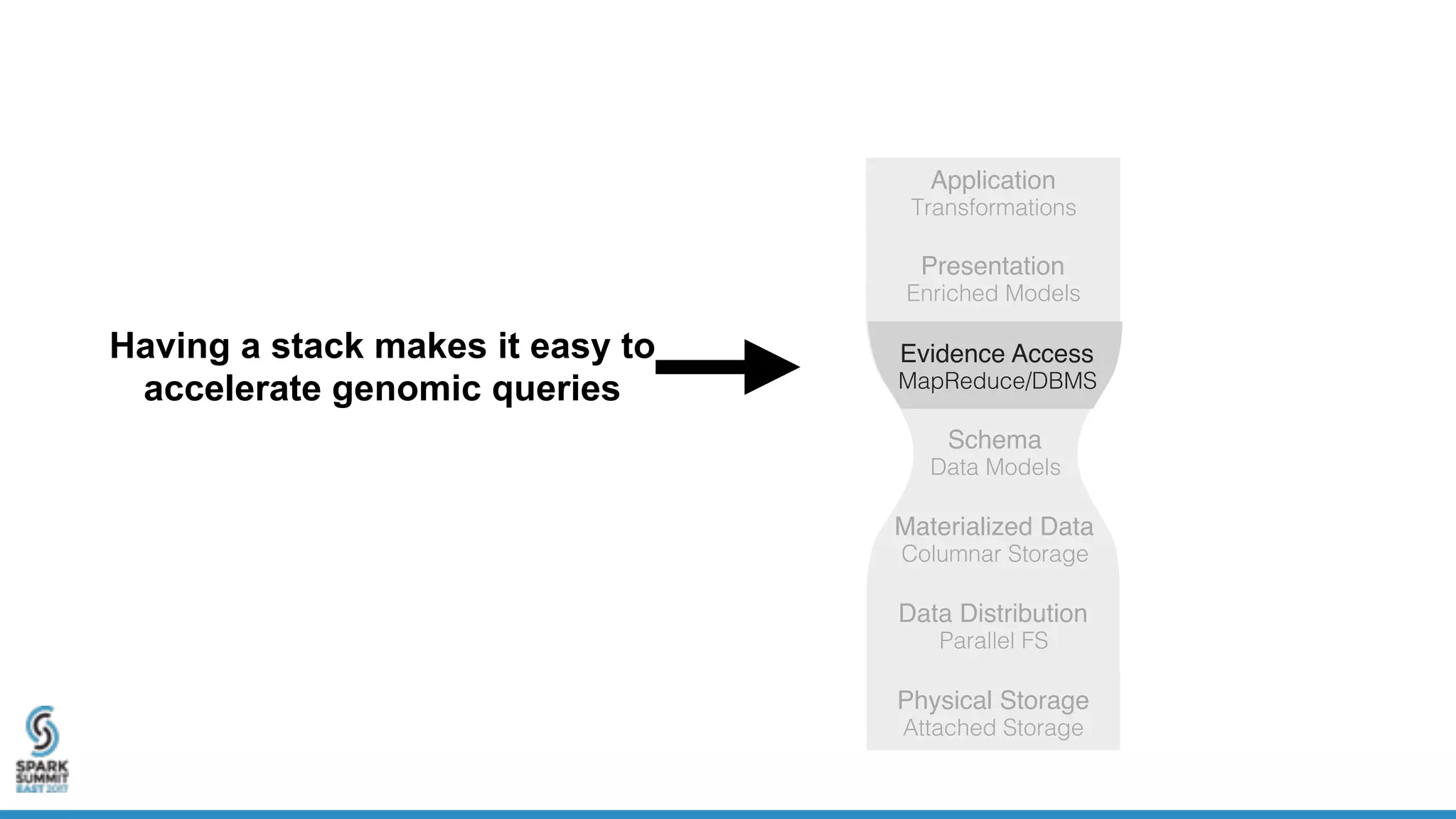
Having a stack makes it easy to
accelerate genomic queries
Application
Transformations
Physical Storage
Attached Storage
Data Distribution
Parallel FS
Materialized Data
Columnar Storage
Evidence Access
MapReduce/DBMS
Presentation
Enriched Models
Schema
Data Models
Application
Transformations
Physical Storage
Attached Storage
Data Distribution
Parallel FS
Materialized Data
Columnar Storage
Evidence Access
MapReduce/DBMS
Presentation
Enriched Models
Schema
Data Models
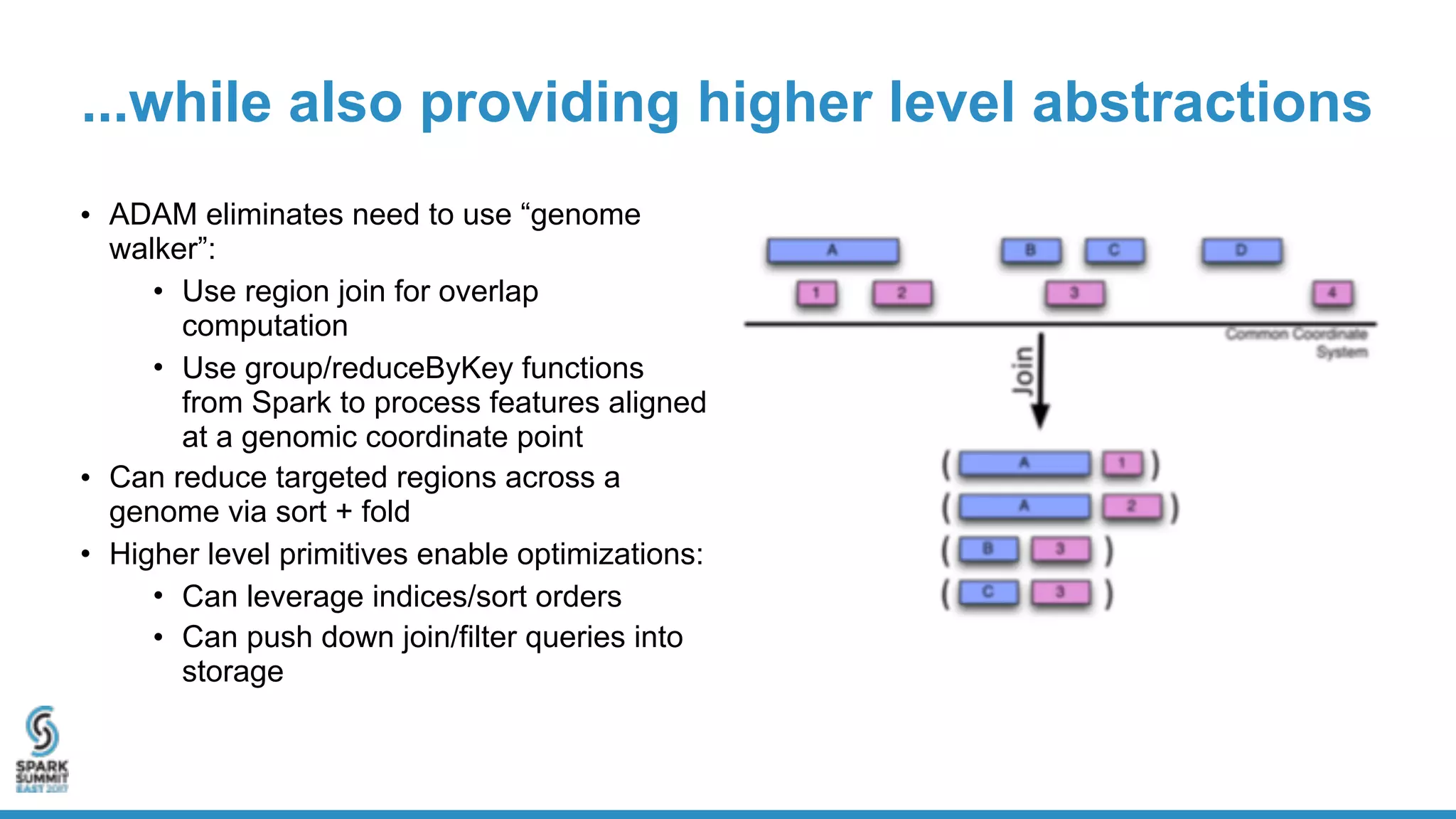
...while also providing higher level abstractions
• ADAM eliminates need to use “genome
walker”:
• Use region join for overlap
computation
• Use group/reduceByKey functions
from Spark to process features aligned
at a genomic coordinate point
• Can reduce targeted regions across a
genome via sort + fold
• Higher level primitives enable optimizations:
• Can leverage indices/sort orders
• Can push down join/filter queries into
storage
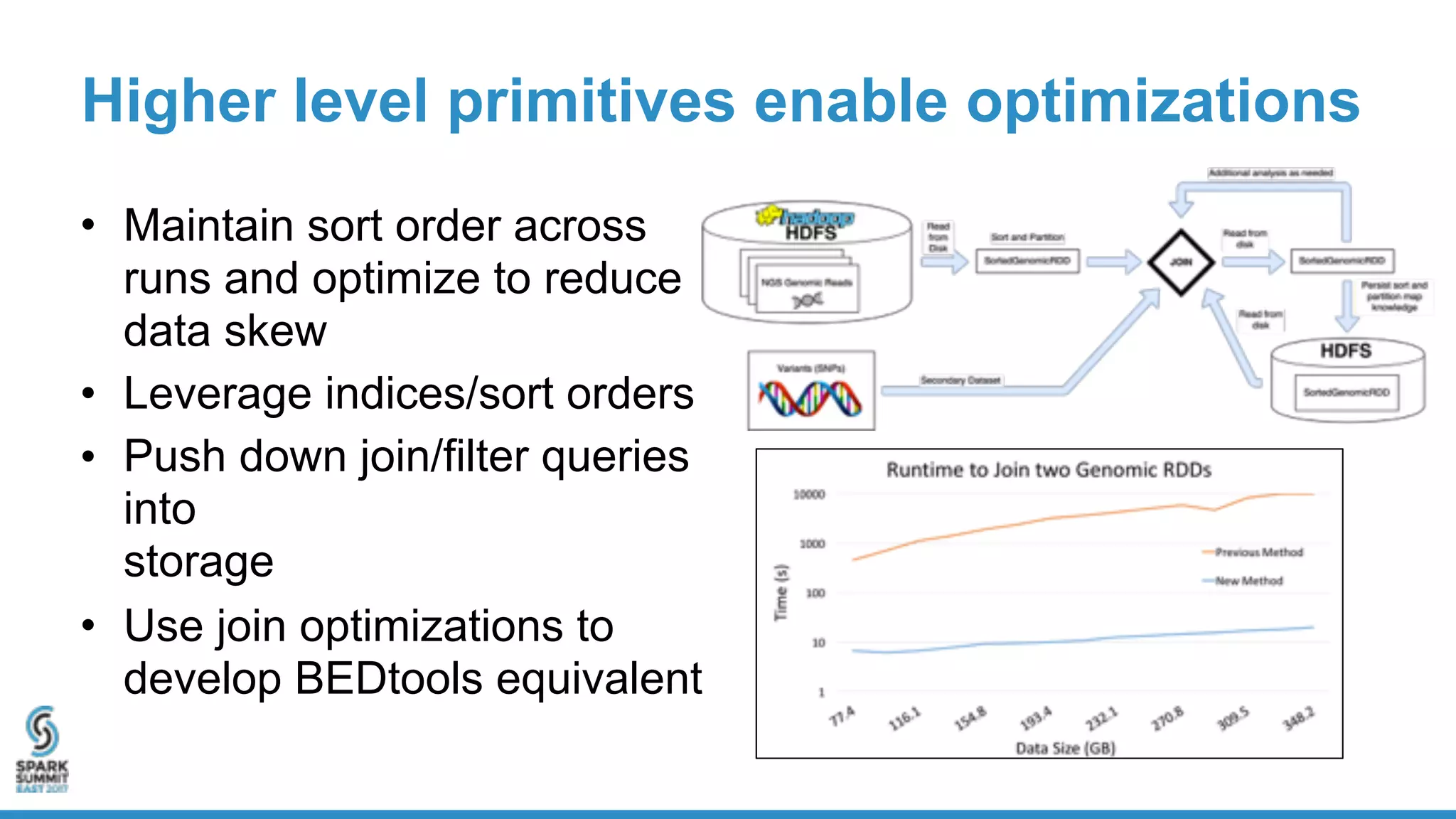
Higher level primitives enable optimizations
• Maintain sort order across
runs and optimize to reduce
data skew
• Leverage indices/sort orders
• Push down join/filter queries
into 

storage
• Use join optimizations to
develop BEDtools equivalent
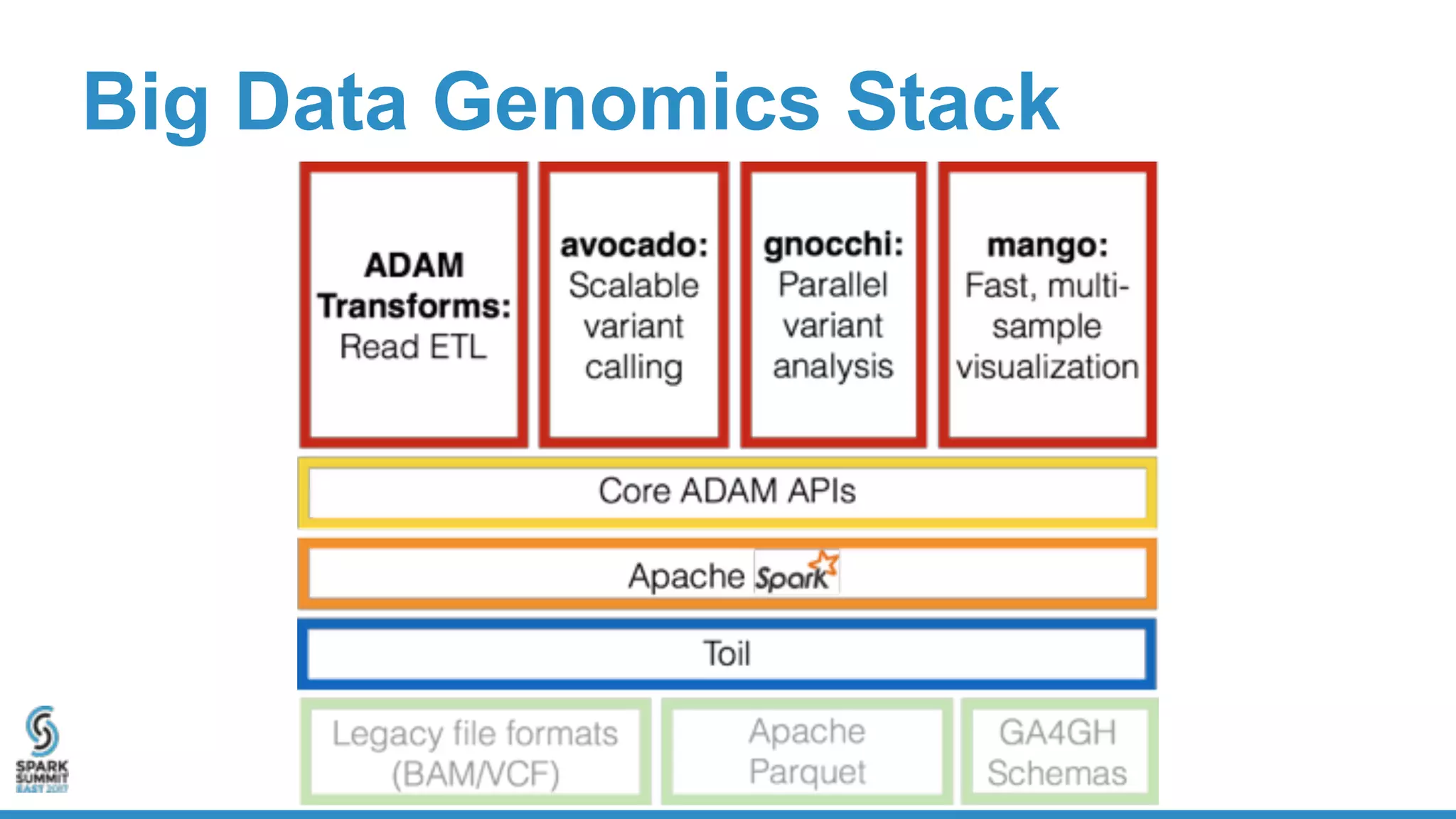
Big Data Genomics Stack
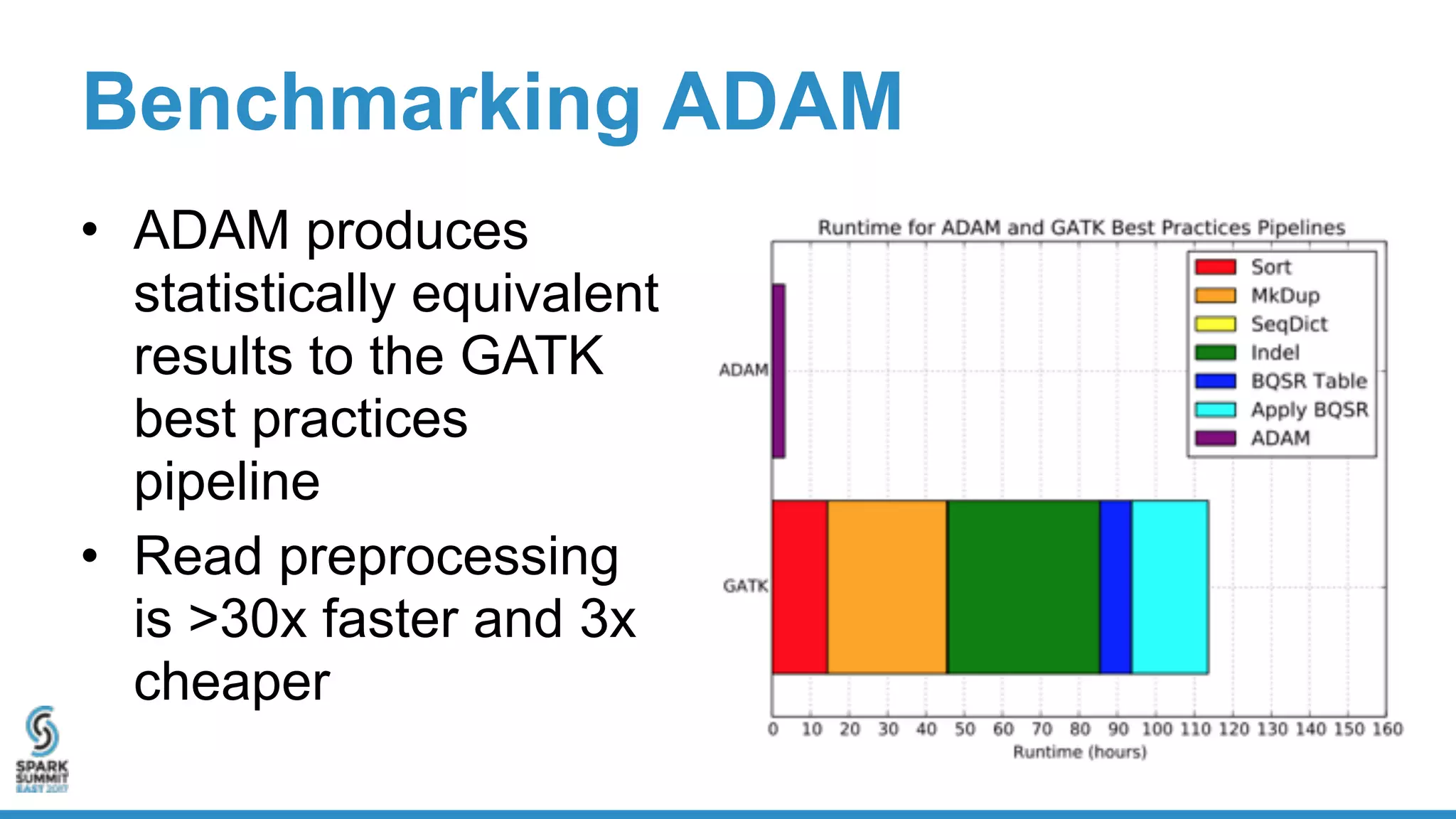
Benchmarking ADAM
• ADAM produces
statistically equivalent
results to the GATK
best practices
pipeline
• Read preprocessing
is >30x faster and 3x
cheaper
Benchmarking ADAM
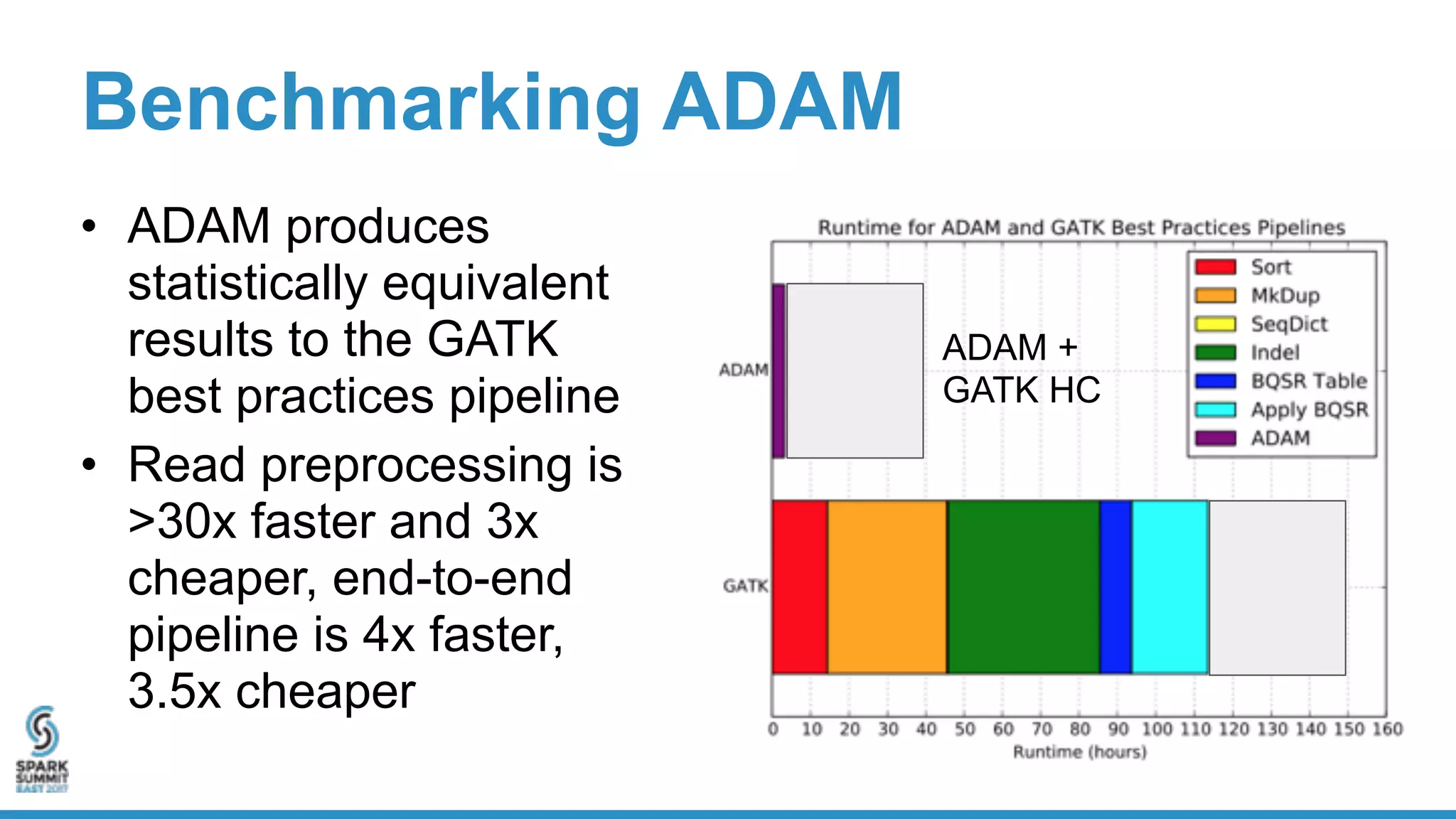
• ADAM produces
statistically equivalent
results to the GATK
best practices pipeline
• Read preprocessing is
>30x faster and 3x
cheaper, end-to-end
pipeline is 4x faster,
3.5x cheaper
ADAM +
GATK HC
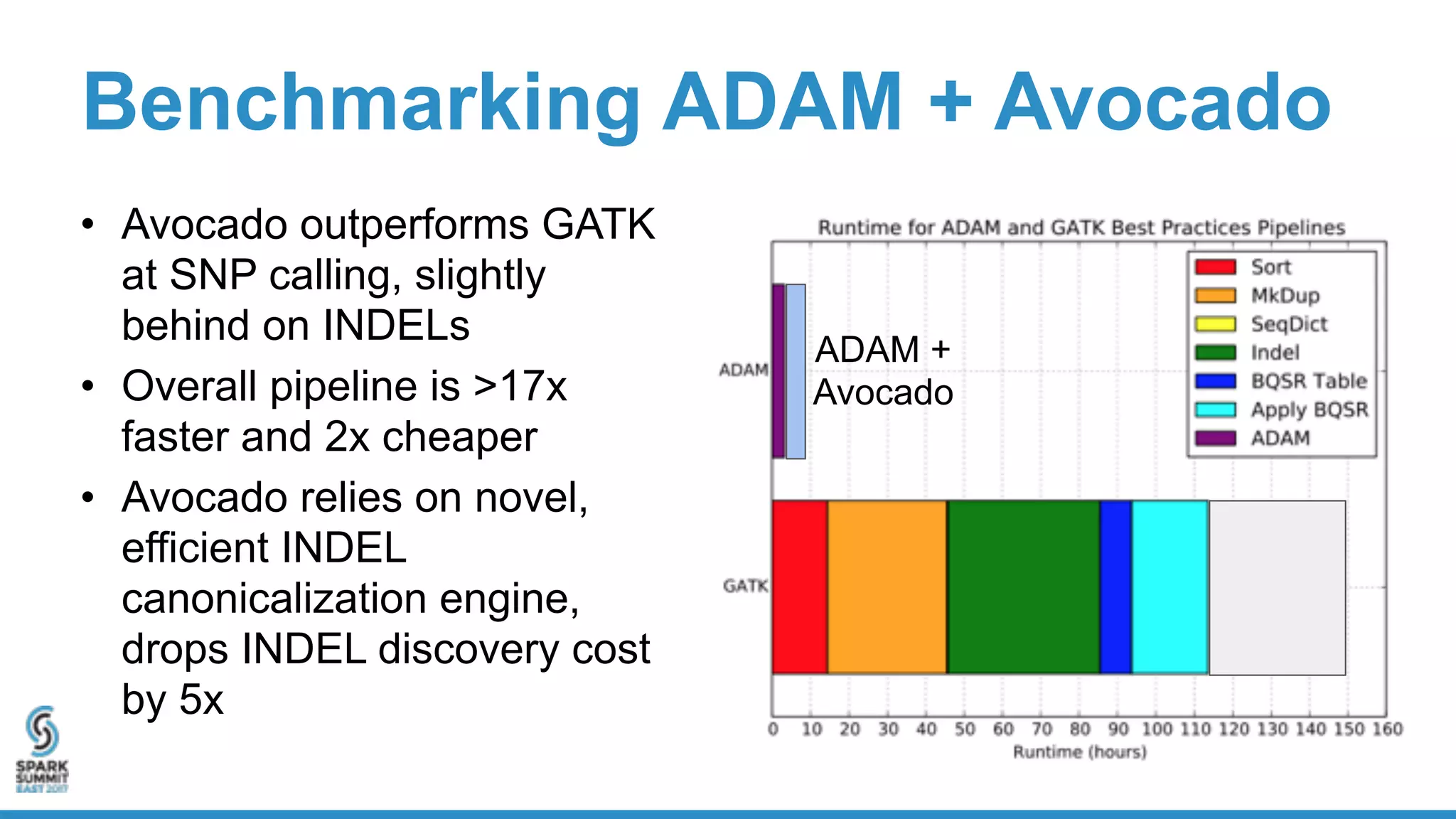
Benchmarking ADAM + Avocado
• Avocado outperforms GATK
at SNP calling, slightly
behind on INDELs
• Overall pipeline is >17x
faster and 2x cheaper
• Avocado relies on novel,
efficient INDEL
canonicalization engine,
drops INDEL discovery cost
by 5x
ADAM +
Avocado
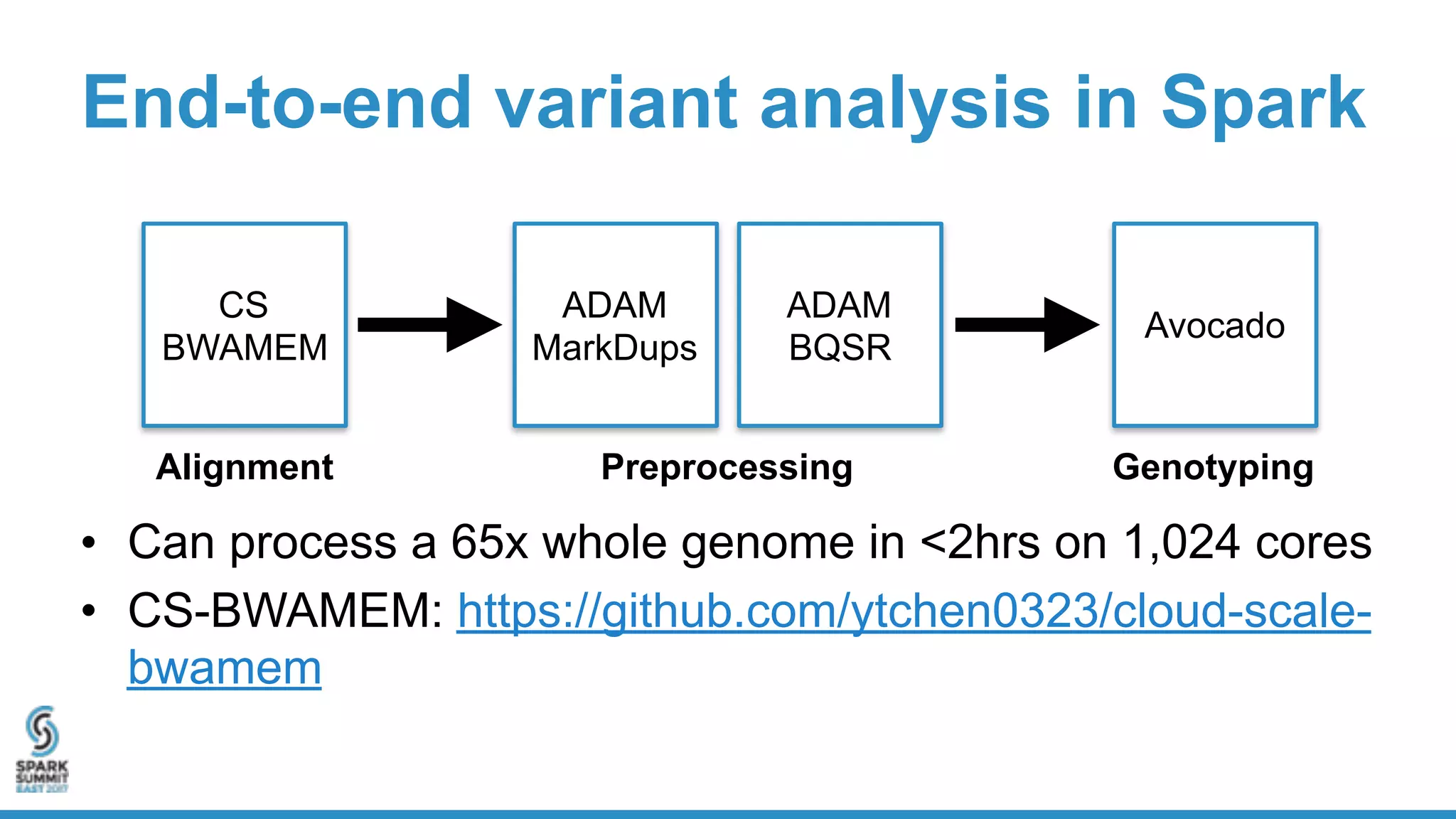
End-to-end variant analysis in Spark
• Can process a 65x whole genome in <2hrs on 1,024 cores
• CS-BWAMEM: https://github.com/ytchen0323/cloud-scale-
bwamem
CS
BWAMEM
Alignment
ADAM
MarkDups
ADAM
BQSR
Preprocessing
Avocado
Genotyping
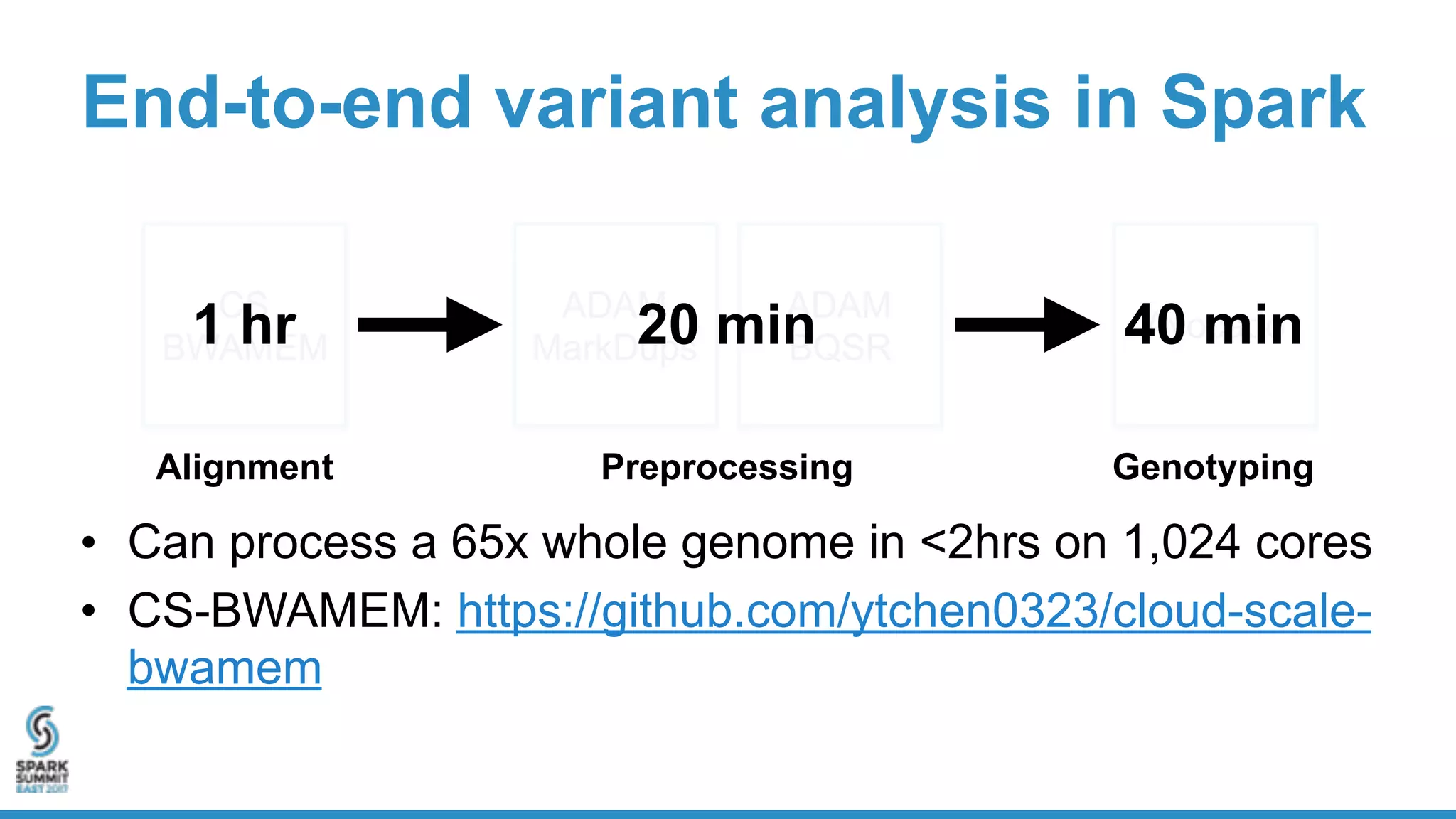
End-to-end variant analysis in Spark
• Can process a 65x whole genome in <2hrs on 1,024 cores
• CS-BWAMEM: https://github.com/ytchen0323/cloud-scale-
bwamem
CS
BWAMEM
Alignment
ADAM
MarkDups
ADAM
BQSR
Preprocessing
Avocado
Genotyping
1 hr 20 min 40 min
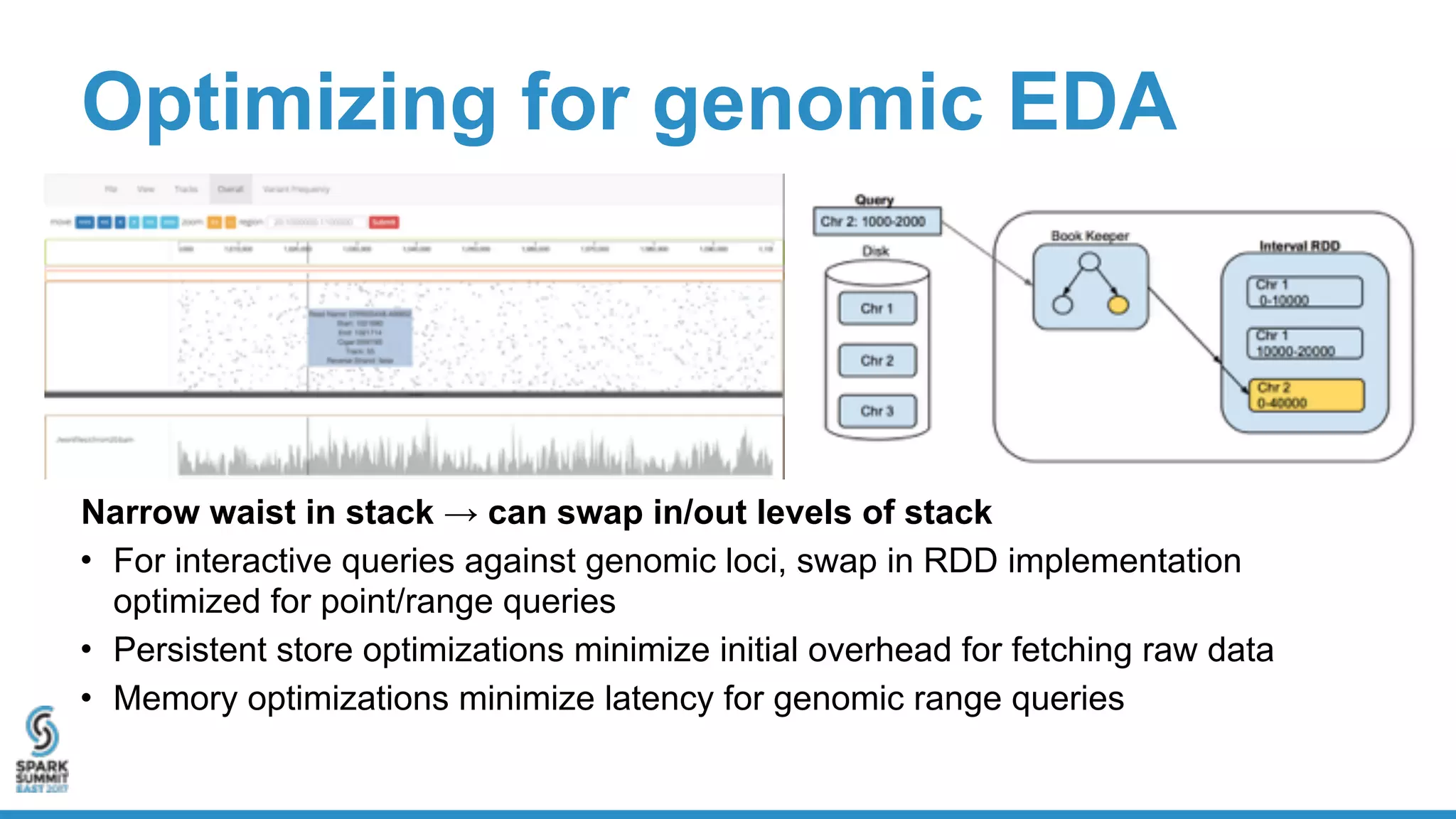
Optimizing for genomic EDA
Narrow waist in stack → can swap in/out levels of stack
• For interactive queries against genomic loci, swap in RDD implementation
optimized for point/range queries
• Persistent store optimizations minimize initial overhead for fetching raw data
• Memory optimizations minimize latency for genomic range queries
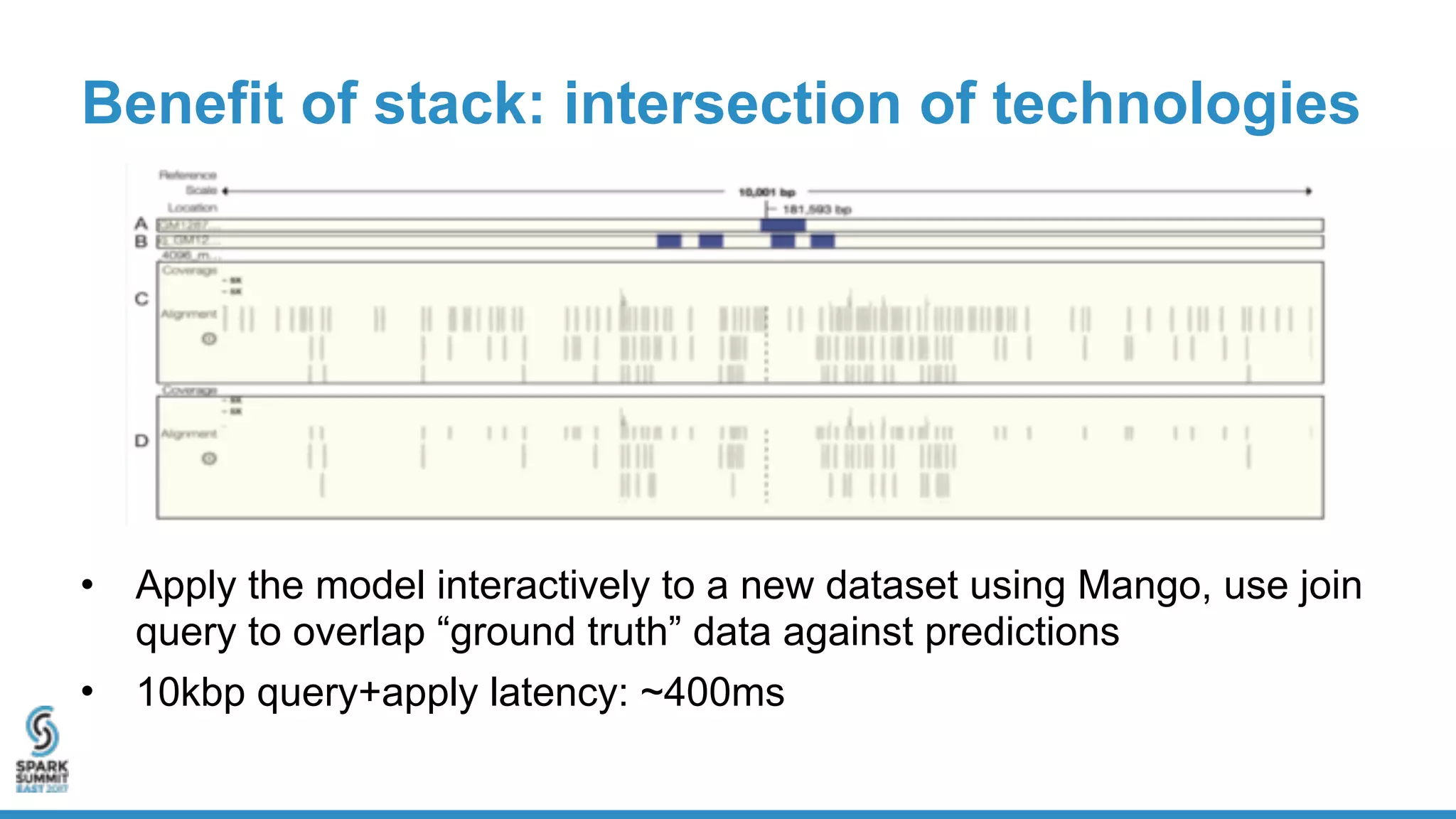
Benefit of stack: intersection of technologies
• Apply the model interactively to a new dataset using Mango, use join
query to overlap “ground truth” data against predictions
• 10kbp query+apply latency: ~400ms
Ongoing work: variant warehousing
• Reads yield genotypes, but we’re often interested
in statistical aggregates across genotypes:
• Probability of seeing a genotype in a
population
• Probability of a genotype associating with a
phenotype
• Data typically is arriving (near) continuously
Demonstrating Incremental Update in Gnocchi
• Problem: want to compute associations between genotypes and phenotypes
(linear/logistic regression)
• Solution: Incremental update of many small GnocchiModels
• Train each distributed model using standard methods
• When new data added, build locally optimized model on new data and
merge resulting model with old model (do not need old data!)
• Work in progress:
• Requires periodic recomputes over entire cohort to remain close to full
recompute solution
• Can limit the number of recomputes by being smart about haplotype
blocks
Acknowledgements
• UC Berkeley: Matt Massie, Timothy Danford, André Schumacher, Jey Kottalam, Karen
Feng, Eric Tu, Alyssa Morrow, Niranjan Kumar, Ananth Pallaseni, Michael Heuer, Justin
Paschall, Taner Dagdelen, Devin Petersohn, Anthony D. Joseph, Dave Patterson
• Mt. Sinai: Arun Ahuja, Neal Sidhwaney, Ryan Williams, Michael Linderman, Jeff
Hammerbacher, Uri Laserson
• GenomeBridge: Carl Yeksigian
• Cloudera: Uri Laserson, Tom White
• Microsoft Research: Ravi Pandya, Bill Bolosky
• UC Santa Cruz: Benedict Paten, David Haussler, Hannes Schmidt, Beau Norgeot,
Audrey Musselman-Brown, John Vivian
• And many other open source contributors, especially Neil Ferguson, Andy Petrella,
Xavier Tordior, Deborah Siegel, Denny Lee
• Over 60 contributors to ADAM/BDG from >12 institutions
Thank You.
Check out the code: https://github.com/bigdatagenomics
Check out a demo: https://databricks.com/blog/2016/05/24/
genome-sequencing-in-a-nutshell.html
Run ADAM in Databricks CE: http://goo.gl/xK8x7s

Processing Terabyte-Scale Genomics Datasets with ADAM: Spark Summit East talk by Frank Austin Nothaft

  • 1.
    Processing Terabyte Scale GenomicsDatasets with ADAM Frank Austin Nothaft University of California, Berkeley @fnothaft
  • 2.
    Genome Resequencing • Whenwe sequence a human genome, we obtain several hundred GB of raw sequence data • With a reference genome, we can use this sequence to compute diffs between individuals • Two problems: • How do we compute this diff? • How do we make sense of the differences?
  • 3.
    Building Scalable GenomicsTools on ADAM • ADAM is an open source, high performance, distributed library for genomic analysis • ADAM defines a: • Data schema and layout on disk • Programming interface for distributed processing of genomic data using Spark + Scala • Goal is to enable both batch and exploratory analysis of all types of genomic data
  • 4.
    Genomics is builtaround flattened, single node tools • Legacy flat-file formats: • Manually curated text/binary flat files • E.g., SAM/BAM → alignment, VCF → variants, BED/GTF/etc → features • These formats scale poorly beyond single computer storage/compute capacity • These legacy formats are functionally limiting and bug-prone: • What accesses can be optimized (read a full row) • What predicates can be evaluated (small number of genomic loci) • How we write genomic algorithms (sorted iterator over genome) • How we avoid technical lock-in (extend metadata)
  • 5.
    ADAM uses aschema as a narrow waist Application Transformations Physical Storage Attached Storage Data Distribution Parallel FS Materialized Data Columnar Storage Evidence Access MapReduce/DBMS Presentation Enriched Models Schema Data Models Variant calling & analysis, RNA-seq analysis, etc. Disk, SDD, block store, memory cache HDFS, Tachyon, HPC file systems, S3 Load data from Parquet and legacy formats Spark, Spark-SQL, Hadoop Enriched Read/Variant Avro Schema for reads, variants, and genotypes Users define analyses via transformations Enriched models provide convenient methods on common models The evidence access layer efficiently executes transformations Schemas define the logical structure of basic genomic objects Common interfaces map logical schema to bytes on disk Parallel file system layer coordinates distribution of data Decoupling storage enables performance/cost tradeoff
  • 6.
    ADAM uses aschema as a narrow waist Application Transformations Physical Storage Attached Storage Data Distribution Parallel FS Materialized Data Columnar Storage Evidence Access MapReduce/DBMS Presentation Enriched Models Schema Data Models record AlignmentRecord { union { null, Contig } contig = null; union { null, long } start = null; union { null, long } end = null; union { null, int } mapq = null; union { null, string } readName = null; union { null, string } sequence = null; union { null, string } mateReference = null; union { null, long } mateAlignmentStart = null; union { null, string } cigar = null; union { null, string } qual = null; union { null, string } recordGroupName = null; union { int, null } basesTrimmedFromStart = 0; union { int, null } basesTrimmedFromEnd = 0; union { boolean, null } readPaired = false; union { boolean, null } properPair = false; union { boolean, null } readMapped = false; union { boolean, null } mateMapped = false; union { boolean, null } firstOfPair = false; union { boolean, null } secondOfPair = false; union { boolean, null } failedVendorQualityChecks = false; union { boolean, null } duplicateRead = false; union { boolean, null } readNegativeStrand = false; union { boolean, null } mateNegativeStrand = false; union { boolean, null } primaryAlignment = false; union { boolean, null } secondaryAlignment = false; union { boolean, null } supplementaryAlignment = false; union { null, string } mismatchingPositions = null; union { null, string } origQual = null; union { null, string } attributes = null; union { null, string } recordGroupSequencingCenter = null; union { null, string } recordGroupDescription = null; union { null, long } recordGroupRunDateEpoch = null; union { null, string } recordGroupFlowOrder = null; union { null, string } recordGroupKeySequence = null; union { null, string } recordGroupLibrary = null; union { null, int } recordGroupPredictedMedianInsertSize = null; union { null, string } recordGroupPlatform = null; union { null, string } recordGroupPlatformUnit = null; union { null, string } recordGroupSample = null; union { null, Contig } mateContig = null; } Application Transformations Physical Storage Attached Storage Data Distribution Parallel FS Materialized Data Columnar Storage Evidence Access MapReduce/DBMS Presentation Enriched Models Schema Data Models
  • 7.
    ADAM uses aschema as a narrow waist Application Transformations Physical Storage Attached Storage Data Distribution Parallel FS Materialized Data Columnar Storage Evidence Access MapReduce/DBMS Presentation Enriched Models Schema Data Models Application Transformations Physical Storage Attached Storage Data Distribution Parallel FS Materialized Data Columnar Storage Evidence Access MapReduce/DBMS Presentation Enriched Models Schema Data Models • ADAM has schemas for: • Reads: SAM/BAM/ CRAM, FASTQ • Features: BED/GTF/ GFF2,3/NarrowPeak/ IntervalList • Variants/Genotypes: (g)VCF/BCF1 • Sequence: FASTA
  • 8.
    Having a stackmakes it easy to accelerate genomic queries Application Transformations Physical Storage Attached Storage Data Distribution Parallel FS Materialized Data Columnar Storage Evidence Access MapReduce/DBMS Presentation Enriched Models Schema Data Models Application Transformations Physical Storage Attached Storage Data Distribution Parallel FS Materialized Data Columnar Storage Evidence Access MapReduce/DBMS Presentation Enriched Models Schema Data Models
  • 9.
    ...while also providinghigher level abstractions • ADAM eliminates need to use “genome walker”: • Use region join for overlap computation • Use group/reduceByKey functions from Spark to process features aligned at a genomic coordinate point • Can reduce targeted regions across a genome via sort + fold • Higher level primitives enable optimizations: • Can leverage indices/sort orders • Can push down join/filter queries into storage
  • 10.
    Higher level primitivesenable optimizations • Maintain sort order across runs and optimize to reduce data skew • Leverage indices/sort orders • Push down join/filter queries into 
 storage • Use join optimizations to develop BEDtools equivalent
  • 11.
  • 12.
    Benchmarking ADAM • ADAMproduces statistically equivalent results to the GATK best practices pipeline • Read preprocessing is >30x faster and 3x cheaper
  • 13.
    Benchmarking ADAM • ADAMproduces statistically equivalent results to the GATK best practices pipeline • Read preprocessing is >30x faster and 3x cheaper, end-to-end pipeline is 4x faster, 3.5x cheaper ADAM + GATK HC
  • 14.
    Benchmarking ADAM +Avocado • Avocado outperforms GATK at SNP calling, slightly behind on INDELs • Overall pipeline is >17x faster and 2x cheaper • Avocado relies on novel, efficient INDEL canonicalization engine, drops INDEL discovery cost by 5x ADAM + Avocado
  • 15.
    End-to-end variant analysisin Spark • Can process a 65x whole genome in <2hrs on 1,024 cores • CS-BWAMEM: https://github.com/ytchen0323/cloud-scale- bwamem CS BWAMEM Alignment ADAM MarkDups ADAM BQSR Preprocessing Avocado Genotyping
  • 16.
    End-to-end variant analysisin Spark • Can process a 65x whole genome in <2hrs on 1,024 cores • CS-BWAMEM: https://github.com/ytchen0323/cloud-scale- bwamem CS BWAMEM Alignment ADAM MarkDups ADAM BQSR Preprocessing Avocado Genotyping 1 hr 20 min 40 min
  • 17.
    Optimizing for genomicEDA Narrow waist in stack → can swap in/out levels of stack • For interactive queries against genomic loci, swap in RDD implementation optimized for point/range queries • Persistent store optimizations minimize initial overhead for fetching raw data • Memory optimizations minimize latency for genomic range queries
  • 18.
    Benefit of stack:intersection of technologies • Apply the model interactively to a new dataset using Mango, use join query to overlap “ground truth” data against predictions • 10kbp query+apply latency: ~400ms
  • 19.
    Ongoing work: variantwarehousing • Reads yield genotypes, but we’re often interested in statistical aggregates across genotypes: • Probability of seeing a genotype in a population • Probability of a genotype associating with a phenotype • Data typically is arriving (near) continuously
  • 20.
    Demonstrating Incremental Updatein Gnocchi • Problem: want to compute associations between genotypes and phenotypes (linear/logistic regression) • Solution: Incremental update of many small GnocchiModels • Train each distributed model using standard methods • When new data added, build locally optimized model on new data and merge resulting model with old model (do not need old data!) • Work in progress: • Requires periodic recomputes over entire cohort to remain close to full recompute solution • Can limit the number of recomputes by being smart about haplotype blocks
  • 21.
    Acknowledgements • UC Berkeley:Matt Massie, Timothy Danford, André Schumacher, Jey Kottalam, Karen Feng, Eric Tu, Alyssa Morrow, Niranjan Kumar, Ananth Pallaseni, Michael Heuer, Justin Paschall, Taner Dagdelen, Devin Petersohn, Anthony D. Joseph, Dave Patterson • Mt. Sinai: Arun Ahuja, Neal Sidhwaney, Ryan Williams, Michael Linderman, Jeff Hammerbacher, Uri Laserson • GenomeBridge: Carl Yeksigian • Cloudera: Uri Laserson, Tom White • Microsoft Research: Ravi Pandya, Bill Bolosky • UC Santa Cruz: Benedict Paten, David Haussler, Hannes Schmidt, Beau Norgeot, Audrey Musselman-Brown, John Vivian • And many other open source contributors, especially Neil Ferguson, Andy Petrella, Xavier Tordior, Deborah Siegel, Denny Lee • Over 60 contributors to ADAM/BDG from >12 institutions
  • 22.
    Thank You. Check outthe code: https://github.com/bigdatagenomics Check out a demo: https://databricks.com/blog/2016/05/24/ genome-sequencing-in-a-nutshell.html Run ADAM in Databricks CE: http://goo.gl/xK8x7s