PROBABLY PROBABILITY
Tackle the Math
Introduction to Probability
Probability
■ Probability is a part of math dealing with the chance of an event occurring.
■ Value between 0 and 1.
■ A probability of 0 means that an event is impossible
■ A probability of 1 means that an event is guaranteed
■ The higher the probability, the more likely the event is to occur.
Probability Definitions
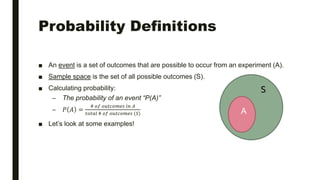
■ An event is a set of outcomes that are possible to occur from an experiment (A).
■ Sample space is the set of all possible outcomes (S).
■ Calculating probability:
– The probability of an event “P(A)”
– 𝑃 𝐴 =
# 𝑜𝑓 𝑜𝑢𝑡𝑐𝑜𝑚𝑒𝑠 𝑖𝑛 𝐴
𝑡𝑜𝑡𝑎𝑙 # 𝑜𝑓 𝑜𝑢𝑡𝑐𝑜𝑚𝑒𝑠 (𝑆)
■ Let’s look at some examples!
S
A
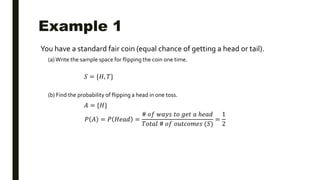
Example 1
You have a standard fair coin (equal chance of getting a head or tail).
(a) Write the sample space for flipping the coin one time.
(b) Find the probability of flipping a head in one toss.
𝑆 = {𝐻, 𝑇}
𝐴 = {𝐻}
𝑃 𝐴 = 𝑃 𝐻𝑒𝑎𝑑 =
# 𝑜𝑓 𝑤𝑎𝑦𝑠 𝑡𝑜 𝑔𝑒𝑡 𝑎 ℎ𝑒𝑎𝑑
𝑇𝑜𝑡𝑎𝑙 # 𝑜𝑓 𝑜𝑢𝑡𝑐𝑜𝑚𝑒𝑠 (𝑆)
=
1
2
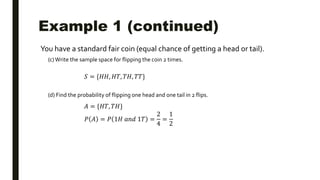
Example 1 (continued)
You have a standard fair coin (equal chance of getting a head or tail).
(c)Write the sample space for flipping the coin 2 times.
(d) Find the probability of flipping one head and one tail in 2 flips.
𝑆 = {𝐻𝐻, 𝐻𝑇, 𝑇𝐻, 𝑇𝑇}
𝐴 = {𝐻𝑇, 𝑇𝐻}
𝑃 𝐴 = 𝑃 1𝐻 𝑎𝑛𝑑 1𝑇 =
2
4
=
1
2
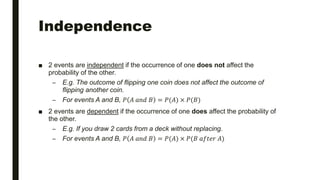
Independence
■ 2 events are independent if the occurrence of one does not affect the
probability of the other.
– E.g. The outcome of flipping one coin does not affect the outcome of
flipping another coin.
– For events A and B, 𝑃 𝐴 𝑎𝑛𝑑 𝐵 = 𝑃(𝐴) × 𝑃(𝐵)
■ 2 events are dependent if the occurrence of one does affect the probability of
the other.
– E.g. If you draw 2 cards from a deck without replacing.
– For events A and B, 𝑃 𝐴 𝑎𝑛𝑑 𝐵 = 𝑃(𝐴) × 𝑃(𝐵 𝑎𝑓𝑡𝑒𝑟 𝐴)
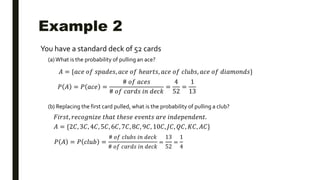
Example 2
You have a standard deck of 52 cards
(a) What is the probability of pulling an ace?
(b) Replacing the first card pulled, what is the probability of pulling a club?
𝐴 = {𝑎𝑐𝑒 𝑜𝑓 𝑠𝑝𝑎𝑑𝑒𝑠, 𝑎𝑐𝑒 𝑜𝑓 ℎ𝑒𝑎𝑟𝑡𝑠, 𝑎𝑐𝑒 𝑜𝑓 𝑐𝑙𝑢𝑏𝑠, 𝑎𝑐𝑒 𝑜𝑓 𝑑𝑖𝑎𝑚𝑜𝑛𝑑𝑠}
𝑃 𝐴 = 𝑃 𝑎𝑐𝑒 =
# 𝑜𝑓 𝑎𝑐𝑒𝑠
# 𝑜𝑓 𝑐𝑎𝑟𝑑𝑠 𝑖𝑛 𝑑𝑒𝑐𝑘
=
4
52
=
1
13
𝐹𝑖𝑟𝑠𝑡, 𝑟𝑒𝑐𝑜𝑔𝑛𝑖𝑧𝑒 𝑡ℎ𝑎𝑡 𝑡ℎ𝑒𝑠𝑒 𝑒𝑣𝑒𝑛𝑡𝑠 𝑎𝑟𝑒 𝑖𝑛𝑑𝑒𝑝𝑒𝑛𝑑𝑒𝑛𝑡.
𝐴 = {2𝐶, 3𝐶, 4𝐶, 5𝐶, 6𝐶, 7𝐶, 8𝐶, 9𝐶, 10𝐶, 𝐽𝐶, 𝑄𝐶, 𝐾𝐶, 𝐴𝐶}
𝑃 𝐴 = 𝑃 𝑐𝑙𝑢𝑏 =
# 𝑜𝑓 𝑐𝑙𝑢𝑏𝑠 𝑖𝑛 𝑑𝑒𝑐𝑘
# 𝑜𝑓 𝑐𝑎𝑟𝑑𝑠 𝑖𝑛 𝑑𝑒𝑐𝑘
=
13
52
=
1
4
Example 2 (continued)
You have a standard deck of 52 cards
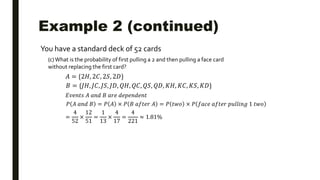
(c)What is the probability of first pulling a 2 and then pulling a face card
without replacing the first card?
𝐴 = {2𝐻, 2𝐶, 2𝑆, 2𝐷}
𝐵 = {𝐽𝐻, 𝐽𝐶, 𝐽𝑆, 𝐽𝐷, 𝑄𝐻, 𝑄𝐶, 𝑄𝑆, 𝑄𝐷, 𝐾𝐻, 𝐾𝐶, 𝐾𝑆, 𝐾𝐷}
𝐸𝑣𝑒𝑛𝑡𝑠 𝐴 𝑎𝑛𝑑 𝐵 𝑎𝑟𝑒 𝑑𝑒𝑝𝑒𝑛𝑑𝑒𝑛𝑡
𝑃 𝐴 𝑎𝑛𝑑 𝐵 = 𝑃 𝐴 × 𝑃 𝐵 𝑎𝑓𝑡𝑒𝑟 𝐴 = 𝑃 𝑡𝑤𝑜 × 𝑃 𝑓𝑎𝑐𝑒 𝑎𝑓𝑡𝑒𝑟 𝑝𝑢𝑙𝑙𝑖𝑛𝑔 1 𝑡𝑤𝑜
=
4
52
×
12
51
=
1
13
×
4
17
=
4
221
≈ 1.81%
Example 2 (continued)
You have a standard deck of 52 cards
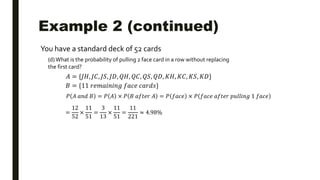
(d)What is the probability of pulling 2 face card in a row without replacing
the first card?
𝐴 = {𝐽𝐻, 𝐽𝐶, 𝐽𝑆, 𝐽𝐷, 𝑄𝐻, 𝑄𝐶, 𝑄𝑆, 𝑄𝐷, 𝐾𝐻, 𝐾𝐶, 𝐾𝑆, 𝐾𝐷}
𝐵 = {11 𝑟𝑒𝑚𝑎𝑖𝑛𝑖𝑛𝑔 𝑓𝑎𝑐𝑒 𝑐𝑎𝑟𝑑𝑠}
𝑃 𝐴 𝑎𝑛𝑑 𝐵 = 𝑃 𝐴 × 𝑃 𝐵 𝑎𝑓𝑡𝑒𝑟 𝐴 = 𝑃 𝑓𝑎𝑐𝑒 × 𝑃 𝑓𝑎𝑐𝑒 𝑎𝑓𝑡𝑒𝑟 𝑝𝑢𝑙𝑙𝑖𝑛𝑔 1 𝑓𝑎𝑐𝑒
=
12
52
×
11
51
=
3
13
×
11
51
=
11
221
≈ 4.98%
Odds
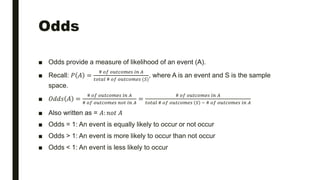
■ Odds provide a measure of likelihood of an event (A).
■ Recall: 𝑃 𝐴 =
# 𝑜𝑓 𝑜𝑢𝑡𝑐𝑜𝑚𝑒𝑠 𝑖𝑛 𝐴
𝑡𝑜𝑡𝑎𝑙 # 𝑜𝑓 𝑜𝑢𝑡𝑐𝑜𝑚𝑒𝑠 (𝑆)
, where A is an event and S is the sample
space.
■ 𝑂𝑑𝑑𝑠 𝐴 =
# 𝑜𝑓 𝑜𝑢𝑡𝑐𝑜𝑚𝑒𝑠 𝑖𝑛 𝐴
# 𝑜𝑓 𝑜𝑢𝑡𝑐𝑜𝑚𝑒𝑠 𝑛𝑜𝑡 𝑖𝑛 𝐴
=
# 𝑜𝑓 𝑜𝑢𝑡𝑐𝑜𝑚𝑒𝑠 𝑖𝑛 𝐴
𝑡𝑜𝑡𝑎𝑙 # 𝑜𝑓 𝑜𝑢𝑡𝑐𝑜𝑚𝑒𝑠 𝑆 − # 𝑜𝑓 𝑜𝑢𝑡𝑐𝑜𝑚𝑒𝑠 𝑖𝑛 𝐴
■ Also written as = 𝐴: 𝑛𝑜𝑡 𝐴
■ Odds = 1: An event is equally likely to occur or not occur
■ Odds > 1: An event is more likely to occur than not occur
■ Odds < 1: An event is less likely to occur
Example 3
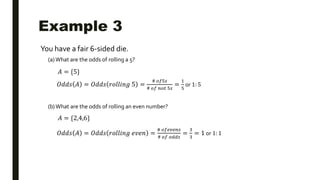
You have a fair 6-sided die.
(a) What are the odds of rolling a 5?
(b)What are the odds of rolling an even number?
𝐴 = {5}
𝑂𝑑𝑑𝑠 𝐴 = 𝑂𝑑𝑑𝑠 𝑟𝑜𝑙𝑙𝑖𝑛𝑔 5 =
# 𝑜𝑓5𝑠
# 𝑜𝑓 𝑛𝑜𝑡 5𝑠
=
1
5
or 1: 5
𝐴 = {2,4,6}
𝑂𝑑𝑑𝑠 𝐴 = 𝑂𝑑𝑑𝑠 𝑟𝑜𝑙𝑙𝑖𝑛𝑔 𝑒𝑣𝑒𝑛 =
# 𝑜𝑓𝑒𝑣𝑒𝑛𝑠
# 𝑜𝑓 𝑜𝑑𝑑𝑠
=
3
3
= 1 or 1: 1
Your Turn
You have 2 fair, 6-sided dice.
(a) What is the probability that both dice show even numbers?
(b)What is the probability that the 2 dice add up to 8?
UPCOMING
EVENTS
■ Tackle the Math Series
– Why Does Order Matter?
– 4 Out of 3 People Struggle
with Math
– Probably Probability
– Do You Know the Line?
– Beating the System (of
Equations)
Our Services
Study Help
• Drop-In Study Help for all courses
• Study Groups
• On-Track Appointments
• Question Drop-Off
Tech Help
• Drop-In Student Tech Help
• Ask-a-Lab Associate Question Drop-off
• Get Tech Ready and Appy Hour Workshops
Learning Help
• Check out our collection of self-service resources that supplement classroom materials
Get In Touch!
www.wccnet.edu/LC (live chat assistance offered during regular hours)
(734) 973-3420
Lab Email: LCLab@wccnet.edu
Tutoring Email: TutorWCC@wccnet.edu

Probably probability

  • 1.
    PROBABLY PROBABILITY Tackle theMath Introduction to Probability
  • 2.
    Probability ■ Probability isa part of math dealing with the chance of an event occurring. ■ Value between 0 and 1. ■ A probability of 0 means that an event is impossible ■ A probability of 1 means that an event is guaranteed ■ The higher the probability, the more likely the event is to occur.
  • 3.
    Probability Definitions ■ Anevent is a set of outcomes that are possible to occur from an experiment (A). ■ Sample space is the set of all possible outcomes (S). ■ Calculating probability: – The probability of an event “P(A)” – 𝑃 𝐴 = # 𝑜𝑓 𝑜𝑢𝑡𝑐𝑜𝑚𝑒𝑠 𝑖𝑛 𝐴 𝑡𝑜𝑡𝑎𝑙 # 𝑜𝑓 𝑜𝑢𝑡𝑐𝑜𝑚𝑒𝑠 (𝑆) ■ Let’s look at some examples! S A
  • 4.
    Example 1 You havea standard fair coin (equal chance of getting a head or tail). (a) Write the sample space for flipping the coin one time. (b) Find the probability of flipping a head in one toss. 𝑆 = {𝐻, 𝑇} 𝐴 = {𝐻} 𝑃 𝐴 = 𝑃 𝐻𝑒𝑎𝑑 = # 𝑜𝑓 𝑤𝑎𝑦𝑠 𝑡𝑜 𝑔𝑒𝑡 𝑎 ℎ𝑒𝑎𝑑 𝑇𝑜𝑡𝑎𝑙 # 𝑜𝑓 𝑜𝑢𝑡𝑐𝑜𝑚𝑒𝑠 (𝑆) = 1 2
  • 5.
    Example 1 (continued) Youhave a standard fair coin (equal chance of getting a head or tail). (c)Write the sample space for flipping the coin 2 times. (d) Find the probability of flipping one head and one tail in 2 flips. 𝑆 = {𝐻𝐻, 𝐻𝑇, 𝑇𝐻, 𝑇𝑇} 𝐴 = {𝐻𝑇, 𝑇𝐻} 𝑃 𝐴 = 𝑃 1𝐻 𝑎𝑛𝑑 1𝑇 = 2 4 = 1 2
  • 6.
    Independence ■ 2 eventsare independent if the occurrence of one does not affect the probability of the other. – E.g. The outcome of flipping one coin does not affect the outcome of flipping another coin. – For events A and B, 𝑃 𝐴 𝑎𝑛𝑑 𝐵 = 𝑃(𝐴) × 𝑃(𝐵) ■ 2 events are dependent if the occurrence of one does affect the probability of the other. – E.g. If you draw 2 cards from a deck without replacing. – For events A and B, 𝑃 𝐴 𝑎𝑛𝑑 𝐵 = 𝑃(𝐴) × 𝑃(𝐵 𝑎𝑓𝑡𝑒𝑟 𝐴)
  • 7.
    Example 2 You havea standard deck of 52 cards (a) What is the probability of pulling an ace? (b) Replacing the first card pulled, what is the probability of pulling a club? 𝐴 = {𝑎𝑐𝑒 𝑜𝑓 𝑠𝑝𝑎𝑑𝑒𝑠, 𝑎𝑐𝑒 𝑜𝑓 ℎ𝑒𝑎𝑟𝑡𝑠, 𝑎𝑐𝑒 𝑜𝑓 𝑐𝑙𝑢𝑏𝑠, 𝑎𝑐𝑒 𝑜𝑓 𝑑𝑖𝑎𝑚𝑜𝑛𝑑𝑠} 𝑃 𝐴 = 𝑃 𝑎𝑐𝑒 = # 𝑜𝑓 𝑎𝑐𝑒𝑠 # 𝑜𝑓 𝑐𝑎𝑟𝑑𝑠 𝑖𝑛 𝑑𝑒𝑐𝑘 = 4 52 = 1 13 𝐹𝑖𝑟𝑠𝑡, 𝑟𝑒𝑐𝑜𝑔𝑛𝑖𝑧𝑒 𝑡ℎ𝑎𝑡 𝑡ℎ𝑒𝑠𝑒 𝑒𝑣𝑒𝑛𝑡𝑠 𝑎𝑟𝑒 𝑖𝑛𝑑𝑒𝑝𝑒𝑛𝑑𝑒𝑛𝑡. 𝐴 = {2𝐶, 3𝐶, 4𝐶, 5𝐶, 6𝐶, 7𝐶, 8𝐶, 9𝐶, 10𝐶, 𝐽𝐶, 𝑄𝐶, 𝐾𝐶, 𝐴𝐶} 𝑃 𝐴 = 𝑃 𝑐𝑙𝑢𝑏 = # 𝑜𝑓 𝑐𝑙𝑢𝑏𝑠 𝑖𝑛 𝑑𝑒𝑐𝑘 # 𝑜𝑓 𝑐𝑎𝑟𝑑𝑠 𝑖𝑛 𝑑𝑒𝑐𝑘 = 13 52 = 1 4
  • 8.
    Example 2 (continued) Youhave a standard deck of 52 cards (c)What is the probability of first pulling a 2 and then pulling a face card without replacing the first card? 𝐴 = {2𝐻, 2𝐶, 2𝑆, 2𝐷} 𝐵 = {𝐽𝐻, 𝐽𝐶, 𝐽𝑆, 𝐽𝐷, 𝑄𝐻, 𝑄𝐶, 𝑄𝑆, 𝑄𝐷, 𝐾𝐻, 𝐾𝐶, 𝐾𝑆, 𝐾𝐷} 𝐸𝑣𝑒𝑛𝑡𝑠 𝐴 𝑎𝑛𝑑 𝐵 𝑎𝑟𝑒 𝑑𝑒𝑝𝑒𝑛𝑑𝑒𝑛𝑡 𝑃 𝐴 𝑎𝑛𝑑 𝐵 = 𝑃 𝐴 × 𝑃 𝐵 𝑎𝑓𝑡𝑒𝑟 𝐴 = 𝑃 𝑡𝑤𝑜 × 𝑃 𝑓𝑎𝑐𝑒 𝑎𝑓𝑡𝑒𝑟 𝑝𝑢𝑙𝑙𝑖𝑛𝑔 1 𝑡𝑤𝑜 = 4 52 × 12 51 = 1 13 × 4 17 = 4 221 ≈ 1.81%
  • 9.
    Example 2 (continued) Youhave a standard deck of 52 cards (d)What is the probability of pulling 2 face card in a row without replacing the first card? 𝐴 = {𝐽𝐻, 𝐽𝐶, 𝐽𝑆, 𝐽𝐷, 𝑄𝐻, 𝑄𝐶, 𝑄𝑆, 𝑄𝐷, 𝐾𝐻, 𝐾𝐶, 𝐾𝑆, 𝐾𝐷} 𝐵 = {11 𝑟𝑒𝑚𝑎𝑖𝑛𝑖𝑛𝑔 𝑓𝑎𝑐𝑒 𝑐𝑎𝑟𝑑𝑠} 𝑃 𝐴 𝑎𝑛𝑑 𝐵 = 𝑃 𝐴 × 𝑃 𝐵 𝑎𝑓𝑡𝑒𝑟 𝐴 = 𝑃 𝑓𝑎𝑐𝑒 × 𝑃 𝑓𝑎𝑐𝑒 𝑎𝑓𝑡𝑒𝑟 𝑝𝑢𝑙𝑙𝑖𝑛𝑔 1 𝑓𝑎𝑐𝑒 = 12 52 × 11 51 = 3 13 × 11 51 = 11 221 ≈ 4.98%
  • 10.
    Odds ■ Odds providea measure of likelihood of an event (A). ■ Recall: 𝑃 𝐴 = # 𝑜𝑓 𝑜𝑢𝑡𝑐𝑜𝑚𝑒𝑠 𝑖𝑛 𝐴 𝑡𝑜𝑡𝑎𝑙 # 𝑜𝑓 𝑜𝑢𝑡𝑐𝑜𝑚𝑒𝑠 (𝑆) , where A is an event and S is the sample space. ■ 𝑂𝑑𝑑𝑠 𝐴 = # 𝑜𝑓 𝑜𝑢𝑡𝑐𝑜𝑚𝑒𝑠 𝑖𝑛 𝐴 # 𝑜𝑓 𝑜𝑢𝑡𝑐𝑜𝑚𝑒𝑠 𝑛𝑜𝑡 𝑖𝑛 𝐴 = # 𝑜𝑓 𝑜𝑢𝑡𝑐𝑜𝑚𝑒𝑠 𝑖𝑛 𝐴 𝑡𝑜𝑡𝑎𝑙 # 𝑜𝑓 𝑜𝑢𝑡𝑐𝑜𝑚𝑒𝑠 𝑆 − # 𝑜𝑓 𝑜𝑢𝑡𝑐𝑜𝑚𝑒𝑠 𝑖𝑛 𝐴 ■ Also written as = 𝐴: 𝑛𝑜𝑡 𝐴 ■ Odds = 1: An event is equally likely to occur or not occur ■ Odds > 1: An event is more likely to occur than not occur ■ Odds < 1: An event is less likely to occur
  • 11.
    Example 3 You havea fair 6-sided die. (a) What are the odds of rolling a 5? (b)What are the odds of rolling an even number? 𝐴 = {5} 𝑂𝑑𝑑𝑠 𝐴 = 𝑂𝑑𝑑𝑠 𝑟𝑜𝑙𝑙𝑖𝑛𝑔 5 = # 𝑜𝑓5𝑠 # 𝑜𝑓 𝑛𝑜𝑡 5𝑠 = 1 5 or 1: 5 𝐴 = {2,4,6} 𝑂𝑑𝑑𝑠 𝐴 = 𝑂𝑑𝑑𝑠 𝑟𝑜𝑙𝑙𝑖𝑛𝑔 𝑒𝑣𝑒𝑛 = # 𝑜𝑓𝑒𝑣𝑒𝑛𝑠 # 𝑜𝑓 𝑜𝑑𝑑𝑠 = 3 3 = 1 or 1: 1
  • 12.
    Your Turn You have2 fair, 6-sided dice. (a) What is the probability that both dice show even numbers? (b)What is the probability that the 2 dice add up to 8?
  • 13.
    UPCOMING EVENTS ■ Tackle theMath Series – Why Does Order Matter? – 4 Out of 3 People Struggle with Math – Probably Probability – Do You Know the Line? – Beating the System (of Equations)
  • 14.
    Our Services Study Help •Drop-In Study Help for all courses • Study Groups • On-Track Appointments • Question Drop-Off Tech Help • Drop-In Student Tech Help • Ask-a-Lab Associate Question Drop-off • Get Tech Ready and Appy Hour Workshops Learning Help • Check out our collection of self-service resources that supplement classroom materials Get In Touch! www.wccnet.edu/LC (live chat assistance offered during regular hours) (734) 973-3420 Lab Email: LCLab@wccnet.edu Tutoring Email: TutorWCC@wccnet.edu