PROBABILITY
“ Theoryof Chance”
Applied to diverse areas such as
Finance, Insurance etc.
Eg: Chennai flash floods, Warranty
Forms the basis of Decision Theory
Eg: Chance of a harthal
3.
PROBABILITY
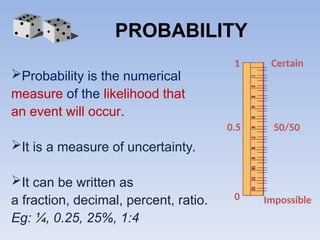
Probability is thenumerical
measure of the likelihood that
an event will occur.
It is a measure of uncertainty.
It can be written as
a fraction, decimal, percent, ratio.
Eg: ¼, 0.25, 25%, 1:4
Certain
Impossible
0.5
1
0
50/50
4.
TERMINOLOGY
Experiment: An experimentis an activity
that produces outcomes.
An experiment is random if
a)it has more than one outcome
b)it is not possible to predict the outcome in
advance
Eg: Tossing coin, Throwing a die
5.
TERMINOLOGY
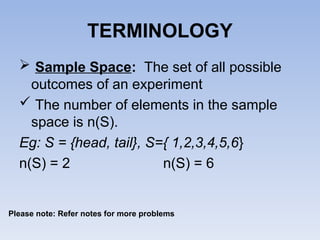
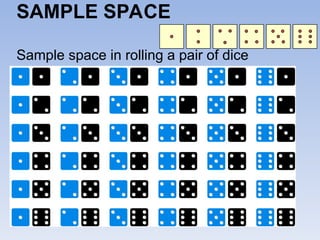
Sample Space:The set of all possible
outcomes of an experiment
The number of elements in the sample
space is n(S).
Eg: S = {head, tail}, S={ 1,2,3,4,5,6}
n(S) = 2 n(S) = 6
Please note: Refer notes for more problems
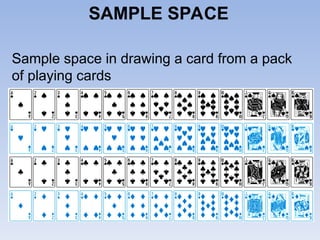
Sample space indrawing a card from a pack
of playing cards
SAMPLE SPACE
8.
TERMINOLOGY
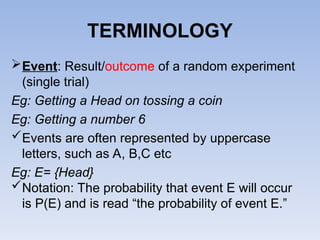
Event: Result/outcome ofa random experiment
(single trial)
Eg: Getting a Head on tossing a coin
Eg: Getting a number 6
Events are often represented by uppercase
letters, such as A, B,C etc
Eg: E= {Head}
Notation: The probability that event E will occur
is P(E) and is read “the probability of event E.”
9.
IMPORTANT TERMINOLOGY
Sure/Certainevents: Events whose OUTCOME is inevitable
Eg: Probability of drawing even or odd number in tossing die
Mutually exclusive events:
If the happening of one outcome automatically rules out the happening of the other.
Eg: Tossing a coin , throwing a die, Picking a male student from a class
Independent events: If the occurrence/non-occurrence of one outcome does not
affect the occurrence of the other.
Eg: Tossing a coin, Throwing a die, Messi’s performance and exam marks
Collectively exhaustive: Favorable and unfavorable events together exhaust all
events
Eg: Tossing a coin
Favourable Cases: The number of outcomes of a random experiment that result in
the desired event are cases favourable to the event
Eg: Cases favourable to getting a Head
Eg: Cases favourable to getting a number ‘6’ on die
10.
There are threeapproaches to probability
1.Classical (Apriori) approach of Probability
2. Empirical approach of Probability(Relative
frequency approach)
3. Subjective approach to Probability
PROBABILITY OF AN EVENT
11.
•Each of theOutcomes in the Sample Space are random,
mutually exclusive and exhaustive, equally likely to occur
•The Probability of an event A:
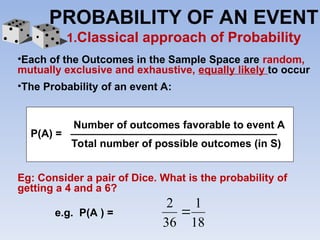
Eg: Consider a pair of Dice. What is the probability of
getting a 4 and a 6?
e.g. P(A ) =
P(A) =
Number of outcomes favorable to event A
Total number of possible outcomes (in S)
18
1
36
2
PROBABILITY OF AN EVENT
1.Classical approach of Probability
12.
PROBABILITY OF AN
EVENT
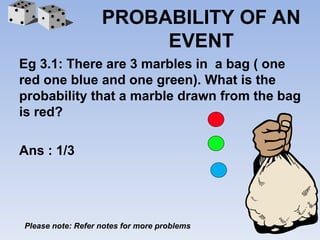
Eg3.1: There are 3 marbles in a bag ( one
red one blue and one green). What is the
probability that a marble drawn from the bag
is red?
Ans : 1/3
Please note: Refer notes for more problems
13.
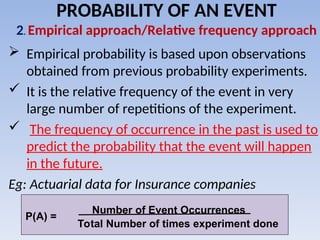
Empirical probabilityis based upon observations
obtained from previous probability experiments.
It is the relative frequency of the event in very
large number of repetitions of the experiment.
The frequency of occurrence in the past is used to
predict the probability that the event will happen
in the future.
Eg: Actuarial data for Insurance companies
PROBABILITY OF AN EVENT
2. Empirical approach/Relative frequency approach
P(A) =
Number of Event Occurrences
Total Number of times experiment done
14.
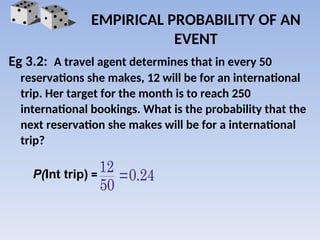
Eg 3.2: Atravel agent determines that in every 50
reservations she makes, 12 will be for an international
trip. Her target for the month is to reach 250
international bookings. What is the probability that the
next reservation she makes will be for a international
trip?
EMPIRICAL PROBABILITY OF AN
EVENT
12
0.24
50
P(Int trip) =
15.
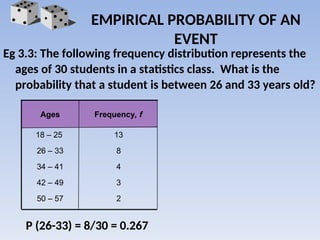
Eg 3.3: Thefollowing frequency distribution represents the
ages of 30 students in a statistics class. What is the
probability that a student is between 26 and 33 years old?
P (26-33) = 8/30 = 0.267
EMPIRICAL PROBABILITY OF AN
EVENT
50 – 57 2
3
4
8
13
42 – 49
34 – 41
26 – 33
18 – 25
Frequency, f
Ages
16.
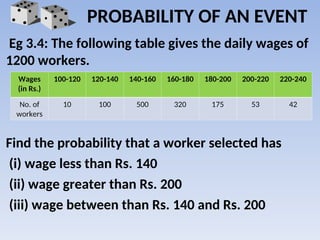
Eg 3.4: Thefollowing table gives the daily wages of
1200 workers.
Find the probability that a worker selected has
(i) wage less than Rs. 140
(ii) wage greater than Rs. 200
(iii) wage between than Rs. 140 and Rs. 200
PROBABILITY OF AN EVENT
Wages
(in Rs.)
100-120 120-140 140-160 160-180 180-200 200-220 220-240
No. of
workers
10 100 500 320 175 53 42
Subjective probabilityis based on the beliefs of the
person making the assessment.
It is the probability assigned to an event by an
individual based on available evidence and gut
feeling
Eg: Warren Buffet v/s Poor me..!
Eg: Choosing an MBA candidate for BMIM
PROBABILITY OF AN EVENT
3. Subjective approach of probability
Please note: Refer notes for more problems
19.
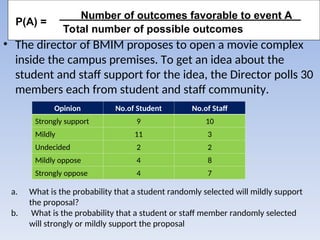
Example 3.5
• Thedirector of BMIM proposes to open a movie complex
inside the campus premises. To get an idea about the
student and staff support for the idea, the Director polls 30
members each from student and staff community.
Opinion No.of Student No.of Staff
Strongly support 9 10
Mildly 11 3
Undecided 2 2
Mildly oppose 4 8
Strongly oppose 4 7
a. What is the probability that a student randomly selected will mildly support
the proposal?
b. What is the probability that a student or staff member randomly selected
will strongly or mildly support the proposal
P(A) =
Number of outcomes favorable to event A
Total number of possible outcomes
20.
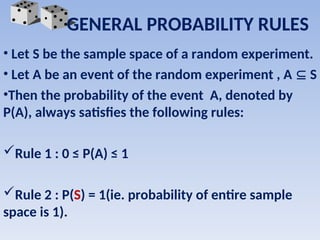
• Let Sbe the sample space of a random experiment.
• Let A be an event of the random experiment , A S
•Then the probability of the event A, denoted by
P(A), always satisfies the following rules:
Rule 1 : 0 ≤ P(A) ≤ 1
Rule 2 : P(S) = 1(ie. probability of entire sample
space is 1).
GENERAL PROBABILITY RULES
21.
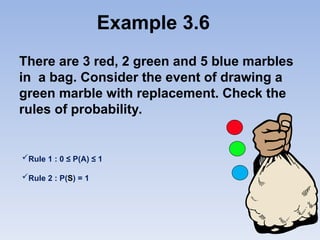
Example 3.6
There are3 red, 2 green and 5 blue marbles
in a bag. Consider the event of drawing a
green marble with replacement. Check the
rules of probability.
Rule 1 : 0 ≤ P(A) ≤ 1
Rule 2 : P(S) = 1
22.
• When eventsA and B are NOT MUTUALLY EXCLUSIVE,
the probability that event A or B will occur is given by
P (A or B) = P (A) + P (B) – P (A and B ).
i.e. P (A B) = P (A) + P (B) – P (A B ).
Here , P (A B) – Probability of A or B happening
P (A) – probability of A happening
P(B) – probability of B happening
P (A B ) – probability of A & B happening together
Eg: Drawing a Jack or Heart from a pack of cards (see
slide 22 AND 23 for clarity)
PROBABILITY RULES
Rule 3: ADDITION RULE OF PROBABILITY
23.
A
J
J
J
J
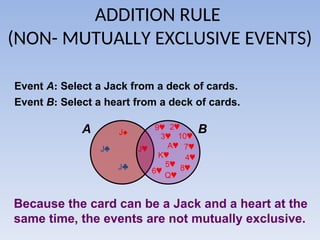
Event A: Selecta Jack from a deck of cards.
Event B: Select a heart from a deck of cards.
Because the card can be a Jack and a heart at the
same time, the events are not mutually exclusive.
B
2
3
4
5
6
A
K
Q
10
9
8
7
ADDITION RULE
(NON- MUTUALLY EXCLUSIVE EVENTS)
24.
ADDITION RULE-NON-
MUTUALLY EXCLUSIVEEVENTS
Example:
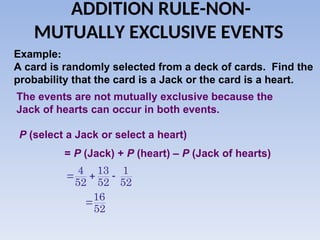
A card is randomly selected from a deck of cards. Find the
probability that the card is a Jack or the card is a heart.
The events are not mutually exclusive because the
Jack of hearts can occur in both events.
P (select a Jack or select a heart)
= P (Jack) + P (heart) – P (Jack of hearts)
4 13 1
52 52 52
16
52
25.
PROBABILITY RULES
Rule 3:ADDITION RULE OF PROBABILITY
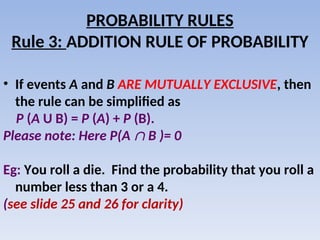
• If events A and B ARE MUTUALLY EXCLUSIVE, then
the rule can be simplified as
P (A U B) = P (A) + P (B).
Please note: Here P(A B )= 0
Eg: You roll a die. Find the probability that you roll a
number less than 3 or a 4.
(see slide 25 and 26 for clarity)
26.
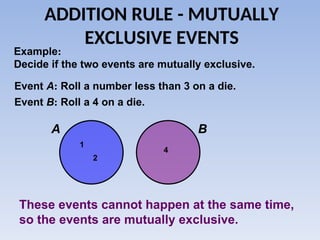
ADDITION RULE -MUTUALLY
EXCLUSIVE EVENTS
Example:
Decide if the two events are mutually exclusive.
Event A: Roll a number less than 3 on a die.
Event B: Roll a 4 on a die.
These events cannot happen at the same time,
so the events are mutually exclusive.
A
1
2
B
4
27.
ADDITION RULE-MUTUALLY
EXCLUSIVE EVENTS
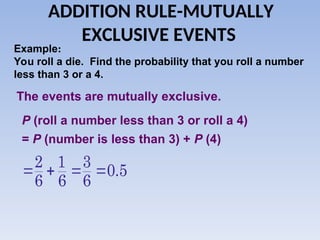
Example:
Youroll a die. Find the probability that you roll a number
less than 3 or a 4.
The events are mutually exclusive.
P (roll a number less than 3 or roll a 4)
= P (number is less than 3) + P (4)
2 1 3
0.5
6 6 6
28.
ADDITION RULE
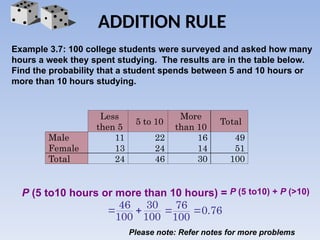
Example 3.7:100 college students were surveyed and asked how many
hours a week they spent studying. The results are in the table below.
Find the probability that a student spends between 5 and 10 hours or
more than 10 hours studying.
P (5 to10) + P (>10)
46 30
100 100
Less
then 5
5 to 10
More
than 10
Total
Male 11 22 16 49
Female 13 24 14 51
Total 24 46 30 100
P (5 to10 hours or more than 10 hours) =
76
0.76
100
Please note: Refer notes for more problems
29.
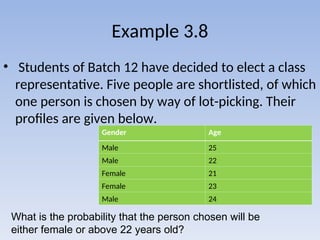
Example 3.8
• Studentsof Batch 12 have decided to elect a class
representative. Five people are shortlisted, of which
one person is chosen by way of lot-picking. Their
profiles are given below.
Gender Age
Male 25
Male 22
Female 21
Female 23
Male 24
What is the probability that the person chosen will be
either female or above 22 years old?
30.
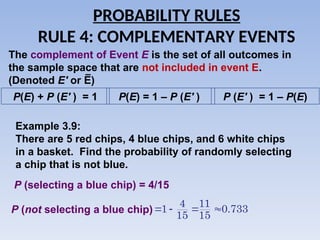
PROBABILITY RULES
RULE 4:COMPLEMENTARY EVENTS
The complement of Event E is the set of all outcomes in
the sample space that are not included in event E.
(Denoted E′ or E)
P(E) + P (E′ ) = 1
Example 3.9:
There are 5 red chips, 4 blue chips, and 6 white chips
in a basket. Find the probability of randomly selecting
a chip that is not blue.
P(E) = 1 – P (E′ ) P (E′ ) = 1 – P(E)
P (selecting a blue chip) = 4/15
P (not selecting a blue chip)
4 11
1 0.733
15 15
31.
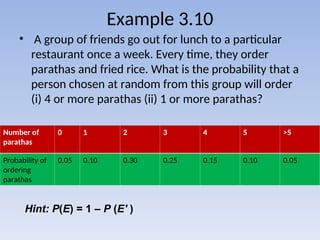
Example 3.10
• Agroup of friends go out for lunch to a particular
restaurant once a week. Every time, they order
parathas and fried rice. What is the probability that a
person chosen at random from this group will order
(i) 4 or more parathas (ii) 1 or more parathas?
Number of
parathas
0 1 2 3 4 5 >5
Probability of
ordering
parathas
0.05 0.10 0.30 0.25 0.15 0.10 0.05
Hint: P(E) = 1 – P (E′ )
32.
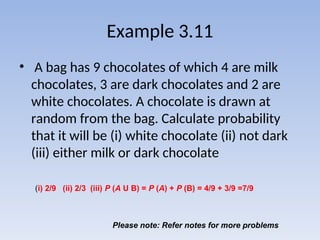
Example 3.11
• Abag has 9 chocolates of which 4 are milk
chocolates, 3 are dark chocolates and 2 are
white chocolates. A chocolate is drawn at
random from the bag. Calculate probability
that it will be (i) white chocolate (ii) not dark
(iii) either milk or dark chocolate
Please note: Refer notes for more problems
(i) 2/9 (ii) 2/3 (iii) P (A U B) = P (A) + P (B) = 4/9 + 3/9 =7/9
33.
RULE 5: MULTIPLICATIONRULE
JOINT PROBABILITY FOR INDEPENDENT EVENTS
Let A and B be two events in sample space.
The probability of two or more independent events occurring
together or in succession.
• Independent event: If the occurrence/non-occurrence of one
event does not affect the occurrence of the other.
Since event A and B are independent, P (A and B) = P (A) · P (B).
P(AB) = P(A) x P(B)
Where P(AB) = probability of events A and B occurring in succession
P(A) = probability of event A
P(B) = probability of event B
34.
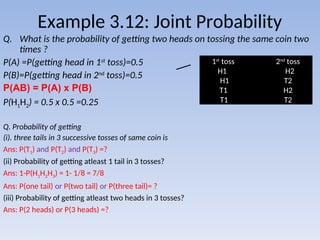
Example 3.12: JointProbability
Q. What is the probability of getting two heads on tossing the same coin two
times ?
P(A) =P(getting head in 1st
toss)=0.5
P(B)=P(getting head in 2nd
toss)=0.5
P(AB) = P(A) x P(B)
P(H1H2) = 0.5 x 0.5 =0.25
Q. Probability of getting
(i). three tails in 3 successive tosses of same coin is
Ans: P(T1) and P(T2) and P(T3) =?
(ii) Probability of getting atleast 1 tail in 3 tosses?
Ans: 1-P(H1H2H3) = 1- 1/8 = 7/8
Ans: P(one tail) or P(two tail) or P(three tail)= ?
(iii) Probability of getting atleast two heads in 3 tosses?
Ans: P(2 heads) or P(3 heads) =?
1st
toss 2nd
toss
H1 H2
H1 T2
T1 H2
T1 T2
35.
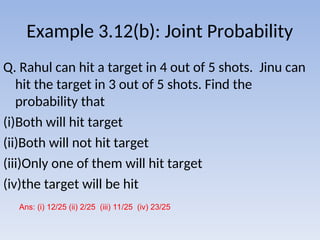
Example 3.12(b): JointProbability
Q. Rahul can hit a target in 4 out of 5 shots. Jinu can
hit the target in 3 out of 5 shots. Find the
probability that
(i)Both will hit target
(ii)Both will not hit target
(iii)Only one of them will hit target
(iv)the target will be hit
Ans: (i) 12/25 (ii) 2/25 (iii) 11/25 (iv) 23/25
36.
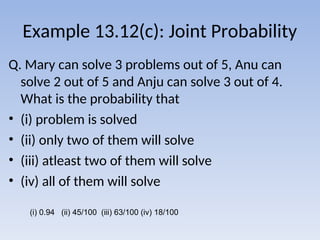
Example 13.12(c): JointProbability
Q. Mary can solve 3 problems out of 5, Anu can
solve 2 out of 5 and Anju can solve 3 out of 4.
What is the probability that
• (i) problem is solved
• (ii) only two of them will solve
• (iii) atleast two of them will solve
• (iv) all of them will solve
(i) 0.94 (ii) 45/100 (iii) 63/100 (iv) 18/100
37.
Hw: Joint probability
Q.A husband and wife appear in an interview for
two vacancies to the same post. The probability
of husbands selection is 4/5 and wifes selection
is 3/5. What is the probability that:
(i)Both will be selected
(ii) one of them will be selected
(iii) none will be selected
(iv) atleast one of them will be selected
38.
RULE 5: MULTIPLICATIONRULE
JOINT PROBABILITY FOR DEPENDENT EVENTS
Let A and B be two events in sample space.
The probability of two or more dependent events occurring
together or in succession.
P(AB) = P(A|B) X P(B)
Where P(AB) = probability that two events A and B occur in succession
P(A|B) = Probability of event A ,given B has happened
P(B) = probability of event B
In case of dependent events, Marginal probability for Event A is obtained by Adding the
probabilities of joint events in which A occurs. (See Example 3.14 for clarity)
39.
Example 3.13(a):
Joint Probability/MultiplicationRule
Q. Two cards are selected, without replacement,
from a deck. Find the probability of selecting a
diamond, and then selecting a spade.
Because the card is not replaced, the events are
dependent.
Here A: drawing a spade B: Drawing a diamond
P(AB) = P(B) x P(A|B)
P (spade and diamond) = P (diamond) x P (spade |diamond)
13 13 169
0.064
52 51 2652
40.
Example 3.14: JointProbability
Q. An urn contains ten balls of different colours such that
2 balls are red and dotted
1 ball is green and dotted
4 balls are red and striped
3 balls are green and striped
What is the probability of (i)drawing a red and striped ball and (ii) Dotted and
red ball (iii) a red ball
Here the events are dependent. Hence P(AB) = P(B) x P(A|B)
Ans: P(R and S)= P(S) x P(R|S) = 7/10 x 4/7=0.4
Ans: P(D and R) = P(D) x P(R|D) = 3/10 x 2/3 = 0.2
Ans: P(R) = P(SR) + P(DR) = 0.4+0.2 =0.6 (hint: marginal probability)
Similarly, find P(SG), P(DG) and P(G)
Ans: 0.3 and 0.1 and 0.4
41.
CONDITIONAL PROBABILITY
FOR INDEPENDENTEVENTS
Let A and B be two INDEPENDENT events in
sample space.
The conditional probability is the probability
that event B occurs given that event A has
occurred.
P(B|A) = P(B)
Similarly,
P(A|B) = P(A)
42.
CONDITIONAL PROBABILITY
FOR DEPENDENTEVENTS
Let A and B be two DEPENDENT events in sample
space. (ie. Probability of one event is affected by
occurrence of other)
The conditional probability that event B occurs given
that event A has occurred is:
P(B|A) = P(BA) / P(A)
Similarly,
P(A|B) = P(AB) / P(B)
where P(B|A) is probability that B occurs, given A has occurred
P(BA) is probability of two events A and B occurring together
P(A) is probability of event A happening
43.
EXAMPLE 3.15: CONDITIONALPROBABILITY
First, decide if the events A and B are independent or dependent.
Now apply suitable formula :
Q. Selecting a diamond from a standard deck of
cards (Event: A), putting it back in the deck,
and then selecting a spade from the same
deck (Event:B).
P(B|A) = P(B) = 13/52 = 1/4
44.
EXAMPLE 3.16: ConditionalProbability
Q. What is the probability that in selecting two cards, one
at a time with replacement, the second card is:
(i)An ace, given that the first card was a face card
(ii) A black jack, given the first card was a red ace?
P(B|A) = P(BA) / P(A)
P(BA) = P(B|A) x P(A)
Hint: (i) Here Event B = drawing Ace and A=face card
(ii) Here Event B = drawing black jack and A = red ace
Now repeat in case of ‘no replacement’
P(B|A) = P(B)
45.
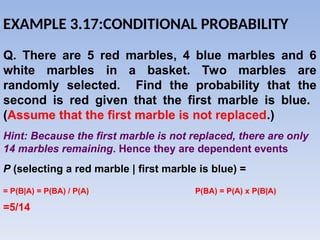
Q. There are5 red marbles, 4 blue marbles and 6
white marbles in a basket. Two marbles are
randomly selected. Find the probability that the
second is red given that the first marble is blue.
(Assume that the first marble is not replaced.)
P (selecting a red marble | first marble is blue) =
=5/14
Hint: Because the first marble is not replaced, there are only
14 marbles remaining. Hence they are dependent events
EXAMPLE 3.17:CONDITIONAL PROBABILITY
= P(B|A) = P(BA) / P(A) P(BA) = P(A) x P(B|A)
46.
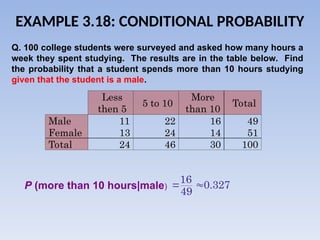
Q. 100 collegestudents were surveyed and asked how many hours a
week they spent studying. The results are in the table below. Find
the probability that a student spends more than 10 hours studying
given that the student is a male.
P (more than 10 hours|male)
16
0.327
49
Less
then 5
5 to 10
More
than 10
Total
Male 11 22 16 49
Female 13 24 14 51
Total 24 46 30 100
EXAMPLE 3.18: CONDITIONAL PROBABILITY
47.
EXAMPLE 3.19: PROBLEM
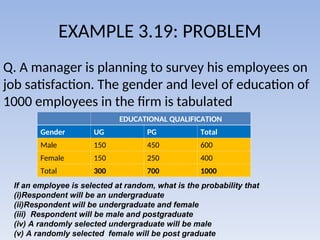
Q.A manager is planning to survey his employees on
job satisfaction. The gender and level of education of
1000 employees in the firm is tabulated
EDUCATIONAL QUALIFICATION
Gender UG PG Total
Male 150 450 600
Female 150 250 400
Total 300 700 1000
If an employee is selected at random, what is the probability that
(i)Respondent will be an undergraduate
(ii)Respondent will be undergraduate and female
(iii) Respondent will be male and postgraduate
(iv) A randomly selected undergraduate will be male
(v) A randomly selected female will be post graduate
48.
QUICK REFERENCE
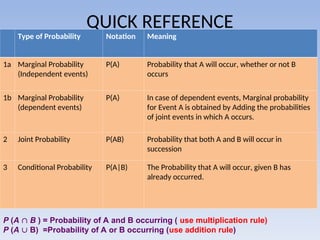
Type ofProbability Notation Meaning
1a Marginal Probability
(Independent events)
P(A) Probability that A will occur, whether or not B
occurs
1b Marginal Probability
(dependent events)
P(A) In case of dependent events, Marginal probability
for Event A is obtained by Adding the probabilities
of joint events in which A occurs.
2 Joint Probability P(AB) Probability that both A and B will occur in
succession
3 Conditional Probability P(A|B) The Probability that A will occur, given B has
already occurred.
P (A B ) = Probability of A and B occurring ( use multiplication rule)
P (A B) =Probability of A or B occurring (use addition rule)
49.
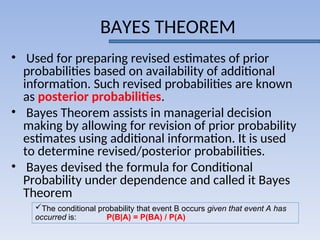
BAYES THEOREM
• Usedfor preparing revised estimates of prior
probabilities based on availability of additional
information. Such revised probabilities are known
as posterior probabilities.
• Bayes Theorem assists in managerial decision
making by allowing for revision of prior probability
estimates using additional information. It is used
to determine revised/posterior probabilities.
• Bayes devised the formula for Conditional
Probability under dependence and called it Bayes
Theorem
The conditional probability that event B occurs given that event A has
occurred is: P(B|A) = P(BA) / P(A)
50.
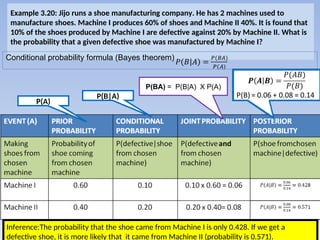
Example 3.20: Jijoruns a shoe manufacturing company. He has 2 machines used to
manufacture shoes. Machine I produces 60% of shoes and Machine II 40%. It is found that
10% of the shoes produced by Machine I are defective against 20% by Machine II. What is
the probability that a given defective shoe was manufactured by Machine I?
Conditional probability formula (Bayes theorem)
P(A) = probability of a shoe coming from a chosen machine
P(B) = probability of getting a defective shoe
P(BA) = P(B|A) X P(A)
P(B|A)
Inference:The probability that the shoe came from Machine I is only 0.428. If we get a
defective shoe, it is more likely that it came from Machine II (probability is 0.571).
P(A)
51.
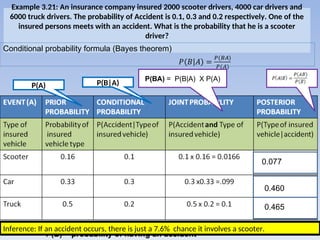
Example 3.21: Aninsurance company insured 2000 scooter drivers, 4000 car drivers and
6000 truck drivers. The probability of Accident is 0.1, 0.3 and 0.2 respectively. One of the
insured persons meets with an accident. What is the probability that he is a scooter
driver?
Conditional probability formula (Bayes theorem)
P(A) = probability of chosen type of vehicle
P(B) = probability of having an accident
P(BA) = P(B|A) X P(A)
P(B|A)
Inference: If an accident occurs, there is just a 7.6% chance it involves a scooter.
P(A)
0.077
0.460
0.465
52.
EXAMPLE 3.22
• Example3.22: We have equal number of two
types of dice in a bowl. On Type 1 die, the
number 1 comes up 40% of the time. On Type
II, the number 1 comes up 70% of the time. If
a die is rolled once and the number ‘one’
appears, what is the probability that it is a
Type I die?
53.
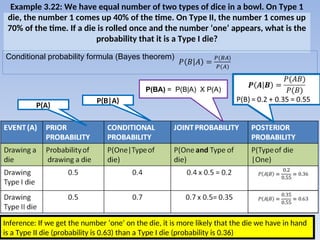
Example 3.22: Wehave equal number of two types of dice in a bowl. On Type 1
die, the number 1 comes up 40% of the time. On Type II, the number 1 comes up
70% of the time. If a die is rolled once and the number ‘one’ appears, what is the
probability that it is a Type I die?
Conditional probability formula (Bayes theorem)
P(A) = probability of drawing a die
P(B) = probability of getting the number one
P(BA) = P(B|A) X P(A)
P(B|A)
Inference: If we get the number ‘one’ on the die, it is more likely that the die we have in hand
is a Type II die (probability is 0.63) than a Type I die (probability is 0.36)
P(A)
54.
EXAMPLE 3.23: BAYESTHEOREM
Q.A firm produces steel pipes in three plants with a daily
production of 1000,1500 and 2500 units respectively. From
past data, it is known that the fraction of defective pipes
produced by the three plants are 0.04,0.09 and 0.07
respectively. If a pipe is selected from a days production and
found to be defective, what is the probability it has come from
Plant II.
Ans: Probability that the defective pipe has come from Plant II is 0.385