Course: Probability and Random Processes
Chapter 1: Probability and Random Variables
1
CLASS RULES
Attendance is mandatory.
You are responsible for whatever is taught in the lecture. If you miss a class, it is your responsibility to
find out about assignment, quizzes and exam.
Punctuality is compulsory.
You are encouraged to collaborate (not copy) on assignment problems with your "study buddies.”
Respect and listen during period
Take notes in lectures
Ask questions
Probability
Probability theory is the branch of mathematics that is
concerned with the study of random phenomena. A random
phenomenon is one that, under repeated observation, yields
different outcomes that are not deterministically predictable.
It refers to an event or outcome that can not be predicted
with certainty.
Randomness is a fundamental concept in probability
theory and statistics, and it is characterized by the fact that
the outcome of a random phenomenon cannot be
determined ahead of time
Probability refers to how likely an event is to occur.
Continue..
Probability means possibility. It deals with the occurrence of a random
event.
The value is expressed from zero to one.
Probability has been introduced in Mathematics to predict how likely
events are to happen.
The meaning of probability is basically the extent to which something is
likely to happen.
This is the basic probability theory, which is also used in the probability
distribution, where you will learn the possibility of outcomes for a
random experiment.
To find the probability of a single event to occur, first, we should know
the total number of possible outcomes.
Motivations Of study
An electrical engineer is likely to deal with "probability" in each of several
areas as follows:
In the analysis of communications systems, one is frequently concerned with
lower signal-to-noise ratios resulting in "bit-errors", false alarms, etc. There is
then a need for careful positioning of thresholds, use of error-correcting
codes, et-cetera to insure that the probability of error is kept within acceptable
bounds.
In the design of circuits and systems, it is often important that the
characteristic of some circuit element like its resistance or inductance has to be
kept within a certain range in order for the circuit to operate properly, so the
probability distribution of this kind of parameter becomes important.
In product development and manufacturing planning, uncertainty as to
product demand and component availability are frequently of concern, and
again, intelligent judgments as to probability are required
In summary, probability and random processes are essential tools for electrical
engineering students to understand the behavior of complex systems and
design them to meet specific performance criteria.
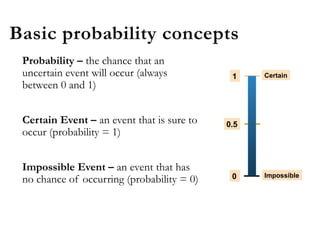
Basic probability concepts
Probability – the chance that an
uncertain event will occur (always
between 0 and 1)
Certain Event – an event that is sure to
occur (probability = 1)
Impossible Event – an event that has
no chance of occurring (probability = 0)
Certain
Impossible
0.5
1
0
probability of occurrence
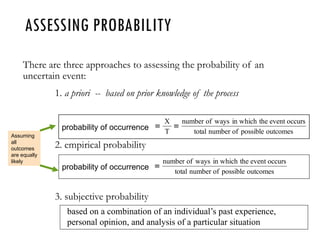
ASSESSING PROBABILITY
There are three approaches to assessing the probability of an
uncertain event:
1. a priori -- based on prior knowledge of the process
2. empirical probability
3. subjective probability
outcomes
possible
of
number
total
occurs
event
the
in which
ways
of
number
T
X


based on a combination of an individual’s past experience,
personal opinion, and analysis of a particular situation
outcomes
possible
of
number
total
occurs
event
the
in which
ways
of
number

Assuming
all
outcomes
are equally
likely
probability of occurrence
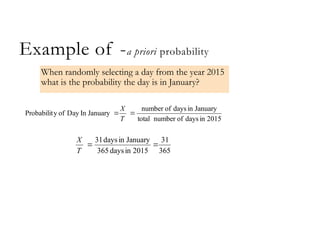
Example of -a priori probability
365
31
2015
in
days
365
January
in
days
31


T
X
When randomly selecting a day from the year 2015
what is the probability the day is in January?
2015
in
days
of
number
total
January
in
days
of
number
January
In
Day
of
y
Probabilit 

T
X
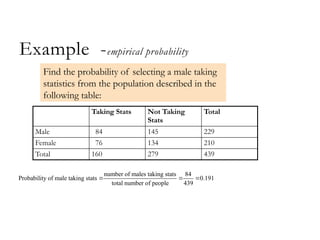
Example -empirical probability
number of males taking stats 84
0.191
total num
Proba
ber o
bility of mal
f peopl
e taking
e 439
stats   
Taking Stats Not Taking
Stats
Total
Male 84 145 229
Female 76 134 210
Total 160 279 439
Find the probability of selecting a male taking
statistics from the population described in the
following table:
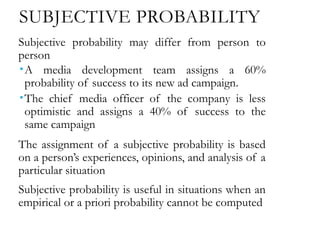
SUBJECTIVE PROBABILITY
Subjective probability may differ from person to
person
A media development team assigns a 60%
probability of success to its new ad campaign.
The chief media officer of the company is less
optimistic and assigns a 40% of success to the
same campaign
The assignment of a subjective probability is based
on a person’s experiences, opinions, and analysis of a
particular situation
Subjective probability is useful in situations when an
empirical or a priori probability cannot be computed
THE TERMINOLOGY OF PROBABILITY
1. Random Experiments
In the study of probability, any process of observation is
referred to as an experiment.
The results of an observation are called the outcomes of
the experiment.
An experiment is called a random experiment if its
outcome cannot be predicted. Typical examples of a
random experiment are the roll of a die, the toss of a coin,
or selecting a message signal for transmission from several
messages.
Examples of these random phenomena include the
number of electronic mail (e-mail) messages received by
all employees of a company in one day, the number of
phone calls arriving at the university’s switchboard over
a given period, the number of components of a system
that fail within a given interval, and the number of A’s
that a student can receive in one academic year.
The terminology of probability
2. Sample Space:
The set of all possible outcomes of a random experiment
is called the sample space (or universal set), and it is
denoted by S.
An element in S is called a sample point. Each outcome
of a random experiment corresponds to a sample point.
3. A random variable
A random variable is a numerical quantity that is generated by a
random experiment or process.
In probability theory, a random variable is defined as a function that
maps the outcomes of a random event to numerical values.
For example, consider a coin toss where we assign a value of 1 for
heads and 0 for tails.
The random variable X can be defined as the outcome of the coin
toss, with the possible values of X being 0 or 1.
Random variables can be either discrete or continuous.
A discrete random variable takes on a finite or countable number of
distinct values, while a continuous random variable takes on values in
a continuous range.
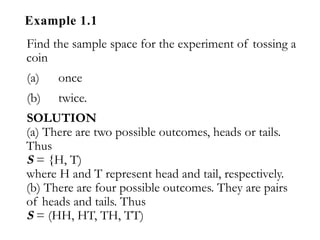
Example 1.1
Find the sample space for the experiment of tossing a
coin
(a) once
(b) twice.
SOLUTION
(a) There are two possible outcomes, heads or tails.
Thus
S = {H, T)
where H and T represent head and tail, respectively.
(b) There are four possible outcomes. They are pairs
of heads and tails. Thus
S = (HH, HT, TH, TT)
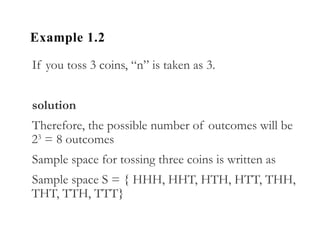
Example 1.2
If you toss 3 coins, “n” is taken as 3.
solution
Therefore, the possible number of outcomes will be
23
= 8 outcomes
Sample space for tossing three coins is written as
Sample space S = { HHH, HHT, HTH, HTT, THH,
THT, TTH, TTT}
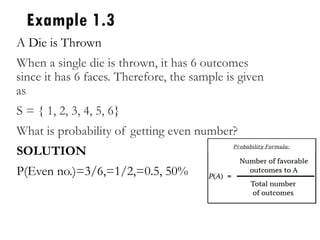
Example 1.3
A Die is Thrown
When a single die is thrown, it has 6 outcomes
since it has 6 faces. Therefore, the sample is given
as
S = { 1, 2, 3, 4, 5, 6}
What is probability of getting even number?
SOLUTION
P(Even no.)=3/6,=1/2,=0.5, 50%
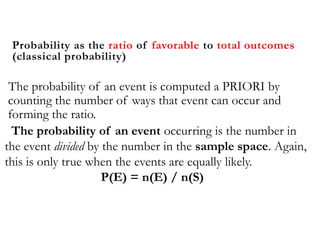
Probability as the ratio of favorable to total outcomes
(classical probability)
The probability of an event is computed a PRIORI by
counting the number of ways that event can occur and
forming the ratio.
The probability of an event occurring is the number in
the event divided by the number in the sample space. Again,
this is only true when the events are equally likely.
P(E) = n(E) / n(S)
Probability rules
All probabilities are between 0 and 1 inclusive
PE = 0 ≤ P ≤ 1
The sum of all the probabilities in the sample space is 1
For example, in a coin flip, the probability of heads is 0.5 and the probability of
tails is also 0.5, and the sum of these probabilities is 1.
There are some other rules which are also important.
The probability of an event which cannot occur is 0.
An event with probability 0 cannot occur, and an event with probability 1 is certain
to occur
The probability of any event which is not in the sample space is zero.
The sum of the probabilities of all possible outcomes in a given event is equal to 1.
Probability rules
The probability of an event which must occur is
1.
The probability of an event not occurring is one
minus the probability of it occurring.
P(E') = 1 - P(E)
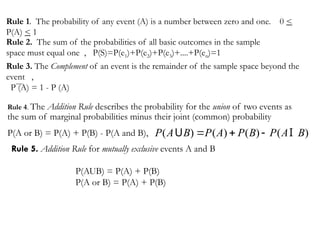
Rule 1. The probability of any event (A) is a number between zero and one. 0 <
P(A) < 1
Rule 2. The sum of the probabilities of all basic outcomes in the sample
space must equal one , P(S)=P(e1)+P(e2)+P(e3)+....+P(en)=1
Rule 3. The Complement of an event is the remainder of the sample space beyond the
event ,
P (A) = 1 - P (A)
Rule 4. The Addition Rule describes the probability for the union of two events as
the sum of marginal probabilities minus their joint (common) probability
P(A or B) = P(A) + P(B) - P(A and B), 

P(AUB) P(A)  P(B)  P(AI B)
Rule 5. Addition Rule for mutually exclusive events A and B
P(AUB) = P(A) + P(B)
P(A or B) = P(A) + P(B)
MUTUALLY EXCLUSIVE EVENTS
Events that cannot occur simultaneously
Examples : Randomly choosing a day from 2025
A = day in January; B = day in February
Events A and B are mutually exclusive
Similarly
Drawing a card → getting a King and getting a Queen (from the
same draw). Impossible to happen simultaneously.
If someone is a man, they can’t be a woman
If you win a game, you can’t lose it at the same time.
If you throw a die and get a five, you can’t get a four at the
same time.
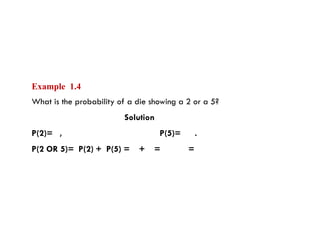
Example 1.4
What is the probability of a die showing a 2 or a 5?
Solution
P(2)= , P(5)= .
P(2 OR 5)= P(2) + P(5) = + = =
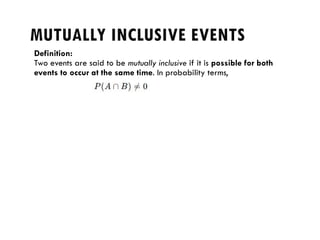
MUTUALLY INCLUSIVE EVENTS
Definition:
Two events are said to be mutually inclusive if it is possible for both
events to occur at the same time. In probability terms,
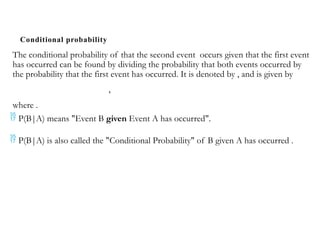
Conditional probability
The conditional probability of that the second event occurs given that the first event
has occurred can be found by dividing the probability that both events occurred by
the probability that the first event has occurred. It is denoted by , and is given by
,
where .
 P(B|A) means "Event B given Event A has occurred".
 P(B|A) is also called the "Conditional Probability" of B given A has occurred .
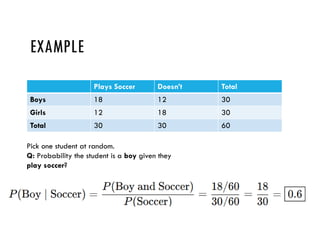
EXAMPLE
Plays Soccer Doesn’t Total
Boys 18 12 30
Girls 12 18 30
Total 30 30 60
Pick one student at random.
Q: Probability the student is a boy given they
play soccer?
27
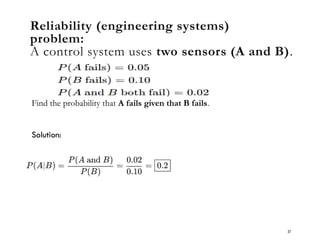
Reliability (engineering systems)
problem:
A control system uses two sensors (A and B).
Find the probability that A fails given that B fails.
Solution:
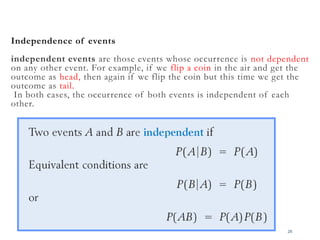
Independence of events
independent events are those events whose occurrence is not dependent
on any other event. For example, if we flip a coin in the air and get the
outcome as head, then again if we flip the coin but this time we get the
outcome as tail.
In both cases, the occurrence of both events is independent of each
other.
28
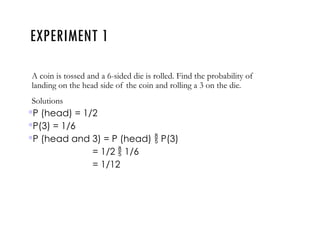
EXPERIMENT 1
A coin is tossed and a 6-sided die is rolled. Find the probability of
landing on the head side of the coin and rolling a 3 on the die.
Solutions
P (head) = 1/2
P(3) = 1/6
P (head and 3) = P (head)  P(3)
= 1/2  1/6
= 1/12
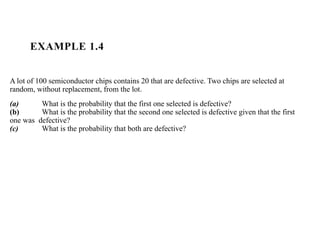
EXAMPLE 1.4
A lot of 100 semiconductor chips contains 20 that are defective. Two chips are selected at
random, without replacement, from the lot.
(a) What is the probability that the first one selected is defective?
(b) What is the probability that the second one selected is defective given that the first
one was defective?
(c) What is the probability that both are defective?
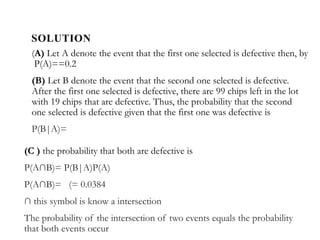
SOLUTION
(A) Let A denote the event that the first one selected is defective then, by
P(A)==0.2
(B) Let B denote the event that the second one selected is defective.
After the first one selected is defective, there are 99 chips left in the lot
with 19 chips that are defective. Thus, the probability that the second
one selected is defective given that the first one was defective is
P(B|A)=
(C ) the probability that both are defective is
P(A∩B)= P(B|A)P(A)
P(A∩B)= (= 0.0384
∩ this symbol is know a intersection
The probability of the intersection of two events equals the probability
that both events occur
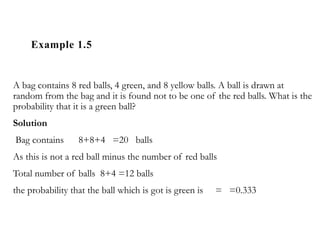
Example 1.5
A bag contains 8 red balls, 4 green, and 8 yellow balls. A ball is drawn at
random from the bag and it is found not to be one of the red balls. What is the
probability that it is a green ball?
Solution
Bag contains 8+8+4 =20 balls
As this is not a red ball minus the number of red balls
Total number of balls 8+4 =12 balls
the probability that the ball which is got is green is = =0.333
BAYES’ THEOREM
Bayes' theorem, named after 18th-century British
mathematician Thomas Bayes, is a mathematical formula
for determining conditional probability.
The theorem provides a way to revise existing predictions
or theories (update probabilities) given new or additional
evidence.
In finance, Bayes' theorem can be used to rate the risk of
lending money to potential borrowers.
Bayes' theorem is well suited to and widely used in machine learning.
Bayes' theorem is also called Bayes' Rule or Bayes' Law and is the
foundation of the field of Bayesian statistics.
This set of rules of probability allows one to update their predictions
of events occurring based on new information that has been received,
making for better and more dynamic estimates.
E X A M P L E 1 . 6
A student buys 1000 chips from supplier A, 2000 chips from supplier B, and
3000 chips from supplier C.
He tested the chips and found that the probability that a chip is defective
depends on the supplier from where it was bought. Specifically, given that a
chip came from supplier A, the probability that it is defective is 0.05; given that
a chip came from supplier B, the probability that it is defective is 0.10; and
given that a chip came from supplier C, the probability that it is defective is
0.10 Given that a randomly selected chip is defective, what is the probability
that it came from supplier A?
EXAMPLE 1.6
SOLUTION
the probability that the randomly selected chip came
from supplier A, given that it is defective, is given by
P(D/A)=0.05, P(A)==
P(D/B) =0.10 , P(B)= =
P(D/C) = 0.10, P(C)= =
P[A|D]= =
P[A|D]= =0.0909 , =9.09%
ACTIVITY
In example 1.6 given that a randomly selected chip is defective, what is the probability
that it came from supplier C?
EXAMPLE 4
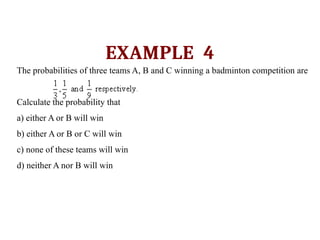
The probabilities of three teams A, B and C winning a badminton competition are
Calculate the probability that
a) either A or B will win
b) either A or B or C will win
c) none of these teams will win
d) neither A nor B will win
SOLUTION
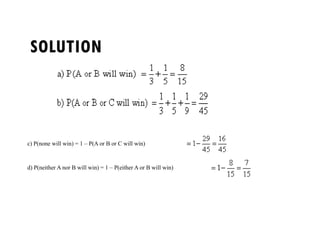
c) P(none will win) = 1 – P(A or B or C will win)
d) P(neither A nor B will win) = 1 – P(either A or B will win)
PRACTICE PROBLEM
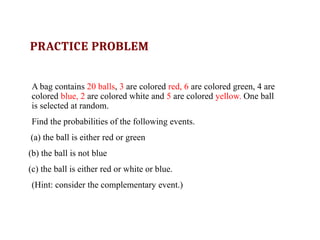
A bag contains 20 balls, 3 are colored red, 6 are colored green, 4 are
colored blue, 2 are colored white and 5 are colored yellow. One ball
is selected at random.
Find the probabilities of the following events.
(a) the ball is either red or green
(b) the ball is not blue
(c) the ball is either red or white or blue.
(Hint: consider the complementary event.)
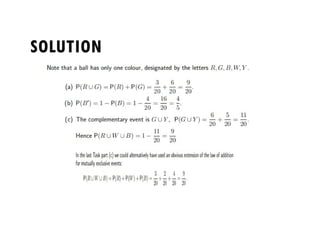
SOLUTION
PRACTICE
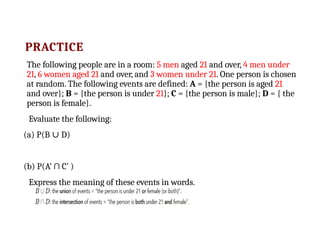
The following people are in a room: 5 men aged 21 and over, 4 men under
21, 6 women aged 21 and over, and 3 women under 21. One person is chosen
at random. The following events are defined: A = {the person is aged 21
and over}; B = {the person is under 21}; C = {the person is male}; D = { the
person is female}.
Evaluate the following:
(a) P(B D)
∪
(b) P(A’ ∩ C’ )
Express the meaning of these events in words.
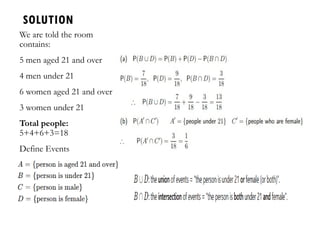
SOLUTION
We are told the room
contains:
5 men aged 21 and over
4 men under 21
6 women aged 21 and over
3 women under 21
Total people:
5+4+6+3=18
Define Events
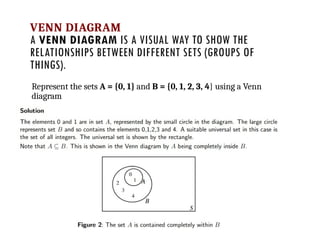
VENN DIAGRAM
A VENN DIAGRAM IS A VISUAL WAY TO SHOW THE
RELATIONSHIPS BETWEEN DIFFERENT SETS (GROUPS OF
THINGS).
Represent the sets A = {0, 1} and B = {0, 1, 2, 3, 4} using a Venn
diagram
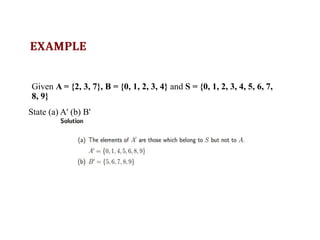
EXAMPLE
Given A = {2, 3, 7}, B = {0, 1, 2, 3, 4} and S = {0, 1, 2, 3, 4, 5, 6, 7,
8, 9}
State (a) A' (b) B'
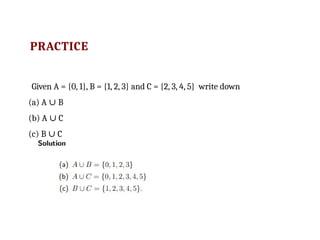
PRACTICE
Given A = {0, 1}, B = {1, 2, 3} and C = {2, 3, 4, 5} write down
(a) A B
∪
(b) A C
∪
(c) B C
∪
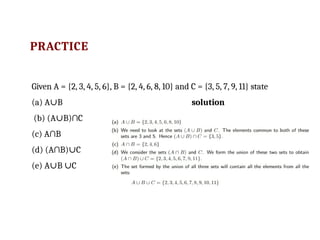
PRACTICE
Given A = {2, 3, 4, 5, 6}, B = {2, 4, 6, 8, 10} and C = {3, 5, 7, 9, 11} state
(a) A B
∪ solution
(b) (A B)∩C
∪
(c) A∩B
(d) (A∩B) C
∪
(e) A B C
∪ ∪
THREE DIAGRAM
A tree diagram represents the hierarchy of the events that need to be completed when
solving a problem. The tree diagram starts with one node, and each node has its branches
that further extend into more branches, and a tree-like structure is formed.
In mathematics, tree diagrams make it easy to visualize and solve probability problems.
They are a significant tool in breaking the problem down in a schematic way. While tree
diagrams can convert many complicated problems into simple ones, they are not very
useful when the sample space becomes too large.
Tree diagram definition:
A probability tree diagram represents all the possible outcomes of an event in an
organized manner. It starts with a dot and extends into branches. The probability of each
outcome is written on its branch.
How to make a tree diagram
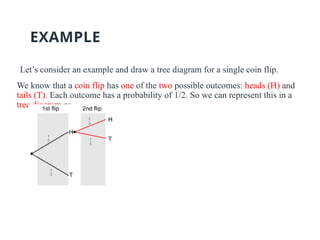
EXAMPLE
Let’s consider an example and draw a tree diagram for a single coin flip.
We know that a coin flip has one of the two possible outcomes: heads (H) and
tails (T). Each outcome has a probability of 1/2. So we can represent this in a
tree diagram as
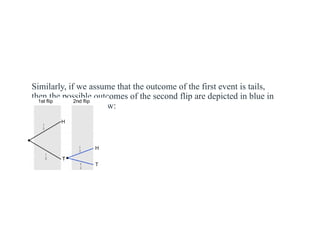
Similarly, if we assume that the outcome of the first event is tails,
then the possible outcomes of the second flip are depicted in blue in
the tree diagram below:
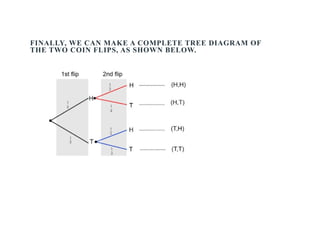
FINALLY, WE CAN MAKE A COMPLETE TREE DIAGRAM OF
THE TWO COIN FLIPS, AS SHOWN BELOW.
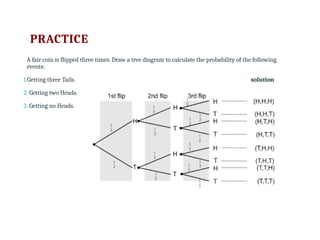
PRACTICE
A fair coin is flipped three times. Draw a tree diagram to calculate the probability of the following
events:
1.Getting three Tails. solution
2. Getting two Heads.
3. Getting no Heads.
APPLICATIONS OF PROBABILITY AND RANDOM PROCESSES (SHORT SUMMARY
Reliability Engineering – Predict system/component lifetime and failures.
Quality Control – Inspect products, ensure they meet specifications.
Communication Systems – Analyze signals, noise, and interference.
Control Systems – Ensure stability and robustness under random noise.
Power Systems – Handle fluctuations in supply and demand for reliability.
Electronic Circuits – Reduce impact of random noise and parameter variations.
Risk & Everyday Life – Used in finance, insurance, health, and accident analysis.
Government & Environment – Predict pollution spread and ecosystem risks.
Business, Law & Healthcare – Insurance premiums, legal evidence, medical testing.
Operations & Telecom – Manage traffic in networks, airlines, and call centers.
Other Uses – Weather forecasting, sales prediction, politics, traffic, disasters, investing.

chapter 1

  • 1.
    Course: Probability andRandom Processes Chapter 1: Probability and Random Variables 1
  • 2.
    CLASS RULES Attendance ismandatory. You are responsible for whatever is taught in the lecture. If you miss a class, it is your responsibility to find out about assignment, quizzes and exam. Punctuality is compulsory. You are encouraged to collaborate (not copy) on assignment problems with your "study buddies.” Respect and listen during period Take notes in lectures Ask questions
  • 3.
    Probability Probability theory isthe branch of mathematics that is concerned with the study of random phenomena. A random phenomenon is one that, under repeated observation, yields different outcomes that are not deterministically predictable. It refers to an event or outcome that can not be predicted with certainty. Randomness is a fundamental concept in probability theory and statistics, and it is characterized by the fact that the outcome of a random phenomenon cannot be determined ahead of time Probability refers to how likely an event is to occur.
  • 4.
    Continue.. Probability means possibility.It deals with the occurrence of a random event. The value is expressed from zero to one. Probability has been introduced in Mathematics to predict how likely events are to happen. The meaning of probability is basically the extent to which something is likely to happen. This is the basic probability theory, which is also used in the probability distribution, where you will learn the possibility of outcomes for a random experiment. To find the probability of a single event to occur, first, we should know the total number of possible outcomes.
  • 5.
    Motivations Of study Anelectrical engineer is likely to deal with "probability" in each of several areas as follows: In the analysis of communications systems, one is frequently concerned with lower signal-to-noise ratios resulting in "bit-errors", false alarms, etc. There is then a need for careful positioning of thresholds, use of error-correcting codes, et-cetera to insure that the probability of error is kept within acceptable bounds. In the design of circuits and systems, it is often important that the characteristic of some circuit element like its resistance or inductance has to be kept within a certain range in order for the circuit to operate properly, so the probability distribution of this kind of parameter becomes important. In product development and manufacturing planning, uncertainty as to product demand and component availability are frequently of concern, and again, intelligent judgments as to probability are required In summary, probability and random processes are essential tools for electrical engineering students to understand the behavior of complex systems and design them to meet specific performance criteria.
  • 6.
    Basic probability concepts Probability– the chance that an uncertain event will occur (always between 0 and 1) Certain Event – an event that is sure to occur (probability = 1) Impossible Event – an event that has no chance of occurring (probability = 0) Certain Impossible 0.5 1 0
  • 7.
    probability of occurrence ASSESSINGPROBABILITY There are three approaches to assessing the probability of an uncertain event: 1. a priori -- based on prior knowledge of the process 2. empirical probability 3. subjective probability outcomes possible of number total occurs event the in which ways of number T X   based on a combination of an individual’s past experience, personal opinion, and analysis of a particular situation outcomes possible of number total occurs event the in which ways of number  Assuming all outcomes are equally likely probability of occurrence
  • 8.
    Example of -apriori probability 365 31 2015 in days 365 January in days 31   T X When randomly selecting a day from the year 2015 what is the probability the day is in January? 2015 in days of number total January in days of number January In Day of y Probabilit   T X
  • 9.
    Example -empirical probability numberof males taking stats 84 0.191 total num Proba ber o bility of mal f peopl e taking e 439 stats    Taking Stats Not Taking Stats Total Male 84 145 229 Female 76 134 210 Total 160 279 439 Find the probability of selecting a male taking statistics from the population described in the following table:
  • 10.
    SUBJECTIVE PROBABILITY Subjective probabilitymay differ from person to person A media development team assigns a 60% probability of success to its new ad campaign. The chief media officer of the company is less optimistic and assigns a 40% of success to the same campaign The assignment of a subjective probability is based on a person’s experiences, opinions, and analysis of a particular situation Subjective probability is useful in situations when an empirical or a priori probability cannot be computed
  • 11.
    THE TERMINOLOGY OFPROBABILITY 1. Random Experiments In the study of probability, any process of observation is referred to as an experiment. The results of an observation are called the outcomes of the experiment. An experiment is called a random experiment if its outcome cannot be predicted. Typical examples of a random experiment are the roll of a die, the toss of a coin, or selecting a message signal for transmission from several messages.
  • 12.
    Examples of theserandom phenomena include the number of electronic mail (e-mail) messages received by all employees of a company in one day, the number of phone calls arriving at the university’s switchboard over a given period, the number of components of a system that fail within a given interval, and the number of A’s that a student can receive in one academic year.
  • 13.
    The terminology ofprobability 2. Sample Space: The set of all possible outcomes of a random experiment is called the sample space (or universal set), and it is denoted by S. An element in S is called a sample point. Each outcome of a random experiment corresponds to a sample point.
  • 14.
    3. A randomvariable A random variable is a numerical quantity that is generated by a random experiment or process. In probability theory, a random variable is defined as a function that maps the outcomes of a random event to numerical values. For example, consider a coin toss where we assign a value of 1 for heads and 0 for tails. The random variable X can be defined as the outcome of the coin toss, with the possible values of X being 0 or 1. Random variables can be either discrete or continuous. A discrete random variable takes on a finite or countable number of distinct values, while a continuous random variable takes on values in a continuous range.
  • 15.
    Example 1.1 Find thesample space for the experiment of tossing a coin (a) once (b) twice. SOLUTION (a) There are two possible outcomes, heads or tails. Thus S = {H, T) where H and T represent head and tail, respectively. (b) There are four possible outcomes. They are pairs of heads and tails. Thus S = (HH, HT, TH, TT)
  • 16.
    Example 1.2 If youtoss 3 coins, “n” is taken as 3. solution Therefore, the possible number of outcomes will be 23 = 8 outcomes Sample space for tossing three coins is written as Sample space S = { HHH, HHT, HTH, HTT, THH, THT, TTH, TTT}
  • 17.
    Example 1.3 A Dieis Thrown When a single die is thrown, it has 6 outcomes since it has 6 faces. Therefore, the sample is given as S = { 1, 2, 3, 4, 5, 6} What is probability of getting even number? SOLUTION P(Even no.)=3/6,=1/2,=0.5, 50%
  • 18.
    Probability as theratio of favorable to total outcomes (classical probability) The probability of an event is computed a PRIORI by counting the number of ways that event can occur and forming the ratio. The probability of an event occurring is the number in the event divided by the number in the sample space. Again, this is only true when the events are equally likely. P(E) = n(E) / n(S)
  • 19.
    Probability rules All probabilitiesare between 0 and 1 inclusive PE = 0 ≤ P ≤ 1 The sum of all the probabilities in the sample space is 1 For example, in a coin flip, the probability of heads is 0.5 and the probability of tails is also 0.5, and the sum of these probabilities is 1. There are some other rules which are also important. The probability of an event which cannot occur is 0. An event with probability 0 cannot occur, and an event with probability 1 is certain to occur The probability of any event which is not in the sample space is zero. The sum of the probabilities of all possible outcomes in a given event is equal to 1.
  • 20.
    Probability rules The probabilityof an event which must occur is 1. The probability of an event not occurring is one minus the probability of it occurring. P(E') = 1 - P(E)
  • 21.
    Rule 1. Theprobability of any event (A) is a number between zero and one. 0 < P(A) < 1 Rule 2. The sum of the probabilities of all basic outcomes in the sample space must equal one , P(S)=P(e1)+P(e2)+P(e3)+....+P(en)=1 Rule 3. The Complement of an event is the remainder of the sample space beyond the event , P (A) = 1 - P (A) Rule 4. The Addition Rule describes the probability for the union of two events as the sum of marginal probabilities minus their joint (common) probability P(A or B) = P(A) + P(B) - P(A and B),   P(AUB) P(A)  P(B)  P(AI B) Rule 5. Addition Rule for mutually exclusive events A and B P(AUB) = P(A) + P(B) P(A or B) = P(A) + P(B)
  • 22.
    MUTUALLY EXCLUSIVE EVENTS Eventsthat cannot occur simultaneously Examples : Randomly choosing a day from 2025 A = day in January; B = day in February Events A and B are mutually exclusive Similarly Drawing a card → getting a King and getting a Queen (from the same draw). Impossible to happen simultaneously. If someone is a man, they can’t be a woman If you win a game, you can’t lose it at the same time. If you throw a die and get a five, you can’t get a four at the same time.
  • 23.
    Example 1.4 What isthe probability of a die showing a 2 or a 5? Solution P(2)= , P(5)= . P(2 OR 5)= P(2) + P(5) = + = =
  • 24.
    MUTUALLY INCLUSIVE EVENTS Definition: Twoevents are said to be mutually inclusive if it is possible for both events to occur at the same time. In probability terms,
  • 25.
    Conditional probability The conditionalprobability of that the second event occurs given that the first event has occurred can be found by dividing the probability that both events occurred by the probability that the first event has occurred. It is denoted by , and is given by , where .  P(B|A) means "Event B given Event A has occurred".  P(B|A) is also called the "Conditional Probability" of B given A has occurred .
  • 26.
    EXAMPLE Plays Soccer Doesn’tTotal Boys 18 12 30 Girls 12 18 30 Total 30 30 60 Pick one student at random. Q: Probability the student is a boy given they play soccer?
  • 27.
    27 Reliability (engineering systems) problem: Acontrol system uses two sensors (A and B). Find the probability that A fails given that B fails. Solution:
  • 28.
    Independence of events independentevents are those events whose occurrence is not dependent on any other event. For example, if we flip a coin in the air and get the outcome as head, then again if we flip the coin but this time we get the outcome as tail. In both cases, the occurrence of both events is independent of each other. 28
  • 29.
    EXPERIMENT 1 A coinis tossed and a 6-sided die is rolled. Find the probability of landing on the head side of the coin and rolling a 3 on the die. Solutions P (head) = 1/2 P(3) = 1/6 P (head and 3) = P (head)  P(3) = 1/2  1/6 = 1/12
  • 30.
    EXAMPLE 1.4 A lotof 100 semiconductor chips contains 20 that are defective. Two chips are selected at random, without replacement, from the lot. (a) What is the probability that the first one selected is defective? (b) What is the probability that the second one selected is defective given that the first one was defective? (c) What is the probability that both are defective?
  • 31.
    SOLUTION (A) Let Adenote the event that the first one selected is defective then, by P(A)==0.2 (B) Let B denote the event that the second one selected is defective. After the first one selected is defective, there are 99 chips left in the lot with 19 chips that are defective. Thus, the probability that the second one selected is defective given that the first one was defective is P(B|A)= (C ) the probability that both are defective is P(A∩B)= P(B|A)P(A) P(A∩B)= (= 0.0384 ∩ this symbol is know a intersection The probability of the intersection of two events equals the probability that both events occur
  • 32.
    Example 1.5 A bagcontains 8 red balls, 4 green, and 8 yellow balls. A ball is drawn at random from the bag and it is found not to be one of the red balls. What is the probability that it is a green ball? Solution Bag contains 8+8+4 =20 balls As this is not a red ball minus the number of red balls Total number of balls 8+4 =12 balls the probability that the ball which is got is green is = =0.333
  • 33.
    BAYES’ THEOREM Bayes' theorem,named after 18th-century British mathematician Thomas Bayes, is a mathematical formula for determining conditional probability. The theorem provides a way to revise existing predictions or theories (update probabilities) given new or additional evidence. In finance, Bayes' theorem can be used to rate the risk of lending money to potential borrowers.
  • 34.
    Bayes' theorem iswell suited to and widely used in machine learning. Bayes' theorem is also called Bayes' Rule or Bayes' Law and is the foundation of the field of Bayesian statistics. This set of rules of probability allows one to update their predictions of events occurring based on new information that has been received, making for better and more dynamic estimates.
  • 35.
    E X AM P L E 1 . 6 A student buys 1000 chips from supplier A, 2000 chips from supplier B, and 3000 chips from supplier C. He tested the chips and found that the probability that a chip is defective depends on the supplier from where it was bought. Specifically, given that a chip came from supplier A, the probability that it is defective is 0.05; given that a chip came from supplier B, the probability that it is defective is 0.10; and given that a chip came from supplier C, the probability that it is defective is 0.10 Given that a randomly selected chip is defective, what is the probability that it came from supplier A?
  • 36.
    EXAMPLE 1.6 SOLUTION the probabilitythat the randomly selected chip came from supplier A, given that it is defective, is given by P(D/A)=0.05, P(A)== P(D/B) =0.10 , P(B)= = P(D/C) = 0.10, P(C)= = P[A|D]= = P[A|D]= =0.0909 , =9.09%
  • 37.
    ACTIVITY In example 1.6given that a randomly selected chip is defective, what is the probability that it came from supplier C?
  • 38.
    EXAMPLE 4 The probabilitiesof three teams A, B and C winning a badminton competition are Calculate the probability that a) either A or B will win b) either A or B or C will win c) none of these teams will win d) neither A nor B will win
  • 39.
    SOLUTION c) P(none willwin) = 1 – P(A or B or C will win) d) P(neither A nor B will win) = 1 – P(either A or B will win)
  • 40.
    PRACTICE PROBLEM A bagcontains 20 balls, 3 are colored red, 6 are colored green, 4 are colored blue, 2 are colored white and 5 are colored yellow. One ball is selected at random. Find the probabilities of the following events. (a) the ball is either red or green (b) the ball is not blue (c) the ball is either red or white or blue. (Hint: consider the complementary event.)
  • 41.
  • 42.
    PRACTICE The following peopleare in a room: 5 men aged 21 and over, 4 men under 21, 6 women aged 21 and over, and 3 women under 21. One person is chosen at random. The following events are defined: A = {the person is aged 21 and over}; B = {the person is under 21}; C = {the person is male}; D = { the person is female}. Evaluate the following: (a) P(B D) ∪ (b) P(A’ ∩ C’ ) Express the meaning of these events in words.
  • 43.
    SOLUTION We are toldthe room contains: 5 men aged 21 and over 4 men under 21 6 women aged 21 and over 3 women under 21 Total people: 5+4+6+3=18 Define Events
  • 44.
    VENN DIAGRAM A VENNDIAGRAM IS A VISUAL WAY TO SHOW THE RELATIONSHIPS BETWEEN DIFFERENT SETS (GROUPS OF THINGS). Represent the sets A = {0, 1} and B = {0, 1, 2, 3, 4} using a Venn diagram
  • 45.
    EXAMPLE Given A ={2, 3, 7}, B = {0, 1, 2, 3, 4} and S = {0, 1, 2, 3, 4, 5, 6, 7, 8, 9} State (a) A' (b) B'
  • 46.
    PRACTICE Given A ={0, 1}, B = {1, 2, 3} and C = {2, 3, 4, 5} write down (a) A B ∪ (b) A C ∪ (c) B C ∪
  • 47.
    PRACTICE Given A ={2, 3, 4, 5, 6}, B = {2, 4, 6, 8, 10} and C = {3, 5, 7, 9, 11} state (a) A B ∪ solution (b) (A B)∩C ∪ (c) A∩B (d) (A∩B) C ∪ (e) A B C ∪ ∪
  • 48.
    THREE DIAGRAM A treediagram represents the hierarchy of the events that need to be completed when solving a problem. The tree diagram starts with one node, and each node has its branches that further extend into more branches, and a tree-like structure is formed. In mathematics, tree diagrams make it easy to visualize and solve probability problems. They are a significant tool in breaking the problem down in a schematic way. While tree diagrams can convert many complicated problems into simple ones, they are not very useful when the sample space becomes too large. Tree diagram definition: A probability tree diagram represents all the possible outcomes of an event in an organized manner. It starts with a dot and extends into branches. The probability of each outcome is written on its branch. How to make a tree diagram
  • 49.
    EXAMPLE Let’s consider anexample and draw a tree diagram for a single coin flip. We know that a coin flip has one of the two possible outcomes: heads (H) and tails (T). Each outcome has a probability of 1/2. So we can represent this in a tree diagram as
  • 50.
    Similarly, if weassume that the outcome of the first event is tails, then the possible outcomes of the second flip are depicted in blue in the tree diagram below:
  • 51.
    FINALLY, WE CANMAKE A COMPLETE TREE DIAGRAM OF THE TWO COIN FLIPS, AS SHOWN BELOW.
  • 52.
    PRACTICE A fair coinis flipped three times. Draw a tree diagram to calculate the probability of the following events: 1.Getting three Tails. solution 2. Getting two Heads. 3. Getting no Heads.
  • 53.
    APPLICATIONS OF PROBABILITYAND RANDOM PROCESSES (SHORT SUMMARY Reliability Engineering – Predict system/component lifetime and failures. Quality Control – Inspect products, ensure they meet specifications. Communication Systems – Analyze signals, noise, and interference. Control Systems – Ensure stability and robustness under random noise. Power Systems – Handle fluctuations in supply and demand for reliability. Electronic Circuits – Reduce impact of random noise and parameter variations. Risk & Everyday Life – Used in finance, insurance, health, and accident analysis. Government & Environment – Predict pollution spread and ecosystem risks. Business, Law & Healthcare – Insurance premiums, legal evidence, medical testing. Operations & Telecom – Manage traffic in networks, airlines, and call centers. Other Uses – Weather forecasting, sales prediction, politics, traffic, disasters, investing.