Visit https://ebookultra.com todownload the full version and
explore more ebooks
Probability and Random Variables G.P. Beaumont
_____ Click the link below to download _____
https://ebookultra.com/download/probability-and-random-
variables-g-p-beaumont/
Explore and download more ebooks at ebookultra.com
2.
Here are somesuggested products you might be interested in.
Click the link to download
What makes variables random probability for the applied
researcher 1st Edition Peter J. Veazie
https://ebookultra.com/download/what-makes-variables-random-
probability-for-the-applied-researcher-1st-edition-peter-j-veazie/
Field Guide to Probability Random Processes and Random
Data Analysis Larry C. Andrews
https://ebookultra.com/download/field-guide-to-probability-random-
processes-and-random-data-analysis-larry-c-andrews/
Forcing with Random Variables and Proof Complexity 1st
Edition Jan Krají■ek
https://ebookultra.com/download/forcing-with-random-variables-and-
proof-complexity-1st-edition-jan-krajicek/
Probability and Random Processes 3rd Edition Geoffrey R.
Grimmett
https://ebookultra.com/download/probability-and-random-processes-3rd-
edition-geoffrey-r-grimmett/
3.
Probability and RandomProcesses with Applications to
Signal Processing 3rd Edition Henry Stark
https://ebookultra.com/download/probability-and-random-processes-with-
applications-to-signal-processing-3rd-edition-henry-stark/
Probability Statistics and Random Processes For Electrical
Engineering 3rd Edition Alberto Leon-Garcia
https://ebookultra.com/download/probability-statistics-and-random-
processes-for-electrical-engineering-3rd-edition-alberto-leon-garcia/
Probability on Graphs Random Processes on Graphs and
Lattices Institute of Mathematical Statistics Textbooks
Geoffrey Grimmett
https://ebookultra.com/download/probability-on-graphs-random-
processes-on-graphs-and-lattices-institute-of-mathematical-statistics-
textbooks-geoffrey-grimmett/
Exercises in Probability A Guided Tour from Measure Theory
to Random Processes via Conditioning 1st Edition L.
Chaumont
https://ebookultra.com/download/exercises-in-probability-a-guided-
tour-from-measure-theory-to-random-processes-via-conditioning-1st-
edition-l-chaumont/
Biotechnology and Genetics in Fisheries and Aquaculture
2nd Edition Andy Beaumont
https://ebookultra.com/download/biotechnology-and-genetics-in-
fisheries-and-aquaculture-2nd-edition-andy-beaumont/
5.
Probability and RandomVariables G.P. Beaumont
Digital Instant Download
Author(s): G.P. Beaumont
ISBN(s): 9781904275190, 1904275192
Edition: Revised
File Details: PDF, 11.96 MB
Year: 2005
Language: english
7.
PROBABILITY AND RANDOMVARIABLES
"Mathematics possesses not only truth, but supreme beauty - a beauty cold and austere like
that of sculpture, and capable of stem perfection, such as only great art can show.
Bertrand Russell (1872-1970) in The Principles of Mathematics
"Talking of education, people have now a-days" (said he) "got a strange opinion that
everything should be taught by lectures Now, I cannot see that lectures can do so much
good as reading the books from which the lectures are taken. I know nothing that can be best
taught by lectures, except where experiments are to be shewn. You may teach chymestry by
lectures — You might teach making of shoes by lectures!"
James Boswell: Life of Samuel Johnson, 1766
IHORWOODi
6 a β^(Γ6
β & & &
> ft 6
8.
Mathematics, Statistics, OperationsResearch
Mathematics and its applications are now awe-inspiring in their scope, variety and depth. There is rapid
growth in pure mathematics and its applications to the traditional fields of physical science, engineering
and statistics, and areas of application are emerging in biology and ecology in which users of mathematics
assimilate new technology.
Clear, concise and authoritative texts are greatly needed and our books will endeavour to supply this need.
Comprehensive and flexible works surveying recent research will introduce new areas and up-to-date
mathematical methods. Undergraduate texts on established topics will stimulate student interest by
including relevant applications. We aim to render a valuable service to all who learn, teach, develop and
use mathematics.
ICTMA 7 Teaching & Learning Mathematical ModeDing S.K. Houston et al. University of Ulster
ICTMA 8 Mathematical ModelUng Eds: P. Galbraith et al, University of Queensland, Brisbane
ICTMA 9 Modelling and Mathematics Education J F. Mathos et ai University of Lisbon, Portugal
ICTMA 10 Mathematical Modelling in Education and Culture S.K. Houston et al
ICTMA 11 Mathematical ModelUng: A Way ofLife S J. Lamon, W A. Parker, S.K. Houston
Calculus: Introduction to Theory and Applications R.M. Johnson, University of Paisley
Control and Optimal Control Theories with Applications D.N. Burghes & A. Graham
Cultural Diversity in Mathematics (Education) Εώ: A Ahmed et al. University College, Chichcstw
Decision and Discrete Mathematics The Spode Group with Ian Hardwick, Tniro School, Cornwall
Delta Functions: Introduction to Generalised Functions R.F. Hoskins, De Montfort University
Digital Signal Processing J.M. Blackledge & M.J. Turner, De Montfort University, Leicester
Electrical Engineering Mathematics R. Clarke. Imperial College, London University
Engineering Mathematics J S Beny, Ε Graham, T.J Ρ Waikins, Plymouth University
Engineering Mathematics Fundamentals H. Grettcn & N. Challis, Sheffield Hallam University
Experimental Design Techniques in Statistical Practice W P. Gardmer & Gettinby
Fluid Dynamics: Theory and Computation S.G Sajjadi, John C Stennis Space Centre, Mississippi
Fractal Geometry J M. Blackledge, De Montfort University, Leicester
Fundamentals of University Mathematics, 2** Edition C McGregor et al. University ofGlasgow
Game Theory: Mathematical Models of Conflict A.J. Jones, University College of Wales, Cardiff
Generalised Functions: Standard & Non-Standard Theories R F Hoskins & J S Pinto
Geometric Computations with interval and New Robust Methods H. Ratschek £ J Rokne
Geometry of Navigation R. Williams, Master Mariner, Liverpool Pott Maritime Centre
Geometry ofSpatial Forms, 2^ Edition PC Gasson, Imperial College, London
Geometry with Trigonometry P.D Bany, National University of heland. Code
Image Processing II: Methods, Algorithms, Applications J.M. Blackledge & M.J Turner
Image Processing III: Mathematical Methods, Algorithms and Applications J.M. BUckledge et al
Infinitesimal Methods of Mathematical Analysis J.Sousa Pinto, University of Aveiro, Portugal
Linear Differential and Difference Equations R.M. Johnson, University of Paisley
Manifold Theory D Martin, University of Glasgow
Mathematical Analysis and Proof D S G Stirling, University of Reading
Mathematical Kaleidoscope B. Conolly & S Vajda
Mathematical Methods for Mathematicians, Physical Scientists and Engineers J. Dunning-Davies
Mathematics: A Second Start, 2"* Edhion S Page, J. Beuy, H. Hampson
Mathematics for Earth Sciences P. Shaikey, University of Portsmouth
Mathematics Teaching Practice J H. Mason, The Open University, Milton Keynes
Measure Theory and Integration, 2"* Edition de Barra, Royal HoUowny College, London University
Networks and Graphs: Techniques and CompuUtional Methods D.K. Smith, University of Exeter
Ordinary Differential Equations and Applications Weiglhofer & Lindsay, University of Glasgow
Probability and Random Variables G.P. Beaumont, Royal Holloway College, London Umversity
RheologicalTechniques,3""Edition R.W Whorlow,N.E Hudson,HA Barnes
Statistical Mechanics: An Introduction D.H. Trevena, University ofAberyst>^'yth
Stochastic Differential Equations and Applications X Mao, University of Strathclyde
Surface Topology PA Firby & C.F. Gardiner, University of Exeter
Wind Over Waves: Forecasting, Applications bstitute of Mathematics Conference Proceedings
9.
PROBABILITY AND RANDOMVARIABLES
G. P. BEAUMONT, BSc, MA, MSc
Senior Lecturer in Statistics
Royal Holloway College
University of London
HORWOODi
t, t> i Λ
& & 6
Horwood Publishing
Chichester, U.K.
Contents
Preface 11
1 Introduction15
2 Probability
2.1 Axiomatic approach 19
2.2 Sample space 19
2.3 Combination of events 20
2.4 Venn diagrams 21
2.5 Axioms for probabilities for a sample space with a finite
number of points 25
2.6 Sets and events 27
2.7 Counting methods 28
2.8 Permutations 29
2.9 Combinations 30
2.10 Arrangements in a row 31
2.11 Random sampling 34
2.12 Combinatorial identities 36
2.13 The quantities (") and the binomial theorem 39
2.14 Multinomial expansion 40
2.15 Runs 44
Reference 46
Brief solutions and comments on the problems 46
12.
Contents
Conditional Probability andIndependence
3.1 Introduction 51
3.2 Evaluating probabilities 51
3.3 Applications 54
3.4 Conditional probabilities 57
3.5 Independent events 63
3.6 Sampling with replacement 65
3.7 The probability of at least one event 69
3.8 Infinite sequence of independent trials 71
Reference 74
Brief solutions and comments on the problems 74
Random Variables
4.1 Infinite sample spaces 80
4.2 Random variables 81
4.3 Discrete and continuous random variables 83
4.4 The Bernoulli distribution 84
4.5 The binomial distribution 85
4.6 The hypergeometric distribution 88
4.7 The geometric distribution 89
4.8 The negative binomial distribution 90
4.9 The Poisson distribution 93
Brief solutions and comments on the problems 98
Continuous Distributions
5.1 Rectangular distribution 103
5.2 Exponential distribution 105
5.3 Random stream of events 107
5.4 The gamma distribution 112
5.5 The normal distribution 113
Brief solutions and comments on the problems 120
Distribution Function
6.1 The mode 123
6.2 The median 123
6.3 Cumulative distribution function 124
6.4 Sampling a distribution 127
6.5 Empirical distribution function 128
Brief solutions and comments on the problems 132
Functions of Random Variables
7.1 Introduction 135
7.2 Functions of discrete random variables 136
7.3 Functions of continuous random variables 1 38
7.4 Non-monotone function 140
Brief solutions and comments on the problems I 4 3
13.
Contents
8 Bivariate Distributions
8.1Discrete bivariate distributions 146
8.2 The trinomial distribution 149
8.3 Continuous bivariate distributions 15 5
8.4 The bivariate normal distribution 158
8.5 Random parameters 162
References 169
Brief solutions and comments on the problems 169
9 Expectation of a Random Variable
9.1 Introduction 178
9.2 The standard distributions 181
9.3 Expectation and choice of action 186
9.4 Expectation of a function of a random variable 187
9.5 Applications 189
Brief solutions and comments on the problems 190
10 Variance of a Random Variable
10.1 Variance and probability 195
10.2 The standard distributions 198
10.3 An application of Tchebychev's inequality 204
10.4 Mean and variance of a function of a continuous random
variable 206
10.5 Truncated distributions 207
Brief solutions and comments on the problems 209
11 Moment Generating Functions
11.1 The moments of a distribution 214
11.2 Symmetry and flatness 215
11.3 Moment generating functions 215
11.4 Function of a random variable 221
11.5 Properties of moment generating functions 222
Brief solutions and comments on the problems 224
12 Moments of Bivariate Distributions
12.1 Conditional and unconditional expectations 228
12.2 Expectations of functions 233
12.3 Covariance 234
12.4 Correlation coefficient 236
12.5 Relation between correlation coefficient and regression
curves 237
12.6 Moment generating functions; bivariate distribution 240
12.7 Bivariate moment generating functions and independence 243
Brief solutions and comments on the problems 244
14.
Contents
13 Probability GeneratingFunctions
13.1 Introduction 250
13.2 Evaluation of moments 251
13.3 Sums of independent random variables 252
13.4 Use of recurrence relations 255
13.5 Compound distributions 257
13.6 Bivariate probability generating functions 258
13.7 Generating sequences 259
13.8 A note on defective distributions 261
Reference 262
Brief solutions and comments on the problems 262
14 Sums of Random Variables
14.1 Variancea and covariances 268
14.2 Sums of independent random variables, distributions 271
14.3 Sums of independent random variables, moment
generating functions 275
14.4 Central limit theorem 278
Brief solutions and comments on the problems 286
15 Unbiased Estimators
15.1 Sampie and distribution 291
15.2 Criteria for estimators 292
15.3 Comparing estimators 294
Reference 299
Brief solutions and comments on the problems 299
16 Sampling Finite Populations
16.1 Introduction 302
16.2 Random sampling without replacement 304
16.3 Estimation of the population variance 307
16.4 Sub-population 308
16.5 Weighted sampling with replacement 311
Brief solutions and comments on the problems 317
17 Generating Random Variables
17.1 Introduction 323
17.2 Sampling a discrete distribution 326
17.3 Particular methods for some standard distributions 326
17.4 Rejection procedures for continuous distributions 327
17.5 Extensions of the rejection method 329
17.6 Rejection method based on factorization of the p.d.f. 331
17.7 Method of compounding distributions 332
17.8 The normal distribution 333
15.
Contents 9
Reference 333
Briefsolutions and comments on the problems 334
Appendix Approximating roots of equations 337
Index 342
17.
Preface
This book isintended for first-year students in Universities, Polytechnics and
Colleges of Education. Although the treatment is mathematical, it is not
intended to be severely rigorous. It requires Advanced Level Mathematics,
together with easy double integration and some idea of convergence. A section
which may be omitted on a first reading is marked with an asterisk.
Courses in Probability are notoriously difficult to teach. The same students
who confidently undertake courses in mathematics often hesitate and stumble
when tackling problems in this area. The difficulties experienced appear to
spring from the diminished role played by formal manipulation and the
increased need to identify the logical imphcations of the information provided.
This text lays stress on the study of illustrative examples and the completion of
typical problems. In an attempt to lighten the reader's burden in the latter
respect, brief solutions and comments have been provided for most of the
problems. For the A.L. questions, however, as a result of a restriction imposed
by some Boards, only an answer and a brief hint has been supplied. All solutions
and answers appearing are of course the sole responsibility of the author, and are
not to be ascribed to any of the examiners concerned.
The presentation of the material, which has developed from part of an earlier
work by the author, would be conveyed by the description 'Probability with
Statistics in Mind'. Statistical techniques are now used in most fields of scientific
endeavour. The availability of computers, with their library programs, now
permits an uninhibited application of statistical analysis. This buoyant state of
18.
12 Preface
affairs isnot without its risks. Extensive data snooping can lead to claims
perilously akin to endorsing the winner of a race after the result has been
declared! Every statistical test applied to data in search of significant features
yields results which cannot be interpreted without some probabihstic assess
ment of their value. In this spirit, we point out ways in which the mathematical
results might be applied.
19.
Acknowledgements
I am indebtedto the following persons and sources for permission to publish.
To the University College of Wales, Aberystwyth, the Universities of Hull,
London and Surrey and the Queen's University of Belfast for questions from
past examination papers.
To the Oxford & Cambridge Schools Examination Board for questions from
past examination questions.
To E. Parzen and John Wiley & Sons, New York and London, for the gist of a
remark on the vexed question of 'Friday the thirteenth' in Modern Probablity
Theory and its applications (1960).
To T.W. Feller and John Wiley & Sons Inc., New York, for extracts from
Table 3 of Chapter 4, Table 2 of Chapter 6 in An Introduction to Probability
Theory and its Applications, Vol. 1 (1957).
To Professor B. Conolly for the use of freshly calculated tables of the normal
distribution function and percentage points of the normal distribution.
1 am grateful to Mrs B. Rutherford for once again agreeing to shoulder the
burden of the typing.
1 wish to thank again Professor K. Bowen for reading most of the material
and for his spirited attempts to put some order in the solutions provided. He
was quick to detect occasions when all aid short of actual help was proffered!
21.
1
Introduction
We shall beusing the word 'chance', and must rely on the reader already having
grasped its meaning. For it is notorious that every determined effort to define a
basic idea eventually involves using terms which are practically equivalent to the
matter under discussion. We come to realize the role played by chance through
our experience that not all events are either impossible or certain. There has
been some reluctance fully to admit anything of the sort, as witness the attempt
made by man to ascribe full power over the future to the gods. More to present
taste is the continual shrinkage in the areas ruled by chance brought about by
the ceaseless expansion of knowledge. The confident prediction of the time of a
solar eclipse is typical of the kind of scientific advance which leads man to hope
that, if only he knew enought, all would be foreseeable. In this view, chance
appears as a phenomenon associated with ignorance and inability to control a
situation.
Consider the sex of a baby not yet born. This is determined by a complicated
biological process which to date is beyond our control. Thus, it is not possible to
say in advance whether a conception will produce a boy or a girl, sometimes
hopes are fulfilled, sometimes not. The possibility of a mathematics of chance
arises from an interesting observation, namely, that in every year a large
population will produce approximately the same proportion of boys. Thus, a
kind of stability arises from the seeming chaos at the individual level.
Interest in the mathematics of chance was vastly stimulated by the activities
of card and dice players, whose games partly owed their attraction to the chance
22.
16 Introduction [Ch.1
elements involved. Indeed, some features of the materials employed in games,
especially those relating to symmetry, appeared to afford an explanation of the
records of results. In games of chance, much attention must be devoted to
questions of 'fairness'. Since an advantage sometimes accrues to the first mover
or player, this honour has itself to be decided by a preliminary procedure, such
as tossing a coin.
When a coin is tossed to decide which of two players is to start a game, the
procedure is generally assumed to be fair to both sides. The meaning of 'fair'
is that both players have the same chance of starting first. What if the coin is
not fair, in the sense that it is more likely to give heads than tails? Intuition
suggests that if one of the parties is unaware of this and calls at random, then
the procedure remains fair. On the other hand, the coin may be unbiased but the
tossing procedure be controllable so as to obtain any desired result. This also can
be met by delaying the call until the coin is in the air. So far the emphasis has
been on the precautions necessary to ensure that both sides really have the same
chance — where chance is supposed to be a word that is understood in some
obvious sense. Probability is a measure of chance, and we shall propose general
rules for calculating the probability of combinations of simple events. Two
distinct but related views seem plausible concerning the meaning of 'the coin is
fair'. In the first view, the emphasis is on a single toss and states that after
exhaustive tests there is no mechanical reason why the coin should come down
heads rather than tails — hence the chances are even. In the second view, the
behaviour of the coin in a long series of tosses is examined. It would then be
held that the chances of heads or taUs are even if the proportion of heads
appears to tend towards one half as the number of tosses increases. It is not, of
course, possible to carry out an infinite sequence of tosses and the proportion of
heads does not tend to a half in quite the same sense as a mathematical sequence
tends to a Hmit. A set of tosses which begins H, T, H, H, T, T, shows proportions
of heads 1/1, 1/2, 2/3, 3/4, 3/5, 1/2, and after the fourth toss we are further
from 1/2 than after the third toss. That the proportion of heads should really
tend to 1/2 was not always felt to be so Obvious' and has been the subject of
experiment. We have talked about two views, but there is a strong temptation to
declare that the second phenomenon is deducible from the fact that there are
two sides to a coin and if the coin is not biased, these are equally likely to turn
up and hence the limiting proportion of heads in a long series of toss must be
1/2. Unfortunately, the phrase 'equally likely' has been incorporated and it
might be held that the only real test of whether the two sides are equally likely
is to observe the proportion of heads in a long series of tosses!
The tossing of a coin is a simple example of a large class of games of chance
with certain common features. Each game is decided on the results or outcomes
of one or more trials, where a trial might be rolling a die, tossing a coin, or
drawing a card from a pack. If the outcomes are distinguishable, we say they are
mutually exclusive, and if they are the only possible results they are also said to
be exhaustive. There may be more than one way of listing the outcomes. If we
draw a card from the pack, the outcomes red, black are mutually exclusive and
23.
Introduction 17
exhaustive, butso are the outcomes Spades, Hearts, Diamonds, and Clubs. These
outcomes can be still further decomposed and there are advantages in using a set
of outcomes which are indecomposable, when each outcome may be called a
simple event. For drawing a card from a pack, we can list 52 mutually exclusive
and exhaustive outcomes, one for each different card in the pack. The trials are
also said to be independent if the result of one trial does not depend on the out
come of any previous trial, or any combination of previous trials.
Suppose in a series of Μ independent trials the outcomes Oi, O 2 , . . . , 0/t are
mutually exclusive and exhaustive and that O,- has appeared fi times. Then fijn,
the relative frequency of O/, satisfies
0 < - < 1.
η
It is a matter of observation that as η increases, fijn appears to settle down to
a limiting value ρ,· where
0 < p, < I.
This apparently provides a suitable basis for assessing numerically the chances of
the outcomes, for to each outcome O, we can associate the number p,, called the
probability of O,. Since
1 = 1
then
k
Σ P, = i.
1 = 1
Furthermore, for each pair of outcomes Oj, O/,
which tends towards p, + pj. Hence the probability of the compound outcome
Oi or Oj is Pi + Pj. The qualification 'apparently' is necessary for:
(a) the independence is difficult to guarantee, for instance, apparatus is
subject to continual wear; and
(b) since the series of trials can never be infinitely long, the probabilities p, are
virtually unknown and we must be content with estimates.
How then shall the actual probabilities be estimated? One method is to use a
previous record of trials and use the relative frequencies of the outcomes. It is
also possible to exploit certain geometrical or mechanical features. Thus, if a
24.
18 Introduction [Ch.1
die is to be rolled, each side, viewed as an outcome, may be assigned a
probability of 1/6. However the probabilities are assigned, three properties must
be observed.
(i) Each probability should be between zero and one inclusive.
(ii) The probability of a compound outcome should be the sum of the
probabilities of its constituents, if these be mutually exclusive.
(iii) The probability of a certain outcome should be one.
There may be many ways of assigning probabilities which are consistent with
these requirements.
For the statistician the interest in probability arises from the frequently
observed fact that the phenomenon of long-run stability of the relative
frequency of outcomes appears in fields embracing all the physical and social
sciences. This was established by arduous study of experimental data and
records. Thus an essential part of life insurance as a business is to be able to
estimate the life expected for a new applicant of a determined age, sex,
profession, and health record. This would be impossible to assess without
finding the proportions of survivors for particular lengths of time in previous
generations of people of the same general category.
In the larger context, what has been called a trial in a game of chance is
termed an experiment. This term will cover a very wide range of situations from
the simple weighing of an object, where the outcome is a weight, to the drawing
of a sample of persons from a population, the outcome perhaps being the
percentage which voted in the last election. All such experiments are to be
thought of as repeatable in the sense of repeated trials, and this view will be
maintained in a hypothetical sense even where the particular experiment might
be held in a certain sense to be unrepeatable. Thus, an experiment which seeks
to estimate the effect of school milk on the weight of children over a suted age
range just cannot be repeated on the same children. In such a case we must also
think of the wider population of children not used in the experiment.
25.
2
Probability
2.1 AXIOMATIC APPROACH
Wewish to discuss elementary ideas in probability from an axiomatic basis. The
previous discussions show us how to frame our axioms so that any deductions
made from them bear a satisfactory relation to the real world. The position is
similar to that in geometry or mechanics. In EucUdean geometry there are
undefined elements known as points, lines, and planes, together with a list of
axioms satisfied by these elements. From these axioms, it is possible to deduce
theorems about figures composed of the basic elements. The axioms and
definitions have clearly been 'drawn from life' in the sense that they assert
properties of the elements which appear to be self-evident. The questions as to
whether the axioms are consistent with each other and whether they are
sufficient to describe the properties of Euclidean space as we find them are not
readily answered. As late as the nineteenth century attempts were made to prove
the uniqueness of the parallel through a point to a given line. It was finally
realized that for Euclidean geometry this property had to be included as an
axiom. Denial of uniqueness gives another geometry.
2.2 SAMPLE SPACE
In order to avoid continually referring to particular games or experiments, it is
useful to employ an abstract representation for a trial and its outcomes. Each
distinguishable and indecomposable outcome, or simple event, is regarded as a
point in a sample space, S. Thus, for the experiment of drawing a card from a
26.
20 Probability [Ch.2
pack the sample space contains 52 points. Every collection of simple events or
set of points of S is called an event. The word event now has a double interpret
ation. In the everyday sense, it means any statement about the result of an
experiment, such as 'the card drawn was a Diamond'. It also means that set of
points in the sample space, each of which corresponds to a simple event, in
which the card is a Diamond. A simple event is also an event. How many distinct
events are there in a sample space containing k points? In making up a set, we
may say of every point in turn that either it is included or it is excluded, that is,
there are two ways of disposing of each point. Hence, there are in all 2* ways of
disposing of all the points. This procedure, however, includes the case when all
the points of S are rejected. The set then contains no points - it is the empty
set. This set, denoted by 0, will be included, for completeness, as an event. No
trial of the experiment can produce an event which corresponds to the empty set
since such a set contains no points corresponding to any of the outcomes. We
may also select all the points of S, hence the whole sample space is an event in
S. If we allow the agreement about the empty set, there are 2 distinct events in
5. In the case when two coins are tossed one after another, k = 4, corresponding
to HH, HT, TH, HH, and there are 2" = 16 events that can be distinguished in
the sample space. There are two ways of looking at this collection of events.
Suppose we think of a label for an event, say 'at least one of the coins showed
heads" then we can pick out the points of 5 which belong to the set of outcomes
which imply that statement. These are HH, HT, and TH. Alternatively, we may
select some points and then search for a meaningful label. Thus, if we take the
two points TT, HT, then this may be labelled 'the second coin tossed resulted in
tails'.
We have declared that the points in a sample space represent the distinguish
able and indecomposable outcomes. This definition seems harmless enough but
in fact needs qualifying by the phrase 'as far as we can see'. Consider two cards
drawn from a pack. If these are drawn one at a time without replacement, then
we can distinguish 52 X 51 = 2652 outcomes and these can be recorded as
ordered pairs such as (Ace of diamonds, 7 of hearts). This particular simple event
is one of the 5 1 X 1 3 sample points which make up the event 'the second card
was a heart'. However, if the two cards were drawn together then their order
cannot be discerned and only 26 X 51 = 1326 different pairs can be
distinguished. The corresponding points can be labelled with sets such as {Ace of
diamonds, 7 of hearts}. A related point arises if we draw two balls at once from
three red and two white balls which are otherwise similar. We can observe three
cases, namely 0, 1 or 2 white balls. But in any application which required the
preponderence of reds to be refiected, it would be an advantage to have a
(conceptual) number of the balls from 1 to 5 and then ten pairs of balls could be
distinguished.
2.3 COMBINATION OF EVENTS
We can perform operations on the sets which are called events to produce sets
which are also events.
27.
Sec. 2.4] VennDiagrams 21
The intersection of two sets Ei, E^ is the set of points of S which belong to
both El and Ei and is an event {written E^ Ej) Thus the intersection of the
sets ( H H , T H , H T } and {HT, ΤΤ) is the set containing the single point HT. This
event may be called 'heads on the first coin and tails on the second coin'. It may
happen that the two sets have no points in common, that is, their intersection is
the empty set. We now see why, for completeness, we decided to count the
empty set as an event. By repetition, the intersection of any finite number of
events is an event.
Another operation is to form the union, written f", U Ej of two sets Ε^,Ε-^.
This is defined as the set which contains all the points of S which are in either
El orEi {or both). Thus, the union of the events {HH, TH, ΗΤ) and {HT. T T ) ,
in the present example, is the event ( H H , T H , H T , T T } , which contains every
point in the sample space and may reasonably be called 'the certain event'.
Finally, for any event Ε we obtain the complement, written by selecting
ail those points of S which are not in E. This event might be called 'not E
Thus, the complement of {HH, TH, ΗΤ) is the event {ττ} and corresponds to
the event 'no head'.
Apart from its generality, the representation of events as sets shows more
clearly how the operations of 'and', 'or', 'not' may be combined.
2.4 VENN DIAGRAMS
The set £Ί is said to be contained in E2, written C , if every point in £ 1
is also a point in Ej . If £"1 C E2 and , E2 are events, then if event £", happens
then also E^ must happen. We may also say that E^ contains £"1, written
El Ό El. A common technique for showing that two sets £Ί, E^ are the same
set is to prove separately that Ei D Ej and Ej ^ £"i. From the definitions,
certain results follow immediately. These will be listed in a particular way to
bring out a certain feature. Let f,, Ej. £"3 be events in a sample space S and
0be the empty set.
The operations of forming intersections and unions satisfy
(1) £·, U ( £ 2 U £ 3 ) = (£-, U £ 2 ) U £ 3 , Π (£j η £ 3 ) = Π f ^ ) η £ 3
(2) £i υ £ 2 = £ 2 υ Ει, Ει rE2 = Ε^ rEi
(3) £ , U £ , = £ , , £ , η £ , = £ 1
(4) £ , υ £ , ' = 5, £ , η = 0
(5) £, U 0 = £ i , £ , η 5 = £ι
(6) £ i U 5 = 5, Ει η 0 = 0
(7) 0 ' = 5 , S' = 0
The pairs of statements are duals in the sense that if in any one, we inter
change union with intersection and S with 0, leaving complementation
undisturbed, we obtain a twin statement which is also true.
Other results can be verified with the assistance of a Venn diagram. In a Venn
diagram, the sample space is represented by a rectangle and any event by a circle
28.
22 Probability [Ch.2
Fig.2.1
Fig. 2.2
Fig. 2.3
Fig. 2.4
in this rectangle. In the three diagrams using this scheme (Figs. 2.1, 2.2 and
2.3), the shaded areas represent π f j , £Ί UEj, ΕΪ respectively. From such
a diagram other results can be 'read off by identifying certain areas in two
different ways. Thus from the fourth diagram (Fig. 2.4) we have at once:
El η{Ε2 u £ - 3 ) = ( £ , n £ j ) u ( £ i nEi).
29.
Sec. 2.4] VennDiagrams 23
This distributive law can be heard as well as seen to be true. For a point which is
in £ , and either £ 2 or £ 3 is certainly either in £ 1 and £ 2 or £ , and £ 3 (and
conversely).
Problem 1
(1) Show that ( £ 1 U £ 2 ) η (£1 U £ 3 ) = £ , U (£2 η £ 3 ) . What is the dual of
this result?
(2) Show that ( £ , Π £ 2 ) ' = £1' U £ 5 .
(3) Show that (£, U £ 2 ) ' = £ , ' η . What is the dual of this result? (2) and
(3) constitute De Morgan's laws.
(4) Show that £ 1 C (£1 υ £2 ) but £ 1 D ( £ , Π £ 2 ) .
(5) If £ i C £ 2 show that
EiOEi = £ 2
Ei nE^ = £,
( £ , n £ 3 ) c ( £ 2 η £ 3 )
( £ , U £ 3 ) C ( £ 2 υ £ 3 )
(6) Use (4) and (5) to deduce that
£ , U ( £ , n £ , ) = £ i
£ , n ( £ i U £ 2 ) = £ ,
Verify the results using Venn diagrams.
(7) Sometimes, the information about an event £ 1 is provided in terms of
whether or not a second event £ 2 has occurred. Show that
£ : = ( £ , n £ , ) U ( £ , n £ 2 ' ) . -
If the sets contain a finite number of points then we can find a certain
relationship between these numbers and the numbers of points found in related
sets formed by set operations. Let JV(E) be the number of points in the event
£. If £ 1 , £ 2 are disjoint sets or are mutually exclusive events we have at once
Λ^(£ι η £ 2 ) = 0,
^ ( £ , υ £ 2 ) = Λ^(£,) + Λ^(£2).
If £ 1 , £ 2 are not disjoint, then
N(Ei U £ 2 ) = ^ ( £ , ) + N(E2 ) - . V ( £ , η £ 2 )
since the number of points in £ 1 Π £ 2 is counted twice in
N(E,) + N{E2).
Also, £ 1 u £ 2 can be expressed as the union of the disjoint sets,
£ i n £ j ' , E[nE2, E^nE^
whence
/ V ( £ , u £ 2 ) = i V ( £ i η £ 2 ' ) + Λ^(£,' η £ 2 ) + yv(£i η £ 2 ) .
For any event £ , , JV(£I ) = yV(£i Π £ 2 ) + Λ^(£ι nEi).
30.
24 Probability [Ch.2
Example1
An ice-cream firm, before launching three new flavours, conducts a tasting with
the assistance of 60 schoolboys. The findings were summarized as:
32 liked A
24 liked Β
31 liked C
10 liked A and Β
11 liked A and C
14 liked BandC
6 liked A and Β and C.
Since there are only three flavours. A, B, C to consider, the information
provided can easily be grasped through a diagram (Fig. 2.5). [A is the set of
people who liked flavour Α.]
Fig. 2.5
By inserting the 6 who Uked all three, we can quickly fill in all the other spaces.
Thus these 6 are part of the 10 who liked A and B, hence there must have been
10 — 6 = 4 who liked A and Β but not C. For more comphcated cases, a formal
approach may be preferred. Thus suppose that we require the number who like
A only. Since
A=iAr)C)UiAn C'), N(A) = N{Ar)Q + N(A η C'),
or
that is
Similarly
32 = 11 + Λ^(/1 η c ' ) ,
N{Anc') = 2.
Ν{Α η Β η c') = Ν{Α η B) - N(A η Β η C) = 10 - 6 = 4.
Finally, the number liking A only must be
N(A ns' nc')=NiAnc')-NiA nBnc') = 21 - 4 = 17.
Two boys are unlisted from the information provided, those who liked none of
the flavours! If the number who liked Β is not reported, we can set bounds to
the missing number. From Fig. 2.5, it must exceed 18, since these like Β and
something else; but it cannot be greater than 60 — 34 = 26, since 34 did not care
forB.
31.
Sec. 2.5] Axiomsfor Probabilities for a Sample Space with a Finite 25
Number of Points
Problem 2. 50 patients suffering from a disease are classified as to the presence
or absence of three symptoms A, B, C. The presence of symptom Β imphes
symptom A also, but precludes symptom C. It is noted that 8 have B, 36 have
A, and 30 have C. Find limits for the number having both C and A.
Problem 3. In a workforce of 80 men and 95 women, an enquiry is made
regarding ownership of a car and possession of a mortgage. It is found that 44
men and 21 women have a mortgage. If 26 men have neither a car nor a
mortgage, find the number of women who have a car but no mortgage.
2.5 AXIOMS FOR PROBABILITIES FOR A SAMPLE SPACE WITH A FINITE
NUMBER OF POINTS
For every event, E, in the sample space S we assign a non-negative number,
called the probability of Ε denoted by Prif), so that the following axioms are
satisfied.
(a) For every event £, Pr(£") > 0.
(b) For the certain event, Pr(5) = 1.
(c) If £ , , £ 2 are mutually exclusive events Pr(£i U £ j ) = Prf£, ) + P r ( £ 2 ) .
There is no unique way of assigning probabilities to the events so that the
axioms are satisfied. However, if the assignment is to bear any reasonable
relation to the reality represented by the experiment, then the number assigned
to an event should be the limiting proportion of times that event occurs in a long
series of uniform trials of the experiment. It will be observed that the axioms
have the previously noted properties of the relative frequencies of outcomes. If
S contains a finite number, k, of points we assign a probability to each point in
the sample space, so that the sum of all these probabilities is unity. To find the
appropriate probability for any event £, we then merely sum the probabilities
attached to the points contained in £. An important example is when equal
probability jk is given to each of the points in the sample space. This
symmetric case is appropriate to many games of chance. In this case if an event
contains r points, the probability of the event will be rfk. Various examples of
the symmetric case will be later examined in detail.
Deductions from the axioms
We first show that the probability of the empty set is zero and hence apart from
its inclusion as an event, contributes nothing to our calculations. Now the empty
set and the whole space S have no points in common, since 0 has no points.
Hence, by axiom (c),
Pr(0 υ S) = Pr(0) + Pr(S) = Pr(0) + 1, by axiom (b). (2.1)
But 0 U 5 is S. Hence, Pr(0 U 5) = 1 and Pr(0) = 0.
32.
26 Probability (Ch.2
An important situation arises when on event Ε is included in another event F.
This means that every point of f is a point of F. Another way of putting this is
to say that Ε imphes F. Let G be the set of points of F not in E, then Ε and G
are mutually exclusive events whose union is F. Hence, by axiom (c)
Pr(F) = ?r{E UG) = ?τ(Ε) + Pr(G).
Hence
Pr(F) = Pr(F) - Pr(G) < Pr(F). (2.2)
Further, since every event is contained in the sample space S,
Pr(£) < Pr(S) = 1. (2.3)
If Pr(£") is known, then Pr(£'') or the probabihty of not Ε can immediately be
calculated. For E. E' are mutually exclusive events whose union is S, since every
point of S is either in Ε or 'not £" and cannot be in both. Hence,
1 = Pr(5) = Pr(£' U E') = Pr(£) + Pr(£'),
or
Pr(£')= 1 - P r ( £ ) . (2.4)
We shall frequently meet events Ε and F which are not mutually exclusive. Let
G be the set of points of F which are not in E, then Ε and G are mutually
exclusive events and £ U G is the set EOF.
Pr(£ U F) = Pr(£ U G) = Pr(£) + Pr(G).
But F is the union of £ π £ and G, and these are mutually exclusive events.
Pr(£ η £) = Pr(F) - Pr(G),
or
that is.
Pr(G) = Pr(£) - Pr(£ η F)
Pr(£ υ F) = Pr(£) + Pr(£) - Pr(£ η F). (2.5)
That is, the probability of £ or F is the probability of £ plus the probabihty of
F minus the probability of £ and F. Naturally, when £ Π F is empty,
Pr(£ Π F) = 0 and (2.5) reduces to axiom (c). The result may also be seen
intuitively from the consideration that Pr(£) + Pr(F) counts the probability of
£ Π F twice, and this must be corrected by subtracting it once. In any case
Pr(£ U F) < Pr(£) + Pr(F). (2.6)
Problem 4. Show that, if £, F, G are events,
Pr(£ υ F U G) = Pr(£) + Pr(F) + Pr(G) - Pr(£ Π F)
- Pr(£ η G) - Pr(F Π G) + Pr(£ nFrG). •
33.
Sec. 2.6] Setsand Events 27
Suppose El, E2, • • • ,E„ are all mutually exclusive events in the sample space S,
then
Pr(£, U £ 2 U £ 3 . . . U £ „ ) = Pr(£,) + Pr(£2) + . . . Pr(£„). (2.7)
For we may regard (£2 U £ 3 . . . U £ „ ) as one event and then
Pr[£, U ( £ 2 U £ 3 . . . υ £„)] = Pr(£,) + Pr(£2 U £ 3 . . . U £ „ )
and the result is obtained by continued application.
All the results above refer to a sample space with a finite number of points. If
the sample space contains infinitely many points then some modifications are
required. For in such spaces it may be possible to define some subsets of S to
which it is not possible to assign probabilities, satisfying the axioms. To meet
this difficulty it is necessary to redefine those subsets of S which are to be called
events. In a more advanced course, this would be done and it would be shown
that in this case also, all finite unions, intersections, and complements of a finite
number of events are also events. Even so, the result (2.7) above fails for the
union of infinitely many events and axiom (c) has to be modified to state that
the probability of the union of an infinite sequence of mutually exclusive events
is the sum of the infinite series of the probabilities of the separate events.
2.6 SETS AND EVENTS
It has been convenient to discuss the rules for manipulating probabilities using
the framework of sets in a sample space. In any particular problem it is more
natural to think of an event as a statement which is or is not confirmed by the
actual outcome of an experiment. Thus, if a die is rolled, the event 'the number
is even' inclines us more to picture the concrete outcomes 2, 4, 6 than to refiect
on the set of three points in a sample space corresponding to these outcomes. It
will be clear, from the way they have been defined, that there is an exact
matching between operations on sets representing events and the ordinary
connectives between statements about actual events, namely:
υ Ξ or
η Ξ and
( ) ' H n o t
As from now on we shall frequently use the statement language, we here repeat
the main results of section 2.5 suitably translated.
0 < Pr(£) < 1
Pr(not £) = 1 - Pr(£)
Pr(£i and £ 2 ) = 0 if £ 1 and £ 2 are inconsistent
Pr(£i or £ 2 ) = Pr(£,) + Pr(£2 ) - Pr(£i and £ 2 ) .
34.
28 Probability [Ch.2
2.7 COUNTING METHODS
Suppose a man has a choice of three different routes from London to Exeter and
thence a choice of two different routes from Exeter to Torquay. It is evident
that he has 3 X 2 = 6 different routes from London to Torquay via Exeter
provided we assume that neither choice from Exeter to Torquay is influenced by
the route from London to Exeter, In general, if action yli may be carried out in
fli different ways and may be followed by action A2 in 02 different ways then
the joint action Αχ followed by A2 may happen in aia^ different ways,
assuming that «3 does not depend on the particular choice of ^ 1. The result
extends to k actions by repetition.
Example 2
How many different numbers of three digits can be formed from the numbers,
1, 2, 3, 4, 5 - (a) if repetitions are allowed (b) if repetitions are not allowed?
How many of these numbers are even in either case?
(a) Each digit can be chosen in five different ways, since repetitions are
allowed, and hence there are 5 X 5 X 5 = 125 such numbers. If the
number is even, the final digit must be either 2 or 4, hence there are
2 X 5 X 5 = 50 such numbers.
(b) The final digit can be chosen in five ways, and regardless of the choice
there are four choices for the next digit and then three for the remaining
digit. Hence 5 X 4 X 3 = 60 numbers in all. There are 2 X 4 X 3 = 24 even
numbers.
Problem 5. In how many different orders can the letters of the word CINEMA
be arranged? How many do not begin with Μ but end with C?
Example 3
In how many different ways can five men stand in a row if two particular men
must be next to each other? In how many ways can this be done m a circle? The
two men can be paired in two ways. The pair and the remaining three men can
be arranged in 2(4 X 3 X 2 X 1 ) = 48 different orders in a row. In a circle, only
the orders relative to a fixed man are different. Having fixed a single man, there
are 2(3 X 2 X 1) = 12 different orders in the circle for the remaining two men,
and the pair (clockwise and anticlockwise counting as different).
Problem 6. Each of four questions on a multiple choice test has three possible
answers. How many candidates must sit the test to ensure that at least two
candidates give the same answers?
Problem 7. If there are M, counters of colour / and k colours in all, show that the
number of selections which can be made taking any number at a time is
ή (1 + « , · ) - 1
35.
Sec. 2.8] Permutations29
Example 4
Consider the placing of r different balls in η different boxes. We are not
concerned with the order in which the balls are picked up or the order in which
they sit in the boxes. If the balls are placed one at a time, then each ball may be
placed in one of η (provided there is ample room) and hence there are n''
different distributions. Now, if each ball is placed at random, the probability of
each distribution is Ijn'^. If there are restrictions, say each box can only take
one ball, then the first ball may be placed in η ways but the second only η — 1
ways and in all there are n{n — ) . . .{n — r + 1) different distributions. Yet
another problem is posed if the balls cannot be distinguished from each other. In
this case, two distributions are the same if corresponding boxes contain the same
number of balls. The various assumptions possible about the balls, boxes and
capacity restrictions can be used as simple models for real experiments. (For an
interesting discussion of such models in physics see ref. [ 1 ]).
Problem 8. Four different balls are placed at random in four different boxes.
Calculate the probability that each box contains just one ball.
2.8 PERMUTATIONS
In how many different ways can η people form a single-file queue at a bus-stop?
The first position can be filled in η ways, then the second in (« — 1) ways since
one person is not now available, the j'th place in η — (/' - 1) ways and so on until
there is just one person to fill the last place. Thus there are n{n — 1). . . 3.2.1
ways in which the queue may be formed. Such products are continually
appearing in counting processes, and a standard notation for such a product is
η !, read as η factorial. The number η ! is thus defined for all positive integers
and, by convention, 0! is 1. The people in the queue are always the same, but
an observer may detect n distinct orders in which they may stand. It is some
times objected that if someone is chosen to be first then he is no longer available
for the second place. This is quite true, but it should be realized that every
person is in front in turn for some of the arrangements; in fact each person is
front for (n — 1)! of the different orders.
Now suppose a bus arrives, in how many different orders can just r people
mount the bus one at a time? To answer this, we do not need to know the order
in the queue or even if they are in a queue at all, provided they mount the bus
one at a time. The first person to get on can be any one of η persons, the second
any one of π — 1 and the rth person any one of « — (r — 1), since r — 1 persons
have already boarded. Hence the total number of distinct ways is n{n — 1)(« — 2)
. . . (n — r -f 1). Now
n{n - 1) . . .(« - r - i - l ) ( « - r ) ( « - r - 1) . . . 3.2.1
rt(« — 1) . . . (rt — r -1- 1) =
(n-rn-r-) .. .1.1.1
η 1
{n-r)
(2.8)
36.
30 Probability [Ch.2
The number of different arrangements of η distinct things taken r at a time is
also called the number of permutations of η things Λ at a time and is written {η
(n - r)!
2.9 COMBINATIONS
We next find the number of different samples of r elements that can be drawn
from a population of η distinct elements. 'Element' may mean person,
institution, or, say, car registration number. We have still to settle how the
sample is to be drawn. We may take r elements all at once or make up the sample
by drawing one element at a time until r have been obtained. Further, if we draw
one at a time, we may either put each one aside until we have collected r
elements (sampling without replacement) or may make a note of which element
it is and then put it back into the population before drawing another element
(sampling with repbcement). Without replacement means that no two elements
in the sample may be the same, while with replacement means that an element
may be recorded as appearing several times in the sample. In this section we shall
consider sampUng without replacement. Taking the elements one at a time
differs from drawing the sample all at once in one important respect, namely
that we can record the order in which the elements appeared in the sample. Thus
we should distinguish between ordered samples and unordered samples. Two
ordered samples will be the same when they have the same elements and these
were drawn in the same order. The number of different ordered samples is the
number of disfinct arrangements or permutations of η distinct elements, r at a
time and this is η!/(« — r). Two unordered samples on the other hand, will be
the same, if they contain the same elements, in whatever order they appear. We
can find the number of distinct ordered samples by taking a particular unordered
sample and finding all the distinct ordered samples which its elements can form.
Since there are r distinct arrangements of r different elements, each unordered
sample yields r ordered samples. Thus r times the number of distinct
unordered samples must equal the number of distinct ordered samples, namely
n/(n — r). Hence the number of distinct unordered samples is n!/[r!(n —r)].
This number, also known as the number of selections or of combinations of η
different elements taken r at a time, is denoted "C,, or (more usually), (^^.
Example 5
The number of different selections of three from the five letters A, B, C, D, Ε is
5!
= 10
3!2!
The number of selections of three which contain A is Q^, since having taken A
we select two more from the remaining four.
37.
Sec. 2.10] Arrangementsin a Row 31
Example 6
A college offers four courses in statistics and five in mathematics to students in
their first year. A student must take two courses in statistics and three in
mathematics. How many different first-year programmes may be devised? A
student may select two courses in statistics from four in ways and with each
such selection he may choose three courses from five in mathematics in
ways. Hence the number of programmes is ( 2 ) ( 3 } ~ ^^^^^^^ found that
one particular course in statistics involves a timetable clash with one particular
course in mathematics, then we must subtract the number of programmes which
contain both these courses. There are 18 of these and hence 42
different programmes possible. Verify this answer by finding the number of
programmes which include just one of the classing courses or neither of them.
Problem 9. Find the maximum number of points of intersecUon of m straight
lines and η circles.
Problem 10. Show that the number of distinct ways in which r different balls
can be placed in η different boxes so that one particular box contains exactly
k balls is (M — 1)''"*. What is the sum of this expression over all values of kl
Problem 11. A bag contains m + k discs. On m of these is inscribed a different
non-zero number, while the remaining k bear the value zero. If η discs are drawn
one at a time without replacement, calculate the probability that the /th disc is a
zero.
2.10 ARRANGEMENTS IN A ROW
We next consider the number of distinct arrangements of ay similar white balls
and flj similar red balls in a row. Here the (a, + 0 2 ) ! arrangements are not all
distinct. Suppose there are a, -I- a^ vacant spaces in a row to be filled by the
balls. Each distinct arrangement of the balls may be found by stating which
places are to be filled by red balls. We have to select places from the a, Λ- ai
available and this can be done in
ways. Alternatively, for any arrangement of the balls, the whites can be inter
changed among themselves in ! ways and the red balls in 02! ways without
yielding an arrangement of different appearance. Hence the number of distinct
38.
32 Probability [Ch.2
arrangements multiplied by ΟχΙα^Ι gives the total number of rearrangements,
which is (a, + ^ 2 ) ! . Hence the number of distinct arrangements is
(a, + 0 2 ) ! Ai +02
Λ ι ! α 2 ! 02
as before. Using this second argument, it can be easily shown that with a,- balls
of colour / and k colours in all, the number of distinct arrangements of the
k
Σ Oi-N
balls is N](ai ! a 2 ! . . .at!). Show by the argument using the selection of places,
that the number of distinct distributions is also
Ν/Ν-αΛ /N-a, -a^X / ^ - a , - a 2 . . . - a ^ -
ai / a 2 03 / Ok
Hence the number of distinguishable ways of arranging 3 white, 4 black, and 2
red bails in a row is
( 3 + 4 + 2)!
= 1260.
3!4!2!
Problem 12. How many different 10-digit numbers can be formed from the
numbers 1, 1, 1, 2, 2, 3, 4, 4, 6, 9 so that no multiples of three are adjacent?
Problem 13. In how many distinguisable ways can four statistics books, three
psychology books, and five novels be arranged on a shelf so that books of the
same type are together when (a) books of the same type are different ;(b) books
of the same type are identical?
Example 7
Two similar packs of η different cards are laid out in two rows side by side. In
how many ways can this be done so that no pair of cards is the same? This is the
basic situation in the problem of derangements, though it is often jokingly
phrased in terms of 'nobody getting his own hat from a cloakroom' or 'no letter
being put in the right envelope'. We begin by supposing that the two packs are
laid out so that every pair is the same (or is matching). We then leave one row
fixed and derange all the cards in the other row. Let there be « η ) derangements
so that no pair is matching. If we concentrate on a particular card A then we see
that another card, chosen in η — 1 ways, takes the place of A in two exclusive
and only possible ways. Either this card merely changes places with A and the
remaining η — 2 cards suffer total derangement in φ(η — 2) ways or A is not
permitted to rest in the place of the other card and the (M — 1) cards including A
are deranged in 0(M — 1) ways. Thus altogether we have.
39.
Sec. 2.10] Arrangementsin a Row 33
φ(η) = (π - 1) [φ(η - 2) + 0(« - 1)].
This equation looks intractable but yields to rewriting in the form
φ(η)-ηφ(η-)= - - ])-(η - ])φ(η - 2)]
= ( - I J ^ [ 0 ( « - 2 ) - ( « - 2 ) 0 { « - 3 ) ]
= ( - 1 ) " - ^ [ φ ( 2 ) - 2 0 ( 1 ) ] .
Now there is only one way of deranging two matched pairs, hence, φ(2) = 1 and
0(1)=O.
Thus φ{η) = ηφ(η - 1) + ( - 1)". Applying the same result to 0(« - 1)
φ{η) = η Κ « - 1 ) φ ( η - 2 ) + ( - 1 ) " - ' ] + ( - 1 ) "
= η(η-1)φ(η-2) + η{-1)"-^ + ( - 1 ) "
η] ηΐ η η
= + . . . + — ( - 1 ) "
2! 3! 4! rt!
, Λ 1 ( - 1 ) "
= η! + . . .
2 ! 3! η
For large η, φ(η)Ιη! is approximately e"' .
Problem 14. If η letters are placed one in each of « addressed envelopes, find the
number of ways in which just r letters are in their correct envelopes. Hence
deduce that.
r = 0 ^
where φ{η) is defined as in Example 7. •
Suppose that an urn contains r red and m — r white balls. A random sample
of η balls is drawn without replacement and we require the probability that the
sample contains just k red balls. Though all the red balls are similar, since each
selection of η is to have the same change of being drawn, we may think of them
as bearing the numbers 1,2, . . . ,r, while the white balls are numbered r + 1,
r + 2 , . . . , w.
The red balls can be selected in ways and with each such way we can
select η - k whites in ways. Hence there a r e ^ ^ ^ ^ ^ _ Q samples
which have equal probability. The probability of just k reds is thus
40.
34 Probability [Ch.2
The formula obtained is appUcable to many practical situations. The
'population' may be of machines and 'red' may stand for defective or the
population may be of adults in a particular town and 'red' may mean 'owns or
rents a television set'.
The reader will have detected various side restrictions on the possible value of
k. Thus k <,r and k η imply k < min {r, n) while η — k ^ m ~ r with k>0
demands k > max [n — (m — r), 0 ] . However, values of which do not satisfy
these bounds will have zero probabihty.
2.11 R A N D O M S A M P L I N G
To make forward planning possible, goverrunents must have reliable statistics
concerning the characteristics and composition of society. Periodically a census
is carried out to obtain this information. Such is the labour and cost of
compiling the results, that only a short list of key questions is administered to all
the reachable and relevant citizens. For information on other matters, the survey
office must rely on the responses of a sample of the population to a longer list of
questions. There is always a danger that some feature of the process used to
select this sample will lead to persistent and uncorrectable bias in the
conclusions drawn for the population. Therefore it would be unwise to select the
sample by taking names from telephone directories when estimating earnings.
One precaution we can take is to give all possible samples, of the required
number of elements, an equal chance of being chosen. The resulting process is
called random sampling.
Thus suppose there are m elements in the population and we wish to draw a
random sample of η elements. In survey work there is no point in examining the
same element more than once so that the results of section 2.10 apply. Therefore
there are ^'^^ different unordered samples which can be drawn without replace
ment and each of these is given probability 1 / ^ ^ ^ .
For example, suppose we wish to draw a random sample of two from four
elements, without replacement. The four elements may be labelled A , B , C , D
and there are = 6 selections of the elements. These are ( A , B ) , ( A , C } ,
{ A , D ) , ( B , C } , { B , D ) , ( C , D } which we number 1 , 2 , 3 , 4 , 5 , 6 respectively. If
a fair die is rolled, the number obtained can be used to indicate which sample is
to be taken.
A consequence of drawing a random sample of η from m, is that all sets of
k(< n) elements have the same probability of appearing in the sample. For if a
particular set of k elements be included, then η — k further elements can be
selected from the m — k remaining in _ ways. Hence the probability that
A' particular elements appear in the sample is i t } / { ' n ) ' probabihty,
41.
Sec. 2.11 ]Random Sampling 3 5
although a function of k, does not depend on the elements involved. When
λ = 1 , the probability that any individual element is included is
/ m - 1 / /ni
m
It is worth pointing out that although random sampling without replacement
ensures that each element in the population has the same chance of appearing in
the sample, the converse need not be true. For example, if the population has
four elements A , B , C , D and the pairs {A, C ) , ( B , D ) are selected each with
probability 1/2, then each of A , B , C , D appears with probability 1/2 but A and
Β cannot appear together.
Example 8
A box contains ten articles, of which just three are defective. If a random sample
of five is drawn, without replacement, calculate the probabilities that the sample
contains (a) just one defective, (b) at most one defective, (c) at least one
defective.
(a) There are {^^^ samples with equal probability. Of these ^j^^^^ contain
just one defective and four non-defective. Hence rquired probability is,
QG) 3
(b) Similarly, the probability of no defective is
QG) 1
Hence the probabihty of at most one defective is
I 5 _ 1
1 2 1 2 ~ 2 '
(c) Pr(at least on defective)
= 1 — Pr(no defective)
1 _ Π
1 2 ~ 1 2 •
Example 9
A hand of 1 3 cards is drawn at random without replacement from a full pack of
42.
36 Probability [Ch.2
playing cards. Find the probability that it contains 4 cards in each of three suits
and a singleton. We can draw 4 cards from 13 in (^^^ ways. Hence we can draw
4 from 13 in three particular suits and a singleton from the remaining suit in
( 4 ^ ) (^} *^y^- ^° provide the singleton may be nominated in(^)
ways. Hence the probability of the stipulated hand is
Problem 15. A bag contains 3 red discs, 3 green discs, and 3 white discs. A
random sample of two is drawn without replacement. Calculate the probabihty
that the discs have different colours.
Problem 16. A bag contains η white discs and η black discs. Pairs of discs are
drawn without replacement until the bag is empty. Show that the probability
that every pair consists of one white and one black disc is 2"
Problem 17. A number is composed from k different pairs of digits. If r digits are
chosen at random, what is the probabihty that they are all different?
2.12 COMBINATORIAL IDENmiES
We next derive some of the elementary properties of the quantities some of
which are of frequent application in the evaluation of probabilities. By
definition if n, r are positive integers and r < n, then
rj r{n-rV.
If in this formula we put r = 0, we obtain 1/0! but we have defined 0! as 1,
hence we define as 1. Further, we shall agree that = 0 if r > n, which is
reasonable, since there are no selections of more than η from η things.
We have at once.
rj r(n-r) n~rj
43.
Sec. 2.12] CombinatorialIdentities 37
This illustrates that if a selection of r elements is made from «, then η — r
elements are left behind and, of course, the number of different remainders
must equal the number of selections. (Part of the charm of the formulae used in
counting processes is the possibility of finding a representation which makes a
formula seem obvious.) Next
r-Xl
(2.10)
This is readily verified, for the right-hand side is
( r - l ) ! ( / J - r + 1)!
1
r ! ( « - r ) ! (r-)(n -τ) Μ - Γ + 1
η + 1
( r - ! ) ! ( « - , · ) ! r(n - /• +
( " + ! ) !
r ! ( « - r + 1)! Λ r )
1
+ -
r
We may also argue as follows: every selection of r elements from η + 1 either
does or does not include a particular element A. If A is included, the remaining
r — 1 elements must be selected from η elements which may be done in ^
ways. If A is not included, then we may select all r elements from the remaining
η elements ^"^^"^ ways. Hence, by addition, the result.
Example 10
This last result is the key to many identities. Writing it in the form
/
r-l
η + 1
r
k
Σ
/ + 1
r
(k + 1
r
η + 1
r
li
in'
j + 2
r r I
the only remaining terms are those involving the lowest and highest values for
n. Hence
44.
38 Probability [Ch.2
kk +
Problem 18. Show that
k=o r
n-k η + 1
r+ 1 r + 1
, n>m>r.
Problem 19. Show that
m
Σ
Problem 20. Show that
Σ
r=Q
Γ + Α:
k
m + A
: + l
/
f
c + 1 /
n -
m
,n>m.
The number of selections of r elements from η ί*^"^» hence the total number
of selections is
η
But we have already shown that the total number of ways of selecting a sample
from η elements is 2" — 1, hence since = 1,
In this formular corresponds to selecting no elements.
Finally, we obtain a result derived from drawing a sample of η from m balls,
r of which are red. The number of selections (involving different balls) so that
the sample contains just k reds ' ^ ^ ^ ^ ^ ^ _ ; ^ ) · every selection of η must
contain either 0, 1, 2,. . . , or « reds (M < r). Hence
k = (^)n-k)
45.
Sec. 2.13 ]The quantities (") and the Binomial Theorem 3 9
must be the total number of selections of η balls from m, that is, Hence
(2.11)
2 Ir (m-r /m
k=ok/n-k/ n/
Problem 21. Discuss (2.11) for the case n>r.
2.13 THE QUANmiES AND THE BINOMIAL THEOREM
The expansion
(1 = 1 +
where χ is any real number and η a positive integer will already have been met.
It is in this connection that the numbers are called the binomial coefficients.
The theorem may readily be proved by the method of induction, but it is
enhghtening to relate it to a certain selection process. Since
(1 +ΛΓ)" = ( 1 +Λ:)(1 + Λ : ) . . .(1 + χ)
to η factors, each term in the expansion is the produce of η symbols, one from
each of the η factors. If the product isx'^, then χ has been selected r times and 1
has been selected η — r times. But we may select r out of η factors in ways,
hence is the coefficient of x'^. From this expansion we can obtain some of
the results already found in the last section. For example, if we put χ = 1, then
2" = 1 +
Consider also the identity (1 + x)'" = (1 + x)'{I + x)'"-' for r<m. The
coefficient of x" in (1 + x)"' is ('^)-The term in x" in(l + x ) ' ' ( l +x)'""''is
found by taking all terms like x*^ from (1 + x)'^, with coefficient > ^nd
multiplying by x " ' * , with coefficient from (1 + x)'""'' and adding
them together. Thus we have
(:)%lo(:::)
46.
40 Probability [Ch.2
Problem22. In the binomial expansion of (1 + x ) " , show that the sum of the
binomial coefficients of the odd powers of χ equals the sum of the binomial
coefficients of the even powers of χ and each has sum 2"''. Hint, show that
Problem 23. Use the identity 0(«) = n<^{n - 1) + ( - 1)" to prove that
'n-V
r=or
Problem 24. Show that,
/
Σ ( - ΐ ) ' "
/•=o ' /
<l>(n-r) = n Σ l ' ) φ(η - r - I) = nl
a - t
= 0.
Problem 25. Prove that
(a) 2j
2n
n-l)
2.14 MULTINOMIAL EXPANSION
As another example of the application of the selection method, we consider the
expansion of(l + χ + x^ + . . . + x"")", which is a polynomial of the form
Σ
and we seek the general form of the coefficients Am- Now x'" is obtained by
taking one symbol from each of the η factors (1 + χ + x^ + . . . + x^) and there
may be repetitions in that x' may be taken from several factors. Suppose in fact
that the term x"' is to be made up from the product of Oq selections of 1, aj
selections of j r ' , . . ., a, selections of χ', and so on. Then, since there are η
factors.
Qo + a, + 0(2 + . . . + ocr = η (2.12)
where we note that some of the α,· can be zero. Also, the degree of the product
is required to be m, that is
47.
Sec. 2.14) MultinomialExpansion 41
or
a, + 2a2 + . . . + rar=m. (2.13)
In how many ways can we make such a selection? The o q symbols 1 can be
taken from η factors in ^ ways, then the a, symbols χ from the remaining
η — do factors in ^ "^"^ ways and so on. Thus there are
η - α ο / n - t t o - α ι
«1 «2
Μ - tto - α, . . . - tt;.., n
OLr / tto la,! . . . a/.
(2.14)
ways of selecting the a,. There are of course, several sets of a, and Am is the
sum of all terms like (2.14) for those sets which satisfy (2.12) and (2.13). For
numerical work, we see that 1 + χ + + . . . + x'^ is the sum of r + 1 terms of
a C P . and is
1 - x ^ * '
1 - X
hence using the binomial theorem for a negative index, which is valid if |x| < 1,
1 - x ^ ^ ' V
1 - x /
= (1 - x ^ * ' ) " ( l - X ) - "
n{n + l)x^
1 + ,ix + + . .
2!
(2.15)
In particular, the coefficient of x'^ involves only the term in x'^ from the second
bracket in (2.15) which has coefficient
«(n + 1)(M + 2) . . . ( « + r - 1 ) _ ( , j + r - l ) !
r " ( « - l ) ! H
n+r-
r
(2.16)
We can find a model for this bit of algebra. Consider the placing of r similar balls
in η distinct boxes. A box contains 0, 1, 2, . . . . r balls. Suppose a, boxes con
tain i balls. Then since the total number of boxes is M.
Σ α, = «
48.
42 Probability [Ch.2
and the number of balls is r,
1-0
Thus /i!/(ao!«i '· • · OrO corresponds to the number of different ways in which
we can select oto boxes to be empty, a, boxes to contain one ball, and so on.
It does not matter at any stage which of the available balls goes into a box as
these are all alike. Hence the number of distinguishable ways in which r similar
balls may be placed in η distinct boxes is ^ ^ This is not the most
concise way of finding this result, but it does lend itself readily to modifications
which solve allied problems.
Distribution of r similar balls in η distinct boxes
We now obtain the number of distinguishable distributions by a combinatorial
argument. Suppose we have η — 1 parallel strokes in a row, and that the spaces
between and outside these strokes represent the η boxes. Next put down r
crosses in some order. Thus for« = 5, r = 4, we could have
X I X X I | x I
which represents 1 ball in box one, 2 balls in box two, 0 balls in box three, one
ball in box four and 0 balls in box five. There are « + r — 1 symbols in a row,
rt — 1 of one kind and r of another kind. There are ^ distinguisable
permutations of these symbols, each one of which corresponds to a distinguish
able arrangement of the r similar balls into η different boxes.
Formulae of this type, which depend on positive integers may be verified by
the method of mathematical induction. Since two variables, r and η are involved,
a little care is needed. Suppose P{n, r) is a proposition that depends on η and r
then it does not suffice to show that (a) P{n + 1, r + 1) is true if In, r) is true,
(h)Jl, 1) is true. This will merely prove the result forP(l, ),P(2, 2),P(3,3),
etc. Several adequate procedures are available, for example,
(a) show t h a t / χ ι , r) is true for all Γ,
(b) show that if P(n, r) is true for all r, then P(n + 1, r) is true for all r.
The induction now 'works' as follows: since (a) is true, put w = 1 in (b), then
P{2, r) is true for all r — and so on.
We can also find the number of distinguishable ways in which r similar balls
can be placed in η distinct boxes so that no box is empty, though we must have
r> n.^e first take any η balls and put one in each box, thus ensuring that no
box is empty. This leaves r — n balls and these may be put in η boxes in
49.
Sec. 2.14] MultinomialExpansion 43
'n + ir-n)-
r —n
distinguishable ways, that is _ distinguishable ways. The first stage of this
argument would fail entirely if the balls were not similar.
Example 11
Find the coefficient of JC'° in the expansion of (Λ: + JC^ + )*. We may write
this as
*
= x ^ l - x ^ ) " (1 - χ Γ *
X —χ"
= x''(l - 4 x ^ + 6x* - 4 χ ' + x ' ^ )
4.Sx^ 4.S.6x^
1 + 4x + + + . . .
2! 2!
4.5.6.7.8.9 jc*
+ 6!
The total coefficient of x ' " is
4.4.5.6 4.5.6.7.8.9
6 + = 10.
3! 6!
This is also the number of ways in which ten single pound coins can be dis
tributed among four men so that each gets at least one and at most three
pounds. There are four distributions of type (3, 3, 3, 1) and six of type (3, 3, 2,
2).
Problem 26. Find the number of distinct ways in which r similar balls may be
placed in η different boxes so that no box is empty by calculating the coefficient
of x'' in the expansion of (x + χ ^ +...-{• x'')".
Show further that the number of different distributions in which exactly m
cells are empty is I V ' , ) , and evaluate
n — i
Σ
m =0 m n — m —
Problem 27. If φ^^^ is the number of distinguishable ways in which r similar balls
can be placed in η different boxes, show that
'^n -i .
50.
44 Probability [Ch.2
Verify that this equation is satisfied by
'n+r-'
«r = V r
Problem 28. Show that the number of distinct ways in which r different balls
may be put into η different boxes is the coefficient of in
r 1 + — + — + . . . + —
1! 2! r
or in r!e"* and verify that this is n". By considering the coefficient of χ*" in
(x x' x'"
1 ! 2! r ! /
prove that the number of distributions in which no box is empty is
2.15 RUNS
Suppose letters of the alphabet are placed in a row and each letter may appear
more than once. A sequence of r similar letters of one kind, which is not
preceded or followed by a letter of the same kind, is said to be a run of length r.
Thus the arrangement ABBABBBAA consists of runs of length 1,2, 1,3, and 2,
five runs in all. Suppose a similar letters A and b similar letters Β are placed at
random in row, we seek the probability that the sequence contains just k runs of
letter A. The number of permutations of (a + b) things is (a + fc)! and since the
letters are placed at random, all these are equally likely and the probability of
each is l/(a + by.. However, there are ab permutations which give the same
distinguishable order. Hence the probabiUty of each distinguishable order is
abj{a + b) = ^ If there are k runs of 'A*s then there must be — 1,
fc, or λ + 1 runs of 'B's, since A-runs and B-runs must alternate. Suppose in fact
there are {k — I) B-runs, then the spacings between and outside these B-runs
may be regarded as k distinct boxes in which we have to place a letters which
correspond to similar balls. Each box must contain at least one 'ball' or there
would be no A-run. The number of distinguishable ways of placing a balls in k
boxes so that no box is empty is _ J ^. Now the b letters Β may be arranged
in their k — 1 boxes in _ distinguishable arrangements which yield k
A-runs and k — I B-runs. On taking account of the other three possibilities, the
total number of distinguishable ways of obtaining k A-runs is
IV
AMONG THE POETS
“THEYLEARN IN SUFFERING WHAT THEY
TEACH IN SONG”
Horace was a man of feeble health; Milton was blind; Pope
deformed. George Herbert, to whom we owe so many of our most
beautiful hymns and anthems, was consumptive. John Donne had an
enormous influence on English literature, although, according to Mr.
Edmund Gosse, his influence was mostly malign. He was praised by
Dryden, paraphrased by Pope, and then completely forgotten for a
century. His versification is often harsh, but “behind that fantastic
garb of language there is an earnest and vigorous mind, and
imagination that harbors fire within its cloudy folds and an insight
into the mysteries of spiritual life which is often startling. Donne
excels in brief flashes of wit and beauty, and in sudden, daring
phrases that have the full perfume of poetry in them.” Izaak Walton
was his admiring friend and first biographer. Donne was constantly
ill during the years of his greatest creative activity, yet this is what he
once said, speaking of his illnesses: “The advantage you and my other
friends have by my frequent fevers is that I am so much the oftener
at the gate of heaven; and, by the solitude and close imprisonment
they reduce me to, I am so much the oftener at my prayers, in which
you and my other dear friends are not forgotten.”
It was owing to ill-health that Coleridge first took opium under the
guise of a patent medicine.
William Cowper early showed a tendency to melancholia, but it
was not until he was almost thirty that the prospects of having to
appear at the bar of the House of Lords, preliminary to taking up the
position of clerk—a mere formality—drove him completely insane.
53.
He attempted suicideand was sent to an asylum where he spent
eighteen months. At the age of forty-two he had another attack from
which it took him almost three years to recover completely.
Nevertheless we find him three years later making his first
appearance as an author with “Olney Hymns,” written in conjunction
with a friend. This was followed by a collection of poems, which was
badly received, one critic declaring that “Mr. Cowper was certainly a
good, pious man, but without one spark of poetic fire.” It was not
until 1785 when he was already fifty-four years old and had been
twice declared insane that he published the book that was to make
him famous. It is entitled: “The Task, Tircinium or a Review of
Schools, and the History of John Gilpin.” Cowper is among the poets
who are epoch-makers. “He brought a new spirit into English verse.
With him begins the ‘enthusiasm for humanity,’ that was afterwards
to become so marked in the poetry of Burns, Shelley, Wordsworth
and Byron.”
Keats suffered from consumption and it is interesting to note that
the progress of his disease coincided with the expansion of his
genius.
Chatterton is the most astounding and precocious figure in the
whole history of letters. He was only seventeen years and nine
months old when starvation drove him to commit suicide, “but the
best of his numerous productions, both in prose and verse, require
no allowance to be made for the immaturity of their author.”
Chatterton’s audience has never been a large one for the reason that
with a few exceptions all his poems are written in Fifteenth Century
English. Among the discriminating, however, he holds a very high
place. His genius and tragic death are commemorated by
Wordsworth in “Resolution and Independence,” by Coleridge in “A
Monody on the Death of Chatterton,” by D. G. Rossetti in “Five
English Poets,” and Keats dedicated “Endymion” to his memory.
I have hesitated as to whether I had a right to include Chatterton
among my examples, because I can find no record of his having
suffered from actual disease. On the other hand he was so abnormal
that I feel that I have no right to ignore him. From his earliest years
he was subject to fits of abstraction during which he would sit for
hours in seeming stupor from which it was almost impossible to
wake him. For a time he was even considered deficient in intellect.
54.
Thomas Hood wasa chronic invalid; his most famous poem, “The
Bridge of Sighs,” was written on his death-bed. Byron and Swinburne
were also physically handicapped.
W. E. Henley was not only a poet but a trenchant critic and a
successful editor. A physical infirmity forced him at the age of
twenty-five to become an inmate of an Edinburgh hospital. While
there he wrote a number of poems in irregular rhythm describing,
with poignant force, his experiences as a patient. Sent to the Cornhill
Magazine, they at once aroused the interest of Leslie Stephen, the
editor, and induced him to visit the young poet and to take Robert
Louis Stevenson with him. This meeting in the hospital and the
friendship which ensued between Stevenson and Henley were
famous in the literary gossip of the last century. Henley’s reputation
will rest on his poetry, and the best of his poems will retain a
permanent place in English literature. As a literary editor he
displayed a gift for discovering men of promise, and “Views and
Reviews” is a “volume of notable criticism.”
Sidney Lanier, one of the most original and talented of American
poets, was consumptive, and Francis Thompson, author of “The
Hound of Heaven,” wrote his flaming verse under acute pain.
The Sixteenth Century was the heyday of poets. Princes regarded
them as the chief ornament of their courts and disputed among
themselves the honor of their company. Ronsard’s life, therefore, was
exceptionally fortunate. He enjoyed the favor of the three sons of
Catherine de’ Medici, more especially of Charles IX, after whose
premature death the poet retired from Paris. Ronsard is celebrated
as the chief glory of an association of poets who called themselves the
“Pléiade.” His own generation bestowed upon him the title of “Prince
of Poets.” Ronsard became deaf at eighteen and so he became a man
of letters instead of a diplomatist. His infirmity is probably
responsible for a “certain premature agedness, a tranquil, temperate
sweetness” which characterizes the school of poetry he founded.
Joachim du Bellay was destined for the army and his poetry would
most probably have been lost to the world if he had not been
attacked by a serious illness which seemed likely to prove fatal. It
was during the idle days of his convalescence that he first read the
Greek and Latin poets. He was also a member of the “Pléiade” and
55.
some of hisisolated pieces excel those of Ronsard in “airy lightness
of touch.”
Molière is the greatest name in French literature. The facts as to
his youth and early manhood are so wrapped in uncertainty, that it is
impossible to say when the frailty of his health first became manifest.
When he emerges from obscurity we find him already subject to
attacks of illness and forced to limit himself to a milk diet. His best
work, however, was still undone. “Tartuffe” was not written until
1664 when Molière was already forty-two years old, and “Le
Misanthrope” was performed a year later. Although it had probably
long been latent, he first showed unmistakable symptoms of
consumption in 1667. In spite of the ravages of disease, and the
continual strain of an impossible domestic situation, he produced
“Le Bourgois Gentilhomme” three years later, followed by “Les
Fourberies de Scapin.” “Le Malade Imaginaire” was written shortly
before his death, and it was while acting the title rôle that he
ruptured a blood vessel. He died a few hours afterwards, alone,
except for the casual presence of two Sisters of Charity.
Scarron, poet, dramatist and novelist, lived twenty years in a state
of miserable deformity and pain. His head and body were twisted;
his legs useless. He bore his sufferings with invincible courage.
Scarron was a prominent figure in the literary and fashionable
society of his day. His work, however, is very unequal. That the
“Roman Burlesque” is a novel of real merit, no competent critic can
deny. It was republished during the nineteenth century, not only in
the original French but in an English translation. Scarron is also of
interest as the first husband of the lady who as Mme. de Maintenon
became the wife of Louis XIV.
Boileau was the youngest of fifteen children. He is said to have had
but one passion, the hatred of stupid books. He was the first critic to
demonstrate the poetical possibilities of the French language. His
two masterpieces are “L’Art Poétique” and “Lutrin.” “After much
depreciation Boileau’s critical work has been rehabilitated and his
judgments have been substantially adopted by his successors.” He
suffered all his life from constitutional debility.
Schiller was a leading spirit of his age, yet from his thirty-second
year “every one of his nerves was an avenue of pain.” Nevinson,
however, considered “it possible the disease served in some way to
56.
increase Schiller’s eageractivity and fan his intellect into keener
flame.” Carlyle also writes of the poet that “in the midst of his
infirmities he persevered with unabated zeal in the great business of
his life. His frame might be impaired, but his spirit retained its fire
unextinguished.” Schiller wrote some of his noblest and greatest
plays during the periods of his most acute suffering. When he died it
was found that all his vital organs were deranged.
Heinrich Heine, another immortal, spent eight years of his
agitated struggling life on what he called “a mattress-grave.” “These
years of suffering seem to have effected what might be called a
spiritual purification of Heine’s nature, and to have brought out all
the good side of his character, whereas adversity in earlier days had
only emphasized his cynicism.” Though crippled and racked with
constant pain, his intellectual and creative powers were no whit
dimmed. His greatest poems were written during these years of
suffering from which he found relief only in death.
Petrarch suffered from epilepsy, and Alfieri, one of the greatest of
the Italian tragic poets, was a martyr to pain. So likewise was
Leopardi, author of some immortal odes; the latter was, furthermore,
deformed. It was said of him that “Pain and Love are the two-fold
poetry of his existence.”
Camoens, the greatest of Portuguese poets, lost his right eye
attempting to board an enemy ship. After a life of incredible
hardship, he died in a public almshouse worn out by disease.
There are hardly any women poets, which is rather curious, as it is
almost the only career that requires neither training nor
paraphernalia, yet among this handful we find four, three of them
being of real importance, namely: Mrs. Browning, Christina Rossetti
and Emily Dickinson. Mrs. Browning was a chronic invalid and wrote
her greatest poems, “Sonnets from the Portuguese,” while actually on
her back. Mr. Edmund Gosse says of Christina Rossetti, “All we really
know about her, save that she was a great saint, was that she was a
great poet.” She was also a great sufferer.
The most curious event of American literary history was the
sudden rise of Emily Dickinson into a posthumous fame. This
strange woman, who shunned publicity with a morbid terror and
never left her “father’s house for any house or town,” nevertheless
bequeathed to the world poems which for life and fire are unexcelled.
57.
She was aninvalid. In 1863 she writes: “I was ill since September,
and since April in Boston for a physician’s care. He does not let me
go, yet I work in my prison, and make guests for myself. Carlo (her
dog) did not come, because he would die in jail and the mountains I
could not hold now, so I brought but the gods!”
Frances Ridley Havergal wrote some of her most beautiful hymns
on a sick bed.
58.
V
NOVELISTS
The first nameI find on my list of novelists who have been subject
to ill health is that of Cervantes. He did not start life an invalid,—far
from it. He seems to have been a youth of unusual vigor. But when
only twenty-three years old he was severely wounded and lost his left
hand in battle—“For the greater glory of the right,” as he gallantly
exclaimed. After that he spent five years in slavery and he escaped
from the Moors only to languish at various times in a Spanish prison.
Hardship, and privations doubtless, and also his old wounds, had
completely shattered his health when he finally sat down to create
his immortal “Don Quixote.” The first part was published when he
was fifty-eight years old, the last when he was sixty-nine.
When Fielding wrote “Tom Jones,” he had been for years a martyr
to gout and other diseases: Gibbon predicted for this work “a
diuturnity exceeding that of the house of Austria!” It is curious that
this book, which bubbles over with the joy of life, was written at a
time when Fielding was plunged into the deepest melancholy.
Swift suffered from “labyrinthian vertigo.”
Laurence Sterne, creator of “Tristram Shandy,” was consumptive,
as he says of himself, “from the first hour I drew breath unto this that
I can hardly breathe at all.” Sterne, no longer young, was increasingly
suffering during the years he brought forth the numerous volumes of
his unique book.
Sir Walter Scott was not only lame from infancy but is an inspiring
example of what can be accomplished under conditions of extreme
physical suffering. When he was forty-six years old began a series of
agonizing attacks of cramps of the stomach which recurred at
frequent intervals for two years. But his activity and capacity for
59.
work remained unbroken.He made his initial attempt at play-
writing when he was recovering from this first seizure. Before the
year was out he had completed “Rob Roy.” Within six months it was
followed by “The Heart of Midlothian,” which filled four volumes of
the second series of “Tales of my Landlord,” and has remained one of
the most popular among his novels. “The Bride of Lammermoor” and
“The Legend of Montrose” were dictated to amanuenses, through fits
of suffering so acute that he could not suppress cries of agony. When
Laidlaw begged him to stop dictating he only answered, “Nay, Willie,
only see that the doors are fast. I would fain keep all the cry, as well
as all the wool to ourselves, but to give over work, that can only be
when I am woolen.”
Mme. de La Fayette lost her health a year before her epoch-making
novel, “La Princess de Cléves,” was published. She lived fifteen years
afterwards, “étant de ceux,” as Sainte-Beuve says, “qui traînent leur
miserable vie jusqu’à la dernière goutte d’huile.” “La Princesse de
Cléves” is not only intrinsically a work of real merit, which is still
read with pleasure, but is important because it is the first novel of
sentiment, the first novel, in the sense we moderns use the word,
that was ever written.
Le Sage was a handsome, engaging youth, but it was not until he
was thirty-nine years old that he made his first success with the
“Diable Boiteux.” Already his deafness was rapidly increasing; and he
was sixty-seven years old and had long been completely deaf when
the last volume of the masterpiece, “Gil Blas,” appeared.
Vauvenargues was a soldier until he had both of his legs frozen
during a winter campaign. This injury, from which he never
recovered, forced him to leave the army. An attack of small-pox
completed the ruin of his health, and thenceforth he led a secluded
life devoted to literary pursuits. It is mainly as a novelist that
Vauvenargues occupies a place in French literature, although his
other works were held in high esteem by his contemporaries.
Edmond and Jules de Goncourt are names famous in French
literary history. “Learning something from Flaubert, and teaching
almost everything to Zola, they invented a new kind of novel, and
their works are the result of a new vision of the world.... A novel of
the Goncourts is made up of an infinite number of details, set side by
side, every detail equally prominent.... French critics have
60.
complained that thelanguage of the Goncourts is no longer the
French of the past, and this is true. It is their distinction, the finest of
their inventions, that in order to render new sensations, a new vision
of things, they invented a new language.” (Mr. Arthur Symons.) Their
journal is a gold mine from which present-day writers still carry
away unacknowledged nuggets. M. Paul Bourget said of them: “Life
reduced itself to a series of epileptic attacks, preceded and followed
by a blank.”
Dostoievsky is considered by many critics the greatest of the great
Russian novelists.
His health was completely shattered by his spending four years in
a Siberian prison as a political offender. This terrible experience,
however, served to create “Recollections of a Dead House” and
“Buried Alive in Siberia.”
Anton Chekhov, the Russian novelist and short story writer, was
only a little over twenty when he began to suffer from attacks of
blood spitting. Although he believed that these came from his throat
they were undoubtedly due to consumption. He was also a martyr to
digestive trouble and headaches.
Chekhov possessed to an unusual degree the nervous energy which
so frequently accompanies disease. He was a remarkably prolific
author, so much so that in one of his letters he prophesies that he
will soon have written enough to fill a library with his own works.
Literature was, however, not his only pursuit. He also practiced
medicine, although he refused to receive any remuneration for his
services. He was public spirited and altruistic and organized an
association for the relief of Siberian prisoners.
His books enjoy an immense vogue and have been translated into
every language.
Whatever may be the future of English fiction, Charlotte Brontë’s
novels will always command attention, by reason of their intensity
and individuality. She suffered from permanent bodily weakness
with various complications.
Some critics consider Emily Brontë superior to her sister.
“Wuthering Heights” is a “thing apart, passionate, unforgettable.”
This remarkable book was written while its author was dying of
consumption.
61.
That super-woman, knownto fame as George Eliot, suffered all her
life from frequent attacks of illness. In spite of her physical
limitations she was capable of the most prolonged and intense
application. Her numerous novels, dating from her thirty-sixth year,
are only a part of her widespread intellectual activities.
Jacobsen, the great Danish novelist, unfortunately too little known
in this country, was, like so many others, cut off from his chosen or
destined profession and driven into literature by ill health. During
the worst phases of his sufferings he produced books that in their
way have never been surpassed.
I must mention here, though she belongs to no category, that
extraordinary child, Marie Bashkirtseff, who, dying of consumption
at twenty-four, left behind her several pictures of great promise (two
of them are in the Luxembourg Gallery, I believe) and her “Journal,”
a remarkable production which created a sensation thirty years ago
and which has lately been republished.
Robert Louis Stevenson’s life is so well-known that I need only to
recall him to your memory.
Henry James was so delicate that he was forced to remain a
spectator of the Civil War, in which his younger brothers fought. Mr.
Edmund Gosse writes the following description of a visit to Henry
James when the latter was already thirty-two years old. “Stretched
on a sofa and apologizing for not rising to greet me, his appearance
gave me a little shock, for I had not thought of him as an invalid. He
hurriedly and rather evasively declared that he was not that, but that
a muscular weakness of the spine obliged him, as he said, ‘to assume
a horizontal posture during some hours of every day in order to bear
an almost unbroken routine of evening engagements.’” It is recorded
that in one winter he dined out one hundred and seven times. What
amazing assiduity! His health gradually grew stronger, but for many
years it seriously handicapped his activity.
I should like to linger a moment with Lafcadio Hearn. He is known
to the world at large as the foremost interpreter of the old and new
Japan. He married a Japanese wife and this gave him a peculiar
insight into the customs as well as the psychology of his adopted
countrymen. His books show a unique understanding of the Oriental
mind and their literary art is exquisite. He not only suffered from ill
health, but in addition lost the sight of one eye in early youth and
62.
ever after wentin fear of total blindness. Yet, far from regretting his
afflictions, this is what he said about them: “The owner of pure
horse-health never purchased the power of discerning the half-lights.
In its separation of the spiritual from the physical portion of
existence, severe sickness is often invaluable to the sufferer, in the
revelation it bestows of the psychological undercurrents of human
existence. From the intuitive recognition of the terrible but at the
same time glorious fact, that the highest life can only be reached by
subordinating physical to spiritual influences, separating the
immaterial from the material self,—therein lies all the history of
asceticism and self-suppression as the most efficacious measure of
developing religious and intellectual power.” That is what experience
had taught one who was certainly not a religionist.
63.
VI
PHYSICAL PERFECTION ANDITS
RELATION TO CIVILIZATION
I am persuaded that it is impossible to banish suffering from the
world. All we have so far accomplished is to exchange one form of
suffering for another.
Take the case of women, for example, and the ailments to which
they are subject. Primitive woman was virtually free from these. She
suffered little at childbirth. To-day the operation of even the normal
female functions has become a serious matter. Science with all its
strides has not been able to cope successfully with the increasing
burden which the conditions of modern life impose on woman’s
physique.
I have chosen women as an illustration because they themselves
would be the first to insist that they had profited more than men
from the advance of thought and the perfecting of a social system
that is largely their own creation. Well, compare this Flower of the
Ages, as we see her in shops, offices, ball-rooms or even colleges,
with an Australian bush-woman, and we will find that neither in
health, strength nor endurance can she rival her savage sister. The
woman of the bush is capable of following her master all day with a
baby on her back; of stopping for a brief period to produce another
and of resuming her progress, unimpeded by her additional burden.
It is well to realize that civilization, which has bestowed such
incalculable benefits upon mankind, has done so largely at the
expense of its physical welfare. Moreover, as men, and more
particularly women, rise in the intellectual scale, they risk the
sacrifice not only of a robust, but of a normal, body. But what of it?
“Wisdom is better than strength; and a wise man is better than a
64.
strong man.” Normust we forget that while civilization has
undoubtedly undermined our physique, it has also abolished the
circumstances which made strength and endurance the supreme
necessities of the battle of life. To be able to follow her male with a
child on her back—to say nothing of the interesting interlude—is not
a quality that would add either to the allurement or efficiency of the
woman of to-day.
Let me here cite four celebrated women who, differing from each
other in every other particular, suffered in common from ill health.
The first in order of time is Madame du Deffand who was for many
years the center of one of the most brilliant of the Eighteenth
Century salons. Her correspondence with Voltaire, La Duchesse
Choiseul and Horace Walpole is immortal and has been frequently
republished. Many of her letters to Voltaire and all of those to Mme.
de Choiseul and Horace Walpole were dictated when she was over
sixty-seven years of age, broken in health and totally blind.
Rachel was the daughter of a poor Jew pedlar, and from the age of
four she roamed the streets singing patriotic songs. A famous singing
teacher heard her and, impressed by the crude power of the little
creature, offered to teach her gratuitously. It is almost unbelievable
to read of the excitement this small, plain Jewess created. She still
lives in hundreds of books and is an integral part of the history of her
period. If we can judge from contemporary praises, Rachel is the
greatest actress of whom there is any record. She suffered from
continual ill health and died of consumption in her thirty-seventh
year.
Grace Darling was the daughter of a lighthouse keeper, and with
her father braved almost certain death in attempting to save the
survivors of the wreck of the Forfarshire. By well-nigh superhuman
efforts they succeeded in rescuing a great number. This gallant
exploit made them both famous. Grace Darling had always been
delicate and died of consumption four years later.
Florence Nightingale, immortal nurse and one of the most
influential women in history, had at the time of her greatest activity a
body so weak that it was a wonder how a woman in such delicate
health was able to perform so much of what Sidney Herbert called “a
man’s work.” During many years of important achievement she was
altogether bed-ridden. Working incessantly, writing, organizing, she
65.
was a powerthroughout the British Empire. Her influence has
spread over the world; to her we owe the first idea of training nurses.
It is really curious that physical fitness should have become an
ideal only after it had ceased to be the indispensable requirement of
our environment. Piano-moving is perhaps the sole occupation to-
day where strength is the only qualification, and intelligence of no
account whatsoever; yet few of us aspire to become piano-movers!
The body is a most delicate machine and only in exceptional cases
can it be kept through life in perfect condition, without an immense
expenditure of time and trouble. Now, a perfect body should only be
considered desirable, if it enables us to rise to greater heights of
achievement. Countless people, however, regard health and vigor not
merely as the means but as the goal itself. They tend and exercise
their bodies at the expense of every other form of activity. The
disproportionate amount of time, energy and aspiration that is
wasted in attempting to perfect and preserve that which is inevitably
doomed to destruction is incredible. A child building a castle on the
sand is engaged in a more durable occupation. For the child, while
erecting its tunnelled and turreted fortress, is at least attempting to
realize some haunting dream of the heights, the depths, the mystery
and magnificence of life. What matter the tide?—the vision is
indestructible.
The Greeks regarded a beautiful body as an end in itself, because
their civilization, by permitting its unveiling, allowed it to act as an
inspiration to others. The nude, however, has no recognized place
among us, and although it still serves to create beauty, it does so
under restricted and abnormal conditions. To be a model is not a
title to fame, nor the ideal of our most enlightened contemporaries.
I hope that I have proved conclusively that a splendid body is no
longer a necessary means of enabling us to rise to the greatest
heights either of ambition or of service. Why, therefore, should we so
morbidly covet physical perfection?
66.
VII
THE PHYSICALLY HANDICAPPED
PHILOSOPHERS
Τὸνφρονεῖν βροτοὺς ὁδώσαντα τὸν πάθει μάθος θέντα κυρίως
ἔχειν.
—Aeschylus, Agememnon, line 186.
Among the British philosophers who were physical sufferers we
find the great Francis Bacon, who from childhood was always weak
and delicate.
John Locke became world-famous by reason of his still celebrated
“Essay concerning Human Understanding.” He was also of political
importance, having occupied for years the position of confidential
adviser to the great Earl of Shaftesbury. Professor Campbell says of
him: “Locke is apt to be forgotten now, because in his own
generation he so well discharged the intellectual mission of initiating
criticism of human knowledge, and of diffusing the spirit of free
enquiry and universal toleration which has since profoundly affected
the civilized world. He has not bequeathed an imposing system,
hardly even a striking discovery in metaphysics, but he is a signal
example in the Anglo-Saxon world of the love of attainable truth for
the sake of truth and goodness. If Locke made few discoveries,
Socrates made none. But both are memorable in the record of human
progress.”
Robert Boyle, the natural philosopher, was the seventh son and
fourteenth child of the great Earl of Cork. His scientific work
procured him extraordinary reputation among his contemporaries. It
67.
was he who“first enunciated the law that the volume of gas varies
inversely as the pressure, which among English-speaking people is
still called by his name.” Great as were his attainments they were
almost over-shadowed by the saintliness of his character, the
liveliness of his wit and the incomparable charm of his manner.
Boyle was a man of the most feeble health. This is what Evelyn says
of him: “The contexture of his body seemed to me so delicate that I
have frequently compared him to Venice glass, ... [which] though
wrought never so fine, being carefully set up, would outlast harder
metals of daily use.”
Robert Hooke, the experimental philosopher, was both deformed
and diseased. He was not a great man and his scientific achievements
would have been “more striking if they had been less varied.”
Nevertheless he was renowned in his day, and his contribution of
real importance for, although “he perfected little he originated
much.” I mention him, and shall mention several others, who have
been forgotten by all but scholars, because I wish to show how large
an army stands behind its illustrious chiefs. Besides, if we
contemplate only the giant luminaries of the firmament of fame, we
shall become discouraged. They paralyze us by the very intensity of
the admiration they evoke. Lesser men, on the contrary, for the
reason that they are nearer our own orbit, are more likely to stir us
into emulation.
Herbert Spencer’s achievements are too well known to necessitate
further comment. He was exceedingly delicate and at his best only
able to work three hours a day.
Descartes, the foremost French philosopher, had a feeble and
somewhat abnormal body. “Yet he considered it” (I am quoting Mr.
Edmund Gosse) “well suited to his own purposes, and was convinced
that the Cartesian philosophy would not have been improved, though
the philosopher’s digestion might, by developing the thews of a
plough-boy.”
Nicholas Malebranche, the great French Cartesian philosopher,
was the tenth child of his parents. Although deformed and
constitutionally feeble he was one of the most sought after men of his
day. From all countries of the world, but more especially from
England (be it said in her honour) scholars, writers and philosophers
flocked to his door. The German princes voyaged to Paris expressly
68.
to see him.The philosopher Berkeley was probably the cause of his
death by forcing himself on Malebranche when the latter had been
ordered absolute quiet. His influence has been variously estimated.
Spinoza is undoubtedly one of his disciples. Mons. Emile Faguet says
of him: “Malebranche est un des plus beaux (metaphysiciens) que
j’aie rencontrés. Si l’on veut ma pensée, je trouve Descartes plus
grand savant et plus vaste ésprit; mais je trouve Malebranche plus
grand philosophe, d’un degré au moins que Descartes lui-Même.”
Speaking of his character he writes: “Il n’y eut jamais homme de plus
d’ésprit, ni plus homme de bien, ni plus seduisant.”
Blaise Pascal, the great French religious philosopher, still holds a
position of immense importance in the history of literature as well as
philosophy. His “Provincial Letters” are the “first example of polite
controversial irony since Lucian and they have continued to be the
best example of it during more than two centuries in which style has
been sedulously practised and in which they have furnished a model
to generation after generation.” His “Pensées,” published after his
death, is “still a favorite exploring ground ... to persons who take an
interest in their problems.” In philosophy his position is this: “He
seized firmly and fully the central idea of the difference between
reason and religion, but unlike most men since his day who, not
contented with a mere concordat, have let religion go and contented
themselves with reason,” Pascal, though equally dissatisfied, “held
fast to religion and continued to fight out the questions of difference
with reason.” From the age of eighteen, Pascal never passed a single
day without pain. Nevertheless, in the worst of his sufferings he was
wont to say: “Do not pity me; sickness is the natural condition of
Christians. In sickness we are as we ought always to be ... in the
suffering of pains, in the privation of goods and of all the pleasures of
the senses, exempt from all passions which work in us during the
whole course of our life, without ambition, without avarice, in the
continual expectation of death.”
Voltaire suffered frequent attacks of illness. It was said of him that
“he was born dying.”
Comte, the French Positive philosopher, accomplished the bulk of
his work after recovering from an attack of insanity during which he
threw himself into the Seine. Perhaps it is too soon to judge of the
ultimate value of his system of philosophy. It has had impassioned
69.
adherents as wellas scornful critics. His main thesis seems to be
“that the improvement of social conditions can only be effected by
moral development and never by any political mechanism, or any
violence in the way of an artificial redistribution of wealth.” In other
words, he preached that a moral transformation must precede any
real advance. Yet he was not a Christian. An enemy defined Comtism
as “Catholicism without Christianity.”
Henri Frederic Amiel, Swiss philosopher and critic, whose chief
work, the “Journal Intime,” published after his death, obtained for
him European reputation, was a valetudinarian. Amiel wrote but
little, but all he accomplished has the quality of exquisite
sensitiveness.
The great Kant was a wretched little creature barely five feet high
with a concave chest and a deformed right shoulder; his constitution
was of the frailest, though by taking extraordinary precautions he
escaped serious illness.
70.
VIII
ASTRONOMERS AND MATHEMATICIANS
JohannKepler, the great German astronomer, was a contemporary
of Tycho Brahe and Galileo with both of whom he was in
correspondence. Kepler’s contributions to science were of the utmost
importance. It was he who established the two cardinal principles of
modern astronomy—the laws of elliptical orbits and of equal areas.
He also enunciated important truths relating to gravity. In spite of
the backward condition of mechanical knowledge, he attempted to
explain the planetary evolutions by a theory of vortices closely
resembling that afterwards adopted by Descartes. He also prepared
the way for the discovery of the infinitesimal calculus. His literary
remains were purchased by Catherine the Second of Russia and were
only published during the latter half of the Nineteenth Century. It is
impossible to consider without astonishment the colossal amount of
work accomplished by Kepler, despite his great physical disabilities.
When only four years old an attack of small-pox had left him with
crippled hands and eyesight permanently impaired. His constitution,
already enfeebled by premature birth, had to withstand successive
shocks of illness.
Flamstead, the great British astronomer, was obliged to leave
school in consequence of a rheumatic affection of the joints. It was to
solace his enforced idleness that he took up the study of astronomy.
The extent and quality of his performance is almost unbelievable
when one considers his severe physical suffering.
Nicholas Saunderson lost his sight before he was twelve months
old, yet he became professor of mathematics at Cambridge. He was
an eminent authority in his day, an original and efficient teacher and
the author of a book on algebra. His knowledge of optics was
71.
remarkable. “He haddistinct ideas of perspective, of the projection of
the sphere, and of the forms assumed by plane or solid figures.”
D’Alembert was not only a mathematician but also a philosopher
of the highest order. He was made a member of the French Academy
at the age of twenty-four. He was so frail that his life was continually
despaired of and he remained a valetudinarian to the end.
72.
IX
STATESMEN AND POLITICIANS
Wenow come to the statesmen and politicians. Robert Cecil, first
Earl of Salisbury, Secretary of State under Queen Elizabeth and Lord
Treasurer under James I, was a statesman who all his life wielded
immense power to the undoubted benefit of his country. Yet in
person he was in strange contrast to his rivals at court, being
deformed and sickly. Elizabeth styled him her pigmy; his enemies
vilified him as “wry-neck,” “crooked-back” and “splay-foot.” In
Bacon’s essay “Of Deformity” he paints his cousin to the life.
John Somers, Lord Keeper under William and Mary, “was in some
respects” (I am quoting Macaulay) “the greatest man of his age. He
was equally eminent as a jurist, as a politician and as a writer.... His
humanity was the more remarkable because he received from nature
a body such as is generally found united to a peevish and irritable
mind. His life was one long malady; his nerves were weak; his
complexion livid; his face prematurely wrinkled.”
William III, I have already mentioned, and now comes a name to
conjure with, the great Lord Clive, founder of the British Empire. At
eighteen he went out to India and shortly afterwards the effect of the
climate on his health began to show itself in those fits of depression
during one of which he ended his life. We see in his end the result of
physical suffering, of chronic disease which opium failed to abate.
William Pitt, Earl of Chatham, one of the greatest statesmen
England ever had, suffered from hereditary gout. The attacks
continued from boyhood with increasing intensity to the close of his
life. He was for two years mentally unbalanced, yet after that he
returned to Parliament and directed for eight years all the power of
his eloquence in favor of the American Colonies. Dr. Johnson said:
73.
“Walpole was aminister given by the King to the people, but Pitt was
a minister given by the people to the King.”
Whatever we may think of Marat as a man, we cannot deny that he
occupies a large place in the history of his time. Yet he was always
delicate, so much so that after the completion of one of his books he
lay in a stupor during thirteen days. In 1788 he was attacked by a
terrible malady, from which he suffered during the whole of his
revolutionary career.
Pitt, the younger, was a sickly child and although he grew into a
healthy youth, his constitution was early broken by gout.
Owing to an accident in early childhood Talleyrand was lamed for
life. At the time this seemed a great misfortune, for owing to his
disability he forfeited his right of primogeniture and the profession
of arms was closed to him. “No Frenchman of his age did so much to
repair the ravages wrought by fanatics and autocrats.”
Henry Fawcett, the English politician and economist, was
accidentally blinded at the age of twenty-five. The effect of his
blindness was, as the event proved, the reverse of calamitous. By
concentrating his energies, it brought his powers to earlier maturity
than would otherwise have been possible, and “it had a mellowing
influence on his character, which in youth had been rough and
canny, and inclined to harshness.” Gladstone appointed him
Postmaster-General in 1880 and not England alone, but the world as
well, is deeply indebted to him for the reforms he inaugurated. He
instituted the parcel post, postal orders, sixpenny telegrams, the
banking of small savings by means of stamps and increased facilities
for life insurance and annuities.
Kavanaugh was an Irish politician and member of the privy council
of Ireland. He had only the rudiments of legs and arms but in spite of
these physical defects he had a remarkable career. He learned to ride
in the most fearless fashion, strapped to a special saddle and
managing his horse with the stumps of his arms; he also fished, shot,
drew and wrote, various mechanical devices supplementing his
limited physical capacities.
74.
Welcome to ourwebsite – the ideal destination for book lovers and
knowledge seekers. With a mission to inspire endlessly, we offer a
vast collection of books, ranging from classic literary works to
specialized publications, self-development books, and children's
literature. Each book is a new journey of discovery, expanding
knowledge and enriching the soul of the reade
Our website is not just a platform for buying books, but a bridge
connecting readers to the timeless values of culture and wisdom. With
an elegant, user-friendly interface and an intelligent search system,
we are committed to providing a quick and convenient shopping
experience. Additionally, our special promotions and home delivery
services ensure that you save time and fully enjoy the joy of reading.
Let us accompany you on the journey of exploring knowledge and
personal growth!
ebookultra.com



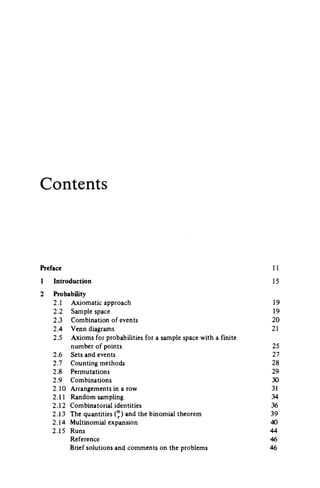
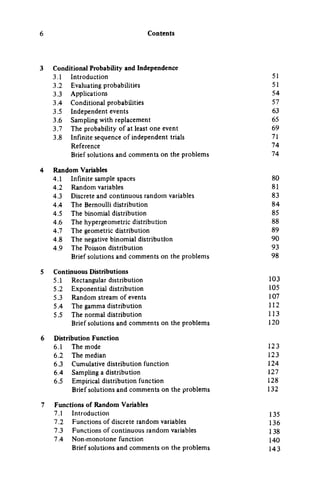
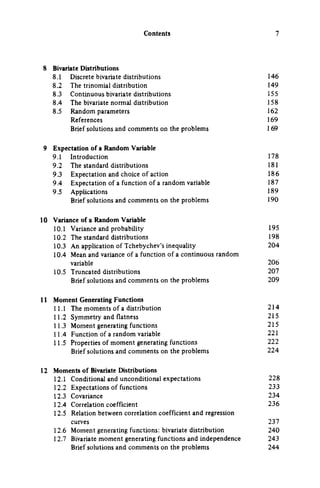
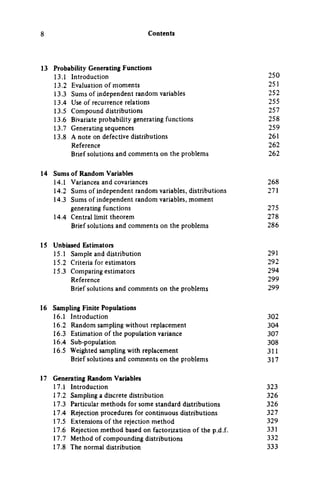
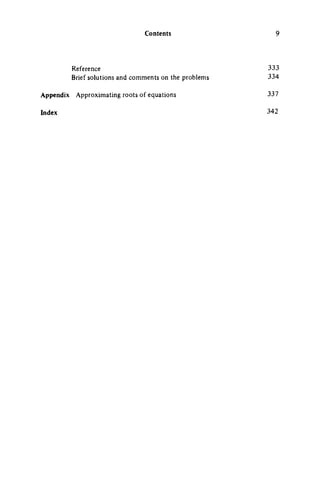

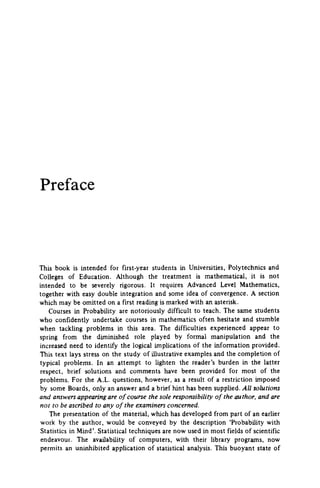

![Sec. 2.4] Venn Diagrams 21
The intersection of two sets Ei, E^ is the set of points of S which belong to
both El and Ei and is an event {written E^ Ej) Thus the intersection of the
sets ( H H , T H , H T } and {HT, ΤΤ) is the set containing the single point HT. This
event may be called 'heads on the first coin and tails on the second coin'. It may
happen that the two sets have no points in common, that is, their intersection is
the empty set. We now see why, for completeness, we decided to count the
empty set as an event. By repetition, the intersection of any finite number of
events is an event.
Another operation is to form the union, written f", U Ej of two sets Ε^,Ε-^.
This is defined as the set which contains all the points of S which are in either
El orEi {or both). Thus, the union of the events {HH, TH, ΗΤ) and {HT. T T ) ,
in the present example, is the event ( H H , T H , H T , T T } , which contains every
point in the sample space and may reasonably be called 'the certain event'.
Finally, for any event Ε we obtain the complement, written by selecting
ail those points of S which are not in E. This event might be called 'not E
Thus, the complement of {HH, TH, ΗΤ) is the event {ττ} and corresponds to
the event 'no head'.
Apart from its generality, the representation of events as sets shows more
clearly how the operations of 'and', 'or', 'not' may be combined.
2.4 VENN DIAGRAMS
The set £Ί is said to be contained in E2, written C , if every point in £ 1
is also a point in Ej . If £"1 C E2 and , E2 are events, then if event £", happens
then also E^ must happen. We may also say that E^ contains £"1, written
El Ό El. A common technique for showing that two sets £Ί, E^ are the same
set is to prove separately that Ei D Ej and Ej ^ £"i. From the definitions,
certain results follow immediately. These will be listed in a particular way to
bring out a certain feature. Let f,, Ej. £"3 be events in a sample space S and
0be the empty set.
The operations of forming intersections and unions satisfy
(1) £·, U ( £ 2 U £ 3 ) = (£-, U £ 2 ) U £ 3 , Π (£j η £ 3 ) = Π f ^ ) η £ 3
(2) £i υ £ 2 = £ 2 υ Ει, Ει rE2 = Ε^ rEi
(3) £ , U £ , = £ , , £ , η £ , = £ 1
(4) £ , υ £ , ' = 5, £ , η = 0
(5) £, U 0 = £ i , £ , η 5 = £ι
(6) £ i U 5 = 5, Ει η 0 = 0
(7) 0 ' = 5 , S' = 0
The pairs of statements are duals in the sense that if in any one, we inter
change union with intersection and S with 0, leaving complementation
undisturbed, we obtain a twin statement which is also true.
Other results can be verified with the assistance of a Venn diagram. In a Venn
diagram, the sample space is represented by a rectangle and any event by a circle](https://image.slidesharecdn.com/68633-250224192747-e150bfde/85/Probability-and-Random-Variables-G-P-Beaumont-27-320.jpg)
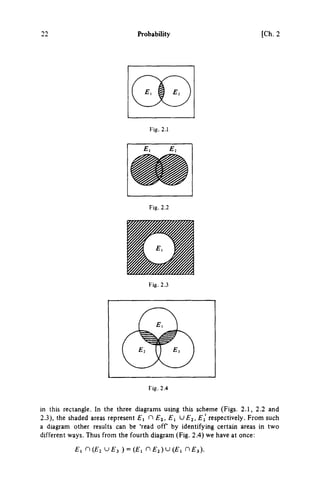
![Sec. 2.4] Venn Diagrams 23
This distributive law can be heard as well as seen to be true. For a point which is
in £ , and either £ 2 or £ 3 is certainly either in £ 1 and £ 2 or £ , and £ 3 (and
conversely).
Problem 1
(1) Show that ( £ 1 U £ 2 ) η (£1 U £ 3 ) = £ , U (£2 η £ 3 ) . What is the dual of
this result?
(2) Show that ( £ , Π £ 2 ) ' = £1' U £ 5 .
(3) Show that (£, U £ 2 ) ' = £ , ' η . What is the dual of this result? (2) and
(3) constitute De Morgan's laws.
(4) Show that £ 1 C (£1 υ £2 ) but £ 1 D ( £ , Π £ 2 ) .
(5) If £ i C £ 2 show that
EiOEi = £ 2
Ei nE^ = £,
( £ , n £ 3 ) c ( £ 2 η £ 3 )
( £ , U £ 3 ) C ( £ 2 υ £ 3 )
(6) Use (4) and (5) to deduce that
£ , U ( £ , n £ , ) = £ i
£ , n ( £ i U £ 2 ) = £ ,
Verify the results using Venn diagrams.
(7) Sometimes, the information about an event £ 1 is provided in terms of
whether or not a second event £ 2 has occurred. Show that
£ : = ( £ , n £ , ) U ( £ , n £ 2 ' ) . -
If the sets contain a finite number of points then we can find a certain
relationship between these numbers and the numbers of points found in related
sets formed by set operations. Let JV(E) be the number of points in the event
£. If £ 1 , £ 2 are disjoint sets or are mutually exclusive events we have at once
Λ^(£ι η £ 2 ) = 0,
^ ( £ , υ £ 2 ) = Λ^(£,) + Λ^(£2).
If £ 1 , £ 2 are not disjoint, then
N(Ei U £ 2 ) = ^ ( £ , ) + N(E2 ) - . V ( £ , η £ 2 )
since the number of points in £ 1 Π £ 2 is counted twice in
N(E,) + N{E2).
Also, £ 1 u £ 2 can be expressed as the union of the disjoint sets,
£ i n £ j ' , E[nE2, E^nE^
whence
/ V ( £ , u £ 2 ) = i V ( £ i η £ 2 ' ) + Λ^(£,' η £ 2 ) + yv(£i η £ 2 ) .
For any event £ , , JV(£I ) = yV(£i Π £ 2 ) + Λ^(£ι nEi).](https://image.slidesharecdn.com/68633-250224192747-e150bfde/85/Probability-and-Random-Variables-G-P-Beaumont-29-320.jpg)
![24 Probability [Ch.2
Example 1
An ice-cream firm, before launching three new flavours, conducts a tasting with
the assistance of 60 schoolboys. The findings were summarized as:
32 liked A
24 liked Β
31 liked C
10 liked A and Β
11 liked A and C
14 liked BandC
6 liked A and Β and C.
Since there are only three flavours. A, B, C to consider, the information
provided can easily be grasped through a diagram (Fig. 2.5). [A is the set of
people who liked flavour Α.]
Fig. 2.5
By inserting the 6 who Uked all three, we can quickly fill in all the other spaces.
Thus these 6 are part of the 10 who liked A and B, hence there must have been
10 — 6 = 4 who liked A and Β but not C. For more comphcated cases, a formal
approach may be preferred. Thus suppose that we require the number who like
A only. Since
A=iAr)C)UiAn C'), N(A) = N{Ar)Q + N(A η C'),
or
that is
Similarly
32 = 11 + Λ^(/1 η c ' ) ,
N{Anc') = 2.
Ν{Α η Β η c') = Ν{Α η B) - N(A η Β η C) = 10 - 6 = 4.
Finally, the number liking A only must be
N(A ns' nc')=NiAnc')-NiA nBnc') = 21 - 4 = 17.
Two boys are unlisted from the information provided, those who liked none of
the flavours! If the number who liked Β is not reported, we can set bounds to
the missing number. From Fig. 2.5, it must exceed 18, since these like Β and
something else; but it cannot be greater than 60 — 34 = 26, since 34 did not care
forB.](https://image.slidesharecdn.com/68633-250224192747-e150bfde/85/Probability-and-Random-Variables-G-P-Beaumont-30-320.jpg)
![Sec. 2.5] Axioms for Probabilities for a Sample Space with a Finite 25
Number of Points
Problem 2. 50 patients suffering from a disease are classified as to the presence
or absence of three symptoms A, B, C. The presence of symptom Β imphes
symptom A also, but precludes symptom C. It is noted that 8 have B, 36 have
A, and 30 have C. Find limits for the number having both C and A.
Problem 3. In a workforce of 80 men and 95 women, an enquiry is made
regarding ownership of a car and possession of a mortgage. It is found that 44
men and 21 women have a mortgage. If 26 men have neither a car nor a
mortgage, find the number of women who have a car but no mortgage.
2.5 AXIOMS FOR PROBABILITIES FOR A SAMPLE SPACE WITH A FINITE
NUMBER OF POINTS
For every event, E, in the sample space S we assign a non-negative number,
called the probability of Ε denoted by Prif), so that the following axioms are
satisfied.
(a) For every event £, Pr(£") > 0.
(b) For the certain event, Pr(5) = 1.
(c) If £ , , £ 2 are mutually exclusive events Pr(£i U £ j ) = Prf£, ) + P r ( £ 2 ) .
There is no unique way of assigning probabilities to the events so that the
axioms are satisfied. However, if the assignment is to bear any reasonable
relation to the reality represented by the experiment, then the number assigned
to an event should be the limiting proportion of times that event occurs in a long
series of uniform trials of the experiment. It will be observed that the axioms
have the previously noted properties of the relative frequencies of outcomes. If
S contains a finite number, k, of points we assign a probability to each point in
the sample space, so that the sum of all these probabilities is unity. To find the
appropriate probability for any event £, we then merely sum the probabilities
attached to the points contained in £. An important example is when equal
probability jk is given to each of the points in the sample space. This
symmetric case is appropriate to many games of chance. In this case if an event
contains r points, the probability of the event will be rfk. Various examples of
the symmetric case will be later examined in detail.
Deductions from the axioms
We first show that the probability of the empty set is zero and hence apart from
its inclusion as an event, contributes nothing to our calculations. Now the empty
set and the whole space S have no points in common, since 0 has no points.
Hence, by axiom (c),
Pr(0 υ S) = Pr(0) + Pr(S) = Pr(0) + 1, by axiom (b). (2.1)
But 0 U 5 is S. Hence, Pr(0 U 5) = 1 and Pr(0) = 0.](https://image.slidesharecdn.com/68633-250224192747-e150bfde/85/Probability-and-Random-Variables-G-P-Beaumont-31-320.jpg)
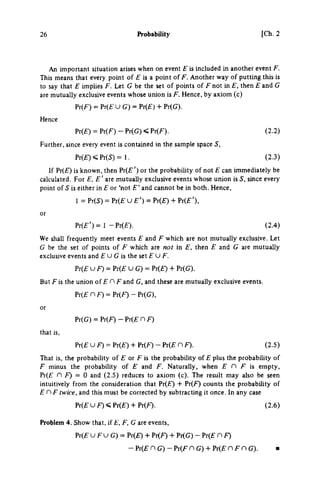
![Sec. 2.6] Sets and Events 27
Suppose El, E2, • • • ,E„ are all mutually exclusive events in the sample space S,
then
Pr(£, U £ 2 U £ 3 . . . U £ „ ) = Pr(£,) + Pr(£2) + . . . Pr(£„). (2.7)
For we may regard (£2 U £ 3 . . . U £ „ ) as one event and then
Pr[£, U ( £ 2 U £ 3 . . . υ £„)] = Pr(£,) + Pr(£2 U £ 3 . . . U £ „ )
and the result is obtained by continued application.
All the results above refer to a sample space with a finite number of points. If
the sample space contains infinitely many points then some modifications are
required. For in such spaces it may be possible to define some subsets of S to
which it is not possible to assign probabilities, satisfying the axioms. To meet
this difficulty it is necessary to redefine those subsets of S which are to be called
events. In a more advanced course, this would be done and it would be shown
that in this case also, all finite unions, intersections, and complements of a finite
number of events are also events. Even so, the result (2.7) above fails for the
union of infinitely many events and axiom (c) has to be modified to state that
the probability of the union of an infinite sequence of mutually exclusive events
is the sum of the infinite series of the probabilities of the separate events.
2.6 SETS AND EVENTS
It has been convenient to discuss the rules for manipulating probabilities using
the framework of sets in a sample space. In any particular problem it is more
natural to think of an event as a statement which is or is not confirmed by the
actual outcome of an experiment. Thus, if a die is rolled, the event 'the number
is even' inclines us more to picture the concrete outcomes 2, 4, 6 than to refiect
on the set of three points in a sample space corresponding to these outcomes. It
will be clear, from the way they have been defined, that there is an exact
matching between operations on sets representing events and the ordinary
connectives between statements about actual events, namely:
υ Ξ or
η Ξ and
( ) ' H n o t
As from now on we shall frequently use the statement language, we here repeat
the main results of section 2.5 suitably translated.
0 < Pr(£) < 1
Pr(not £) = 1 - Pr(£)
Pr(£i and £ 2 ) = 0 if £ 1 and £ 2 are inconsistent
Pr(£i or £ 2 ) = Pr(£,) + Pr(£2 ) - Pr(£i and £ 2 ) .](https://image.slidesharecdn.com/68633-250224192747-e150bfde/85/Probability-and-Random-Variables-G-P-Beaumont-33-320.jpg)
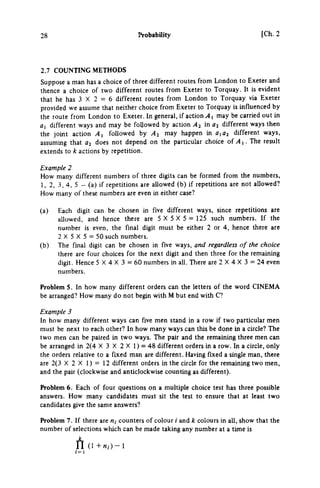
![Sec. 2.8] Permutations 29
Example 4
Consider the placing of r different balls in η different boxes. We are not
concerned with the order in which the balls are picked up or the order in which
they sit in the boxes. If the balls are placed one at a time, then each ball may be
placed in one of η (provided there is ample room) and hence there are n''
different distributions. Now, if each ball is placed at random, the probability of
each distribution is Ijn'^. If there are restrictions, say each box can only take
one ball, then the first ball may be placed in η ways but the second only η — 1
ways and in all there are n{n — ) . . .{n — r + 1) different distributions. Yet
another problem is posed if the balls cannot be distinguished from each other. In
this case, two distributions are the same if corresponding boxes contain the same
number of balls. The various assumptions possible about the balls, boxes and
capacity restrictions can be used as simple models for real experiments. (For an
interesting discussion of such models in physics see ref. [ 1 ]).
Problem 8. Four different balls are placed at random in four different boxes.
Calculate the probability that each box contains just one ball.
2.8 PERMUTATIONS
In how many different ways can η people form a single-file queue at a bus-stop?
The first position can be filled in η ways, then the second in (« — 1) ways since
one person is not now available, the j'th place in η — (/' - 1) ways and so on until
there is just one person to fill the last place. Thus there are n{n — 1). . . 3.2.1
ways in which the queue may be formed. Such products are continually
appearing in counting processes, and a standard notation for such a product is
η !, read as η factorial. The number η ! is thus defined for all positive integers
and, by convention, 0! is 1. The people in the queue are always the same, but
an observer may detect n distinct orders in which they may stand. It is some
times objected that if someone is chosen to be first then he is no longer available
for the second place. This is quite true, but it should be realized that every
person is in front in turn for some of the arrangements; in fact each person is
front for (n — 1)! of the different orders.
Now suppose a bus arrives, in how many different orders can just r people
mount the bus one at a time? To answer this, we do not need to know the order
in the queue or even if they are in a queue at all, provided they mount the bus
one at a time. The first person to get on can be any one of η persons, the second
any one of π — 1 and the rth person any one of « — (r — 1), since r — 1 persons
have already boarded. Hence the total number of distinct ways is n{n — 1)(« — 2)
. . . (n — r -f 1). Now
n{n - 1) . . .(« - r - i - l ) ( « - r ) ( « - r - 1) . . . 3.2.1
rt(« — 1) . . . (rt — r -1- 1) =
(n-rn-r-) .. .1.1.1
η 1
{n-r)
(2.8)](https://image.slidesharecdn.com/68633-250224192747-e150bfde/85/Probability-and-Random-Variables-G-P-Beaumont-35-320.jpg)
![30 Probability [Ch. 2
The number of different arrangements of η distinct things taken r at a time is
also called the number of permutations of η things Λ at a time and is written {η
(n - r)!
2.9 COMBINATIONS
We next find the number of different samples of r elements that can be drawn
from a population of η distinct elements. 'Element' may mean person,
institution, or, say, car registration number. We have still to settle how the
sample is to be drawn. We may take r elements all at once or make up the sample
by drawing one element at a time until r have been obtained. Further, if we draw
one at a time, we may either put each one aside until we have collected r
elements (sampling without replacement) or may make a note of which element
it is and then put it back into the population before drawing another element
(sampling with repbcement). Without replacement means that no two elements
in the sample may be the same, while with replacement means that an element
may be recorded as appearing several times in the sample. In this section we shall
consider sampUng without replacement. Taking the elements one at a time
differs from drawing the sample all at once in one important respect, namely
that we can record the order in which the elements appeared in the sample. Thus
we should distinguish between ordered samples and unordered samples. Two
ordered samples will be the same when they have the same elements and these
were drawn in the same order. The number of different ordered samples is the
number of disfinct arrangements or permutations of η distinct elements, r at a
time and this is η!/(« — r). Two unordered samples on the other hand, will be
the same, if they contain the same elements, in whatever order they appear. We
can find the number of distinct ordered samples by taking a particular unordered
sample and finding all the distinct ordered samples which its elements can form.
Since there are r distinct arrangements of r different elements, each unordered
sample yields r ordered samples. Thus r times the number of distinct
unordered samples must equal the number of distinct ordered samples, namely
n/(n — r). Hence the number of distinct unordered samples is n!/[r!(n —r)].
This number, also known as the number of selections or of combinations of η
different elements taken r at a time, is denoted "C,, or (more usually), (^^.
Example 5
The number of different selections of three from the five letters A, B, C, D, Ε is
5!
= 10
3!2!
The number of selections of three which contain A is Q^, since having taken A
we select two more from the remaining four.](https://image.slidesharecdn.com/68633-250224192747-e150bfde/85/Probability-and-Random-Variables-G-P-Beaumont-36-320.jpg)
![Sec. 2.10] Arrangements in a Row 31
Example 6
A college offers four courses in statistics and five in mathematics to students in
their first year. A student must take two courses in statistics and three in
mathematics. How many different first-year programmes may be devised? A
student may select two courses in statistics from four in ways and with each
such selection he may choose three courses from five in mathematics in
ways. Hence the number of programmes is ( 2 ) ( 3 } ~ ^^^^^^^ found that
one particular course in statistics involves a timetable clash with one particular
course in mathematics, then we must subtract the number of programmes which
contain both these courses. There are 18 of these and hence 42
different programmes possible. Verify this answer by finding the number of
programmes which include just one of the classing courses or neither of them.
Problem 9. Find the maximum number of points of intersecUon of m straight
lines and η circles.
Problem 10. Show that the number of distinct ways in which r different balls
can be placed in η different boxes so that one particular box contains exactly
k balls is (M — 1)''"*. What is the sum of this expression over all values of kl
Problem 11. A bag contains m + k discs. On m of these is inscribed a different
non-zero number, while the remaining k bear the value zero. If η discs are drawn
one at a time without replacement, calculate the probability that the /th disc is a
zero.
2.10 ARRANGEMENTS IN A ROW
We next consider the number of distinct arrangements of ay similar white balls
and flj similar red balls in a row. Here the (a, + 0 2 ) ! arrangements are not all
distinct. Suppose there are a, -I- a^ vacant spaces in a row to be filled by the
balls. Each distinct arrangement of the balls may be found by stating which
places are to be filled by red balls. We have to select places from the a, Λ- ai
available and this can be done in
ways. Alternatively, for any arrangement of the balls, the whites can be inter
changed among themselves in ! ways and the red balls in 02! ways without
yielding an arrangement of different appearance. Hence the number of distinct](https://image.slidesharecdn.com/68633-250224192747-e150bfde/85/Probability-and-Random-Variables-G-P-Beaumont-37-320.jpg)
. Show by the argument using the selection of places,
that the number of distinct distributions is also
Ν/Ν-αΛ /N-a, -a^X / ^ - a , - a 2 . . . - a ^ -
ai / a 2 03 / Ok
Hence the number of distinguishable ways of arranging 3 white, 4 black, and 2
red bails in a row is
( 3 + 4 + 2)!
= 1260.
3!4!2!
Problem 12. How many different 10-digit numbers can be formed from the
numbers 1, 1, 1, 2, 2, 3, 4, 4, 6, 9 so that no multiples of three are adjacent?
Problem 13. In how many distinguisable ways can four statistics books, three
psychology books, and five novels be arranged on a shelf so that books of the
same type are together when (a) books of the same type are different ;(b) books
of the same type are identical?
Example 7
Two similar packs of η different cards are laid out in two rows side by side. In
how many ways can this be done so that no pair of cards is the same? This is the
basic situation in the problem of derangements, though it is often jokingly
phrased in terms of 'nobody getting his own hat from a cloakroom' or 'no letter
being put in the right envelope'. We begin by supposing that the two packs are
laid out so that every pair is the same (or is matching). We then leave one row
fixed and derange all the cards in the other row. Let there be « η ) derangements
so that no pair is matching. If we concentrate on a particular card A then we see
that another card, chosen in η — 1 ways, takes the place of A in two exclusive
and only possible ways. Either this card merely changes places with A and the
remaining η — 2 cards suffer total derangement in φ(η — 2) ways or A is not
permitted to rest in the place of the other card and the (M — 1) cards including A
are deranged in 0(M — 1) ways. Thus altogether we have.](https://image.slidesharecdn.com/68633-250224192747-e150bfde/85/Probability-and-Random-Variables-G-P-Beaumont-38-320.jpg)
![Sec. 2.10] Arrangements in a Row 33
φ(η) = (π - 1) [φ(η - 2) + 0(« - 1)].
This equation looks intractable but yields to rewriting in the form
φ(η)-ηφ(η-)= - - ])-(η - ])φ(η - 2)]
= ( - I J ^ [ 0 ( « - 2 ) - ( « - 2 ) 0 { « - 3 ) ]
= ( - 1 ) " - ^ [ φ ( 2 ) - 2 0 ( 1 ) ] .
Now there is only one way of deranging two matched pairs, hence, φ(2) = 1 and
0(1)=O.
Thus φ{η) = ηφ(η - 1) + ( - 1)". Applying the same result to 0(« - 1)
φ{η) = η Κ « - 1 ) φ ( η - 2 ) + ( - 1 ) " - ' ] + ( - 1 ) "
= η(η-1)φ(η-2) + η{-1)"-^ + ( - 1 ) "
η] ηΐ η η
= + . . . + — ( - 1 ) "
2! 3! 4! rt!
, Λ 1 ( - 1 ) "
= η! + . . .
2 ! 3! η
For large η, φ(η)Ιη! is approximately e"' .
Problem 14. If η letters are placed one in each of « addressed envelopes, find the
number of ways in which just r letters are in their correct envelopes. Hence
deduce that.
r = 0 ^
where φ{η) is defined as in Example 7. •
Suppose that an urn contains r red and m — r white balls. A random sample
of η balls is drawn without replacement and we require the probability that the
sample contains just k red balls. Though all the red balls are similar, since each
selection of η is to have the same change of being drawn, we may think of them
as bearing the numbers 1,2, . . . ,r, while the white balls are numbered r + 1,
r + 2 , . . . , w.
The red balls can be selected in ways and with each such way we can
select η - k whites in ways. Hence there a r e ^ ^ ^ ^ ^ _ Q samples
which have equal probability. The probability of just k reds is thus](https://image.slidesharecdn.com/68633-250224192747-e150bfde/85/Probability-and-Random-Variables-G-P-Beaumont-39-320.jpg)
![34 Probability [Ch. 2
The formula obtained is appUcable to many practical situations. The
'population' may be of machines and 'red' may stand for defective or the
population may be of adults in a particular town and 'red' may mean 'owns or
rents a television set'.
The reader will have detected various side restrictions on the possible value of
k. Thus k <,r and k η imply k < min {r, n) while η — k ^ m ~ r with k>0
demands k > max [n — (m — r), 0 ] . However, values of which do not satisfy
these bounds will have zero probabihty.
2.11 R A N D O M S A M P L I N G
To make forward planning possible, goverrunents must have reliable statistics
concerning the characteristics and composition of society. Periodically a census
is carried out to obtain this information. Such is the labour and cost of
compiling the results, that only a short list of key questions is administered to all
the reachable and relevant citizens. For information on other matters, the survey
office must rely on the responses of a sample of the population to a longer list of
questions. There is always a danger that some feature of the process used to
select this sample will lead to persistent and uncorrectable bias in the
conclusions drawn for the population. Therefore it would be unwise to select the
sample by taking names from telephone directories when estimating earnings.
One precaution we can take is to give all possible samples, of the required
number of elements, an equal chance of being chosen. The resulting process is
called random sampling.
Thus suppose there are m elements in the population and we wish to draw a
random sample of η elements. In survey work there is no point in examining the
same element more than once so that the results of section 2.10 apply. Therefore
there are ^'^^ different unordered samples which can be drawn without replace
ment and each of these is given probability 1 / ^ ^ ^ .
For example, suppose we wish to draw a random sample of two from four
elements, without replacement. The four elements may be labelled A , B , C , D
and there are = 6 selections of the elements. These are ( A , B ) , ( A , C } ,
{ A , D ) , ( B , C } , { B , D ) , ( C , D } which we number 1 , 2 , 3 , 4 , 5 , 6 respectively. If
a fair die is rolled, the number obtained can be used to indicate which sample is
to be taken.
A consequence of drawing a random sample of η from m, is that all sets of
k(< n) elements have the same probability of appearing in the sample. For if a
particular set of k elements be included, then η — k further elements can be
selected from the m — k remaining in _ ways. Hence the probability that
A' particular elements appear in the sample is i t } / { ' n ) ' probabihty,](https://image.slidesharecdn.com/68633-250224192747-e150bfde/85/Probability-and-Random-Variables-G-P-Beaumont-40-320.jpg)
![Sec. 2.11 ] Random Sampling 3 5
although a function of k, does not depend on the elements involved. When
λ = 1 , the probability that any individual element is included is
/ m - 1 / /ni
m
It is worth pointing out that although random sampling without replacement
ensures that each element in the population has the same chance of appearing in
the sample, the converse need not be true. For example, if the population has
four elements A , B , C , D and the pairs {A, C ) , ( B , D ) are selected each with
probability 1/2, then each of A , B , C , D appears with probability 1/2 but A and
Β cannot appear together.
Example 8
A box contains ten articles, of which just three are defective. If a random sample
of five is drawn, without replacement, calculate the probabilities that the sample
contains (a) just one defective, (b) at most one defective, (c) at least one
defective.
(a) There are {^^^ samples with equal probability. Of these ^j^^^^ contain
just one defective and four non-defective. Hence rquired probability is,
QG) 3
(b) Similarly, the probability of no defective is
QG) 1
Hence the probabihty of at most one defective is
I 5 _ 1
1 2 1 2 ~ 2 '
(c) Pr(at least on defective)
= 1 — Pr(no defective)
1 _ Π
1 2 ~ 1 2 •
Example 9
A hand of 1 3 cards is drawn at random without replacement from a full pack of](https://image.slidesharecdn.com/68633-250224192747-e150bfde/85/Probability-and-Random-Variables-G-P-Beaumont-41-320.jpg)
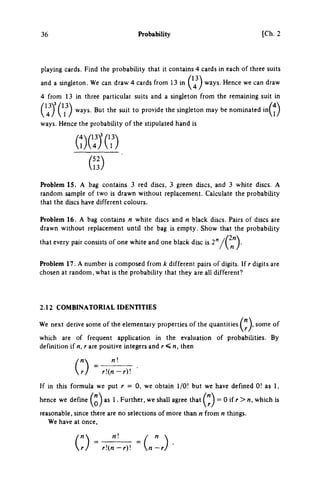
![Sec. 2.12] Combinatorial Identities 37
This illustrates that if a selection of r elements is made from «, then η — r
elements are left behind and, of course, the number of different remainders
must equal the number of selections. (Part of the charm of the formulae used in
counting processes is the possibility of finding a representation which makes a
formula seem obvious.) Next
r-Xl
(2.10)
This is readily verified, for the right-hand side is
( r - l ) ! ( / J - r + 1)!
1
r ! ( « - r ) ! (r-)(n -τ) Μ - Γ + 1
η + 1
( r - ! ) ! ( « - , · ) ! r(n - /• +
( " + ! ) !
r ! ( « - r + 1)! Λ r )
1
+ -
r
We may also argue as follows: every selection of r elements from η + 1 either
does or does not include a particular element A. If A is included, the remaining
r — 1 elements must be selected from η elements which may be done in ^
ways. If A is not included, then we may select all r elements from the remaining
η elements ^"^^"^ ways. Hence, by addition, the result.
Example 10
This last result is the key to many identities. Writing it in the form
/
r-l
η + 1
r
k
Σ
/ + 1
r
(k + 1
r
η + 1
r
li
in'
j + 2
r r I
the only remaining terms are those involving the lowest and highest values for
n. Hence](https://image.slidesharecdn.com/68633-250224192747-e150bfde/85/Probability-and-Random-Variables-G-P-Beaumont-43-320.jpg)
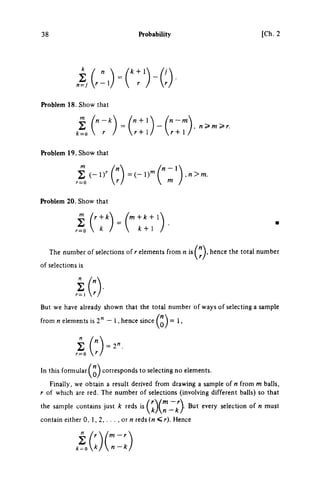
![Sec. 2.13 ] The quantities (") and the Binomial Theorem 3 9
must be the total number of selections of η balls from m, that is, Hence
(2.11)
2 Ir (m-r /m
k=ok/n-k/ n/
Problem 21. Discuss (2.11) for the case n>r.
2.13 THE QUANmiES AND THE BINOMIAL THEOREM
The expansion
(1 = 1 +
where χ is any real number and η a positive integer will already have been met.
It is in this connection that the numbers are called the binomial coefficients.
The theorem may readily be proved by the method of induction, but it is
enhghtening to relate it to a certain selection process. Since
(1 +ΛΓ)" = ( 1 +Λ:)(1 + Λ : ) . . .(1 + χ)
to η factors, each term in the expansion is the produce of η symbols, one from
each of the η factors. If the product isx'^, then χ has been selected r times and 1
has been selected η — r times. But we may select r out of η factors in ways,
hence is the coefficient of x'^. From this expansion we can obtain some of
the results already found in the last section. For example, if we put χ = 1, then
2" = 1 +
Consider also the identity (1 + x)'" = (1 + x)'{I + x)'"-' for r<m. The
coefficient of x" in (1 + x)"' is ('^)-The term in x" in(l + x ) ' ' ( l +x)'""''is
found by taking all terms like x*^ from (1 + x)'^, with coefficient > ^nd
multiplying by x " ' * , with coefficient from (1 + x)'""'' and adding
them together. Thus we have
(:)%lo(:::)](https://image.slidesharecdn.com/68633-250224192747-e150bfde/85/Probability-and-Random-Variables-G-P-Beaumont-45-320.jpg)
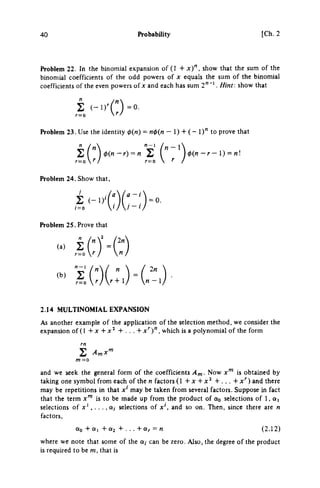
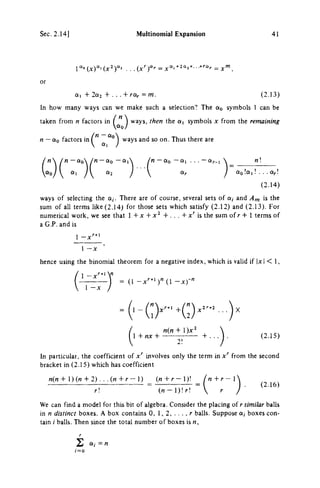
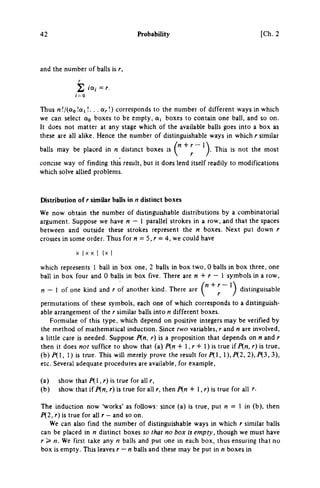
![Sec. 2.14] Multinomial Expansion 43
'n + ir-n)-
r —n
distinguishable ways, that is _ distinguishable ways. The first stage of this
argument would fail entirely if the balls were not similar.
Example 11
Find the coefficient of JC'° in the expansion of (Λ: + JC^ + )*. We may write
this as
*
= x ^ l - x ^ ) " (1 - χ Γ *
X —χ"
= x''(l - 4 x ^ + 6x* - 4 χ ' + x ' ^ )
4.Sx^ 4.S.6x^
1 + 4x + + + . . .
2! 2!
4.5.6.7.8.9 jc*
+ 6!
The total coefficient of x ' " is
4.4.5.6 4.5.6.7.8.9
6 + = 10.
3! 6!
This is also the number of ways in which ten single pound coins can be dis
tributed among four men so that each gets at least one and at most three
pounds. There are four distributions of type (3, 3, 3, 1) and six of type (3, 3, 2,
2).
Problem 26. Find the number of distinct ways in which r similar balls may be
placed in η different boxes so that no box is empty by calculating the coefficient
of x'' in the expansion of (x + χ ^ +...-{• x'')".
Show further that the number of different distributions in which exactly m
cells are empty is I V ' , ) , and evaluate
n — i
Σ
m =0 m n — m —
Problem 27. If φ^^^ is the number of distinguishable ways in which r similar balls
can be placed in η different boxes, show that
'^n -i .](https://image.slidesharecdn.com/68633-250224192747-e150bfde/85/Probability-and-Random-Variables-G-P-Beaumont-49-320.jpg)
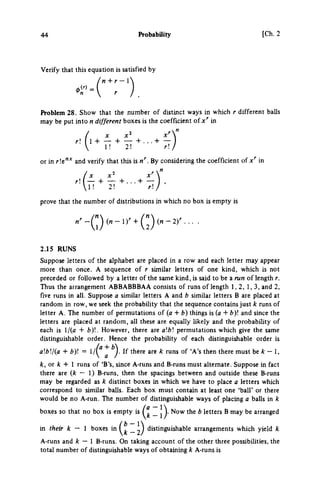


![was he who “first enunciated the law that the volume of gas varies
inversely as the pressure, which among English-speaking people is
still called by his name.” Great as were his attainments they were
almost over-shadowed by the saintliness of his character, the
liveliness of his wit and the incomparable charm of his manner.
Boyle was a man of the most feeble health. This is what Evelyn says
of him: “The contexture of his body seemed to me so delicate that I
have frequently compared him to Venice glass, ... [which] though
wrought never so fine, being carefully set up, would outlast harder
metals of daily use.”
Robert Hooke, the experimental philosopher, was both deformed
and diseased. He was not a great man and his scientific achievements
would have been “more striking if they had been less varied.”
Nevertheless he was renowned in his day, and his contribution of
real importance for, although “he perfected little he originated
much.” I mention him, and shall mention several others, who have
been forgotten by all but scholars, because I wish to show how large
an army stands behind its illustrious chiefs. Besides, if we
contemplate only the giant luminaries of the firmament of fame, we
shall become discouraged. They paralyze us by the very intensity of
the admiration they evoke. Lesser men, on the contrary, for the
reason that they are nearer our own orbit, are more likely to stir us
into emulation.
Herbert Spencer’s achievements are too well known to necessitate
further comment. He was exceedingly delicate and at his best only
able to work three hours a day.
Descartes, the foremost French philosopher, had a feeble and
somewhat abnormal body. “Yet he considered it” (I am quoting Mr.
Edmund Gosse) “well suited to his own purposes, and was convinced
that the Cartesian philosophy would not have been improved, though
the philosopher’s digestion might, by developing the thews of a
plough-boy.”
Nicholas Malebranche, the great French Cartesian philosopher,
was the tenth child of his parents. Although deformed and
constitutionally feeble he was one of the most sought after men of his
day. From all countries of the world, but more especially from
England (be it said in her honour) scholars, writers and philosophers
flocked to his door. The German princes voyaged to Paris expressly](https://image.slidesharecdn.com/68633-250224192747-e150bfde/85/Probability-and-Random-Variables-G-P-Beaumont-67-320.jpg)