Here are the probabilities for the different scenarios:
Odd: P(odd) = 7/15
Greater than 5: P(greater than 5) = 10/15
Even and less than 7: P(even and less than 7) = 2/15
Even or less than 7: P(even or less than 7) = 11/15
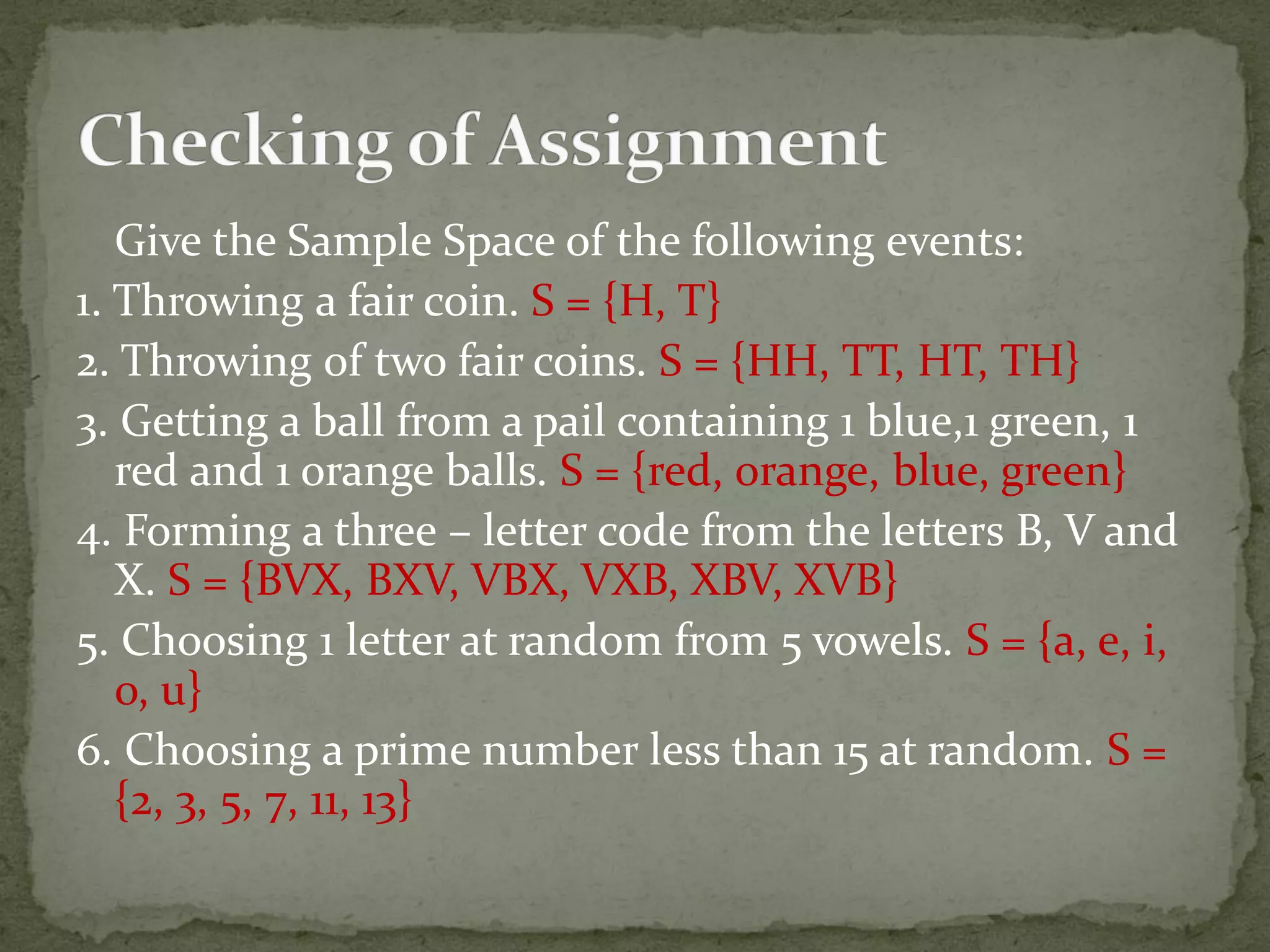
Give the SampleSpace of the following events:
1. Throwing a fair coin. S = {H, T}
2. Throwing of two fair coins. S = {HH, TT, HT, TH}
3. Getting a ball from a pail containing 1 blue,1 green, 1
red and 1 orange balls. S = {red, orange, blue, green}
4. Forming a three – letter code from the letters B, V and
X. S = {BVX, BXV, VBX, VXB, XBV, XVB}
5. Choosing 1 letter at random from 5 vowels. S = {a, e, i,
o, u}
6. Choosing a prime number less than 15 at random. S =
{2, 3, 5, 7, 11, 13}
2.
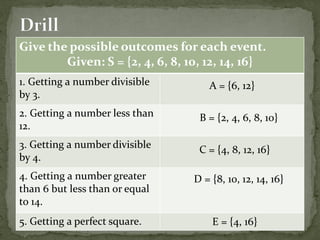
Give the possibleoutcomes for each event.
Given: S = {2, 4, 6, 8, 10, 12, 14, 16}
1. Getting a number divisible
by 3.
2. Getting a number less than
12.
3. Getting a number divisible
by 4.
4. Getting a number greater
than 6 but less than or equal
to 14.
5. Getting a perfect square.
A = {6, 12}
B = {2, 4, 6, 8, 10}
C = {4, 8, 12, 16}
D = {8, 10, 12, 14, 16}
E = {4, 16}
4.
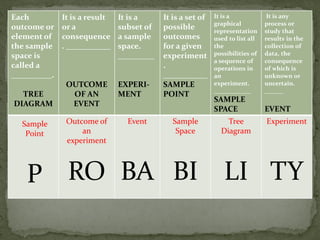
Each
outcome or
element of
thesample
space is
called a
__________.
TREE
DIAGRAM
It is a result
or a
consequence
. ___________
OUTCOME
OF AN
EVENT
It is a
subset of
a sample
space.
_________
EXPERI-
MENT
It is a set of
possible
outcomes
for a given
experiment
.
___________
SAMPLE
POINT
It is a
graphical
representation
used to list all
the
possibilities of
a sequence of
operations in
an
experiment.
____________
SAMPLE
SPACE
It is any
process or
study that
results in the
collection of
data, the
consequence
of which is
unknown or
uncertain.
______
EVENT
Sample
Point
P
Outcome of
an
experiment
RO
Event
BA
Sample
Space
BI
Tree
Diagram
LI
Experiment
TY
5.
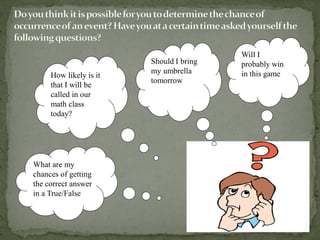
Should I bring
myumbrella
tomorrow?
How likely is it
that I will be
called in our
math class
today?
What are my
chances of getting
the correct answer
in a True/False
type?
Will I
probably win
in this game?
6.
How doyou deal with these questions?
Were you able to answer them with certainty?
7.
The branchof mathematics that deals with
uncertainty is
When we say PROBABILITY, we talk about
8.
PROBABILITY isa measure or estimation of how likely
it is that an event will occur. Activities such as tossing
or flipping a coin or picking a card from a standard
deck of cards without looking which could be repeated
over and over again and which have well – defined
results are called
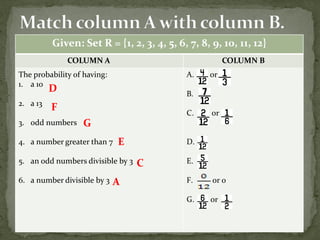
Given: Set R= {1, 2, 3, 4, 5, 6, 7, 8, 9, 10, 11, 12}
COLUMN A COLUMN B
The probability of having:
1. a 10
2. a 13
3. odd numbers
4. a number greater than 7
5. an odd numbers divisible by 3
6. a number divisible by 3
A. or
B.
C. Or or
D.
E.
F. or 0
G. or
D
F
G
E
C
A
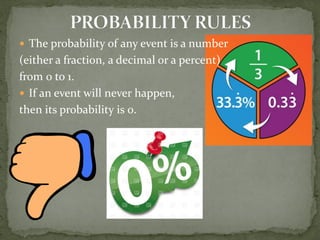
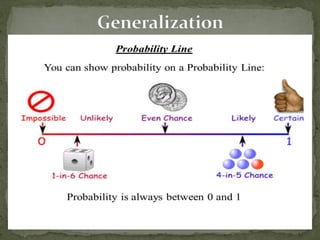
The probabilityof any event is a number
(either a fraction, a decimal or a percent)
from 0 to 1.
If an event will never happen,
then its probability is 0.
14.
If anevent is sure to happen, then the probability is 1.
15.
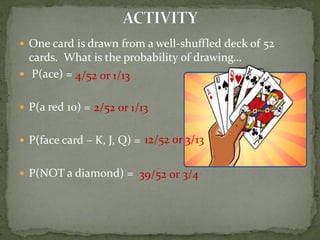
One cardis drawn from a well-shuffled deck of 52
cards. What is the probability of drawing…
P(ace) =
P(a red 10) =
P(face card – K, J, Q) =
P(NOT a diamond) =
4/52 or 1/13
2/52 or 1/13
12/52 or 3/13
39/52 or 3/4
16.
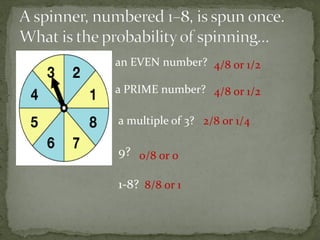
an EVENnumber?
a PRIME number?
a multiple of 3?
9?
1-8?
4/8 or 1/2
4/8 or 1/2
2/8 or 1/4
0/8 or 0
8/8 or 1
17.
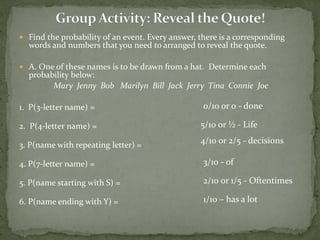
Find theprobability of an event. Every answer, there is a corresponding
words and numbers that you need to arranged to reveal the quote.
A. One of these names is to be drawn from a hat. Determine each
probability below:
Mary Jenny Bob Marilyn Bill Jack Jerry Tina Connie Joe
1. P(3-letter name) =
2. P(4-letter name) =
3. P(name with repeating letter) =
4. P(7-letter name) =
5. P(name starting with S) =
6. P(name ending with Y) =
0/10 or 0 - done
5/10 or ½ - Life
4/10 or 2/5 - decisions
3/10 - of
2/10 or 1/5 - Oftentimes
1/10 – has a lot
18.
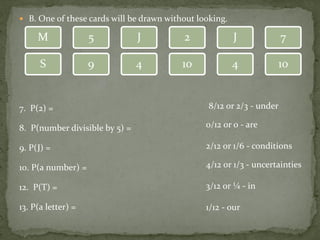
B. Oneof these cards will be drawn without looking.
7. P(2) =
8. P(number divisible by 5) =
9. P(J) =
10. P(a number) =
12. P(T) =
13. P(a letter) =
J5
9S
M
104
2 J 7
4 10
8/12 or 2/3 - under
0/12 or 0 - are
2/12 or 1/6 - conditions
4/12 or 1/3 - uncertainties
3/12 or ¼ - in
1/12 - our
19.
1.
2.
3.
4.
5.
6.
7.
8.
9.
10.
11.
12.
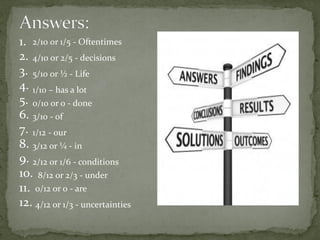
2/10 or 1/5- Oftentimes
4/10 or 2/5 - decisions
5/10 or ½ - Life
1/10 – has a lot
0/10 or 0 - done
3/10 - of
1/12 - our
3/12 or ¼ - in
2/12 or 1/6 - conditions
8/12 or 2/3 - under
0/12 or 0 - are
4/12 or 1/3 - uncertainties
20.
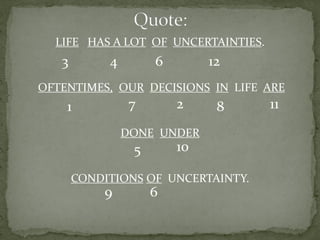
LIFE HAS ALOT OF UNCERTAINTIES.
OFTENTIMES, OUR DECISIONS IN LIFE ARE
DONE UNDER
CONDITIONS OF UNCERTAINTY.
3 4 6 12
1 7 2 8 11
5 10
9 6
21.
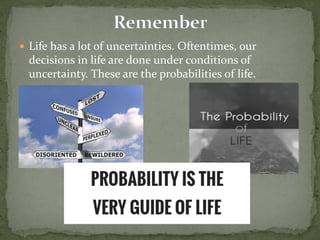
Life hasa lot of uncertainties. Oftentimes, our
decisions in life are done under conditions of
uncertainty. These are the probabilities of life.
22.
Suppose someonevery dear to you was
diagnosed of having a serious illness.
According to the doctor, the illness can be
treated through an expensive operation
with a 50-50 chance of surviving. As a
person very close to the patient, will you
take the chance? Why? Why not?
23.
There are3 C’s in life: Choice, Chance and Change. We
must make a CHOICE, to take the CHANCE, or our life
will never CHANGE.
25.
TRY THESE:
Answer thefollowing questions. Write it in ½
crosswise sheet of paper.
A large urn contains 15 billiard balls which are
numbered from 1 to 15. A ball is drawn at random and
the number is recorded. Find the probability p that the
number is:
odd
greater than 5
even and less than 7
even or less than 7