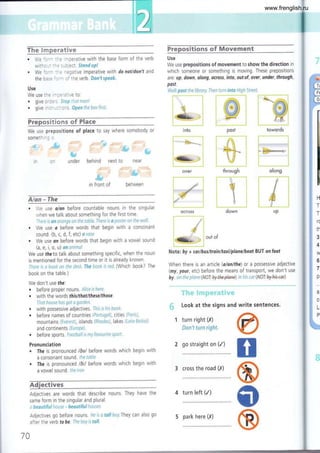
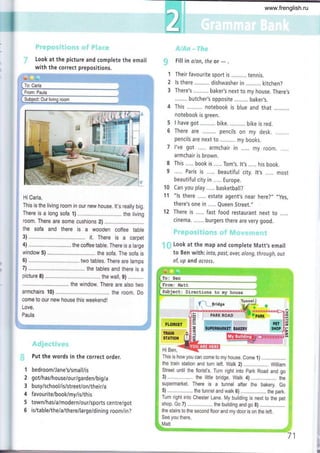
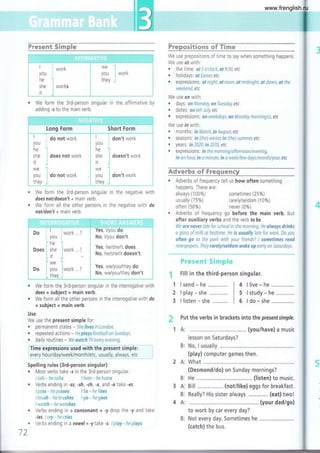
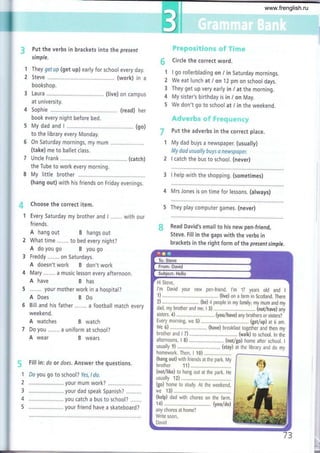
f . iJ ¡.
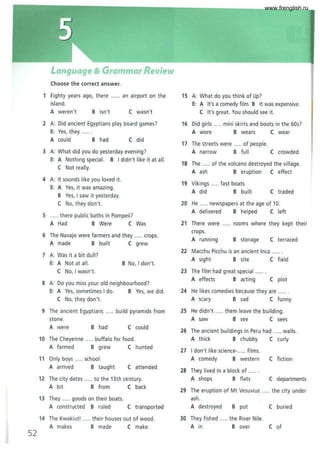
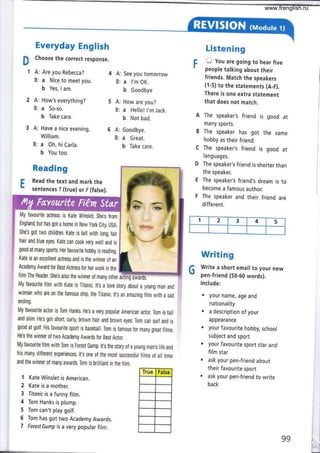
, j ¡.t 1.." j
'"J'."J'
.-.-.:J ."1
-
N
éü
4+f É
* v;" .*l*
B {;
"{*
i r"
www.frenglish.ru
Published by Express Publishing
Liberty iiouse, Greenham Business Paik, I'lewbur¡r
Berkshire RG19 6HW
Tel.: (0044) 1635 817 363
Fax: (0044) 1635817 463
e-mail: inquiries@expresspublishing.co.uk
http://www.expresspu bl ishing.co.u k
@ Virginia Evans - Jenny Dooley,2012
Design and lllustration @ Express Publishing, 2012
Colour lllustrations:Victor, Emmanuel, Angela, Simon Andrews. Kyr @ Express Publishing, 2012
First published2012
Made in EU
All rights reserved. No part of this publication may be reproduced, stored in a retrieval system, or
transmitted in any form, or by any means, electronic, photocopying, or otherwise, without the prior
written permission of the publishers.
This book is not meant to be changed in any way.
rsBN 978-1 -78098-443-8
Ae ksrcww8edg€ffiffiffies
Authors' Acknowledgements
We would like to thank all the staff at Express Publishing who have contributed their skills to producing this
book. Thanks for their support and patience are due in particular to: Megan Lawton (Editor in Chiefl; Mary Swan
and Sean Todd (senior editors); Michael Sadler and Steve Miller (editorial assistants); Richard White (senior
production controller); the Express design team; Sweetspot (recording producers); and Kevin Harris, Kimberly
Baker, Steven Gibbs and Christine Little. We would also like to thank those institutions and teachers who piloted
the manuscript, and whose comments and feedback were invaluable in the production of the book.
Every effort has been made to trace all the copyright holders. lf any have been inadvertently overlooked, the publishers
will be pleased to make the necessary arrangements at the first opportunity.
www.frenglish.ru
Workbook & Grammar Book
Virginia Evans - Jenny Dooley
Express Publishing
www.frenglish.ru
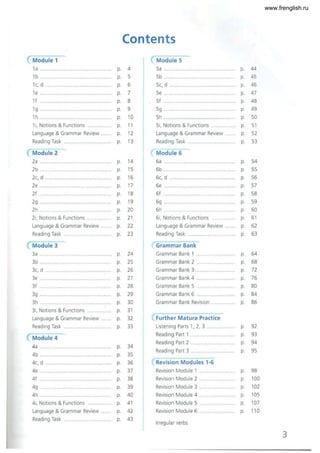
Contents
( Module 1
1a
lb ....................................... .
le, d ........
le ............. ......................... .
1f
19 ............. ............. ............. .
lh
1i, Notions & Functions
Language & Grammar Review.
Reading Task
Module 2
2a ..
2b
p. 4
p. 5
p.
p.
p.
p.
p.
6
7
8
9
10
p. 11
p. 12
p. 13
p.
p.
2c, d
2e
................. ...................... p.
14
15
16
17
18
19
20
2f
2g . H "
2h
2i, Notions & Functions
Language & Grammar Review.
Reading Task
( Module 3
3a
3b ..
3c, d
3e ..
31
3g
3h
3i. Notions & Functions
Language & Grammar Review.
Reading Task
( Module 4
4a
4b.
4c, d
4e
4f
4g
4h ..
4i, Notions & Functions
Language & Grammar Review ..
Reading Task . .
p
p.
p.
p.
p. 21
p. 22
p. 23
p.
p.
p.
p.
p.
p.
p.
24
25
26
27
28
29
30
p. 31
p. 32
p. 33
p. 34
p. 35
p. 36
p. 37
p. 38
p. 39
p. 40
p. 41
p. 42
p. 43
Module 5
5a ............................. .
5b ......... ................................
5c, d........ . .... .....
5e
5f
59
5h .................
51, Notions & Functions
Language & Grammar Review ..
Reading Task
Module 6
6a
6b ....... .. ..
6c. d ...................................
6e ........... H
6f
6g ... . ..
6h
6i, Notions & Functions
Language & Grammar Review.
Reading Task
Grammar Bank
Grammar Bank 1
Grammar Bank 2
Grammar Bank 3.................
Grammar Bank 4 .................
Grammar Bank 5
Grammar Bank 6 ..
Grammar Bank Revision
Further Matura Practice
Listening Parts 1, 2, 3
Reading Part 1
Reading Part 2 .
Reading Part 3 .
Revision Modules 1·6
Revision Module 1
Revision Module 2
Revision Module 3
Revision Module 4
Revision Module 5
Revision Module 6 .............
Irregular verbs
p. 44
p. 45
p. 46
p. 47
p. 48
p. 49
p. 50
p. 51
p. 52
p. 53
p. 54
p. 55
p. 56
p. 57
p. 58
p. 59
p. 60
p. 61
p. 62
p. 63
p. 64
P 68
p. 72
p. 76
p. 80
p. 84
p. 86
p. 92
p. 93
p. 94
p. 95
p. 98
p. 100
p. 102
p. 105
p. 107
p. 110
3
www.frenglish.ru
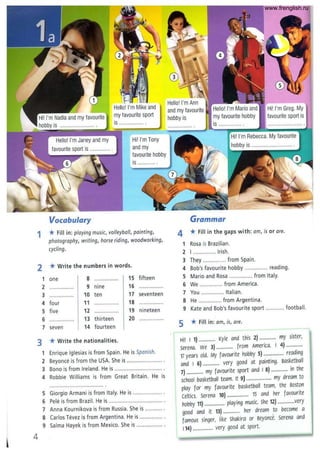
Vocabulary
Hi! I'm Tony
and my
favourite hobby
is ..........
1 * Fill in: playing music, volleyball, painting,
photography, writing, horse riding, woodworking,
cycling.
2
1
2
3
4
5
6
7
3
1
2
3
4
5
6
7
8
9
4
*Write the numbers in words.
one 8 15 fifteen
................ 9 nine 16 ..............
10 ten 17 seventeen
four 11 18 ................
five 12 ...... , ......... 19 nineteen
13 thirteen 20 ................
seven 14 fourteen
*Write the nationalities.
Enrique Iglesias is from Spain. He is Spanish.
Beyonce is from the USA. She is .... " ......... " ...... .
Bono is from Ireland. He is ............................... ,
Robbie Williams is from Great Britain. He is
Giorgio Armani is from Italy. He is ................... .
Pele is from Brazil. He is ....................................
Anna Kournikova is from Russia. She is
Carlos Tevez is from Argentina. He is .......................... '.
Salma Hayek is from Mexico. She is ", ......... " ... .
and my favourite
hobby is
Grammar
Hil I'm Greg. My
favourite sport is
4 *Fill in the gaps with: am, is or are.
1 Rosa is Brazilian.
2 I ............. Irish.
3 They ............... from Spain.
4 Bob's favourite hobby ............... reading.
5 Mario and Rosa ............... from Italy.
6 We ............... from America.
7 You ........... . Italian.
8 He ............... from Argentina.
9 Kate and Bob's favourite sport ............ football.
5 * Fill in: am, is, are.
Hi! I 1) .............. Kyle and this 2) .............. my sister,
Serena. we 3) .............. from America. I 4) ..............
17 years old. My favourite hobby 5) ................. reading
and I 6) .............. very good at painting. Basketball
7) .............. my favourite sport and I 8) .............. in the
school basketball team. It 9) ..................... my dream to
play for my favourite basketball team, the Boston
celtics. Serena 10) .................. 15 and her favourite
hobby 11) ................. playing music. she 12) ..............very
good and it 13) .............. her dream to become a
famous singer, like Shakira or Beyonce. Serena and
114) ................. very good at sport.
www.frenglish.ru
Vocabulary
1 * Match the
words to the
pictures.
A
[ill
E
waiter
[ID judge
[IT] actress
[![] vet
[ill nurse
[IT] fire fighter
Grammar
2 *Circle the correct item, a/an.
1 My mum is a / an nurse.
2 Brad Pitt is a / an actor.
3 Robert's father is a / an electrician.
4 Ann's a / an secretary.
S He's a / an lawyer.
6 She's a / an artist.
7 Mrs Harris is a / an vet.
8 He'sa / an teacher.
3 *Fill in: is, are, 'm not, isn't or aren't.
................... she a doctor? Yes, she ................. .
2 I ................... an actress. I am a lawyer.
3 ............. they from Mexico? Yes, they .............. .
4 They ................... twenty. They are twenty·two.
S Mark is a farmer. He ............................ a waiter.
6 We are Spanish. We ............................... Italian.
7 I am from Portugal. I ............................ Spanish.
8 ..................... he a pilot? No, he ...................... .
9 .................... you a teacher? No, I .................... .
10 .................. he from Spain? Yes, he ................. .
4 * Fill in the gaps with the correct
pronouns/possessive adjectives.
1 Kathy is from America................ is twenty·one
years old................ is a dancer.
2 ... are Mexican. Our country is beautiful.
3 ............... name is Paul. My brother's name is
Michael. ............... are vets.
4 My brother is twenty years old............... name
is Sam.
S Ben and Kerry are students. """'" ..... favourite
film is The Godfather.
6 .............. am from Puebla............... is a great
city.
7 She is an actress................ job is great.
8 I am Billy and ............... is John............... are
fire fighters.
Reading & Writing
5 a) *Read and
underline the
correct word.
Hi! I 1) 'ml's Ken. I'm
nineteen years old
and I'm from
2) Spain/Spanish. I'm
3) a/an actor. 4) My/I
love painting, too. My
favourite artist
5) is/are Claude Monet. He's from France.
6) He/His paintings 7) is/are so colourful. They
8) is/are full of bright flowers. My favourite one is
9) alan painting called Water Lilies. It 10) is/are a
scene from 11) he/his garden. Monet is 12) alan
great artist!
b) *Answer the questions.
1 How old is Ken? ................................................
2 What nationality is he? .....................................
3 Who's Claude Monet? .......................................
4 Which is Ken's favourite painting? ...................
6 ** Write a short text about yourself like
the one in Ex. Sa. Write your name, age,
nationality, job, favourite artist and favourite
painting.
5
www.frenglish.ru
Vocabulary
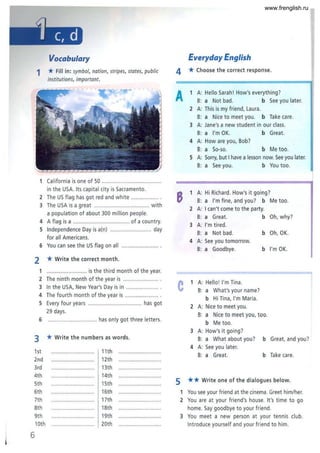
1 *Fill in: symbol, nation, stripes, states, public
institutions, important.
1 California is one of 50 ........ ......................
in the USA. Its capital city is Sacramento.
2 The US flag has got red and white .................. .
3 The USA is a great .................................... with
a population of about 300 million people.
4 A flag is a ..................................... of a country.
5 Independence Day is a(n) ........................... day
for all Americans.
6 You can see the US flag on all ........................ .
2 *Write the correct month.
1 .......................... is the third month of the year.
2 The ninth month of the year is ....................... .
3 In the USA, New Year's Day is in ..................... .
4 The fourth month of the year is ..................... .
5 Every four years ................................... has got
29 days.
6 ................................ has only got three letters.
3 *Write the numbers as words .
1st
2nd
3rd
4th
5th
6th
7th
8th
9th
10th
6
11th
12th
13th
14th
15th
16th
17th
18th
19th
20th
Everyday English
4 *Choose the correct response.
A 1 A: Hello Sarah! How's everything?
B: a Not bad. b See you later.
2 A: This is my friend, Laura.
B: a Nice to meet you. b Take care.
3 A: Jane's a new student in our class.
B: a I'm OK. b Great.
4 A: How are you, Bob?
B: a So-so. b Me too.
5 A: Sorry, but I have a lesson now. See you later.
B: a See you. b You too.
8 1 A: Hi Richard. How's it going?
B: a I'm fine, and you? b Me too.
2 A: I can't come to the party.
B: a Great. b Oh, why?
3 A: I'm tired .
B: a Not bad. b Oh, OK.
4 A: See you tomorrow.
B: a Goodbye. b I'm OK.
C 1 A: Hello! I'm Tina.
B: a What's your name?
5
b Hi Tina, I'm Maria.
2 A: Nice to meet you.
B: a Nice to meet you, too.
b Me too.
3 A: How's it going?
B: a What about you? b Great, and you?
4 A: See you later.
B: a Great. b Take care.
** Write one of the dialogues below.
1 You see your friend at the cinema. Greet him/her.
2 You are at your friend's house. It's time to go
home. Say goodbye to your friend .
3 You meet a new person at your tennis club.
Introduce yourself and your friend to him.
www.frenglish.ru
Vocabulary
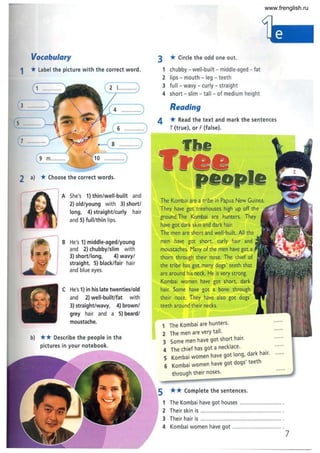
1 *label the picture with the correct word.
6 .............
•--( 8 .............)
9 m.......... o .............
2 a) *Choose the correct words.
A She's 1) thin/well-built and
2) old/young with 3) short/
long, 4) straight/curly hair
and 5) full/thin lips.
B He's 1) middle-aged/young
and 2) chubby/slim with
3) short/long, 4) wavy/
straight, 5) black/fair hair
and blue eyes.
He's 1) in his late twenties/old
and 2) well-built/fat with
3) straight/wavy, 4) brown/
grey hair and a 5) beard/
moustache.
b) ** Describe the people in the
pictures in your notebook.
3 *Circle the odd one out.
1 chubby - well-built - middle-aged - fat
2 lips - mouth - leg - teeth
3 full - wavy- curly - straight
4 short - slim - tall - of medium height
Reading
4 *Read the text and mark the sentences
T(true), or F (false).
The Kombai are a tribe in Papua New Guinea.
They have got treehouses high up off the
ground.The Kombai are hunters. They
have got dark skin and dark hair.
The men are short and well-built. All the
men have got short, curly hair and
moustaches. Many of the men have got
thorn through their nose. The chief of
the tribe has got many dogs' teeth that
are around his neck. He is very strong.
Kombai women have got short, dark
hair. Some have got a bone through
their nose. They have also got dogs'
teeth around their necks.
1 The Kombai are hunters.
2 The men are very tall.
3 Some men have got short hair.
4 The chief has got a necklace. .
5 Kombai women have got long, dark hair.
6 Kombai women have got dogs' teeth
through their noses.
** Complete the sentences.
......
1 The Kombai have got houses ............................. .
Their skin is ..................................................... .
Their hair is ..................................................... .
Kombai women have got ............................... .
7
www.frenglish.ru
8
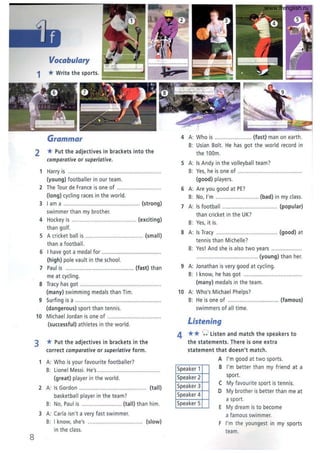
Vocabulary
1 *Write the sports. ti~~~~= r--:I;;;;~
1iiIii~=:;:;;
Grammar
2 * Put the adjectives in brackets into the
comparative or superlative.
1 Harry is .............................................................
(young) footballer in our team.
2 The Tour de France is one of .............................
(long) cycling races in the world.
3 I am a .................................................. (strong)
swimmer than my brother.
4 Hockey is .......................................... (exciting)
than golf.
S A cricket ball is ...................................... (small)
than a football.
6 I have got a medal for .......................................
(high) pole vau lt in the school.
7 Paul is ............................................. (fast) than
me at cycling.
8 Tracy has got .....................................................
(many) swimming medals than Tim.
9 Surfing is a .. .............................. ........................
(dangerous) sport than tennis.
10 Michael Jordan is one of ...................................
(successful) athletes in the world .
3 * Put the adjectives in brackets in the
correct comparative or superlative form .
1 A: Who is your favourite footballer?
B: Lionel Messi. He's ..................
(great) player in the world.
2 A: Is Gordon ........ ............ ............ ......... (tall)
basketball player in the team?
B: No, Paul is .......................... (tall) than him.
3 A: (aria isn't a very fast swimmer.
B: I know, she's .............................. ...... (slow)
in the class.
4 A: Who is ......... ... (fast) man on earth.
B: Usian Bolt. He has got the world record in
the 100m.
S A: Is Andy in the volleyball team?
B: Yes, he is one of .........................................
(good) players.
6 A: Are you good at PE?
B: No, I'm ..... ..................... (bad) in my class.
7 A: Is football ................................... (popular)
than cricket in the UK?
B: Yes, it is.
8 A: Is Tracy .. ................. ............... .... (good) at
tennis than Michelle?
B: Yes! And she is also two years ....................
........................................ (young) than her.
9 A: Jonathan is very good at cycling.
B: I know, he has got ......................................
(many) medals in the team.
10 A: Who's Michael Phelps?
B: He is one of ................................ (famous)
swimmers of all time.
Listening
4 **0 listen and match the speakers to
the statements. Jhere is one extra
statement that doesn't match.
A I'm good at two sports.
Speaker 1 B I'm better than my friend at a
Speaker 2 sport.
Speaker 3
( My favourite sport is tenn is.
Speaker 4
D My brother is better than me at
Speaker 5
a sport.
E My dream is to become
a famous swimmer.
F I'm the youngest in my sports
team.
www.frenglish.ru
Vocabulary
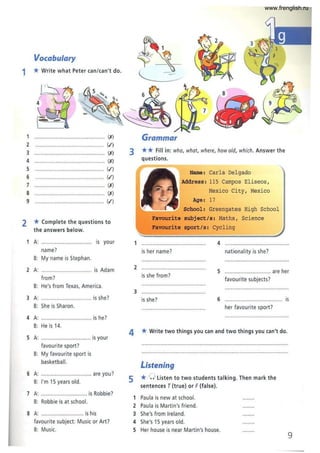
1 * Write what Peter can/can't do.
1 .••....•............•............ (,x)
2 ............................................. W)
3
4
5
6
7
8
.•.......... ................ (,x)
....... (,x)
...................................... (.f)
.............................•....... (.f)
. . . . . . . ....... (,x)
.....•....... .......... (,x)
9 .......................................... (.f)
2 * Complete the questions to
the answers below.
A: ............................. is your
name?
B: My name is Stephan.
2 A: ................................ is Adam
from?
B: He's from Texas, America.
3 A: .......................... ...... is she?
B: She is Sharon.
4 A: ...................... is he?
B: He is 14.
5 A: ..................... ........... is your
favourite sport?
B: My favourite sport is
basketball.
6 A: ......................... ...•.. are you?
B: I'm 15 years old.
7 A: .............................. is Robbie?
B: Robbie is at school.
8 A: .............................. is his
favourite subject: Music or Art?
B: Music.
Grammar
3 ** Fill in: who, what, where, howold, which. Answer the
questions.
Name: Carla Delgado
Address: 115 Carnpos Eliseos ,
Mexico City, Mexico
Age: 17
School: Greengates High School
subject/s: Maths , Science
Favourite sport/s: Cycling
1 ................... ....................... 4 .........................
is her name? nationality is she?
2 ..........................................
is she from?
5 .............................. are her
favourite subjects?
3 .....................................
is she? 6 ..................................... is
her favourite sport?
4 *Write two things you can and two things you can't do.
Listening
5 * ()listen to two students talking. Then mark the
sentences T(true) or F (false).
1 Paula is new at school.
2 Paula is Martin's friend.
3 She's from Ireland.
4 She's 15 years old.
5 Her house is near Martin's house.
9
www.frenglish.ru
10
Writing (an email giving personal
information)
1 * Read the email. Put the paragraphs A-O
in the correct order.
[!IJ My best friend is Sandra. She is seventeen.
We are in the same class at school. Her
favourite subjects are French and History.
[[]:=J I'm a student at Westwood High School. My
favourite school subjects ore Moths and
Spanish. I'm good at sports. too. I can play
ice hockey and basketball very well. My
favourite basketball player is LeBron James.
He's great! My favourite singer is Beyonce
and my favourite actor is Brad Pitt. He's just
great.
[IIJ What about you? Where ore you from?
Which ore your favourite school subjects
and sports? Please write soon.
Maggie Costanza
[QIJ Hi! My name is Maggie and I'm seventeen.
I'm from New York City. USA. If's 0 great
place.There is lots to see and do here.
2 *Capitalise the sentences.
1 his favourite football player is javier hernandez.
2 matt is from sydney, australia.
3 kate's favourite day is wednesday.
4 jim is english but i am scottish.
5 my favourite month is july.
3 * Read the rubric and answer the questions.
---------------------~
Write an email to your English pen friend
about your best friend .
I Say what your best friend is like.
I Mention their favourite school subject.
I Say what sport they are interested in.
I Ask your pen friend who his/her best friend is.
I
I
I
I
I
I
I
I
I
I
---------------------~
1 How old is he/she?
2 Where is he/she from?
3 What is the name of his/her school?
4 What are his/her favourite subjects?
5 What are his/her favourite sports?
6 Who is his/her favourite sports star?
7 Who's his/her favourite singer?
8 Who's his/her favourite actor/actress?
9 What is his/her favourite hobby?
4 ** Use the rubric and the answers in
Ex. 3 to write an email to your English pen
friend about your best friend (40-50 words).
• ............... . .. ..... ...... " .. ... .. ... ! ", •••••••• .. ..... . .. .... . ..
www.frenglish.ru
Vocabulary
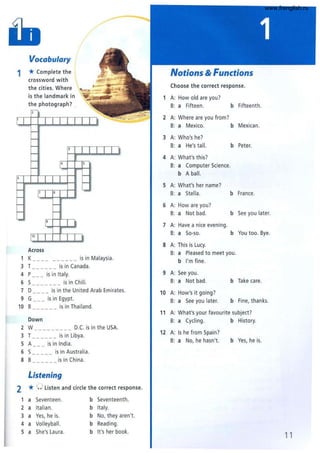
1 * Complete the
crossword with
the cities. Where
is the landmark in
the photograph? .
4
Across
1 K __ _ ___ is in Malaysia.
3 T ______ is in Canada.
4 P___ is in Italy.
6 S___ _ ___ is in Chili.
7 D is in the United Arab Emirates.
9 G___ is in Egypt.
10 B______ is in Thailand.
Down
2 W _______ _ _ D.e. is in the USA.
3 T___ _ __ is in Libya.
5 A is in India.
6 S_____ is in Australia.
S B___ _ __ is in China.
Listening
2 * 0 listen and circle the correct response.
1 a Seventeen. b Seventeenth.
2 a Italian. b Italy.
3 a Yes, he is. b No, they aren'.
4 a Volleyball. b Reading.
5 a She's Laura. b It's her book.
1
2
3
4
5
6
7
S
9
10
11
12
Notions & Functions
Choose the correct response.
A: How old are you?
B: a Fifteen. b Fifteenth.
A: Where are you from?
B: a Mexico. b Mexican.
A: Who's he?
B: a He's tall. b Peter.
A: What's this?
B: a Computer Science.
b A ball.
A: What's her name?
B: a Stella. b France.
A: How are you?
B: a Not bad. b See you later.
A: Have a nice evening.
B: a So-so. b You too. Bye.
A: This is Lucy.
B: a Pleased to meet you.
b I'm fine.
A: See you.
B: a Not bad. b Take care.
A: How's it going?
B: a See you later. b Fine, thanks.
A: What's your favourite subject?
B: a Cycling. b History.
A: Is he from Spain?
B: a No, he hasn'. b Yes, he is.
11
www.frenglish.ru
Language & Grammar Review
Choose the correct answer.
1 A: Are you sixteen years old? 16 LUcy is ...... student in our class.
B: Yes, I . A better B good C the best
A are B is C am
17 Her earrings are very ...... .
2 My favourite sports ..... football and basketball. A chubby B medium C heavy
A is Bare C am
18 My ...... is to become a doctor.
3 Tom is fifteen ....... mother is a nurse. A subject B dream C wealth
A Its B He C His
19 Our basketball ...... is very good.
4 A: How are you? A group B team C tribe
B: A Not bad. B See you later. C Goodbye.
20 Juan is a ...... student in our class.
5 A: Have a good day. A new B medium C full
B: A Not bad. B Hello. C You too.
21 A flag is a special ...... for a country.
6 A: This is Kate. A sign B display C symbol
B: A Pleased to meet you.
B Take care.
C What's his name?
22 Our dog is ill. Let's take him to the ...... .
A pilot B vet C waiter
7 They are Canadian. They ..... American.
23 Emma is of ..... height.
A medium B ta ll C short
A am not B isn't C aren't
24 I can't ...... a bike.
8 Kenny is ...... astronaut.
A ride B drive C run
A a B an C -
9 Who is ...... favourite singer?
A you B you're C your
25 Patrick is ...... than Paul.
A the oldest Bold C older
10 ...... name is Ricky. I'm 12 years old.
A My B I C Its
26 He's got a beard and a ...... .
A skin B moustache Clip
11 He's a ...... author from Mexico.
A famous B common C regular
27 Henry and lan love basketball. ...... favourite
player is Dwayne Wade.
A Their B They C We
12 ...... favourite singer is Beyonce.
A She B Her C Its
28 Her hair is
A slim B wavy C full
13 He's short and ...... .
A curly B medium C chubby
29 The Maasai are a ...... in Africa.
A sign B tribe C team
14 Pygmies have got short ...... .
A eyes B legs Clips
30 This is ..... sister, Paula.
A she B I C my
15 When is the flag on ......?
A state B display C institution
12
www.frenglish.ru
ReQding TQsk (True-Fa/se)
Read the text and mark the sentences 1-10 T(true) or F(false).
11'
MarcOsl'_....
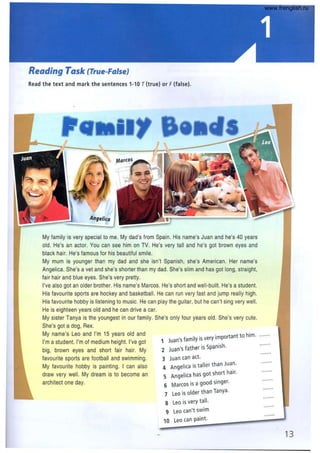
My family is very special to me. My dad's from Spain. His name's Juan and he's 40 years
old. He's an actor. You can see him on TV. He's very tall and he's got brown eyes and
black hair. He's famous for his beautiful smile.
My mum is younger than my dad and she isn't Spanish, she's American. Her name's
Angelica. She's a vet and she's shorter than my dad. She's slim and has got long, straight,
fair hair and blue eyes. She's very pretty.
I've also got an older brother. His name's Marcos. He's short and well-built. He's a student.
His favourite sports are hockey and basketball. He can run very fast and jump really high.
His favourite hobby is listening to music. He can play the guitar, but he can't sing very well.
He is eighteen years old and he can drive a car.
My sister Tanya is the youngest in our family. She's only four years old. She's very cute.
She's got a dog, Rex.
My name's Leo and I'm 15 years old and
I'm a student. I'mof medium height. I've got
big, brown eyes and short fair hair. My
favourite sports are football and swimming.
My favourite hobby is painting. I can also
draw very well. My dream is to become an
architect one day.
1 Juan's family is very important to him.
2 Juan's father is Spanish.
3 Juan can act.
4 Angelica is taller than Juan.
S Angelica has got short hair.
6 Marcos is a good singer.
7 Leo is older than Tanya.
8 Leo is very tall.
9 Leo can't swim
10 Leo can paint.
, ......
,......
" .....
13
www.frenglish.ru
14
•
Vocabulary
1 *Fill in the gaps with the correct word:
kitchen, dining room, living room, bothroom,
bedroom.
1 We have a small bath and a toilet in the
2 The ......................................... has got a fridge
and a sink.
3 There is a huge sofa with big cushions in the
4 The ................... has got a big table and chairs.
S My wardrobe and all my clothes are in my
Grammar
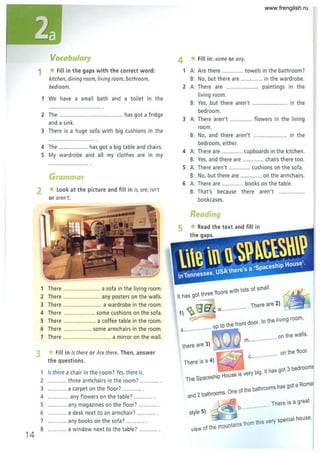
2 *Look at the picture and fill in is, are, isn't
or aren't.
1 There ........................ a sofa in the living room.
2 There ........................ any posters on the walls.
3 There ......................... a wardrobe in the room.
4 There .................... some cushions on the sofa.
S There ..................... a coffee table in the room .
6 There .................. some armchairs in the room.
7 There ............................... a mirror on the wall.
Fill in Is there or Are there. Then, answer
the questions.
Is there a chair in the room? Yes, there is.
2 .... ....... three armchairs in the room? ......... .. .
3 .... ....... a carpet on the floor? ........... .
4 .......... .. any flowers on the table? ........... .
S ... ........ any magazines on the floor? .. ......... .
6 ......... .. a desk next to an armchair? ........... .
7 ........... any books on the sofa? ........... .
8 ...... ..... a window next to the table? ........... .
4 * Fill in: some or any.
A: Are there .............. towels in the bathroom?
s: No, but there are .............. in the wardrobe.
2 A: There are ..................... paintings in the
living room.
S: Yes, but there aren't ....................... in the
bedroom.
3 A: There aren't .............. flowers in the living
room.
S: No, and there aren't ...................... in the
bedroom, either.
4 A: There are .............. cupboards in the kitchen.
S: Yes, and there are ...... ........ chairs there too.
S A: There aren't ............. cushions on the sofa.
S: No, but there are .............. on the armchairs.
6 A: There are .............. books on the table.
S: That's because there aren't .. ...
bookcases.
Reading
5 *Read the text and fill in
. hits of small
It has got three floors Wit 0
1) ~IQfllt. w ...... ·· . There are 2)
~ f t aoor In the living room ,
.. up to the ron .
s...····· .......
on the wailS .
m..··· .........
there are 3)
There is a 4) ~ c.. ····· ........ .
on the floor.
.----
. - bi It has got 3 bearoo
ms
hip House IS very g.
The Spaces
h ot a Romar
One of the bathrooms as g
and 2 bathrooms.
. There is a great
b..· .........
style 5)
l&I'--- ta
-ins from this very special house.
view of the moun
I
www.frenglish.ru
Vocabulary
1 *Fill in: neighbourhood, tins, space, dirty,
disposable, station.
Astronauts travel to ................. ............ ........ .
2 Her house is in a quiet ...................... .............
3 There are a lot of .....,......................... dishes in
the kitchen sink.
4 Astronauts have got ........................... clothes.
They can throw them away after wearing them.
5 There is a space ................... ............. in space.
6 Astronauts' food is in ..................................... .
Grammar
2 *Write the plural forms.
1 computer - .............................................
2 tin - ............................... ................
3 lea f - ........................................................
4 pipe - ..... .................................................
5 roof - ......................................................
6 box - .......................................................
7 knife - ........................................... .........
8 plant - ......................................................
9 foot - .. .....................................................
10 man - ....... ................................................
11 toy - .................. .....................................
12 brush - ....................................................
3 *Fill in: this, these, that or those.
1 .................... is a cushion.
2 .................... is a chair. roF
3 .. .................. are towels . roF
4 ... ............ .... are bowls.
5 .................... are dishes. roF
6 .................... is a frying pan.
4
5
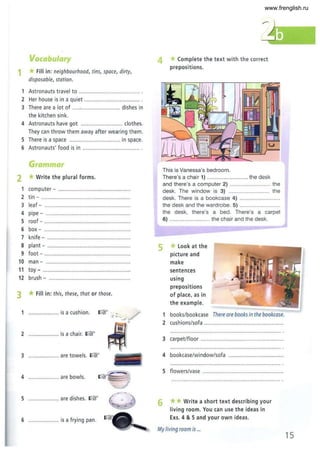
Complete the text with the correct
prepositions.
This is Vanessa's bedroom.
There's a chair 1) ..... .................. the desk
and there's a computer 2) .... ............ the
desk. The window is 3) ........................... the
desk. There is a bookcase 4) ..........................
the desk and the wardrobe. 5) ...........................
the desk, there's a bed. There's a carpet
6) ........................... the chair and the desk.
*look at the
picture and
make
sentences
using
prepositions
of place, as in
the example.
1 books/bookcase There are books in the bookcase.
2 cushions/sofa ....................................................
3 carpet/floor ......................................................
4 bookcase/window/sofa ...................................
5 flowers/vase ....................................................
6 ** Write a short text describing your
living room. You can use the ideas in
Exs.4 & 5 and your own ideas.
My living room is ...
15
www.frenglish.ru
- -~.
,
.~
Vocabulary
1 a) *Match the words to make phrases.
[IT] take A agent
[IT] horse B American independence
[IT] skating C rent
[IT] symbol of D photographs
[IT] flat for E rink
[ID on the first F riding
[IT] get G wet
[IT] estate H floor
b) If Then use the phrases to complete
the sentences.
1 You can go .......................... through the park.
2 The Statue of Liberty is a(n) .................
3 Get your camera and ........................................
of the animals in the zoo.
4 Is there a(n) .................................. in this area?
S There is a cinema and a(n) ................................
in the city centre.
6 Her flat is ....................................................... .
7 You can ............................................................
during the boat tour, but it's fun.
S The ............................................... has got two
houses to show us.
Listening
2 *0 Listen and complete the gaps.
bedrooms,
1) ........................... . h
kltc en,
a 2) .......................
living room,
a 3) ..................... .
a di~ing room, a garden with great
4) ..........................., a perfect
home
5) ···.. ··· ..
contact: 6) ......................... .
Tel: 0131 258630
ayEng·
Choose the correct response.
1 A: Can I help you?
B: a Yes, please.
b It's expensive.
2 A: What's the address?
B: a Third floor.
b 120 Milton Road.
3 A: How much is it?
B: a It's £120,000.
b It's number 12.
4 A: Can I see it?
B: a Of course.
b It's blue.
S A: How many rooms has it got?
B: a 6.
b 3 o'clock.
6 A: Is tomorrow at 4 o'clock OK?
B: a That's right.
b Yes. That's great.
7 A: OK. See you then .
B: a Not bad.
b Bye.
4 ** Write a new dialogue using the
information below. Use the exchanges in
Ex. 3 as a model.
• 6 Cranfield Court • £93,000 • 2 bedrooms
• 1 bathroom • Wednesday 3 o'clock
www.frenglish.ru
Vocabulary
1 *Do the crossword.
,,- 2
-I -
, 4 -
rs
--
- - , 2
-....
--
,,- c- c-
l '-
8
--
I' I - - - - - -
r' I 11
. - -
,
=
-- 4
2 *Choose the correct preposition.
1 There are often lots of boats on/in the lake.
2 The islands are home of/to the Uros people.
3 Life in/on the islands is very quiet.
4 The lake is popular with/of tourists.
5 The hotel has got a great view of/from the
lake.
6 Lake Titicaca is 12,500 feet over/above sea
level.
7 The Uros women are in/at home all day.
Reading
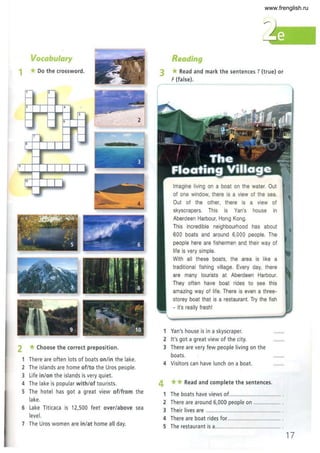
3 *Read and mark the sentences T (true) or
F(false).
Imagine living on a boat on the water. Out
of one window, there is a view of the sea.
Out of the other, there is a view of
skyscrapers. This is Van's house in
Aberdeen Harbour, Hong Kong.
This incredible neighbourhood has about
600 boats and around 6,000 people. The
people here are fishermen and their way of
life is very simple.
With all these boats, the area is like a
traditional fishing village. Every day, there
are many tourists at Aberdeen Harbour.
They often have boat rides to see this
amazing way of life. There is even a three-
storey boat that is a restaurant. Try the fish
- it's really fresh!
1 Van's house is in a skyscraper.
2 It's got a great view of the city.
3 There are very few people living on the
boats.
4 Visitors can have lunch on a boat.
4 **Read and complete the sentences.
1 The boats have views of.................................. .
2 There are around 6,000 people on .................. .
3 Their lives are ................................................. .
4 There are boat rides for. .................................. .
5 The restaurant is a........................................... .
17
www.frenglish.ru
2
Vocabulary
1 a) *Write the shops.
You can buy bread at the
2 You can buy meat at the
3 You can buy pasta at the
4 You can buy flowers at the
5 You can buy medicine at the
6 You can buy a dictionary at the
7 You can buy a cat at the
8 You can buy a jacket at the
b) *Which of the shops in
Ex. 1a are there in your
neighbourhood? Which
aren't?
In my neighbourhood, there .....................
....................... There aren't ....................... .
Grammar
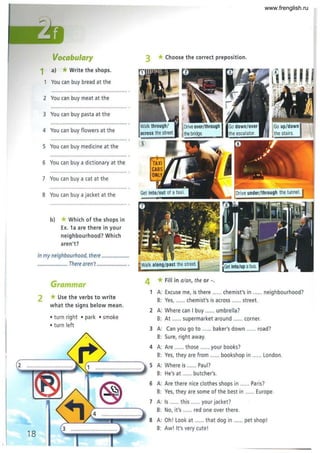
2 *Use the verbs to write
what the signs below mean.
• turn right • park • smoke
• turn left
3 *Choose the correct preposition.
4 *Fill in a/an, the or -.
1 A: Excuse me, is there ...... chemist's in ...... neighbourhood?
B: Yes, ... ... chemist's is across ...... street.
2 A: Where can I buy ...... umbrella?
B: At ...... supermarket around ...... corner.
3 A: Can you go to ...... baker's down ...... road?
B: Sure, right away.
4 A: Are ...... those ...... your books?
B: Yes, they are from ...... bookshop in ...... London.
5 A: Where is ...... Paul?
B: He's at ...... butcher's.
6 A: Are there nice clothes shops in ...... Pa ris?
B: Yes, they are some of the best in ...... Europe.
7 A: Is ...... this ...... your jacket?
B: No, it's ..... red one over there.
S A: Oh! Look at ...... that dog in ...... pet shop!
B: Aw! It's very cute!
www.frenglish.ru
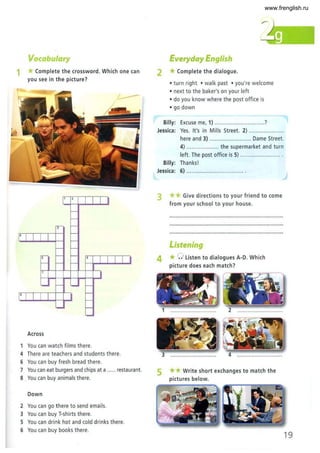
Vocabulary
1 *Complete the crossword. Which one can
you see in the picture?
1 2
1 1
I-
I-
,,- I-
[' [ I I
I-
I-
I- I-
,.,- I- I- , I I I I I
I- I- I-
7
I
'- I- '- I-
I' I I I I
I-
I-
~ I-
'-
Across
You can watch films there.
4 There are teachers and students there.
6 You can buy fresh bread there.
7 You can eat burgers and chips at a ...... restaurant.
8 . You can buy animals there.
Down
2 You can go there to send emails.
3 You can buy T-shirts there.
5 You can drink hot and cold drinks there.
6 You can buy books there.
Everyday English
2 *Complete the dialogue.
• turn right • walk past • you're welcome
• next to the baker's on your left
• do you know where the post office is
• go down
Billy: Excuse me, 1) ..............................?
Jessica: Yes. It's in Mills Street. 2) .................... ..
here and 3) .......................... Dame Street.
4) .. .... .... ......... the supermarket and turn
left. The post office is 5) .... .................... .
Billy: Thanks!
Jessica: 6) ................................... .
3 ** Give directions to your friend to come
from your school to your house.
Listening
4 *0 listen to dialogues A-D. Which
picture does each match?
5
1 .............................. 2
**Write short exchanges to match the
pictures below.
19
www.frenglish.ru
20
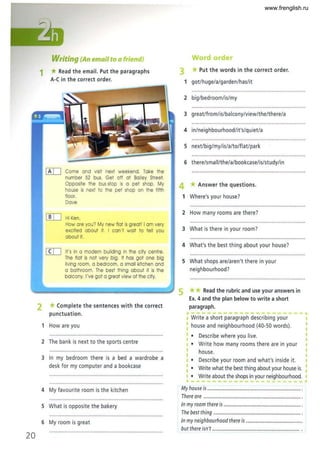
Writing (An emQiI to Qfriend)
1 *Read the email. Put the paragraphs
A-C in the correct order.
[K[J Come and visit next weekend. Take the
number 52 bus. Get olf at Bailey S
treet.
Opposite the bus stop is 0 pet shop. My
house is next to the pet shop on the fifth
floor.
Dove
[!IJ Hi Ken.
How are you? My new flat is great! I om very
excited about it. I can't wait to tell you
about it.
[ID It's in 0 modern building in the city centre.
The flat Is not very big. It has got one big
living room, 0 bedroom, a small kitchen and
o bathroom. The best thing about it is the
balcony. I've got a great view of the city.
2 *Complete the sentences with the correct
punctuation.
1 How are you
2 The bank is next to the sports centre
3 In my bedroom there is a bed a wardrobe a
desk for my computer and a bookcase
Word orde
3 * Put the words in the correct order.
1 got/huge/a/garden/has/it
2 big/bedroom/is/my
3 great/from/is/balcony/view/the/there/a
4 in/neighbourhood/it's/quiet/a
5 next/big/my/is/a/to/flat/park
6 there/sma II/the/a/bookcase/is/study/in
4 *Answer the questions.
1 Where's your house?
2 How many rooms are there?
3 What is there in your room?
4 What's the best thing about your house?
5 What shops are/aren't there in your
neighbourhood?
5 **Read the rubric and use your answers in
Ex. 4 and the plan below to write a short
paragraph.
p-- - - -,.
I Write a short paragraph describing your
I house and neighbourhood (40-50 words).
• Describe where you live.
• Write how many rooms there are in your
house.
• Describe your room and what's inside it.
I · Write what the best thing about your house is.
I · Write about the shops in your neighbourhood.
•
4 My favourite room is the kitchen My house is .......................................................................... ,
There are ............................................................................. ,
5 What is opposite the bakery In my room there is ............................................................. .
The best thing ..................................................................... .
6 My room is great In my neighbourhood there is .............................................
but there isn't ..................................................................... .
www.frenglish.ru
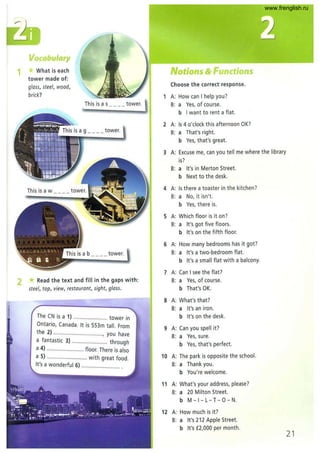
1
Vocabulary
What is each
tower made of:
glass, steel, wood,
brick?
Thisisas tower.
2 * Read the text and fill in the gaps with:
steel, tap, view, restaurant, sight, glass.
The CN is a 1) ..................... tower in
Ontario, Canada. It is 553m tall. From
the 2) ................................, you have
a fantastic 3) ....................... through
a 4) ........................ floor. There is also
a 5) ........... ............... with great food.
It's a wonderful 6) ......................... .
Notions & Functions
Choose the correct response.
1 A: How can I help you?
B: a Yes, of course.
b I want to rent a flat.
2 A: Is 4 o'clock this afternoon OK?
B: a That's right.
b Yes, that's great.
3 A: Excuse me, can you tell me where the library
is?
B: a It's in Merton Street.
b Next to the desk.
4 A: Is there a toaster in the kitchen?
B: a No, it isn't.
b Yes, there is.
5 A: Which floor is it on 7
B: a It's got five floors.
b It's on the fifth floor.
6 A: How many bedrooms has it got?
B: a It's a two-bedroom flat.
b It's a small flat with a balcony.
7 A: Can I see the flat?
B: a Yes, of course.
b That's OK.
8 A: What's that?
B: a It's an iron.
b It's on the desk.
9 A: Can you spell it?
B: a Yes, sure.
b Yes, that's perfect.
10 A: The park is opposite the school.
B: a Thank you.
b You're welcome.
11 A: What's your address, please7
B: a 20 Milton Street.
b M - I - L- T- 0 - N.
12 A: How much is it?
B: a It's 212 Apple Street.
bit's £2,000 per month.
21
www.frenglish.ru
Language &Grammar Review
(hoose the correct answer.
1 A: Is tomorrow at seven OK?
B: A No, there isn't. B Yes, that's great.
( No, why?
2 The ...... of Liberty is on Liberty Island.
A Lake B Statue (Rink
3 There'sa ...... on the floor.
A grass B carpet ( garden
4 Is ...... your pencil?
A this B these ( the
5 We have got paintings ...... the wall.
A in B under (on
6 They've got two ........
A children B child ( childrens
7 Are there ...... cushions on your sofa?
A some B the ( any
8 There's a house for ...... in the area.
A advert B rent ( address
9 There are three ...... in the kitchen, so it's very bright.
A plants B stairs ( windows
10 Her house is in a ...... neighbourhood.
A different B floating (quiet
11 Are there any astronauts in the space ......?
A station B house (machine
12 The books are ...... the bookcase.
A in B under (between
13 How many ...... are there in your house?
A rinks Brides ( floors
14 Where's the ...... cleaner?
A iron B washing ( vacuum
15 There are ...... in the kitchen.
A wardrobes B cupboards ( baths
16 A: Is there a sofa in the living room?
B: A No, thank you. B Yes, there is. ( Yes, it is.
17 Don't miss the ...... to take great photographs.
A chance B path ( ride
18 There aren't ...... shops near our house.
A some B the ( any
22
19 He's a(n) ...... agent.
A riding B estate ( skating
20 ...... wardrobe in my room is white.
A A B - ( The
21 A: Can I see the house tomorrow?
B: A Yes, of course.
( How is it?
B You're welcome.
22 Look up in the sky; is ...... a plane?
A this B these (that
23 The house is in the ...... of a spaceship.
A place B shape (level
24 A: What are those?
B: A They're cushions B On the balcony.
( That's on the table.
25 I've got a great ...... from my window.
A view B sight (park
26 Walk ...... the bridge and turn left.
A under B in ( between
27 A: What's your address, please?
B: A 52 Henry Street. B No, it isn't.
( It's €400 per month.
28 The island is ...... with tourists.
A popular B surprising ( unique
29 They've got ...... to go fishing.
A dishes B huts ( boats
30 (ome to ...... this unique way of life.
A experience B live ( visit
31 There's an island on the .......
A waterfall B mountain ( lake
32 There are a lot of trees in the .......
A forest B river ( cliff
33 Return the book to the ...... .
A library B chemist's ( post office
34 You can buy bread at the .......
A butcher's B baker's ( chemist's
35 The forest is ...... to some tribes.
A home B flat ( house
www.frenglish.ru
Reading Task (matching headings to paragraphs)
Read the information about a house in India. Match the headings (A-H) with their correct
paragraphs (1-7). One heading does not match.
Is it a dream home? Well it's definitely expensivel Antilia is a house
in South Mumbai, India and it's currently the most expensive home
in the world. It's worth over a billion US dollars. Lets take a look ....
CID Antilia is on the 10th most expensive street in the world. It's
174 metres tall and has got 27 floors. Each floor is completely
different. It's more of a skyscraper than a house.
[I[] Antilia is the new home of business man Mukesh Ambani, his
A A GREAT VIEW
B A HOME FOR FIVE
C NO NEED TO SHARE A ROOM
D KEEP FIT AT HOME
E A GOOD TIME FOR EVERYONE
f A HOUSE IN THE CLOUDS
G HOT OUTSIDE, COLD INSIDE
H A QUIET HOME
wife and three children. Mukesh Ambani is the richest man in India.
There are three helipads on the top of the building for Mr. Ambani's helicopters.
There are also six floors that can fit 168 cars!
[I[J Then there are the family's floors. These are on the top four floors of the
building. Each member of the family has got their own bedroom,
living room and bathroom.
[I[J The home has got a health club, with swimming pools and
yoga rooms. The family can exercise in the gym or dance
in the dance studios. They can also relax in a hot spa bath.
[ill In the evening, they can enjoy a film in the home cinema.
Fifty people can watch a film in the cinema. There is also
a ballroom where the family and guests can have dinner
and parties.
[iD Another special room in the home is the ice
room. Here the Ambani family can cool off from
the hot Indian weather. This amazing room can
even make snow!
LzIJ Finally, Antilia has got beautiful
gardens on the outside of the
building and green rooms, with
many different flowers and plants.
From the top floors you can see
the Mumbai city skyline and the
Arabian Sea.
www.frenglish.ru
Vocabulary 3 * Fill in: milks, routine, poisonous, bite, venom.
1 *Match the verbs to the nouns. 1 There are a lot of ................ snakes in the USA.
2 Antivenin is a medicine that comes from snake
[IT] play A the Net
[IT] send B board games 3 Each year, poisonous snakes .. .. .. .......................
[IT] listen to C muSIC 8,000 people in the USA.
[IT] surf D text messages 4 Every day, Bill ............................. the snakes to
[IT] hang out E with friends col lect their venom.
5 Walking to school is part of my daily .....
2 *Fill in: play (x2), have (x3), go, get up,
walk (x3), watch in the correct form. Grammar
4 *Put the verbs in brackets int o t he present
Tom 1) ............" .. .. . early in the morning.
He 2) .............. .... .. .. breakfast and then
he 3) .. .. ......"".. ..... to school. At school,
he 4)
Chege 1) ............... .. (be) fourteen years old. He
After school, he 5) ...... ............... football 2) ................. (live) in a small village in Kenya. He
3) .. .......... ..... (have) three younger sisters. Every
weekday, Chege 4) ................. (get up) early, at 4:30
with his friends. Then, he 6)
in the morning. He 5) ................. (cook) breakfast for
his family and they 6) ................. (eat) together. At
6:00, Chege 7) ................. (leave) his house for
home and 7) .. .. .............. .. dinner. After
school. Chege 8) ................. (walk) seven kilometres
to the bus stop. He 9) ................. (catch) the school
bus at 7:30. Chege 10) .... ............. (get) to school at
9:30. At school, Chege 11) ................. (study) English,
dinner, he 8) .. ...... ... his dog French, Maths, and Science. He 12) ................ .
(share) his class books with three other students. School
13) .......... .. ..... (finish) at 4:00. Afterwards, Chege
and then he 9) ................ .... computer and his friends 14) ................. (play) football. At
5:00, Chege 15) .............. ... (say) goodbye to his
friends and 16) ........ .. ....... (take) the bus back to his
games. After that, he 10)
village. He 17) .......... ....... (return) home at 8:30.
There's just time to have dinner and do homework,
before he 18) .......... .. ..... (go) to bed. It's a very long
day for Chege but he 19) ................. (like) going to
TV before he 11) ~>41 ~ ..................... to bed. school.
24
www.frenglish.ru
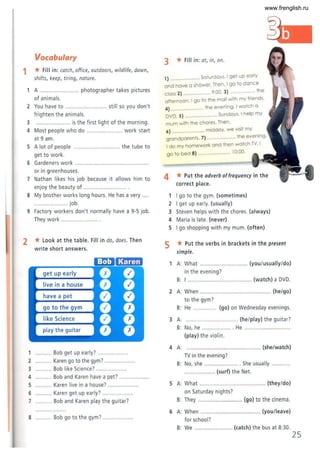
1
Vocabulary
* Fill in: catch, office, outdoors, wildlife, dawn,
shifts, keep, tiring, nature.
A .............. ........... photographer takes pictures
of ani mals.
2 You have to .......................... still so you don't
frighten the animals.
3 ..................... is the first light of the morning.
4 Most people who do ............... .. .. work start
at 9 am.
5 A lot of people .... ... the tube to
get to work.
6 Gardeners work .......... .... .......... .. ....................
or in greenhouses.
7 Nathan likes his job because it allows him to
enjoy t he beauty of ....................
8 My brother works long hours. He has a very . .
...................... job.
9 Factory workers don't normally have a 9-5 job.
They work .......................
2 * Look at the table. Fill in do, does. Then
write short answers.
get up early
live in a house
1 .......... Bob get up early? ........
2 ........ Karen go to the gym? ..
3 ........... Bob like Science? ...................
4 ........... Bob and Karen have a pet? ..
5 ........... Karen live in a house? ..
6 Karen get up early?
7 Bob and Karen play the guitar?
8 Bob go to the gym? ..................
3 * Fill in: at, in, on .
1) . ... Saturdays. I get up early
and have a shower. Then. I go to dance
class 2) ................ 9:00. 3) ......... the
afternoon. I go to the mall with my friends.
4) ........... ...." the evening. I watch a
DVD. 5) ........ . .... .. . Sundays. I help my
mum with the chores. Then.
6) ................ middoy. we visit my
t 7) the evening.
grondparen s. ..... . ...
I do my homework and then watch TV. I
go to bed 8) ................... 10:00.
4 * Put the adverb offrequency in the
correct place.
I go to the gym. (sometimes)
2 I get up early. (usually)
3 Steven helps with the chores. (always)
4 Maria is late. (never)
5 I go shopping with my mum. (often)
5 * Put the verbs in brackets in the present
simple.
A: What ....... (you/usually/do)
in the evening?
B: I ............... ........... (watch) a DVD.
2 A: When ................................... ......... (he/go)
to the gym?
B: He ............ (go) on Wednesday evenings.
3 A: .............. .............. .. (he/play) the guitar?
B: No, he ......
(play) the violin.
4 A:
TV in the evening?
B: No, she .....
.. . He ..................
.................... (she/watch)
.. ... She usually ............
............... (surf) the Net.
5 A: What ........................................... (they/do)
on Saturday nights?
B: They ............................. (go) to the cinema.
6 A: When ......
for school?
B: We ....
.................. (youJleave)
..... (catch) the bus at 8:30.
25
www.frenglish.ru
26
Vocabulary
1 * Choose the correct word to complete the sentence.
1 Going to a new school is exciting because you can make/do
new friends.
2 They usually read/study their subjects in the library after lessons.
3 We always do/write projects for Science lessons.
4 My sister shares/stays a room with her best friend at
university.
5 The boys have/make fun every time they go swimming.
6 Carol leaves/lives alone in a small house by the sea.
7 Living on campus/camp is exciting for many students.
8 You should join/sign a club to meet new people.
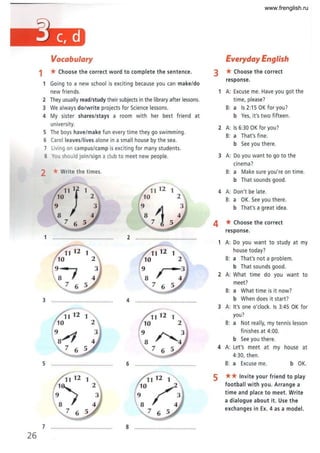
2 *Write the times.
•
:Ol1} 1
76 5
1 ........................................ 2 ........................................
1
I
7 6
3 ........................ ............. 4 ...
5 ............................. 6 ..................................... .
11 12 1
10/.
9 3
8 4
76 5
7 ......................... .............. 8 ................ ...........
Everyday English
3 *Choose the correct
response.
1 A: Excuse me. Have you got the
time, please?
B: a Is 2:15 OK for you?
b Yes, it's two fifteen .
2 A: Is 6:30 OK for you?
B: a That's fine.
b See you there.
3 A: Do you want to go to the
cinema?
B: a Make sure you 're on time.
b That sounds good.
4 A: Don't be late.
B: a OK. See you there.
b That's a great idea.
4 *Choose the correct
response.
1 A: Do you want to study at my
house today?
B: a That's not a problem.
b That sounds good.
2 A: What time do you want to
meet?
B: a What time is it now?
b When does it start?
3 A: It's one o'clock. Is 3:45 OK for
you?
B: a Not really, my tennis lesson
finishes at 4:00.
b See you there.
4 A: Let'S meet at my house at
4:30, then .
B: a Excuse me. b OK.
5 ** Invite your friend to play
football with you. Arrange a
time and place to meet. Write
a dialogue about it. Use the
exchanges in Ex. 4 as a model.
www.frenglish.ru
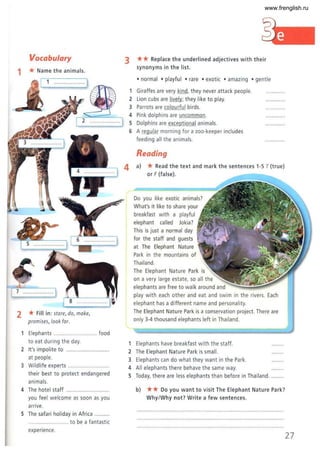
Vocabulary
1 * Name the animals.
1 .................... 1
2 *Fill in: stare, do, make,
promises, look for.
1 Elephants ..... .. .... food
to eat during the day.
2 It's impolite to ..................
at people.
3 Wildlife experts ...................
their best to protect endangered
animals.
4 The hotel staff
you feel welcome as soon as you
arrive.
5 The safari holiday in Africa ..
.. ............ ........... to be a fantastic
experience.
3 ** Replace the underlined adjectives with their
synonyms in the list.
• normal • playful • rare • exotic • amazing • gentle
1 Giraffes are very kind, they never attack people.
2 Lion cubs are lively; they like to play.
3 Parrots are colou rful birds.
4 Pink dolphins are uncommon.
5 Dolphins are exceptional animals.
6 A regula r morning for a zoo-keeper includes
feeding all the animals.
Reading
4 a) *Read the text and mark the sentences 1-5 T (true)
or F (false).
Do you like exotic animals?
What's it like to share your
breakfast with a playful
elephant called Jokia?
This is just a normal day
for the staff and guests
at The E
lephant Nature
Park in the mountains of
Thailand.
The Elephant Nature Park is
on a very large estate, so all the
elephants are free to walk around and
play with each other and eat and swim in the rivers. E
ach
elephant has a different name and personality.
The Elephant Nature Park is a conservation project. There are
only 3-4 thousand elephants left in Thailand.
Elephants have breakfast with the staff.
2 The Elephant Nature Park is small.
3 Elephants can do what they want in the P
ark.
4 All elephants there behave the same way.
5 Today, there are less elephants than before in Thailand.
b) ** Do you want to visit The Elephant Nature Park?
Why/Why not? Write a few sentences.
27
www.frenglish.ru
28
Vocabulary
1 *Match the pictures to the school
subjects.
• Maths • Music • Geography • Art • Science
• ICT • PE • History
5+5=10 I
4.4=8
15+15=30
1 .................... [[ 2 ...... .....
3 .................... [,--I_
4 _ _-----'11 S .................. 1
o 0"
00 ~ ~pr~
6 ......... ...... 11 7 ................. 11 8 . ···· .. 1
2 *Match the words. Use the phrases to
complete the sentences.
[IT] school a experience
[IT] packed b skills
[IT] circus c uniform
[IT] unique d walking
[IT] tightrope e lunch
1 Trapeze, acrobatics and clowning are all
different types of ...................................
2 A trip to the circus is a ............................... for
children because they can see wild animals
perform.
3 Most students in England have to wear a
4 You don't have to bring a ..............................,
the school dining hall is pretty good.
S At the circus you can see exciting performances,
such as ............ .................................. .
Grammar
3 *look at the rules. Then complete
the sentences. Use have to, don't have to.
• wait your turn in the queue
• sit at a specific table
• bring your own drinks X
• put your rubbish in the bin I
• wash your plate X
• be polite to the lunch staff I
1 You have to wait your turn in the queue.
2 .......................................................................
3 ......................,..................................................
4 ........................................................................
S
6 .........................................................................
4 *Fill in should/shouldn't.
OK
• Bring a camera.
• Arrive before the performance.
• Be quiet during the performance.
• Turn off your mobile phone.
NOT OK
• Touch the circus animals.• Put your feet on the seats.
• Bring your own food.• Enter the circus area.
You should bring a camera. .......................................
5 *Choose the correct word ,
1 A: look at Tony. He's such a good footballer!
B: Yeah, he's great/greatly!
2 A: Do you like our new History teacher?
B: Yes, his lessons are very interesting/
interestingly.
3 A: You play the violin beautiful/beautifully.
B: Thank you. I practise very careful/carefully.
4 A: What do you think of the school dining hall?
B: The food is horribly/horrible!
S A: Are you good/well at Art?
B: No! I draw terribly/terrible!
www.frenglish.ru
Vocabulary
1 *Write the correct word.
Your mum's mum is your
grandmother.
2 You sister's son is your
3 Your dad's brother is your
4 Your son's daughter is your
S Your brother's daughter is your
6 Your dad's dad is your .............. .
7 Your uncle and aunt's children
are your ............................
2 *Write the matching word.
1 dad, mum 2 .........., niece
3 uncle, .......... 4 , .., ........ ...... "
S grandfather, daughter
............." .. 6 brother,
7 ............, wife ...........,', ......
3 *Match the exchanges.
ITIJ Who's Laura?
[IIJ Whose is this bike?
IT[] Whose cousin is Ann?
A It's John's.
B Mary and Peter's.
C She's my aunt.
Listening
4 * 0 You'll hear Harry and
Clara talking about their
families. Listen and mark the
sentences (1-6) T(true) or
F(false).
Harry has one brother.
2 His cousin lives in Boston. ..
3 Harry's sister works as a
doctor.
4 Clara has a small family.
S Clara's oldest brother is
married.
6 Clara is an aunt.
Reading
5 * Read the text and for questions 1-4
choose the right answer A, B, Cor D.
Jacqui lives with her family on a sheep farm in the
outback of Australia. The nearest town is two hundred
miles away, so she must study at home. Once or twice a
year,shegoes intothe school building.The rest of the time,
the school comes to her.S
he completes all of her schoolwork
by post, radio or viathe Internet.
"Iusuallyget up at six o'clock.Imust feed the chickens and collect their
eggs, thenwe have breakfast. After that, I turn on my computer and check my
messages. School starts at eight thirty with assembly and registration. We have
lessons beforelunch, and early in the afternoon.At five o'clock, I help my mother
makedinner and then Ido my hom
ework.
I really likelivingin theoutback. My father and brothers are sheep herders, and
I love working with them. I enjoy the School of the Air because I can stay at
home and learn, but I miss my friends. My best friend Stephanie lives two
hundred miles away and I only see her once ayear at school. Shehas to go into
school every day."
The 'real' school isinAlice Springs, in the heart of the Australian outback.This is
where the teachers give their lessons.The school provides education to childrenin
themost isolated parts of Australiaand is fifty years old. T
here is avisitor'scentre
for tourists.
1 According to the text, Jacqui
A lives in an Australian town.
B uses the Internet to help her with her schooling.
( travels two hundred miles daily to get to school.
D only studies once or twice a year.
2 Jacqui's day begins with
A eggs for breakfast.
B feeding the chickens.
( assembly and registration at school.
D checking her messages.
3 Jacqui's only problem is that
A she has too much work.
B she has to stay at home a lot.
( her friend lives too far away.
D she has to go to school every day.
4 Jacqui's school
A is in the middle of the outback.
B only educates students near Alice Springs.
( has a fifty-year-old visitor's centre.
D has teachers that travel all over the outback.
29
www.frenglish.ru
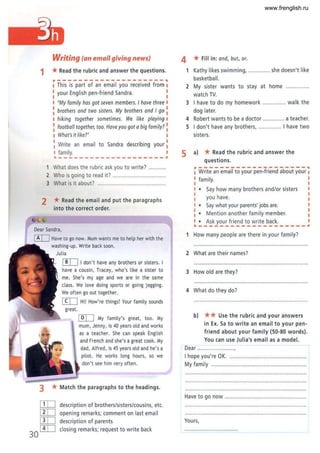
Writing (an email giving news)
1 *Read the rubric and answer the questions.
r--------------------
I This is part of an email you received from
I your English pen-friend Sandra.
"My family has got seven members. I have three
brothers and two sisters. My brothers and I go
I hiking together sometimes. We like playing
: football together, too. Have you got a big family?
I What's it like?"
: Write an email to Sandra describing your I
I family. I
.--------------- -----~
1 What does the rubric ask you to write? ...
2 Who is going to read it? ...." ..." ...." .....,.....,"'".
3 What is it about? """.""""""".",,.......,,......,, ..
2 *Read the email and put the paragraphs
into the correct order.
[!IJ I don't have any brothers or sisters. I
have a cousin, Tracey, who's like a sister to
me. She's my age and we are in the same
class. We love doing sports or going jogging.
We often go out together.
[IIJ Hi! How're things? Your family sounds
great.
[QIJ My family's great, too. My
mum, Jenny, is 40 years old and works
as a teacher. She can speak English
and French and she's agreat cook. My
dad, Alfred, is 45 years old and he's a
pilot. He works long hours, so we
don't see him very often.
3 *Match the paragraphs to the headings.
ITD description of brothers/sisters/cousins, etc.
[ID opening remarks; comment on last email
CID description of parents
30 [!IJ closing remarks; request to write back
4 *Fill in: and, but, or.
1 Kathy likes swimming, .............. she doesn't like
basketball.
2 My sister wants to stay at home
watch TV.
3 I have to do my homework .......". "" walk the
dog later,
4 Robert wants to be a doctor .......... '" a teacher,
5 I don't have any brothers, """""..... I have two
sisters.
5 a) * Read the rubric and answer the
questions.
--------------------,
Write an email to your pen-friend about your I
family. I
• Say how many brothers and/or sisters
you have.
• Say what your parents' jobs are.
• Mention another fami ly member,
• Ask your friend to write back.
-------------------_.
1 How many people are there in your family?
2 What are their names?
3 How old are they?
4 What do they do?
b) ** Use the rubric and your answers
in Ex. Sa to write an email to your pen-
friend about your family (50-80 words).
You can use Julia's email as a model.
Dear ......... ""...........,
I hope you're OK...." ................"",,...................
My family" ........ """............. """ ................ " ......
Have to go now ........... """....... ""......."
Yours,
www.frenglish.ru
Vocabulary
1 * look at the pictures and complete the
crossword puzzle.
2 *Fill in: lives, reptile, backbone, look, change,
insects to complete the text.
~ The chameleon is a(n) 1) ........................................ .
It has a(n) 2) ................................................. and lays
eggs. It 3) ................................................ in northern
Africa, the Middle East, India and Madagascar. It has a
long tongue to catch 4) ...........................:..... and its
eyes move in different directions. It can fill Its lungs
with air to 5) ................................ bigger. The best
thing about chameleons is that they can
6) ................................ the colour of their skin to
match the environment.
Listening
3 ** 0 listen and circle the best response.
1 a Yes, we do.
2 a Usually not.
3 a It's twenty to five.
4 a Don't be late.
S a Mary's.
b
b
b
b
b
No, they don't.
Every Saturday.
Is 6:15 OK for you?
That sounds good.
It's for Mary.
Notions & Functions
Circle the correct response.
1 A: Is 5:30 OK?
B: a No, it isn't. b Really!
2 A: I can't meet you before 10.
B: a That's a great idea.
b That's not a problem.
3 A: Who's linda?
B: a It's her grandma.
b She's my grandma.
4 A: Do you have any brothers?
B: a No, I'm an only child.
b It's Peter and Bob.
S A: What does your sister do?
B: a She's a teacher.
b She's married.
6 A: Do they live near you?
B: a They live in a flat.
b Yes, they do.
7 A: Is your mum a doctor?
B: a No, she doesn't.
b No, she works as a teacher.
8 A: Do you see your grandparents often?
B: a Every weekend.
b Always.
9 A: My uncle works in a restaurant.
B: a Does he have a job?
b Really? What does he do?
10 A: let's meet outside the park.
B: a That's not a problem.
b OK. See you there.
11 A: Excuse me, what time is it?
B: a It's three thirty.
b Is 4:30 OK for you?
12 A: Whose brother is Doug?
B: a Bruce and William's.
b He's married.
31
www.frenglish.ru
32
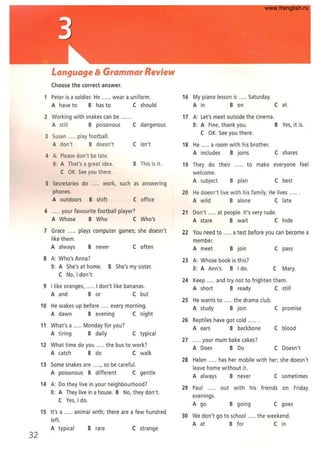
Language & Grammar Review
Choose the correct answer.
1 Peter is a soldier. He ...... wear a uniform.
A have to B has to C should
2 Working with snakes can be .. .
A still B poisonous C dangerous
3 Susan ..... play football.
A don't B doesn't C isn't
4 A: Please don't be late.
B: A That'sa great idea. B This is it.
C OK. See you there.
5 Secretaries do ..... work, such as answering
phones.
A outdoors B shift C office
6 ..... your favourite football player?
A Whose B Who C Who's
7 Grace ..... plays computer games; she doesn't
like them.
A always B never C often
8 A: Who's Anna?
B: A She's at home. B She's my sister.
C No, I don't.
9 I like oranges, ..... I don't like bananas.
A and B or C but
10 He wakes up before . every morning.
A dawn B evening C night
11 What's a ..... Monday for you?
A tiring B daily C typical
12 What time do you .. ... the bus to work?
A catch B do C walk
13 Some snakes are .. ..., so be careful.
A poisonous B different C gentle
14 A: Do they live in your neighbourhood?
B: A They live in a house. B No, they don't.
C Yes, I do.
15 It's a .. ... animal with; there are a few hundred
left.
A typical B rare C strange
16 My piano lesson is .. ... Saturday.
A in B on C at
17 A: Let's meet outside the cinema.
B: A Fine, thank you. B Yes, it is.
C OK. See you there.
18 He ..... a room with his brother.
A includes B joins C shares
19 They do their ..... to make everyone feel
welcome.
A subject B plan C best
20 He doesn't live with his family. He lives ......
A wild B alone C late
21 Don't ..... at people. It's very rude.
A stare B wait Chide
22 You need to ..... a test before you can become a
member.
A meet B join C pass
23 A: Whose book is this'
B: A Ann's. B I do. C Mary.
24 Keep ..... and try not to frighten them.
A short B ready C still
25 He wants to ..... the drama club.
A study B join C promise
26 Reptiles have got cold
A ears B backbone C blood
27 ..... your mum bake cakes?
A Does B Do C Doesn't
28 Helen .. ... has her mobile with her; she doesn't
leave home without it.
A always B never C sometimes
29 Paul out with his friends on Friday
evenings.
A go B going C goes
30 We don't go to school .. ... the weekend.
A at B for C in
www.frenglish.ru
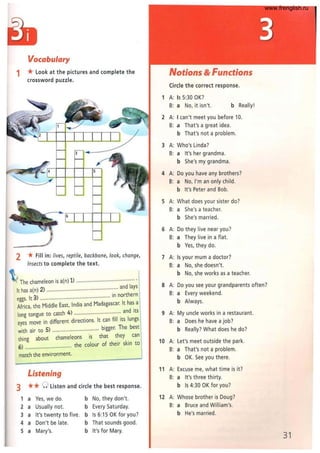
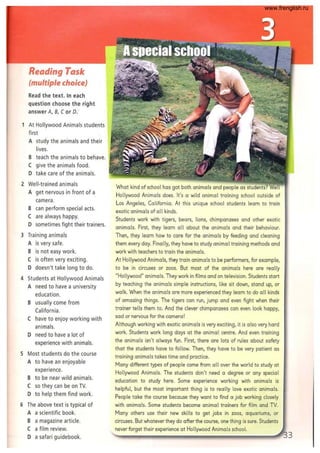
Reading Task
(multiple choice)
Read the text. In each
question choose the right
answer A, B, Cor 0:
1 At Hollywood Animals students
first
A study the animals and their
lives.
B teach the animals to behave.
C give the animals food.
D take care of the animals.
2 Well-trained animals
A get nervous in front of a
camera.
B can perform special acts.
C are always happy.
D sometimes fight their trainers.
3 Training animals
A is very safe.
B is not easy work.
C is often very exciting.
D doesn't take long to do.
4 Students at Hollywood Animals
A need to have a university
education.
B usually come from
California.
C have to enjoy working with
animals.
D need to have a lot of
experience with animals.
5 Most students do the course
A to have an enjoyable
experience.
B to be near wild animals.
C so they can be on TV.
D to help them find work.
6 The above text is typical of
A a scientific book.
B a magazine article.
C a film review.
D a safari guidebook.
What kind of school has got both animals and people as students?
Hollywood Animals does. It's a wild animal training school outside of
Los Angeles, California. At this unique school students learn to train
exotic animals of 011 kinds.
Students work with tigers, bears, lions, chimpanzees and other exotic
animals. First, they learn 011 about the animals and their behaviour.
Then, they learn how to care for the animals by feeding and cleaning
them every day. Finally, they have to study animal training methods and
work with teachers to train the animals.
At Hollywood Animals, they train animals to be performers, for example,
to be in circuses or zoos. But most of the animals here are really
"Hollywood" animals. They work in films and on television. Students start
by teaching the animals simple instructions, like sit down, stand up, or
walk. When the animals are more experienced they learn to do all kinds
of amazing things. The tigers can run, jump and even fight when their
trainer tells them to. And the clever chimpanzees can even look happy,
sad or nervous for the camera!
Although working with exotic animals is very exciting, it is also very hard
work. Students work long days at the animal centre. And even training
the animals isn't always fun. First, there are lots of rules about safety
that the students have to follow. Then, they have to be very patient as
training animals takes time and practice.
Many different types of people come from 011 over the world to study at
Hollywood Animals. The students don't need a degree or any special
education to study here. Some experience working with animals is
helpful, but the most important thing is to really love exotic animals.
People take the course because they want to find a job working closely
with animals. Some students become animal trainers for film and TV.
Many others use their new skills to get jobs in zoos, aquariums, or
circuses. But whatever they do after the course, one thing is sure. Students
never forget their experience at Hollywood Animals school.
3
www.frenglish.ru
Vocabulary
1 *Fill in: snow-capped mountains, volcano,
sights, route, fort, flea market, crafts, delicious,
packing.
1 There are lots of ........................ to visit in
Barcelona .
2 You can buy some souvenirs in the ...............
3 In winter we can see the ......................... from
our house.
4 At the local market you can buy lots of arts and
5 The train stops at five stations along the
6 Rig ht now, we are ......................... our clothes
for ou r holiday.
7 We are eating seafood in a restaurant; it's
8 A lot of soldiers live inside the ......................... .
9 Mount Vesuvius, in Italy, is a ........... ................. .
2 * Fill in the correct weather word.
8 It's ...................... .
3 * Fill in the gaps in the text using the
pictures.
It's hot and 1) ............. ......... here in
Cape Cod. Today, I'm relaxing on a beautiful
................. ........ . There are many
people ...................... in the sea. My
...................... local dishes
with her friend. My dad isn't here at the moment.
He is 5) ...................... on a tour bus. My
sister, Karen, is 6) ..... .. ............... for
souvenirs in the market in Bourne and my brother,
John, is 7)
........... . Summer is my
favourite season; it's great!
Grammar
4 *Write the -ing form of the verbs.
1 fly ........ ............ 7 w rite .................
2 eat ........ "."",, ... 8 swim .......... .., ... .•.. ..
3 shop 9 send ......................
4 come ........." ......... 10 buy .....................,
5 play .................... 11 listen ...••.....•...........
6 make ................ 12 sit ......................
5 * Put the verbs in brackets into the present
continuous.
Hi, Emmal _ I ·
i
Greetings from Alaska . It's freezing cold here. 1
And it 1) .............................. (snow) today, so
Ted and I 2) ..... ...................... (wear) warm
clothes. At the moment, we 3) .............. . . .
(visit) the Winter Ice Festival. Some artists
4) .............................. (carve) sculptures from
. They're beautiful. Ted 5) .... ...................
Ice. . I
(take) pictures to show everybody back home.
6) .......................... (have) a great time here.
Take care ,
Mary
www.frenglish.ru
Vocabulary
1 * list the clothes under the headings:
2
T-shirt, tie, sandals, shirt, jeans, trainers, bowtie,
suit, dress, blouse, belt, skirt, hat, jacket, coat,
trousers, boots, scarf, jumper, shorts, socks
Shoes Clothes Accessories
*Fill in: looking for, present, success, together,
expensive, halfprice, match.
Everything is ....................... at the department
store for one day only!
2 The party was a great ..... ...............................
3 Alice is ............................................ a new bag.
4 I can't afford to buy those shoes. They're very
S What skirt can Iwear to ...................................
with my red shoes?
6 Let's get a(n) ................................. for Tommy's
birthday.
7 We can go into the town centre .. .................. .
Grammar
3 *Put the verbs in brackets in the present
simple or present continuous.
Bill ...................... .......................... (talk) to his
friend on the phone right now.
2 Peter .............. ............................... .. (not/ride)
his bike to school every morning.
3 Hurry up! Kate and Liz ................................... ..
(wait) for us at the train station.
4 I ............................................................. (have)
lunch at one o'clock every day.
S We sometimes ..................................................
(help) our mother with the housework.
6 They ................................................ (not/play)
hockey at the moment.
7 Usually, Ken and Tom ........................................
(not/come) to football practice on Sundays.
8 Elizabeth ..................... .......................... (wear)
a red top today.
4 * Ask and answer, as in the example.
1 it/rain? .' ,
Is it raining? No,It Isn t.
2 they/fish?
" ..' .
........
........................... azine?
3 the girllread a mag
........
.........
.........
........." ' , ..........
.........
........
...... ... .. ... .... . . 7
4 they/isten to musIC. ................... ........
. ......
........
........
......... ...... 7
5 boyslwear trousers . .......... .........
." .." ..
6 ~h~ ·~·i·;ljh~id~·i~h;~9 rod?
" .......
.......
.........
.........
......, .
5 ** Put the verbs in brackets into the
present simple or the present continuous.
Dear Katy,
Hello from New York City! We 1) .........................
d
ful time here! We 2) ......................
(have) a won er . ht in
(stay) in a hotel in Times Square, 50 we are fig uall
the middle of the city. In the mornmgs, we us Y
(eat) breakfast m one of New
3)· ..···· d
....I··.... Then for the rest of the day,
York's famous e IS . , . d
(explore) the City. My da
we 4) ......·..................(i~ve) history, 50 most days,
5) ....... ...................... (visit) different museums.
he 6) ··· .. ·~··~i·~..hi·~ but often, my mum and I
Sometimes w ) ' . nth Avenue
7) ............................ (go) shoppmg on I (sit) in a
instead! Right now, I8) .............·..............·while m
fe in the Metropolitan Museum of Art Y
ca (look) around the
parents 9) .............................
museum shop. Wish you were here!
Take care,
Sarah
35
www.frenglish.ru
36
Vocabulary
1 *Match the words in the two columns. Then
use them to complete the sentences.
[ill shopping A park
[ill food B cinema
[IT] fast food C coaster
[ill 14·screen D malls
[ill dinosaur E creatures
[ill amusement F museum
[ill roller G restaurant
[ill sea H court
1 You can choose to eat from a huge number of
restaurants in the ....................................
2 Sam is eating a hot dog at a(n) .......................
......................... right now.
3 .......................................... give you the chance
to visit a lot of shops under one roof.
4 Let's go and see a film at the new ...................
..................... in the city centre.
S The children want to go on all the rides in the
6 The ................................. is great! The exhibits
look so real.
7 Ben doesn't like going on ...............................
rides; he finds them scary.
S You can see ......................................., such as
dolphins and sharks at the aquarium.
2 *Fill in: shop, book, have, watch, stay, visit,
see or get in the correct form.
1 Wendy loves history, so she often ....................
museums at the weekend.
2 When you .......................... tired of shopping,
you can have a coffee at the cafe.
3 John often ...................... films on his DVD
player at home.
4 You can sometimes ...................... sharks in
this part of the sea.
S Brenda usually ...................... for clothes in the
local shopping centre.
6 Steve always ..................... at expensive hotels
when he goes abroad.
7 Kate .................... lunch at the same restaurant
every day.
S You can ............. tickets for the concert online.
3
1
2
3
4
S
*Choose the.correct preposition.
You can do many things on the Internet, about/
from sending emails to writing a blog.
France is famous for/of its delicious cuisine.
The travel agency offers a variety with/of holiday
destinations to choose from.
Children's playgrounds appear in/on most
neighbourhoods around the city.
I'm tired of/on waiting for Valerie; let's just
leave without her.
Everyday English
4 * Use the sentences to complete the
dialogue. One sentence isn't necessary.
• Can I have one, please?
• Here's your pizza and your lemonade.
• I'd like a slice of pizza, please.
• Here's your change.
• How much is a lemonade?
• Here you are.
• No, thank you.
A: Hello. Can I help you?
B: Hi. 1) ................................................................
A: Alright. Anything else?
B: 2) ..................................................................
A: It costs 50 pence.
B: OK. 3) .......................................................
A: Of course. 4) ....................... .........................
That's £2.50, please.
B: OK. 5) ........ ................................... .. ..............
A: Thank you. ~ ................................
B: Thanks. Bye.
Writing
5 ** You are at a fast food restaurant.
Write a dialogue like the one in Ex. 4. Use
the pictures below or your own ideas.
•
www.frenglish.ru
Vocabulary
1 *Fill in: map, stall, traditional, fried, delicious,
locals, choose.
You can buy delicious bread from a ..................
in the market.
2 Most of the ................ ..... do their shopping at
the market.
3 You can see people in their ............................. .
costumes at the market.
4 Take a ...................... in case you get lost.
5 You can eat ................................ insects at the
Chatuchak Market.
6 This cake is ............................ Here, try some.
7 There are a lot of antiques to ................. from.
Grammar
2 *Choose the correct word.
3
1 You must/mustn't touch the antiques.
2 You can't/must wear shoes inside this place. It's
not allowed.
3 You can't/must follow the map to find the market.
4 You must/can buy souvenirs at the airport. It's
possible.
5 You mustn't/can throw rubbish on the streets.
Listening
** 0 listen to the dialogue and for
questions 1-5 choose the best answer
(A, Bor C).
1 Jenny and Peter are
A in a supermarket.
C with Peter's mum.
B at a street market.
2 Peter wants to get his mother
A a piece of jewellery. B a T
-shirt.
e an antique.
3 Jenny's sister wants to
A start a coin collection. B buy some coins.
e buy something for Jenny.
4 Peter can't
A see where L
aura is. B find fi lm posters.
e see where his brother is.
5 Peter's brother John
A is shopping for a watch. B is Jeft's classmate.
e wants to buy some books.
Reading
4 * Read the text and mark the sentences
T (true) or F (false).
Hi Tnomas, I The sun is sninireg ared we're
Greetiregs Jrom Tokyo. ea Market. The market takes
visitireg the Togo Shnne Fl d res oJ a snriree. It's the
P
lace ore Suredays in the gar e ared giJts Jor Jriereds.
f b IImg souvemrs q
Perfect place Jor u, d h'lte chirea 1950s Jl m
J 't blue an W '
You care Jired Jurnl ure, ld .res toys ared even
P
osters, Buddha statues, dO I Thc~;e is also traditional
l t and Swor s.
ancient he me s . L. l velll nower patterns
d ostumes WIt" 0 , J'
jewellery an c arich culture. .
nere. Tne Japanese nave d· L. M" sister is takmg
f 9 a san WIC". , . 't
Right noW, I'm ea In . a reat time! You must VISI
notographs. We're haVIng 9
p . I
Tokyo sometlme. See you soon,
Mark
1 Mark is out shopping.
2 The market is open all week.
3 The market doesn't sell souvenirs.
4 You can only buy new things at the
market.
5 Mark is in Tokyo with a family member.
6 Mark's taking photographs.
7 Mark's enjoying his trip.
5 ** Read again and complete the
sentences. Use up to five words.
1 Mark is writing from ...................................... .
2 The weather is ................................................ .
3 The market is open ......................................... .
4 You can buy ......................................................
5 Japanese people have ......................................
37
www.frenglish.ru
Vocabulary
1 *Write the words under the
correct heading: beans, salmon,
bananas, cheese, tea, cereal, bread,
rice, beef, onions, water, lettuce,
sugar, cherries, coffee, pasta, chicken,
butter, tomatoes, cauliflower.
DAIRY PRODUCTS MEAT &FISH
IFRUITI VEGETABLES It];1I~ ';'1,1.;Iait
38
2 * Fill in: steomed, good, slice,
creamy, scrambled, cold, green,
strong
1 ............................... rice
2 ................................ tea
3 ................................ manners
4 ................................ of toast
5 ................................ butter
6 ................................ eggs
7 ................................ meat
8 ................................ coffee
Grammar
3 *Choose the correct word.
1 We've got a few/a little apples.
Let's make a pie.
2 There is too many/much sugar in
my coffee.
3 Are you hungry? There's a little/a
few pasta left.
4 How much/many cheese is there?
5 We need some/a few butter for
the ca ke.
6 How many/much eggs do you
need to make an omelette?
7 There are some/much apples in
the fridge.
8 There is many/a lot of cereal in
the cupboard.
9 I've got a little/a few flour. I can
make a pizza.
4 * Circle the co rrect item,
1 A: How many / much bananas do you want from the
supermarket?
B: Oh, just a few / a little.
2 A: Mark eats too many / much sweets.
B: I know. It's very bad for his teeth.
3 A: We've got a few / a little lemons.
B: Great! Let's make some / a few lemonade.
4 A: How much / many milk do you want in your tea?
B: Just a few / a little please.
5 A: We need lots of / much eggs for breakfast .
B: But, we only have a little / a few.
6 A: We have a lot of / many bread in the cupboard.
B: Well, let's make a little / some sandwiches.
5 *Look at Tom's timetable. Complete the sentences
with goingto.
Monday
Tuesday
Wednesday
Thursday
Friday
Saturday
Sunday
cook pasta for dinner
eat Chinese food with Laura
meet friends at a cafe
go to the supermarket with Mum
go shopping for clothes with Bob
have a party
visit a food festival with Kate
1 Is Tom going to cook pasta for dinner on Tuesday?
No, he isn't.
2 ...... Tom and Laura ....................... Chinese food on Monday?
No, they ................................ .
3 ...... Tom ........................ his friends at a cafe on Wednesday?
Yes, he ................................ .
4 ...... Tom and his mum ........... to the supermarket on Friday?
No, t hey ................................ .
5 ...... Tom and Bob ................. shopping for clothes on Friday?
Yes, they .............................
6 .... Tom ................................................... a party on Friday?
No, he ................................ .
7 ...... Tom and Kate ....................... a food festival on Sunday?
Yes, they .......................... ...... .
6 * Write which of the following you are/oren't goingto do
this weekend.
1 I ..................................""............... (cook) fish for dinner. (.I)
2 I ................................................................. (watch) DVDs. (,1')
3 I ........................................................ (do) my homework. (.I)
4 I ..... .........." ........... ................. (have) lunch with friends.(.t)
5 I ..........................,..................................... (go) to a party. (,1')
www.frenglish.ru
Vocabulary
1 *Match the words to make
phrases. Then use them in the
correct form to complete the
sentences.
ITIJ wear
[ill play
[ill watch A the parade
[ill paint B their faces
[ill eat
( traditional
food
D music
E traditional
costumes
1 Clowns ........................................
and wear colourful clothes to
look funny.
2 They are listening to the band
3 We're .. ........................................
in the street right now.
4 I am .............................................
now. It's delicious.
S Some people ...............................
................ during the celebration .
They look amazing.
2 ** Look at the picture. Write
a short description in your
notebook. Write about:
weather, people's clothes,
activities.
Listening
3 **0 Listen and mark the sentences T {true}
or F {false}.
1 The speaker is in India.
2 Diwali lasts for three days.
3 People put candles in their
window for Diwali.
4 People give each other new
clothes for Diwali.
S The speaker is eating
sweets now.
6 There are fireworks
during Diwali.
Everyday English
4 *(hoose the correct response.
1 A: Let's put up some balloons.
B: a Sure, why not? b I think so.
2 A: Do you feel like watching the parade?
B: a Thank you. b Great idea!
3 Shall we go on the carnival rides?
a Not bad. b I'd rather not.
4 A: Let's wear costumes to the party.
B: a Are you doing anything? b That sounds good.
S A: Do you feel like listening to music?
B: a Sure!
b Can you hear the music playing?
6 A: Let's watch the fireworks.
B: a I'd rather not. Let's stay at home instead.
b Shall we?
39
www.frenglish.ru
40
Writing (an email about a festival)
1 * Read the email and fill in the missing
sentences.
)
ITIJ It's freezing cold here and snowing, but
we're having a wonderful time. I'm spending New
Year's Eve with my cousin. It's a big celebration
here. The Scottish people have their own name for
it. They call it Hogmanay.
[IC] They have a torchlight parade and a street
party. At the moment, I'm eating some traditional
food called stovies and people are dancing in the
street. We're all waiting to watch the fireworks
display at midnight.
ru See you when I get home,
Myriam
A Bye for now.
B Greetings from Edinburgh!
C In Edinburgh, people celebrate it every year
with a four-day festival.
2 *Read the remarks 1-4 and mark them
o(opening) or ((closing).
1 Bye for now.
2 I'm here in Edinburgh.
3 See you when I get home.
4 Hi Stacey.
When we describe a festival we use adjectives
to make our description interesting.
3 * Fill in: delicious, traditional, colourful, happy,
spectacular.
1 People are wearing .................... ..... costumes.
2 They are eating ...................... chocolate cakes.
3 There are ..................." ............ decorations in
the streets.
4 People sing ..................................... songs and
dance in the streets.
5 There's a ............................... fireworks display
in the evening. Don't miss it.
4 *Read the rubric and answer the questions.
r--------------------,
I Write an email describing
: festival. Mention:
I . the name of the festival,
I
I ' the place of the festival,
: . how you celebrate it,
I ' why it is special.
your favourite I
I
I
~--------------------~
1 What is your favourite festival in your city/
country?
2 When do you celebrate it?
3 How long does it last?
4 How do you celebrate it?
5 What is special about this festival?
5 ** Use the rubric and your answers in
Ex. 4 to write an email describing your
favourite festival. (100-120 words).
www.frenglish.ru
Vocabulary
1 *Replace the words in bold with their
opposites.
1 Deserts usually have low
temperatures.
2 Alaska has long summer months.
3 It doesn't rain often during wet
periods.
4 The tundra has a hot climate.
Reading
2 a) * Fill in: drop, characterises, reach, exist,
Heavy rain 1) .. ..............
the tropical rainforest climate' ;~;~;~ "
climate, different seasons don't
2) .. ......
.......................... . The rainy
season 3)
. .. ............................... all year
and rain falls nearly every day. All
round, 4) ................................ are ~~:r
same too. During the day, temperatures
5) .......
.............................. around 30'C
and at night, they 6) ..............
............ to
around 20'C. Because of all the rain, it is
easy for plants to 7) .
. · ·· · .. m
tropical rainforest climates Ma b .
lant . ny eauliful
p . s grow there so some people call th
ramforests "the jewels of the Earth". e
b) ** Mark the sentences T (true) or
F(false).
1 There are two seasons in the tropical
rainforest climate.
2 It rains a lot.
3 Temperatures are very low at night.
4 There are a lot of plants in this climate.
Notions & Functions
Choose the correct response.
1 A: What about this scarf?
8: a I have a lot of money.
b It's too expensive.
2 A: How about these gloves?
8: a Good idea.
b I guess not.
3 A: Do you like this bag?
8: a 8uy this, then .
b It looks great.
4 A: Do you have these trousers in a larger size?
8: a Yes, they're fine.
b No, I'm sorry.
5 A: How much are these sunglasses?
8: a Here you go.
b They're £100.
6 A: How can I help you?
8: a I want a hot dog.
b It's really nice.
7 A: What are you doing here?
8: a I usually go there every Sunday.
b I'm looking for a present.
8 A: Anything to drink?
8: a A soda, please.
b Here you are.
9 A: Let's go shopping.
8: a Good idea.
b Is that all?
10 A: Do you feel like going out?
B: a Sure, why not?
b You mustn't.
41
www.frenglish.ru
42
Language & Grammar Review
(hoose the correct answer.
1 James and Lilly ...... to the shops tomorrow.
A is going B are going ( isn't going
2 During carnival, children ...... their faces.
A crown B paint ( watch
3 (an I have ...... tomatoes, please?
A too many . B a little (a few
4 Julie ...... the car at the moment.
A drives B is driving ( are driving
5 You can see sharks in the ...... .
A court B aquari um ( market
6 A: Are you calling from your mobile phone?
B: Yes, I
A do B have ( am
7 I can't walk in high ...... .
A trainers B heels ( shoes
8 You ...... visit the museum today. It's closed on
Mondays.
A mustn't B can't ( can
9 The restaurant ...... different types of food.
A serves B gives ( supplies
10 You can see people in their ...... costumes.
A painted B traditional ( delicious
11 Let's watch the fireworks ...... .
A ride B display (parade
12 A: Anything to drink?
B: A A cola, please. B Thank you. Bye.
( It's £1 .50.
13 It's ...... cold today.
A boiling B freezing ( raining
14 It's difficult for plants to ...... in cold weather.
A stay Blast ( survive
15 This is Julie's scarf. Give it to ...... .
A she's B she ( her
16 A: Do you feel like going to the cinema?
B: A OK, why not? B Thank you.
( Here you are.
17 There's a ...... of dishes to order from .
A court B cone ( variety
18 There are a lot of ...... selling fru it.
A fleas B courts (stalls
19 This skirt is half ...... Buy it.
A change B top ( price
20 Eric usually ...... to school by bus.
A travels B catches ( takes
21 There are a lot of things to ...... from.
A take B choose (follow
22 It's raining. Put on your ...... .
A shorts B sanda ls (boots
23 You ...... visit that shop in the evening. It's open
late.
A can B mustn't ( can't
24 Jenny's skirt ...... the colour of her eyes.
A looks B fits ( matches
25 They are ...... for the rain to stop.
A waiting B staying (holding
26 A: How can I help you?
B: A I want a hamburger. B No, you can't.
( It's delicious.
27 Temperatures ...... to -SO
( at night.
A hold Breach (drop
-
28 You need a ...... in case you get lost.
A tool B map ( delicacy
29 Temperatures are ...... in winter.
A humid Brainy (Iow
30 A: How about this T-shirt?
B: A Good idea. B They're too small.
( No, I didn't.
www.frenglish.ru
Reading Task (matching)
Read the information about a chocolate festival. Match the headings (A-H) to the correct
paragraphs (1-7). One heading does not match.
A WATCH PEOPLE MAKECHOCOLATE
B A FUN CELEBRATION
C CHOCOLATE IN THE HOME
D A HUGE VARIETY OF CHOCOLATE TO BUY
E RELAXING WITH CHOCOLATE
F TRY SOME DELICIOUS CHOCOLATE
G DELICIOUS ARTWORK
MAKE YOUR OWN CHOCOLATE
www.frenglish.ru
Vocabulary
1 *Do the crossword.
er-
~ ,,---
- '2 f--
- f-- '2 f--
- ..-- f-- f-- f--
- 5
I- I I I
I- I- I- I- I-
6
I 11
I- I- I- .-
I- I- '- -
'- f-- I- '-
44
,,-
f-- f-- l-
I- I- '-
r' 1
'- f- I-
'- I-
I-
I-
,
Across !)
5 You can buy something to wear there.
6 You can pay to leave your car there.
-
f-
f-
I
I-
'-
11 A big store that sells many different things.
Down :J
Letters to you arrive there first.
2 They serve nice meals there.
3 You can see a play there.
4 A structure that has many apartments.
7 You can buy something to read there.
S You can go there when you are sick.
9 A place where you can pay to stay for the night.
10 A place that serves hot and cold drinks and snacks.
12 You can see beautiful paintings and statues there.
2 * Replace the words in bold with their
opposites: full, running, ancient, busy, narrow,
large, public and small.
Pompeii was a(n) 1) modern city. The 2) wide streets
were always 3) empty of people. It was a very
4) quiet city. Pompeii had a 5) small marketplace.
There were also two 6) large theatres. There were
many 7) private baths and many buildings had
8) still water.
'0
f-
f-
3 * Match the definitions to the words.
[ID a small area in a town or city where people
go to buy and sell things
[IT] a square in ancient Roman towns
[IIJ a building with statues of Roman gods
[!IJ a public building for swimming and bathing
IT[] a place that sells bread and cakes
[ill a building where people stay while on
holiday
A temple
B hotel
C marketplace
D bakery
4 * Fill in: was, wasn't, were, weren't.
forum
bath
• A: How 1) .................... the party last night?
B: It 2) .................... great!
A: 3) .................... Tom and Sally there?
B: No, they 4) .................. They 5) ..................
at home.
• A: Where 6) ................... Janice yesterday?
B: She 7) ................... at the theatre with her
mum.
A: 8) .................... Mark with them?
B: No, he 9) ............................., but his sister
10) ..............
Grammar
5 * Fill in: had, didn't have, WQS, weren't, were.
There 1) ................ wide streets in the ancient city of
Athens. In fact, the streets 2) ...................... narrow.
The city 3) ......................... department stores. but it
4) ........................ a large Agoia, or marketplace.
There 5) ..................... a great theatre. Most buildings
6) .................. running water. but the city 7) ....
public fountains where people could get their water.
www.frenglish.ru
Vocabulary
1 * Fill in: ruled,
attended, worked,
hunted,
transported,
played.
The Aztecs .................. ............... as farmers
and craftsmen .
2 They .................. goods by boat.
3 Men .................... for meat.
4 Their children ............... .. .. a game similar to
basketball and football.
5 The Emperor .................... the Empire with
his army.
6 Many children .................. school.
Grammar
2 *Fill in: had,
did, didn't or
could.
A: ..............
wealthy boys
in ancient
Egypt read and
w rite?
B: Yes, they could.
2 A: .........
ancient Egyptians have video games?
B: No, they .. ................ .. . They played board
games, though. Their favourite one was Senet.
3 A: .......... ........... girls attend school in ancient
Egypt?
B: No, they couldn't. Only wealthy boys
attended school.
4 A: ..................... they tell the time?
B: Yes, they could. They .... .. ......... water
clocks.
5 A: .............. ancient Egyptians have cars?
B: No, they .............. They used boats instead.
3 * Write the past simple of the verbs below.
1 work ................ 6 play ................
2 live ................ 7 walk ... .•...........
3 fish ••••••••• •• ••• o. S design ................
4 travel .............. 9 study ................
5 attend ..............., 10 discover ................
4 **Put the verbs in brackets in the past
simple.
Most Romans 1) ......................... (live) in very small houses.
The wealthy ones 2) .
very important in
3) ........ ..................
.......... (own) villas. Family was
ancient Rome. A usual family
(consist) of a father, a mother,
unmarried children and married sons with their families and
slaves. Both boys and girls 4) ............................... (start) their
education at the age of 7. They 5) .......................... (study)
Maths, Grammar, History and Literature.
Students 6) .. (stop) at noon for lunch.
After that, they 7) .......................... (return) to classes to finish
their school day Back home, kids 8) ......... .......... (play)
with their pets and their toys. They 9) ....
(not/play) video games, but they 10) ..
(enjoy) playing board and ball games. Ancient Romans
11) .. . ..... (not/use) knives and forks to eat their
food. They 12) ....................... ...... (have) spoons and they
13) .. (use) their fingers, too. All Romans
14) ................................... (watch) performances at open-air
theatres.
Talking about weekend
activities
5 a) * Put the verbs in the correct tense.
A: What 1) ..................... (you/do) last weekend?
B: Oh, not hing special, really. What about you?
A: 12) .................. (go) to the theatre with Molly.
B: 3) .......... .................. ................. (you/enjoy) it?
A: Yes, it 4) ......................................... (be) great.
b) ** Write a similar dialogue.
45
www.frenglish.ru
46
1
Vocabulary
*Fill in: science-fiction, skirts,
effects, style, dance, band, portable.
1 We saw a(n) ..................
film. It was about life on Mars.
2 The Rolling Stones are a
music ............. .. ................
who were popular in the
1960s.
3 The special .......
in that film were amazing!
The aliens looked so
, realistic.
tr 4 A popular ................... .
in the 1960s was The T
wist.
Many teenagers liked it.
S In the 60s, women liked to wear
mini .................. .... ... .
6 Did you know that t he hippy
......................... was very popular
with teenagers in the 60s?
7 In the 60s, teenagers had ..............
radios to listen to music.
2 * Choose the correct
preposition.
1 My grandpa was crazy of/about
leather jackets. He had more than
ten!
2 What styles were onlin fashion
50 years ago?
3 Neil Armstrong was the first
person to walk onlin the moon.
4 When my mum was a teenager,
she listened to her favourite
songs onlin the radio.
S When I w as little, I lived in the
country on/in a farm . Now, I live
in the city.
6 On/In the 1960s, teenagers liked
listening to bands like Led
Zeppelin and The Beatles.
3 *Fill in: milk, delivered, walked, miss, had, chores.
1 We ............. .. picnics in the countryside when I was
young .
2 George . .. ........................ the dog last night.
3 I .................. ...... newspapers after school when I was young.
4 Everyone in our family helped with the .......... .............. .
S Last year, my family moved to the city. I real ly ........................
life in the country.
6 When Tom lived on a farm, he helped his parents .................. ..
the cows every day.
Everyday English
4 * Complete the dialogue.
• What about you?
• Do you miss all that?
• Was it boring?
• Did you like it there?
Kenny: Did you grow up in the countryside, lan?
lan: No, I didn't. I lived in a big city.
Kenny: 1) ................................................................. ............
lan: Yes, I did. There was a lot to do. I went swimming and I
often went to the cinema.
Kenny: Sounds like you had a nice life there.
lan: It was great. I miss it. 2) ........................................ .
Kenny: I lived in a village before I moved here.
lan: 3) .................................................. .............................
Kenny: No, there w as a lot to do. I delivered newspapers in
the mornings. My friends and I played outside all the
time and I cycled to school every day.
lan: 4) ... .. .........................................................." " " " """.
Kenny: Sometimes, but I love it here, too!
5 **Write a similar dialogue to the one in Ex. 4. Use
these ideas.
• lived in a village/town • played football at the weekends
• worked in a bookshop • walked the neighbour's dog
www.frenglish.ru
Vocabulary
1 *Fill in: discovered, dated back,
destroyed, knew, constructed, grew,
lived, left.
In 1841 , an American explorer
called John Lloyd Stephens
............................ the Mayan city
of Chichen Itza in Mexico.
2 John Lloyd Stephens believed the
city ........................ ... to around
600 AD
3 Mayan people ............................
................ a lot about astronomy.
4 Lots of Mayan people .................
................... ........ in small houses
on the edges of the city.
5 They .................................. corn,
beans and tomatoes for food.
6 In Chichen Itza, the Mayan people
......................................... a large
pyramid called 'El Castillo'.
7 The Mayans ................................
their city suddenly and no one
saw them again.
8 When the Spanish came to rule
Chichen Itza they .........................
some of the old buildings.
2 ** Replace the underlined
words with their opposites.
1 The palace had thick walls. t__ _
2 The building was huge. s_ _ _ _
3 The houses were very weak.
s___ __
4 He wore a beautiful hat. u
5 The ancient city had many
fountains. m____ _
6 The city had 10.!! buildings.
s__ __
Reading
3 a) *Read the text and mark the sentences 1-8 T(true)
or F(false).
1 Cahokia is a very old site.
2 Not many people lived there.
3 They had very tall pyramids.
4 The city had walls to keep the enemies away.
5 The people there couldn't tell the time.
6 They were hunters.
7 They raised animals for food.
8 Lack of food is a possible reason why people left the city ....
The Ancient City of Cah0 kia
Cahokia is an ancient villa I h
Americo. This amozing sitegdea~~S~a~ktto
e
7~~s~~ppidRiver in
time over 20 000 I I' d an at one
people left C~hoki~:,"~e Ive thkere. Then suddenly, all of the
Th M' . ' . no one nows why.
mounJs o;s~~:;~~~a~:'s~ple w~o lived. in Cahokia built big
bUilding On top of theseape 0 :yr~:'dt' Often they put a
Cahokia was OVer 10 moun s. e argest pyramid in
houses, temples and stro~gtoreY;1 tatIII The Mississippians built
They I wa s 0 protect their City too
were a so very clever I Th .' .
even made a calendar' th leop e. e MISsissippians
to tell the time. They aI~ h;;: tooden poles and the sun
game was called 'chunkey'. paying field. Their favourite
The Mississippians were also d f
crojSh like corn and tomatoes and h~:d a%:~~'f:r
h
f':o9'ew
e reason why they left Ca hok' ' . .
some people say they left the city b la IS shtlll a mystery, but
ecause t ere was no food.
b) * Now complete the sentences.
1 Cahokia is near .................................................".................. .
2 The Mississippians built ........................................................ .
3 To tell the time, they .......... .................................................. .
4 They played ......... .. .............................,.....,.......................... .
5 The Mississippiansate ............................." ........................... .
6 No one knows why the people ............................................. .
7 A possible reason is that ....................................................... .
47
www.frenglish.ru
t/oec&u$mryr
* F¡ll in: steol, invade, become,
terrorise, soil, found, burY, feor,
moke, attack, build and saYe in the
correct form.
1 Francis Drake......'.. around
the world between 1577 and 1580
on the orders of Queen Elizabeth'
2 Marie Curie once said that the use
of x-rays during the war
the lives of manY injured men.
3 Blackbeard and his crew
ships on the Atlantic Ocean and
Caribbean Sea to get their treasures'
4 lvan the Terrible
and killed thousands of PeoPle
during his reign.
5 ln'1798, Napoleon Bonaparte...."..
.... EgYPt with an armY
of nearly 33,000 men.
6 The Europeans
the Vikings because theY were
extremely strong warriors who
made surPrise attacks'
7 lvan the Terrible was just 17 years
old when he ..............
the first tsar of Russia.
8 Queen Elizabeth
Francis Drake a knight in 1581.
9 They a huge
navy and attacked them.
10 During his second voyage to the
New World, ChristoPher Columbus
.. the new colonY
of La lsabela.
11 Blackbeard hid the treasures he
from different
ships on land.
2 The Vikings often .........
their dead at sea, on burning boats.
* till in power, reason, approval, odmiral, powers, novy,
and debt.
The ancient Egyptians believed that King Tutankhamun had
supernatural ................ ...'. and could do magic'
King Henry Vlll spent a lot of money during his reign and
when he died England had a large ....'..... to pay off'
Lord Nelson, the famous English naval '....."'!.¡¡..!!.'¡""¡'r!"',
defeated Napoleon at the battle of Trafalgar.
Some people believed that poison was the real ."....""""""
for Napoleon's death.
King Henry Vll was the first English king to build a(n)
When he died, England had 5 royal warships'
Defeating the Spanish Armada gave England more
over Spain.
Queen Elizabeth I gave Francis Drake her secret
to travel around the world'
ürwnrmar
* Use the verbs in the pastcontinuous to complete the
sentences.
. rain . sail . study . cook . talk . play . not work
They .......... .......'. in the ocean when the pirates
attacked them.
He ..,,......... ......' to the sailors when the admiral
appeared.
It ............... ...'. hard yesterday in the evening so
they didn't go out.
..,you historY
yesterday at 5 o'clock in the afternoon?
Jane ........... on the history project when
you called.
While Dan '.... dinner, Bill and Laura
lnvoders on the comPuter.
4 ** Complete the sentences using the pastcontinuous'
1 At 6 o'clock last Monday afternoon my friend
This time yesterdaY we .,,..'...."
At 9 o'clock last Saturday evening my friends
2
3
4B
4 This time last SundaY I
www.frenglish.ru
Vocabulary
1 *Find ten words related to films.
F A N T A 5 Y B Y Z T F W H
K N 0 B C 0 M E D Y H T G 5
F C J T D N M H 0 R R 0 R
5 M U 5 I C A L T L E X I
W A 0 R 0 M A N C E L J R
Z T N 5 N 0 E P U K L Q z U
W E 5 T E R N W W A E Y X B
A D V E N T U R E K R V 0 C
2 *Fill in: boring, interesting, sad, funny, amazing, scary.
That film we watched yesterday was so boring, I fell asleep
halfway through it.
2 I don't like horror films. I think they are ................................
3 I was really upset when the family disappeared; it was such a
................ ................. film.
4 My dad doesn't like westerns, but he loves science-fiction
films. He says they are much more ............................
5 Sara's favourite films are comedies. She likes them because
they are .. ........................ .
6 I really enjoyed Alice in Wonderland; it was just .......................
Listening
3 ** 0 You will hear
two people talking
about a trip to the
cinema. Listen to the
dialogue and mark the
sentences T {true} or F
{false}.
1 Jane and Carrie went to the cinema last weekend.
2 It was twenty pounds for one ticket.
3 Carrie didn't think the film was scary.
4 Josh didn't really enjoy watching the film.
S Josh prefers science-fiction films.
Everyday English
4 * Choose the correct
response.
1 A: Did you like that film?
B: a It was a science-fiction film.
b It was fantastic I
2 A: I like action films. How about
you?
B: a I prefer animated films.
b It was tiring.
3 A: Did you think that film was
funny?
B: a Yes, it was a great comedy.
b I prefer comedies.
4 A: What type of films do you like?
B: a I prefer fantasy films.
b I quite like it.
S A: Did you like animated films
w hen you were young?
B: a I prefer fantasy films.
b Yes, I quite liked them.
6 A: What did Patty do at the
weekend?
7
B: a She watched that new
action film.
b She loved it.
A: What was the new Iron Man
film like?
B: a I loved it. Make sure you
see it.
b I saw it last month.
8 A: Do you like horror films?
B: a They are terrifying .
b No, I prefer romances.
49
www.frenglish.ru
50
Writing (a review ofa film)
1 *Read the review and answer the questions.
Clash of the Titans
1 What type of film is it?
2 Who stars in it?
3 What is the plot about?
by Jeremy Smithers
Clash of the Titans is a 3D fantasy
film starring Sam Worthington. It's a
story from Greek mythology about
the time when humans went to war
with the gods. The humans make the
gods angry when they destroy the
temple of Zeus, the king of the gods,
at Argas. Then, the god Hades kills
some humans and the innocent
family of Perseus, too. Perseus, the
human son of Zeus, wants revenge
against Hades. He battles against
strange demons, frightening beasts,
and Hades to protect the city of
Argas and its Princess. The film is
full of action with amazing special
effects. Don't miss it!
4 How does Jeremy recommend the film?
Replace the words in bold with synonyms from the
list.
• depressing • frightening • great • terrible • dull
• amusing • thrilling
1 The film was so funny, I couldn't stop laughing.
2 Avatar is a good film. You should see it.
3 The film was very scary, I couldn't sleep.
4 Don't watch this film; it's so boring I fell asleep.
5 I cried at the end of the film. It was sad.
6 The film was exciting. I was on the edge of my
seat.
7 The plot of the film was bad. I wouldn't
recommend it.
3 * Complete the
recommendations with: you'll
love it, miss it, a must-see, It's a
bore to watch, should see it. Then
mark them P(positive) or
N (negative).
A Avatar is an amazing film with
spectacular special effects. Don't
1) ..............................................
B Robin Hood is a great film. It has a
good plot and exciting action
scenes. You 2) .......................... .
C The acting in The Bounty Hunter is
terrible and the plot doesn't
make sense. 3) .........................
D Up is 4) ......................................
I'm sure 5) ................................. .
4 * Read the rubric and answer
the questions.
r---------------~
I Write a short review of your I
I favourite film. I
I I
I ' Describe what type of film it is. I
I . Describe the actors that star I
I I
in it. I
I . Describe the plot of the film. I
: . Give your personal opinion :
I and recommendation. I
~---------------~
1 What type of film is it?
2 Who stars in it?
3 Wh_
at is the plot about?
4 How do you recommend it?
5 ** Use the rubric and your
answers in Ex. 4 to write a
short review of the film for
the school magazine (60-80
words).
www.frenglish.ru
Vocabulary
1 *Fill in: continent, respected, travelled, pull,
looked after, protected.
The Navajo lived in earth and wood houses and
.......... on foot.
2 The men .............,....... ..... the tribe from their
enemies.
3 The Native Americans .......................................
the environment and tried not to destroy it.
4 They sometimes used dogs to ........ ................. .
their sleds.
5 The women of the tribe did the housework and
....................... the children .
6 Europeans arrived on t he ..................................
of America in the 15th century.
2 *Match the words. Use the phrases to
complete the sentences.
[IT] wooden A skin
[IT] native B houses
[IT] animal
C crops
[IT] 0 tribes
grew
There were many... ............ ............ living
on the continent of America .
2 The Navajo .. ............................... to feed their
families.
3 The Kwakiutllived in large .........
4 They used natural materials like, ............... ......,
to make their clothes.
3 *Choose the correct preposition.
The Navajo travelled from place to place inion
foot.
2 The Kwakiutl used canoes forl to fishing.
3 When did the Europeans arrive inion the
continent?
4 Nature was very important tolby the Native
Americans.
5 The Cheyenne made their houses ofIfram
buffalo skin.
Notions & Functions
Choose the correct response.
1 A: Where was Jane yesterday afternoon?
B: a At the pool.
b No, she wasn't.
2 A: Were you at the park last Sunday?
B: a No, we weren't.
b Yes, they were .
3 A: Did he play board games when he was a
kid?
B: a Yes, he did.
b No, they didn't.
4 A: What did you do last weekend?
B: a Nothing special. What about you?
b I li ked it a lot.
5 A: Cou ld you swim at the age of six?
B: a No, you couldn't.
b No, I couldn't.
6 A: It sounds like you really liked it.
B: a Yes, it was great.
b Yes, sometimes I do.
7 A: Was it boring?
B: a No, not at all.
b No, I didn't.
8 A: Do you miss all that?
B: a Well, sometimes we do.
b Yes, we did.
9 A: What was the film like?
B: a I prefer thrillers.
b I didn't like it.
10 A: What do you think of Avatar?
B: a It's a must·see. Don't miss it.
b I like all types of films.
51
www.frenglish.ru
52
Language & Grammar Review
Choose the correct answer.
1 Eighty years ago, there ...... an airport on the
island.
A weren't B isn't C wasn't
2 A: Did ancient Egyptians play board games?
8: Yes, they ......
A could B had C did
3 A: What did you do yesterday evening?
8: A Nothing special. B I didn't like it at all.
C Not really.
4 A: It sounds like you loved it.
B: A Yes, it was amazing.
B Yes, I saw it yesterday.
C No, they don't.
5 ..... there public baths in Pompeii?
A Had B Were C Was
6 The Navajo were farmers and they ..... crops.
A made B built C grew
7 A: Was it a bit dull?
B: A Not at all. B No, I don't.
C No, I wasn't.
8 A: Do you miss your old neighbourhood?
B: A Yes, sometimes I do. B Yes, we did.
C No, they don't.
9 The ancient Egyptians ..... build pyramids from
stone.
A were B had C could
10 The Cheyenne ..... buffalo for food.
A farmed B grew C hunted
11 Only boys ..... school.
A arrived B taught C attended
12 The city dates ..... to the 15th century.
A bit B from C back
13 They ..... goods on their boats.
A constructed B ruled C transported
14 The Kwakiutl ..... their houses out of wood.
A makes B made C make
15 A: What do you think of Up?
8: A It's a comedy film. B It was expensive.
C It's great. You should see it.
16 Did girls ..... mini skirts and boots in the 60s?
A wore B wears C wear
17 The streets were ..... of people.
A narrow B full C crowded
18 The ..... of the volcano destroyed the vi llage.
A ash B eruption C effect
19 Vikings ..... fast boats.
A did B built C traded
20 He ..... newspapers at the age of 10.
A delivered B helped Cleft
21 There were
crops.
rooms where they kept their
A running B storage C terraced
22 Macchu Picchu is an ancient Inca ......
A sight B site C field
23 The film had great special ......
A effects B acting C plot
24 He likes comedies because they are ......
A scary B sad C funny
25 He didn't ..... them leave the building.
A saw B see C sees
26 The ancient buildings in Peru had ..... walls.
A thick B chubby C curly
27 I don't like science-..... films.
A comedy B western C fiction
28 They lived in a block of ......
A shops B flats C departments
29 The eruption of Mt Vesuvius ..... the city under
ash.
A destroyed B put C buried
30 They fished ..... the River Nile.
A in B over C of
www.frenglish.ru
Reading Task (multiple choice)
Read the text. In each question (1-6) choose
the right answer A, B, Cor D.
TerrifYing and merciless -are the words to describe this most
famous English pirate. Blackbeard was a large, tall man and he
carried two swords, lots of guns and knives. His real name was
Edward Teach, but he got his pirate name fi'om the long black
beard which covered most of his face. Ships all over the
Caribbean Sea feared an attack by Blackbeard and his crew.
Teach began his career on the high seas at an early age
when he sailed in tile English Navy in the War of tl,e
Spanish Succession (1702-1 713). After the war he joined
the crew of the Pirate Homigold. In 1717, they captured a
French ship that Homigold later gave to Teach. Teach took
control of this ship which he named 'The Queen Anne's
Revenge' . This was the first ofmany ships that he commanded,
and it began his reputation as a terrifYing and dangerous pirate.
Over the next year, Blackbeard and his crew captured more than 50
ships. They often leamed a ship's nationality and then raised that
country's flag in order to appear fi-iendly. This allowed Blackbeard's ship to get close to the other ship. The pirates then
raised Blackbeard's flag and attacked tile ship. They went on board the ship and stole treasure and goods.
Blackbeard's li fe came to an end when the Royal British Navy sent Lieutenant Maynard after Blackbeard in November,
1718. Maynard found Blackbeard and his crew in small harbour in North Carolina. The pirates and Maynard's crew
fought each other. [n the battle, Maynard shot and killed Blackbeard. Aftelwards, Maynard searched for Blackbeard's
treasure, but was unable find it. When Blackbeard died so did the secret of his treasure which remains a mystery to this
day.
The pirate Blackbeard 4 Blackbeard and his crew got close to other ships by
A had a short black beard. A secretly going on board.
B was of medium height. B not showing any flag at all.
C was a frightening man. C stealing the other ship's flag.
D had ships all over the Caribbean. D showing the same flag as the other ship.
2 Blackbeard first went to sea 5 When Maynard found Blackbeard,
A when he was quite young. A Maynard fought and died.
B to work for Pirate Hornigold. B Blackbeard fought, but lost his life.
C to fight the French. C Maynard took Blackbeard's treasure.
D to sail to Spain. D the pirates killed Maynard.
3 Blackbeard got his first ship 6 The above text is typical of
A from another pirate. A a history book.
B by attacking the English Navy. B an adventure story.
C from Queen Anne. C an autobiography.
D by stealing it from another pirate. D a historical novel.
53
www.frenglish.ru
54
Vocabulary
1 *Choose the correct word.
1 Tom wants to ride/drive a camel when he goes
to Egypt.
2 One of the things I've always wanted to do is
climb/flyover the city in a helicopter.
3 Sue has driven/sailed on a yacht twice.
4 George drove/cycled a quad bike for the first
time yesterday.
2 *Fill in: source, highlight, clear, true, and
desert.
lOne of Jenny's wildest dreams came .......
when she went diving with sharks.
2 Some travellers got lost in the ...................
and had t o walk for days under the hot sun.
3 The ..................... ........ of the Amazon River is
in Nevado Mismi, a 5,597-metre mountain in
southern Peru.
4 Divers can see tropical fish and colourful corals
in the ............................ water near the beach.
5 The ............................. of our trip to Spain was
visiting the Prado museum in Madrid.
3 a) *Match the words in the two columns.
IJIJ double-decker A ruins
[IT] active B van
[IT] city C volcano
[IT] ancient 0 bus
[ID river E skyline
[IT] camper F cruise
b) *Use four of the phrases above to
complete the sentences.
1 We went on a .................................. yesterday.
It was nice to be on the water.
2 The tour bus stopped at the .... .........................
of a two thousand year old town.
3 It was really fun travelling around London on a
red .. .............................. and seeing the sights.
4 We enjoyed an amazing view of the Parisian
...................... from the top of the Eiffel Tower.
Grammar
4 *Write the past participles of the verbs
below.
1 take - ................... 5 ride - .................
2 make - ................... 6 see - .......................
3 swim - ........ ........... 7 climb - ...................
4 do - ........................ 8 try - ................ .
5 *Put the verbs in brackets into the present
perfect.
1 Susan ........................... (visit) Barcelona
three times this year.
2 Jane ................. .................. ...... (leave) for her
two-month holiday around Latin America.
3 Of all the hotels we .............................
(stay) in so far, this is the best one.
4 James and Lilly ................................... (travel)
to most countries around Europe.
5 George ................................ (promise) to send
us some postcards from his trip to Japan.
6 The Smiths ......................................... (decide)
to go camping for their summer holidays.
7 AIIan ..................................... ............. (choose)
to go camping for his summer holiday.
8 It ............................................. (be) three years
since we last went abroad.
9 They .................................... (bring) back some
great souvenirs for everyone from their trip.
6 *Choose the correct item.
1 Linda's not here. She has been/has gone to
the travel agent's.
2 Dave and Jenna have been/have gone to
Australia twice.
3 Alex has gone/has been on a cycling tour across
the country. He's coming back next month.
4 Kate has been/has gone on holiday to Italy
four times this year.
5 Emma has been/has gone to get Terry from
the airport. I'm expecting them any time now.
6 Diana has gone/has been to the shops. Would
you like to wait for her?
7 I have gone/have been to the Edinburgh Festival
three times and I'm going again next year.
8 Hugh and Laura love New York City. They have
gone/have been there many times.
www.frenglish.ru
Vocabulary
1 *Do the crossword puzzle.
2 *Fill in: weird, old·fashioned, on board, bun,
still, thought and look.
The best way to see San Francisco is to jump
................. ... .................... a cable car and ride
around the city.
2 I had a(n) ........... ..................... .. experience on
the boat. I thought I saw a sea monster.
3 Keep ....................................... ! I want to take
a photo of you next to that statue.
4 She was so lost in .................. ............ that she
missed her bus stop.
S The air hostess had a blue uniform on and wore
her hair in a(n) .......... ............. ............ .
6 In London, there are ............................... taxis
from the 1940s.
7 Jane gave me a puzzled ......... .........................
when the tram stopped suddenly.
Grammar
3 *Make sentences using the words below.
Use for or since and the present perfect.
1 I/not have/a holiday/two years ........................
2 Andy/live/8razil/2008 .......................................
3 It/not snow/in my town/a long time ................
4 He/not travel/abroad/last summer ...................
5 I/be/ in Venice/a few days now .........................
6 We/ not eat/out/months ... ..............................
4 *Underline the correct word.
1 Helen has never/ever been to Italy.
2 We have already/yet bought the plane tickets.
3 Have you been on the sightseeing tour yet/just?
4 Madeleine has since/just missed her flight.
S I haven't ridden a bike since/for I was a child.
6 Have you since/ever been diving with sharks?
7 I haven't been camping for/since three years.
5 *Put the verbs in brackets into the present
perfect.
1 A: ............................ (you/ever/be) camping?
8: Yes, but I ....................................... (not/do)
it for ages.
2 A: Do you want to go skydiving?
8: Yes I do. I ........................ (never/try)
skydiving before.
3 A: I ... .......................... ............... (just/receive)
a postcard from Mary. She's in Hawaii.
8: Really? How long .............. .........................
(she/be) there?
4 A: ...................................... ... (James and
lilly/arrive) in London yet?
8: I don't know, they ..........
(not/call) me.
5 A: How's your trip? ........ ............... ...................
(you/do) anything interesting?
8: Well, we .......................... (fly) over the city
in a helicopter and we .................................
(take) some amazing photos so far.
6 A: I ................................................ (not/book)
our ferry tickets yet.
8: That's OK. I ......................................... (ask)
George to do it.
55
www.frenglish.ru
56
Vocabulary
1 * Fill in: organised, volunteered, participated,
allowed, changed, donate, care, looks after.
Last week our school .. .........................
a special charity event to help the poor.
2 Helping at the animal shelter
me to learn more about animals.
3 My experience of working with children in
Africa ................ ................. ..... my life.
4 Many celebrities . .. money to
charity every year.
5 David ................................. to collect food and
helped give it out to homeless people.
6 P
eople from more than 10 different countries
................. in World Animal Day' last October.
7 Jane helps ........... ....... for the elderly
at a nursing home.
8 The animal shelter ...........................................
animals. such as stray cats and dogs.
2 * Fill in: cultures. raffle. aid, local. race,
disabled, experience, fundraising, positive.
1 The ....................... .............. programme helps
bring clean water to villages in Africa.
2 In Indonesia, I worked with the ............
people to grow food.
3 Carla volunteers to help ................
people do their shopping.
4 The organisers sell ............ .... tickets
at the dinner dance every year.
5 My class organised various ..............................
events to raise money for charity.
6 Chris is planning to run in next month's charity
................ to collect money for people in need.
7 Volunteers worked hard to help bring a
change to the community.
8 After volunteering abroad for more than 10 years,
Pat has learned a lot about different .................
9 Helping others to have a better life is an
unforgettable ....................
Listening
r
3 * ',.J You will hear a radio show about a
4
volunteer programme. For each quest ion
(1-5) choose the best answer (A, B, or C).
1 'Thankful Thursday' is a day
A when children make teddy bears for charity.
B to discuss different ways to volunteer.
C when people help sick children.
2 The first step in organising a'Charity Bear Party' is to
A raise money.
B make the bears.
C find a school or place for the event.
3 After putting the bears' bodies together, the
children
A put clothing on the bears.
B make birth certi ficates for the bears.
C make the bears' faces.
4 In the end. the chi ldren
A give the bears to sick children.
B sell the bears to children.
C raise money by selling the bears to hospitals.
5 The programme helps children understand that
A some children are very sick.
B teddy bears make sick children feel better.
C it's possible for them to help people.
Everyday English
*Choose the correct answer.
A: We're looking for someone to look after the
animals.
B: a Fantastic!
b I can definitely help.
2 A: When are you available?
B: a I'm free every Monday night.
b I'll see you there.
3 A: You can start on Friday if you li
B: a I can sell raffle tickets.
b OK, I'll be there.
4 A: I can help to care for
old people.
B: a Are you interested?
b Great l
www.frenglish.ru
Vorcbulary
* Fill in: downlood, caught, instant,
networking, browse, mode, text
You should only .......... music from
online music shops.
I was so .... up in texting someone,
I didn't see my bus go past.
I bought a new smartphone so I can access the
lnternet and ............, my favourite web pages.
I often use my computer to ..............
message my friends on line,
Social ......... sites are a great way to
keep in touch with people and share photos.
Most teenagers ................. their friends often.
You should always check that your GPS receiver
is in driving before you start driving.
Gramfttar
* put the verbs in the brackets in the posf
simple or the present perfect.
HiJenny, l1)............. .. (not/see)
you for ages!
Hi Alice! I know, I 2) ..........,.................. (be)
really busy lately. How are you?
l'm great. lt 3) ....,..... (be) my
birthday last week.
Oh no, I 4) ............. (forget) to call
you, l'm so sorry.
That's OK.
Did you do anything special?
Yes. I 5) . (go) to the cinema with
friends and my parents 5) ...............
(give) me an amazing new phone.
Really, can I see it?
Yeah, here it is, lt's the best phone I
7) .........,..... (ever/have).
Wow, I 8) .....,.,.....,... (never/see) a touch-
screen phone before. Can you download videos?
Yes, I 9) .....,......... (just/download)
Rihanna's new video.
ls it good? I 10)...,.,,........,.... (not/see) it yet.
I like it, but then again, I love all her musicl
Well, I have to run. I've got my lT class in a
few minutes.
0K. See you soon!
* put the verbs in brackets into the posf
simple or the present perfect.
6
7
1A:
B:
2A:
B:
3A:
B:
4A:
B:
5A:
B:
6A:
B:
n.* ¿; ;,;;;;;;;
(You/risten) to Tom's
Yes, it's great! L...,..,................ (watch) the
video clip on YouTube last night.
(youiever/be) to a
technology exhibition?
Yes. ln fact I ............. (go) to one last week.
I ................. (start) taking computer
lessons last month.
That's great! What
(you/learn) so far?
..,.... (you/send) Sue a message
about Friday's party yet?
Oh no. I totally (forget).
(you/hear) any news
from Joe and Linda?
Yes, I ......... (chat) with them online
last night.
(you/speak) to Bob yet?
Yes, I ......... ...... (call) him a few
minutes ago.
* Circle the correct item.
I've ...... sent Tom a text message.
A yet B ever C just D for
Have you ...... written a blog?
A yet B ever C since D for
Sarah hasn't finished her ICT project....,.
A yet B just C already D for
...... you emailed Tony yet?
A Did B Does C Have D Are
l've had this netbook ...... two years.
A for B ever C since D already
...... you call me yesterday?
A Did B Does C Have D Do
Julie ...... a new MP3 player last week.
A gets
C has got
B got
D is getting
¿ñ
A:
B:
A:
B:
A:
B:
B:
A:
A:
B:
A:
B:
57
www.frenglish.ru
d
r:n
Vocabulary
* Fill in'. blow, point, kiss, greet, burp, purse,
nod, shake.
ln Europe when relatives meet they give each
other a . on the cheek'
It is impolite to ...'..'... your nose during meals'
ln the Philippines guests ""' loudly
after a meal to show they've enjoyed it'
Russian people never .,...,.. " hands
before they take off their gloves.
It's rude to .......... at a person with your finger'
ln many countries people """ their
lips and shake their heads to show disapproval'
You can .. 1lour head or move it uP
and down, in most countries to show you agree'
ln Canada, the lnuits ... each other,
by rubbing noses instead of shaking hands'
* Choose the correct word.
Respect country/social rules when you greet
people abroad.
Please sit and do/make yourself comfortable'
Don't use your index/thumb finger to point at
people.
People in the Philippines move their eyes to
show/point direction.
ln Canada, maintain direct eye contact/
communication when talking to another person'
ln the USA greet people with a firm/stiff
h andshake.
ln most countries when people clench their
fists it is a sign/mark of anger.
ln Asian countries guests feel obliged/ forced
to remove their shoes before entering a home'
Grammar
* Rewrite the sentences in the passive'
lf you break something, tell the host'
2 They appreciate a thank-you note after the dinner'
3 Alice sent flowers to the Martins'
4 They require formal dress.
2
3
Reading
4 * nead the text and
mark the sentences
(1-6) I (true) or F (false).
Just like food is difierent from l
country to countrY so are
table manners. Before You
travel to another countrY
there are a few things 1lou
should know about mealtimes
around the world.
5
6
2
3
At a table in England, it's rude to lick your fingers or
your knife. You need to be careful when eating soup'
bon't slurp or make noise while eating it. lt is also
impolite to starl eating before your host has served
everyone at the table. Try not to put your elbows on the
tablé and, finally, don't take food from your neighbou/s
plate.
in France it is important to always say 'please' and
'thank you' to people serving at the table. When eating
bread, break off a piece with your fingers rather than
use a knife. When you are at a restaurant and haven't
finished your food make sure you don't leave your fork
and knife on your plate as this is a signal for the waiter
to take your Plate.
For moót meals in SaudiArabia people sit on the floor
or at a low table with cushions. Remember to cross
your legs when you sit. Eat only with your right hand
becausé most Saudi Arabians think the left hand is not
clean. lt is polite to try all of the food that the host
serves. Saudi Arabians usually don't say much when
they eat as they really want to enjoy the food' Finally, it
is ot<ay to burp after a meal as it tells the host that you
liked the food.
1 English people wait for their host to finish
serving before they start their meal.
2 ln England, it is acceptable to eat from
someone else's dish.
French people use knives to cut their
bread.
ln France, waiters take your plate when
they see your fork and knife on it.
People in Saudi Arabia sit on a chair to
have a meal.
The Saudi Arabians talk a lot during
mealtime.
58
5 The host offered the first toast'
www.frenglish.ru
Vocabulary
1 *Use the words in the boxes to label the
pictures.
cut
have • nosebleed • wrist • finger
sprain
twist
get
• stomach .ache • fever • toothache
• ankle • headache • cold • sunburn
1 He'scut his finger 2 ..............................
3 .............................. 4 ..............................
5 ...... ....................... 6 ..............................
7 .............................. 8 ..............................
9 .............................. 10 ..
2 *Use sentences A·E to complete the
dialogue.
A If I were you, I would stay home.
B I have a fever too.
( What seems to be the problem?
D My advice is to drink lots of fluids.
E What are the symptoms?
A: Hello, Mr Smith. 1) ........................................ ?
B: I don't feel well, doctor! I think I'm ill.
A: 2)... .......... .. ,
B: Well, I have a headache and a runny nose.
A: Hmm, anything else?
B: 3) ......................................... .
A: It sounds like the flu, Mr Smith.
B: Oh, no. What should I do?
A: 4) ......................................... .
B: (an I sti ll go to work'
A: 5) ...................................... You need your rest.
B: Thank you, doctor.
Listening
3 *0 You are going to hear a radio interview
with Michelle Whiten, who works at a local
hospital. For each question (1·5) choose the
best answer (A, 8 or C).
1 Michelle works as a
A doctor. B nurse.
2 Michelle says that headaches
A are normally easy to treat.
( receptionist.
B are no reason to go to the doctor.
( take a long time to go away.
3 Michelle says that people often sprain their
ankles while
A going for a walk.
( in their homes.
B making food.
4 The interviewer believes that aspirin
A is a very popular treatment.
B can't help someone with a sprained ankle.
( can't relieve pain as much as having a rest
does.
5 People who suffer from a minor ailment
A usually worry too much about it.
B should seek advice immediately.
( often do not need to see a nurse or a doctor.
59
www.frenglish.ru
Writing (A story)
1 * Read the story and choose the correct sequence
word.
last Sunday I went fishing with my best friend
Nick. We left very early in the morning and
to the lake.
1) First/ Next we made some sandwiches
to take with us. 2) Finally/Then we packed
our fishing gear into the boat.
3) First/After that, we set off and rowed to the
deepest part of the lake, where we hoped to catch 0 big fish.
After many hours without catching a fish, we were ready to head
back to shore when suddenly we got a bite! I looked up and in the
distance I saw a huge scary loaking fish. I screamed at Nick to let
go of the fishing rod and pulled him down into his seat.
4) Finally/Next, I told him to grab the oars and we rowed away as
fast as we could. 5) First/Finally we made it to the shore and we
fel t very glad to be safe. We never went fishing on the lake again,
though!
2 *Read the extract. Put the verbs in brackets into the
past simple.
My friends 1) ...........................
(tell) me that the old empty
house on the corner of my street
2) .... .... . ... ..... . (be)
haunted. But I 3) ......................
(not/believe) them. So one day
14) ................... (decide) to go
and look for myself! I
5) ......... ........ (open) the front
door slowly and
6) ...................... (enter) the
house. I 7) ........... ...... ..........
(start) to walk down the hallway.
Suddenly, I 8) ....................
(hear) a loud bang behind me. I
9) ......................... (turn) around
and 10) ........................... (see)
a scary shadow. Then, I
11) ........................... (shout) for
help and 12) ...........................
(run) quickly out of the house.
"I'"II"I~
3 *look at the
picture and use
the words!
phrases in the
list, as well as
your own
ideas to write
a paragraph
setting the
scene for a
story.
• Saturday morning
• My friend Ted and I
• warm sunny day
• go mountain biking
4 *Put the events of the story
in the correct order.
rnTed had a broken leg and the
doctor put a plaster cast on it
for six weeks.
lliIJ I used my mobile phone to ca ll
for help.
m We were on a rough biking
trail.
@I] Ted was on the ground in pain
and couldn't move his right leg.
~ An ambulance came and took us
to the hospital.
[ID Ted rode over a rock and fell off
his bike.
5 ** Read the rubric and use the
paragraph you wrote in Ex. 3 and
the events in Ex. 4 to write your
story. Write a different ending to
your story.
Write a story about a cycling
experience (100-120 words).
• Say when and where the story
took place.
• Describe the events in the order
they happened.
• Say what happened in the end
and how you felt.
www.frenglish.ru
Reading
1 *Fill in: touch, messoges, get through, users,
communicate, sophisticated.
Mobile PliGht!
~tiq..eHe
Mobile phone etiquette is a hot topic. Today's
teenagers are increasingly using 1) ....................
technology, like mobile phones, to keep in
2) .................... with their friends and families.
But does your need to 3) .................... upset
other people?
Here are a few tips on how to be polite. It is
disrespectful to make calls and to send or receive
4) ................. in public places, like the
cinema or theatre. So switch off
your mobile phone! When you are
in a public place and you do need
to 5) ........................ to someone,
make sure that your conversation
is not disturbing other people
around you. What is more, all
mobile phone 6) ....................
should limit the number of
times their phone rings.
Most of all, don't shout
on your mobile in public
places, your mobile is not
a megaphone!
2 ** Mark the sentences T(true) or F(false).
Most teenagers use mobile phones to
communicate with the people who are
closest to them.
2 Using a mobile phone in the cinema is
rude.
3 You should never make calls in public
places.
4 It doesn't matter how many times your
mobile rings.
5 When you use a mobile, you need to speak
loudly.
Notions & Functions
Choose the correct response.
1 A: I can help to collect money.
B: a I'm interested in volunteering.
b Great!
2 A: When are you available?
B: a Ok, I'll see you there.
b I'm free on Tuesday afternoons.
3 A: What are the symptoms?
B: a I've cut my finger.
b I have a runny nose and fever.
4 A: I'm interested in volunteering for the youth
centre.
B: a I can definitely organise a fundraising event.
b We're always looking for new volunteers.
5 A: I have a toothache.
B: a Why don't you see a dentist.
b If I were you I would drink lots of fluids.
6 A: Have you ever sailed on a yacht?
B: a No, I didn't.
b No, I haven't.
7 A: When are you free?
B: a I can make it on Monday mornings.
b You can start on Monday if you like.
S A: Just come in around noon and ask for Peter.
B: a Goodbye.
b Ok, I will be there.
9 A: I've twisted my ankle and it hurts.
B: a I think you should rest it for a few days.
b My advice is to take cough medicine.
10 A: Joe has already left for Madrid.
B: a He's lived there for a year.
b When did he leave?
11 A: Is Louise at home?
B: a She's just gone out.
b She's already been to the doctor.
12 A: Good morning. A Friend in Need Charity.
B: a Hello, I'm interested in volunteering.
b Are you interested?
61
www.frenglish.ru
62
Language & Grammar Review
Choose the correct answer.
1 I'd really love to .......... in a camper van.
A sail B travel C fly
2 Dean .......... abroad many times.
A travel C has travelled
B have travelled
3 We went on a camel .......... when we were in
Egypt.
A drive B cruise
4 Social networking sites are
with your friends online.
A sharing B chatting
C ride
great for
C writing
5 Ben and Sue
holidays yet.
A hasn't
.......... come back from their
B don't
6 Emma has got a lot of
volunteer.
C haven't
working as a
A experience B field C culture
7 .......... John's new quad bike yet?
A Have you seen C Has you seen
B You have seen
8 When I suggested going skiing at the weekend,
Tom .......... his head in agreement.
A pursed B showed C nodded
9 Barney .......... his profile picture last night.
A changed B has changed C changes
10 Sam isn't here. He's .......... to the beach.
A been B went C gone
11 Don't you know it's rude to .......... at people?
A kiss B point C show
12 You need to see adentist about that .......... of yours.
A headache C stomach ache
B toothache
13 In some countries it's impolite to .......... your
nose in public.
A burp B nod C blow
14 James called for a .......... to take him to the airport.
A tram B bus C taxi
15 Gina has been a nurse .......... 1995.
A since B for C just
16 I've always wanted to .......... in a charity aid
programme.
A volunteer B organise C participate
17 We've already .......... to the Greek islands. Let's
go somewhere else this summer.
A been B gone C stayed
18 Our teacher explained to us how a mobile
phone .......... works.
A frequency B user C network
19 This is the first time I ......... on a yacht.
A have sailed B sails C sailed
20 The Coliseum in Rome is a place where history
.......... to life.
A comes B goes C walks
21 Chris is .......... in a charity race this weekend.
A attending B organising C running
22 Volunteers get to work hand ....... hand with
the locals.
A by B In C and
23 Jonathan .......... dozens of web pages before
he found the information he wanted.
A browsed B shared C updated
24 Helen's plane has .......... landed.
A just B yet C never
25 My mum .......... all our old clothes to charity.
A donates B collects C volunteers
26 Jason always .......... hands with someone he
meets for the first time.
A shakes B gives C takes
27 I .......... this laptop for only a week and it's
already having problems.
A had B 've had C 'm having
28 Why don't you use your GPS receiver to
the map of the area?
A tweet B look up C surf
29 Sandra had the .......... and didn't go to school.
A fever B cold C flu
30 Janet .......... from Mexico yesterday.
A has returned B returns C returned
www.frenglish.ru
Reading Task (True-False)
Read the text and mark the sentences (1-7) T(true) or F(false).
1 Nicaragua has some
interesting geographical
features.
2 Alady from San Jacinto
took them to the
volcano.
3 The guide had problems
with the hot weather.
4 They stopped for a rest
on the way to the
volcano.
S When they reached the
top, it was night time.
6 Inside the volcano's
crater it was empty.
7 Going to the volcano
was the highlight of the
writer's visit.
63
www.frenglish.ru
. We use the indefinite article a before nouns which begtn
with a consonant sound (b, c, d, f , g'h' I' k, I, m' n' p' q'
r, 5, t, v, w, x, y, z).
a balloon o horse a kite
. We use the indefinite article an before nouns which
begin with a vowel sound (a, e, i, o, u)'
on-egg an aetoPlane on umbrella
I -+ always with a caPrtal letter
Vou r in the singular and Plural
he - for a man or a boY
she r for a woman or a girl
it '+ for an animal or a thing
we r for people
they + for PeoPle, animals or things
Fossess&we eetives/ F r0 x'¡ 6 {x r'! s
I
my/yo u r/h is/her/rts/o u r/you r/their I
_ _ ^*__ .J
m ine/you rs/h is/hers/-/ou rs/you rs/ t
theirs ^ _j
a
a
a
Possessive adjectives show
a) that something belongs to somebody Thrsismycamera
b) the relationshrp between two or more people
She is our sister,
We put possessive adjectives before nouns Heismybrother'
We use
'your
for both the second person singular and plural'
We do óot put possessive pronouns before an adjective or a
noun.Ihis bookismine.
got?
We form the 3rd-person singular in the negative with hos
notlhosn't got.
We form itt tt. other persons in the negative with
hove notlhaven't got'
We form the 3rd-person singular in the interrogative with
has + subject (noun or personal pronoun) + got'
We form'all the other persons in the interrogative with
have+subject+got.
Use
. We use the verb hove got:
a) to show that something belongs to somebody
He hos got a comPuter and a bike'
b) to desciibe people, animals or things Lucyhasgotshort
brown hair a'nd brown eyes' His dog has got a very shorttail'
c) to talk about relationships ihavegottwobrothers
o ln short answers we use have/haven't/has/hasn't'
Short Form
t'm
yo u're
he's
she's
it's
we're
you're
they're
We usually use the long form of the verb to be in written
En g I ish Tiey are f rom Piland and they are seventeen y ears old'
W. ,t. the short form of the verb to be in spoken
Englrsh and lnformal written Enqlish'
A: What'syour nameT
8: My name's Marco and I'm from ltalY'
e.,
l"*. l
Have i you 1
L theYi
I am not
! you are not
I he is not
:
i she is not
it is not
we are not
you are not
they are not
l'm not
you aren't
he isn't
she isn't
it isn't
we aren't
you aren't
they aren't
Am l?
Are you?
ls he?
ls she?
ls it?
Are we?
Are you?
Are theY?
ln short answers, we do not repeat the whole question'
We use Yes or No, the subject pronoun and the
appropriate verb form.
Wá ,i. the long form of the verb to be ln positive short
answers. Are yóu a ftocher? Yes, I om' (N)T: Yes):m)
W. ,t. the short form of the verb to be in negative
short answers.
Areyou French? lVo, /m not. (NOI Ne'la#+a€¿)
Long Form
I have not got i I haven't got
you have not got iYou haven't got
www.frenglish.ru
%,
7) .................... my favourite subjects.
[/y best friends 8) .................. Mandy
and Shelley. They 9) ................. in my
class. They 10) .................... good at
[/aths and History. Mandy
11) ...................... 13 and Shelley
12) ................ ...... 14.
What about you?
Write soon,
Rachel
1A:
B:
2A:
B:
3A:
B:
4A:
B:
5A:
B:
Complete the sentences. Use 0m, is/'s, isn't,
ore/'re, oren't.
. you a student?
Yes, L.........
. Julia from England?
No, she . She .............. from Chile.
. the boys Mexican?
No, they . They from Spain.
. Maths your favourite subject?
No, it ......... . My favourite subject
. History.
Arthur and Maria thirteen years old?
No, they . They .............. fourteen.
ffig
& Read the dialogue and underline the correct
words.
Sue: Hi, I 1)'ml's Sue. I 2)'ml'te from lreland.
Nick: And I 3)'sl'm Nick. I 4)'rel'm lrish, too.
David: Nice to meet you! I 5) 'si'm David.
Sue: 6) ls/Are you from ltaly?
David: No, I 7)'m not/isn't ltalian. I 8)'sl'm from
Krakow. I 9)'m/'re Polish.
Nick: 10) ls/Are you a new student in this school?
David: Yes, I f 1)am/are. And you? 12)Areils you
new here, too?
Sue: No, we 13) isn't/aren't. lt 14)'sl're our second
year here.
S +.c fuj * *t P r* i"*'* * ¡ 2 * ; 4' -,3 !, r¿,:..:" ::Z'.i.*
&,@*xái'**x,É#***a*#*Evq?"?{*72'*',.2{zt,
,% Underline the correct wbrd.
l/My sister isn't an actress. She/Her is an
architect. These books are her/hers.
Lucia is from Argentina. She/Her is fifteen years
old. She/Her favourite singer is Lady Gaga.
The waiters aren't from Peru. They/Their are
from Brazil.
WeiOur are Spanish. We/Our favourite actor is
Gael Garcí a Bernal. He/His is great.
Andrew's from ltaly. He/His is sixteen years old.
He/His favourite sport is tennis. This ball is
he/his.
Peter and Lucy are fourteen years old. They/Their
are from England. They/Their favourite subject is
Science. These books are theirs/their.
'?fu* *'*rfu fu*'sx #*t
Fill in has or have, then answer the questions.
Ffas Simon got brown eyes? (X / blue eyes)
No, he hasn't. He's got blue eyes.
the boys got blue eyes? (/)
Jane and Clare got short dark hair?
(l / long blonde hair) ..........
4 ................. Mr Parker got a moustache? (/)
5 ................. Anna got long red hair?
(,{ / short brown hair) ..........
I
Éai¿&s*
Complete with a or an,
::::.'i:::.,1:19-!:*j
pencil *'
Complete the email with am, is, ot ore.
HiJim,
My name 1) ,,................ Rachel. l2) ..... .,.,.... from ' ,
Manchester, Enqland. I 3) . ,............... 17 vears old ,,+!+i
65
www.frenglish.ru
#ffi
; i .',,.. ---:,:!::'-'."-"-'-'""'-.'-"*'".1*::^ "' -' "l
rt
:-.'--,.-.'''-*-,*',-...'+*;...-..-,.--,,,.-.--"-., . , :l-. .. ,-.----,-.-,,,--i
;one-/two- i short ; shorter (than) i the shortest i
jsyllable i nig ! Oigg.t (than) i the biggest ,
"
adjectives nice ' nicer (than) the nicest
j - -' -.' "" ""'"-^':"""'--"-"-'***-^1.-"-"---*-"- *1
,-y adjectives i easy ¡ easier (than) I the easiest i
i'
€ornparisoms -,erdjectives
{Comparativcs * Surparlatives}
€mm
We use cdn to express ability. lconspeakSpanish. Can is the
same in all persons. The negative of can is connot or can't.
Q¡"¡estion ñrords
We use:
, Who for people.
A: Who are you?
B: l'm Bob.
, What for things.
A: What is it?
8: lt's a boak.
, Where for places.
A: Whereis Michellefrom?
B: Shefrom trance,
. How old for age,
A: How old is Kate?
B: She's twelve years old.
, Which for things when there are two or more possible
answers.
A: Which is your favaurite colaur, blue or red?
B: Blue.
*J u'* rn p ;:* r' ;: 's*i -.,;
*:t, i t#-'"¿p,*
$. F t* c; i r*"+: y{
Use the adjectives in the comparotive or the
superlotive form.
Rugby is ...............
(dangerous) than American football.
Tony is
(tall) of the three players.
A football team has
(many) players than a basketball team.
Tennis is ....,..........,
(tough) than golf.
I think Lionel Messi is ......,.,,..,..
(good) footballer in the world.
To me tennis is ...............
(difficult) sport to learn.
Swimming is ...............
(easy) than canoeing.
Wembley is,........,.....
(big) football stadium in England.
Tennis is .............,..
(expensive) than football.
10 David Beckham is one of
; LVVV-JYildUtE )ULLC))t Ut )ULLü))t Ut
aojecuves (tnan)
t' " ''. .-. .--e . ----"' - ".-----i..*.'.'".=".-:.-'*'..-.-----¿------."..-...- -.-"-,j
'qood better (than) the best "
trreoutar :
"',:"1:"' bad , worse (than) the worst
. aotecuVes
much/many : more (than) the most
Form
. With one-syllable and two-syllable adjectives we add
-er in the comparative and -est in the superlative.
cold * colder (than) - the coldest
fast - faster {than)- the fastest
With adjectives of more than two syllables we form
the comparative with more and the superlative with fhe
most.
beautiful - more beautiful (than) - the most beautiful
difficult - more difficult (than) - the most difficult
Some two-syllable adjectives such as friendly, clever,
etc form the comparative and superlative either with
-erl-est or with morelthe most.
clever - cleverer (than)-the cleverest or
clever ^ more clever (than) - the most clever
. Some adjectives are irregular and change completely in
the comparative and superlative.
good - better (than) - the best
Spelling
. With one-syllable adjectives ending in -e we add only -r
in the comparative and -st in the superlative.
nirc - nicer (than) - the nicest
. With one-syllable adjectives that end in vowel +
consonant, we double the last consonant and we add -er
or -est.
big - bigger (thctn) * the biggest
. With two-syllable adjectives that end in -y, we change
the -y to -i and we add -er or -est.
easy - easier (than) - the easiest
Use
. We use the comparative to compare two people, animals,
things, places, etc. We can use tl¡an with the comparative.
John ts taller than Nick.
tootbal! is more difficult than basketball.
. We use the superlative to compare one person, animal,
thing, etc with more than one person, animal, thing, etc
in the same group. We use fhe ... of/in with the
s u perlative.
Ben ís the tollest student of all.
Russia is the biggest rcuntry in the world.
"É
Thi
but
tha
(sh
19
is3
0n
41 ,
swi
5) .
swir
6) .
me(
the
(sur
tear
66
(popular) footballers in the world.
www.frenglish.ru
Fill in the comporative or superlotiye form of
the adjectives in brackets.
Cristiano Ronaldo is
(tall) than Lionel Messi.
2 Michael Phelps is ...............
(fast) swimmer in the world.
3 Serena Williams is
(strong) than her sister, Venus.
4 Golfer Tiger Woods is
(rich) than tennis player Roger Federer.
3
4
1
2
5 Yelena lsinbayeva is
(good) female pole vaulter of all.
6 Grzegorz Lato is
(successful) Polish footballer of all time.
Read about Tom's friend, Joe, and fill in the
gaps with the adjectives in the comporative
or the superlotive form.
This is my friend Joe. He is in his early twenties like me,
'1.. ::1f '.
: ; Look at the table and fill in can or con,t.
dance
swim
cook
sing
dive
ffiffi
x,/
iane ................ dance, but she ................ cook.
Jane and Kirsty sing, but they
............. dive,
Chris ................ dance, but he ................ swim.
Kirsty ..,..,... sing and dance, but she
........ swim.
Chris and Kirsty ............ cook, but Jane
.'
Complete the questions to the answers
below.
x
)(
x
i Name: Vicky
I
$ Age:17
$ Country: Russia
ffi. Favourite Subjec
x
)(
I ...i.,
cut he is six months 1) ..................... ........ (old)
:han me. Joe is much 2) ...........................
(short) than me. He's only 1.70m and l'm
i.98ml We've both got wavy hair but his hair
s 3) ............... (long). we're
¡n the same swimming team, He's a i
swimmer on the team. He's got É {
(successful) athlete on the
:eam,
,-¡ Use Whot's or Who's and the adjectives in
brackets in the superlotive to complete the
questions. Then ask and answer in pairs.
1 Wha's ffie fhinnesr (thin) student in your class?
ts your name?
My name is Juan.
are you?
l'm sixteen years old.
are Kate and Jenny?
They're at school.
;;;;;;;;;;;ü;ii;
is Your ravourite sPort'
1A:
B:
2A:
B:
3A:
B:
4A:
B: My favourite sport is tennis.
5 A: .,....... ..... is she?
B: She's my sister, Tonia.
1:;: Look at the
notes. Then
complete
the
questions
and
answers.
{s
t: Music
It',s
It's
4 ............ (famous) athlete in the world?
It's
5 ..,,.......... (popular) sport in the world?
5he
...... old is she?
She
...... is she from?
5he
...... is her favourite subject?
It's It
67
www.frenglish.ru
a
a
ff¡ere $s * ñlaeve sr€ * ,&1,,&r¡ * Some - Any ThislThese - ThatlThose
¡ We use this/these to talk about or point to people,
animals or things which are near us.
P
.
@
. We use thereisftthere's)/there ore to say that someone or
something exists.
Il¡ere is a televísion in the raom.
There are fcur aranges on the table.
Thereare doesn't have a short form.
We use thereis when we are listrng individual things.
There3 c melon, ú waÍermeiln cnd ct carton of eggs an the
tabie. (NOT There are a melon, a watermelon and a carton of
eggs on the table.)
¿--r
We use thot/those to talk about or point to people,
animals, or things which are far from us.
That is d lanp
Thase cue books.
"t'ii,=t';.: in-;-
'!'?¿;,,.':'¿":
í::1'.{! -. í::..j!:.i:1 .. '.,.:¡.=¡,:o "'it#:,
Fill in: lsthere ot Are there. Look at the
pictures and answer the questions.
'l
e'r t'
l
lsthere a coffee table in the living room?
Yes, there is.
a sofa in the living room?
any cush¡ons on the sofa?
any chairs in the living room?
any curtains at the windows?
ffi
This is a tuble.
'..@-
r-t' '&,
IJ:ese are fD.s"
-" " ' ":'"-"-"
i There's a clothes, There are some
shop in my shops in my
i neighbourhood. , nelghbourhood
, There isn't a , There aren't any
, lbaker's
"
ls there a toy
,supermarkets
. Are there any
: theatres?
lé;:ih¡ó'"
No, there isn't.
Yes, there are,
No, there aren't
. We use a/on rn the singular in all three forms
(affirmative, negative and interrogative)
There's a melon. There tsn't a watermelan, ls there an npple?
. We use some in the plural in the affirmative.
There are some grapes in the bowl.
. We use ony in the plural in the negative and interrogative.
There aren't any berries. Are there any berriesl
c)l..-^l-
. Most nouns take -s to form their plural. boak- baoks
o Nouns ending in -s, -ss, -ch, -x, or -sh take -es
bus - buses, dress - dresses, church - churches, fax - faxes,
brush - brushes
. Some nouns ending in -f or -fe drop the 'f or -fe and take
-ves to form their plural.
walf - wolves, wtfe - wives BUT raaf - raafs
. Nouns ending in a consonant + -y drop the -y and take -ies,
raspberry - raspberries, baby * babies
Nouns ending in a vowel + -y take -s.
bay * boys, toy - tays
Some nouns ending in -o take -es.
pot1to - pjtatoes BUT radia - radlas, piano - ptanas,
photo - phatas, video - videas, rhina - rhinos, hippo - hippos
' '
'-'::
ijlllL
ls there ...? ,
Are there ... ? )
!.
:_
F'
t-
tt
I
,-.-..,i
1A:
B:
2A:
B:
3A:
B:
4A:
B:
5A:
B:
6A:
B:
...,.....:.... -.,..,--:.._,....-.:.-.,
: men
, women
child ren
: people
, feet
, teeth
i mice
man
woman
ch iLd
pers0n
; foot
: tooth
: mOUSe
6B
a mirror in the living room?
www.frenglish.ru
I
Choose the correct word.
1 There are some/an/any chairs in the kitchen.
2 There is a/an/some mirror in the bathroom.
3 There are anylalsome books on the desk.
4 There is some/an/any armchair in the living room,
5 There aren't some lanlany cupboards in the
bedroom.
6 There isn't some/a/any window in the kitchen.
Rewrite in the plural.
'l lt is a bus. lJrey *r* &uses.
2 lt is a glass.
3 lt is a leaf.
&
ffi
4 He is a student.
ffi
t,ffi
@
t-
l:.Y
Complete the sentences, as in th
,'a
{ +- .}
*/ {u'
clock and tft¡s is an iron.
+^
.*-a#
._-_r_- 1,*t
e example.
r.
¡:l:i:::l
t-:
I. I
t,: :,
t.
*-3
I lfrst is a
trli
ffi
M
ry
f - {
f
J .,,.......,,.
*;, li
l¡ - .;
€ i
4 ............. are pillows and............. is a bed.
ll, r
5 ............. is a toaster and ,.,.......... are cups.
- Write the sentences in the ptural, as in the
example.
This is a bus.
That is a mouse.
This is a brush.
That is a chair.
This is a box.
This is a desk.
That is a poster.
This is a sofa.
IJ¡ess sre &#ses"
9l.ii
[-.r 
woman and ............. are girls.
isa
5 He is a man.
!
1
2
3
4
5
5
7
8
6 lt is a tomato.
69
www.frenglish.ru
--iffi
FHru
The lmperative
. We 'c'- :"e rmperative with the base
witho- - -'e subject. Stand uP!
. We fo'- :-e negative imperative with
the bas: ':'- of the verb. Don'tsPeok'
Fnep¿¡sitüons of ft¡loveryent _
Use
We use prepositions of movement to show the direction in
which someone or something is moving. These prepositions
are. up, down, along, across, into, outof, over, under, through,
post.
Walk psst the library. Then turn into High Street.
form of the verb
do notldon't and
Use
We
a
use the -le'ative to
grve orc:': Stop that man!
. give ins:'-::,ons. 0pen the box first
Frepositions of Flaee
We use prepositions of place to say where somebody or
something s
¡,i
,,S', q*c
tu
under behind next to neaÍ
Tc
Fr
St
d.
Ct
Lr
P
¡ :',wf g i-_,_*--"^-.."*i
fw*t
ít
i* "" "^"*"-****,i
olong
: -**"[*-
',{l
ti
;é i
i _lt *" _"-"1
UP
-fu
€#
,ltli
"fu
in front of between
Alan -TItc
. We use a/on before countable nouns in the singular
when we talk about something for the first time.
There is an lrange on the table.There is a poster on the wall.
. We use a before words that begin with a consonant
sound. (b, c, d, f, etc) cvase
. We use an before words that begin with a vowel sound
(a, e, i, o, u) ananimal
We use the to talk about something specific, when the noun
is mentioned for the second time or it is already known.
There is a book on the desk. The bookis red. (Which book? The
book on the table.)
We don't use úhe:
. before proper nouns. Alicetshere.
r with the words thislthat/these/those.
That house has got a garden.
a
a
with possessive adjectives. This is his book.
before names of countries (Portugal), cities (Parisl,
mountains (Everest), islands lRhodes), lakes (Lake Batkal)
and continents (Europe).
before sports. Foatballis my favounte sport.
Pronunciation
, The is pronounced /óa/ before
a consonant sound. ¡he tabie
, The is pronounced /Ói/ before
a vowel sound. fhe iron
words which begin with
Adjectives are words that descrlbe nouns. They have the
same form in the singular and plural.
a beautiful house - beautiful houses
Adjectives go before nouns. He isatall boy.They can also go
after the verb fo be. The boy is tall.
Note: by + cor/busltrain/taxilplanelboat BUT onfoot
When there is an article (a/an/the) or a possessive adjective
(my, your, etc) before the means of transport, we don't use
by. on the plane (N)T: @+hsp.laps) tn his car (N?T byhk++)
TFe* $rvap*fl;#9iÉld*
Look at the signs and
1 turn right (I)
Don't turn right.
2 go straight on (/)
3 cross the road (I)
4 turn left (/)
H
T
T
rC
ti
3,
4"
W
6,
7"
p
write sentences.
@
n
@
0
o
{;
towords
70
5 park here (,f)
www.frenglish.ru
Look at the picture and complete the email
with the correct prepositions.
HiCarla,
This is the living room in our new house. lt's really big.
There is a long sofa 1) the living
room. There are some cushions 2) .............. .
the sofa and there is a wooden coffee table
3) ........,....... it. There is a carpet
4) .........., ... the coffee table. There is a large
window 5) ................ the sofa. The sofa is
6) ................ two tables. There are lamps
7) ............ .. .... the tables and there is a
picture 8) ..........,..... ... the wall, g) ........,..
the window. There are also two
armchairs 10) .. .... .... the room. Do
come to our new house this weekend!
Love,
Paula
Put the words in the correct order.
'l bedroom/Jane's/small/is
2 got/has/house/our/garden/big/a
3 busy/school/is/street/on/their/a
4 favourite/book/my/is/this
5 town/has lalmodernlour/sports centre/got
6 is/table/the/a/there/large/dining room/in?
Fill in a/an, the or
- .
4 This notebook is blue and that
notebook is green.
I have got bike. .......... bike is red.
There are......... pencils on my desk..........
pencils are next to ......,... my books.
l've got ..... armchair in ..... my room. .....
armchair is brown.
This..... book is...., Tom's. lt's..... his book.
..... Paris is.....beautiful city. |t,s..... most
beautiful city in ..... Europe.
Can you play ..... basketball?
"ls there .,... estate agent's near here?,,
,,yes,
there's one in ..... Queen Street."
There is,,... fast food restaurant next to.....
cinema. ...... burgers there are very good.
Look at the map and complete Matt,s email
to Ben with: info, past, over, along, through, out
of, up and ocrcss.
to my house
$' r.__
lridge
Hi Ben,
This is how you can come to my house. Come 1)
the train station and turn left. Walk 2) William
Street until the florist's. Turn right into park Road and go
3) ............. .. the little bridge. Watk 4) "................... the
supermarket. There is a tunnel after the bakery. Go
5)............. .. the tunneland walk 6).................... the park,
Turn right into Chester Lane. My building is next to the pet
shop. Go 7) ...."...... .. the building and go 8)
the stairs to the second floor and my door is on the left,
See you there,
i-, I
,./
t... ...,,ri
5
6
8
9
10
1'l
12
FTORIST
T¡AII{
8TATlOr{
Matt
71
www.frenglish.ru
Present Sirxple
o We form the 3rd-person singular in the affirmative by
adding -s to the main verb.
l,
Prepositiens ofTi¡me
We use prepositions of time to say when something happens
We use at with:
o the time. of 5otlock,at93A,etc
. holidays: otEaster,etc
. expressions. at night, at noon, at midnight, at dawn, ot the
weekend, etc
We use on with:
. days: on Monday, onTuesday, etc
. dates: on6thJuly,etc
r expression s. on weekday1 on Manday morning(s), etc
We use in with:
. months: in March, in August, etc
. seasons. in (the) winter, in (the) sumner, etc
. years: in2A20,in2035,etc
. expression s'. in the morning/afternoon/evening,
in an hour, in a minute, in a week/few days/month/year, etc
,&durerbs sf Frcquene&r
. Adverbs of frequency tell us how often something
happens These are
always (100%) sometimes (25%)
We form the 3rd-person singular
does not/doesn't + main verb.
We form all the other persons in
notldon't + main verb.
in the negative with
the negative with do
usually (75%)
often (50%)
rarely/seldom (10%)
never (0%)
t1
Adverbs of frequency go before the main verb, but
after auxiliary verbs and the verb to be.
We are never late for school in the marning. He always drinks
a glass of milk at bedt¡me. He is usuolly late for work. Do you
often go to the park with your friends? I sometimes reod
newspapers.They rarely/seldom wake up early on Saturdays.
ffir*smrsts Sürxap**
Fill in the third-person singular.
r We form the 3rd-person singular in the interrogative with
does + subject + main verb.
o We form all the other persons in the rnterrogative with do
+ subject + main verb.
Use
We use the present simple for:
. permanent states - Shelivesin London.
. repeated actions - Heplaysfootball on Sundays.
. daily routines - WewatchW every evening.
i Tf mé eipieGlóñ; u;ód wlih dr ó'piéséñi-;liñ p iéi
i ey: ry | q y
/9 9
yr¡y9 9!1ln
o n t h/.!:, ! :, q
l!y,
u
ly--u l',:, 9-t.
Spelling rules (3rd-person singular)
. Most verbs take -s in the 3rd-person singular.
I talk - he t6lks I hate - he hates
. Verbs ending in -ss, -sh, -ch, -x, and -o take -es
I pass - he passes I fix - he fixes
lbrush -hebrushes I go-hegoes
lwatch - hewatches
H Put the verbs in brackets into the presentsimple.
(you/have) a music
lesson on Saturdays?
No, I usually
(play) computer games then.
What .........
(Desmond/do) on Sunday mornings?
He .............. ,... (listen) to music.
Bill ................. (noti like) eggs for breakfast.
Really? His sister always (eat) two!
to work by car every day?
Not every day. Sometimes he
(catch) the bus.
1t
2t
3t
send - he
play - she
listen - she
4 I live - he ...............
5 I study - he ............
6 I do - she ...,...........
1A:
B:
2A:
B:
A:
B:
A:
Verbs ending in a consonant + -y drop the -y and
-ies. I cry - he cries
Verbs ending in avowel+ -ytake -s. lplay-heplays
B:
,. i: i : .i:1.::1i::::.!
i,*;;*;:i:::;#
l worK ... 1
...!..
:,
,^ -:-^L,-.., ::-.-, .;.. *:"... - *::
, I Yes, l/you do
you : No, l/you don't
ihe " '
¡ : Yes. he/she/rr does.
Does she iwork .? I -'.--','":1 ": ':---
L ,t j I No' heAhe/it doesn't
i lwe -: t
I oo ¡ ;;; lwork ' i ves' we/vou/thev do
L- -i-ttsv-¿- * L-l::'*yl:1":i:
ta ke
(your dad/go)
www.frenglish.ru
#
1
2
3
4
5
"l
2
Put the verbs in brackets into the present
simple.
They getup (get up) early for school every day.
Steve ........, (work) in a
bookshop.
Laura ......... (live) on campus
at university.
Sophie ...... (read) her
book every night before bed.
My dad and I ........, ................ (go)
to the library every Monday.
On Saturday mornings, my mum
(take) me to ballet class,
Uncle Frank .,.... (catch)
the Tube to work every morning.
My little brother
(hang out) with his friends on Friday evenings.
Choose the correct item.
Every Saturday my brother and I
friends.
A hang out B hangs out
What time .,..... to bed every night?
A do you go B you go
Freddy ....... on Saturdays.
A doesn't work B don't work
Mary ....... a music lesson every afternoon.
A have B has
5 ....... your mother work in a hospital?
A Does BDo
F*"*p*s$€$*ms *f ?$ru*
Circle the correct word.
I go rollerblading on / in Saturday mornings.
We eat lunch at I on 12 pm on school days.
They get up very early in i at the morning.
My sister's birthday is in / on May.
We don't go to school at / in the weekend.
&.riw*rfu s *ff W r*x4+s*rz*e.
Put the adverbs in the correct place.
My dad buys a newspaper. (usually)
My dod usually buys a newspoper.
I catch the bus to school. (never)
3 I help with the shopping. (sometimes)
4 Mrs Jones is on time for lessons, (always)
5 They play computer games. (never)
ffi Read David's emailto his new pen-friend,
Steve. Fill in the gaps with the verbs in
brackets in the right form of the presenf s imple.
Bill and his father ....... a football match every
weekend.
A watches B watch
Do you ....... a uniform at school?
A wear B wears
G Fill in: do or does. Answer the questions.
1 Do you go to school? Yes, I do,
2 ......,.,,............. your mum work?
3 ....................... your dad speak Spanish?
4 .....,,,,,............. you catch a bus to school? .......
5 ....,.................. your friend have a skateboard?
rl!
www.frenglish.ru
We use should/shouldn'tlought tolought not to g ive advice.
You should exerctse more of¡en. (lt's a good idea.)
You ought not to be latefor an appoíntment. (lt's morally wrong.)
We use should/shouldn't to make a suggestion.
Yo u should g o to the p arty. (lt's my su g gestion.)
tlave to (itis neeesssry/it's your dwttr)
Affirmative
t/You/We,rlhey have to wark on Saturdays.
He/She/lt has to work on SaturdaYs.
Negative
l/You/We,rlhey do not/don't have to work on Saturdays.
He/5he/tt does not/doesn't have to work on Satttrdays.
lnterrogative / Short answers
Do i/you/we/they hove to work cn Saturdays?
Yes, l/y ou /we/they do,/N o, I/y ou /w e/th ey don't,
Does he/she/it have to work on Saturdays?
Yes, he/she/it does./No, he/she/it doesn't.
We use hove to / has to to say that it is necessary to do
something or to express obligation or duty.
He hos to frnd a job soon. (lt's necessary)
We have to be at school at half past eíght every mornrng. (lt's the
rule./lt's a duty.)
We use don'tldoesn'thaveto to express lack of obligation.
They don'thaveto goto school attheweekends. (lt is not necessary)
ect¡ves
Adjectives are words that describe nouns. They have the
same form in the singular and plural.
a rare animal - rare animals
Adjectives go before nouns. He is a goad student They can also
go after the verb to be. Ihis student is good.
We usually form an adjective by adding -ful, -al,'ous, -able,
-y, Jess to the noun/verb.
Linkers
. When we want to link ideas rn spoken and written English
we use ond, but and or.
We use ond to link similar
German.
We use but for things that
I don't ltke basketball.
We use or to give a choice
ctnema.
ta
ideas. Fiona studtes French and
are different. I love football, but
. We can ga to the theatre or the
The Possess¡ve €ase
To show possession:
. we add 's when a noun is singular.
lttsthebly'sccp. (= 11 is his cap, the cap belongs to him.)
. we add'when a noun is plural and ends in -s.
This is the gtrls' house. (- lt is their house; the house
belongs to them.)
. we add Swhen a noun is plural irregular.
These are the women's umbrellas.
. we add 's to the last noun of a phrase to show that
somethrng belongs to two or more people.
Thts ts Paulsnd Jane'stelevisian,(= lt is their television.)
. we add 's to each noun of a phrase to show that
something belongs to each person. These are Mary's and
Ftona'sbags. (= Each girl has their own bag.)
ln general, the possessive case is used for people. ln order to
talk about things, we use the preposition of.
John3 mother BUT lhe window of the room
We use Who's/Who ls to ask about a person.
Who'sTom? My new classmate.
We use Whoselo ask about possession.
Whose bag is this? lt Mary's.
Fossessive Ad,iectiv€s/prono{¡ns
i::i',11"i.::"1
tr1'f 1iil-.: +:rl"-¡'i1'l'3i::T+ aFlqyaT¡,tiT+T¿f i
::t
i
.-¿
;
play - playful
person - personal
danqer - dangerous
fashion - fashionable
risk - risky
care - careless
my
your
his
her
its
our
y0ur
their
-;,-rr4..r;1;.,*4r.! r,!¡.*l!
mine
y0urs
his
Adverbs
Adverbs describe verbs. They tell us how something is done.
She dancesbeautifully. (How does she dance? Beautifully.)
r We usually form an adverb by adding Jy to the adjective
slow - slowly
. Adjectlves ending in Je drop the -e and take -y.
possible - possibly
. Adjectives ending in consonant + -y drop the -y and
take -ily.
happy - happily
. Adjectives ending in J take -ly.
beautiful * beautifully
. Some adverbs are irregular. They are either the same or
completely different from the adjective.
good - welt, fast * fast, hard - hard, early - early, late * late
74
Possessive adjectives and possessive pronouns show
possession (something belongs to somebody) and the
relationship between people. This is my book.That is her father.
Thaf car is hers.
Possessive adjectives are followed by nouns whereas
possessive pronouns are not.
Compare: This ts our hause. (possessive adjective)
This houseis ours. (possessive pronoun)
hers
OUTS
y0urs
thei rs
www.frenglish.ru
I
;:¡i?g:l¡¿"iir#¡¡ j,].":c,¡Ii:¡Í:t:It";Iit,1i;1"'¡,¡.riy¡;,
Rewrite the sentences us¡ng should/oughtto,
shouldn't/ought not to, hove to, don,t hove to, hos
to, doesn't hove to,
It's a good idea to brush your teeth after meals.
You ...........
It is necessary to switch off your mobile phone
during exams.
It isn't necessary for us to get up early at the
weekends.
We ...,..,.,...
Doctors are obliged to wear a uniform at work.
Doctors
It's not a good idea to eat in class.
You .,....,....
It is a teacher's duty to check students, homework.
A teacher
It's not necessary for Tom to go to football
practice on Sundays,
It's not a good idea for students to be late for
the exam.
Students
It's not necessary for Jane to take the bus to
school.
Jane..........
It's a good idea to exercise to keep fit.
You ...........
It's Ruth's duty to answer phone calls and make
appointments.
'12 lt isn't necessary for students to wear a uniform
at school.
Students
.r
{l ldentify the adjective or the adverb in each
sentence, as in the example.
The cheetah runs fcsf. {sdverb}
She is a careless driver.
Susan thinks school exams are difficult.
They sleep late at night.
5he sings wonderfully.
The giraffe is a tall animal.
He usually goes to bed early.
i Choose the correct word.
Angie is a goodiwell trapeze artist.
Sharon dances very well/great.
My best friend speaks soft/softly.
Simon sings terrible/terribly.
My aunt drives very careful/carefully.
Please talk quietly/quiet! There is an exam.
' Complete the sentences with the correct
adverbs from the adjectives in the list.
r polite ¡ early . beautiful o quiet . good
Please speak ........ to your classmatesl
Play ........... ...,., the baby is asleepl
My little brother reads very
for his age.
He plays the guitar
She always arrives
:1.: r.a :r , " :
Fill in: ond, but, or.
1
2
3
4
5
6
1
2
3
4
5
I enjoy surfing the Net ..... sending
emails.
I like Science ...... I don't like Maths.
Sue loves going to the library
reading books.
Snowboarding is fun,
sometimes dangerous.
,.........,........ it's
5 Do you want to play a board game
watch a DVD?
": f Underline the correct word in bold.
1 This is Marcella'siMarcella mobile phone.
2 ls this notebook your/yours?
3 Who's/Whose rollerblades are these?
4 This is the car's key/key of the car.
5 Who/Who's that man? That,s my teacher.
6 This is Nick's and Mary/Nick and Mary,s house.
7 Hers/Her birthday is in May.
8 Those are the children's/childrens, grandparents.
9 These bikes are their/theirs.
10 Where are the boys'/boys jackets?
11 What is the address of the house/house's
add ress?
2
3
11
75
www.frenglish.ru
Fresem sntim&¡o&¡ ver&
i Ves, we/you/they are./No, we/you/they aren't.
T ¡ m üip ¡é;;ññ; u ñ¡- * tt h i ti e ;iáse ñl ló n ii n u óu s :
,19y glll"g r9_I91!
,11
present, these days, etc
Form
We form the present continuous with the verb fo be and
the main verb + -ing.
Spelling rules (-ing form)
o Most verbs add -ing after the base form of the main verb.
wash * washing, read - reading, watch - watching
Verbs ending in -e drop the -e and add -ing.
write - writing, take - taking
Verbs ending in a vowel + a consonant double the
consonant and add -ing. run-running, stop-stopping
Use
We use the present continuous for:
r actions happening now, at the tlme of speaking
Jenny is doing her homework now.
¡ actions happening around the time of speaking.
Jerry is working hard these days.
We use the present simple for:
. permanent states. John lives in New York.
. daily routines. He works from 1l to 7 every day.
. repeated actions, Heusually playstennisatweekends.
We use the present continuous for:
o actions happening now, at the time of speaking.
Tony is watching TV right now.
. actions happening not necessarily now, but around the
time of speaking. Laura is looking far a new job these days.
Some stative verbs do not usually have a present continuous
form. Some of these verbs are: have (= possess), tike,love,
wont, know, Iive, remember, understand, believe, need, see,
smell, etc I need a bike, (N0T:tn+eediag+bik,)
I have a car. (N0T:tmhe+ng+ee+)
BUT l'm havingbreakfastnow.(= l'm eating)
Fr*w*re€ fl *rx*É re as*8.5s
Look at the picture. Write questions and
answer them.
Kate/ride a horse? ls Kate riding a horseT
No, she isn't. She's riding a bike.
Bob/sunbathe?
John and Laura/play basketball?
Susan/eat a burger?
Tony/play computer games?
Shelly and Gary/swim in the lake?
2
3
4
5
6
you are not walking you aren't walking
í!
76
www.frenglish.ru
1
2
Put the verbs in brackets into the present
continuous.
It's 2 o'clock in the afternoon ...
Paula .......... .... (eat) her lunch now.
Kevin and Mark .....,... ...,. (watch)
a film at the cinema.
Paula's brother (play)
football in the park.
Paula's parents
the hills,
(hike) in
5 Kevin and Mark,s sister.....,..
(read) a travel magazine.
?*r,;-ty+,'ir;e;!*xr:z'.pá*i'"r5{ñ"{;"Ei*ra.{:cr*
i". +::¡ *'t t í ¡: a.; s* ¡,.¿ +
Put the verbs in brackets into the present
simple or the present continuous.
1 A: I usually
(watch) a film on Friday evenings.
Really? You're luckyl I
Greetings from Spaint My family and I f )
(have) a wonderful time in walaga. TÁe weather
z) .. . . . ....... (be) perfecil we i)
(go) to the beach every day.
We 4) .... (stay¡ at a beautiful hotel. At
the moment, I 5) .......... (sit) at the hotel
café and 6)............... (eat) my favourite
ice-cre¿m. My mum and dad 7) ..,.........:...
(swim) in the sea and my little brother, Jack,
8).......,....... (make) sandcastles.
The food is great here, too! We 9) ........,
(eat) local dishes every night at one of the seaside
restaurants. My favourite dish is paella. After
dinner, we usually l0) .............................. (go) for a
walk around the port. We lf) ...................
(return) to the hotel late in the evening.
How is it in ttaly? 12) .......,................_...
(you/enjoy) your holiday?
Can't wait to hear from youl
Christina
í.j+ Put the verbs in brackets into the present
simple or the present continuous.
60,,t)
( To: Bridqet
l- ¡rom, cñr¡stiña*-
"
{"jgUsl.t|j_tsuru %
Dear Bridget,
Choose the correct answer.
1 Tina TV at the moment.
A watch B is watching C watches
2 lt isn't raining
A now B often C usually
We ............ wear boots in the summer.
A aren't B doesn,t C don,t
Billy walk to school every morning?
ADo B Does C ls
5 She gets up early.
A now B at the moment C usually
6 Do you to school?
A walk B walks C walking
7 I often computer games in the afternoon.
A am playing B play C plays
8 Ann staying with her aunt these days.
1*;;l
(have) dance lessons then.
Where . (Lucy/go)?
She.,..........
(visit) her grandparents.
What
(Dave and Vicky/do) at the moment?
B: They
(eat) lunch with their parents.
(youiwant) to visit a museum today?
B: lcan't. 1 ......,...,.....
(do) the household chores.
5 A: What
(they/talk) about?
B: They
(try) to decide where to go on holiday.
5 A: What
(you/think) of my new dress?
B: I .....,......
(like) the colour. Blue really suits you.
7 A: Jake, L............... (need) some help
with my homework.
B: Later, Pete. I (have) dinner now.
8 A: ......... . (it/rain) a lot in England?
B: Yes, but this week the sun ............
(shine)!
Aam B are Cis
77
www.frenglish.ru
po{grbre -__-- __ _ _
We use can:
. to express ability in the present.
Helen can speakfaur languages.(She is able to.)
. to show that something is possible or allowed.
Yau can vislt the museum at weekends. (lt is possible.)
Yau can use my laptop, (You are allowed.)
We use cant:
. to express lack of ability. I can't play the piano. (l am not
able to.)
. to show that something isn't possible.
Yau can't visit the museLtm on Sundays - ¡t's nlt open. (lt isn't
possible.)
MustlMusf mof - ll4usfm'f ffft ¡¡ccess&rtfUau
ere abligcd)
o We use musf to express a rule, "obligation"or necessity.
Yau must clme t0 clsss on flme. (lt's the rule/law.)
lmust study harder. (lI's necessary.)
r We use must notlmusfn't to express prohibition.
You must not/mustn't eat in class. (lt isn't allowed, it's
forb i dden. )
Countable/Un€oL!ntable nouns -
Quantifiers
. Countable nouns a[e nouns we can count. They have
plural forms. one peür - two peürs
¡ Uncountable nouns are nouns we can't count. They
don't have plural forms. milk, bread, pasta
r Uncountable nouns usually have only singular forms.
meat (N]T:two#asfs)
i;li::t ::*r**1?"'.Tl'=::*!':n*::Í?'{,:::::::i":'::::i"*ili:r,-,l i::, "::j
[,-:rJ:::-:,".:.----.-:*--;s;'-*'--;;..-;,-;-;-:i-;': ] ' t
Howmanypotatoesarethere?jHowmuchteaisthere?
ryr::iir=er::,:":=*fl:.rTl"-j'r{lüiil:ir..:.r]T-'t]
L,i::.r1,:l--,ii,fÍii,ifi
¡': ,,i,.1. :i ,rr .::f -t-::,fi
".'--.**.-,*^"i
iAm I going to ...? . Yes, I am / No, I'm not. i
you are not going to
hel
she ; is not going to
itj
wei
Y,o' ;dre hot going to
tney .:
iAre you going to ...? iYes, you are./ No, you aren't
i irre 'i : .,
i
't
irñ. igo¡ng to ? i^ttt, jt/tjl/j,:
-- No, heAhe/it isn't
..it " ¡
1..4:
... -..*.**,."-'.:
We use a subject personal pronoun before a verb instead
of the noun or the name of a person.
He is a vet. She works tn a school. We ltve in Landon.
We use the object personal pronouns after verbs or
prepositions as objects.
I like Peter. I líke him. Look at the girls. Laok at them.
you are going to
he 'l
she i is going to
it ";
we *l
you're going to
he
she
it
WC
you
they
's going to
Are there any potatoes?
There are too many potatoes.
There are some potatoes.
There are a lot ofllots of
potatoes.
There are a few potatoes.
(not many, but enough)
There are (very) few potatoes.
ls there any tea?
There rs too much tea.
There is some tea.
There is a lot ofllots of
tea.
There is a little tea. (not
much, but enough) :
There rs (very) little tea
(hardly any, almost nothing) I
.VOUI
';
. thev .
L- ".-.-- "-1,,-_ _*---*,,*.t--**-
Use
We use be goingto to talk about our future plans and intentions
She is gaing ta make a pizza. (She's planni ng to.)
What ore you going to da at the weekend?
fimó expressions used with begoingto: tomoiiow. ñéxi
week/month/year, etc
Subieet/Obiect Persomal Fronot¡ns
y0u
he
she
it
WC
i (hard ly tny;, rltot]
-1::-.1
.Therearen,tanypotatOe5..Thereisn,tanytea.
L,-",._.-..,-..._.....^,.,*.:.:-." ---....--..",...."-..-i -.",,..".----.."..".-,,"-..-i
. We use a/on with countable nouns in the singular.
I've got on orange.
We use some with countable nouns in the plural and
uncountable nouns in the affirmative.
He's got some lranges. He's got some milk.
We use ony with countable nouns in the plural and
uncountable nouns in the negative and
interrogative . There aren't any apples.ls there any flour?
US
you
them
me
y0u
him
her
¡t
7B
Be aoinoto
www.frenglish.ru
{)*¡aa * fr"Ét¡sl¡
Rewrite the sentences using can, cln,t, mLtst
or mustn't.
It isn't allowed to take photographs in the museum.
You con'tlmustn't take photagraphs in the museun.
It's possible to buy souvenirs until 1 1 pm.
You ...........
It isn't possible to watch this film if you,re
under 1 5.
You ............
You aren't allowed to talk in class,
You ......,....
It's necessary for children to be with an adult in
the pool.
Children
It's not allowed to eat food inside the aquarium.
You .....,.....
It's possible to find lots of antiques at the local
market.
You ........,..
It's necessary for people to book their tickets
early.
People
ff*-a*r*.9ÉÉá+*a":;
Choose the correct word.
A: How's your coffee?
B: lt's very sweet. There's too much/too many
sugar in it.
A: Can I have a few/a little bananas, please?
B: l'm sorry! We haven't got any/some left.
A: How much/How many bread do we need?
B: We've got many/some. We don,t need any/
many more.
A: ls there any/some milk in the fridge?
B: 0nly a few/a little.
A: We've got muchia lot of oranges.
B: That's OK. We can make many/some orange
ju ice.
A: How much/How many drinks do we need?
B: All our friends are coming, so we need too
many/lots of drinks.
A: ls there many I much pasta left?
B: No. Let's buy some / a few.
A: Do you need any I a little pears?
B: Yes, and too many lsome apples.
b) What are/aren't you going to do this
weekend? Write four sentences.
S*;h;**'e;,sffi fu $".**S:Wr*{rt{e{z#á'ft?*{z{:á}{29
Rewrite the sentences. Replace the
underlined words with the correct subject
or object pronoun.
Kathy and Liam are friends with phil.
They are friends with him.
Jack is going to call his parents tonight.
3 Look at Anna. Anna is beautiful.
4 Mary is going to meet me. you and Jill at the
cinema.
5 Nick has got two dogs, He's walking the dogs in
the park.
6 Ben and I are going to visit you and Tom
tomorrow.
#:x #*!s-qt+.t*
..$ a) What are Mary, Sam and Alex goingto/not
going to do this weekend? Use the
prompts to complete the sentences.
I u.,y I s* I er.*
Dohomeworkl / l,r 1,,
Have lunch with I I I
friends I r | / l)(
It¡
shopforstroei
| ¡ i / i x
watchafitm í r I x I t
ttl
I Mary, Sam and Alex ..,.,...,. .. their
homework.
2 Mary and Alex .. lunch with friends,
3 Sam lunch with friends.
4 Alex for shoes.
5 Mary and Sam for shoes.
6 Alex a film.
7 Mary and Sam ... a film.
79
www.frenglish.ru
l#ss¡'lfferc
r¡máéipitliións üié¿ *¡iii iñlpásiiimpüf itre i
l verb to be: yesterday, last week/month/year, two days/ i
rweeklmonths/years ago, in 1995, etc. j
Had is the past s¡mple of the verb have.ll is the same in
all persons in the singular and plural.
We form the interrogative with did + subject + hove.
Did he have a lesson last night?
We form the negative wilh didnot/didn't+have.
t did notldidn't have a skateboard when I was five years old.
a ef €&r,
ffiss/b?Éers
Fill in: was, were, wosn't, weren't.
. A: Where 1).....................y0uyesterday?
B: I 2) ., at home.
A: Who 3) .......... ...... you with?
B: I 4) .. with Jason and George.
Where 5) ..................... you?
I 6) ............... at the cinema waiting for you!
7) ..................... you at school this morning?
Of course I 8) ..................1 Today is Saturday.
Oh yes, you're right. 9) .. you
and your sister at the Saturday Club then?
Yes, we 10) .............
11)..........,.......... Jim and Mary at the café
on Sunday?
No, they 12) .......... 1¡) ......... you there?
Yes, I 14)
My parents 15)............... at the theatre
last night.
16) ...,........... you with them?
No, I 17) but my brother 18) ......... .
Where 19) ..........,..,, you?
I 20) ...... at home watching TV.
Use the prompts below to ask and answer
questions as in the example.
Wil I iam Shakespea re/actor?/writer
A: WasWilliom Shakespeore an actor?
B: /Vo, he wasn't. He was a writer.
Machu Picchu/volcano?/ancient city
A:
B:
Thomas Edison/military leader?/famous inventor
A: .............
B:
4 The Beatles/warriors?/a famous rock band
A:
B:
5 Neil Armstrong/English admiral?/American
astronaut
A:
B:
6 The Navajo/explorers?/ farmers
A:
B:
I was
you were
I was not/wasn't
you were not/weren't
B:
A:
.A:
B:
A:
.A:
B:
A:
B:
A:
ru
Could is the past simp e of con. Could is the same in
persons in the singular and plural. When he was young,
could ploy football.(= he was able to play football)
all
he
Was I ..?
Were you
Yes, I was./ No, I wasn't.
Yes, you were./ No, you weren't
l/yo u/h eAhe/it/we/th ey had.
l/you/he/she/it/we/they could sin g.
l/you/heAhe/iVwe/they could not/
couldn't sing.
Could l/you/heAhe/iVwe/they sing ?
Y.r ty*/h./rr,./it¡r*¡il .¡l?ot, IU
BO
www.frenglish.ru
il
Nick's family
were on a
winter
holiday last
year. Ask and
answer
questions about what they
had on their holiday as in the example.
dog (/)
&ío r*cy **r* ei dcgi
lcs, rftey did"
sled (/)
Choose the correct answer.
"Did the children have a fancy dress party last
week?" "Yes, they hadidid.,,
Was/Were the Vikings pirates?
Claire couldn't/wasn,t ride a bike when she
was four.
The town didn't had/have running water for
many years.
"Could you play the piano when you were
seven?" "No, I didn,t/couldn,t.',
"Was Steve at home last night?,, ,,yes,
he
did/was."
Fill in the gaps with was, were, have or could.
Did you a nice flight? yes, it was fine.
Tom at the theatre last night? No, he
was in bed with the flu.
you ride a bike at the age of three? No,
I was too young.
Did you long hair when you were young,
granny? Yes, dear. I had beautiful long hair.
Fay at the gym last Tuesday? No, she
had a music class.
Did Pompeii ....... a cinema? No, but it had a hotel.
Did your grandparents ,........., a house by the
sea? No, it was up in the mountain.
women attend school in ancient Greece?
No, they couldn't.
Read the text and fill in the gaps with was/
wasn't, were/weren't, hod/didn,t have.
London was a very different city in
the 1700s. Buildings 1) ......,........
any running water or baths. There
2) ...........:...,,. any blocks of flars but small ugly buildings. The
streets 3) namow and dirty. Th;t 4)
department stores and there 5) .............-. u poit offi... London
6) ...........,............. some shoe shops for the rich, but there
7).......... ...... a museum in town. There g)
slme hosnlufmld
:
lor of sick peopte. .-
S I
2
3
3 bike (x) 1
2
4 winter clothes (/)
5 canoe (,,Y)
Write what Julian could/couldn f do when he
was eight years old, as in the exampte.
sail a boat (,x)
J¿.¡fia¡l eor¡fd¡"¡'f ssij s &e¿:i iq¡f.¡en fte ,r¡cs ejsftÉ.
play the guitar (f)
3 ride a horse (/)
4 swim (/)
5 speak ttalian (X)
6 play volleyball (X)
7 read and write (X)
6
7
WAter
Faffi
shols¡r^"-.=-_-#
lllgr€s l,
ffi
8 help his mother with chores (/)
www.frenglish.ru
iffi
iffi
Fast Sirnple
¡ i l/you/heAhe/it/we/ihey waited. I
.¡- ". -",-. "-"".-j
i l/you/he/she/it/we/they
i did not/didn't wait.
i
, Did l/you/heAhe/it/we/they wait?
. actions which happened at a specific time in the past
The time is either mentioned or implied.
He moved to England from Australia in 1984.
Mozart composed a number of symphonies snd concerts,
r Time expressions used with the past simple: yesterday,
i last night/week etc., two weeks/a month ago, in 1988, etc.
ffi + s. t T-i * q:{'l¡
S+
! + É, :"* rÍ a ! * "r r..+." r" n-'¡. $ i
# Fill in the gaps with the correct form of the
verbs in brackets in the postsimple.
Europeans ...,,.. (arrive)
in America during the 15th century.
The eruption of Mount Vesuvius
(destroy) the city of Pompeii.
Ancient Egyptians who had little money
....... (notiattend) school.
ln the 1960s many teenagers
(listen) to The Beatles.
(you/watch)
the comedy film on Channel 3 last night?
Mark and David ......... ............ (live)
on a farm when they were little.
Write questions and answers, as in the
example.
Leila/watch The Avengerslyesterday? (lames Bond
film)
Did Leila watch The Avengers yesterday?
No, she didn't. She watched the James Band film.
Andrea and John/go to the cinema/last night?
(theatre)
3 Ben/go to school/this morning? (stay at home)
You/walk the dog/yesterday afternoon? (help
with chores)
¡ Did l/you/helshelitl
: we/they wait?
| . .. ,.,.
lrregular verbs
l/you/he/she/it/we/they saw
i l/yo u/h eAh e/it/we/th ey
iu¡-¿ ry,!t9l-9lJ :::: -
I Oid tlyou/he/she/it/we/they see?
'' " tt:r :':r.::t:_:"--:.:,11....11-:::1j11.-1:l:;:l:"
Did l/you/he/she/it/
we/they see?
Form
Yes, I/you/he/she/it/we/they did./ ]
No, l/you/he/she/it/we/they didn't. ¡
We form the past simple with the subject (noun or personal
pronoun) and the appropriate form of the verb.
Affirmative
. We form the affirmative of most regular verbs by adding -ed
to the base form of the verb. I play - I played
. Other verbs have irregular affirmative f orms. I eat - I ste
lnterrogative
We form the interrogative of the past simple with did + subject
+ base form of the verb.
Did yau play tennis yesterday?
Fid you eat breakfast this morninE?
Negative
. We form the negative of the past simple wtrh didn't +
base form of the verb. I didn't watch television yesterday.
ile didn't sleep welllax nigltt.
. We form positive short answers with did and negative
short answers with didnt.
"Did yau call him7" "Yes, I did."
"Did yau tell her?" "Na, i didn't."
Spelling: affirmative of regular verbs
¡ We add -d to verbs ending in -e. llive - llived
. Verbs ending in consonant + -y drop the -y and add -ied.
lstudy-lstudied
. Verbs ending in one stressed vowel between two
consonants double the last consonant and take -ed.
lsltp - I slipped
use the past simple for:
{¡
Je
(
Use
We
a
82
past habrts. He ware glasses when he was young,
www.frenglish.ru
i': Write the pasf simple form of the verbs.
do
Put the verbs in brackets into the past simple.
A: ......... (you/go) to the bookshop yesterday?
B: Yes, L......., (buy) paul Coelho,s new book.
A: John (arrive) late for
work this morning.
B: I know. He .............. ...,.... (have)
a dentist's appointment.
A: Pam and her sister are glad they
(come) to your party!
B: Good! (theyimeet)
many new people?
4 A: Stella (find) a great
new Japanese restaurant in town.
B: Oh, I ................ . (eat) there last
night, but I ................... (not/try) the sushit
5 A: . (you/see) the new
James Bond film last night?
B: No. I .......................... (have) a shower and
...... (go) to bed early.
i.1. Complete the questions with the verbs
below in the correct form. Then choose the
correct answef.
o play o make . go o write . attack . visit
1 What character Harrison Ford
in 198'l ?
A lndiana Jones B Han Solo
2 Which city ......,..... Mr Bean
Bean's Holiday?
A Cairo
3 What film .........,.. George Lucas ...........,
A Avatar B Star Wars
4 Who the Green Goblin .......,,,..?
A Spiderman B Darth Vader
5 What planet Jack .,,...,.... . to in Avatar?
d
see
rea
tell
i.ir.
1
2
1
2
3
4
5
6
7
8
9
10
write
! Fill in the gaps with the past simple. Use
verbs from Ex. 10.
1 Joe ..... over to watch TV last night.
2 John ......... Lucy at the department
store and they ......,... ..... some new
winter clothes.
3 They a great time at the
fancy dress party last weekend.
4 L.......... ........ about the new James
Bond film in the newspaper yesterday.
5 He ..,...... . all his pocket
money on fashionable clothes.
.i Choose the correct answer.
f Did you went/go to the cinema last Sunday?
2 The earthquake destroy/destroyed all the
buildings in the old town.
3 Were/Did the children play outside all day
yesterday?
4 Did Ann help her mum with chores? yes, she
did/had.
5 Susan and Craig live/lived on a farm when they
were children.
6 What did you eat/ate for dinner yesterday?
. Complete the dialogue with the correct form
of the verbs in brackets in the pastsimple.
Sally: Hi, Jenny. How 1) ............ (be) your weekend?
Jenny: Quite boring. I 2) ,.......... (not/do)
much. What 3) ........ (you/do)?
Sally: On Saturday, I 4) ............. (go) to the
cinema with Paul. We 5) ...............
(watch) the film Volentine'sDay.
Jenny: 6)........,...... (you/like) it?
Sally: Yeah, it was OK. I 7) ........... (enjoy) watching
all my favourite actors. But, I 8)
(notilike) the story. lt was too confusing.
There 9) (be) too many storylines.
A Death Star
6 What book ............
in 2005?
A Twilight
B Paris
B Pandora
Stephanie Meyer
B Harry Potter
,l
ftI
I
www.frenglish.ru
te q$ qq ry $i {}v-e-gs {ryc{{rys{,c_i:vgl& :irys,l
:
l/He/She/lt was playing. We/You,/They were playing.
long Form t, Short Form
l/He/She/lt was not playing. : l/He/She/lt wasn't playing
We/You,/They were not We/You/Ihey weren't
playing. playing.
a) What were these people doing at 6
o'clock yesterday afternoon? Use the
verbs to write sentences.
I
i
l
ll
:
r'5
1 they/surf the Net 2 they/have dinner
3 Bob/work on his
laptop
4 they/drink coffee
.:
Was I playing?
Were you playing?
Was he/she/rt playing?
Were we/you/they
playing?
Spelling rules
Yes, I was./No, I wasn't.
Yes, you were./No, you weren't
Yes, heAhe/it was./No, he/she/it
wasn't.
Yes, we/you/they are./
No, we/you/they aren't
. Verb + -ing rvOrft- ¡,i'¿:r'(lrig
. verb -e + -ing dnnrr-dclring
. one syllable verbs ending in vowel + consonant ¡ double
consonant + -ing siÍ si$lng BUT lrcvri- itcl':lJing
Use
We use the past continuous:
. for an action that was in progress at a stated time in the
past. We do not know when the action started or finlshed.
5l;¿ wss ironfng ai ú c clcci y¿sierrcy cller;.rcal. (We do not
know when she started ironing or when she finished.)
. for a past action which was in progress when another
action interrupted it. We use the past continuous for
the action in progress (longer action) and the past
simple for the action which interrupted it (shorter
action). lw*s sJeepirg wfien,4iiscr caiiEd.
r for two or more actions which were happening at the
same time in the past (simultaneous actions).
Mir¡n wcs raokíng wfi¡le iwrs doing my hoile wct(.
. to give background informatlon to a story.
it wcs rcining and ¡fi¿ lvir--¿i wcs blowing i,n¡her,' l.'v* lsf¡ ¡ol-rs.
Time expressions used with the pastcontinuous:
while, when, as, all day/nighVmorning, all day yesterday, etc.
Fast Simple lrs Past CCIr¡timuous
5 Claire/talk on her
mobile
6 they/play football
actions whrch happened at a
stated time in the past
Ker¡ vrsifed rondon jssf mcnffi.
(The time is stated. The action
is complete.)
actions which happened one
after the other in the past
Hr €$f {.rp, nrsde Drea¡fcst antJ
*¡e¡'¡f ic Ll'cil.
actions in progress at a
stated time in the past (we
do not know when the action
started or finished)
i-¡ir w*s ivorJ<ing ci fíve *'eiceft
yeslerday *ffer*aor:.
two or more actions which
were happening at the
same time in the past
I wcs wsfcftin g a {i!:n ;'vi:tie n:'i
dtd was listening:c'¡:: r
b) What were you doing at 6 o'clock
yesterday afternoon?
2
3
4
5
B4
www.frenglish.ru
il
)
')
)
7:30 - 8:00
8:00 - 8:30
8:30 - 9:00
l0:00 - l2:00
l2:00 - 2:00
4:00 - ó:00
7:00 - 8:00
have breakfaat
drive to work
check emailo
prepare reportg
have lunch with )ue
do the ahoppina wíth Mark
exzrcise at qym
"
a) Look at Ann's diary for last Tuesday.
Write what she was doing at the times
mentioned below.
t i; Put the verbs in brackets into the posf
simple or post continuous.
I A: What .. (Ron/do) at
10 o'clock yesterday morning?
B: He ...,,... ..... (study) for his test.
2 A: why (not/you/call)
Tracey yesterday?
B: I wanted to but I ................ (work)
all afternoon.
3 A: ... (you/meet) Anna yesterday?
B: Yes, we ....,............... (have) lunch together.
4 A: When (they/leave) for Moscow?
B: Two years ago.
5 A: What happened to you?
B: I ........... . (play) football when I
......... (sf ip) and fell down.
6 A: (you/enjoy) your trip?
B: Not really. tt . (rain)
the whole time.
7 A: When (you/see) Andy?
B: While I ................. (wait) for the bus.
8 A: I (call) you yesterday
afternoon but there was no answer.
B: Sandy and I ......... (do) the shopping.
ir Put the verbs in brackets into the posf
simple or the post continuous.
Bob and Steve 1) ........, (watk) to
the library yesterday afternoon and they
2) ........ ... ... .......... (eat) a sandwich. Suddenly it
3) .,..............,.......,.. (start) raining so they quickty
4) ...,... ... ... . (run) to the bus shelter.
They 5) ..,..... (decide) to wait there
until it 6) ....,...,. (stop) raining.
The sun 1) ....... ....,..... (shine) and the
birds 2) ..,.. (sing) white the Smiths
3) ............ ... .......... (have) a picníc in the forest.
Suddenly, they 4) .......... (hear) a
strange noise coming from behind some bushes.
Mr Smith 5) ............ .... (go) to check. A
small puppy 6) .............. .. (hide) there.
They 7) .......,.. (decide) to take it
home with them.
85
f Ann w*s having breakfast at 7:45.
2 Ann at g:.15.
3 Ann at g:45.
4 Ann at 1 1:00.
5 Ann and Sue .. at i:00.
6 Ann and Mark at 5:30.
7 Ann .. tt7:30.
b) Correct the statements.
I Ann was having breakfast at g:25.
ff*, Ánn u¡csn'f having &reskfcst af g:?5, Sñe wcs
driving fo wsr&,
I Ann was driving to work at 9:00.
3 Ann was checking her emails at 10:00.
4 Ann was exercising at the gym at 5:30.
5 Ann was doing the shopping with Mark at .t:30.
Use the past continuous to form questions,
then answer them.
youlplay football/at 5 o,clock yesterday
afternoon ?
Were yau playing faotbaltsf S ot/ock yestcrday
afternaanT Fes, I r¡¡as.l¡Vq I wasn't,
your friends/watch TV/at 9 o,clock last night?
youlhave lunch/at 1 o'clock yesterday afternoon?
it/rain/all day yesterday?
your friend/do his/her homework/at 6 o,clock
yesterday afternoon?
.t
2
3
4
5
www.frenglish.ru
iffi
i.
Fnesent Ferfeet Fneser¡t Ferfect vs Fast Sirnple
Form: subject + have/hos + past participle We use the past simple for:
i I l,---.- -.-.-,..^^, ,^^'^.^ ! | ir..^ ^--;..^..1r^^+^^
' ! have arrived/eaten : ' j've arrived/eaten I
youi : youi
. ! nave arrlveO/ealen ', a
-ve alrlveO/edlerl : We USe the preSent peffeCt fOr:
youi : youi
he "¡ i 't-,. ;. i . actions whrch started in the past and continue up to the
,ñ* in* arrived/eaten I ,¡. ,,s arrived/eaten , present. Sheheslivedonafarmsinceshewasyoung.
she ihas arrived/eaten : she :'s arrived/eaten , pre)urrt )t!(ttus"vvuuttututttt)tttLx
f j i rt j . experiences. They haveflown to tndia
WC WC
you have arrived/eaten you 've arrived/eaten
they-i ; they,t
É.1]lifi::l]i'::f'"J1aara-5::''."l"1::i.1l.*..:*."".-."."."'.'-...*'*l'.i..".
Write the past participles of the following
Long Form
:. , -- -
"
, . --.- . -- - . .
"---- , ,
rl
"' have not arrived/eaten
I
iyou i
!ne'i
i she
:it
iwe
i
you:
t!91,,
Short Form
'-;""" _""
haven't arrived/eaten
ride
read
drink
leave
come
iYou '
ihe
.has not arrived/eaten she hasn't arrived/eaten
it
iwe 'j
have not arrived/eaten i you j haven't arrived/eaten
they
. --.-.- -. ...".-..,..,. -*-.i-..
'r: 'ri.
l: I I :
4 , Yes, l/you have./ ;f" Put the words in the correct order to make
sentences.
1 in/we/ridden/Egypt/have/camels
2 finished/she/homework/hasn't/her/yet
3 never/l/San Francisco/have/visited
8
9
10
11
12
13
14
j
Have
i You
i' h.
Has i she
,. it
lwe
Form
¡
, . :
Yes. heAhe/it has
arrlve0 //ealen / l
No, he/she/it hasn't.
¿
i lrto, t/you haven't
I
i Yes, we/you/they have.
i No, we/you/they haven't
. We form the present perfect with the auxiliary verb
hovelhos and the past participle of the main verb.
. We usually form the past partrciple of regular verbs by
adding -ed to the verb. plcty - played
. We form the past participle of irregular verbs differently.
leave - left
. We form questions by putting have/has before the
subject. Have you trovelled by aeroplane?
. We form the negative by putting not after have/has.
They hoven't finished yet.
Use
We use the present perfect for:
. actions which started in the past and continue up to the
present. They have lived in this house stnce last Aúober.
. experiences. She ftas travelÍed all over Europe.
Have you ever been htking?
Note: Shehos gone taFronce. (She is still there.)
Sheftas beentotrance. (She has come back.)
Time expressions used with the present perfect: for,
since, yet, already,
lust,
ever, never
86
4 they/travelled/have/to/ever/Pompeii?
5 has/three/seen/she/Ih e Twilight Sogaltimes
Circle the correct word.
1 A: Have you been on holiday just / yet?
B: Yes, I have. I have already i just returned
from Rome.
I haven't visited a museum since / for ages.
Me neither. I haven't been to one since /
already last summer.
Have you lived in London for / since long?
No, not at all. I have already / just moved
here,
Have you decided which film to watch yet /
since?
Yes, but I think it's started just / already.
:].;
2A:
B:
3A:
B:
4A:
B:
1
I
1t
I
I
t_
www.frenglish.ru
t.' .' :..:. .:::
)t' .r i; i. ,,' ,,, ; i ír i i. .r:
i ijt ti :i:. t'j
i fi l ¿l .
Put the verbs in brackets into the present
perfect or the past simple.
Where ........ (you/be)?
I ................ (not/see) you for ages.
Chris..........
(not/make) any plans for his birthday yet.
Sally .....,..... (live) in London
when she was young, but she
(live) in Paris since she was sixteen.
(you/ever/try)
Japanese food?
I usually meet Adam every day, but I ...............
(not/see) him since last week. We
(speak) for five
minutes on the phone yesterday, though.
ln pairs, act out dialogues, as in the
example.
r meet a famous person (who)
. try bungee jumping (when)
.;. Read Joanne's postcard to her friend and
put the verbs in brackets into the pasf
simple or present perfect.
¡i HiJesse,
,,' Greetings from Canada. l'm here with my cousins Bob and
', Lance. Can¿da is amazing. We 1) ...........
:i ..:................... (take) many photos since we
. 3) .......... (get) here. goO a) ..........
(email) you some the oiñei day. 5) . . ....
, Anyway, so far I 6) ......... (go) bungee jumping
,, and 7) .......... ...... (ski) dorín'some mountains.
,, Yesteid¿y, Bob and L¿nce 8) (fly) over
i' Toronto in a helicopter. I 9)
' (not/go)becauset1'0)........,....
,, ache. Tomorow we're going to Montreal. 11) .......................
t, ....:.......................... (Vo"u/eíelbe) there before? Well, Lance
121,.....,,.............:............... (never/tour)rhiscityso
,,,i he's really excited. Natalie lives there and I 13) ............_......
. , ...... (not/see) her since she
1,, 14) '.............. ....,.. (;isió me'at ch¡istmas, so I
can'twait to go either!
Bye for now!
Joanne
. fly in a plane (where)
r go camping (when)
A: Have yau evet lTtet a famaus persan?
B: Yes, I have.
A: Wha did you meet?
8: I met Srad piff. efc
Use the time expressions to write sentences
about yourself.
. two weeks ago . since . for . last month
o just o already o yet o yesterday
. never . last year
I went to 6 rcncert twa weeks ago.
Read the fact file about Miley Cyrus, who is
a famous teenage pop star. Write a short
paragraph for the Famouspeople section of
your school magazine using the notes.
!r¡
G
é
*
6
Miley eyrus wos born an
Navember 23, 1992.She ...
be bornl23rd Nov 1992
grow uPlNashville, Tennessee' USA
ior,
^onY
TV & fítm roleslsince 2001
1
2
3
4
5
6
7
8
9
10
DisneyI chooselher to PlaY
Honna Montana in 2006
Mskel3 solo olbumslso for
Sheliurt releoselher new album
Win I 1 3 awardsl since 200 6
Not receive I Golden Clobe
iit
iig
7i
¡t¡
i. t
,ít
www.frenglish.ru
Tlxs Fassive
Form
We form the passive with the verb fo be in the appropriate
tense and the past participle of the main verb.
PfeSent -lili¡li:ar l+SiC¡S ij.',r ii:i .-'rirrli-t ¡¡¡e ¡¡sis,'Ss
Simple li.iirii, i:;,..ri:itrri:l
' ' 1', f¡¿df:fi :rr'd¡e
Past Simple
"'fi if r F3
We use the passive.
. when the person/people doing the action is/are
unknown, unimportant or obvious from the context.
,-l;;'1;;,,;¡-i r&'*-{ *r**€*. (We don't know who broke it.)
Jl;i: ¡:';ii-lrr-tr; t¡"j{¡s G:.-s*t.j*a*d-i':,-iriiir:;'r (Who announced it is
unimportant )
i::¿ l-r¡;r:¡:i r.v*s *ss¡*leJ **. (lt's obvious that the doctor
operated on the patient.)
. when the action itself is more important than the
person/people doing it, as in headlines, newspaper
articles, formal notices, advertisements, etc.
ii,ritil'iaii ,'i ¡:,¡¡';...;r;q-< :+*rs $*r**g*d tr ::.ia a.;li:l ..
. to make statements more formal or polite.
i'i':,'-¡r::: ri'¡:ljrr'a:j;¿-{ ¿:¡* *efd,¡: ij:ú :Ili'l;r;ii (fOf mal)
I:;:-, :;r¡:-i-i s¡ssr:'i ;J*s:J:ed i:ijiaj ii, (mOf e pOl ite th a n Sayi n g :
¡ c.-, *is¡¡'f {i**¡- il,.: i; i¡s:-; :.¡, ¡:l;i: i' .)
Changing from the active to the passive:
. The object of the active sentence becomes the subject
of the passive sentence.
. The active verb remains in the same tense, but chanqés
into a passive form.
. The subject of the active sentence becomes the agent,
and is either introduced with the preposition by or it is
omitted.
Subject Verb Object
ACTIVE N/ary cooked lunch.
Subject Verb Agent
PASSIVE Lunch was cooked by N/ary.
F¡ll in is, are, was or were.
1 The house ......., .. destroyed by the
earthquake last week.
2 The event ......... organised every year.
3 The email ..,............. sent by Jane last Monday.
4 The missing painting found last week.
5 The letters delivered every morning.
6 Dinner served at 7:00. Don't be late.
7 GreotExpectotions written by Dickens,
8 The invitations . posted last Friday.
9 A reception ............... held after the ceremony.
10 The first film ........... released in 2009.
How is paper
made? Rewrite the
following sentences
in the passive.
They cut down trees.
i¡*g-c c¡g a¿i"i s*'l'-¡*.
They send the trees
to a paper mill.
A machine removes
the bark from the
wood.
4 They chop the wood into small pieces.
5 They cook the pieces until they become a pulp.
6 They pour the paper pulp into a container.
7 They pour the pulp onto a large screen.
8 They drain the water from the paper.
9 Finally, they press the paper flat.
: Rewrite the sentences in the postsimple
possive form. Use the agent where
necessary.
1 The Phoenicians first used sails around 2,000
BC. Si;¡J: it¡*¡s fi¡si rissd *y ¡** '*i:r,=e;'¡iris¡':s
*ls*¡:d
;,*ir* "i.
2 They introduced electric cars ¡n 1896.
3 The Egyptians created the first organised navy
in 2,300 BC.
4 The Sumerians developed oar-powered ships in
3,500 BC.
5 Cornelius van Drebbel built the first submarine
in 1520.
É;
.{
:.i
.,9
j
::il
::l
::l
:;l
:;.:l
::ll
.ii*
t:!:l
i.+:
:i+l
,:€
:+=
+jj
,*:
:+.3
s
s;
#
w
he,
BB
www.frenglish.ru
&
f**t
*,,
i:t ¡¡';l f, i +.'¡ ge f';q' 9-'ff *f;WS
.i Put the verbs in brackets into the present
simple.
Put the verbs in brackets into the present
simple or the present continuous.
Dear Clare,
r l) ............
(write) from the beautiful
Italian island ol Capri.
Every day the n'eather
2).......................... (be)
warm and sunny so ¡e
3) ........... ... (spend) mosr days on rhe
beach. My family and I 4) ........ (stay)
in the main tolr,n. Right now, I b) ......... .. .. .
(sit) by the swimming pool and listening ro music
on my MP3 player. Mr par.enrs 6) ......... .. ... ..
(be) in town. They 7) ................................ (buy)
souvenirs. Tomorrow, I 8) ............
(want) to visit Ana Capri, a rown up in the
mountains. You g) (travel)
there by bus. Then, a chairlift l0)
(take) you up ro Mount Solaro. The view from
there l1) .........,..... (be) breathtaking.
Hope you lZ) ... ... ... . . (have) a good
time back in England. 13) ... ... ....
(itlrain) there now?
See you soon.
Adam
Put the verbs in brackets into the present
simple, present continuous or present perfect.
1) ................. ........ (youibe) young and
enthusiastic? 2) .......,......... (you/have)
free time on Saturdays? 3) ..........
(you/ever/do/any) babysitting before? We 4) ...........
..................... (look for) for a babysitter
for our son Jason (B) and our daughter Chloe (6).
we 5).......... (want) someone
to play games with the children and take them for
walks. Jason 6) ..........,...... ... (learn) to
play the piano and he 7) ,...........
(need) help with his music lessons. The hours
B) ........... (be)from 9 am to 6 pm.
Please contact Mrs Walters on 0gg4 - J0082. 1'
:
Jasmine Walsh is a teacher. Every morning she
1) ..........,..,.. (get up) at
7 o'clock, has a shower and gets dressed. She
always 2) ......,......... ..... (wear) smart
clothes to school, like jackets and trousers.
Lessons 3)
(begin) arI
never
am and Jasmine is
late, She always
4)
: - (arrive) at school at 8.45. In
the morning, she 5) .................
..,.... (teach)
Maths, English and Science. There is a
break for lunch at 12.30. Jasmjne usually
6) ................ (eat) in the school canteen or
she brings a sandwich. Lessons start again at 1.30. In the
afternoon, there 7) (be) Art,
Music and PSHE classes. Sometimes, Jasmine
S) ................ (read) stories to the class. too.
The children 9) ,............... (go)home at 3.30.
Jasmine 10) .............. (tidy) up the classroom. .,.
She often 11) .,......,.,.,. (have) pupils' work to
correct, as well. When she gets home at 5.30, she usually
12) .....,.,...,.. (feel) very tired. After dinner, she
13) .... .... .... .. (watch) TV, but she rarely
14) .............. (go) to bed later than 10 pml
r.*
'i,. Put the verbs in brackets into the present
simple or the presentcontinuous,
J
/
I
-bg
www.frenglish.ru
Put the verbs in brackets into the pastsimple.
The classes in Victorian English schools were often :
very large. Sometimes a single teacher
1) ................. (teach) 70 or 80 pupils! The i
children 2) ........................ (spend) their day learning
reading, writing and Maths. Puplls 3)
(sit) in rows facing their teacher. The teacher
4) ................. (write) on rhe blackboard
and the pupils 5) (copy) rhe
lesson on their slates with a sharp tool. Schools
6) ................. .. (not/buy) much paper
because it was expensive. For the reading lesson,
children 7) ........................ (stand) up in a semi-circle
and 8) .......... (read) from a book in turns.
They also 9) ................. (repeat) poems many
times until they 10) (know)
them by heart. It was a long day for children from the
countryside. They often 11) ...............
(have) to walk several miles to school. They
12) ............... (come) to their lessons cold
and tired ar 9 o'clock and 13)
(leave) at 5 o'clock.
Put the verbs in brackets into the post simple
or the present perfect.
Alex, f ) .... (you/go) to
Charlotte's party last night?
Yes, I 2) ..............(do).
Really? But I 3)
(not/see) you there.
Well, I 4) ....,.....,.,. (arrive)
quite late. What time 5) ............,.
(you/leave)?
I 6) ............. (leave) just after 10 pm.
Well I only 7) ............... .......... (get)
there at 10.30 pm.
That explains it then. 8) ...,.,........
(you/have) a good time?
l9) ,....,...... (have) an amazing time!
Me too. I 10) ......,....
(just/call) Charlotte to thank her,
That's nice. I f 1) ..............
(noticall) her yet because I 12) ..........
(lose) my mobile phone last night!
0h! Bad luck! f 3)
(you/cancel) your contract yet?
Yes, I f 4) ,............ (do)
that first thing this morning.
Choose the correct answer A, B, C or D.
r-,í)')
í':T:: nJi:i.,f*ü*tr
*
2) ............ loads o1
already! Yesterday,
Buckingham Place, the National Art
Gallery and the British Museum. Then we
4) ...,....... a boat ride along the River Thames. The
day before that, we 5) ............ around London,s
historical centre and 6) some shopping on
Oxford Street. Oxford Street is one of the busiest
shopping streets in Europe. We 7) so many
people! So far, both of us absolutely love London.
AIex says it is the most exciting city he S) ............
to. The only bad thing is we g) ............any sunny
weather yet. lt f 0) .. ...... . raining since we got
here! But you don't come to England for the
weather!
See you when we get back.
Love
B:
A:
A:
B:
B:
A:
Alex and Kelly
lAbe
B being
2Ado
B have done
3 A visited
B were visiting
4 A has taken
B takes
5 A walking
B walked
6 A does
Bdo
7 A have never seen
B never saw
8 A did ever go
B has ever been
9 A didn't have
B are not having
10 A doesn't stop
B isn't stopping
C have been
Dis
C are doing
D d¡d
C vlsit
D have visited
C are going to take
D took
C is walking
D have walked
c did
D done
C are never seeing
D never see
C has never been
D never went
C haven't had
D have not
C hasn't stopped
D isn't going to stop
90
A:
www.frenglish.ru
Choose the correct answer, A, B, C or D. Put the verbs in brackets into the present
perfect, the posf simple or going to.
A: (youifill in)
the job application form yet?
B: No. I ...........,..,.. ,................ (do)
it tomorrow.
A: Alex ..........,... (live)
in London for two years.
B: Does he like it there?
A: Yes. Actually, he ..............
(buy) his own flat next month,
A: ..,...,,..... (Carol/come)
to the party last Friday?
B: No. We ....,.......
(not/see) her for three weeks.
4 A: Brad and Julie
(not/have) a holiday since 2005!
B: I know, but they
(visit) Kenya this April.
5A:
(you/do) your homework yet, Bill?
B: Yes, Mum. I
(already/finish) it.
A: Your bedroom's a mess. When
(you/tidy) it?
B: But Mum! I
(tidy) it this morningl
7 A: ... (Tom/start) judo
lessons next autumn?
B: Actually, he .............
(already/start). He
(go) to his first lesson yesterday.
A asking
B asked
A 've just taken up
B am just taking up
A spend
B have spent
Ais
B are
A have taught
B taught
A already buy
B has already buy
A have gone
B are going to go
A entered
B enter
C asks
D are asking
C are just took up
D am just took up
C spent
D am spending
C was
D were
C is going to teach
D teaches
C have already bought
D has already bought
C goes
Dgo
C have entered
D am going to enter
8A:
B:
9A:
B:
10 A:
B:
(Bob and Diane/ever/be) to Poland before?
Yes, they
(spend) their summer holidays there in 2002.
I ................ .... (not/eat) at that
restaurant again !
I agree. The food
(taste) absolutely awful.
Harriet's so excited. She ............
(just/get) a GPS in her car.
0h really? L............,...
(have) one of those for five years.
91 I
I
Dear Jack,
Thanks for your email. You 1) ............ me what
hobbies I have. I like football, swimming and
doing crosswords. And guess what? l2l ......... a
new hobby - skiing! I 3) ... last Christmas
at my friend's house in the
mountains. There 4)
lots of snow and my friend
"* - I 5) ........ me how to ski. I
4* loved it! I 6) ............. my
3---------------f
' own set of skis and poles. I
ry' fu usually 7) ........... skiing
at the weekends. Next
weekend, l8) . ........
a cross-country event!
I have to go now. Write
back soon.
Best wishes,
Anatol
www.frenglish.ru
$ {"*
fut the verbs in brackets into the present
simple, past simple, present perfect or going to.
(go) to Britain every year and I
2).....,........, (visit) Buckingham
Palace more than once. But last summer I
3),..,........,.. .,...,. (go) to
Sandringham, the Queen's country house in
Norfolk. Some tourists 4) ....,...,,.
(notiknow) about this place even though it's quite
near London.
Last June, my family and I 5)
(take) a guided tour of the house. I 6) ,...................
(never/see) seen such amazing antique furniture
and paintings.
ln Sandringham's huge garden, the eueen
7) ............... ..... (grow) lots of fruit and
vegetables. On our visit it was full of flowers. lt
was so hot we 8) ....,.......... (not/walk)
very far. lnstead, we 9) ......... .... (have)
a tractor ride round the grounds past the big lake.
After lunch at the Visitor Centre we f 0)
....... (decide) to see the Museum. My
dad 11) (think) the vintage
cars and the old red fire engine were really cool!
Next year we 12) (visit) Woburn
Abbey Safari Park! Dad 13)
(already/book) the tickets!
SaturdaY, 14 JulY
Dear DiarY,
ordered a steak! I had a fabulous.lly]
It's 11 Pm and I 1) this in bed! I
2) ..,...., . a wonderful birthday' This
morning, Mum and I 3) """""'shopping'
She 4) ,....'..'.., me a super new handbag'
ln the afternoon, I went to the
amusement park with Dad and my sister
Betty. Betty 5) ...."""" scared on some of
the iides but I 6) theY were fun'
I usuallY 7) ..'.'."' a Party on mY
birthdaY, but most of m1l friends
8) - awaY at the moment' So' Dad
9i us all out for a Chinese meal'
My best friend Amelia 10) """""" too'
She ff) Chinese food so she
1A
B
write
'm writing
've just had
did just have
go
going
got
get
is being
was
have thought
am thinking
have
are having
takes
is going to take
come
have come
isn't liking
like
wrote
written
just has
have just
went
goes
has got
is getting
were
has been
thinks
thought
has had
am going to have
wa5
were
took
has taken
are coming
came
doesn't like
has liked
c
D
c
D
c
D
c
D
c
D
c
D
c
D
c
D
c
D
c
D
c
D
2A
B
3A
B
4A
B
5A
B
6A
B
7A
B
SAis
B are
9A
B
10A
B
11 A
B
h
92
www.frenglish.ru
Part I
1 Kelly stayed in a hotel while in eueenstown.
2 Kelly didn't like the weather.
3 Kelly tried bungee jumping.
4 The locals were very nice to Kelly and paul.
5 Paul and Kelly want to return to Arrowtown.
Steve's homes have
A lots of windows.
B lots of rooms.
C bright colours.
Steve feels people are surprised to
learn that
A he is so passionate about
architecture.
B his favourite architecture is from
the 50s and 60s.
C he never went to architecture
school.
t"r You will hear Kelly talking to a friend about her holiday. Listen and mark
the sentences I (true) or F (false).
TRUE FALSE
T/F statements
Read the T/F
statements carefully to
familiarise yourself
with the content of
the recording. lt is
often one word that
determines if a
statement is T (true) or
F (false).
Multiple Matching
Read the sentences
and underline the key
words. While listening,
try to listen for words/
phrases related to the
underlined words.
Multiple Choice
Listening
Read the questions
and the possible
answers. Underline the
key words. Listen
carefully the first time
and choose your
answer. Confirm your
answer during the
second listening.
Part 2
O' you are going to hear five teenagers talking about an unusual activity
they like to do. Match the speakers (1-5) to the statements (A-F). There is one
extra statement that does not match.
A The speaker met new people while doing their activity.
B The speaker got a chance to discover new places.
C The speaker is very private about what they do.
D The speaker finds what they do very amusing.
E The speaker wants to do the activity more often.
F The speaker discovered what they like to do by accident.
Part 3
O You witl hear an interviewwith a famous architect. For each question (1-5)
choose the best answer (A, B, or C).
3 The Glass Pavilion is unique because of
A its great views of Los Angeles.
B the nature around it.
C its glass walls.
4 Steve buys old cars because
A he Iikes driving them.
B he enjoys the way they look.
C he makes money from them.
5 Steve advises listeners to
A read architecture books.
B follow their dreams
C be careful about choosing their
dreams
93,
I
1 2 3 4 5
www.frenglish.ru
Matching headings to
paragraphs
The title of a
paragraph gives the
main idea of that
paragraph. Read the
paragraph once to get
the main idea. Then
look for words related
to the title. This will
help you match the
paragraph to its title.
$leE
Part 1
Read the information about a
wildlife group. Match the
headings (A-G) with their
correct paragraphs (1-6). One
heading does not match.
1 EDUCAT|NG
oTHERS
B OUR PRESENT PROJECT
C HETPING OUR ANIMAI- FRIENDS
? MAKING NEW FRIENDS
E WORKING WITH OUR COMMUNIIY
j ,y_lwErcoME NEW voLuNrEERs
G KEEPING UP WITH WHAT's NEW
ll,l.rl ri
m We are a student conservation group that works to protect wildlife locally and globally. Every
day, more and more species, like the brown bear, the African elephant and the cheetah, become
endangered. As a group, we work on different projects that protect our wonderfulwildlife.
ETI One of our goals is to get local people to join. We organise events with schools and
other local organisations to raise money for the conservation of different nature parks.
t Through our conservation work and events, our members never stop learning about
wildlife. We attend wildlife talks with animal expefts and take smalltrips to forests and mountains
as part of our efforl to stay in touch with the latest information on conservation issues. One of our
most impoftant activities is the improvement of our area by planting more trees and gardens and
cleaning up parks and nature areas.
m Teaching people to respect nature is our main goal. Through our events and
lks, people learn about the importance of wildlife, We also send out a lot of
and visit schools to present the problems wildlife faces today.
Right now, we are working with other conservation groups to create a
nature park in East Oxford. lt's a park that provides a safe place for wildlife to grow
develop. We organise work days in the park where our members help develop
and clean up an area of the park. We are proud that we have created such a
valuable area.
Here at the Oxford Student Wildlife Group, we want to make positive
changes in the world, We love nature and want to protect it, We are always happy to
94
have new members. So, take a friend and come and check us out!
www.frenglish.ru
Part 2
Read the text and mark the statements
f -8 I (true), F (false) or D5 (the text
doesn't provide such information).
1 Damian enjoys his job because of the variety.
2 People of many different nationalities work for the circus.
3 Damian begins his day with a small meal.
4 Damian has got a big family.
5 Damian performs in the afternoon.
6 Damian has to be careful at work.
7 Damian is close to the other acrobats.
8 Damian would prefer a 9 to 5 job.
Working at a circus
It's fun being a circus acrobat. As ,,Damian
the Great", I love performing for hundreds
of people. Of course, I also work very
hard and performing for a circus ,"un,
that you're never in the same place for
very long. But that,s great because everv
day is a Iittle bit differentt
In my circus there are 150 performers, from
40 different countries. Usually, we do
between six and ten shows a week. on an average day, r wake up about ten o,crock in
the morning. I'm always hungry, and r start the dáy wiin a big breakfast; coffee, orange
juice, eggs and toast. After this, I take a long shower! I have lived far away from my
family and friends for a rong time now, and r miss them a rot. so after breakfast, r use
my laptop to send emails to friends and family back home. rn the afternoons, r often go
sightseeing in the place we are performing.
The show starts at z pm, but performers have to be in the circus tent at 5 pm. r
like to get there earry- to practise my routine. Even though
've
done the
performance hundreds of times, I still get nervous. r perform nire metres up in the
air and there's no safety equipment.
After this, it's time for me to put my costume on. r arso paint my face compretery
white, which takes another thirty minutes. Next, ail the acrobats do some
exercises together, and then r spend some time reraxing. r have to be very carm
before I perform because r could easily fall. r feel great wien |m in the air but I,m
always huppy to come down again!
By the time I've finished work, r'm hungry again. r don,t normaily eat runch
because l've got to hang upside down a rot duriÁg my actr For dinner, r go to the
circus canteen with the other acrobats. r spend so much time with the other
performers that they are rike famiry to me. r,m happy to work with such great
people. My job can be difficurt and dangerous but itis also very exciting, r don,t
think I could do a normal 9-5 job nowl
I
i
¡1
lr
ll
i
I
I
I
I
T/F/DS statements
Read the T/F/DS
statements and
underline the key
words. Look for similar
words/phrases in the
text. Then decide if a
statement is T (true),
F (false) or DS (the text
doesn't provide such
information). For a
statement to be ,true,,
every part of it has to
match the information
in the text.
T F D5
95
www.frenglish.ru
Multiple choice
reading
Read the text quickly
to get the gist. Read
the questions and
possible answers. Find
the part of the text
that contains the
answer to the
question. Read
carefully trying to find
synonymous phrases.
Remember that the
questions follow in the
order the information
appears in the text.
Part 3
Read the text. ln each question
choose the right answer A, B, C
or D.
Babylon
Histor ans describe the ancient city of Babylon as a
beautiful place w th green gardens, amazing architecture
and busy marketplaces. About 3000 years ago, the city of
Babylon was an impressive place. Today, thts once great
city lies in ruins next to the [uphrates Rivef, about 85km
south ofthe present-day city of Bagdad, raq.
Around 2000 BC, King Hammurabi created the empire of
Babyonia and named the then small city of Babylon its
centre Under Hammurabithe Baby onian empire became
very powerfu and the city of Babylon became the largest
city in the world at the time King Hammurabi developed
a code of wntten laws in the Babyonian anguage that
everyone in Babylonia, rich or poo; had to fo low.
The most famous king of Babylon was Nebuch adnezzar Il.
He made the city into one of the wonders of the ancient
world Nebuchadnezzar ll achieved this through his
amazing construction prolects. For example, to improve
the entrance ofthe city, he built the beautiful lshtar Gates.
These buge gates stood at the start of Processional Way, a
wide street with statues of animals that led into the city
The shtar Gates honoured the goddess lshtar and had her
symbol, the lion, on them He also built various grand
temples and made the imperial palace more luxurious.
One of these grand temples was a pyramid-shaped
ternp e that food 91 metres high in the palace gardens
and was the talest building in Babylon Many ancient
writers called it the 'Tower of Babel' and it was another
architectura wonder of the city. The kinq also buit
another amazing pace in Babylon According to ancient
wntrngs, he constructed the Hanging Gardens of Babylon
to honour his wife. Archaeologists have yet to find
evidence of the existence of these mythical gardens that
hung from a terraced building
Besides the amazing architecture, life in the city of
Babylon was great There were busy markets that sold
food, jewellery and clothing lveryone lived inside the city
and had comfortable homes Peop e celebrated various
festivals and holidays in the many ternpes The city
enloyed many years of greatness, until ii eventually fe I to
the hands ofthe Persians in 539 BC
The location of Babylon was
A where Bagdad is today.
B close to the Euphrates River.
C 85km from the Euphrates River.
D south of the Euphrates River.
King Hammurabi
A was the first Emperor of
Babylonia.
B created the city of Babylon.
C developed the Babylonian
language.
D created a city centre in Babylon.
The lshtar Gates had
A statues of the king on them.
B the goddess lshtar on them.
C pictures of lions on them,
D Babylonian symbols on them.
The Towel of Babel was
A a terraced building.
B on ProcessionalWay.
C at the entrance of the city.
D part of the imperial palace.
According to archaeologists,
A it is not certain whether the
Tower of Babel really existed.
B it is not certain whether the
Hanging Gardens of Babylon
really existed.
C the Tower of Babel was outside
the city.
D the Hanging Gardens of Babylon
honoured the King.
According to the authot
A the people of Babylon had a
good life.
B living in Babylon was difficult.
C most people lived near the city.
D Babylon was a quiet city.
96
I
I
I
I
I

www.frenglish.ru
www.frenglish.ru
Vocabulary
Choose the correct item.
My favourite .,....,. is reading.
A game B sPort C class D hobbY
My mother has got long, ........ hair.
A slim B straight C PlumP D full
Who is your ........ athlete?
Grammar
Choose the correct item.
Jane is ........ than MarY.
A tall B taller C tallest
........ names are Daniel and Jim.
A They B Their C His
A isn't B aren't C 'm not
They ,....... got a comPuter.
A'sB'mC've
This is my notebook. ....,,.. blue.
A lts B lt's C lt
........ is your surname?
A What B Where C How
Hockey is the ........ sport in Canada'
A popular C most PoPular
B more popular
......., Simon play the guitar?
AHas Bls CCan
Anna and Celeste are from ltaly' ..'.... are ltalian'
A Their B They C We
12 ......,, 's she? Her name is Anna.
A What B How C Who
A more B most C manY
14 ........ Tammy and Jen sisters?
A Have B ls C Are
15 Steven is the tallest..."... his class.
D
A
1
c
1
A best
B popular
The colours of the UK .....'.. are red, white and
blue.
A nation
B symbol
A architect
B electrician
C favourite
D famous
C flag
D country
C vet
D waiter
Afor Bto Cfrom Dat
6 Tom is a(n) ........ at the local restaurant.
The Maasai peoPle are an African
A tribe B nation C grouP D team
J.K Rowling is a famous
amazing !
A astronaut
B electrician
Her books are
B of medium height D fair
10 Her favourite day of the week is .....'.' '
A October B SundaY C MaY D APril
D Complete the sentences with the correct
u word.
. dark . dream ' hero ' landmark ' wealth
1 My . is to become a famous actress'
2 The Leaning Tower of Pisa is a famous
3 My . is the famous tennis PlaYer,
Serena Williams.
4 ln many cultures, gold jewellery is a sign of
..... and beautY.
5 Many peoPle from Africa have 9ot
skin.
C author 10
D fire fighter A He BHis CMY
My brother is.,...... . He isn't fat. 11 Carla """" got long hair' lt's short' .
A middle- aged C plump A hasn't B has C isn't ..
M
En
ST
h¿
g(
K¿
At
fit
M
W
er
M
al
g(
Ht
M
hi
at
9B
Aof B from C in
www.frenglish.ru
D
1
Everyday English
Choose the correct response.
A: Are you Rebecca?
B: a Nice to meet you.
b Yes, I am.
A: How's everything?
B: a So-so.
b Take care.
A: Have a nice evening,
William.
B: a Oh, hi Carla.
b You too.
Reading
Read the text and mark the
sentences I (true) or F (false).
1 Kate Winslet is American.
2 Kate is a mother.
3 Titanic is a funny film.
4 Tom Hanks is plump.
5 Tom can't play golf.
6 Tom has got two Academy Awards.
7 Forest Gump is a very popular film,
A: See you tomorrow
B: a I'm OK.
b Goodbye
How are you?
a Hellol l'm Jack.
b Not bad.
Goodbye.
a Great.
b Take care.
Listen ing
O You are going to hear five
people talking about their
friends. Match the speakers
(f -S) to the statements (A-F).
There is one extra statement
that does not match.
The speaker's friend is good at
many sports.
The speaker has got the same
hobby as their friend.
The speaker's friend is good at
languages.
The speaker's friend is shorter than
the speaker.
The speaker's friend's dream is to
become a famous author.
The speaker and their friend are
different.
Writing
Write a short email to your new
pen-friend (50-60 words).
lnclude:
your name, age and
nationality
a description of your
appearance
your favourite hobby, school
subject and sport
your favourite sport star and
film star
ask your pen-friend about
their favourite sport
ask your pen-friend to write
back
A:
B:
A:
B:
My favourite actress is Kate Winslet, She,s from
England, but has got a home in New york City, USA.
She's got two children, Kate is tall with long, fair
hair and blue eyes. Kate can cook very well and is
good at many sports. Her favourite hobby is reading.
Kate is an excellent actress and is the winner of an
Academy Award for Best Actress for her work in the
film The Reader. She's also the winner of many other a
My favourite film with Kate is Titanic. lt's a love story about a young man and
woman who are on the famous ship, the Titanic. lt's an amazing film with a sad
ending.
My favourite actor is Tom Hanks He's a very popular American actor. Tom is tall
and slim. He's got short, curly, brown hair and brown eyes. Tom can surf and is
good at golf. His favourite sport ¡s baseball. Tom is famous for many great films.
He's the winner of two Academy Awards for Best Actor.
My favourite film with Tom is Forest Gump. lt's the story of a young man,s life and
his many different experiences. lt's one of the most successful films of all time
and the winner of many awards. Tom is brilliant in the fifm.
True False
G
:l
il
l{
r!
1 2 3 4 5
99
www.frenglish.ru
Voeabulary
ñ Choose the correct item.
FT
1 There are three red ........ on the sofa.
A carpets
B cushions
Gramrnar
Choose the correct item.
1 There is a poster ........ the wall.
c
........ a carpet on the floor?
A There are B There is
Ba C-
B under C in
C ls there
There is a cooker in the ..,...., .
A living room C dining room
B kitchen D utility room
3 You can see the New York ........ from the top of
the skyscraper.
A view B sight C skyline D shape
C mirrors
D armchairs
C popular
D unusual
C butcher's
D chemist's
C forest
D waterfall
C mountains
D forests
C toaster
D cooker
Aon
6 There are a lot of plants in the ........ .
A That B These C This
A leaf B leaves C leafs
A into B over C through
6 ls there ........ baker's in your neighbourhood?
A the B_ Ca
There are four ........ in the living room.
A persons B people C person
Ted is ........ the dining room.
Aon Bin C under
A some B any C the
A The BAn C-
A opposite B next C in front
Aa B- C the
A that B those C this
A There B These C Those
Aan
7 There are floating ........ on the lake.
A unique
B simple
please.
A florist's
B ba ker's
A beach
B desert
A deserts
B islands
A fridge
B iron
x
I
s
t¿
t(
f
L
n
1
t
L
"(
hi
to
T
rc
cl
tik
a
L
flc
vc
fo
tr
Lj
It
cl
iil'
r!
H
It'r
E
I
Gr
lnl
his
F
off
1
You can buy .....,.. at the clothes shop.
A adictionary C flowers
B a jacket D bread
'10 This skyscraper has got 105........!
A surfaces B floors C metres D flights
F Circle the correct item.
m
&d
1 Wash the dishes in the sink / bath, please.
2 There is a boat on the river / cliff.
3 You can buy / rent a flat for f300 per month.
4 The city is home / house to three million people.
5 At the post office you can buy jackets / stamps.
100
www.frenglish.ru
Reading
n Read the information about the EiffelTower.
v Match the headings (A-l) with their correct
paragraphs (1-8). One heading does not match.
Everyday EngFis*t
Choose the correct response.
f A: Hi, I want to rent a flat near the city centre.
B: a lt's on High Street, opposite the Gym.
b OK, there is a nice flat in that area.
A: Can I see the flat?
B: a lt's on the first floor.
b Of course, ls 5 o,clock OK?
What's that?
a lt's next to the park.
b lt's a toaster.
How much is the flat?
a lt's number 25.
b lt's f340 per month.
Where's the lnternet café?
a lt's in the living room.
b lt's in Princess Street.
How many rooms has it got?
a lt's a three-bedroom flat.
b lt's a large flat.
L8sten !mg
O you are going to hear five teenagers
talking about their homes. Match the
speakers (1-5) to the statements (A_F). There
is one extra statement that does not match.
The speaker's house is small.
The speaker has got an amazing view of the city.
The speaker has got a modern flat.
The speaker's house is in a very beautiful area.
The speaker's neighbourhood is very busy.
The speaker's home is very large.
Writlmg
Write a short text desuibing your dream
house (50-60 words). tnclude:
. where your dream house is
. how many rooms your dream house has got
. what is inside your dream house
. what is the best thing about your dream
house
E
c
D
TAKE THE EIFFEL
TOWER HOME
GREETING FROM
PARIS
SEE THE ARCHITECT
IHE AMAZING
SIGHTS OF PARIS
E A HIGH AND WELL.
BUILT TOWER
F CINEMA TIME
G HOLIDAY IN FRANCE
H LUNCH IN THE CLOUDS
I A LOVELY PLACE FOR
PARTIES
A:
B:
m The Eirrerrower is 324 @{
metres tall. lt's a strong steel tower '-r ,*
F
A
B
c
D
E
F
G
Ihe
H&I
The EiffelTower is the
symbol of Paris! Let's
take a look at this unique
tower...
with 3 floors. From the ground to the third floor there are
1,665 stairs,
E] Visitors can start their tour on the first floor at the
"Cineiffel". Here, they can watch short films about the
history of the tower and see unique old photos of the
tower and the city of paris.
I 3 I I On the first ftoor there is atso the Gustave Eiffet
room. This is a large, elegant room. lt has got 250 red
chairs and a big balcony. This room is for special events,
like award ceremonies and birthdays.
m Next, visitors can go up to the second floor. This
floor is 115 metres high. This is the floor for foodl Visitors
can eat a sandwich in a café. Or, for some real French
1oo9,
tfey can go to the expensive Jules Verne restaurant!
I 5 Í | For shopping, visitors can go to the second ftoor,
It has got three shops. They can buy souvenir items, like
cups, T-shirts and small models of the Eiffel Tower, for
their friends and family.
I 6 I I Then it's up to the third ftoor, the top of the tower.
Here, at 276 metres high, the view of the city is wonderfuf .
It's a great place for photos!
I 7 I I On the top ftoor, visitors can atso visit the office of
Gustave Eiffel, the creator and the man behind the tower!
lnside the office they can see a wax model of Gustave and
his old office furniture.
ru Finally, visitors can go to the Eiffet rower post
office on the ground floor. They can send their friends and
family a postcard with a picture of the Eiffel Tower. They
can say hi from paris in stylel
1 2 3 4 5
101
www.frenglish.ru
A
1
Vocabulary
Choose the correct item.
It's not nice to ........ at people.
Grammar
f Choose the correct item.
L
1 Emma ........ Music at school.
I ........ dinner at 6 o'clock in the evening.
A take B have C do D get
My mother's brother is my ......... .
A grandfather C son
B nephew D uncle
Sam ........ the Net every evening.
A surfs B listens C sends D plays
Hannah has guitar........on Tuesday afternoons.
A study B don't study C studies
A but Band Cor
........ walk to school everyday?
A You do B Do you C Does you
........ MP3 player is this?
A Who B Whose C Who's
Kat usually goes to the cinema ....,... Saturday
afternoons.
Aon Bin Cat
A never B often C sometimes
ls this the........ car?
A woman's B women C woman
8 I like to surf the lnternet ........ the evenings.
Aon Bin
A stare
B watch
A routines
B games
A rare
B typical
A niece
B cousin
A jugglers
B acrobats
C see
D view
C chores
D lessons
C wild
D normal
C nephew
D sister
C staff
D performers
This is ........ house.
A Jack's and Sue
C Jack and 5ue
Cat
B Jack and Sue's
I often ......,. text messages to my friends.
A watch B send C get D do
John has got no brothers or sisters. He is a(n)
........ child.
A divorced B married C single D only
You can't find this species of plant everywhere.
It's very
'ffi

(
t
a
]
t
f
I
f
(
!
I
V
s
r,
s
V
c
c
Í(
b
Ir
A
tt
9 My aunt's daughter is my ........ .
Aon Bin Cat
A never B always C usually
You ........ chew gum in class.
A ought not to B don't have to
C doesn't have to
Chris ........ like Maths.
Ado B don't C doesn't
14 Tom speaks French really ........ .
A best B good C well
uniform.
A has to B has
'12
13
B
Complete the sentences with the correct
word.
. shifts . poisonous . still . quarter . raise
Be careful of ................... snakes in the jungle.
Charity organisations....,...,....... money
to help the poor.
Most nurses work either morning or evening
Keep ,......... so I can take a photograph
of you.
Lessons finish at a ..,.,.......... to four.
1
2
102
C should
www.frenglish.ru
Reading
n Read the text. ln each
V the right answer, A, g,
question 1-6 choose
CorD.
ffiffi
.-
rainforest? well, like any normal hotel Ariau has got big Brazilian meals. After dinner is a good time for guests to
swimming pools, an internet café and shops. And simply have a coffee in a treetop café and watch the wildlife.
walking around the hotel is like being in a huge zoo! You Guests can sit outside, but they have to watch out for the
can watch the colourful parrots and monkeys in the trees playful monkeys. They like to eat the hotel food tool
of the rainforest. Then there are extraordinary activities At Ariau Towers, the staff want guests to feel welcome
for guests to try' Guests can swim with dolphins, take a and have an amazing experience. Experienced staff that
boat ride to see alligators or go on a rainforest tour and speak many differenilanguages also teach guests about
Iearn which plants they can use as medicine. the importance of the environment and wildlife. Guests
At the end of the day, guests can have dinner in one of at Ariau have a great time. They can also learn
the hotel's restaurants and they can try lots of delicious something if they want, tool
-t
r:.1::19.1rf,vr.t+..n1.
'-' .
1 The hotel is special because
A it is in a very big city.
B it is floating on a river.
C it is in the rainforest.
D it is high up in the forest trees.
2 To get their meals guests have to
A walk eight kilometres.
B walk to a different area.
C go to the ground floor.
D wait in their rooms.
3 The hotel has got
A dangerous animals.
B an animal park.
C a chemist's.
D places to buy things.
4 ln the evenings, guests can
A go on a rainforest tour.
B eat dinner in a café.
C see a film about animals.
D taste local dishes.
5 Guests at Ariau Towers
A learn about nature.
B go to classes about the rainforest.
C think the staff are amazing.
D learn a foreign language.
6 The above text is typical of
A a geography book.
B an adventure story.
C a tourist magazine.
D an environmental book
103
www.frenglish.ru
1A:
B:
2A:
B:
3A:
B:
4A:
B:
5A:
B:
6A:
B:
Everyday English
Choose the correct response.
Have you got the time, please?
a At quarter past three. b lt's a quarter past three.
Do you go to the cinema often?
a Not really. b That's OK.
What time do you want to meet?
a Let's meet by the lnternet Café.
b ls 3:30 OK for you?
Do you want to go to the circus on Friday?
a That sounds good. b No, it isn't.
Writing
C Read the rubric and answer the
¡ questions.
b OK, see you there.
b Yes, it is.
This is part of an email you
received from your English pen-
friend, Sam.
My weekdays ore very busy. Whot
time do you usually get up? What
is a typicol weekday of yours like?
What do you usuolly do on
Saturdays? Write bock.
Write your email rr**^ :
your pen-friend's questions.
:
(50-80 words). I
Don't be late.
a That's not bad.
ls 6:30 OK?
a Yes, I am.
I
I
I
¡
t
I
Listen ing
O you will hear two people talking about pet reptiles.
l-isten and mark the sentences I (true) or F (false).
1
2
3
4
5
Dogs are the most popular pets in the UK.
Reptiles are very difficult to keep as pets.
Pet dogs are more expensive to keep than
reptiles.
Leopard Geckos are safe to have as pets.
Anna has a pet snake.
True False
b
104
www.frenglish.ru
Vocabulary
A
Choose the correct item.
I Tim and his brother are going ........ on a tour
bus around the city.
Gramrnar
f Choose the correct item.
L
f This market is great. I love ........ .
A them Bir C him
It's really chilly outside; take your ........ with you.
A top B boots C shorts D coat
the marketplace.
A same C usual
B traditional D routine
4 ........,|ike a scarf and a bag, make a dress look
better.
A Antiques
B Jewellery
People can buy crafts at the market
A souvenirs B sights C courts D stalls
The ........ to Puebla is fantastic with great views
of the mountain.
A route B coach C guide D map
Children must learn ........ table manners.
A important C good
B traditional D strong
At night temperatures drop below
A boiling B freezing C chilly D cold
Let's go to the new indoor ........ park.
A amusement C cinema
B mall D museum
'10 Kevin eats too much ........ food, like eggs and
bacon.
A scrambled B steamed C sliced D fried
Circle the correct item.
We are going to watch the firework / parade
display.
2 Ihe village is near snow-capped / freezing
mountains.
3 Carla is buying ten CDs; they,re gorgeous /
half-price I
4 lt's foggy I raining outside; take your umbrella.
5 You can buy antiques at the flea / snack market.
The mall is closed; we ........ go shopping today.
A mustn't B aren,t C can,t
How ........ eggs do you need?
A walking
B hiking
C shopping
D sightseeing
C Tops
D Accessories
B
1
A much B many C few
We are going ........ a parade tomorrow.
A watching B watch C to watch
We miss you. Send ........ an email soon.
Aus B them C ¡t
6 You ........ leave the mall now. lt,s closing.
A can B are C must
Can I have ........ oranges, please?
A afew B toomany C alittle
Anthony's friends are meeting ........ at the mall.
Ahe Bhis Chim
Steve ...,.... to play tennis this afternoon.
A goes B is going C go
l0 There is too ........ milk in my cereal.
A many B few C much
D
Put the verbs in brackets into the present
simple or present continuous.
On Saturdays, my mum
(go) to the flea market.
Joel usually ..... (wear)
trainers to school.
Look, they ..... (dance)
in the street!
This blouse is gorgeous. I really
(like) itl
Patrick ...,.,... (visit) an
aquarium with his class today.
105
www.frenglish.ru
Everyday English
Read the dialogue and fill in the missing phrases.
. Here's your change . That's f.4.25 c What can I get you
. Can I have a lemonade . Anything else
A: Next please. 1) ......,......., ,...........?
B: l'd like a slice of pizza, please.
A: Ok.2)..,..........,. ....................,.....?
B: Yes. 3) .......... please?
A: Sure, here's your pizza and your drink. 4) ..............
please.
B: Here you are.
A: Thank you. 5)
B: Thank you.
Reading
Read the text and mark
the sentences I (true) or
F (false).
Are you looking for an unusual
shopping experience? At Galerie
Harfa Mall in Prague, The Czech Republic, there are lots of shops,
people and even dinosaurs! That's right; dinosaurs come to life at
this unique shopping mall. Outside, on the roof of the mall, is a
huge dinosaur-themed amusement park. Here, you can see many
giant dinosaur robots that move and make sounds. The rooftop
has also got cafés and fast-food restaurants, a children's
playground, and an ice-skating rink. Inside the mall there are
160 shops and stalls that sell everything from electronics and
clothing to books, toys and fresh vegetables. After a day of
shopping you can relax at the health spa and gym or take a
swim in the indoor swimming pool. You can end your day with
a meal at one of the many nice restaurants or at the food court
in the mall. At Galerie Harfa there is something for everyone.
So, it's worth a visit!
True False
Listen ing
O Vou will hear an interview
with a tour guide. For each
question (1-5), choose the best
answer (A, I or C).
The tour guide says it's
A cloudy outside.
B raining outside.
C warm outside.
The lndia Gate is a popular
A monument.
B park,
C restaurant.
Red Fort is a good place to
A take pictures.
B have a picnic.
C start the tour.
At the Dilli Haat flea market you
can buy
A maps.
B food.
C music CDs.
Lodhi Garden is
A next to the lndia Gate.
B a place where people can
exercise.
C a very noisy place.
Writing
Read the rubric and answer the
::'::: -
G
H
I This is part of an email you
I received from your English pen-
I friend, Paul.
The dinosaurs are inside the mall.
You can't eat on the roof of the mall,
Kids can play on the roof of the mall.
The mall has got an indoor ice-skating rink.
You can buy televisions and CD players at the mall,
There is a place to exercise at the mall,
There are only fast-food restaurants at the mall.
What's the most popular morket in
your city? Whot con you buy
there? Do you like it?
Write your email answering
your pen-friend's questions,
(50-80 words).
I
I
I
I
I
I
1
2
3
4
5
6
7
106
L
www.frenglish.ru
,'l
B
1
2
3
A
1
Vocabulary
Choose the correct item.
Ihe TV show was so ........
asleep.
A depressing C
B scary D
I like to do my shopping at
Park Street.
A department store C hospital
B block of flats D hotel
The lncas ........ crops, like corn and cocoa.
A grew C hunted
B fished D built
The ancient city of Babylon had thick walls to
......., it from attack.
A destroy
B invade
5 Rock and roll bands like The Beatles had a lot of
........ in the 1960s.
A hits
B fashions
6 ln Troy the ...,.... helped protect the city.
Circle the correct item.
Troy was famous for its narrow / thick streets.
The son of a king is a knight / prince.
The Navajo were a native / public tribe of North
America.
Avotor was a great film and the plot / star was
interesting.
5 The ancient Egyptians transported / travelled
goods by boat.
Grammar
Put the verbs in brackets into the past simple
or the post continuous.
We ............ ...,...., (visit) an ancient
temple last weekend.
What ..,..... . (Tom/see)
at the cinema on Friday?
They .......... (watch) TV
when the phone rang.
The Vikings (carry) goods by boat.
When I saw her, she ...........,
(talk) to Jeff.
Where ....,. (they/live)
when they were young?
The girls (sleep) in their room while
the boys .. (play) computer games.
The Navajo lndians
(not/build) houses from stone.
(you/see) the Machu picchu
ruins when you were in peru?
He .,...,....,.. (fly) to Rome this time
last Monday.
Fill in the gaps with hod, could, w0s ot were.
The people of Troy workshops to
make clothes.
The stone buildings of Machu picchu
very strong.
I watched lndiana Jones on Saturday. lt .....r........
a very exciting film.
The Spanish colonies all over South
America.
ln ancient times, only the phoenicians
make purple-coloured dye.
107
that I almost fell
boring
interesting
the big ........ on
c
C protect
D disrupt
A temple
B palace
A made
B evolved
A fountain
B palace
A horror
B comedy
C fads
D crazes
C marketplace
D watchtowers
C forum
D wall
C full
D crowded
C romance
D thriller
4
5
C invented
D explored
8 The lnca emperor lived in a beautiful ........ .
A busy
B empty
'10 I like ........ films because they are funny.
10
D
1
www.frenglish.ru
Reading
E
Read the text. ln each question choose the right answer, A,B,CorD.
For the Vikings, the greatest achievement for any man was to
do something great in their lifetime so that people remembered
them after their death. To achieve this, some Vikings sailed the
seas in search of treasure and new lands. One of the most
famous Vikings is Eric Thorvaldson. He achieved fame as Erik
the Red, the man who discovered Greenland.
Erik the Red lived between 950-1005 AD. He got his name from
his bright red hair and beard, and his hot, fiery personality. For
the first part of his life, Erik lived happily in lceland. His
adventures started in 981, when he had a fight with his
neighbours and killed two men. Local people were very mad.
They told Erik to leave the country for 3 years. Erik and his
family had no choice. They left Iceland and sailed off into the
huge Atlantic ocean.
Erik sailed west from Iceland to look for a new island to live on.
However, he sailed so far that he discovered something
amazing. A new country! Erik spent two years exploring the
new country. The land was mostly covered in ice, but he found
Viking men wanted
A to sail to Greenland,
B to write lots of history books.
C to find lots of ships.
D to be famous after they died.
Eric left lceland because
A people didn't like his personality.
B his family wanted to leave.
C he killed some people.
D he wanted an adventure.
Eric discovered
A new islands to the west of lceland.
B a green area in the west of lceland,
C a wonderful new tribe of people.
D a new country he could live in.
a few green areas and decided to
found a colony there. To begin his
colony, Erik needed help. So, in 985,
he returned to Iceland to tell people
about his "wonderful" new land.
Erik called his new land Greenland
to make people think it was a nicer
place to live than Iceland. Many
people were interested in the new
country. When Erik sailed back to
Greenland in 986, 25 ships with 500
men and women and many animals
went with him.
The Vikings started two colonies in
Greenland. To survive, they farmed
sheep and cows, hunted polar bears
and whales, and traded whale bones
and bear skins. Thanks to their
farming and hunting skills the
colonies grew and grew. By the year
1000, about 3,000 people lived in
Greenland. For the next 500 years,
Vikings lived in Greenland. Then,
the Vikings left, and no one really
understands why. But Erik the Red
is still famous as the man who
discovered and named Greenland!
Eric went back to lceland
A to meet some interesting people.
B to begin a colony there.
C to buy animals.
D to ask people to move to Greenland.
The colonies were successful because
A the villagers farmed wild animals.
B they could grow a lot of food.
C the Vikings were great hunters and farmers.
D 3000 people moved to Greenland.
The Vikings stayed in Greenland for
A 1000 years.
B 3000 years.
C 500 years,
D no one knows how long.
t
108
www.frenglish.ru
:-t
Everyday English
Choose the correct response.
A: Did you live here when you were young?
B: a Yes, ldid.
b No, they didn't.
A: Does he miss all that?
B: a Well, sometimes he does.
b Yes, sometimes we do.
A: What was the film like?
B: a lt was very funny.
b lt was Spiderman 2.
What did you do last night?
a lt was amazingl
b I saw a film at the cinema.
Could you play tennis at the age of six?
a No, you couldn't.
b No, I couldn't.
Do you like musicals?
a No, I prefer science-fiction films.
b Yes, it was a great science-fiction film.
Listen ing
O You will hear two people talking about
films. Listen and mark the sentences
I (true) or F (false).
True False
Writing
l-l
Read the rubric and answer the questions.
This is part of an email you received from your I
English pen-friend, James. i
I went to the cinemo last Saturday, I saw o
science fiction film. Whaft your fovourite film?
What is it about? Who stars in it?
Write your email answering your pen_
friend's questions. (50-80 words).
¡E__rJ
A:
B:
A:
B:
A:
B:
G
Mark and Emmy want to go to
the cinema at the weekend.
Mark doesn't want to see Twilight
because it's a fantasy film.
Emmy liked the new Harry potter
film.
Mark thinks Fantastic Four films
are thrilling.
Emmy and Mark decide to watch
a comedy film.
109
www.frenglish.ru
Vocabulary
A
Choose the correct item.
'1 Last year, I went on an amazing helicopter ........
over New York City.
A cruise
B ride
Remember to buy a
the........ .
A lorry
B scooter
3 You shouldn't ........ music without paying for it.
Complete the sentences with the correct
word.
Can you help me organise/attend a fundraising
event for charity?
ln the UK, shaking/nodding your head means no.
I have a lot of experience/contact working
with animals.
ln some countries, it is rude to blow/purse your
nose in public.
It is easy to cut/twist your ankle when skiing.
Grammar
Choose the correct item.
Anna ........ to Europe last year.
A has been B has gone C went
Tina's plane hasn't landed
A yet B already C never
3 Ben has lived in lndia ........ 3 years now.
A since B just C for
4 Tara ......,. them an email last night.
A has sent B sent C send
A swum B swam C has swum
l've never ........ a blog.
A written B wrote C write
Have you ........ volunteered for a charity?
A never B yet C ever
Maria ........ a new smartphone yesterday.
A has given B was given C is given
........ they visited the pyramids yet?
A Did B Has C Have
A gone Bgo C went
11 Films ....,... in Hollywood.
A made B are made C make
A didn't B hasn't C haven't
The children ........ anything since lunch.
A hasn't eaten B didn't eat C haven't eaten
Chris left an hour
A yesterday B ago C last
Jake has ........ climbed a mountain.
2
3
A download
B update
A participate
B help
A shake
B give
A listen
B text
A buy
B donate
A transmit
B share
C climb
D drive
ticket before you get on
C van
D tram
C listen
D browse
C attend
D volunteer
C fever
D toothache
C point
D take
C chat
D surf
C collect
D organise
C communicate
D join
c
I ........ for a local charity that works with
animals.
A bike C bus
B coach D gondola
6 Tom ate too much at dinnertime and now he
has a ........ .
A stomach ache
B headache
ln the UK, people normally ........ hands when
they first meet.
13
14
I
(
i
b
o
t
lc
s
t
rl
t(
br
I
ni
di
dr
I
Cr
pl
th
I
a(
g(
Br
-
!
br
ar
je'
gr"
110
15
A ever B yet C never
www.frenglish.ru
Reading
n Read the information about a cruise. Match the headings (A_l) with their correct
v paragraphs (l-8). one heading does not match.
A WONDERS OF THE ANCIENT WORLD
B BEAUTIFUL BEACHES
C UNDERWATER MAGIC
D PUT YOUR FEET UP
E A WILD DRIVE
F SHOPPING FOR TREASURES
G SPORTAI SEA
H THE SHIP THAT NEVER SLEEPS
I WHEN YOU FEEL HUNGRY
g cruise lo refnernfin,
Have you ever wanted to explore Egypt, the land of endless sun and ancient histoty? why notdo
so 0n a cruise? Consider the Egyptian Magic cruise ...
tr] For those who want a more relaxing holiday,
there's a beauty salon and spa on the 4th deck. Lie down,
relax, and enjoy a back or foot massage from our top
beauty professionals.
4l ln the evening, the fun continues late into the
night! The ship has got a cinema, a smail theatre and a
disco with live music. Watch the latest films, a play or
{nce the night awayt
jf Our firct stop is port Said. From here we travel to
Cairo, to vísit Egypt,s most famous monuments _ the
pyramids. The pyramids are over 4500 years old. Seeing
tfrem is an incredible experience.
=
The next stop is Safaga. Here it,s time for a desert
adventure. Spend a day riding a quad bike across the
golden sands of the Egyptian desert. Stop for tea with a
Bedouin tribe before you speed back across the dunes!
l_) Before we leave Safaga, there is time to visit a
bus-v local market. Egypt has always been famous for gold,
and here is a great place to buy some beautiful gold
,le-tellery. You can also buy lovely silver dishes. They make
gre¿t souven¡rsl
E rhe Egyptian Magic cruise ship has a fantastic
variety of facilities available. For example, there is not one,
but five restaurants. Have lunch in our iop-quality restaurant
or enjoy a snack at one of our cafés. The choice is yoursl
E] There's always something to do on the ship. A
whole floor of basketball and tenn¡s courts keeps exercise
lovers happy. There,s a modern gym and two large
swimming pools too.
ru Our last stop is the seaside city of Sharm El
Sheikh. With it's warm blue sea and bright coral reefs, this
is a great place for scuba diving. o¡ve down into a sea
world more exotic and colourfullhan you could possibly
imagine!
www.frenglish.ru
1A:
B:
2A:
B:
3A:
B:
g
bel
bea
bea
bec
beg
bite
blor
brer
brir
bu il
bur
bur
buy
lca
n
j cat,
ich
o
¡con
l.o,
l.r.
I
de¿
i¿ iq
l¿"
lar.
lo*
ldrir
lo'"
l"'
lfa
ll
lfee
I fee
I
rsr
lrin,
I
rlv
lfor
lro'
lfor
lu.
ln.
lorv
lé"
Inu
ln"
in,
lm
I
t'' it
lho
ln'
lo'
lo'.
H
E
Everyday English
Choose the correct response.
Hello. l'm interested in volunteering.
a Great. We always want new volunteers.
b I can start on Saturday.
When are you available?
a I can sell raffle tickets.
b l'm free at weekends.
I have a cough and I can't stop sneezing.
a My advice is to drink lots of fluids.
b 0K. Thank you.
Writing
Read the rubric and answer the questions.
This is part of an email you received from your
English pen-friend, Nathan.
Did you enjoy your holiday? Where did you go?
What did you do? Was everything OK?
Write your email answering your pen-
j'':T':T:':T l': :'l:'1'L _
A: Have you ever sailed on a yacht?
B: a Yes, I have. b No, they haven't.
A: What are the symptoms?
B: a lhaveafever b lcutmyfinger.
A: You can start on Saturday at 4 pm,
B: a OK, I will be there.
b Come in and ask for Jenny.
Listening
O you will hear an interview about a trip
to South Africa. For each question (1-5)
choose the best answer (4, I or C).
Ben is a
A university student. B a scientist.
C a sports player.
Ben went to South Africa to
A watch wildlife. B do water sports.
C help people learn English.
At the school there was
A a library. B a gym.
C a place to play outside.
Ben thought
A people in Balen were nice.
B life was boring without TV.
C the food was very bad.
Ben's favourite thing about the trip was
A the children he worked with.
B the natural beauty of Africa.
C the local animals.
112
www.frenglish.ru
Irregular Verbs
/led/
be /bi:/
bear /beal
beat /b:t/
become /brk,rm/
begin /brgrn/
bite lnartl
blow /btoü/
break /brerk/
lbrnl
tbildt
lwazl
lbc.'l
/b!t/
became /brkerm/
began /brgen/
bit /brt/
blew ¡o ul
broke /broqk/
brought /bral/
built /brtt/
burnt (burned) /bs:'nt
(b3:'nd)/
burst /b3:'st/
bought loc:tl
ikadl
/kEl/
llloazl
ame /kerrn/
/kost/
ut /k^t/
/dclt/
dug ¡o¡g¡
did lctrot
drew /dru:/
dreamt (dreamed) /dremt
(dri:md)/
drank /dr@rtk/
drove /droqv/
ate /qlti
(learned) llq,nt
n /bs:rn/
(le:'nd)/
left / eft/
lent / ent/
let /let/
lit /r/
lost / BSt/
made /merd/
meant /ment/
met /met/
paid /perdl
put /put/
rst /b3:rst/
y lbal
can /ken/
catch /k@tl/
choose /tlu:z/
come /k^m/
cost /kDSt/
cut /k^t/
read /rqcl/
ridden /no"nl
lrLrrl
lrÍ"nl
k
^rl
/sqd/
/stin/
/sould/
t /sqnt/
/sqt/
deal /dr:l/
dig ldrgl
do /clu:i
ldraw
/drr:i
dream rdn.m/
l
idrink idrr!k/
drive /drarv/
eat / t/
fall ¡tc: ¡
feed /ti:d/
feel /fi: /
fight ltartl
find /farnd/
fly lftal
forbid /farbrd/
forget /ferget/
forgive /fargtv/
freeze ltrr.zl
get /get/
g tve /grv/
go rgou/
grow /grou/
hang /ha¡/
have /hrev/
hear /hrel
hide /harcl/
h it rhrt/
hold /hould/
hurt /h3:rt/
keep /ki:p/
know /nor¡/
/soun/
fell ltcy
fed lte¿l
felt fiett/
fought fic:t/
found /faund/
flew /t u:/
forbade /ta'bed/
forgot /fe,gBt/
forgave fia,gerv/
{erken/
ne /Jon/
t /Jot/
lloanl
shut /l^t/
sung /s^t/
sat /s@t/
slept /slept/
smelt (smelled) /smett
(smeld)/
n ispoukon/
spelt (spelled) lspelt
(spqld)/
spent /spqnt/
ood /stod/
/stoul"n/
uck /st¡k/
ung /st^t/
/swq'n/
/swepi/
/sw4m/
taken /terken/
taught /tct/
torn /to'ni
told /toold/
thought /0c11
thrown /0rq¡¡n'
understood
/4nde'stqd/
woken /wooken/
WOrn /wqrn/
won /w^n/
written /flt"n/
Itroazl
/gBt/
/gerv/
/w-^nt/
grew /grq/
ung (hanged) na¡
ad /haedl
ltu.tdt
id /hrd/
it /hrt/
held hc ¿l
hurt /h3:'t/
L_ l
been /brn/
born(e) /bc:'nl
beaten /b!t"n/
become /brk^m/
begun /brg4n/
bitten /b!t"n/
blown /bloun/
broken /brooken/
brought /brcl/
built /blt/
burnt (burned) /b3t,nt (b3:,nd
burst /b3t,st/
bought lnc:v
able to) /brn erb"l te i
(dreamed) /dremt
runk /dr^!k/
riven /drrv"n/
eaten /it"n/
fallen /fc:ten/
fed liqol
felt ffctt/
fought /fcl/
found faond/
flown /floon/
forbidden /te'orct.n/
forgotten /fo'gDt.n/
forgiven /fo'grv"n/
frozen lfroaz"nl
(hanged) /hA0 (héocl)/
lend / end/
let /let/
light /lart/
lose llu.zl
make /merk/
mean /mi:n/
meet /mi:t/
pay lpel
put /pot/
read lrr,dl
ride lrañl
ring lrryl
rise lrazl
sleep /sli:p/
smell /smel/
speak /spl k/
spell /spel/
spend /spend/
stand /stend/
steal /sti.l/
take /terk/
teach /t:tJ/
tell /tel/
think /0r¡k/
throw /0rocr/
u ndersta nd
/¡nderstaend/
wake /werk/
wear /weer/
win /wrn/
write lrail
led / ed/
learnt (learned) /t-s:'n1
(la:,nd)/
left /etu
lent /lqnt/
let / qt/
lit / rt/
lost /lDSt/
made /metd/
rang lre.Dl
roSe /rqqzl
ran lrenl
said /sed/
saw /sc:1
sold /sor.¡ld/
sent /sqnt/
set /sqt/
sewed /sQüd/
shook ljot<l
shone /lon/
showed /lood/
(smelled) lsmqt
snT qld)/
poke /spoqk/
t (spelled) /spelt
tuck /stnx/
tung 1st^!/
took /tuk/
taught /tql/
tore /tq,/
told /tou d/
thought /ecl/
threw /eru /
understood
wrote /rout/
kept /kept/
www.frenglish.ru
Prime Time 1 is a
modular course at CEF level
A1/A2. The course combines active
learning with a variety of lively topics
presented in six themed modules.
Student's Book with
Vocabulary Bank
:i,r??:...,-...
WOrkbOOk
& Grammar Book
Teacher's Resource Pack
& Tests
lsBN 978-1 -7 BC9S-443-8
, ilil Jtlil J lil[lfllllllill
f*->.
ii':f_:
.¿
t ¡ i ,'i J 5 ! i - :
i:*' i-; i-.¿*j.=-*1.n,,.*.."
¡
._-.!:r-j¡ -..
;:l-.-+"li
i : ! ¡ . ¿ é-
g --:+..
-w'
Class audio CDs
I
,PLJX.
www.frenglish.ru

prime-time-1/Work Book for primary school

  • 1.
    f . iJ¡. , j ¡.t 1.." j '"J'."J' .-.-.:J ."1 - N éü 4+f É * v;" .*l* B {; "{* i r" www.frenglish.ru
  • 2.
    Published by ExpressPublishing Liberty iiouse, Greenham Business Paik, I'lewbur¡r Berkshire RG19 6HW Tel.: (0044) 1635 817 363 Fax: (0044) 1635817 463 e-mail: inquiries@expresspublishing.co.uk http://www.expresspu bl ishing.co.u k @ Virginia Evans - Jenny Dooley,2012 Design and lllustration @ Express Publishing, 2012 Colour lllustrations:Victor, Emmanuel, Angela, Simon Andrews. Kyr @ Express Publishing, 2012 First published2012 Made in EU All rights reserved. No part of this publication may be reproduced, stored in a retrieval system, or transmitted in any form, or by any means, electronic, photocopying, or otherwise, without the prior written permission of the publishers. This book is not meant to be changed in any way. rsBN 978-1 -78098-443-8 Ae ksrcww8edg€ffiffiffies Authors' Acknowledgements We would like to thank all the staff at Express Publishing who have contributed their skills to producing this book. Thanks for their support and patience are due in particular to: Megan Lawton (Editor in Chiefl; Mary Swan and Sean Todd (senior editors); Michael Sadler and Steve Miller (editorial assistants); Richard White (senior production controller); the Express design team; Sweetspot (recording producers); and Kevin Harris, Kimberly Baker, Steven Gibbs and Christine Little. We would also like to thank those institutions and teachers who piloted the manuscript, and whose comments and feedback were invaluable in the production of the book. Every effort has been made to trace all the copyright holders. lf any have been inadvertently overlooked, the publishers will be pleased to make the necessary arrangements at the first opportunity. www.frenglish.ru
  • 3.
    Workbook & GrammarBook Virginia Evans - Jenny Dooley Express Publishing www.frenglish.ru
  • 4.
    Contents ( Module 1 1a lb....................................... . le, d ........ le ............. ......................... . 1f 19 ............. ............. ............. . lh 1i, Notions & Functions Language & Grammar Review. Reading Task Module 2 2a .. 2b p. 4 p. 5 p. p. p. p. p. 6 7 8 9 10 p. 11 p. 12 p. 13 p. p. 2c, d 2e ................. ...................... p. 14 15 16 17 18 19 20 2f 2g . H " 2h 2i, Notions & Functions Language & Grammar Review. Reading Task ( Module 3 3a 3b .. 3c, d 3e .. 31 3g 3h 3i. Notions & Functions Language & Grammar Review. Reading Task ( Module 4 4a 4b. 4c, d 4e 4f 4g 4h .. 4i, Notions & Functions Language & Grammar Review .. Reading Task . . p p. p. p. p. 21 p. 22 p. 23 p. p. p. p. p. p. p. 24 25 26 27 28 29 30 p. 31 p. 32 p. 33 p. 34 p. 35 p. 36 p. 37 p. 38 p. 39 p. 40 p. 41 p. 42 p. 43 Module 5 5a ............................. . 5b ......... ................................ 5c, d........ . .... ..... 5e 5f 59 5h ................. 51, Notions & Functions Language & Grammar Review .. Reading Task Module 6 6a 6b ....... .. .. 6c. d ................................... 6e ........... H 6f 6g ... . .. 6h 6i, Notions & Functions Language & Grammar Review. Reading Task Grammar Bank Grammar Bank 1 Grammar Bank 2 Grammar Bank 3................. Grammar Bank 4 ................. Grammar Bank 5 Grammar Bank 6 .. Grammar Bank Revision Further Matura Practice Listening Parts 1, 2, 3 Reading Part 1 Reading Part 2 . Reading Part 3 . Revision Modules 1·6 Revision Module 1 Revision Module 2 Revision Module 3 Revision Module 4 Revision Module 5 Revision Module 6 ............. Irregular verbs p. 44 p. 45 p. 46 p. 47 p. 48 p. 49 p. 50 p. 51 p. 52 p. 53 p. 54 p. 55 p. 56 p. 57 p. 58 p. 59 p. 60 p. 61 p. 62 p. 63 p. 64 P 68 p. 72 p. 76 p. 80 p. 84 p. 86 p. 92 p. 93 p. 94 p. 95 p. 98 p. 100 p. 102 p. 105 p. 107 p. 110 3 www.frenglish.ru
  • 5.
    Vocabulary Hi! I'm Tony andmy favourite hobby is .......... 1 * Fill in: playing music, volleyball, painting, photography, writing, horse riding, woodworking, cycling. 2 1 2 3 4 5 6 7 3 1 2 3 4 5 6 7 8 9 4 *Write the numbers in words. one 8 15 fifteen ................ 9 nine 16 .............. 10 ten 17 seventeen four 11 18 ................ five 12 ...... , ......... 19 nineteen 13 thirteen 20 ................ seven 14 fourteen *Write the nationalities. Enrique Iglesias is from Spain. He is Spanish. Beyonce is from the USA. She is .... " ......... " ...... . Bono is from Ireland. He is ............................... , Robbie Williams is from Great Britain. He is Giorgio Armani is from Italy. He is ................... . Pele is from Brazil. He is .................................... Anna Kournikova is from Russia. She is Carlos Tevez is from Argentina. He is .......................... '. Salma Hayek is from Mexico. She is ", ......... " ... . and my favourite hobby is Grammar Hil I'm Greg. My favourite sport is 4 *Fill in the gaps with: am, is or are. 1 Rosa is Brazilian. 2 I ............. Irish. 3 They ............... from Spain. 4 Bob's favourite hobby ............... reading. 5 Mario and Rosa ............... from Italy. 6 We ............... from America. 7 You ........... . Italian. 8 He ............... from Argentina. 9 Kate and Bob's favourite sport ............ football. 5 * Fill in: am, is, are. Hi! I 1) .............. Kyle and this 2) .............. my sister, Serena. we 3) .............. from America. I 4) .............. 17 years old. My favourite hobby 5) ................. reading and I 6) .............. very good at painting. Basketball 7) .............. my favourite sport and I 8) .............. in the school basketball team. It 9) ..................... my dream to play for my favourite basketball team, the Boston celtics. Serena 10) .................. 15 and her favourite hobby 11) ................. playing music. she 12) ..............very good and it 13) .............. her dream to become a famous singer, like Shakira or Beyonce. Serena and 114) ................. very good at sport. www.frenglish.ru
  • 6.
    Vocabulary 1 * Matchthe words to the pictures. A [ill E waiter [ID judge [IT] actress [![] vet [ill nurse [IT] fire fighter Grammar 2 *Circle the correct item, a/an. 1 My mum is a / an nurse. 2 Brad Pitt is a / an actor. 3 Robert's father is a / an electrician. 4 Ann's a / an secretary. S He's a / an lawyer. 6 She's a / an artist. 7 Mrs Harris is a / an vet. 8 He'sa / an teacher. 3 *Fill in: is, are, 'm not, isn't or aren't. ................... she a doctor? Yes, she ................. . 2 I ................... an actress. I am a lawyer. 3 ............. they from Mexico? Yes, they .............. . 4 They ................... twenty. They are twenty·two. S Mark is a farmer. He ............................ a waiter. 6 We are Spanish. We ............................... Italian. 7 I am from Portugal. I ............................ Spanish. 8 ..................... he a pilot? No, he ...................... . 9 .................... you a teacher? No, I .................... . 10 .................. he from Spain? Yes, he ................. . 4 * Fill in the gaps with the correct pronouns/possessive adjectives. 1 Kathy is from America................ is twenty·one years old................ is a dancer. 2 ... are Mexican. Our country is beautiful. 3 ............... name is Paul. My brother's name is Michael. ............... are vets. 4 My brother is twenty years old............... name is Sam. S Ben and Kerry are students. """'" ..... favourite film is The Godfather. 6 .............. am from Puebla............... is a great city. 7 She is an actress................ job is great. 8 I am Billy and ............... is John............... are fire fighters. Reading & Writing 5 a) *Read and underline the correct word. Hi! I 1) 'ml's Ken. I'm nineteen years old and I'm from 2) Spain/Spanish. I'm 3) a/an actor. 4) My/I love painting, too. My favourite artist 5) is/are Claude Monet. He's from France. 6) He/His paintings 7) is/are so colourful. They 8) is/are full of bright flowers. My favourite one is 9) alan painting called Water Lilies. It 10) is/are a scene from 11) he/his garden. Monet is 12) alan great artist! b) *Answer the questions. 1 How old is Ken? ................................................ 2 What nationality is he? ..................................... 3 Who's Claude Monet? ....................................... 4 Which is Ken's favourite painting? ................... 6 ** Write a short text about yourself like the one in Ex. Sa. Write your name, age, nationality, job, favourite artist and favourite painting. 5 www.frenglish.ru
  • 7.
    Vocabulary 1 *Fill in:symbol, nation, stripes, states, public institutions, important. 1 California is one of 50 ........ ...................... in the USA. Its capital city is Sacramento. 2 The US flag has got red and white .................. . 3 The USA is a great .................................... with a population of about 300 million people. 4 A flag is a ..................................... of a country. 5 Independence Day is a(n) ........................... day for all Americans. 6 You can see the US flag on all ........................ . 2 *Write the correct month. 1 .......................... is the third month of the year. 2 The ninth month of the year is ....................... . 3 In the USA, New Year's Day is in ..................... . 4 The fourth month of the year is ..................... . 5 Every four years ................................... has got 29 days. 6 ................................ has only got three letters. 3 *Write the numbers as words . 1st 2nd 3rd 4th 5th 6th 7th 8th 9th 10th 6 11th 12th 13th 14th 15th 16th 17th 18th 19th 20th Everyday English 4 *Choose the correct response. A 1 A: Hello Sarah! How's everything? B: a Not bad. b See you later. 2 A: This is my friend, Laura. B: a Nice to meet you. b Take care. 3 A: Jane's a new student in our class. B: a I'm OK. b Great. 4 A: How are you, Bob? B: a So-so. b Me too. 5 A: Sorry, but I have a lesson now. See you later. B: a See you. b You too. 8 1 A: Hi Richard. How's it going? B: a I'm fine, and you? b Me too. 2 A: I can't come to the party. B: a Great. b Oh, why? 3 A: I'm tired . B: a Not bad. b Oh, OK. 4 A: See you tomorrow. B: a Goodbye. b I'm OK. C 1 A: Hello! I'm Tina. B: a What's your name? 5 b Hi Tina, I'm Maria. 2 A: Nice to meet you. B: a Nice to meet you, too. b Me too. 3 A: How's it going? B: a What about you? b Great, and you? 4 A: See you later. B: a Great. b Take care. ** Write one of the dialogues below. 1 You see your friend at the cinema. Greet him/her. 2 You are at your friend's house. It's time to go home. Say goodbye to your friend . 3 You meet a new person at your tennis club. Introduce yourself and your friend to him. www.frenglish.ru
  • 8.
    Vocabulary 1 *label thepicture with the correct word. 6 ............. •--( 8 .............) 9 m.......... o ............. 2 a) *Choose the correct words. A She's 1) thin/well-built and 2) old/young with 3) short/ long, 4) straight/curly hair and 5) full/thin lips. B He's 1) middle-aged/young and 2) chubby/slim with 3) short/long, 4) wavy/ straight, 5) black/fair hair and blue eyes. He's 1) in his late twenties/old and 2) well-built/fat with 3) straight/wavy, 4) brown/ grey hair and a 5) beard/ moustache. b) ** Describe the people in the pictures in your notebook. 3 *Circle the odd one out. 1 chubby - well-built - middle-aged - fat 2 lips - mouth - leg - teeth 3 full - wavy- curly - straight 4 short - slim - tall - of medium height Reading 4 *Read the text and mark the sentences T(true), or F (false). The Kombai are a tribe in Papua New Guinea. They have got treehouses high up off the ground.The Kombai are hunters. They have got dark skin and dark hair. The men are short and well-built. All the men have got short, curly hair and moustaches. Many of the men have got thorn through their nose. The chief of the tribe has got many dogs' teeth that are around his neck. He is very strong. Kombai women have got short, dark hair. Some have got a bone through their nose. They have also got dogs' teeth around their necks. 1 The Kombai are hunters. 2 The men are very tall. 3 Some men have got short hair. 4 The chief has got a necklace. . 5 Kombai women have got long, dark hair. 6 Kombai women have got dogs' teeth through their noses. ** Complete the sentences. ...... 1 The Kombai have got houses ............................. . Their skin is ..................................................... . Their hair is ..................................................... . Kombai women have got ............................... . 7 www.frenglish.ru
  • 9.
    8 Vocabulary 1 *Write thesports. ti~~~~= r--:I;;;;~ 1iiIii~=:;:;; Grammar 2 * Put the adjectives in brackets into the comparative or superlative. 1 Harry is ............................................................. (young) footballer in our team. 2 The Tour de France is one of ............................. (long) cycling races in the world. 3 I am a .................................................. (strong) swimmer than my brother. 4 Hockey is .......................................... (exciting) than golf. S A cricket ball is ...................................... (small) than a football. 6 I have got a medal for ....................................... (high) pole vau lt in the school. 7 Paul is ............................................. (fast) than me at cycling. 8 Tracy has got ..................................................... (many) swimming medals than Tim. 9 Surfing is a .. .............................. ........................ (dangerous) sport than tennis. 10 Michael Jordan is one of ................................... (successful) athletes in the world . 3 * Put the adjectives in brackets in the correct comparative or superlative form . 1 A: Who is your favourite footballer? B: Lionel Messi. He's .................. (great) player in the world. 2 A: Is Gordon ........ ............ ............ ......... (tall) basketball player in the team? B: No, Paul is .......................... (tall) than him. 3 A: (aria isn't a very fast swimmer. B: I know, she's .............................. ...... (slow) in the class. 4 A: Who is ......... ... (fast) man on earth. B: Usian Bolt. He has got the world record in the 100m. S A: Is Andy in the volleyball team? B: Yes, he is one of ......................................... (good) players. 6 A: Are you good at PE? B: No, I'm ..... ..................... (bad) in my class. 7 A: Is football ................................... (popular) than cricket in the UK? B: Yes, it is. 8 A: Is Tracy .. ................. ............... .... (good) at tennis than Michelle? B: Yes! And she is also two years .................... ........................................ (young) than her. 9 A: Jonathan is very good at cycling. B: I know, he has got ...................................... (many) medals in the team. 10 A: Who's Michael Phelps? B: He is one of ................................ (famous) swimmers of all time. Listening 4 **0 listen and match the speakers to the statements. Jhere is one extra statement that doesn't match. A I'm good at two sports. Speaker 1 B I'm better than my friend at a Speaker 2 sport. Speaker 3 ( My favourite sport is tenn is. Speaker 4 D My brother is better than me at Speaker 5 a sport. E My dream is to become a famous swimmer. F I'm the youngest in my sports team. www.frenglish.ru
  • 10.
    Vocabulary 1 * Writewhat Peter can/can't do. 1 .••....•............•............ (,x) 2 ............................................. W) 3 4 5 6 7 8 .•.......... ................ (,x) ....... (,x) ...................................... (.f) .............................•....... (.f) . . . . . . . ....... (,x) .....•....... .......... (,x) 9 .......................................... (.f) 2 * Complete the questions to the answers below. A: ............................. is your name? B: My name is Stephan. 2 A: ................................ is Adam from? B: He's from Texas, America. 3 A: .......................... ...... is she? B: She is Sharon. 4 A: ...................... is he? B: He is 14. 5 A: ..................... ........... is your favourite sport? B: My favourite sport is basketball. 6 A: ......................... ...•.. are you? B: I'm 15 years old. 7 A: .............................. is Robbie? B: Robbie is at school. 8 A: .............................. is his favourite subject: Music or Art? B: Music. Grammar 3 ** Fill in: who, what, where, howold, which. Answer the questions. Name: Carla Delgado Address: 115 Carnpos Eliseos , Mexico City, Mexico Age: 17 School: Greengates High School subject/s: Maths , Science Favourite sport/s: Cycling 1 ................... ....................... 4 ......................... is her name? nationality is she? 2 .......................................... is she from? 5 .............................. are her favourite subjects? 3 ..................................... is she? 6 ..................................... is her favourite sport? 4 *Write two things you can and two things you can't do. Listening 5 * ()listen to two students talking. Then mark the sentences T(true) or F (false). 1 Paula is new at school. 2 Paula is Martin's friend. 3 She's from Ireland. 4 She's 15 years old. 5 Her house is near Martin's house. 9 www.frenglish.ru
  • 11.
    10 Writing (an emailgiving personal information) 1 * Read the email. Put the paragraphs A-O in the correct order. [!IJ My best friend is Sandra. She is seventeen. We are in the same class at school. Her favourite subjects are French and History. [[]:=J I'm a student at Westwood High School. My favourite school subjects ore Moths and Spanish. I'm good at sports. too. I can play ice hockey and basketball very well. My favourite basketball player is LeBron James. He's great! My favourite singer is Beyonce and my favourite actor is Brad Pitt. He's just great. [IIJ What about you? Where ore you from? Which ore your favourite school subjects and sports? Please write soon. Maggie Costanza [QIJ Hi! My name is Maggie and I'm seventeen. I'm from New York City. USA. If's 0 great place.There is lots to see and do here. 2 *Capitalise the sentences. 1 his favourite football player is javier hernandez. 2 matt is from sydney, australia. 3 kate's favourite day is wednesday. 4 jim is english but i am scottish. 5 my favourite month is july. 3 * Read the rubric and answer the questions. ---------------------~ Write an email to your English pen friend about your best friend . I Say what your best friend is like. I Mention their favourite school subject. I Say what sport they are interested in. I Ask your pen friend who his/her best friend is. I I I I I I I I I I ---------------------~ 1 How old is he/she? 2 Where is he/she from? 3 What is the name of his/her school? 4 What are his/her favourite subjects? 5 What are his/her favourite sports? 6 Who is his/her favourite sports star? 7 Who's his/her favourite singer? 8 Who's his/her favourite actor/actress? 9 What is his/her favourite hobby? 4 ** Use the rubric and the answers in Ex. 3 to write an email to your English pen friend about your best friend (40-50 words). • ............... . .. ..... ...... " .. ... .. ... ! ", •••••••• .. ..... . .. .... . .. www.frenglish.ru
  • 12.
    Vocabulary 1 * Completethe crossword with the cities. Where is the landmark in the photograph? . 4 Across 1 K __ _ ___ is in Malaysia. 3 T ______ is in Canada. 4 P___ is in Italy. 6 S___ _ ___ is in Chili. 7 D is in the United Arab Emirates. 9 G___ is in Egypt. 10 B______ is in Thailand. Down 2 W _______ _ _ D.e. is in the USA. 3 T___ _ __ is in Libya. 5 A is in India. 6 S_____ is in Australia. S B___ _ __ is in China. Listening 2 * 0 listen and circle the correct response. 1 a Seventeen. b Seventeenth. 2 a Italian. b Italy. 3 a Yes, he is. b No, they aren'. 4 a Volleyball. b Reading. 5 a She's Laura. b It's her book. 1 2 3 4 5 6 7 S 9 10 11 12 Notions & Functions Choose the correct response. A: How old are you? B: a Fifteen. b Fifteenth. A: Where are you from? B: a Mexico. b Mexican. A: Who's he? B: a He's tall. b Peter. A: What's this? B: a Computer Science. b A ball. A: What's her name? B: a Stella. b France. A: How are you? B: a Not bad. b See you later. A: Have a nice evening. B: a So-so. b You too. Bye. A: This is Lucy. B: a Pleased to meet you. b I'm fine. A: See you. B: a Not bad. b Take care. A: How's it going? B: a See you later. b Fine, thanks. A: What's your favourite subject? B: a Cycling. b History. A: Is he from Spain? B: a No, he hasn'. b Yes, he is. 11 www.frenglish.ru
  • 13.
    Language & GrammarReview Choose the correct answer. 1 A: Are you sixteen years old? 16 LUcy is ...... student in our class. B: Yes, I . A better B good C the best A are B is C am 17 Her earrings are very ...... . 2 My favourite sports ..... football and basketball. A chubby B medium C heavy A is Bare C am 18 My ...... is to become a doctor. 3 Tom is fifteen ....... mother is a nurse. A subject B dream C wealth A Its B He C His 19 Our basketball ...... is very good. 4 A: How are you? A group B team C tribe B: A Not bad. B See you later. C Goodbye. 20 Juan is a ...... student in our class. 5 A: Have a good day. A new B medium C full B: A Not bad. B Hello. C You too. 21 A flag is a special ...... for a country. 6 A: This is Kate. A sign B display C symbol B: A Pleased to meet you. B Take care. C What's his name? 22 Our dog is ill. Let's take him to the ...... . A pilot B vet C waiter 7 They are Canadian. They ..... American. 23 Emma is of ..... height. A medium B ta ll C short A am not B isn't C aren't 24 I can't ...... a bike. 8 Kenny is ...... astronaut. A ride B drive C run A a B an C - 9 Who is ...... favourite singer? A you B you're C your 25 Patrick is ...... than Paul. A the oldest Bold C older 10 ...... name is Ricky. I'm 12 years old. A My B I C Its 26 He's got a beard and a ...... . A skin B moustache Clip 11 He's a ...... author from Mexico. A famous B common C regular 27 Henry and lan love basketball. ...... favourite player is Dwayne Wade. A Their B They C We 12 ...... favourite singer is Beyonce. A She B Her C Its 28 Her hair is A slim B wavy C full 13 He's short and ...... . A curly B medium C chubby 29 The Maasai are a ...... in Africa. A sign B tribe C team 14 Pygmies have got short ...... . A eyes B legs Clips 30 This is ..... sister, Paula. A she B I C my 15 When is the flag on ......? A state B display C institution 12 www.frenglish.ru
  • 14.
    ReQding TQsk (True-Fa/se) Readthe text and mark the sentences 1-10 T(true) or F(false). 11' MarcOsl'_.... My family is very special to me. My dad's from Spain. His name's Juan and he's 40 years old. He's an actor. You can see him on TV. He's very tall and he's got brown eyes and black hair. He's famous for his beautiful smile. My mum is younger than my dad and she isn't Spanish, she's American. Her name's Angelica. She's a vet and she's shorter than my dad. She's slim and has got long, straight, fair hair and blue eyes. She's very pretty. I've also got an older brother. His name's Marcos. He's short and well-built. He's a student. His favourite sports are hockey and basketball. He can run very fast and jump really high. His favourite hobby is listening to music. He can play the guitar, but he can't sing very well. He is eighteen years old and he can drive a car. My sister Tanya is the youngest in our family. She's only four years old. She's very cute. She's got a dog, Rex. My name's Leo and I'm 15 years old and I'm a student. I'mof medium height. I've got big, brown eyes and short fair hair. My favourite sports are football and swimming. My favourite hobby is painting. I can also draw very well. My dream is to become an architect one day. 1 Juan's family is very important to him. 2 Juan's father is Spanish. 3 Juan can act. 4 Angelica is taller than Juan. S Angelica has got short hair. 6 Marcos is a good singer. 7 Leo is older than Tanya. 8 Leo is very tall. 9 Leo can't swim 10 Leo can paint. , ...... ,...... " ..... 13 www.frenglish.ru
  • 15.
    14 • Vocabulary 1 *Fill inthe gaps with the correct word: kitchen, dining room, living room, bothroom, bedroom. 1 We have a small bath and a toilet in the 2 The ......................................... has got a fridge and a sink. 3 There is a huge sofa with big cushions in the 4 The ................... has got a big table and chairs. S My wardrobe and all my clothes are in my Grammar 2 *Look at the picture and fill in is, are, isn't or aren't. 1 There ........................ a sofa in the living room. 2 There ........................ any posters on the walls. 3 There ......................... a wardrobe in the room. 4 There .................... some cushions on the sofa. S There ..................... a coffee table in the room . 6 There .................. some armchairs in the room. 7 There ............................... a mirror on the wall. Fill in Is there or Are there. Then, answer the questions. Is there a chair in the room? Yes, there is. 2 .... ....... three armchairs in the room? ......... .. . 3 .... ....... a carpet on the floor? ........... . 4 .......... .. any flowers on the table? ........... . S ... ........ any magazines on the floor? .. ......... . 6 ......... .. a desk next to an armchair? ........... . 7 ........... any books on the sofa? ........... . 8 ...... ..... a window next to the table? ........... . 4 * Fill in: some or any. A: Are there .............. towels in the bathroom? s: No, but there are .............. in the wardrobe. 2 A: There are ..................... paintings in the living room. S: Yes, but there aren't ....................... in the bedroom. 3 A: There aren't .............. flowers in the living room. S: No, and there aren't ...................... in the bedroom, either. 4 A: There are .............. cupboards in the kitchen. S: Yes, and there are ...... ........ chairs there too. S A: There aren't ............. cushions on the sofa. S: No, but there are .............. on the armchairs. 6 A: There are .............. books on the table. S: That's because there aren't .. ... bookcases. Reading 5 *Read the text and fill in . hits of small It has got three floors Wit 0 1) ~IQfllt. w ...... ·· . There are 2) ~ f t aoor In the living room , .. up to the ron . s...····· ....... on the wailS . m..··· ......... there are 3) There is a 4) ~ c.. ····· ........ . on the floor. .---- . - bi It has got 3 bearoo ms hip House IS very g. The Spaces h ot a Romar One of the bathrooms as g and 2 bathrooms. . There is a great b..· ......... style 5) l&I'--- ta -ins from this very special house. view of the moun I www.frenglish.ru
  • 16.
    Vocabulary 1 *Fill in:neighbourhood, tins, space, dirty, disposable, station. Astronauts travel to ................. ............ ........ . 2 Her house is in a quiet ...................... ............. 3 There are a lot of .....,......................... dishes in the kitchen sink. 4 Astronauts have got ........................... clothes. They can throw them away after wearing them. 5 There is a space ................... ............. in space. 6 Astronauts' food is in ..................................... . Grammar 2 *Write the plural forms. 1 computer - ............................................. 2 tin - ............................... ................ 3 lea f - ........................................................ 4 pipe - ..... ................................................. 5 roof - ...................................................... 6 box - ....................................................... 7 knife - ........................................... ......... 8 plant - ...................................................... 9 foot - .. ..................................................... 10 man - ....... ................................................ 11 toy - .................. ..................................... 12 brush - .................................................... 3 *Fill in: this, these, that or those. 1 .................... is a cushion. 2 .................... is a chair. roF 3 .. .................. are towels . roF 4 ... ............ .... are bowls. 5 .................... are dishes. roF 6 .................... is a frying pan. 4 5 Complete the text with the correct prepositions. This is Vanessa's bedroom. There's a chair 1) ..... .................. the desk and there's a computer 2) .... ............ the desk. The window is 3) ........................... the desk. There is a bookcase 4) .......................... the desk and the wardrobe. 5) ........................... the desk, there's a bed. There's a carpet 6) ........................... the chair and the desk. *look at the picture and make sentences using prepositions of place, as in the example. 1 books/bookcase There are books in the bookcase. 2 cushions/sofa .................................................... 3 carpet/floor ...................................................... 4 bookcase/window/sofa ................................... 5 flowers/vase .................................................... 6 ** Write a short text describing your living room. You can use the ideas in Exs.4 & 5 and your own ideas. My living room is ... 15 www.frenglish.ru
  • 17.
    - -~. , .~ Vocabulary 1 a)*Match the words to make phrases. [IT] take A agent [IT] horse B American independence [IT] skating C rent [IT] symbol of D photographs [IT] flat for E rink [ID on the first F riding [IT] get G wet [IT] estate H floor b) If Then use the phrases to complete the sentences. 1 You can go .......................... through the park. 2 The Statue of Liberty is a(n) ................. 3 Get your camera and ........................................ of the animals in the zoo. 4 Is there a(n) .................................. in this area? S There is a cinema and a(n) ................................ in the city centre. 6 Her flat is ....................................................... . 7 You can ............................................................ during the boat tour, but it's fun. S The ............................................... has got two houses to show us. Listening 2 *0 Listen and complete the gaps. bedrooms, 1) ........................... . h kltc en, a 2) ....................... living room, a 3) ..................... . a di~ing room, a garden with great 4) ..........................., a perfect home 5) ···.. ··· .. contact: 6) ......................... . Tel: 0131 258630 ayEng· Choose the correct response. 1 A: Can I help you? B: a Yes, please. b It's expensive. 2 A: What's the address? B: a Third floor. b 120 Milton Road. 3 A: How much is it? B: a It's £120,000. b It's number 12. 4 A: Can I see it? B: a Of course. b It's blue. S A: How many rooms has it got? B: a 6. b 3 o'clock. 6 A: Is tomorrow at 4 o'clock OK? B: a That's right. b Yes. That's great. 7 A: OK. See you then . B: a Not bad. b Bye. 4 ** Write a new dialogue using the information below. Use the exchanges in Ex. 3 as a model. • 6 Cranfield Court • £93,000 • 2 bedrooms • 1 bathroom • Wednesday 3 o'clock www.frenglish.ru
  • 18.
    Vocabulary 1 *Do thecrossword. ,,- 2 -I - , 4 - rs -- - - , 2 -.... -- ,,- c- c- l '- 8 -- I' I - - - - - - r' I 11 . - - , = -- 4 2 *Choose the correct preposition. 1 There are often lots of boats on/in the lake. 2 The islands are home of/to the Uros people. 3 Life in/on the islands is very quiet. 4 The lake is popular with/of tourists. 5 The hotel has got a great view of/from the lake. 6 Lake Titicaca is 12,500 feet over/above sea level. 7 The Uros women are in/at home all day. Reading 3 *Read and mark the sentences T (true) or F(false). Imagine living on a boat on the water. Out of one window, there is a view of the sea. Out of the other, there is a view of skyscrapers. This is Van's house in Aberdeen Harbour, Hong Kong. This incredible neighbourhood has about 600 boats and around 6,000 people. The people here are fishermen and their way of life is very simple. With all these boats, the area is like a traditional fishing village. Every day, there are many tourists at Aberdeen Harbour. They often have boat rides to see this amazing way of life. There is even a three- storey boat that is a restaurant. Try the fish - it's really fresh! 1 Van's house is in a skyscraper. 2 It's got a great view of the city. 3 There are very few people living on the boats. 4 Visitors can have lunch on a boat. 4 **Read and complete the sentences. 1 The boats have views of.................................. . 2 There are around 6,000 people on .................. . 3 Their lives are ................................................. . 4 There are boat rides for. .................................. . 5 The restaurant is a........................................... . 17 www.frenglish.ru
  • 19.
    2 Vocabulary 1 a) *Writethe shops. You can buy bread at the 2 You can buy meat at the 3 You can buy pasta at the 4 You can buy flowers at the 5 You can buy medicine at the 6 You can buy a dictionary at the 7 You can buy a cat at the 8 You can buy a jacket at the b) *Which of the shops in Ex. 1a are there in your neighbourhood? Which aren't? In my neighbourhood, there ..................... ....................... There aren't ....................... . Grammar 2 *Use the verbs to write what the signs below mean. • turn right • park • smoke • turn left 3 *Choose the correct preposition. 4 *Fill in a/an, the or -. 1 A: Excuse me, is there ...... chemist's in ...... neighbourhood? B: Yes, ... ... chemist's is across ...... street. 2 A: Where can I buy ...... umbrella? B: At ...... supermarket around ...... corner. 3 A: Can you go to ...... baker's down ...... road? B: Sure, right away. 4 A: Are ...... those ...... your books? B: Yes, they are from ...... bookshop in ...... London. 5 A: Where is ...... Paul? B: He's at ...... butcher's. 6 A: Are there nice clothes shops in ...... Pa ris? B: Yes, they are some of the best in ...... Europe. 7 A: Is ...... this ...... your jacket? B: No, it's ..... red one over there. S A: Oh! Look at ...... that dog in ...... pet shop! B: Aw! It's very cute! www.frenglish.ru
  • 20.
    Vocabulary 1 *Complete thecrossword. Which one can you see in the picture? 1 2 1 1 I- I- ,,- I- [' [ I I I- I- I- I- ,.,- I- I- , I I I I I I- I- I- 7 I '- I- '- I- I' I I I I I- I- ~ I- '- Across You can watch films there. 4 There are teachers and students there. 6 You can buy fresh bread there. 7 You can eat burgers and chips at a ...... restaurant. 8 . You can buy animals there. Down 2 You can go there to send emails. 3 You can buy T-shirts there. 5 You can drink hot and cold drinks there. 6 You can buy books there. Everyday English 2 *Complete the dialogue. • turn right • walk past • you're welcome • next to the baker's on your left • do you know where the post office is • go down Billy: Excuse me, 1) ..............................? Jessica: Yes. It's in Mills Street. 2) .................... .. here and 3) .......................... Dame Street. 4) .. .... .... ......... the supermarket and turn left. The post office is 5) .... .................... . Billy: Thanks! Jessica: 6) ................................... . 3 ** Give directions to your friend to come from your school to your house. Listening 4 *0 listen to dialogues A-D. Which picture does each match? 5 1 .............................. 2 **Write short exchanges to match the pictures below. 19 www.frenglish.ru
  • 21.
    20 Writing (An emQiIto Qfriend) 1 *Read the email. Put the paragraphs A-C in the correct order. [K[J Come and visit next weekend. Take the number 52 bus. Get olf at Bailey S treet. Opposite the bus stop is 0 pet shop. My house is next to the pet shop on the fifth floor. Dove [!IJ Hi Ken. How are you? My new flat is great! I om very excited about it. I can't wait to tell you about it. [ID It's in 0 modern building in the city centre. The flat Is not very big. It has got one big living room, 0 bedroom, a small kitchen and o bathroom. The best thing about it is the balcony. I've got a great view of the city. 2 *Complete the sentences with the correct punctuation. 1 How are you 2 The bank is next to the sports centre 3 In my bedroom there is a bed a wardrobe a desk for my computer and a bookcase Word orde 3 * Put the words in the correct order. 1 got/huge/a/garden/has/it 2 big/bedroom/is/my 3 great/from/is/balcony/view/the/there/a 4 in/neighbourhood/it's/quiet/a 5 next/big/my/is/a/to/flat/park 6 there/sma II/the/a/bookcase/is/study/in 4 *Answer the questions. 1 Where's your house? 2 How many rooms are there? 3 What is there in your room? 4 What's the best thing about your house? 5 What shops are/aren't there in your neighbourhood? 5 **Read the rubric and use your answers in Ex. 4 and the plan below to write a short paragraph. p-- - - -,. I Write a short paragraph describing your I house and neighbourhood (40-50 words). • Describe where you live. • Write how many rooms there are in your house. • Describe your room and what's inside it. I · Write what the best thing about your house is. I · Write about the shops in your neighbourhood. • 4 My favourite room is the kitchen My house is .......................................................................... , There are ............................................................................. , 5 What is opposite the bakery In my room there is ............................................................. . The best thing ..................................................................... . 6 My room is great In my neighbourhood there is ............................................. but there isn't ..................................................................... . www.frenglish.ru
  • 22.
    1 Vocabulary What is each towermade of: glass, steel, wood, brick? Thisisas tower. 2 * Read the text and fill in the gaps with: steel, tap, view, restaurant, sight, glass. The CN is a 1) ..................... tower in Ontario, Canada. It is 553m tall. From the 2) ................................, you have a fantastic 3) ....................... through a 4) ........................ floor. There is also a 5) ........... ............... with great food. It's a wonderful 6) ......................... . Notions & Functions Choose the correct response. 1 A: How can I help you? B: a Yes, of course. b I want to rent a flat. 2 A: Is 4 o'clock this afternoon OK? B: a That's right. b Yes, that's great. 3 A: Excuse me, can you tell me where the library is? B: a It's in Merton Street. b Next to the desk. 4 A: Is there a toaster in the kitchen? B: a No, it isn't. b Yes, there is. 5 A: Which floor is it on 7 B: a It's got five floors. b It's on the fifth floor. 6 A: How many bedrooms has it got? B: a It's a two-bedroom flat. b It's a small flat with a balcony. 7 A: Can I see the flat? B: a Yes, of course. b That's OK. 8 A: What's that? B: a It's an iron. b It's on the desk. 9 A: Can you spell it? B: a Yes, sure. b Yes, that's perfect. 10 A: The park is opposite the school. B: a Thank you. b You're welcome. 11 A: What's your address, please7 B: a 20 Milton Street. b M - I - L- T- 0 - N. 12 A: How much is it? B: a It's 212 Apple Street. bit's £2,000 per month. 21 www.frenglish.ru
  • 23.
    Language &Grammar Review (hoosethe correct answer. 1 A: Is tomorrow at seven OK? B: A No, there isn't. B Yes, that's great. ( No, why? 2 The ...... of Liberty is on Liberty Island. A Lake B Statue (Rink 3 There'sa ...... on the floor. A grass B carpet ( garden 4 Is ...... your pencil? A this B these ( the 5 We have got paintings ...... the wall. A in B under (on 6 They've got two ........ A children B child ( childrens 7 Are there ...... cushions on your sofa? A some B the ( any 8 There's a house for ...... in the area. A advert B rent ( address 9 There are three ...... in the kitchen, so it's very bright. A plants B stairs ( windows 10 Her house is in a ...... neighbourhood. A different B floating (quiet 11 Are there any astronauts in the space ......? A station B house (machine 12 The books are ...... the bookcase. A in B under (between 13 How many ...... are there in your house? A rinks Brides ( floors 14 Where's the ...... cleaner? A iron B washing ( vacuum 15 There are ...... in the kitchen. A wardrobes B cupboards ( baths 16 A: Is there a sofa in the living room? B: A No, thank you. B Yes, there is. ( Yes, it is. 17 Don't miss the ...... to take great photographs. A chance B path ( ride 18 There aren't ...... shops near our house. A some B the ( any 22 19 He's a(n) ...... agent. A riding B estate ( skating 20 ...... wardrobe in my room is white. A A B - ( The 21 A: Can I see the house tomorrow? B: A Yes, of course. ( How is it? B You're welcome. 22 Look up in the sky; is ...... a plane? A this B these (that 23 The house is in the ...... of a spaceship. A place B shape (level 24 A: What are those? B: A They're cushions B On the balcony. ( That's on the table. 25 I've got a great ...... from my window. A view B sight (park 26 Walk ...... the bridge and turn left. A under B in ( between 27 A: What's your address, please? B: A 52 Henry Street. B No, it isn't. ( It's €400 per month. 28 The island is ...... with tourists. A popular B surprising ( unique 29 They've got ...... to go fishing. A dishes B huts ( boats 30 (ome to ...... this unique way of life. A experience B live ( visit 31 There's an island on the ....... A waterfall B mountain ( lake 32 There are a lot of trees in the ....... A forest B river ( cliff 33 Return the book to the ...... . A library B chemist's ( post office 34 You can buy bread at the ....... A butcher's B baker's ( chemist's 35 The forest is ...... to some tribes. A home B flat ( house www.frenglish.ru
  • 24.
    Reading Task (matchingheadings to paragraphs) Read the information about a house in India. Match the headings (A-H) with their correct paragraphs (1-7). One heading does not match. Is it a dream home? Well it's definitely expensivel Antilia is a house in South Mumbai, India and it's currently the most expensive home in the world. It's worth over a billion US dollars. Lets take a look .... CID Antilia is on the 10th most expensive street in the world. It's 174 metres tall and has got 27 floors. Each floor is completely different. It's more of a skyscraper than a house. [I[] Antilia is the new home of business man Mukesh Ambani, his A A GREAT VIEW B A HOME FOR FIVE C NO NEED TO SHARE A ROOM D KEEP FIT AT HOME E A GOOD TIME FOR EVERYONE f A HOUSE IN THE CLOUDS G HOT OUTSIDE, COLD INSIDE H A QUIET HOME wife and three children. Mukesh Ambani is the richest man in India. There are three helipads on the top of the building for Mr. Ambani's helicopters. There are also six floors that can fit 168 cars! [I[J Then there are the family's floors. These are on the top four floors of the building. Each member of the family has got their own bedroom, living room and bathroom. [I[J The home has got a health club, with swimming pools and yoga rooms. The family can exercise in the gym or dance in the dance studios. They can also relax in a hot spa bath. [ill In the evening, they can enjoy a film in the home cinema. Fifty people can watch a film in the cinema. There is also a ballroom where the family and guests can have dinner and parties. [iD Another special room in the home is the ice room. Here the Ambani family can cool off from the hot Indian weather. This amazing room can even make snow! LzIJ Finally, Antilia has got beautiful gardens on the outside of the building and green rooms, with many different flowers and plants. From the top floors you can see the Mumbai city skyline and the Arabian Sea. www.frenglish.ru
  • 25.
    Vocabulary 3 *Fill in: milks, routine, poisonous, bite, venom. 1 *Match the verbs to the nouns. 1 There are a lot of ................ snakes in the USA. 2 Antivenin is a medicine that comes from snake [IT] play A the Net [IT] send B board games 3 Each year, poisonous snakes .. .. .. ....................... [IT] listen to C muSIC 8,000 people in the USA. [IT] surf D text messages 4 Every day, Bill ............................. the snakes to [IT] hang out E with friends col lect their venom. 5 Walking to school is part of my daily ..... 2 *Fill in: play (x2), have (x3), go, get up, walk (x3), watch in the correct form. Grammar 4 *Put the verbs in brackets int o t he present Tom 1) ............" .. .. . early in the morning. He 2) .............. .... .. .. breakfast and then he 3) .. .. ......"".. ..... to school. At school, he 4) Chege 1) ............... .. (be) fourteen years old. He After school, he 5) ...... ............... football 2) ................. (live) in a small village in Kenya. He 3) .. .......... ..... (have) three younger sisters. Every weekday, Chege 4) ................. (get up) early, at 4:30 with his friends. Then, he 6) in the morning. He 5) ................. (cook) breakfast for his family and they 6) ................. (eat) together. At 6:00, Chege 7) ................. (leave) his house for home and 7) .. .. .............. .. dinner. After school. Chege 8) ................. (walk) seven kilometres to the bus stop. He 9) ................. (catch) the school bus at 7:30. Chege 10) .... ............. (get) to school at 9:30. At school, Chege 11) ................. (study) English, dinner, he 8) .. ...... ... his dog French, Maths, and Science. He 12) ................ . (share) his class books with three other students. School 13) .......... .. ..... (finish) at 4:00. Afterwards, Chege and then he 9) ................ .... computer and his friends 14) ................. (play) football. At 5:00, Chege 15) .............. ... (say) goodbye to his friends and 16) ........ .. ....... (take) the bus back to his games. After that, he 10) village. He 17) .......... ....... (return) home at 8:30. There's just time to have dinner and do homework, before he 18) .......... .. ..... (go) to bed. It's a very long day for Chege but he 19) ................. (like) going to TV before he 11) ~>41 ~ ..................... to bed. school. 24 www.frenglish.ru
  • 26.
    1 Vocabulary * Fill in:catch, office, outdoors, wildlife, dawn, shifts, keep, tiring, nature. A .............. ........... photographer takes pictures of ani mals. 2 You have to .......................... still so you don't frighten the animals. 3 ..................... is the first light of the morning. 4 Most people who do ............... .. .. work start at 9 am. 5 A lot of people .... ... the tube to get to work. 6 Gardeners work .......... .... .......... .. .................... or in greenhouses. 7 Nathan likes his job because it allows him to enjoy t he beauty of .................... 8 My brother works long hours. He has a very . . ...................... job. 9 Factory workers don't normally have a 9-5 job. They work ....................... 2 * Look at the table. Fill in do, does. Then write short answers. get up early live in a house 1 .......... Bob get up early? ........ 2 ........ Karen go to the gym? .. 3 ........... Bob like Science? ................... 4 ........... Bob and Karen have a pet? .. 5 ........... Karen live in a house? .. 6 Karen get up early? 7 Bob and Karen play the guitar? 8 Bob go to the gym? .................. 3 * Fill in: at, in, on . 1) . ... Saturdays. I get up early and have a shower. Then. I go to dance class 2) ................ 9:00. 3) ......... the afternoon. I go to the mall with my friends. 4) ........... ...." the evening. I watch a DVD. 5) ........ . .... .. . Sundays. I help my mum with the chores. Then. 6) ................ middoy. we visit my t 7) the evening. grondparen s. ..... . ... I do my homework and then watch TV. I go to bed 8) ................... 10:00. 4 * Put the adverb offrequency in the correct place. I go to the gym. (sometimes) 2 I get up early. (usually) 3 Steven helps with the chores. (always) 4 Maria is late. (never) 5 I go shopping with my mum. (often) 5 * Put the verbs in brackets in the present simple. A: What ....... (you/usually/do) in the evening? B: I ............... ........... (watch) a DVD. 2 A: When ................................... ......... (he/go) to the gym? B: He ............ (go) on Wednesday evenings. 3 A: .............. .............. .. (he/play) the guitar? B: No, he ...... (play) the violin. 4 A: TV in the evening? B: No, she ..... .. . He .................. .................... (she/watch) .. ... She usually ............ ............... (surf) the Net. 5 A: What ........................................... (they/do) on Saturday nights? B: They ............................. (go) to the cinema. 6 A: When ...... for school? B: We .... .................. (youJleave) ..... (catch) the bus at 8:30. 25 www.frenglish.ru
  • 27.
    26 Vocabulary 1 * Choosethe correct word to complete the sentence. 1 Going to a new school is exciting because you can make/do new friends. 2 They usually read/study their subjects in the library after lessons. 3 We always do/write projects for Science lessons. 4 My sister shares/stays a room with her best friend at university. 5 The boys have/make fun every time they go swimming. 6 Carol leaves/lives alone in a small house by the sea. 7 Living on campus/camp is exciting for many students. 8 You should join/sign a club to meet new people. 2 *Write the times. • :Ol1} 1 76 5 1 ........................................ 2 ........................................ 1 I 7 6 3 ........................ ............. 4 ... 5 ............................. 6 ..................................... . 11 12 1 10/. 9 3 8 4 76 5 7 ......................... .............. 8 ................ ........... Everyday English 3 *Choose the correct response. 1 A: Excuse me. Have you got the time, please? B: a Is 2:15 OK for you? b Yes, it's two fifteen . 2 A: Is 6:30 OK for you? B: a That's fine. b See you there. 3 A: Do you want to go to the cinema? B: a Make sure you 're on time. b That sounds good. 4 A: Don't be late. B: a OK. See you there. b That's a great idea. 4 *Choose the correct response. 1 A: Do you want to study at my house today? B: a That's not a problem. b That sounds good. 2 A: What time do you want to meet? B: a What time is it now? b When does it start? 3 A: It's one o'clock. Is 3:45 OK for you? B: a Not really, my tennis lesson finishes at 4:00. b See you there. 4 A: Let'S meet at my house at 4:30, then . B: a Excuse me. b OK. 5 ** Invite your friend to play football with you. Arrange a time and place to meet. Write a dialogue about it. Use the exchanges in Ex. 4 as a model. www.frenglish.ru
  • 28.
    Vocabulary 1 * Namethe animals. 1 .................... 1 2 *Fill in: stare, do, make, promises, look for. 1 Elephants ..... .. .... food to eat during the day. 2 It's impolite to .................. at people. 3 Wildlife experts ................... their best to protect endangered animals. 4 The hotel staff you feel welcome as soon as you arrive. 5 The safari holiday in Africa .. .. ............ ........... to be a fantastic experience. 3 ** Replace the underlined adjectives with their synonyms in the list. • normal • playful • rare • exotic • amazing • gentle 1 Giraffes are very kind, they never attack people. 2 Lion cubs are lively; they like to play. 3 Parrots are colou rful birds. 4 Pink dolphins are uncommon. 5 Dolphins are exceptional animals. 6 A regula r morning for a zoo-keeper includes feeding all the animals. Reading 4 a) *Read the text and mark the sentences 1-5 T (true) or F (false). Do you like exotic animals? What's it like to share your breakfast with a playful elephant called Jokia? This is just a normal day for the staff and guests at The E lephant Nature Park in the mountains of Thailand. The Elephant Nature Park is on a very large estate, so all the elephants are free to walk around and play with each other and eat and swim in the rivers. E ach elephant has a different name and personality. The Elephant Nature Park is a conservation project. There are only 3-4 thousand elephants left in Thailand. Elephants have breakfast with the staff. 2 The Elephant Nature Park is small. 3 Elephants can do what they want in the P ark. 4 All elephants there behave the same way. 5 Today, there are less elephants than before in Thailand. b) ** Do you want to visit The Elephant Nature Park? Why/Why not? Write a few sentences. 27 www.frenglish.ru
  • 29.
    28 Vocabulary 1 *Match thepictures to the school subjects. • Maths • Music • Geography • Art • Science • ICT • PE • History 5+5=10 I 4.4=8 15+15=30 1 .................... [[ 2 ...... ..... 3 .................... [,--I_ 4 _ _-----'11 S .................. 1 o 0" 00 ~ ~pr~ 6 ......... ...... 11 7 ................. 11 8 . ···· .. 1 2 *Match the words. Use the phrases to complete the sentences. [IT] school a experience [IT] packed b skills [IT] circus c uniform [IT] unique d walking [IT] tightrope e lunch 1 Trapeze, acrobatics and clowning are all different types of ................................... 2 A trip to the circus is a ............................... for children because they can see wild animals perform. 3 Most students in England have to wear a 4 You don't have to bring a .............................., the school dining hall is pretty good. S At the circus you can see exciting performances, such as ............ .................................. . Grammar 3 *look at the rules. Then complete the sentences. Use have to, don't have to. • wait your turn in the queue • sit at a specific table • bring your own drinks X • put your rubbish in the bin I • wash your plate X • be polite to the lunch staff I 1 You have to wait your turn in the queue. 2 ....................................................................... 3 ......................,.................................................. 4 ........................................................................ S 6 ......................................................................... 4 *Fill in should/shouldn't. OK • Bring a camera. • Arrive before the performance. • Be quiet during the performance. • Turn off your mobile phone. NOT OK • Touch the circus animals.• Put your feet on the seats. • Bring your own food.• Enter the circus area. You should bring a camera. ....................................... 5 *Choose the correct word , 1 A: look at Tony. He's such a good footballer! B: Yeah, he's great/greatly! 2 A: Do you like our new History teacher? B: Yes, his lessons are very interesting/ interestingly. 3 A: You play the violin beautiful/beautifully. B: Thank you. I practise very careful/carefully. 4 A: What do you think of the school dining hall? B: The food is horribly/horrible! S A: Are you good/well at Art? B: No! I draw terribly/terrible! www.frenglish.ru
  • 30.
    Vocabulary 1 *Write thecorrect word. Your mum's mum is your grandmother. 2 You sister's son is your 3 Your dad's brother is your 4 Your son's daughter is your S Your brother's daughter is your 6 Your dad's dad is your .............. . 7 Your uncle and aunt's children are your ............................ 2 *Write the matching word. 1 dad, mum 2 .........., niece 3 uncle, .......... 4 , .., ........ ...... " S grandfather, daughter ............." .. 6 brother, 7 ............, wife ...........,', ...... 3 *Match the exchanges. ITIJ Who's Laura? [IIJ Whose is this bike? IT[] Whose cousin is Ann? A It's John's. B Mary and Peter's. C She's my aunt. Listening 4 * 0 You'll hear Harry and Clara talking about their families. Listen and mark the sentences (1-6) T(true) or F(false). Harry has one brother. 2 His cousin lives in Boston. .. 3 Harry's sister works as a doctor. 4 Clara has a small family. S Clara's oldest brother is married. 6 Clara is an aunt. Reading 5 * Read the text and for questions 1-4 choose the right answer A, B, Cor D. Jacqui lives with her family on a sheep farm in the outback of Australia. The nearest town is two hundred miles away, so she must study at home. Once or twice a year,shegoes intothe school building.The rest of the time, the school comes to her.S he completes all of her schoolwork by post, radio or viathe Internet. "Iusuallyget up at six o'clock.Imust feed the chickens and collect their eggs, thenwe have breakfast. After that, I turn on my computer and check my messages. School starts at eight thirty with assembly and registration. We have lessons beforelunch, and early in the afternoon.At five o'clock, I help my mother makedinner and then Ido my hom ework. I really likelivingin theoutback. My father and brothers are sheep herders, and I love working with them. I enjoy the School of the Air because I can stay at home and learn, but I miss my friends. My best friend Stephanie lives two hundred miles away and I only see her once ayear at school. Shehas to go into school every day." The 'real' school isinAlice Springs, in the heart of the Australian outback.This is where the teachers give their lessons.The school provides education to childrenin themost isolated parts of Australiaand is fifty years old. T here is avisitor'scentre for tourists. 1 According to the text, Jacqui A lives in an Australian town. B uses the Internet to help her with her schooling. ( travels two hundred miles daily to get to school. D only studies once or twice a year. 2 Jacqui's day begins with A eggs for breakfast. B feeding the chickens. ( assembly and registration at school. D checking her messages. 3 Jacqui's only problem is that A she has too much work. B she has to stay at home a lot. ( her friend lives too far away. D she has to go to school every day. 4 Jacqui's school A is in the middle of the outback. B only educates students near Alice Springs. ( has a fifty-year-old visitor's centre. D has teachers that travel all over the outback. 29 www.frenglish.ru
  • 31.
    Writing (an emailgiving news) 1 *Read the rubric and answer the questions. r-------------------- I This is part of an email you received from I your English pen-friend Sandra. "My family has got seven members. I have three brothers and two sisters. My brothers and I go I hiking together sometimes. We like playing : football together, too. Have you got a big family? I What's it like?" : Write an email to Sandra describing your I I family. I .--------------- -----~ 1 What does the rubric ask you to write? ... 2 Who is going to read it? ...." ..." ...." .....,.....,"'". 3 What is it about? """.""""""".",,.......,,......,, .. 2 *Read the email and put the paragraphs into the correct order. [!IJ I don't have any brothers or sisters. I have a cousin, Tracey, who's like a sister to me. She's my age and we are in the same class. We love doing sports or going jogging. We often go out together. [IIJ Hi! How're things? Your family sounds great. [QIJ My family's great, too. My mum, Jenny, is 40 years old and works as a teacher. She can speak English and French and she's agreat cook. My dad, Alfred, is 45 years old and he's a pilot. He works long hours, so we don't see him very often. 3 *Match the paragraphs to the headings. ITD description of brothers/sisters/cousins, etc. [ID opening remarks; comment on last email CID description of parents 30 [!IJ closing remarks; request to write back 4 *Fill in: and, but, or. 1 Kathy likes swimming, .............. she doesn't like basketball. 2 My sister wants to stay at home watch TV. 3 I have to do my homework .......". "" walk the dog later, 4 Robert wants to be a doctor .......... '" a teacher, 5 I don't have any brothers, """""..... I have two sisters. 5 a) * Read the rubric and answer the questions. --------------------, Write an email to your pen-friend about your I family. I • Say how many brothers and/or sisters you have. • Say what your parents' jobs are. • Mention another fami ly member, • Ask your friend to write back. -------------------_. 1 How many people are there in your family? 2 What are their names? 3 How old are they? 4 What do they do? b) ** Use the rubric and your answers in Ex. Sa to write an email to your pen- friend about your family (50-80 words). You can use Julia's email as a model. Dear ......... ""..........., I hope you're OK...." ................"",,................... My family" ........ """............. """ ................ " ...... Have to go now ........... """....... ""......." Yours, www.frenglish.ru
  • 32.
    Vocabulary 1 * lookat the pictures and complete the crossword puzzle. 2 *Fill in: lives, reptile, backbone, look, change, insects to complete the text. ~ The chameleon is a(n) 1) ........................................ . It has a(n) 2) ................................................. and lays eggs. It 3) ................................................ in northern Africa, the Middle East, India and Madagascar. It has a long tongue to catch 4) ...........................:..... and its eyes move in different directions. It can fill Its lungs with air to 5) ................................ bigger. The best thing about chameleons is that they can 6) ................................ the colour of their skin to match the environment. Listening 3 ** 0 listen and circle the best response. 1 a Yes, we do. 2 a Usually not. 3 a It's twenty to five. 4 a Don't be late. S a Mary's. b b b b b No, they don't. Every Saturday. Is 6:15 OK for you? That sounds good. It's for Mary. Notions & Functions Circle the correct response. 1 A: Is 5:30 OK? B: a No, it isn't. b Really! 2 A: I can't meet you before 10. B: a That's a great idea. b That's not a problem. 3 A: Who's linda? B: a It's her grandma. b She's my grandma. 4 A: Do you have any brothers? B: a No, I'm an only child. b It's Peter and Bob. S A: What does your sister do? B: a She's a teacher. b She's married. 6 A: Do they live near you? B: a They live in a flat. b Yes, they do. 7 A: Is your mum a doctor? B: a No, she doesn't. b No, she works as a teacher. 8 A: Do you see your grandparents often? B: a Every weekend. b Always. 9 A: My uncle works in a restaurant. B: a Does he have a job? b Really? What does he do? 10 A: let's meet outside the park. B: a That's not a problem. b OK. See you there. 11 A: Excuse me, what time is it? B: a It's three thirty. b Is 4:30 OK for you? 12 A: Whose brother is Doug? B: a Bruce and William's. b He's married. 31 www.frenglish.ru
  • 33.
    32 Language & GrammarReview Choose the correct answer. 1 Peter is a soldier. He ...... wear a uniform. A have to B has to C should 2 Working with snakes can be .. . A still B poisonous C dangerous 3 Susan ..... play football. A don't B doesn't C isn't 4 A: Please don't be late. B: A That'sa great idea. B This is it. C OK. See you there. 5 Secretaries do ..... work, such as answering phones. A outdoors B shift C office 6 ..... your favourite football player? A Whose B Who C Who's 7 Grace ..... plays computer games; she doesn't like them. A always B never C often 8 A: Who's Anna? B: A She's at home. B She's my sister. C No, I don't. 9 I like oranges, ..... I don't like bananas. A and B or C but 10 He wakes up before . every morning. A dawn B evening C night 11 What's a ..... Monday for you? A tiring B daily C typical 12 What time do you .. ... the bus to work? A catch B do C walk 13 Some snakes are .. ..., so be careful. A poisonous B different C gentle 14 A: Do they live in your neighbourhood? B: A They live in a house. B No, they don't. C Yes, I do. 15 It's a .. ... animal with; there are a few hundred left. A typical B rare C strange 16 My piano lesson is .. ... Saturday. A in B on C at 17 A: Let's meet outside the cinema. B: A Fine, thank you. B Yes, it is. C OK. See you there. 18 He ..... a room with his brother. A includes B joins C shares 19 They do their ..... to make everyone feel welcome. A subject B plan C best 20 He doesn't live with his family. He lives ...... A wild B alone C late 21 Don't ..... at people. It's very rude. A stare B wait Chide 22 You need to ..... a test before you can become a member. A meet B join C pass 23 A: Whose book is this' B: A Ann's. B I do. C Mary. 24 Keep ..... and try not to frighten them. A short B ready C still 25 He wants to ..... the drama club. A study B join C promise 26 Reptiles have got cold A ears B backbone C blood 27 ..... your mum bake cakes? A Does B Do C Doesn't 28 Helen .. ... has her mobile with her; she doesn't leave home without it. A always B never C sometimes 29 Paul out with his friends on Friday evenings. A go B going C goes 30 We don't go to school .. ... the weekend. A at B for C in www.frenglish.ru
  • 34.
    Reading Task (multiple choice) Readthe text. In each question choose the right answer A, B, Cor 0: 1 At Hollywood Animals students first A study the animals and their lives. B teach the animals to behave. C give the animals food. D take care of the animals. 2 Well-trained animals A get nervous in front of a camera. B can perform special acts. C are always happy. D sometimes fight their trainers. 3 Training animals A is very safe. B is not easy work. C is often very exciting. D doesn't take long to do. 4 Students at Hollywood Animals A need to have a university education. B usually come from California. C have to enjoy working with animals. D need to have a lot of experience with animals. 5 Most students do the course A to have an enjoyable experience. B to be near wild animals. C so they can be on TV. D to help them find work. 6 The above text is typical of A a scientific book. B a magazine article. C a film review. D a safari guidebook. What kind of school has got both animals and people as students? Hollywood Animals does. It's a wild animal training school outside of Los Angeles, California. At this unique school students learn to train exotic animals of 011 kinds. Students work with tigers, bears, lions, chimpanzees and other exotic animals. First, they learn 011 about the animals and their behaviour. Then, they learn how to care for the animals by feeding and cleaning them every day. Finally, they have to study animal training methods and work with teachers to train the animals. At Hollywood Animals, they train animals to be performers, for example, to be in circuses or zoos. But most of the animals here are really "Hollywood" animals. They work in films and on television. Students start by teaching the animals simple instructions, like sit down, stand up, or walk. When the animals are more experienced they learn to do all kinds of amazing things. The tigers can run, jump and even fight when their trainer tells them to. And the clever chimpanzees can even look happy, sad or nervous for the camera! Although working with exotic animals is very exciting, it is also very hard work. Students work long days at the animal centre. And even training the animals isn't always fun. First, there are lots of rules about safety that the students have to follow. Then, they have to be very patient as training animals takes time and practice. Many different types of people come from 011 over the world to study at Hollywood Animals. The students don't need a degree or any special education to study here. Some experience working with animals is helpful, but the most important thing is to really love exotic animals. People take the course because they want to find a job working closely with animals. Some students become animal trainers for film and TV. Many others use their new skills to get jobs in zoos, aquariums, or circuses. But whatever they do after the course, one thing is sure. Students never forget their experience at Hollywood Animals school. 3 www.frenglish.ru
  • 35.
    Vocabulary 1 *Fill in:snow-capped mountains, volcano, sights, route, fort, flea market, crafts, delicious, packing. 1 There are lots of ........................ to visit in Barcelona . 2 You can buy some souvenirs in the ............... 3 In winter we can see the ......................... from our house. 4 At the local market you can buy lots of arts and 5 The train stops at five stations along the 6 Rig ht now, we are ......................... our clothes for ou r holiday. 7 We are eating seafood in a restaurant; it's 8 A lot of soldiers live inside the ......................... . 9 Mount Vesuvius, in Italy, is a ........... ................. . 2 * Fill in the correct weather word. 8 It's ...................... . 3 * Fill in the gaps in the text using the pictures. It's hot and 1) ............. ......... here in Cape Cod. Today, I'm relaxing on a beautiful ................. ........ . There are many people ...................... in the sea. My ...................... local dishes with her friend. My dad isn't here at the moment. He is 5) ...................... on a tour bus. My sister, Karen, is 6) ..... .. ............... for souvenirs in the market in Bourne and my brother, John, is 7) ........... . Summer is my favourite season; it's great! Grammar 4 *Write the -ing form of the verbs. 1 fly ........ ............ 7 w rite ................. 2 eat ........ "."",, ... 8 swim .......... .., ... .•.. .. 3 shop 9 send ...................... 4 come ........." ......... 10 buy ....................., 5 play .................... 11 listen ...••.....•........... 6 make ................ 12 sit ...................... 5 * Put the verbs in brackets into the present continuous. Hi, Emmal _ I · i Greetings from Alaska . It's freezing cold here. 1 And it 1) .............................. (snow) today, so Ted and I 2) ..... ...................... (wear) warm clothes. At the moment, we 3) .............. . . . (visit) the Winter Ice Festival. Some artists 4) .............................. (carve) sculptures from . They're beautiful. Ted 5) .... ................... Ice. . I (take) pictures to show everybody back home. 6) .......................... (have) a great time here. Take care , Mary www.frenglish.ru
  • 36.
    Vocabulary 1 * listthe clothes under the headings: 2 T-shirt, tie, sandals, shirt, jeans, trainers, bowtie, suit, dress, blouse, belt, skirt, hat, jacket, coat, trousers, boots, scarf, jumper, shorts, socks Shoes Clothes Accessories *Fill in: looking for, present, success, together, expensive, halfprice, match. Everything is ....................... at the department store for one day only! 2 The party was a great ..... ............................... 3 Alice is ............................................ a new bag. 4 I can't afford to buy those shoes. They're very S What skirt can Iwear to ................................... with my red shoes? 6 Let's get a(n) ................................. for Tommy's birthday. 7 We can go into the town centre .. .................. . Grammar 3 *Put the verbs in brackets in the present simple or present continuous. Bill ...................... .......................... (talk) to his friend on the phone right now. 2 Peter .............. ............................... .. (not/ride) his bike to school every morning. 3 Hurry up! Kate and Liz ................................... .. (wait) for us at the train station. 4 I ............................................................. (have) lunch at one o'clock every day. S We sometimes .................................................. (help) our mother with the housework. 6 They ................................................ (not/play) hockey at the moment. 7 Usually, Ken and Tom ........................................ (not/come) to football practice on Sundays. 8 Elizabeth ..................... .......................... (wear) a red top today. 4 * Ask and answer, as in the example. 1 it/rain? .' , Is it raining? No,It Isn t. 2 they/fish? " ..' . ........ ........................... azine? 3 the girllread a mag ........ ......... ......... ........." ' , .......... ......... ........ ...... ... .. ... .... . . 7 4 they/isten to musIC. ................... ........ . ...... ........ ........ ......... ...... 7 5 boyslwear trousers . .......... ......... ." .." .. 6 ~h~ ·~·i·;ljh~id~·i~h;~9 rod? " ....... ....... ......... ......... ......, . 5 ** Put the verbs in brackets into the present simple or the present continuous. Dear Katy, Hello from New York City! We 1) ......................... d ful time here! We 2) ...................... (have) a won er . ht in (stay) in a hotel in Times Square, 50 we are fig uall the middle of the city. In the mornmgs, we us Y (eat) breakfast m one of New 3)· ..···· d ....I··.... Then for the rest of the day, York's famous e IS . , . d (explore) the City. My da we 4) ......·..................(i~ve) history, 50 most days, 5) ....... ...................... (visit) different museums. he 6) ··· .. ·~··~i·~..hi·~ but often, my mum and I Sometimes w ) ' . nth Avenue 7) ............................ (go) shoppmg on I (sit) in a instead! Right now, I8) .............·..............·while m fe in the Metropolitan Museum of Art Y ca (look) around the parents 9) ............................. museum shop. Wish you were here! Take care, Sarah 35 www.frenglish.ru
  • 37.
    36 Vocabulary 1 *Match thewords in the two columns. Then use them to complete the sentences. [ill shopping A park [ill food B cinema [IT] fast food C coaster [ill 14·screen D malls [ill dinosaur E creatures [ill amusement F museum [ill roller G restaurant [ill sea H court 1 You can choose to eat from a huge number of restaurants in the .................................... 2 Sam is eating a hot dog at a(n) ....................... ......................... right now. 3 .......................................... give you the chance to visit a lot of shops under one roof. 4 Let's go and see a film at the new ................... ..................... in the city centre. S The children want to go on all the rides in the 6 The ................................. is great! The exhibits look so real. 7 Ben doesn't like going on ............................... rides; he finds them scary. S You can see ......................................., such as dolphins and sharks at the aquarium. 2 *Fill in: shop, book, have, watch, stay, visit, see or get in the correct form. 1 Wendy loves history, so she often .................... museums at the weekend. 2 When you .......................... tired of shopping, you can have a coffee at the cafe. 3 John often ...................... films on his DVD player at home. 4 You can sometimes ...................... sharks in this part of the sea. S Brenda usually ...................... for clothes in the local shopping centre. 6 Steve always ..................... at expensive hotels when he goes abroad. 7 Kate .................... lunch at the same restaurant every day. S You can ............. tickets for the concert online. 3 1 2 3 4 S *Choose the.correct preposition. You can do many things on the Internet, about/ from sending emails to writing a blog. France is famous for/of its delicious cuisine. The travel agency offers a variety with/of holiday destinations to choose from. Children's playgrounds appear in/on most neighbourhoods around the city. I'm tired of/on waiting for Valerie; let's just leave without her. Everyday English 4 * Use the sentences to complete the dialogue. One sentence isn't necessary. • Can I have one, please? • Here's your pizza and your lemonade. • I'd like a slice of pizza, please. • Here's your change. • How much is a lemonade? • Here you are. • No, thank you. A: Hello. Can I help you? B: Hi. 1) ................................................................ A: Alright. Anything else? B: 2) .................................................................. A: It costs 50 pence. B: OK. 3) ....................................................... A: Of course. 4) ....................... ......................... That's £2.50, please. B: OK. 5) ........ ................................... .. .............. A: Thank you. ~ ................................ B: Thanks. Bye. Writing 5 ** You are at a fast food restaurant. Write a dialogue like the one in Ex. 4. Use the pictures below or your own ideas. • www.frenglish.ru
  • 38.
    Vocabulary 1 *Fill in:map, stall, traditional, fried, delicious, locals, choose. You can buy delicious bread from a .................. in the market. 2 Most of the ................ ..... do their shopping at the market. 3 You can see people in their ............................. . costumes at the market. 4 Take a ...................... in case you get lost. 5 You can eat ................................ insects at the Chatuchak Market. 6 This cake is ............................ Here, try some. 7 There are a lot of antiques to ................. from. Grammar 2 *Choose the correct word. 3 1 You must/mustn't touch the antiques. 2 You can't/must wear shoes inside this place. It's not allowed. 3 You can't/must follow the map to find the market. 4 You must/can buy souvenirs at the airport. It's possible. 5 You mustn't/can throw rubbish on the streets. Listening ** 0 listen to the dialogue and for questions 1-5 choose the best answer (A, Bor C). 1 Jenny and Peter are A in a supermarket. C with Peter's mum. B at a street market. 2 Peter wants to get his mother A a piece of jewellery. B a T -shirt. e an antique. 3 Jenny's sister wants to A start a coin collection. B buy some coins. e buy something for Jenny. 4 Peter can't A see where L aura is. B find fi lm posters. e see where his brother is. 5 Peter's brother John A is shopping for a watch. B is Jeft's classmate. e wants to buy some books. Reading 4 * Read the text and mark the sentences T (true) or F (false). Hi Tnomas, I The sun is sninireg ared we're Greetiregs Jrom Tokyo. ea Market. The market takes visitireg the Togo Shnne Fl d res oJ a snriree. It's the P lace ore Suredays in the gar e ared giJts Jor Jriereds. f b IImg souvemrs q Perfect place Jor u, d h'lte chirea 1950s Jl m J 't blue an W ' You care Jired Jurnl ure, ld .res toys ared even P osters, Buddha statues, dO I Thc~;e is also traditional l t and Swor s. ancient he me s . L. l velll nower patterns d ostumes WIt" 0 , J' jewellery an c arich culture. . nere. Tne Japanese nave d· L. M" sister is takmg f 9 a san WIC". , . 't Right noW, I'm ea In . a reat time! You must VISI notographs. We're haVIng 9 p . I Tokyo sometlme. See you soon, Mark 1 Mark is out shopping. 2 The market is open all week. 3 The market doesn't sell souvenirs. 4 You can only buy new things at the market. 5 Mark is in Tokyo with a family member. 6 Mark's taking photographs. 7 Mark's enjoying his trip. 5 ** Read again and complete the sentences. Use up to five words. 1 Mark is writing from ...................................... . 2 The weather is ................................................ . 3 The market is open ......................................... . 4 You can buy ...................................................... 5 Japanese people have ...................................... 37 www.frenglish.ru
  • 39.
    Vocabulary 1 *Write thewords under the correct heading: beans, salmon, bananas, cheese, tea, cereal, bread, rice, beef, onions, water, lettuce, sugar, cherries, coffee, pasta, chicken, butter, tomatoes, cauliflower. DAIRY PRODUCTS MEAT &FISH IFRUITI VEGETABLES It];1I~ ';'1,1.;Iait 38 2 * Fill in: steomed, good, slice, creamy, scrambled, cold, green, strong 1 ............................... rice 2 ................................ tea 3 ................................ manners 4 ................................ of toast 5 ................................ butter 6 ................................ eggs 7 ................................ meat 8 ................................ coffee Grammar 3 *Choose the correct word. 1 We've got a few/a little apples. Let's make a pie. 2 There is too many/much sugar in my coffee. 3 Are you hungry? There's a little/a few pasta left. 4 How much/many cheese is there? 5 We need some/a few butter for the ca ke. 6 How many/much eggs do you need to make an omelette? 7 There are some/much apples in the fridge. 8 There is many/a lot of cereal in the cupboard. 9 I've got a little/a few flour. I can make a pizza. 4 * Circle the co rrect item, 1 A: How many / much bananas do you want from the supermarket? B: Oh, just a few / a little. 2 A: Mark eats too many / much sweets. B: I know. It's very bad for his teeth. 3 A: We've got a few / a little lemons. B: Great! Let's make some / a few lemonade. 4 A: How much / many milk do you want in your tea? B: Just a few / a little please. 5 A: We need lots of / much eggs for breakfast . B: But, we only have a little / a few. 6 A: We have a lot of / many bread in the cupboard. B: Well, let's make a little / some sandwiches. 5 *Look at Tom's timetable. Complete the sentences with goingto. Monday Tuesday Wednesday Thursday Friday Saturday Sunday cook pasta for dinner eat Chinese food with Laura meet friends at a cafe go to the supermarket with Mum go shopping for clothes with Bob have a party visit a food festival with Kate 1 Is Tom going to cook pasta for dinner on Tuesday? No, he isn't. 2 ...... Tom and Laura ....................... Chinese food on Monday? No, they ................................ . 3 ...... Tom ........................ his friends at a cafe on Wednesday? Yes, he ................................ . 4 ...... Tom and his mum ........... to the supermarket on Friday? No, t hey ................................ . 5 ...... Tom and Bob ................. shopping for clothes on Friday? Yes, they ............................. 6 .... Tom ................................................... a party on Friday? No, he ................................ . 7 ...... Tom and Kate ....................... a food festival on Sunday? Yes, they .......................... ...... . 6 * Write which of the following you are/oren't goingto do this weekend. 1 I ..................................""............... (cook) fish for dinner. (.I) 2 I ................................................................. (watch) DVDs. (,1') 3 I ........................................................ (do) my homework. (.I) 4 I ..... .........." ........... ................. (have) lunch with friends.(.t) 5 I ..........................,..................................... (go) to a party. (,1') www.frenglish.ru
  • 40.
    Vocabulary 1 *Match thewords to make phrases. Then use them in the correct form to complete the sentences. ITIJ wear [ill play [ill watch A the parade [ill paint B their faces [ill eat ( traditional food D music E traditional costumes 1 Clowns ........................................ and wear colourful clothes to look funny. 2 They are listening to the band 3 We're .. ........................................ in the street right now. 4 I am ............................................. now. It's delicious. S Some people ............................... ................ during the celebration . They look amazing. 2 ** Look at the picture. Write a short description in your notebook. Write about: weather, people's clothes, activities. Listening 3 **0 Listen and mark the sentences T {true} or F {false}. 1 The speaker is in India. 2 Diwali lasts for three days. 3 People put candles in their window for Diwali. 4 People give each other new clothes for Diwali. S The speaker is eating sweets now. 6 There are fireworks during Diwali. Everyday English 4 *(hoose the correct response. 1 A: Let's put up some balloons. B: a Sure, why not? b I think so. 2 A: Do you feel like watching the parade? B: a Thank you. b Great idea! 3 Shall we go on the carnival rides? a Not bad. b I'd rather not. 4 A: Let's wear costumes to the party. B: a Are you doing anything? b That sounds good. S A: Do you feel like listening to music? B: a Sure! b Can you hear the music playing? 6 A: Let's watch the fireworks. B: a I'd rather not. Let's stay at home instead. b Shall we? 39 www.frenglish.ru
  • 41.
    40 Writing (an emailabout a festival) 1 * Read the email and fill in the missing sentences. ) ITIJ It's freezing cold here and snowing, but we're having a wonderful time. I'm spending New Year's Eve with my cousin. It's a big celebration here. The Scottish people have their own name for it. They call it Hogmanay. [IC] They have a torchlight parade and a street party. At the moment, I'm eating some traditional food called stovies and people are dancing in the street. We're all waiting to watch the fireworks display at midnight. ru See you when I get home, Myriam A Bye for now. B Greetings from Edinburgh! C In Edinburgh, people celebrate it every year with a four-day festival. 2 *Read the remarks 1-4 and mark them o(opening) or ((closing). 1 Bye for now. 2 I'm here in Edinburgh. 3 See you when I get home. 4 Hi Stacey. When we describe a festival we use adjectives to make our description interesting. 3 * Fill in: delicious, traditional, colourful, happy, spectacular. 1 People are wearing .................... ..... costumes. 2 They are eating ...................... chocolate cakes. 3 There are ..................." ............ decorations in the streets. 4 People sing ..................................... songs and dance in the streets. 5 There's a ............................... fireworks display in the evening. Don't miss it. 4 *Read the rubric and answer the questions. r--------------------, I Write an email describing : festival. Mention: I . the name of the festival, I I ' the place of the festival, : . how you celebrate it, I ' why it is special. your favourite I I I ~--------------------~ 1 What is your favourite festival in your city/ country? 2 When do you celebrate it? 3 How long does it last? 4 How do you celebrate it? 5 What is special about this festival? 5 ** Use the rubric and your answers in Ex. 4 to write an email describing your favourite festival. (100-120 words). www.frenglish.ru
  • 42.
    Vocabulary 1 *Replace thewords in bold with their opposites. 1 Deserts usually have low temperatures. 2 Alaska has long summer months. 3 It doesn't rain often during wet periods. 4 The tundra has a hot climate. Reading 2 a) * Fill in: drop, characterises, reach, exist, Heavy rain 1) .. .............. the tropical rainforest climate' ;~;~;~ " climate, different seasons don't 2) .. ...... .......................... . The rainy season 3) . .. ............................... all year and rain falls nearly every day. All round, 4) ................................ are ~~:r same too. During the day, temperatures 5) ....... .............................. around 30'C and at night, they 6) .............. ............ to around 20'C. Because of all the rain, it is easy for plants to 7) . . · ·· · .. m tropical rainforest climates Ma b . lant . ny eauliful p . s grow there so some people call th ramforests "the jewels of the Earth". e b) ** Mark the sentences T (true) or F(false). 1 There are two seasons in the tropical rainforest climate. 2 It rains a lot. 3 Temperatures are very low at night. 4 There are a lot of plants in this climate. Notions & Functions Choose the correct response. 1 A: What about this scarf? 8: a I have a lot of money. b It's too expensive. 2 A: How about these gloves? 8: a Good idea. b I guess not. 3 A: Do you like this bag? 8: a 8uy this, then . b It looks great. 4 A: Do you have these trousers in a larger size? 8: a Yes, they're fine. b No, I'm sorry. 5 A: How much are these sunglasses? 8: a Here you go. b They're £100. 6 A: How can I help you? 8: a I want a hot dog. b It's really nice. 7 A: What are you doing here? 8: a I usually go there every Sunday. b I'm looking for a present. 8 A: Anything to drink? 8: a A soda, please. b Here you are. 9 A: Let's go shopping. 8: a Good idea. b Is that all? 10 A: Do you feel like going out? B: a Sure, why not? b You mustn't. 41 www.frenglish.ru
  • 43.
    42 Language & GrammarReview (hoose the correct answer. 1 James and Lilly ...... to the shops tomorrow. A is going B are going ( isn't going 2 During carnival, children ...... their faces. A crown B paint ( watch 3 (an I have ...... tomatoes, please? A too many . B a little (a few 4 Julie ...... the car at the moment. A drives B is driving ( are driving 5 You can see sharks in the ...... . A court B aquari um ( market 6 A: Are you calling from your mobile phone? B: Yes, I A do B have ( am 7 I can't walk in high ...... . A trainers B heels ( shoes 8 You ...... visit the museum today. It's closed on Mondays. A mustn't B can't ( can 9 The restaurant ...... different types of food. A serves B gives ( supplies 10 You can see people in their ...... costumes. A painted B traditional ( delicious 11 Let's watch the fireworks ...... . A ride B display (parade 12 A: Anything to drink? B: A A cola, please. B Thank you. Bye. ( It's £1 .50. 13 It's ...... cold today. A boiling B freezing ( raining 14 It's difficult for plants to ...... in cold weather. A stay Blast ( survive 15 This is Julie's scarf. Give it to ...... . A she's B she ( her 16 A: Do you feel like going to the cinema? B: A OK, why not? B Thank you. ( Here you are. 17 There's a ...... of dishes to order from . A court B cone ( variety 18 There are a lot of ...... selling fru it. A fleas B courts (stalls 19 This skirt is half ...... Buy it. A change B top ( price 20 Eric usually ...... to school by bus. A travels B catches ( takes 21 There are a lot of things to ...... from. A take B choose (follow 22 It's raining. Put on your ...... . A shorts B sanda ls (boots 23 You ...... visit that shop in the evening. It's open late. A can B mustn't ( can't 24 Jenny's skirt ...... the colour of her eyes. A looks B fits ( matches 25 They are ...... for the rain to stop. A waiting B staying (holding 26 A: How can I help you? B: A I want a hamburger. B No, you can't. ( It's delicious. 27 Temperatures ...... to -SO ( at night. A hold Breach (drop - 28 You need a ...... in case you get lost. A tool B map ( delicacy 29 Temperatures are ...... in winter. A humid Brainy (Iow 30 A: How about this T-shirt? B: A Good idea. B They're too small. ( No, I didn't. www.frenglish.ru
  • 44.
    Reading Task (matching) Readthe information about a chocolate festival. Match the headings (A-H) to the correct paragraphs (1-7). One heading does not match. A WATCH PEOPLE MAKECHOCOLATE B A FUN CELEBRATION C CHOCOLATE IN THE HOME D A HUGE VARIETY OF CHOCOLATE TO BUY E RELAXING WITH CHOCOLATE F TRY SOME DELICIOUS CHOCOLATE G DELICIOUS ARTWORK MAKE YOUR OWN CHOCOLATE www.frenglish.ru
  • 45.
    Vocabulary 1 *Do thecrossword. er- ~ ,,--- - '2 f-- - f-- '2 f-- - ..-- f-- f-- f-- - 5 I- I I I I- I- I- I- I- 6 I 11 I- I- I- .- I- I- '- - '- f-- I- '- 44 ,,- f-- f-- l- I- I- '- r' 1 '- f- I- '- I- I- I- , Across !) 5 You can buy something to wear there. 6 You can pay to leave your car there. - f- f- I I- '- 11 A big store that sells many different things. Down :J Letters to you arrive there first. 2 They serve nice meals there. 3 You can see a play there. 4 A structure that has many apartments. 7 You can buy something to read there. S You can go there when you are sick. 9 A place where you can pay to stay for the night. 10 A place that serves hot and cold drinks and snacks. 12 You can see beautiful paintings and statues there. 2 * Replace the words in bold with their opposites: full, running, ancient, busy, narrow, large, public and small. Pompeii was a(n) 1) modern city. The 2) wide streets were always 3) empty of people. It was a very 4) quiet city. Pompeii had a 5) small marketplace. There were also two 6) large theatres. There were many 7) private baths and many buildings had 8) still water. '0 f- f- 3 * Match the definitions to the words. [ID a small area in a town or city where people go to buy and sell things [IT] a square in ancient Roman towns [IIJ a building with statues of Roman gods [!IJ a public building for swimming and bathing IT[] a place that sells bread and cakes [ill a building where people stay while on holiday A temple B hotel C marketplace D bakery 4 * Fill in: was, wasn't, were, weren't. forum bath • A: How 1) .................... the party last night? B: It 2) .................... great! A: 3) .................... Tom and Sally there? B: No, they 4) .................. They 5) .................. at home. • A: Where 6) ................... Janice yesterday? B: She 7) ................... at the theatre with her mum. A: 8) .................... Mark with them? B: No, he 9) ............................., but his sister 10) .............. Grammar 5 * Fill in: had, didn't have, WQS, weren't, were. There 1) ................ wide streets in the ancient city of Athens. In fact, the streets 2) ...................... narrow. The city 3) ......................... department stores. but it 4) ........................ a large Agoia, or marketplace. There 5) ..................... a great theatre. Most buildings 6) .................. running water. but the city 7) .... public fountains where people could get their water. www.frenglish.ru
  • 46.
    Vocabulary 1 * Fillin: ruled, attended, worked, hunted, transported, played. The Aztecs .................. ............... as farmers and craftsmen . 2 They .................. goods by boat. 3 Men .................... for meat. 4 Their children ............... .. .. a game similar to basketball and football. 5 The Emperor .................... the Empire with his army. 6 Many children .................. school. Grammar 2 *Fill in: had, did, didn't or could. A: .............. wealthy boys in ancient Egypt read and w rite? B: Yes, they could. 2 A: ......... ancient Egyptians have video games? B: No, they .. ................ .. . They played board games, though. Their favourite one was Senet. 3 A: .......... ........... girls attend school in ancient Egypt? B: No, they couldn't. Only wealthy boys attended school. 4 A: ..................... they tell the time? B: Yes, they could. They .... .. ......... water clocks. 5 A: .............. ancient Egyptians have cars? B: No, they .............. They used boats instead. 3 * Write the past simple of the verbs below. 1 work ................ 6 play ................ 2 live ................ 7 walk ... .•........... 3 fish ••••••••• •• ••• o. S design ................ 4 travel .............. 9 study ................ 5 attend ..............., 10 discover ................ 4 **Put the verbs in brackets in the past simple. Most Romans 1) ......................... (live) in very small houses. The wealthy ones 2) . very important in 3) ........ .................. .......... (own) villas. Family was ancient Rome. A usual family (consist) of a father, a mother, unmarried children and married sons with their families and slaves. Both boys and girls 4) ............................... (start) their education at the age of 7. They 5) .......................... (study) Maths, Grammar, History and Literature. Students 6) .. (stop) at noon for lunch. After that, they 7) .......................... (return) to classes to finish their school day Back home, kids 8) ......... .......... (play) with their pets and their toys. They 9) .... (not/play) video games, but they 10) .. (enjoy) playing board and ball games. Ancient Romans 11) .. . ..... (not/use) knives and forks to eat their food. They 12) ....................... ...... (have) spoons and they 13) .. (use) their fingers, too. All Romans 14) ................................... (watch) performances at open-air theatres. Talking about weekend activities 5 a) * Put the verbs in the correct tense. A: What 1) ..................... (you/do) last weekend? B: Oh, not hing special, really. What about you? A: 12) .................. (go) to the theatre with Molly. B: 3) .......... .................. ................. (you/enjoy) it? A: Yes, it 4) ......................................... (be) great. b) ** Write a similar dialogue. 45 www.frenglish.ru
  • 47.
    46 1 Vocabulary *Fill in: science-fiction,skirts, effects, style, dance, band, portable. 1 We saw a(n) .................. film. It was about life on Mars. 2 The Rolling Stones are a music ............. .. ................ who were popular in the 1960s. 3 The special ....... in that film were amazing! The aliens looked so , realistic. tr 4 A popular ................... . in the 1960s was The T wist. Many teenagers liked it. S In the 60s, women liked to wear mini .................. .... ... . 6 Did you know that t he hippy ......................... was very popular with teenagers in the 60s? 7 In the 60s, teenagers had .............. radios to listen to music. 2 * Choose the correct preposition. 1 My grandpa was crazy of/about leather jackets. He had more than ten! 2 What styles were onlin fashion 50 years ago? 3 Neil Armstrong was the first person to walk onlin the moon. 4 When my mum was a teenager, she listened to her favourite songs onlin the radio. S When I w as little, I lived in the country on/in a farm . Now, I live in the city. 6 On/In the 1960s, teenagers liked listening to bands like Led Zeppelin and The Beatles. 3 *Fill in: milk, delivered, walked, miss, had, chores. 1 We ............. .. picnics in the countryside when I was young . 2 George . .. ........................ the dog last night. 3 I .................. ...... newspapers after school when I was young. 4 Everyone in our family helped with the .......... .............. . S Last year, my family moved to the city. I real ly ........................ life in the country. 6 When Tom lived on a farm, he helped his parents .................. .. the cows every day. Everyday English 4 * Complete the dialogue. • What about you? • Do you miss all that? • Was it boring? • Did you like it there? Kenny: Did you grow up in the countryside, lan? lan: No, I didn't. I lived in a big city. Kenny: 1) ................................................................. ............ lan: Yes, I did. There was a lot to do. I went swimming and I often went to the cinema. Kenny: Sounds like you had a nice life there. lan: It was great. I miss it. 2) ........................................ . Kenny: I lived in a village before I moved here. lan: 3) .................................................. ............................. Kenny: No, there w as a lot to do. I delivered newspapers in the mornings. My friends and I played outside all the time and I cycled to school every day. lan: 4) ... .. .........................................................." " " " """. Kenny: Sometimes, but I love it here, too! 5 **Write a similar dialogue to the one in Ex. 4. Use these ideas. • lived in a village/town • played football at the weekends • worked in a bookshop • walked the neighbour's dog www.frenglish.ru
  • 48.
    Vocabulary 1 *Fill in:discovered, dated back, destroyed, knew, constructed, grew, lived, left. In 1841 , an American explorer called John Lloyd Stephens ............................ the Mayan city of Chichen Itza in Mexico. 2 John Lloyd Stephens believed the city ........................ ... to around 600 AD 3 Mayan people ............................ ................ a lot about astronomy. 4 Lots of Mayan people ................. ................... ........ in small houses on the edges of the city. 5 They .................................. corn, beans and tomatoes for food. 6 In Chichen Itza, the Mayan people ......................................... a large pyramid called 'El Castillo'. 7 The Mayans ................................ their city suddenly and no one saw them again. 8 When the Spanish came to rule Chichen Itza they ......................... some of the old buildings. 2 ** Replace the underlined words with their opposites. 1 The palace had thick walls. t__ _ 2 The building was huge. s_ _ _ _ 3 The houses were very weak. s___ __ 4 He wore a beautiful hat. u 5 The ancient city had many fountains. m____ _ 6 The city had 10.!! buildings. s__ __ Reading 3 a) *Read the text and mark the sentences 1-8 T(true) or F(false). 1 Cahokia is a very old site. 2 Not many people lived there. 3 They had very tall pyramids. 4 The city had walls to keep the enemies away. 5 The people there couldn't tell the time. 6 They were hunters. 7 They raised animals for food. 8 Lack of food is a possible reason why people left the city .... The Ancient City of Cah0 kia Cahokia is an ancient villa I h Americo. This amozing sitegdea~~S~a~ktto e 7~~s~~ppidRiver in time over 20 000 I I' d an at one people left C~hoki~:,"~e Ive thkere. Then suddenly, all of the Th M' . ' . no one nows why. mounJs o;s~~:;~~~a~:'s~ple w~o lived. in Cahokia built big bUilding On top of theseape 0 :yr~:'dt' Often they put a Cahokia was OVer 10 moun s. e argest pyramid in houses, temples and stro~gtoreY;1 tatIII The Mississippians built They I wa s 0 protect their City too were a so very clever I Th .' . even made a calendar' th leop e. e MISsissippians to tell the time. They aI~ h;;: tooden poles and the sun game was called 'chunkey'. paying field. Their favourite The Mississippians were also d f crojSh like corn and tomatoes and h~:d a%:~~'f:r h f':o9'ew e reason why they left Ca hok' ' . . some people say they left the city b la IS shtlll a mystery, but ecause t ere was no food. b) * Now complete the sentences. 1 Cahokia is near .................................................".................. . 2 The Mississippians built ........................................................ . 3 To tell the time, they .......... .................................................. . 4 They played ......... .. .............................,.....,.......................... . 5 The Mississippiansate ............................." ........................... . 6 No one knows why the people ............................................. . 7 A possible reason is that ....................................................... . 47 www.frenglish.ru
  • 49.
    t/oec&u$mryr * F¡ll in:steol, invade, become, terrorise, soil, found, burY, feor, moke, attack, build and saYe in the correct form. 1 Francis Drake......'.. around the world between 1577 and 1580 on the orders of Queen Elizabeth' 2 Marie Curie once said that the use of x-rays during the war the lives of manY injured men. 3 Blackbeard and his crew ships on the Atlantic Ocean and Caribbean Sea to get their treasures' 4 lvan the Terrible and killed thousands of PeoPle during his reign. 5 ln'1798, Napoleon Bonaparte....".. .... EgYPt with an armY of nearly 33,000 men. 6 The Europeans the Vikings because theY were extremely strong warriors who made surPrise attacks' 7 lvan the Terrible was just 17 years old when he .............. the first tsar of Russia. 8 Queen Elizabeth Francis Drake a knight in 1581. 9 They a huge navy and attacked them. 10 During his second voyage to the New World, ChristoPher Columbus .. the new colonY of La lsabela. 11 Blackbeard hid the treasures he from different ships on land. 2 The Vikings often ......... their dead at sea, on burning boats. * till in power, reason, approval, odmiral, powers, novy, and debt. The ancient Egyptians believed that King Tutankhamun had supernatural ................ ...'. and could do magic' King Henry Vlll spent a lot of money during his reign and when he died England had a large ....'..... to pay off' Lord Nelson, the famous English naval '....."'!.¡¡..!!.'¡""¡'r!"', defeated Napoleon at the battle of Trafalgar. Some people believed that poison was the real ."...."""""" for Napoleon's death. King Henry Vll was the first English king to build a(n) When he died, England had 5 royal warships' Defeating the Spanish Armada gave England more over Spain. Queen Elizabeth I gave Francis Drake her secret to travel around the world' ürwnrmar * Use the verbs in the pastcontinuous to complete the sentences. . rain . sail . study . cook . talk . play . not work They .......... .......'. in the ocean when the pirates attacked them. He ..,,......... ......' to the sailors when the admiral appeared. It ............... ...'. hard yesterday in the evening so they didn't go out. ..,you historY yesterday at 5 o'clock in the afternoon? Jane ........... on the history project when you called. While Dan '.... dinner, Bill and Laura lnvoders on the comPuter. 4 ** Complete the sentences using the pastcontinuous' 1 At 6 o'clock last Monday afternoon my friend This time yesterdaY we .,,..'...." At 9 o'clock last Saturday evening my friends 2 3 4B 4 This time last SundaY I www.frenglish.ru
  • 50.
    Vocabulary 1 *Find tenwords related to films. F A N T A 5 Y B Y Z T F W H K N 0 B C 0 M E D Y H T G 5 F C J T D N M H 0 R R 0 R 5 M U 5 I C A L T L E X I W A 0 R 0 M A N C E L J R Z T N 5 N 0 E P U K L Q z U W E 5 T E R N W W A E Y X B A D V E N T U R E K R V 0 C 2 *Fill in: boring, interesting, sad, funny, amazing, scary. That film we watched yesterday was so boring, I fell asleep halfway through it. 2 I don't like horror films. I think they are ................................ 3 I was really upset when the family disappeared; it was such a ................ ................. film. 4 My dad doesn't like westerns, but he loves science-fiction films. He says they are much more ............................ 5 Sara's favourite films are comedies. She likes them because they are .. ........................ . 6 I really enjoyed Alice in Wonderland; it was just ....................... Listening 3 ** 0 You will hear two people talking about a trip to the cinema. Listen to the dialogue and mark the sentences T {true} or F {false}. 1 Jane and Carrie went to the cinema last weekend. 2 It was twenty pounds for one ticket. 3 Carrie didn't think the film was scary. 4 Josh didn't really enjoy watching the film. S Josh prefers science-fiction films. Everyday English 4 * Choose the correct response. 1 A: Did you like that film? B: a It was a science-fiction film. b It was fantastic I 2 A: I like action films. How about you? B: a I prefer animated films. b It was tiring. 3 A: Did you think that film was funny? B: a Yes, it was a great comedy. b I prefer comedies. 4 A: What type of films do you like? B: a I prefer fantasy films. b I quite like it. S A: Did you like animated films w hen you were young? B: a I prefer fantasy films. b Yes, I quite liked them. 6 A: What did Patty do at the weekend? 7 B: a She watched that new action film. b She loved it. A: What was the new Iron Man film like? B: a I loved it. Make sure you see it. b I saw it last month. 8 A: Do you like horror films? B: a They are terrifying . b No, I prefer romances. 49 www.frenglish.ru
  • 51.
    50 Writing (a reviewofa film) 1 *Read the review and answer the questions. Clash of the Titans 1 What type of film is it? 2 Who stars in it? 3 What is the plot about? by Jeremy Smithers Clash of the Titans is a 3D fantasy film starring Sam Worthington. It's a story from Greek mythology about the time when humans went to war with the gods. The humans make the gods angry when they destroy the temple of Zeus, the king of the gods, at Argas. Then, the god Hades kills some humans and the innocent family of Perseus, too. Perseus, the human son of Zeus, wants revenge against Hades. He battles against strange demons, frightening beasts, and Hades to protect the city of Argas and its Princess. The film is full of action with amazing special effects. Don't miss it! 4 How does Jeremy recommend the film? Replace the words in bold with synonyms from the list. • depressing • frightening • great • terrible • dull • amusing • thrilling 1 The film was so funny, I couldn't stop laughing. 2 Avatar is a good film. You should see it. 3 The film was very scary, I couldn't sleep. 4 Don't watch this film; it's so boring I fell asleep. 5 I cried at the end of the film. It was sad. 6 The film was exciting. I was on the edge of my seat. 7 The plot of the film was bad. I wouldn't recommend it. 3 * Complete the recommendations with: you'll love it, miss it, a must-see, It's a bore to watch, should see it. Then mark them P(positive) or N (negative). A Avatar is an amazing film with spectacular special effects. Don't 1) .............................................. B Robin Hood is a great film. It has a good plot and exciting action scenes. You 2) .......................... . C The acting in The Bounty Hunter is terrible and the plot doesn't make sense. 3) ......................... D Up is 4) ...................................... I'm sure 5) ................................. . 4 * Read the rubric and answer the questions. r---------------~ I Write a short review of your I I favourite film. I I I I ' Describe what type of film it is. I I . Describe the actors that star I I I in it. I I . Describe the plot of the film. I : . Give your personal opinion : I and recommendation. I ~---------------~ 1 What type of film is it? 2 Who stars in it? 3 Wh_ at is the plot about? 4 How do you recommend it? 5 ** Use the rubric and your answers in Ex. 4 to write a short review of the film for the school magazine (60-80 words). www.frenglish.ru
  • 52.
    Vocabulary 1 *Fill in:continent, respected, travelled, pull, looked after, protected. The Navajo lived in earth and wood houses and .......... on foot. 2 The men .............,....... ..... the tribe from their enemies. 3 The Native Americans ....................................... the environment and tried not to destroy it. 4 They sometimes used dogs to ........ ................. . their sleds. 5 The women of the tribe did the housework and ....................... the children . 6 Europeans arrived on t he .................................. of America in the 15th century. 2 *Match the words. Use the phrases to complete the sentences. [IT] wooden A skin [IT] native B houses [IT] animal C crops [IT] 0 tribes grew There were many... ............ ............ living on the continent of America . 2 The Navajo .. ............................... to feed their families. 3 The Kwakiutllived in large ......... 4 They used natural materials like, ............... ......, to make their clothes. 3 *Choose the correct preposition. The Navajo travelled from place to place inion foot. 2 The Kwakiutl used canoes forl to fishing. 3 When did the Europeans arrive inion the continent? 4 Nature was very important tolby the Native Americans. 5 The Cheyenne made their houses ofIfram buffalo skin. Notions & Functions Choose the correct response. 1 A: Where was Jane yesterday afternoon? B: a At the pool. b No, she wasn't. 2 A: Were you at the park last Sunday? B: a No, we weren't. b Yes, they were . 3 A: Did he play board games when he was a kid? B: a Yes, he did. b No, they didn't. 4 A: What did you do last weekend? B: a Nothing special. What about you? b I li ked it a lot. 5 A: Cou ld you swim at the age of six? B: a No, you couldn't. b No, I couldn't. 6 A: It sounds like you really liked it. B: a Yes, it was great. b Yes, sometimes I do. 7 A: Was it boring? B: a No, not at all. b No, I didn't. 8 A: Do you miss all that? B: a Well, sometimes we do. b Yes, we did. 9 A: What was the film like? B: a I prefer thrillers. b I didn't like it. 10 A: What do you think of Avatar? B: a It's a must·see. Don't miss it. b I like all types of films. 51 www.frenglish.ru
  • 53.
    52 Language & GrammarReview Choose the correct answer. 1 Eighty years ago, there ...... an airport on the island. A weren't B isn't C wasn't 2 A: Did ancient Egyptians play board games? 8: Yes, they ...... A could B had C did 3 A: What did you do yesterday evening? 8: A Nothing special. B I didn't like it at all. C Not really. 4 A: It sounds like you loved it. B: A Yes, it was amazing. B Yes, I saw it yesterday. C No, they don't. 5 ..... there public baths in Pompeii? A Had B Were C Was 6 The Navajo were farmers and they ..... crops. A made B built C grew 7 A: Was it a bit dull? B: A Not at all. B No, I don't. C No, I wasn't. 8 A: Do you miss your old neighbourhood? B: A Yes, sometimes I do. B Yes, we did. C No, they don't. 9 The ancient Egyptians ..... build pyramids from stone. A were B had C could 10 The Cheyenne ..... buffalo for food. A farmed B grew C hunted 11 Only boys ..... school. A arrived B taught C attended 12 The city dates ..... to the 15th century. A bit B from C back 13 They ..... goods on their boats. A constructed B ruled C transported 14 The Kwakiutl ..... their houses out of wood. A makes B made C make 15 A: What do you think of Up? 8: A It's a comedy film. B It was expensive. C It's great. You should see it. 16 Did girls ..... mini skirts and boots in the 60s? A wore B wears C wear 17 The streets were ..... of people. A narrow B full C crowded 18 The ..... of the volcano destroyed the vi llage. A ash B eruption C effect 19 Vikings ..... fast boats. A did B built C traded 20 He ..... newspapers at the age of 10. A delivered B helped Cleft 21 There were crops. rooms where they kept their A running B storage C terraced 22 Macchu Picchu is an ancient Inca ...... A sight B site C field 23 The film had great special ...... A effects B acting C plot 24 He likes comedies because they are ...... A scary B sad C funny 25 He didn't ..... them leave the building. A saw B see C sees 26 The ancient buildings in Peru had ..... walls. A thick B chubby C curly 27 I don't like science-..... films. A comedy B western C fiction 28 They lived in a block of ...... A shops B flats C departments 29 The eruption of Mt Vesuvius ..... the city under ash. A destroyed B put C buried 30 They fished ..... the River Nile. A in B over C of www.frenglish.ru
  • 54.
    Reading Task (multiplechoice) Read the text. In each question (1-6) choose the right answer A, B, Cor D. TerrifYing and merciless -are the words to describe this most famous English pirate. Blackbeard was a large, tall man and he carried two swords, lots of guns and knives. His real name was Edward Teach, but he got his pirate name fi'om the long black beard which covered most of his face. Ships all over the Caribbean Sea feared an attack by Blackbeard and his crew. Teach began his career on the high seas at an early age when he sailed in tile English Navy in the War of tl,e Spanish Succession (1702-1 713). After the war he joined the crew of the Pirate Homigold. In 1717, they captured a French ship that Homigold later gave to Teach. Teach took control of this ship which he named 'The Queen Anne's Revenge' . This was the first ofmany ships that he commanded, and it began his reputation as a terrifYing and dangerous pirate. Over the next year, Blackbeard and his crew captured more than 50 ships. They often leamed a ship's nationality and then raised that country's flag in order to appear fi-iendly. This allowed Blackbeard's ship to get close to the other ship. The pirates then raised Blackbeard's flag and attacked tile ship. They went on board the ship and stole treasure and goods. Blackbeard's li fe came to an end when the Royal British Navy sent Lieutenant Maynard after Blackbeard in November, 1718. Maynard found Blackbeard and his crew in small harbour in North Carolina. The pirates and Maynard's crew fought each other. [n the battle, Maynard shot and killed Blackbeard. Aftelwards, Maynard searched for Blackbeard's treasure, but was unable find it. When Blackbeard died so did the secret of his treasure which remains a mystery to this day. The pirate Blackbeard 4 Blackbeard and his crew got close to other ships by A had a short black beard. A secretly going on board. B was of medium height. B not showing any flag at all. C was a frightening man. C stealing the other ship's flag. D had ships all over the Caribbean. D showing the same flag as the other ship. 2 Blackbeard first went to sea 5 When Maynard found Blackbeard, A when he was quite young. A Maynard fought and died. B to work for Pirate Hornigold. B Blackbeard fought, but lost his life. C to fight the French. C Maynard took Blackbeard's treasure. D to sail to Spain. D the pirates killed Maynard. 3 Blackbeard got his first ship 6 The above text is typical of A from another pirate. A a history book. B by attacking the English Navy. B an adventure story. C from Queen Anne. C an autobiography. D by stealing it from another pirate. D a historical novel. 53 www.frenglish.ru
  • 55.
    54 Vocabulary 1 *Choose thecorrect word. 1 Tom wants to ride/drive a camel when he goes to Egypt. 2 One of the things I've always wanted to do is climb/flyover the city in a helicopter. 3 Sue has driven/sailed on a yacht twice. 4 George drove/cycled a quad bike for the first time yesterday. 2 *Fill in: source, highlight, clear, true, and desert. lOne of Jenny's wildest dreams came ....... when she went diving with sharks. 2 Some travellers got lost in the ................... and had t o walk for days under the hot sun. 3 The ..................... ........ of the Amazon River is in Nevado Mismi, a 5,597-metre mountain in southern Peru. 4 Divers can see tropical fish and colourful corals in the ............................ water near the beach. 5 The ............................. of our trip to Spain was visiting the Prado museum in Madrid. 3 a) *Match the words in the two columns. IJIJ double-decker A ruins [IT] active B van [IT] city C volcano [IT] ancient 0 bus [ID river E skyline [IT] camper F cruise b) *Use four of the phrases above to complete the sentences. 1 We went on a .................................. yesterday. It was nice to be on the water. 2 The tour bus stopped at the .... ......................... of a two thousand year old town. 3 It was really fun travelling around London on a red .. .............................. and seeing the sights. 4 We enjoyed an amazing view of the Parisian ...................... from the top of the Eiffel Tower. Grammar 4 *Write the past participles of the verbs below. 1 take - ................... 5 ride - ................. 2 make - ................... 6 see - ....................... 3 swim - ........ ........... 7 climb - ................... 4 do - ........................ 8 try - ................ . 5 *Put the verbs in brackets into the present perfect. 1 Susan ........................... (visit) Barcelona three times this year. 2 Jane ................. .................. ...... (leave) for her two-month holiday around Latin America. 3 Of all the hotels we ............................. (stay) in so far, this is the best one. 4 James and Lilly ................................... (travel) to most countries around Europe. 5 George ................................ (promise) to send us some postcards from his trip to Japan. 6 The Smiths ......................................... (decide) to go camping for their summer holidays. 7 AIIan ..................................... ............. (choose) to go camping for his summer holiday. 8 It ............................................. (be) three years since we last went abroad. 9 They .................................... (bring) back some great souvenirs for everyone from their trip. 6 *Choose the correct item. 1 Linda's not here. She has been/has gone to the travel agent's. 2 Dave and Jenna have been/have gone to Australia twice. 3 Alex has gone/has been on a cycling tour across the country. He's coming back next month. 4 Kate has been/has gone on holiday to Italy four times this year. 5 Emma has been/has gone to get Terry from the airport. I'm expecting them any time now. 6 Diana has gone/has been to the shops. Would you like to wait for her? 7 I have gone/have been to the Edinburgh Festival three times and I'm going again next year. 8 Hugh and Laura love New York City. They have gone/have been there many times. www.frenglish.ru
  • 56.
    Vocabulary 1 *Do thecrossword puzzle. 2 *Fill in: weird, old·fashioned, on board, bun, still, thought and look. The best way to see San Francisco is to jump ................. ... .................... a cable car and ride around the city. 2 I had a(n) ........... ..................... .. experience on the boat. I thought I saw a sea monster. 3 Keep ....................................... ! I want to take a photo of you next to that statue. 4 She was so lost in .................. ............ that she missed her bus stop. S The air hostess had a blue uniform on and wore her hair in a(n) .......... ............. ............ . 6 In London, there are ............................... taxis from the 1940s. 7 Jane gave me a puzzled ......... ......................... when the tram stopped suddenly. Grammar 3 *Make sentences using the words below. Use for or since and the present perfect. 1 I/not have/a holiday/two years ........................ 2 Andy/live/8razil/2008 ....................................... 3 It/not snow/in my town/a long time ................ 4 He/not travel/abroad/last summer ................... 5 I/be/ in Venice/a few days now ......................... 6 We/ not eat/out/months ... .............................. 4 *Underline the correct word. 1 Helen has never/ever been to Italy. 2 We have already/yet bought the plane tickets. 3 Have you been on the sightseeing tour yet/just? 4 Madeleine has since/just missed her flight. S I haven't ridden a bike since/for I was a child. 6 Have you since/ever been diving with sharks? 7 I haven't been camping for/since three years. 5 *Put the verbs in brackets into the present perfect. 1 A: ............................ (you/ever/be) camping? 8: Yes, but I ....................................... (not/do) it for ages. 2 A: Do you want to go skydiving? 8: Yes I do. I ........................ (never/try) skydiving before. 3 A: I ... .......................... ............... (just/receive) a postcard from Mary. She's in Hawaii. 8: Really? How long .............. ......................... (she/be) there? 4 A: ...................................... ... (James and lilly/arrive) in London yet? 8: I don't know, they .......... (not/call) me. 5 A: How's your trip? ........ ............... ................... (you/do) anything interesting? 8: Well, we .......................... (fly) over the city in a helicopter and we ................................. (take) some amazing photos so far. 6 A: I ................................................ (not/book) our ferry tickets yet. 8: That's OK. I ......................................... (ask) George to do it. 55 www.frenglish.ru
  • 57.
    56 Vocabulary 1 * Fillin: organised, volunteered, participated, allowed, changed, donate, care, looks after. Last week our school .. ......................... a special charity event to help the poor. 2 Helping at the animal shelter me to learn more about animals. 3 My experience of working with children in Africa ................ ................. ..... my life. 4 Many celebrities . .. money to charity every year. 5 David ................................. to collect food and helped give it out to homeless people. 6 P eople from more than 10 different countries ................. in World Animal Day' last October. 7 Jane helps ........... ....... for the elderly at a nursing home. 8 The animal shelter ........................................... animals. such as stray cats and dogs. 2 * Fill in: cultures. raffle. aid, local. race, disabled, experience, fundraising, positive. 1 The ....................... .............. programme helps bring clean water to villages in Africa. 2 In Indonesia, I worked with the ............ people to grow food. 3 Carla volunteers to help ................ people do their shopping. 4 The organisers sell ............ .... tickets at the dinner dance every year. 5 My class organised various .............................. events to raise money for charity. 6 Chris is planning to run in next month's charity ................ to collect money for people in need. 7 Volunteers worked hard to help bring a change to the community. 8 After volunteering abroad for more than 10 years, Pat has learned a lot about different ................. 9 Helping others to have a better life is an unforgettable .................... Listening r 3 * ',.J You will hear a radio show about a 4 volunteer programme. For each quest ion (1-5) choose the best answer (A, B, or C). 1 'Thankful Thursday' is a day A when children make teddy bears for charity. B to discuss different ways to volunteer. C when people help sick children. 2 The first step in organising a'Charity Bear Party' is to A raise money. B make the bears. C find a school or place for the event. 3 After putting the bears' bodies together, the children A put clothing on the bears. B make birth certi ficates for the bears. C make the bears' faces. 4 In the end. the chi ldren A give the bears to sick children. B sell the bears to children. C raise money by selling the bears to hospitals. 5 The programme helps children understand that A some children are very sick. B teddy bears make sick children feel better. C it's possible for them to help people. Everyday English *Choose the correct answer. A: We're looking for someone to look after the animals. B: a Fantastic! b I can definitely help. 2 A: When are you available? B: a I'm free every Monday night. b I'll see you there. 3 A: You can start on Friday if you li B: a I can sell raffle tickets. b OK, I'll be there. 4 A: I can help to care for old people. B: a Are you interested? b Great l www.frenglish.ru
  • 58.
    Vorcbulary * Fill in:downlood, caught, instant, networking, browse, mode, text You should only .......... music from online music shops. I was so .... up in texting someone, I didn't see my bus go past. I bought a new smartphone so I can access the lnternet and ............, my favourite web pages. I often use my computer to .............. message my friends on line, Social ......... sites are a great way to keep in touch with people and share photos. Most teenagers ................. their friends often. You should always check that your GPS receiver is in driving before you start driving. Gramfttar * put the verbs in the brackets in the posf simple or the present perfect. HiJenny, l1)............. .. (not/see) you for ages! Hi Alice! I know, I 2) ..........,.................. (be) really busy lately. How are you? l'm great. lt 3) ....,..... (be) my birthday last week. Oh no, I 4) ............. (forget) to call you, l'm so sorry. That's OK. Did you do anything special? Yes. I 5) . (go) to the cinema with friends and my parents 5) ............... (give) me an amazing new phone. Really, can I see it? Yeah, here it is, lt's the best phone I 7) .........,..... (ever/have). Wow, I 8) .....,.,.....,... (never/see) a touch- screen phone before. Can you download videos? Yes, I 9) .....,......... (just/download) Rihanna's new video. ls it good? I 10)...,.,,........,.... (not/see) it yet. I like it, but then again, I love all her musicl Well, I have to run. I've got my lT class in a few minutes. 0K. See you soon! * put the verbs in brackets into the posf simple or the present perfect. 6 7 1A: B: 2A: B: 3A: B: 4A: B: 5A: B: 6A: B: n.* ¿; ;,;;;;;;; (You/risten) to Tom's Yes, it's great! L...,..,................ (watch) the video clip on YouTube last night. (youiever/be) to a technology exhibition? Yes. ln fact I ............. (go) to one last week. I ................. (start) taking computer lessons last month. That's great! What (you/learn) so far? ..,.... (you/send) Sue a message about Friday's party yet? Oh no. I totally (forget). (you/hear) any news from Joe and Linda? Yes, I ......... (chat) with them online last night. (you/speak) to Bob yet? Yes, I ......... ...... (call) him a few minutes ago. * Circle the correct item. I've ...... sent Tom a text message. A yet B ever C just D for Have you ...... written a blog? A yet B ever C since D for Sarah hasn't finished her ICT project....,. A yet B just C already D for ...... you emailed Tony yet? A Did B Does C Have D Are l've had this netbook ...... two years. A for B ever C since D already ...... you call me yesterday? A Did B Does C Have D Do Julie ...... a new MP3 player last week. A gets C has got B got D is getting ¿ñ A: B: A: B: A: B: B: A: A: B: A: B: 57 www.frenglish.ru
  • 59.
    d r:n Vocabulary * Fill in'.blow, point, kiss, greet, burp, purse, nod, shake. ln Europe when relatives meet they give each other a . on the cheek' It is impolite to ...'..'... your nose during meals' ln the Philippines guests ""' loudly after a meal to show they've enjoyed it' Russian people never .,...,.. " hands before they take off their gloves. It's rude to .......... at a person with your finger' ln many countries people """ their lips and shake their heads to show disapproval' You can .. 1lour head or move it uP and down, in most countries to show you agree' ln Canada, the lnuits ... each other, by rubbing noses instead of shaking hands' * Choose the correct word. Respect country/social rules when you greet people abroad. Please sit and do/make yourself comfortable' Don't use your index/thumb finger to point at people. People in the Philippines move their eyes to show/point direction. ln Canada, maintain direct eye contact/ communication when talking to another person' ln the USA greet people with a firm/stiff h andshake. ln most countries when people clench their fists it is a sign/mark of anger. ln Asian countries guests feel obliged/ forced to remove their shoes before entering a home' Grammar * Rewrite the sentences in the passive' lf you break something, tell the host' 2 They appreciate a thank-you note after the dinner' 3 Alice sent flowers to the Martins' 4 They require formal dress. 2 3 Reading 4 * nead the text and mark the sentences (1-6) I (true) or F (false). Just like food is difierent from l country to countrY so are table manners. Before You travel to another countrY there are a few things 1lou should know about mealtimes around the world. 5 6 2 3 At a table in England, it's rude to lick your fingers or your knife. You need to be careful when eating soup' bon't slurp or make noise while eating it. lt is also impolite to starl eating before your host has served everyone at the table. Try not to put your elbows on the tablé and, finally, don't take food from your neighbou/s plate. in France it is important to always say 'please' and 'thank you' to people serving at the table. When eating bread, break off a piece with your fingers rather than use a knife. When you are at a restaurant and haven't finished your food make sure you don't leave your fork and knife on your plate as this is a signal for the waiter to take your Plate. For moót meals in SaudiArabia people sit on the floor or at a low table with cushions. Remember to cross your legs when you sit. Eat only with your right hand becausé most Saudi Arabians think the left hand is not clean. lt is polite to try all of the food that the host serves. Saudi Arabians usually don't say much when they eat as they really want to enjoy the food' Finally, it is ot<ay to burp after a meal as it tells the host that you liked the food. 1 English people wait for their host to finish serving before they start their meal. 2 ln England, it is acceptable to eat from someone else's dish. French people use knives to cut their bread. ln France, waiters take your plate when they see your fork and knife on it. People in Saudi Arabia sit on a chair to have a meal. The Saudi Arabians talk a lot during mealtime. 58 5 The host offered the first toast' www.frenglish.ru
  • 60.
    Vocabulary 1 *Use thewords in the boxes to label the pictures. cut have • nosebleed • wrist • finger sprain twist get • stomach .ache • fever • toothache • ankle • headache • cold • sunburn 1 He'scut his finger 2 .............................. 3 .............................. 4 .............................. 5 ...... ....................... 6 .............................. 7 .............................. 8 .............................. 9 .............................. 10 .. 2 *Use sentences A·E to complete the dialogue. A If I were you, I would stay home. B I have a fever too. ( What seems to be the problem? D My advice is to drink lots of fluids. E What are the symptoms? A: Hello, Mr Smith. 1) ........................................ ? B: I don't feel well, doctor! I think I'm ill. A: 2)... .......... .. , B: Well, I have a headache and a runny nose. A: Hmm, anything else? B: 3) ......................................... . A: It sounds like the flu, Mr Smith. B: Oh, no. What should I do? A: 4) ......................................... . B: (an I sti ll go to work' A: 5) ...................................... You need your rest. B: Thank you, doctor. Listening 3 *0 You are going to hear a radio interview with Michelle Whiten, who works at a local hospital. For each question (1·5) choose the best answer (A, 8 or C). 1 Michelle works as a A doctor. B nurse. 2 Michelle says that headaches A are normally easy to treat. ( receptionist. B are no reason to go to the doctor. ( take a long time to go away. 3 Michelle says that people often sprain their ankles while A going for a walk. ( in their homes. B making food. 4 The interviewer believes that aspirin A is a very popular treatment. B can't help someone with a sprained ankle. ( can't relieve pain as much as having a rest does. 5 People who suffer from a minor ailment A usually worry too much about it. B should seek advice immediately. ( often do not need to see a nurse or a doctor. 59 www.frenglish.ru
  • 61.
    Writing (A story) 1* Read the story and choose the correct sequence word. last Sunday I went fishing with my best friend Nick. We left very early in the morning and to the lake. 1) First/ Next we made some sandwiches to take with us. 2) Finally/Then we packed our fishing gear into the boat. 3) First/After that, we set off and rowed to the deepest part of the lake, where we hoped to catch 0 big fish. After many hours without catching a fish, we were ready to head back to shore when suddenly we got a bite! I looked up and in the distance I saw a huge scary loaking fish. I screamed at Nick to let go of the fishing rod and pulled him down into his seat. 4) Finally/Next, I told him to grab the oars and we rowed away as fast as we could. 5) First/Finally we made it to the shore and we fel t very glad to be safe. We never went fishing on the lake again, though! 2 *Read the extract. Put the verbs in brackets into the past simple. My friends 1) ........................... (tell) me that the old empty house on the corner of my street 2) .... .... . ... ..... . (be) haunted. But I 3) ...................... (not/believe) them. So one day 14) ................... (decide) to go and look for myself! I 5) ......... ........ (open) the front door slowly and 6) ...................... (enter) the house. I 7) ........... ...... .......... (start) to walk down the hallway. Suddenly, I 8) .................... (hear) a loud bang behind me. I 9) ......................... (turn) around and 10) ........................... (see) a scary shadow. Then, I 11) ........................... (shout) for help and 12) ........................... (run) quickly out of the house. "I'"II"I~ 3 *look at the picture and use the words! phrases in the list, as well as your own ideas to write a paragraph setting the scene for a story. • Saturday morning • My friend Ted and I • warm sunny day • go mountain biking 4 *Put the events of the story in the correct order. rnTed had a broken leg and the doctor put a plaster cast on it for six weeks. lliIJ I used my mobile phone to ca ll for help. m We were on a rough biking trail. @I] Ted was on the ground in pain and couldn't move his right leg. ~ An ambulance came and took us to the hospital. [ID Ted rode over a rock and fell off his bike. 5 ** Read the rubric and use the paragraph you wrote in Ex. 3 and the events in Ex. 4 to write your story. Write a different ending to your story. Write a story about a cycling experience (100-120 words). • Say when and where the story took place. • Describe the events in the order they happened. • Say what happened in the end and how you felt. www.frenglish.ru
  • 62.
    Reading 1 *Fill in:touch, messoges, get through, users, communicate, sophisticated. Mobile PliGht! ~tiq..eHe Mobile phone etiquette is a hot topic. Today's teenagers are increasingly using 1) .................... technology, like mobile phones, to keep in 2) .................... with their friends and families. But does your need to 3) .................... upset other people? Here are a few tips on how to be polite. It is disrespectful to make calls and to send or receive 4) ................. in public places, like the cinema or theatre. So switch off your mobile phone! When you are in a public place and you do need to 5) ........................ to someone, make sure that your conversation is not disturbing other people around you. What is more, all mobile phone 6) .................... should limit the number of times their phone rings. Most of all, don't shout on your mobile in public places, your mobile is not a megaphone! 2 ** Mark the sentences T(true) or F(false). Most teenagers use mobile phones to communicate with the people who are closest to them. 2 Using a mobile phone in the cinema is rude. 3 You should never make calls in public places. 4 It doesn't matter how many times your mobile rings. 5 When you use a mobile, you need to speak loudly. Notions & Functions Choose the correct response. 1 A: I can help to collect money. B: a I'm interested in volunteering. b Great! 2 A: When are you available? B: a Ok, I'll see you there. b I'm free on Tuesday afternoons. 3 A: What are the symptoms? B: a I've cut my finger. b I have a runny nose and fever. 4 A: I'm interested in volunteering for the youth centre. B: a I can definitely organise a fundraising event. b We're always looking for new volunteers. 5 A: I have a toothache. B: a Why don't you see a dentist. b If I were you I would drink lots of fluids. 6 A: Have you ever sailed on a yacht? B: a No, I didn't. b No, I haven't. 7 A: When are you free? B: a I can make it on Monday mornings. b You can start on Monday if you like. S A: Just come in around noon and ask for Peter. B: a Goodbye. b Ok, I will be there. 9 A: I've twisted my ankle and it hurts. B: a I think you should rest it for a few days. b My advice is to take cough medicine. 10 A: Joe has already left for Madrid. B: a He's lived there for a year. b When did he leave? 11 A: Is Louise at home? B: a She's just gone out. b She's already been to the doctor. 12 A: Good morning. A Friend in Need Charity. B: a Hello, I'm interested in volunteering. b Are you interested? 61 www.frenglish.ru
  • 63.
    62 Language & GrammarReview Choose the correct answer. 1 I'd really love to .......... in a camper van. A sail B travel C fly 2 Dean .......... abroad many times. A travel C has travelled B have travelled 3 We went on a camel .......... when we were in Egypt. A drive B cruise 4 Social networking sites are with your friends online. A sharing B chatting C ride great for C writing 5 Ben and Sue holidays yet. A hasn't .......... come back from their B don't 6 Emma has got a lot of volunteer. C haven't working as a A experience B field C culture 7 .......... John's new quad bike yet? A Have you seen C Has you seen B You have seen 8 When I suggested going skiing at the weekend, Tom .......... his head in agreement. A pursed B showed C nodded 9 Barney .......... his profile picture last night. A changed B has changed C changes 10 Sam isn't here. He's .......... to the beach. A been B went C gone 11 Don't you know it's rude to .......... at people? A kiss B point C show 12 You need to see adentist about that .......... of yours. A headache C stomach ache B toothache 13 In some countries it's impolite to .......... your nose in public. A burp B nod C blow 14 James called for a .......... to take him to the airport. A tram B bus C taxi 15 Gina has been a nurse .......... 1995. A since B for C just 16 I've always wanted to .......... in a charity aid programme. A volunteer B organise C participate 17 We've already .......... to the Greek islands. Let's go somewhere else this summer. A been B gone C stayed 18 Our teacher explained to us how a mobile phone .......... works. A frequency B user C network 19 This is the first time I ......... on a yacht. A have sailed B sails C sailed 20 The Coliseum in Rome is a place where history .......... to life. A comes B goes C walks 21 Chris is .......... in a charity race this weekend. A attending B organising C running 22 Volunteers get to work hand ....... hand with the locals. A by B In C and 23 Jonathan .......... dozens of web pages before he found the information he wanted. A browsed B shared C updated 24 Helen's plane has .......... landed. A just B yet C never 25 My mum .......... all our old clothes to charity. A donates B collects C volunteers 26 Jason always .......... hands with someone he meets for the first time. A shakes B gives C takes 27 I .......... this laptop for only a week and it's already having problems. A had B 've had C 'm having 28 Why don't you use your GPS receiver to the map of the area? A tweet B look up C surf 29 Sandra had the .......... and didn't go to school. A fever B cold C flu 30 Janet .......... from Mexico yesterday. A has returned B returns C returned www.frenglish.ru
  • 64.
    Reading Task (True-False) Readthe text and mark the sentences (1-7) T(true) or F(false). 1 Nicaragua has some interesting geographical features. 2 Alady from San Jacinto took them to the volcano. 3 The guide had problems with the hot weather. 4 They stopped for a rest on the way to the volcano. S When they reached the top, it was night time. 6 Inside the volcano's crater it was empty. 7 Going to the volcano was the highlight of the writer's visit. 63 www.frenglish.ru
  • 65.
    . We usethe indefinite article a before nouns which begtn with a consonant sound (b, c, d, f , g'h' I' k, I, m' n' p' q' r, 5, t, v, w, x, y, z). a balloon o horse a kite . We use the indefinite article an before nouns which begin with a vowel sound (a, e, i, o, u)' on-egg an aetoPlane on umbrella I -+ always with a caPrtal letter Vou r in the singular and Plural he - for a man or a boY she r for a woman or a girl it '+ for an animal or a thing we r for people they + for PeoPle, animals or things Fossess&we eetives/ F r0 x'¡ 6 {x r'! s I my/yo u r/h is/her/rts/o u r/you r/their I _ _ ^*__ .J m ine/you rs/h is/hers/-/ou rs/you rs/ t theirs ^ _j a a a Possessive adjectives show a) that something belongs to somebody Thrsismycamera b) the relationshrp between two or more people She is our sister, We put possessive adjectives before nouns Heismybrother' We use 'your for both the second person singular and plural' We do óot put possessive pronouns before an adjective or a noun.Ihis bookismine. got? We form the 3rd-person singular in the negative with hos notlhosn't got. We form itt tt. other persons in the negative with hove notlhaven't got' We form the 3rd-person singular in the interrogative with has + subject (noun or personal pronoun) + got' We form'all the other persons in the interrogative with have+subject+got. Use . We use the verb hove got: a) to show that something belongs to somebody He hos got a comPuter and a bike' b) to desciibe people, animals or things Lucyhasgotshort brown hair a'nd brown eyes' His dog has got a very shorttail' c) to talk about relationships ihavegottwobrothers o ln short answers we use have/haven't/has/hasn't' Short Form t'm yo u're he's she's it's we're you're they're We usually use the long form of the verb to be in written En g I ish Tiey are f rom Piland and they are seventeen y ears old' W. ,t. the short form of the verb to be in spoken Englrsh and lnformal written Enqlish' A: What'syour nameT 8: My name's Marco and I'm from ltalY' e., l"*. l Have i you 1 L theYi I am not ! you are not I he is not : i she is not it is not we are not you are not they are not l'm not you aren't he isn't she isn't it isn't we aren't you aren't they aren't Am l? Are you? ls he? ls she? ls it? Are we? Are you? Are theY? ln short answers, we do not repeat the whole question' We use Yes or No, the subject pronoun and the appropriate verb form. Wá ,i. the long form of the verb to be ln positive short answers. Are yóu a ftocher? Yes, I om' (N)T: Yes):m) W. ,t. the short form of the verb to be in negative short answers. Areyou French? lVo, /m not. (NOI Ne'la#+a€¿) Long Form I have not got i I haven't got you have not got iYou haven't got www.frenglish.ru
  • 66.
    %, 7) .................... myfavourite subjects. [/y best friends 8) .................. Mandy and Shelley. They 9) ................. in my class. They 10) .................... good at [/aths and History. Mandy 11) ...................... 13 and Shelley 12) ................ ...... 14. What about you? Write soon, Rachel 1A: B: 2A: B: 3A: B: 4A: B: 5A: B: Complete the sentences. Use 0m, is/'s, isn't, ore/'re, oren't. . you a student? Yes, L......... . Julia from England? No, she . She .............. from Chile. . the boys Mexican? No, they . They from Spain. . Maths your favourite subject? No, it ......... . My favourite subject . History. Arthur and Maria thirteen years old? No, they . They .............. fourteen. ffig & Read the dialogue and underline the correct words. Sue: Hi, I 1)'ml's Sue. I 2)'ml'te from lreland. Nick: And I 3)'sl'm Nick. I 4)'rel'm lrish, too. David: Nice to meet you! I 5) 'si'm David. Sue: 6) ls/Are you from ltaly? David: No, I 7)'m not/isn't ltalian. I 8)'sl'm from Krakow. I 9)'m/'re Polish. Nick: 10) ls/Are you a new student in this school? David: Yes, I f 1)am/are. And you? 12)Areils you new here, too? Sue: No, we 13) isn't/aren't. lt 14)'sl're our second year here. S +.c fuj * *t P r* i"*'* * ¡ 2 * ; 4' -,3 !, r¿,:..:" ::Z'.i.* &,@*xái'**x,É#***a*#*Evq?"?{*72'*',.2{zt, ,% Underline the correct wbrd. l/My sister isn't an actress. She/Her is an architect. These books are her/hers. Lucia is from Argentina. She/Her is fifteen years old. She/Her favourite singer is Lady Gaga. The waiters aren't from Peru. They/Their are from Brazil. WeiOur are Spanish. We/Our favourite actor is Gael Garcí a Bernal. He/His is great. Andrew's from ltaly. He/His is sixteen years old. He/His favourite sport is tennis. This ball is he/his. Peter and Lucy are fourteen years old. They/Their are from England. They/Their favourite subject is Science. These books are theirs/their. '?fu* *'*rfu fu*'sx #*t Fill in has or have, then answer the questions. Ffas Simon got brown eyes? (X / blue eyes) No, he hasn't. He's got blue eyes. the boys got blue eyes? (/) Jane and Clare got short dark hair? (l / long blonde hair) .......... 4 ................. Mr Parker got a moustache? (/) 5 ................. Anna got long red hair? (,{ / short brown hair) .......... I Éai¿&s* Complete with a or an, ::::.'i:::.,1:19-!:*j pencil *' Complete the email with am, is, ot ore. HiJim, My name 1) ,,................ Rachel. l2) ..... .,.,.... from ' , Manchester, Enqland. I 3) . ,............... 17 vears old ,,+!+i 65 www.frenglish.ru
  • 67.
    #ffi ; i .',,..---:,:!::'-'."-"-'-'""'-.'-"*'".1*::^ "' -' "l rt :-.'--,.-.'''-*-,*',-...'+*;...-..-,.--,,,.-.--"-., . , :l-. .. ,-.----,-.-,,,--i ;one-/two- i short ; shorter (than) i the shortest i jsyllable i nig ! Oigg.t (than) i the biggest , " adjectives nice ' nicer (than) the nicest j - -' -.' "" ""'"-^':"""'--"-"-'***-^1.-"-"---*-"- *1 ,-y adjectives i easy ¡ easier (than) I the easiest i i' €ornparisoms -,erdjectives {Comparativcs * Surparlatives} €mm We use cdn to express ability. lconspeakSpanish. Can is the same in all persons. The negative of can is connot or can't. Q¡"¡estion ñrords We use: , Who for people. A: Who are you? B: l'm Bob. , What for things. A: What is it? 8: lt's a boak. , Where for places. A: Whereis Michellefrom? B: Shefrom trance, . How old for age, A: How old is Kate? B: She's twelve years old. , Which for things when there are two or more possible answers. A: Which is your favaurite colaur, blue or red? B: Blue. *J u'* rn p ;:* r' ;: 's*i -.,; *:t, i t#-'"¿p,* $. F t* c; i r*"+: y{ Use the adjectives in the comparotive or the superlotive form. Rugby is ............... (dangerous) than American football. Tony is (tall) of the three players. A football team has (many) players than a basketball team. Tennis is ....,.........., (tough) than golf. I think Lionel Messi is ......,.,,..,.. (good) footballer in the world. To me tennis is ............... (difficult) sport to learn. Swimming is ............... (easy) than canoeing. Wembley is,........,..... (big) football stadium in England. Tennis is .............,.. (expensive) than football. 10 David Beckham is one of ; LVVV-JYildUtE )ULLC))t Ut )ULLü))t Ut aojecuves (tnan) t' " ''. .-. .--e . ----"' - ".-----i..*.'.'".=".-:.-'*'..-.-----¿------."..-...- -.-"-,j 'qood better (than) the best " trreoutar : "',:"1:"' bad , worse (than) the worst . aotecuVes much/many : more (than) the most Form . With one-syllable and two-syllable adjectives we add -er in the comparative and -est in the superlative. cold * colder (than) - the coldest fast - faster {than)- the fastest With adjectives of more than two syllables we form the comparative with more and the superlative with fhe most. beautiful - more beautiful (than) - the most beautiful difficult - more difficult (than) - the most difficult Some two-syllable adjectives such as friendly, clever, etc form the comparative and superlative either with -erl-est or with morelthe most. clever - cleverer (than)-the cleverest or clever ^ more clever (than) - the most clever . Some adjectives are irregular and change completely in the comparative and superlative. good - better (than) - the best Spelling . With one-syllable adjectives ending in -e we add only -r in the comparative and -st in the superlative. nirc - nicer (than) - the nicest . With one-syllable adjectives that end in vowel + consonant, we double the last consonant and we add -er or -est. big - bigger (thctn) * the biggest . With two-syllable adjectives that end in -y, we change the -y to -i and we add -er or -est. easy - easier (than) - the easiest Use . We use the comparative to compare two people, animals, things, places, etc. We can use tl¡an with the comparative. John ts taller than Nick. tootbal! is more difficult than basketball. . We use the superlative to compare one person, animal, thing, etc with more than one person, animal, thing, etc in the same group. We use fhe ... of/in with the s u perlative. Ben ís the tollest student of all. Russia is the biggest rcuntry in the world. "É Thi but tha (sh 19 is3 0n 41 , swi 5) . swir 6) . me( the (sur tear 66 (popular) footballers in the world. www.frenglish.ru
  • 68.
    Fill in thecomporative or superlotiye form of the adjectives in brackets. Cristiano Ronaldo is (tall) than Lionel Messi. 2 Michael Phelps is ............... (fast) swimmer in the world. 3 Serena Williams is (strong) than her sister, Venus. 4 Golfer Tiger Woods is (rich) than tennis player Roger Federer. 3 4 1 2 5 Yelena lsinbayeva is (good) female pole vaulter of all. 6 Grzegorz Lato is (successful) Polish footballer of all time. Read about Tom's friend, Joe, and fill in the gaps with the adjectives in the comporative or the superlotive form. This is my friend Joe. He is in his early twenties like me, '1.. ::1f '. : ; Look at the table and fill in can or con,t. dance swim cook sing dive ffiffi x,/ iane ................ dance, but she ................ cook. Jane and Kirsty sing, but they ............. dive, Chris ................ dance, but he ................ swim. Kirsty ..,..,... sing and dance, but she ........ swim. Chris and Kirsty ............ cook, but Jane .' Complete the questions to the answers below. x )( x i Name: Vicky I $ Age:17 $ Country: Russia ffi. Favourite Subjec x )( I ...i., cut he is six months 1) ..................... ........ (old) :han me. Joe is much 2) ........................... (short) than me. He's only 1.70m and l'm i.98ml We've both got wavy hair but his hair s 3) ............... (long). we're ¡n the same swimming team, He's a i swimmer on the team. He's got É { (successful) athlete on the :eam, ,-¡ Use Whot's or Who's and the adjectives in brackets in the superlotive to complete the questions. Then ask and answer in pairs. 1 Wha's ffie fhinnesr (thin) student in your class? ts your name? My name is Juan. are you? l'm sixteen years old. are Kate and Jenny? They're at school. ;;;;;;;;;;;ü;ii; is Your ravourite sPort' 1A: B: 2A: B: 3A: B: 4A: B: My favourite sport is tennis. 5 A: .,....... ..... is she? B: She's my sister, Tonia. 1:;: Look at the notes. Then complete the questions and answers. {s t: Music It',s It's 4 ............ (famous) athlete in the world? It's 5 ..,,.......... (popular) sport in the world? 5he ...... old is she? She ...... is she from? 5he ...... is her favourite subject? It's It 67 www.frenglish.ru
  • 69.
    a a ff¡ere $s *ñlaeve sr€ * ,&1,,&r¡ * Some - Any ThislThese - ThatlThose ¡ We use this/these to talk about or point to people, animals or things which are near us. P . @ . We use thereisftthere's)/there ore to say that someone or something exists. Il¡ere is a televísion in the raom. There are fcur aranges on the table. Thereare doesn't have a short form. We use thereis when we are listrng individual things. There3 c melon, ú waÍermeiln cnd ct carton of eggs an the tabie. (NOT There are a melon, a watermelon and a carton of eggs on the table.) ¿--r We use thot/those to talk about or point to people, animals, or things which are far from us. That is d lanp Thase cue books. "t'ii,=t';.: in-;- '!'?¿;,,.':'¿": í::1'.{! -. í::..j!:.i:1 .. '.,.:¡.=¡,:o "'it#:, Fill in: lsthere ot Are there. Look at the pictures and answer the questions. 'l e'r t' l lsthere a coffee table in the living room? Yes, there is. a sofa in the living room? any cush¡ons on the sofa? any chairs in the living room? any curtains at the windows? ffi This is a tuble. '..@- r-t' '&, IJ:ese are fD.s" -" " ' ":'"-"-" i There's a clothes, There are some shop in my shops in my i neighbourhood. , nelghbourhood , There isn't a , There aren't any , lbaker's " ls there a toy ,supermarkets . Are there any : theatres? lé;:ih¡ó'" No, there isn't. Yes, there are, No, there aren't . We use a/on rn the singular in all three forms (affirmative, negative and interrogative) There's a melon. There tsn't a watermelan, ls there an npple? . We use some in the plural in the affirmative. There are some grapes in the bowl. . We use ony in the plural in the negative and interrogative. There aren't any berries. Are there any berriesl c)l..-^l- . Most nouns take -s to form their plural. boak- baoks o Nouns ending in -s, -ss, -ch, -x, or -sh take -es bus - buses, dress - dresses, church - churches, fax - faxes, brush - brushes . Some nouns ending in -f or -fe drop the 'f or -fe and take -ves to form their plural. walf - wolves, wtfe - wives BUT raaf - raafs . Nouns ending in a consonant + -y drop the -y and take -ies, raspberry - raspberries, baby * babies Nouns ending in a vowel + -y take -s. bay * boys, toy - tays Some nouns ending in -o take -es. pot1to - pjtatoes BUT radia - radlas, piano - ptanas, photo - phatas, video - videas, rhina - rhinos, hippo - hippos ' ' '-':: ijlllL ls there ...? , Are there ... ? ) !. :_ F' t- tt I ,-.-..,i 1A: B: 2A: B: 3A: B: 4A: B: 5A: B: 6A: B: ...,.....:.... -.,..,--:.._,....-.:.-., : men , women child ren : people , feet , teeth i mice man woman ch iLd pers0n ; foot : tooth : mOUSe 6B a mirror in the living room? www.frenglish.ru
  • 70.
    I Choose the correctword. 1 There are some/an/any chairs in the kitchen. 2 There is a/an/some mirror in the bathroom. 3 There are anylalsome books on the desk. 4 There is some/an/any armchair in the living room, 5 There aren't some lanlany cupboards in the bedroom. 6 There isn't some/a/any window in the kitchen. Rewrite in the plural. 'l lt is a bus. lJrey *r* &uses. 2 lt is a glass. 3 lt is a leaf. & ffi 4 He is a student. ffi t,ffi @ t- l:.Y Complete the sentences, as in th ,'a { +- .} */ {u' clock and tft¡s is an iron. +^ .*-a# ._-_r_- 1,*t e example. r. ¡:l:i:::l t-: I. I t,: :, t. *-3 I lfrst is a trli ffi M ry f - { f J .,,.......,,. *;, li l¡ - .; € i 4 ............. are pillows and............. is a bed. ll, r 5 ............. is a toaster and ,.,.......... are cups. - Write the sentences in the ptural, as in the example. This is a bus. That is a mouse. This is a brush. That is a chair. This is a box. This is a desk. That is a poster. This is a sofa. IJ¡ess sre &#ses" 9l.ii [-.r woman and ............. are girls. isa 5 He is a man. ! 1 2 3 4 5 5 7 8 6 lt is a tomato. 69 www.frenglish.ru
  • 71.
    --iffi FHru The lmperative . We'c'- :"e rmperative with the base witho- - -'e subject. Stand uP! . We fo'- :-e negative imperative with the bas: ':'- of the verb. Don'tsPeok' Fnep¿¡sitüons of ft¡loveryent _ Use We use prepositions of movement to show the direction in which someone or something is moving. These prepositions are. up, down, along, across, into, outof, over, under, through, post. Walk psst the library. Then turn into High Street. form of the verb do notldon't and Use We a use the -le'ative to grve orc:': Stop that man! . give ins:'-::,ons. 0pen the box first Frepositions of Flaee We use prepositions of place to say where somebody or something s ¡,i ,,S', q*c tu under behind next to neaÍ Tc Fr St d. Ct Lr P ¡ :',wf g i-_,_*--"^-.."*i fw*t ít i* "" "^"*"-****,i olong : -**"[*- ',{l ti ;é i i _lt *" _"-"1 UP -fu €# ,ltli "fu in front of between Alan -TItc . We use a/on before countable nouns in the singular when we talk about something for the first time. There is an lrange on the table.There is a poster on the wall. . We use a before words that begin with a consonant sound. (b, c, d, f, etc) cvase . We use an before words that begin with a vowel sound (a, e, i, o, u) ananimal We use the to talk about something specific, when the noun is mentioned for the second time or it is already known. There is a book on the desk. The bookis red. (Which book? The book on the table.) We don't use úhe: . before proper nouns. Alicetshere. r with the words thislthat/these/those. That house has got a garden. a a with possessive adjectives. This is his book. before names of countries (Portugal), cities (Parisl, mountains (Everest), islands lRhodes), lakes (Lake Batkal) and continents (Europe). before sports. Foatballis my favounte sport. Pronunciation , The is pronounced /óa/ before a consonant sound. ¡he tabie , The is pronounced /Ói/ before a vowel sound. fhe iron words which begin with words which begin with Adjectives are words that descrlbe nouns. They have the same form in the singular and plural. a beautiful house - beautiful houses Adjectives go before nouns. He isatall boy.They can also go after the verb fo be. The boy is tall. Note: by + cor/busltrain/taxilplanelboat BUT onfoot When there is an article (a/an/the) or a possessive adjective (my, your, etc) before the means of transport, we don't use by. on the plane (N)T: @+hsp.laps) tn his car (N?T byhk++) TFe* $rvap*fl;#9iÉld* Look at the signs and 1 turn right (I) Don't turn right. 2 go straight on (/) 3 cross the road (I) 4 turn left (/) H T T rC ti 3, 4" W 6, 7" p write sentences. @ n @ 0 o {; towords 70 5 park here (,f) www.frenglish.ru
  • 72.
    Look at thepicture and complete the email with the correct prepositions. HiCarla, This is the living room in our new house. lt's really big. There is a long sofa 1) the living room. There are some cushions 2) .............. . the sofa and there is a wooden coffee table 3) ........,....... it. There is a carpet 4) .........., ... the coffee table. There is a large window 5) ................ the sofa. The sofa is 6) ................ two tables. There are lamps 7) ............ .. .... the tables and there is a picture 8) ..........,..... ... the wall, g) ........,.. the window. There are also two armchairs 10) .. .... .... the room. Do come to our new house this weekend! Love, Paula Put the words in the correct order. 'l bedroom/Jane's/small/is 2 got/has/house/our/garden/big/a 3 busy/school/is/street/on/their/a 4 favourite/book/my/is/this 5 town/has lalmodernlour/sports centre/got 6 is/table/the/a/there/large/dining room/in? Fill in a/an, the or - . 4 This notebook is blue and that notebook is green. I have got bike. .......... bike is red. There are......... pencils on my desk.......... pencils are next to ......,... my books. l've got ..... armchair in ..... my room. ..... armchair is brown. This..... book is...., Tom's. lt's..... his book. ..... Paris is.....beautiful city. |t,s..... most beautiful city in ..... Europe. Can you play ..... basketball? "ls there .,... estate agent's near here?,, ,,yes, there's one in ..... Queen Street." There is,,... fast food restaurant next to..... cinema. ...... burgers there are very good. Look at the map and complete Matt,s email to Ben with: info, past, over, along, through, out of, up and ocrcss. to my house $' r.__ lridge Hi Ben, This is how you can come to my house. Come 1) the train station and turn left. Walk 2) William Street until the florist's. Turn right into park Road and go 3) ............. .. the little bridge. Watk 4) "................... the supermarket. There is a tunnel after the bakery. Go 5)............. .. the tunneland walk 6).................... the park, Turn right into Chester Lane. My building is next to the pet shop. Go 7) ...."...... .. the building and go 8) the stairs to the second floor and my door is on the left, See you there, i-, I ,./ t... ...,,ri 5 6 8 9 10 1'l 12 FTORIST T¡AII{ 8TATlOr{ Matt 71 www.frenglish.ru
  • 73.
    Present Sirxple o Weform the 3rd-person singular in the affirmative by adding -s to the main verb. l, Prepositiens ofTi¡me We use prepositions of time to say when something happens We use at with: o the time. of 5otlock,at93A,etc . holidays: otEaster,etc . expressions. at night, at noon, at midnight, at dawn, ot the weekend, etc We use on with: . days: on Monday, onTuesday, etc . dates: on6thJuly,etc r expression s. on weekday1 on Manday morning(s), etc We use in with: . months: in March, in August, etc . seasons. in (the) winter, in (the) sumner, etc . years: in2A20,in2035,etc . expression s'. in the morning/afternoon/evening, in an hour, in a minute, in a week/few days/month/year, etc ,&durerbs sf Frcquene&r . Adverbs of frequency tell us how often something happens These are always (100%) sometimes (25%) We form the 3rd-person singular does not/doesn't + main verb. We form all the other persons in notldon't + main verb. in the negative with the negative with do usually (75%) often (50%) rarely/seldom (10%) never (0%) t1 Adverbs of frequency go before the main verb, but after auxiliary verbs and the verb to be. We are never late for school in the marning. He always drinks a glass of milk at bedt¡me. He is usuolly late for work. Do you often go to the park with your friends? I sometimes reod newspapers.They rarely/seldom wake up early on Saturdays. ffir*smrsts Sürxap** Fill in the third-person singular. r We form the 3rd-person singular in the interrogative with does + subject + main verb. o We form all the other persons in the rnterrogative with do + subject + main verb. Use We use the present simple for: . permanent states - Shelivesin London. . repeated actions - Heplaysfootball on Sundays. . daily routines - WewatchW every evening. i Tf mé eipieGlóñ; u;ód wlih dr ó'piéséñi-;liñ p iéi i ey: ry | q y /9 9 yr¡y9 9!1ln o n t h/.!:, ! :, q l!y, u ly--u l',:, 9-t. Spelling rules (3rd-person singular) . Most verbs take -s in the 3rd-person singular. I talk - he t6lks I hate - he hates . Verbs ending in -ss, -sh, -ch, -x, and -o take -es I pass - he passes I fix - he fixes lbrush -hebrushes I go-hegoes lwatch - hewatches H Put the verbs in brackets into the presentsimple. (you/have) a music lesson on Saturdays? No, I usually (play) computer games then. What ......... (Desmond/do) on Sunday mornings? He .............. ,... (listen) to music. Bill ................. (noti like) eggs for breakfast. Really? His sister always (eat) two! to work by car every day? Not every day. Sometimes he (catch) the bus. 1t 2t 3t send - he play - she listen - she 4 I live - he ............... 5 I study - he ............ 6 I do - she ...,........... 1A: B: 2A: B: A: B: A: Verbs ending in a consonant + -y drop the -y and -ies. I cry - he cries Verbs ending in avowel+ -ytake -s. lplay-heplays B: ,. i: i : .i:1.::1i::::.! i,*;;*;:i:::;# l worK ... 1 ...!.. :, ,^ -:-^L,-.., ::-.-, .;.. *:"... - *:: , I Yes, l/you do you : No, l/you don't ihe " ' ¡ : Yes. he/she/rr does. Does she iwork .? I -'.--','":1 ": ':--- L ,t j I No' heAhe/it doesn't i lwe -: t I oo ¡ ;;; lwork ' i ves' we/vou/thev do L- -i-ttsv-¿- * L-l::'*yl:1":i: ta ke (your dad/go) www.frenglish.ru
  • 74.
    # 1 2 3 4 5 "l 2 Put the verbsin brackets into the present simple. They getup (get up) early for school every day. Steve ........, (work) in a bookshop. Laura ......... (live) on campus at university. Sophie ...... (read) her book every night before bed. My dad and I ........, ................ (go) to the library every Monday. On Saturday mornings, my mum (take) me to ballet class, Uncle Frank .,.... (catch) the Tube to work every morning. My little brother (hang out) with his friends on Friday evenings. Choose the correct item. Every Saturday my brother and I friends. A hang out B hangs out What time .,..... to bed every night? A do you go B you go Freddy ....... on Saturdays. A doesn't work B don't work Mary ....... a music lesson every afternoon. A have B has 5 ....... your mother work in a hospital? A Does BDo F*"*p*s$€$*ms *f ?$ru* Circle the correct word. I go rollerblading on / in Saturday mornings. We eat lunch at I on 12 pm on school days. They get up very early in i at the morning. My sister's birthday is in / on May. We don't go to school at / in the weekend. &.riw*rfu s *ff W r*x4+s*rz*e. Put the adverbs in the correct place. My dad buys a newspaper. (usually) My dod usually buys a newspoper. I catch the bus to school. (never) 3 I help with the shopping. (sometimes) 4 Mrs Jones is on time for lessons, (always) 5 They play computer games. (never) ffi Read David's emailto his new pen-friend, Steve. Fill in the gaps with the verbs in brackets in the right form of the presenf s imple. Bill and his father ....... a football match every weekend. A watches B watch Do you ....... a uniform at school? A wear B wears G Fill in: do or does. Answer the questions. 1 Do you go to school? Yes, I do, 2 ......,.,,............. your mum work? 3 ....................... your dad speak Spanish? 4 .....,,,,,............. you catch a bus to school? ....... 5 ....,.................. your friend have a skateboard? rl! www.frenglish.ru
  • 75.
    We use should/shouldn'tloughttolought not to g ive advice. You should exerctse more of¡en. (lt's a good idea.) You ought not to be latefor an appoíntment. (lt's morally wrong.) We use should/shouldn't to make a suggestion. Yo u should g o to the p arty. (lt's my su g gestion.) tlave to (itis neeesssry/it's your dwttr) Affirmative t/You/We,rlhey have to wark on Saturdays. He/She/lt has to work on SaturdaYs. Negative l/You/We,rlhey do not/don't have to work on Saturdays. He/5he/tt does not/doesn't have to work on Satttrdays. lnterrogative / Short answers Do i/you/we/they hove to work cn Saturdays? Yes, l/y ou /we/they do,/N o, I/y ou /w e/th ey don't, Does he/she/it have to work on Saturdays? Yes, he/she/it does./No, he/she/it doesn't. We use hove to / has to to say that it is necessary to do something or to express obligation or duty. He hos to frnd a job soon. (lt's necessary) We have to be at school at half past eíght every mornrng. (lt's the rule./lt's a duty.) We use don'tldoesn'thaveto to express lack of obligation. They don'thaveto goto school attheweekends. (lt is not necessary) ect¡ves Adjectives are words that describe nouns. They have the same form in the singular and plural. a rare animal - rare animals Adjectives go before nouns. He is a goad student They can also go after the verb to be. Ihis student is good. We usually form an adjective by adding -ful, -al,'ous, -able, -y, Jess to the noun/verb. Linkers . When we want to link ideas rn spoken and written English we use ond, but and or. We use ond to link similar German. We use but for things that I don't ltke basketball. We use or to give a choice ctnema. ta ideas. Fiona studtes French and are different. I love football, but . We can ga to the theatre or the The Possess¡ve €ase To show possession: . we add 's when a noun is singular. lttsthebly'sccp. (= 11 is his cap, the cap belongs to him.) . we add'when a noun is plural and ends in -s. This is the gtrls' house. (- lt is their house; the house belongs to them.) . we add Swhen a noun is plural irregular. These are the women's umbrellas. . we add 's to the last noun of a phrase to show that somethrng belongs to two or more people. Thts ts Paulsnd Jane'stelevisian,(= lt is their television.) . we add 's to each noun of a phrase to show that something belongs to each person. These are Mary's and Ftona'sbags. (= Each girl has their own bag.) ln general, the possessive case is used for people. ln order to talk about things, we use the preposition of. John3 mother BUT lhe window of the room We use Who's/Who ls to ask about a person. Who'sTom? My new classmate. We use Whoselo ask about possession. Whose bag is this? lt Mary's. Fossessive Ad,iectiv€s/prono{¡ns i::i',11"i.::"1 tr1'f 1iil-.: +:rl"-¡'i1'l'3i::T+ aFlqyaT¡,tiT+T¿f i ::t i .-¿ ; play - playful person - personal danqer - dangerous fashion - fashionable risk - risky care - careless my your his her its our y0ur their -;,-rr4..r;1;.,*4r.! r,!¡.*l! mine y0urs his Adverbs Adverbs describe verbs. They tell us how something is done. She dancesbeautifully. (How does she dance? Beautifully.) r We usually form an adverb by adding Jy to the adjective slow - slowly . Adjectlves ending in Je drop the -e and take -y. possible - possibly . Adjectives ending in consonant + -y drop the -y and take -ily. happy - happily . Adjectives ending in J take -ly. beautiful * beautifully . Some adverbs are irregular. They are either the same or completely different from the adjective. good - welt, fast * fast, hard - hard, early - early, late * late 74 Possessive adjectives and possessive pronouns show possession (something belongs to somebody) and the relationship between people. This is my book.That is her father. Thaf car is hers. Possessive adjectives are followed by nouns whereas possessive pronouns are not. Compare: This ts our hause. (possessive adjective) This houseis ours. (possessive pronoun) hers OUTS y0urs thei rs www.frenglish.ru
  • 76.
    I ;:¡i?g:l¡¿"iir#¡¡ j,].":c,¡Ii:¡Í:t:It";Iit,1i;1"'¡,¡.riy¡;, Rewrite thesentences us¡ng should/oughtto, shouldn't/ought not to, hove to, don,t hove to, hos to, doesn't hove to, It's a good idea to brush your teeth after meals. You ........... It is necessary to switch off your mobile phone during exams. It isn't necessary for us to get up early at the weekends. We ...,..,.,... Doctors are obliged to wear a uniform at work. Doctors It's not a good idea to eat in class. You .,....,.... It is a teacher's duty to check students, homework. A teacher It's not necessary for Tom to go to football practice on Sundays, It's not a good idea for students to be late for the exam. Students It's not necessary for Jane to take the bus to school. Jane.......... It's a good idea to exercise to keep fit. You ........... It's Ruth's duty to answer phone calls and make appointments. '12 lt isn't necessary for students to wear a uniform at school. Students .r {l ldentify the adjective or the adverb in each sentence, as in the example. The cheetah runs fcsf. {sdverb} She is a careless driver. Susan thinks school exams are difficult. They sleep late at night. 5he sings wonderfully. The giraffe is a tall animal. He usually goes to bed early. i Choose the correct word. Angie is a goodiwell trapeze artist. Sharon dances very well/great. My best friend speaks soft/softly. Simon sings terrible/terribly. My aunt drives very careful/carefully. Please talk quietly/quiet! There is an exam. ' Complete the sentences with the correct adverbs from the adjectives in the list. r polite ¡ early . beautiful o quiet . good Please speak ........ to your classmatesl Play ........... ...,., the baby is asleepl My little brother reads very for his age. He plays the guitar She always arrives :1.: r.a :r , " : Fill in: ond, but, or. 1 2 3 4 5 6 1 2 3 4 5 I enjoy surfing the Net ..... sending emails. I like Science ...... I don't like Maths. Sue loves going to the library reading books. Snowboarding is fun, sometimes dangerous. ,.........,........ it's 5 Do you want to play a board game watch a DVD? ": f Underline the correct word in bold. 1 This is Marcella'siMarcella mobile phone. 2 ls this notebook your/yours? 3 Who's/Whose rollerblades are these? 4 This is the car's key/key of the car. 5 Who/Who's that man? That,s my teacher. 6 This is Nick's and Mary/Nick and Mary,s house. 7 Hers/Her birthday is in May. 8 Those are the children's/childrens, grandparents. 9 These bikes are their/theirs. 10 Where are the boys'/boys jackets? 11 What is the address of the house/house's add ress? 2 3 11 75 www.frenglish.ru
  • 77.
    Fresem sntim&¡o&¡ ver& iVes, we/you/they are./No, we/you/they aren't. T ¡ m üip ¡é;;ññ; u ñ¡- * tt h i ti e ;iáse ñl ló n ii n u óu s : ,19y glll"g r9_I91! ,11 present, these days, etc Form We form the present continuous with the verb fo be and the main verb + -ing. Spelling rules (-ing form) o Most verbs add -ing after the base form of the main verb. wash * washing, read - reading, watch - watching Verbs ending in -e drop the -e and add -ing. write - writing, take - taking Verbs ending in a vowel + a consonant double the consonant and add -ing. run-running, stop-stopping Use We use the present continuous for: r actions happening now, at the tlme of speaking Jenny is doing her homework now. ¡ actions happening around the time of speaking. Jerry is working hard these days. We use the present simple for: . permanent states. John lives in New York. . daily routines. He works from 1l to 7 every day. . repeated actions, Heusually playstennisatweekends. We use the present continuous for: o actions happening now, at the time of speaking. Tony is watching TV right now. . actions happening not necessarily now, but around the time of speaking. Laura is looking far a new job these days. Some stative verbs do not usually have a present continuous form. Some of these verbs are: have (= possess), tike,love, wont, know, Iive, remember, understand, believe, need, see, smell, etc I need a bike, (N0T:tn+eediag+bik,) I have a car. (N0T:tmhe+ng+ee+) BUT l'm havingbreakfastnow.(= l'm eating) Fr*w*re€ fl *rx*É re as*8.5s Look at the picture. Write questions and answer them. Kate/ride a horse? ls Kate riding a horseT No, she isn't. She's riding a bike. Bob/sunbathe? John and Laura/play basketball? Susan/eat a burger? Tony/play computer games? Shelly and Gary/swim in the lake? 2 3 4 5 6 you are not walking you aren't walking í! 76 www.frenglish.ru
  • 78.
    1 2 Put the verbsin brackets into the present continuous. It's 2 o'clock in the afternoon ... Paula .......... .... (eat) her lunch now. Kevin and Mark .....,... ...,. (watch) a film at the cinema. Paula's brother (play) football in the park. Paula's parents the hills, (hike) in 5 Kevin and Mark,s sister.....,.. (read) a travel magazine. ?*r,;-ty+,'ir;e;!*xr:z'.pá*i'"r5{ñ"{;"Ei*ra.{:cr* i". +::¡ *'t t í ¡: a.; s* ¡,.¿ + Put the verbs in brackets into the present simple or the present continuous. 1 A: I usually (watch) a film on Friday evenings. Really? You're luckyl I Greetings from Spaint My family and I f ) (have) a wonderful time in walaga. TÁe weather z) .. . . . ....... (be) perfecil we i) (go) to the beach every day. We 4) .... (stay¡ at a beautiful hotel. At the moment, I 5) .......... (sit) at the hotel café and 6)............... (eat) my favourite ice-cre¿m. My mum and dad 7) ..,.........:... (swim) in the sea and my little brother, Jack, 8).......,....... (make) sandcastles. The food is great here, too! We 9) ........, (eat) local dishes every night at one of the seaside restaurants. My favourite dish is paella. After dinner, we usually l0) .............................. (go) for a walk around the port. We lf) ................... (return) to the hotel late in the evening. How is it in ttaly? 12) .......,................_... (you/enjoy) your holiday? Can't wait to hear from youl Christina í.j+ Put the verbs in brackets into the present simple or the present continuous. 60,,t) ( To: Bridqet l- ¡rom, cñr¡stiña*- " {"jgUsl.t|j_tsuru % Dear Bridget, Choose the correct answer. 1 Tina TV at the moment. A watch B is watching C watches 2 lt isn't raining A now B often C usually We ............ wear boots in the summer. A aren't B doesn,t C don,t Billy walk to school every morning? ADo B Does C ls 5 She gets up early. A now B at the moment C usually 6 Do you to school? A walk B walks C walking 7 I often computer games in the afternoon. A am playing B play C plays 8 Ann staying with her aunt these days. 1*;;l (have) dance lessons then. Where . (Lucy/go)? She.,.......... (visit) her grandparents. What (Dave and Vicky/do) at the moment? B: They (eat) lunch with their parents. (youiwant) to visit a museum today? B: lcan't. 1 ......,...,..... (do) the household chores. 5 A: What (they/talk) about? B: They (try) to decide where to go on holiday. 5 A: What (you/think) of my new dress? B: I .....,...... (like) the colour. Blue really suits you. 7 A: Jake, L............... (need) some help with my homework. B: Later, Pete. I (have) dinner now. 8 A: ......... . (it/rain) a lot in England? B: Yes, but this week the sun ............ (shine)! Aam B are Cis 77 www.frenglish.ru
  • 79.
    po{grbre -__-- ___ _ We use can: . to express ability in the present. Helen can speakfaur languages.(She is able to.) . to show that something is possible or allowed. Yau can vislt the museum at weekends. (lt is possible.) Yau can use my laptop, (You are allowed.) We use cant: . to express lack of ability. I can't play the piano. (l am not able to.) . to show that something isn't possible. Yau can't visit the museLtm on Sundays - ¡t's nlt open. (lt isn't possible.) MustlMusf mof - ll4usfm'f ffft ¡¡ccess&rtfUau ere abligcd) o We use musf to express a rule, "obligation"or necessity. Yau must clme t0 clsss on flme. (lt's the rule/law.) lmust study harder. (lI's necessary.) r We use must notlmusfn't to express prohibition. You must not/mustn't eat in class. (lt isn't allowed, it's forb i dden. ) Countable/Un€oL!ntable nouns - Quantifiers . Countable nouns a[e nouns we can count. They have plural forms. one peür - two peürs ¡ Uncountable nouns are nouns we can't count. They don't have plural forms. milk, bread, pasta r Uncountable nouns usually have only singular forms. meat (N]T:two#asfs) i;li::t ::*r**1?"'.Tl'=::*!':n*::Í?'{,:::::::i":'::::i"*ili:r,-,l i::, "::j [,-:rJ:::-:,".:.----.-:*--;s;'-*'--;;..-;,-;-;-:i-;': ] ' t Howmanypotatoesarethere?jHowmuchteaisthere? ryr::iir=er::,:":=*fl:.rTl"-j'r{lüiil:ir..:.r]T-'t] L,i::.r1,:l--,ii,fÍii,ifi ¡': ,,i,.1. :i ,rr .::f -t-::,fi ".'--.**.-,*^"i iAm I going to ...? . Yes, I am / No, I'm not. i you are not going to hel she ; is not going to itj wei Y,o' ;dre hot going to tney .: iAre you going to ...? iYes, you are./ No, you aren't i irre 'i : ., i 't irñ. igo¡ng to ? i^ttt, jt/tjl/j,: -- No, heAhe/it isn't ..it " ¡ 1..4: ... -..*.**,."-'.: We use a subject personal pronoun before a verb instead of the noun or the name of a person. He is a vet. She works tn a school. We ltve in Landon. We use the object personal pronouns after verbs or prepositions as objects. I like Peter. I líke him. Look at the girls. Laok at them. you are going to he 'l she i is going to it "; we *l you're going to he she it WC you they 's going to Are there any potatoes? There are too many potatoes. There are some potatoes. There are a lot ofllots of potatoes. There are a few potatoes. (not many, but enough) There are (very) few potatoes. ls there any tea? There rs too much tea. There is some tea. There is a lot ofllots of tea. There is a little tea. (not much, but enough) : There rs (very) little tea (hardly any, almost nothing) I .VOUI '; . thev . L- ".-.-- "-1,,-_ _*---*,,*.t--**- Use We use be goingto to talk about our future plans and intentions She is gaing ta make a pizza. (She's planni ng to.) What ore you going to da at the weekend? fimó expressions used with begoingto: tomoiiow. ñéxi week/month/year, etc Subieet/Obiect Persomal Fronot¡ns y0u he she it WC i (hard ly tny;, rltot] -1::-.1 .Therearen,tanypotatOe5..Thereisn,tanytea. L,-",._.-..,-..._.....^,.,*.:.:-." ---....--..",...."-..-i -.",,..".----.."..".-,,"-..-i . We use a/on with countable nouns in the singular. I've got on orange. We use some with countable nouns in the plural and uncountable nouns in the affirmative. He's got some lranges. He's got some milk. We use ony with countable nouns in the plural and uncountable nouns in the negative and interrogative . There aren't any apples.ls there any flour? US you them me y0u him her ¡t 7B Be aoinoto www.frenglish.ru
  • 80.
    {)*¡aa * fr"Ét¡sl¡ Rewritethe sentences using can, cln,t, mLtst or mustn't. It isn't allowed to take photographs in the museum. You con'tlmustn't take photagraphs in the museun. It's possible to buy souvenirs until 1 1 pm. You ........... It isn't possible to watch this film if you,re under 1 5. You ............ You aren't allowed to talk in class, You ......,.... It's necessary for children to be with an adult in the pool. Children It's not allowed to eat food inside the aquarium. You .....,..... It's possible to find lots of antiques at the local market. You ........,.. It's necessary for people to book their tickets early. People ff*-a*r*.9ÉÉá+*a":; Choose the correct word. A: How's your coffee? B: lt's very sweet. There's too much/too many sugar in it. A: Can I have a few/a little bananas, please? B: l'm sorry! We haven't got any/some left. A: How much/How many bread do we need? B: We've got many/some. We don,t need any/ many more. A: ls there any/some milk in the fridge? B: 0nly a few/a little. A: We've got muchia lot of oranges. B: That's OK. We can make many/some orange ju ice. A: How much/How many drinks do we need? B: All our friends are coming, so we need too many/lots of drinks. A: ls there many I much pasta left? B: No. Let's buy some / a few. A: Do you need any I a little pears? B: Yes, and too many lsome apples. b) What are/aren't you going to do this weekend? Write four sentences. S*;h;**'e;,sffi fu $".**S:Wr*{rt{e{z#á'ft?*{z{:á}{29 Rewrite the sentences. Replace the underlined words with the correct subject or object pronoun. Kathy and Liam are friends with phil. They are friends with him. Jack is going to call his parents tonight. 3 Look at Anna. Anna is beautiful. 4 Mary is going to meet me. you and Jill at the cinema. 5 Nick has got two dogs, He's walking the dogs in the park. 6 Ben and I are going to visit you and Tom tomorrow. #:x #*!s-qt+.t* ..$ a) What are Mary, Sam and Alex goingto/not going to do this weekend? Use the prompts to complete the sentences. I u.,y I s* I er.* Dohomeworkl / l,r 1,, Have lunch with I I I friends I r | / l)( It¡ shopforstroei | ¡ i / i x watchafitm í r I x I t ttl I Mary, Sam and Alex ..,.,...,. .. their homework. 2 Mary and Alex .. lunch with friends, 3 Sam lunch with friends. 4 Alex for shoes. 5 Mary and Sam for shoes. 6 Alex a film. 7 Mary and Sam ... a film. 79 www.frenglish.ru
  • 81.
    l#ss¡'lfferc r¡máéipitliións üié¿ *¡iiiiñlpásiiimpüf itre i l verb to be: yesterday, last week/month/year, two days/ i rweeklmonths/years ago, in 1995, etc. j Had is the past s¡mple of the verb have.ll is the same in all persons in the singular and plural. We form the interrogative with did + subject + hove. Did he have a lesson last night? We form the negative wilh didnot/didn't+have. t did notldidn't have a skateboard when I was five years old. a ef €&r, ffiss/b?Éers Fill in: was, were, wosn't, weren't. . A: Where 1).....................y0uyesterday? B: I 2) ., at home. A: Who 3) .......... ...... you with? B: I 4) .. with Jason and George. Where 5) ..................... you? I 6) ............... at the cinema waiting for you! 7) ..................... you at school this morning? Of course I 8) ..................1 Today is Saturday. Oh yes, you're right. 9) .. you and your sister at the Saturday Club then? Yes, we 10) ............. 11)..........,.......... Jim and Mary at the café on Sunday? No, they 12) .......... 1¡) ......... you there? Yes, I 14) My parents 15)............... at the theatre last night. 16) ...,........... you with them? No, I 17) but my brother 18) ......... . Where 19) ..........,..,, you? I 20) ...... at home watching TV. Use the prompts below to ask and answer questions as in the example. Wil I iam Shakespea re/actor?/writer A: WasWilliom Shakespeore an actor? B: /Vo, he wasn't. He was a writer. Machu Picchu/volcano?/ancient city A: B: Thomas Edison/military leader?/famous inventor A: ............. B: 4 The Beatles/warriors?/a famous rock band A: B: 5 Neil Armstrong/English admiral?/American astronaut A: B: 6 The Navajo/explorers?/ farmers A: B: I was you were I was not/wasn't you were not/weren't B: A: .A: B: A: .A: B: A: B: A: ru Could is the past simp e of con. Could is the same in persons in the singular and plural. When he was young, could ploy football.(= he was able to play football) all he Was I ..? Were you Yes, I was./ No, I wasn't. Yes, you were./ No, you weren't l/yo u/h eAhe/it/we/th ey had. l/you/he/she/it/we/they could sin g. l/you/heAhe/iVwe/they could not/ couldn't sing. Could l/you/heAhe/iVwe/they sing ? Y.r ty*/h./rr,./it¡r*¡il .¡l?ot, IU BO www.frenglish.ru
  • 82.
    il Nick's family were ona winter holiday last year. Ask and answer questions about what they had on their holiday as in the example. dog (/) &ío r*cy **r* ei dcgi lcs, rftey did" sled (/) Choose the correct answer. "Did the children have a fancy dress party last week?" "Yes, they hadidid.,, Was/Were the Vikings pirates? Claire couldn't/wasn,t ride a bike when she was four. The town didn't had/have running water for many years. "Could you play the piano when you were seven?" "No, I didn,t/couldn,t.', "Was Steve at home last night?,, ,,yes, he did/was." Fill in the gaps with was, were, have or could. Did you a nice flight? yes, it was fine. Tom at the theatre last night? No, he was in bed with the flu. you ride a bike at the age of three? No, I was too young. Did you long hair when you were young, granny? Yes, dear. I had beautiful long hair. Fay at the gym last Tuesday? No, she had a music class. Did Pompeii ....... a cinema? No, but it had a hotel. Did your grandparents ,........., a house by the sea? No, it was up in the mountain. women attend school in ancient Greece? No, they couldn't. Read the text and fill in the gaps with was/ wasn't, were/weren't, hod/didn,t have. London was a very different city in the 1700s. Buildings 1) ......,........ any running water or baths. There 2) ...........:...,,. any blocks of flars but small ugly buildings. The streets 3) namow and dirty. Th;t 4) department stores and there 5) .............-. u poit offi... London 6) ...........,............. some shoe shops for the rich, but there 7).......... ...... a museum in town. There g) slme hosnlufmld : lor of sick peopte. .- S I 2 3 3 bike (x) 1 2 4 winter clothes (/) 5 canoe (,,Y) Write what Julian could/couldn f do when he was eight years old, as in the exampte. sail a boat (,x) J¿.¡fia¡l eor¡fd¡"¡'f ssij s &e¿:i iq¡f.¡en fte ,r¡cs ejsftÉ. play the guitar (f) 3 ride a horse (/) 4 swim (/) 5 speak ttalian (X) 6 play volleyball (X) 7 read and write (X) 6 7 WAter Faffi shols¡r^"-.=-_-# lllgr€s l, ffi 8 help his mother with chores (/) www.frenglish.ru
  • 83.
    iffi iffi Fast Sirnple ¡ il/you/heAhe/it/we/ihey waited. I .¡- ". -",-. "-"".-j i l/you/he/she/it/we/they i did not/didn't wait. i , Did l/you/heAhe/it/we/they wait? . actions which happened at a specific time in the past The time is either mentioned or implied. He moved to England from Australia in 1984. Mozart composed a number of symphonies snd concerts, r Time expressions used with the past simple: yesterday, i last night/week etc., two weeks/a month ago, in 1988, etc. ffi + s. t T-i * q:{'l¡ S+ ! + É, :"* rÍ a ! * "r r..+." r" n-'¡. $ i # Fill in the gaps with the correct form of the verbs in brackets in the postsimple. Europeans ...,,.. (arrive) in America during the 15th century. The eruption of Mount Vesuvius (destroy) the city of Pompeii. Ancient Egyptians who had little money ....... (notiattend) school. ln the 1960s many teenagers (listen) to The Beatles. (you/watch) the comedy film on Channel 3 last night? Mark and David ......... ............ (live) on a farm when they were little. Write questions and answers, as in the example. Leila/watch The Avengerslyesterday? (lames Bond film) Did Leila watch The Avengers yesterday? No, she didn't. She watched the James Band film. Andrea and John/go to the cinema/last night? (theatre) 3 Ben/go to school/this morning? (stay at home) You/walk the dog/yesterday afternoon? (help with chores) ¡ Did l/you/helshelitl : we/they wait? | . .. ,.,. lrregular verbs l/you/he/she/it/we/they saw i l/yo u/h eAh e/it/we/th ey iu¡-¿ ry,!t9l-9lJ :::: - I Oid tlyou/he/she/it/we/they see? '' " tt:r :':r.::t:_:"--:.:,11....11-:::1j11.-1:l:;:l:" Did l/you/he/she/it/ we/they see? Form Yes, I/you/he/she/it/we/they did./ ] No, l/you/he/she/it/we/they didn't. ¡ We form the past simple with the subject (noun or personal pronoun) and the appropriate form of the verb. Affirmative . We form the affirmative of most regular verbs by adding -ed to the base form of the verb. I play - I played . Other verbs have irregular affirmative f orms. I eat - I ste lnterrogative We form the interrogative of the past simple with did + subject + base form of the verb. Did yau play tennis yesterday? Fid you eat breakfast this morninE? Negative . We form the negative of the past simple wtrh didn't + base form of the verb. I didn't watch television yesterday. ile didn't sleep welllax nigltt. . We form positive short answers with did and negative short answers with didnt. "Did yau call him7" "Yes, I did." "Did yau tell her?" "Na, i didn't." Spelling: affirmative of regular verbs ¡ We add -d to verbs ending in -e. llive - llived . Verbs ending in consonant + -y drop the -y and add -ied. lstudy-lstudied . Verbs ending in one stressed vowel between two consonants double the last consonant and take -ed. lsltp - I slipped use the past simple for: {¡ Je ( Use We a 82 past habrts. He ware glasses when he was young, www.frenglish.ru
  • 84.
    i': Write thepasf simple form of the verbs. do Put the verbs in brackets into the past simple. A: ......... (you/go) to the bookshop yesterday? B: Yes, L......., (buy) paul Coelho,s new book. A: John (arrive) late for work this morning. B: I know. He .............. ...,.... (have) a dentist's appointment. A: Pam and her sister are glad they (come) to your party! B: Good! (theyimeet) many new people? 4 A: Stella (find) a great new Japanese restaurant in town. B: Oh, I ................ . (eat) there last night, but I ................... (not/try) the sushit 5 A: . (you/see) the new James Bond film last night? B: No. I .......................... (have) a shower and ...... (go) to bed early. i.1. Complete the questions with the verbs below in the correct form. Then choose the correct answef. o play o make . go o write . attack . visit 1 What character Harrison Ford in 198'l ? A lndiana Jones B Han Solo 2 Which city ......,..... Mr Bean Bean's Holiday? A Cairo 3 What film .........,.. George Lucas ..........., A Avatar B Star Wars 4 Who the Green Goblin .......,,,..? A Spiderman B Darth Vader 5 What planet Jack .,,...,.... . to in Avatar? d see rea tell i.ir. 1 2 1 2 3 4 5 6 7 8 9 10 write ! Fill in the gaps with the past simple. Use verbs from Ex. 10. 1 Joe ..... over to watch TV last night. 2 John ......... Lucy at the department store and they ......,... ..... some new winter clothes. 3 They a great time at the fancy dress party last weekend. 4 L.......... ........ about the new James Bond film in the newspaper yesterday. 5 He ..,...... . all his pocket money on fashionable clothes. .i Choose the correct answer. f Did you went/go to the cinema last Sunday? 2 The earthquake destroy/destroyed all the buildings in the old town. 3 Were/Did the children play outside all day yesterday? 4 Did Ann help her mum with chores? yes, she did/had. 5 Susan and Craig live/lived on a farm when they were children. 6 What did you eat/ate for dinner yesterday? . Complete the dialogue with the correct form of the verbs in brackets in the pastsimple. Sally: Hi, Jenny. How 1) ............ (be) your weekend? Jenny: Quite boring. I 2) ,.......... (not/do) much. What 3) ........ (you/do)? Sally: On Saturday, I 4) ............. (go) to the cinema with Paul. We 5) ............... (watch) the film Volentine'sDay. Jenny: 6)........,...... (you/like) it? Sally: Yeah, it was OK. I 7) ........... (enjoy) watching all my favourite actors. But, I 8) (notilike) the story. lt was too confusing. There 9) (be) too many storylines. A Death Star 6 What book ............ in 2005? A Twilight B Paris B Pandora Stephanie Meyer B Harry Potter ,l ftI I www.frenglish.ru
  • 85.
    te q$ qqry $i {}v-e-gs {ryc{{rys{,c_i:vgl& :irys,l : l/He/She/lt was playing. We/You,/They were playing. long Form t, Short Form l/He/She/lt was not playing. : l/He/She/lt wasn't playing We/You,/They were not We/You/Ihey weren't playing. playing. a) What were these people doing at 6 o'clock yesterday afternoon? Use the verbs to write sentences. I i l ll : r'5 1 they/surf the Net 2 they/have dinner 3 Bob/work on his laptop 4 they/drink coffee .: Was I playing? Were you playing? Was he/she/rt playing? Were we/you/they playing? Spelling rules Yes, I was./No, I wasn't. Yes, you were./No, you weren't Yes, heAhe/it was./No, he/she/it wasn't. Yes, we/you/they are./ No, we/you/they aren't . Verb + -ing rvOrft- ¡,i'¿:r'(lrig . verb -e + -ing dnnrr-dclring . one syllable verbs ending in vowel + consonant ¡ double consonant + -ing siÍ si$lng BUT lrcvri- itcl':lJing Use We use the past continuous: . for an action that was in progress at a stated time in the past. We do not know when the action started or finlshed. 5l;¿ wss ironfng ai ú c clcci y¿sierrcy cller;.rcal. (We do not know when she started ironing or when she finished.) . for a past action which was in progress when another action interrupted it. We use the past continuous for the action in progress (longer action) and the past simple for the action which interrupted it (shorter action). lw*s sJeepirg wfien,4iiscr caiiEd. r for two or more actions which were happening at the same time in the past (simultaneous actions). Mir¡n wcs raokíng wfi¡le iwrs doing my hoile wct(. . to give background informatlon to a story. it wcs rcining and ¡fi¿ lvir--¿i wcs blowing i,n¡her,' l.'v* lsf¡ ¡ol-rs. Time expressions used with the pastcontinuous: while, when, as, all day/nighVmorning, all day yesterday, etc. Fast Simple lrs Past CCIr¡timuous 5 Claire/talk on her mobile 6 they/play football actions whrch happened at a stated time in the past Ker¡ vrsifed rondon jssf mcnffi. (The time is stated. The action is complete.) actions which happened one after the other in the past Hr €$f {.rp, nrsde Drea¡fcst antJ *¡e¡'¡f ic Ll'cil. actions in progress at a stated time in the past (we do not know when the action started or finished) i-¡ir w*s ivorJ<ing ci fíve *'eiceft yeslerday *ffer*aor:. two or more actions which were happening at the same time in the past I wcs wsfcftin g a {i!:n ;'vi:tie n:'i dtd was listening:c'¡:: r b) What were you doing at 6 o'clock yesterday afternoon? 2 3 4 5 B4 www.frenglish.ru
  • 86.
    il ) ') ) 7:30 - 8:00 8:00- 8:30 8:30 - 9:00 l0:00 - l2:00 l2:00 - 2:00 4:00 - ó:00 7:00 - 8:00 have breakfaat drive to work check emailo prepare reportg have lunch with )ue do the ahoppina wíth Mark exzrcise at qym " a) Look at Ann's diary for last Tuesday. Write what she was doing at the times mentioned below. t i; Put the verbs in brackets into the posf simple or post continuous. I A: What .. (Ron/do) at 10 o'clock yesterday morning? B: He ...,,... ..... (study) for his test. 2 A: why (not/you/call) Tracey yesterday? B: I wanted to but I ................ (work) all afternoon. 3 A: ... (you/meet) Anna yesterday? B: Yes, we ....,............... (have) lunch together. 4 A: When (they/leave) for Moscow? B: Two years ago. 5 A: What happened to you? B: I ........... . (play) football when I ......... (sf ip) and fell down. 6 A: (you/enjoy) your trip? B: Not really. tt . (rain) the whole time. 7 A: When (you/see) Andy? B: While I ................. (wait) for the bus. 8 A: I (call) you yesterday afternoon but there was no answer. B: Sandy and I ......... (do) the shopping. ir Put the verbs in brackets into the posf simple or the post continuous. Bob and Steve 1) ........, (watk) to the library yesterday afternoon and they 2) ........ ... ... .......... (eat) a sandwich. Suddenly it 3) .,..............,.......,.. (start) raining so they quickty 4) ...,... ... ... . (run) to the bus shelter. They 5) ..,..... (decide) to wait there until it 6) ....,...,. (stop) raining. The sun 1) ....... ....,..... (shine) and the birds 2) ..,.. (sing) white the Smiths 3) ............ ... .......... (have) a picníc in the forest. Suddenly, they 4) .......... (hear) a strange noise coming from behind some bushes. Mr Smith 5) ............ .... (go) to check. A small puppy 6) .............. .. (hide) there. They 7) .......,.. (decide) to take it home with them. 85 f Ann w*s having breakfast at 7:45. 2 Ann at g:.15. 3 Ann at g:45. 4 Ann at 1 1:00. 5 Ann and Sue .. at i:00. 6 Ann and Mark at 5:30. 7 Ann .. tt7:30. b) Correct the statements. I Ann was having breakfast at g:25. ff*, Ánn u¡csn'f having &reskfcst af g:?5, Sñe wcs driving fo wsr&, I Ann was driving to work at 9:00. 3 Ann was checking her emails at 10:00. 4 Ann was exercising at the gym at 5:30. 5 Ann was doing the shopping with Mark at .t:30. Use the past continuous to form questions, then answer them. youlplay football/at 5 o,clock yesterday afternoon ? Were yau playing faotbaltsf S ot/ock yestcrday afternaanT Fes, I r¡¡as.l¡Vq I wasn't, your friends/watch TV/at 9 o,clock last night? youlhave lunch/at 1 o'clock yesterday afternoon? it/rain/all day yesterday? your friend/do his/her homework/at 6 o,clock yesterday afternoon? .t 2 3 4 5 www.frenglish.ru
  • 87.
    iffi i. Fnesent Ferfeet Fneser¡tFerfect vs Fast Sirnple Form: subject + have/hos + past participle We use the past simple for: i I l,---.- -.-.-,..^^, ,^^'^.^ ! | ir..^ ^--;..^..1r^^+^^ ' ! have arrived/eaten : ' j've arrived/eaten I youi : youi . ! nave arrlveO/ealen ', a -ve alrlveO/edlerl : We USe the preSent peffeCt fOr: youi : youi he "¡ i 't-,. ;. i . actions whrch started in the past and continue up to the ,ñ* in* arrived/eaten I ,¡. ,,s arrived/eaten , present. Sheheslivedonafarmsinceshewasyoung. she ihas arrived/eaten : she :'s arrived/eaten , pre)urrt )t!(ttus"vvuuttututttt)tttLx f j i rt j . experiences. They haveflown to tndia WC WC you have arrived/eaten you 've arrived/eaten they-i ; they,t É.1]lifi::l]i'::f'"J1aara-5::''."l"1::i.1l.*..:*."".-."."."'.'-...*'*l'.i..". Write the past participles of the following Long Form :. , -- - " , . --.- . -- - . . "---- , , rl "' have not arrived/eaten I iyou i !ne'i i she :it iwe i you: t!91,, Short Form '-;""" _"" haven't arrived/eaten ride read drink leave come iYou ' ihe .has not arrived/eaten she hasn't arrived/eaten it iwe 'j have not arrived/eaten i you j haven't arrived/eaten they . --.-.- -. ...".-..,..,. -*-.i-.. 'r: 'ri. l: I I : 4 , Yes, l/you have./ ;f" Put the words in the correct order to make sentences. 1 in/we/ridden/Egypt/have/camels 2 finished/she/homework/hasn't/her/yet 3 never/l/San Francisco/have/visited 8 9 10 11 12 13 14 j Have i You i' h. Has i she ,. it lwe Form ¡ , . : Yes. heAhe/it has arrlve0 //ealen / l No, he/she/it hasn't. ¿ i lrto, t/you haven't I i Yes, we/you/they have. i No, we/you/they haven't . We form the present perfect with the auxiliary verb hovelhos and the past participle of the main verb. . We usually form the past partrciple of regular verbs by adding -ed to the verb. plcty - played . We form the past participle of irregular verbs differently. leave - left . We form questions by putting have/has before the subject. Have you trovelled by aeroplane? . We form the negative by putting not after have/has. They hoven't finished yet. Use We use the present perfect for: . actions which started in the past and continue up to the present. They have lived in this house stnce last Aúober. . experiences. She ftas travelÍed all over Europe. Have you ever been htking? Note: Shehos gone taFronce. (She is still there.) Sheftas beentotrance. (She has come back.) Time expressions used with the present perfect: for, since, yet, already, lust, ever, never 86 4 they/travelled/have/to/ever/Pompeii? 5 has/three/seen/she/Ih e Twilight Sogaltimes Circle the correct word. 1 A: Have you been on holiday just / yet? B: Yes, I have. I have already i just returned from Rome. I haven't visited a museum since / for ages. Me neither. I haven't been to one since / already last summer. Have you lived in London for / since long? No, not at all. I have already / just moved here, Have you decided which film to watch yet / since? Yes, but I think it's started just / already. :].; 2A: B: 3A: B: 4A: B: 1 I 1t I I t_ www.frenglish.ru
  • 88.
    t.' .' :..:..::: )t' .r i; i. ,,' ,,, ; i ír i i. .r: i ijt ti :i:. t'j i fi l ¿l . Put the verbs in brackets into the present perfect or the past simple. Where ........ (you/be)? I ................ (not/see) you for ages. Chris.......... (not/make) any plans for his birthday yet. Sally .....,..... (live) in London when she was young, but she (live) in Paris since she was sixteen. (you/ever/try) Japanese food? I usually meet Adam every day, but I ............... (not/see) him since last week. We (speak) for five minutes on the phone yesterday, though. ln pairs, act out dialogues, as in the example. r meet a famous person (who) . try bungee jumping (when) .;. Read Joanne's postcard to her friend and put the verbs in brackets into the pasf simple or present perfect. ¡i HiJesse, ,,' Greetings from Canada. l'm here with my cousins Bob and ', Lance. Can¿da is amazing. We 1) ........... :i ..:................... (take) many photos since we . 3) .......... (get) here. goO a) .......... (email) you some the oiñei day. 5) . . .... , Anyway, so far I 6) ......... (go) bungee jumping ,, and 7) .......... ...... (ski) dorín'some mountains. ,, Yesteid¿y, Bob and L¿nce 8) (fly) over i' Toronto in a helicopter. I 9) ' (not/go)becauset1'0)........,.... ,, ache. Tomorow we're going to Montreal. 11) ....................... t, ....:.......................... (Vo"u/eíelbe) there before? Well, Lance 121,.....,,.............:............... (never/tour)rhiscityso ,,,i he's really excited. Natalie lives there and I 13) ............_...... . , ...... (not/see) her since she 1,, 14) '.............. ....,.. (;isió me'at ch¡istmas, so I can'twait to go either! Bye for now! Joanne . fly in a plane (where) r go camping (when) A: Have yau evet lTtet a famaus persan? B: Yes, I have. A: Wha did you meet? 8: I met Srad piff. efc Use the time expressions to write sentences about yourself. . two weeks ago . since . for . last month o just o already o yet o yesterday . never . last year I went to 6 rcncert twa weeks ago. Read the fact file about Miley Cyrus, who is a famous teenage pop star. Write a short paragraph for the Famouspeople section of your school magazine using the notes. !r¡ G é * 6 Miley eyrus wos born an Navember 23, 1992.She ... be bornl23rd Nov 1992 grow uPlNashville, Tennessee' USA ior, ^onY TV & fítm roleslsince 2001 1 2 3 4 5 6 7 8 9 10 DisneyI chooselher to PlaY Honna Montana in 2006 Mskel3 solo olbumslso for Sheliurt releoselher new album Win I 1 3 awardsl since 200 6 Not receive I Golden Clobe iit iig 7i ¡t¡ i. t ,ít www.frenglish.ru
  • 89.
    Tlxs Fassive Form We formthe passive with the verb fo be in the appropriate tense and the past participle of the main verb. PfeSent -lili¡li:ar l+SiC¡S ij.',r ii:i .-'rirrli-t ¡¡¡e ¡¡sis,'Ss Simple li.iirii, i:;,..ri:itrri:l ' ' 1', f¡¿df:fi :rr'd¡e Past Simple "'fi if r F3 We use the passive. . when the person/people doing the action is/are unknown, unimportant or obvious from the context. ,-l;;'1;;,,;¡-i r&'*-{ *r**€*. (We don't know who broke it.) Jl;i: ¡:';ii-lrr-tr; t¡"j{¡s G:.-s*t.j*a*d-i':,-iriiir:;'r (Who announced it is unimportant ) i::¿ l-r¡;r:¡:i r.v*s *ss¡*leJ **. (lt's obvious that the doctor operated on the patient.) . when the action itself is more important than the person/people doing it, as in headlines, newspaper articles, formal notices, advertisements, etc. ii,ritil'iaii ,'i ¡:,¡¡';...;r;q-< :+*rs $*r**g*d tr ::.ia a.;li:l .. . to make statements more formal or polite. i'i':,'-¡r::: ri'¡:ljrr'a:j;¿-{ ¿:¡* *efd,¡: ij:ú :Ili'l;r;ii (fOf mal) I:;:-, :;r¡:-i-i s¡ssr:'i ;J*s:J:ed i:ijiaj ii, (mOf e pOl ite th a n Sayi n g : ¡ c.-, *is¡¡'f {i**¡- il,.: i; i¡s:-; :.¡, ¡:l;i: i' .) Changing from the active to the passive: . The object of the active sentence becomes the subject of the passive sentence. . The active verb remains in the same tense, but chanqés into a passive form. . The subject of the active sentence becomes the agent, and is either introduced with the preposition by or it is omitted. Subject Verb Object ACTIVE N/ary cooked lunch. Subject Verb Agent PASSIVE Lunch was cooked by N/ary. F¡ll in is, are, was or were. 1 The house ......., .. destroyed by the earthquake last week. 2 The event ......... organised every year. 3 The email ..,............. sent by Jane last Monday. 4 The missing painting found last week. 5 The letters delivered every morning. 6 Dinner served at 7:00. Don't be late. 7 GreotExpectotions written by Dickens, 8 The invitations . posted last Friday. 9 A reception ............... held after the ceremony. 10 The first film ........... released in 2009. How is paper made? Rewrite the following sentences in the passive. They cut down trees. i¡*g-c c¡g a¿i"i s*'l'-¡*. They send the trees to a paper mill. A machine removes the bark from the wood. 4 They chop the wood into small pieces. 5 They cook the pieces until they become a pulp. 6 They pour the paper pulp into a container. 7 They pour the pulp onto a large screen. 8 They drain the water from the paper. 9 Finally, they press the paper flat. : Rewrite the sentences in the postsimple possive form. Use the agent where necessary. 1 The Phoenicians first used sails around 2,000 BC. Si;¡J: it¡*¡s fi¡si rissd *y ¡** '*i:r,=e;'¡iris¡':s *ls*¡:d ;,*ir* "i. 2 They introduced electric cars ¡n 1896. 3 The Egyptians created the first organised navy in 2,300 BC. 4 The Sumerians developed oar-powered ships in 3,500 BC. 5 Cornelius van Drebbel built the first submarine in 1520. É; .{ :.i .,9 j ::il ::l ::l :;l :;.:l ::ll .ii* t:!:l i.+: :i+l ,:€ :+= +jj ,*: :+.3 s s; # w he, BB www.frenglish.ru
  • 90.
    & f**t *,, i:t ¡¡';l f,i +.'¡ ge f';q' 9-'ff *f;WS .i Put the verbs in brackets into the present simple. Put the verbs in brackets into the present simple or the present continuous. Dear Clare, r l) ............ (write) from the beautiful Italian island ol Capri. Every day the n'eather 2).......................... (be) warm and sunny so ¡e 3) ........... ... (spend) mosr days on rhe beach. My family and I 4) ........ (stay) in the main tolr,n. Right now, I b) ......... .. .. . (sit) by the swimming pool and listening ro music on my MP3 player. Mr par.enrs 6) ......... .. ... .. (be) in town. They 7) ................................ (buy) souvenirs. Tomorrow, I 8) ............ (want) to visit Ana Capri, a rown up in the mountains. You g) (travel) there by bus. Then, a chairlift l0) (take) you up ro Mount Solaro. The view from there l1) .........,..... (be) breathtaking. Hope you lZ) ... ... ... . . (have) a good time back in England. 13) ... ... .... (itlrain) there now? See you soon. Adam Put the verbs in brackets into the present simple, present continuous or present perfect. 1) ................. ........ (youibe) young and enthusiastic? 2) .......,......... (you/have) free time on Saturdays? 3) .......... (you/ever/do/any) babysitting before? We 4) ........... ..................... (look for) for a babysitter for our son Jason (B) and our daughter Chloe (6). we 5).......... (want) someone to play games with the children and take them for walks. Jason 6) ..........,...... ... (learn) to play the piano and he 7) ,........... (need) help with his music lessons. The hours B) ........... (be)from 9 am to 6 pm. Please contact Mrs Walters on 0gg4 - J0082. 1' : Jasmine Walsh is a teacher. Every morning she 1) ..........,..,.. (get up) at 7 o'clock, has a shower and gets dressed. She always 2) ......,......... ..... (wear) smart clothes to school, like jackets and trousers. Lessons 3) (begin) arI never am and Jasmine is late, She always 4) : - (arrive) at school at 8.45. In the morning, she 5) ................. ..,.... (teach) Maths, English and Science. There is a break for lunch at 12.30. Jasmjne usually 6) ................ (eat) in the school canteen or she brings a sandwich. Lessons start again at 1.30. In the afternoon, there 7) (be) Art, Music and PSHE classes. Sometimes, Jasmine S) ................ (read) stories to the class. too. The children 9) ,............... (go)home at 3.30. Jasmine 10) .............. (tidy) up the classroom. .,. She often 11) .,......,.,.,. (have) pupils' work to correct, as well. When she gets home at 5.30, she usually 12) .....,.,...,.. (feel) very tired. After dinner, she 13) .... .... .... .. (watch) TV, but she rarely 14) .............. (go) to bed later than 10 pml r.* 'i,. Put the verbs in brackets into the present simple or the presentcontinuous, J / I -bg www.frenglish.ru
  • 91.
    Put the verbsin brackets into the pastsimple. The classes in Victorian English schools were often : very large. Sometimes a single teacher 1) ................. (teach) 70 or 80 pupils! The i children 2) ........................ (spend) their day learning reading, writing and Maths. Puplls 3) (sit) in rows facing their teacher. The teacher 4) ................. (write) on rhe blackboard and the pupils 5) (copy) rhe lesson on their slates with a sharp tool. Schools 6) ................. .. (not/buy) much paper because it was expensive. For the reading lesson, children 7) ........................ (stand) up in a semi-circle and 8) .......... (read) from a book in turns. They also 9) ................. (repeat) poems many times until they 10) (know) them by heart. It was a long day for children from the countryside. They often 11) ............... (have) to walk several miles to school. They 12) ............... (come) to their lessons cold and tired ar 9 o'clock and 13) (leave) at 5 o'clock. Put the verbs in brackets into the post simple or the present perfect. Alex, f ) .... (you/go) to Charlotte's party last night? Yes, I 2) ..............(do). Really? But I 3) (not/see) you there. Well, I 4) ....,.....,.,. (arrive) quite late. What time 5) ............,. (you/leave)? I 6) ............. (leave) just after 10 pm. Well I only 7) ............... .......... (get) there at 10.30 pm. That explains it then. 8) ...,.,........ (you/have) a good time? l9) ,....,...... (have) an amazing time! Me too. I 10) ......,.... (just/call) Charlotte to thank her, That's nice. I f 1) .............. (noticall) her yet because I 12) .......... (lose) my mobile phone last night! 0h! Bad luck! f 3) (you/cancel) your contract yet? Yes, I f 4) ,............ (do) that first thing this morning. Choose the correct answer A, B, C or D. r-,í)') í':T:: nJi:i.,f*ü*tr * 2) ............ loads o1 already! Yesterday, Buckingham Place, the National Art Gallery and the British Museum. Then we 4) ...,....... a boat ride along the River Thames. The day before that, we 5) ............ around London,s historical centre and 6) some shopping on Oxford Street. Oxford Street is one of the busiest shopping streets in Europe. We 7) so many people! So far, both of us absolutely love London. AIex says it is the most exciting city he S) ............ to. The only bad thing is we g) ............any sunny weather yet. lt f 0) .. ...... . raining since we got here! But you don't come to England for the weather! See you when we get back. Love B: A: A: B: B: A: Alex and Kelly lAbe B being 2Ado B have done 3 A visited B were visiting 4 A has taken B takes 5 A walking B walked 6 A does Bdo 7 A have never seen B never saw 8 A did ever go B has ever been 9 A didn't have B are not having 10 A doesn't stop B isn't stopping C have been Dis C are doing D d¡d C vlsit D have visited C are going to take D took C is walking D have walked c did D done C are never seeing D never see C has never been D never went C haven't had D have not C hasn't stopped D isn't going to stop 90 A: www.frenglish.ru
  • 92.
    Choose the correctanswer, A, B, C or D. Put the verbs in brackets into the present perfect, the posf simple or going to. A: (youifill in) the job application form yet? B: No. I ...........,..,.. ,................ (do) it tomorrow. A: Alex ..........,... (live) in London for two years. B: Does he like it there? A: Yes. Actually, he .............. (buy) his own flat next month, A: ..,...,,..... (Carol/come) to the party last Friday? B: No. We ....,....... (not/see) her for three weeks. 4 A: Brad and Julie (not/have) a holiday since 2005! B: I know, but they (visit) Kenya this April. 5A: (you/do) your homework yet, Bill? B: Yes, Mum. I (already/finish) it. A: Your bedroom's a mess. When (you/tidy) it? B: But Mum! I (tidy) it this morningl 7 A: ... (Tom/start) judo lessons next autumn? B: Actually, he ............. (already/start). He (go) to his first lesson yesterday. A asking B asked A 've just taken up B am just taking up A spend B have spent Ais B are A have taught B taught A already buy B has already buy A have gone B are going to go A entered B enter C asks D are asking C are just took up D am just took up C spent D am spending C was D were C is going to teach D teaches C have already bought D has already bought C goes Dgo C have entered D am going to enter 8A: B: 9A: B: 10 A: B: (Bob and Diane/ever/be) to Poland before? Yes, they (spend) their summer holidays there in 2002. I ................ .... (not/eat) at that restaurant again ! I agree. The food (taste) absolutely awful. Harriet's so excited. She ............ (just/get) a GPS in her car. 0h really? L............,... (have) one of those for five years. 91 I I Dear Jack, Thanks for your email. You 1) ............ me what hobbies I have. I like football, swimming and doing crosswords. And guess what? l2l ......... a new hobby - skiing! I 3) ... last Christmas at my friend's house in the mountains. There 4) lots of snow and my friend "* - I 5) ........ me how to ski. I 4* loved it! I 6) ............. my 3---------------f ' own set of skis and poles. I ry' fu usually 7) ........... skiing at the weekends. Next weekend, l8) . ........ a cross-country event! I have to go now. Write back soon. Best wishes, Anatol www.frenglish.ru
  • 93.
    $ {"* fut theverbs in brackets into the present simple, past simple, present perfect or going to. (go) to Britain every year and I 2).....,........, (visit) Buckingham Palace more than once. But last summer I 3),..,........,.. .,...,. (go) to Sandringham, the Queen's country house in Norfolk. Some tourists 4) ....,...,,. (notiknow) about this place even though it's quite near London. Last June, my family and I 5) (take) a guided tour of the house. I 6) ,................... (never/see) seen such amazing antique furniture and paintings. ln Sandringham's huge garden, the eueen 7) ............... ..... (grow) lots of fruit and vegetables. On our visit it was full of flowers. lt was so hot we 8) ....,.......... (not/walk) very far. lnstead, we 9) ......... .... (have) a tractor ride round the grounds past the big lake. After lunch at the Visitor Centre we f 0) ....... (decide) to see the Museum. My dad 11) (think) the vintage cars and the old red fire engine were really cool! Next year we 12) (visit) Woburn Abbey Safari Park! Dad 13) (already/book) the tickets! SaturdaY, 14 JulY Dear DiarY, ordered a steak! I had a fabulous.lly] It's 11 Pm and I 1) this in bed! I 2) ..,...., . a wonderful birthday' This morning, Mum and I 3) """""'shopping' She 4) ,....'..'.., me a super new handbag' ln the afternoon, I went to the amusement park with Dad and my sister Betty. Betty 5) ...."""" scared on some of the iides but I 6) theY were fun' I usuallY 7) ..'.'."' a Party on mY birthdaY, but most of m1l friends 8) - awaY at the moment' So' Dad 9i us all out for a Chinese meal' My best friend Amelia 10) """""" too' She ff) Chinese food so she 1A B write 'm writing 've just had did just have go going got get is being was have thought am thinking have are having takes is going to take come have come isn't liking like wrote written just has have just went goes has got is getting were has been thinks thought has had am going to have wa5 were took has taken are coming came doesn't like has liked c D c D c D c D c D c D c D c D c D c D c D 2A B 3A B 4A B 5A B 6A B 7A B SAis B are 9A B 10A B 11 A B h 92 www.frenglish.ru
  • 94.
    Part I 1 Kellystayed in a hotel while in eueenstown. 2 Kelly didn't like the weather. 3 Kelly tried bungee jumping. 4 The locals were very nice to Kelly and paul. 5 Paul and Kelly want to return to Arrowtown. Steve's homes have A lots of windows. B lots of rooms. C bright colours. Steve feels people are surprised to learn that A he is so passionate about architecture. B his favourite architecture is from the 50s and 60s. C he never went to architecture school. t"r You will hear Kelly talking to a friend about her holiday. Listen and mark the sentences I (true) or F (false). TRUE FALSE T/F statements Read the T/F statements carefully to familiarise yourself with the content of the recording. lt is often one word that determines if a statement is T (true) or F (false). Multiple Matching Read the sentences and underline the key words. While listening, try to listen for words/ phrases related to the underlined words. Multiple Choice Listening Read the questions and the possible answers. Underline the key words. Listen carefully the first time and choose your answer. Confirm your answer during the second listening. Part 2 O' you are going to hear five teenagers talking about an unusual activity they like to do. Match the speakers (1-5) to the statements (A-F). There is one extra statement that does not match. A The speaker met new people while doing their activity. B The speaker got a chance to discover new places. C The speaker is very private about what they do. D The speaker finds what they do very amusing. E The speaker wants to do the activity more often. F The speaker discovered what they like to do by accident. Part 3 O You witl hear an interviewwith a famous architect. For each question (1-5) choose the best answer (A, B, or C). 3 The Glass Pavilion is unique because of A its great views of Los Angeles. B the nature around it. C its glass walls. 4 Steve buys old cars because A he Iikes driving them. B he enjoys the way they look. C he makes money from them. 5 Steve advises listeners to A read architecture books. B follow their dreams C be careful about choosing their dreams 93, I 1 2 3 4 5 www.frenglish.ru
  • 95.
    Matching headings to paragraphs Thetitle of a paragraph gives the main idea of that paragraph. Read the paragraph once to get the main idea. Then look for words related to the title. This will help you match the paragraph to its title. $leE Part 1 Read the information about a wildlife group. Match the headings (A-G) with their correct paragraphs (1-6). One heading does not match. 1 EDUCAT|NG oTHERS B OUR PRESENT PROJECT C HETPING OUR ANIMAI- FRIENDS ? MAKING NEW FRIENDS E WORKING WITH OUR COMMUNIIY j ,y_lwErcoME NEW voLuNrEERs G KEEPING UP WITH WHAT's NEW ll,l.rl ri m We are a student conservation group that works to protect wildlife locally and globally. Every day, more and more species, like the brown bear, the African elephant and the cheetah, become endangered. As a group, we work on different projects that protect our wonderfulwildlife. ETI One of our goals is to get local people to join. We organise events with schools and other local organisations to raise money for the conservation of different nature parks. t Through our conservation work and events, our members never stop learning about wildlife. We attend wildlife talks with animal expefts and take smalltrips to forests and mountains as part of our efforl to stay in touch with the latest information on conservation issues. One of our most impoftant activities is the improvement of our area by planting more trees and gardens and cleaning up parks and nature areas. m Teaching people to respect nature is our main goal. Through our events and lks, people learn about the importance of wildlife, We also send out a lot of and visit schools to present the problems wildlife faces today. Right now, we are working with other conservation groups to create a nature park in East Oxford. lt's a park that provides a safe place for wildlife to grow develop. We organise work days in the park where our members help develop and clean up an area of the park. We are proud that we have created such a valuable area. Here at the Oxford Student Wildlife Group, we want to make positive changes in the world, We love nature and want to protect it, We are always happy to 94 have new members. So, take a friend and come and check us out! www.frenglish.ru
  • 96.
    Part 2 Read thetext and mark the statements f -8 I (true), F (false) or D5 (the text doesn't provide such information). 1 Damian enjoys his job because of the variety. 2 People of many different nationalities work for the circus. 3 Damian begins his day with a small meal. 4 Damian has got a big family. 5 Damian performs in the afternoon. 6 Damian has to be careful at work. 7 Damian is close to the other acrobats. 8 Damian would prefer a 9 to 5 job. Working at a circus It's fun being a circus acrobat. As ,,Damian the Great", I love performing for hundreds of people. Of course, I also work very hard and performing for a circus ,"un, that you're never in the same place for very long. But that,s great because everv day is a Iittle bit differentt In my circus there are 150 performers, from 40 different countries. Usually, we do between six and ten shows a week. on an average day, r wake up about ten o,crock in the morning. I'm always hungry, and r start the dáy wiin a big breakfast; coffee, orange juice, eggs and toast. After this, I take a long shower! I have lived far away from my family and friends for a rong time now, and r miss them a rot. so after breakfast, r use my laptop to send emails to friends and family back home. rn the afternoons, r often go sightseeing in the place we are performing. The show starts at z pm, but performers have to be in the circus tent at 5 pm. r like to get there earry- to practise my routine. Even though 've done the performance hundreds of times, I still get nervous. r perform nire metres up in the air and there's no safety equipment. After this, it's time for me to put my costume on. r arso paint my face compretery white, which takes another thirty minutes. Next, ail the acrobats do some exercises together, and then r spend some time reraxing. r have to be very carm before I perform because r could easily fall. r feel great wien |m in the air but I,m always huppy to come down again! By the time I've finished work, r'm hungry again. r don,t normaily eat runch because l've got to hang upside down a rot duriÁg my actr For dinner, r go to the circus canteen with the other acrobats. r spend so much time with the other performers that they are rike famiry to me. r,m happy to work with such great people. My job can be difficurt and dangerous but itis also very exciting, r don,t think I could do a normal 9-5 job nowl I i ¡1 lr ll i I I I I T/F/DS statements Read the T/F/DS statements and underline the key words. Look for similar words/phrases in the text. Then decide if a statement is T (true), F (false) or DS (the text doesn't provide such information). For a statement to be ,true,, every part of it has to match the information in the text. T F D5 95 www.frenglish.ru
  • 97.
    Multiple choice reading Read thetext quickly to get the gist. Read the questions and possible answers. Find the part of the text that contains the answer to the question. Read carefully trying to find synonymous phrases. Remember that the questions follow in the order the information appears in the text. Part 3 Read the text. ln each question choose the right answer A, B, C or D. Babylon Histor ans describe the ancient city of Babylon as a beautiful place w th green gardens, amazing architecture and busy marketplaces. About 3000 years ago, the city of Babylon was an impressive place. Today, thts once great city lies in ruins next to the [uphrates Rivef, about 85km south ofthe present-day city of Bagdad, raq. Around 2000 BC, King Hammurabi created the empire of Babyonia and named the then small city of Babylon its centre Under Hammurabithe Baby onian empire became very powerfu and the city of Babylon became the largest city in the world at the time King Hammurabi developed a code of wntten laws in the Babyonian anguage that everyone in Babylonia, rich or poo; had to fo low. The most famous king of Babylon was Nebuch adnezzar Il. He made the city into one of the wonders of the ancient world Nebuchadnezzar ll achieved this through his amazing construction prolects. For example, to improve the entrance ofthe city, he built the beautiful lshtar Gates. These buge gates stood at the start of Processional Way, a wide street with statues of animals that led into the city The shtar Gates honoured the goddess lshtar and had her symbol, the lion, on them He also built various grand temples and made the imperial palace more luxurious. One of these grand temples was a pyramid-shaped ternp e that food 91 metres high in the palace gardens and was the talest building in Babylon Many ancient writers called it the 'Tower of Babel' and it was another architectura wonder of the city. The kinq also buit another amazing pace in Babylon According to ancient wntrngs, he constructed the Hanging Gardens of Babylon to honour his wife. Archaeologists have yet to find evidence of the existence of these mythical gardens that hung from a terraced building Besides the amazing architecture, life in the city of Babylon was great There were busy markets that sold food, jewellery and clothing lveryone lived inside the city and had comfortable homes Peop e celebrated various festivals and holidays in the many ternpes The city enloyed many years of greatness, until ii eventually fe I to the hands ofthe Persians in 539 BC The location of Babylon was A where Bagdad is today. B close to the Euphrates River. C 85km from the Euphrates River. D south of the Euphrates River. King Hammurabi A was the first Emperor of Babylonia. B created the city of Babylon. C developed the Babylonian language. D created a city centre in Babylon. The lshtar Gates had A statues of the king on them. B the goddess lshtar on them. C pictures of lions on them, D Babylonian symbols on them. The Towel of Babel was A a terraced building. B on ProcessionalWay. C at the entrance of the city. D part of the imperial palace. According to archaeologists, A it is not certain whether the Tower of Babel really existed. B it is not certain whether the Hanging Gardens of Babylon really existed. C the Tower of Babel was outside the city. D the Hanging Gardens of Babylon honoured the King. According to the authot A the people of Babylon had a good life. B living in Babylon was difficult. C most people lived near the city. D Babylon was a quiet city. 96 I I I I I www.frenglish.ru
  • 98.
  • 99.
    Vocabulary Choose the correctitem. My favourite .,....,. is reading. A game B sPort C class D hobbY My mother has got long, ........ hair. A slim B straight C PlumP D full Who is your ........ athlete? Grammar Choose the correct item. Jane is ........ than MarY. A tall B taller C tallest ........ names are Daniel and Jim. A They B Their C His A isn't B aren't C 'm not They ,....... got a comPuter. A'sB'mC've This is my notebook. ....,,.. blue. A lts B lt's C lt ........ is your surname? A What B Where C How Hockey is the ........ sport in Canada' A popular C most PoPular B more popular ......., Simon play the guitar? AHas Bls CCan Anna and Celeste are from ltaly' ..'.... are ltalian' A Their B They C We 12 ......,, 's she? Her name is Anna. A What B How C Who A more B most C manY 14 ........ Tammy and Jen sisters? A Have B ls C Are 15 Steven is the tallest..."... his class. D A 1 c 1 A best B popular The colours of the UK .....'.. are red, white and blue. A nation B symbol A architect B electrician C favourite D famous C flag D country C vet D waiter Afor Bto Cfrom Dat 6 Tom is a(n) ........ at the local restaurant. The Maasai peoPle are an African A tribe B nation C grouP D team J.K Rowling is a famous amazing ! A astronaut B electrician Her books are B of medium height D fair 10 Her favourite day of the week is .....'.' ' A October B SundaY C MaY D APril D Complete the sentences with the correct u word. . dark . dream ' hero ' landmark ' wealth 1 My . is to become a famous actress' 2 The Leaning Tower of Pisa is a famous 3 My . is the famous tennis PlaYer, Serena Williams. 4 ln many cultures, gold jewellery is a sign of ..... and beautY. 5 Many peoPle from Africa have 9ot skin. C author 10 D fire fighter A He BHis CMY My brother is.,...... . He isn't fat. 11 Carla """" got long hair' lt's short' . A middle- aged C plump A hasn't B has C isn't .. M En ST h¿ g( K¿ At fit M W er M al g( Ht M hi at 9B Aof B from C in www.frenglish.ru
  • 100.
    D 1 Everyday English Choose thecorrect response. A: Are you Rebecca? B: a Nice to meet you. b Yes, I am. A: How's everything? B: a So-so. b Take care. A: Have a nice evening, William. B: a Oh, hi Carla. b You too. Reading Read the text and mark the sentences I (true) or F (false). 1 Kate Winslet is American. 2 Kate is a mother. 3 Titanic is a funny film. 4 Tom Hanks is plump. 5 Tom can't play golf. 6 Tom has got two Academy Awards. 7 Forest Gump is a very popular film, A: See you tomorrow B: a I'm OK. b Goodbye How are you? a Hellol l'm Jack. b Not bad. Goodbye. a Great. b Take care. Listen ing O You are going to hear five people talking about their friends. Match the speakers (f -S) to the statements (A-F). There is one extra statement that does not match. The speaker's friend is good at many sports. The speaker has got the same hobby as their friend. The speaker's friend is good at languages. The speaker's friend is shorter than the speaker. The speaker's friend's dream is to become a famous author. The speaker and their friend are different. Writing Write a short email to your new pen-friend (50-60 words). lnclude: your name, age and nationality a description of your appearance your favourite hobby, school subject and sport your favourite sport star and film star ask your pen-friend about their favourite sport ask your pen-friend to write back A: B: A: B: My favourite actress is Kate Winslet, She,s from England, but has got a home in New york City, USA. She's got two children, Kate is tall with long, fair hair and blue eyes. Kate can cook very well and is good at many sports. Her favourite hobby is reading. Kate is an excellent actress and is the winner of an Academy Award for Best Actress for her work in the film The Reader. She's also the winner of many other a My favourite film with Kate is Titanic. lt's a love story about a young man and woman who are on the famous ship, the Titanic. lt's an amazing film with a sad ending. My favourite actor is Tom Hanks He's a very popular American actor. Tom is tall and slim. He's got short, curly, brown hair and brown eyes. Tom can surf and is good at golf. His favourite sport ¡s baseball. Tom is famous for many great films. He's the winner of two Academy Awards for Best Actor. My favourite film with Tom is Forest Gump. lt's the story of a young man,s life and his many different experiences. lt's one of the most successful films of all time and the winner of many awards. Tom is brilliant in the fifm. True False G :l il l{ r! 1 2 3 4 5 99 www.frenglish.ru
  • 101.
    Voeabulary ñ Choose thecorrect item. FT 1 There are three red ........ on the sofa. A carpets B cushions Gramrnar Choose the correct item. 1 There is a poster ........ the wall. c ........ a carpet on the floor? A There are B There is Ba C- B under C in C ls there There is a cooker in the ..,...., . A living room C dining room B kitchen D utility room 3 You can see the New York ........ from the top of the skyscraper. A view B sight C skyline D shape C mirrors D armchairs C popular D unusual C butcher's D chemist's C forest D waterfall C mountains D forests C toaster D cooker Aon 6 There are a lot of plants in the ........ . A That B These C This A leaf B leaves C leafs A into B over C through 6 ls there ........ baker's in your neighbourhood? A the B_ Ca There are four ........ in the living room. A persons B people C person Ted is ........ the dining room. Aon Bin C under A some B any C the A The BAn C- A opposite B next C in front Aa B- C the A that B those C this A There B These C Those Aan 7 There are floating ........ on the lake. A unique B simple please. A florist's B ba ker's A beach B desert A deserts B islands A fridge B iron x I s t¿ t( f L n 1 t L "( hi to T rc cl tik a L flc vc fo tr Lj It cl iil' r! H It'r E I Gr lnl his F off 1 You can buy .....,.. at the clothes shop. A adictionary C flowers B a jacket D bread '10 This skyscraper has got 105........! A surfaces B floors C metres D flights F Circle the correct item. m &d 1 Wash the dishes in the sink / bath, please. 2 There is a boat on the river / cliff. 3 You can buy / rent a flat for f300 per month. 4 The city is home / house to three million people. 5 At the post office you can buy jackets / stamps. 100 www.frenglish.ru
  • 102.
    Reading n Read theinformation about the EiffelTower. v Match the headings (A-l) with their correct paragraphs (1-8). One heading does not match. Everyday EngFis*t Choose the correct response. f A: Hi, I want to rent a flat near the city centre. B: a lt's on High Street, opposite the Gym. b OK, there is a nice flat in that area. A: Can I see the flat? B: a lt's on the first floor. b Of course, ls 5 o,clock OK? What's that? a lt's next to the park. b lt's a toaster. How much is the flat? a lt's number 25. b lt's f340 per month. Where's the lnternet café? a lt's in the living room. b lt's in Princess Street. How many rooms has it got? a lt's a three-bedroom flat. b lt's a large flat. L8sten !mg O you are going to hear five teenagers talking about their homes. Match the speakers (1-5) to the statements (A_F). There is one extra statement that does not match. The speaker's house is small. The speaker has got an amazing view of the city. The speaker has got a modern flat. The speaker's house is in a very beautiful area. The speaker's neighbourhood is very busy. The speaker's home is very large. Writlmg Write a short text desuibing your dream house (50-60 words). tnclude: . where your dream house is . how many rooms your dream house has got . what is inside your dream house . what is the best thing about your dream house E c D TAKE THE EIFFEL TOWER HOME GREETING FROM PARIS SEE THE ARCHITECT IHE AMAZING SIGHTS OF PARIS E A HIGH AND WELL. BUILT TOWER F CINEMA TIME G HOLIDAY IN FRANCE H LUNCH IN THE CLOUDS I A LOVELY PLACE FOR PARTIES A: B: m The Eirrerrower is 324 @{ metres tall. lt's a strong steel tower '-r ,* F A B c D E F G Ihe H&I The EiffelTower is the symbol of Paris! Let's take a look at this unique tower... with 3 floors. From the ground to the third floor there are 1,665 stairs, E] Visitors can start their tour on the first floor at the "Cineiffel". Here, they can watch short films about the history of the tower and see unique old photos of the tower and the city of paris. I 3 I I On the first ftoor there is atso the Gustave Eiffet room. This is a large, elegant room. lt has got 250 red chairs and a big balcony. This room is for special events, like award ceremonies and birthdays. m Next, visitors can go up to the second floor. This floor is 115 metres high. This is the floor for foodl Visitors can eat a sandwich in a café. Or, for some real French 1oo9, tfey can go to the expensive Jules Verne restaurant! I 5 Í | For shopping, visitors can go to the second ftoor, It has got three shops. They can buy souvenir items, like cups, T-shirts and small models of the Eiffel Tower, for their friends and family. I 6 I I Then it's up to the third ftoor, the top of the tower. Here, at 276 metres high, the view of the city is wonderfuf . It's a great place for photos! I 7 I I On the top ftoor, visitors can atso visit the office of Gustave Eiffel, the creator and the man behind the tower! lnside the office they can see a wax model of Gustave and his old office furniture. ru Finally, visitors can go to the Eiffet rower post office on the ground floor. They can send their friends and family a postcard with a picture of the Eiffel Tower. They can say hi from paris in stylel 1 2 3 4 5 101 www.frenglish.ru
  • 103.
    A 1 Vocabulary Choose the correctitem. It's not nice to ........ at people. Grammar f Choose the correct item. L 1 Emma ........ Music at school. I ........ dinner at 6 o'clock in the evening. A take B have C do D get My mother's brother is my ......... . A grandfather C son B nephew D uncle Sam ........ the Net every evening. A surfs B listens C sends D plays Hannah has guitar........on Tuesday afternoons. A study B don't study C studies A but Band Cor ........ walk to school everyday? A You do B Do you C Does you ........ MP3 player is this? A Who B Whose C Who's Kat usually goes to the cinema ....,... Saturday afternoons. Aon Bin Cat A never B often C sometimes ls this the........ car? A woman's B women C woman 8 I like to surf the lnternet ........ the evenings. Aon Bin A stare B watch A routines B games A rare B typical A niece B cousin A jugglers B acrobats C see D view C chores D lessons C wild D normal C nephew D sister C staff D performers This is ........ house. A Jack's and Sue C Jack and 5ue Cat B Jack and Sue's I often ......,. text messages to my friends. A watch B send C get D do John has got no brothers or sisters. He is a(n) ........ child. A divorced B married C single D only You can't find this species of plant everywhere. It's very 'ffi ( t a ] t f I f ( ! I V s r, s V c c Í( b Ir A tt 9 My aunt's daughter is my ........ . Aon Bin Cat A never B always C usually You ........ chew gum in class. A ought not to B don't have to C doesn't have to Chris ........ like Maths. Ado B don't C doesn't 14 Tom speaks French really ........ . A best B good C well uniform. A has to B has '12 13 B Complete the sentences with the correct word. . shifts . poisonous . still . quarter . raise Be careful of ................... snakes in the jungle. Charity organisations....,...,....... money to help the poor. Most nurses work either morning or evening Keep ,......... so I can take a photograph of you. Lessons finish at a ..,.,.......... to four. 1 2 102 C should www.frenglish.ru
  • 104.
    Reading n Read thetext. ln each V the right answer, A, g, question 1-6 choose CorD. ffiffi .- rainforest? well, like any normal hotel Ariau has got big Brazilian meals. After dinner is a good time for guests to swimming pools, an internet café and shops. And simply have a coffee in a treetop café and watch the wildlife. walking around the hotel is like being in a huge zoo! You Guests can sit outside, but they have to watch out for the can watch the colourful parrots and monkeys in the trees playful monkeys. They like to eat the hotel food tool of the rainforest. Then there are extraordinary activities At Ariau Towers, the staff want guests to feel welcome for guests to try' Guests can swim with dolphins, take a and have an amazing experience. Experienced staff that boat ride to see alligators or go on a rainforest tour and speak many differenilanguages also teach guests about Iearn which plants they can use as medicine. the importance of the environment and wildlife. Guests At the end of the day, guests can have dinner in one of at Ariau have a great time. They can also learn the hotel's restaurants and they can try lots of delicious something if they want, tool -t r:.1::19.1rf,vr.t+..n1. '-' . 1 The hotel is special because A it is in a very big city. B it is floating on a river. C it is in the rainforest. D it is high up in the forest trees. 2 To get their meals guests have to A walk eight kilometres. B walk to a different area. C go to the ground floor. D wait in their rooms. 3 The hotel has got A dangerous animals. B an animal park. C a chemist's. D places to buy things. 4 ln the evenings, guests can A go on a rainforest tour. B eat dinner in a café. C see a film about animals. D taste local dishes. 5 Guests at Ariau Towers A learn about nature. B go to classes about the rainforest. C think the staff are amazing. D learn a foreign language. 6 The above text is typical of A a geography book. B an adventure story. C a tourist magazine. D an environmental book 103 www.frenglish.ru
  • 105.
    1A: B: 2A: B: 3A: B: 4A: B: 5A: B: 6A: B: Everyday English Choose thecorrect response. Have you got the time, please? a At quarter past three. b lt's a quarter past three. Do you go to the cinema often? a Not really. b That's OK. What time do you want to meet? a Let's meet by the lnternet Café. b ls 3:30 OK for you? Do you want to go to the circus on Friday? a That sounds good. b No, it isn't. Writing C Read the rubric and answer the ¡ questions. b OK, see you there. b Yes, it is. This is part of an email you received from your English pen- friend, Sam. My weekdays ore very busy. Whot time do you usually get up? What is a typicol weekday of yours like? What do you usuolly do on Saturdays? Write bock. Write your email rr**^ : your pen-friend's questions. : (50-80 words). I Don't be late. a That's not bad. ls 6:30 OK? a Yes, I am. I I I ¡ t I Listen ing O you will hear two people talking about pet reptiles. l-isten and mark the sentences I (true) or F (false). 1 2 3 4 5 Dogs are the most popular pets in the UK. Reptiles are very difficult to keep as pets. Pet dogs are more expensive to keep than reptiles. Leopard Geckos are safe to have as pets. Anna has a pet snake. True False b 104 www.frenglish.ru
  • 106.
    Vocabulary A Choose the correctitem. I Tim and his brother are going ........ on a tour bus around the city. Gramrnar f Choose the correct item. L f This market is great. I love ........ . A them Bir C him It's really chilly outside; take your ........ with you. A top B boots C shorts D coat the marketplace. A same C usual B traditional D routine 4 ........,|ike a scarf and a bag, make a dress look better. A Antiques B Jewellery People can buy crafts at the market A souvenirs B sights C courts D stalls The ........ to Puebla is fantastic with great views of the mountain. A route B coach C guide D map Children must learn ........ table manners. A important C good B traditional D strong At night temperatures drop below A boiling B freezing C chilly D cold Let's go to the new indoor ........ park. A amusement C cinema B mall D museum '10 Kevin eats too much ........ food, like eggs and bacon. A scrambled B steamed C sliced D fried Circle the correct item. We are going to watch the firework / parade display. 2 Ihe village is near snow-capped / freezing mountains. 3 Carla is buying ten CDs; they,re gorgeous / half-price I 4 lt's foggy I raining outside; take your umbrella. 5 You can buy antiques at the flea / snack market. The mall is closed; we ........ go shopping today. A mustn't B aren,t C can,t How ........ eggs do you need? A walking B hiking C shopping D sightseeing C Tops D Accessories B 1 A much B many C few We are going ........ a parade tomorrow. A watching B watch C to watch We miss you. Send ........ an email soon. Aus B them C ¡t 6 You ........ leave the mall now. lt,s closing. A can B are C must Can I have ........ oranges, please? A afew B toomany C alittle Anthony's friends are meeting ........ at the mall. Ahe Bhis Chim Steve ...,.... to play tennis this afternoon. A goes B is going C go l0 There is too ........ milk in my cereal. A many B few C much D Put the verbs in brackets into the present simple or present continuous. On Saturdays, my mum (go) to the flea market. Joel usually ..... (wear) trainers to school. Look, they ..... (dance) in the street! This blouse is gorgeous. I really (like) itl Patrick ...,.,... (visit) an aquarium with his class today. 105 www.frenglish.ru
  • 107.
    Everyday English Read thedialogue and fill in the missing phrases. . Here's your change . That's f.4.25 c What can I get you . Can I have a lemonade . Anything else A: Next please. 1) ......,......., ,...........? B: l'd like a slice of pizza, please. A: Ok.2)..,..........,. ....................,.....? B: Yes. 3) .......... please? A: Sure, here's your pizza and your drink. 4) .............. please. B: Here you are. A: Thank you. 5) B: Thank you. Reading Read the text and mark the sentences I (true) or F (false). Are you looking for an unusual shopping experience? At Galerie Harfa Mall in Prague, The Czech Republic, there are lots of shops, people and even dinosaurs! That's right; dinosaurs come to life at this unique shopping mall. Outside, on the roof of the mall, is a huge dinosaur-themed amusement park. Here, you can see many giant dinosaur robots that move and make sounds. The rooftop has also got cafés and fast-food restaurants, a children's playground, and an ice-skating rink. Inside the mall there are 160 shops and stalls that sell everything from electronics and clothing to books, toys and fresh vegetables. After a day of shopping you can relax at the health spa and gym or take a swim in the indoor swimming pool. You can end your day with a meal at one of the many nice restaurants or at the food court in the mall. At Galerie Harfa there is something for everyone. So, it's worth a visit! True False Listen ing O Vou will hear an interview with a tour guide. For each question (1-5), choose the best answer (A, I or C). The tour guide says it's A cloudy outside. B raining outside. C warm outside. The lndia Gate is a popular A monument. B park, C restaurant. Red Fort is a good place to A take pictures. B have a picnic. C start the tour. At the Dilli Haat flea market you can buy A maps. B food. C music CDs. Lodhi Garden is A next to the lndia Gate. B a place where people can exercise. C a very noisy place. Writing Read the rubric and answer the ::'::: - G H I This is part of an email you I received from your English pen- I friend, Paul. The dinosaurs are inside the mall. You can't eat on the roof of the mall, Kids can play on the roof of the mall. The mall has got an indoor ice-skating rink. You can buy televisions and CD players at the mall, There is a place to exercise at the mall, There are only fast-food restaurants at the mall. What's the most popular morket in your city? Whot con you buy there? Do you like it? Write your email answering your pen-friend's questions, (50-80 words). I I I I I I 1 2 3 4 5 6 7 106 L www.frenglish.ru
  • 108.
    ,'l B 1 2 3 A 1 Vocabulary Choose the correctitem. Ihe TV show was so ........ asleep. A depressing C B scary D I like to do my shopping at Park Street. A department store C hospital B block of flats D hotel The lncas ........ crops, like corn and cocoa. A grew C hunted B fished D built The ancient city of Babylon had thick walls to ......., it from attack. A destroy B invade 5 Rock and roll bands like The Beatles had a lot of ........ in the 1960s. A hits B fashions 6 ln Troy the ...,.... helped protect the city. Circle the correct item. Troy was famous for its narrow / thick streets. The son of a king is a knight / prince. The Navajo were a native / public tribe of North America. Avotor was a great film and the plot / star was interesting. 5 The ancient Egyptians transported / travelled goods by boat. Grammar Put the verbs in brackets into the past simple or the post continuous. We ............ ...,...., (visit) an ancient temple last weekend. What ..,..... . (Tom/see) at the cinema on Friday? They .......... (watch) TV when the phone rang. The Vikings (carry) goods by boat. When I saw her, she ..........., (talk) to Jeff. Where ....,. (they/live) when they were young? The girls (sleep) in their room while the boys .. (play) computer games. The Navajo lndians (not/build) houses from stone. (you/see) the Machu picchu ruins when you were in peru? He .,...,....,.. (fly) to Rome this time last Monday. Fill in the gaps with hod, could, w0s ot were. The people of Troy workshops to make clothes. The stone buildings of Machu picchu very strong. I watched lndiana Jones on Saturday. lt .....r........ a very exciting film. The Spanish colonies all over South America. ln ancient times, only the phoenicians make purple-coloured dye. 107 that I almost fell boring interesting the big ........ on c C protect D disrupt A temple B palace A made B evolved A fountain B palace A horror B comedy C fads D crazes C marketplace D watchtowers C forum D wall C full D crowded C romance D thriller 4 5 C invented D explored 8 The lnca emperor lived in a beautiful ........ . A busy B empty '10 I like ........ films because they are funny. 10 D 1 www.frenglish.ru
  • 109.
    Reading E Read the text.ln each question choose the right answer, A,B,CorD. For the Vikings, the greatest achievement for any man was to do something great in their lifetime so that people remembered them after their death. To achieve this, some Vikings sailed the seas in search of treasure and new lands. One of the most famous Vikings is Eric Thorvaldson. He achieved fame as Erik the Red, the man who discovered Greenland. Erik the Red lived between 950-1005 AD. He got his name from his bright red hair and beard, and his hot, fiery personality. For the first part of his life, Erik lived happily in lceland. His adventures started in 981, when he had a fight with his neighbours and killed two men. Local people were very mad. They told Erik to leave the country for 3 years. Erik and his family had no choice. They left Iceland and sailed off into the huge Atlantic ocean. Erik sailed west from Iceland to look for a new island to live on. However, he sailed so far that he discovered something amazing. A new country! Erik spent two years exploring the new country. The land was mostly covered in ice, but he found Viking men wanted A to sail to Greenland, B to write lots of history books. C to find lots of ships. D to be famous after they died. Eric left lceland because A people didn't like his personality. B his family wanted to leave. C he killed some people. D he wanted an adventure. Eric discovered A new islands to the west of lceland. B a green area in the west of lceland, C a wonderful new tribe of people. D a new country he could live in. a few green areas and decided to found a colony there. To begin his colony, Erik needed help. So, in 985, he returned to Iceland to tell people about his "wonderful" new land. Erik called his new land Greenland to make people think it was a nicer place to live than Iceland. Many people were interested in the new country. When Erik sailed back to Greenland in 986, 25 ships with 500 men and women and many animals went with him. The Vikings started two colonies in Greenland. To survive, they farmed sheep and cows, hunted polar bears and whales, and traded whale bones and bear skins. Thanks to their farming and hunting skills the colonies grew and grew. By the year 1000, about 3,000 people lived in Greenland. For the next 500 years, Vikings lived in Greenland. Then, the Vikings left, and no one really understands why. But Erik the Red is still famous as the man who discovered and named Greenland! Eric went back to lceland A to meet some interesting people. B to begin a colony there. C to buy animals. D to ask people to move to Greenland. The colonies were successful because A the villagers farmed wild animals. B they could grow a lot of food. C the Vikings were great hunters and farmers. D 3000 people moved to Greenland. The Vikings stayed in Greenland for A 1000 years. B 3000 years. C 500 years, D no one knows how long. t 108 www.frenglish.ru
  • 110.
    :-t Everyday English Choose thecorrect response. A: Did you live here when you were young? B: a Yes, ldid. b No, they didn't. A: Does he miss all that? B: a Well, sometimes he does. b Yes, sometimes we do. A: What was the film like? B: a lt was very funny. b lt was Spiderman 2. What did you do last night? a lt was amazingl b I saw a film at the cinema. Could you play tennis at the age of six? a No, you couldn't. b No, I couldn't. Do you like musicals? a No, I prefer science-fiction films. b Yes, it was a great science-fiction film. Listen ing O You will hear two people talking about films. Listen and mark the sentences I (true) or F (false). True False Writing l-l Read the rubric and answer the questions. This is part of an email you received from your I English pen-friend, James. i I went to the cinemo last Saturday, I saw o science fiction film. Whaft your fovourite film? What is it about? Who stars in it? Write your email answering your pen_ friend's questions. (50-80 words). ¡E__rJ A: B: A: B: A: B: G Mark and Emmy want to go to the cinema at the weekend. Mark doesn't want to see Twilight because it's a fantasy film. Emmy liked the new Harry potter film. Mark thinks Fantastic Four films are thrilling. Emmy and Mark decide to watch a comedy film. 109 www.frenglish.ru
  • 111.
    Vocabulary A Choose the correctitem. '1 Last year, I went on an amazing helicopter ........ over New York City. A cruise B ride Remember to buy a the........ . A lorry B scooter 3 You shouldn't ........ music without paying for it. Complete the sentences with the correct word. Can you help me organise/attend a fundraising event for charity? ln the UK, shaking/nodding your head means no. I have a lot of experience/contact working with animals. ln some countries, it is rude to blow/purse your nose in public. It is easy to cut/twist your ankle when skiing. Grammar Choose the correct item. Anna ........ to Europe last year. A has been B has gone C went Tina's plane hasn't landed A yet B already C never 3 Ben has lived in lndia ........ 3 years now. A since B just C for 4 Tara ......,. them an email last night. A has sent B sent C send A swum B swam C has swum l've never ........ a blog. A written B wrote C write Have you ........ volunteered for a charity? A never B yet C ever Maria ........ a new smartphone yesterday. A has given B was given C is given ........ they visited the pyramids yet? A Did B Has C Have A gone Bgo C went 11 Films ....,... in Hollywood. A made B are made C make A didn't B hasn't C haven't The children ........ anything since lunch. A hasn't eaten B didn't eat C haven't eaten Chris left an hour A yesterday B ago C last Jake has ........ climbed a mountain. 2 3 A download B update A participate B help A shake B give A listen B text A buy B donate A transmit B share C climb D drive ticket before you get on C van D tram C listen D browse C attend D volunteer C fever D toothache C point D take C chat D surf C collect D organise C communicate D join c I ........ for a local charity that works with animals. A bike C bus B coach D gondola 6 Tom ate too much at dinnertime and now he has a ........ . A stomach ache B headache ln the UK, people normally ........ hands when they first meet. 13 14 I ( i b o t lc s t rl t( br I ni di dr I Cr pl th I a( g( Br - ! br ar je' gr" 110 15 A ever B yet C never www.frenglish.ru
  • 112.
    Reading n Read theinformation about a cruise. Match the headings (A_l) with their correct v paragraphs (l-8). one heading does not match. A WONDERS OF THE ANCIENT WORLD B BEAUTIFUL BEACHES C UNDERWATER MAGIC D PUT YOUR FEET UP E A WILD DRIVE F SHOPPING FOR TREASURES G SPORTAI SEA H THE SHIP THAT NEVER SLEEPS I WHEN YOU FEEL HUNGRY g cruise lo refnernfin, Have you ever wanted to explore Egypt, the land of endless sun and ancient histoty? why notdo so 0n a cruise? Consider the Egyptian Magic cruise ... tr] For those who want a more relaxing holiday, there's a beauty salon and spa on the 4th deck. Lie down, relax, and enjoy a back or foot massage from our top beauty professionals. 4l ln the evening, the fun continues late into the night! The ship has got a cinema, a smail theatre and a disco with live music. Watch the latest films, a play or {nce the night awayt jf Our firct stop is port Said. From here we travel to Cairo, to vísit Egypt,s most famous monuments _ the pyramids. The pyramids are over 4500 years old. Seeing tfrem is an incredible experience. = The next stop is Safaga. Here it,s time for a desert adventure. Spend a day riding a quad bike across the golden sands of the Egyptian desert. Stop for tea with a Bedouin tribe before you speed back across the dunes! l_) Before we leave Safaga, there is time to visit a bus-v local market. Egypt has always been famous for gold, and here is a great place to buy some beautiful gold ,le-tellery. You can also buy lovely silver dishes. They make gre¿t souven¡rsl E rhe Egyptian Magic cruise ship has a fantastic variety of facilities available. For example, there is not one, but five restaurants. Have lunch in our iop-quality restaurant or enjoy a snack at one of our cafés. The choice is yoursl E] There's always something to do on the ship. A whole floor of basketball and tenn¡s courts keeps exercise lovers happy. There,s a modern gym and two large swimming pools too. ru Our last stop is the seaside city of Sharm El Sheikh. With it's warm blue sea and bright coral reefs, this is a great place for scuba diving. o¡ve down into a sea world more exotic and colourfullhan you could possibly imagine! www.frenglish.ru
  • 113.
    1A: B: 2A: B: 3A: B: g bel bea bea bec beg bite blor brer brir bu il bur bur buy lca n j cat, ich o ¡con l.o, l.r. I de¿ i¿iq l¿" lar. lo* ldrir lo'" l"' lfa ll lfee I fee I rsr lrin, I rlv lfor lro' lfor lu. ln. lorv lé" Inu ln" in, lm I t'' it lho ln' lo' lo'. H E Everyday English Choose the correct response. Hello. l'm interested in volunteering. a Great. We always want new volunteers. b I can start on Saturday. When are you available? a I can sell raffle tickets. b l'm free at weekends. I have a cough and I can't stop sneezing. a My advice is to drink lots of fluids. b 0K. Thank you. Writing Read the rubric and answer the questions. This is part of an email you received from your English pen-friend, Nathan. Did you enjoy your holiday? Where did you go? What did you do? Was everything OK? Write your email answering your pen- j'':T':T:':T l': :'l:'1'L _ A: Have you ever sailed on a yacht? B: a Yes, I have. b No, they haven't. A: What are the symptoms? B: a lhaveafever b lcutmyfinger. A: You can start on Saturday at 4 pm, B: a OK, I will be there. b Come in and ask for Jenny. Listening O you will hear an interview about a trip to South Africa. For each question (1-5) choose the best answer (4, I or C). Ben is a A university student. B a scientist. C a sports player. Ben went to South Africa to A watch wildlife. B do water sports. C help people learn English. At the school there was A a library. B a gym. C a place to play outside. Ben thought A people in Balen were nice. B life was boring without TV. C the food was very bad. Ben's favourite thing about the trip was A the children he worked with. B the natural beauty of Africa. C the local animals. 112 www.frenglish.ru
  • 114.
    Irregular Verbs /led/ be /bi:/ bear/beal beat /b:t/ become /brk,rm/ begin /brgrn/ bite lnartl blow /btoü/ break /brerk/ lbrnl tbildt lwazl lbc.'l /b!t/ became /brkerm/ began /brgen/ bit /brt/ blew ¡o ul broke /broqk/ brought /bral/ built /brtt/ burnt (burned) /bs:'nt (b3:'nd)/ burst /b3:'st/ bought loc:tl ikadl /kEl/ llloazl ame /kerrn/ /kost/ ut /k^t/ /dclt/ dug ¡o¡g¡ did lctrot drew /dru:/ dreamt (dreamed) /dremt (dri:md)/ drank /dr@rtk/ drove /droqv/ ate /qlti (learned) llq,nt n /bs:rn/ (le:'nd)/ left / eft/ lent / ent/ let /let/ lit /r/ lost / BSt/ made /merd/ meant /ment/ met /met/ paid /perdl put /put/ rst /b3:rst/ y lbal can /ken/ catch /k@tl/ choose /tlu:z/ come /k^m/ cost /kDSt/ cut /k^t/ read /rqcl/ ridden /no"nl lrLrrl lrÍ"nl k ^rl /sqd/ /stin/ /sould/ t /sqnt/ /sqt/ deal /dr:l/ dig ldrgl do /clu:i ldraw /drr:i dream rdn.m/ l idrink idrr!k/ drive /drarv/ eat / t/ fall ¡tc: ¡ feed /ti:d/ feel /fi: / fight ltartl find /farnd/ fly lftal forbid /farbrd/ forget /ferget/ forgive /fargtv/ freeze ltrr.zl get /get/ g tve /grv/ go rgou/ grow /grou/ hang /ha¡/ have /hrev/ hear /hrel hide /harcl/ h it rhrt/ hold /hould/ hurt /h3:rt/ keep /ki:p/ know /nor¡/ /soun/ fell ltcy fed lte¿l felt fiett/ fought fic:t/ found /faund/ flew /t u:/ forbade /ta'bed/ forgot /fe,gBt/ forgave fia,gerv/ {erken/ ne /Jon/ t /Jot/ lloanl shut /l^t/ sung /s^t/ sat /s@t/ slept /slept/ smelt (smelled) /smett (smeld)/ n ispoukon/ spelt (spelled) lspelt (spqld)/ spent /spqnt/ ood /stod/ /stoul"n/ uck /st¡k/ ung /st^t/ /swq'n/ /swepi/ /sw4m/ taken /terken/ taught /tct/ torn /to'ni told /toold/ thought /0c11 thrown /0rq¡¡n' understood /4nde'stqd/ woken /wooken/ WOrn /wqrn/ won /w^n/ written /flt"n/ Itroazl /gBt/ /gerv/ /w-^nt/ grew /grq/ ung (hanged) na¡ ad /haedl ltu.tdt id /hrd/ it /hrt/ held hc ¿l hurt /h3:'t/ L_ l been /brn/ born(e) /bc:'nl beaten /b!t"n/ become /brk^m/ begun /brg4n/ bitten /b!t"n/ blown /bloun/ broken /brooken/ brought /brcl/ built /blt/ burnt (burned) /b3t,nt (b3:,nd burst /b3t,st/ bought lnc:v able to) /brn erb"l te i (dreamed) /dremt runk /dr^!k/ riven /drrv"n/ eaten /it"n/ fallen /fc:ten/ fed liqol felt ffctt/ fought /fcl/ found faond/ flown /floon/ forbidden /te'orct.n/ forgotten /fo'gDt.n/ forgiven /fo'grv"n/ frozen lfroaz"nl (hanged) /hA0 (héocl)/ lend / end/ let /let/ light /lart/ lose llu.zl make /merk/ mean /mi:n/ meet /mi:t/ pay lpel put /pot/ read lrr,dl ride lrañl ring lrryl rise lrazl sleep /sli:p/ smell /smel/ speak /spl k/ spell /spel/ spend /spend/ stand /stend/ steal /sti.l/ take /terk/ teach /t:tJ/ tell /tel/ think /0r¡k/ throw /0rocr/ u ndersta nd /¡nderstaend/ wake /werk/ wear /weer/ win /wrn/ write lrail led / ed/ learnt (learned) /t-s:'n1 (la:,nd)/ left /etu lent /lqnt/ let / qt/ lit / rt/ lost /lDSt/ made /metd/ rang lre.Dl roSe /rqqzl ran lrenl said /sed/ saw /sc:1 sold /sor.¡ld/ sent /sqnt/ set /sqt/ sewed /sQüd/ shook ljot<l shone /lon/ showed /lood/ (smelled) lsmqt snT qld)/ poke /spoqk/ t (spelled) /spelt tuck /stnx/ tung 1st^!/ took /tuk/ taught /tql/ tore /tq,/ told /tou d/ thought /ecl/ threw /eru / understood wrote /rout/ kept /kept/ www.frenglish.ru
  • 115.
    Prime Time 1is a modular course at CEF level A1/A2. The course combines active learning with a variety of lively topics presented in six themed modules. Student's Book with Vocabulary Bank :i,r??:...,-... WOrkbOOk & Grammar Book Teacher's Resource Pack & Tests lsBN 978-1 -7 BC9S-443-8 , ilil Jtlil J lil[lfllllllill f*->. ii':f_: .¿ t ¡ i ,'i J 5 ! i - : i:*' i-; i-.¿*j.=-*1.n,,.*.." ¡ ._-.!:r-j¡ -.. ;:l-.-+"li i : ! ¡ . ¿ é- g --:+.. -w' Class audio CDs I ,PLJX. www.frenglish.ru