Pricing
Dr. Gopal Thapa
Price
 Price is the amount of money charged for a
product or a service.
 Price is the money paid for the value of a product
12/27/2022 Copy right reserved 2
Price
 Interest
 Rent
 Salary
 Wages
 Tax
 Fare
 Commission
 Premium
 Fee etc
12/27/2022 Copy right reserved 3
Price
 Price is the sum of all the values that customers
give up to gain the benefits of having or using a
product or service
 Philip Kotler
 Price is the amount of money and or other items
with utility needed to acquire a product.
 Stanton
12/27/2022 Copy right reserved 4
Price
 Price is the only element in the marketing mix that
produces revenue
 All other elements represent costs.
 Price is also one of the most flexible marketing
mix elements.
 Price has been the major factor affecting buyer
choice
 Price determine a firm’s market share and
profitability
12/27/2022 Copy right reserved 5
Price
 Price plays a key role in creating customer value
and building customer relationships
 Smart managers treat pricing as a key strategic
tool for creating and capturing customer value
 A small percentage improvement in price can
generate a large percentage increase in
profitability
12/27/2022 Copy right reserved 6
Major Pricing Strategies
 Customer value based pricing
 Good value pricing
 Value added pricing
 Other pricing strategies
 Cost based pricing
 Competition based Pricing
12/27/2022 Copy right reserved 7
Customer Value Based Pricing
 Customer value–based pricing uses buyers’
perceptions of value as the key to pricing.
 Value-based pricing means that the marketer
cannot design a product and marketing program
and then set the price.
 Price is considered along with all other marketing
mix variables before the marketing program is set.
12/27/2022 Copy right reserved 8
Customer Value Based Pricing
 Assess customer needs and value perceptions
 Set target price to match customer perceived value
 Determine costs that can be incurred
 Design product to deliver desired value at target
price
12/27/2022 Copy right reserved 9
Customer Value Based Pricing
 Good-value pricing
 Value added pricing
12/27/2022 Copy right reserved 10
Good Value Pricing
 The Great Recession of 2008 to 2009 caused a
fundamental and lasting shift in consumer attitudes
toward price and quality.
 In response, many companies have changed their
pricing approaches to bring them in line with changing
economic conditions and consumer price perceptions.
 More and more, marketers have adopted the strategy
of good-value pricing—offering the right combination
of quality and good service at a fair price.
12/27/2022 Copy right reserved 11
Good Value Pricing
 In many cases, this has involved introducing less-
expensive versions of established brand name
products or new lower-price lines.
 An important type of good-value pricing at the
retail level is called everyday low pricing (EDLP).
 EDLP involves charging a constant, everyday low
price with few or no temporary price discounts.
12/27/2022 Copy right reserved 12
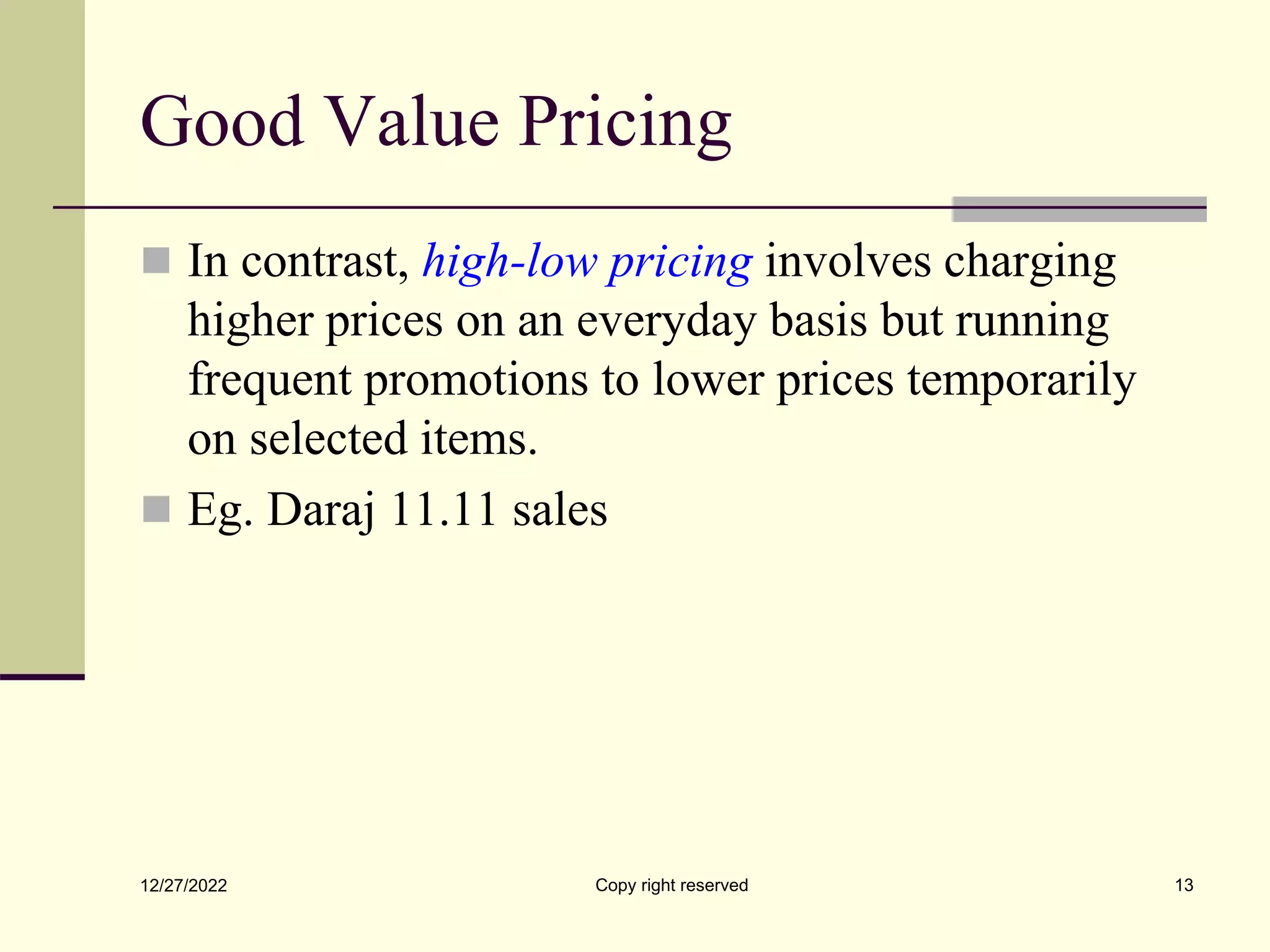
Good Value Pricing
 In contrast, high-low pricing involves charging
higher prices on an everyday basis but running
frequent promotions to lower prices temporarily
on selected items.
 Eg. Daraj 11.11 sales
12/27/2022 Copy right reserved 13
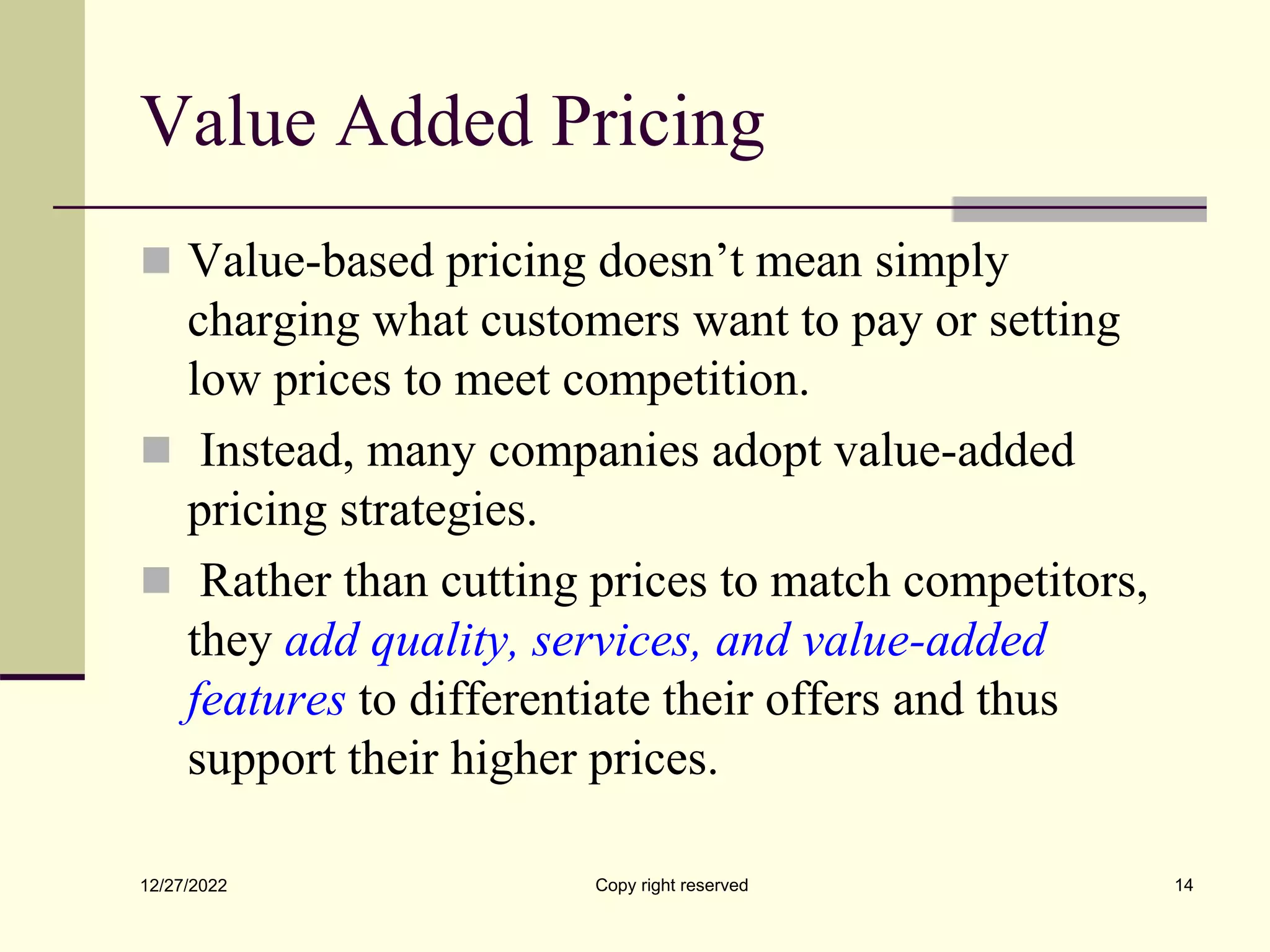
Value Added Pricing
 Value-based pricing doesn’t mean simply
charging what customers want to pay or setting
low prices to meet competition.
 Instead, many companies adopt value-added
pricing strategies.
 Rather than cutting prices to match competitors,
they add quality, services, and value-added
features to differentiate their offers and thus
support their higher prices.
12/27/2022 Copy right reserved 14
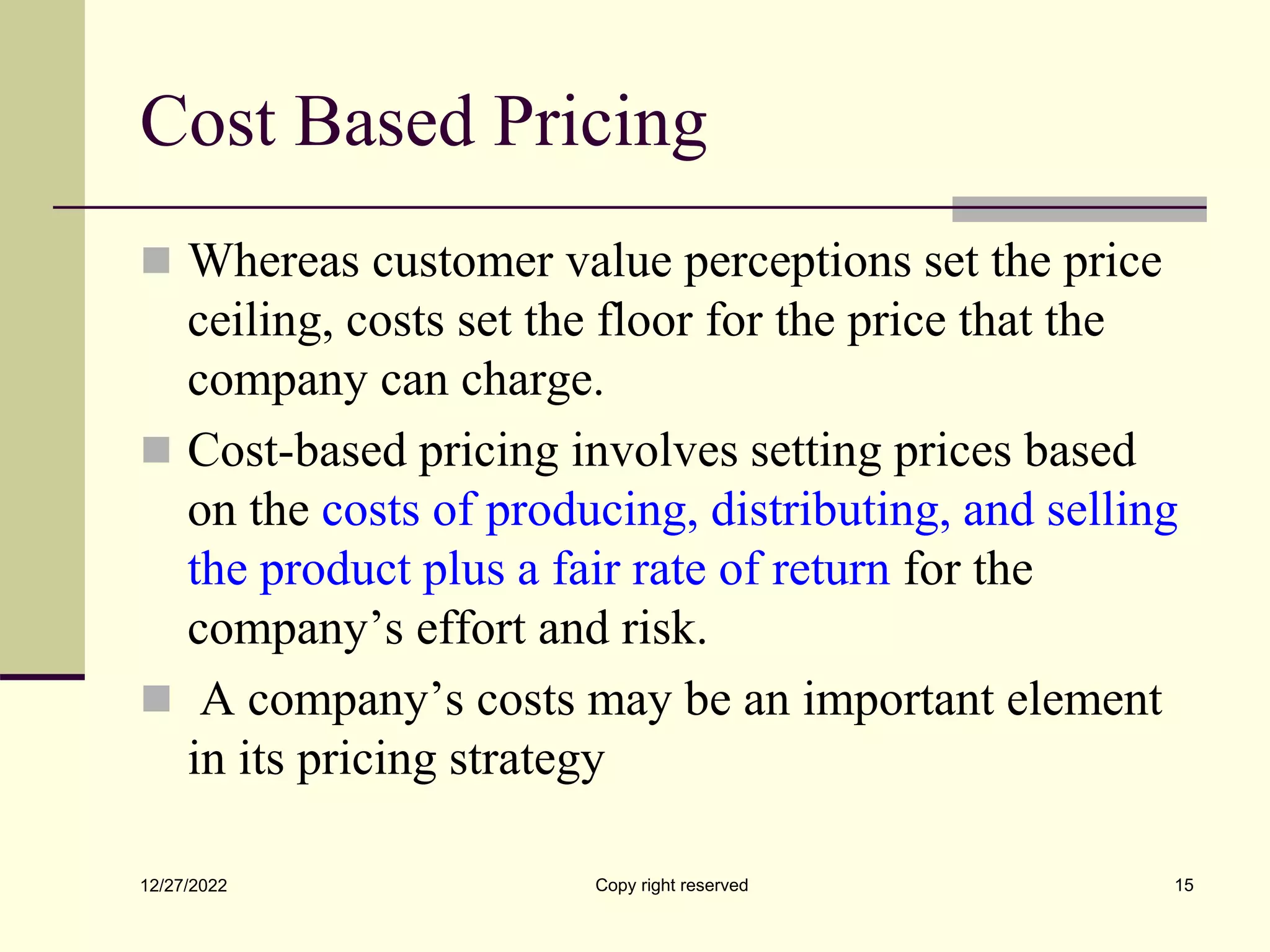
Cost Based Pricing
 Whereas customer value perceptions set the price
ceiling, costs set the floor for the price that the
company can charge.
 Cost-based pricing involves setting prices based
on the costs of producing, distributing, and selling
the product plus a fair rate of return for the
company’s effort and risk.
 A company’s costs may be an important element
in its pricing strategy
12/27/2022 Copy right reserved 15
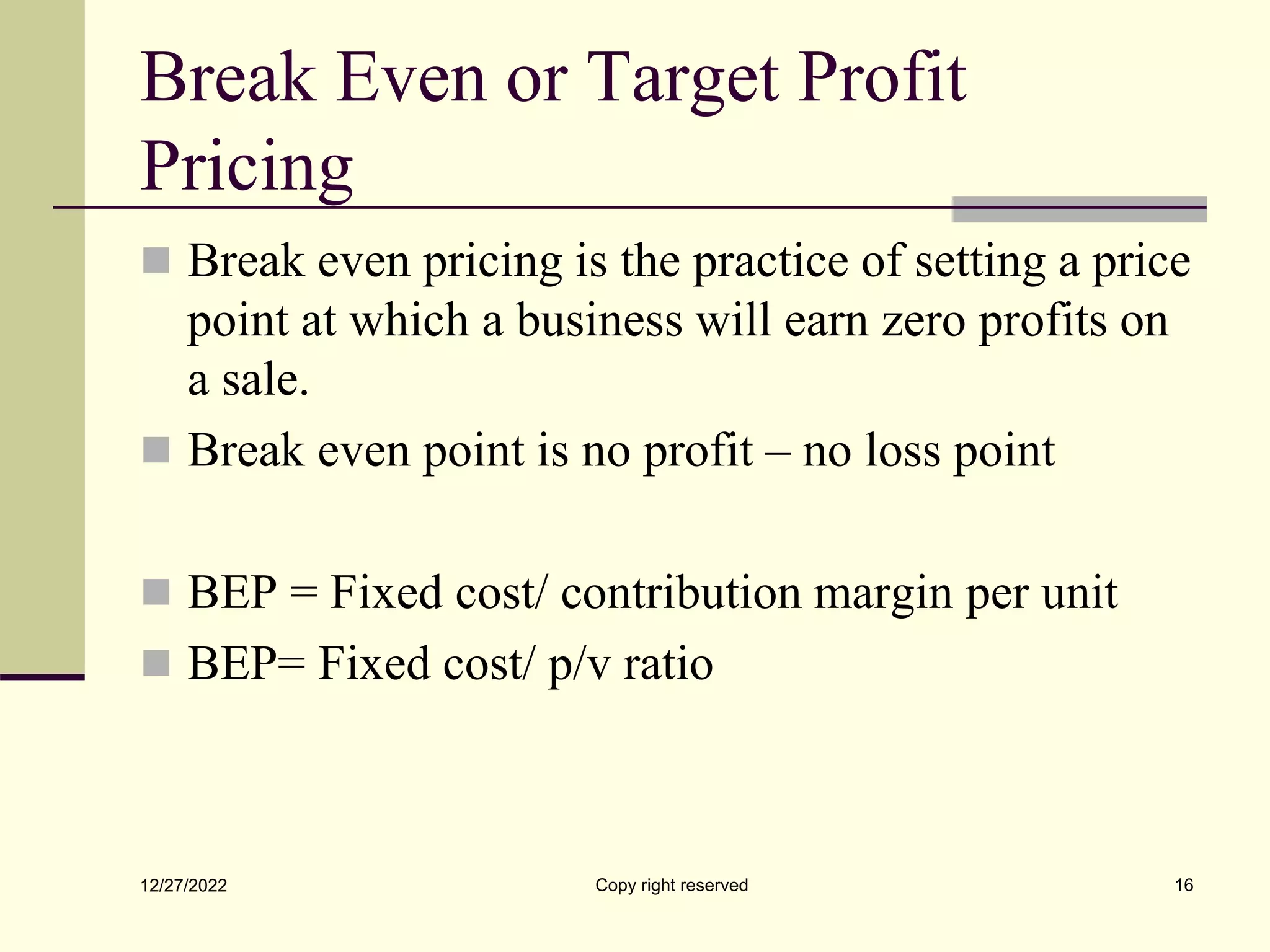
Break Even or Target Profit
Pricing
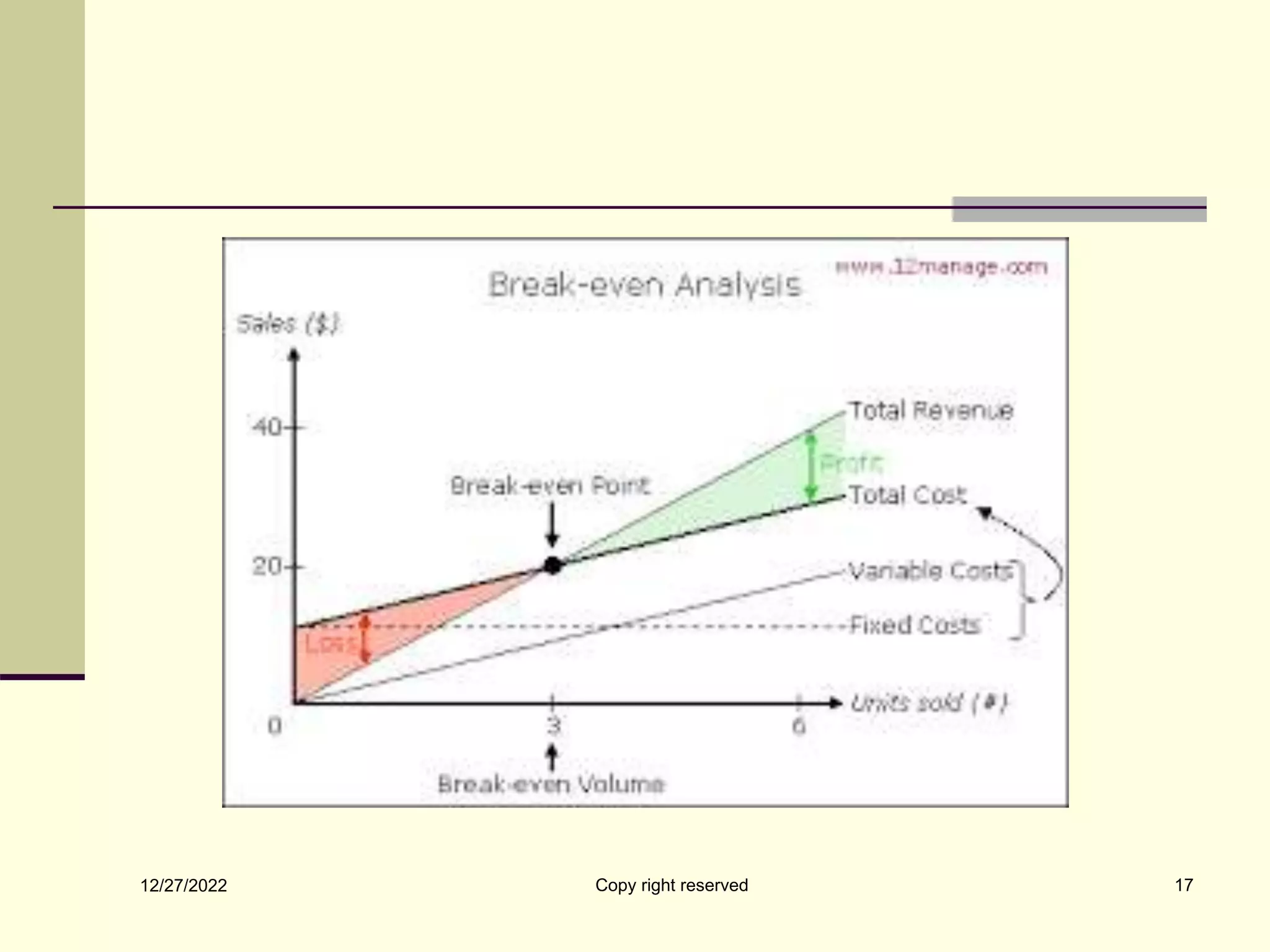
 Break even pricing is the practice of setting a price
point at which a business will earn zero profits on
a sale.
 Break even point is no profit – no loss point
 BEP = Fixed cost/ contribution margin per unit
 BEP= Fixed cost/ p/v ratio
12/27/2022 Copy right reserved 16
12/27/2022 Copy right reserved 17
Cost Based Pricing
 Cost-Plus Pricing (Mark up pricing)
 Break even or target profit pricing
12/27/2022 Copy right reserved 18
Cost-Plus Pricing (Markup
Pricing)
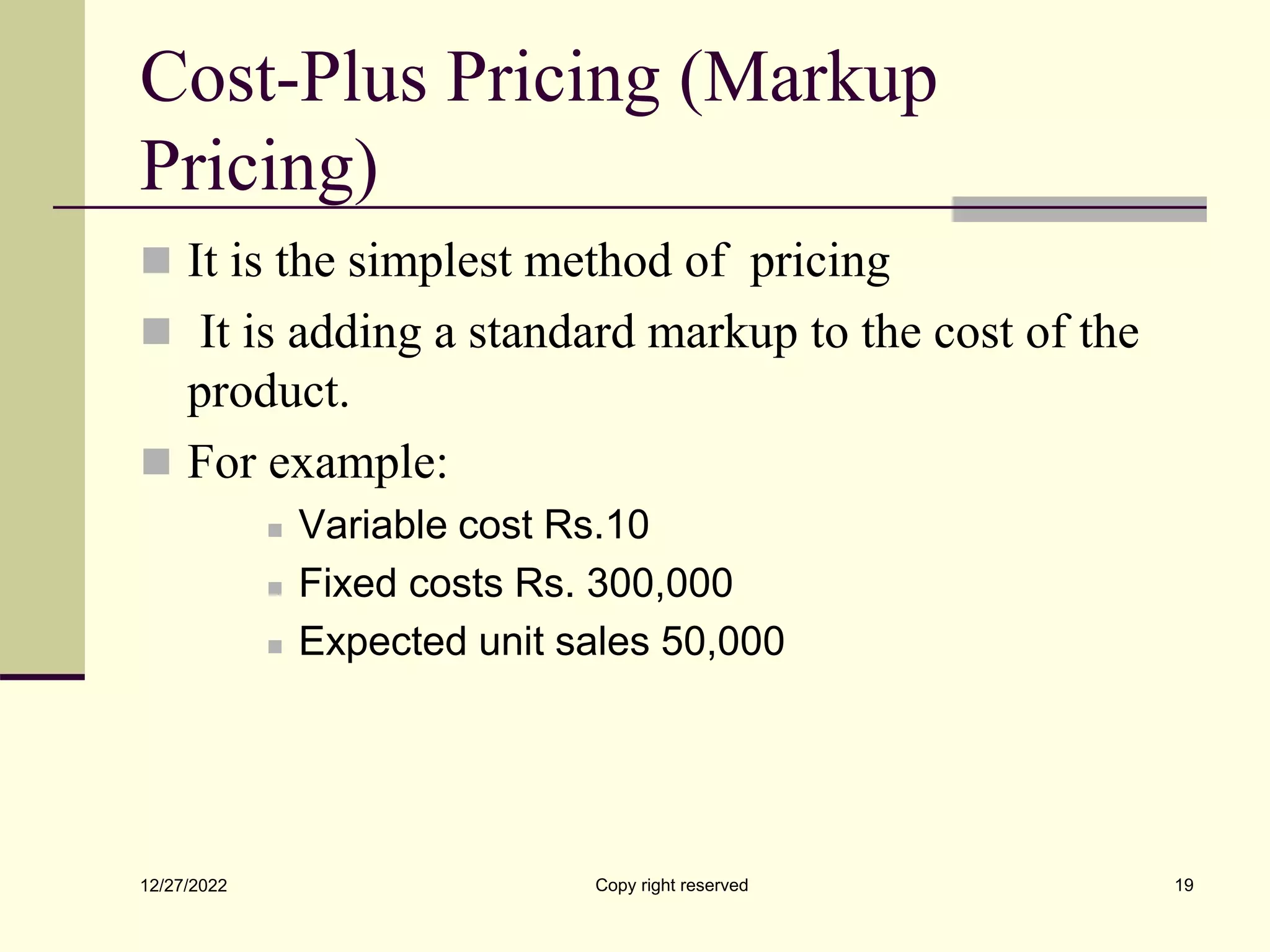
 It is the simplest method of pricing
 It is adding a standard markup to the cost of the
product.
 For example:
 Variable cost Rs.10
 Fixed costs Rs. 300,000
 Expected unit sales 50,000
12/27/2022 Copy right reserved 19
Cost-Plus Pricing (Markup
Pricing)
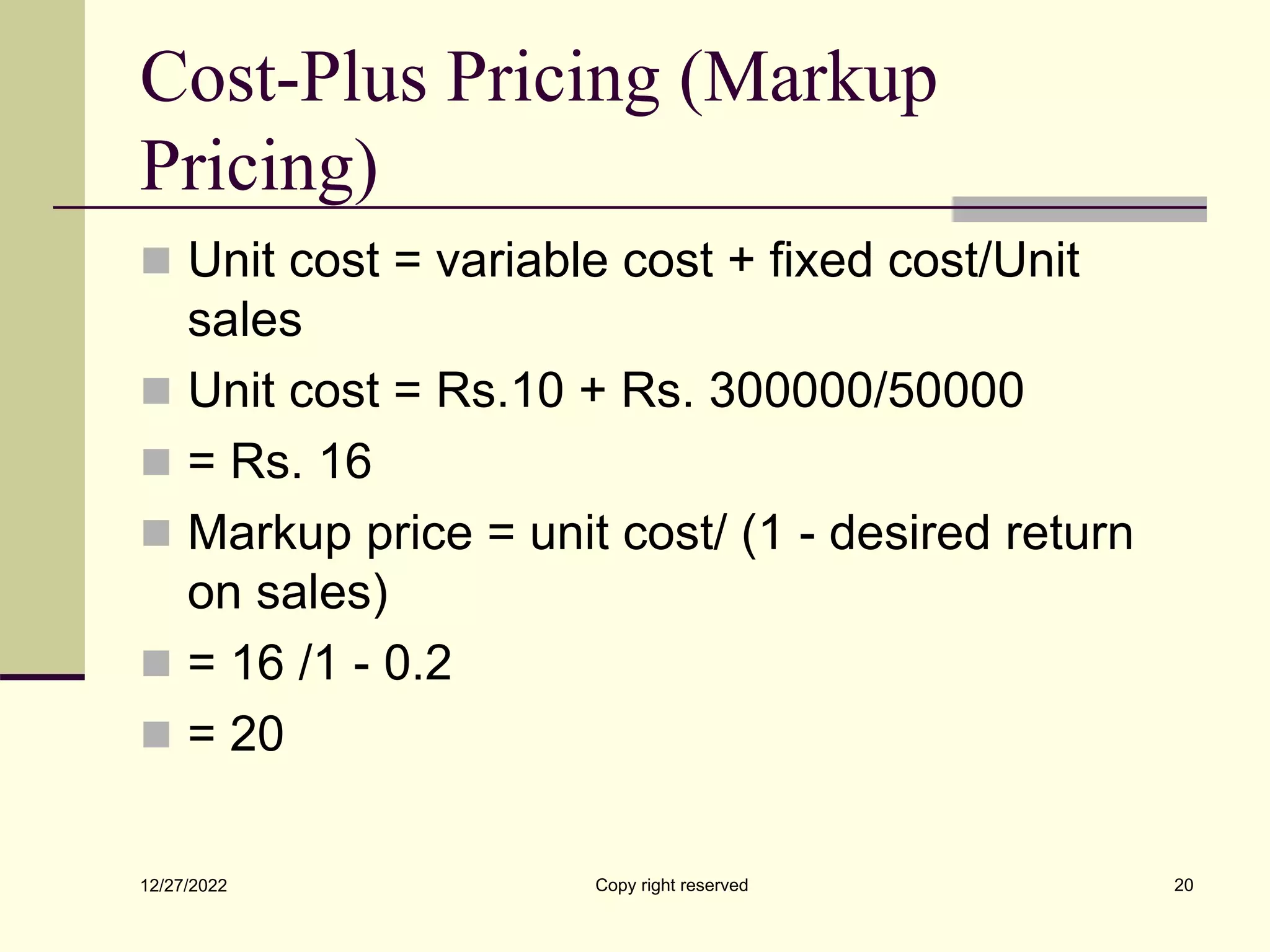
 Unit cost = variable cost + fixed cost/Unit
sales
 Unit cost = Rs.10 + Rs. 300000/50000
 = Rs. 16
 Markup price = unit cost/ (1 - desired return
on sales)
 = 16 /1 - 0.2
 = 20
12/27/2022 Copy right reserved 20
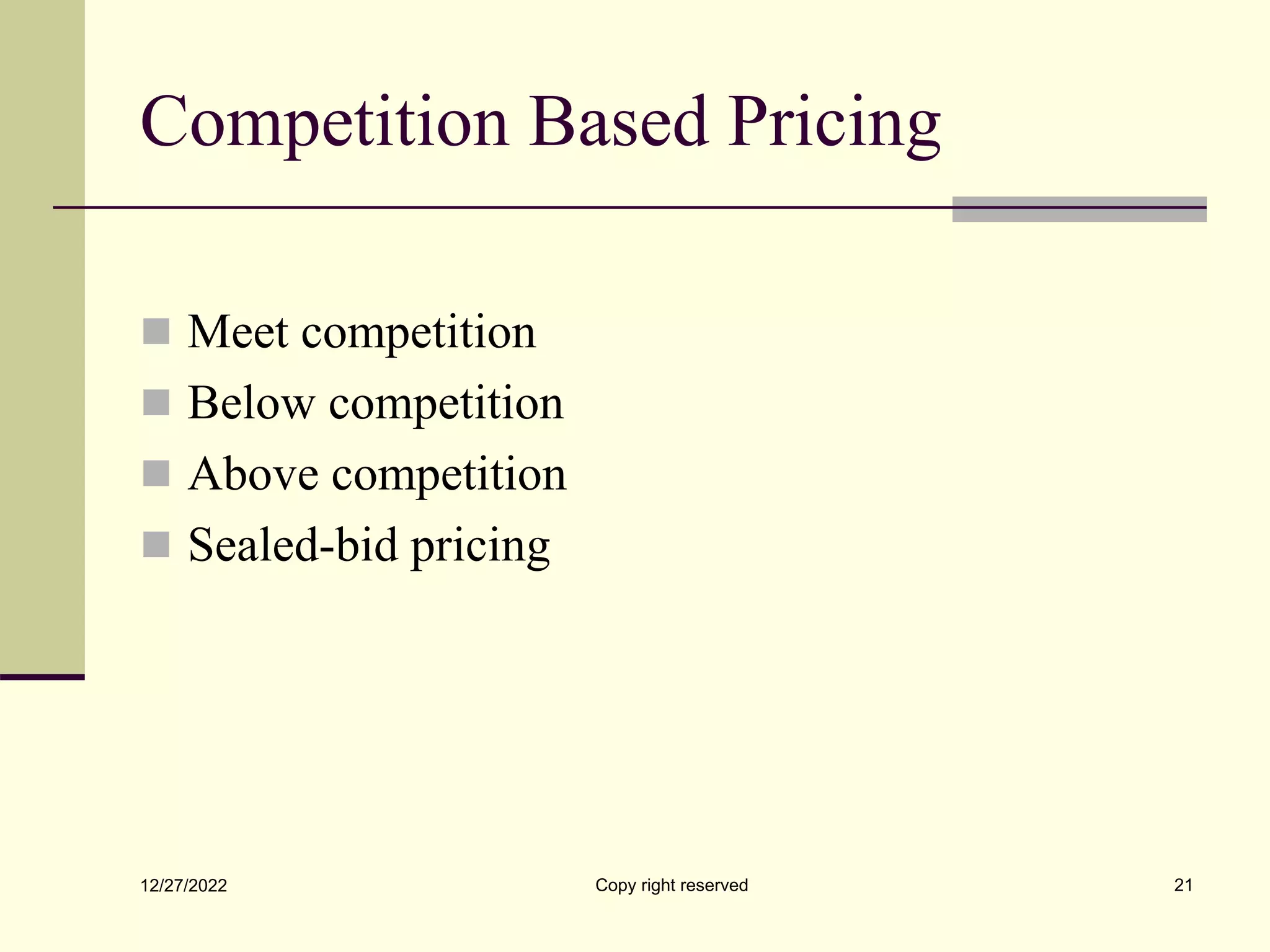
Competition Based Pricing
 Meet competition
 Below competition
 Above competition
 Sealed-bid pricing
12/27/2022 Copy right reserved 21
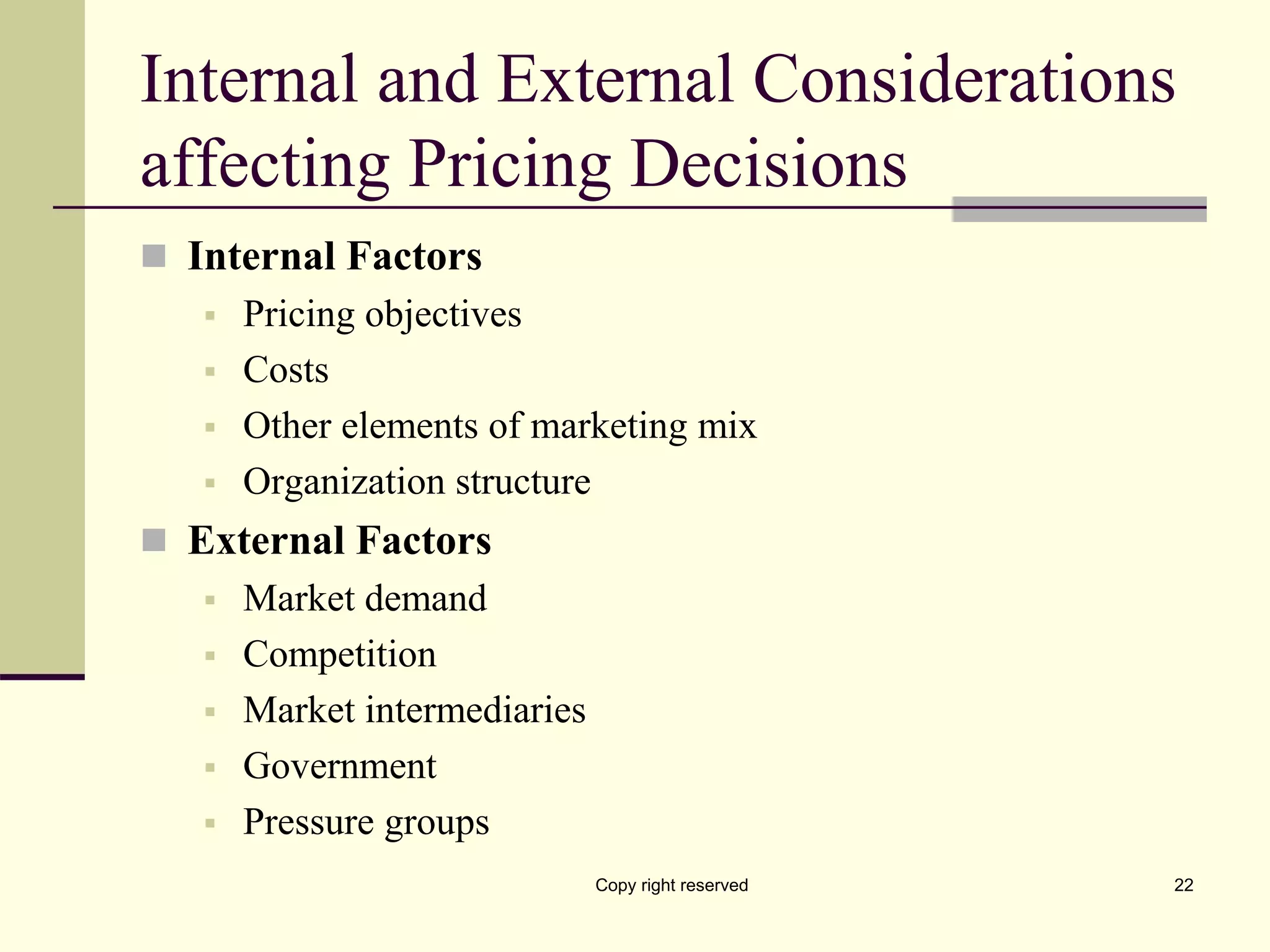
Internal and External Considerations
affecting Pricing Decisions
 Internal Factors
 Pricing objectives
 Costs
 Other elements of marketing mix
 Organization structure
 External Factors
 Market demand
 Competition
 Market intermediaries
 Government
 Pressure groups
Copy right reserved 22

Pricing for BBS third year

  • 1.
  • 2.
    Price  Price isthe amount of money charged for a product or a service.  Price is the money paid for the value of a product 12/27/2022 Copy right reserved 2
  • 3.
    Price  Interest  Rent Salary  Wages  Tax  Fare  Commission  Premium  Fee etc 12/27/2022 Copy right reserved 3
  • 4.
    Price  Price isthe sum of all the values that customers give up to gain the benefits of having or using a product or service  Philip Kotler  Price is the amount of money and or other items with utility needed to acquire a product.  Stanton 12/27/2022 Copy right reserved 4
  • 5.
    Price  Price isthe only element in the marketing mix that produces revenue  All other elements represent costs.  Price is also one of the most flexible marketing mix elements.  Price has been the major factor affecting buyer choice  Price determine a firm’s market share and profitability 12/27/2022 Copy right reserved 5
  • 6.
    Price  Price playsa key role in creating customer value and building customer relationships  Smart managers treat pricing as a key strategic tool for creating and capturing customer value  A small percentage improvement in price can generate a large percentage increase in profitability 12/27/2022 Copy right reserved 6
  • 7.
    Major Pricing Strategies Customer value based pricing  Good value pricing  Value added pricing  Other pricing strategies  Cost based pricing  Competition based Pricing 12/27/2022 Copy right reserved 7
  • 8.
    Customer Value BasedPricing  Customer value–based pricing uses buyers’ perceptions of value as the key to pricing.  Value-based pricing means that the marketer cannot design a product and marketing program and then set the price.  Price is considered along with all other marketing mix variables before the marketing program is set. 12/27/2022 Copy right reserved 8
  • 9.
    Customer Value BasedPricing  Assess customer needs and value perceptions  Set target price to match customer perceived value  Determine costs that can be incurred  Design product to deliver desired value at target price 12/27/2022 Copy right reserved 9
  • 10.
    Customer Value BasedPricing  Good-value pricing  Value added pricing 12/27/2022 Copy right reserved 10
  • 11.
    Good Value Pricing The Great Recession of 2008 to 2009 caused a fundamental and lasting shift in consumer attitudes toward price and quality.  In response, many companies have changed their pricing approaches to bring them in line with changing economic conditions and consumer price perceptions.  More and more, marketers have adopted the strategy of good-value pricing—offering the right combination of quality and good service at a fair price. 12/27/2022 Copy right reserved 11
  • 12.
    Good Value Pricing In many cases, this has involved introducing less- expensive versions of established brand name products or new lower-price lines.  An important type of good-value pricing at the retail level is called everyday low pricing (EDLP).  EDLP involves charging a constant, everyday low price with few or no temporary price discounts. 12/27/2022 Copy right reserved 12
  • 13.
    Good Value Pricing In contrast, high-low pricing involves charging higher prices on an everyday basis but running frequent promotions to lower prices temporarily on selected items.  Eg. Daraj 11.11 sales 12/27/2022 Copy right reserved 13
  • 14.
    Value Added Pricing Value-based pricing doesn’t mean simply charging what customers want to pay or setting low prices to meet competition.  Instead, many companies adopt value-added pricing strategies.  Rather than cutting prices to match competitors, they add quality, services, and value-added features to differentiate their offers and thus support their higher prices. 12/27/2022 Copy right reserved 14
  • 15.
    Cost Based Pricing Whereas customer value perceptions set the price ceiling, costs set the floor for the price that the company can charge.  Cost-based pricing involves setting prices based on the costs of producing, distributing, and selling the product plus a fair rate of return for the company’s effort and risk.  A company’s costs may be an important element in its pricing strategy 12/27/2022 Copy right reserved 15
  • 16.
    Break Even orTarget Profit Pricing  Break even pricing is the practice of setting a price point at which a business will earn zero profits on a sale.  Break even point is no profit – no loss point  BEP = Fixed cost/ contribution margin per unit  BEP= Fixed cost/ p/v ratio 12/27/2022 Copy right reserved 16
  • 17.
  • 18.
    Cost Based Pricing Cost-Plus Pricing (Mark up pricing)  Break even or target profit pricing 12/27/2022 Copy right reserved 18
  • 19.
    Cost-Plus Pricing (Markup Pricing) It is the simplest method of pricing  It is adding a standard markup to the cost of the product.  For example:  Variable cost Rs.10  Fixed costs Rs. 300,000  Expected unit sales 50,000 12/27/2022 Copy right reserved 19
  • 20.
    Cost-Plus Pricing (Markup Pricing) Unit cost = variable cost + fixed cost/Unit sales  Unit cost = Rs.10 + Rs. 300000/50000  = Rs. 16  Markup price = unit cost/ (1 - desired return on sales)  = 16 /1 - 0.2  = 20 12/27/2022 Copy right reserved 20
  • 21.
    Competition Based Pricing Meet competition  Below competition  Above competition  Sealed-bid pricing 12/27/2022 Copy right reserved 21
  • 22.
    Internal and ExternalConsiderations affecting Pricing Decisions  Internal Factors  Pricing objectives  Costs  Other elements of marketing mix  Organization structure  External Factors  Market demand  Competition  Market intermediaries  Government  Pressure groups Copy right reserved 22