Preventing loss of
personal data on a
Mobile Network
23.09.2017 / Oleksii Lukin / Head Of
Information Security SubDepartment
Public
β€’ Lukin Oleksii
– Head od Information Security SubDepartment
β€’ Scope
– Presentation focused on technical attacks on a Mobile network and its supporting
infrastructure
– Does not looking specifically are employee internal risks or social engineering attacks both of
which constitute significant risks for any organisation
Introduction
2
1. Definition of personal data in a mobile network
2. Mobile Network attacks & controls
3. BSS & Corporate Network attacks & controls
4. Key Message
Agenda
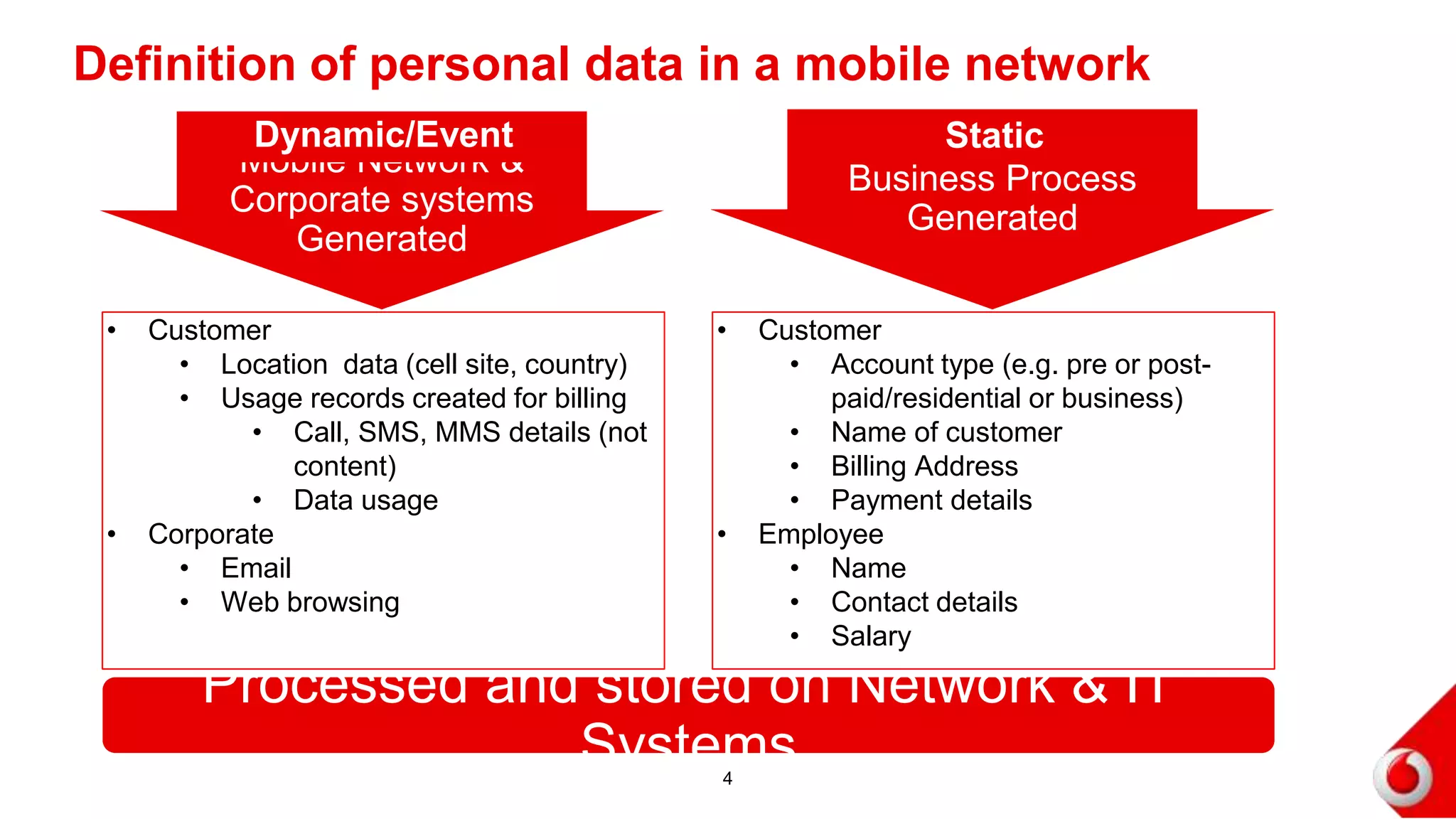
Definition of personal data in a mobile network
4
Mobile Network & Corporate
systems Generated
Business Process
Generated
Processed and stored on Network & IT Systems
β€’ Customer
β€’ Location data (cell site, country)
β€’ Usage records created for billing
β€’ Call, SMS, MMS details (not
content)
β€’ Data usage
β€’ Corporate
β€’ Email
β€’ Web browsing
β€’ Customer
β€’ Account type (e.g. pre or post-
paid/residential or business)
β€’ Name of customer
β€’ Billing Address
β€’ Payment details
β€’ Employee
β€’ Name
β€’ Contact details
β€’ Salary
Dynamic/Event Static
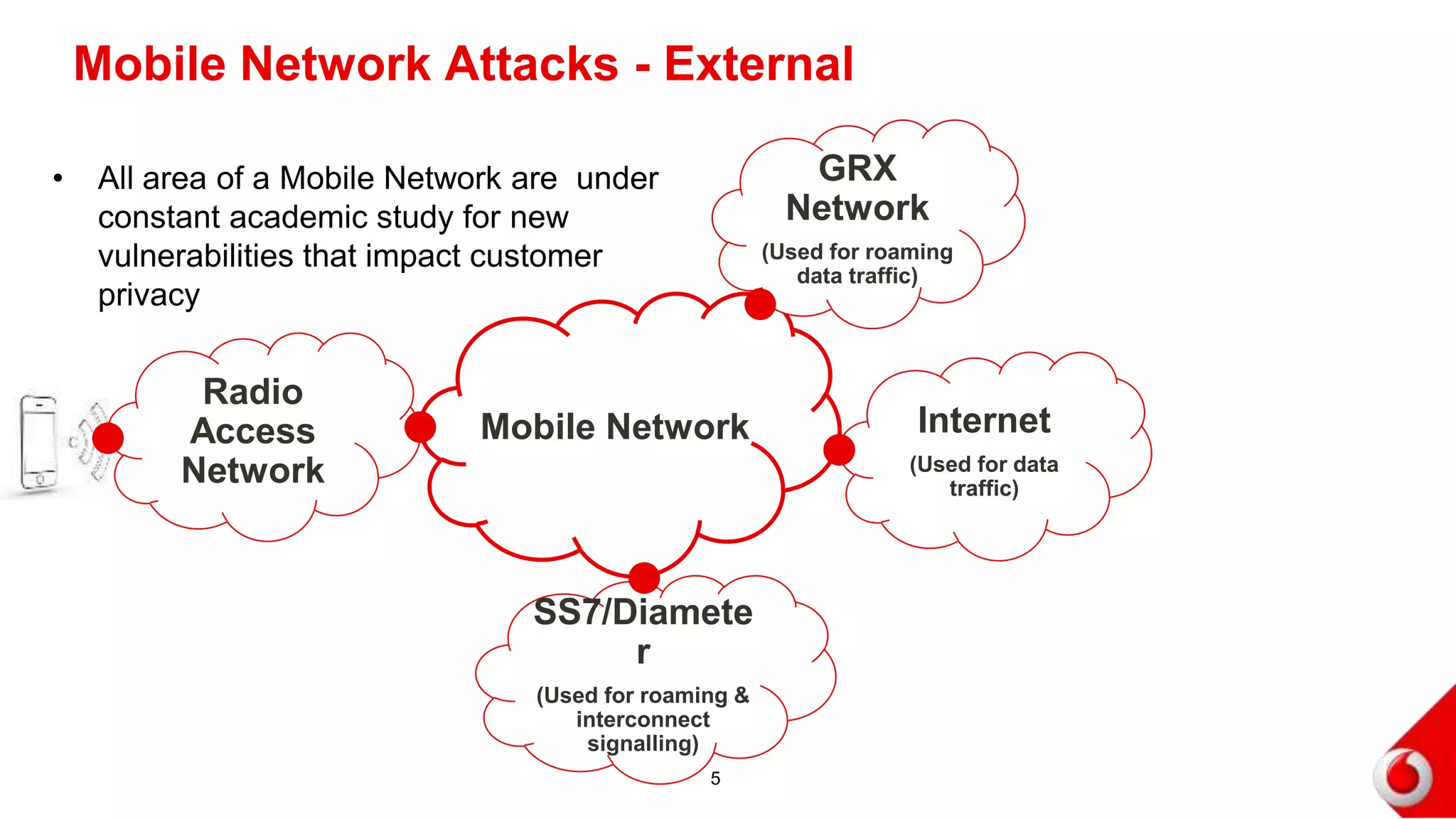
Mobile Network Attacks - External
5
Mobile Network
GRX
Network
(Used for roaming
data traffic)
Internet
(Used for data
traffic)
SS7/Diameter
(Used for roaming &
interconnect
signalling)
Radio
Access
Network
β€’ All area of a Mobile Network are under
constant academic study for new
vulnerabilities that impact customer
privacy
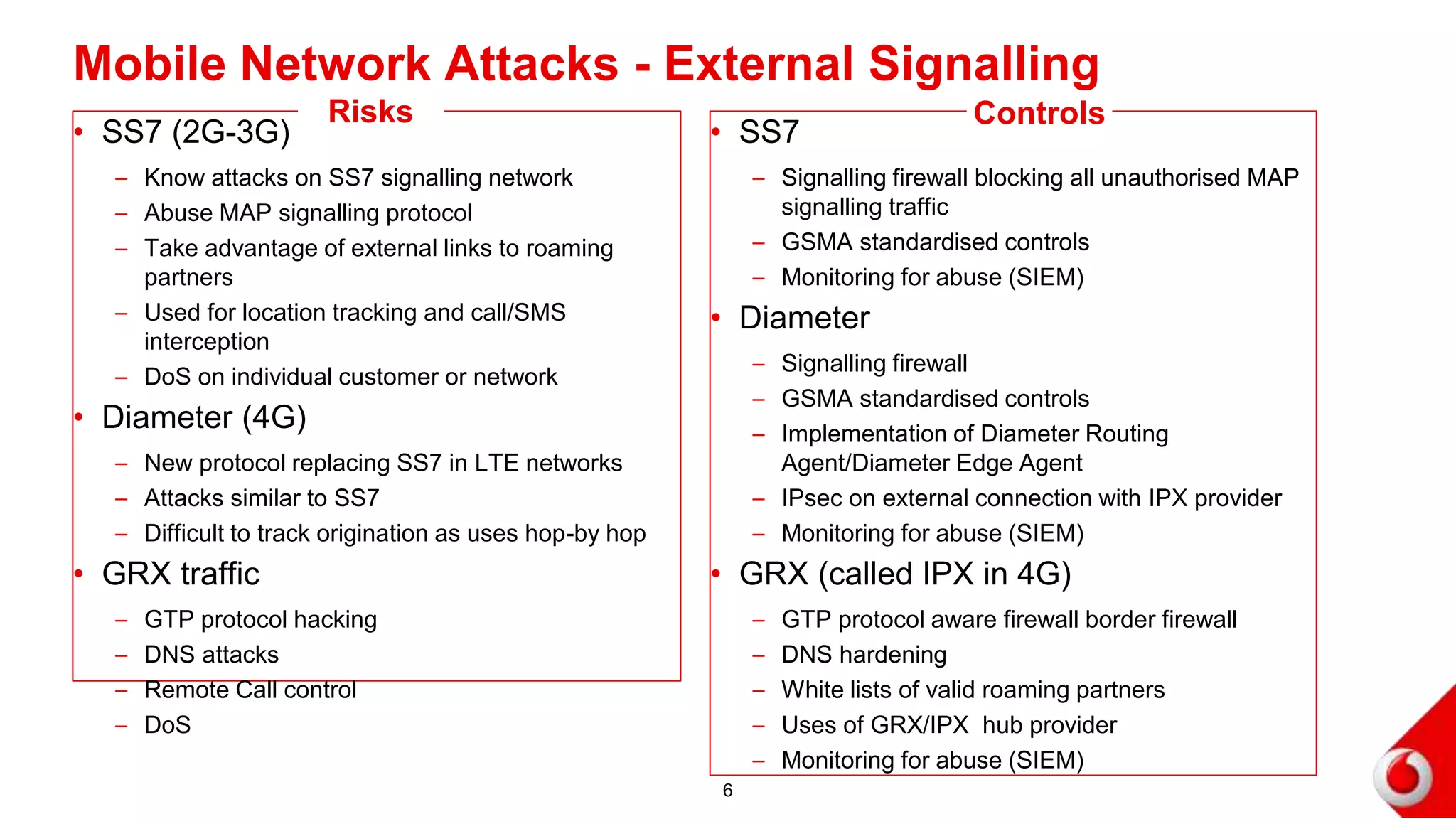
Mobile Network Attacks - External Signalling
β€’ SS7 (2G-3G)
– Know attacks on SS7 signalling network
– Abuse MAP signalling protocol
– Take advantage of external links to roaming
partners
– Used for location tracking and call/SMS
interception
– DoS on individual customer or network
β€’ Diameter (4G)
– New protocol replacing SS7 in LTE networks
– Attacks similar to SS7
– Difficult to track origination as uses hop-by hop
β€’ GRX traffic
– GTP protocol hacking
– DNS attacks
– Remote Call control
– DoS
β€’ SS7
– Signalling firewall blocking all unauthorised MAP
signalling traffic
– GSMA standardised controls
– Monitoring for abuse (SIEM)
β€’ Diameter
– Signalling firewall
– GSMA standardised controls
– Implementation of Diameter Routing
Agent/Diameter Edge Agent
– IPsec on external connection with IPX provider
– Monitoring for abuse (SIEM)
β€’ GRX (called IPX in 4G)
– GTP protocol aware firewall border firewall
– DNS hardening
– White lists of valid roaming partners
– Uses of GRX/IPX hub provider
– Monitoring for abuse (SIEM)
6
Risks Controls
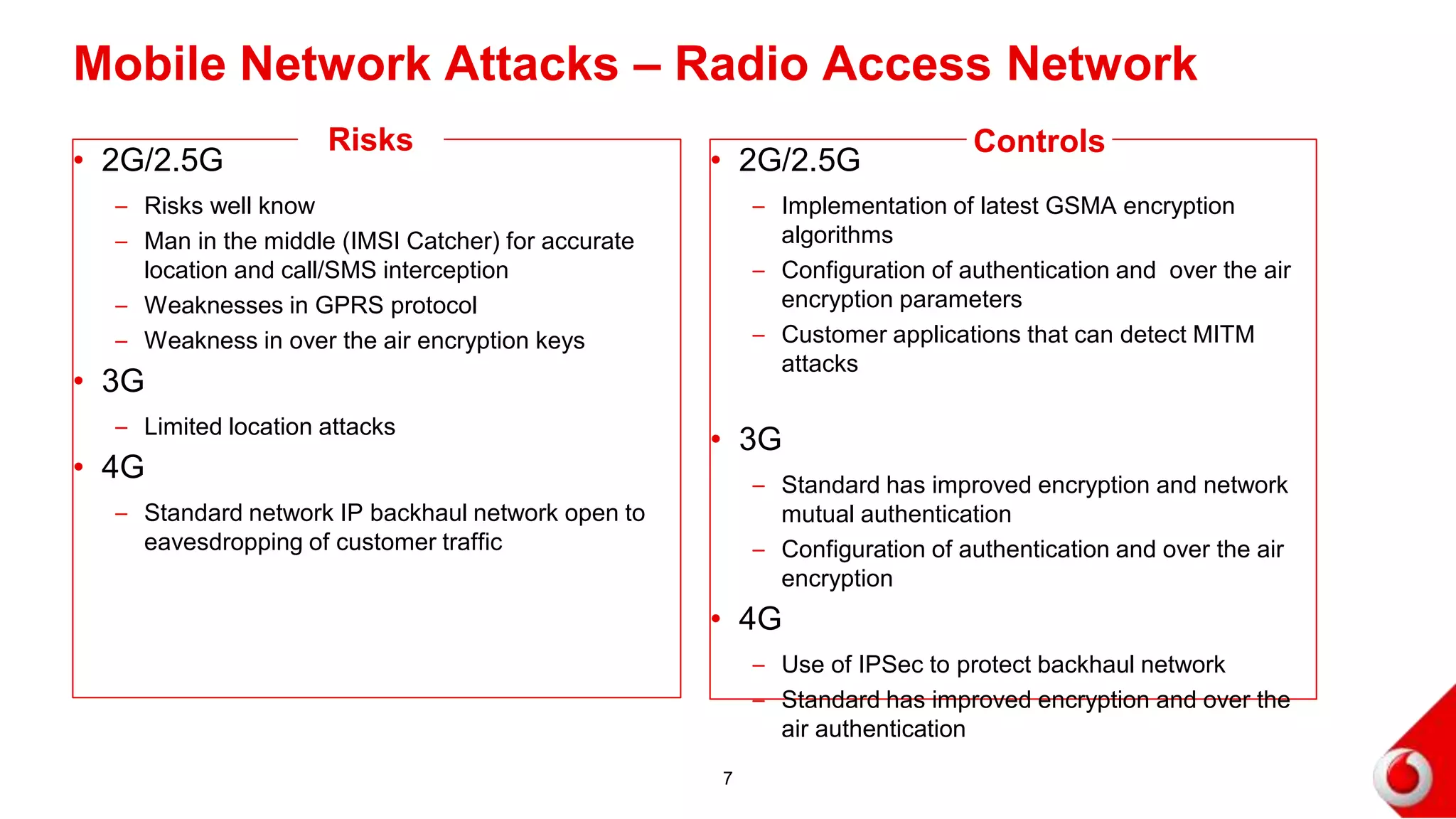
Mobile Network Attacks – Radio Access Network
β€’ 2G/2.5G
– Risks well know
– Man in the middle (IMSI Catcher) for accurate
location and call/SMS interception
– Weaknesses in GPRS protocol
– Weakness in over the air encryption keys
β€’ 3G
– Limited location attacks
β€’ 4G
– Standard network IP backhaul network open to
eavesdropping of customer traffic
β€’ 2G/2.5G
– Implementation of latest GSMA encryption
algorithms
– Configuration of authentication and over the air
encryption parameters
– Customer applications that can detect MITM
attacks
β€’ 3G
– Standard has improved encryption and network
mutual authentication
– Configuration of authentication and over the air
encryption
β€’ 4G
– Use of IPSec to protect backhaul network
– Standard has improved encryption and over the
air authentication
7
Risks Controls
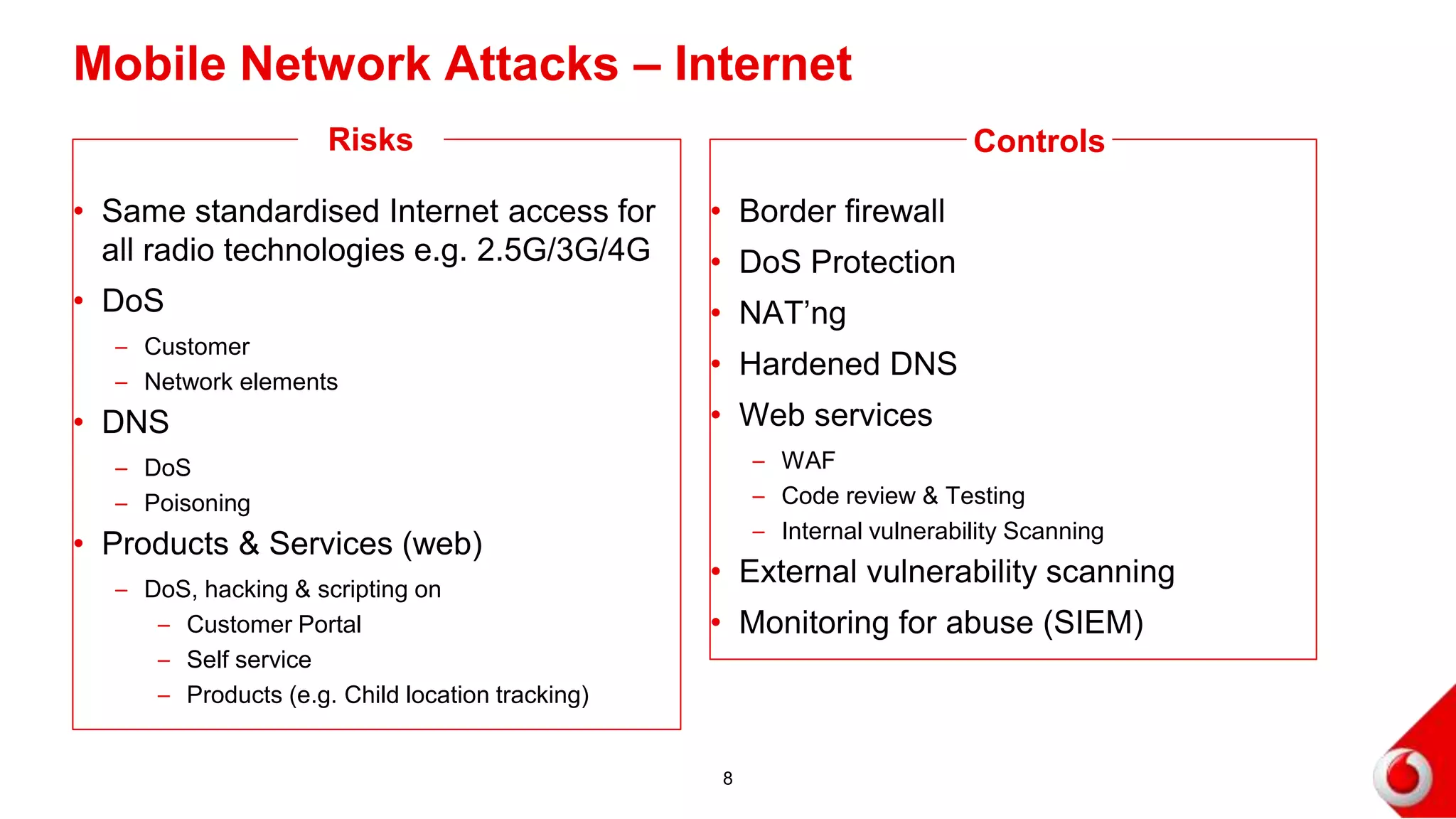
Mobile Network Attacks – Internet
β€’ Same standardised Internet access for
all radio technologies e.g. 2.5G/3G/4G
β€’ DoS
– Customer
– Network elements
β€’ DNS
– DoS
– Poisoning
β€’ Products & Services (web)
– DoS, hacking & scripting on
– Customer Portal
– Self service
– Products (e.g. Child location tracking)
β€’ Border firewall
β€’ DoS Protection
β€’ NAT’ng
β€’ Hardened DNS
β€’ Web services
– WAF
– Code review & Testing
– Internal vulnerability Scanning
β€’ External vulnerability scanning
β€’ Monitoring for abuse (SIEM)
8
Risks Controls
Mobile Network Attacks – Internal
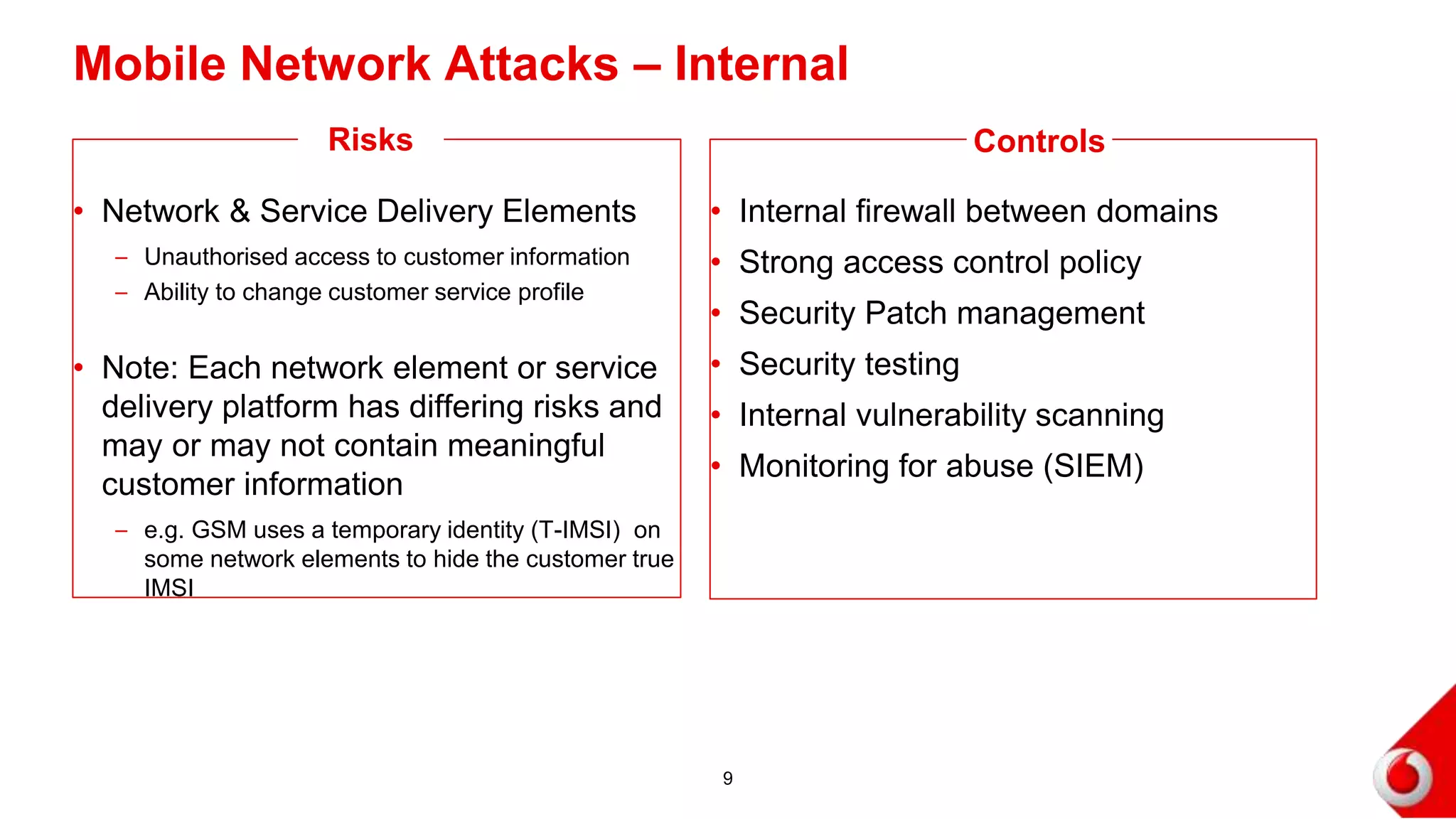
β€’ Network & Service Delivery Elements
– Unauthorised access to customer information
– Ability to change customer service profile
β€’ Note: Each network element or service
delivery platform has differing risks and
may or may not contain meaningful
customer information
– e.g. GSM uses a temporary identity (T-IMSI) on
some network elements to hide the customer true
IMSI
β€’ Internal firewall between domains
β€’ Strong access control policy
β€’ Security Patch management
β€’ Security testing
β€’ Internal vulnerability scanning
β€’ Monitoring for abuse (SIEM)
9
Risks Controls
Remote
Vendor
Support
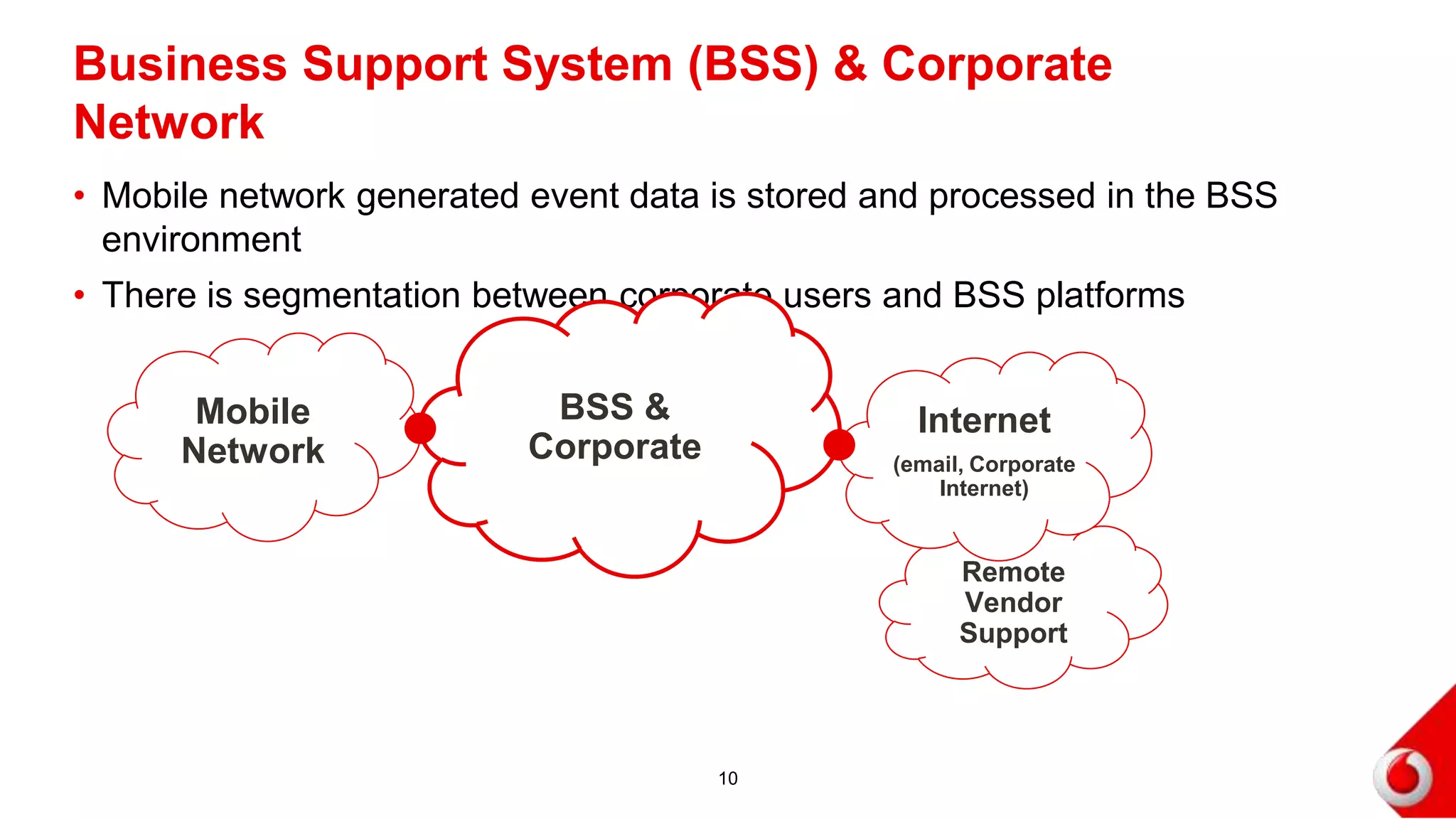
β€’ Mobile network generated event data is stored and processed in the BSS
environment
β€’ There is segmentation between corporate users and BSS platforms
Business Support System (BSS) & Corporate
Network
10
BSS &
Corporate
Internet
(email, Corporate
Internet)
Mobile
Network
BSS & Corporate Network Attacks – External
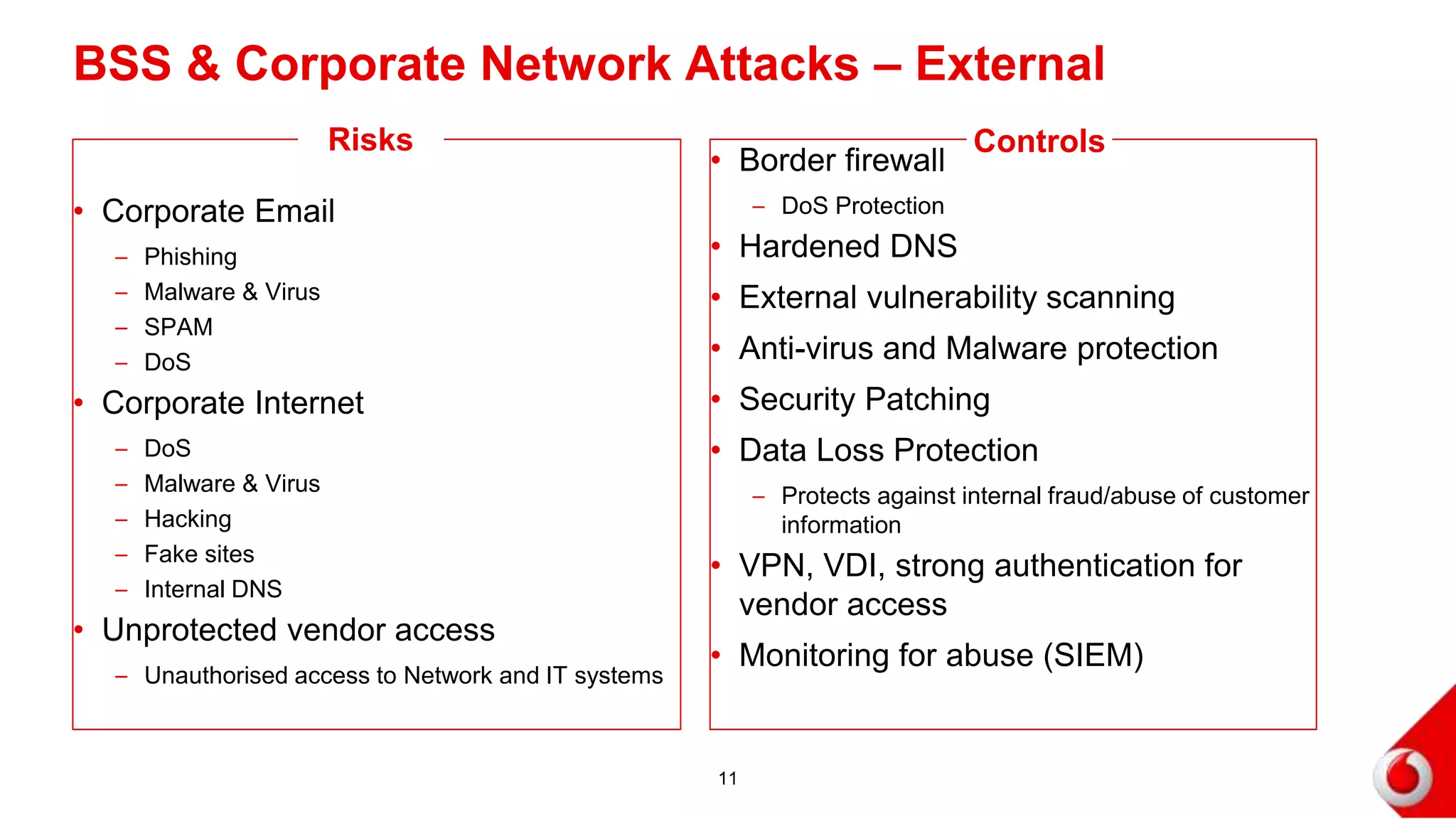
β€’ Corporate Email
– Phishing
– Malware & Virus
– SPAM
– DoS
β€’ Corporate Internet
– DoS
– Malware & Virus
– Hacking
– Fake sites
– Internal DNS
β€’ Unprotected vendor access
– Unauthorised access to Network and IT systems
β€’ Border firewall
– DoS Protection
β€’ Hardened DNS
β€’ External vulnerability scanning
β€’ Anti-virus and Malware protection
β€’ Security Patching
β€’ Data Loss Protection
– Protects against internal fraud/abuse of customer
information
β€’ VPN, VDI, strong authentication for
vendor access
β€’ Monitoring for abuse (SIEM)
11
Risks Controls
BSS & Corporate Network Attacks - Internal
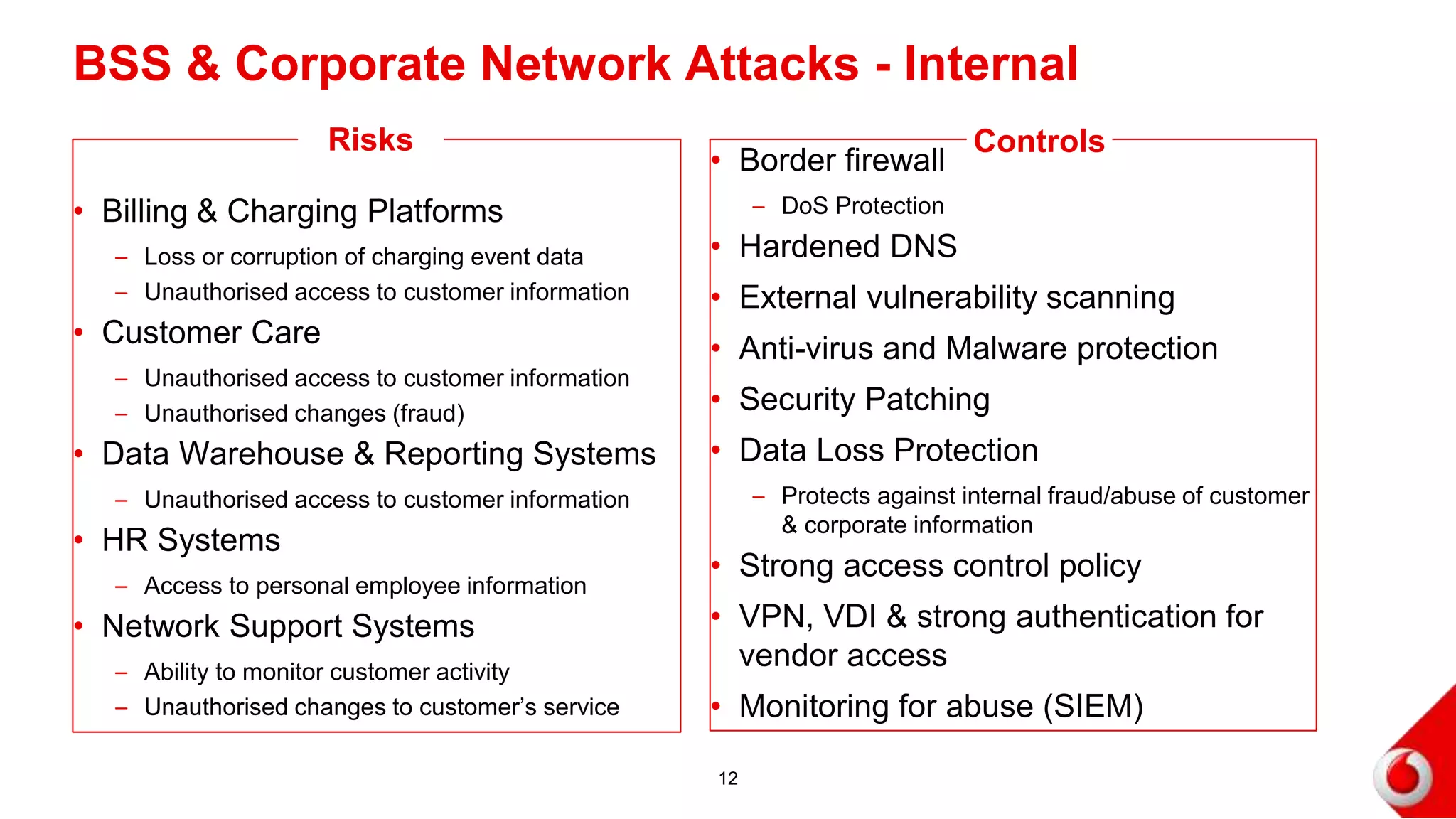
β€’ Billing & Charging Platforms
– Loss or corruption of charging event data
– Unauthorised access to customer information
β€’ Customer Care
– Unauthorised access to customer information
– Unauthorised changes (fraud)
β€’ Data Warehouse & Reporting Systems
– Unauthorised access to customer information
β€’ HR Systems
– Access to personal employee information
β€’ Network Support Systems
– Ability to monitor customer activity
– Unauthorised changes to customer’s service
β€’ Border firewall
– DoS Protection
β€’ Hardened DNS
β€’ External vulnerability scanning
β€’ Anti-virus and Malware protection
β€’ Security Patching
β€’ Data Loss Protection
– Protects against internal fraud/abuse of customer
& corporate information
β€’ Strong access control policy
β€’ VPN, VDI & strong authentication for
vendor access
β€’ Monitoring for abuse (SIEM)
12
Risks Controls
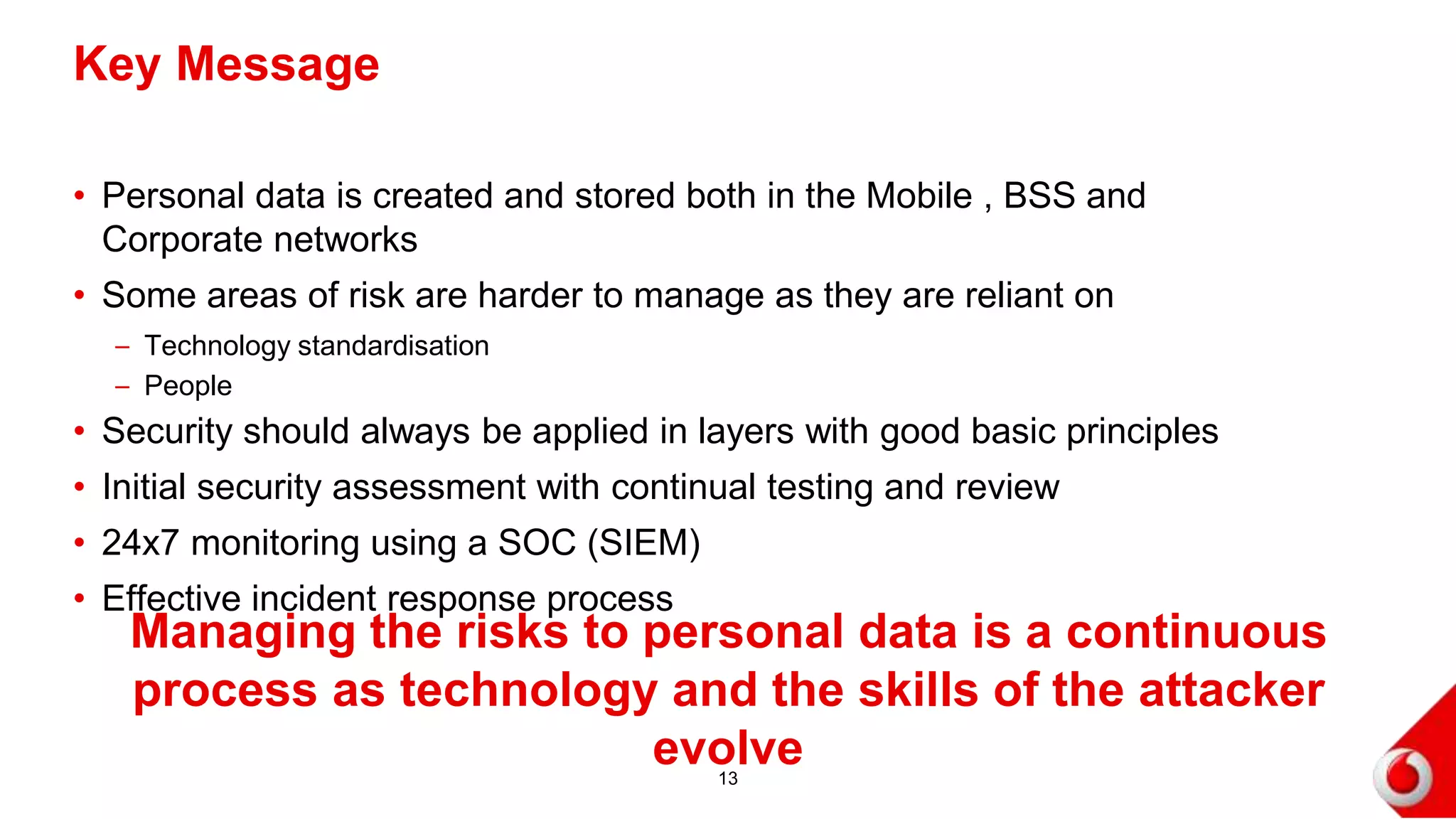
β€’ Personal data is created and stored both in the Mobile , BSS and
Corporate networks
β€’ Some areas of risk are harder to manage as they are reliant on
– Technology standardisation
– People
β€’ Security should always be applied in layers with good basic principles
β€’ Initial security assessment with continual testing and review
β€’ 24x7 monitoring using a SOC (SIEM)
β€’ Effective incident response process
Key Message
13
Managing the risks to personal data is a continuous process as
technology and the skills of the attacker evolve

"Preventing Loss of Personal Data on a Mobile Network", Oleksii Lukin

  • 1.
    Preventing loss of personaldata on a Mobile Network 23.09.2017 / Oleksii Lukin / Head Of Information Security SubDepartment Public
  • 2.
    β€’ Lukin Oleksii –Head od Information Security SubDepartment β€’ Scope – Presentation focused on technical attacks on a Mobile network and its supporting infrastructure – Does not looking specifically are employee internal risks or social engineering attacks both of which constitute significant risks for any organisation Introduction 2
  • 3.
    1. Definition ofpersonal data in a mobile network 2. Mobile Network attacks & controls 3. BSS & Corporate Network attacks & controls 4. Key Message Agenda
  • 4.
    Definition of personaldata in a mobile network 4 Mobile Network & Corporate systems Generated Business Process Generated Processed and stored on Network & IT Systems β€’ Customer β€’ Location data (cell site, country) β€’ Usage records created for billing β€’ Call, SMS, MMS details (not content) β€’ Data usage β€’ Corporate β€’ Email β€’ Web browsing β€’ Customer β€’ Account type (e.g. pre or post- paid/residential or business) β€’ Name of customer β€’ Billing Address β€’ Payment details β€’ Employee β€’ Name β€’ Contact details β€’ Salary Dynamic/Event Static
  • 5.
    Mobile Network Attacks- External 5 Mobile Network GRX Network (Used for roaming data traffic) Internet (Used for data traffic) SS7/Diameter (Used for roaming & interconnect signalling) Radio Access Network β€’ All area of a Mobile Network are under constant academic study for new vulnerabilities that impact customer privacy
  • 6.
    Mobile Network Attacks- External Signalling β€’ SS7 (2G-3G) – Know attacks on SS7 signalling network – Abuse MAP signalling protocol – Take advantage of external links to roaming partners – Used for location tracking and call/SMS interception – DoS on individual customer or network β€’ Diameter (4G) – New protocol replacing SS7 in LTE networks – Attacks similar to SS7 – Difficult to track origination as uses hop-by hop β€’ GRX traffic – GTP protocol hacking – DNS attacks – Remote Call control – DoS β€’ SS7 – Signalling firewall blocking all unauthorised MAP signalling traffic – GSMA standardised controls – Monitoring for abuse (SIEM) β€’ Diameter – Signalling firewall – GSMA standardised controls – Implementation of Diameter Routing Agent/Diameter Edge Agent – IPsec on external connection with IPX provider – Monitoring for abuse (SIEM) β€’ GRX (called IPX in 4G) – GTP protocol aware firewall border firewall – DNS hardening – White lists of valid roaming partners – Uses of GRX/IPX hub provider – Monitoring for abuse (SIEM) 6 Risks Controls
  • 7.
    Mobile Network Attacks– Radio Access Network β€’ 2G/2.5G – Risks well know – Man in the middle (IMSI Catcher) for accurate location and call/SMS interception – Weaknesses in GPRS protocol – Weakness in over the air encryption keys β€’ 3G – Limited location attacks β€’ 4G – Standard network IP backhaul network open to eavesdropping of customer traffic β€’ 2G/2.5G – Implementation of latest GSMA encryption algorithms – Configuration of authentication and over the air encryption parameters – Customer applications that can detect MITM attacks β€’ 3G – Standard has improved encryption and network mutual authentication – Configuration of authentication and over the air encryption β€’ 4G – Use of IPSec to protect backhaul network – Standard has improved encryption and over the air authentication 7 Risks Controls
  • 8.
    Mobile Network Attacks– Internet β€’ Same standardised Internet access for all radio technologies e.g. 2.5G/3G/4G β€’ DoS – Customer – Network elements β€’ DNS – DoS – Poisoning β€’ Products & Services (web) – DoS, hacking & scripting on – Customer Portal – Self service – Products (e.g. Child location tracking) β€’ Border firewall β€’ DoS Protection β€’ NAT’ng β€’ Hardened DNS β€’ Web services – WAF – Code review & Testing – Internal vulnerability Scanning β€’ External vulnerability scanning β€’ Monitoring for abuse (SIEM) 8 Risks Controls
  • 9.
    Mobile Network Attacks– Internal β€’ Network & Service Delivery Elements – Unauthorised access to customer information – Ability to change customer service profile β€’ Note: Each network element or service delivery platform has differing risks and may or may not contain meaningful customer information – e.g. GSM uses a temporary identity (T-IMSI) on some network elements to hide the customer true IMSI β€’ Internal firewall between domains β€’ Strong access control policy β€’ Security Patch management β€’ Security testing β€’ Internal vulnerability scanning β€’ Monitoring for abuse (SIEM) 9 Risks Controls
  • 10.
    Remote Vendor Support β€’ Mobile networkgenerated event data is stored and processed in the BSS environment β€’ There is segmentation between corporate users and BSS platforms Business Support System (BSS) & Corporate Network 10 BSS & Corporate Internet (email, Corporate Internet) Mobile Network
  • 11.
    BSS & CorporateNetwork Attacks – External β€’ Corporate Email – Phishing – Malware & Virus – SPAM – DoS β€’ Corporate Internet – DoS – Malware & Virus – Hacking – Fake sites – Internal DNS β€’ Unprotected vendor access – Unauthorised access to Network and IT systems β€’ Border firewall – DoS Protection β€’ Hardened DNS β€’ External vulnerability scanning β€’ Anti-virus and Malware protection β€’ Security Patching β€’ Data Loss Protection – Protects against internal fraud/abuse of customer information β€’ VPN, VDI, strong authentication for vendor access β€’ Monitoring for abuse (SIEM) 11 Risks Controls
  • 12.
    BSS & CorporateNetwork Attacks - Internal β€’ Billing & Charging Platforms – Loss or corruption of charging event data – Unauthorised access to customer information β€’ Customer Care – Unauthorised access to customer information – Unauthorised changes (fraud) β€’ Data Warehouse & Reporting Systems – Unauthorised access to customer information β€’ HR Systems – Access to personal employee information β€’ Network Support Systems – Ability to monitor customer activity – Unauthorised changes to customer’s service β€’ Border firewall – DoS Protection β€’ Hardened DNS β€’ External vulnerability scanning β€’ Anti-virus and Malware protection β€’ Security Patching β€’ Data Loss Protection – Protects against internal fraud/abuse of customer & corporate information β€’ Strong access control policy β€’ VPN, VDI & strong authentication for vendor access β€’ Monitoring for abuse (SIEM) 12 Risks Controls
  • 13.
    β€’ Personal datais created and stored both in the Mobile , BSS and Corporate networks β€’ Some areas of risk are harder to manage as they are reliant on – Technology standardisation – People β€’ Security should always be applied in layers with good basic principles β€’ Initial security assessment with continual testing and review β€’ 24x7 monitoring using a SOC (SIEM) β€’ Effective incident response process Key Message 13 Managing the risks to personal data is a continuous process as technology and the skills of the attacker evolve