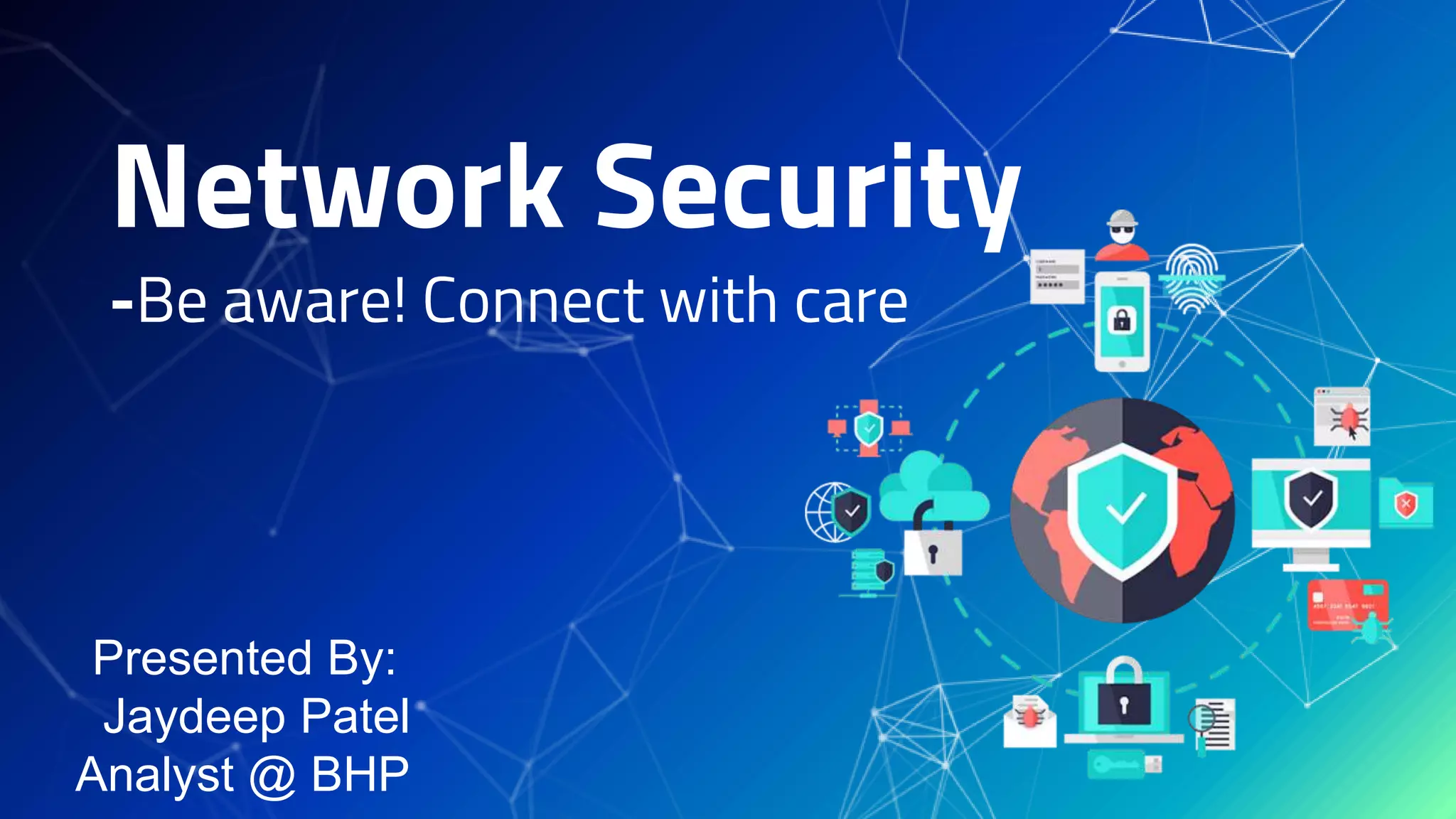
Network Security
-Be aware! Connect with care
Presented By:
Jaydeep Patel
Analyst @ BHP
Outline
▰ What is Security?
▰ Requirements of Network Security.
▰ Vulnerable to the Network
▰ Common Attacks and Threats
▰ Countermeasures
2
What is Security ?
Security
4
▰ Security is freedom from, or resilience
against, potential harm caused by others.
“Security in IT is like locking your house or
car – it dosen’t stop the bad guys, but if
it’s good enough they may move on to an
easier target.
– Paul Herbka (Cyber Security, GCI)
5
Vulnerable to the Network Security
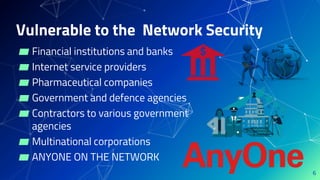
▰ Financial institutions and banks
▰ Internet service providers
▰ Pharmaceutical companies
▰ Government and defence agencies
▰ Contractors to various government
agencies
▰ Multinational corporations
▰ ANYONE ON THE NETWORK
6
Common Attacks and Threats
Computer Networks are the battlefields of Now…!!
7
8
▰ Finding a way into the Network
▰ Exploiting software bugs, buffer Overflow
▰ Denial of Service
▰ TCP Hijacking
▰ Packet Sniffing
▰ Social Engineering
Common Attacks and Threats
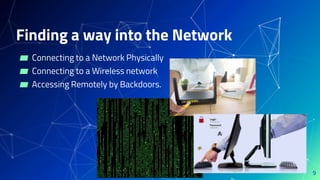
Finding a way into the Network
▰ Connecting to a Network Physically
▰ Connecting to a Wireless network
▰ Accessing Remotely by Backdoors.
9
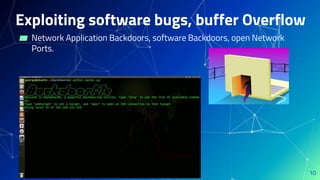
Exploiting software bugs, buffer Overflow
▰ Network Application Backdoors, software Backdoors, open Network
Ports.
10
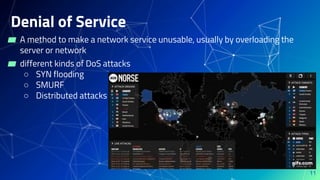
Denial of Service
▰ A method to make a network service unusable, usually by overloading the
server or network
▰ different kinds of DoS attacks
○ SYN flooding
○ SMURF
○ Distributed attacks
11
The Largest DDoS attack of all the Time
12
▰ Date : February, 2018
▰ Target : GitHub – A popular code management service used by
millions of developers
▰ Peak Incoming Traffic : 1.3 Terabytes per Second (Tbps)
▰ Packet Rate : 126.9 Million per second
▰ Type of Attack : Memcached DDoS attack
▰ Magnitude : Around 50,000x
▰ Length of Attack : 20 Minutes
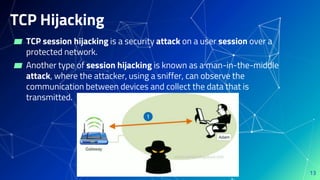
TCP Hijacking
▰ TCP session hijacking is a security attack on a user session over a
protected network.
▰ Another type of session hijacking is known as a man-in-the-middle
attack, where the attacker, using a sniffer, can observe the
communication between devices and collect the data that is
transmitted.
13
Packet Sniffing
▰ Packet sniffers work by intercepting and logging network traffic that
they can 'see' via the wired or wireless network interface that the packet
sniffing software has access to on its host computer.
14
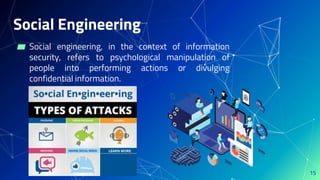
Social Engineering
▰ Social engineering, in the context of information
security, refers to psychological manipulation of
people into performing actions or divulging
confidential information.
15
Countermeasures
True Network Security is preparing for
what’s next , not what was last.
16
The Best Solution
17
Antivirus and Antimalware Software
▰ This software is used for protecting against malware, which includes
spyware, ransomware, Trojans, worms, and viruses. Malware can also
become very dangerous as it can infect a network and then remain calm for
days or even weeks. This software handles this threat by scanning for
malware entry and regularly tracks files afterward in order to detect
anomalies, remove malware, and fix damage.
18
Firewalls
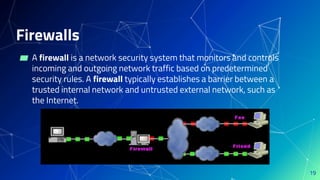
▰ A firewall is a network security system that monitors and controls
incoming and outgoing network traffic based on predetermined
security rules. A firewall typically establishes a barrier between a
trusted internal network and untrusted external network, such as
the Internet.
19
Intrusion Detection System
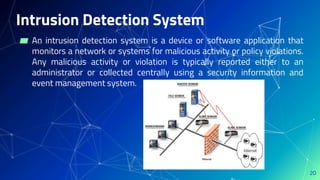
▰ An intrusion detection system is a device or software application that
monitors a network or systems for malicious activity or policy violations.
Any malicious activity or violation is typically reported either to an
administrator or collected centrally using a security information and
event management system.
20
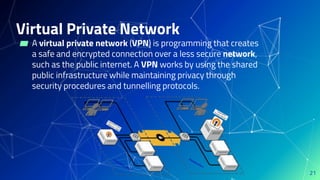
Virtual Private Network
▰ A virtual private network (VPN) is programming that creates
a safe and encrypted connection over a less secure network,
such as the public internet. A VPN works by using the shared
public infrastructure while maintaining privacy through
security procedures and tunnelling protocols.
21
Network Access Control (NAC)
▰ This network security process helps you to control who can access your
network. It is essential to recognize each device and user in order to keep
out potential attackers. This indeed will help you to enforce your security
policies. Noncompliant endpoint devices can be given only limited access
or just blocked.
22
Conclusion
▰ The Internet works only because we implicitly trust one another
▰ It is very easy to exploit this trust
▰ The same holds true for software
▰ It is important to stay on top of the latest CERT security advisories to know
how to patch any security holes
23
Time to Q & A
24
Thank You
25

Network security

  • 1.
    Network Security -Be aware!Connect with care Presented By: Jaydeep Patel Analyst @ BHP
  • 2.
    Outline ▰ What isSecurity? ▰ Requirements of Network Security. ▰ Vulnerable to the Network ▰ Common Attacks and Threats ▰ Countermeasures 2
  • 3.
  • 4.
    Security 4 ▰ Security isfreedom from, or resilience against, potential harm caused by others.
  • 5.
    “Security in ITis like locking your house or car – it dosen’t stop the bad guys, but if it’s good enough they may move on to an easier target. – Paul Herbka (Cyber Security, GCI) 5
  • 6.
    Vulnerable to theNetwork Security ▰ Financial institutions and banks ▰ Internet service providers ▰ Pharmaceutical companies ▰ Government and defence agencies ▰ Contractors to various government agencies ▰ Multinational corporations ▰ ANYONE ON THE NETWORK 6
  • 7.
    Common Attacks andThreats Computer Networks are the battlefields of Now…!! 7
  • 8.
    8 ▰ Finding away into the Network ▰ Exploiting software bugs, buffer Overflow ▰ Denial of Service ▰ TCP Hijacking ▰ Packet Sniffing ▰ Social Engineering Common Attacks and Threats
  • 9.
    Finding a wayinto the Network ▰ Connecting to a Network Physically ▰ Connecting to a Wireless network ▰ Accessing Remotely by Backdoors. 9
  • 10.
    Exploiting software bugs,buffer Overflow ▰ Network Application Backdoors, software Backdoors, open Network Ports. 10
  • 11.
    Denial of Service ▰A method to make a network service unusable, usually by overloading the server or network ▰ different kinds of DoS attacks ○ SYN flooding ○ SMURF ○ Distributed attacks 11
  • 12.
    The Largest DDoSattack of all the Time 12 ▰ Date : February, 2018 ▰ Target : GitHub – A popular code management service used by millions of developers ▰ Peak Incoming Traffic : 1.3 Terabytes per Second (Tbps) ▰ Packet Rate : 126.9 Million per second ▰ Type of Attack : Memcached DDoS attack ▰ Magnitude : Around 50,000x ▰ Length of Attack : 20 Minutes
  • 13.
    TCP Hijacking ▰ TCPsession hijacking is a security attack on a user session over a protected network. ▰ Another type of session hijacking is known as a man-in-the-middle attack, where the attacker, using a sniffer, can observe the communication between devices and collect the data that is transmitted. 13
  • 14.
    Packet Sniffing ▰ Packetsniffers work by intercepting and logging network traffic that they can 'see' via the wired or wireless network interface that the packet sniffing software has access to on its host computer. 14
  • 15.
    Social Engineering ▰ Socialengineering, in the context of information security, refers to psychological manipulation of people into performing actions or divulging confidential information. 15
  • 16.
    Countermeasures True Network Securityis preparing for what’s next , not what was last. 16
  • 17.
  • 18.
    Antivirus and AntimalwareSoftware ▰ This software is used for protecting against malware, which includes spyware, ransomware, Trojans, worms, and viruses. Malware can also become very dangerous as it can infect a network and then remain calm for days or even weeks. This software handles this threat by scanning for malware entry and regularly tracks files afterward in order to detect anomalies, remove malware, and fix damage. 18
  • 19.
    Firewalls ▰ A firewallis a network security system that monitors and controls incoming and outgoing network traffic based on predetermined security rules. A firewall typically establishes a barrier between a trusted internal network and untrusted external network, such as the Internet. 19
  • 20.
    Intrusion Detection System ▰An intrusion detection system is a device or software application that monitors a network or systems for malicious activity or policy violations. Any malicious activity or violation is typically reported either to an administrator or collected centrally using a security information and event management system. 20
  • 21.
    Virtual Private Network ▰A virtual private network (VPN) is programming that creates a safe and encrypted connection over a less secure network, such as the public internet. A VPN works by using the shared public infrastructure while maintaining privacy through security procedures and tunnelling protocols. 21
  • 22.
    Network Access Control(NAC) ▰ This network security process helps you to control who can access your network. It is essential to recognize each device and user in order to keep out potential attackers. This indeed will help you to enforce your security policies. Noncompliant endpoint devices can be given only limited access or just blocked. 22
  • 23.
    Conclusion ▰ The Internetworks only because we implicitly trust one another ▰ It is very easy to exploit this trust ▰ The same holds true for software ▰ It is important to stay on top of the latest CERT security advisories to know how to patch any security holes 23
  • 24.
    Time to Q& A 24
  • 25.

Editor's Notes

  • #2 Hi Everyone, Myself Jaydeep Patel an Analyst @ BHP, I am here to make you people aware about an important aspect i.e. Network Security. A risk to everyone’s privacy.
  • #3 During this presentation will apprise you all about the current issues in network security and also will help you with some tips to keep yourself secure.
  • #5 In other words, any thing that keeps us safe in first place is known as security, discussing in general terms for an example having lock in the door, which avoids entry of unwanted people inside the door.
  • #6 It Simply means the better we have, more secure we are.
  • #11 Applications which uses Internet, can be a door for someone to your computer
  • #12 SYN flooding attack - Send SYN packets with bogus source address - Server responds with SYN ACK and keeps state about TCP half-open connection SMURF - Source IP address of a broadcast ping is forged - Large number of machines respond back to victim, overloading it Distributed Denial of Service - Same techniques as regular DoS, but on a much larger scale
  • #13 The attack works by sending spoofed requests to a vulnerable server, which then responds with a larger amount of data than the initial request, magnifying the volume of traffic. Memcached is a database caching system for speeding up websites and networks. Memcached amplification can be thought of in the context of a malicious teenager calling a restaurant and saying "I’ll have one of everything, please call me back and tell me my whole order." When the restaurant asks for a callback number, the number given is the targeted victim’s phone number. The target then receives a call from the restaurant with a lot of information that they didn’t request.
  • #14 If an attacker learns the associated TCP state for the connection, then the connection can be hijacked! Attacker can insert malicious data into the TCP stream, and the recipient will believe it came from the original source