A PRESENTATION ON
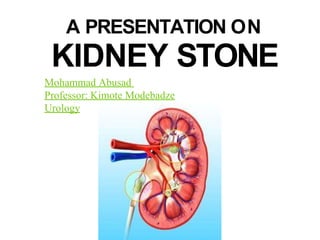
KIDNEY STONE
Mohammad Abusad
Professor: Kimote Modebadze
Urology
OBJECTIVES
• INTRODUCTION
• INCIDENCE
• STONE FORMATION
• TYPES OF STONES
• CLINICAL MANIFESTATIONS
• CAUSES & RISK FACTORS
• PATHOPHYSIOLOGY
• TREATMENT & PREVENTION
INTRODUCTION
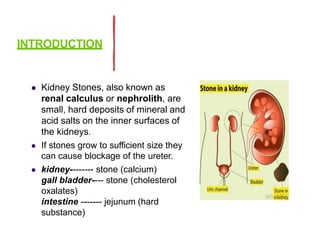
 Kidney Stones, also known as
renal calculus or nephrolith, are
small, hard deposits of mineral and
acid salts on the inner surfaces of
the kidneys.
 If stones grow to sufficient size they
can cause blockage of the ureter.
 kidney-------- stone (calcium)
gall bladder---- stone (cholesterol
oxalates)
intestine ------- jejunum (hard
substance)
INCIDENCE
Urinary calculi are more common in men
than in women.
Incidence of urinary calculi peaks
between the 3rd and 5th decades of life.
80% of stones under 2mm in size
90% of stones pass through the urinary
system spontaneously
There is seasonal variation with stone
occurring more often in the summer
months suspecting the role of dehydration
in this process.
STONE
FORMATION
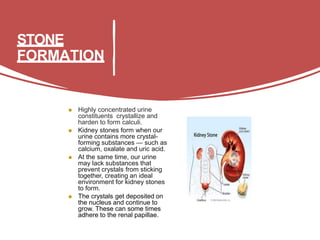
 Highly concentrated urine
constituents crystallize and
harden to form calculi.
 Kidney stones form when our
urine contains more crystal-
forming substances — such as
calcium, oxalate and uric acid.
 At the same time, our urine
may lack substances that
prevent crystals from sticking
together, creating an ideal
environment for kidney stones
to form.
 The crystals get deposited on
the nucleus and continue to
grow. These can some times
adhere to the renal papillae.
TYPESOF
KIDNEY
STONES
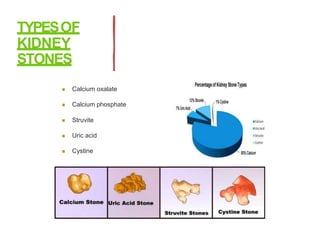
 Calcium oxalate
 Calcium phosphate
 Struvite
 Uric acid
 Cystine
Calcium stones: Most kidney stones are calcium
stones, usually in the form of calcium oxalate and calcium
phosphate. Oxalate is a naturally occurring substance
found in food. Some fruits and vegetables, as well as
nuts and chocolate, have high oxalate levels. Our liver
also produces oxalate.
IN ALKALINE URINE

ENLARGES RAPIDLY

TAKE SHAPE OF CALYCES

STAGHORN 
CALCIUM PHOSPHATE
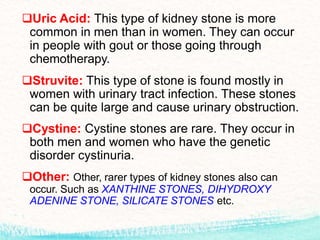
Uric Acid: This type of kidney stone is more
common in men than in women. They can occur
in people with gout or those going through
chemotherapy.
Struvite: This type of stone is found mostly in
women with urinary tract infection. These stones
can be quite large and cause urinary obstruction.
Cystine: Cystine stones are rare. They occur in
both men and women who have the genetic
disorder cystinuria.
Other: Other, rarer types of kidney stones also can
occur. Such as XANTHINE STONES, DIHYDROXY
ADENINE STONE, SILICATE STONES etc.
CLINICAL
MANIFESTATIONS
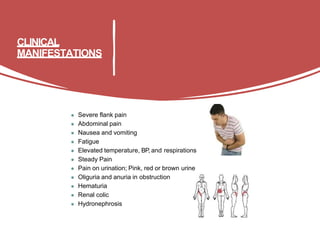
 Severe flank pain
 Abdominal pain
 Nausea and vomiting
 Fatigue
 Elevated temperature, BP, and respirations
 Steady Pain
 Pain on urination; Pink, red or brown urine
 Oliguria and anuria in obstruction
 Hematuria
 Renal colic
 Hydronephrosis
CAUSES  Supersaturation of urine is
the key to stone formation
 Imbalance of pH in urine
 Gout
 Hyperparathyroidism
 Inflammatory Bowel
Disease
 UTI (Urinary Tract
Infections)
 Dehydration
 Crystal aggregation
RISK FACTORS
HIGHMINERALCONTENTIN
DRINKINGW
A
TER
DEHYDRA
TION
FAMILYORPERSONAL
HISTORY
DIET
ARYINTAKE
BEINGOBESE
PATHOPHYSIOLOGY
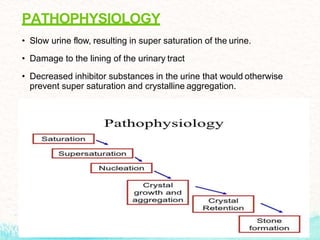
• Slow urine flow, resulting in super saturation of the urine.
• Damage to the lining of the urinary tract
• Decreased inhibitor substances in the urine that would otherwise
prevent super saturation and crystalline aggregation.
DIAGNOSTIC STUDIES
RETROGRA
DE
PYELOGR
AM
24 HOUR
URINE
SPECIMEN
DRUG
THERAPY-
Opioids,NSAID
s.
TREATMENT& PREVENTION
Acute Treatment:
 Pain Medication!!
 Strain urine for stones
 Keep Hydrated
 Ambulation
 Diet Restrictions
 Emotional Support
 Invasive Procedure (may be
necessary)
Surgical Procedures
• Lithotripsy: used sound wave to break up large stones into smaller
fragments allowing it to pass through the urinary tract.
• Extracorporeal Shock-Wave Lithotrypsy (ESWL)
• Percutaneous Ultrasonic
• Electrohydraulic
• Laser
• Surgical Therapy
• Nephrolithotomy (Kidney)
• Pyelolithotomy (Renal Pelvis)
• Ureterolithotomy (Ureter)
• Basket Extraction/Ureteroscopy
Lithotripsy Basket Extraction
PREVENTION
• Hydration
• Drink 3 liters of fluid per day (14 cups)
• Ideally water
• Lemonade (citrate
decrease stone
formation)
• Diet
• Low sodium & calcium intake.
• Avoid intake of oxalate-containing
foods (eg, spinach,strawberries,
rhubarb, tea, peanuts, wheat bran).
• Low protein intake is required.
• Exercise/Increase Activity
• -Avoid activities leading to sudden
increases in environmental temperatures
that may cause excessive sweating and
dehydration.
E A T WELL, S T A Y WELL….
MEDICATIONS
Pain relief may require
narcotic medications. The
presence of infection requires
treatment with antibiotics.
Other medications include:
allopurinol for uric acid
stones
diuretics
sodium bicarbonate or
sodium citrate
phosphorus solutions
REFERENCES
 http://en.wikipedia.org/wiki/Kidney_stone#Diagnosis
 http://www.webmd.com/kidney-stones/kidney- stones-
surgery
 http://www.mayoclinic.org/diseases- conditions/kidney-
stones/basics/definition/con- 20024829
 http://w w w.healthline.com/health/kidney-
stones#Overview1
 http://w w w.healthline.com/health/kidney-
stones#Types2
presentation-kidney-stonefinal.pptx

presentation-kidney-stonefinal.pptx

  • 1.
    A PRESENTATION ON KIDNEYSTONE Mohammad Abusad Professor: Kimote Modebadze Urology
  • 2.
    OBJECTIVES • INTRODUCTION • INCIDENCE •STONE FORMATION • TYPES OF STONES • CLINICAL MANIFESTATIONS • CAUSES & RISK FACTORS • PATHOPHYSIOLOGY • TREATMENT & PREVENTION
  • 3.
    INTRODUCTION  Kidney Stones,also known as renal calculus or nephrolith, are small, hard deposits of mineral and acid salts on the inner surfaces of the kidneys.  If stones grow to sufficient size they can cause blockage of the ureter.  kidney-------- stone (calcium) gall bladder---- stone (cholesterol oxalates) intestine ------- jejunum (hard substance)
  • 4.
    INCIDENCE Urinary calculi aremore common in men than in women. Incidence of urinary calculi peaks between the 3rd and 5th decades of life. 80% of stones under 2mm in size 90% of stones pass through the urinary system spontaneously There is seasonal variation with stone occurring more often in the summer months suspecting the role of dehydration in this process.
  • 5.
    STONE FORMATION  Highly concentratedurine constituents crystallize and harden to form calculi.  Kidney stones form when our urine contains more crystal- forming substances — such as calcium, oxalate and uric acid.  At the same time, our urine may lack substances that prevent crystals from sticking together, creating an ideal environment for kidney stones to form.  The crystals get deposited on the nucleus and continue to grow. These can some times adhere to the renal papillae.
  • 7.
    TYPESOF KIDNEY STONES  Calcium oxalate Calcium phosphate  Struvite  Uric acid  Cystine
  • 8.
    Calcium stones: Mostkidney stones are calcium stones, usually in the form of calcium oxalate and calcium phosphate. Oxalate is a naturally occurring substance found in food. Some fruits and vegetables, as well as nuts and chocolate, have high oxalate levels. Our liver also produces oxalate. IN ALKALINE URINE  ENLARGES RAPIDLY  TAKE SHAPE OF CALYCES  STAGHORN  CALCIUM PHOSPHATE
  • 9.
    Uric Acid: Thistype of kidney stone is more common in men than in women. They can occur in people with gout or those going through chemotherapy. Struvite: This type of stone is found mostly in women with urinary tract infection. These stones can be quite large and cause urinary obstruction. Cystine: Cystine stones are rare. They occur in both men and women who have the genetic disorder cystinuria. Other: Other, rarer types of kidney stones also can occur. Such as XANTHINE STONES, DIHYDROXY ADENINE STONE, SILICATE STONES etc.
  • 11.
    CLINICAL MANIFESTATIONS  Severe flankpain  Abdominal pain  Nausea and vomiting  Fatigue  Elevated temperature, BP, and respirations  Steady Pain  Pain on urination; Pink, red or brown urine  Oliguria and anuria in obstruction  Hematuria  Renal colic  Hydronephrosis
  • 12.
    CAUSES  Supersaturationof urine is the key to stone formation  Imbalance of pH in urine  Gout  Hyperparathyroidism  Inflammatory Bowel Disease  UTI (Urinary Tract Infections)  Dehydration  Crystal aggregation
  • 13.
  • 14.
    PATHOPHYSIOLOGY • Slow urineflow, resulting in super saturation of the urine. • Damage to the lining of the urinary tract • Decreased inhibitor substances in the urine that would otherwise prevent super saturation and crystalline aggregation.
  • 15.
  • 16.
    TREATMENT& PREVENTION Acute Treatment: Pain Medication!!  Strain urine for stones  Keep Hydrated  Ambulation  Diet Restrictions  Emotional Support  Invasive Procedure (may be necessary)
  • 17.
    Surgical Procedures • Lithotripsy:used sound wave to break up large stones into smaller fragments allowing it to pass through the urinary tract. • Extracorporeal Shock-Wave Lithotrypsy (ESWL) • Percutaneous Ultrasonic • Electrohydraulic • Laser • Surgical Therapy • Nephrolithotomy (Kidney) • Pyelolithotomy (Renal Pelvis) • Ureterolithotomy (Ureter) • Basket Extraction/Ureteroscopy
  • 18.
  • 19.
    PREVENTION • Hydration • Drink3 liters of fluid per day (14 cups) • Ideally water • Lemonade (citrate decrease stone formation) • Diet • Low sodium & calcium intake. • Avoid intake of oxalate-containing foods (eg, spinach,strawberries, rhubarb, tea, peanuts, wheat bran). • Low protein intake is required. • Exercise/Increase Activity • -Avoid activities leading to sudden increases in environmental temperatures that may cause excessive sweating and dehydration.
  • 20.
    E A TWELL, S T A Y WELL….
  • 21.
    MEDICATIONS Pain relief mayrequire narcotic medications. The presence of infection requires treatment with antibiotics. Other medications include: allopurinol for uric acid stones diuretics sodium bicarbonate or sodium citrate phosphorus solutions
  • 22.
    REFERENCES  http://en.wikipedia.org/wiki/Kidney_stone#Diagnosis  http://www.webmd.com/kidney-stones/kidney-stones- surgery  http://www.mayoclinic.org/diseases- conditions/kidney- stones/basics/definition/con- 20024829  http://w w w.healthline.com/health/kidney- stones#Overview1  http://w w w.healthline.com/health/kidney- stones#Types2