1
Multi-User DBMS Architecture
• Types
– Teleprocessing
– File-Server
– Client-Server
2
Multi-User DBMS Architecture
• Major components in a data-intensive
environment:
– User Interface
– Business Logic
– DBMS & Database
3
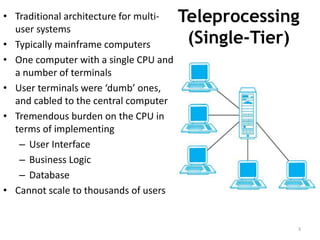
Teleprocessing
(Single-Tier)
• Traditional architecture for multi-
user systems
• Typically mainframe computers
• One computer with a single CPU and
a number of terminals
• User terminals were ‘dumb’ ones,
and cabled to the central computer
• Tremendous burden on the CPU in
terms of implementing
– User Interface
– Business Logic
– Database
• Cannot scale to thousands of users
4
File-Server
Architecture
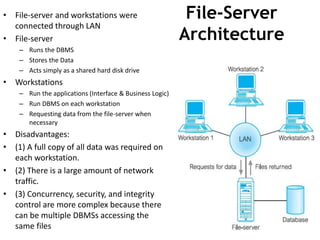
• File-server and workstations were
connected through LAN
• File-server
– Runs the DBMS
– Stores the Data
– Acts simply as a shared hard disk drive
• Workstations
– Run the applications (Interface & Business Logic)
– Run DBMS on each workstation
– Requesting data from the file-server when
necessary
• Disadvantages:
• (1) A full copy of all data was required on
each workstation.
• (2) There is a large amount of network
traffic.
• (3) Concurrency, security, and integrity
control are more complex because there
can be multiple DBMSs accessing the
same files
5
Traditional Two-Tier
Client-Server
Architecture
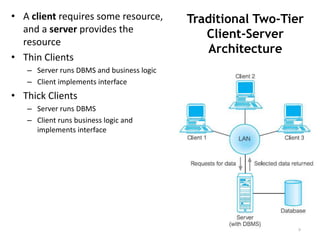
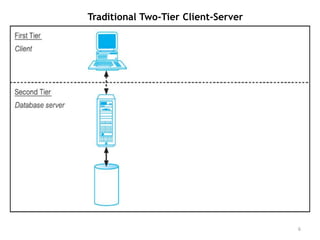
• A client requires some resource,
and a server provides the
resource
• Thin Clients
– Server runs DBMS and business logic
– Client implements interface
• Thick Clients
– Server runs DBMS
– Client runs business logic and
implements interface
6
Traditional Two-Tier Client-Server
7
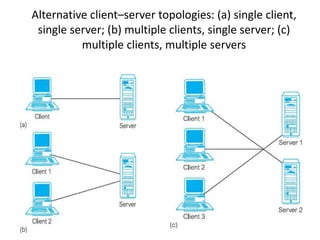
Alternative client–server topologies: (a) single client,
single server; (b) multiple clients, single server; (c)
multiple clients, multiple servers
8
Three-Tier Client Server
Architecture
• Problems with 2-tier Architecture:
– ‘Fat’ client, requiring considerable resources on
client’s computer to run effectively
– Significant client side administration overhead
– Preventing true scalability
• In 1995, three layers were proposed,
each potentially running on a
different platform
9
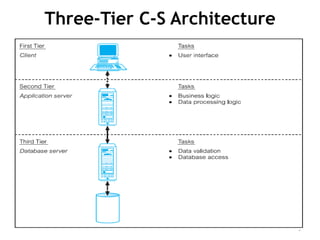
Three-Tier C-S Architecture
10
Three-Tier Client-Sever
Architecture
• User interface layer – runs on client
• Business logic layer – middle tier runs
on a server (application server)
• DBMS – stores data required by the
middle tier and runs on a separate
server (database server)
11
Three-Tier C-S Architecture
• Better overall performance
• ‘Thin’ client, requiring less expensive hardware
• Easier to modify or replace one tier without
affecting others
• The three-tier architecture can be extended to
n-tiers, with additional tiers added to provide
more scalability
• For example, the middle tier of the three-tier
architecture could be split into two, with one
tier for the Web server and another for the
application server

Presentation3 Multi-User Architecture.pdf

  • 1.
    1 Multi-User DBMS Architecture •Types – Teleprocessing – File-Server – Client-Server
  • 2.
    2 Multi-User DBMS Architecture •Major components in a data-intensive environment: – User Interface – Business Logic – DBMS & Database
  • 3.
    3 Teleprocessing (Single-Tier) • Traditional architecturefor multi- user systems • Typically mainframe computers • One computer with a single CPU and a number of terminals • User terminals were ‘dumb’ ones, and cabled to the central computer • Tremendous burden on the CPU in terms of implementing – User Interface – Business Logic – Database • Cannot scale to thousands of users
  • 4.
    4 File-Server Architecture • File-server andworkstations were connected through LAN • File-server – Runs the DBMS – Stores the Data – Acts simply as a shared hard disk drive • Workstations – Run the applications (Interface & Business Logic) – Run DBMS on each workstation – Requesting data from the file-server when necessary • Disadvantages: • (1) A full copy of all data was required on each workstation. • (2) There is a large amount of network traffic. • (3) Concurrency, security, and integrity control are more complex because there can be multiple DBMSs accessing the same files
  • 5.
    5 Traditional Two-Tier Client-Server Architecture • Aclient requires some resource, and a server provides the resource • Thin Clients – Server runs DBMS and business logic – Client implements interface • Thick Clients – Server runs DBMS – Client runs business logic and implements interface
  • 6.
  • 7.
    7 Alternative client–server topologies:(a) single client, single server; (b) multiple clients, single server; (c) multiple clients, multiple servers
  • 8.
    8 Three-Tier Client Server Architecture •Problems with 2-tier Architecture: – ‘Fat’ client, requiring considerable resources on client’s computer to run effectively – Significant client side administration overhead – Preventing true scalability • In 1995, three layers were proposed, each potentially running on a different platform
  • 9.
  • 10.
    10 Three-Tier Client-Sever Architecture • Userinterface layer – runs on client • Business logic layer – middle tier runs on a server (application server) • DBMS – stores data required by the middle tier and runs on a separate server (database server)
  • 11.
    11 Three-Tier C-S Architecture •Better overall performance • ‘Thin’ client, requiring less expensive hardware • Easier to modify or replace one tier without affecting others • The three-tier architecture can be extended to n-tiers, with additional tiers added to provide more scalability • For example, the middle tier of the three-tier architecture could be split into two, with one tier for the Web server and another for the application server