RESEARCH METHODOLOGIES
               MS(SE)

              PAPER 1

           YINGXU WANG

A HIERARCHICAL ABSTRACTION MODEL FOR
        SOFTWARE ENGINEERING
• The author has presented a Hierarchical
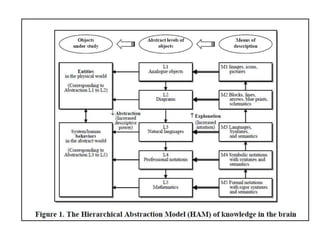
  Abstract Model (HAM) and has further
  elaborated it.
• The author has derived fundamental
  principles of software engineering practices
  and discussed the cognitive constraints for
  software engineering and how they can be
  solved.
ABSTRACT
• The author believes that abstraction plays a
  major role in software engineering.
• He has presented a Hierarchical Abstract
  Model (HAM) where he has elaborated five
  levels of abstraction known as
  analogue, objects, diagrams, natural
  languages, professional notation systems and
  mathematics.
INTRODUCTION
• The author believes that a subset of objects
  sharing a common property from a set of
  objects can be drawn-out using abstraction.
• He not only views abstraction as a
  philosophy, but sees it playing a major role in
  the entire structure of mathematics.
THE HEIRARCHICAL ABSTRATION
             MODEL


• The author explains how abstract objects do
  not exist in the real world but are reflections
  of real world entities.
CAN MICROTECH DEALS WITH THE PROBLEMS
 OF NANOTECH IN SOFTWARE ENGINEERING?
• The author believes that if electronic or
  mechanical engineers were asked if a microtech
  yardstick could be used to measure nanotech
  objects they would reply that it’s impossible.

• The usage of graphical blocks and their variations
  to denote more intricate system architectures
  and dynamic behaviors of software systems used
  by software engineers is believed by the author
  the fundamental reasons of many of the failures
  in software engineering practice.
• The author dislikes the practice of using icons
  and diagrams in software engineering because
  they lie in the lower level in HAM.
• Diagrams cannot be transformed by
  computers into codes.
• He explained, if a cartoon’s dialogue is erased
  , different meanings will be perceived by the
  drawing, which is inadequate for software
  engineering.
• The explicit descriptivity states that only a
  higher level abstract, precise, and rigorous
  means is adequate to express an object at a
  given level of abstraction in the HAM model.
THE COGNITIVE CONSTRAINTS OF
      SOFTWARE ENGINEERING
• The author describes cognitive constraints for
  software engineering and by using abstract
  means how software engineering descriptivity
  can be improved.
• The author defines the word intangibility on
  the basis of software, he believes that the only
  way to embody an intangible software is to
  express it with formal notations and diagrams
  at different levels of abstraction.
• He defines the word inexpressiveness and
  believes that the architecture, static behaviors
  and dynamic behaviors of the system need to
  expressed rigorously and explicitly.
• He defines the third basic constraint inexplicit
  embodiment and states that no machine may
  help to extend an inadequate specification or
  inadequate architectural and behavioral
  design into executable code.
CONCLUSIONS

The author has presented a Hierarchical
Abstraction Model for explaining the need of
abstraction and suitable mathematical means
to deal with cognitive constraints of software.

A HIERARCHICAL ABSTRACTION MODEL FOR SOFTWARE ENGINEERING

  • 1.
    RESEARCH METHODOLOGIES MS(SE) PAPER 1 YINGXU WANG A HIERARCHICAL ABSTRACTION MODEL FOR SOFTWARE ENGINEERING
  • 2.
    • The authorhas presented a Hierarchical Abstract Model (HAM) and has further elaborated it. • The author has derived fundamental principles of software engineering practices and discussed the cognitive constraints for software engineering and how they can be solved.
  • 3.
    ABSTRACT • The authorbelieves that abstraction plays a major role in software engineering. • He has presented a Hierarchical Abstract Model (HAM) where he has elaborated five levels of abstraction known as analogue, objects, diagrams, natural languages, professional notation systems and mathematics.
  • 4.
    INTRODUCTION • The authorbelieves that a subset of objects sharing a common property from a set of objects can be drawn-out using abstraction. • He not only views abstraction as a philosophy, but sees it playing a major role in the entire structure of mathematics.
  • 5.
    THE HEIRARCHICAL ABSTRATION MODEL • The author explains how abstract objects do not exist in the real world but are reflections of real world entities.
  • 7.
    CAN MICROTECH DEALSWITH THE PROBLEMS OF NANOTECH IN SOFTWARE ENGINEERING? • The author believes that if electronic or mechanical engineers were asked if a microtech yardstick could be used to measure nanotech objects they would reply that it’s impossible. • The usage of graphical blocks and their variations to denote more intricate system architectures and dynamic behaviors of software systems used by software engineers is believed by the author the fundamental reasons of many of the failures in software engineering practice.
  • 8.
    • The authordislikes the practice of using icons and diagrams in software engineering because they lie in the lower level in HAM. • Diagrams cannot be transformed by computers into codes. • He explained, if a cartoon’s dialogue is erased , different meanings will be perceived by the drawing, which is inadequate for software engineering.
  • 9.
    • The explicitdescriptivity states that only a higher level abstract, precise, and rigorous means is adequate to express an object at a given level of abstraction in the HAM model.
  • 10.
    THE COGNITIVE CONSTRAINTSOF SOFTWARE ENGINEERING • The author describes cognitive constraints for software engineering and by using abstract means how software engineering descriptivity can be improved. • The author defines the word intangibility on the basis of software, he believes that the only way to embody an intangible software is to express it with formal notations and diagrams at different levels of abstraction.
  • 11.
    • He definesthe word inexpressiveness and believes that the architecture, static behaviors and dynamic behaviors of the system need to expressed rigorously and explicitly. • He defines the third basic constraint inexplicit embodiment and states that no machine may help to extend an inadequate specification or inadequate architectural and behavioral design into executable code.
  • 12.
    CONCLUSIONS The author haspresented a Hierarchical Abstraction Model for explaining the need of abstraction and suitable mathematical means to deal with cognitive constraints of software.