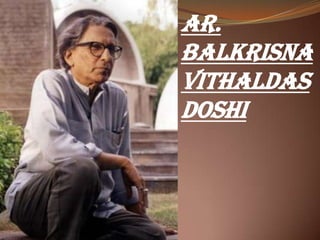
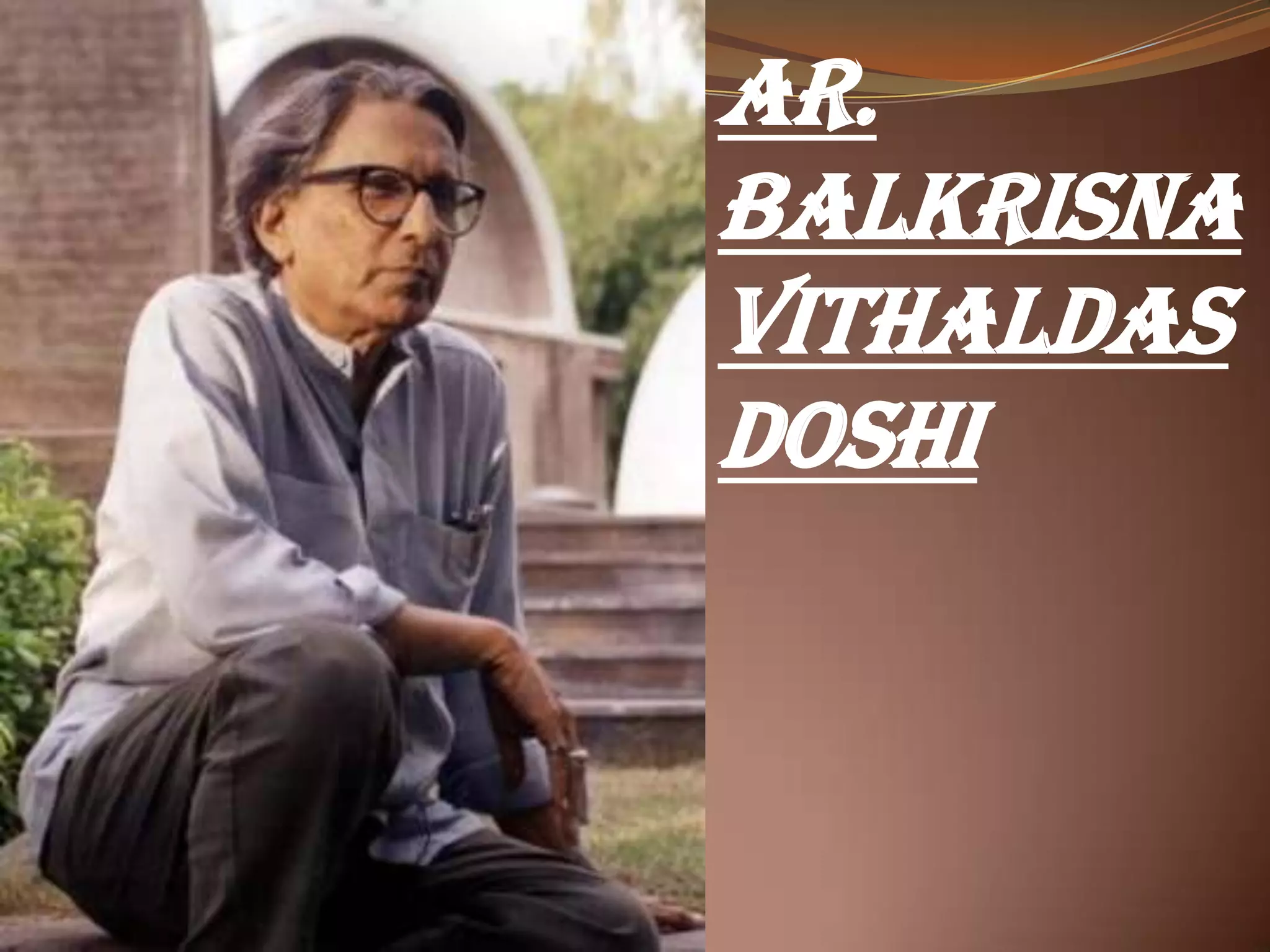
Ar.
BALKRISNA
VITHALDAS
DOSHI
LIFE HISTORY
 Balkrishna Vithaldas Doshi was born in Pune,
India in 1927.
 He did his bachelors from J. J. School of Art,
Bombay in 1950.
He worked for four years with Le Corbusier as
senior designer (1951-54) in Paris.
In 1956 he established a private practice in
Vastu-Shilpa, Ahmedabad and in 1962 he
established the Vastu-Shilpa Foundation for
Environmental Design.
He also founded and designed the School of Architecture
and Planning in Ahmedabad. Doshi has worked in
partnership as Stein, Doshi & Bhalla since 1977.
Doshi worked closely with Louis khan andAnant raje,
when Kahn designed the campus of the Indian Institute of
Management.
In 1958 he was a fellow at the Graham Foundation for
Advanced Studies in the Fine Arts.
Doshi has been a member of the Jury for several
international and national competitions including the Indira
Gandhi National Centre for Arts and Aga Khan Award for
Architecture.
He was presented in 1995,Aga Khan Award for
Architecture, for the Aranya Community Housing in Indore,
India.
PHILOSOPHIES
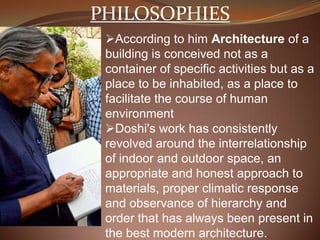
According to him Architecture of a
building is conceived not as a
container of specific activities but as a
place to be inhabited, as a place to
facilitate the course of human
environment
Doshi's work has consistently
revolved around the interrelationship
of indoor and outdoor space, an
appropriate and honest approach to
materials, proper climatic response
and observance of hierarchy and
order that has always been present in
the best modern architecture.
PHILOSOPHIES
It is this so called ‘filter’ between
contemporary and traditional architecture
which Doshi has masterfully brought in.
The success of any project depends on
effective construction, contracting, logistic
planning and co-ordination.
An essential part of the philosophy is the
construction of scale models and of full
scale mockups to make decisions jointly
with the client about the building.
PRINCIPLES
Doshi has categorized 4 principles in
traditional architecture which he
believes would greatly enrich
contemporary practice.
1. Doshi belief in the ‘Mythical
Sense’ of space often evident in
traditional architecture which is not
simply confined to open or closed
areas. According to him space can
be modified according to the desire
of the perceiver and is never static.
PRINCIPLES
2. The structural and formal systems that Doshi has
adopted led him to assimilate the 2nd principle of
Vaastu-Purusha Mandala to ensure minimum
standards of health and hygiene in each project .
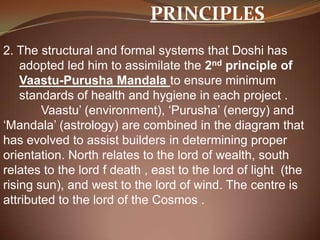
Vaastu’ (environment), ‘Purusha’ (energy) and
‘Mandala’ (astrology) are combined in the diagram that
has evolved to assist builders in determining proper
orientation. North relates to the lord of wealth, south
relates to the lord f death , east to the lord of light (the
rising sun), and west to the lord of wind. The centre is
attributed to the lord of the Cosmos .
PRINCIPLES
3. A more specific principle is to follow ‘flexible rather
than rigid approach to the structure’. This is how
transformation of space from the mere static container ;
to a place where people actually feel a psychic
interchange is best achieved. Here Doshi refers to the
multiple mixed structural systems, of the type found in
Madurai temple and city of Fatehpur Sikri.
4. The idea of flexibility leads him to a principle, of
incorporating “symbolism”. He believes that it can only
be accommodated by mixture of structural systems.
Symbolically charged space must be designed as
receptacle for human activity.
Some of his project s
are explained here :-
Indore low cost housing
, INDORE
Hussian Gufa , Ahemdabad
Sangath Architect
office, Ahemdabad
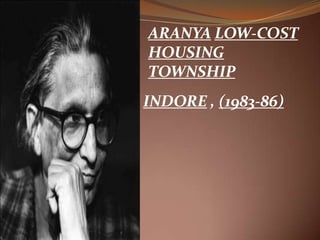
ARANYA LOW-COST
HOUSING
TOWNSHIP
INDORE , (1983-86)
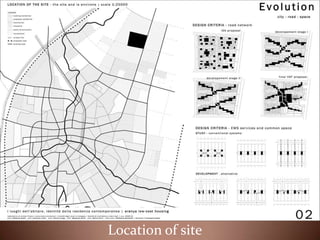
Location of site
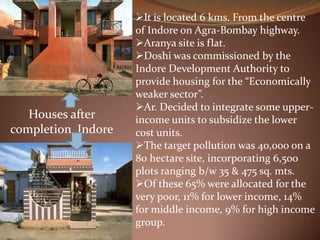
It is located 6 kms. From the centre
of Indore on Agra-Bombay highway.
Aranya site is flat.
Doshi was commissioned by the
Indore Development Authority to
provide housing for the “Economically
weaker sector”.
Ar. Decided to integrate some upper-
income units to subsidize the lower
cost units.
The target pollution was 40,000 on a
80 hectare site, incorporating 6,500
plots ranging b/w 35 & 475 sq. mts.
Of these 65% were allocated for the
very poor, 11% for lower income, 14%
for middle income, 9% for high income
group.
Houses after
completion Indore
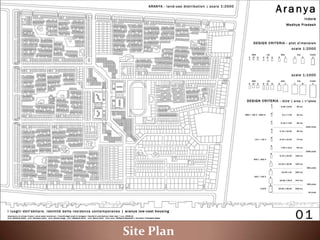
Site Plan
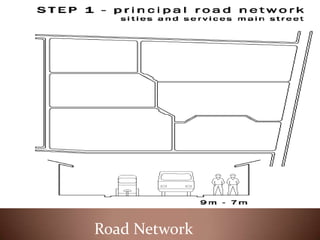
Road Network
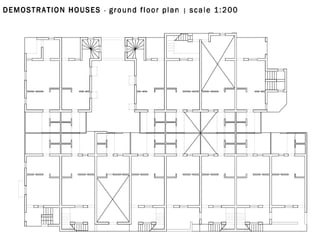
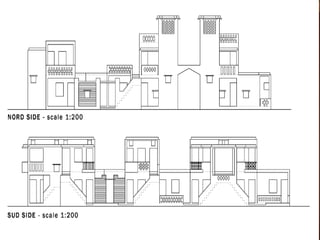
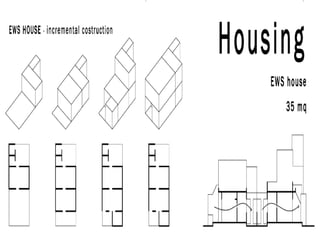
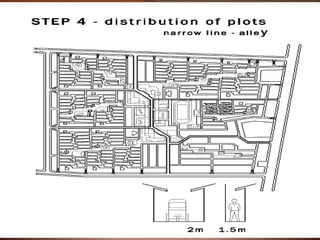
The Aranya housing scheme divided as 58% residential use, 23.5%
pedestrian & vehicular access roads, 8% open space, 7% shared
community.
Doshi divided the site with a north-south spine where the main
amenities are clustered, feeding 3 zones of housing on each side.
The choice of orientation, as well as the use of offsets, also maximizes
shade.
Houses are clustered in groups of 10.
A Septic tank has been provided for every cluster or 20 houses.
Water is drawn from 3 local reservoirs to serve the entire project.
Material Used In Construction
The outer periphery consist units for H.I.G and most weaker section is
inside.
Each house provided with an OTTA- an outdoor platform.
For economic resources use of shared foundations and party walls been
carved out.
Brick, stone, and concrete are available locally, but owners are free to use
any material they choose for house construction and decoration.
The main street runs at the centre of plan in zig-zag pattern.
External patios is provided as the spaces for interaction.
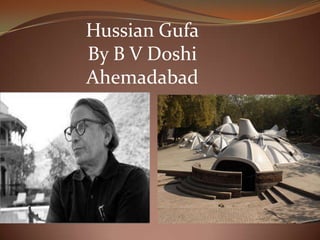
Hussian Gufa
By B V Doshi
Ahemadabad
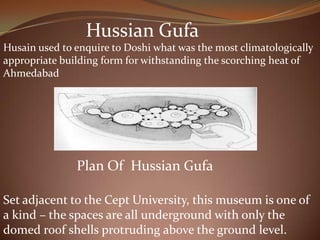
Hussian Gufa
Husain used to enquire to Doshi what was the most climatologically
appropriate building form for withstanding the scorching heat of
Ahmedabad
Plan Of Hussian Gufa
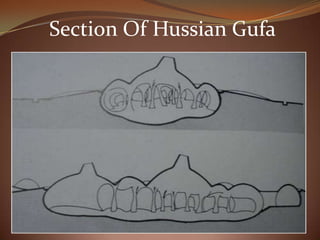
Set adjacent to the Cept University, this museum is one of
a kind – the spaces are all underground with only the
domed roof shells protruding above the ground level.
Section Of Hussian Gufa
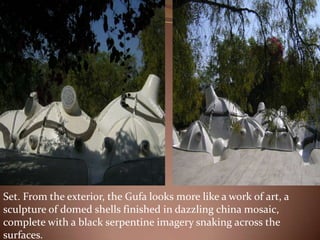
Set. From the exterior, the Gufa looks more like a work of art, a
sculpture of domed shells finished in dazzling china mosaic,
complete with a black serpentine imagery snaking across the
surfaces.
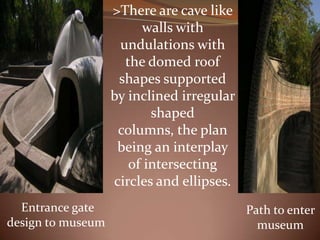
>There are cave like
walls with
undulations with
the domed roof
shapes supported
by inclined irregular
shaped
columns, the plan
being an interplay
of intersecting
circles and ellipses.
Entrance gate
design to museum
Path to enter
museum
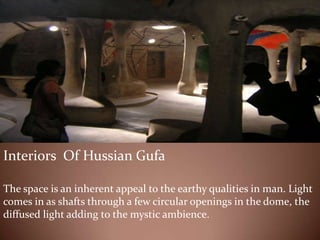
Interiors Of Hussian Gufa
The space is an inherent appeal to the earthy qualities in man. Light
comes in as shafts through a few circular openings in the dome, the
diffused light adding to the mystic ambience.
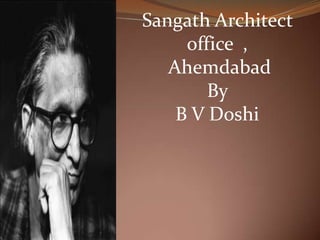
Sangath Architect
office ,
Ahemdabad
By
B V Doshi
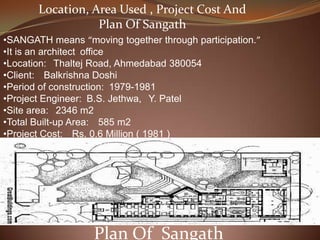
Plan Of Sangath
•SANGATH means “moving together through participation.”
•It is an architect office
•Location: Thaltej Road, Ahmedabad 380054
•Client: Balkrishna Doshi
•Period of construction: 1979-1981
•Project Engineer: B.S. Jethwa, Y. Patel
•Site area: 2346 m2
•Total Built-up Area: 585 m2
•Project Cost: Rs. 0.6 Million ( 1981 )
Location, Area Used , Project Cost And
Plan Of Sangath
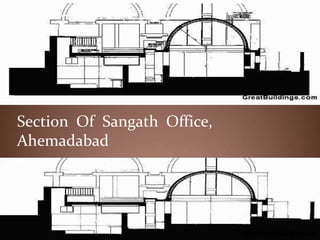
Section Of Sangath Office,
Ahemadabad
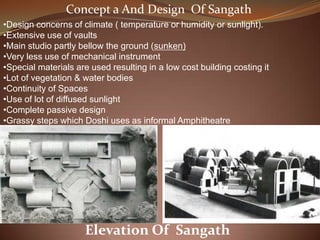
•Design concerns of climate ( temperature or humidity or sunlight).
•Extensive use of vaults
•Main studio partly bellow the ground (sunken)
•Very less use of mechanical instrument
•Special materials are used resulting in a low cost building costing it
•Lot of vegetation & water bodies
•Continuity of Spaces
•Use of lot of diffused sunlight
•Complete passive design
•Grassy steps which Doshi uses as informal Amphitheatre
Elevation Of Sangath
Concept a And Design Of Sangath
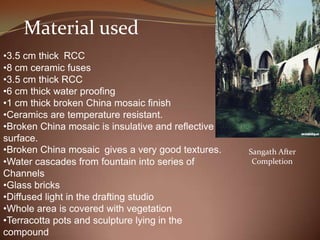
•3.5 cm thick RCC
•8 cm ceramic fuses
•3.5 cm thick RCC
•6 cm thick water proofing
•1 cm thick broken China mosaic finish
•Ceramics are temperature resistant.
•Broken China mosaic is insulative and reflective
surface.
•Broken China mosaic gives a very good textures.
•Water cascades from fountain into series of
Channels
•Glass bricks
•Diffused light in the drafting studio
•Whole area is covered with vegetation
•Terracotta pots and sculpture lying in the
compound
Material used
Sangath After
Completion
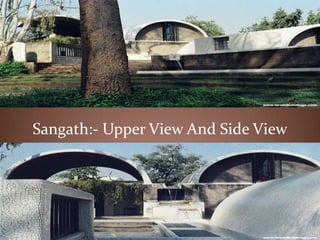
Sangath:- Upper View And Side View
He is one of the most legendry Architect of India
He has also contributed in many other projects.
Eg . National Institute Of Fashion And Technology, Delhi
Indian Institute Of Business Management , Banglore
So with thanks to Teachers and Friends
We take your leave
Thank You
Gaurav Kumar
Jugal Varshney

Presentation2

  • 1.
  • 2.
    LIFE HISTORY  BalkrishnaVithaldas Doshi was born in Pune, India in 1927.  He did his bachelors from J. J. School of Art, Bombay in 1950. He worked for four years with Le Corbusier as senior designer (1951-54) in Paris. In 1956 he established a private practice in Vastu-Shilpa, Ahmedabad and in 1962 he established the Vastu-Shilpa Foundation for Environmental Design.
  • 3.
    He also foundedand designed the School of Architecture and Planning in Ahmedabad. Doshi has worked in partnership as Stein, Doshi & Bhalla since 1977. Doshi worked closely with Louis khan andAnant raje, when Kahn designed the campus of the Indian Institute of Management. In 1958 he was a fellow at the Graham Foundation for Advanced Studies in the Fine Arts. Doshi has been a member of the Jury for several international and national competitions including the Indira Gandhi National Centre for Arts and Aga Khan Award for Architecture. He was presented in 1995,Aga Khan Award for Architecture, for the Aranya Community Housing in Indore, India.
  • 4.
    PHILOSOPHIES According to himArchitecture of a building is conceived not as a container of specific activities but as a place to be inhabited, as a place to facilitate the course of human environment Doshi's work has consistently revolved around the interrelationship of indoor and outdoor space, an appropriate and honest approach to materials, proper climatic response and observance of hierarchy and order that has always been present in the best modern architecture.
  • 5.
    PHILOSOPHIES It is thisso called ‘filter’ between contemporary and traditional architecture which Doshi has masterfully brought in. The success of any project depends on effective construction, contracting, logistic planning and co-ordination. An essential part of the philosophy is the construction of scale models and of full scale mockups to make decisions jointly with the client about the building.
  • 6.
    PRINCIPLES Doshi has categorized4 principles in traditional architecture which he believes would greatly enrich contemporary practice. 1. Doshi belief in the ‘Mythical Sense’ of space often evident in traditional architecture which is not simply confined to open or closed areas. According to him space can be modified according to the desire of the perceiver and is never static.
  • 7.
    PRINCIPLES 2. The structuraland formal systems that Doshi has adopted led him to assimilate the 2nd principle of Vaastu-Purusha Mandala to ensure minimum standards of health and hygiene in each project . Vaastu’ (environment), ‘Purusha’ (energy) and ‘Mandala’ (astrology) are combined in the diagram that has evolved to assist builders in determining proper orientation. North relates to the lord of wealth, south relates to the lord f death , east to the lord of light (the rising sun), and west to the lord of wind. The centre is attributed to the lord of the Cosmos .
  • 8.
    PRINCIPLES 3. A morespecific principle is to follow ‘flexible rather than rigid approach to the structure’. This is how transformation of space from the mere static container ; to a place where people actually feel a psychic interchange is best achieved. Here Doshi refers to the multiple mixed structural systems, of the type found in Madurai temple and city of Fatehpur Sikri. 4. The idea of flexibility leads him to a principle, of incorporating “symbolism”. He believes that it can only be accommodated by mixture of structural systems. Symbolically charged space must be designed as receptacle for human activity.
  • 9.
    Some of hisproject s are explained here :- Indore low cost housing , INDORE Hussian Gufa , Ahemdabad Sangath Architect office, Ahemdabad
  • 10.
  • 11.
  • 12.
    It is located6 kms. From the centre of Indore on Agra-Bombay highway. Aranya site is flat. Doshi was commissioned by the Indore Development Authority to provide housing for the “Economically weaker sector”. Ar. Decided to integrate some upper- income units to subsidize the lower cost units. The target pollution was 40,000 on a 80 hectare site, incorporating 6,500 plots ranging b/w 35 & 475 sq. mts. Of these 65% were allocated for the very poor, 11% for lower income, 14% for middle income, 9% for high income group. Houses after completion Indore
  • 13.
  • 14.
  • 15.
    The Aranya housingscheme divided as 58% residential use, 23.5% pedestrian & vehicular access roads, 8% open space, 7% shared community. Doshi divided the site with a north-south spine where the main amenities are clustered, feeding 3 zones of housing on each side. The choice of orientation, as well as the use of offsets, also maximizes shade. Houses are clustered in groups of 10. A Septic tank has been provided for every cluster or 20 houses. Water is drawn from 3 local reservoirs to serve the entire project. Material Used In Construction The outer periphery consist units for H.I.G and most weaker section is inside. Each house provided with an OTTA- an outdoor platform. For economic resources use of shared foundations and party walls been carved out. Brick, stone, and concrete are available locally, but owners are free to use any material they choose for house construction and decoration. The main street runs at the centre of plan in zig-zag pattern. External patios is provided as the spaces for interaction.
  • 20.
    Hussian Gufa By BV Doshi Ahemadabad
  • 21.
    Hussian Gufa Husain usedto enquire to Doshi what was the most climatologically appropriate building form for withstanding the scorching heat of Ahmedabad Plan Of Hussian Gufa Set adjacent to the Cept University, this museum is one of a kind – the spaces are all underground with only the domed roof shells protruding above the ground level.
  • 22.
  • 23.
    Set. From theexterior, the Gufa looks more like a work of art, a sculpture of domed shells finished in dazzling china mosaic, complete with a black serpentine imagery snaking across the surfaces.
  • 24.
    >There are cavelike walls with undulations with the domed roof shapes supported by inclined irregular shaped columns, the plan being an interplay of intersecting circles and ellipses. Entrance gate design to museum Path to enter museum
  • 25.
    Interiors Of HussianGufa The space is an inherent appeal to the earthy qualities in man. Light comes in as shafts through a few circular openings in the dome, the diffused light adding to the mystic ambience.
  • 26.
  • 27.
    Plan Of Sangath •SANGATHmeans “moving together through participation.” •It is an architect office •Location: Thaltej Road, Ahmedabad 380054 •Client: Balkrishna Doshi •Period of construction: 1979-1981 •Project Engineer: B.S. Jethwa, Y. Patel •Site area: 2346 m2 •Total Built-up Area: 585 m2 •Project Cost: Rs. 0.6 Million ( 1981 ) Location, Area Used , Project Cost And Plan Of Sangath
  • 28.
    Section Of SangathOffice, Ahemadabad
  • 29.
    •Design concerns ofclimate ( temperature or humidity or sunlight). •Extensive use of vaults •Main studio partly bellow the ground (sunken) •Very less use of mechanical instrument •Special materials are used resulting in a low cost building costing it •Lot of vegetation & water bodies •Continuity of Spaces •Use of lot of diffused sunlight •Complete passive design •Grassy steps which Doshi uses as informal Amphitheatre Elevation Of Sangath Concept a And Design Of Sangath
  • 30.
    •3.5 cm thickRCC •8 cm ceramic fuses •3.5 cm thick RCC •6 cm thick water proofing •1 cm thick broken China mosaic finish •Ceramics are temperature resistant. •Broken China mosaic is insulative and reflective surface. •Broken China mosaic gives a very good textures. •Water cascades from fountain into series of Channels •Glass bricks •Diffused light in the drafting studio •Whole area is covered with vegetation •Terracotta pots and sculpture lying in the compound Material used Sangath After Completion
  • 31.
    Sangath:- Upper ViewAnd Side View
  • 32.
    He is oneof the most legendry Architect of India He has also contributed in many other projects. Eg . National Institute Of Fashion And Technology, Delhi Indian Institute Of Business Management , Banglore So with thanks to Teachers and Friends We take your leave Thank You Gaurav Kumar Jugal Varshney