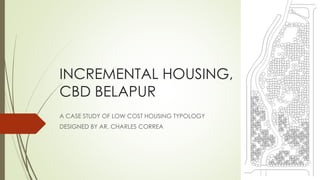
INCREMENTAL HOUSING, 
CBD BELAPUR 
A CASE STUDY OF LOW COST HOUSING TYPOLOGY 
DESIGNED BY AR. CHARLES CORREA
"Making housing is like a bird 
building its nest. You start with a 
basic house, but you have to let 
people change it to their own 
needs.“ 
- Charles Correa
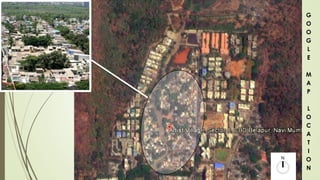
G 
O 
O 
G 
L 
E 
M 
A 
P 
L 
O 
C 
A 
T 
I 
O 
N
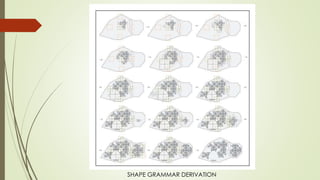
SHAPE GRAMMAR DERIVATION
A BRIEF INTRODUCTION 
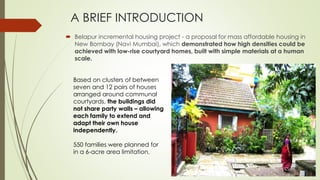
 Belapur incremental housing project - a proposal for mass affordable housing in 
New Bombay (Navi Mumbai), which demonstrated how high densities could be 
achieved with low-rise courtyard homes, built with simple materials at a human 
scale. 
Based on clusters of between 
seven and 12 pairs of houses 
arranged around communal 
courtyards, the buildings did 
not share party walls – allowing 
each family to extend and 
adapt their own house 
independently. 
550 families were planned for 
in a 6-acre area limitation.
PLANNING SPACES 
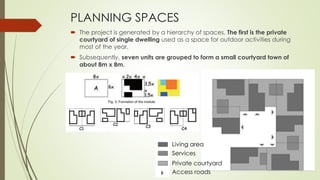
 The project is generated by a hierarchy of spaces. The first is the private 
courtyard of single dwelling used as a space for outdoor activities during 
most of the year. 
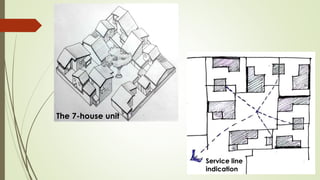
 Subsequently, seven units are grouped to form a small courtyard town of 
about 8m x 8m. 
Living area 
Services 
Private courtyard 
Access roads
PLANNING SPACES 
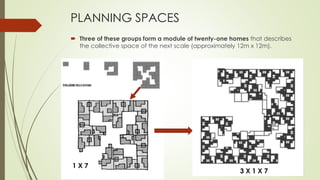
 Three of these groups form a module of twenty-one homes that describes 
the collective space of the next scale (approximately 12m x 12m). 
3 X 1 X 7 
1 X 7
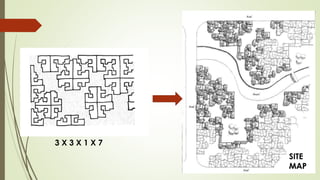
3 X 3 X 1 X 7 
SITE 
MAP
PLANNING SPACES 
 Correa discussed housing and the 
importance of people to be involved in 
determining its design and use. 
 Additionally, he also emphasized 
incremental housing as a centerpiece to 
any solution that was proposed for a place 
like Dharavi 
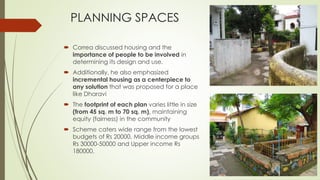
 The footprint of each plan varies little in size 
(from 45 sq. m to 70 sq. m), maintaining 
equity (fairness) in the community 
 Scheme caters wide range from the lowest 
budgets of Rs 20000, Middle income groups 
Rs 30000-50000 and Upper income Rs 
180000.
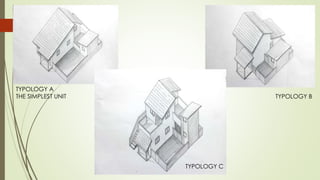
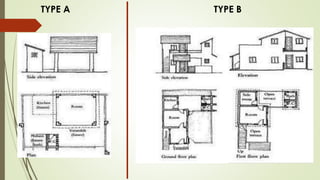
TYPOLOGY A 
THE SIMPLEST UNIT TYPOLOGY B 
TYPOLOGY C
TYPE A TYPE B
The 7-house unit 
Service line 
indication
MATERIALS AND CONSTRUCTION 
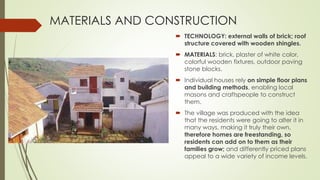
 TECHNOLOGY: external walls of brick; roof 
structure covered with wooden shingles. 
 MATERIALS: brick, plaster of white color, 
colorful wooden fixtures, outdoor paving 
stone blocks. 
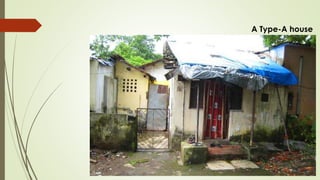
 Individual houses rely on simple floor plans 
and building methods, enabling local 
masons and craftspeople to construct 
them. 
 The village was produced with the idea 
that the residents were going to alter it in 
many ways, making it truly their own, 
therefore homes are freestanding, so 
residents can add on to them as their 
families grow; and differently priced plans 
appeal to a wide variety of income levels.
THE CURRENT SCENARIO 
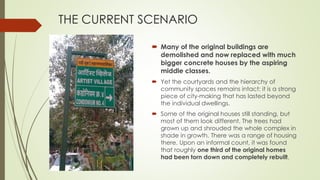
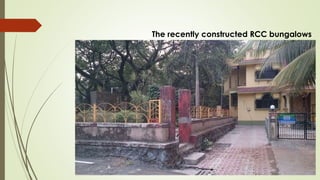
 Many of the original buildings are 
demolished and now replaced with much 
bigger concrete houses by the aspiring 
middle classes. 
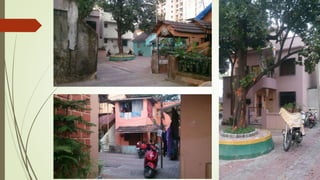
 Yet the courtyards and the hierarchy of 
community spaces remains intact: it is a strong 
piece of city-making that has lasted beyond 
the individual dwellings. 
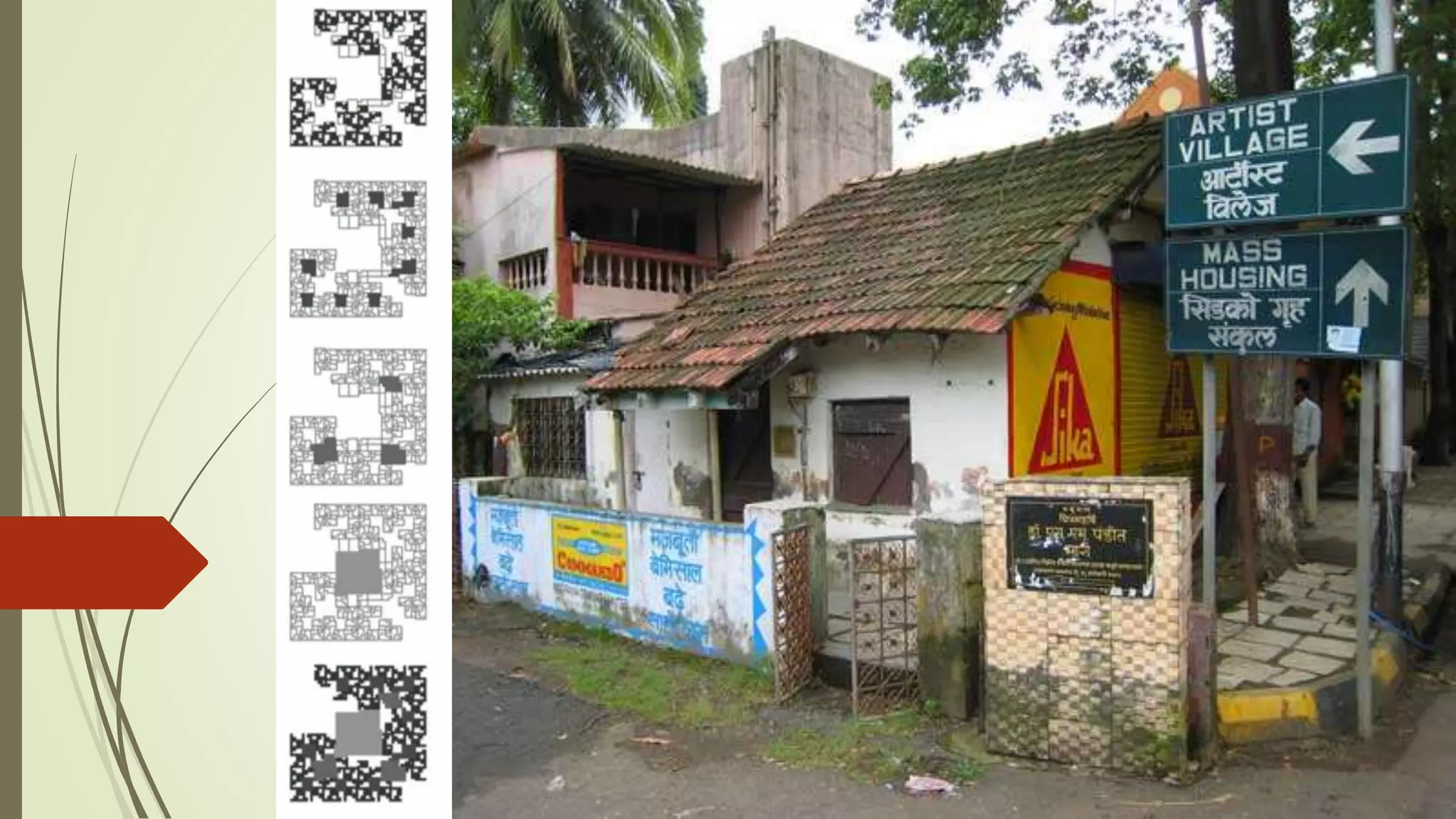
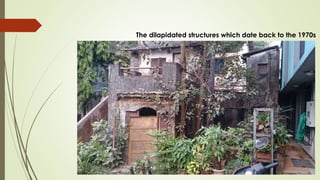
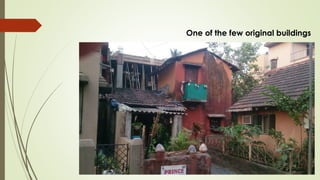
 Some of the original houses still standing, but 
most of them look different. The trees had 
grown up and shrouded the whole complex in 
shade in growth. There was a range of housing 
there. Upon an informal count, it was found 
that roughly one third of the original homes 
had been torn down and completely rebuilt.
ON THE STREETS
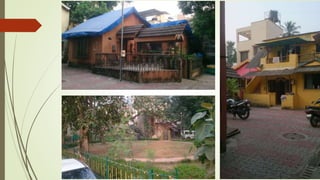
The recently constructed RCC bungalows
The dilapidated structures which date back to the 1970s
One of the few original buildings
A Type-A house
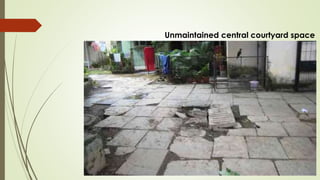
Unmaintained central courtyard space
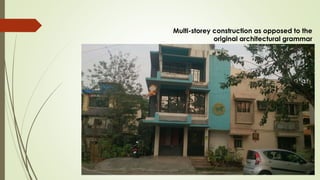
Multi-storey construction as opposed to the 
original architectural grammar
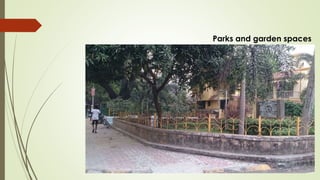
Parks and garden spaces
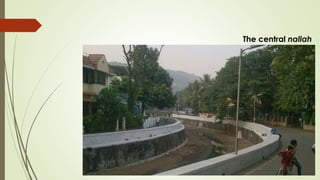
The central nallah
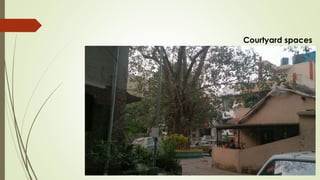
Courtyard spaces
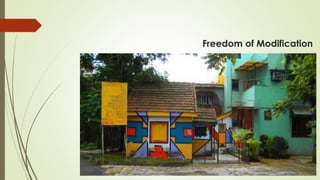
Freedom of Modification
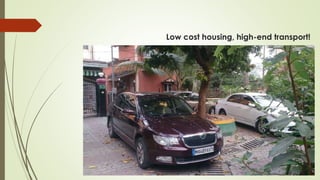
Low cost housing, high-end transport!
THE SHORTCOMINGS 
 On speaking to some of the residents, there were some drawbacks 
that were brought to light – 
 One resident we talked to complained that no provisions were made for 
the common spaces in the center of each cluster of houses. No one was in 
charge of maintaining them. These spaces do not fall under any 
jurisdiction; not private nor public. 
 Most of the houses have been remodeled or destroyed and rebuilt as 
some inhabitants said they were impractical (”What was the architect 
thinking when he put toilets outside the house?”). Some clusters of houses 
became “model” mini-gated-communities while others became mini-slums. 
 The concrete houses arose as a result of the changing aspirations of the 
residents. They no longer wanted a ‘village’ or a rural backdrop. Modern 
materials and technologies have thus been employed to a great extent.
CONCLUSION 
 This housing project offers the quality 
of life of a village with the 
sophistication of a city. 
 Each cluster permits the emergence 
of a local community feeling, while 
integrating each house to the whole 
settlement at different levels. The 
hierarchy itself is very organic. 
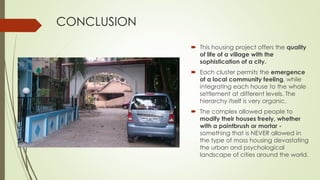
 The complex allowed people to 
modify their houses freely, whether 
with a paintbrush or mortar - 
something that is NEVER allowed in 
the type of mass housing devastating 
the urban and psychological 
landscape of cities around the world.
“ 
” 
"It is really worth a visit. Don’t go to see 
Charles Correa’s architectural skills or you will 
be disappointed. Go instead to see what a 
genius urban designer can do when he thinks 
beyond design." 
AIROOTS.ORG 
THANK YOU 
RASIKA DONGARE PRANAY BHAVSAR 
JAYANT GYANI RITHIKA RAVISHANKAR 
AISHWARYA HATKAR RAMA SHIRWALKAR 
ROSHANI TAMKHADE

Belapur Incremental housing - A case study

  • 2.
    INCREMENTAL HOUSING, CBDBELAPUR A CASE STUDY OF LOW COST HOUSING TYPOLOGY DESIGNED BY AR. CHARLES CORREA
  • 3.
    "Making housing islike a bird building its nest. You start with a basic house, but you have to let people change it to their own needs.“ - Charles Correa
  • 4.
    G O O G L E M A P L O C A T I O N
  • 5.
  • 6.
    A BRIEF INTRODUCTION  Belapur incremental housing project - a proposal for mass affordable housing in New Bombay (Navi Mumbai), which demonstrated how high densities could be achieved with low-rise courtyard homes, built with simple materials at a human scale. Based on clusters of between seven and 12 pairs of houses arranged around communal courtyards, the buildings did not share party walls – allowing each family to extend and adapt their own house independently. 550 families were planned for in a 6-acre area limitation.
  • 7.
    PLANNING SPACES The project is generated by a hierarchy of spaces. The first is the private courtyard of single dwelling used as a space for outdoor activities during most of the year.  Subsequently, seven units are grouped to form a small courtyard town of about 8m x 8m. Living area Services Private courtyard Access roads
  • 8.
    PLANNING SPACES Three of these groups form a module of twenty-one homes that describes the collective space of the next scale (approximately 12m x 12m). 3 X 1 X 7 1 X 7
  • 9.
    3 X 3X 1 X 7 SITE MAP
  • 10.
    PLANNING SPACES Correa discussed housing and the importance of people to be involved in determining its design and use.  Additionally, he also emphasized incremental housing as a centerpiece to any solution that was proposed for a place like Dharavi  The footprint of each plan varies little in size (from 45 sq. m to 70 sq. m), maintaining equity (fairness) in the community  Scheme caters wide range from the lowest budgets of Rs 20000, Middle income groups Rs 30000-50000 and Upper income Rs 180000.
  • 11.
    TYPOLOGY A THESIMPLEST UNIT TYPOLOGY B TYPOLOGY C
  • 12.
  • 13.
    The 7-house unit Service line indication
  • 14.
    MATERIALS AND CONSTRUCTION  TECHNOLOGY: external walls of brick; roof structure covered with wooden shingles.  MATERIALS: brick, plaster of white color, colorful wooden fixtures, outdoor paving stone blocks.  Individual houses rely on simple floor plans and building methods, enabling local masons and craftspeople to construct them.  The village was produced with the idea that the residents were going to alter it in many ways, making it truly their own, therefore homes are freestanding, so residents can add on to them as their families grow; and differently priced plans appeal to a wide variety of income levels.
  • 15.
    THE CURRENT SCENARIO  Many of the original buildings are demolished and now replaced with much bigger concrete houses by the aspiring middle classes.  Yet the courtyards and the hierarchy of community spaces remains intact: it is a strong piece of city-making that has lasted beyond the individual dwellings.  Some of the original houses still standing, but most of them look different. The trees had grown up and shrouded the whole complex in shade in growth. There was a range of housing there. Upon an informal count, it was found that roughly one third of the original homes had been torn down and completely rebuilt.
  • 16.
  • 17.
  • 18.
    The dilapidated structureswhich date back to the 1970s
  • 19.
    One of thefew original buildings
  • 20.
  • 21.
  • 22.
    Multi-storey construction asopposed to the original architectural grammar
  • 23.
  • 24.
  • 25.
  • 28.
  • 29.
    Low cost housing,high-end transport!
  • 30.
    THE SHORTCOMINGS On speaking to some of the residents, there were some drawbacks that were brought to light –  One resident we talked to complained that no provisions were made for the common spaces in the center of each cluster of houses. No one was in charge of maintaining them. These spaces do not fall under any jurisdiction; not private nor public.  Most of the houses have been remodeled or destroyed and rebuilt as some inhabitants said they were impractical (”What was the architect thinking when he put toilets outside the house?”). Some clusters of houses became “model” mini-gated-communities while others became mini-slums.  The concrete houses arose as a result of the changing aspirations of the residents. They no longer wanted a ‘village’ or a rural backdrop. Modern materials and technologies have thus been employed to a great extent.
  • 31.
    CONCLUSION  Thishousing project offers the quality of life of a village with the sophistication of a city.  Each cluster permits the emergence of a local community feeling, while integrating each house to the whole settlement at different levels. The hierarchy itself is very organic.  The complex allowed people to modify their houses freely, whether with a paintbrush or mortar - something that is NEVER allowed in the type of mass housing devastating the urban and psychological landscape of cities around the world.
  • 32.
    “ ” "Itis really worth a visit. Don’t go to see Charles Correa’s architectural skills or you will be disappointed. Go instead to see what a genius urban designer can do when he thinks beyond design." AIROOTS.ORG THANK YOU RASIKA DONGARE PRANAY BHAVSAR JAYANT GYANI RITHIKA RAVISHANKAR AISHWARYA HATKAR RAMA SHIRWALKAR ROSHANI TAMKHADE