PRESENTATION 
ON 
SECURTIZATION & MORTGAGE LOANS 
A PART OF 
MERCHANT BANKING & FINANCIAL SERVICES
What is securitization? 
What is mortgages? 
Name some mortgages companies in 
India.
INTRODUCTION 
Securtization as a financing technique, is concerned with in 
securities, backed by pools of mortgage loans. The securities 
so created are known as Mortgages. 
Securitization refers to the process of turning assets into 
securities. 
When used in real estate, securitization means taking 
mortgages issued by the banks & other lenders & converting 
them into securities that can be sold to investors. 
 Financial instruments that can be readily bought & sold in 
financial markets, the way that stocks, bonds & futures 
contracts are traded.
Definition 
The process of trading in the securities that are created on 
the backing of pools of mortgage loans from banks & financial 
institutions is called asset securitization . 
 Mortgage loans include housing loans, car & truck loans, 
credit card receivables, trade receivables, etc 
 A technique whereby assets are converted into 
securities, which are in turn converted into cash on an 
ongoing basis, with a view to allow for increasing turnover of 
business & profit, is known as asset securitization. 
 The technique provides for flexibility in yield, pricing 
pattern, issue risk & marketability of instruments, which is to 
the advantage of both borrowers & lenders.
MORTGAGES COMPANIES IN INDIA ARE 
HDFC LTD 
LIC Housing finance LTD. 
ICICI Home finance company LTD. 
PNB Housing finance LTD. 
CAN Finance homes ltd. 
BOB Housing finance ltd.
Securitization Companies In India Are 
Asset Reconstruction Company India Ltd (Arcil) 
Mumbai. 
Aichemist Asset Reconstruction Company Ltd 
New Delhi. 
Reliance Asset Reconstruction Company Pvt Ltd. 
Mumbai.
SECURITISATION OF FINANCIAL ASSETS 
Why Securitisation? 
1. A convenient mechanism to suit changing 
needs of borrowers and lenders 
2. Matches supply of funds with demand 
demands for funds through floating 
negotiable securities
SECURITISATION OF FINANCIAL ASSETS 
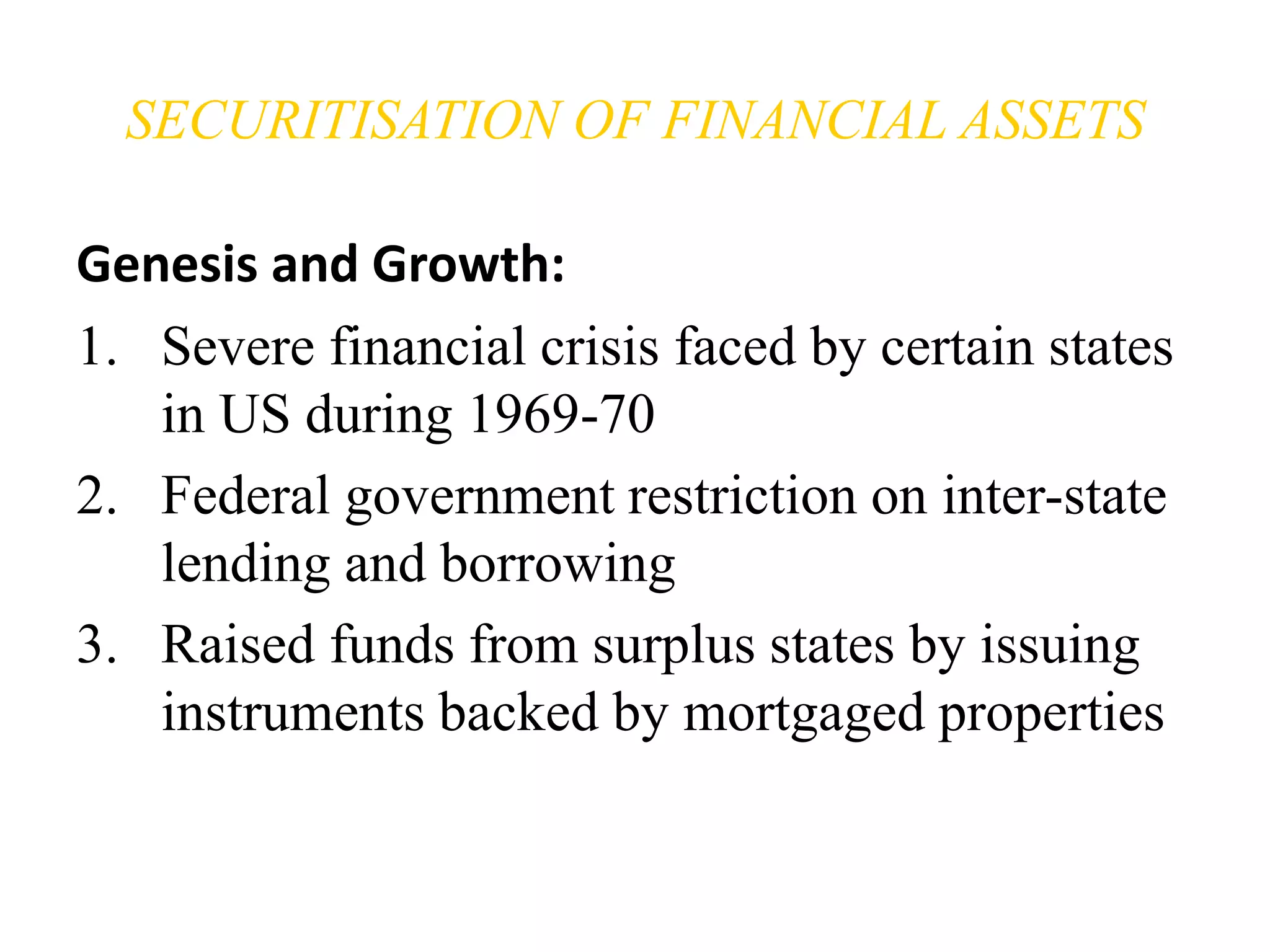
Genesis and Growth: 
1. Severe financial crisis faced by certain states 
in US during 1969-70 
2. Federal government restriction on inter-state 
lending and borrowing 
3. Raised funds from surplus states by issuing 
instruments backed by mortgaged properties
SECURITISATION OF FINANCIAL ASSETS 
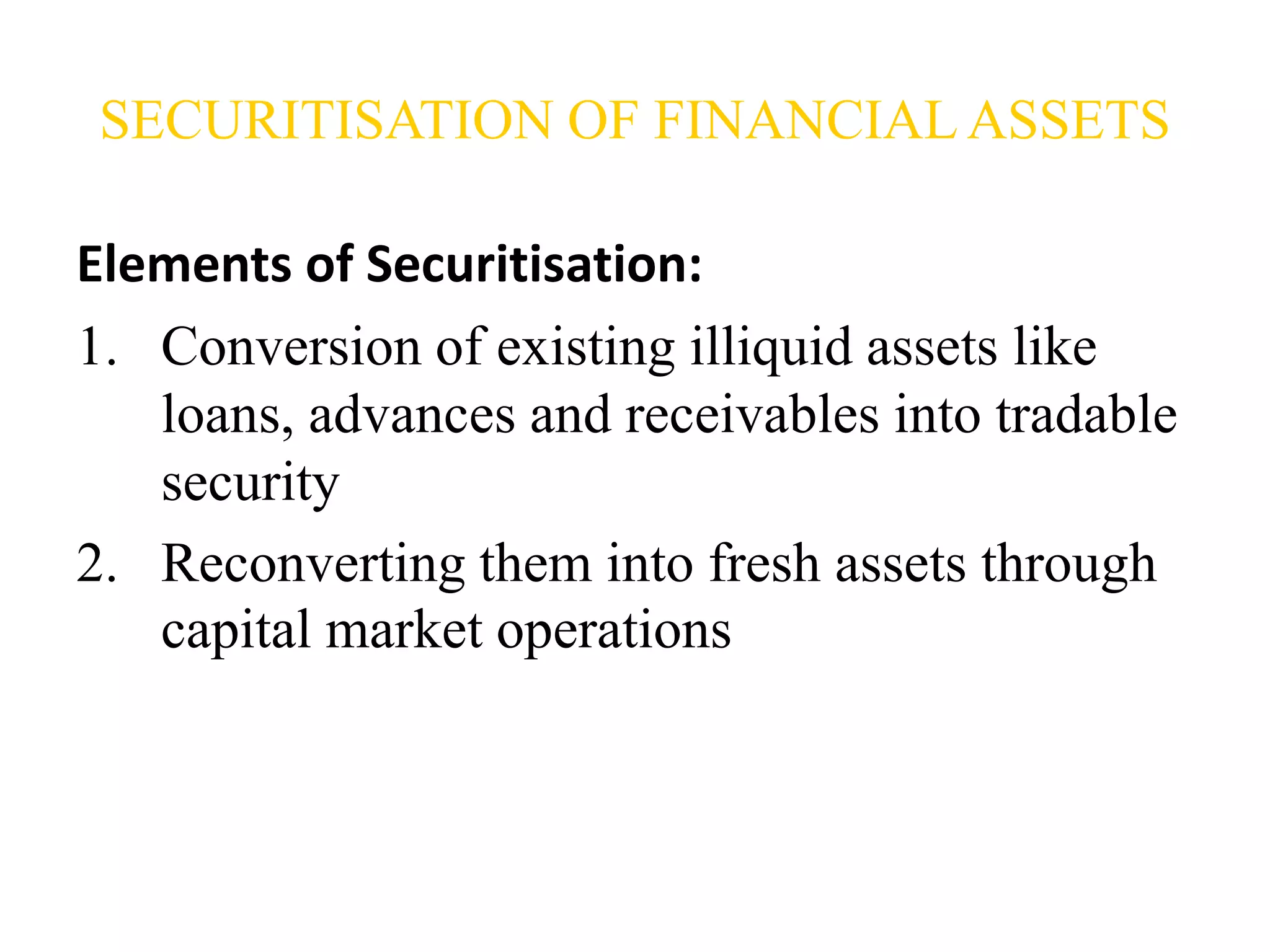
Elements of Securitisation: 
1. Conversion of existing illiquid assets like 
loans, advances and receivables into tradable 
security 
2. Reconverting them into fresh assets through 
capital market operations
SECURITISATION OF FINANCIAL ASSETS 
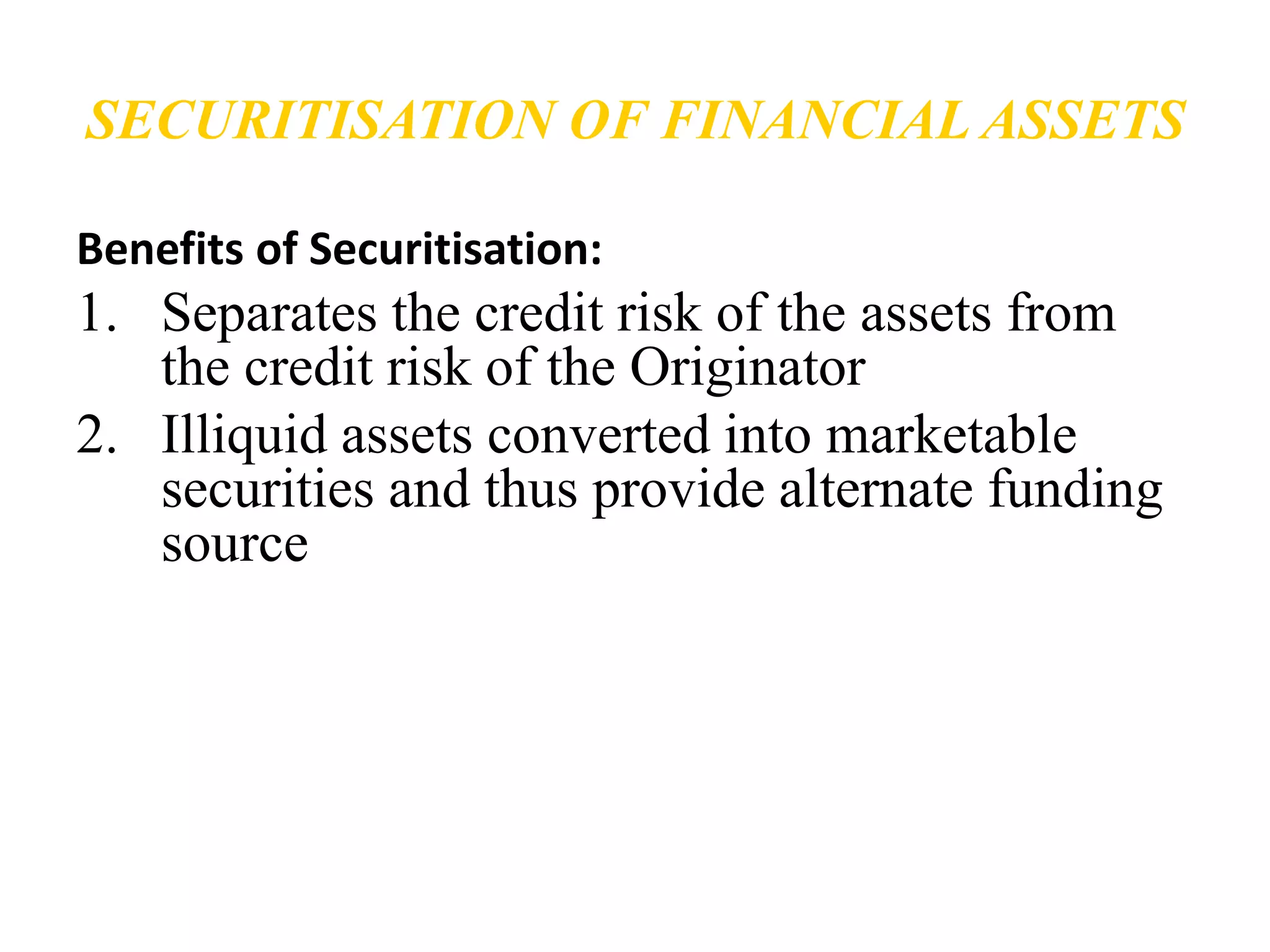
Benefits of Securitisation: 
1. Separates the credit risk of the assets from 
the credit risk of the Originator 
2. Illiquid assets converted into marketable 
securities and thus provide alternate funding 
source
SECURITISATION OF FINANCIAL ASSETS 
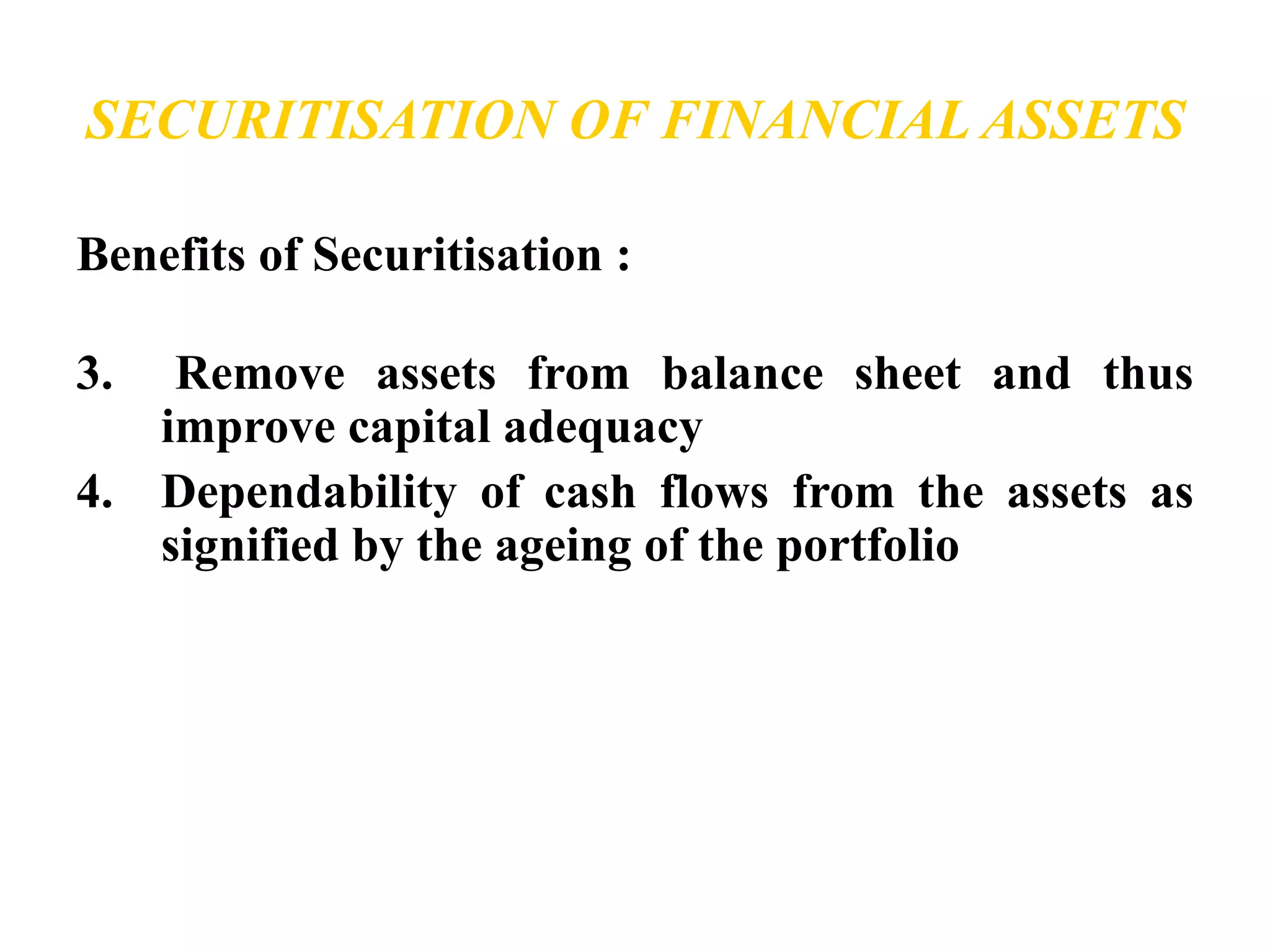
Benefits of Securitisation : 
3. Remove assets from balance sheet and thus 
improve capital adequacy 
4. Dependability of cash flows from the assets as 
signified by the ageing of the portfolio
SECURITISATION OF FINANCIAL ASSETS 
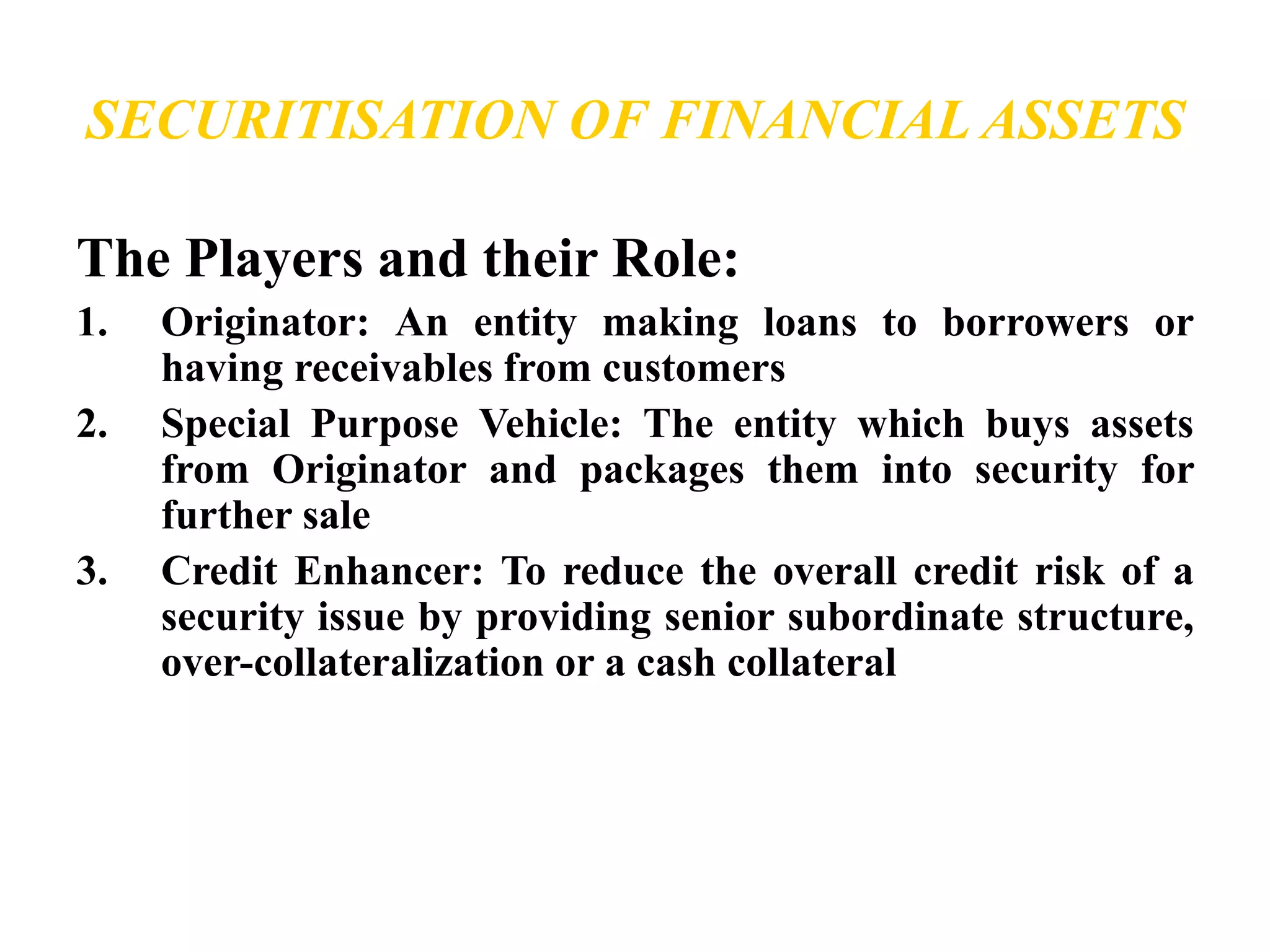
The Players and their Role: 
1. Originator: An entity making loans to borrowers or 
having receivables from customers 
2. Special Purpose Vehicle: The entity which buys assets 
from Originator and packages them into security for 
further sale 
3. Credit Enhancer: To reduce the overall credit risk of a 
security issue by providing senior subordinate structure, 
over-collateralization or a cash collateral
SECURITISATION OF FINANCIAL ASSETS 
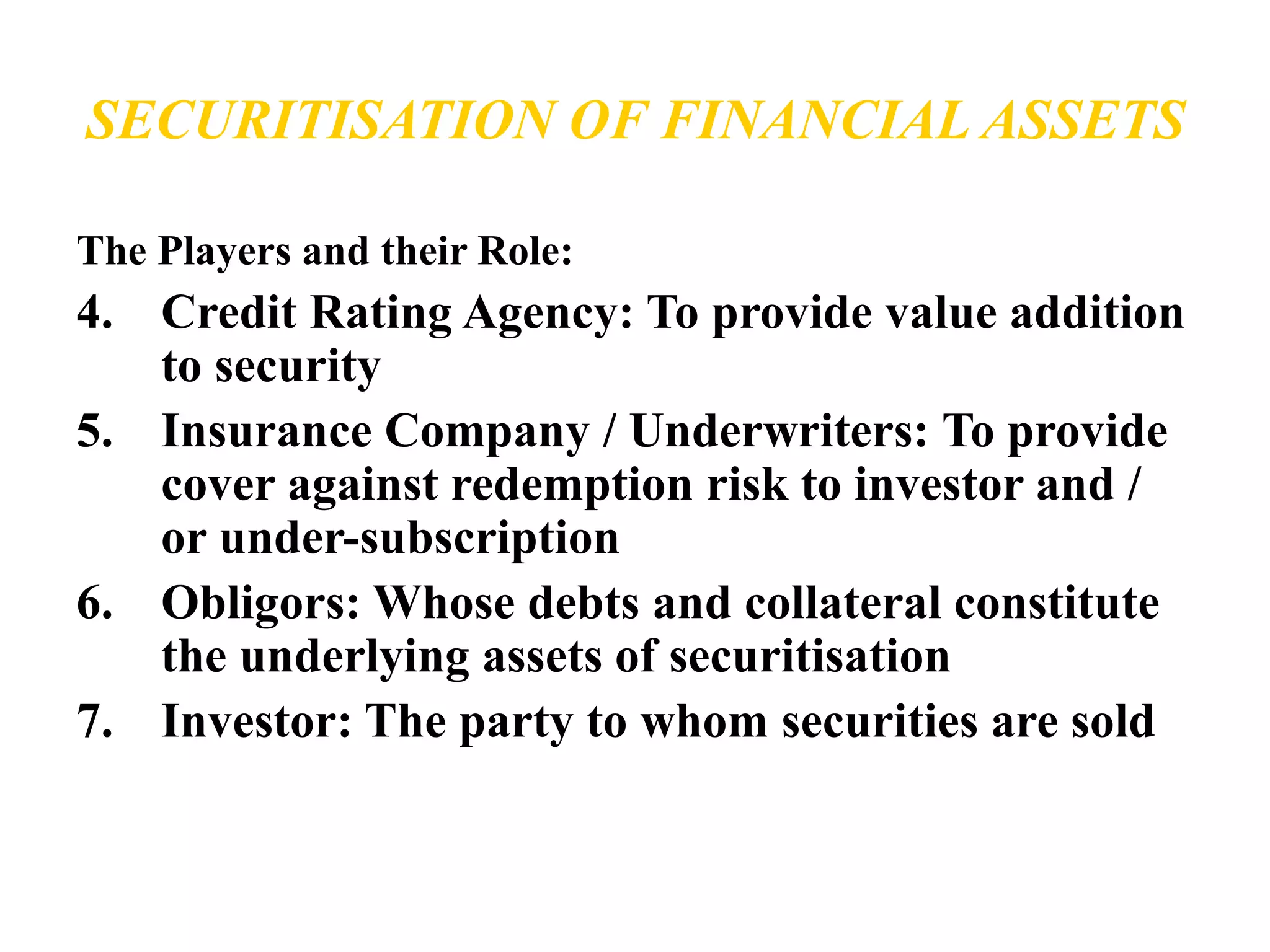
The Players and their Role: 
4. Credit Rating Agency: To provide value addition 
to security 
5. Insurance Company / Underwriters: To provide 
cover against redemption risk to investor and / 
or under-subscription 
6. Obligors: Whose debts and collateral constitute 
the underlying assets of securitisation 
7. Investor: The party to whom securities are sold
SECURITISATION OF FINANCIAL ASSETS 
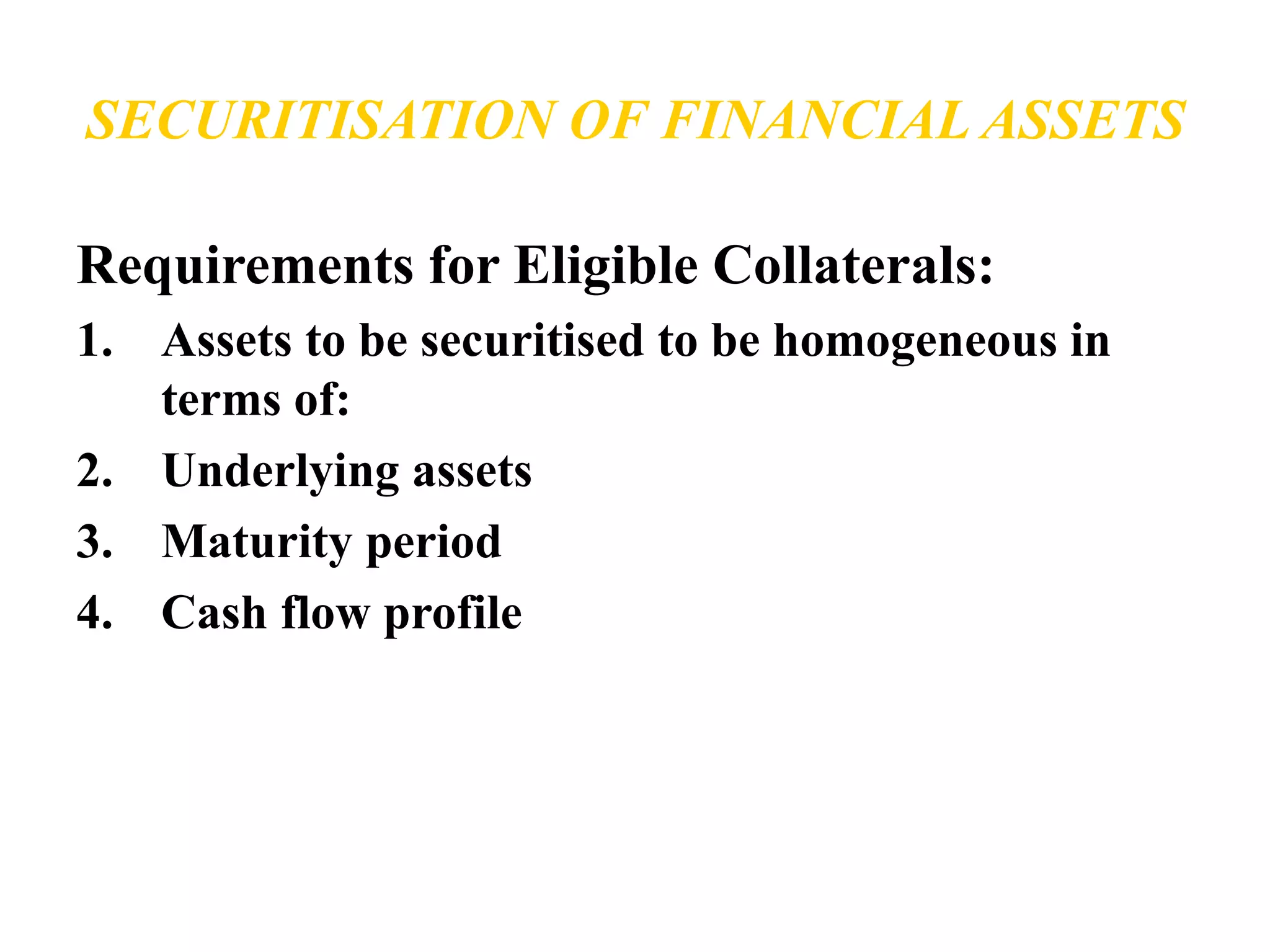
Requirements for Eligible Collaterals: 
1. Assets to be securitised to be homogeneous in 
terms of: 
2. Underlying assets 
3. Maturity period 
4. Cash flow profile
SECURITISATION OF FINANCIAL ASSETS 
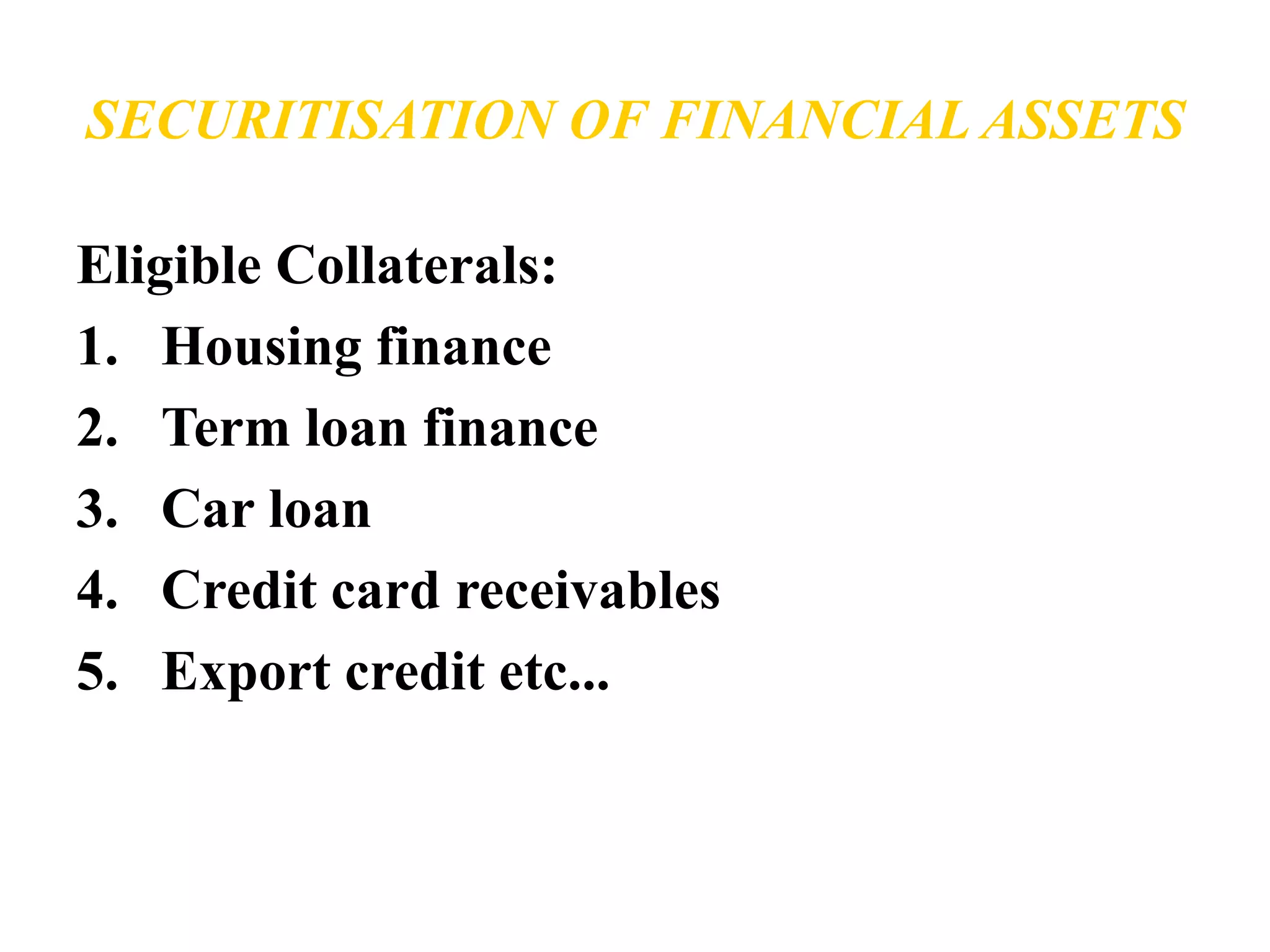
Eligible Collaterals: 
1. Housing finance 
2. Term loan finance 
3. Car loan 
4. Credit card receivables 
5. Export credit etc...
SECURITISATION OF FINANCIAL ASSETS 
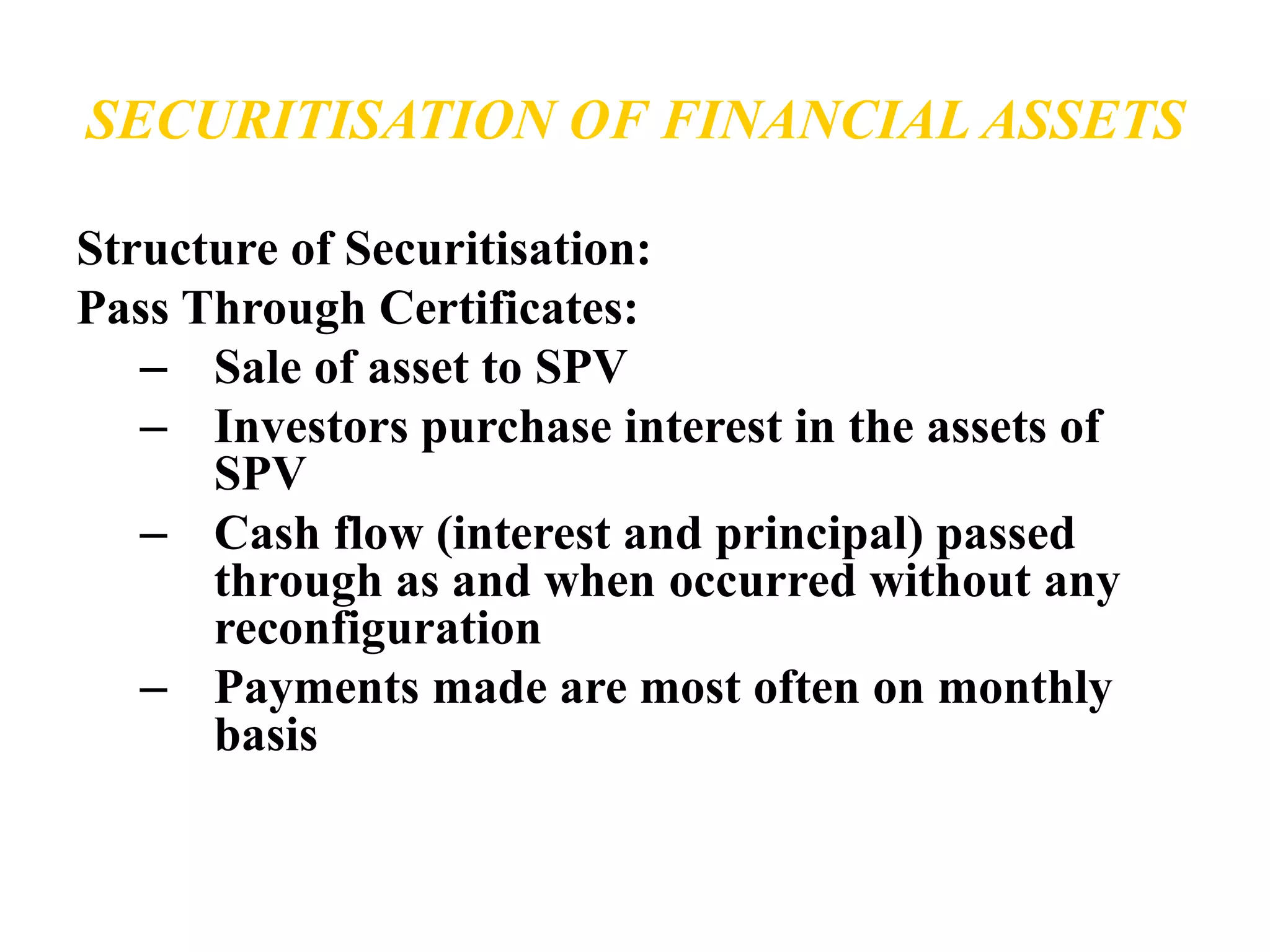
Structure of Securitisation: 
Pass Through Certificates: 
– Sale of asset to SPV 
– Investors purchase interest in the assets of 
SPV 
– Cash flow (interest and principal) passed 
through as and when occurred without any 
reconfiguration 
– Payments made are most often on monthly 
basis
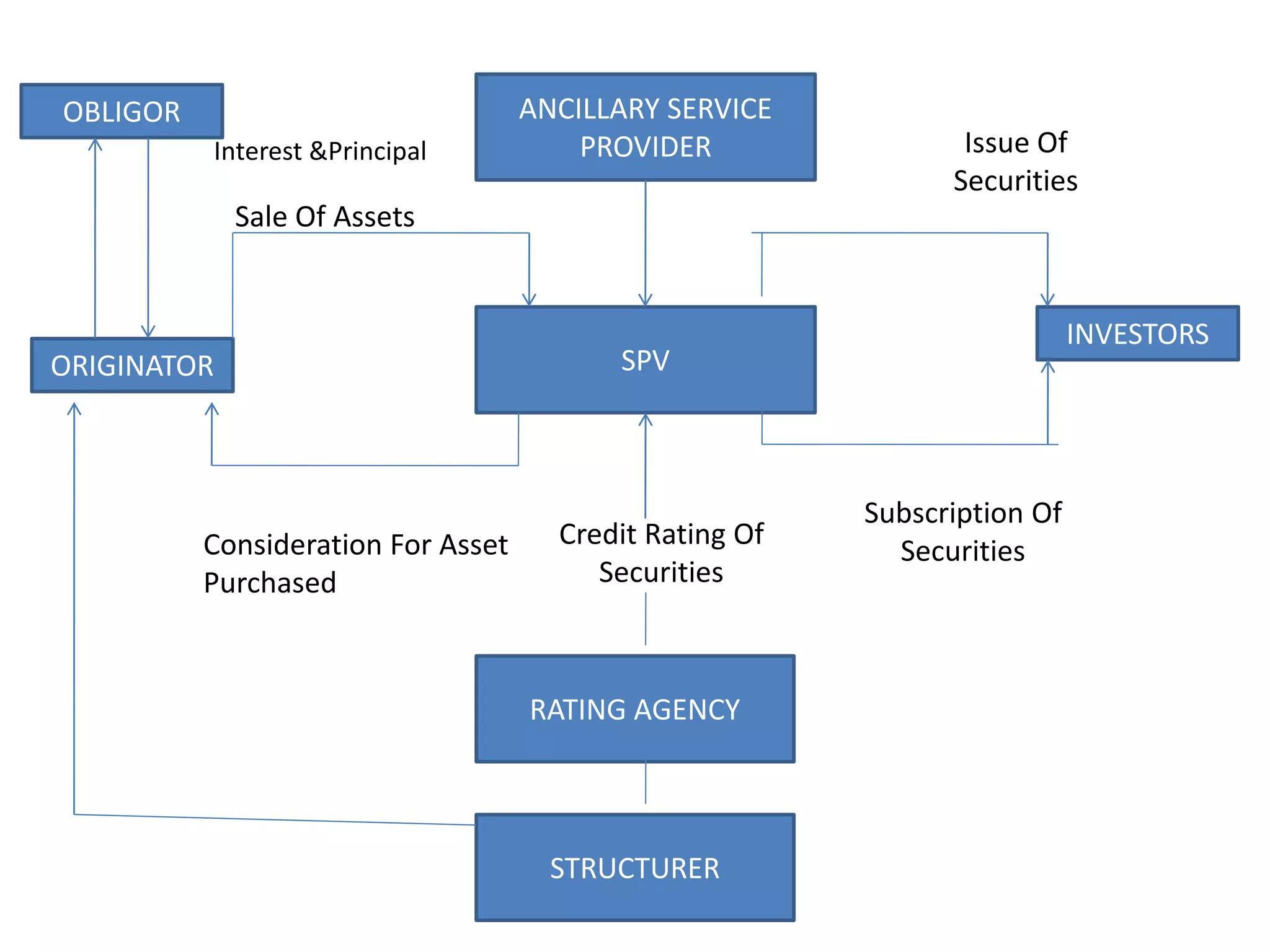
ANCILLARY SERVICE 
PROVIDER 
SPV 
RATING AGENCY 
STRUCTURER 
OBLIGOR 
ORIGINATOR 
Issue Of 
Securities 
INVESTORS 
Interest &Principal 
Sale Of Assets 
Consideration For Asset 
Purchased 
Credit Rating Of 
Securities 
Subscription Of 
Securities
SECURITISATION OF FINANCIAL ASSETS 
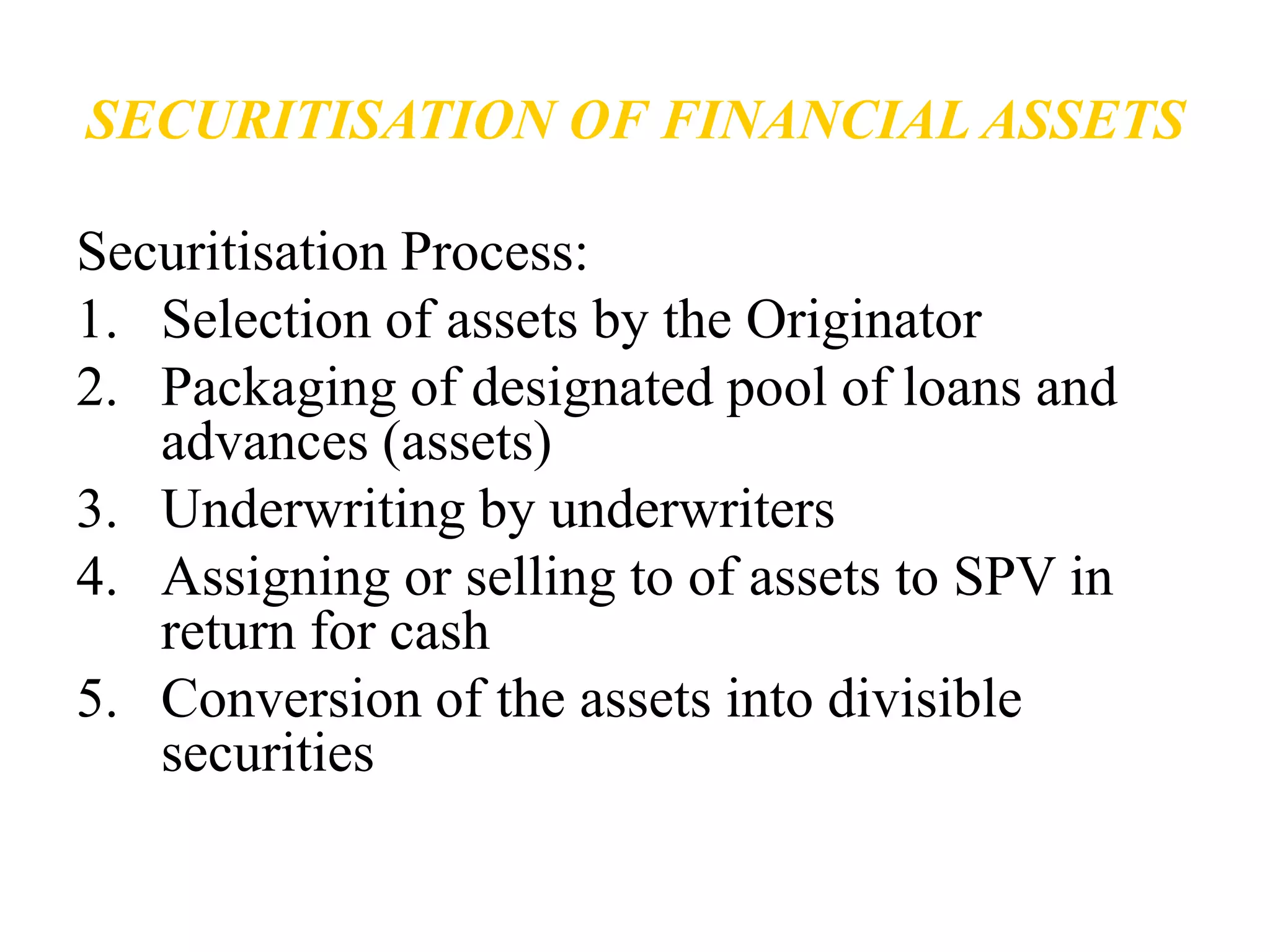
Securitisation Process: 
1. Selection of assets by the Originator 
2. Packaging of designated pool of loans and 
advances (assets) 
3. Underwriting by underwriters 
4. Assigning or selling to of assets to SPV in 
return for cash 
5. Conversion of the assets into divisible 
securities
SECURITISATION OF FINANCIAL ASSETS 
6. SPV sells them to investors through private 
placement or stock market in return for cash 
7. Investors receive income and return of capital 
from the assets over the life time of the securities 
8. The risk on the securities owned by investors is 
minimized as the securities are collateralisied by 
assets 
9. The difference between the rate of the borrowers 
and the return promised to investors is the 
servicing fee for originator and SPV
SECURITISATION OF FINANCIAL ASSETS 
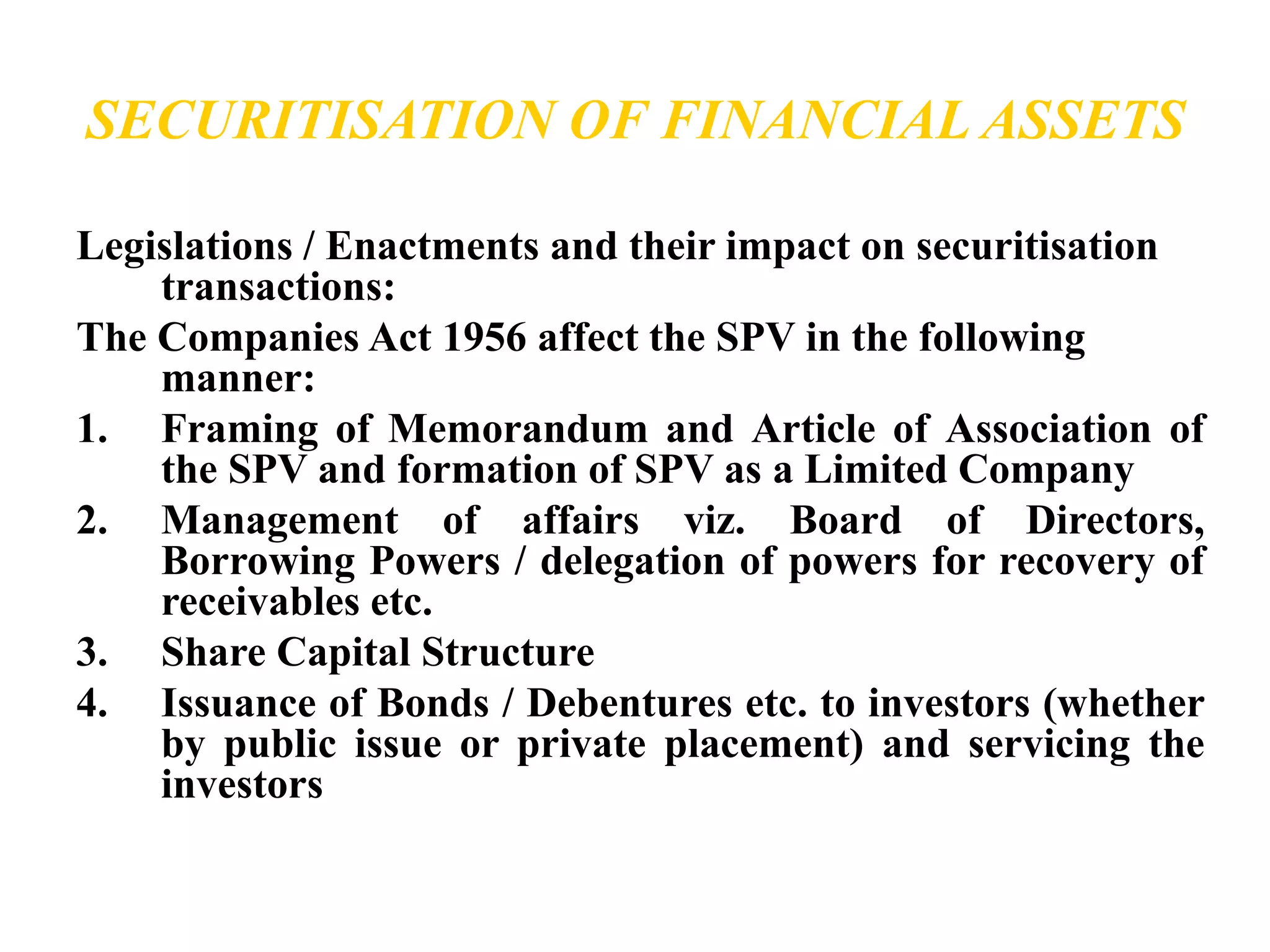
Legislations / Enactments and their impact on securitisation 
transactions: 
The Companies Act 1956 affect the SPV in the following 
manner: 
1. Framing of Memorandum and Article of Association of 
the SPV and formation of SPV as a Limited Company 
2. Management of affairs viz. Board of Directors, 
Borrowing Powers / delegation of powers for recovery of 
receivables etc. 
3. Share Capital Structure 
4. Issuance of Bonds / Debentures etc. to investors (whether 
by public issue or private placement) and servicing the 
investors
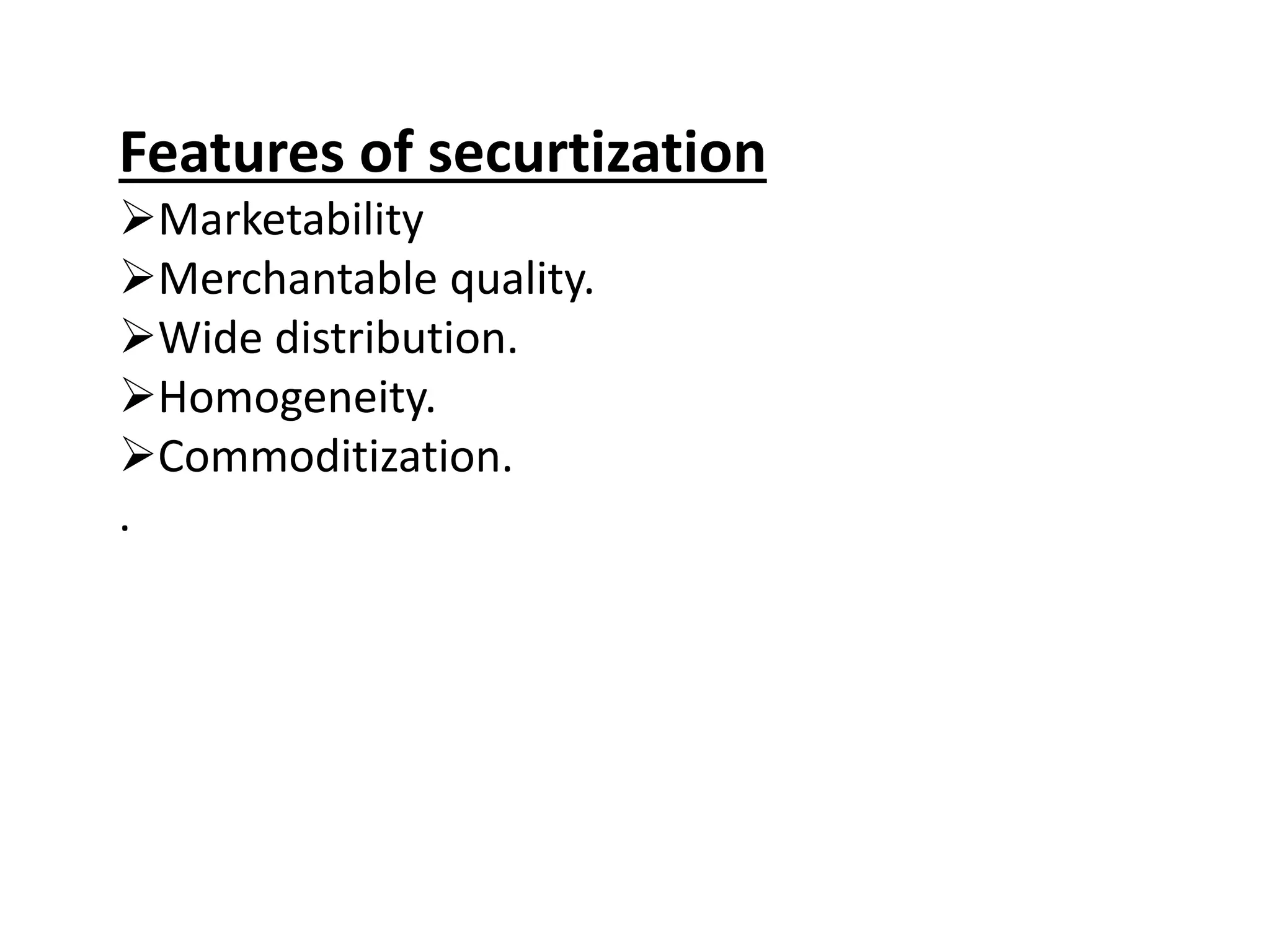
Features of securtization 
Marketability 
Merchantable quality. 
Wide distribution. 
Homogeneity. 
Commoditization. 
.
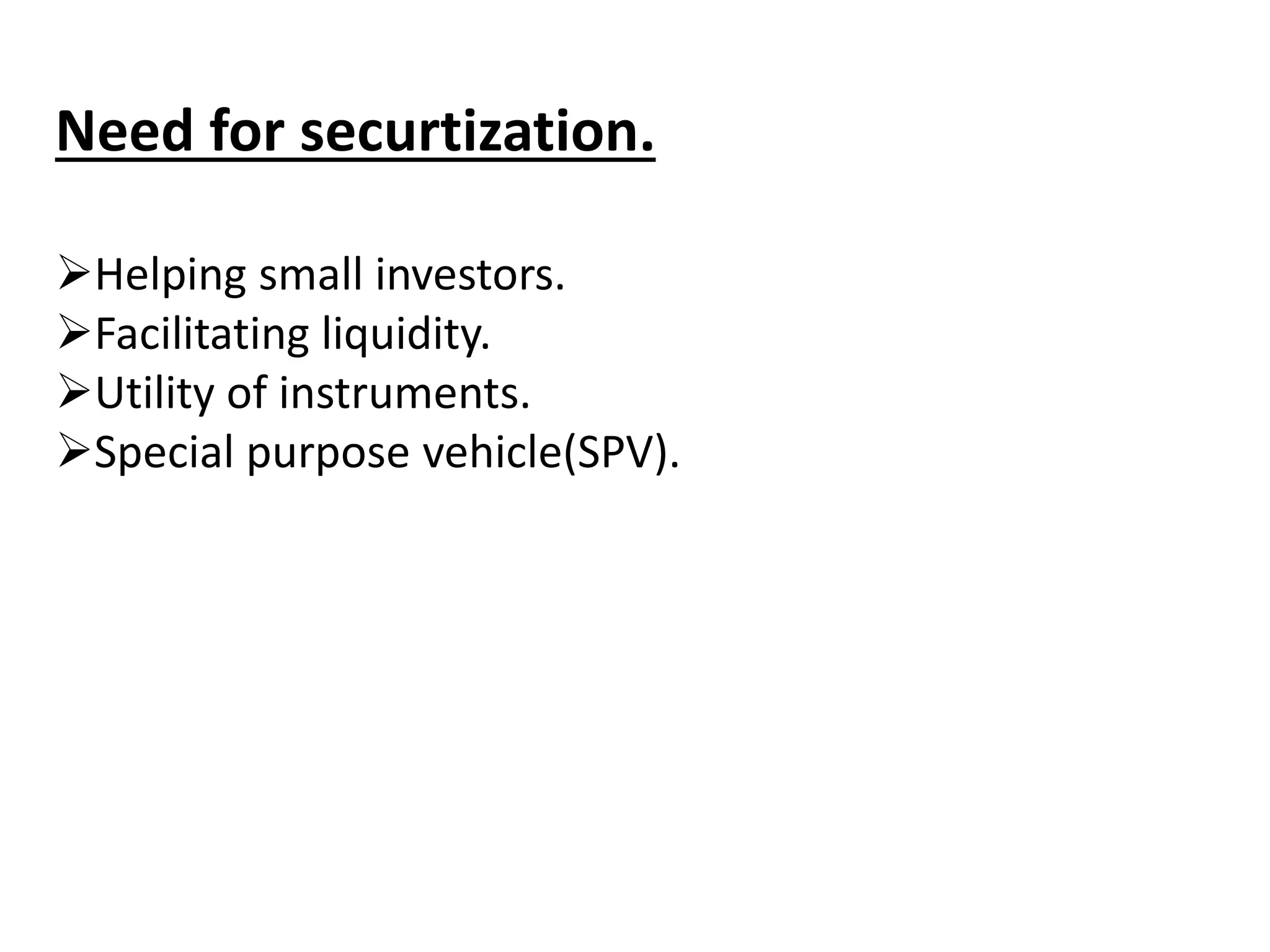
Need for securtization. 
Helping small investors. 
Facilitating liquidity. 
Utility of instruments. 
Special purpose vehicle(SPV).
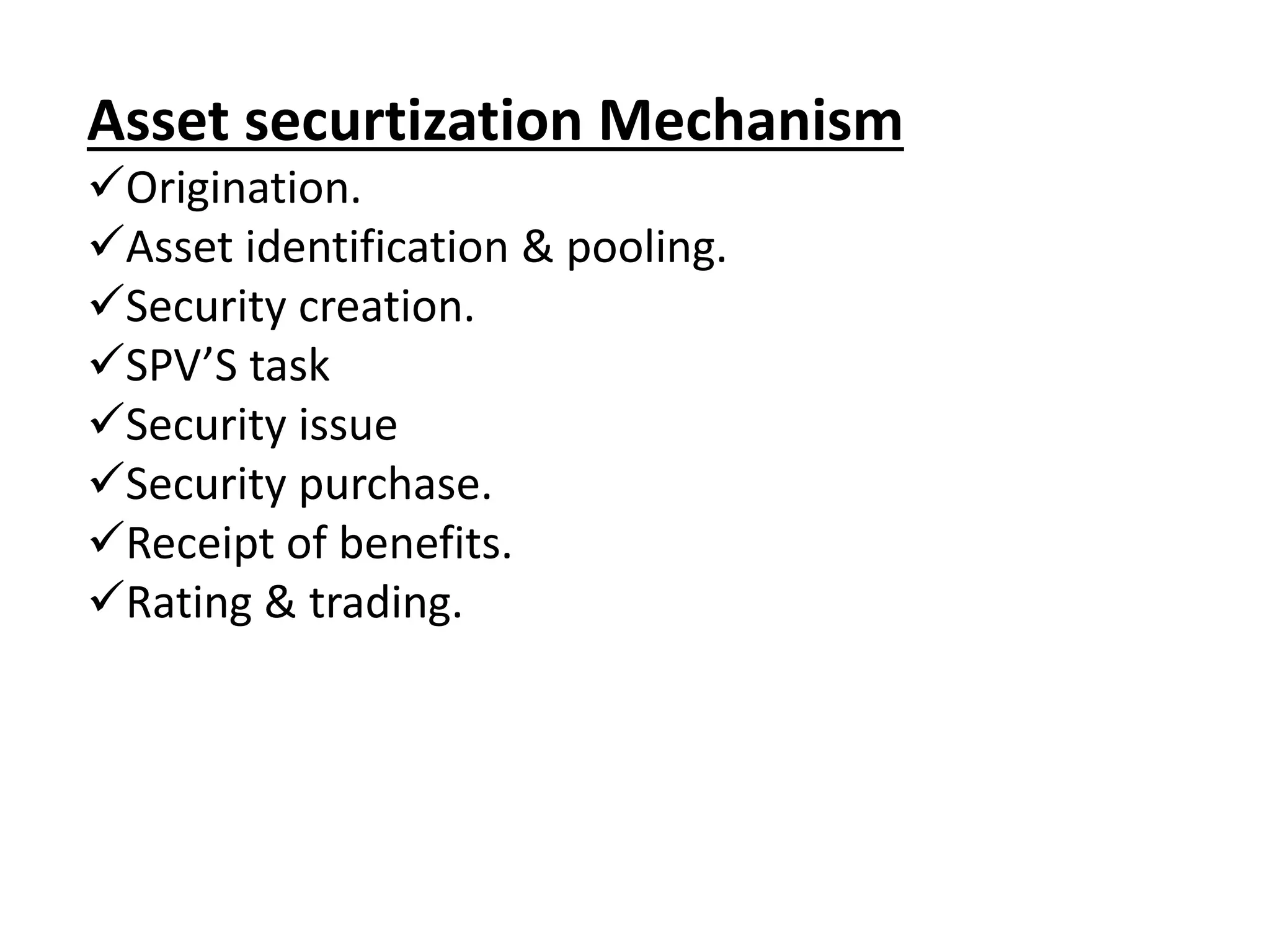
Asset securtization Mechanism 
Origination. 
Asset identification & pooling. 
Security creation. 
SPV’S task 
Security issue 
Security purchase. 
Receipt of benefits. 
Rating & trading.
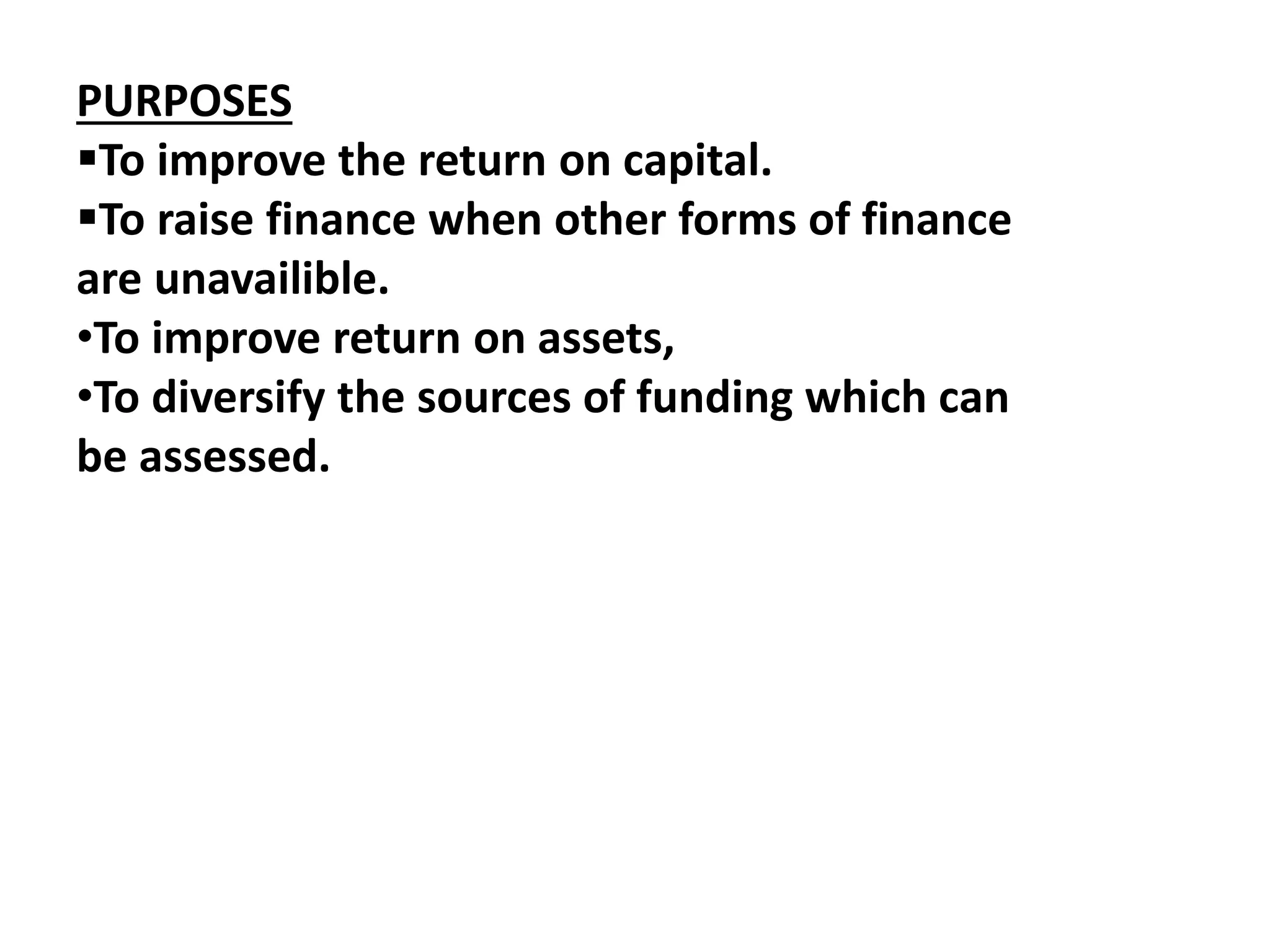
PURPOSES 
To improve the return on capital. 
To raise finance when other forms of finance 
are unavailible. 
•To improve return on assets, 
•To diversify the sources of funding which can 
be assessed.
Economic functions of securtization 
Creating financial market. 
Diversification. 
Promoting savings. 
Diversified risks. 
Focus on use of resources
Limitations of securtizations. 
Debility to central bank, 
Heightened volatility. 
Pressure on profitability.
By 
Moula hussain K

securtization & mortgage loans

  • 1.
    PRESENTATION ON SECURTIZATION& MORTGAGE LOANS A PART OF MERCHANT BANKING & FINANCIAL SERVICES
  • 2.
    What is securitization? What is mortgages? Name some mortgages companies in India.
  • 3.
    INTRODUCTION Securtization asa financing technique, is concerned with in securities, backed by pools of mortgage loans. The securities so created are known as Mortgages. Securitization refers to the process of turning assets into securities. When used in real estate, securitization means taking mortgages issued by the banks & other lenders & converting them into securities that can be sold to investors.  Financial instruments that can be readily bought & sold in financial markets, the way that stocks, bonds & futures contracts are traded.
  • 4.
    Definition The processof trading in the securities that are created on the backing of pools of mortgage loans from banks & financial institutions is called asset securitization .  Mortgage loans include housing loans, car & truck loans, credit card receivables, trade receivables, etc  A technique whereby assets are converted into securities, which are in turn converted into cash on an ongoing basis, with a view to allow for increasing turnover of business & profit, is known as asset securitization.  The technique provides for flexibility in yield, pricing pattern, issue risk & marketability of instruments, which is to the advantage of both borrowers & lenders.
  • 5.
    MORTGAGES COMPANIES ININDIA ARE HDFC LTD LIC Housing finance LTD. ICICI Home finance company LTD. PNB Housing finance LTD. CAN Finance homes ltd. BOB Housing finance ltd.
  • 6.
    Securitization Companies InIndia Are Asset Reconstruction Company India Ltd (Arcil) Mumbai. Aichemist Asset Reconstruction Company Ltd New Delhi. Reliance Asset Reconstruction Company Pvt Ltd. Mumbai.
  • 7.
    SECURITISATION OF FINANCIALASSETS Why Securitisation? 1. A convenient mechanism to suit changing needs of borrowers and lenders 2. Matches supply of funds with demand demands for funds through floating negotiable securities
  • 8.
    SECURITISATION OF FINANCIALASSETS Genesis and Growth: 1. Severe financial crisis faced by certain states in US during 1969-70 2. Federal government restriction on inter-state lending and borrowing 3. Raised funds from surplus states by issuing instruments backed by mortgaged properties
  • 9.
    SECURITISATION OF FINANCIALASSETS Elements of Securitisation: 1. Conversion of existing illiquid assets like loans, advances and receivables into tradable security 2. Reconverting them into fresh assets through capital market operations
  • 10.
    SECURITISATION OF FINANCIALASSETS Benefits of Securitisation: 1. Separates the credit risk of the assets from the credit risk of the Originator 2. Illiquid assets converted into marketable securities and thus provide alternate funding source
  • 11.
    SECURITISATION OF FINANCIALASSETS Benefits of Securitisation : 3. Remove assets from balance sheet and thus improve capital adequacy 4. Dependability of cash flows from the assets as signified by the ageing of the portfolio
  • 12.
    SECURITISATION OF FINANCIALASSETS The Players and their Role: 1. Originator: An entity making loans to borrowers or having receivables from customers 2. Special Purpose Vehicle: The entity which buys assets from Originator and packages them into security for further sale 3. Credit Enhancer: To reduce the overall credit risk of a security issue by providing senior subordinate structure, over-collateralization or a cash collateral
  • 13.
    SECURITISATION OF FINANCIALASSETS The Players and their Role: 4. Credit Rating Agency: To provide value addition to security 5. Insurance Company / Underwriters: To provide cover against redemption risk to investor and / or under-subscription 6. Obligors: Whose debts and collateral constitute the underlying assets of securitisation 7. Investor: The party to whom securities are sold
  • 14.
    SECURITISATION OF FINANCIALASSETS Requirements for Eligible Collaterals: 1. Assets to be securitised to be homogeneous in terms of: 2. Underlying assets 3. Maturity period 4. Cash flow profile
  • 15.
    SECURITISATION OF FINANCIALASSETS Eligible Collaterals: 1. Housing finance 2. Term loan finance 3. Car loan 4. Credit card receivables 5. Export credit etc...
  • 16.
    SECURITISATION OF FINANCIALASSETS Structure of Securitisation: Pass Through Certificates: – Sale of asset to SPV – Investors purchase interest in the assets of SPV – Cash flow (interest and principal) passed through as and when occurred without any reconfiguration – Payments made are most often on monthly basis
  • 17.
    ANCILLARY SERVICE PROVIDER SPV RATING AGENCY STRUCTURER OBLIGOR ORIGINATOR Issue Of Securities INVESTORS Interest &Principal Sale Of Assets Consideration For Asset Purchased Credit Rating Of Securities Subscription Of Securities
  • 18.
    SECURITISATION OF FINANCIALASSETS Securitisation Process: 1. Selection of assets by the Originator 2. Packaging of designated pool of loans and advances (assets) 3. Underwriting by underwriters 4. Assigning or selling to of assets to SPV in return for cash 5. Conversion of the assets into divisible securities
  • 19.
    SECURITISATION OF FINANCIALASSETS 6. SPV sells them to investors through private placement or stock market in return for cash 7. Investors receive income and return of capital from the assets over the life time of the securities 8. The risk on the securities owned by investors is minimized as the securities are collateralisied by assets 9. The difference between the rate of the borrowers and the return promised to investors is the servicing fee for originator and SPV
  • 20.
    SECURITISATION OF FINANCIALASSETS Legislations / Enactments and their impact on securitisation transactions: The Companies Act 1956 affect the SPV in the following manner: 1. Framing of Memorandum and Article of Association of the SPV and formation of SPV as a Limited Company 2. Management of affairs viz. Board of Directors, Borrowing Powers / delegation of powers for recovery of receivables etc. 3. Share Capital Structure 4. Issuance of Bonds / Debentures etc. to investors (whether by public issue or private placement) and servicing the investors
  • 21.
    Features of securtization Marketability Merchantable quality. Wide distribution. Homogeneity. Commoditization. .
  • 22.
    Need for securtization. Helping small investors. Facilitating liquidity. Utility of instruments. Special purpose vehicle(SPV).
  • 23.
    Asset securtization Mechanism Origination. Asset identification & pooling. Security creation. SPV’S task Security issue Security purchase. Receipt of benefits. Rating & trading.
  • 24.
    PURPOSES To improvethe return on capital. To raise finance when other forms of finance are unavailible. •To improve return on assets, •To diversify the sources of funding which can be assessed.
  • 25.
    Economic functions ofsecurtization Creating financial market. Diversification. Promoting savings. Diversified risks. Focus on use of resources
  • 26.
    Limitations of securtizations. Debility to central bank, Heightened volatility. Pressure on profitability.
  • 27.