Prepared by:


            Jimit Dhruv
         Elect.Engg,Dept.
Valiya Institute Of Technology-Valiya
Introduction
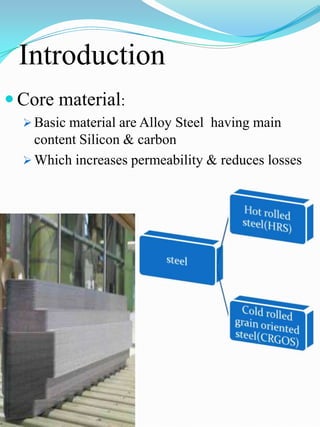
 Core material:
   Basic material are Alloy Steel having main
    content Silicon & carbon
   Which increases permeability & reduces losses
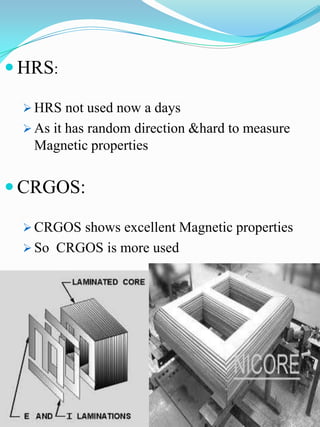
 HRS:

   HRS not used now a days
   As it has random direction &hard to measure
   Magnetic properties


 CRGOS:

   CRGOS shows excellent Magnetic properties
   So CRGOS is more used
Core construction
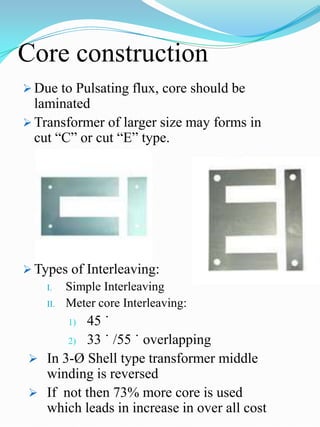
 Due to Pulsating flux, core should be
  laminated
 Transformer of larger size may forms in
  cut “C” or cut “E” type.


 Types of Interleaving:
    I.  Simple Interleaving
    II. Meter core Interleaving:

        1)45 ˙
       2) 33 ˙ /55 ˙ overlapping

  In 3-Ø Shell type transformer middle
   winding is reversed
  If not then 73% more core is used
   which leads in increase in over all cost
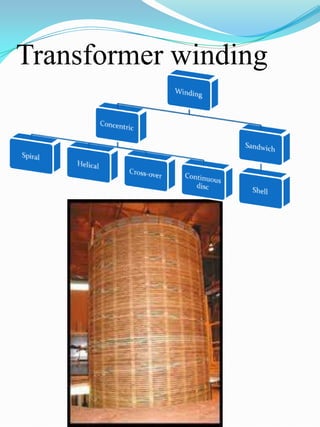
Transformer winding
Concentric
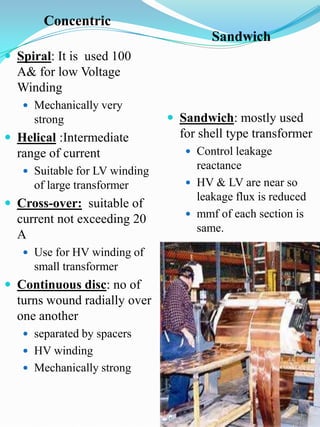
                                       Sandwich
 Spiral: It is used 100
  A& for low Voltage
  Winding
    Mechanically very
     strong                     Sandwich: mostly used
 Helical :Intermediate          for shell type transformer
  range of current                 Control leakage
    Suitable for LV winding
                                    reactance
     of large transformer          HV & LV are near so
                                    leakage flux is reduced
 Cross-over: suitable of
                                   mmf of each section is
  current not exceeding 20
                                    same.
  A
    Use for HV winding of
     small transformer
 Continuous disc: no of
  turns wound radially over
  one another
    separated by spacers
    HV winding
    Mechanically strong
Insulations
Two main kinds of Insulations:

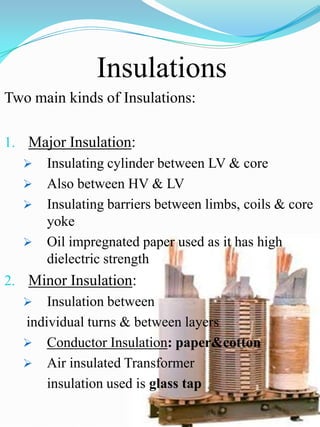
1. Major Insulation:
    Insulating cylinder between LV & core
    Also between HV & LV
    Insulating barriers between limbs, coils & core
       yoke
    Oil impregnated paper used as it has high
       dielectric strength
2. Minor Insulation:
    Insulation between
   individual turns & between layers
    Conductor Insulation: paper&cotton
    Air insulated Transformer
       insulation used is glass tap
Bushing
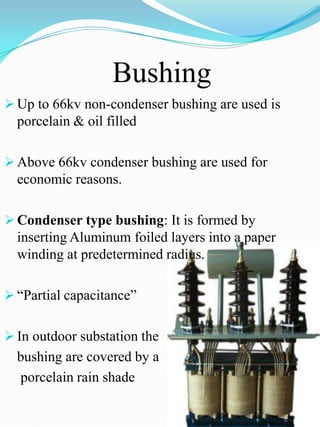
 Up to 66kv non-condenser bushing are used is
  porcelain & oil filled

 Above 66kv condenser bushing are used for
  economic reasons.

 Condenser type bushing: It is formed by
  inserting Aluminum foiled layers into a paper
  winding at predetermined radius.

 “Partial capacitance”


 In outdoor substation the
  bushing are covered by a
  porcelain rain shade
Tapping
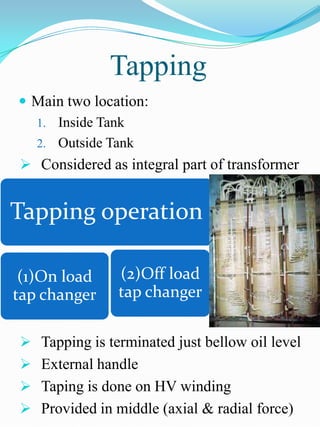
 Main two location:
  1. Inside Tank
  2. Outside Tank
 Considered as integral part of transformer


Tapping operation

 (1)On load    (2)Off load
tap changer    tap changer


 Tapping is terminated just bellow oil level
 External handle
 Taping is done on HV winding
 Provided in middle (axial & radial force)
Transformer Tank
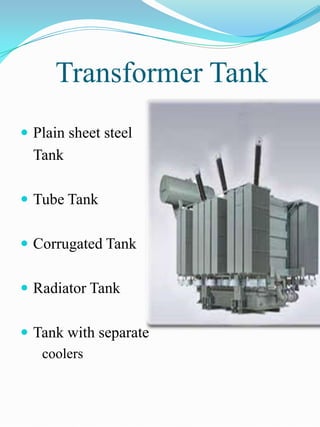
 Plain sheet steel
  Tank

 Tube Tank


 Corrugated Tank


 Radiator Tank


 Tank with separate
   coolers
Conservator
 What is Conservator ?


 The expansion of oil from Transformer
  tank takes up in Conservator


 When oil contracts, air from
  atmosphere enters in Conservator .

 Risk of contamination of oil in transformer


 Breather valve is mounted to avoide
  moisture

 Breather contain silica in it
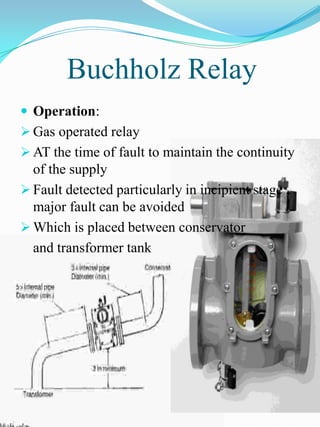
Buchholz Relay
 Operation:
 Gas operated relay
 AT the time of fault to maintain the continuity
  of the supply
 Fault detected particularly in incipient stage ,
  major fault can be avoided
 Which is placed between conservator
  and transformer tank
Transformer oil
 Double purpose :
   ie cooling & Insulating


 Permittivity is 2.5


 As per I.A.S breakdown strength of oil
  used must be 50kv RMS

 Major disadvantage is sluging


 To overcome this, synthetic oil is prefered


 One of the e.g is Chlorinated dephenyl is a
  synthetic oil its permittivity is 4.5
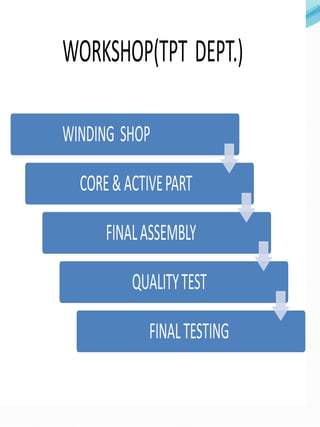
WORKSHOP(TPT DEPT.)

WINDING SHOP

  CORE & ACTIVE PART

      FINAL ASSEMBLY

          QUALITY TEST

             FINAL TESTING
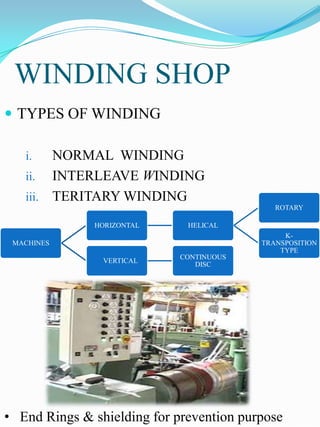
WINDING SHOP
 TYPES OF WINDING

   i.   NORMAL WINDING
   ii. INTERLEAVE WINDING
   iii. TERITARY WINDING
                                             ROTARY

              HORIZONTAL      HELICAL
                                               K-
 MACHINES                                 TRANSPOSITION
                                              TYPE
                             CONTINUOUS
                VERTICAL
                                DISC


• End Rings & shielding for prevention purpose
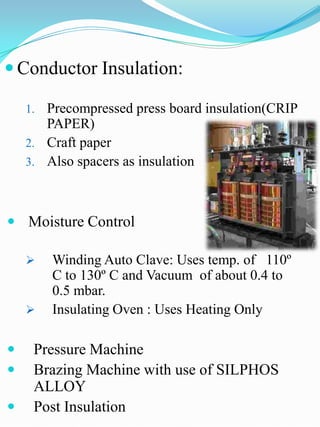
 Conductor Insulation:

    1. Precompressed press board insulation(CRIP
       PAPER)
    2. Craft paper
    3. Also spacers as insulation


 Moisture Control

        Winding Auto Clave: Uses temp. of 110º
         C to 130º C and Vacuum of about 0.4 to
         0.5 mbar.
        Insulating Oven : Uses Heating Only

    Pressure Machine
    Brazing Machine with use of SILPHOS
     ALLOY
    Post Insulation
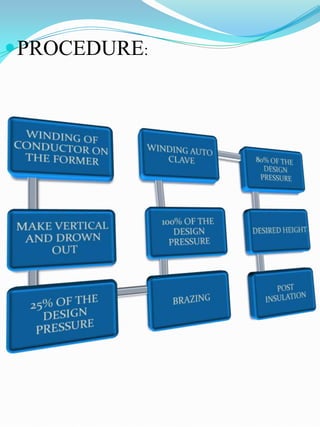
 PROCEDURE:
CORE & ACTIVE
 PART
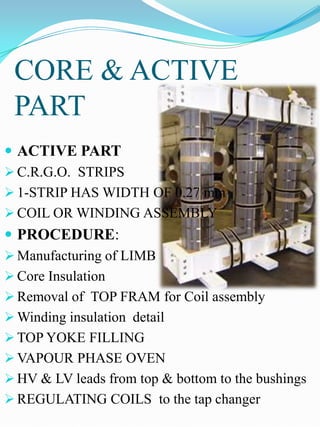
 ACTIVE PART
 C.R.G.O. STRIPS
 1-STRIP HAS WIDTH OF 0.27 mm
 COIL OR WINDING ASSEMBLY
 PROCEDURE:
 Manufacturing of LIMB
 Core Insulation
 Removal of TOP FRAM for Coil assembly
 Winding insulation detail
 TOP YOKE FILLING
 VAPOUR PHASE OVEN
 HV & LV leads from top & bottom to the bushings
 REGULATING COILS to the tap changer
FINAL ASSEMBLY
 Installation of active part and assembly of
  accessories
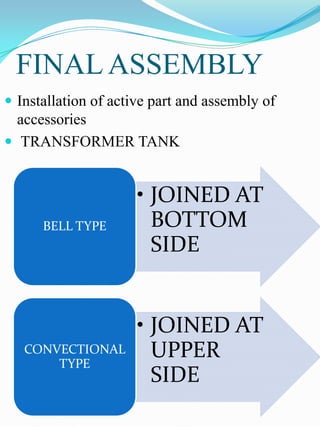
 TRANSFORMER TANK


                      • JOINED AT
      BELL TYPE         BOTTOM
                        SIDE


                      • JOINED AT
   CONVECTIONAL
       TYPE
                        UPPER
                        SIDE
 ACCESSORIES:

  Blanker : Leakage of oil & Radiators
  adjointment

  Buchholz Relay: To trip the transformer


  OSR (oil serge relay): To indicate the level
  and quality of oil

  MOLG(magnate oil gage): It indicates the
  level of oil in the conservator

  Breather Valve: Provide dry air using silica
   gel and have air seal of neoprene
  Cooling Equipment: Generally for cooling
   of oil in a tank
     1.   Radiators
     2.   Thermosyphan
 Method of Cooling:
    i.   ONAN
    ii. ONAF
    iii. OFAF
    iv. For very high temp using HEAT
         EXCHANGER


 CT(Current Transformer):Two
         purposes;
    1.     Winding temp indicator (WTI)
    2.     Oil temp indicator (OTI)
        BUSHINGS: The leads from top and
         bottom of the winding are brought out to a
         length of few cm only and the outdoor
         terminal of the transformer are provided
         by bushings
 PROCEDURE
  Vacuuming of Tank(up to 0.3 mbar) for about
   24hrs to 36hrs

  The Leak Rate Test with the use of water & air


  Oil Test which includes BDV & PPM


  Oil Filling


  After the IMPREGNATION TIME the whole
   accessories are to be attached.
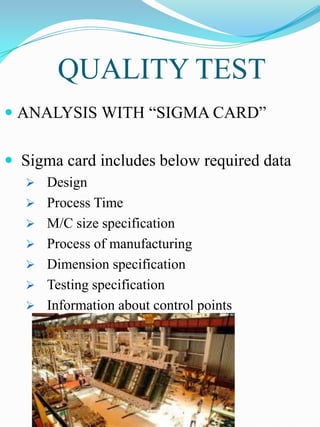
QUALITY TEST
 ANALYSIS WITH “SIGMA CARD”


 Sigma card includes below required data
    Design
    Process Time
    M/C size specification
    Process of manufacturing
    Dimension specification
    Testing specification
    Information about control points
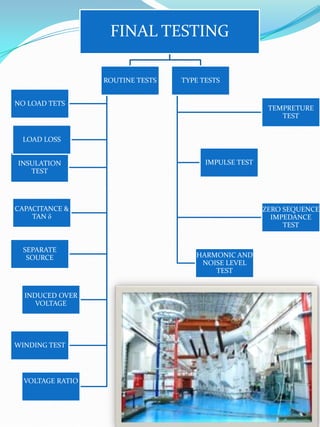
FINAL TESTING

                  ROUTINE TESTS   TYPE TESTS


NO LOAD TETS
                                                        TEMPRETURE
                                                           TEST


 LOAD LOSS


INSULATION                              IMPULSE TEST
   TEST


CAPACITANCE &                                          ZERO SEQUENCE
    TAN δ                                                IMPEDANCE
                                                            TEST


  SEPARATE
   SOURCE                            HARMONIC AND
                                      NOISE LEVEL
                                         TEST


  INDUCED OVER
     VOLTAGE


WINDING TEST


  VOLTAGE RATIO
CT (CURRENT TRANSFORMER)
 Generally CT is use for the below four
  purposes:
    Measurement of Current
    Measurement of Power
    Isolation between High voltage and Low Voltage
    Inputs to Relays & Protection Systems
 PROCEDURE OF CURRENT
  TRANSFORMER:
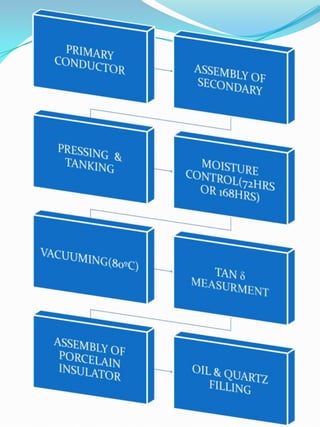
 CO NDUCTORS USES :ALUMINIUM OR
  COPPER(HIGH CURRENT RATING)

 In the manufacturing of the primary winding or
  protection core there will be the creation of the
  capacitance as below.

    GRADING & SUB GRADING.
    MAIN GRADING HAS WRAPPED
     ALUMINIUM FOIL & CRIP PAPER
    AT 300MM DISTANCE PERFORATED ALU.
     FOIL (400MM) AND CRIP PAPER.
    SIMULTANEOUSLY INSULATION MAKE
     CAPACITANCE
 Quartz in CT

 Reduces the quantity of oil
 Provides mechanical strength for the
    conductors
   Improves the quality of oil by absorbing
    moisture
   Being a bad conductor of heat, it allows slow
    heating /cooling of the CT.
    Finally expansion tank is attached and after
    that evacuation of oil and gas filling will be
    there .
   There is also one imp term is D3 point which
    is also called the earth point.
Thank You

PRESENTATION ON MANUFACTURING OF TRANSFORMER By Dhruv Jimit

  • 1.
    Prepared by: Jimit Dhruv Elect.Engg,Dept. Valiya Institute Of Technology-Valiya
  • 2.
    Introduction  Core material:  Basic material are Alloy Steel having main content Silicon & carbon  Which increases permeability & reduces losses
  • 3.
     HRS:  HRS not used now a days  As it has random direction &hard to measure Magnetic properties  CRGOS:  CRGOS shows excellent Magnetic properties  So CRGOS is more used
  • 4.
    Core construction  Dueto Pulsating flux, core should be laminated  Transformer of larger size may forms in cut “C” or cut “E” type.  Types of Interleaving: I. Simple Interleaving II. Meter core Interleaving: 1)45 ˙ 2) 33 ˙ /55 ˙ overlapping  In 3-Ø Shell type transformer middle winding is reversed  If not then 73% more core is used which leads in increase in over all cost
  • 5.
  • 6.
    Concentric Sandwich  Spiral: It is used 100 A& for low Voltage Winding  Mechanically very strong  Sandwich: mostly used  Helical :Intermediate for shell type transformer range of current  Control leakage  Suitable for LV winding reactance of large transformer  HV & LV are near so leakage flux is reduced  Cross-over: suitable of  mmf of each section is current not exceeding 20 same. A  Use for HV winding of small transformer  Continuous disc: no of turns wound radially over one another  separated by spacers  HV winding  Mechanically strong
  • 7.
    Insulations Two main kindsof Insulations: 1. Major Insulation:  Insulating cylinder between LV & core  Also between HV & LV  Insulating barriers between limbs, coils & core yoke  Oil impregnated paper used as it has high dielectric strength 2. Minor Insulation:  Insulation between individual turns & between layers  Conductor Insulation: paper&cotton  Air insulated Transformer insulation used is glass tap
  • 8.
    Bushing  Up to66kv non-condenser bushing are used is porcelain & oil filled  Above 66kv condenser bushing are used for economic reasons.  Condenser type bushing: It is formed by inserting Aluminum foiled layers into a paper winding at predetermined radius.  “Partial capacitance”  In outdoor substation the bushing are covered by a porcelain rain shade
  • 9.
    Tapping  Main twolocation: 1. Inside Tank 2. Outside Tank  Considered as integral part of transformer Tapping operation (1)On load (2)Off load tap changer tap changer  Tapping is terminated just bellow oil level  External handle  Taping is done on HV winding  Provided in middle (axial & radial force)
  • 10.
    Transformer Tank  Plainsheet steel Tank  Tube Tank  Corrugated Tank  Radiator Tank  Tank with separate coolers
  • 11.
    Conservator  What isConservator ?  The expansion of oil from Transformer tank takes up in Conservator  When oil contracts, air from atmosphere enters in Conservator .  Risk of contamination of oil in transformer  Breather valve is mounted to avoide moisture  Breather contain silica in it
  • 12.
    Buchholz Relay  Operation: Gas operated relay  AT the time of fault to maintain the continuity of the supply  Fault detected particularly in incipient stage , major fault can be avoided  Which is placed between conservator and transformer tank
  • 13.
    Transformer oil  Doublepurpose :  ie cooling & Insulating  Permittivity is 2.5  As per I.A.S breakdown strength of oil used must be 50kv RMS  Major disadvantage is sluging  To overcome this, synthetic oil is prefered  One of the e.g is Chlorinated dephenyl is a synthetic oil its permittivity is 4.5
  • 14.
    WORKSHOP(TPT DEPT.) WINDING SHOP CORE & ACTIVE PART FINAL ASSEMBLY QUALITY TEST FINAL TESTING
  • 15.
    WINDING SHOP  TYPESOF WINDING i. NORMAL WINDING ii. INTERLEAVE WINDING iii. TERITARY WINDING ROTARY HORIZONTAL HELICAL K- MACHINES TRANSPOSITION TYPE CONTINUOUS VERTICAL DISC • End Rings & shielding for prevention purpose
  • 16.
     Conductor Insulation: 1. Precompressed press board insulation(CRIP PAPER) 2. Craft paper 3. Also spacers as insulation  Moisture Control  Winding Auto Clave: Uses temp. of 110º C to 130º C and Vacuum of about 0.4 to 0.5 mbar.  Insulating Oven : Uses Heating Only  Pressure Machine  Brazing Machine with use of SILPHOS ALLOY  Post Insulation
  • 17.
  • 18.
    CORE & ACTIVE PART  ACTIVE PART  C.R.G.O. STRIPS  1-STRIP HAS WIDTH OF 0.27 mm  COIL OR WINDING ASSEMBLY  PROCEDURE:  Manufacturing of LIMB  Core Insulation  Removal of TOP FRAM for Coil assembly  Winding insulation detail  TOP YOKE FILLING  VAPOUR PHASE OVEN  HV & LV leads from top & bottom to the bushings  REGULATING COILS to the tap changer
  • 19.
    FINAL ASSEMBLY  Installationof active part and assembly of accessories  TRANSFORMER TANK • JOINED AT BELL TYPE BOTTOM SIDE • JOINED AT CONVECTIONAL TYPE UPPER SIDE
  • 20.
     ACCESSORIES: Blanker : Leakage of oil & Radiators adjointment  Buchholz Relay: To trip the transformer  OSR (oil serge relay): To indicate the level and quality of oil  MOLG(magnate oil gage): It indicates the level of oil in the conservator  Breather Valve: Provide dry air using silica gel and have air seal of neoprene  Cooling Equipment: Generally for cooling of oil in a tank 1. Radiators 2. Thermosyphan
  • 21.
     Method ofCooling: i. ONAN ii. ONAF iii. OFAF iv. For very high temp using HEAT EXCHANGER  CT(Current Transformer):Two purposes; 1. Winding temp indicator (WTI) 2. Oil temp indicator (OTI)  BUSHINGS: The leads from top and bottom of the winding are brought out to a length of few cm only and the outdoor terminal of the transformer are provided by bushings
  • 22.
     PROCEDURE Vacuuming of Tank(up to 0.3 mbar) for about 24hrs to 36hrs  The Leak Rate Test with the use of water & air  Oil Test which includes BDV & PPM  Oil Filling  After the IMPREGNATION TIME the whole accessories are to be attached.
  • 23.
    QUALITY TEST  ANALYSISWITH “SIGMA CARD”  Sigma card includes below required data  Design  Process Time  M/C size specification  Process of manufacturing  Dimension specification  Testing specification  Information about control points
  • 24.
    FINAL TESTING ROUTINE TESTS TYPE TESTS NO LOAD TETS TEMPRETURE TEST LOAD LOSS INSULATION IMPULSE TEST TEST CAPACITANCE & ZERO SEQUENCE TAN δ IMPEDANCE TEST SEPARATE SOURCE HARMONIC AND NOISE LEVEL TEST INDUCED OVER VOLTAGE WINDING TEST VOLTAGE RATIO
  • 25.
    CT (CURRENT TRANSFORMER) Generally CT is use for the below four purposes:  Measurement of Current  Measurement of Power  Isolation between High voltage and Low Voltage  Inputs to Relays & Protection Systems  PROCEDURE OF CURRENT TRANSFORMER:  CO NDUCTORS USES :ALUMINIUM OR COPPER(HIGH CURRENT RATING)  In the manufacturing of the primary winding or protection core there will be the creation of the capacitance as below.  GRADING & SUB GRADING.  MAIN GRADING HAS WRAPPED ALUMINIUM FOIL & CRIP PAPER  AT 300MM DISTANCE PERFORATED ALU. FOIL (400MM) AND CRIP PAPER.  SIMULTANEOUSLY INSULATION MAKE CAPACITANCE
  • 27.
     Quartz inCT  Reduces the quantity of oil  Provides mechanical strength for the conductors  Improves the quality of oil by absorbing moisture  Being a bad conductor of heat, it allows slow heating /cooling of the CT.  Finally expansion tank is attached and after that evacuation of oil and gas filling will be there .  There is also one imp term is D3 point which is also called the earth point.
  • 28.