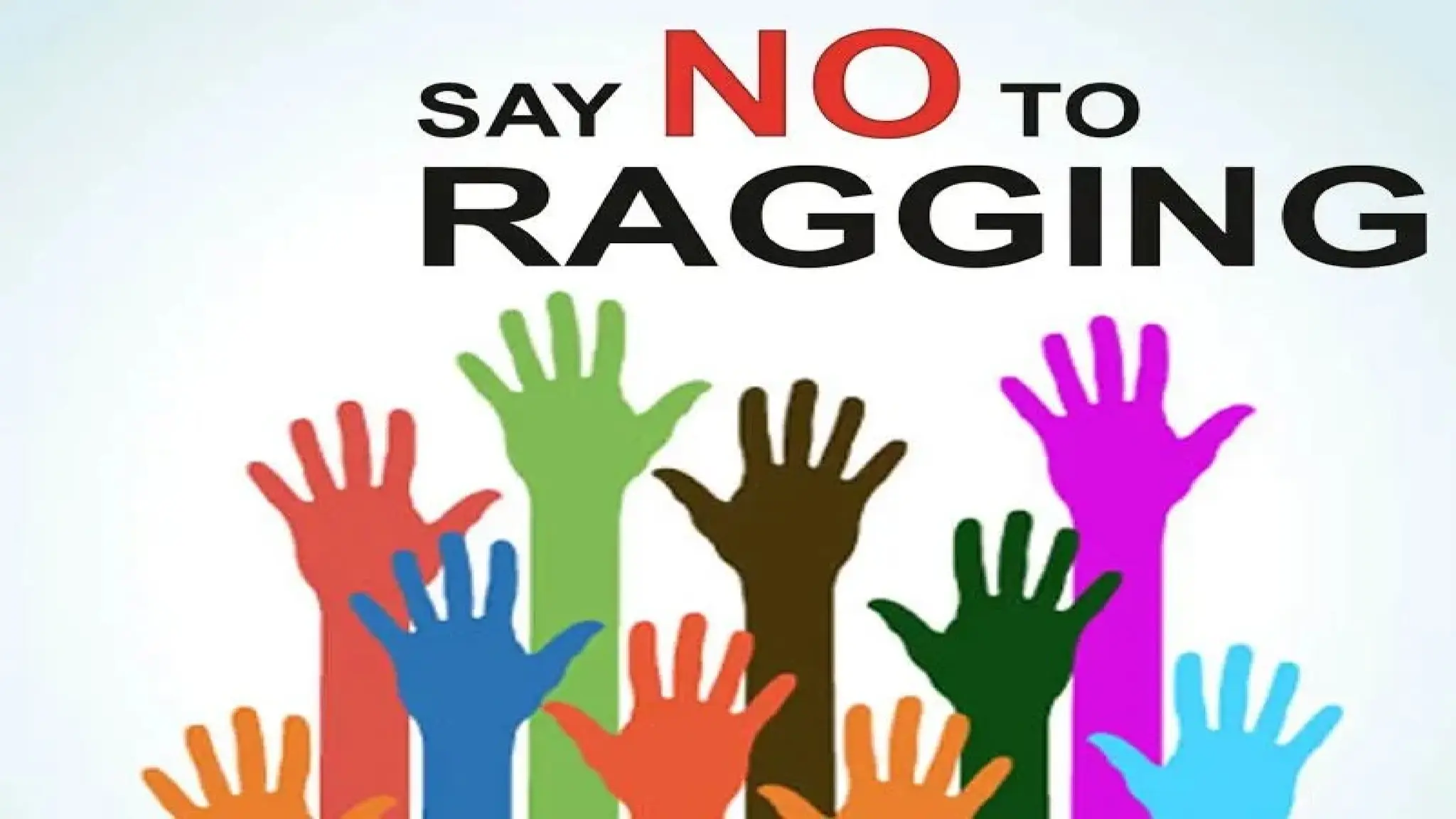
Anti-Ragging Day
BY TANISH BAGHEL
The Supreme Court of India has
defined ragging as –
 "Ragging is any disorderly conduct, whether by words spoken or
written, or by an act which has the effect of teasing, treating or
handling with rudeness any student, indulging in rowdy or
undisciplined activities which cause or are likely to cause
annoyance, hardship or psychological harm or to raise fear or
apprehension thereof in a fresher or a junior student and which has
the effect of causing or generating a sense of shame or
embarrassment so as to adversely affect the psyche of a fresher or
a junior student."
Where has Ragging come from?
 The ragging problem is a legacy of the British.■
 Who imported the practice to India from public schools back home.
 But while experts say extreme forms of hazing have all but
disappeared in Britain, they continue in India and other Asian
countries.
Types of Ragging
 Mild Ragging :Mild ragging helps in breaking the ice between the
seniors and the juniors. It provides a platform for the juniors and the
seniors to interact.
 Severe Ragging :Ragging which leads to mental trauma, or instills a
fear in the minds of the juniors, in sometimes can also be the
cause of deaths.
Reason of ragging
 Discrimination based on caste, region, language, class etc. plays a
vital role in influencing it, especially in small cities and towns.
 Ragging is used as a measuring rod to test the courage of the
seniors. Many seniors who are reluctant to rag, finally succumb to
peer pressure. Many seniors rag just to stay in their group of friends.In
many instances it starts as a healthy interaction but due to
adrenaline rush and excitement in the group the seniors get carried
away and ragging turns ugly.
 Students consider ragging as an old rituals having
social acceptance.
Still prevalent
 Despite ban in almost all colleges, it has not been very effective, as
seen by the number of ragging cases still reported by the media.
 This has expanded its tentacles so wide that we started getting
shocking news every now & then in the form of loss of precious
human life...
 Recent death of an engineering student is another example which
depicts the limitless boundaries of this social problem.
 It still sends chills down the spine whenever the topic of
ragging comes up...
Fictional work
 Fictional works like novels, films, dramas also depict ragging in
various ways according to their whims & fancies.
 At times lighter & at times very serious.
 Movies like 3 Idiots & Munna Bhai MBBS have depicted ragging in a
very light hearted way
 In other films forms of ragging like eve teasing, insulting and mocking
the teachers are often glorified
Ways of ragging
 Dress code ragging- Often an awkward & uncomfortable dress
code is imposed.
 Formal introduction- Introduce themselves in pure local language.
 Verbal torture- indulging in loose talks
 Playing the fool- asked to enact scenes, do silly things.
 Hostel ragging- asked to do odd things
 Drug abuse & Sexual abuse- severest form
Psychology of raggers
 Gives a sense of Authority → boosts morale of a person → puts
him/her on high.
 An attitude of "I give back, what I got before“
 Gratification of Sadistic tendencies- a good opportunity to satiate
ones sadistic demands.
 Makes a Fashion statement- many think that ragging will put them
on a different pedestal in their college.
 Peer pressure
Effects on victim
 Ragging or even the very thought about it- provokes Stress.
 Stress is a mind and body response or reaction to a real or imagined
threat, event or change.
 Effects seen are-Psychological problems
 Cognitive changes
 Behavioral problems
 Physical problems
 Other reactions to stressful events
Psychological problems-
 Anxiety (most common)
 Negative self image, reduced self esteem & loss of faith
 Anger, Irritability, Nightmares
Cognitive changes-
 Lack of concentration & attention
 Reduced productivity
 Forgetfulness, Errors of judgment
Origin of Anit ragging act
 Raghavan Committee Report submitted in 2007Problem of ragging
was questioned by Vishwa Jagriti Missions, leading the Honorable
Supreme Court to give directions to curb ragging.
 But the problem was not abated & horrifying cases were still being
reported.
 This compelled the Honorable Supreme Court to form a committee
to look into this matter. Raghavan committee was appointed by
Union Human Resource Development ministry under Supreme Court
directive.
 chairman RK Raghavan.
Key recommendations
 Inclusion of ragging for accreditation by Central regulatory bodies
for educational institutions.
 Recommended anti-ragging cells at the central, state and college
level.
 Psychological counselling on anti-ragging and human rights at the
senior secondary school level..
 Establishing of a stringent anti-ragging law..
 Toll free helpline for ragging victims (1800-180-5522)
Recommended actions to be
taken by the authorities
 Appropriate committee to actively monitor, promote & regulate
healthy interaction between fresher's & seniors.
 Involve students in matters of institution, may make students feel
that they are responsible partners.
 Organization of fresher's welcome parties-For proper introduction
 Bring out talents without element of indecency
 Presence of faculty- prevent crossing limits of decency
Legal Provisions Addressing
Ragging in India
• Indian Penal Code (IPC) Provisions:
• Wrongful Restraint (Section 339): Criminalized when someone is
prevented from moving in a direction they have the right to proceed.
Penalty: Simple imprisonment up to 1 month, fine up to Rs 500, or both.
• Wrongful Confinement (Section 340): Criminalized when someone is
wrongfully restrained within certain limits. Penalty: Varies based on the
severity of the act.
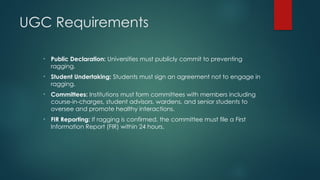
UGC Requirements
• Public Declaration: Universities must publicly commit to preventing
ragging.
• Student Undertaking: Students must sign an agreement not to engage in
ragging.
• Committees: Institutions must form committees with members including
course-in-charges, student advisors, wardens, and senior students to
oversee and promote healthy interactions.
• FIR Reporting: If ragging is confirmed, the committee must file a First
Information Report (FIR) within 24 hours.
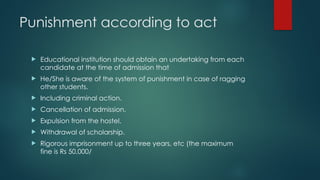
Punishment according to act
 Educational institution should obtain an undertaking from each
candidate at the time of admission that
 He/She is aware of the system of punishment in case of ragging
other students.
 Including criminal action.
 Cancellation of admission.
 Expulsion from the hostel.
 Withdrawal of scholarship.
 Rigorous imprisonment up to three years, etc (the maximum
fine is Rs 50,000/
THANK YOU

Presentation on anti ragging awareness.pptx

  • 2.
  • 3.
    The Supreme Courtof India has defined ragging as –  "Ragging is any disorderly conduct, whether by words spoken or written, or by an act which has the effect of teasing, treating or handling with rudeness any student, indulging in rowdy or undisciplined activities which cause or are likely to cause annoyance, hardship or psychological harm or to raise fear or apprehension thereof in a fresher or a junior student and which has the effect of causing or generating a sense of shame or embarrassment so as to adversely affect the psyche of a fresher or a junior student."
  • 4.
    Where has Raggingcome from?  The ragging problem is a legacy of the British.■  Who imported the practice to India from public schools back home.  But while experts say extreme forms of hazing have all but disappeared in Britain, they continue in India and other Asian countries.
  • 5.
    Types of Ragging Mild Ragging :Mild ragging helps in breaking the ice between the seniors and the juniors. It provides a platform for the juniors and the seniors to interact.  Severe Ragging :Ragging which leads to mental trauma, or instills a fear in the minds of the juniors, in sometimes can also be the cause of deaths.
  • 6.
    Reason of ragging Discrimination based on caste, region, language, class etc. plays a vital role in influencing it, especially in small cities and towns.  Ragging is used as a measuring rod to test the courage of the seniors. Many seniors who are reluctant to rag, finally succumb to peer pressure. Many seniors rag just to stay in their group of friends.In many instances it starts as a healthy interaction but due to adrenaline rush and excitement in the group the seniors get carried away and ragging turns ugly.  Students consider ragging as an old rituals having social acceptance.
  • 7.
    Still prevalent  Despiteban in almost all colleges, it has not been very effective, as seen by the number of ragging cases still reported by the media.  This has expanded its tentacles so wide that we started getting shocking news every now & then in the form of loss of precious human life...  Recent death of an engineering student is another example which depicts the limitless boundaries of this social problem.  It still sends chills down the spine whenever the topic of ragging comes up...
  • 8.
    Fictional work  Fictionalworks like novels, films, dramas also depict ragging in various ways according to their whims & fancies.  At times lighter & at times very serious.  Movies like 3 Idiots & Munna Bhai MBBS have depicted ragging in a very light hearted way  In other films forms of ragging like eve teasing, insulting and mocking the teachers are often glorified
  • 9.
    Ways of ragging Dress code ragging- Often an awkward & uncomfortable dress code is imposed.  Formal introduction- Introduce themselves in pure local language.  Verbal torture- indulging in loose talks  Playing the fool- asked to enact scenes, do silly things.  Hostel ragging- asked to do odd things  Drug abuse & Sexual abuse- severest form
  • 10.
    Psychology of raggers Gives a sense of Authority → boosts morale of a person → puts him/her on high.  An attitude of "I give back, what I got before“  Gratification of Sadistic tendencies- a good opportunity to satiate ones sadistic demands.  Makes a Fashion statement- many think that ragging will put them on a different pedestal in their college.  Peer pressure
  • 11.
    Effects on victim Ragging or even the very thought about it- provokes Stress.  Stress is a mind and body response or reaction to a real or imagined threat, event or change.  Effects seen are-Psychological problems  Cognitive changes  Behavioral problems  Physical problems  Other reactions to stressful events
  • 12.
    Psychological problems-  Anxiety(most common)  Negative self image, reduced self esteem & loss of faith  Anger, Irritability, Nightmares Cognitive changes-  Lack of concentration & attention  Reduced productivity  Forgetfulness, Errors of judgment
  • 13.
    Origin of Anitragging act  Raghavan Committee Report submitted in 2007Problem of ragging was questioned by Vishwa Jagriti Missions, leading the Honorable Supreme Court to give directions to curb ragging.  But the problem was not abated & horrifying cases were still being reported.  This compelled the Honorable Supreme Court to form a committee to look into this matter. Raghavan committee was appointed by Union Human Resource Development ministry under Supreme Court directive.  chairman RK Raghavan.
  • 14.
    Key recommendations  Inclusionof ragging for accreditation by Central regulatory bodies for educational institutions.  Recommended anti-ragging cells at the central, state and college level.  Psychological counselling on anti-ragging and human rights at the senior secondary school level..  Establishing of a stringent anti-ragging law..  Toll free helpline for ragging victims (1800-180-5522)
  • 15.
    Recommended actions tobe taken by the authorities  Appropriate committee to actively monitor, promote & regulate healthy interaction between fresher's & seniors.  Involve students in matters of institution, may make students feel that they are responsible partners.  Organization of fresher's welcome parties-For proper introduction  Bring out talents without element of indecency  Presence of faculty- prevent crossing limits of decency
  • 16.
    Legal Provisions Addressing Raggingin India • Indian Penal Code (IPC) Provisions: • Wrongful Restraint (Section 339): Criminalized when someone is prevented from moving in a direction they have the right to proceed. Penalty: Simple imprisonment up to 1 month, fine up to Rs 500, or both. • Wrongful Confinement (Section 340): Criminalized when someone is wrongfully restrained within certain limits. Penalty: Varies based on the severity of the act.
  • 17.
    UGC Requirements • PublicDeclaration: Universities must publicly commit to preventing ragging. • Student Undertaking: Students must sign an agreement not to engage in ragging. • Committees: Institutions must form committees with members including course-in-charges, student advisors, wardens, and senior students to oversee and promote healthy interactions. • FIR Reporting: If ragging is confirmed, the committee must file a First Information Report (FIR) within 24 hours.
  • 18.
    Punishment according toact  Educational institution should obtain an undertaking from each candidate at the time of admission that  He/She is aware of the system of punishment in case of ragging other students.  Including criminal action.  Cancellation of admission.  Expulsion from the hostel.  Withdrawal of scholarship.  Rigorous imprisonment up to three years, etc (the maximum fine is Rs 50,000/
  • 19.