1  
A Day in the Life of the Grid: July 21, 2011
This  snapshot  of  the  hour-­‐by-­‐hour  operation  of  a  large  regional  transmission  
organization  on  a  hot  summer  day  illustrates  the  benefits  of  greater  
regional  oversight  of  the  transmission  system  and  points  the  way  to  even  
greater  benefits,  as  end-­‐use  customers  gain  the  ability  to  interact  with  the  
regional  wholesale  market.  
by  Paul  Feldman  
ISO the Midwest Independent
Transmission System Operator1
is an independent regional
transmission organization that
encompasses all or part of 11 states.
MISO manages a large portion of the bulk
electric system in the central and upper
Midwest through an organized market.
This approach provides buyers and
sellers the real, instantaneous price of
1
  MISO r -‐time
wholesale electric energy markets, directing and
controlling over 131,000 MW of generating
resources and approximately 50,000 miles of
transmission lines. Consumer loads in the MISO
region have been as high as 104,000 MW during
peak summer days, and MISO settles more than
$23 billion in gross market charges annually.
wholesale electricity over a region,
which has a huge intra-‐day and
geographical variance. Exposing these
prices, along with technology and tariff
advances over the past several years,
gives rise to even more opportunities for
economically attractive transactions at
M
Paul  Feldman,  
independent  Board  of  Director,  extends  his  
  who  
were  instrumental  in  preparing  the  
information  presented  here.    
to  the  National  Association  
of  Utility  Regulatory  Utility  Commissioners  in  
February.  The  video  presentation  is  posted  on  
the  MISO  website  linked  here  and  below.  
2  
the retail level, through improved
coordination between the wholesale and
retail markets.
Improvements in communicating
accurate retail price signals to end-‐use
consumers, coupled with providing them
access directly or indirectly to the
wholesale markets would allow their
consumption decisions to benefit
themselves and general market
outcomes. To the extent these
opportunities are wisely pursued, the
bulk electric system can be made less
expensive and more reliable for all.
This may soon be possible, but there is
still a lot to be done.
This presentation was
developed to show
how the wholesale
market works and
why it is important to
retail pricing
decisions and,
ultimately, the end-‐
customer. While this
is based on events
within the MISO footprint, the hour-‐by-‐
hour observations made here would
apply to virtually all RTOs.
MISO uses price maps to show energy
prices across its regional footprint
throughout each day. This link to a
video from the MISO website depicts the
series of price maps from Wednesday
July 21, 2011, which shows the changing
price of wholesale electricity across the
24 hours of the day. The time of day is
registered in the upper right corner. The
price maps are a direct reflection of the
least cost deployment of resources
throughout the region while respecting
the reliability criterion to protect the
system from any single generator or
transmission outage.
he prices depicted are actual
Locational
Marginal Prices, or LMPs for short.
The prices are represented by colors,
with the highest prices being orange to
red in the 10 to 20 cents per kilowatt-‐
hour range, and the lowest prices being
green to blue in the 3 cents to zero
cents per kWh range. While the video
shows Megawatt-‐hour prices, w
divide these by 1,000 and use kWh
prices to better
make the
connection to retail
reality.
These are the
actual prices for
wholesale
electricity prices
an economist would
like to see motivate
energy decisions. As you
watch the video or follow developments
in the text below, think about how these
widely varying wholesale prices compare
with the average, time-‐constant retail
price that most people and businesses
actually pay and the disparity between
the two. Remember that the disparity is
quite expensive at peak load periods,
contributing to a greatly underutilized,
but very expensive asset: the generation
and transmission facilities which
comprise the bulk electric system.
Also, think about the end-‐customer
assets distributed generation or
T
Consider  how  widely-­‐varying  wholesale  
prices  compare  with  the  average,  
time-­‐constant  retail  price  that  
most  customers     
and  the  disparity  between  the  two.  
3  
reduced customer demand that could be
called upon that customers might
choose to make available in return for a
substantial saving.
Finally, think about how these savings
could be used by consumers and
businesses alike to invest in our
economy, while strengthening the bulk
power system at the same time.
Other things to note: The faint gray
dotted lines shown throughout the
region are existing 345 kV transmission
lines. The heavy dark lines shown on
the map are the 16 elements of a $5.8B
Multi-‐Value Project (MVP) portfolio of
proposed transmission lines. This
portfolio is specifically designed to
reduce congestion in the MISO footprint
and enable least cost generation to
reach load throughout the footprint. In
December, 2011, the MISO Board
approved implementation of this
portfolio after careful and considerable
review of a very conservative business
case that includes a Benefit to Cost
Ratio of more than 2 to 1. A 2 to 1
Benefit to Cost ratio is an extraordinary
value in any
business.
For now many low
cost wind
generation
resources are
largely trapped in
the western part of
the MISO regional
footprint, as you
will see through this
peak day and
virtually all future days until more
transmission is built.
No
Wednesday July 21, 2011, and take a
closer look at each of these 24 hours
and . . .
Midnight:
It is midnight moving into July 21, 2011.
The previous day had been swelteringly
hot, and we are starting a new day
expected to be just as hot.
peak for the MISO region was almost 104
GW about 15% of the electricity used in
the entire US.
similar. Figure 1 is a price map for
midnight July 21, the beginning of our
day. A transmission constraint has
caused the high prices observed at this
unusual time, a graphic illustration of
-‐value
transmission projects are designed to
prevent.
Instructions have already been sent to
every one of over 1,300 generation and
participating load-‐side resources in the
footprint letting them know what
conditions are expected each hour of
Figure  1  
  
4  
the day.
These instructions will be monitored
throughout the day and modified as
conditions dictate, but every five
minutes a reminder or new instruction
packet is released so everyone is up to
date on next steps.
Wholesale price volatility is a very real
and daily phenomenon caused by widely
ranging fuel prices, very limited storage
ability, weather conditions, transmission
line constraints, and other factors. You
are looking at the state-‐of-‐the-‐art in
terms of price setting delivering prices
that result in lowest cost system
deployment and high reliability. The
system planning and resource adequacy
efforts have targeted only one end-‐user
outage every 4,000 days.
not all. These prices
are transparent to everyone, and
therefore used to inform future
bilateral contracts governing the value
of these contacts by shedding a bright
light on true costs. Where organized
markets do not exist price discovery is
more of an art-‐form.
Throughout the ensuing description, I
will weave in a few vignettes, which mix
fact and fiction a bit to make a point of
possible interest.
However, despite any
fictional elements
they are all entirely
possible and realistic
today.
1:00 AM:
We are one hour into
implementing the
grid management
plan for the day.
As shown in Figure 2,
prices are below 3 cents/kWh across the
region except on the southern Illinois-‐
Indiana border, where a transmission
constraint has limited the flow of low-‐
cost power into the area and 10
cent/kWh generators have been brought
on line to serve the load. Just 130 miles
north of the 10 cent energy price, zero
variable cost wind resources are trapped
and cannot get out due to lack of
transmission line capacity, driving prices
to zero.
Operators in the control room are
constantly looking at the weather
forecast and system conditions.
Software runs quietly in the background
collecting data from 250,000 points
every 4 seconds across the grid on
cyber-‐secure channels. The same
systems check every potential grid
failure point every 89 seconds and
calculate protective reactions for every
one of them.
B
Figure  2  
5  
Meanwhile, prices are determined and
posted every 5 minutes for energy and
multiple ancillary service products for
each of 1,976 locations. You are looking
at just energy prices and not all the
separately-‐priced ancillary services
products, although there is a very high
price correlation between all these
products at any moment in time.
2:00 AM:
By 2:00 AM, with more people in bed,
temperatures and load across the region
has dropped off further. Wind
generation output is at 3.5 GW, leaving
6.5 GW of name-‐plate, zero incremental
cost wind capacity unproductive for lack
of wind.
ransmission constraints are
virtually nonexistent, as load is
down and the system is greatly
underutilized.
Shop-‐Mart, a large multi-‐state retailer,
monitors the weather daily and predicts
that prices today at the wholesale level
will be even higher than yesterday due
to higher forecasted temperatures in the
region. The corporate energy manager
gave orders to offer all of their demand
response capability into the MISO market
wherever states allow such action.
Many states pictured here and elsewhere
are sorting through options related to
allowing end-‐customers to access
wholesale markets directly, through
aggregators, through energy companies,
or combinations thereof.
Shop-‐Mart is a sophisticated energy user
with many locations and capability to
control HVAC, refrigeration, and lighting
that would allow them to save millions
of dollars each year if they could
consistently participate in organized
market demand response and ancillary
service program tariffs. Such access
would have the additional benefit of
lessening the need for future
generation, increasing reliability,
dampening wholesale prices in the near
term, and freeing capital for
investment.
3:00 AM:
Figure 3 shows that prices are near zero
in the western portion of
footprint. Wind farms producing with a
fuel cost of zero are willing to be paid
anything above minus 2.9 cents per kWh
as they receive a Production Tax Credit
of 3 cents/kWh for energy they
actually produce.
A data center in White Fish Bay,
Wisconsin, carries out orders left earlier
in the day to fully charge all batteries at
the $0 price they expect at this hour.
The data center exists on an industrial
campus configured as a microgrid and
has access to the wholesale market as
an industrial customer.
Every electric car expected to be built
in the next 15 years could charge at this
hour and not strain the bulk power
system. Even the most aggressive retail
Time of Use tariffs that have been
adopted have minimum prices far in
excess of the actual variable price of
electricity at this moment. This leaves
lots of room for states to consider
stimulating the electric vehicle market.
T
6          
     
     
4:00 AM:
MISO control room operators continue to
monitor the software outputs and keep
an eye on the 10 by 70 foot data screen
that dominates the control room in
Carmel, Indiana.
Systems in the St. Paul, Minnesota
backup control center 581 miles away
are updated on a real-‐time basis and
operators there are ready to take over
on a flash-‐cut basis in the event of a
failure at the main control center.
There is little change from the prior
hour, as system load settles in at its
minimum for the day 67 GW. The
equivalent of more than 23 nuclear
plants will be fired up in the next few
hours to meet the peak later in the day.
Prices in the west plummet to zero and
below, as load drops off and the wind is
generating at 3 GW.
On the early morning of the peak day
and the most expensive day for the year
the average real wholesale price
across the
entire
footprint
between
midnight and
4:00 AM is
2.3 cents per
kWh.
On this same
day in this
same
footprint,
actual price
of gasoline is
$3.82. Working through the math, if
you wanted to buy an incremental mile
of fuel for your car right now, gasoline is
over 1800% more expensive than
electricity.
5:00 AM:
People in Michigan are starting to get up
and turn things on. Prices rise as more
expensive, although still cheap,
generation is brought on-‐ line in
anticipation of the daily ramp up.
Winds in Lafayette, Indiana, are non-‐
existent and the football-‐field-‐long
turbine blades stand idle in what is
usually a very windy area.
Figure  3  
7          
     
     
6:00 AM:
Demand is
increasing faster in
the eastern portion
of the footprint than
in the west, as the
sun continues to
clear the eastern
horizon. A price-‐
map of each
ancillary service
product would show
very similar price
separation and
variability across the region.
ning but a price
disparity between Iowa and Michigan is
already obvious in Figure 4.
Incremental energy in Iowa is nearly
free, while in Michigan energy is already
up to 7.5 cents per kWh, reflecting
transmission constraints that prohibit
less expensive energy from flowing into
the state. Michigan would clearly
benefit from additional transmission into
the state.
7:00 AM:
Winds have started to pick up in
Lafayette, Indiana and wind generation
is ramping up inside this traditionally
transmission-‐constrained area. Low cost
generation is trapped in the area
because there is not enough
transmission to move it out to where it
is needed. This results in all generators
in the area that are subject to market
prices receiving a near zero price. The
two dark lines out of the area show
proposed transmission lines that will
ultimately move the low cost energy to
a wider market, resulting in a lower cost
to the overall footprint and giving the
wind generator a better price for its
product
ind creates some unique
challenges to a balancing
authority. Despite its near
zero variable costs, in a small balancing
reliability issues and additional costs as
other resources are needed to manage
capacity. MISO transitioned in 2009
from 23 balancing authorities to a single
balancing authority, allowing these
challenges to be better managed at the
lowest cost. The geographic diversity of
MISO also moderates the
overall variability of the wind. The
scale of the footprint also provides more
options in siting of wind, allowing states
lacking wind resources greater access to
higher wind capacity resources.
MISO is similar in size and geographical
diversity and was previously similar in
W
Figure  4  
8          
     
     
terms of its proliferation of Balancing
Authorities to the Western
Interconnection, minus California.
8:00 AM:
As Figure 5 shows, trapped wind in
west-‐central Indiana is pushing prices to
zero and less, while nearly adjacent
areas are at $100 per MWh more than
twice the average system price.
Grid software has properly determined
that raising the price on the high-‐price-‐
side of the transmission constraint and
electrically pushing back on the
constraint will enable the lowest total
cost for the region at this moment.
Traders caught short in the red area are
not happy campers.
Dealing with constraints is also an area
where end-‐customer resources can
prove to be of value in lowering cost and
maintaining reliability. Software
overlays from either aggregating energy
companies or independent aggregators
can configure end-‐customer resources to
provide energy and ancillary service-‐
equivalent functionality to the grid
operator, who remains legally agnostic
between the possibilities. Over the
long term, traditional generation assets
and end-‐customer resources that can be
configured to provide grid services
should each contribute according to
their marginal cost structures and fine-‐
grained functionality.
MISO launched an ancillary services
market in 2009, which resulted in a
large increase in the value MISO
provides, as measured annually in its
ongoing Value Proposition Study. A good
example of this is the provision of
frequency regulating reserves which
manage the instantaneous changes in
load that
continuously occur
on the system.
Prior to 2009,
each balancing
authority managed
its own
regulation,
typically with
reserves held on
its newest coal
units, which
tended to have
the best control
systems. In total,
over 1,100 MW of low-‐cost coal
generation was held back for regulation.
Consolidation into a single balancing
authority and providing frequency
regulation through a central market
allowed the regulation requirement to
be reduced to less than 400 MW, and
Figure  5  
9          
     
     
also allowed the requirement to be met
with less efficient units, freeing up the
most efficient units for energy
production the equivalent of four low
cost coal units. The result is an annual
savings of $176-‐$195 million.
9:00 AM:
Interpreted appropriately, Locational
Marginal Prices are markers pointing to
opportunities to lower cost and improve
reliability. Constraints, which are
indicated by price differences in the
region, should be examined for ways to
improve the cost efficiency of the
system. Detailed examination should
examine several options for each
constraint, looking for the most cost-‐
effective way to deal with the
constraint, options include: additional
generation, additional transmission, and
load-‐side resource participation
opportunities.
In high load areas that presently
experience constraints, blocking access
to low cost generation, demand
response options can be a very efficient
option. Currently in the MISO region,
most demand side resources are not
offered for use to the wholesale market
except in emergency situations
creating economic inefficiencies. Load-‐
side solutions are also inherently clean,
fast and do not suffer from NIMBY
issues. Several companies have now
adopted the Green Button a customer-‐
friendly means to view actual system
real-‐time costs, and a necessary step in
the direction of end-‐user cost control.
Of course not every nail needs one of
these hammers. It may be appropriate
to accept inefficiency in cases where
the cost of a constraint is small enough,
or the constraint may occur so
infrequently, that the best economic
decision is to accept the inefficiency
cost than any of the other options.
In most of the western portion of the
Eastern Interconnect, and the eastern
portion of the Western Interconnect,
customers only have the option of
wholesale market access through their
local energy company, based on retail
tariffs. Other areas of the country allow
aggregators to approach customers with
a wide variety of increasingly innovative
offers related to participation in
wholesale markets. State regulators
have to sort out the right approach for
customers.
oving to the MISO control room,
at 9:34 AM operators declare a
Maximum Generation Warning
as load is tracking ahead of forecast and
forced outages are exceeding
expectations. Models suggested the
warning four minutes ago as the
appropriate next step. At 9:35,
frequency dips to its low for the day at
59.964. Generation is falling a bit
behind the morning ramp up.
Among large customers, Shop-‐Mart
energy manager sends an e-‐mail to its
control center asking if everyone is
ready to shed 50 MW of load between
1:00 and 2:00 this afternoon as per
schedules with the Grid Operator. The
email was unnecessary; it was covered
on software-‐driven autopilot since
M
10          
     
     
orders were issued earlier in the day.
10:00 AM:
Things continue to heat up, and the
morning ramp the rate of load increase
is formidable. To further complicate
the ramp-‐up, wind is falling off a cliff
and wind-‐driven blades are slowing
across the region. Current forecasts are
for peak-‐wind to be a full 3 GW less than
the peak wind from yesterday;
about 3 nuclear plants worth of
generation missing in action.
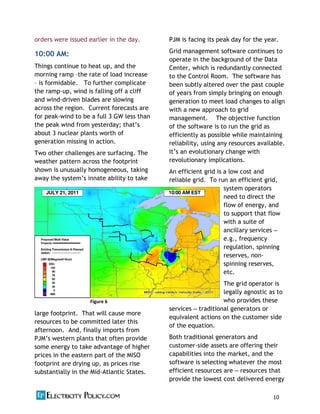
Two other challenges are surfacing. The
weather pattern across the footprint
shown is unusually homogeneous, taking
away the innate ability to take
advantage of weather diversity in a
large footprint. That will cause more
resources to be committed later this
afternoon. And, finally imports from
some energy to take advantage of higher
prices in the eastern part of the MISO
footprint are drying up, as prices rise
substantially in the Mid-‐Atlantic States.
PJM is facing its peak day for the year.
Grid management software continues to
operate in the background of the Data
Center, which is redundantly connected
to the Control Room. The software has
been subtly altered over the past couple
of years from simply bringing on enough
generation to meet load changes to align
with a new approach to grid
management. The objective function
of the software is to run the grid as
efficiently as possible while maintaining
reliability, using any resources available.
revolutionary implications.
An efficient grid is a low cost and
reliable grid. To run an efficient grid,
system operators
need to direct the
flow of energy, and
to support that flow
with a suite of
ancillary services
e.g., frequency
regulation, spinning
reserves, non-‐
spinning reserves,
etc.
The grid operator is
legally agnostic as to
who provides these
services traditional generators or
equivalent actions on the customer side
of the equation.
Both traditional generators and
customer-‐side assets are offering their
capabilities into the market, and the
software is selecting whatever the most
efficient resources are resources that
provide the lowest cost delivered energy
Figure  6  
11          
     
     
in a reliable fashion.
Every day more customer assets are
being offered into the market and
replacing traditional generation assets
that are higher cost. Even at this mid-‐
morning hour, Figure 6 shows and
increasing cost trend, a normal
very early in the
trend toward customer participation
but the trend is
there pushed by
technology
advances and
Smart Grid-‐
caused customer
education and
awakening.
At this moment,
thousands of
entrepreneurs are
dreaming up ways
to enable
customers to
participate in the
process and
leverage the still-‐evolving Smart Grid
system. The beneficiaries will be the
end-‐customers and just in time given
price pressure driven by aging
generation plant retirements and higher
plant replacement costs not to
mention sorely needed distribution
upgrades.
11:00 AM:
Very high prices in excess of 10
cents/kWh -‐start to surface in central
Illinois (Figure 7), as the Chicago area
draws energy from the southwest and
transmission lines are nearing their
capacity. While generators in the PJM
region had been selling into the MISO
market earlier in the day, MISO is now
exporting over 500 MW to PJM a trend
that will grow and continue through the
heat of the day.
The pattern of very high/very low prices
in a tight, adjacent geographical setting
efforts to achieve
low cost across the footprint in the face
of those constraints. Think of the
transmission grid as a system of pipes
with flowing water. A constraint
hampers the flow of cheap water. More
of the cheap water can get into the
network if someone will apply pressure
to the pipe discharging toward the
cheap water and distribute it to other
pipes. Grid operators do that by turning
on more expensive generation at the
other end of the constrained line
resulting in increased prices on one end
of the constraint. This causes less stress
on the constrained line and the lowest
cost possible in the footprint, given the
constraints and resources available.
Figure  7  
12          
     
     
mathematically far more complicated
than that, of course.
12:00 noon:
Prices have soared above 10 cents/kWh
in the east more than a 400% increase
over the early morning hours. The
wholesale markets are a true reflection
of the actual cost
of electricity at
each of 1,975
locations every 5
minutes. At this
moment the real
cost of energy in
Illinois, Indiana,
Michigan, and Ohio
is well in excess of
the retail price
every customer is
actually charged.
The disparity
between the real
wholesale price and the retail price that
actually drives customer decision-‐
making leads to massive inefficiencies,
waste, and severe under-‐utilization of a
$1 trillion asset. Retail Time-‐Of-‐Use
pricing that at least roughly aligns with
the wholesale reality could help a lot
a tricky business as well.
At 12:45 PM, a plant in Indiana trips off
line and the loss of over 400 MW of
power ripples across the Interconnect at
60% of the speed of light, and frequency
in the entire interconnect dips to 59.967
hertz -‐ the second lowest for the day.
The dip is responding to the loss of
generation. Through a combination of
software-‐driven actions, frequency
recovers in less than 5 minutes.
Synchrophasors across the eastern half
of the continent log the event to within
one-‐millionth of a second the time it
takes electricity to travel two football
fields. (Synchrophasors measure voltage
and current at diverse locations on a
power grid and can output accurately
time-‐stamped voltage and current. In
the larger world of -‐h
minor occurrence. The grid is
always protected against any single
event and the only impact of the
instantaneous loss of over 400 MW is a
slight price increase as the supply curve
shifts left to recognize more expensive
generation coming on-‐line. (Figure 8.)
The grid is then immediately
reconfigured to protect against the next
potential event.
Figure  8  
13          
     
     
1:00 PM (13:00hrs):
Average
temperatures in
the region are
nearing 100
degrees, and
wind has dropped
off to less than 1
GW. Effectively,
only 1,800 of the
30,000 wind
blades in the
region are
producing at
capacity. Grid
operators dispatch the next batch of
least-‐cost generation, which is almost
always the most expensive generation
on the system. Average prices in the
east are 300% higher than prices in the
west. Some rain and cloud cover
flattens the load growth at the 100.5
GW level, while the system peaks at 3.5
GW less than yesterday. Figure 9 shows
the condition of the network at 1 PM.
At 1:00 PM exactly, a signal goes out to
717 IP addresses from Shop-‐Mart s
control center freeing a 50 MW chunk of
the demand response
capability. Actions taken within 31
seconds include light dimming, a 3.7
degree rise in refrigeration units, and a
2.1 degree temperature rise in selected
stores. No store employee or customer
notices as the program automatically
grinds on for the next hour, reducing
system peak, saving over 50 MW of high-‐
cost, on-‐peak energy, and providing
substantial savings to Shop-‐Mart.
Among the consequences of Shop-‐
action are these:
$10,000 flows to Shop-‐
bottom line;
the bulk electric system is slightly
more reliable ;
a slightly lower price for all
customers in the interconnect;
saving of the cost to generate 4.3
MW that would have been lost in
transmission and distribution lines
and spread to customers;
a savings of the cost to carry
7.5MW of reserve margin that
would have been spread across all
customers,
a reduction of 70 tons of CO2
emissions for which Shop-‐Mart is
not paid,
slightly reduced earnings for a
traditional generator,
slightly less earnings for
distribution companies serving
Shop-‐Mart locations, and
slightly less future need for new
Figure  9  
14          
     
     
transmission and generation
construction.
There are many pieces here for utilities,
customers, and regulators to consider.
In other action, the Alcoa smelter in
Newburgh on the southern Indiana
border has been providing frequency
regulation service to the grid since early
morning, reacting to a 4 second signal
just as it does every other day. Now
Alcoa drops its demand by 80 MW from
480MW to take
advantage of a
$200 per MWh
price. The
economic goal
simply switched
from making beer
cans to making
negawatts, while
as much of the
smelter capacity
as possible was
reduced for an
hour. For a typical
aluminum smelter, electric power costs
account for 30% to 40% of the total cost
of producing primary aluminum. In the
continental United States, Alcoa
currently owns and/or operates ten
aluminum smelters and many associated
fabricating facilities with a combined
average load of over 2,600 MW.
2:00 PM (14:00hrs):
The end-‐customer events in the last
hour highlight the beginning of a trend
toward more end-‐customer
participation. Huge decreases in
communication costs and advances in
digital technologies are enabling new
load side (customer-‐side-‐of-‐the-‐meter)
assets the flexibility to control their
power usage and their power costs.
Demand response resources have been
called upon east of MISO, lowering
prices for the Interconnect, but further
demand response by MISO member
customers are not needed. Reserve
margins are adequate for the day, with
the Shop-‐Mart and Alcoa actions noted
above.
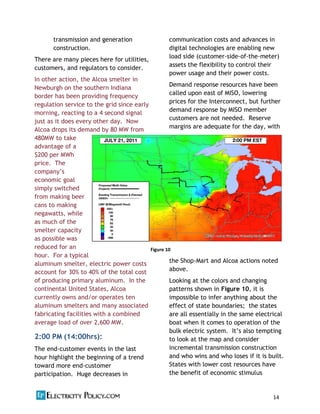
Looking at the colors and changing
patterns shown in Figure 10, it is
impossible to infer anything about the
effect of state boundaries; the states
are all essentially in the same electrical
boat when it comes to operation of the
bulk electric system. ing
to look at the map and consider
incremental transmission construction
and who wins and who loses if it is built.
States with lower cost resources have
the benefit of economic stimulus
Figure  10  
15          
     
     
through increased
exports to higher
cost areas. States
gaining access to
lower cost
resources have
the economic
stimulus of lower
end-‐customer
bills, freeing up
cash for local
expenditures and
investment.
and publicly
available analysis shows that every sub-‐
region is a winner for the proposed
transmission builds.
3:00 PM (15:00hrs):
High prices in the east and central
portions of the footprint ease due to a
combination of a flattening demand and
an increase in power imported from
external suppliers that occurred during
the prior hour. A weather front moving
across the Midwest is lowering humidity
levels and causing increased cloud cover
in some areas, ending the escalating
temperatures. This relieves most of the
congestion on the transmission system
for now.
However, at 3:55 PM, another plant in
southern Indiana, with a capacity of
almost 500 MW, trips off-‐line. The grid
software, which runs a co-‐optimized
real-‐time energy and operating reserve
market, has procured and deployed
enough reserve capacity to protect the
system. Reserves represent another
ancillary services product for which end-‐
customer resources can be readily
configured via software and offered into
the market for payment. Again, the
event is easily handled by the software
which reconfigures the grid and gives
everyone new marching orders within a
few minutes.
4:00 PM (16:00hrs):
Load for the MISO region continues to
peak at 100.5 MW, down about 3 GW
change in weather for parts of the
region.
Current real time prices in the
Milwaukee area are some of the lowest
across the footprint (Figure 11), as
temperatures peaked there hours earlier
as a result of changing weather
conditions and transmission constraints
at the Wisconsin -‐ Illinois border.
Automatic five-‐minute dispatch
instructions and price signals are
incenting generators in the Milwaukee
area to reduce their output to mitigate
congestion, thus trapping low cost
Figure  11  
16          
     
     
power that could otherwise reduce costs
across the footprint. The short black
line connecting Wisconsin and Illinois
represents a proposed six-‐mile segment
of 345 KV transmission that would
alleviate this congestion, allowing
customers to the south and east access
to this low cost generation in Wisconsin.
ust to the east, PJM sets a new all-‐
time peak at 160 GW at the same
moment wind in PJM reaches its
lowest point for the day at 300 MW
down 1.3 GW from earlier in the day.
The west-‐to-‐east price pattern is
indicative of the normal relative price
arrangement teeing up the need for
west to east transmission to deliver
lower cost resources where prices are
higher.
5:00 PM (17:00hrs):
After several very hot days, customers
are demanding more energy for air
conditioning. Traditional generation
assets are stressed and many have had
to de-‐rate and reduce output due to
temperature. Grid operators are
immediately and automatically
software-‐notified of reduced capability.
Wholesale prices are between 10 cents
and 20 cents per kWh across the region.
Peak hours drive the need for new
construction in generation, transmission,
and distribution. At this moment, the
61 million people in this picture are all
making electricity decisions based on
average and at this moment far too
low retail electricity prices. Retail
prices across the footprint signal end
users that electricity is no more valuable
now than it was at 4:00 AM despite a
20 cent/kWh-‐plus cost difference. The
implications of low retail prices
artificially incenting excessive customer
demand, notably on-‐peak, include:
unneeded construction, higher bills,
unnecessary pollution, and increased
energy dependence.
Opportunities for customer demand
response and supply from distributed
generation still have a contribution to
make, however. Back at the data
center in White Fish Bay, with batteries
at full charge and three days of fuel on
hand for back-‐ up generators, data
center management decides to kick in
all five of its 2 MW generators and sell
power back into the grid. They have
access to the $200 MWh price, but their
incremental cost to generate is only $20
per MWh, thus they are able to make
$1,800 this hour lowering their total
monthly energy bill by 3% for this one
hour action alone.
There is an amazing 170 GW of this type
of customer side generation across the
US, with less than 1% of it being
maximized for the cu
through access to wholesale markets.
Alcoa returned to full beer can
production 3 hours ago but now prices
are at 45 cents/kWh and they happily
shed 80 MW of load again for the next
hour before returning to a standard
production schedule.
Organized markets and the ability to
profit from customer response to power
prices help make the economics of this
facility work. The United States, once
the leading aluminum producer,
J
17  
has been surpassed by China, Russia,
and Canada. The long term viability of
these types of facilities within the US is
contingent upon cost reduction and cost
competitiveness.
6:00 PM (18:00hrs):
Things are starting to cool off in the
west and prices are less than half what
they were just an hour ago.
7:00 PM (19:00hrs):
Even as
temperatures cool
slightly, MISO
operators are still
faced with nine
binding constraints
in the region
three more than
last hour. Each
constraint means
that lower cost
powe On a day like
today, operators are never relieved of
this effort. During the cooler morning
hours they only had three to five
constraints to manage, but during the
day as many as thirteen were actively
being managed.
8:00 PM (20:00hrs):
The heat index along the Lake Michigan
shoreline in eastern Wisconsin has fallen
materially in the last hour. Demand
there continues to fall and prices
continue to signal for less generation.
Additional constraints, effectively a lack
of transmission capacity to transport
cheap energy out of this region, trap low
cost generation in the area.
9:00 PM (21:00hrs):
As street lights come on and households
increase power consumption, the steady
decline in demand over the last couple
of hours is momentarily slowed. The
continued removal of generating
capacity from the system combines with
this brief period of flattening demand to
cause the need for some short-‐term,
high-‐cost generation relief. Constraints
continue to trap generation in
Wisconsin. Although prices are higher
for this short
period, it is still the
least cost
deployment for the
region considering
what had to be
done in previous
hours, and the
needs ahead.
Economics for Alcoa
have again flipped from making beer
cans, so the company again sheds 80 MW
of load in exchange for the 34
cents/kWh price. Alcoa is a great
example of a large end-‐customer
actually changing its operation to
improve profitability and contribute to a
more efficient grid at the same time.
At the other extreme of size, a
residential electric hot water heater
or an aggregate arrangement of them
that can be controlled is pretty much
the same as a smelter and can provide
the same services to the grid.
Aggregated across many residential
customers of such an asset can function
as a low cost, highly reliable asset for
use in frequency regulation, reserves, or
An  aggregation  of  residential  electric  hot  
water  heaters  that  can  be  controlled    
has  pretty  much  the  same  value    
to  the  system  as  a  smelter  and  can    
provide  the  same  services  to  the  grid.    
18  
energy source or sink. Many
cooperatives and municipals are at the
leading edge of using residential hot
water management programs to cut
peaks and reduce their system cost.
Even if we undertake massive reforms to
better manage electricity, there will
always be locational price separation
and inter-‐minute price volatility. And
there will always be opportunities for
end-‐customers to participate in a
meaningful way.
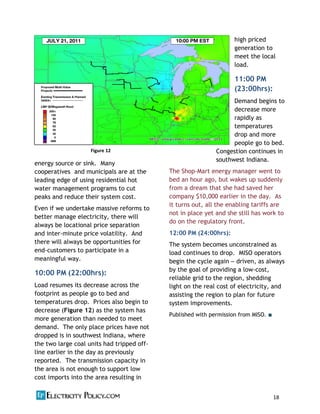
10:00 PM (22:00hrs):
Load resumes its decrease across the
footprint as people go to bed and
temperatures drop. Prices also begin to
decrease (Figure 12) as the system has
more generation than needed to meet
demand. The only place prices have not
dropped is in southwest Indiana, where
the two large coal units had tripped off-‐
line earlier in the day as previously
reported. The transmission capacity in
the area is not enough to support low
cost imports into the area resulting in
high priced
generation to
meet the local
load.
11:00 PM
(23:00hrs):
Demand begins to
decrease more
rapidly as
temperatures
drop and more
people go to bed.
Congestion continues in
southwest Indiana.
The Shop-‐Mart energy manager went to
bed an hour ago, but wakes up suddenly
from a dream that she had saved her
company $10,000 earlier in the day. As
it turns out, all the enabling tariffs are
not in place yet and she still has work to
do on the regulatory front.
12:00 PM (24:00hrs):
The system becomes unconstrained as
load continues to drop. MISO operators
begin the cycle again driven, as always
by the goal of providing a low-‐cost,
reliable grid to the region, shedding
light on the real cost of electricity, and
assisting the region to plan for future
system improvements.
Published with permission from MISO.
Figure  12  Figure  12

A Day in the Life of the Grid

  • 2.
    1   A Dayin the Life of the Grid: July 21, 2011 This  snapshot  of  the  hour-­‐by-­‐hour  operation  of  a  large  regional  transmission   organization  on  a  hot  summer  day  illustrates  the  benefits  of  greater   regional  oversight  of  the  transmission  system  and  points  the  way  to  even   greater  benefits,  as  end-­‐use  customers  gain  the  ability  to  interact  with  the   regional  wholesale  market.   by  Paul  Feldman   ISO the Midwest Independent Transmission System Operator1 is an independent regional transmission organization that encompasses all or part of 11 states. MISO manages a large portion of the bulk electric system in the central and upper Midwest through an organized market. This approach provides buyers and sellers the real, instantaneous price of 1  MISO r -‐time wholesale electric energy markets, directing and controlling over 131,000 MW of generating resources and approximately 50,000 miles of transmission lines. Consumer loads in the MISO region have been as high as 104,000 MW during peak summer days, and MISO settles more than $23 billion in gross market charges annually. wholesale electricity over a region, which has a huge intra-‐day and geographical variance. Exposing these prices, along with technology and tariff advances over the past several years, gives rise to even more opportunities for economically attractive transactions at M Paul  Feldman,   independent  Board  of  Director,  extends  his    who   were  instrumental  in  preparing  the   information  presented  here.     to  the  National  Association   of  Utility  Regulatory  Utility  Commissioners  in   February.  The  video  presentation  is  posted  on   the  MISO  website  linked  here  and  below.  
  • 3.
    2   the retaillevel, through improved coordination between the wholesale and retail markets. Improvements in communicating accurate retail price signals to end-‐use consumers, coupled with providing them access directly or indirectly to the wholesale markets would allow their consumption decisions to benefit themselves and general market outcomes. To the extent these opportunities are wisely pursued, the bulk electric system can be made less expensive and more reliable for all. This may soon be possible, but there is still a lot to be done. This presentation was developed to show how the wholesale market works and why it is important to retail pricing decisions and, ultimately, the end-‐ customer. While this is based on events within the MISO footprint, the hour-‐by-‐ hour observations made here would apply to virtually all RTOs. MISO uses price maps to show energy prices across its regional footprint throughout each day. This link to a video from the MISO website depicts the series of price maps from Wednesday July 21, 2011, which shows the changing price of wholesale electricity across the 24 hours of the day. The time of day is registered in the upper right corner. The price maps are a direct reflection of the least cost deployment of resources throughout the region while respecting the reliability criterion to protect the system from any single generator or transmission outage. he prices depicted are actual Locational Marginal Prices, or LMPs for short. The prices are represented by colors, with the highest prices being orange to red in the 10 to 20 cents per kilowatt-‐ hour range, and the lowest prices being green to blue in the 3 cents to zero cents per kWh range. While the video shows Megawatt-‐hour prices, w divide these by 1,000 and use kWh prices to better make the connection to retail reality. These are the actual prices for wholesale electricity prices an economist would like to see motivate energy decisions. As you watch the video or follow developments in the text below, think about how these widely varying wholesale prices compare with the average, time-‐constant retail price that most people and businesses actually pay and the disparity between the two. Remember that the disparity is quite expensive at peak load periods, contributing to a greatly underutilized, but very expensive asset: the generation and transmission facilities which comprise the bulk electric system. Also, think about the end-‐customer assets distributed generation or T Consider  how  widely-­‐varying  wholesale   prices  compare  with  the  average,   time-­‐constant  retail  price  that   most  customers     and  the  disparity  between  the  two.  
  • 4.
    3   reduced customerdemand that could be called upon that customers might choose to make available in return for a substantial saving. Finally, think about how these savings could be used by consumers and businesses alike to invest in our economy, while strengthening the bulk power system at the same time. Other things to note: The faint gray dotted lines shown throughout the region are existing 345 kV transmission lines. The heavy dark lines shown on the map are the 16 elements of a $5.8B Multi-‐Value Project (MVP) portfolio of proposed transmission lines. This portfolio is specifically designed to reduce congestion in the MISO footprint and enable least cost generation to reach load throughout the footprint. In December, 2011, the MISO Board approved implementation of this portfolio after careful and considerable review of a very conservative business case that includes a Benefit to Cost Ratio of more than 2 to 1. A 2 to 1 Benefit to Cost ratio is an extraordinary value in any business. For now many low cost wind generation resources are largely trapped in the western part of the MISO regional footprint, as you will see through this peak day and virtually all future days until more transmission is built. No Wednesday July 21, 2011, and take a closer look at each of these 24 hours and . . . Midnight: It is midnight moving into July 21, 2011. The previous day had been swelteringly hot, and we are starting a new day expected to be just as hot. peak for the MISO region was almost 104 GW about 15% of the electricity used in the entire US. similar. Figure 1 is a price map for midnight July 21, the beginning of our day. A transmission constraint has caused the high prices observed at this unusual time, a graphic illustration of -‐value transmission projects are designed to prevent. Instructions have already been sent to every one of over 1,300 generation and participating load-‐side resources in the footprint letting them know what conditions are expected each hour of Figure  1    
  • 5.
    4   the day. Theseinstructions will be monitored throughout the day and modified as conditions dictate, but every five minutes a reminder or new instruction packet is released so everyone is up to date on next steps. Wholesale price volatility is a very real and daily phenomenon caused by widely ranging fuel prices, very limited storage ability, weather conditions, transmission line constraints, and other factors. You are looking at the state-‐of-‐the-‐art in terms of price setting delivering prices that result in lowest cost system deployment and high reliability. The system planning and resource adequacy efforts have targeted only one end-‐user outage every 4,000 days. not all. These prices are transparent to everyone, and therefore used to inform future bilateral contracts governing the value of these contacts by shedding a bright light on true costs. Where organized markets do not exist price discovery is more of an art-‐form. Throughout the ensuing description, I will weave in a few vignettes, which mix fact and fiction a bit to make a point of possible interest. However, despite any fictional elements they are all entirely possible and realistic today. 1:00 AM: We are one hour into implementing the grid management plan for the day. As shown in Figure 2, prices are below 3 cents/kWh across the region except on the southern Illinois-‐ Indiana border, where a transmission constraint has limited the flow of low-‐ cost power into the area and 10 cent/kWh generators have been brought on line to serve the load. Just 130 miles north of the 10 cent energy price, zero variable cost wind resources are trapped and cannot get out due to lack of transmission line capacity, driving prices to zero. Operators in the control room are constantly looking at the weather forecast and system conditions. Software runs quietly in the background collecting data from 250,000 points every 4 seconds across the grid on cyber-‐secure channels. The same systems check every potential grid failure point every 89 seconds and calculate protective reactions for every one of them. B Figure  2  
  • 6.
    5   Meanwhile, pricesare determined and posted every 5 minutes for energy and multiple ancillary service products for each of 1,976 locations. You are looking at just energy prices and not all the separately-‐priced ancillary services products, although there is a very high price correlation between all these products at any moment in time. 2:00 AM: By 2:00 AM, with more people in bed, temperatures and load across the region has dropped off further. Wind generation output is at 3.5 GW, leaving 6.5 GW of name-‐plate, zero incremental cost wind capacity unproductive for lack of wind. ransmission constraints are virtually nonexistent, as load is down and the system is greatly underutilized. Shop-‐Mart, a large multi-‐state retailer, monitors the weather daily and predicts that prices today at the wholesale level will be even higher than yesterday due to higher forecasted temperatures in the region. The corporate energy manager gave orders to offer all of their demand response capability into the MISO market wherever states allow such action. Many states pictured here and elsewhere are sorting through options related to allowing end-‐customers to access wholesale markets directly, through aggregators, through energy companies, or combinations thereof. Shop-‐Mart is a sophisticated energy user with many locations and capability to control HVAC, refrigeration, and lighting that would allow them to save millions of dollars each year if they could consistently participate in organized market demand response and ancillary service program tariffs. Such access would have the additional benefit of lessening the need for future generation, increasing reliability, dampening wholesale prices in the near term, and freeing capital for investment. 3:00 AM: Figure 3 shows that prices are near zero in the western portion of footprint. Wind farms producing with a fuel cost of zero are willing to be paid anything above minus 2.9 cents per kWh as they receive a Production Tax Credit of 3 cents/kWh for energy they actually produce. A data center in White Fish Bay, Wisconsin, carries out orders left earlier in the day to fully charge all batteries at the $0 price they expect at this hour. The data center exists on an industrial campus configured as a microgrid and has access to the wholesale market as an industrial customer. Every electric car expected to be built in the next 15 years could charge at this hour and not strain the bulk power system. Even the most aggressive retail Time of Use tariffs that have been adopted have minimum prices far in excess of the actual variable price of electricity at this moment. This leaves lots of room for states to consider stimulating the electric vehicle market. T
  • 7.
    6                 4:00 AM: MISO control room operators continue to monitor the software outputs and keep an eye on the 10 by 70 foot data screen that dominates the control room in Carmel, Indiana. Systems in the St. Paul, Minnesota backup control center 581 miles away are updated on a real-‐time basis and operators there are ready to take over on a flash-‐cut basis in the event of a failure at the main control center. There is little change from the prior hour, as system load settles in at its minimum for the day 67 GW. The equivalent of more than 23 nuclear plants will be fired up in the next few hours to meet the peak later in the day. Prices in the west plummet to zero and below, as load drops off and the wind is generating at 3 GW. On the early morning of the peak day and the most expensive day for the year the average real wholesale price across the entire footprint between midnight and 4:00 AM is 2.3 cents per kWh. On this same day in this same footprint, actual price of gasoline is $3.82. Working through the math, if you wanted to buy an incremental mile of fuel for your car right now, gasoline is over 1800% more expensive than electricity. 5:00 AM: People in Michigan are starting to get up and turn things on. Prices rise as more expensive, although still cheap, generation is brought on-‐ line in anticipation of the daily ramp up. Winds in Lafayette, Indiana, are non-‐ existent and the football-‐field-‐long turbine blades stand idle in what is usually a very windy area. Figure  3  
  • 8.
    7                 6:00 AM: Demand is increasing faster in the eastern portion of the footprint than in the west, as the sun continues to clear the eastern horizon. A price-‐ map of each ancillary service product would show very similar price separation and variability across the region. ning but a price disparity between Iowa and Michigan is already obvious in Figure 4. Incremental energy in Iowa is nearly free, while in Michigan energy is already up to 7.5 cents per kWh, reflecting transmission constraints that prohibit less expensive energy from flowing into the state. Michigan would clearly benefit from additional transmission into the state. 7:00 AM: Winds have started to pick up in Lafayette, Indiana and wind generation is ramping up inside this traditionally transmission-‐constrained area. Low cost generation is trapped in the area because there is not enough transmission to move it out to where it is needed. This results in all generators in the area that are subject to market prices receiving a near zero price. The two dark lines out of the area show proposed transmission lines that will ultimately move the low cost energy to a wider market, resulting in a lower cost to the overall footprint and giving the wind generator a better price for its product ind creates some unique challenges to a balancing authority. Despite its near zero variable costs, in a small balancing reliability issues and additional costs as other resources are needed to manage capacity. MISO transitioned in 2009 from 23 balancing authorities to a single balancing authority, allowing these challenges to be better managed at the lowest cost. The geographic diversity of MISO also moderates the overall variability of the wind. The scale of the footprint also provides more options in siting of wind, allowing states lacking wind resources greater access to higher wind capacity resources. MISO is similar in size and geographical diversity and was previously similar in W Figure  4  
  • 9.
    8                 terms of its proliferation of Balancing Authorities to the Western Interconnection, minus California. 8:00 AM: As Figure 5 shows, trapped wind in west-‐central Indiana is pushing prices to zero and less, while nearly adjacent areas are at $100 per MWh more than twice the average system price. Grid software has properly determined that raising the price on the high-‐price-‐ side of the transmission constraint and electrically pushing back on the constraint will enable the lowest total cost for the region at this moment. Traders caught short in the red area are not happy campers. Dealing with constraints is also an area where end-‐customer resources can prove to be of value in lowering cost and maintaining reliability. Software overlays from either aggregating energy companies or independent aggregators can configure end-‐customer resources to provide energy and ancillary service-‐ equivalent functionality to the grid operator, who remains legally agnostic between the possibilities. Over the long term, traditional generation assets and end-‐customer resources that can be configured to provide grid services should each contribute according to their marginal cost structures and fine-‐ grained functionality. MISO launched an ancillary services market in 2009, which resulted in a large increase in the value MISO provides, as measured annually in its ongoing Value Proposition Study. A good example of this is the provision of frequency regulating reserves which manage the instantaneous changes in load that continuously occur on the system. Prior to 2009, each balancing authority managed its own regulation, typically with reserves held on its newest coal units, which tended to have the best control systems. In total, over 1,100 MW of low-‐cost coal generation was held back for regulation. Consolidation into a single balancing authority and providing frequency regulation through a central market allowed the regulation requirement to be reduced to less than 400 MW, and Figure  5  
  • 10.
    9                 also allowed the requirement to be met with less efficient units, freeing up the most efficient units for energy production the equivalent of four low cost coal units. The result is an annual savings of $176-‐$195 million. 9:00 AM: Interpreted appropriately, Locational Marginal Prices are markers pointing to opportunities to lower cost and improve reliability. Constraints, which are indicated by price differences in the region, should be examined for ways to improve the cost efficiency of the system. Detailed examination should examine several options for each constraint, looking for the most cost-‐ effective way to deal with the constraint, options include: additional generation, additional transmission, and load-‐side resource participation opportunities. In high load areas that presently experience constraints, blocking access to low cost generation, demand response options can be a very efficient option. Currently in the MISO region, most demand side resources are not offered for use to the wholesale market except in emergency situations creating economic inefficiencies. Load-‐ side solutions are also inherently clean, fast and do not suffer from NIMBY issues. Several companies have now adopted the Green Button a customer-‐ friendly means to view actual system real-‐time costs, and a necessary step in the direction of end-‐user cost control. Of course not every nail needs one of these hammers. It may be appropriate to accept inefficiency in cases where the cost of a constraint is small enough, or the constraint may occur so infrequently, that the best economic decision is to accept the inefficiency cost than any of the other options. In most of the western portion of the Eastern Interconnect, and the eastern portion of the Western Interconnect, customers only have the option of wholesale market access through their local energy company, based on retail tariffs. Other areas of the country allow aggregators to approach customers with a wide variety of increasingly innovative offers related to participation in wholesale markets. State regulators have to sort out the right approach for customers. oving to the MISO control room, at 9:34 AM operators declare a Maximum Generation Warning as load is tracking ahead of forecast and forced outages are exceeding expectations. Models suggested the warning four minutes ago as the appropriate next step. At 9:35, frequency dips to its low for the day at 59.964. Generation is falling a bit behind the morning ramp up. Among large customers, Shop-‐Mart energy manager sends an e-‐mail to its control center asking if everyone is ready to shed 50 MW of load between 1:00 and 2:00 this afternoon as per schedules with the Grid Operator. The email was unnecessary; it was covered on software-‐driven autopilot since M
  • 11.
    10                 orders were issued earlier in the day. 10:00 AM: Things continue to heat up, and the morning ramp the rate of load increase is formidable. To further complicate the ramp-‐up, wind is falling off a cliff and wind-‐driven blades are slowing across the region. Current forecasts are for peak-‐wind to be a full 3 GW less than the peak wind from yesterday; about 3 nuclear plants worth of generation missing in action. Two other challenges are surfacing. The weather pattern across the footprint shown is unusually homogeneous, taking away the innate ability to take advantage of weather diversity in a large footprint. That will cause more resources to be committed later this afternoon. And, finally imports from some energy to take advantage of higher prices in the eastern part of the MISO footprint are drying up, as prices rise substantially in the Mid-‐Atlantic States. PJM is facing its peak day for the year. Grid management software continues to operate in the background of the Data Center, which is redundantly connected to the Control Room. The software has been subtly altered over the past couple of years from simply bringing on enough generation to meet load changes to align with a new approach to grid management. The objective function of the software is to run the grid as efficiently as possible while maintaining reliability, using any resources available. revolutionary implications. An efficient grid is a low cost and reliable grid. To run an efficient grid, system operators need to direct the flow of energy, and to support that flow with a suite of ancillary services e.g., frequency regulation, spinning reserves, non-‐ spinning reserves, etc. The grid operator is legally agnostic as to who provides these services traditional generators or equivalent actions on the customer side of the equation. Both traditional generators and customer-‐side assets are offering their capabilities into the market, and the software is selecting whatever the most efficient resources are resources that provide the lowest cost delivered energy Figure  6  
  • 12.
    11                 in a reliable fashion. Every day more customer assets are being offered into the market and replacing traditional generation assets that are higher cost. Even at this mid-‐ morning hour, Figure 6 shows and increasing cost trend, a normal very early in the trend toward customer participation but the trend is there pushed by technology advances and Smart Grid-‐ caused customer education and awakening. At this moment, thousands of entrepreneurs are dreaming up ways to enable customers to participate in the process and leverage the still-‐evolving Smart Grid system. The beneficiaries will be the end-‐customers and just in time given price pressure driven by aging generation plant retirements and higher plant replacement costs not to mention sorely needed distribution upgrades. 11:00 AM: Very high prices in excess of 10 cents/kWh -‐start to surface in central Illinois (Figure 7), as the Chicago area draws energy from the southwest and transmission lines are nearing their capacity. While generators in the PJM region had been selling into the MISO market earlier in the day, MISO is now exporting over 500 MW to PJM a trend that will grow and continue through the heat of the day. The pattern of very high/very low prices in a tight, adjacent geographical setting efforts to achieve low cost across the footprint in the face of those constraints. Think of the transmission grid as a system of pipes with flowing water. A constraint hampers the flow of cheap water. More of the cheap water can get into the network if someone will apply pressure to the pipe discharging toward the cheap water and distribute it to other pipes. Grid operators do that by turning on more expensive generation at the other end of the constrained line resulting in increased prices on one end of the constraint. This causes less stress on the constrained line and the lowest cost possible in the footprint, given the constraints and resources available. Figure  7  
  • 13.
    12                 mathematically far more complicated than that, of course. 12:00 noon: Prices have soared above 10 cents/kWh in the east more than a 400% increase over the early morning hours. The wholesale markets are a true reflection of the actual cost of electricity at each of 1,975 locations every 5 minutes. At this moment the real cost of energy in Illinois, Indiana, Michigan, and Ohio is well in excess of the retail price every customer is actually charged. The disparity between the real wholesale price and the retail price that actually drives customer decision-‐ making leads to massive inefficiencies, waste, and severe under-‐utilization of a $1 trillion asset. Retail Time-‐Of-‐Use pricing that at least roughly aligns with the wholesale reality could help a lot a tricky business as well. At 12:45 PM, a plant in Indiana trips off line and the loss of over 400 MW of power ripples across the Interconnect at 60% of the speed of light, and frequency in the entire interconnect dips to 59.967 hertz -‐ the second lowest for the day. The dip is responding to the loss of generation. Through a combination of software-‐driven actions, frequency recovers in less than 5 minutes. Synchrophasors across the eastern half of the continent log the event to within one-‐millionth of a second the time it takes electricity to travel two football fields. (Synchrophasors measure voltage and current at diverse locations on a power grid and can output accurately time-‐stamped voltage and current. In the larger world of -‐h minor occurrence. The grid is always protected against any single event and the only impact of the instantaneous loss of over 400 MW is a slight price increase as the supply curve shifts left to recognize more expensive generation coming on-‐line. (Figure 8.) The grid is then immediately reconfigured to protect against the next potential event. Figure  8  
  • 14.
    13                 1:00 PM (13:00hrs): Average temperatures in the region are nearing 100 degrees, and wind has dropped off to less than 1 GW. Effectively, only 1,800 of the 30,000 wind blades in the region are producing at capacity. Grid operators dispatch the next batch of least-‐cost generation, which is almost always the most expensive generation on the system. Average prices in the east are 300% higher than prices in the west. Some rain and cloud cover flattens the load growth at the 100.5 GW level, while the system peaks at 3.5 GW less than yesterday. Figure 9 shows the condition of the network at 1 PM. At 1:00 PM exactly, a signal goes out to 717 IP addresses from Shop-‐Mart s control center freeing a 50 MW chunk of the demand response capability. Actions taken within 31 seconds include light dimming, a 3.7 degree rise in refrigeration units, and a 2.1 degree temperature rise in selected stores. No store employee or customer notices as the program automatically grinds on for the next hour, reducing system peak, saving over 50 MW of high-‐ cost, on-‐peak energy, and providing substantial savings to Shop-‐Mart. Among the consequences of Shop-‐ action are these: $10,000 flows to Shop-‐ bottom line; the bulk electric system is slightly more reliable ; a slightly lower price for all customers in the interconnect; saving of the cost to generate 4.3 MW that would have been lost in transmission and distribution lines and spread to customers; a savings of the cost to carry 7.5MW of reserve margin that would have been spread across all customers, a reduction of 70 tons of CO2 emissions for which Shop-‐Mart is not paid, slightly reduced earnings for a traditional generator, slightly less earnings for distribution companies serving Shop-‐Mart locations, and slightly less future need for new Figure  9  
  • 15.
    14                 transmission and generation construction. There are many pieces here for utilities, customers, and regulators to consider. In other action, the Alcoa smelter in Newburgh on the southern Indiana border has been providing frequency regulation service to the grid since early morning, reacting to a 4 second signal just as it does every other day. Now Alcoa drops its demand by 80 MW from 480MW to take advantage of a $200 per MWh price. The economic goal simply switched from making beer cans to making negawatts, while as much of the smelter capacity as possible was reduced for an hour. For a typical aluminum smelter, electric power costs account for 30% to 40% of the total cost of producing primary aluminum. In the continental United States, Alcoa currently owns and/or operates ten aluminum smelters and many associated fabricating facilities with a combined average load of over 2,600 MW. 2:00 PM (14:00hrs): The end-‐customer events in the last hour highlight the beginning of a trend toward more end-‐customer participation. Huge decreases in communication costs and advances in digital technologies are enabling new load side (customer-‐side-‐of-‐the-‐meter) assets the flexibility to control their power usage and their power costs. Demand response resources have been called upon east of MISO, lowering prices for the Interconnect, but further demand response by MISO member customers are not needed. Reserve margins are adequate for the day, with the Shop-‐Mart and Alcoa actions noted above. Looking at the colors and changing patterns shown in Figure 10, it is impossible to infer anything about the effect of state boundaries; the states are all essentially in the same electrical boat when it comes to operation of the bulk electric system. ing to look at the map and consider incremental transmission construction and who wins and who loses if it is built. States with lower cost resources have the benefit of economic stimulus Figure  10  
  • 16.
    15                 through increased exports to higher cost areas. States gaining access to lower cost resources have the economic stimulus of lower end-‐customer bills, freeing up cash for local expenditures and investment. and publicly available analysis shows that every sub-‐ region is a winner for the proposed transmission builds. 3:00 PM (15:00hrs): High prices in the east and central portions of the footprint ease due to a combination of a flattening demand and an increase in power imported from external suppliers that occurred during the prior hour. A weather front moving across the Midwest is lowering humidity levels and causing increased cloud cover in some areas, ending the escalating temperatures. This relieves most of the congestion on the transmission system for now. However, at 3:55 PM, another plant in southern Indiana, with a capacity of almost 500 MW, trips off-‐line. The grid software, which runs a co-‐optimized real-‐time energy and operating reserve market, has procured and deployed enough reserve capacity to protect the system. Reserves represent another ancillary services product for which end-‐ customer resources can be readily configured via software and offered into the market for payment. Again, the event is easily handled by the software which reconfigures the grid and gives everyone new marching orders within a few minutes. 4:00 PM (16:00hrs): Load for the MISO region continues to peak at 100.5 MW, down about 3 GW change in weather for parts of the region. Current real time prices in the Milwaukee area are some of the lowest across the footprint (Figure 11), as temperatures peaked there hours earlier as a result of changing weather conditions and transmission constraints at the Wisconsin -‐ Illinois border. Automatic five-‐minute dispatch instructions and price signals are incenting generators in the Milwaukee area to reduce their output to mitigate congestion, thus trapping low cost Figure  11  
  • 17.
    16                 power that could otherwise reduce costs across the footprint. The short black line connecting Wisconsin and Illinois represents a proposed six-‐mile segment of 345 KV transmission that would alleviate this congestion, allowing customers to the south and east access to this low cost generation in Wisconsin. ust to the east, PJM sets a new all-‐ time peak at 160 GW at the same moment wind in PJM reaches its lowest point for the day at 300 MW down 1.3 GW from earlier in the day. The west-‐to-‐east price pattern is indicative of the normal relative price arrangement teeing up the need for west to east transmission to deliver lower cost resources where prices are higher. 5:00 PM (17:00hrs): After several very hot days, customers are demanding more energy for air conditioning. Traditional generation assets are stressed and many have had to de-‐rate and reduce output due to temperature. Grid operators are immediately and automatically software-‐notified of reduced capability. Wholesale prices are between 10 cents and 20 cents per kWh across the region. Peak hours drive the need for new construction in generation, transmission, and distribution. At this moment, the 61 million people in this picture are all making electricity decisions based on average and at this moment far too low retail electricity prices. Retail prices across the footprint signal end users that electricity is no more valuable now than it was at 4:00 AM despite a 20 cent/kWh-‐plus cost difference. The implications of low retail prices artificially incenting excessive customer demand, notably on-‐peak, include: unneeded construction, higher bills, unnecessary pollution, and increased energy dependence. Opportunities for customer demand response and supply from distributed generation still have a contribution to make, however. Back at the data center in White Fish Bay, with batteries at full charge and three days of fuel on hand for back-‐ up generators, data center management decides to kick in all five of its 2 MW generators and sell power back into the grid. They have access to the $200 MWh price, but their incremental cost to generate is only $20 per MWh, thus they are able to make $1,800 this hour lowering their total monthly energy bill by 3% for this one hour action alone. There is an amazing 170 GW of this type of customer side generation across the US, with less than 1% of it being maximized for the cu through access to wholesale markets. Alcoa returned to full beer can production 3 hours ago but now prices are at 45 cents/kWh and they happily shed 80 MW of load again for the next hour before returning to a standard production schedule. Organized markets and the ability to profit from customer response to power prices help make the economics of this facility work. The United States, once the leading aluminum producer, J
  • 18.
    17   has beensurpassed by China, Russia, and Canada. The long term viability of these types of facilities within the US is contingent upon cost reduction and cost competitiveness. 6:00 PM (18:00hrs): Things are starting to cool off in the west and prices are less than half what they were just an hour ago. 7:00 PM (19:00hrs): Even as temperatures cool slightly, MISO operators are still faced with nine binding constraints in the region three more than last hour. Each constraint means that lower cost powe On a day like today, operators are never relieved of this effort. During the cooler morning hours they only had three to five constraints to manage, but during the day as many as thirteen were actively being managed. 8:00 PM (20:00hrs): The heat index along the Lake Michigan shoreline in eastern Wisconsin has fallen materially in the last hour. Demand there continues to fall and prices continue to signal for less generation. Additional constraints, effectively a lack of transmission capacity to transport cheap energy out of this region, trap low cost generation in the area. 9:00 PM (21:00hrs): As street lights come on and households increase power consumption, the steady decline in demand over the last couple of hours is momentarily slowed. The continued removal of generating capacity from the system combines with this brief period of flattening demand to cause the need for some short-‐term, high-‐cost generation relief. Constraints continue to trap generation in Wisconsin. Although prices are higher for this short period, it is still the least cost deployment for the region considering what had to be done in previous hours, and the needs ahead. Economics for Alcoa have again flipped from making beer cans, so the company again sheds 80 MW of load in exchange for the 34 cents/kWh price. Alcoa is a great example of a large end-‐customer actually changing its operation to improve profitability and contribute to a more efficient grid at the same time. At the other extreme of size, a residential electric hot water heater or an aggregate arrangement of them that can be controlled is pretty much the same as a smelter and can provide the same services to the grid. Aggregated across many residential customers of such an asset can function as a low cost, highly reliable asset for use in frequency regulation, reserves, or An  aggregation  of  residential  electric  hot   water  heaters  that  can  be  controlled     has  pretty  much  the  same  value     to  the  system  as  a  smelter  and  can     provide  the  same  services  to  the  grid.    
  • 19.
    18   energy sourceor sink. Many cooperatives and municipals are at the leading edge of using residential hot water management programs to cut peaks and reduce their system cost. Even if we undertake massive reforms to better manage electricity, there will always be locational price separation and inter-‐minute price volatility. And there will always be opportunities for end-‐customers to participate in a meaningful way. 10:00 PM (22:00hrs): Load resumes its decrease across the footprint as people go to bed and temperatures drop. Prices also begin to decrease (Figure 12) as the system has more generation than needed to meet demand. The only place prices have not dropped is in southwest Indiana, where the two large coal units had tripped off-‐ line earlier in the day as previously reported. The transmission capacity in the area is not enough to support low cost imports into the area resulting in high priced generation to meet the local load. 11:00 PM (23:00hrs): Demand begins to decrease more rapidly as temperatures drop and more people go to bed. Congestion continues in southwest Indiana. The Shop-‐Mart energy manager went to bed an hour ago, but wakes up suddenly from a dream that she had saved her company $10,000 earlier in the day. As it turns out, all the enabling tariffs are not in place yet and she still has work to do on the regulatory front. 12:00 PM (24:00hrs): The system becomes unconstrained as load continues to drop. MISO operators begin the cycle again driven, as always by the goal of providing a low-‐cost, reliable grid to the region, shedding light on the real cost of electricity, and assisting the region to plan for future system improvements. Published with permission from MISO. Figure  12  Figure  12