PRESENTEDBy
MinaReda
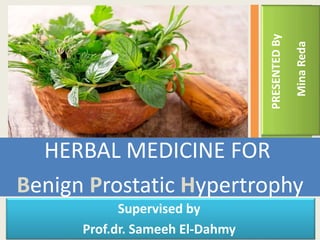
HERBAL MEDICINE FOR
Benign Prostatic Hypertrophy
Supervised by
Prof.dr. Sameeh El-Dahmy
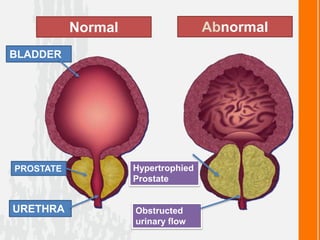
Benign prostatic hypertrophy is a
Generalised disease of the prostate
due to hormonal derangement which
leads to enlargement of the
gland (increase in the number of
epithelial cells and stromal tissue)
to cause compression of the
urethra leading to symptoms .
Introduction
Normal Abnormal
BLADDER
PROSTATE Hypertrophied
Prostate
Obstructed
urinary flow
URETHRA
Causes
Symptoms
• Lower urinary tract symptoms (LUTS)
• Voiding (Obstructive) Symptoms
 Intermittency
 Hesitancy
 Incomplete voiding
 Weak urinary stream
 Straining to pass urine
 Prolonged micturition
 Terminal dribbling
• Storage (Irritative) Symptoms
 Frequency of urination
 Nocturia
 Urgency (compelling need to void that can not be
deferred)
 Urge incontinence
Treatment of BPH
• Lifestyle modification
• Watchful Waiting
• Medical Therapy
 Alpha blockers
 5α-Reductase inhibitors
 Combination Therapy
• Phytotherapy (alternative)
• Surgical Treatment : Conventional Surgical or
Minimally Invasive Treatment
Herbal Medicine
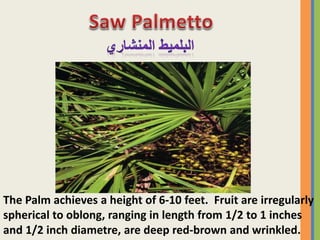
The Palm achieves a height of 6-10 feet. Fruit are irregularly
spherical to oblong, ranging in length from 1/2 to 1 inches
and 1/2 inch diametre, are deep red-brown and wrinkled.
• Source -- Serenoa repens Bartram. -- Native to
the Southern Atlantic coast through the Gulf coast
from South Carolina through Texas.
• Family: Arecaceae .
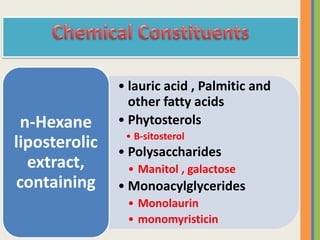
• lauric acid , Palmitic and
other fatty acids
• Phytosterols
• B-sitosterol
• Polysaccharides
• Manitol , galactose
• Monoacylglycerides
• Monolaurin
• monomyristicin
n-Hexane
liposterolic
extract,
containing
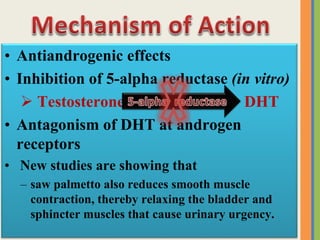
• Antiandrogenic effects
• Inhibition of 5-alpha reductase (in vitro)
 Testosterone DHT
• Antagonism of DHT at androgen
receptors
• New studies are showing that
– saw palmetto also reduces smooth muscle
contraction, thereby relaxing the bladder and
sphincter muscles that cause urinary urgency.
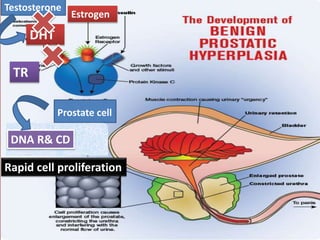
DHT
Estrogen
Testosterone
TR
Prostate cell
DNA R& CD
Rapid cell proliferation
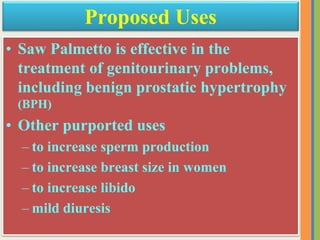
• Saw Palmetto is effective in the
treatment of genitourinary problems,
including benign prostatic hypertrophy
(BPH)
• Other purported uses
– to increase sperm production
– to increase breast size in women
– to increase libido
– mild diuresis
Proposed Uses
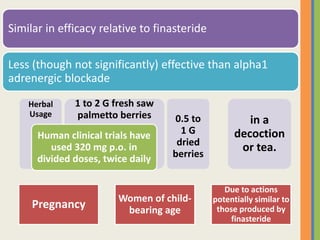
Similar in efficacy relative to finasteride
Less (though not significantly) effective than alpha1
adrenergic blockade
in a
decoction
or tea.
0.5 to
1 G
dried
berries
1 to 2 G fresh saw
palmetto berries
Herbal
Usage
Human clinical trials have
used 320 mg p.o. in
divided doses, twice daily
Pregnancy
Women of child-
bearing age
Due to actions
potentially similar to
those produced by
finasteride
The plant grows 2-3 feet high with heart-shaped,
serrated leaves. Plants are gender specific, with
flowers in long , branched clusters appearing June-
September. The plant is hirsute, with each hair serving
as a small, hollow, needle-like form of protection.
• Source Urtica dioica L., a perennial of
the nettle family (Urticaceæ).
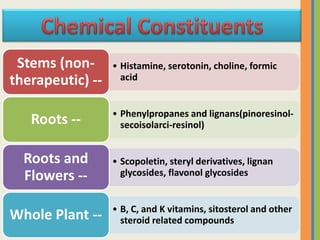
• Histamine, serotonin, choline, formic
acid
Stems (non-
therapeutic) --
• Phenylpropanes and lignans(pinoresinol-
secoisolarci-resinol)Roots --
• Scopoletin, steryl derivatives, lignan
glycosides, flavonol glycosides
Roots and
Flowers --
• B, C, and K vitamins, sitosterol and other
steroid related compoundsWhole Plant --
• Antiandrogenic effects
– inhibits the binding of a testosterone-related
protein to its receptor site on prostate cell
membranes.
• evidence exists for
– Use as a bladder irrigant in humans resulted in
reduces postoperative blood loss, bacteriuria, and
inflammation.
R-prostateDHT
DHT
Estrogen
Testosterone
TR
Prostate cell
DNA R& CD
Rapid cell proliferation
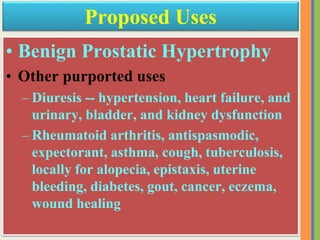
• Benign Prostatic Hypertrophy
• Other purported uses
– Diuresis -- hypertension, heart failure, and
urinary, bladder, and kidney dysfunction
– Rheumatoid arthritis, antispasmodic,
expectorant, asthma, cough, tuberculosis,
locally for alopecia, epistaxis, uterine
bleeding, diabetes, gout, cancer, eczema,
wound healing
Proposed Uses
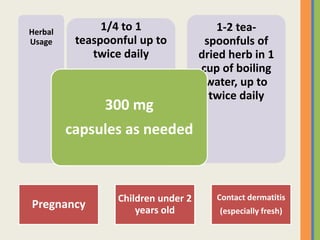
1-2 tea-
spoonfuls of
dried herb in 1
cup of boiling
water, up to
twice daily
1/4 to 1
teaspoonful up to
twice daily
Herbal
Usage
300 mg
capsules as needed
Pregnancy
Children under 2
years old
Contact dermatitis
(especially fresh)
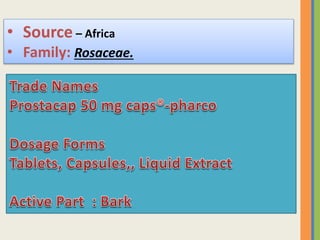
It is an evergreen tree native to the higher
elevations of central and southern Africa.
• Source – Africa
• Family: Rosaceae.
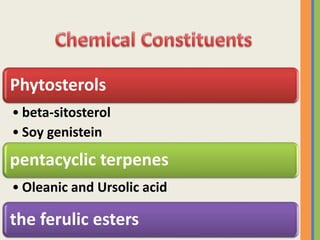
Phytosterols
• beta-sitosterol
• Soy genistein
pentacyclic terpenes
• Oleanic and Ursolic acid
the ferulic esters
• Reduce prostate swelling (edema)
• Antiandrogenic effects
– block dihydrotestosterone binding to prostate
cells.
• New studies show that
– pygeum also interferes with protein kinase
C activity to inhibit the proliferation of
prostate cells.
R-prostateDHT
DHT
Estrogen
Testosterone
TR
Prostate cell
DNA R& CD
Rapid cell proliferation
Protein kinase c
• Benign Prostatic Hypertrophy
• Other purported uses
– improve urinary symptoms associated
with enlargement of the prostate gland
– Reduces, urinary frequency, the number
of times patients need to wake up at night to
urinate.
Proposed Uses
Saw Palmetto, Pygeum, Stinging Nettle,
Quercetin, is carefully formulated with
important herbs and nutrients to provide
optimal prostate health:
100 mg
once
daily
50 mg
twice
daily
Herbal
Usage
The recommended dose is
50 to 150 mg daily
Pregnancy
Women of child-
bearing age
Due to actions
potentially similar to
those produced by
finasteride
Source -- Cucurbita pepo L., Cucurbitaceæ
family
widely cultivated in North America and Australia.
Active Parts -- Seeds
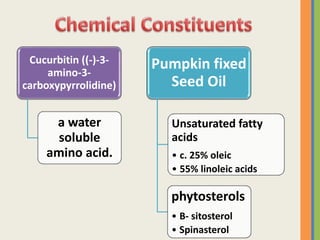
Cucurbitin ((-)-3-
amino-3-
carboxypyrrolidine)
a water
soluble
amino acid.
Pumpkin fixed
Seed Oil
Unsaturated fatty
acids
• c. 25% oleic
• 55% linoleic acids
phytosterols
• B- sitosterol
• Spinasterol
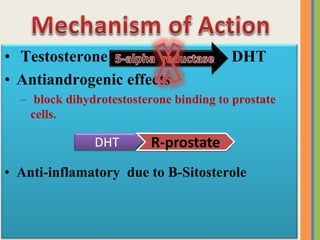
• Testosterone DHT
• Antiandrogenic effects
– block dihydrotestosterone binding to prostate
cells.
• Anti-inflamatory due to B-Sitosterole
R-prostateDHT
DHT
Estrogen
Testosterone
TR
Prostate cell
DNA R& CD
Rapid cell proliferation
Protein kinase c
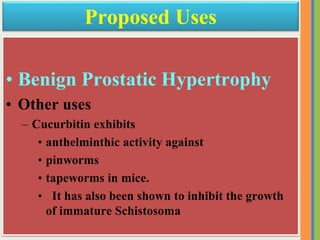
• Benign Prostatic Hypertrophy
• Other uses
– Cucurbitin exhibits
• anthelminthic activity against
• pinworms
• tapeworms in mice.
• It has also been shown to inhibit the growth
of immature Schistosoma
Proposed Uses
Dosage Forms
seeds (whole or crushed), seed extract or oil,
tablets, tea
Pepon:Trade Names
100 mg
once
daily
50 mg
twice
daily
Herbal
Usage
ingestion of a
handful of seeds
daily
Pregnancy
Women of child-
bearing age
Electrolyte
Imbalance (from the
mild diuretic actions)
Testosterone
DHT
Saw palmetto
Nettle
Pygeum
Pumpkin
High amounts in tomatoes &tomato products
One cup (240 mL) of tomato juice = 23 mg of lycopene.
A powerful antioxidant that may help protect cells from
damage.
4 mg of lycopene supplements twice daily might delay
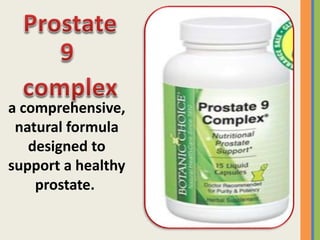
a comprehensive,
natural formula
designed to
support a healthy
prostate.
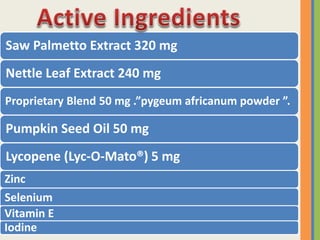
Saw Palmetto Extract 320 mg
Nettle Leaf Extract 240 mg
Proprietary Blend 50 mg .”pygeum africanum powder ”.
Pumpkin Seed Oil 50 mg
Lycopene (Lyc-O-Mato®) 5 mg
Zinc
Selenium
Vitamin E
Iodine
• Benign prostatic hyperplasia is a common finding in most
of the aged males and does not signify any risk of
developing cancer.
• Treatment becomes necessary if the affected individuals
begin developing any symptoms.
• An annual checkup for monitoring the growth of prostate
may be beneficial in individuals aged above 40 years.
• The herbal preparation was shown to be well tolerated
and have a significant positive effect on physical
symptoms of BPH when taken over 3 months, a clinically
significant outcome in otherwise healthy men.
• A significant limiting factor to our understanding of the
use and effectiveness of phytotherapy is the lack of
standardization of these products .
Conclusion
Presentation

Presentation

  • 1.
    PRESENTEDBy MinaReda HERBAL MEDICINE FOR BenignProstatic Hypertrophy Supervised by Prof.dr. Sameeh El-Dahmy
  • 2.
    Benign prostatic hypertrophyis a Generalised disease of the prostate due to hormonal derangement which leads to enlargement of the gland (increase in the number of epithelial cells and stromal tissue) to cause compression of the urethra leading to symptoms . Introduction
  • 3.
  • 4.
  • 5.
    Symptoms • Lower urinarytract symptoms (LUTS) • Voiding (Obstructive) Symptoms  Intermittency  Hesitancy  Incomplete voiding  Weak urinary stream  Straining to pass urine  Prolonged micturition  Terminal dribbling • Storage (Irritative) Symptoms  Frequency of urination  Nocturia  Urgency (compelling need to void that can not be deferred)  Urge incontinence
  • 6.
    Treatment of BPH •Lifestyle modification • Watchful Waiting • Medical Therapy  Alpha blockers  5α-Reductase inhibitors  Combination Therapy • Phytotherapy (alternative) • Surgical Treatment : Conventional Surgical or Minimally Invasive Treatment
  • 7.
  • 8.
    The Palm achievesa height of 6-10 feet. Fruit are irregularly spherical to oblong, ranging in length from 1/2 to 1 inches and 1/2 inch diametre, are deep red-brown and wrinkled.
  • 9.
    • Source --Serenoa repens Bartram. -- Native to the Southern Atlantic coast through the Gulf coast from South Carolina through Texas. • Family: Arecaceae .
  • 10.
    • lauric acid, Palmitic and other fatty acids • Phytosterols • B-sitosterol • Polysaccharides • Manitol , galactose • Monoacylglycerides • Monolaurin • monomyristicin n-Hexane liposterolic extract, containing
  • 11.
    • Antiandrogenic effects •Inhibition of 5-alpha reductase (in vitro)  Testosterone DHT • Antagonism of DHT at androgen receptors • New studies are showing that – saw palmetto also reduces smooth muscle contraction, thereby relaxing the bladder and sphincter muscles that cause urinary urgency.
  • 12.
  • 13.
    • Saw Palmettois effective in the treatment of genitourinary problems, including benign prostatic hypertrophy (BPH) • Other purported uses – to increase sperm production – to increase breast size in women – to increase libido – mild diuresis Proposed Uses
  • 14.
    Similar in efficacyrelative to finasteride Less (though not significantly) effective than alpha1 adrenergic blockade in a decoction or tea. 0.5 to 1 G dried berries 1 to 2 G fresh saw palmetto berries Herbal Usage Human clinical trials have used 320 mg p.o. in divided doses, twice daily Pregnancy Women of child- bearing age Due to actions potentially similar to those produced by finasteride
  • 15.
    The plant grows2-3 feet high with heart-shaped, serrated leaves. Plants are gender specific, with flowers in long , branched clusters appearing June- September. The plant is hirsute, with each hair serving as a small, hollow, needle-like form of protection.
  • 16.
    • Source Urticadioica L., a perennial of the nettle family (Urticaceæ).
  • 17.
    • Histamine, serotonin,choline, formic acid Stems (non- therapeutic) -- • Phenylpropanes and lignans(pinoresinol- secoisolarci-resinol)Roots -- • Scopoletin, steryl derivatives, lignan glycosides, flavonol glycosides Roots and Flowers -- • B, C, and K vitamins, sitosterol and other steroid related compoundsWhole Plant --
  • 18.
    • Antiandrogenic effects –inhibits the binding of a testosterone-related protein to its receptor site on prostate cell membranes. • evidence exists for – Use as a bladder irrigant in humans resulted in reduces postoperative blood loss, bacteriuria, and inflammation. R-prostateDHT
  • 19.
  • 20.
    • Benign ProstaticHypertrophy • Other purported uses – Diuresis -- hypertension, heart failure, and urinary, bladder, and kidney dysfunction – Rheumatoid arthritis, antispasmodic, expectorant, asthma, cough, tuberculosis, locally for alopecia, epistaxis, uterine bleeding, diabetes, gout, cancer, eczema, wound healing Proposed Uses
  • 21.
    1-2 tea- spoonfuls of driedherb in 1 cup of boiling water, up to twice daily 1/4 to 1 teaspoonful up to twice daily Herbal Usage 300 mg capsules as needed Pregnancy Children under 2 years old Contact dermatitis (especially fresh)
  • 22.
    It is anevergreen tree native to the higher elevations of central and southern Africa.
  • 23.
    • Source –Africa • Family: Rosaceae.
  • 24.
    Phytosterols • beta-sitosterol • Soygenistein pentacyclic terpenes • Oleanic and Ursolic acid the ferulic esters
  • 25.
    • Reduce prostateswelling (edema) • Antiandrogenic effects – block dihydrotestosterone binding to prostate cells. • New studies show that – pygeum also interferes with protein kinase C activity to inhibit the proliferation of prostate cells. R-prostateDHT
  • 26.
    DHT Estrogen Testosterone TR Prostate cell DNA R&CD Rapid cell proliferation Protein kinase c
  • 27.
    • Benign ProstaticHypertrophy • Other purported uses – improve urinary symptoms associated with enlargement of the prostate gland – Reduces, urinary frequency, the number of times patients need to wake up at night to urinate. Proposed Uses
  • 28.
    Saw Palmetto, Pygeum,Stinging Nettle, Quercetin, is carefully formulated with important herbs and nutrients to provide optimal prostate health: 100 mg once daily 50 mg twice daily Herbal Usage The recommended dose is 50 to 150 mg daily Pregnancy Women of child- bearing age Due to actions potentially similar to those produced by finasteride
  • 29.
    Source -- Cucurbitapepo L., Cucurbitaceæ family widely cultivated in North America and Australia. Active Parts -- Seeds
  • 30.
    Cucurbitin ((-)-3- amino-3- carboxypyrrolidine) a water soluble aminoacid. Pumpkin fixed Seed Oil Unsaturated fatty acids • c. 25% oleic • 55% linoleic acids phytosterols • B- sitosterol • Spinasterol
  • 31.
    • Testosterone DHT •Antiandrogenic effects – block dihydrotestosterone binding to prostate cells. • Anti-inflamatory due to B-Sitosterole R-prostateDHT
  • 32.
    DHT Estrogen Testosterone TR Prostate cell DNA R&CD Rapid cell proliferation Protein kinase c
  • 33.
    • Benign ProstaticHypertrophy • Other uses – Cucurbitin exhibits • anthelminthic activity against • pinworms • tapeworms in mice. • It has also been shown to inhibit the growth of immature Schistosoma Proposed Uses
  • 34.
    Dosage Forms seeds (wholeor crushed), seed extract or oil, tablets, tea Pepon:Trade Names 100 mg once daily 50 mg twice daily Herbal Usage ingestion of a handful of seeds daily Pregnancy Women of child- bearing age Electrolyte Imbalance (from the mild diuretic actions)
  • 35.
  • 36.
    High amounts intomatoes &tomato products One cup (240 mL) of tomato juice = 23 mg of lycopene. A powerful antioxidant that may help protect cells from damage. 4 mg of lycopene supplements twice daily might delay
  • 37.
    a comprehensive, natural formula designedto support a healthy prostate.
  • 38.
    Saw Palmetto Extract320 mg Nettle Leaf Extract 240 mg Proprietary Blend 50 mg .”pygeum africanum powder ”. Pumpkin Seed Oil 50 mg Lycopene (Lyc-O-Mato®) 5 mg Zinc Selenium Vitamin E Iodine
  • 39.
    • Benign prostatichyperplasia is a common finding in most of the aged males and does not signify any risk of developing cancer. • Treatment becomes necessary if the affected individuals begin developing any symptoms. • An annual checkup for monitoring the growth of prostate may be beneficial in individuals aged above 40 years. • The herbal preparation was shown to be well tolerated and have a significant positive effect on physical symptoms of BPH when taken over 3 months, a clinically significant outcome in otherwise healthy men. • A significant limiting factor to our understanding of the use and effectiveness of phytotherapy is the lack of standardization of these products . Conclusion