HISTORY TAKING
AND EXAMINATION
IN PEDIATRICS
BY: DR AMADU JALLOH
PEDIATRIC HISTORY
• Introduce yourself to the parents
• A warm greeting and simple smile allay anxiety and
promote confident.
HOW TO LEAD THE
TALK?
• Encourage the parents to tell the history with
minimum interruption and listen carefully.
• It is essential to find out what the concern of the
parents are.
• You should not swallow the diagnosis given by the
parents.
DIFFERENCES OF
PEDIATRIC HISTORY AND
ADULT HISTORY
(1) CONTENT DIFFERENCES
. Prenatal and birth history
. Developmental history
. Immunization history
. Nutritional history
. Social history of family-environmental risk
DIFFERENCES OF PEDIATRIC
HISTORY AND ADULT HISTORY
(2) PARENTS ARE HISTORIANS
. Parents interpretation of signs and symptoms
. Observation of parents and child interactions
. Parental behavior/emotions are important
HISTORY TAKING
• BIODATA
 Name
 Age
 Date of admission
 Sex
 Religion
 Address
 Tribe
 Informant
 Reliability of information with reasons
HISTORY TAKING
• PRESENTING COMPLAINTS (PC)
 Always with a duration
 Preferably presenting compliant should not exceed 5 in number.
 Note some symptoms are reported interms of episode and not in
interms of day eg. 5 episodes of convulsion prior to presentation not
convulsions of 5 days duration.
 It is possible that a patient can present with a seizure of long duration
(eg pt. with seizure disorders). In this situation, state the duration
which seizure have been present for and the number of episodes per
day.
HISTORY TAKING
• HISTORY OF PRESENTING COMPLAINT (HXPC)
 Must be reported strictly in the informant’s words.
 Always remember the 5Cs and report your +ves findings before your -ves.
• “5Cs”
I. C – Characterize each symptoms eg cough was insidious in onset, non-
paroxysmal, non-backy, not productive of sputum for child above 6 years old.
II. C – Cause – Rule out every possible causes of the PC.
III. C – Course – The progression of illness since onset
IV. C – Complication enquire about likely complications that could have arise as a
result of the condition.
V. C – Care state the care patient (px) received since onset of illness and state if
there has been improvement with evidence
HISTORY TAKING
• PAST MEDICAL HISTORY (PMHX)
 Hx of previous hospital admission, reason, duration of
stay.
 Hx of surgery
 Hx of blood transfusion
 Hx of chronic illness, SCD, bronchial asthma, seizure
disorders, Bronchitis, TB, HIV, Jaundice, Epilepsy, Heart
disease, and PUD.
• PRENATAL, NATAL AND POST NATAL HISTORY
 Parity and age of mother
 Was pregnancy delivered at term or not
 Gestational age at booking, place of booking
 How may doses of TT received
 Hx of fever or rash during pregnancy
 Hx of prolonged labour, Mode of delivery, and Place of delivery
 Did baby cry/breath immediately after birth or measures taken before child achieved a
vigorous cry.
 Number of days spent before discharge if prolonged, ask for reasons
 Drugs used during pregnancy
 Radiation exposure especially in cases of congenital anomalies.
HISTORY TAKING
HISTORY TAKING
• . NUTRITIONAL HISTORY (NHX)
 Note difference between
a) Exclusive and predominant breast feeding
b) Complementary and supplementary feeding
 In some cases a 24 hours, dietary recall will be necessary
 For older children or children that are not breast feeding inquire about “FADU” ie.
• F – Frequency: how many times child eats in a day at least 5 – 6 times.
• A – Adequacy: Does the child finish his/her food or is there always left over? And what is
the the quantity taken.
• D – Density: what are the constituents of the meal? What food groups and how much of
each food group ie the number of mix or classes of nutrient present.
• U – Utility: how well is the child growing , is he/she using the ingested food or are there
episode of vomiting and diarrhea after each meal.
HISTORY TAKING
• . IMMUNIZATION HISTORY (IHX)
 Ask about each vaccines where and when taken.
 Ask if the NPI schedule was completed ie evidence of certificate given and if not ask why
immunization was not received
 Document any side-effects after each immunization.
• At birth  BCG, OPVo
•
• 6 weeks  1st
OPV, DPT – HepB, Hib
• Pneumococcal, Rotavirus 1
•
• 10 weeks  2nd
OPV, DPT – HepB – Hib
• Pneumococcal, Rotavirus 2, IPTi 1
•
HISTORY TAKING
• IMMUNIZATION HISTORY (IHX)
• 14 weeks  3rd
OPV, DPT – HepB – Hib
• Pneumococcal, IPTi 2, IPV
•
• 6 months  Vitamin A
• 9 months  Yellow fever, measles ,IPTi 3
•
• 12 Months  De-worming, vitamin A.
•
• 15 Months ; Measles Second Dose .
HISTORY TAKING
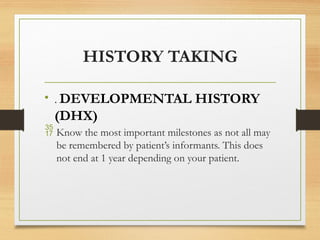
• . DEVELOPMENTAL HISTORY
(DHX)
 Know the most important milestones as not all may
be remembered by patient’s informants. This does
not end at 1 year depending on your patient.
HISTORY TAKING
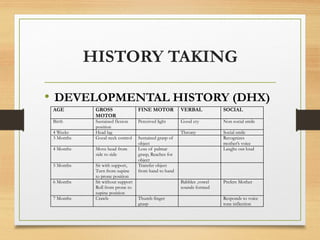
• DEVELOPMENTAL HISTORY (DHX)
AGE GROSS
MOTOR
FINE MOTOR VERBAL SOCIAL
Birth Sustained flexion
position
Perceived light Good cry Non social smile
4 Weeks Head lag Throaty Social smile
3 Months Good neck control Sustained grasp of
object
Recognizes
mother’s voice
4 Months Move head from
side to side
Loss of palmar
grasp, Reaches for
object
Laughs out loud
5 Months Sit with support,
Turn from supine
to prone position
Transfer object
from hand to hand
6 Months Sit without support
Roll from prone to
supine position
Babbles ,vowel
sounds formed
Prefers Mother
7 Months Crawls Thumb finger
grasp
Responds to voice
tone inflection
HISTORY TAKING
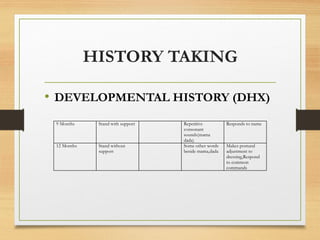
• DEVELOPMENTAL HISTORY (DHX)
9 Months Stand with support Repetitive
consonant
sounds(mama
dada)
Responds to name
12 Months Stand without
support
Some other words
beside mama,dada
Makes postural
adjustment to
dressing,Respond
to common
commands
HISTORY TAKING
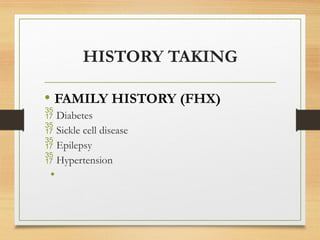
• FAMILY HISTORY (FHX)
 Diabetes
 Sickle cell disease
 Epilepsy
 Hypertension
•
HISTORY TAKING
• . SOCIAL HISTORY (SHX)
 Parent/caregiver take alcohol
 Do parent/caregiver smoke
 Parent/caregiver occupation
 Type of house lived in
 Neighborhood
 Toilet facilities
 Sources of water
 Patient’s performance in school (especially in chronic illness e.g SCD,
seizure disorder)
 Relationships of parent/caregiver
HISTORY TAKING
• . DRUG HISTORY (DHX)
Herbal medication
Chronic drug use
Any medication
History of drug allergy

HISTORY TAKING
• . DIFFERENTIAL DIAGNOSIS
HISTORY TAKING
• . REVIEW OF SYSTEMS
a) GENERAL REVIEW
 Weakness
 Fever
 Loss of appetite (Anorexia)
 Weight loss
 Night sweet
 Lack of sleep (insomnia)
 Itch or rash
 Headache
HISTORY TAKING
a) CVS
 Chest pain
 Palpitation
 Paroxysmal nocturnal dyspnea (PND) / Breathlessness at
night
 Dyspnea (shortness of breath)
 Claudication (pain in legs on walking)
 Orthopnea (breathlessness on lying flat).
•
HISTORY TAKING
a) RESPIRATORY SYSTEM (RS)
 Cough
 Wheeze
 Haemopthysis
 Chest pain
 Dyspnea
 PND
 Apnea
 Tachypnea
•
HISTORY TAKING
a) GASTRO INTESTINAL SYSTEM (GIT)
 Abdominal pain
 Haematemesis (vomiting of blood)
 Vomiting
 Dysphagia (Difficulty swallowing)
 Odynophagia (pain on swallowing)
 Hematochezia (bright red blood in stool)
 Diarrhea
 Constipation
 Melaena (black stool)
HISTORY TAKING
a) GENITOURINARY SYSTEM (GUS)
 Dysuria ( pain passing urine)
 Nocturia (Frequent passing urine at night)
 Haematuria (Blood in the urine)
 Incontinence ( stress and urine)
 Polyuria (passing excess urine)
 Discharge
 Hesitancy
 Loin pain
•
HISTORY TAKING
a) CENTRAL NERVOUS SYSTEM (CNS)
 Headaches
 Dizziness
 Faints (loss of consciousness)
 Altered sensation
 Weakness
 Visual disturbance
 Hearing
 Memory changes
 Concentration change
 Insomnia
 Fatigue
 Tremor
 Speech abnormality
 Numbness
HISTORY TAKING
a)MUSCULOSKELETAL SYSTEM (MSC)
 Joint pain
 Muscle pain
 Bone pain
 Muscle weakness
 Muscle stiffness
 Joint stiffness
HISTORY TAKING
a) ENDOCRINE SYSTEM (ES)
 Polydipsia (excessive thirst)
 Polyphagia
 Polyuria
 Appetite
 Heat intolerance
 Cold intolerance
 Change in sweating

HISTORY TAKING
a)OTHERS
 Bleeding or bruising
 Skin rash

HISTORY TAKING
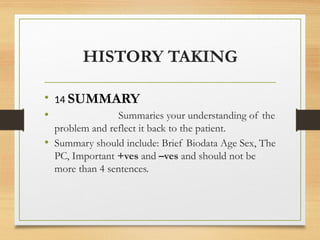
• 14 SUMMARY
• Summaries your understanding of the
problem and reflect it back to the patient.
• Summary should include: Brief Biodata Age Sex, The
PC, Important +ves and –ves and should not be
more than 4 sentences.
PHYSICAL EXAMINATION
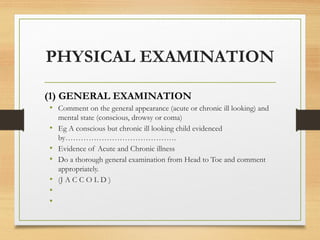
(1) GENERAL EXAMINATION
• Comment on the general appearance (acute or chronic ill looking) and
mental state (conscious, drowsy or coma)
• Eg A conscious but chronic ill looking child evidenced
by…………………………………….
• Evidence of Acute and Chronic illness
• Do a thorough general examination from Head to Toe and comment
appropriately.
• (J A C C O L D )
•
•
PHYSICAL EXAMINATION
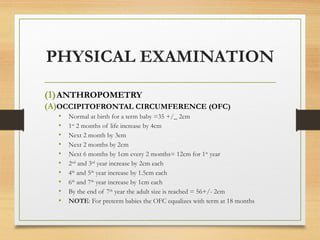
(1)ANTHROPOMETRY
(A)OCCIPITOFRONTAL CIRCUMFERENCE (OFC)
• Normal at birth for a term baby =35 +/_ 2cm
• 1st
2 months of life increase by 4cm
• Next 2 month by 3cm
• Next 2 months by 2cm
• Next 6 months by 1cm every 2 months= 12cm for 1st
year
• 2nd
and 3rd
year increase by 2cm each
• 4th
and 5th
year increase by 1.5cm each
• 6th
and 7th
year increase by 1cm each
• By the end of 7th
year the adult size is reached = 56+/- 2cm
• NOTE: For preterm babies the OFC equalizes with term at 18 months
PHYSICAL EXAMINATION
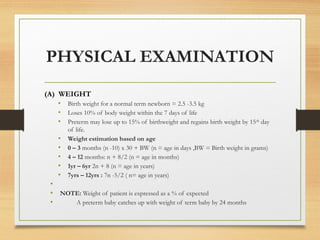
(A) WEIGHT
• Birth weight for a normal term newborn = 2.5 -3.5 kg
• Loses 10% of body weight within the 7 days of life
• Preterm may lose up to 15% of birthweight and regains birth weight by 15th
day
of life.
• Weight estimation based on age
• 0 – 3 months (n -10) x 30 + BW (n = age in days ,BW = Birth weight in grams)
• 4 – 12 months: n + 8/2 (n = age in months)
• 1yr – 6yr 2n + 8 (n = age in years)
• 7yrs – 12yrs : 7n -5/2 ( n= age in years)
•
• NOTE: Weight of patient is expressed as a % of expected
• A preterm baby catches up with weight of term baby by 24 months
PHYSICAL EXAMINATION
(A) HEIGHT/ LENGTH
• Height: Measurement taken while patient is in standing position.
• Length: Taken while the patient is supine (used in the first 12 months ie
infants)
• Length is about 1.25cm more than the height because;
• Effect of gravity reduces the joint spaces while standing.
• The curvature of the spine in erect position is present while in supine
position it is straightened.
• At birth length = 50cm +/- 5cm
• >1yrs height = 6n + 77 (n = age in years)
• A preterm infant’s length catches up with that of a term neonate at 40
months
PHYSICAL EXAMINATION
(A)CHEST CIRCUMFERENCE
• Is 2 to 4cm < OFC at birth
• Equal with OFC at 1 yrs
• After 1yrs CC > OFC
PHYSICAL EXAMINATION
(A)
MID ARM CIRCUMFERENCE (MAC)
• Relevant in patient between 1 and 5 yrs because MAC is
relatively constant in this age group
• Is halfway the distance between the acromion and olecranon
process (palpate for these landmarks before measuring)
• MAC < 12.5cm Red = Malnourished
• 12.5 – 14 cm Yellow = Borderline Malnourished
• 14 – 16cm, Green = well nourished.
•
PHYSICAL EXAMINATION
• SYSTEMIC EXAMINATION
• Start with the system with major pathology
• Examine all other systems completely.
•
CARDIOVASCULAR
SYSTEM
• The apex beat is usually felt in the 4th
intercostal
space just to the left of the midclavicular line in
children under seven years of age. After that in the
5th
intercostal space in the midclavicular line.
CARDIOVASCULAR
SYSTEM
• CHEST INSPECTION
The general shape of the chest (pectus
excavatum/pectus carinatum)
Any scares, visible pulsations etc.
CARDIOVASCULAR
SYSTEM
• CHEST AUSCULTATION
• Regular heart beat?
• Any murmur?
ABDOMENAL EXAM
• INSPECTION:
• Distension, swelling, scaphoid Abdomen, Ascites?
• Visible abdominal veins, umbilicus inverted or
everted, striae etc.
ABDOMENAL EXAM
• PALPATION:
• Abdomen should be soft, not tender, where is it
tender? ,is the patient feeling pain?
• Liver: the lower boarder of the liver is normally 1cm
below the costal margin in infants and children.
ABDOMENAL EXAM
• PERCUSSION:
• Dull, Tympanic
• AUSCULTATION
• Bowel movements, raised bowel murmur?
NEUROLOGICAL EXAM
• Observation
• Mental status
• Cranial nerves
• Cerebellar function
• Motor System
• Sensory System
• Reflexes primitives
NEUROLOGICAL EXAM
• WHAT IS A NEURO EXAM?
• A neurological exam is a simple series of tests that allows
us to watch the nervous system in action
• Mental status (level of awareness and interaction with the
environment)
• Motor and Sensory skills
• Balance and coordination
• Reflexes
NEUROLOGICAL EXAM
• HOW TO PERFORM NEURO EXAM
• Mental Status; Assess the child’s level of awareness
and how he or she interacts with the environment. 1st
highly dependent on the age. For older children, we
watch how they interact with their parents.
• Motor function and balance; If the child is old
enough we may ask to: push and pull against the
doctors hands with arms and legs
NEUROLOGICAL EXAM
• Motor function and balance.
• Hop, skip or jump
• Walk on tip-toes, walk on heels, walk on outsides of feet or
walk on insides of feet
• Squeeze fingers
• Stand with eyes closed while being gently pushed to one side
• We may check how his or her joints move. If the child isn’t old
enough to follow instructions, we may just observe how he or
she moves.
NEUROLOGICAL EXAM
• Sensory perception; This examines the child’s
ability to feel. We may touch the child’s leg, arms or
other parts of her body and have identify the
sensation(hot/cold, sharp/dull).
• Reflexes; If the child is older, we examine reflexes
by gently tapping a small, soft reflex hammer on
different points on the body.
NEUROLOGICAL EXAM
• Cranial Nerves.
• 12 main nerves of the brain, called the cranial nerves
• Each of which has a number.
• During a complete neurological exam, we evaluate
most of them, but we may choose to concentrate on
certain areas, depending on the patient symptoms.
NEUROLOGICAL EXAM
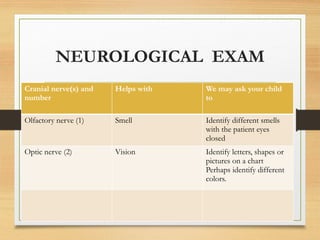
Cranial nerve(s) and
number
Helps with We may ask your child
to
Olfactory nerve (1) Smell Identify different smells
with the patient eyes
closed
Optic nerve (2) Vision Identify letters, shapes or
pictures on a chart
Perhaps identify different
colors.
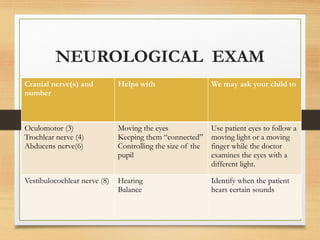
NEUROLOGICAL EXAM
Cranial nerve(s) and
number
Helps with We may ask your child to
Oculomotor (3)
Trochlear nerve (4)
Abducens nerve(6)
Moving the eyes
Keeping them “connected”
Controlling the size of the
pupil
Use patient eyes to follow a
moving light or a moving
finger while the doctor
examines the eyes with a
different light.
Vestibulocochlear nerve (8) Hearing
Balance
Identify when the patient
hears certain sounds
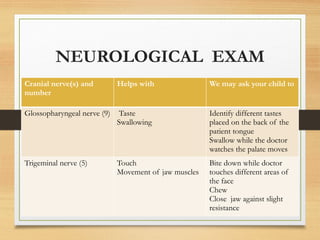
NEUROLOGICAL EXAM
Cranial nerve(s) and
number
Helps with We may ask your child to
Glossopharyngeal nerve (9) Taste
Swallowing
Identify different tastes
placed on the back of the
patient tongue
Swallow while the doctor
watches the palate moves
Trigeminal nerve (5) Touch
Movement of jaw muscles
Bite down while doctor
touches different areas of
the face
Chew
Close jaw against slight
resistance
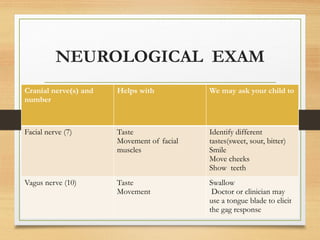
NEUROLOGICAL EXAM
Cranial nerve(s) and
number
Helps with We may ask your child to
Facial nerve (7) Taste
Movement of facial
muscles
Identify different
tastes(sweet, sour, bitter)
Smile
Move cheeks
Show teeth
Vagus nerve (10) Taste
Movement
Swallow
Doctor or clinician may
use a tongue blade to elicit
the gag response
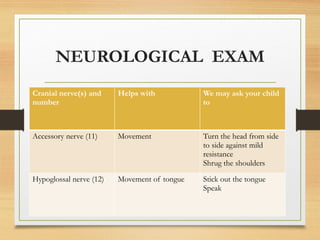
NEUROLOGICAL EXAM
Cranial nerve(s) and
number
Helps with We may ask your child
to
Accessory nerve (11) Movement Turn the head from side
to side against mild
resistance
Shrug the shoulders
Hypoglossal nerve (12) Movement of tongue Stick out the tongue
Speak
INVESTIGATIONS
• Divide it into specific and general.
• Investigations are to
• Confirm or Exclude differentials
• Determine extent of the problem and
complications
TREATMENT
• Divided into Specific and Supportive
FOLLOW UP CARE
• Advice before discharge
• Prevention of trigger factors
• Identify or watch out for complications
• Counseling
•
THANK YOU

PRESENTATION 2.pptxlkjhhxbb. Bcbcncncnnj

  • 1.
    HISTORY TAKING AND EXAMINATION INPEDIATRICS BY: DR AMADU JALLOH
  • 2.
    PEDIATRIC HISTORY • Introduceyourself to the parents • A warm greeting and simple smile allay anxiety and promote confident.
  • 3.
    HOW TO LEADTHE TALK? • Encourage the parents to tell the history with minimum interruption and listen carefully. • It is essential to find out what the concern of the parents are. • You should not swallow the diagnosis given by the parents.
  • 4.
    DIFFERENCES OF PEDIATRIC HISTORYAND ADULT HISTORY (1) CONTENT DIFFERENCES . Prenatal and birth history . Developmental history . Immunization history . Nutritional history . Social history of family-environmental risk
  • 5.
    DIFFERENCES OF PEDIATRIC HISTORYAND ADULT HISTORY (2) PARENTS ARE HISTORIANS . Parents interpretation of signs and symptoms . Observation of parents and child interactions . Parental behavior/emotions are important
  • 6.
    HISTORY TAKING • BIODATA Name  Age  Date of admission  Sex  Religion  Address  Tribe  Informant  Reliability of information with reasons
  • 7.
    HISTORY TAKING • PRESENTINGCOMPLAINTS (PC)  Always with a duration  Preferably presenting compliant should not exceed 5 in number.  Note some symptoms are reported interms of episode and not in interms of day eg. 5 episodes of convulsion prior to presentation not convulsions of 5 days duration.  It is possible that a patient can present with a seizure of long duration (eg pt. with seizure disorders). In this situation, state the duration which seizure have been present for and the number of episodes per day.
  • 8.
    HISTORY TAKING • HISTORYOF PRESENTING COMPLAINT (HXPC)  Must be reported strictly in the informant’s words.  Always remember the 5Cs and report your +ves findings before your -ves. • “5Cs” I. C – Characterize each symptoms eg cough was insidious in onset, non- paroxysmal, non-backy, not productive of sputum for child above 6 years old. II. C – Cause – Rule out every possible causes of the PC. III. C – Course – The progression of illness since onset IV. C – Complication enquire about likely complications that could have arise as a result of the condition. V. C – Care state the care patient (px) received since onset of illness and state if there has been improvement with evidence
  • 9.
    HISTORY TAKING • PASTMEDICAL HISTORY (PMHX)  Hx of previous hospital admission, reason, duration of stay.  Hx of surgery  Hx of blood transfusion  Hx of chronic illness, SCD, bronchial asthma, seizure disorders, Bronchitis, TB, HIV, Jaundice, Epilepsy, Heart disease, and PUD.
  • 10.
    • PRENATAL, NATALAND POST NATAL HISTORY  Parity and age of mother  Was pregnancy delivered at term or not  Gestational age at booking, place of booking  How may doses of TT received  Hx of fever or rash during pregnancy  Hx of prolonged labour, Mode of delivery, and Place of delivery  Did baby cry/breath immediately after birth or measures taken before child achieved a vigorous cry.  Number of days spent before discharge if prolonged, ask for reasons  Drugs used during pregnancy  Radiation exposure especially in cases of congenital anomalies. HISTORY TAKING
  • 11.
    HISTORY TAKING • .NUTRITIONAL HISTORY (NHX)  Note difference between a) Exclusive and predominant breast feeding b) Complementary and supplementary feeding  In some cases a 24 hours, dietary recall will be necessary  For older children or children that are not breast feeding inquire about “FADU” ie. • F – Frequency: how many times child eats in a day at least 5 – 6 times. • A – Adequacy: Does the child finish his/her food or is there always left over? And what is the the quantity taken. • D – Density: what are the constituents of the meal? What food groups and how much of each food group ie the number of mix or classes of nutrient present. • U – Utility: how well is the child growing , is he/she using the ingested food or are there episode of vomiting and diarrhea after each meal.
  • 12.
    HISTORY TAKING • .IMMUNIZATION HISTORY (IHX)  Ask about each vaccines where and when taken.  Ask if the NPI schedule was completed ie evidence of certificate given and if not ask why immunization was not received  Document any side-effects after each immunization. • At birth  BCG, OPVo • • 6 weeks  1st OPV, DPT – HepB, Hib • Pneumococcal, Rotavirus 1 • • 10 weeks  2nd OPV, DPT – HepB – Hib • Pneumococcal, Rotavirus 2, IPTi 1 •
  • 13.
    HISTORY TAKING • IMMUNIZATIONHISTORY (IHX) • 14 weeks  3rd OPV, DPT – HepB – Hib • Pneumococcal, IPTi 2, IPV • • 6 months  Vitamin A • 9 months  Yellow fever, measles ,IPTi 3 • • 12 Months  De-worming, vitamin A. • • 15 Months ; Measles Second Dose .
  • 14.
    HISTORY TAKING • .DEVELOPMENTAL HISTORY (DHX)  Know the most important milestones as not all may be remembered by patient’s informants. This does not end at 1 year depending on your patient.
  • 15.
    HISTORY TAKING • DEVELOPMENTALHISTORY (DHX) AGE GROSS MOTOR FINE MOTOR VERBAL SOCIAL Birth Sustained flexion position Perceived light Good cry Non social smile 4 Weeks Head lag Throaty Social smile 3 Months Good neck control Sustained grasp of object Recognizes mother’s voice 4 Months Move head from side to side Loss of palmar grasp, Reaches for object Laughs out loud 5 Months Sit with support, Turn from supine to prone position Transfer object from hand to hand 6 Months Sit without support Roll from prone to supine position Babbles ,vowel sounds formed Prefers Mother 7 Months Crawls Thumb finger grasp Responds to voice tone inflection
  • 16.
    HISTORY TAKING • DEVELOPMENTALHISTORY (DHX) 9 Months Stand with support Repetitive consonant sounds(mama dada) Responds to name 12 Months Stand without support Some other words beside mama,dada Makes postural adjustment to dressing,Respond to common commands
  • 17.
    HISTORY TAKING • FAMILYHISTORY (FHX)  Diabetes  Sickle cell disease  Epilepsy  Hypertension •
  • 18.
    HISTORY TAKING • .SOCIAL HISTORY (SHX)  Parent/caregiver take alcohol  Do parent/caregiver smoke  Parent/caregiver occupation  Type of house lived in  Neighborhood  Toilet facilities  Sources of water  Patient’s performance in school (especially in chronic illness e.g SCD, seizure disorder)  Relationships of parent/caregiver
  • 19.
    HISTORY TAKING • .DRUG HISTORY (DHX) Herbal medication Chronic drug use Any medication History of drug allergy 
  • 20.
    HISTORY TAKING • .DIFFERENTIAL DIAGNOSIS
  • 21.
    HISTORY TAKING • .REVIEW OF SYSTEMS a) GENERAL REVIEW  Weakness  Fever  Loss of appetite (Anorexia)  Weight loss  Night sweet  Lack of sleep (insomnia)  Itch or rash  Headache
  • 22.
    HISTORY TAKING a) CVS Chest pain  Palpitation  Paroxysmal nocturnal dyspnea (PND) / Breathlessness at night  Dyspnea (shortness of breath)  Claudication (pain in legs on walking)  Orthopnea (breathlessness on lying flat). •
  • 23.
    HISTORY TAKING a) RESPIRATORYSYSTEM (RS)  Cough  Wheeze  Haemopthysis  Chest pain  Dyspnea  PND  Apnea  Tachypnea •
  • 24.
    HISTORY TAKING a) GASTROINTESTINAL SYSTEM (GIT)  Abdominal pain  Haematemesis (vomiting of blood)  Vomiting  Dysphagia (Difficulty swallowing)  Odynophagia (pain on swallowing)  Hematochezia (bright red blood in stool)  Diarrhea  Constipation  Melaena (black stool)
  • 25.
    HISTORY TAKING a) GENITOURINARYSYSTEM (GUS)  Dysuria ( pain passing urine)  Nocturia (Frequent passing urine at night)  Haematuria (Blood in the urine)  Incontinence ( stress and urine)  Polyuria (passing excess urine)  Discharge  Hesitancy  Loin pain •
  • 26.
    HISTORY TAKING a) CENTRALNERVOUS SYSTEM (CNS)  Headaches  Dizziness  Faints (loss of consciousness)  Altered sensation  Weakness  Visual disturbance  Hearing  Memory changes  Concentration change  Insomnia  Fatigue  Tremor  Speech abnormality  Numbness
  • 27.
    HISTORY TAKING a)MUSCULOSKELETAL SYSTEM(MSC)  Joint pain  Muscle pain  Bone pain  Muscle weakness  Muscle stiffness  Joint stiffness
  • 28.
    HISTORY TAKING a) ENDOCRINESYSTEM (ES)  Polydipsia (excessive thirst)  Polyphagia  Polyuria  Appetite  Heat intolerance  Cold intolerance  Change in sweating 
  • 29.
    HISTORY TAKING a)OTHERS  Bleedingor bruising  Skin rash 
  • 30.
    HISTORY TAKING • 14SUMMARY • Summaries your understanding of the problem and reflect it back to the patient. • Summary should include: Brief Biodata Age Sex, The PC, Important +ves and –ves and should not be more than 4 sentences.
  • 31.
    PHYSICAL EXAMINATION (1) GENERALEXAMINATION • Comment on the general appearance (acute or chronic ill looking) and mental state (conscious, drowsy or coma) • Eg A conscious but chronic ill looking child evidenced by……………………………………. • Evidence of Acute and Chronic illness • Do a thorough general examination from Head to Toe and comment appropriately. • (J A C C O L D ) • •
  • 32.
    PHYSICAL EXAMINATION (1)ANTHROPOMETRY (A)OCCIPITOFRONTAL CIRCUMFERENCE(OFC) • Normal at birth for a term baby =35 +/_ 2cm • 1st 2 months of life increase by 4cm • Next 2 month by 3cm • Next 2 months by 2cm • Next 6 months by 1cm every 2 months= 12cm for 1st year • 2nd and 3rd year increase by 2cm each • 4th and 5th year increase by 1.5cm each • 6th and 7th year increase by 1cm each • By the end of 7th year the adult size is reached = 56+/- 2cm • NOTE: For preterm babies the OFC equalizes with term at 18 months
  • 33.
    PHYSICAL EXAMINATION (A) WEIGHT •Birth weight for a normal term newborn = 2.5 -3.5 kg • Loses 10% of body weight within the 7 days of life • Preterm may lose up to 15% of birthweight and regains birth weight by 15th day of life. • Weight estimation based on age • 0 – 3 months (n -10) x 30 + BW (n = age in days ,BW = Birth weight in grams) • 4 – 12 months: n + 8/2 (n = age in months) • 1yr – 6yr 2n + 8 (n = age in years) • 7yrs – 12yrs : 7n -5/2 ( n= age in years) • • NOTE: Weight of patient is expressed as a % of expected • A preterm baby catches up with weight of term baby by 24 months
  • 34.
    PHYSICAL EXAMINATION (A) HEIGHT/LENGTH • Height: Measurement taken while patient is in standing position. • Length: Taken while the patient is supine (used in the first 12 months ie infants) • Length is about 1.25cm more than the height because; • Effect of gravity reduces the joint spaces while standing. • The curvature of the spine in erect position is present while in supine position it is straightened. • At birth length = 50cm +/- 5cm • >1yrs height = 6n + 77 (n = age in years) • A preterm infant’s length catches up with that of a term neonate at 40 months
  • 35.
    PHYSICAL EXAMINATION (A)CHEST CIRCUMFERENCE •Is 2 to 4cm < OFC at birth • Equal with OFC at 1 yrs • After 1yrs CC > OFC
  • 36.
    PHYSICAL EXAMINATION (A) MID ARMCIRCUMFERENCE (MAC) • Relevant in patient between 1 and 5 yrs because MAC is relatively constant in this age group • Is halfway the distance between the acromion and olecranon process (palpate for these landmarks before measuring) • MAC < 12.5cm Red = Malnourished • 12.5 – 14 cm Yellow = Borderline Malnourished • 14 – 16cm, Green = well nourished. •
  • 37.
    PHYSICAL EXAMINATION • SYSTEMICEXAMINATION • Start with the system with major pathology • Examine all other systems completely. •
  • 38.
    CARDIOVASCULAR SYSTEM • The apexbeat is usually felt in the 4th intercostal space just to the left of the midclavicular line in children under seven years of age. After that in the 5th intercostal space in the midclavicular line.
  • 39.
    CARDIOVASCULAR SYSTEM • CHEST INSPECTION Thegeneral shape of the chest (pectus excavatum/pectus carinatum) Any scares, visible pulsations etc.
  • 40.
    CARDIOVASCULAR SYSTEM • CHEST AUSCULTATION •Regular heart beat? • Any murmur?
  • 41.
    ABDOMENAL EXAM • INSPECTION: •Distension, swelling, scaphoid Abdomen, Ascites? • Visible abdominal veins, umbilicus inverted or everted, striae etc.
  • 42.
    ABDOMENAL EXAM • PALPATION: •Abdomen should be soft, not tender, where is it tender? ,is the patient feeling pain? • Liver: the lower boarder of the liver is normally 1cm below the costal margin in infants and children.
  • 43.
    ABDOMENAL EXAM • PERCUSSION: •Dull, Tympanic • AUSCULTATION • Bowel movements, raised bowel murmur?
  • 44.
    NEUROLOGICAL EXAM • Observation •Mental status • Cranial nerves • Cerebellar function • Motor System • Sensory System • Reflexes primitives
  • 45.
    NEUROLOGICAL EXAM • WHATIS A NEURO EXAM? • A neurological exam is a simple series of tests that allows us to watch the nervous system in action • Mental status (level of awareness and interaction with the environment) • Motor and Sensory skills • Balance and coordination • Reflexes
  • 46.
    NEUROLOGICAL EXAM • HOWTO PERFORM NEURO EXAM • Mental Status; Assess the child’s level of awareness and how he or she interacts with the environment. 1st highly dependent on the age. For older children, we watch how they interact with their parents. • Motor function and balance; If the child is old enough we may ask to: push and pull against the doctors hands with arms and legs
  • 47.
    NEUROLOGICAL EXAM • Motorfunction and balance. • Hop, skip or jump • Walk on tip-toes, walk on heels, walk on outsides of feet or walk on insides of feet • Squeeze fingers • Stand with eyes closed while being gently pushed to one side • We may check how his or her joints move. If the child isn’t old enough to follow instructions, we may just observe how he or she moves.
  • 48.
    NEUROLOGICAL EXAM • Sensoryperception; This examines the child’s ability to feel. We may touch the child’s leg, arms or other parts of her body and have identify the sensation(hot/cold, sharp/dull). • Reflexes; If the child is older, we examine reflexes by gently tapping a small, soft reflex hammer on different points on the body.
  • 49.
    NEUROLOGICAL EXAM • CranialNerves. • 12 main nerves of the brain, called the cranial nerves • Each of which has a number. • During a complete neurological exam, we evaluate most of them, but we may choose to concentrate on certain areas, depending on the patient symptoms.
  • 50.
    NEUROLOGICAL EXAM Cranial nerve(s)and number Helps with We may ask your child to Olfactory nerve (1) Smell Identify different smells with the patient eyes closed Optic nerve (2) Vision Identify letters, shapes or pictures on a chart Perhaps identify different colors.
  • 51.
    NEUROLOGICAL EXAM Cranial nerve(s)and number Helps with We may ask your child to Oculomotor (3) Trochlear nerve (4) Abducens nerve(6) Moving the eyes Keeping them “connected” Controlling the size of the pupil Use patient eyes to follow a moving light or a moving finger while the doctor examines the eyes with a different light. Vestibulocochlear nerve (8) Hearing Balance Identify when the patient hears certain sounds
  • 52.
    NEUROLOGICAL EXAM Cranial nerve(s)and number Helps with We may ask your child to Glossopharyngeal nerve (9) Taste Swallowing Identify different tastes placed on the back of the patient tongue Swallow while the doctor watches the palate moves Trigeminal nerve (5) Touch Movement of jaw muscles Bite down while doctor touches different areas of the face Chew Close jaw against slight resistance
  • 53.
    NEUROLOGICAL EXAM Cranial nerve(s)and number Helps with We may ask your child to Facial nerve (7) Taste Movement of facial muscles Identify different tastes(sweet, sour, bitter) Smile Move cheeks Show teeth Vagus nerve (10) Taste Movement Swallow Doctor or clinician may use a tongue blade to elicit the gag response
  • 54.
    NEUROLOGICAL EXAM Cranial nerve(s)and number Helps with We may ask your child to Accessory nerve (11) Movement Turn the head from side to side against mild resistance Shrug the shoulders Hypoglossal nerve (12) Movement of tongue Stick out the tongue Speak
  • 55.
    INVESTIGATIONS • Divide itinto specific and general. • Investigations are to • Confirm or Exclude differentials • Determine extent of the problem and complications
  • 56.
    TREATMENT • Divided intoSpecific and Supportive
  • 57.
    FOLLOW UP CARE •Advice before discharge • Prevention of trigger factors • Identify or watch out for complications • Counseling •
  • 58.