Kebh
2012

BIBLIOGRAPHY & INDEXES
BIBLIOGRAPHIES V. INDEXES

 So what is the difference?
 Indexes usually list what is within a work
    A  magazine index tells you what is within each
      issue of a magazine
   Bibliographies just point to the whole work.
     List
         of references at the end of your papers—
      whole works (articles, websites, books, etc.)
WHAT ARE BIBLIOGRAPHIES?
   If you are a book collector or deal with rare
    books… read this
         http://www.bibsocamer.org/bibdef.htm
   If you are just a journeyman librarian (like us)…
    read this
      ―a list often with descriptive or critical notes of
       writings relating to a particular subject, period, or
       author‖ Merriam Webster online dictionary
      ―…A systematic list or enumeration of written works
       by a specific author or on a given subject, or that
       share one or more common characteristics
       (language, form, period, place of publication, etc.).‖
         ABC CLIO online dictionary of library science
    CRITICAL THINKING: so is School Library Journal
    an index or a bibliography? How about Titlewave?
    TEL?
WHAT ARE INDEXES?
    An alphabetically arranged list of headings consisting of the personal names,
     places, and subjects treated in a written work, with page numbers to refer
     the reader to the point in the text at which information pertaining to the heading
     is found.
                                  Online dictionary of library science http://www.abc-clio.com/ODLIS/odlis_A.aspx
    So….whatever you call it, you know it points to resources.


    CRITICAL THINKING: Do you know that abstracting and indexing is a highly skilled art? There are
    multiple semester courses in these two skills! Think about what you need to do to create an index for
    an encyclopedia or to create abstracts for every professional paper in a festschrift.
    ―The American Society of Indexers was founded in 1968 and is an affiliate of the American Library
    Association that seeks to promote indexing, abstracting, and database construction.‖
   So a bibliography brings together many items on a
    topic and usually gives a short summary on the
    content (or a review)
   Bibliographies help you find materials that are
    connected by a common thread—wait! Don‘t indexes
    do that too?
   Yes, some indexes do.
   Index is usually a bit less annotated than a
    bibliography. Don‘t worry about the terminology at this
    point. Just look at many of each and you will start to
    see the differences between an index and a
    bibliography.
ORIGIN OF BIBLIOGRAPHY                                      ORIGIN OF INDEX
   Etymology: <                                      Etymology: < Latin index, indic-
    Greek βιβλιογραϕία book-writing:                   em, plural indicēs
    compare French bibliographie.
   4. A list of the books of a particular            †a. A table of contents prefixed to a book, a
    author, printer, or country, or of those           brief list or summary of the matters treated in
    dealing with any particular theme; the             it, an argument; also, a
    literature of a subject.                           preface, prologue. Obs.
   1814 T. H. HORNE Introd. Study
    Bibliogr. I. II. iii. §4. 365 Professional,        b. An alphabetical list, placed (usually) at the
    or..special bibliography, has reference            end of a book, of the names, subjects, etc.
    only to one class of books, and                    occurring in it, with indication of the places in
    comprehends every work published on                which they occur.
    the subject of which it treats... Special
    bibliographies may be disposed either             [1578 H. LYTE tr. R. Dodoens Niewe
    alphabetically, or systematically.                 Herball (heading) Index Latinorum nominum.
   1869 W. ROWLANDS (title) Cambrian                 1578 H. LYTE tr. R. Dodoens Niewe
    Bibliography.
   1879 R. H. SHEPHERD (title) The                    Herball, Index appellationum et
    Bibliography of Ruskin.                            nomenclaturarum omnium Stirpium [etc.].
   1882 Nature 11 May 26/1 The                       1578 H. LYTE tr. R. Dodoens Niewe
    literature or bibliography of the species          Herball, The Englishe Table conteyning the
    of the Orthocerata.                                names and syrnames [etc.].]
   1930 K. MALONE in English
    Jrnl. 19 646 The term bibliography is             1580 A. FLEMING in Baret's Aluearie (rev. ed.)
    also used, unhappily, I think, to mean             Aaaa j, Which words, though expressed in
    ‗list of writings germane to a given topic‘.       this Index, are notwithstanding omitted..in this
                                                       Aluearie.
     from the OED online – so the word, ―Bibliography‖ was first used in 1814 and
     ―index‖ was first used in 1578
EXAMPLES OF BIBLIOGRAPHIES
   Subject bibliography
       A to Zoo: Subject Access to Children's Picture Books
       Genreflecting: A Guide to Popular Reading Interests
       Book Links articles contain bibliographies that help you find books to
        use with curriculum
   General bibliographies are found in the DDC 016 class and in the
    Z class of LOC
       Subject bibs any are classed with the discipline and have a 016
        somewhere in the class number

CRITICAL THINKING : What is the difference between and index and a
bibliography? The LCSH for A to Zoo is Picture books for children-Indexes.
The LCSH for Genreflecting is Fiction—Bibliography.
                                       So is A to Zoo an index or a bibliography?
EXAMPLES OF INDEXES

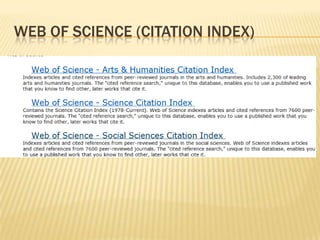
 Web of Science
 Library Literature and Information Science

 Reader‘s Guide to Periodicals

 Ebscohost
ULRICH'S PERIODICALS DIRECTORY
   Standard list of journals that real librarians use when
    trying to find new periodicals or trying to find subscription
    info or name changes. It is available through Walker
    Library as of the Databases A-Z. Please take a look at a
    few entries in that. What information do you find there?
    everything! More than you understand.
   Do you know what the Abstracting & Indexing Sources
    area is telling you?
   What the Title History, Demographics, Key Features
    mean?
   Terminology : 'cease', 'supercedes'.
   Notice the Table of Contents on the left. It lists the
    contents of each of the issues of the journal and links to
    Walker‘s access to those!
MAGAZINES FOR LIBRARIES***
    Cheryl LaGuardia editor with Bill and Linda
     Sternberg Katz.
          An annotated listing by subject of over 6,000
           periodicals. Each entry gives name of periodical,
           beginning publication date, publisher, editor,
           address, price and such information as indexing,
           size, and level of audience. Short abstracts describe
           the scope, political slant, and other aspects of the
           publication. Arrangement is topical, bringing
           magazines and journals on like subjects together. To
           find an individual title, use the title index at the end
           of the volume.
***There is a Magazines for School Libraries, but it is seriously out of
date.
You can buy one for a penny from Amazon!
MAGAZINES FOR LIBRARIES EXCERPT FROM
THE ONLINE VERSION
   International Journal of Learning and Media
   Posted on: 27 Oct 2009
   Reviewed by: Cheryl LaGuardia, Research Librarian, Widener Library, Harvard
    University
   IJLM‘s aim is to provide an international forum for practitioners, researchers, and
    scholars ―to examine the changing relationships between learning and media
    across a wide range of forms and settings.‖ The coverage is mostly about young
    people (K-12), and the focus is (not surprisingly, coming from MIT) on new and
    emerging media technologies, forms, and practices. Each issue includes
    editorials, case studies, scholarly articles, and an active online
    network, including the sections ―Keywords,‖ ―Missives,‖ ―Formulations &
    Findings,‖ ―Knowing & Doing,‖ and ―News.‖ The impressive editorial board seeks
    contributions addressing theoretical, textual, historical, and sociological
    dimensions of media and learning, along with both practical and political issues
    of these dimensions. Scholarly articles are peer reviewed, but the journal also
    publishes ―topical and polemical writing, for visual and multimedia
    presentations, and for online dialogues.‖ A hot new title, reasonably priced and
    delivered online in the optimal format, this journal is strongly recommended for
    school librarians, large public libraries, and academic libraries supporting
    education programs
CITATION INDEXES
   These index the citations in scholarly works. So if I write a paper
    and my list of references cites the work of 5 authors, those
    citations become the entries in the citation index.
   It‘s just what the name says---an index to citations.
   Why would one do this?? How would one use this?
       In deep scholarly work, it is useful to know if a source has been used
        by others.
       If you find a seminal source, you can use the citation index to see
        who else has used the source. Chances are that their work will be
        useful for you as another source.
       Just as you comb through the bibliographies of seminal sources, you
        can see who else used the seminal source IN their bibligraphy.
       Just think, if you use the seminal source, then your work will be in a
        citation index!
CRITICAL THINKING:
KWOC and KWIC
indexes, what are
they?
WEB OF SCIENCE (CITATION INDEX)
LIBRARY LITERATURE AND INFORMATION SCIENCE


  Is an index to the body of library literature
 EBSCO Publishing
 Online (used to be in print before it was taken
over by EBSCO)
 All libraries including K-12 schools, university
and college libraries, government institutions,
hospital and medical institutions and public
libraries.
Library Literature AND INFORMATION SCIENCE


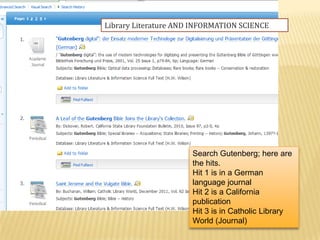
                      Search Gutenberg; here are
                      the hits.
                      Hit 1 is in a German
                      language journal
                      Hit 2 is a California
                      publication
                      Hit 3 is in Catholic Library
                      World (Journal)

6110 bibliography

  • 1.
  • 2.
    BIBLIOGRAPHIES V. INDEXES So what is the difference?  Indexes usually list what is within a work A magazine index tells you what is within each issue of a magazine  Bibliographies just point to the whole work.  List of references at the end of your papers— whole works (articles, websites, books, etc.)
  • 3.
    WHAT ARE BIBLIOGRAPHIES?  If you are a book collector or deal with rare books… read this  http://www.bibsocamer.org/bibdef.htm  If you are just a journeyman librarian (like us)… read this  ―a list often with descriptive or critical notes of writings relating to a particular subject, period, or author‖ Merriam Webster online dictionary  ―…A systematic list or enumeration of written works by a specific author or on a given subject, or that share one or more common characteristics (language, form, period, place of publication, etc.).‖ ABC CLIO online dictionary of library science CRITICAL THINKING: so is School Library Journal an index or a bibliography? How about Titlewave? TEL?
  • 4.
    WHAT ARE INDEXES?  An alphabetically arranged list of headings consisting of the personal names, places, and subjects treated in a written work, with page numbers to refer the reader to the point in the text at which information pertaining to the heading is found.  Online dictionary of library science http://www.abc-clio.com/ODLIS/odlis_A.aspx  So….whatever you call it, you know it points to resources. CRITICAL THINKING: Do you know that abstracting and indexing is a highly skilled art? There are multiple semester courses in these two skills! Think about what you need to do to create an index for an encyclopedia or to create abstracts for every professional paper in a festschrift. ―The American Society of Indexers was founded in 1968 and is an affiliate of the American Library Association that seeks to promote indexing, abstracting, and database construction.‖
  • 5.
    So a bibliography brings together many items on a topic and usually gives a short summary on the content (or a review)  Bibliographies help you find materials that are connected by a common thread—wait! Don‘t indexes do that too?  Yes, some indexes do.  Index is usually a bit less annotated than a bibliography. Don‘t worry about the terminology at this point. Just look at many of each and you will start to see the differences between an index and a bibliography.
  • 6.
    ORIGIN OF BIBLIOGRAPHY ORIGIN OF INDEX  Etymology: <  Etymology: < Latin index, indic- Greek βιβλιογραϕία book-writing: em, plural indicēs compare French bibliographie.  4. A list of the books of a particular  †a. A table of contents prefixed to a book, a author, printer, or country, or of those brief list or summary of the matters treated in dealing with any particular theme; the it, an argument; also, a literature of a subject. preface, prologue. Obs.  1814 T. H. HORNE Introd. Study Bibliogr. I. II. iii. §4. 365 Professional,  b. An alphabetical list, placed (usually) at the or..special bibliography, has reference end of a book, of the names, subjects, etc. only to one class of books, and occurring in it, with indication of the places in comprehends every work published on which they occur. the subject of which it treats... Special bibliographies may be disposed either  [1578 H. LYTE tr. R. Dodoens Niewe alphabetically, or systematically. Herball (heading) Index Latinorum nominum.  1869 W. ROWLANDS (title) Cambrian  1578 H. LYTE tr. R. Dodoens Niewe Bibliography.  1879 R. H. SHEPHERD (title) The Herball, Index appellationum et Bibliography of Ruskin. nomenclaturarum omnium Stirpium [etc.].  1882 Nature 11 May 26/1 The  1578 H. LYTE tr. R. Dodoens Niewe literature or bibliography of the species Herball, The Englishe Table conteyning the of the Orthocerata. names and syrnames [etc.].]  1930 K. MALONE in English Jrnl. 19 646 The term bibliography is  1580 A. FLEMING in Baret's Aluearie (rev. ed.) also used, unhappily, I think, to mean Aaaa j, Which words, though expressed in ‗list of writings germane to a given topic‘. this Index, are notwithstanding omitted..in this Aluearie. from the OED online – so the word, ―Bibliography‖ was first used in 1814 and ―index‖ was first used in 1578
  • 7.
    EXAMPLES OF BIBLIOGRAPHIES  Subject bibliography  A to Zoo: Subject Access to Children's Picture Books  Genreflecting: A Guide to Popular Reading Interests  Book Links articles contain bibliographies that help you find books to use with curriculum  General bibliographies are found in the DDC 016 class and in the Z class of LOC  Subject bibs any are classed with the discipline and have a 016 somewhere in the class number CRITICAL THINKING : What is the difference between and index and a bibliography? The LCSH for A to Zoo is Picture books for children-Indexes. The LCSH for Genreflecting is Fiction—Bibliography. So is A to Zoo an index or a bibliography?
  • 8.
    EXAMPLES OF INDEXES Web of Science  Library Literature and Information Science  Reader‘s Guide to Periodicals  Ebscohost
  • 9.
    ULRICH'S PERIODICALS DIRECTORY  Standard list of journals that real librarians use when trying to find new periodicals or trying to find subscription info or name changes. It is available through Walker Library as of the Databases A-Z. Please take a look at a few entries in that. What information do you find there? everything! More than you understand.  Do you know what the Abstracting & Indexing Sources area is telling you?  What the Title History, Demographics, Key Features mean?  Terminology : 'cease', 'supercedes'.  Notice the Table of Contents on the left. It lists the contents of each of the issues of the journal and links to Walker‘s access to those!
  • 10.
    MAGAZINES FOR LIBRARIES***  Cheryl LaGuardia editor with Bill and Linda Sternberg Katz.  An annotated listing by subject of over 6,000 periodicals. Each entry gives name of periodical, beginning publication date, publisher, editor, address, price and such information as indexing, size, and level of audience. Short abstracts describe the scope, political slant, and other aspects of the publication. Arrangement is topical, bringing magazines and journals on like subjects together. To find an individual title, use the title index at the end of the volume. ***There is a Magazines for School Libraries, but it is seriously out of date. You can buy one for a penny from Amazon!
  • 11.
    MAGAZINES FOR LIBRARIESEXCERPT FROM THE ONLINE VERSION  International Journal of Learning and Media  Posted on: 27 Oct 2009  Reviewed by: Cheryl LaGuardia, Research Librarian, Widener Library, Harvard University  IJLM‘s aim is to provide an international forum for practitioners, researchers, and scholars ―to examine the changing relationships between learning and media across a wide range of forms and settings.‖ The coverage is mostly about young people (K-12), and the focus is (not surprisingly, coming from MIT) on new and emerging media technologies, forms, and practices. Each issue includes editorials, case studies, scholarly articles, and an active online network, including the sections ―Keywords,‖ ―Missives,‖ ―Formulations & Findings,‖ ―Knowing & Doing,‖ and ―News.‖ The impressive editorial board seeks contributions addressing theoretical, textual, historical, and sociological dimensions of media and learning, along with both practical and political issues of these dimensions. Scholarly articles are peer reviewed, but the journal also publishes ―topical and polemical writing, for visual and multimedia presentations, and for online dialogues.‖ A hot new title, reasonably priced and delivered online in the optimal format, this journal is strongly recommended for school librarians, large public libraries, and academic libraries supporting education programs
  • 12.
    CITATION INDEXES  These index the citations in scholarly works. So if I write a paper and my list of references cites the work of 5 authors, those citations become the entries in the citation index.  It‘s just what the name says---an index to citations.  Why would one do this?? How would one use this?  In deep scholarly work, it is useful to know if a source has been used by others.  If you find a seminal source, you can use the citation index to see who else has used the source. Chances are that their work will be useful for you as another source.  Just as you comb through the bibliographies of seminal sources, you can see who else used the seminal source IN their bibligraphy.  Just think, if you use the seminal source, then your work will be in a citation index! CRITICAL THINKING: KWOC and KWIC indexes, what are they?
  • 13.
    WEB OF SCIENCE(CITATION INDEX)
  • 14.
    LIBRARY LITERATURE ANDINFORMATION SCIENCE  Is an index to the body of library literature  EBSCO Publishing  Online (used to be in print before it was taken over by EBSCO)  All libraries including K-12 schools, university and college libraries, government institutions, hospital and medical institutions and public libraries.
  • 15.
    Library Literature ANDINFORMATION SCIENCE Search Gutenberg; here are the hits. Hit 1 is in a German language journal Hit 2 is a California publication Hit 3 is in Catholic Library World (Journal)