Software developmentinan electric vehicle:the TU/e Lupo ELir. Paul van OorschotMechanical Engineering, Dynamics and ControlOctober 3, 2011, EindhovenPAGE 1
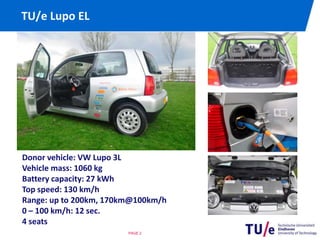
TU/e Lupo ELpicture + specsPAGE 2Donor vehicle: VW Lupo 3LVehicle mass: 1060 kg Battery capacity: 27 kWhTop speed: 130 km/hRange: up to 200km, 170km@100km/h0 – 100 km/h: 12 sec.4 seats
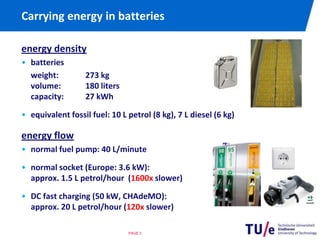
Carrying energy in batteriesenergy densitybatteries	weight: 	273 kgvolume: 	180 literscapacity: 	27 kWhequivalent fossil fuel: 10 L petrol (8 kg), 7 L diesel (6 kg)energy flownormal fuel pump: 40 L/minutenormal socket (Europe: 3.6 kW): approx. 1.5 L petrol/hour  (1600x slower)DC fast charging (50 kW, CHAdeMO): approx. 20 L petrol/hour (120x slower)PAGE 3
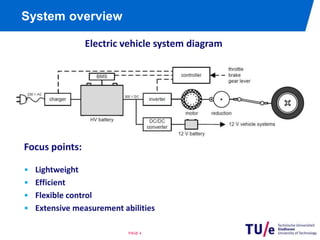
System overviewPAGE 4Electric vehicle system diagramChassis 598 kgICE = 239 kgFocus points:Lightweight
Efficient
Flexiblecontrol
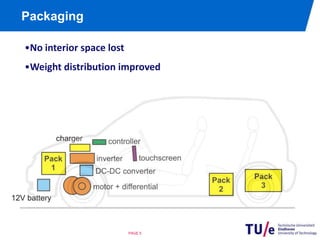
ExtensivemeasurementabilitiesPackagingPAGE 5No interior space lost
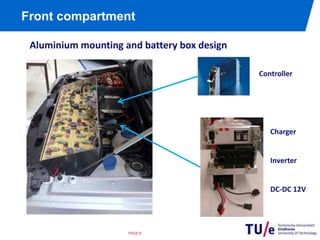
Weight distribution improvedFront compartmentPAGE 6Aluminium mounting and battery box designControllerChargerInverterDC-DC 12V
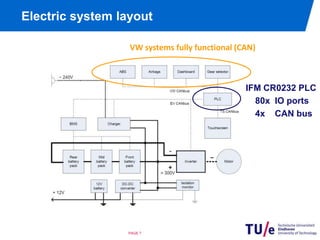
IFM CR0232 PLC80x  IO ports4x    CAN busElectric system layout	PAGE 7VW systems fully functional (CAN)
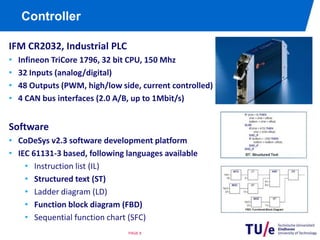
PAGE 8ControllerIFM CR2032, Industrial PLCInfineonTriCore 1796, 32 bit CPU, 150 Mhz
32 Inputs (analog/digital)
48 Outputs (PWM, high/low side, currentcontrolled)
4 CAN bus interfaces (2.0 A/B, up to 1Mbit/s)SoftwareCoDeSysv2.3 software development platform
IEC 61131-3 based, followinglanguagesavailable
Instruction list (IL)

Presentatie paul van oorschot, tu

Editor's Notes

  • #8 Electric drivetrain / batteriesMotor12V Circuit-----clickImportant component IFM PLC, has 4 CAN-bus and 80 IOUsed to connect -----click