THE CRITIQUE OF THE EDUCATIONAL INSTITUTIONS
IN THE 1970´S AS AN HISTORICAL EVENT WITHIN THE
CONFIGURATION OF THE LIQUID SOCIAL IMAGINARY
          IN THE TWENTY FIRST CENTURY

       Jon Igelmo Zaldívar (Universidad de
                    Deusto)
       Xavier Laudo Castillo (Universitat de
                   Barcelona)


      International StandingConferencefortheHistoryofEducation
                 GenevaSwitzerland, June 27-30,2012
INTRODUCTION

 Nowadays within the postmodern social
  imaginary the spectrum of critical thinking in
  relation to modern institutions is being expanded
  in the western world.
 A new social imaginary appear when it is possible
  to detect a group of changes in:
               a) the validity of the truth.
  b) the consistency and stability of the values.
  c) the social interaction amongst human.

    International StandingConferencefortheHistoryofEducation
               GenevaSwitzerland, June 27-30,2012
TWO KEY CONCEPTS: LIQUID
 PEDAGOGY AND DESCHOOLING
 THEORIES
 Liquid pedagogy: a set of normative provisions on
  education that propose series of means to be
  adapted constantly to the context; aim to achieve to
  embody a model of person able to adapt
  him/herself to the uncertainty and change; and
  develop hermeneutic skills to interpret the reality
  without universal absolute references.
 Deschooling theories: theoretical suspicions about
  the task of the educational systems in the world
  after Second World War. For this trend in pedagogy
  the institutionalized education is no longer
  perceived as a solution for the principal problems
  of humanity. Instead, education is presented as a
       International StandingConferencefortheHistoryofEducation
  problem amongst others. June 27-30,2012
                  GenevaSwitzerland,
HISTORIOGRAPHY AS A
 METHODOLOGICAL TOOL.

 The post-social historiographic methodology points
  out that discourse is not a simple means that leads
  people to transmit an objective notion of reality
  without incorporating new meanings. In
  contrast, discourse is an active component in the
  process of creating these meanings while
  participating as an independent factor to frame
  historical processes.
 This school of historiography focuses on the way in
  which is shaped a discourse in the historical time
  and not on the impact of the practices and ideas in
       International StandingConferencefortheHistoryofEducation
  the society GenevaSwitzerland, June 27-30,2012
                  or social structures.
A HYPOTHESIS TO RELATE TWO
  EVENTS

 The theoretical reconfigurations of the liquid
  pedagogical imaginary has their genealogical
  historical continuity in the deschooling theories
  presented in the 1970s.
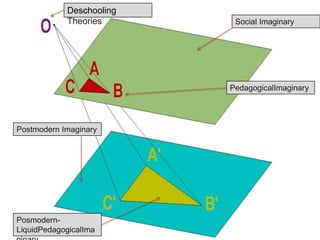
 This continuity is not an equivalent element as it is
  the connection in the space between two points by
  straight line. It turns out that the relationship
  between the deschooling theories and the liquid
  pedagogical imaginary is better represented taking
  as a reference the mathematic metaphor of the
  homothetic transformation.
      International StandingConferencefortheHistoryofEducation
                 GenevaSwitzerland, June 27-30,2012
Deschooling
CONCLUSIONS

 We claim it is time to change the questions made
  to the deschooling theories until now by historians
  of education, and try out with new perspectives of
  analysis:
- In which way can be said that the critique to
  school in the 1970´s was both a symptom and a
  effect for the emergence of a new pedagogical
  imaginary characterized by the discredit and
  doubt against the biggest educational institutions
  of the western world?
- Has the liquid pedagogy got the same origin and
  historical cause than the deschooling discourse?
     International StandingConferencefortheHistoryofEducation
             GenevaSwitzerland, June 27-30,2012

Presentación-jon

  • 1.
    THE CRITIQUE OFTHE EDUCATIONAL INSTITUTIONS IN THE 1970´S AS AN HISTORICAL EVENT WITHIN THE CONFIGURATION OF THE LIQUID SOCIAL IMAGINARY IN THE TWENTY FIRST CENTURY Jon Igelmo Zaldívar (Universidad de Deusto) Xavier Laudo Castillo (Universitat de Barcelona) International StandingConferencefortheHistoryofEducation GenevaSwitzerland, June 27-30,2012
  • 2.
    INTRODUCTION  Nowadays withinthe postmodern social imaginary the spectrum of critical thinking in relation to modern institutions is being expanded in the western world.  A new social imaginary appear when it is possible to detect a group of changes in: a) the validity of the truth. b) the consistency and stability of the values. c) the social interaction amongst human. International StandingConferencefortheHistoryofEducation GenevaSwitzerland, June 27-30,2012
  • 3.
    TWO KEY CONCEPTS:LIQUID PEDAGOGY AND DESCHOOLING THEORIES  Liquid pedagogy: a set of normative provisions on education that propose series of means to be adapted constantly to the context; aim to achieve to embody a model of person able to adapt him/herself to the uncertainty and change; and develop hermeneutic skills to interpret the reality without universal absolute references.  Deschooling theories: theoretical suspicions about the task of the educational systems in the world after Second World War. For this trend in pedagogy the institutionalized education is no longer perceived as a solution for the principal problems of humanity. Instead, education is presented as a International StandingConferencefortheHistoryofEducation problem amongst others. June 27-30,2012 GenevaSwitzerland,
  • 4.
    HISTORIOGRAPHY AS A METHODOLOGICAL TOOL.  The post-social historiographic methodology points out that discourse is not a simple means that leads people to transmit an objective notion of reality without incorporating new meanings. In contrast, discourse is an active component in the process of creating these meanings while participating as an independent factor to frame historical processes.  This school of historiography focuses on the way in which is shaped a discourse in the historical time and not on the impact of the practices and ideas in International StandingConferencefortheHistoryofEducation the society GenevaSwitzerland, June 27-30,2012 or social structures.
  • 5.
    A HYPOTHESIS TORELATE TWO EVENTS  The theoretical reconfigurations of the liquid pedagogical imaginary has their genealogical historical continuity in the deschooling theories presented in the 1970s.  This continuity is not an equivalent element as it is the connection in the space between two points by straight line. It turns out that the relationship between the deschooling theories and the liquid pedagogical imaginary is better represented taking as a reference the mathematic metaphor of the homothetic transformation. International StandingConferencefortheHistoryofEducation GenevaSwitzerland, June 27-30,2012
  • 6.
  • 7.
    CONCLUSIONS  We claimit is time to change the questions made to the deschooling theories until now by historians of education, and try out with new perspectives of analysis: - In which way can be said that the critique to school in the 1970´s was both a symptom and a effect for the emergence of a new pedagogical imaginary characterized by the discredit and doubt against the biggest educational institutions of the western world? - Has the liquid pedagogy got the same origin and historical cause than the deschooling discourse? International StandingConferencefortheHistoryofEducation GenevaSwitzerland, June 27-30,2012