LANGUAGE
https://nareshit.com/courses/c-language-online-training
Online Training
Understanding Preprocessor Directives in C
Preprocessor directives are special commands in C
programming that are processed by the
preprocessor before the compilation of code
begins. They begin with a # symbol and are used to
give instructions to the preprocessor, which
handles tasks such as including header files,
defining constants, and conditional compilation.
These directives play a crucial role in streamlining
code structure, enhancing code reusability, and
improving program efficiency.
https://nareshit.com/courses/c-language-online-training
Understanding Preprocessor Directives in C
What are Preprocessor Directives?
In C programming, preprocessor directives are instructions for the
preprocessor, a program that processes the source code before it is
compiled into executable code. Unlike regular C code, which is
executed line-by-line by the compiler, preprocessor directives are
directives that tell the preprocessor to perform specific tasks. For
example, the #include directive is used to include header files in the
source code, allowing programmers to access functions and definitions
from external libraries or modules.
WHY LEARN PREPROCESSOR DIRECTIVES?
https://nareshit.com/courses/c-language-online-training
Learning preprocessor directives is essential for any C programmer seeking to
write efficient and maintainable code. These directives provide powerful
mechanisms for code modularization and optimization. For instance, the #define
directive allows programmers to define constants and macros, which can
simplify complex computations and improve code readability. Moreover,
conditional directives such as #ifdef, #ifndef, and #if enable developers to
include or exclude portions of code based on specific conditions, facilitating
platform-specific customization and version management.
COMMONLY USED PREPROCESSOR
DIRECTIVES:
Among the most commonly used preprocessor directives is
#include, which instructs the preprocessor to insert the
contents of a specified header file into the source code. This is
crucial for integrating external libraries and modules into C
programs, enabling developers to leverage existing
functionalities without rewriting code. Additionally, the
#define directive allows programmers to define macros and
constants, enhancing code maintainability and flexibility by
encapsulating repetitive or complex logic into reusable units.
https://nareshit.com/courses/c-language-online-training
Conditional directives such as #ifdef, #ifndef, and #if are
instrumental in conditional compilation, where different
parts of the code are compiled based on predefined
conditions. This feature is particularly useful for managing
code variations across different platforms or environments,
ensuring that the application behaves correctly under
various circumstances.
BEST PRACTICES FOR USING PREPROCESSOR
DIRECTIVES:
While preprocessor directives offer significant benefits, their misuse
can lead to code complexity and maintenance issues. It's essential to
adhere to best practices such as using meaningful names for macros
and constants, limiting the scope of macros to avoid unintended side
effects, and avoiding excessive use of conditional compilation. By
following these guidelines, developers can harness the power of
preprocessor directives effectively while maintaining code clarity and
simplicity.
https://nareshit.com/courses/c-language-online-training
LEARNING PREPROCESSOR DIRECTIVES
ONLINE:
To master preprocessor directives and advance your C
programming skills, consider enrolling in online courses or
training programs. Our institute offers comprehensive
courses tailored to beginners and experienced programmers
alike, covering essential topics such as preprocessor
directives, macros, and conditional compilation. Through
structured learning modules and hands-on exercises, you
can gain practical insights and proficiency in using
preprocessor directives to optimize your C code effectively.
https://nareshit.com/courses/c-language-online-training
CONCLUSION:
In conclusion, preprocessor directives are
indispensable tools in C programming for
enhancing code modularity, efficiency, and
flexibility. By understanding and leveraging
directives such as #include, #define, and
conditional directives, programmers can write
more robust and adaptable codebases. Explore
our online courses to delve deeper into
preprocessor directives and elevate your
programming skills today.
https://nareshit.com/courses/c-language-online-trainingt
https://nareshit.com/courses/c-language-online-training
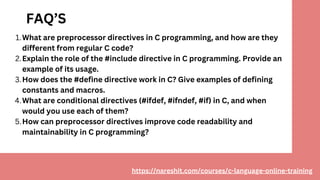
What are preprocessor directives in C programming, and how are they
different from regular C code?
1.
Explain the role of the #include directive in C programming. Provide an
example of its usage.
2.
How does the #define directive work in C? Give examples of defining
constants and macros.
3.
What are conditional directives (#ifdef, #ifndef, #if) in C, and when
would you use each of them?
4.
How can preprocessor directives improve code readability and
maintainability in C programming?
5.
FAQ’S
https://nareshit.com/courses/c-language-online-training
www.naresit.com 8179191999

preprocessor directives in C programming.pdf

  • 1.
  • 2.
    Preprocessor directives arespecial commands in C programming that are processed by the preprocessor before the compilation of code begins. They begin with a # symbol and are used to give instructions to the preprocessor, which handles tasks such as including header files, defining constants, and conditional compilation. These directives play a crucial role in streamlining code structure, enhancing code reusability, and improving program efficiency. https://nareshit.com/courses/c-language-online-training Understanding Preprocessor Directives in C
  • 3.
    What are PreprocessorDirectives? In C programming, preprocessor directives are instructions for the preprocessor, a program that processes the source code before it is compiled into executable code. Unlike regular C code, which is executed line-by-line by the compiler, preprocessor directives are directives that tell the preprocessor to perform specific tasks. For example, the #include directive is used to include header files in the source code, allowing programmers to access functions and definitions from external libraries or modules.
  • 4.
    WHY LEARN PREPROCESSORDIRECTIVES? https://nareshit.com/courses/c-language-online-training Learning preprocessor directives is essential for any C programmer seeking to write efficient and maintainable code. These directives provide powerful mechanisms for code modularization and optimization. For instance, the #define directive allows programmers to define constants and macros, which can simplify complex computations and improve code readability. Moreover, conditional directives such as #ifdef, #ifndef, and #if enable developers to include or exclude portions of code based on specific conditions, facilitating platform-specific customization and version management.
  • 5.
    COMMONLY USED PREPROCESSOR DIRECTIVES: Amongthe most commonly used preprocessor directives is #include, which instructs the preprocessor to insert the contents of a specified header file into the source code. This is crucial for integrating external libraries and modules into C programs, enabling developers to leverage existing functionalities without rewriting code. Additionally, the #define directive allows programmers to define macros and constants, enhancing code maintainability and flexibility by encapsulating repetitive or complex logic into reusable units. https://nareshit.com/courses/c-language-online-training
  • 6.
    Conditional directives suchas #ifdef, #ifndef, and #if are instrumental in conditional compilation, where different parts of the code are compiled based on predefined conditions. This feature is particularly useful for managing code variations across different platforms or environments, ensuring that the application behaves correctly under various circumstances.
  • 7.
    BEST PRACTICES FORUSING PREPROCESSOR DIRECTIVES: While preprocessor directives offer significant benefits, their misuse can lead to code complexity and maintenance issues. It's essential to adhere to best practices such as using meaningful names for macros and constants, limiting the scope of macros to avoid unintended side effects, and avoiding excessive use of conditional compilation. By following these guidelines, developers can harness the power of preprocessor directives effectively while maintaining code clarity and simplicity. https://nareshit.com/courses/c-language-online-training
  • 8.
    LEARNING PREPROCESSOR DIRECTIVES ONLINE: Tomaster preprocessor directives and advance your C programming skills, consider enrolling in online courses or training programs. Our institute offers comprehensive courses tailored to beginners and experienced programmers alike, covering essential topics such as preprocessor directives, macros, and conditional compilation. Through structured learning modules and hands-on exercises, you can gain practical insights and proficiency in using preprocessor directives to optimize your C code effectively. https://nareshit.com/courses/c-language-online-training
  • 9.
    CONCLUSION: In conclusion, preprocessordirectives are indispensable tools in C programming for enhancing code modularity, efficiency, and flexibility. By understanding and leveraging directives such as #include, #define, and conditional directives, programmers can write more robust and adaptable codebases. Explore our online courses to delve deeper into preprocessor directives and elevate your programming skills today. https://nareshit.com/courses/c-language-online-trainingt
  • 10.
    https://nareshit.com/courses/c-language-online-training What are preprocessordirectives in C programming, and how are they different from regular C code? 1. Explain the role of the #include directive in C programming. Provide an example of its usage. 2. How does the #define directive work in C? Give examples of defining constants and macros. 3. What are conditional directives (#ifdef, #ifndef, #if) in C, and when would you use each of them? 4. How can preprocessor directives improve code readability and maintainability in C programming? 5. FAQ’S
  • 11.