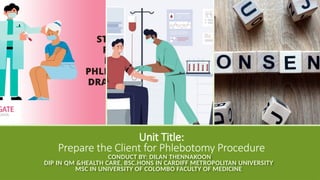
Unit Title:
Prepare the Client for Phlebotomy Procedure
CONDUCT BY: DILAN THENNAKOON
DIP IN QM &HEALTH CARE, BSC.HONS IN CARDIFF METROPOLITAN UNIVERSITY
MSC IN UNIVERSITY OF COLOMBO FACULTY OF MEDICINE
Step-by-step Guidelines for Effective Client Preparation
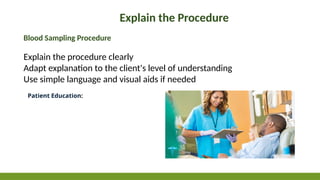
Explain the Procedure
Blood Sampling Procedure
Explain the procedure clearly
Adapt explanation to the client's level of understanding
Use simple language and visual aids if needed
Patient Education:
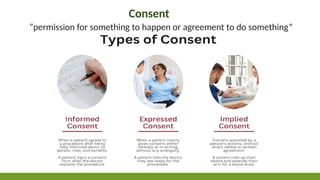
Consent
“permission for something to happen or agreement to do something”
Ethical Dilemmas
Sometimes, phlebotomists face tough situations, like working with
patients who are really scared or making a mistake. Here’s how they can
handle these challenges the right way:
Difficult Patients
Difficult patients can come in many different forms. They might be
scared, have disabilities, have hard-to-find veins, or even be combative.
It’s important to be adaptable and have a plan for when these things
happen. If you find yourself in one of these situations, try these steps
1.Approach the patient with compassion. Make sure that you are listening
and addressing their concerns.
2.Be sensitive to the needs of the patient. Make necessary adjustments for
those with disabilities or specific beliefs.
3.Use methods like distraction, conversation, or creating a soothing
environment to ease patient anxiety.
4.Always obtain consent before carrying on with a procedure. If consent is
withdrawn, stop immediately.
1. Nawaloka Hospitals PLC management is committed to involve patients and
families in treatment and care consent.
2. As a part of an established process, all patients and families are informed as to the
scope of a general consent, when used by the hospital.
3. Consent is a communications process, not a form.
4. The process provides an opportunity for the patient to understand the benefits,
risks and alternatives to the treatment he or she is about to undergo.
General consent for treatment, if obtained when a patient is admitted as
an inpatient or is registered for the first time as an outpatient, is clear in its
scope and limits.
POLICY
1. Consent forms are used to document the process.
2. It is generally the responsibility of the physician or his representative to obtain consent.
Situations may arise when a patient is not able to consent to treatment or a procedure as a
result of the patient’s medical condition including but not limited to unconsciousness, the
influence of drugs or intoxicants, mental illness, or other permanent or temporary
impairment of reasoning capability. In this case, a patient representative may give consent.
A patient representative may be any of the following, in order of preference:
a)A legal guardian or court appointed conservator of person; or if none
b)A patient appointed health care power of attorney or health care representative or if
none
c)The patient’s next of kin, in the following order of priority: (1) spouse, (2) adult child,
(3) parent, (4) adult sibling, (5) and grandparent.
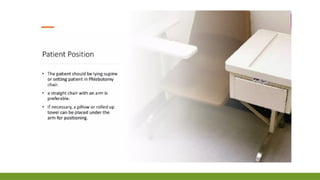
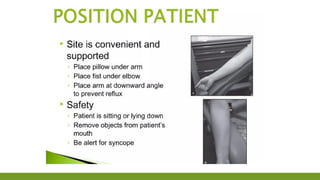
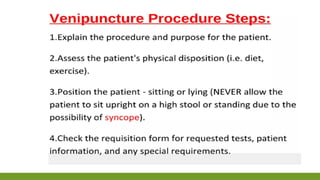
Position the Client
 Ensure proper posture for safety and comfort
 Use arm supports
 Consider client's physical and emotional condition
Patient Positioning:
Arm Position:
•The patient's arm should be extended and slightly hyperextended at
the elbow.
Chair/Bed:
•The patient can be seated in a chair, lying down, or sitting up in bed,
depending on the situation.
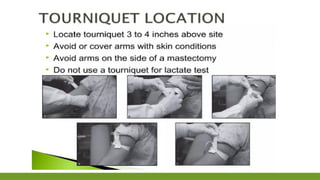
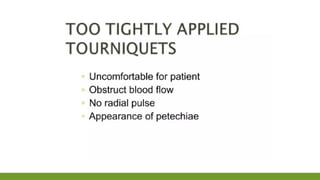
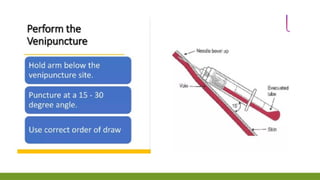
Tourniquet:
•Apply the tourniquet 3-4 inches above the intended puncture site, but
not too tightly or for more than 2 minutes to avoid complications.
Address Client’s Concerns
Consider Client’s Concerns
 Use interviewing and
observation
 Identify any fears or hesitations
 Clarify and address them
empathetically
Reassure Throughout
 Provide emotional support
 Keep communication open
 Offer updates during the process if
needed
Reassure the Client and Relatives
Prepare Equipment
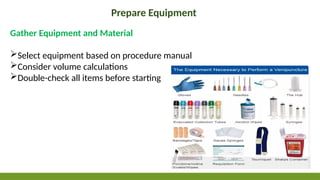
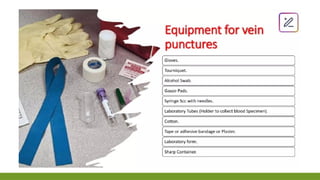
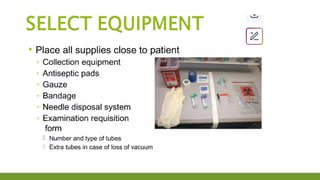
Gather Equipment and Material
Select equipment based on procedure manual
Consider volume calculations
Double-check all items before starting
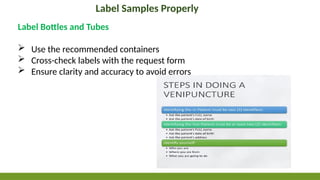
Label Samples Properly
Label Bottles and Tubes
 Use the recommended containers
 Cross-check labels with the request form
 Ensure clarity and accuracy to avoid errors
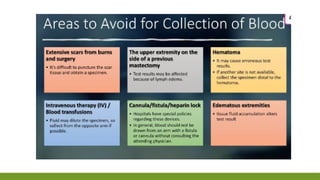
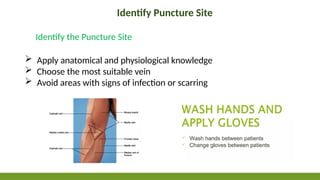
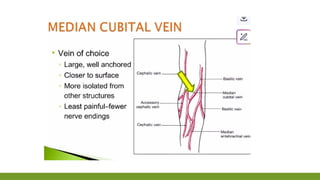
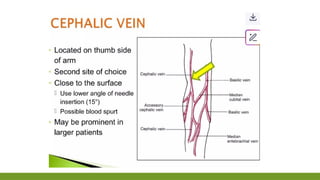
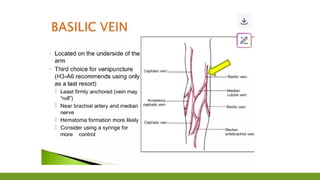
Identify Puncture Site
 Apply anatomical and physiological knowledge
 Choose the most suitable vein
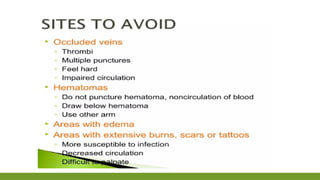
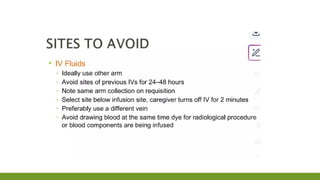
 Avoid areas with signs of infection or scarring
Identify the Puncture Site
Prepare the Client for Phlebotomy Procedure.pptx

Prepare the Client for Phlebotomy Procedure.pptx

  • 1.
    Unit Title: Prepare theClient for Phlebotomy Procedure CONDUCT BY: DILAN THENNAKOON DIP IN QM &HEALTH CARE, BSC.HONS IN CARDIFF METROPOLITAN UNIVERSITY MSC IN UNIVERSITY OF COLOMBO FACULTY OF MEDICINE
  • 2.
    Step-by-step Guidelines forEffective Client Preparation
  • 3.
    Explain the Procedure BloodSampling Procedure Explain the procedure clearly Adapt explanation to the client's level of understanding Use simple language and visual aids if needed Patient Education:
  • 4.
    Consent “permission for somethingto happen or agreement to do something”
  • 5.
    Ethical Dilemmas Sometimes, phlebotomistsface tough situations, like working with patients who are really scared or making a mistake. Here’s how they can handle these challenges the right way: Difficult Patients Difficult patients can come in many different forms. They might be scared, have disabilities, have hard-to-find veins, or even be combative. It’s important to be adaptable and have a plan for when these things happen. If you find yourself in one of these situations, try these steps
  • 6.
    1.Approach the patientwith compassion. Make sure that you are listening and addressing their concerns. 2.Be sensitive to the needs of the patient. Make necessary adjustments for those with disabilities or specific beliefs. 3.Use methods like distraction, conversation, or creating a soothing environment to ease patient anxiety. 4.Always obtain consent before carrying on with a procedure. If consent is withdrawn, stop immediately.
  • 7.
    1. Nawaloka HospitalsPLC management is committed to involve patients and families in treatment and care consent. 2. As a part of an established process, all patients and families are informed as to the scope of a general consent, when used by the hospital. 3. Consent is a communications process, not a form. 4. The process provides an opportunity for the patient to understand the benefits, risks and alternatives to the treatment he or she is about to undergo. General consent for treatment, if obtained when a patient is admitted as an inpatient or is registered for the first time as an outpatient, is clear in its scope and limits. POLICY
  • 8.
    1. Consent formsare used to document the process. 2. It is generally the responsibility of the physician or his representative to obtain consent. Situations may arise when a patient is not able to consent to treatment or a procedure as a result of the patient’s medical condition including but not limited to unconsciousness, the influence of drugs or intoxicants, mental illness, or other permanent or temporary impairment of reasoning capability. In this case, a patient representative may give consent. A patient representative may be any of the following, in order of preference: a)A legal guardian or court appointed conservator of person; or if none b)A patient appointed health care power of attorney or health care representative or if none c)The patient’s next of kin, in the following order of priority: (1) spouse, (2) adult child, (3) parent, (4) adult sibling, (5) and grandparent.
  • 9.
    Position the Client Ensure proper posture for safety and comfort  Use arm supports  Consider client's physical and emotional condition Patient Positioning: Arm Position: •The patient's arm should be extended and slightly hyperextended at the elbow. Chair/Bed: •The patient can be seated in a chair, lying down, or sitting up in bed, depending on the situation. Tourniquet: •Apply the tourniquet 3-4 inches above the intended puncture site, but not too tightly or for more than 2 minutes to avoid complications.
  • 12.
    Address Client’s Concerns ConsiderClient’s Concerns  Use interviewing and observation  Identify any fears or hesitations  Clarify and address them empathetically
  • 14.
    Reassure Throughout  Provideemotional support  Keep communication open  Offer updates during the process if needed Reassure the Client and Relatives
  • 15.
    Prepare Equipment Gather Equipmentand Material Select equipment based on procedure manual Consider volume calculations Double-check all items before starting
  • 18.
    Label Samples Properly LabelBottles and Tubes  Use the recommended containers  Cross-check labels with the request form  Ensure clarity and accuracy to avoid errors
  • 21.
    Identify Puncture Site Apply anatomical and physiological knowledge  Choose the most suitable vein  Avoid areas with signs of infection or scarring Identify the Puncture Site